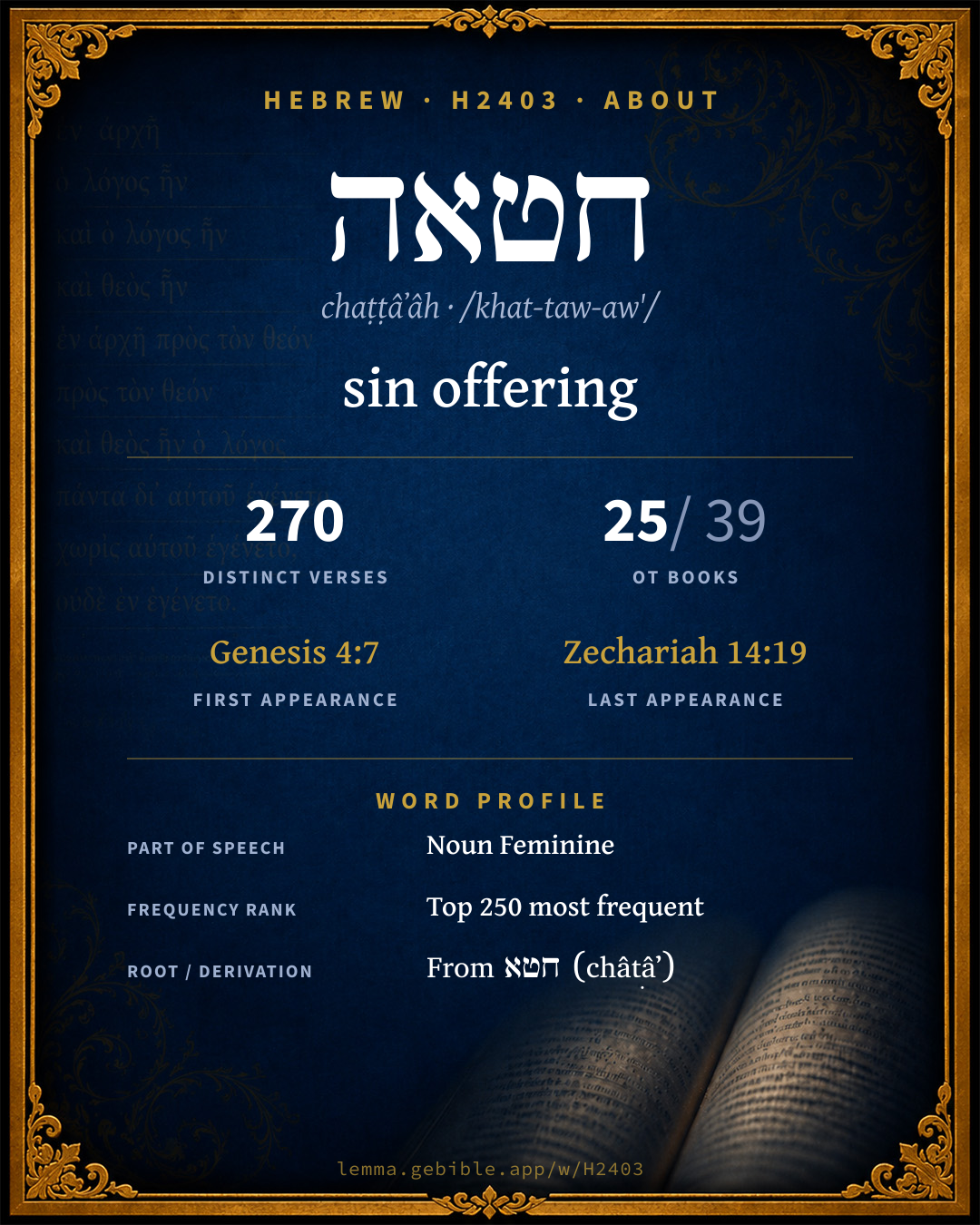
חַטָּאָה
sin offering
‘sin offering’ is one of 2 main senses fuller range ↓
Full lexicon entry — Brown-Driver-Briggs (BDB)
From Brown-Driver-Briggs (BDB)
Where this word appears
See every Absolute-state word in the Hebrew Bible →
Grammar key — what these labels mean
Part of speech
- Noun
- A naming word — a person, place, thing, or idea.
Noun type
- Common
- A common noun — a general class of person, place, or thing (“king,” “city,” “water”), not a specific name.
State
- Absolute
- The independent form of a noun, not bound to a following word.
- Construct
- A noun bound to a following noun in a possessive / “of” relationship (the construct chain).
Gender
- Feminine
- Grammatically feminine.
Number
- Singular
- One.
- Plural
- More than one (in Hebrew, generally three or more).
Every verse where H2403 appears in the Book of Ezekiel — 24 distinct verses. Click any verse to open its interlinear word-by-word view. Verse text shown in the World English Bible for context — . Each verse’s Hebrew form is shown with its reference; the English is not keyword-highlighted, since the data carries no word-level English alignment. Use “Compare translations” on any verse to read it across multiple English versions. This concordance covers the Hebrew Bible; Septuagint (Greek Old Testament) occurrences are not indexed here.
Ezekiel
- Ezekiel 3:20 בְּ/חַטָּאת֣/וֹ prep + n c fs cs + sfx pers 3ms Again, when a righteous man does turn from his righteousness, and commit iniquity, and I lay a stumbling block before him, he shall die: because you have not given him warning, he shall die in his sin, and his righteous deeds which he has done shall not be remembered; but his blood will I require at your hand.
- Ezekiel 16:51 חַטֹּאתַ֖יִ/ךְ n c fp cs + sfx pers 2fs Neither has Samaria committed half of your sins; but you have multiplied your abominations more than they, and have justified your sisters by all your abominations which you have done.
- Ezekiel 16:52 בְּ/חַטֹּאתַ֛יִ/ךְ prep + n c fp cs + sfx pers 2fs You also, bear you your own shame, in that you have given judgment for your sisters; through your sins that you have committed more abominable than they, they are more righteous that you: yes, be also confounded, and bear your shame, in that you have justified your sisters.
- Ezekiel 18:14 חַטֹּ֥את n c fp cs Now, behold, if he fathers a son, who sees all his father's sins, which he has done, and fears, and does not such like;
- Ezekiel 18:21 חטאת/ו חַטֹּאתָי/ו֙ n c fs cs + sfx pers 3ms n c fp cs + sfx pers 3ms But if the wicked turn from all his sins that he has committed, and keep all my statutes, and do that which is lawful and right, he shall surely live, he shall not die.
- Ezekiel 18:24 וּ/בְ/חַטָּאת֥/וֹ conj + prep + n c fs cs + sfx pers 3ms But when the righteous turns away from his righteousness, and commits iniquity, and does according to all the abominations that the wicked man does, shall he live? None of his righteous deeds that he has done shall be remembered: in his trespass that he has trespassed, and in his sin that he has sinned, in them shall he die.
- Ezekiel 21:24 חַטֹּ֣אותֵי/כֶ֔ם n c fp cs + sfx pers 2mp Therefore thus says the Lord Yahweh: Because you have made your iniquity to be remembered, in that your transgressions are uncovered, so that in all your doings your sins do appear; because you have come to memory, you shall be taken with the hand.
- Ezekiel 33:10 וְ/חַטֹּאתֵ֖י/נוּ conj + n c fp cs + sfx pers 1cp You, son of man, tell the house of Israel: Thus you speak, saying, Our transgressions and our sins are on us, and we pine away in them; how then can we live?
- Ezekiel 33:14 מֵֽ/חַטָּאת֔/וֹ prep + n c fs cs + sfx pers 3ms Again, when I say to the wicked, You shall surely die; if he turn from his sin, and do that which is lawful and right;
- Ezekiel 33:16 חטאת/ו חַטֹּאתָי/ו֙ n c fs cs + sfx pers 3ms n c fp cs + sfx pers 3ms None of his sins that he has committed shall be remembered against him: he has done that which is lawful and right; he shall surely live.
- Ezekiel 40:39 וְ/הַ/חַטָּ֖את conj + ptcl def.art + n c fs In the porch of the gate were two tables on this side, and two tables on that side, to kill thereon the burnt offering and the sin-offering and the trespass-offering.
- Ezekiel 42:13 וְ/הַ/חַטָּ֣את conj + ptcl def.art + n c fs Then said he to me, The north chambers and the south chambers, which are before the separate place, they are the holy chambers, where the priests who are near to Yahweh shall eat the most holy things: there shall they lay the most holy things, and the meal-offering, and the sin-offering, and the trespass-offering; for the place is holy.
- Ezekiel 43:19 לְ/חַטָּֽאת prep + n c fs You shall give to the priests the Levites who are of the seed of Zadok, who are near to me, to minister to me, says the Lord Yahweh, a young bull for a sin-offering.
- Ezekiel 43:21 הַֽ/חַטָּ֑את ptcl def.art + n c fs You shall also take the bull of the sin-offering, and it shall be burnt in the appointed place of the house, outside of the sanctuary.
- Ezekiel 43:22 לְ/חַטָּ֑את prep + n c fs On the second day you shall offer a male goat without blemish for a sin-offering; and they shall cleanse the altar, as they did cleanse it with the bull.
- Ezekiel 43:25 חַטָּ֖את n c fs Seven days shall you prepare every day a goat for a sin-offering: they shall also prepare a young bull, and a ram out of the flock, without blemish.
- Ezekiel 44:27 חַטָּאת֑/וֹ n c fs cs + sfx pers 3ms In the day that he goes into the sanctuary, into the inner court, to minister in the sanctuary, he shall offer his sin-offering, says the Lord Yahweh.
- Ezekiel 44:29 וְ/הַ/חַטָּ֣את conj + ptcl def.art + n c fs They shall eat the meal-offering, and the sin-offering, and the trespass-offering; and every devoted thing in Israel shall be theirs.
- Ezekiel 45:17 הַ/חַטָּ֣את ptcl def.art + n c fs It shall be the prince's part to give the burnt offerings, and the meal-offerings, and the drink-offerings, in the feasts, and on the new moons, and on the Sabbaths, in all the appointed feasts of the house of Israel: he shall prepare the sin-offering, and the meal-offering, and the burnt offering, and the peace-offerings, to make atonement for the house of Israel.
- Ezekiel 45:19 הַ/חַטָּ֗את ptcl def.art + n c fs The priest shall take of the blood of the sin-offering, and put it on the door-posts of the house, and on the four corners of the ledge of the altar, and on the posts of the gate of the inner court.
- Ezekiel 45:22 חַטָּֽאת n c fs On that day shall the prince prepare for himself and for all the people of the land a bull for a sin-offering.
- Ezekiel 45:23 וְ/חַטָּ֕את conj + n c fs The seven days of the feast he shall prepare a burnt offering to Yahweh, seven bulls and seven rams without blemish daily the seven days; and a male goat daily for a sin-offering.
- Ezekiel 45:25 כַּֽ/חַטָּאת֙ prep det + n c fs In the seventh [month], in the fifteenth day of the month, in the feast, shall he do the like the seven days; according to the sin-offering, according to the burnt offering, and according to the meal-offering, and according to the oil.
- Ezekiel 46:20 הַ/חַטָּ֑את ptcl def.art + n c fs He said to me, This is the place where the priests shall boil the trespass-offering and the sin-offering, [and] where they shall bake the meal-offering; that they not bring them forth into the outer court, to sanctify the people.
About this entry
At a glance — auto-summarized from this page’s data, not written by a person. Every figure links to its source below. This summary describes the numbers; it doesn’t interpret them.
חטאה (chaṭṭâʼâh) is a Hebrew noun most often rendered “sin offering.” It first appears in Genesis 4:7. It turns up in 270 verses across 25 books, a common footprint. It is not a single-sense word — see its full sense range. From the same root come חטא, חטא and חטא. For the data behind this summary, explore the sense tree and the renderings breakdown below.
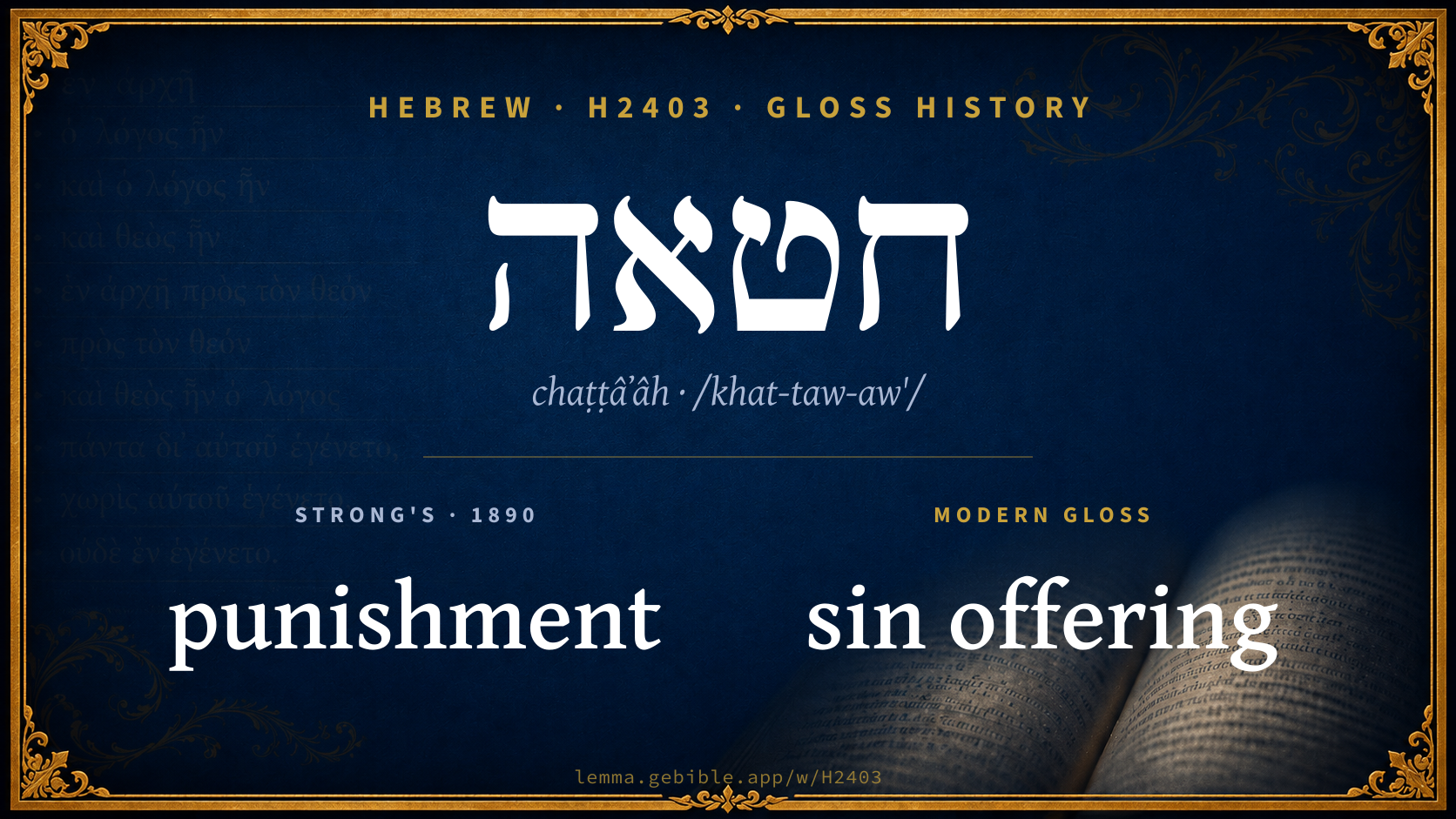
Gloss history
Strong's 1890 vs modern scholarship
About this word
Strong's H2403 catalogs a Hebrew word from the Hebrew Old Testament.
These counts are not copied from any lexicon or concordance. They are computed here, from the morphology-tagged Hebrew Old Testament. What Lemma adds →
- 270
- distinct verses
- The word appears in 270 distinct verses.
- 25 / 39
- OT books
- The word appears in 25 of 39 Old Testament books.
- #165
- by frequency
- Top 250 most frequent Hebrew words (rank 165 of 8,640 Hebrew words by occurrence).
View all 270 occurrences in the concordance →
By section of the Old Testament
By traditional corpus
Conventional, traditional groupings — biblical authorship is debated, so this is a traditional corpus grouping, not an authorship claim. Each share is this word’s portion of its verses in that division of the Hebrew canon. Each figure is a share of the word’s 270 distinct verses.
- Torah (Pentateuch) 125 verses · 46%
- Prophets (Nevi'im) 101 verses · 37%
- Writings (Ketuvim) 44 verses · 16%
How translations render this word
Counts come from each version’s own published word-to-Strong’s tagging or interlinear alignment — an approximate guide to how each version renders this word, not a word-level alignment the data otherwise carries. Because each total is that version’s own tagged count, the per-version totals vary from one another and need not match the appearance or distinct-verse counts above. These counts may also differ from a printed concordance because Lemma counts each distinctly tagged rendering and does not collapse phrase taggings into a single head-word total. This is a fixed set of word-tagged versions (KJV, ASV, BSB, ULT) and does not change with the reading translation you choose elsewhere. Each version’s license is shown beside its name below (and on Sources).
BDB lists this Strong’s number as 2 distinct words (homographs). Each count above pools all of them and is not split by sense — see the Senses section below. A low-frequency rendering may belong to a different one of those words, not the primary meaning.
- King James Version†: Sin offering 101×, Sin 76×, Sins 46×
- American Standard Version†: Sin-offering 86×, Sin 68×, Sins 39×
- Berean Standard Bible†: Sin offering 104×, Sin 79×, Sins 66×
- unfoldingWord Literal Text†: Sin offering 98×, Sin 75×, Sins 39×
King James Version Public Domain
Renders H2403 across 296† tagged occurrences — most commonly:
Plus 48 renderings that appear only once — usually multi-word phrases or single function words the recovered tagging swept in, not distinct renderings.
American Standard Version Public Domain
Renders H2403 across 314† tagged occurrences — most commonly:
Plus other, less common renderings. Plus 64 renderings that appear only once — usually multi-word phrases or single function words the recovered tagging swept in, not distinct renderings.
Berean Standard Bible Public Domain
Renders H2403 across 292† tagged occurrences — most commonly:
Plus 27 renderings that appear only once — usually multi-word phrases or single function words the recovered tagging swept in, not distinct renderings. Not rendered by a distinct English word in 3 further occurrences.
unfoldingWord Literal Text CC BY-SA 4.0
Renders H2403 across 295† tagged occurrences — most commonly:
Plus 24 renderings that appear only once — usually multi-word phrases or single function words the recovered tagging swept in, not distinct renderings.
14 senses and sub-senses in the full BDB
What do BDB’s symbols mean?
BDB uses these scholarly abbreviations:
| Symbol | Meaning |
|---|---|
| 𝔊 | the Septuagint (the ancient Greek translation, LXX) |
| 𝔙 | the Vulgate (the Latin translation) |
| 𝔖 | the Syriac version (the Peshitta) |
| 𝔗 | the Targum (the Aramaic translation) |
| ψ | the Psalms |
| √ | root (the underlying root or stem) |
| ‖ | parallel passage (a synonymous or contrasted parallel) |
| † | the dagger: every passage where the word occurs is cited |
The 14 senses and sub-senses the full Brown-Driver-Briggs lexicon distinguishes for this word, in lexicon order (not ranked by frequency), with BDB’s own verbatim wording and sub-sense lettering. Shown in Hebrew script with BDB’s own scholarly abbreviations. The condensed entry is in the Lexicon Entry tab. See also the Forms in the corpus table below.
חטאה I sinful thing, sin, Ex 34
חטאה II
- 1. sin:
- a. against man Gn 31:36; 50:17 (E), Nu 12:11 (J) 1 S 20:1; ח׳ אדם sins against man Nu 5:6 (P). Elsewhere e.g. Genesis 31:36
- b. against God Lv 4:14, 23, 28 (P), 1 S 2:17; 14:38 1 K 16:13(×2) 2 K 21:16, 17 2 Ch 33:19 Is 3:9; 30:1; 58:1; 59:2, 12 Je 5:25; 16:10, 18; 30:14, 15; 50:20 La 4:6, 22 Ez 16:51; 18:14; 21:29; 33:10, 16 Am 5:12 (We Kl. Proph. reads חטאיכם, as s 1:18—v. חֵטא—on acc. of masc. עצומים), Mi 1:13; 3:8 ψ 32:5; 51:5; 59:4 Pr 5:22; 13:6; 14:34; 21:4; 24:9 Jb 13:23(×2) Dn 9:20(×2) ח׳ נעורי sins of my youth ψ 25:7; פרי בטני ח׳ נפשׁי Mi 6:7 fruit of my body (my child as an offering) for the sin of myself; sin of divination 1 S 15:23; of the mouth ψ 59:13; ח׳ עמי יאכלו Ho 4:8 the sin of my people they eat (gain their daily food by means of it, cf. We; 𝔗 Hi Or al. sin-offering, but this not elsewhere in early proph., and ‖ עָוֹן against it, v. WeProl. 3. 76); לפתח חטאת רבץ Gn 4:7 (J) at the door (of Cain) sin is a crouching beast; sin of the people is embodied in the golden calf Dt 9:21; and the high places of Beth Aven Ho 10:8; c. בְּ on the ground of sin Ne 9:37; for sin Mi 1:5 2 K 24:3 Is 40:2 Je 15:13; 17:3 Ez 16:52; with or by sin 1 K 14:22; 16:2 Is 43:24; הלך בח׳ walk in sin 1 K 15:3, 26, 34; 16:19, 26, 31 2 K 17:22; דבק בח׳ cleave unto sin 2 K 3:3; c. עַל, on account of sin Dt 9:18 1 K 15:30; 16:19 Mi 6:13; for sin Lv 4:3, 28, 35; 5:6, 13 (P) 19:22; 26:18, 24, 28 (H); יסף על ח׳ add unto sin 1 S 12:19 2 Ch 28:13 Is 30:1 Jb 34:37; c. כְּ according to sin Lv 26:21; c. לְ to or for sin Lv 16:16, 21 Dt 19:15 1 K 12:30; 13:34 Pr 10:16 Zc 13:1; c. מִן because of sin Lv 4:26; 5:6, 10; 16:34 (P), 19:22 (H), La 4:13; more than sin Jb 35:3; טָהַרְתִּי מֵחַטָּאתִי I am clean from my sin Pr 20:9; מפני ח׳ because of sin ψ 38:4; בגלל ח׳ because of sin 1 K 14:16; הלך אחר ח׳ walk after sin 2 K 13:2. e.g. Leviticus 4:14
- c. men should return from sin שׁוּב מִן 1 K 8:35 = 2 Ch 6:26, Ez 18:21; 33:14; depart from it סוּר מֵעַל 2 K 10:31; 15:18; סוּר מן 2 K 13:6, 11; 14:24; 15:9, 24, 28; be concerned about דאג מן ψ 38:19; confess הִתְוַדָּה ח׳ Nu 5:7 (P); התודה על ח׳ Ne 1:6; 9:2. e.g. 1 Kings 8:35
- d. God deals with sin: (1) he visits punishment upon it (על) פקד Ex 32:34 (JE) Ho 8:13; 9:9 Je 14:10; inquires after it דרשׁ ל Jb 10:6; watches over it שׁמר על Jb 14:16; hoards it up Ho 13:12; (2) by forgiveness: נשׂא ח׳ Ex 10:17; 32:32 (JE), 1 S 15:25; נשׂא עון ח׳ ψ 32:5; נשׂא לח׳ Jos 24:19 (E), ψ 25:18; pardon סלח לח׳ Ex 34:9 (JE) 1 K 8:34, 36 2 Ch 6:25, 27; 7:14 Je 36:3; removal הסר Is 27:9; העביר 2 S 12:13; casting into the depths of the sea Mi 7:19; (3) by covering over, making atonement for חַטָּֽאתְךָ תְּכֻפָּ֑ר Is 6:7 thy sin shall be covered over; actively, כפּר עַל ח׳ ψ 79:9; כסּה ח׳ ψ 85:3 (cf. כְּסוּי חֲטָאָה ψ 32:1); לְהָתֵם ח׳ (Qr) make an end of sins Dn 9:24; (4) by blotting out מחה ח׳ Is 44:22 Je 18:23 ψ 109:14 Ne 3:37; cleanse from sin טַהֲרֵנִי מח׳ ψ 51:4; מקוֹר לח׳ a fountain for sin Zc 13:1; (5) by not remembering it לא זכר ח׳ Is 43:25; לח׳ לא זכר Je 31:34; אַל־תֵּפֶן אֶל־חַטָּאתוֹ Dt 9:27 look not unto his sin. e.g. Exodus 32:34
- e. atonement may be secured for, כפּר בעד ח׳ Ex 32:30 (JE; Moses, by his intercession). e.g. Exodus 32:30
- f. according to P (H) the priest is to make atonement for a person (כפּר על) by sin-offering or trespass-offering, מח׳ because of sin Lv 4:26; 5:6, 10; 16:34; על ח׳ 4:35; 5:13 (all P), 19:22 (H; v. WeComp, 59 = JBTh xxii, 427), so that the man is clean from sin טהר מח׳ Lv 16:30. e.g. Leviticus 4:26
- 2. condition of sin, guilt of sin Gn 18:20 Nu 16:26; 32:23 (J), Ez 3:20; 18:24, ח׳ יְהוּדָה חֲרוּשָׁה עַל־לוּחַ לִבָּם וּלְקַרְנוֹת מִזְבְּחוֹתֵיכֶם the sin (guilt) of Judah is graven upon the table of their heart, and upon the horns of your altars Je 17:1. e.g. Genesis 18:20
- 3. punishment for sin: זֹאת תִּהְיֶה ח׳ מִצְרָ֑יִם וח׳ כָל־הַגּוֹיִם Zc 14:19 this will be the punishment for sin of Egypt and the punishment for sin of all nations (the plague with which Yahweh will smite them). e.g. Zechariah 14:19
- 4. sin-offering: one of the kinds of offering of P, Lv 7:37; first in the history 2 K 12:17 (reign of Jehoash), where חטּאת of money given to priests; elsewhere only in Chr.; 2 Ch 29:21, 23, 24 Hezekiah had made a ח׳ of 7 צְפִירֵי עִזִּים at purification of temple; Ezr 8:35; 12 צְפִירֵי ח׳ were offered; Ne 10:34 ח׳ ‖ עולות;—in these no evidence of special ritual. Sin-offering elsewhere only in codes of H Ez and P.—On Ho 4:8 v. 1 supr. In H, Lv 23:19 a שׂעיר עזים, for feast of weeks. In Ez ח׳ in gen. ‖ other sacrifices, Ez 40:39; 45:17, 25; 46:20; and priests eat them Ez 42:13; 44:29. At dedication of altar, the blood of a young bullock was to be applied to horns of altar, the corners of its settle and its border, the bullock itself burnt without the sanctuary; for each of the 7 days following a שׂעיר עזים was to be offered Ez 43:19, 21, 22, 25. On first day of first month a young bullock was to be offered to cleanse the sanctuary: its blood upt on the door posts of the house and of the gate of the inner court and on the four corners of the settle of the altar; also on the seventh day (𝔊 first day of seventh month) Ez 45:17, 19 (cf. v 18, 20). On 14th day of first month the prince was to offer a bullock for himself and the people and on each of the 7 days of the Passover week a שׂעיר עזים Ez 45:22, 23. When a priest entered the sanctuary to minister after his cleansing he was to offer his sin-offering Ez 44:27. P gives several grades: e.g. Leviticus 7:37
- a. a ruler should offer a he-goat Lv 4:24, 25 Nu 7:16, 22, 28, 34, 40, 46, 52, 58, 64, 70, 76, 82, 87; an ordinary person a she-goat Lv 4:29 (cf. v 28) 5:6 Nu 15:27, ewe lamb Lv 4:32, 33(×2), 34; 14:19 Nu 6:14, 16, a turtle dove or young pigeon Lv 5:7, 8, 9(×2); 12:6, 8; 14:22, 31; 15:15, 30 Nu 6:11, or one-tenth of an ephah of fine flour Lv 5:11(×2), 12; according to ability of the person, and nature of offence. The victim was brought unto the tent of meeting, the hands of the offerer laid on its head, it was slaughtered by the offerer, the priest took some of the blood and put it on horns of altar of burnt-offering and the rest of the blood he poured out at the base of it, to cover over the sin, or cleanse the altar from the sin defiling it. All the fat pieces (cf. Lv 4:22–35) and a handful of the flour (cf. Lv 5:12) were burned on altar. The rest of the flesh and the flour were eaten by priests in court of Holy place Lv 5:13; 6:10, 18(×2), 23 (cf. v 11, 19), 7:7; 10:16, 17, 19(×2); 14:13 Nu 18:9. e.g. Leviticus 4:24
- b. a bullock was offered for priests Ex 29:14, 36 Lv 4:3, 8, 20; 8:2, 14(×2); 9:2, 7, 8, 10; for Levites at their installation Nu 8:3, 12 and for whole congregation Lv 4:14, 21; but usually offering for congregation was he-goat Nu 15:24, 25, especially at dedication of altar Lv 9:3, 15, 22, and in ritual of feasts Nu 28:15, 22, 30; 29:5, 11, 16, 19, 22, 25, 28, 31, 34, 38. Before consecr. of tabernacle the blood went to altar of burnt-offering (Lv 9:9), but subsequ. some of it was sprinkled seven times before the vail and some of it put on horns of altar of incense to cleanse this higher altar; the fat pieces were burned on altar of burnt-offering, and the rest of the victim burned without the camp (Lv 4:3–21; 6:23; 8:16, 17; 9:10, 11). e.g. Exodus 29:14
- c. on day of atonement, sin-offering for high priest was a bullock Lv 16:3, 6; and for congregation two he-goats, one לַעֲזָאזֵל (v. עזאזל) Lv 16:5 (cf. v 8, 10, 20–22), the other for sacrifice ליהוה Lv 16:9 (cf. v 8). Some of the blood of Aaron’s bullock was first taken into innermost sanctuary and sprinkled on the כפרת and seven times before it; so also blood of the he-goat Lv 16:11(×2), 15 (cf. v 12–14, 16, 17) to cleanse highest altar: then the blood of the two victims was applied to lower altars as in a and b and so sin was covered over at the three altars Ex 30:10 (cf. Lv 16:16–19). The fat pieces went to altar of burnt-offering and the rest of the victims was burnt without the camp Lv 16:25, 27(×2). (Sins which might be covered over were limited to those committed בשׁגגה Lv 4:2, 22, 27 Nu 15:27, לשׁגגה Nu 15:24, minor offences Lv 5:1–6; and ceremonial uncleanness Lv 12:6, 8; 14:13; 15:15 Nu 6:11, 14.)—Phrases for sacrificing are: עשׂה ח׳ Lv 9:7, 22 14:19 Nu 6:16 Ez 45:17, הקריב ח׳ Lv 10:19 Ez 44:27, שׁחט ח׳ Lv 14:13 Ez 40:39. e.g. Leviticus 16:3
- 5. purification from sins of ceremonial uncleanness, all P: מֵי ח׳ Nu 8:7 water of purification from sin; מֵי נִדָּה ח׳ הוּא water of (cleansing from) impurity, it is a purification from sin Nu 19:9; עֲפַר שְׂרֵפַת הח׳ Nu 19:17 ashes of the burning of the purification from sin (RV renders sin-offering; but there was no offering made, only water of purification was used). e.g. Numbers 8:7
Senses from the full Brown-Driver-Briggs lexicon (Brown, Driver, Briggs; Oxford 1906 — public domain), digitized via Sefaria, supplemented by the OpenScriptures HebrewLexicon (CC BY 4.0). Full attribution on Sources.
Word origin
I. n.f. sinful thing, sin, Ex 34:7 (JE) Is 5:18.
I. n.f. 1 S 14:38 (Gn 4:7 no exception for רֹבֵץ is noun = crouching beast) sin, sin-offering, ח׳ Gn 4:7 + 124 times; לְחַטָּ֯ת Nu 15:24 (textual error for לחטאת), לְחַטַּאת Zc 13:1 (but read לְחַטָּאת StaZAW i. 35); cstr. חַטַּאת Ex 30:10 + 19 times; sf. חַטָּאתִי Gn 31:36 + 16 times; חַטָּאתֹיו֯ 1 K 16:26, חַטַּאתְכֶם Ex 32:30 + 3 times, etc., + 52 times sf.; pl. חַטָּאוֹת 2 K 12:17 + 3 times; cstr. חַטֹּאות ψ 25:7 + 17 times; חַטֹּאת Nu 5:6 + 6 times; sf. חַטֹּאותָ֑י ψ 25:18; חַטֹּאתָו֯ Ez 18:21; 33:16, etc., + 40 times sf.;—
— Brown-Driver-Briggs (Oxford 1906, public domain), digitized via Sefaria, supplemented by the OpenScriptures HebrewLexicon (CC BY 4.0). See Sources.
Derived from חטא (châṭâʼ) (H2398) — to sin.
Jastrow Dictionary
A second Hebrew/Aramaic lexicon for comparison, covering Aramaic and post-biblical (Talmudic, Targumic, Midrashic) usage that the biblical-Hebrew BDB does not. Matched by lemma rather than by Strong’s number, so a lemma may carry more than one Jastrow headword (shown separately below), and the entries cover usage well beyond the Bible.
חֲטָאָה
- (חֲטָא)
- 1. sinner. Ber. 60ᵃ ח׳ את art thou a sinner?—Pl. חַטָּאַיָּא, חַטָּאִין, חַטָּאֵי, חַטָ׳, חַטַּיָּיה, חַטַּיָּא. Targ. Prov. I, 10. Targ. Ps. CIV, 35.—Gen. R. s. 12; Yalk. ib. 19. Pesik. Naḥ. p. 128ᵇ; Yalk. Ex. 391; a. e.
- 2. searcher of sin, accuser. Targ. Zech. III, 1 (ed. Lag. יַחֲטָא).
חֶטְאָה
- Targ. Deut. XIX, 15. Targ. I Sam. X, 26. Targ. Gen. IV, 7 (ed. Berl. חִטְאָה, some ed. חַטַּאת). Targ. Prov. XXI, 4 (ed. Lag. חטהא); a. e.—M. Kat. 16ᵃ פרטינן חֶטְאֵיה וכ׳ we must specify his sin publicly. Snh. 37ᵇ חטא אחריתי the sin of another act.—Pl. חֶטְאִין, חִיטְ׳, חֶטְאֵי. Targ. Jer. XIV, 19 (ed. Lag. חובין). Targ. O. Lev. XVIII, 7 (v. זִימָּה II). Targ. Prov. XIV, 34 (ed. Lag. חֶטִהֵי); a. fr. [Ib. XXVIII, 13 חֶטּוֹי, v. חֲטָי.]
A Dictionary of the Targumim, the Talmud Babli and Yerushalmi, and the Midrashic Literature (Marcus Jastrow; London, Luzac, 1903) — Public Domain. Digitized via Sefaria. Digitized via Sefaria. Full attribution on Sources.
Forms in the corpus
The 172 distinct written forms H2403 takes in the Hebrew Bible, most frequent first — each parse links to that state’s occurrences in the concordance. Hebrew forms include their vowel points and cantillation, so a single lemma takes many written forms.
The 60 most common forms are shown; 112 rarer forms follow in the full concordance.
Same root — word family
Other BDB entries built from the same root as H2403, grouped by Strong’s listed origin. These share a root / origin per the lexicon — not necessarily a shared meaning. Each links to that word’s own entry.
Derives from
Shares the same root
Compare all same-root words → Showing 4 of 5 — not the complete family. They share a root, not necessarily a meaning.
Septuagint verse parallels
This word appears in 255 verses that also exist in the Greek Old Testament (Septuagint), out of the 270 Hebrew verses it occurs in. You can read those verses in Greek by switching the Old Testament edition to the Septuagint.
Read these verses in the Septuagint
- Genesis 4:7
- Exodus 10:17
- Leviticus 4:3
- Numbers 5:6
- Deuteronomy 9:18
- Joshua 24:19
- 1 Samuel 2:17
- 2 Samuel 12:13
- 1 Kings 8:34
- 2 Kings 3:3
- 2 Chronicles 6:25
- Ezra 8:35
This is a verse-level parallel only — the same verses exist in both the Hebrew and Greek Old Testaments. No word-level Hebrew↔Greek correspondence is claimed: the data carries no such alignment, so no Greek word is shown as this Hebrew word’s translation. Coverage is not total — the Septuagint omits the deuterocanon and renumbers the Psalms, so some Hebrew verses have no direct Greek parallel.