
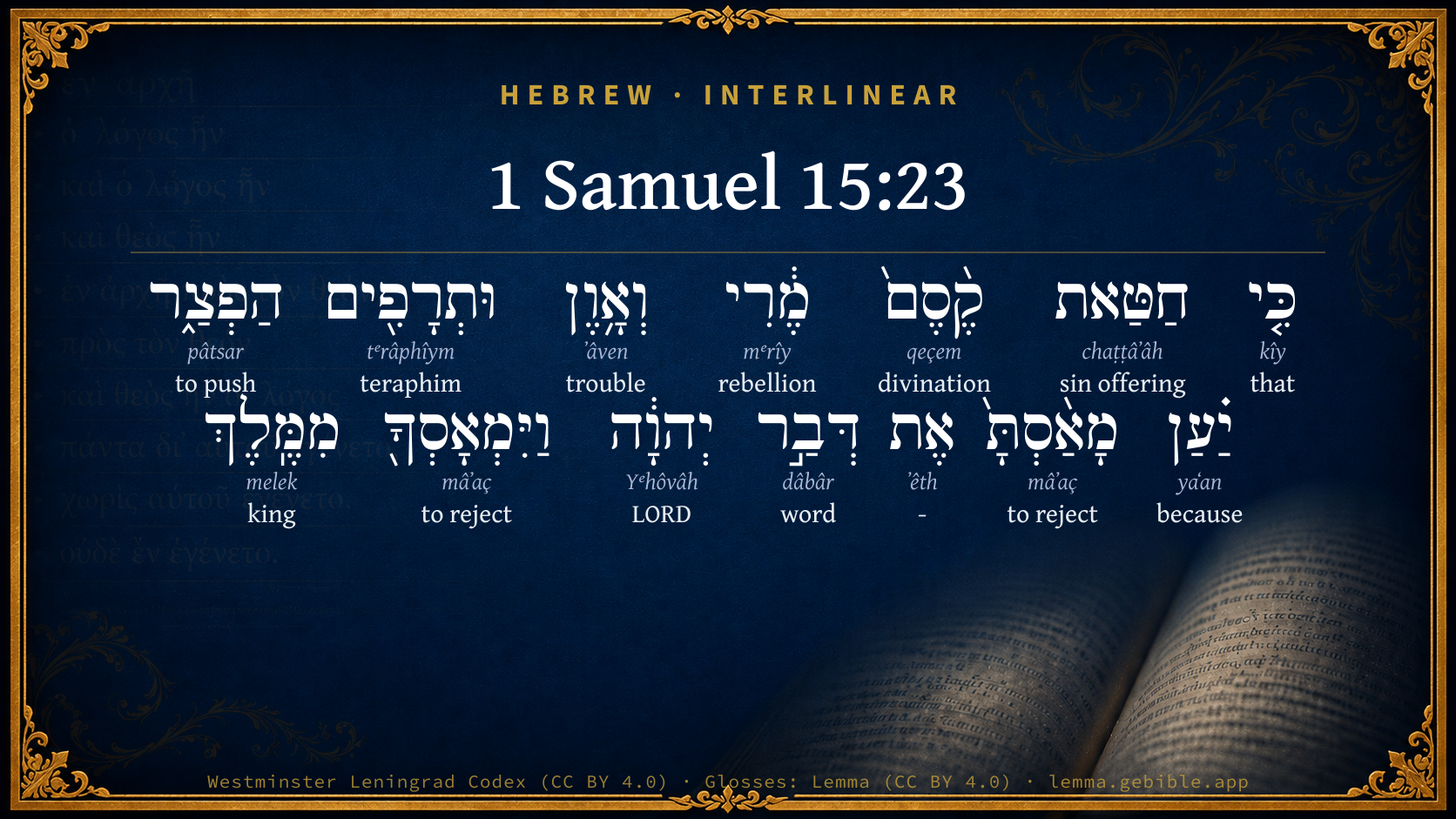
1 Samuel 15:23

Hebrew (Westminster Leningrad Codex) 1 Samuel 15:23 appears in the Hebrew Old Testament. The text above is from the Westminster Leningrad Codex. Each word links to its Strong’s number, a concise gloss, and parsing drawn from the Open Scriptures Hebrew Bible morphology. Click any word for its full Brown-Driver-Briggs (BDB) entry.
Download image
Cite this verse

1 Samuel 15:23 (World English Bible). Public Domain. Lemma interlinear Bible study tool, https://lemma.gebible.app/v/1-samuel/15/23.

Show BibTeX & RIS
BibTeX
RIS
English Translation
For rebellion is as the sin of witchcraft, and stubbornness is as idolatry and teraphim. Because you have rejected the word of Yahweh, he has also rejected you from being king.
World English Bible · Public Domain
Download a study sheet

One document with this verse’s original text, its word-by-word gloss line, the meaning frame, cross-references with their text, attributed commentary, and full source and license credits — printable, and it pastes into notes with its structure intact.

This verse Autodidact and up

Study sheet (.html) Plain text (.txt)

A passage Seminary Student

Up to 50 verses in one chapter. A passage sheet keeps up to 6 commentary sources and 12 cross-references per verse, in the order this page ranks them, and says so on the sheet whenever that leaves anything out. Ask for a single verse and you get the Autodidact verse sheet above.

Everything on this page stays free to read, with no account — the sheet is a download of what is already on screen, not access to it.

Want to remove ads? Support Godless Engineer
Compare translations 3

The same verse in 3 English versions, stacked beneath the original-language interlinear above. Click any original word for its lexicon entry.

Each is an independent rendering of the whole verse — the interlinear is not word-aligned to these translations.

Highlighted words mark where these versions differ — a whole-verse word diff, not a word-by-word alignment.

  • World English Bible Public Domain
    For rebellion is as the sin of witchcraft, and stubbornness is as idolatry and teraphim. Because you have rejected the word of Yahweh, he has also rejected you from being king.
  • King James Version Public Domain
    For rebellion is as the sin of witchcraft, and stubbornness is as iniquity and idolatry. Because thou hast rejected the word of the LORD, he hath also rejected thee from being king.
  • unfoldingWord Literal Text CC BY-SA 4.0
    For rebellion the sin of divination, and to insist iniquity and teraphim. Because you have rejected the word of Yahweh, he has rejected you from king.”

unfoldingWord Literal Text — © unfoldingWord, licensed CC BY-SA 4.0. Word-aligned USFM3 via Door43 (git.door43.org/unfoldingWord/en_ult).

Versions to compare (up to 4)

3 of 4 selected

Show all 18 translations

Every available English version of this verse, each an independent rendering of the whole verse.

  • World English Bible Public Domain
    For rebellion is as the sin of witchcraft, and stubbornness is as idolatry and teraphim. Because you have rejected the word of Yahweh, he has also rejected you from being king.
  • Berean Standard Bible Public Domain
    For rebellion is like the sin of divination, and arrogance is like the wickedness of idolatry. Because you have rejected the word of the LORD, He has rejected you as king.”
  • Majority Standard Bible Public Domain
    For rebellion is like the sin of divination, and arrogance is like the wickedness of idolatry. Because you have rejected the word of the LORD, He has rejected you as king.”
  • King James Version Public Domain
    For rebellion is as the sin of witchcraft, and stubbornness is as iniquity and idolatry. Because thou hast rejected the word of the LORD, he hath also rejected thee from being king.
  • American Standard Version (1901) Public Domain
    For rebellion is as the sin of witchcraft, and stubbornness is as idolatry and teraphim. Because thou hast rejected the word of Jehovah, he hath also rejected thee from being king.
  • Revised Version (1885) Public Domain
    For rebellion is as the sin of witchcraft, and stubbornness is as idolatry and teraphim. Because thou hast rejected the word of the LORD, he hath also rejected thee from being king.
  • Geneva Bible (1599) Public Domain
    For rebellion is as the sinne of withcraft, and transgression is wickednesse and idolatrie. Because thou hast cast away the worde of the Lord, therefore hee hath cast away thee from being King.
  • Douay-Rheims (1899) Public Domain
    Because it is like the sin of witchcraft, to rebel: and like the crime of idolatry, to refuse to obey. Forasmuch therefore as thou hast rejected the word of the Lord, the Lord hath also rejected thee from being king.
  • Young's Literal Translation Public Domain
    for a sin of divination `is' rebellion, and iniquity and teraphim `is' stubbornness; because thou hast rejected the word of Jehovah, He also doth reject thee from `being' king.'
  • Literal Standard Version CC BY-SA 4.0
    for rebellion [is as] a sin of divination, and stubbornness [is as] iniquity and teraphim; because you have rejected the word of YHWH, He also rejects you from [being] king.”
  • Unlocked Literal Bible CC BY-SA 4.0
    For rebellion is like the sin of divination, and stubbornness is like wickedness and iniquity. Because you have rejected the word of Yahweh, he has also rejected you from being king.”
  • unfoldingWord Literal Text CC BY-SA 4.0
    For rebellion the sin of divination, and to insist iniquity and teraphim. Because you have rejected the word of Yahweh, he has rejected you from king.”
  • Darby Bible Public Domain
    For rebellion is [as] the sin of divination, And selfwill is [as] iniquity and idolatry. Because thou hast rejected the word of Jehovah, He hath also rejected thee from being king.
  • World Messianic Bible Public Domain
    For rebellion is as the sin of witchcraft, and stubbornness is as idolatry and teraphim. Because you have rejected the LORD’s word, he has also rejected you from being king.”
  • Webster's Bible Public Domain
    For rebellion is as the sin of witchcraft, and stubbornness is as iniquity and idolatry. Because thou hast rejected the word of the LORD, he hath also rejected thee from being king.
  • Free Bible Version CC BY-SA 4.0
    Rebellion is as bad as witchcraft, and arrogance is as bad as the sin of idolatry. Because you have rejected the Lord's commands, he has rejected you as king.”
  • Bible in Basic English Public Domain
    For to go against his orders is like the sin of those who make use of secret arts, and pride is like giving worship to images. Because you have put away from you the word of the Lord, he has put you from your place as king.
  • JPS Tanakh (1917) Public Domain
    For rebellion is as the sin of witchcraft, and stubbornness is as idolatry and teraphim. Because thou hast rejected the word of the LORD, He hath also rejected thee from being king.'

Literal Standard Version (2020), Covenant Press — licensed CC BY-SA 4.0. Text via the HelloAO Bible API (eBible.org). Unlocked Literal Bible (unfoldingWord) — licensed CC BY-SA 4.0. Text via the HelloAO Bible API (eBible.org). unfoldingWord Literal Text — © unfoldingWord, licensed CC BY-SA 4.0. Word-aligned USFM3 via Door43 (git.door43.org/unfoldingWord/en_ult). Free Bible Version, Dr. Jonathan Gallagher — licensed CC BY-SA 4.0. Text via the HelloAO Bible API (eBible.org).

Word by word

More ways to search: Search by grammar → Find every occurrence → Compare this word →

Practice this passage: Drill this verse → Learn its vocabulary →

הַפְצַ֑ר
pâtsar
H6484
“to push”
Verb, Hiphil, Infinitive Absolute
Part of Speech
Verb
Stem
Hiphil
Form
Infinitive Absolute
Full BDB Definition

Origin: a primitive root

TWOT: 1801

to press, push - (Qal) to push, press - (Hiphil) be insolent, display pushing (arrogance, presumption)
  1. כִּ֤י kîy H3588 “that” Conjunction
  2. חַטַּאת chaṭṭâʼâh H2403 “sin offering of” Noun, Common, Feminine, Singular, Construct
  3. קֶ֨סֶם֙ qeçem H7081 “divination” Noun, Common, Masculine, Singular, Absolute
  4. מֶ֔רִי mᵉrîy H4805 “rebellion” Noun, Common, Masculine, Singular, Absolute
  5. וְאָ֥וֶן ʼâven H205 “and · trouble” Conjunction + Noun, Common, Masculine, Singular, Absolute
  6. וּתְרָפִ֖ים tᵉrâphîym H8655 “and · teraphim” Conjunction + Noun, Common, Masculine, Plural, Absolute
  7. יַ֗עַן yaʻan H3282 “because” Conjunction
  8. מָאַ֨סְתָּ֙ mâʼaç H3988 “to reject” Verb, Qal, Perfect, 2nd Person, Masculine, Singular
  9. אֶת ʼêth H853 “-” Particle, Direct Object
  10. דְּבַ֣ר dâbâr H1697 “word of” Noun, Common, Masculine, Singular, Construct
  11. יְהוָ֔ה Yᵉhôvâh H3068 “LORD” Noun, Proper
  12. וַיִּמְאָסְךָ֖ mâʼaç H3988 “and · to reject · you” Conjunction + Verb, Qal, Sequential Imperfect, 3rd Person, Masculine, Singular + Suffix, Personal, 2nd Person, Masculine, Singular
  13. מִמֶּֽלֶךְ melek H4428 “from · king” Preposition + Noun, Common, Masculine, Singular, Absolute

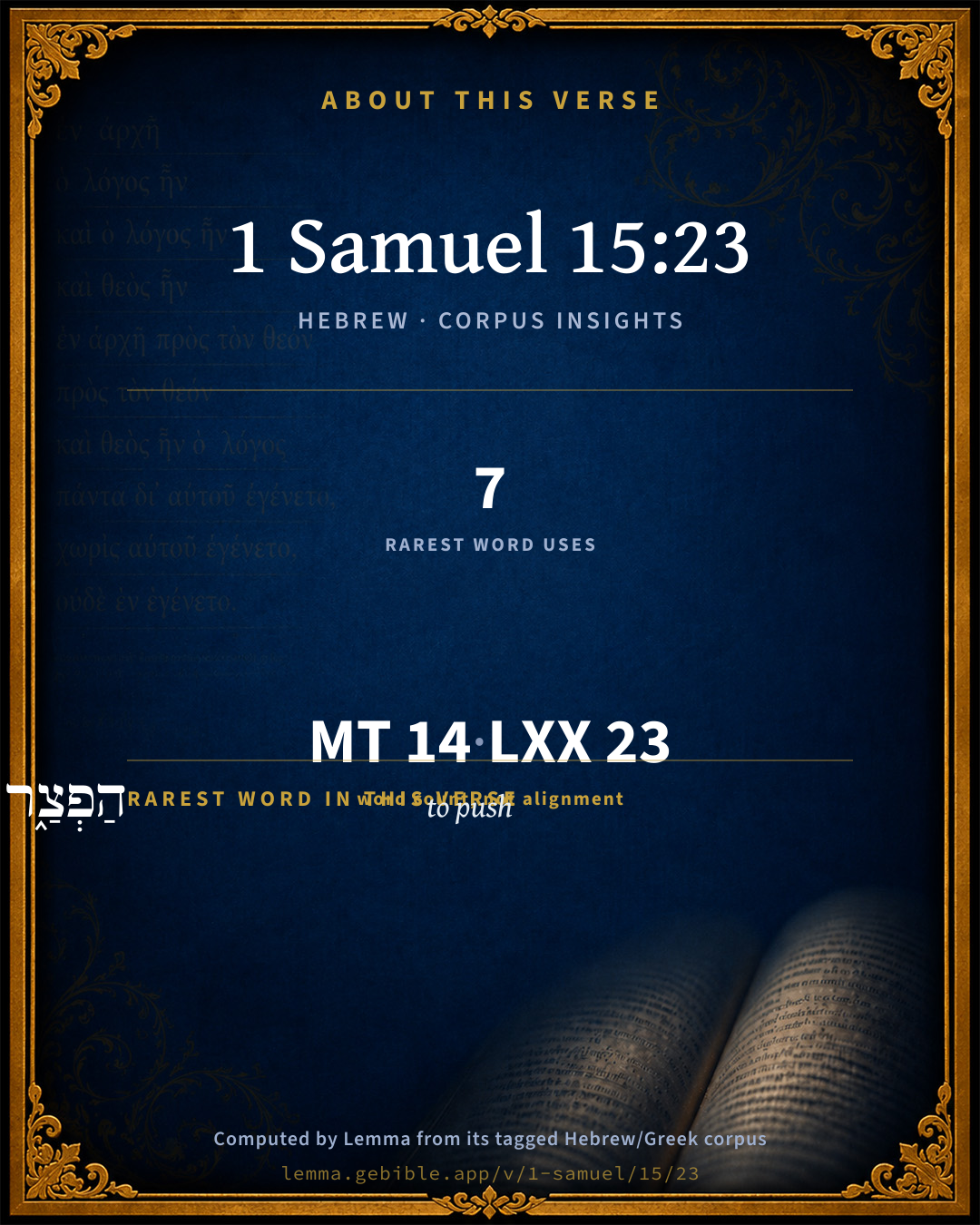
About this verse

These counts appear in no published source. They are computed here, from the morphology-tagged text and Lemma’s own curated glosses. What Lemma adds →

14
words
13
distinct lemmas
Historical
section

Notable vocabulary

The rarest word here is הַפְצַ֑ר to push H6484 — appearing just 7 times in the whole Hebrew Bible.

Shared distinctive vocabulary

הַפְצַ֑ר to push H6484 occurs in 7 verses of the Hebrew Bible. Also found in:

Grammatical profile

  • 3 verbs
  • 8 nouns
  • 2 conjunctions
  • 1 particle

Verb forms

  • הַפְצַ֑ר Hiphil · Infinitive Absolute
  • מָאַ֨סְתָּ֙ Qal · Perfect
  • וַיִּמְאָסְךָ֖ Qal · Sequential Imperfect

Repetition

A word recurs within this verse — often emphatic in Hebrew:

  • מָאַ֨סְתָּ֙ to reject H3988 ×2

Hebrew & Septuagint length

In English translation the verse runs 31 words from the Hebrew and 31 from the Septuagint (LXX English) — the same length.

A rough comparison of the two English renderings, which tokenize alike — not a word-level alignment.

Word counts can differ between the Hebrew and the Greek without any difference in meaning — e.g. the Hebrew direct-object marker אֵת has no separate Greek word, and Greek often adds the article ὁ.

In the original languages it is 14 Hebrew tokens and 23 Greek tokens — but the two are counted differently (Hebrew bundles its prefixes and suffixes into one token; the Greek is in lemma form), so that isn’t a like-for-like length.

Cross-references

27

Topical passages linked to 1 Samuel 15:23 in the Treasury of Scripture Knowledge — connected by theme and wording, ordered by reader-vote popularity; previews shown in the World English Bible.

  • Jeremiah 28:16 Therefore thus says Yahweh, Behold, I will send you away from off the surface of the earth: this year you shall die, because you have spoken rebellion against Yahweh.
  • 1 Samuel 13:14 But now your kingdom shall not continue: Yahweh has sought him a man after his own heart, and Yahweh has appointed him to be prince over his people, because you have not kept that which Yahweh commanded you.
  • Leviticus 20:6 "'The person that turns to those who are mediums, and to the wizards, to play the prostitute after them, I will even set my face against that person, and will cut him off from among his people.
  • Galatians 5:20 idolatry, sorcery, hatred, strife, jealousies, outbursts of anger, rivalries, divisions, heresies,
  • Deuteronomy 18:10–11 There shall not be found with you anyone who makes his son or his daughter to pass through the fire, one who uses divination, one who practices sorcery, or an enchanter, or a sorcerer,
  • Jeremiah 29:32 therefore thus says Yahweh, Behold, I will punish Shemaiah the Nehelamite, and his seed; he shall not have a man to dwell among this people, neither shall he see the good that I will do to my people, says Yahweh, because he has spoken rebellion against Yahweh.
  • 2 Corinthians 6:16 What agreement has a temple of God with idols? For you are a temple of the living God. Even as God said, "I will dwell in them, and walk in them; and I will be their God, and they will be my people."
  • Exodus 22:18 "You shall not allow a sorceress to live.
  • Joshua 22:16–19 Thus says the whole congregation of Yahweh, What trespass is this that you have committed against the God of Israel, to turn away this day from following Yahweh, in that you have built you an altar, to rebel this day against Yahweh?
  • Ezekiel 2:5–8 They, whether they will hear, or whether they will forbear, (for they are a rebellious house), yet shall know that there has been a prophet among them.
  • Genesis 31:19 Now Laban had gone to shear his sheep: and Rachel stole the teraphim that were her father's.
  • Genesis 31:34 Now Rachel had taken the teraphim, put them in the camel's saddle, and sat on them. Laban felt about all the tent, but didn't find them.
  • 2 Kings 17:15–20 They rejected his statutes, and his covenant that he made with their fathers, and his testimonies which he testified to them; and they followed vanity, and became vain, and [went] after the nations that were round about them, concerning whom Yahweh had charged those who they should not do like them.
  • 1 Chronicles 28:9 You, Solomon my son, know the God of your father, and serve him with a perfect heart and with a willing mind; for Yahweh searches all hearts, and understands all the imaginations of the thoughts: if you seek him, he will be found of you; but if you forsake him, he will cast you off forever.
  • Psalms 107:11 Because they rebelled against the words of God, And condemned the counsel of the Most High.
  • Leviticus 20:27 "'A man or a woman that is a medium, or is a wizard, shall surely be put to death: they shall stone them with stones; their blood shall be upon them.'"
  • Deuteronomy 9:7 Remember, don't forget, how you provoked Yahweh your God to wrath in the wilderness: from the day that you went forth out of the land of Egypt, until you came to this place, you have been rebellious against Yahweh.
  • 1 Samuel 2:30 Therefore Yahweh, the God of Israel, says, I said indeed that your house, and the house of your father, should walk before me forever: but now Yahweh says, Be it far from me; for those who honor me I will honor, and those who despise me shall be lightly esteemed.
  • Job 34:37 For he adds rebellion to his sin. He claps his hands among us, And multiplies his words against God."
  • Numbers 14:9 Only don't rebel against Yahweh, neither fear the people of the land; for they are bread for us: their defense is removed from over them, and Yahweh is with us: don't fear them.
  • Deuteronomy 9:24 You have been rebellious against Yahweh from the day that I knew you.
  • 1 Samuel 12:14–15 If you will fear Yahweh, and serve him, and listen to his voice, and not rebel against the commandment of Yahweh, and both you and also the king who reigns over you are followers of Yahweh your God, [well]:
  • 1 Samuel 16:1 Yahweh said to Samuel, How long will you mourn for Saul, seeing I have rejected him from being king over Israel? fill your horn with oil, and go: I will send you to Jesse the Bethlehemite; for I have provided me a king among his sons.
  • Isaiah 8:19 When they shall tell you, "Consult with those who have familiar spirits and with the wizards, who chirp and who mutter:" shouldn't a people consult with their God? on behalf of the living [should they consult] with the dead?
  • Isaiah 19:3 The spirit of Egypt shall fail in the midst of it; and I will destroy the counsel of it: and they shall seek to the idols, and to the charmers, and to those who have familiar spirits, and to the wizards.
  • Revelation 22:15 Outside are the dogs, the sorcerers, the sexually immoral, the murderers, the idolaters, and everyone who loves and practices falsehood.
  • Revelation 21:8 But for the cowardly, unbelieving, sinners, abominable, murderers, sexually immoral, sorcerers, idolaters, and all liars, their part is in the lake that burns with fire and sulfur, which is the second death."

Cross-references courtesy of OpenBible.info (CC BY 4.0).

Hebrew and Greek witnesses Masoretic Hebrew ↔ Greek Septuagint

The same verse in the two great witnesses to the Old Testament, shown verse-for-verse.

These are two independent witnesses, not word-aligned to each other, and the Septuagint is shown in lemma (dictionary) form.

Hebrew 1 Samuel 15:23 Masoretic · Westminster Leningrad Codex

כִּ֤י חַטַּאת קֶ֨סֶם֙ מֶ֔רִי וְאָ֥וֶן וּתְרָפִ֖ים הַפְצַ֑ר יַ֗עַן מָאַ֨סְתָּ֙ אֶת דְּבַ֣ר יְהוָ֔ה וַיִּמְאָסְךָ֖ מִמֶּֽלֶךְ

For rebellion is as the sin of witchcraft, and stubbornness is as idolatry and teraphim. Because you have rejected the word of Yahweh, he has also rejected you from being king.

World English Bible · Public Domain

Greek LXX 1 Samuel 15:23 Septuagint · lemma form

ὅτι ἁμαρτία οἰώνισμα εἰμί ὀδύνη καί πόνος θεραφις ἐπιἄγω ὅτι ἐκοὐδενόω ὁ ῥῆμα κύριος καί ἐκοὐδενόω σύ κύριος μή εἰμί βασιλεύς ἐπί ἰσραήλ

For sin is as divination; idols bring on pain and grief. Because you have rejected the word of the Lord, the Lord also shall reject you from being king over Israel.

LXX2012 (modern English Septuagint) · Public Domain

Hebrew: Westminster Leningrad Codex (CC BY 4.0). Greek: Septuagint (public domain); English from LXX2012 (modern English Septuagint) (Public Domain). How the Septuagint differs from the Hebrew →

Targum (Aramaic paraphrase)

1

The Targum is the ancient Jewish Aramaic paraphrase of the Hebrew Scriptures — an interpretive translation, not the Hebrew text itself. Onkelos (literal) and Pseudo-Jonathan (expansive) render the Torah, and Jonathan the Prophets. Coverage is partial: where no permissively-licensed English translation exists for a verse, only the Aramaic is shown. This is verse-level text, not a word-by-word alignment to the Hebrew.

  1. Targum Jonathan Prophets (Joshua–Malachi)
    אֲרֵי כְּחוֹב גַבְרַיָא דְשָׁאֲלִין בְּקִיסְמָא כֵּן חוֹבַת כָּל גְבַר דִמְסָרַב עַל פִּתְגָמָא דַייָ וּכְחוֹבֵי עַמָא דְטָעוּ בָּתַר טַעֲוָתָא כֵּן חוֹבַת כָּל אֱנַשׁ דִפְצַר וּמוֹסִיף עַל מִילֵי נְבִיָא חֲלַף דְקַצְתָּא בְּפִתְגָמָא דַייָ רַחֲקָךְ מִלְמֶהֱוֵי מַלְכָּא:

    (no public-domain English translation for this verse)

    Targum Jonathan — Aramaic: “Mikraot Gedolot” (public domain). English: “Sefaria Community Translation” (CC0 1.0 (public-domain dedication)); “London "Chaldee Paraphrase," 1871” (public domain). Text via Sefaria.

Commentary

Notes on 1 Samuel 15:23 from classic Christian and Jewish commentators (each source and its license shown beneath its notes). The classic Christian expositions comment on the surrounding passage and are grouped to its opening verse, so a note may address several verses; the Jewish commentaries on the Tanakh (Rashi and others) are per-verse, so they appear only where the commentator wrote on this verse.

Lemma curates 59 commentaries, every one of them public domain or Creative Commons licensed, each selected and text-cleaned for this edition rather than reprinted as found. About our sources →

Trapp's Complete Commentary

John Trapp

1Sa 15:23 For rebellion [is as] the sin of witchcraft, and stubbornness [is as] iniquity and idolatry. Because thou hast rejected the word of the LORD, he hath also rejected thee from [being] king.

Ver. 23. For rebellion is as the sin of witchcraft.] Because it dethroneth God, as it were, and setteth up self in his place. For as the covetous man’s god is his gold, the glutton’s his belly, the ambitionist’s honour; so the obstinate sinner’s god is his own reason and will, which alone he serveth, seeketh, and setteth up for his chiefest good. It is his pleasure, his profit, and his preferment, that is every wicked man’s trinity: and his carnal self that is these in unity. What wonder then that God so hateth such? {Deu 29:19-21} He cannot satisfy himself in saying what he will do to them: but is absolute in threatening, to show that he will be resolute in punishing. See the like, Isa 22:12-14 Eze 24:13-14.

John Trapp, A Commentary or Exposition upon All the Books of the Old and New Testament (1647–1656) — public domain. Text from a community e-Sword module.

The Biblical Illustrator

Joseph S. Exell

1Sa_15:23

Rebellion is as the sin of witchcraft.

Rebellion against God all malignant as witchcraft

To rebel against the clearest light and most express declaration of the will of God: this is an action of the like malignity, even as the sin of witchcraft. When a crime is said to be as the sin of witchcraft, the meaning is that it is a fault of so heinous and provoking a nature that the obstinate commission of it is altogether inconsistent with all true principles of religion, and, in effect, a total renunciation of them. The word iniquity, in the latter part of the text, is iniquity towards God, the forsaking His worship, the denying Him His true honour, the turning from Him to false gods, or joining them with Him; and therefore it is expressed by two words together, iniquity and idolatry. Which two words in this place do not signify two distinct things, but are of the same import as if it had been said in one, the iniquity of idolatry, the perverseness or unrighteousness of serving false gods. This their disobedience in any one known instance of immorality, this their rebellion, is as the sin of witchcraft; and their stubbornness is as the iniquity of idolatry. Their refusing to obey the true God, whom they profess to worship, is like serving a false one. For wherein consists the iniquity of idolatry, and the wickedness of serving false gods; but in this, that it derogates from the majesty of the true God, and denies Him that honour which is His alone peculiar due? Not that there are not degrees of disobedience in rebelling against God; but that a wilful stubbornness in any particular disobedience is absolutely inconsistent with the favour of God, and that there may be a perverseness in persisting habitually in single sins, even like to the perverseness of a total apostasy. One mortal wound destroys a man, as certainly as many; and incorrigible obstinacy in the practice of any sin, may be of equal malignity even as idolatry itself. Equal not perhaps as to the degree of the particular punishment it shall bring upon him; but equal as to the certainty of its bringing him in general to condemnation. God requires that men should serve Him with their whole heart. But the folly of wicked men will distinguish where there is no distinction; and they will serve God in what manner only, and in what instances they please. This is that great deceitfulness of sin. The external, the formal and ceremonial part of religion, they will possibly be very fond of, but the inward and real virtues of the mind, meekness and purity, humility and charity, equity, simplicity and true holiness, for these they would gladly commute, and make amends with any compensation. This is the great and general corruption; this has in all times and in all places been the first and the last error in matters of religion. Saul would needs sacrifice unto the Lord his God, out of those very spoils, which he had presumptuously taken, against Gods express command. In following ages the whole nation of the Jews would in like manner be always very diligent, in offering their sacrifices and oblations, as if that would make amends for the viciousness of their lives. And yet how often did the scriptures admonish them to the contrary (Psa_50:13; Ecc_5:1; Isa_1:11; Isa_1:16; Hos_6:6). Even in our Saviours time, after all these repeated admonitions, the Pharisees still continued to value themselves upon their mere external performances; and yet that very Scribe who was sent to tempt him, could not but acknowledge to our Lord that He had said the truth in affirming that for a man to love God with all his heart, and . . . his neighbour as himself; was more than all whole burnt offerings and sacrifices (St. Mar_12:33). They would with great superstition wash the outside of their cups and pots, while the inside of their own hearts was full of unrighteousness and all uncleanness. In a word, they would do anything rather than what was right and ought to be done; and therefore our Saviour declares, that except our righteousness exceeds the righteousness of the Scribes and Pharisees, we shall in no case enter into the Kingdom of Heaven. Among the several corrupters of Christianity likewise, what is it that men have not been willing to undertake, what journeys and pilgrimages, what hardships and abstinences, what voluntary humilities and uncommanded austerities, what profuse gifts to monasteries or religious societies, and unbounded zeal for propagating what they call right opinions, that is, such as happen to prevail, or be in fashion amongst them; instead of serving God with simplicity of devotion and loving their neighbours as themselves? If a man runs in a race, yet if he takes a shorter way to the mark, sad runs not in that course which is by the rules appointed and marked out, his labour is in vain; and if a man professes to serve God, yet if he serves Him not in that method of obedience which God Himself requires, but will go a nearer way to heaven, either according to his own humour and fancy, or in the way of any human invention whatsoever, instead of the plain rules of reason and scripture, he may justly fall short of his reward. But no description of the perverseness of this sort of sinning can set it forth in so lively a manner as the giving some historical examples of it. And I shall mention two, which contain a more exact representation of the nature of this stubbornness than any explication of it in words could do. The one is the behaviour of Saul, in the other actions of his life, besides that referred to in the text; the other is the behaviour of the Jews, in their passage through the wilderness towards the promised land. When God commanded them to return back into the wilderness, then on the contrary they would go up into the land which the Lord had promised them, and would fight for it presumptuously, and were defeated. In these instances their rebellious disposition was as the sin of witchcraft, and their stubbornness like to the iniquity of idolatry (S. Clark, D. D.)

Discord and Harmony

Among the moral difficulties of the Old Testament is the apparent disproportion between particular acts of sin and the temporal punishment with which God visited them. Even when we have considered the points on which Dr. Mozley insists in his masterly lectures upon Ruling Ideas in Early Ages: when we have recognised how God accommodated, as it were His will to the possible or current conceptions of mens minds, that out of each stage in the education of our race He might elicit the very best character that it could produce: even when we have made allowance for the need of teaching rough people by rough means, and of driving plain truths into the heart of a rude and obdurate age by strong and sudden judgments:--still it may be strange to us that the most awful weapons in all the armoury of wrath should be sometimes brought out against offences which at first seem little more than faults of taste or policy or a passing temper: faults such as even good men might commit in a moment of carelessness or irritation, or on what we should call their unlucky days. How could it be equitable in a life thus rude and wild, a life where only the broadest distinctions were as yet apparent, and where the subtler lines of moral definition had not yet been traced, to doom with so terrible a sentence the hasty word of an angry woman or of a soldier flushed with peril and victory? Surely a part of the answer to such questions is found when we reflect how infinitely different may be in different lives the moral significance of the very same act. It is not only that the real quality of every action depends upon its motive: there is often a further and a deeper meaning to be read in the inner history of that character out of which, perhaps, the motive itself has come. That which on the surface seems too trivial to be heeded, may be the only outward evidence of a change which has been going on in us for years; there perhaps alone may be revealed the drift and volume of the stream which from some far-off spring has been flowing for many a mile beneath the ground: and the silent, secret course of half a lifetime may be betrayed beyond recall in that one glimpse. There are trivial acts which may disclose the bygone stages of our moral history, just as some trick of gesture or pronunciation lets out the secret of a mans parentage or nationality, or as some faint and useless trait connects a species with the ancestry of its evolution. Some such critical significance in Sauls neglect of the Divine command seems to be suggested in the strange comparison by which Samuel illustrates it: Rebellion, he says, is as the sin of witchcraft, and stubbornness is at iniquity and idolatry. The likeness is not, on the surface, clear; there seems no near or necessary connection between disobedience and superstition: but perhaps their link of kindred may appear if we look more closely into the meaning and history of the act which had provoked the sentence. We shall, I think, find it to have been the outcome and revelation of a deep disorder such as always tends to bewilder or distort the religious impulses of the soul. The spirit then which came to Saul on that great day of his anointing was the prophetic spirit of insight into the true drift and order of the world: he was admitted to the counsels of the Almighty, and recognised the Divinity that shapes our ends. Thus was be prepared to reign: thus did he see the truth of history in all its lines stretched out and ordered in the sight of God: thus did he learn the law whose conscious service was to be his sovereignty. What might not Saul have been, where might he not have placed his name among the beloved and blessed of God and men, if only he had enthroned the revelation of that day for undivided empire in his heart: if only, like another Saul, he could have looked back to the day of his conversion and declared that he had not been disobedient unto the heavenly vision: if only like him he had thenceforward striven to bring into captivity every thought to the obedience of Christy. For is not this the secret of all his failure and misery, his madness and his superstition, is not this the deep significance of hit sin--that while he saw the Light he would not live by it? he knew the Law and would not work by it: he heard the Counsel of God and held hit will apart from it. He was, says Dean Stanley, half-converted, half-aroused; his mind moved unequally and disproportionately in its new sphere: until the zeal of a partial conversion degenerated into a fanciful and gloomy superstition. All through his life there went the maddening elements of discord: day after day the higher and the lower fought within him for the throne of his irresolute, distracted heart: day after day he woke to hear two voices clashing and disputing for his guidance: and now he followed one and now the other: yet when he chose the better he still looked wistfully at the lower life, and when he chose the worse he trembled at the thought of God. He could neither say, with the frank self-degradation of the heathen satirist, I see the better and approve it: I pursue the worse; nor yet with the man after Gods own heart, Teach me Thy way, O Lord, and I will walk in Thy truth: O knit my heart unto Thee, that I may fear Thy Name. And so he lived in discord, and he reigned by anarchy: restless and aimless, suspicious and dissatisfied, halting between light and darkness, and beset in that twilight by weird unhealthy thoughts like the evil dreams that make it bliss to wake, ever falling away from that which he saw and owned as God-like There is surely a deep meaning in the submission with which such a life as his welcomes the influence of music. The moral discord, the distraction and disorder of his will spread at times over all the powers of the mind: and the strain and irritation of that restless conflict broke out in gusts of terror and frenzy. And it came to pass, when the evil spirit from God was upon Saul that David took an harp, and played with his hand: so Saul was refreshed, and was well, and the evil spirit departed from him. Even through his misery there came the great and constant prophecy of music: above the discord of his soul he heard those merciful echoes of a higher harmony; he knew that somewhere out, side all the chaos of his broken life, there were steadfast principles of melody, and calm and measured ways, and the eternal rhythm of an undisturbed song: he felt once more that the Most High is He Who sweetly and mightily ordereth all things, and there is peace for those who love His law. For there is a rest which remaineth for the people of God. That great prophecy of music is among us still: still the true harmony of tuneful sounds helps men to be patient through distress and conflict, and to hope that their steps may yet be led into the sure ways of peace In the recess of a wall in the Catacomb of St Calixtus there is a painting of Orpheus: in his left hand he holds a lyre: the right is raised as though to mark the rhythm of his song: and round him are the wild beasts, tamed and hushed to listen while he plays. There is no doubt that the picture represents our Blessed Lord. Though the artist as he painted it was surrounded by the bodies of those who for Jesus sake had borne the cruelty of persecution even unto death: though he himself, it may be, had left all to follow Christ and to be a partaker of His sufferings: still he knew Him as the Master of all Harmony, the Prince of Peace: still he felt that only since be took the Crucified to be his Lord had all the wild discord and conflict of his soul passed into mysterious and most blessed confidence of union with an eternal law of Melody. And we, if out of the confusion and bewilderment of our days, from the weakness and hesitation of our faith, we look back with a bitter sense of severance and strangeness to the simple and unhindered self-surrender of those saints of old: still let us hold fast by this--which is indeed a truth that all may test and prove:--that in proportion as the perfect obedience of the life of Christ comes through humility and prayer and thought to be the constant aim of all our efforts: we shall with growing hope and with a wonder that is ever lost in gratitude know that even our lives are not without the earnest of their rest in an eternal harmony. (F. Paget.)

Because thou hast rejected the word of the Lord, He hath also rejected thee from being king.

Saul rejected

We walk through the streets and see a fellow creature who had great abilities; who was once held in great esteem; for whom a brilliant future was predicted. We see such an one presenting that combination of indescribable symptoms which we expressively sum up in the one word reduced. And the contemplation of such a wreck is singularly depressing; the disposition of him who could witness it without sorrow in his greatest enemy is by no means to be envied. Saul was such a man. His history is indeed melancholy. It is perplexing, also. Many persons, I dare say, think Saul was, on the whole, hardly treated. I can easily imagine one taking for granted that he was bad because he is told so, and because God rejected him; but saying to himself that he does not quite see that he was so bad--that he should never have expected to find him so severely punished--that it is strange that David escaped on so much easier terms. What, sin did Saul ever commit so heinous as the sin of David?

I. This perplexity, and wrong estimate of Sauls character, arises from various causes: principally from our false views about sin and obedience. It happens that we live in a state of society where many acts are at once offences against society, and also sins against God. Influenced as we naturally are by what is seen, we come, in time, to view as sins only those which are transgressions of the laws of society, and to think little or nothing about those of which society takes no note. So, too, about obedience. We think that it is like work given to a servant. The more he does of it, the better servant he is. What his feelings may be about his master make little difference, provided he gets through his work. What he does is the only way in which we judge of him, as a good or bad servant. Accordingly, we suppose God judges of us, His servants, by the amount of our obedience. He issues a command, and, we suppose, the man who obeys much of it must be better than the man who obeys very little. This is not true. We may have gone with Gods command, just, so far as that command coincided with our own inclination, and stopped short where the real and trying exercise of an obedient spirit came in, where alone it was needed.

II. Guarding, then, against these common and erroneous views about sin and obedience, let us come to some of Sauls acts. His falling away began from the circumstance recorded in the thirteenth chapter and first verse. Samuel came and rebuked him. This seems hard, especially when we consider the trying circumstances in which Saul was placed at the time: powerful enemies near at hand--many of his people fallen away--the rest following him, trembling--Samuel not coming--and, after all, as people would say now, It was only a matter of form. What difference could it make, who offered the sacrifice? He showed a spirit above ritual observances--above ceremony and order. He certainly did. So did Naaman: and both were made to see the folly of their presumption. Some anxiety would have been natural in any man. But Saul was more than anxious. A distinct commandment of God forbade him to offer sacrifice, and yet he did it to secure an end which he thought to be desirable towards the overthrow of the Philistines. He forgot that the most trifling matter, when once it became the subject of a Divine command, ceased to be insignificant; if for no other reason, at least for this, that its observance thereby became a test--not of regard to form, but--of obedience to God. Now what disposition was manifested by this conduct? Was it not an utter absence of that faith, without which it is impossible to please God? What would be its effect, upon the people, when the excitement was over? What, but to encourage them in their departure from the ordinances of Him from Whom they longed to stray, and be as the heathen?

III. The Almighty, then, did not reject this his first chosen King of Israel for any slight fault or any momentary swerving from the path of obedience through ignorance or from impulse, but for habitually and perseveringly going wrong in that very respect which was of most consequence in the due execution of his office. He had to meet the difficult question which met the Apostles, whether he should obey God rather than man. They had no hesitation in arriving at a decision: neither had he: but they decided it differently. If ever there was a time in which Saul would have been appreciated, ours is that, time. Were he alive now he would be just the man that would rise in the world--probably get into Parliament, lead a party, perhaps become Prime Minister. He was the man for the people. A striking man; able, energetic, fitted to command; above all, prepared to obey the Lord just so far as, by suiting the peoples views, he should help to his own exaltation. The popular religion or phase of any particular religion would be his. All creeds just as far Divine as they were popular. None more the truth than another. Sauls day fell in an evil era, and, for him, under an evil dispensation. In his time the tares and the wheat, did not grow together till the harvest. The tares were rooted out at the time, and so people who came could be shown what were pronounced tares by the Lord of the Harvest, and what was their end. This is one very important, advantage we derive from the system of temporal rewards and punishments and the special Providence under which the Jews lived. By these means we can strive at, the principle on which His future judgment according to works will be conducted. Thus, a line of conduct in which we should have detected nothing very striking, either of good or of evil, when marked with Gods disapproval, arrests our attention, leads us to examination, and acts as a corrective to the erroneous judgment on human conduct which the time or the society in which we live had led us to form in our minds. Many would think that Saul had succeeded. Our Lord tells us that this is impossible. The compromise, He says, cannot be effected. Gods rejection of Saul shows us that he did not succeed. The characters condemned and approved in the Old Testament are marked by the very same characteristics, after all, as those which are condemned and approved in the New. Double-mindedness, want of faith, loving this present world, loving, the praise of men more than the praise of God, seeking to be friends with it, making that our great aim, and the friendship of Him Who redeemed us secondary to that: a determination to do our own will; a hesitation and insincerity in saying, come what may, Thy will be done; these are ever the marks of those who are held up as sad examples of inconsistency, to be deplored and to be avoided. (J. C. Coghlan, D. D.)

Sauls deserved and irrevocable doom

Before Samuel turned after Saul he delivered his conscience, and pronounced the irrevocable doom against him. That doom was deserved, and it was irrevocable

1. It was deserved. Saul was forewarned. He had received a plain commission from God. He occupied a high position. He belonged to a nation that had the light of Divine revelation. He was their king, and had pledged himself to keep the constitution, which demanded obedience to the will of God. He was the first king, and according to his conduct was the monarchy on the one hand, and the subject people on the other, likely to be influenced. Obedience in his case had been concentrated on important points; but in these he had transgressed. It therefore repented the Lord that he had made Saul king. But his purpose of a right theocracy under a man after his own heart was not to fail: The Strength of Israel will not lie nor repent; for he is not a man that he should repent.

2. It was irrevocable. God had solemnly declared that he would turn the kingdom from Saul. He had never said that Saul would be kept in the kingdom and found a dynasty in Israel. He was not bound to continue him in the office. He had raised him to the throne that he might have a fair trial, and full opportunity of acting aright. Saul was endowed by God with every advantage, with kingly qualities, surrounded with a band of men whose hearts God had touched, appointed to special commissions, and hedged up by every means likely to aid his fidelity. But God might change the sovereignty. When, therefore, he beheld Sauls conduct he is said to have repented that He had made him king. Here we find a principle which can bear a most extensive application. Gods dealings with us are still wrought on the same plan. He has not given His word regarding our circumstances here. He has not pledged Himself to continue them as they have been. He may change these. He acts towards us as a judicious teacher, and shapes His course according to our conduct. There are reasons in our manner of action, proceeding from our abuse of mercies, which may necessitate a change. He may alter our worldly position, and send adversity instead of prosperity. He may lay a restraint upon our ambition, and make us feel by sad experience the vanity of human wishes. He may afflict our households, or prostrate ourselves. In this respect much depends upon the individual with regard to the providence of life. It was Sauls disobedience that warranted the chastisement which he received, and the change in Gods mode of dealing with him. (R. Steel.)

The character of Saul

1.The first thought which occurs to us is--In this its first king, as in a mirror, behold Israel itself. Israel, like Saul, was chosen by God to rule the people. Israel was gifted with grace sufficient and upheld by glorious promises. But Israel, like Saul, has turned to his own way. Because he has rejected the Lord, the Lord hath also rejected him from being king.

2. The second thought is--In this character behold multitudes among ourselves reflected. How many are there, against whom nothing morally wrong can be alleged, who are not prone to any palpable vice, who have tasted the good word of God and the powers of the world to come, with whom everything for time and eternity trembles on the balance, and the question is whether they will serve the Lord in life or whether they will not. Saul forgot the Lord his God. He sought not to Him for new supplies of that grace which had once been imparted to him. He was like one of those foolish ones who slumbered with their lamps burning, trusting that they would continue to burn on, but took no oil in their vessels for a supply. He went on his way, and thought not of God. But if forgetfulness of God be the passive symptom of the fatal disease, self-will is the active one. It was this which misled Saul. He leaned to his own understanding. He had his own ways, and his own calculations, where Gods will had been already positively pronounced. (H. Alford, B. D.)

The Biblical Illustrator, edited by Joseph S. Exell (c. 1880s–1900s) — public domain. Text from a community e-Sword module.

Joseph Benson's Commentary

1Sa 15:23. For rebellion — Disobedience to God’s command; is as the sin of witchcraft — Or the using divinations, and consulting familiar spirits, is as plainly condemned, and as certainly damnable and destructive. Stubbornness — Contumacy, persisting in sin, justifying it, and pleading for it; is as iniquity and idolatry — Or, rather, the iniquity of idolatry, the highest degree of wickedness. The meaning is, that as Saul had wilfully disobeyed the command of God, he was guilty of rebellion against him; and that wilful, peremptory disobedience to any command of God is, for the nature of it, a most heinous sin, though the matter in which it is manifested be ever so small. The Lord hath rejected thee from being king — That is, hath pronounced the sentence of rejection; for that he was not now actually deposed by God, plainly appears in that not only the people, but even David, after this, owned him as king. Indeed, he continued to be king till the day of his death. He was only actually rejected and deposed when he was slain in battle. But the expression may chiefly respect his posterity, to whom God would not suffer the kingdom to descend.

Joseph Benson's Commentary on the Old and New Testaments (1811–1818) — public domain. Text from a community e-Sword module.

Tyndale Open Study Notes

Tyndale Open Resources

15:23 Rebellion . . . and stubbornness, sins of the heart, are as bad as the sinful practices of idolatrous pagans. • Scripture condemns witchcraft (see study note on Deut 18:10).

Tyndale Open Study Notes — © Tyndale Open Resources, licensed CC BY-SA 4.0. Text via the HelloAO Bible API.

Geneva Bible (1599)

Geneva Bible translators

God hateth nothing more than the disobedience of his Commandment, though the intent seems never so good to man.

Geneva Bible (1599) marginal notes — public domain. Text via Bolls.life.

Adam Clarke's Commentary

Verse 23. For rebellion is as the sin of witchcraft, and stubbornness is as iniquity and idolatry.] This is no translation of those difficult words, כי חטאת קסם מרי ואון ותרפים הפצר ki chattath kesem meri veaven utheraphim haphtsar. It appears to me that the three nouns which occur first in the text refer each to the three last in order. Thus, חטאת chattath, TRANSGRESSION, refers to און aven, INIQUITY, which is the principle whence transgression springs. קסם kesem, DIVINATION, refers to תרפים teraphim, consecrated images or telesms, vulgarly talismans, used in incantations. And מרי meri, REBELLION, refers evidently to הפצר haphstar, STUBBORNNESS, whence rebellion springs. The meaning therefore of this difficult place may be the following: As transgression comes from iniquity, divination from teraphim, and rebellion from stubbornness, so, because thou hast rejected the word of the Lord, he hath also rejected thee from being king. All the versions are different.

Adam Clarke's Commentary on the Bible (1810–1826) — public domain. Text from a community e-Sword/MySword module.

Ellicott's Commentary for English Readers

(23) For rebellion is as the sin of witchcraft.—Witchcraft, more literally soothsaying or divination, was a sin constantly held up to reprobation in the Old Testament. It was the greatest of all the dangers to which Israel was exposed, and was in fact a tampering with the idol-worship of the surrounding nations. Impurity, and an utter lack of all the loftier principles of morality which the one true God and His chosen servants would impress on the peoples of the East, characterised the various systems of idol-worship then current in Syria and the adjacent countries. And Samuel here, in this solemn inspired saying, briefly gives the grounds of the Lord’s rejection of His Anointed: “Rebellion,” or conscious disobedience to the express commands of the Eternal, in the case of Saul, God’s chosen king, was nothing else than the deadly sin of idol-worship, for it set aside the true Master of Israel, and virtually acknowledged another. The next sentence still more emphatically expresses the same thought: “Stubbornness,” or “intractableness,” is in the eyes of the pure God the same thing as worshipping idols and teraphim. The Hebrew word aven, rendered iniquity, literally signifies “nothingness;” it is a word used in the late prophets for an idol (Hos_10:8; Isa_66:3). The word in the original translated in the English Version “idolatry,” is teraphim. Teraphim were apparently small household gods or idols, venerated as the arbiters of good and evil fortune. In Roman life we find similar idols under the name of “Lares.” Teraphim is derived from an unused root, taraph, signifying “to live comfortably;” Arabic, tarafa: compare the Sanscrit trip, and the Greek τρέΦειν. These idols appear to have been small human figures of various sizes. The image in 1Sa_19:13 was probably nearly life-size. These teraphim were made generally of silver or of wood. It has been suggested that the teraphim which Rachel stole were images of her ancestors. (See Note on Gen_31:19, and Mr. Whitelaw’s comment on ib. in the Pulpit Commentary.)

A Bible Commentary for English Readers, edited by Charles John Ellicott (1878–1897) — public domain. Text from a community e-Sword module.

The Cambridge Bible for Schools and Colleges

gen. ed. J. J. S. Perowne

23. rebellion is as the sin of witchcraft, &c.] Opposition to the will of God is as bad as divination by the help of evil spirits, which is tantamount to apostasy from God: obstinate resistance to Him is no better than worshipping idols (vanity or emptiness) and images (teraphim: see note on 1Sa_19:13). Disobedience is in fact idolatry, because it elevates self-will into a god.

There seems to be an allusion to Saul’s zeal in abolishing the practice of witchcraft (1Sa_28:3). Samuel charges him with being not less guilty than those whom he had been so eager to condemn.

The Cambridge Bible for Schools and Colleges (gen. ed. J. J. S. Perowne; Cambridge University Press, 1878–1918) — public domain. Text from a community e-Sword module.

John Gill's Exposition

For rebellion is as the sin of witchcraft,.... Or divination (e), in whatsoever way it was exercised; for there were various sorts of it among the Heathens, and all condemned by the law of God, Deu 18:10. Now rebellion against God, or disobeying his commands, though in things otherwise, were they not forbidden by him, lawful to be done, is as heinous a sin as to be guilty of witchcraft, or any kind of divination forbidden by the law of God, and deserves as sore a punishment:

and stubbornness is as iniquity and idolatry: for a man, when he has committed a sin, to persist in it obstinately, or to vindicate himself in it, and insist on his innocence, which was Saul's case, is as hateful to God as any iniquity whatever; yea, as bad as idolatry, or making use of the teraphim, as is the word here; of which see Hos 3:4 than which nothing is more abominable to the Lord:

because thou hast rejected the word of the Lord; disregarded his command, treated it with contempt and abhorrence:

he hath rejected thee from being king; not actually, for he continued to exercise kingly power and authority to his death, and was treated as a king by his subjects, and even by David, though anointed by the Lord; but the sentence of rejection was pronounced upon him, and the bestowal of the government on his posterity was cut off.

(e) "peccatum divinationis", Pagninus, Montanus, Vatablus; "ariolandi", V. L. "magiae", Munster, Tigurine version.

John Gill's Exposition of the Whole Bible (1746–1763) — public domain (CC PDM 1.0). Text via the HelloAO Bible API.

Albert Barnes' Notes on the Bible

The meaning is “Rebellion is as bad as the sin of divination, and stubbornness is as bad as worshipping false gods (iniquity), and teraphim (idolatry).”

Albert Barnes' Notes on the Bible (1834–1885) — public domain. Text from a community e-Sword/MySword module.

Haydock's Catholic Bible Commentary

Obey. Hebrew, "Rebellion is the sin of divination or witchcraft, and resistance is iniquity, and the Theraphim." Symmachus, "the injustice of idols." Theraphim here designate idolatrous representations, Genesis xxxi. 19. They were probably of Chaldean origin, in honour of the sun and fire, (Calmet) and were venerated like the Penates, and supposed to be the sources of prosperity, from the Arabic Taraph, "to give abundance." Hence Laban was so solicitous to recover what Rachel had taken away. (Louis de Dieu) --- By sacrifices we give our goods, or another’s flesh is immolated; (Mor. xxxiii. 10.; Du Hamel) by obedience, we give ourselves to God. (St. Gregory) (Worthington)

George Leo Haydock (1774–1849), Haydock's Catholic Family Bible and Commentary, 1859 edition — public domain. Excludes Psalms (Douay-Rheims chapter numbering differs from Protestant) and Deuterocanonical books (Catholic canon only).

Matthew Poole's English Annotations

Rebellion, i.e. disobedience to God’s express precept, which was Saul’s case.

Is as the sin of witchcraft; is, though not so great, yet as inexcusable and impudent a sin as witchcraft; as plainly condemned, and as certainly destructive and damnable.

Stubbornness; either wilful and presumptuous sin, whereby a man violently breaks loose from God’s command, and resists his authority; or rather, perseverance or contumacy in sin, justifying it, and pleading for it, which was Saul’s present crime.

Is as iniquity and idolatry, or, the iniquity of idolatry; this being an hendiadis; as judgment and justice, Deu 16:18, is put for the judgment of justice, or just judgment. Or, idolatry, (for so the Hebrew word aven signifies, as Jer 10:15; Hos 4:15; 10:5, compared with 1Ki 12:29) even the teraphim, which is here mentioned as one of the worst kinds of idolatry.

Hath also rejected thee from being king, i.e. hath pronounced the sentence of rejection; for that he was not actually rejected or deposed by God plainly appears, because not only the people, but even David, after this, owned him as king; and Samuel, at Saul’s desire, did honour him, i.e. own him as king, before the people, 1Sa 15:30.

Matthew Poole's English Annotations on the Holy Bible (1683–1685) — public domain. Text from a community e-Sword/MySword module.

Whedon's Commentary on the Bible

Daniel D. Whedon

23. For rebellion… the sin of witchcraft — This gives the sense, but it would be as well to transpose these words and follow the order of the Hebrew, thus: For the sin of witchcraft is rebellion, and iniquity and idolatry are stubbornness. That is, Saul’s rebellious and stubborn opposition to the word of God is as bad as the sins of witchcraft and idolatry; for these sins, in their inmost nature and essence, are refractoriness against the Divine law.

Daniel D. Whedon (gen. ed.), Commentary on the Old and New Testaments (1874–1909) — public domain. Text from a community e-Sword module.

John Wesley's Explanatory Notes

Rebellion - Disobedience to God's command. Stubbornness - Contumacy in sin, justifying it, and pleading for it. Iniquity - Or, the iniquity of idolatry. Rejected - Hath pronounced the sentence of rejection: for that he was not actually deposed by God before, plainly appears, because not only the people, but even David, after this, owned him as king. Those are unworthy to rule over men, who are not willing that God should rule over them.

John Wesley, Explanatory Notes Upon the Whole Bible (1754–1765) — public domain. Text via the GEBible commentary corpus.

Rashi

Rabbi Shlomo Yitzchaki (Rashi)

For defiance is like the sin of sorcery, and stubborness is like the sin of idolatry. And like the penalty for idolatry, so is the penalty for stubborness. Targum Yonoson renders, 'For, as the sin of a people [who divine, so is the sin of any man who disobeys the word of Adonoy] and as the sins of a nation who has strayed after idols, so is the sin of any person who adds [to the words of a prophet].

Stubborness. An expression adding, and similarly, "He urged [וַיִפְצַר] him," i.e., he spoke many words to convince him.

Rashi on the Tanakh — English translations: “The Judaica Press complete Tanach with Rashi, translated by A. J. Rosenberg” (CC BY 4.0); “Pentateuch with Rashi's commentary by M. Rosenbaum and A.M. Silbermann, 1929-1934” (public domain); “The Metsudah Tanach series, Lakewood, N.J” (CC BY 4.0); and “The Book of Joshua, Metsudah Publications, 1997” (CC BY 4.0). Text via Sefaria.

Lesson kit

Teaching starters — assembled from the data on this page, not authored interpretation. Every prompt links to the verse data it draws on. Edit before teaching.

1 Samuel, in the Historical, opens this verse with 14 words (13 distinct Hebrew lemmas). Its most distinctive word is pâtsar (“to push”). A historical commentator’s framing appears above. Read the whole chapter for the surrounding context.

Discussion questions

  1. The word pâtsar carries the sense “to push.” How does it shape the verse?
  2. How does Genesis 19:3, which shares the word «to push», read alongside this verse?
  3. What does the repetition of “to reject” (2× in this one verse) do in this verse?
  4. These translations render this verse differently; the difference is in the English rendering, not the original. What questions does that raise?
  5. «הַפְצַ֑ר» is a Hiphil Infinitive Absolute verb. How does that grammatical form shape the action described?
  6. Compare how Trapp's Complete Commentary and The Biblical Illustrator read this verse. Where do they agree or differ?

Things to notice

Reading settings

Reading text

Shown beneath each verse's original-language words.

Old Testament
Old Testament edition

Read the OT as the Masoretic Hebrew (MT) or the Greek Septuagint (LXX).

English shown for the Greek Septuagint (in the Hebrew ↔ Greek comparison).

Comparing translations? Open the Compare panel on any verse page to stack up to four side by side.