Ezekiel 44:29

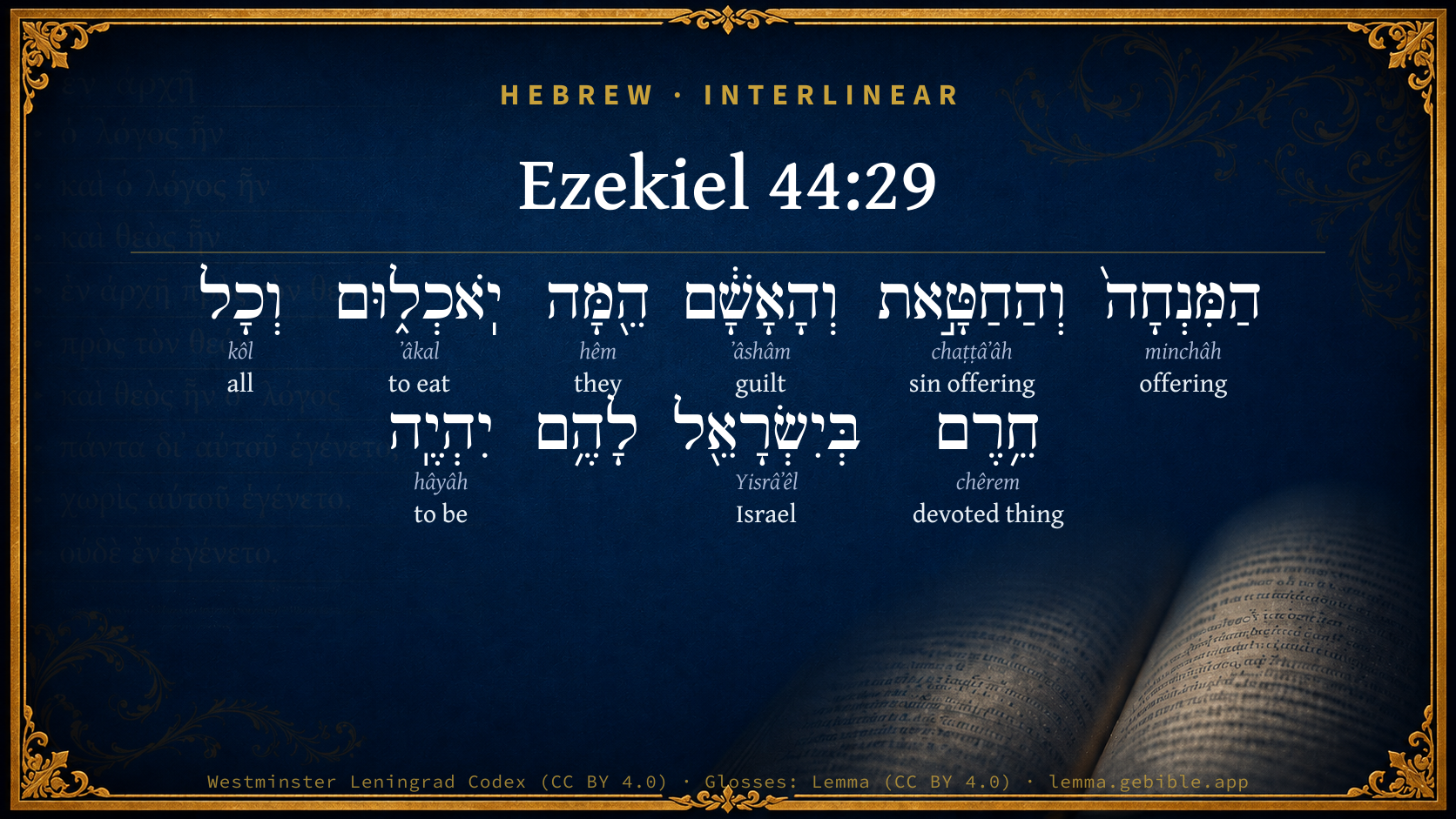
Hebrew (Westminster Leningrad Codex) Ezekiel 44:29 appears in the Hebrew Old Testament. The text above is from the Westminster Leningrad Codex. Each word links to its Strong’s number, a concise gloss, and parsing drawn from the Open Scriptures Hebrew Bible morphology. Click any word for its full Brown-Driver-Briggs (BDB) entry.
Download image
Cite this verse

Ezekiel 44:29 (World English Bible). Public Domain. Lemma interlinear Bible study tool, https://lemma.gebible.app/v/ezekiel/44/29.

Show BibTeX & RIS
BibTeX
RIS
English Translation
They shall eat the meal-offering, and the sin-offering, and the trespass-offering; and every devoted thing in Israel shall be theirs.
World English Bible · Public Domain
Download a study sheet

One document with this verse’s original text, its word-by-word gloss line, the meaning frame, cross-references with their text, attributed commentary, and full source and license credits — printable, and it pastes into notes with its structure intact.

This verse Autodidact and up

Study sheet (.html) Plain text (.txt)

A passage Seminary Student

Up to 50 verses in one chapter. A passage sheet keeps up to 6 commentary sources and 12 cross-references per verse, in the order this page ranks them, and says so on the sheet whenever that leaves anything out. Ask for a single verse and you get the Autodidact verse sheet above.

Everything on this page stays free to read, with no account — the sheet is a download of what is already on screen, not access to it.

Want to remove ads? Support Godless Engineer
Compare translations 3

The same verse in 3 English versions, stacked beneath the original-language interlinear above. Click any original word for its lexicon entry.

Each is an independent rendering of the whole verse — the interlinear is not word-aligned to these translations.

Highlighted words mark where these versions differ — a whole-verse word diff, not a word-by-word alignment.

  • World English Bible Public Domain
    They shall eat the meal-offering, and the sin-offering, and the trespass-offering; and every devoted thing in Israel shall be theirs.
  • King James Version Public Domain
    They shall eat the meat offering, and the sin offering, and the trespass offering: and every dedicated thing in Israel shall be theirs.
  • unfoldingWord Literal Text CC BY-SA 4.0
    They will eat the food offerings, the sin offerings, the guilt offerings, and everything devoted to Yahweh in Israel, will be theirs.

unfoldingWord Literal Text — © unfoldingWord, licensed CC BY-SA 4.0. Word-aligned USFM3 via Door43 (git.door43.org/unfoldingWord/en_ult).

Versions to compare (up to 4)

3 of 4 selected

Show all 18 translations

Every available English version of this verse, each an independent rendering of the whole verse.

  • World English Bible Public Domain
    They shall eat the meal-offering, and the sin-offering, and the trespass-offering; and every devoted thing in Israel shall be theirs.
  • Berean Standard Bible Public Domain
    They shall eat the grain offerings, the sin offerings, and the guilt offerings. Everything in Israel devoted to the LORD will belong to them.
  • Majority Standard Bible Public Domain
    They shall eat the grain offerings, the sin offerings, and the guilt offerings. Everything in Israel devoted to the LORD will belong to them.
  • King James Version Public Domain
    They shall eat the meat offering, and the sin offering, and the trespass offering: and every dedicated thing in Israel shall be theirs.
  • American Standard Version (1901) Public Domain
    They shall eat the meal-offering, and the sin-offering, and the trespass-offering; and every devoted thing in Israel shall be theirs.
  • Revised Version (1885) Public Domain
    They shall eat the meal offering, and the sin offering, and the guilt offering; and every devoted thing in Israel shall be theirs.
  • Geneva Bible (1599) Public Domain
    They shall eate the meat offring, and the sinne offring, and the trespas offring, and euery dedicate thing in Israel shall be theirs.
  • Douay-Rheims (1899) Public Domain
    They shall eat the victim both for sin and for trespass: and every vowed thing in Israel shall be theirs.
  • Young's Literal Translation Public Domain
    The present, and the sin-offering, and the guilt-offering, they do eat, and every devoted thing in Israel is theirs.
  • Literal Standard Version CC BY-SA 4.0
    The present, and the sin-offering, and the guilt-offering, they eat, and every devoted thing in Israel is theirs.
  • Unlocked Literal Bible CC BY-SA 4.0
    They will eat the food offerings, the sin offerings, the guilt offerings, and everything devoted to Yahweh in Israel, will be theirs.
  • unfoldingWord Literal Text CC BY-SA 4.0
    They will eat the food offerings, the sin offerings, the guilt offerings, and everything devoted to Yahweh in Israel, will be theirs.
  • Darby Bible Public Domain
    They shall eat the oblation and the sin-offering and the trespass-offering; and every devoted thing in Israel shall be theirs.
  • World Messianic Bible Public Domain
    They shall eat the meal offering, and the sin offering, and the trespass offering; and every devoted thing in Israel shall be theirs.
  • Webster's Bible Public Domain
    They shall eat the meat-offering, and the sin-offering, and the trespass-offering; and every dedicated thing in Israel shall be theirs.
  • Free Bible Version CC BY-SA 4.0
    They are to eat the grain offerings, sin offerings, and guilt offerings. Everything brought by the people of Israel and dedicated to the Lord will be theirs.
  • Bible in Basic English Public Domain
    Their food is to be the meal offering and the sin-offering and the offering for error; and everything given specially to the Lord in Israel will be theirs.
  • JPS Tanakh (1917) Public Domain
    The meal-offering, and the sin-offering, and the guilt-offering, they, even they, shall eat; and every devoted thing in Israel shall be theirs.

Literal Standard Version (2020), Covenant Press — licensed CC BY-SA 4.0. Text via the HelloAO Bible API (eBible.org). Unlocked Literal Bible (unfoldingWord) — licensed CC BY-SA 4.0. Text via the HelloAO Bible API (eBible.org). unfoldingWord Literal Text — © unfoldingWord, licensed CC BY-SA 4.0. Word-aligned USFM3 via Door43 (git.door43.org/unfoldingWord/en_ult). Free Bible Version, Dr. Jonathan Gallagher — licensed CC BY-SA 4.0. Text via the HelloAO Bible API (eBible.org).

Word by word

More ways to search: Search by grammar → Find every occurrence → Compare this word →

Practice this passage: Drill this verse → Learn its vocabulary →

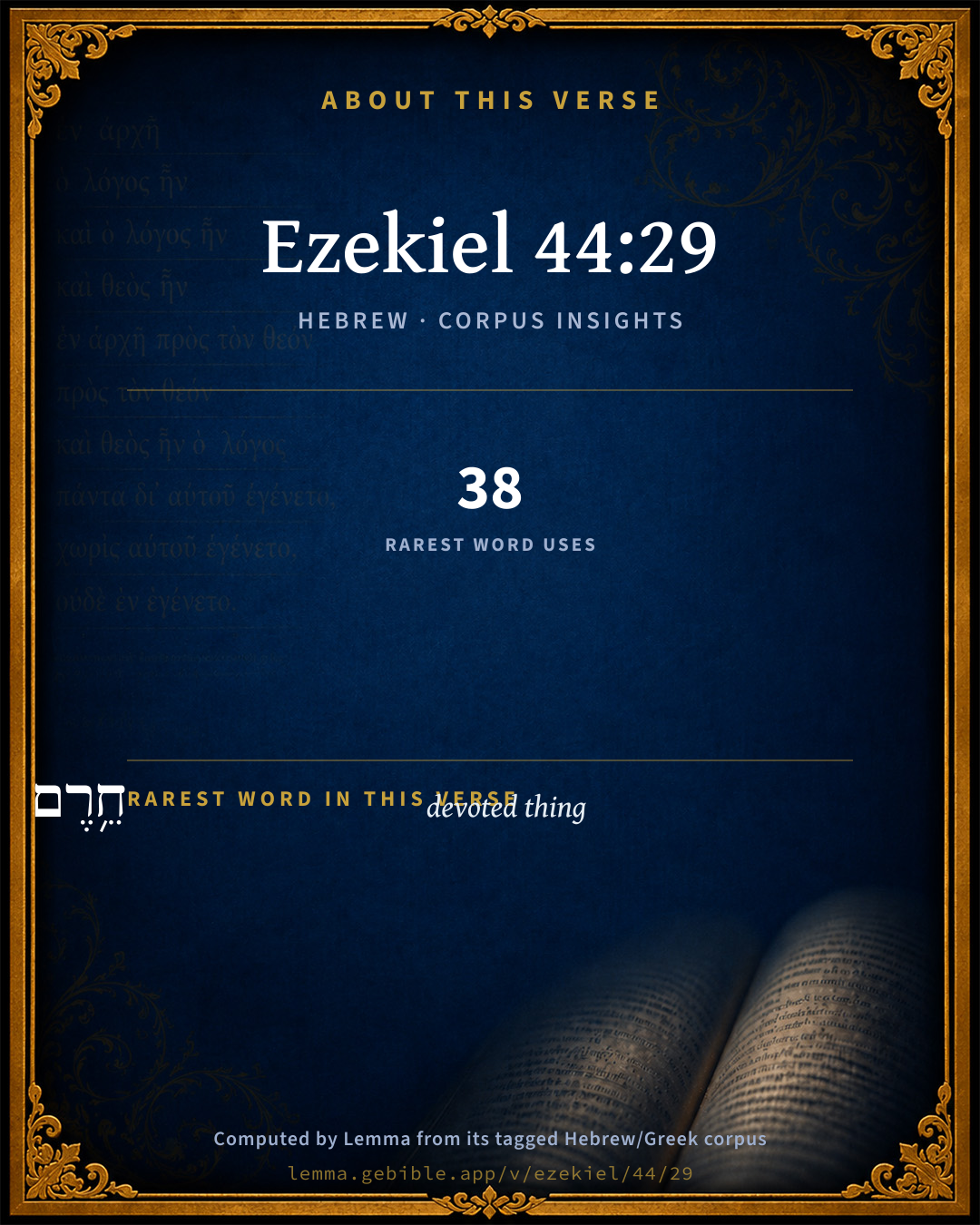
חֵ֥רֶם
chêrem
H2764
“devoted thing”
Noun, Common, Masculine, Singular, Absolute
Part of Speech
Noun
Type
Common
Gender
Masculine
Number
Singular
State
Absolute
Full BDB Definition

Origin: from H2763

TWOT: 744a , 745a

a thing devoted, thing dedicated, ban, devotion - a net, thing perforated - have been utterly destroyed, (appointed to) utter destruction
  1. הַמִּנְחָה֙ minchâh H4503 “the · offering” Particle, Definite Article + Noun, Common, Feminine, Singular, Absolute
  2. וְהַחַטָּ֣את chaṭṭâʼâh H2403 “and · the · sin offering” Conjunction + Particle, Definite Article + Noun, Common, Feminine, Singular, Absolute
  3. וְהָאָשָׁ֔ם ʼâshâm H817 “and · the · guilt” Conjunction + Particle, Definite Article + Noun, Common, Masculine, Singular, Absolute
  4. הֵ֖מָּה hêm H1992 “they” Pronoun, Personal, 3rd Person, Masculine, Plural
  5. יֹֽאכְל֑וּם ʼâkal H398 “to eat · them” Verb, Qal, Imperfect, 3rd Person, Masculine, Plural + Suffix, Personal, 3rd Person, Masculine, Plural
  6. וְכָל kôl H3605 “and · all of” Conjunction + Noun, Common, Masculine, Singular, Construct
  7. בְּיִשְׂרָאֵ֖ל Yisrâʼêl H3478 “in/at · Israel” Preposition + Noun, Proper
  8. יִהְיֶֽה hâyâh H1961 “to be” Verb, Qal, Imperfect, 3rd Person, Masculine, Singular

About this verse

These counts appear in no published source. They are computed here, from the morphology-tagged text and Lemma’s own curated glosses. What Lemma adds →

10
words
9
distinct lemmas
Prophets
section

Shared distinctive vocabulary

חֵ֥רֶם devoted thing H2764 occurs in 31 verses of the Hebrew Bible. Also found in:

Grammatical profile

  • 2 verbs
  • 6 nouns
  • 1 pronoun
  • 1 preposition

Verb forms

  • יֹֽאכְל֑וּם Qal · Imperfect
  • יִהְיֶֽה Qal · Imperfect

Hebrew & Septuagint length

In English translation the verse runs 20 words from the Hebrew and 21 from the Septuagint (LXX English) — closely comparable.

A rough comparison of the two English renderings, which tokenize alike — not a word-level alignment.

Word counts can differ between the Hebrew and the Greek without any difference in meaning — e.g. the Hebrew direct-object marker אֵת has no separate Greek word, and Greek often adds the article ὁ.

Cross-references

12

Topical passages linked to Ezekiel 44:29 in the Treasury of Scripture Knowledge — connected by theme and wording, ordered by reader-vote popularity; previews shown in the World English Bible.

  • Numbers 18:14 Everything devoted in Israel shall be yours.
  • Leviticus 27:21 but the field, when it goes out in the Jubilee, shall be holy to Yahweh, as a field devoted; it shall be owned by the priests.
  • Leviticus 27:28 "'Notwithstanding, no devoted thing, that a man shall devote to Yahweh of all that he has, whether of man or animal, or of the field of his possession, shall be sold or redeemed: every devoted thing is most holy to Yahweh.
  • Leviticus 6:14–18 "'This is the law of the meal offering: the sons of Aaron shall offer it before Yahweh, before the altar.
  • Leviticus 6:26 The priest who offers it for sin shall eat it. It shall be eaten in a holy place, in the court of the Tent of Meeting.
  • Leviticus 6:29 Every male among the priests shall eat of it: it is most holy.
  • Leviticus 7:6 Every male among the priests may eat of it. It shall be eaten in a holy place. It is most holy.
  • Leviticus 2:3 That which is left of the meal offering shall be Aaron's and his sons'. It is a most holy thing of the offerings of Yahweh made by fire.
  • Leviticus 2:10 That which is left of the meal offering shall be Aaron's and his sons'. It is a thing most holy of the offerings of Yahweh made by fire.
  • Numbers 18:9–11 This shall be your of the most holy things, [reserved] from the fire: every offering of theirs, even every meal-offering of theirs, and every sin-offering of theirs, and every trespass-offering of theirs, which they shall render to me, shall be most holy for you and for your sons.
  • 1 Corinthians 9:13–14 Don't you know that those who serve around sacred things eat from the things of the temple, and those who wait on the altar have their portion with the altar?
  • Hebrews 13:10 We have an altar from which those who serve the holy tabernacle have no right to eat.

Cross-references courtesy of OpenBible.info (CC BY 4.0).

Hebrew and Greek witnesses Masoretic Hebrew ↔ Greek Septuagint

The same verse in the two great witnesses to the Old Testament, shown verse-for-verse.

These are two independent witnesses, not word-aligned to each other, and the Septuagint is shown in lemma (dictionary) form.

Hebrew Ezekiel 44:29 Masoretic · Westminster Leningrad Codex

הַמִּנְחָה֙ וְהַחַטָּ֣את וְהָאָשָׁ֔ם הֵ֖מָּה יֹֽאכְל֑וּם וְכָל חֵ֥רֶם בְּיִשְׂרָאֵ֖ל לָהֶ֥ם יִהְיֶֽה

They shall eat the meal-offering, and the sin-offering, and the trespass-offering; and every devoted thing in Israel shall be theirs.

World English Bible · Public Domain

Greek LXX Ezekiel 44:29 Septuagint · lemma form

καί ὁ θυσία καί ὁ ὑπέρ ἁμαρτία καί ὁ ὑπέρ ἄγνοια οὗτος ἐσθίω καί πᾶς ἀφόρισμα ἐν ὁ ἰσραήλ αὐτός εἰμί

And these shall eat the meat-offerings, and the sin-offerings, and the trespass-offerings; and every special offering in Israel shall be theirs.

LXX2012 (modern English Septuagint) · Public Domain

Hebrew: Westminster Leningrad Codex (CC BY 4.0). Greek: Septuagint (public domain); English from LXX2012 (modern English Septuagint) (Public Domain). How the Septuagint differs from the Hebrew →

Targum (Aramaic paraphrase)

1

The Targum is the ancient Jewish Aramaic paraphrase of the Hebrew Scriptures — an interpretive translation, not the Hebrew text itself. Onkelos (literal) and Pseudo-Jonathan (expansive) render the Torah, and Jonathan the Prophets. Coverage is partial: where no permissively-licensed English translation exists for a verse, only the Aramaic is shown. This is verse-level text, not a word-by-word alignment to the Hebrew.

  1. Targum Jonathan Prophets (Joshua–Malachi)
    מִנְחֲתָא חֲטָאתָא וַאֲשָׁמָא אִינוּן יֵכְלוּנֵיהּ וְכָל חָרְמָא בְיִשְׂרָאֵל לְהוֹן יְהֵי:

    (no public-domain English translation for this verse)

    Targum Jonathan — Aramaic: “Mikraot Gedolot” (public domain). English: “Sefaria Community Translation” (CC0 1.0 (public-domain dedication)); “London "Chaldee Paraphrase," 1871” (public domain). Text via Sefaria.

Commentary

Notes on Ezekiel 44:29 from classic Christian and Jewish commentators (each source and its license shown beneath its notes). The classic Christian expositions comment on the surrounding passage and are grouped to its opening verse, so a note may address several verses; the Jewish commentaries on the Tanakh (Rashi and others) are per-verse, so they appear only where the commentator wrote on this verse.

Lemma curates 59 commentaries, every one of them public domain or Creative Commons licensed, each selected and text-cleaned for this edition rather than reprinted as found. About our sources →

Trapp's Complete Commentary

John Trapp

Eze 44:29 They shall eat the meat offering, and the sin offering, and the trespass offering; and every dedicated thing in Israel shall be theirs.

Ver. 29. They shall eat.] See on Eze 44:28.

John Trapp, A Commentary or Exposition upon All the Books of the Old and New Testament (1647–1656) — public domain. Text from a community e-Sword module.

The Cambridge Bible for Schools and Colleges

gen. ed. J. J. S. Perowne

29. Cf. Lev_2:3; Lev_7:9-11, for the meat-offering; Lev_6:18; Lev_7:6-7; Num_18:9-10, for the sin- and trespass-offerings; and for that put to the ban or “devoted” to Jehovah, Lev_27:28; Num_18:14. For “dedicated” as marg. devoted.

The Cambridge Bible for Schools and Colleges (gen. ed. J. J. S. Perowne; Cambridge University Press, 1878–1918) — public domain. Text from a community e-Sword module.

John Gill's Exposition

They shall eat the meat offering, and the sin offering, and the trespass offering,.... Which were typical of Christ; the meat offering, or rather bread offering, it being made of fine flour, was a type of Christ the bread of life; and the sin and trespass offerings pointed at his being made sin and a sacrifice for it; which the people and priests of the Lord in a spiritual sense eat, feed, and live upon by faith: and besides, as the priests under the law had a part in all these offerings, whereby they and their families were maintained, Lev 2:3, so it is the will and ordination of Christ, that as those that ministered about holy things, and waited at the altar, should live of them, and partake with that, so they that preach the Gospel should live by it, Co1 9:13,

and every dedicated thing in Israel shall be theirs; or, "every devoted thing" (s); that is, to holy uses, what the people willingly offer to support the interest of religion; signifying that the ministers of the word shall live upon the free contributions of the people.

(s) "omne anathema", Montanus, Junius & Tremellius, Piscator; "omne devotum", Cocceius, Starckius.

John Gill's Exposition of the Whole Bible (1746–1763) — public domain (CC PDM 1.0). Text via the HelloAO Bible API.

Matthew Poole's English Annotations

We must not think that the whole of these were eat, God had his part, and the priest his part too; somewhat of each came to the priest.

Every dedicated thing; as first-fruits, and tithes, &c., the priest had part of them.

Matthew Poole's English Annotations on the Holy Bible (1683–1685) — public domain. Text from a community e-Sword/MySword module.

Whedon's Commentary on the Bible

Daniel D. Whedon

29-31. The priests lived from the temple offerings, having as theirs the meat offering (Lev_2:1-16; Lev_6:14-16; Lev_7:9-11; Num_28:12-13), the sin offering (Lev_6:18-29; Lev_7:6; Lev_7:17; Num_18:9-10), the trespass [guilt] offering (Lev_7:28-38), and every dedicated [devoted] thing in Israel (Lev_27:26; Lev_27:28; Num_18:14), and the first [or, best] of all the first fruits of all things (Exo_23:19; Num_18:13), and every oblation, or, heave offering (Num_15:19; Num_18:19); that is, “any portion of one’s property offered to the deity in gratitude for past favors or in hope of future favors;” and the first of the dough or “coarse meal” (Num_15:20-21). The priest, as all the people, must be careful only to eat food properly killed (Exo_22:31; Deu_14:21; Lev_16:15; Lev_22:8). In the light of recent medical science this, like the majority of the Levitical injunctions, is seen to be a healthful precaution. (For kitchen of the priests see L on chart, facing page 209, and Eze_46:19-24.)

Daniel D. Whedon (gen. ed.), Commentary on the Old and New Testaments (1874–1909) — public domain. Text from a community e-Sword module.

The Pulpit Commentary

To the priests should be allocated, in addition, what already had been assigned them by the Law for their support, the meat (or, meal) offering, consisting of flour, corn, or bread (comp. Lev_2:1-16; Num_28:12, Num_28:13) and the sin offering. (see Lev_6:25-29 Lev_7:6; Num_18:9, Num_18:10) and the trespass (or, guilt) offering, (Lev_7:28-38) and every dedicated (or, devoted) thing in Israel. (see Lev_27:21; Num_18:14) The burnt offering is omitted, because it was entirely consumed upon the altar, with the exception of the hide or skin, which under the Law became a perquisite of the officiating priest. (Lev_7:8) That Ezekiel is silent about this, while the requirement of Lev_7:30, that the priest should obtain the breast with the right shoulder of every fire offering, goes beyond the prescription of Deu_18:3, that the shoulder, two cheeks, and the maw should be the priest"s portion, is regarded by Wellhausen and Smend as a proof that Ezekiel stands between Deuteronomy and the priest-code. But as Ezekiel does not condescend upon the particular parts which should be reserved from the fire offerings, it is impossible to say whether he held with the Deuteronomist or the writer of the priest-code, supposing them to be different; and, inasmuch as Lev_7:30 speaks of an offerings, by fire that was first paid to Jehovah and by him afterwards handed over to Aaron and his sons, while Deu_18:3 treats of the dues which should be paid by the people directly to the priests, it is clear that both practices may have existed together instead of the one (the former) coming in as an advance upon the other (the latter); see Keil on Deu_18:3.

The devoted thing.

There were objects, both animate and inanimate, in connection with the worship and the sacrifices of the temple, which were in an especial sense dedicated and devoted to the Lord. By this provision, spiritual instruction was afforded, and religious reverence was encouraged. As in the Christian dispensation nothing is common or unclean, we are taught to regard everything that belongs to and is associated with the Christian as consecrated to the Lord.

I ALL THAT THE CHRISTIAN HAS IS DEVOTED TO THE LORD IN VIRTUE OF WHAT THE LORD HAS DONE FOR HIM.

1. Everything is the Lord"s gift. What have we that we did not receive?

2. Everything is redeemed by Christ, who, in giving himself a ransom for us, redeemed our possessions and our powers unto himself.

II ALL THAT THE CHRISTIAN HAS IS DEVOTED TO THE LORD IN VIRTUE OF HIS CONSCIOUS SURRENDER AND DELIBERATE CONSECRATION OF HIMSELF TO HIS REDEEMING GOD. The dedication which the true Christian has made of himself to his Savior is unreserved.

Yet if I might make some reserve, And duty did not can, I love my Lord with zeal so great That I would give thee all!

As it was foretold that upon the bells of the horses should be inscribed, "Holiness unto the Lord," so, as a matter of fact, should the sincere Christian devote to his Redeemer all the common possessions, all the daily opportunities, with which Providence enriches him.

III THE PRINCIPLE LENDS A NEW BEAUTY AND DIGNITY TO ALL THAT THE CHRISTIAN OWNS AND DOES. Every Christian"s life is dedicated, and all his property and all his talents and influence are devoted. He is not his own. Thus the light of heaven is shed upon the darkness of earth, and common things are not without a glory, because they are sanctified and ennobled as used for the service and the praise of God. T.

The Pulpit Commentary (1880–1919), ed. H.D.M. Spence-Jones & Joseph S. Exell — public domain. Text from a community e-Sword module.

Rashi

Rabbi Shlomo Yitzchaki (Rashi)

and everything that is holy [Heb. חֶרֶם,] an expression of sanctity, and so is every expression of חֶרֶם [when used] in the context of hallowed things.

Rashi on the Tanakh — English translations: “The Judaica Press complete Tanach with Rashi, translated by A. J. Rosenberg” (CC BY 4.0); “Pentateuch with Rashi's commentary by M. Rosenbaum and A.M. Silbermann, 1929-1934” (public domain); “The Metsudah Tanach series, Lakewood, N.J” (CC BY 4.0); and “The Book of Joshua, Metsudah Publications, 1997” (CC BY 4.0). Text via Sefaria.

Lesson kit

Teaching starters — assembled from the data on this page, not authored interpretation. Every prompt links to the verse data it draws on. Edit before teaching.

Ezekiel, in the Prophets, opens this verse with 10 words (9 distinct Hebrew lemmas). Its most distinctive word is chêrem (“devoted thing”). A historical commentator’s framing appears above. Read the whole chapter for the surrounding context.

Discussion questions

  1. How does “devoted thing” (chêrem) shape what this verse is saying?
  2. Leviticus 27:21 shares the word «devoted thing» with this verse. How do the two illuminate each other?
  3. These translations render this verse differently. What is at stake in choosing one wording over another?
  4. The verb «יֹֽאכְל֑וּם» is Qal Imperfect. How does its form color the action?
  5. Reading how Trapp's Complete Commentary and The Cambridge Bible for Schools and Colleges read this verse, where do the two commentators agree and where do they part?

Things to notice

Reading settings

Reading text

Shown beneath each verse's original-language words.

Old Testament
Old Testament edition

Read the OT as the Masoretic Hebrew (MT) or the Greek Septuagint (LXX).

English shown for the Greek Septuagint (in the Hebrew ↔ Greek comparison).

Comparing translations? Open the Compare panel on any verse page to stack up to four side by side.