
1 Kings 15:3

Hebrew (Westminster Leningrad Codex) 1 Kings 15:3 appears in the Hebrew Old Testament. The text above is from the Westminster Leningrad Codex. Each word links to its Strong’s number, a concise gloss, and parsing drawn from the Open Scriptures Hebrew Bible morphology. Click any word for its full Brown-Driver-Briggs (BDB) entry.
Download image
Cite this verse

1 Kings 15:3 (World English Bible). Public Domain. Lemma interlinear Bible study tool, https://lemma.gebible.app/v/1-kings/15/3.

Show BibTeX & RIS
BibTeX
RIS
English Translation
He walked in all the sins of his father, which he had done before him; and his heart was not perfect with Yahweh his God, as the heart of David his father.
World English Bible · Public Domain
Download a study sheet

One document with this verse’s original text, its word-by-word gloss line, the meaning frame, cross-references with their text, attributed commentary, and full source and license credits — printable, and it pastes into notes with its structure intact.

This verse Autodidact and up

Study sheet (.html) Plain text (.txt)

A passage Seminary Student

Up to 50 verses in one chapter. A passage sheet keeps up to 6 commentary sources and 12 cross-references per verse, in the order this page ranks them, and says so on the sheet whenever that leaves anything out. Ask for a single verse and you get the Autodidact verse sheet above.

Everything on this page stays free to read, with no account — the sheet is a download of what is already on screen, not access to it.

Want to remove ads? Support Godless Engineer
Compare translations 3

The same verse in 3 English versions, stacked beneath the original-language interlinear above. Click any original word for its lexicon entry.

Each is an independent rendering of the whole verse — the interlinear is not word-aligned to these translations.

Highlighted words mark where these versions differ — a whole-verse word diff, not a word-by-word alignment.

  • World English Bible Public Domain
    He walked in all the sins of his father, which he had done before him; and his heart was not perfect with Yahweh his God, as the heart of David his father.
  • King James Version Public Domain
    And he walked in all the sins of his father, which he had done before him: and his heart was not perfect with the LORD his God, as the heart of David his father.
  • unfoldingWord Literal Text CC BY-SA 4.0
    And he walked in all of the sins of his father that he had done to his face. And his heart was not complete with Yahweh his God like the heart of David his father.

unfoldingWord Literal Text — © unfoldingWord, licensed CC BY-SA 4.0. Word-aligned USFM3 via Door43 (git.door43.org/unfoldingWord/en_ult).

Versions to compare (up to 4)

3 of 4 selected

Show all 18 translations

Every available English version of this verse, each an independent rendering of the whole verse.

  • World English Bible Public Domain
    He walked in all the sins of his father, which he had done before him; and his heart was not perfect with Yahweh his God, as the heart of David his father.
  • Berean Standard Bible Public Domain
    And Abijam walked in all the sins that his father before him had committed, and his heart was not as fully devoted to the LORD his God as the heart of David his forefather had been.
  • Majority Standard Bible Public Domain
    And Abijam walked in all the sins that his father before him had committed, and his heart was not as fully devoted to the LORD his God as the heart of David his forefather had been.
  • King James Version Public Domain
    And he walked in all the sins of his father, which he had done before him: and his heart was not perfect with the LORD his God, as the heart of David his father.
  • American Standard Version (1901) Public Domain
    And he walked in all the sins of his father, which he had done before him; and his heart was not perfect with Jehovah his God, as the heart of David his father.
  • Revised Version (1885) Public Domain
    And he walked in all the sins of his father, which he had done before him: and his heart was not perfect with the LORD his God, as the heart of David his father.
  • Geneva Bible (1599) Public Domain
    And hee walked in all the sinnes of his father, which hee had done before him: and his heart was not perfit with the Lord his God as the heart of Dauid his father.
  • Douay-Rheims (1899) Public Domain
    And he walked in all the sins of his father, which he had done before him: end his heart was not perfect with the Lord his God, as was the heart of David his father.
  • Young's Literal Translation Public Domain
    and he walketh in all the sins of his father, that he did before him, and his heart hath not been perfect with Jehovah his God, as the heart of David his father;
  • Literal Standard Version CC BY-SA 4.0
    and he walks in all the sins of his father that he did before him, and his heart has not been perfect with his God YHWH, as the heart of his father David;
  • Unlocked Literal Bible CC BY-SA 4.0
    He walked in all the sins that his father had committed before his time; his heart was not devoted to Yahweh his God as the heart of David, his ancestor, had been.
  • unfoldingWord Literal Text CC BY-SA 4.0
    And he walked in all of the sins of his father that he had done to his face. And his heart was not complete with Yahweh his God like the heart of David his father.
  • Darby Bible Public Domain
    And he walked in all the sins of his father, which he had done before him; and his heart was not perfect with Jehovah his God, as the heart of David his father.
  • World Messianic Bible Public Domain
    He walked in all the sins of his father, which he had done before him; and his heart was not perfect with the LORD his God, as the heart of David his father.
  • Webster's Bible Public Domain
    And he walked in all the sins of his father, which he had done before him: and his heart was not perfect with the LORD his God, as the heart of David his father.
  • Free Bible Version CC BY-SA 4.0
    Abijam committed all the sins his father had before him. He was not wholly dedicated to the Lord his God as his forefather David had been.
  • Bible in Basic English Public Domain
    And he did the same sins which his father had done before him: his heart was not completely true to the Lord his God, like the heart of David his father.
  • JPS Tanakh (1917) Public Domain
    And he walked in all the sins of his father, which he had done before him; and his heart was not whole with the LORD his God, as the heart of David his father.

Literal Standard Version (2020), Covenant Press — licensed CC BY-SA 4.0. Text via the HelloAO Bible API (eBible.org). Unlocked Literal Bible (unfoldingWord) — licensed CC BY-SA 4.0. Text via the HelloAO Bible API (eBible.org). unfoldingWord Literal Text — © unfoldingWord, licensed CC BY-SA 4.0. Word-aligned USFM3 via Door43 (git.door43.org/unfoldingWord/en_ult). Free Bible Version, Dr. Jonathan Gallagher — licensed CC BY-SA 4.0. Text via the HelloAO Bible API (eBible.org).

Word by word

More ways to search: Search by grammar → Find every occurrence → Compare this word →

Practice this passage: Drill this verse → Learn its vocabulary →

שָׁלֵם֙
shâlêm
H8003
“complete”
Adjective, Adjective, Masculine, Singular, Absolute
Part of Speech
Adjective
Type
Adjective
Gender
Masculine
Number
Singular
State
Absolute
Full BDB Definition

Origin: from H7999

TWOT: 2401d

complete, safe, peaceful, perfect, whole, full, at peace - complete - full, perfect - finished - safe, unharmed - peace (of covenant of peace, mind) - perfect, complete (of keeping covenant relation)
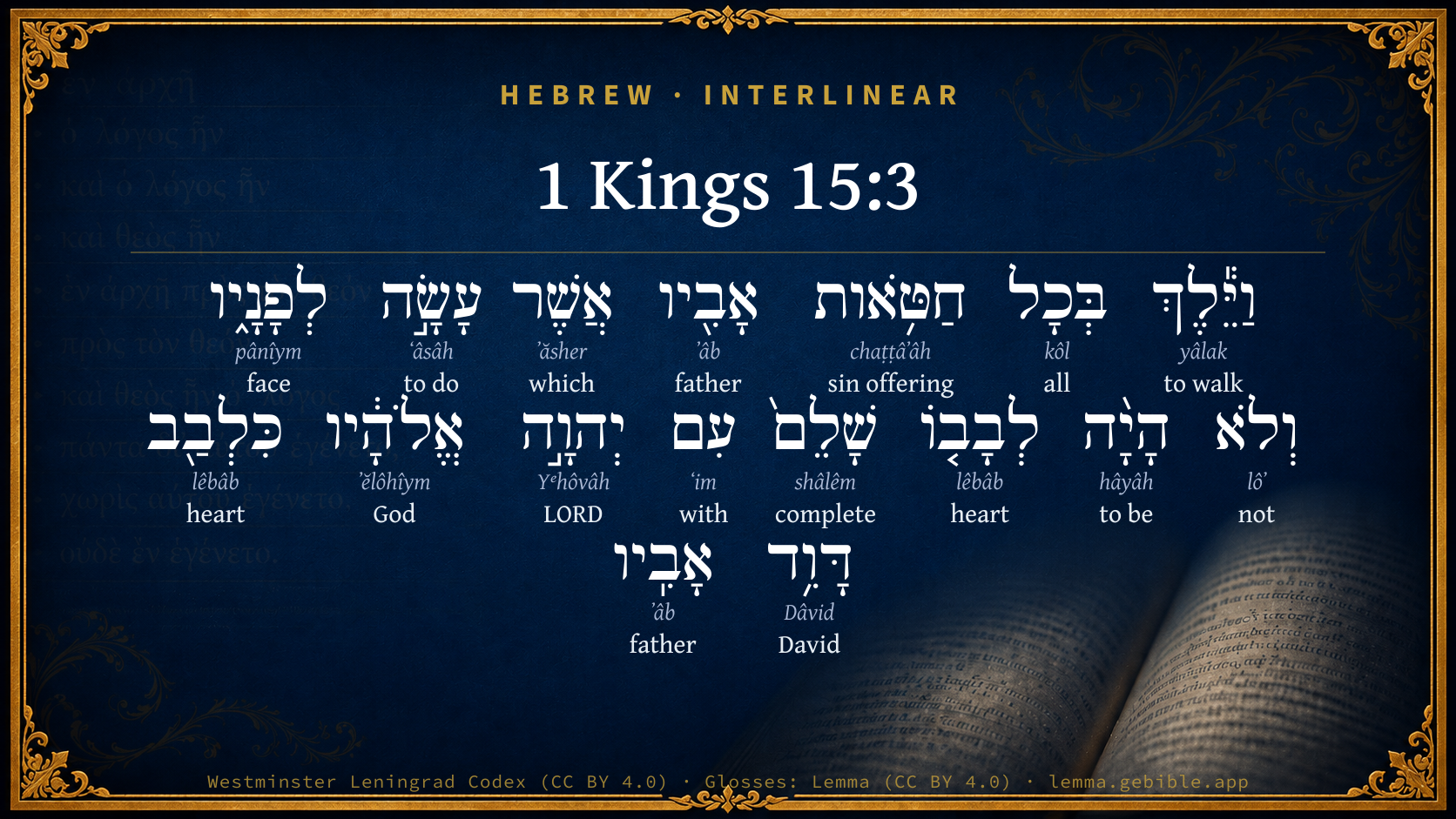
  1. וַיֵּ֕לֶךְ yâlak H3212 “and · to walk” Conjunction + Verb, Qal, Sequential Imperfect, 3rd Person, Masculine, Singular
  2. בְּכָל kôl H3605 “in/at · all of” Preposition + Noun, Common, Masculine, Singular, Construct
  3. חַטֹּ֥אות chaṭṭâʼâh H2403 “sin offerings of” Noun, Common, Feminine, Plural, Construct
  4. אָבִ֖יו ʼâb H1 “father · his” Noun, Common, Masculine, Singular, Construct + Suffix, Personal, 3rd Person, Masculine, Singular
  5. אֲשֶׁר ʼăsher H834 “which” Particle, Relative
  6. עָשָׂ֣ה ʻâsâh H6213 “to do” Verb, Qal, Perfect, 3rd Person, Masculine, Singular
  7. לְפָנָ֑יו pânîym H6440 “to/for · face(s) · his” Preposition + Noun, Common, Both, Plural, Construct + Suffix, Personal, 3rd Person, Masculine, Singular
  8. וְלֹא lôʼ H3808 “and · not” Conjunction + Particle, Negative
  9. הָיָ֨ה hâyâh H1961 “to be” Verb, Qal, Perfect, 3rd Person, Masculine, Singular
  10. לְבָב֤וֹ lêbâb H3824 “heart · his” Noun, Common, Masculine, Singular, Construct + Suffix, Personal, 3rd Person, Masculine, Singular
  11. עִם ʻim H5973 “with” Preposition
  12. יְהוָ֣ה Yᵉhôvâh H3068 “LORD” Noun, Proper
  13. אֱלֹהָ֔יו ʼĕlôhîym H430 “God(s) · his” Noun, Common, Masculine, Plural, Construct + Suffix, Personal, 3rd Person, Masculine, Singular
  14. כִּלְבַ֖ב lêbâb H3824 “like/as · heart of” Preposition + Noun, Common, Masculine, Singular, Construct
  15. דָּוִ֥ד Dâvid H1732 “David” Noun, Proper
  16. אָבִֽיו ʼâb H1 “father · his” Noun, Common, Masculine, Singular, Construct + Suffix, Personal, 3rd Person, Masculine, Singular

About this verse

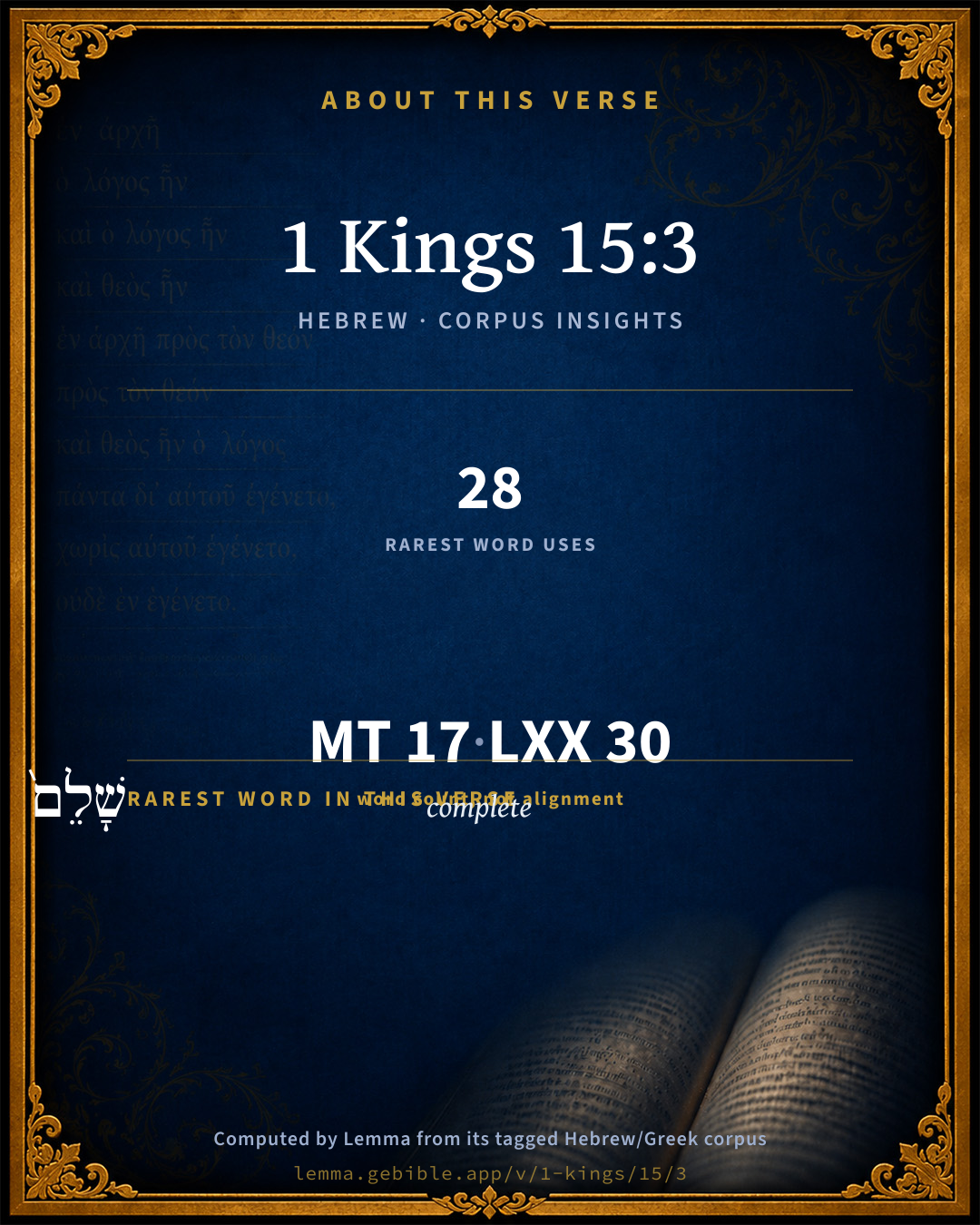
These counts appear in no published source. They are computed here, from the morphology-tagged text and Lemma’s own curated glosses. What Lemma adds →

17
words
15
distinct lemmas
Historical
section

Shared distinctive vocabulary

שָׁלֵם֙ complete H8003 occurs in 27 verses of the Hebrew Bible. Also found in:

Grammatical profile

  • 3 verbs
  • 10 nouns
  • 1 adjective
  • 1 preposition
  • 2 particles

Verb forms

  • וַיֵּ֕לֶךְ Qal · Sequential Imperfect
  • עָשָׂ֣ה Qal · Perfect
  • הָיָ֨ה Qal · Perfect

Repetition

Words recur within this verse — often emphatic in Hebrew:

  • אָבִ֖יו father H1 ×2
  • לְבָב֤וֹ heart H3824 ×2

Hebrew & Septuagint length

In English translation the verse runs 32 words from the Hebrew and 34 from the Septuagint (LXX English) — closely comparable.

A rough comparison of the two English renderings, which tokenize alike — not a word-level alignment.

Word counts can differ between the Hebrew and the Greek without any difference in meaning — e.g. the Hebrew direct-object marker אֵת has no separate Greek word, and Greek often adds the article ὁ.

In the original languages it is 17 Hebrew tokens and 30 Greek tokens — but the two are counted differently (Hebrew bundles its prefixes and suffixes into one token; the Greek is in lemma form), so that isn’t a like-for-like length.

Cross-references

8

Topical passages linked to 1 Kings 15:3 in the Treasury of Scripture Knowledge — connected by theme and wording, ordered by reader-vote popularity; previews shown in the World English Bible.

  • 1 Kings 11:4 For it happened, when Solomon was old, that his wives turned away his heart after other gods; and his heart was not perfect with Yahweh his God, as was the heart of David his father.
  • Psalms 119:80 Let my heart be blameless toward your decrees, That I may not be disappointed.
  • 1 Kings 3:14 If you will walk in my ways, to keep my statutes and my commandments, as your father David did walk, then I will lengthen your days.
  • 1 Kings 11:33 because that they have forsaken me, and have worshiped Ashtoreth the goddess of the Sidonians, Chemosh the god of Moab, and Milcom the god of the children of Ammon; and they have not walked in my ways, to do that which is right in my eyes, and [to keep] my statutes and my ordinances, as did David his father.
  • 1 Kings 14:21–22 Rehoboam the son of Solomon reigned in Judah. Rehoboam was forty-one years old when he began to reign, and he reigned seventeen years in Jerusalem, the city which Yahweh had chosen out of all the tribes of Israel, to put his name there: and his mother's name was Naamah the Ammonitess.
  • 2 Kings 20:3 Remember now, Yahweh, I beg you, how I have walked before you in truth and with a perfect heart, and have done that which is good in your sight. Hezekiah wept sore.
  • 2 Chronicles 31:20–21 Thus did Hezekiah throughout all Judah; and he worked that which was good and right and faithful before Yahweh his God.
  • 2 Chronicles 25:2 He did that which was right in the eyes of Yahweh, but not with a perfect heart.

Cross-references courtesy of OpenBible.info (CC BY 4.0).

Hebrew and Greek witnesses Masoretic Hebrew ↔ Greek Septuagint

The same verse in the two great witnesses to the Old Testament, shown verse-for-verse.

These are two independent witnesses, not word-aligned to each other, and the Septuagint is shown in lemma (dictionary) form.

Hebrew 1 Kings 15:3 Masoretic · Westminster Leningrad Codex

וַיֵּ֕לֶךְ בְּכָל חַטֹּ֥אות אָבִ֖יו אֲשֶׁר עָשָׂ֣ה לְפָנָ֑יו וְלֹא הָיָ֨ה לְבָב֤וֹ שָׁלֵם֙ עִם יְהוָ֣ה אֱלֹהָ֔יו כִּלְבַ֖ב דָּוִ֥ד אָבִֽיו

He walked in all the sins of his father, which he had done before him; and his heart was not perfect with Yahweh his God, as the heart of David his father.

World English Bible · Public Domain

Greek LXX 1 Kings 15:3 Septuagint · lemma form

καί πορεύομαι ἐν ὁ ἁμαρτία ὁ πατήρ αὐτός ὅς ποιέω ἐνώπιον αὐτός καί οὐ εἰμί ὁ καρδία αὐτός τέλειος μετά κύριος θεός αὐτός ὡς ὁ καρδία δαυίδ ὁ πατήρ αὐτός

And he walked in the sins of his father which he wrought in his presence, and his heart was not perfect with the Lord his God, as was the heart of his father David.

LXX2012 (modern English Septuagint) · Public Domain

On this verse, The Cambridge Bible for Schools and Colleges discusses the Septuagint’s reading. Read the note in Commentary ↓

Hebrew: Westminster Leningrad Codex (CC BY 4.0). Greek: Septuagint (public domain); English from LXX2012 (modern English Septuagint) (Public Domain). How the Septuagint differs from the Hebrew →

Targum (Aramaic paraphrase)

1

The Targum is the ancient Jewish Aramaic paraphrase of the Hebrew Scriptures — an interpretive translation, not the Hebrew text itself. Onkelos (literal) and Pseudo-Jonathan (expansive) render the Torah, and Jonathan the Prophets. Coverage is partial: where no permissively-licensed English translation exists for a verse, only the Aramaic is shown. This is verse-level text, not a word-by-word alignment to the Hebrew.

  1. Targum Jonathan Prophets (Joshua–Malachi)
    וַאֲזֵל בְּכָל חוֹבֵי אֲבוּהִי דַעֲבַד קָדָמוֹהִי וְלָא הֲוָה לִבֵיהּ שְׁלִים בִּדְחַלְתֵּיהּ דַייָ אֱלָהֵיהּ כְּלִבֵּיהּ דְדָוִד אֲבוּהִי:

    (no public-domain English translation for this verse)

    Targum Jonathan — Aramaic: “Mikraot Gedolot” (public domain). English: “Sefaria Community Translation” (CC0 1.0 (public-domain dedication)); “London "Chaldee Paraphrase," 1871” (public domain). Text via Sefaria.

Commentary

Notes on 1 Kings 15:3 from classic Christian and Jewish commentators (each source and its license shown beneath its notes). The classic Christian expositions comment on the surrounding passage and are grouped to its opening verse, so a note may address several verses; the Jewish commentaries on the Tanakh (Rashi and others) are per-verse, so they appear only where the commentator wrote on this verse.

Lemma curates 59 commentaries, every one of them public domain or Creative Commons licensed, each selected and text-cleaned for this edition rather than reprinted as found. About our sources →

Trapp's Complete Commentary

John Trapp

1Ki 15:3 And he walked in all the sins of his father, which he had done before him: and his heart was not perfect with the LORD his God, as the heart of David his father.

Ver. 3. And he walked in all the sins.] Though at first he seemed to be somewhat good, {2Ch 13:12} yet soon after he showed himself in his colours.

Which he had done before him.] That is, In his sight, whereby he became an ill precedent to him.

John Trapp, A Commentary or Exposition upon All the Books of the Old and New Testament (1647–1656) — public domain. Text from a community e-Sword module.

Tyndale Open Study Notes

Tyndale Open Resources

15:3-5 Despite Abijam’s unfaithfulness, God remained faithful to his covenant with David (2 Sam 7:12-16; Ps 89:19-29) and preserved David’s line on Judah’s throne. Each king that followed David was to be a lamp, dispensing the light of God’s grace (1 Kgs 11:36).

Tyndale Open Study Notes — © Tyndale Open Resources, licensed CC BY-SA 4.0. Text via the HelloAO Bible API.

Jamieson, Fausset & Brown

Robert Jamieson, A. R. Fausset & David Brown

his heart was not perfect with the Lord . . . , as the heart of David his father--(Compare Kg1 11:4; Kg1 14:22). He was not positively bad at first, for it appears that he had done something to restore the pillaged treasures of the temple (Kg1 15:15). This phrase contains a comparative reference to David's heart. His doing that which was right in the eyes of the Lord (Kg1 15:5) is frequently used in speaking of the kings of Judah, and means only that they did or did not do that which, in the general course and tendency of their government, was acceptable to God. It furnishes no evidence as to the lawfulness or piety of one specific act.

Jamieson, Fausset & Brown — Commentary Critical and Explanatory on the Whole Bible (1871) — public domain (CC PDM 1.0). Text via the HelloAO Bible API.

Adam Clarke's Commentary

Verse 3. His heart was not perfect] He was an idolater, or did not support the worship of the true God. This appears to be the general meaning of the heart not being perfect with God.

Adam Clarke's Commentary on the Bible (1810–1826) — public domain. Text from a community e-Sword/MySword module.

Ellicott's Commentary for English Readers

(3) Walked in all the sins of his father.—This adoption of the idolatries of Rehoboam did not prevent Abijam (see 2Ch_13:4-12) from representing himself as the champion of the Temple and the priesthood against the rival worship of Jeroboam, and dedicating treasures—perhaps the spoils of his victory—in the house of the Lord. From the qualified phrase “his heart was not perfect before God,” however, it may be inferred that, like Solomon and Rehoboam, he professed to worship Jehovah only as the supreme God of his Pantheon; and it is a curious irony of circumstance that he should be recorded as inveighing against the degradation of His worship in Israel, while he himself countenanced or connived at the worse sin of the worship of rival gods in Judah.

A Bible Commentary for English Readers, edited by Charles John Ellicott (1878–1897) — public domain. Text from a community e-Sword module.

The Cambridge Bible for Schools and Colleges

gen. ed. J. J. S. Perowne

3. And he walked in all the sins of his father] The LXX. omits ‘all.’ For an account of the sins of Rehoboam see above 1Ki_14:22-24.

as the heart of David his father] The LXX. omits ‘David.’ The word ‘perfect’ as here applied to David, does not mean that he did not offend, but that he aimed at keeping the law of God, and was deeply penitent for his sin when he fell into it. It was this prompt repentance, and return to what was right, which made David to differ from most of the kings who came after him.

The Cambridge Bible for Schools and Colleges (gen. ed. J. J. S. Perowne; Cambridge University Press, 1878–1918) — public domain. Text from a community e-Sword module.

John Gill's Exposition

Nevertheless, for David's sake did the Lord his God give him a lamp in Jerusalem,.... A kingdom there, as the Targum, splendid and glorious, to be continued in his posterity: to set up his son after him; in it:

and to establish Jerusalem: to continue that in which the temple was, for the sake of which, and the worship of God in it, there was a succession of David's posterity on the throne of Judah.

John Gill's Exposition of the Whole Bible (1746–1763) — public domain (CC PDM 1.0). Text via the HelloAO Bible API.

Albert Barnes' Notes on the Bible

He walked in all the sins of his father - Yet Abijam prepared precious offerings for the temple service 1Ki 15:15, probably to replace vessels which Shishak had carried off, and in his war with Jeroboam professed himself a faithful servant of Yahweh 2Ch 13:10-12.

Albert Barnes' Notes on the Bible (1834–1885) — public domain. Text from a community e-Sword/MySword module.

Matthew Poole's English Annotations

In all the sins of his father; which his father lived in; either, first, Before his humiliation. Or rather, secondly, After his deliverance from Shishak, when, though he did not openly renounce the worship of God, he seems to have relapsed into his former sins; which otherwise would not have been remembered against him; as David’s name and memory is never loaded with the shame of his sins, because he truly repented of them.

Matthew Poole's English Annotations on the Holy Bible (1683–1685) — public domain. Text from a community e-Sword/MySword module.

Whedon's Commentary on the Bible

Daniel D. Whedon

3. In all the sins of his father — The writer of Chronicles makes no mention of Abijah’s sins, though he dwells on other facts of his history in far greater detail than the writer of Kings.

Not perfect — See note at 1Ki_11:4.

Daniel D. Whedon (gen. ed.), Commentary on the Old and New Testaments (1874–1909) — public domain. Text from a community e-Sword module.

The Pulpit Commentary

And he walked in all the sins of his father, which he had done before him sins, i.e. , from the theocratic standpoint. See 1Ki_14:22, 1Ki_14:25. It does not appear that either Abijah or Rehoboam was a vicious man, and from his pious language on Mount Zemaraim (2Ch_13:10-12) we should certainly have thought that Abijah was a god-fearing prince. But ver. 13 proves that he had sanctioned idolatry, and this was no doubt his principal sin, as the next words explain: and his heart was not perfect with the Lord and his God, as the heart of David his father the words used of Solomon. (1Ki_2:4)

The Pulpit Commentary (1880–1919), ed. H.D.M. Spence-Jones & Joseph S. Exell — public domain. Text from a community e-Sword module.

Keil & Delitzsch

C. F. Keil & F. Delitzsch

Abijam walked as king in the footsteps of his father. Although he made presents to the temple (Kg1 15:15), his heart was not שׁלם, wholly or undividedly given to the Lord, like the heart of David (cf., Kg1 11:4); but (כּי, after a previous negative) for David's sake Jehovah had left him a light in Jerusalem, to set up his son after him and to let Jerusalem stand, because (אשׁר) David had done right in the eyes of God, etc., i.e., so that it was only for David's sake that Jehovah did not reject him, and allowed the throne to pass to his son. For the fact itself compare Kg1 11:13, Kg1 11:36; and for the words, "except in the matter of Uriah the Hittite," see 2 Sam 11 and 12.

Keil & Delitzsch — Biblical Commentary on the Old Testament (1861–1891) — public domain (CC PDM 1.0). Text via the HelloAO Bible API. (Old Testament only.)

Lesson kit

Teaching starters — assembled from the data on this page, not authored interpretation. Every prompt links to the verse data it draws on. Edit before teaching.

1 Kings, in the Historical, opens this verse with 17 words (15 distinct Hebrew lemmas). Its most distinctive word is shâlêm (“complete”). A historical commentator’s framing appears above. Read the whole chapter for the surrounding context.

Discussion questions

  1. The word shâlêm carries the sense “complete.” How does it shape the verse?
  2. Genesis 15:16 shares the word «complete» with this verse. How do the two illuminate each other?
  3. “father” occurs 2× in this one verse. What is the effect of the repetition?
  4. These translations render this verse differently. What is at stake in choosing one wording over another?
  5. The verb «וַיֵּ֕לֶךְ» is Qal Sequential Imperfect. How does its form color the action?
  6. Reading how Trapp's Complete Commentary and Tyndale Open Study Notes read this verse, where do the two commentators agree and where do they part?

Things to notice

Reading settings

Reading text

Shown beneath each verse's original-language words.

Old Testament
Old Testament edition

Read the OT as the Masoretic Hebrew (MT) or the Greek Septuagint (LXX).

English shown for the Greek Septuagint (in the Hebrew ↔ Greek comparison).

Comparing translations? Open the Compare panel on any verse page to stack up to four side by side.