
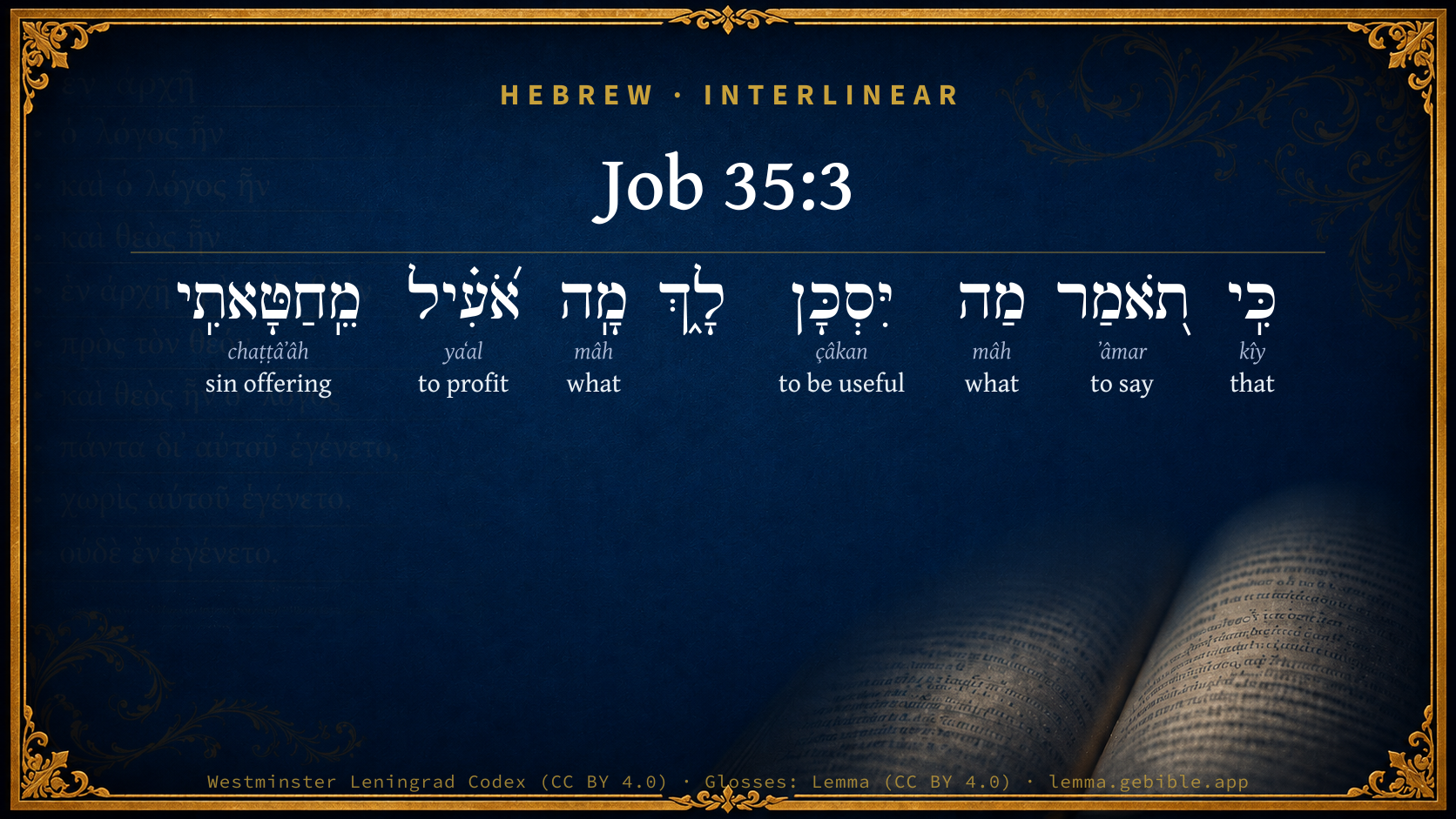
Job 35:3

Hebrew (Westminster Leningrad Codex) Job 35:3 appears in the Hebrew Old Testament. The text above is from the Westminster Leningrad Codex. Each word links to its Strong’s number, a concise gloss, and parsing drawn from the Open Scriptures Hebrew Bible morphology. Click any word for its full Brown-Driver-Briggs (BDB) entry.
Download image
Cite this verse

Job 35:3 (World English Bible). Public Domain. Lemma interlinear Bible study tool, https://lemma.gebible.app/v/job/35/3.

Show BibTeX & RIS
BibTeX
RIS
English Translation
That you ask, 'What advantage will it be to you? What profit shall I have, more than if I had sinned?'
World English Bible · Public Domain
Download a study sheet

One document with this verse’s original text, its word-by-word gloss line, the meaning frame, cross-references with their text, attributed commentary, and full source and license credits — printable, and it pastes into notes with its structure intact.

This verse Autodidact and up

Study sheet (.html) Plain text (.txt)

A passage Seminary Student

Up to 50 verses in one chapter. A passage sheet keeps up to 6 commentary sources and 12 cross-references per verse, in the order this page ranks them, and says so on the sheet whenever that leaves anything out. Ask for a single verse and you get the Autodidact verse sheet above.

Everything on this page stays free to read, with no account — the sheet is a download of what is already on screen, not access to it.

Want to remove ads? Support Godless Engineer
Compare translations 3

The same verse in 3 English versions, stacked beneath the original-language interlinear above. Click any original word for its lexicon entry.

Each is an independent rendering of the whole verse — the interlinear is not word-aligned to these translations.

Highlighted words mark where these versions differ — a whole-verse word diff, not a word-by-word alignment.

  • World English Bible Public Domain
    That you ask, 'What advantage will it be to you? What profit shall I have, more than if I had sinned?'
  • King James Version Public Domain
    For thou saidst, What advantage will it be unto thee? and, What profit shall I have, if I be cleansed from my sin?
  • unfoldingWord Literal Text CC BY-SA 4.0
    For you have said, ‘What does it benefit you? What do I gain more than my sin?’

unfoldingWord Literal Text — © unfoldingWord, licensed CC BY-SA 4.0. Word-aligned USFM3 via Door43 (git.door43.org/unfoldingWord/en_ult).

Versions to compare (up to 4)

3 of 4 selected

Show all 18 translations

Every available English version of this verse, each an independent rendering of the whole verse.

  • World English Bible Public Domain
    That you ask, 'What advantage will it be to you? What profit shall I have, more than if I had sinned?'
  • Berean Standard Bible Public Domain
    For you ask, ‘What does it profit me, and what benefit do I gain apart from sin?’
  • Majority Standard Bible Public Domain
    For you ask, ‘What does it profit me, and what benefit do I gain apart from sin?’
  • King James Version Public Domain
    For thou saidst, What advantage will it be unto thee? and, What profit shall I have, if I be cleansed from my sin?
  • American Standard Version (1901) Public Domain
    That thou sayest, What advantage will it be unto thee? `And', What profit shall I have, more than if I had sinned?
  • Revised Version (1885) Public Domain
    That thou sayest, What advantage will it be unto thee? and, What profit shall I have, more than if I had sinned?
  • Geneva Bible (1599) Public Domain
    For thou hast said, What profiteth it thee and what auaileth it me, to purge me from my sinne?
  • Douay-Rheims (1899) Public Domain
    For thou saidst: That which is right doth not please thee: or what will it profit thee if I sin?
  • Young's Literal Translation Public Domain
    For thou sayest, `What doth it profit Thee! What do I profit from my sin?'
  • Literal Standard Version CC BY-SA 4.0
    For you say, What does it profit You? What do I profit from my sin?
  • Unlocked Literal Bible CC BY-SA 4.0
    For you ask, 'What use is it to me?' and, 'Would I be better off if I had sinned?'
  • unfoldingWord Literal Text CC BY-SA 4.0
    For you have said, ‘What does it benefit you? What do I gain more than my sin?’
  • Darby Bible Public Domain
    For thou hast asked of what profit it is unto thee: what do I gain more than if I had sinned?
  • World Messianic Bible Public Domain
    that you ask, ‘What advantage will it be to you? What profit will I have, more than if I had sinned?’
  • Webster's Bible Public Domain
    For thou saidst, What advantage will it be to thee? and, What profit shall I have, if I be cleansed from my sin?
  • Free Bible Version CC BY-SA 4.0
    And you ask, ‘What benefit do I get? What good has it done me by not sinning?’
  • Bible in Basic English Public Domain
    What profit is it to me, and how am I better off than if I had done wrong?
  • JPS Tanakh (1917) Public Domain
    That thou inquirest: 'What advantage will it be unto Thee?' And: 'What profit shall I have, more than if I had sinned?'

Literal Standard Version (2020), Covenant Press — licensed CC BY-SA 4.0. Text via the HelloAO Bible API (eBible.org). Unlocked Literal Bible (unfoldingWord) — licensed CC BY-SA 4.0. Text via the HelloAO Bible API (eBible.org). unfoldingWord Literal Text — © unfoldingWord, licensed CC BY-SA 4.0. Word-aligned USFM3 via Door43 (git.door43.org/unfoldingWord/en_ult). Free Bible Version, Dr. Jonathan Gallagher — licensed CC BY-SA 4.0. Text via the HelloAO Bible API (eBible.org).

Word by word

More ways to search: Search by grammar → Find every occurrence → Compare this word →

Practice this passage: Drill this verse → Learn its vocabulary →

About this verse

These counts appear in no published source. They are computed here, from the morphology-tagged text and Lemma’s own curated glosses. What Lemma adds →

8
words
6
distinct lemmas
Wisdom
section

Notable vocabulary

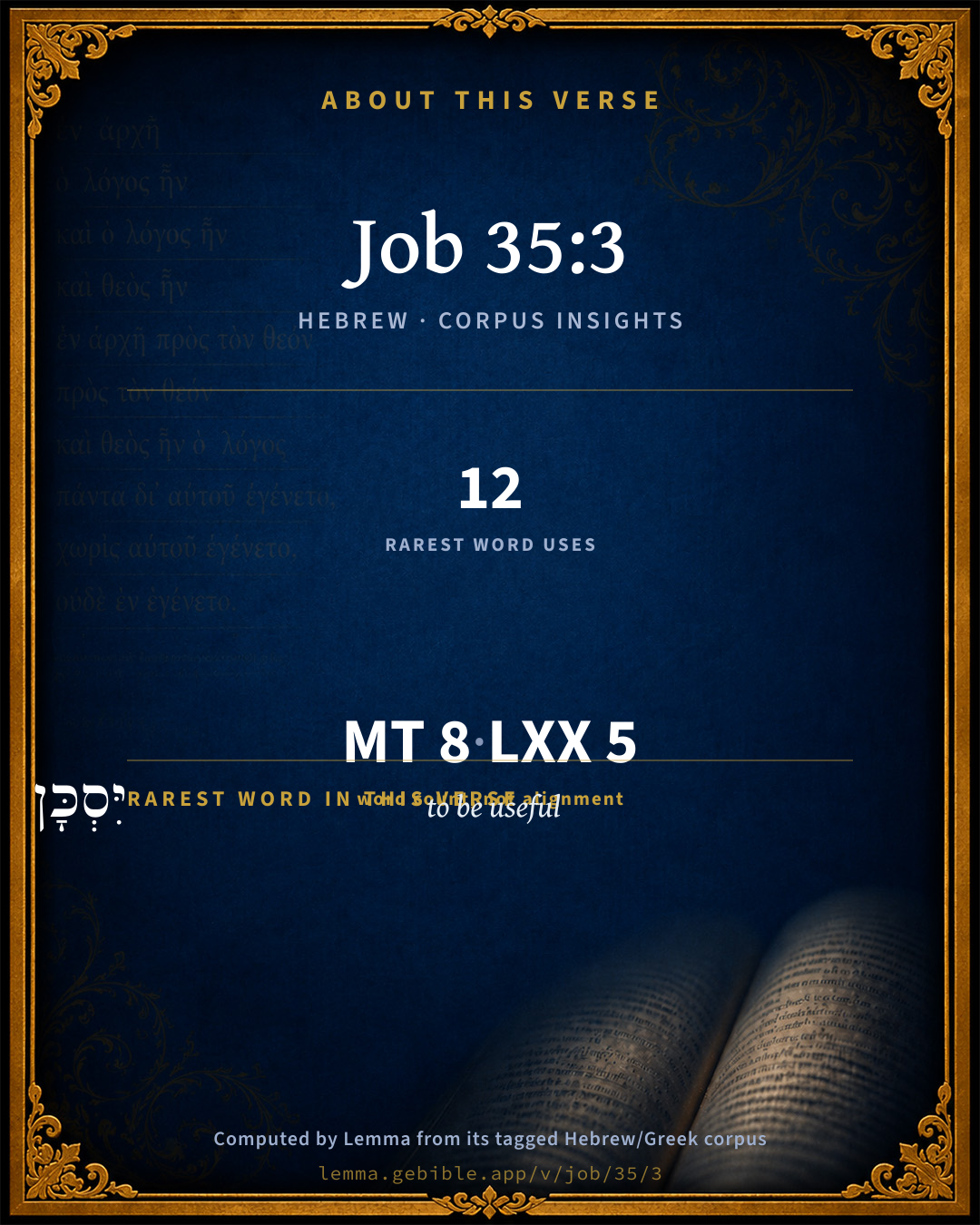
The rarest word here is יִּסְכָּן to be useful H5532 — appearing just 12 times in the whole Hebrew Bible.

Shared distinctive vocabulary

יִּסְכָּן to be useful H5532 occurs in 10 verses of the Hebrew Bible. Also found in:

Grammatical profile

  • 3 verbs
  • 1 noun
  • 1 preposition
  • 1 conjunction
  • 2 particles

Verb forms

  • תֹ֭אמַר Qal · Imperfect
  • יִּסְכָּן Qal · Imperfect
  • אֹ֝עִ֗יל Hiphil · Imperfect

Repetition

A word recurs within this verse — often emphatic in Hebrew:

Hebrew & Septuagint length

In English translation the verse runs 21 words from the Hebrew and 8 from the Septuagint (LXX English) — the Septuagint runs noticeably shorter here. See the side-by-side →

A rough comparison of the two English renderings, which tokenize alike — not a word-level alignment.

Word counts can differ between the Hebrew and the Greek without any difference in meaning — e.g. the Hebrew direct-object marker אֵת has no separate Greek word, and Greek often adds the article ὁ.

In the original languages it is 8 Hebrew tokens and 5 Greek tokens — but the two are counted differently (Hebrew bundles its prefixes and suffixes into one token; the Greek is in lemma form), so that isn’t a like-for-like length.

Cross-references

8

Topical passages linked to Job 35:3 in the Treasury of Scripture Knowledge — connected by theme and wording, ordered by reader-vote popularity; previews shown in the World English Bible.

  • Job 34:9 For he has said, 'It profits a man nothing That he should delight himself with God.'
  • Malachi 3:14 You have said, 'It is vain to serve God;' and 'What profit is it that we have kept his charge, and that we have walked mournfully before Yahweh of Hosts?
  • Job 9:21–22 I am blameless. I don't regard myself. I despise my life.
  • Job 9:30–31 If I wash myself with snow, And cleanse my hands with lye,
  • Job 10:15 If I am wicked, woe to me. If I am righteous, I still shall not lift up my head, Being filled with disgrace, And conscious of my affliction.
  • Job 21:15 What is the Almighty, that we should serve him? What profit should we have, if we pray to him?'
  • Job 31:2 For what is the portion from God above, And the heritage from the Almighty on high?
  • Psalms 73:13 Surely in vain I have cleansed my heart, And washed my hands in innocence,

Cross-references courtesy of OpenBible.info (CC BY 4.0).

Hebrew and Greek witnesses Masoretic Hebrew ↔ Greek Septuagint

The same verse in the two great witnesses to the Old Testament, shown verse-for-verse.

Here the Septuagint runs noticeably shorter than the Hebrew — LXX2012 (modern English Septuagint) 8 words vs World English Bible 21. A rough length comparison of the two English translations, not a word-level alignment — read both below.

These are two independent witnesses, not word-aligned to each other, and the Septuagint is shown in lemma (dictionary) form.

Hebrew Job 35:3 Masoretic · Westminster Leningrad Codex

כִּֽי תֹ֭אמַר מַה יִּסְכָּן לָ֑ךְ מָֽה אֹ֝עִ֗יל מֵֽחַטָּאתִֽי

That you ask, 'What advantage will it be to you? What profit shall I have, more than if I had sinned?'

World English Bible · Public Domain

Greek LXX Job 35:3 Septuagint · lemma form

ἤ εἶπον τίς ποιέω ἁμαρτάνω

I will answer you, and your three friends.

LXX2012 (modern English Septuagint) · Public Domain

On this verse, John Gill's Exposition discusses the Septuagint’s reading. Read the note in Commentary ↓

Hebrew: Westminster Leningrad Codex (CC BY 4.0). Greek: Septuagint (public domain); English from LXX2012 (modern English Septuagint) (Public Domain). How the Septuagint differs from the Hebrew →

Commentary

Notes on Job 35:3 from classic Christian and Jewish commentators (each source and its license shown beneath its notes). The classic Christian expositions comment on the surrounding passage and are grouped to its opening verse, so a note may address several verses; the Jewish commentaries on the Tanakh (Rashi and others) are per-verse, so they appear only where the commentator wrote on this verse.

Lemma curates 59 commentaries, every one of them public domain or Creative Commons licensed, each selected and text-cleaned for this edition rather than reprinted as found. About our sources →

Trapp's Complete Commentary

John Trapp

Job 35:3 For thou saidst, What advantage will it be unto thee? [and], What profit shall I have, [if I be cleansed] from my sin?

Ver. 3. For thou saidst, What advantage will it be unto thee?] Here he endeavours to prove the charge, grounding upon some words of Job’s, as Job 9:22; Job 10:15, which seem to hold out thus much, that no good was to be gotten by leaving evil ways, since good men and bad suffer and perish together. But we must know, that Job herein reasoned not of those things that happen after death, but only of the prosperous or unhappy estate of this life present; denying, and that rightly, that we are hereby to judge God’s love or hatred, or of any man’s honest or dishonest conversation. Neither yet did he stand in defence of his own righteousness against God, but only appealed to God as a most wise and just judge, against the false accusations of his foe-like friends, who, by pouring oil into the fire, as it were, very much vexed and disquieted him all along.

Or what profit shall I have if I be cleansed from my sin?] Or, What profit shall I have be it more than by my sin? This, if Elihu could have proved that Job had said, he might very well have justified what he had wished to him, and affirmed of him in the two last verses of the preceding chapter.

John Trapp, A Commentary or Exposition upon All the Books of the Old and New Testament (1647–1656) — public domain. Text from a community e-Sword module.

The Biblical Illustrator

Joseph S. Exell

Job_35:3-8

For thou saidst, What advantage will it be unto thee?

Mans character

Nothing is so important to man as his character.

I. That selfishness is an evil in mans character. For thou saidst, What advantage will it be unto thee? and, What profit shall I have, if I be cleansed from my sin? Whether Job expressed this selfish idea or not, Elihus language implies that such an idea is a great evil. It is by no means an uncommon thing for men to take up religion on purely selfish motives.

1. There are some who take it up for mere worldly gain.

2. There are some who take it up for eternal gain. Their object is to escape hell and get to heaven. Religion to them is not the summum bonum, is but a means to a selfish end.

II. That God is independent of mans character Look unto the heavens, and see; and behold the clouds which are higher than thou. If thou sinnest, what doest thou against Him? or if thy transgressions be multiplied, what doest thou unto Him? This being the case, it follows that sovereignty must be the principle of all His conduct with men.

1. It is the reason of all law. Why does He require us to love and serve Him? Not for His own sake, but for ours. Thus only I can become happy.

2. It is the source of redemption. Why did He send His Son into the world? He cannot be advantaged by it. God so loved the world, etc.

3. It is the ground of rewards. The blessedness He communicates to the good, is given not on the ground of merit, but of grace.

III. That society is influenced by mans character. One mans character is reproduced in another. The righteousness of one must profit society. Three things give every man some influence upon his race.

1. Relationship.

2. Dependence.

3. Affection.

If righteous we are fountains of life, whence rivers to irrigate, purify, and beautify the world will flow down the ages. (Homilist.)

The Biblical Illustrator, edited by Joseph S. Exell (c. 1880s–1900s) — public domain. Text from a community e-Sword module.

Jamieson, Fausset & Brown

Robert Jamieson, A. R. Fausset & David Brown

Rather, explanatory of "this" in Job 35:2, "That thou sayest (to thyself, as if a distinct person) What advantage is it (thy integrity) to thee? What profit have I (by integrity) more than (I should have) by my sin?" that is, more than if I had sinned (Job 34:9). Job had said that the wicked, who use these very words, do not suffer for it (Job 21:13-15); whereby he virtually sanctioned their sentiments. The same change of persons from oblique to direct address occurs (Job 19:28; Job 22:17).

Jamieson, Fausset & Brown — Commentary Critical and Explanatory on the Whole Bible (1871) — public domain (CC PDM 1.0). Text via the HelloAO Bible API.

Adam Clarke's Commentary

Verse 3. What advantage will it be unto thee?] As if he had said to God, "My righteousness cannot profit thee, nor do I find that it is of any benefit to myself." Or perhaps Elihu makes here a general assertion, which he afterwards endeavours to exemplify: Thou hast been reasoning how it may profit thee, and thou hast said, "What profit shall I have in righteousness more than in sin?"

Adam Clarke's Commentary on the Bible (1810–1826) — public domain. Text from a community e-Sword/MySword module.

John Gill's Exposition

I will answer thee, and thy companions with thee. Meaning not his three friends, as the Septuagint version expresses it; for they were not on the side of Job, and of the same sentiment with him, but rather on the side of Elihu; especially Eliphaz, who expresses much the same sentiment he does, Job 22:2; but all that were of the same mind with Job, whether present or absent, or in whatsoever part of the world; the answer he should return to him would serve for them all, and sufficiently confute such a bad notion of God, let it be embraced by whomsoever.

; but all that were of the same mind with Job, whether present or absent, or in whatsoever part of the world; the answer he should return to him would serve for them all, and sufficiently confute such a bad notion of God, let it be embraced by whomsoever.

Job 35:5

job 35:5

job 35:5

job 35:5Look unto the heavens, and see,.... The firmament of heaven, in which are the sun and moon and stars:

and behold the clouds which are higher than thou; the clouds of the air or sky, which are lower than the starry heavens, yet these were higher than Job, and much more the starry heavens: but because the word has the signification of "thinness", which does not so well agree with the clouds, which are thick substances, condensed air; some take it to be meant of the supreme region of the heavens, which is pure and thin; so Sephorno: and Job is directed to look to these, not as stargazers do, such as are given to judicial astrology, to judge of the fates of men and kingdoms; but rather thereby to be led to the contemplation of God the author of them, and the glorious perfections of his being they display; and chiefly to observe the height of them, that they were out of his reach, and he could neither help them nor hurt them; that he could neither increase nor diminish the light of the celestial bodies, which he could only behold; nor either advance or hinder their course, nor in the least add to or abate their influence and efficacy; and if he could neither be beneficial nor harmful to them, how was it possible that he could be of any advantage or detriment to God, by any actions of his, good or bad, who is higher and out of sight? This is the answer Elihu in general returned, he more particularly replies as follows.

John Gill's Exposition of the Whole Bible (1746–1763) — public domain (CC PDM 1.0). Text via the HelloAO Bible API.

Albert Barnes' Notes on the Bible

For thou saidst - Another sentiment of a similar kind which Elihu proposes to examine. He had already adverted to this sentiment of Job in Job 34:9, and examined it at some length, and had shown in reply to it that God could not be unjust, and that there was great impropriety when man presumed to arraign the justice of the Most High. He now adverts to it again in order to show that God could not be benefited or injured by the conduct of man, and that he was, therefore, under no inducement to treat him otherwise than impartially.

What advantage will it be unto thee? - see the notes at Job 34:9. The phrase “unto thee,” refers to Job himself. He had said this to himself; or to his own soul. Such a mode of expression is not uncommon in the Scriptures.

And, What profit shall I have if I be cleansed from my sin - Margin, “or, by it” more than by my sin.”” The Hebrew will admit of either of these interpretations, and the sense is not materially varied. The idea is, that as to good treatment or securing the favor of God under the arrangements of his government, a man might just as well be wicked as righteous. He would be as likely to be prosperous in the world, and to experience the tokens of the divine favor. Job had by no means advanced such a sentiment; but he had maintained that he was treated “as if” he were a sinner; that the dealings of Providence were “not” in this world in accordance with the character of people; and this was interpreted by Elihu as maintaining that there was no advantage in being righteous, or that a man might as well be a sinner. It was for such supposed sentiments as these, that Elihu and the three friends of Job charged him with giving “answers” for wicked people, or maintaining opinions which went to sustain and encourage the wicked; see Job 34:36.

Albert Barnes' Notes on the Bible (1834–1885) — public domain. Text from a community e-Sword/MySword module.

Haydock's Catholic Bible Commentary

Please thee, since thou punishest the guiltless. (Menochius) --- If I sin. Job had not said so, but it seemed to follow from his expressions, chap. xxi. 7. See chap. xxii. 3. Whether sin be committed and punished, or not, what does it profit God? (Calmet) --- His sovereign perfections require that he should not let sin pass unnoticed, and Job never entertained an idea to the contrary.

George Leo Haydock (1774–1849), Haydock's Catholic Family Bible and Commentary, 1859 edition — public domain. Excludes Psalms (Douay-Rheims chapter numbering differs from Protestant) and Deuterocanonical books (Catholic canon only).

Matthew Poole's English Annotations

This verse contains the proof of the foregoing charges. Job had oft affirmed that he was, and still continued to be, righteous, though he had no present benefit by it, but much bitterness with it; and God was not kind to Job, notwithstanding all his former and present piety, but dealt with him as if he had been a most wicked man; which was in effect to say, that he was more righteous than God.

What advantage will it, to wit, his righteousness last mentioned, be unto thee, i.e. unto me; such changes of persons being very frequent in the Hebrew language.

If I be cleansed from my sin; or, by the expiation of my sin; for the same Hebrew word signifies both to sin and to purge out or expiate sin. Or, by it (to wit, by my righteousness) more than by my sin. So the sense is, I have no more present benefit by all my care to please and serve God, than wicked men have by their sins against him. God regards my cries no more than theirs, and shows no more kindness or pity to me than he doth to the most profligate wretches. But still remember Job speaks not here of the future life, wherein he knew he should have much advantage, as he professed before, but only of this present state.

Matthew Poole's English Annotations on the Holy Bible (1683–1685) — public domain. Text from a community e-Sword/MySword module.

Whedon's Commentary on the Bible

Daniel D. Whedon

3. What profit… my sin — Literally, What shall I gain more than by my sin? In Job_9:22; Job_21:23-26 Job had seemed to say that the perfect and the wicked are alike to God. In Elihu’s remembrance these unguarded statements assume the form of a comparison between the gains from virtue and the profits from sin.

Daniel D. Whedon (gen. ed.), Commentary on the Old and New Testaments (1874–1909) — public domain. Text from a community e-Sword module.

The Pulpit Commentary

For thou saidst What advantage will it be unto thee? i.e. What advantage will thy righteousness be unto thee? Job had certainly argued that his righteousness brought him no temporal advantage; but he had always a conviction that he would ultimately be the better for it. Elihu, however, does not acknowledge this; and, assuming that Job expects to receive no advantage at all from his integrity, argues that God is not bound to afford him any. And, What profit shall I have, if I be cleansed from my sin? rather, And what profit shall I have, more than if I had sinned? (see the Revised Version, and compare the comments of Rosenmuller and Canon Cook).

Vers. 3, 4. Is goodness profitable?

I A NATURAL QUESTION. Job is driven to put this question; or, rather, Elihu concludes that Job"s language shows that the patriarch is debating it within himself. Satan had sneered at the notion of disinterested goodness, and had asked, "Doth Job fear God for naught?". (Job_1:9) Now Job is begin-nine to see that the profits of goodness, as they are commonly believed in, do not accrue, for good men suffer as much as other men, if not more. The utilitarian question crops up in practice, whatever ethical theory we may have adopted. People will ask What is the advantage of religion? Why should they deny their passions? What will they be the better for refraining from evil? The inquiry is natural for two reasons.

1. We naturally desire to see results. Men wish to know that some good end is to be reached. They are not satisfied with a good road; they must know where it leads to.

2. We naturally desire our own advantage. The instincts implanted in us encourage such a desire. In itself it is not bad, but natural. Evil comes from the abuse or the supremacy of it.

II A SUPERFLUOUS QUESTION. Although the question is natural, we ought to be able to rise above it. After all, our chief concern is not with results, but with duty. Our part is to do the right, whether it leads to failure or to success. Obedience is our sphere; results are with God. We sow and water; he it is who gives the increase. It is difficult to learn this lesson, for we all gravitate to selfish and material ends unless we are lifted out of ourselves. Still, the lesson must be learnt. If a man is only virtuous on account of the rewards of virtue, he is not really virtuous at all. He who does not steal simply because be is persuaded that "honesty is the best policy," is a thief at heart. Conscience is independent of advantage, and true goodness is only that which rests on conscience.

III AN ANSWERABLE QUESTION. Elihu is ready with his reply. Perhaps it is not quite so simple a matter as he assumes, for he is one of those fearless talkers who handle the most difficult problems with jaunty confidence. Still, he helps us towards a reply. Goodness is not ignored by God. This Elihu show, in three ways.

1. God is too great to unjustly deprive men of the rewards of their deeds. These may not come at once; but God can have no conceivable motive for withholding them (vers. 5-8).

2. The absence of immediate blessings is a proof of Divine negligence. While complaining that their rewards are not given them, men may not be treating God aright, and so nor deserving his blessing (vers. 9-13).

3. God"s watchfulness ensures his righteous treatment of his creatures. (Vers. 14-16) Thus according to Elihu goodness is ultimately for the advantage of its possessor. But may we not go further, and say that even if it brings no ultimate reward it is infinitely better than sin, for goodness is in itself a blessing? Few of us can be great, or rich, or very successful. But it is better to be good than to be great, or rich, or successful; for to be good is to be like Christ, like God. W.F.A.

The Pulpit Commentary (1880–1919), ed. H.D.M. Spence-Jones & Joseph S. Exell — public domain. Text from a community e-Sword module.

John Wesley's Explanatory Notes

Thou saidst - Another imputation upon God. Unto thee - Unto me; such changes of persons being frequent in the Hebrew language. What profit, &c. - God does not reward so much as I deserve. But it was not fair to charge this upon Job, which he had neither directly nor indirectly affirmed.

John Wesley, Explanatory Notes Upon the Whole Bible (1754–1765) — public domain. Text via the GEBible commentary corpus.

Rashi

Rabbi Shlomo Yitzchaki (Rashi)

That you say, ‘What will it benefit you ways of uprightness,

and what profit will I have more than if I had sinned?’

Rashi on the Tanakh — English translations: “The Judaica Press complete Tanach with Rashi, translated by A. J. Rosenberg” (CC BY 4.0); “Pentateuch with Rashi's commentary by M. Rosenbaum and A.M. Silbermann, 1929-1934” (public domain); “The Metsudah Tanach series, Lakewood, N.J” (CC BY 4.0); and “The Book of Joshua, Metsudah Publications, 1997” (CC BY 4.0). Text via Sefaria.

Lesson kit

Teaching starters — assembled from the data on this page, not authored interpretation. Every prompt links to the verse data it draws on. Edit before teaching.

Job, in the Wisdom, opens this verse with 8 words (6 distinct Hebrew lemmas). Its most distinctive word is çâkan (“to be useful”). The Greek Septuagint runs shorter here. A historical commentator’s framing appears above. Read the whole chapter for the surrounding context.

Discussion questions

  1. How does “to be useful” (çâkan) shape what this verse is saying?
  2. Numbers 22:30 shares the word «to be useful» with this verse. How do the two illuminate each other?
  3. “what” occurs 2× in this one verse. What is the effect of the repetition?
  4. Compared with the Hebrew, the Septuagint runs shorter here. What questions does that raise?
  5. These translations render this verse differently. What is at stake in choosing one wording over another?
  6. The verb «תֹ֭אמַר» is Qal Imperfect. How does its form color the action?
  7. Reading how Trapp's Complete Commentary and The Biblical Illustrator read this verse, where do the two commentators agree and where do they part?

Things to notice

Reading settings

Reading text

Shown beneath each verse's original-language words.

Old Testament
Old Testament edition

Read the OT as the Masoretic Hebrew (MT) or the Greek Septuagint (LXX).

English shown for the Greek Septuagint (in the Hebrew ↔ Greek comparison).

Comparing translations? Open the Compare panel on any verse page to stack up to four side by side.