
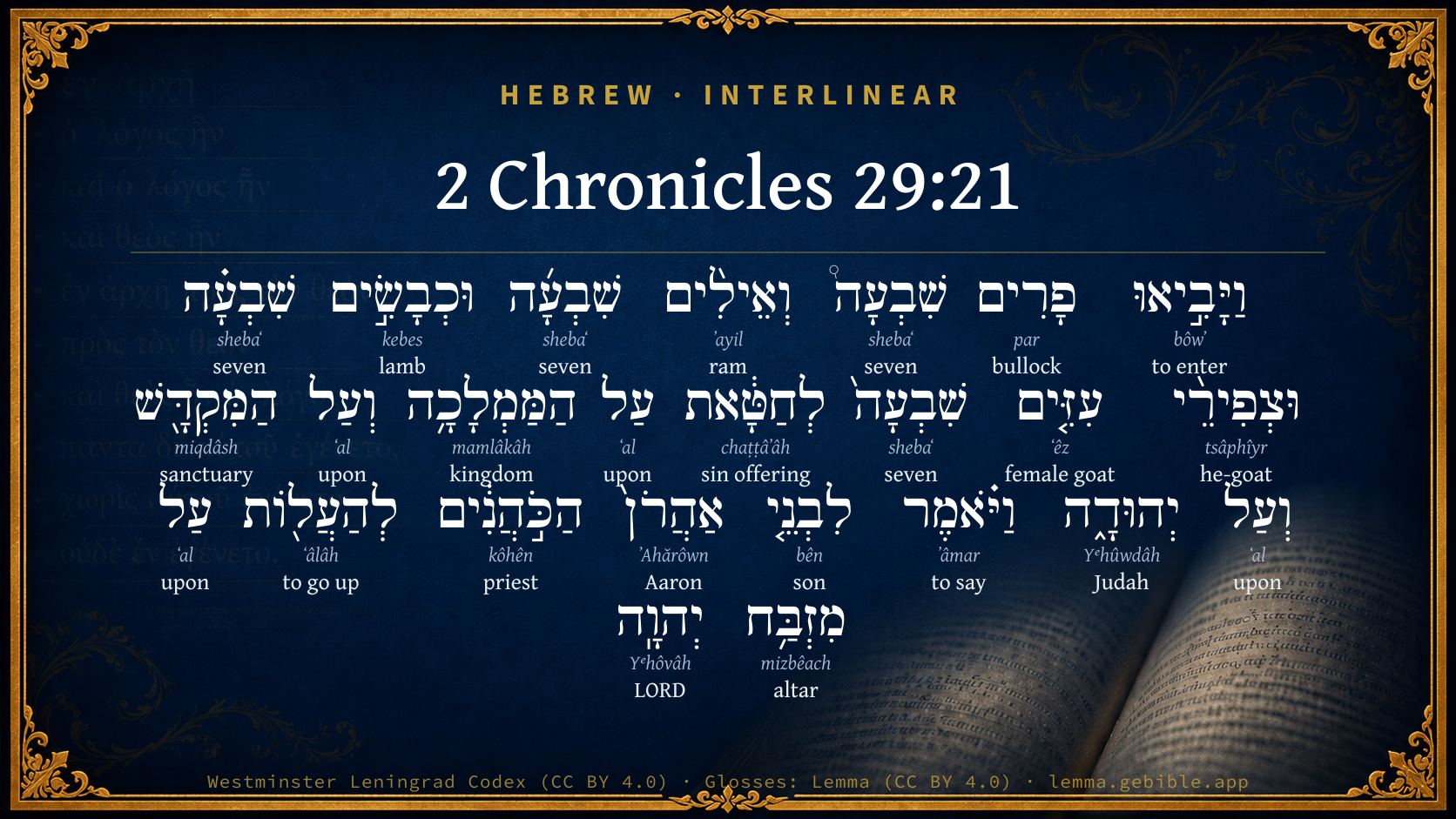
2 Chronicles 29:21

Hebrew (Westminster Leningrad Codex) 2 Chronicles 29:21 appears in the Hebrew Old Testament. The text above is from the Westminster Leningrad Codex. Each word links to its Strong’s number, a concise gloss, and parsing drawn from the Open Scriptures Hebrew Bible morphology. Click any word for its full Brown-Driver-Briggs (BDB) entry.
Download image
Cite this verse

2 Chronicles 29:21 (World English Bible). Public Domain. Lemma interlinear Bible study tool, https://lemma.gebible.app/v/2-chronicles/29/21.

Show BibTeX & RIS
BibTeX
RIS
English Translation
They brought seven bulls, and seven rams, and seven lambs, and seven male goats, for a sin-offering for the kingdom and for the sanctuary and for Judah. He commanded the priests the sons of Aaron to offer them on the altar of Yahweh.
World English Bible · Public Domain
Highlights
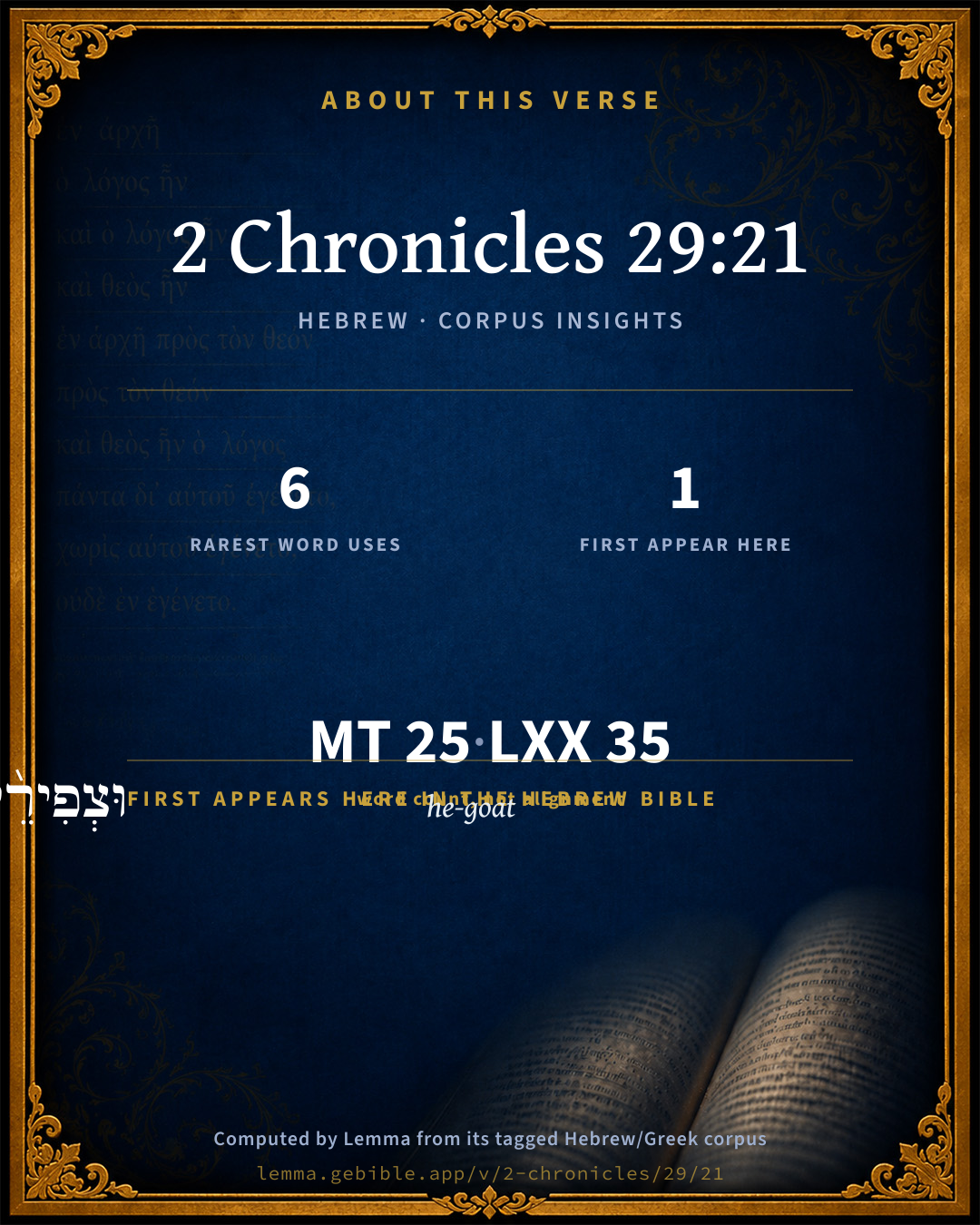
  • 1 first appearance in the Hebrew Bible
Full analysis ↓
Download a study sheet

One document with this verse’s original text, its word-by-word gloss line, the meaning frame, cross-references with their text, attributed commentary, and full source and license credits — printable, and it pastes into notes with its structure intact.

This verse Autodidact and up

Study sheet (.html) Plain text (.txt)

A passage Seminary Student

Up to 50 verses in one chapter. A passage sheet keeps up to 6 commentary sources and 12 cross-references per verse, in the order this page ranks them, and says so on the sheet whenever that leaves anything out. Ask for a single verse and you get the Autodidact verse sheet above.

Everything on this page stays free to read, with no account — the sheet is a download of what is already on screen, not access to it.

Want to remove ads? Support Godless Engineer
Compare translations 3

The same verse in 3 English versions, stacked beneath the original-language interlinear above. Click any original word for its lexicon entry.

Each is an independent rendering of the whole verse — the interlinear is not word-aligned to these translations.

Highlighted words mark where these versions differ — a whole-verse word diff, not a word-by-word alignment.

  • World English Bible Public Domain
    They brought seven bulls, and seven rams, and seven lambs, and seven male goats, for a sin-offering for the kingdom and for the sanctuary and for Judah. He commanded the priests the sons of Aaron to offer them on the altar of Yahweh.
  • King James Version Public Domain
    And they brought seven bullocks, and seven rams, and seven lambs, and seven he goats, for a sin offering for the kingdom, and for the sanctuary, and for Judah. And he commanded the priests the sons of Aaron to offer them on the altar of the LORD.
  • unfoldingWord Literal Text CC BY-SA 4.0
    And they brought seven bulls, and seven rams, and seven lambs, and seven male goats of female goats for a sin offering for the kingdom, and for the sanctuary, and for Judah. And he said to the sons of Aaron, the priests, to cause to go up to the altar of Yahweh.

unfoldingWord Literal Text — © unfoldingWord, licensed CC BY-SA 4.0. Word-aligned USFM3 via Door43 (git.door43.org/unfoldingWord/en_ult).

Versions to compare (up to 4)

3 of 4 selected

Show all 18 translations

Every available English version of this verse, each an independent rendering of the whole verse.

  • World English Bible Public Domain
    They brought seven bulls, and seven rams, and seven lambs, and seven male goats, for a sin-offering for the kingdom and for the sanctuary and for Judah. He commanded the priests the sons of Aaron to offer them on the altar of Yahweh.
  • Berean Standard Bible Public Domain
    They brought seven bulls, seven rams, seven lambs, and seven male goats as a sin offering for the kingdom, for the sanctuary, and for Judah. And the king commanded the priests, the descendants of Aaron, to offer them on the altar of the LORD.
  • Majority Standard Bible Public Domain
    They brought seven bulls, seven rams, seven lambs, and seven male goats as a sin offering for the kingdom, for the sanctuary, and for Judah. And the king commanded the priests, the descendants of Aaron, to offer them on the altar of the LORD.
  • King James Version Public Domain
    And they brought seven bullocks, and seven rams, and seven lambs, and seven he goats, for a sin offering for the kingdom, and for the sanctuary, and for Judah. And he commanded the priests the sons of Aaron to offer them on the altar of the LORD.
  • American Standard Version (1901) Public Domain
    And they brought seven bullocks, and seven rams, and seven lambs, and seven he-goats, for a sin-offering for the kingdom and for the sanctuary and for Judah. And he commanded the priests the sons of Aaron to offer them on the altar of Jehovah.
  • Revised Version (1885) Public Domain
    And they brought seven bullocks; and seven rams, and seven lambs, and seven he-goats, for a sin offering for the kingdom and for the sanctuary and for Judah. And he commanded the priests the sons of Aaron to offer them on the altar of the LORD.
  • Geneva Bible (1599) Public Domain
    And they brought seuen bullockes, and seuen rammes, and seuen lambes, and seuen hee goates, for a sinne offring for the kingdome, and for the sanctuarie, and for Iudah. And he commanded the Priests the sonnes of Aaron, to offer them on the altar of the Lord.
  • Douay-Rheims (1899) Public Domain
    And they offered together seven bullocks, and seven rams, and seven lambs, and seven he goats for sin, for the kingdom, for the sanctuary, for Juda: and he spoke to the priests the sons of Aaron, to offer them upon the altar of the Lord.
  • Young's Literal Translation Public Domain
    and they bring in seven bullocks, and seven rams, and seven lambs, and seven young he-goats, for a sin-offering for the kingdom, and for the sanctuary, and for Judah; and he saith to sons of Aaron, the priests, to cause `them' to ascend on the altar of Jehovah.
  • Literal Standard Version CC BY-SA 4.0
    and they bring in seven bullocks, and seven rams, and seven lambs, and seven young male goats, for a sin-offering for the kingdom, and for the sanctuary, and for Judah; and he commands to sons of Aaron, the priests, to cause [them] to ascend on the altar of YHWH.
  • Unlocked Literal Bible CC BY-SA 4.0
    They brought seven bulls, seven rams, seven lambs, and seven male goats as a sin offering for the kingdom, for the sanctuary, and for Judah. He commanded the priests, the sons of Aaron, to offer them on the altar of Yahweh.
  • unfoldingWord Literal Text CC BY-SA 4.0
    And they brought seven bulls, and seven rams, and seven lambs, and seven male goats of female goats for a sin offering for the kingdom, and for the sanctuary, and for Judah. And he said to the sons of Aaron, the priests, to cause to go up to the altar of Yahweh.
  • Darby Bible Public Domain
    And they brought seven bullocks, and seven rams, and seven lambs, and seven he-goats for a sin-offering for the kingdom, and for the sanctuary, and for Judah. And he commanded the priests the sons of Aaron to offer [them] upon the altar of Jehovah.
  • World Messianic Bible Public Domain
    They brought seven bulls, seven rams, seven lambs, and seven male goats, for a sin offering for the kingdom, for the sanctuary, and for Judah. He commanded the priests the sons of Aaron to offer them on the LORD’s altar.
  • Webster's Bible Public Domain
    And they brought seven bullocks, and seven rams, and seven lambs, and seven he-goats, for a sin-offering for the kingdom, and for the sanctuary, and for Judah. And he commanded the priests the sons of Aaron to offer them on the altar of the LORD.
  • Free Bible Version CC BY-SA 4.0
    They brought seven bulls, seven rams, seven male lambs, and seven male goats as a sin offering for the kingdom, for the sanctuary, and for Judah. The king ordered the priests, the descendants of Aaron, to offer them on the altar of the Lord.
  • Bible in Basic English Public Domain
    And they took with them seven oxen and seven male sheep and seven lambs and seven he-goats as a sin-offering for the kingdom and for the holy house and for Judah. And he gave orders to the sons of Aaron, the priests, that these were to be offered on the altar of the Lord.
  • JPS Tanakh (1917) Public Domain
    And they brought seven bullocks, and seven rams, and seven lambs, and seven he-goats, for a sin-offering for the kingdom and for the sanctuary and for Judah. And he commanded the priests the sons of Aaron to offer them on the altar of the LORD.

Literal Standard Version (2020), Covenant Press — licensed CC BY-SA 4.0. Text via the HelloAO Bible API (eBible.org). Unlocked Literal Bible (unfoldingWord) — licensed CC BY-SA 4.0. Text via the HelloAO Bible API (eBible.org). unfoldingWord Literal Text — © unfoldingWord, licensed CC BY-SA 4.0. Word-aligned USFM3 via Door43 (git.door43.org/unfoldingWord/en_ult). Free Bible Version, Dr. Jonathan Gallagher — licensed CC BY-SA 4.0. Text via the HelloAO Bible API (eBible.org).

Word by word

More ways to search: Search by grammar → Find every occurrence → Compare this word →

Practice this passage: Drill this verse → Learn its vocabulary →

וּצְפִירֵ֨י
tsâphîyr
H6842
“and · he-goats of”
Conjunction + Noun, Common, Masculine, Plural, Construct
Part of Speech
Conjunction + Noun
Type
Common
Gender
Masculine
Number
Plural
State
Construct
Full BDB Definition

Origin: from H6852

TWOT: 1962a

he-goat
  1. וַיָּבִ֣יאוּ bôwʼ H935 “and · to enter” Conjunction + Verb, Hiphil, Sequential Imperfect, 3rd Person, Masculine, Plural
  2. פָרִים par H6499 “bullocks” Noun, Common, Masculine, Plural, Absolute
  3. שִׁבְעָה֩ shebaʻ H7651 “seven” Adjective, Cardinal number, Masculine, Singular, Absolute
  4. וְאֵילִ֨ים ʼayil H352 “and · rams” Conjunction + Noun, Common, Masculine, Plural, Absolute
  5. שִׁבְעָ֜ה shebaʻ H7651 “seven” Adjective, Cardinal number, Masculine, Singular, Absolute
  6. וּכְבָשִׂ֣ים kebes H3532 “and · lambs” Conjunction + Noun, Common, Masculine, Plural, Absolute
  7. שִׁבְעָ֗ה shebaʻ H7651 “seven” Adjective, Cardinal number, Masculine, Singular, Absolute
  8. עִזִּ֤ים ʻêz H5795 “female goats” Noun, Common, Feminine, Plural, Absolute
  9. שִׁבְעָה֙ shebaʻ H7651 “seven” Adjective, Cardinal number, Masculine, Singular, Absolute
  10. לְחַטָּ֔את chaṭṭâʼâh H2403 “to/for · sin offering” Preposition + Noun, Common, Feminine, Singular, Absolute
  11. עַל ʻal H5921 “upon” Preposition
  12. הַמַּמְלָכָ֥ה mamlâkâh H4467 “the · kingdom” Particle, Definite Article + Noun, Common, Feminine, Singular, Absolute
  13. וְעַל ʻal H5921 “and · upon” Conjunction + Preposition
  14. הַמִּקְדָּ֖שׁ miqdâsh H4720 “the · sanctuary” Particle, Definite Article + Noun, Common, Masculine, Singular, Absolute
  15. וְעַל ʻal H5921 “and · upon” Conjunction + Preposition
  16. יְהוּדָ֑ה Yᵉhûwdâh H3063 “Judah” Noun, Proper
  17. וַיֹּ֗אמֶר ʼâmar H559 “and · to say” Conjunction + Verb, Qal, Sequential Imperfect, 3rd Person, Masculine, Singular
  18. לִבְנֵ֤י bên H1121 “to/for · sons of” Preposition + Noun, Common, Masculine, Plural, Construct
  19. אַהֲרֹן֙ ʼAhărôwn H175 “Aaron” Noun, Proper
  20. הַכֹּ֣הֲנִ֔ים kôhên H3548 “the · priests” Particle, Definite Article + Noun, Common, Masculine, Plural, Absolute
  21. לְהַעֲל֖וֹת ʻâlâh H5927 “to go up” Preposition + Verb, Hiphil, Infinitive Construct
  22. עַל ʻal H5921 “upon” Preposition
  23. מִזְבַּ֥ח mizbêach H4196 “altar of” Noun, Common, Masculine, Singular, Construct
  24. יְהוָֽה Yᵉhôvâh H3068 “LORD” Noun, Proper

About this verse

These counts appear in no published source. They are computed here, from the morphology-tagged text and Lemma’s own curated glosses. What Lemma adds →

25
words
19
distinct lemmas
Historical
section

Notable vocabulary

The rarest word here is וּצְפִירֵ֨י he-goat H6842 — appearing just 6 times in the whole Hebrew Bible.

First appearance in Scripture

This word makes its first canonical appearance in the Hebrew Bible here:

  • וּצְפִירֵ֨י he-goat H6842

Shared distinctive vocabulary

וּצְפִירֵ֨י he-goat H6842 occurs in 5 verses of the Hebrew Bible. Also found in:

Grammatical profile

  • 3 verbs
  • 14 nouns
  • 4 adjectives
  • 4 prepositions

Verb forms

  • וַיָּבִ֣יאוּ Hiphil · Sequential Imperfect
  • וַיֹּ֗אמֶר Qal · Sequential Imperfect
  • לְהַעֲל֖וֹת Hiphil · Infinitive Construct

Repetition

Words recur within this verse — often emphatic in Hebrew:

  • שִׁבְעָה֩ seven H7651 ×4
  • עַל upon H5921 ×4

Hebrew & Septuagint length

In English translation the verse runs 43 words from the Hebrew and 45 from the Septuagint (LXX English) — closely comparable.

A rough comparison of the two English renderings, which tokenize alike — not a word-level alignment.

Word counts can differ between the Hebrew and the Greek without any difference in meaning — e.g. the Hebrew direct-object marker אֵת has no separate Greek word, and Greek often adds the article ὁ.

In the original languages it is 25 Hebrew tokens and 35 Greek tokens — but the two are counted differently (Hebrew bundles its prefixes and suffixes into one token; the Greek is in lemma form), so that isn’t a like-for-like length.

Cross-references

9

Topical passages linked to 2 Chronicles 29:21 in the Treasury of Scripture Knowledge — connected by theme and wording, ordered by reader-vote popularity; previews shown in the World English Bible.

  • Leviticus 4:3–14 if the anointed priest sins so as to bring guilt on the people, then let him offer for his sin, which he has sinned, a young bull without blemish to Yahweh for a sin offering.
  • Job 42:8 Now therefore, take to yourselves seven bulls and seven rams, and go to my servant Job, and offer up for yourselves a burnt offering; and my servant Job shall pray for you, for I will accept him, that I not deal with you according to your folly. For you have not spoken of me the thing that is right, as my servant Job has."
  • Ezekiel 45:23 The seven days of the feast he shall prepare a burnt offering to Yahweh, seven bulls and seven rams without blemish daily the seven days; and a male goat daily for a sin-offering.
  • Numbers 23:1 Balaam said to Balak, Build me here seven altars, and prepare me here seven bulls and seven rams.
  • Numbers 23:14 He took him into the field of Zophim, to the top of Pisgah, and built seven altars, and offered up a bull and a ram on every altar.
  • Numbers 23:29 Balaam said to Balak, Build me here seven altars, and prepare me here seven bulls and seven rams.
  • 1 Chronicles 15:26 It happened, when God helped the Levites who bore the ark of the covenant of Yahweh, that they sacrificed seven bulls and seven rams.
  • Ezra 8:35 The children of the captivity, who had come out of exile, offered burnt offerings to the God of Israel, twelve bulls for all Israel, ninety-six rams, seventy-seven lambs, and twelve male goats for a sin-offering: all this was a burnt offering to Yahweh.
  • Numbers 15:22–24 When you shall err, and not observe all these commandments, which Yahweh has spoken to Moses,

Cross-references courtesy of OpenBible.info (CC BY 4.0).

Hebrew and Greek witnesses Masoretic Hebrew ↔ Greek Septuagint

The same verse in the two great witnesses to the Old Testament, shown verse-for-verse.

These are two independent witnesses, not word-aligned to each other, and the Septuagint is shown in lemma (dictionary) form.

Hebrew 2 Chronicles 29:21 Masoretic · Westminster Leningrad Codex

וַיָּבִ֣יאוּ פָרִים שִׁבְעָה֩ וְאֵילִ֨ים שִׁבְעָ֜ה וּכְבָשִׂ֣ים שִׁבְעָ֗ה וּצְפִירֵ֨י עִזִּ֤ים שִׁבְעָה֙ לְחַטָּ֔את עַל הַמַּמְלָכָ֥ה וְעַל הַמִּקְדָּ֖שׁ וְעַל יְהוּדָ֑ה וַיֹּ֗אמֶר לִבְנֵ֤י אַהֲרֹן֙ הַכֹּ֣הֲנִ֔ים לְהַעֲל֖וֹת עַל מִזְבַּ֥ח יְהוָֽה

They brought seven bulls, and seven rams, and seven lambs, and seven male goats, for a sin-offering for the kingdom and for the sanctuary and for Judah. He commanded the priests the sons of Aaron to offer them on the altar of Yahweh.

World English Bible · Public Domain

Greek LXX 2 Chronicles 29:21 Septuagint · lemma form

καί ἀναφέρω μόσχος ἑπτά κριός ἑπτά ἀμνός ἑπτά χίμαρος αἴξ ἑπτά περί ἁμαρτία περί ὁ βασιλεία καί περί ὁ ἅγιος καί περί ἰσραήλ καί εἶπον ὁ υἱός ἀαρών ὁ ἱερεύς ἀναβαίνω ἐπί ὁ θυσιαστήριον κύριος

And he brought seven calves, seven rams, seven lambs, seven kids of goats for a sin-offering, for the kingdom, and for the holy things, and for Israel: and he told the priests the sons of Aaron to go up to the altar of the Lord.

LXX2012 (modern English Septuagint) · Public Domain

Hebrew: Westminster Leningrad Codex (CC BY 4.0). Greek: Septuagint (public domain); English from LXX2012 (modern English Septuagint) (Public Domain). How the Septuagint differs from the Hebrew →

Commentary

Notes on 2 Chronicles 29:21 from classic Christian and Jewish commentators (each source and its license shown beneath its notes). The classic Christian expositions comment on the surrounding passage and are grouped to its opening verse, so a note may address several verses; the Jewish commentaries on the Tanakh (Rashi and others) are per-verse, so they appear only where the commentator wrote on this verse.

Lemma curates 59 commentaries, every one of them public domain or Creative Commons licensed, each selected and text-cleaned for this edition rather than reprinted as found. About our sources →

Trapp's Complete Commentary

John Trapp

2Ch 29:21 And they brought seven bullocks, and seven rams, and seven lambs, and seven he goats, for a sin offering for the kingdom, and for the sanctuary, and for Judah. And he commanded the priests the sons of Aaron to offer [them] on the altar of the LORD.

Ver. 21. And they brought seven bullocks and seven rams.] Hezekiah being to dedicate, and, as it were, anew to consecrate the temple by solemn sacrifices, bringeth seven of a sort of all kinds of clean beasts, to denote the community or whole body of the kingdom.

To offer them on the altar of the Lord.] God sanctified the altar, {Exo 29:44} and the altar sanctified the gift. {Mat 23:19} We Christians also have an altar, {Heb 13:10} but not as our late altar-men would have had it, and we believe that our sevenfold manifold sins shall be taken away by that perfect and absolute sacrifice of the Messiah, that Lamb without blemish and without spot. {1Pe 1:19}

John Trapp, A Commentary or Exposition upon All the Books of the Old and New Testament (1647–1656) — public domain. Text from a community e-Sword module.

Joseph Benson's Commentary

2Ch 29:21. They brought seven bullocks — The number seven is customary in sacred matters, and is here used in regard of the vast numbers and various kinds of sins, the guilt whereof yet lay upon the kingdom, which was now to be expiated. Indeed, in case of one particular sin of ignorance committed by the people, there was but one bullock to be offered, but here the sins were many and presumptuous. For a sin-offering for the kingdom — To make atonement for the sins of the king, and the royal family, and the court. And for the sanctuary — For all the idolatry and uncleanness wherewith the temple had been polluted, which, as it had been cleansed naturally by the priests’ hands, so now it was to be purged morally by sacrifices. And for Judah — For the sins of all the people of Judah. They thought it not enough to lament and forsake their sins, but they brought a sin-offering. Even our repentance and reformation will not obtain pardon, but through Christ, who was made sin, that is, a sin-offering, for us.

Joseph Benson's Commentary on the Old and New Testaments (1811–1818) — public domain. Text from a community e-Sword module.

Tyndale Open Study Notes

Tyndale Open Resources

29:21 The bulls, . . . rams, and lambs were for the burnt offering, and the male goats were for the sin offering (see Lev 1; 4:1–5:13).

Tyndale Open Study Notes — © Tyndale Open Resources, licensed CC BY-SA 4.0. Text via the HelloAO Bible API.

Adam Clarke's Commentary

Verse 21. They brought seven bullocks, c.] This was more than the law required see Le 4:13, c. It ordered one calf or ox for the sins of the people, and one he-goat for the sins of the prince but Hezekiah here offers many more. And the reason appears sufficiently evident: the law speaks only of sins of ignorance; but here were sins of every kind and every die-idolatry, apostasy from the Divine worship, profanation of the temple, c., c. The sin-offerings, we are informed, were offered, first for the KINGDOM-for the transgressions of the king and his family secondly, for the SANCTUARY, which had been defiled and polluted, and for the priests who had been profane, negligent, and unholy and, finally, for JUDAH-for the whole mass of the people, who had been led away into every kind of abomination by the above examples.

Adam Clarke's Commentary on the Bible (1810–1826) — public domain. Text from a community e-Sword/MySword module.

Ellicott's Commentary for English Readers

(21) Seven bullocks . . . rams . . . lambs.—For a burnt offering (‘ôlah). See the legal prescriptions respecting the sin offering (Leviticus 4). On the present extraordinary occasion, an extraordinary sacrifice was offered. Balak and Balaam offered seven bullocks and seven rams as a burnt offering (Num_23:1-2, seq.).

And seven he goats, for a sin offering.—Comp. Ezr_6:17; Ezr_8:35; and Lev_4:23; Lev_4:28; also 2Ch_29:23. The reigning house and the sanctuary and the people had all contracted defilement during the late period of idolatry.

The priests the sons of Aaron to offer.—In careful accordance with the rule of the Torah.

A Bible Commentary for English Readers, edited by Charles John Ellicott (1878–1897) — public domain. Text from a community e-Sword module.

The Cambridge Bible for Schools and Colleges

gen. ed. J. J. S. Perowne

21. they brought] Acc. to Lev_4:3; Lev_4:23; Lev_4:32 the sin offering might be a bullock or a he goat or a lamb. As the sacrifice was not for an individual but for a whole people the sin offering on this occasion consisted of seven of each of four different sacrificial animals.

for the kingdom] i.e. for the kingly house.

for the sanctuary] i.e. for the Temple (cp. Lev_16:16), but probably inclusive of the personnel of the Temple, i.e. the priests and Levites, since otherwise they would have been passed over in the great sin offering.

on the altar of the Lord] Not on the altar of Ahaz (2Ki_16:11).

The Cambridge Bible for Schools and Colleges (gen. ed. J. J. S. Perowne; Cambridge University Press, 1878–1918) — public domain. Text from a community e-Sword module.

John Gill's Exposition

And they brought forth the he goats for the sin offering before the king and the congregation,.... Which were to make atonement for the sins of both:

and they laid their hands on them; signifying thereby that they were vicarious sacrifices to be offered up in their own room and stead, and that they deserved to die, as these creatures would: transferring as it were hereby their sins unto them, for which they were to be sacrificed, and to make atonement, as an emblem of the imputation of the sins of the Lord's people to Christ, sacrificed in their stead.

John Gill's Exposition of the Whole Bible (1746–1763) — public domain (CC PDM 1.0). Text via the HelloAO Bible API.

Albert Barnes' Notes on the Bible

Hezekiah commenced his restoration of the Yahweh-worship with an unusually comprehensive sin-offering, embracing the four chief kinds of sacrificial animals, and seven animals of each kind: he intended to atone for the sins, both conscious and unconscious, of the king, the priests, the people of Judah, and the people of Israel. After the completion of these expiatory rites, he proceeded to the offering of the burnt-offering 2Ch 29:27.

Albert Barnes' Notes on the Bible (1834–1885) — public domain. Text from a community e-Sword/MySword module.

Haydock's Catholic Bible Commentary

Seven. Only one was prescribed for sins of ignorance, Lev. iv. 13, 22. S. Jerom, Trad. --- But the late transgressions were of a different nature; and the king consults his zeal, rather than what he was absolutely obliged to do. --- Juda, to expiate the sins of the royal family, of priests, and people.

George Leo Haydock (1774–1849), Haydock's Catholic Family Bible and Commentary, 1859 edition — public domain. Excludes Psalms (Douay-Rheims chapter numbering differs from Protestant) and Deuterocanonical books (Catholic canon only).

Matthew Poole's English Annotations

The number of seven is famous and customary in sacred matters, and is here used in regard of the vast numbers and various kinds of sins, the guilt whereof yet lay upon the kingdom, which was now to be expiated. Indeed, in case of one particular sin of ignorance done by the people, there was but one bullock to be offered, Lev 4:13,14, but here the sins were many and presumptuous, &c.

A sin-offering for the kingdom; to make atonement for the sins of the king, and the royal family, and the court.

For the sanctuary; for all the idolatry and uncleanness wherewith the temple had been polluted, which, as it had been cleansed naturally by the priests’ hands, so now was to be purged morally by sacrifices.

For Judah; for the sins of all the people of Judah.

Matthew Poole's English Annotations on the Holy Bible (1683–1685) — public domain. Text from a community e-Sword/MySword module.

The Pulpit Commentary

There is diversity of opinion, whether the seven bullocks ( seven rams ( seven lambs ( were burnt offering (hl; wO), or, with the seven he-goats ( yreypix), were sin offering (taF; j). Some think (as, for instance, Canon Rawlinson) that they were sin offering, as the account of the offering of them (ver. 22) takes priority for them over the he-goats; others (as Bertheau, Professor J. G. Murphy, etc.), that they were certainly burnt offering. It scarcely appears as though much stress can be laid upon what is apparently the chief reason of Canon Rawlinson"s opinion, in face of the immediate language of the last sentence of our ver. 24, "for the king commended the burnt offering and the sin offering for all Israel." The fact of no mention of burnt offering in our present verse, and of the natural construction of the description, "for a sin offering for the kingdom," etc., as applying to all that had preceded, seems the better argument, and all that is necessary, unless something moderately decisive be forthcoming to rebut it. The solution of all, however, is probably to our hand in Ezr_8:35, which is a very close and significant parallel to our present verse. The first mention of the sacrifice of or "young bullocks" is found in Exo_24:5, and afterwards in Exo_29:1, Exo_29:3; Lev_4:3, etc.; 8:2, 14, etc. The first mention of the sacrifice of is Gen_22:13; and, after, Exo_29:15-18, Exo_29:19-21, etc.; Lev_5:15 Lev_8:2, Lev_8:22, etc. The first mention of the sacrifices of the is Exo_12:3-7, and, after, Exo_29:38, etc. The first mention of the sacrifice of yreypix is the present passage; and, after, Ezr_8:25. But the mention of sacrifices of goats is found in Lev_1:10 Lev_3:12, and often besides. For the kingdom; i.e. probably for "all that are in authority," viz. the king and rulers, the Hebrew word (hklm) designating here those exercising dominion (1Ki_11:11 1Ki_14:8; 1Sa_28:17) rather than the country under dominion (Jos_10:2; 1Sa_27:5) It is, however, possible that allusion to the whole kingdom of Judah and Israel is made here. For the sanctuary; i.e. those who officiated in holy things. For Judah; i.e. for all the people.

The Pulpit Commentary (1880–1919), ed. H.D.M. Spence-Jones & Joseph S. Exell — public domain. Text from a community e-Sword module.

John Wesley's Explanatory Notes

Seven - The number seven is customary in sacred matters, and is here used in regard of the vast numbers and various kinds of sins, the guilt whereof yet lay upon the kingdom, which was now to be expiated. Indeed, in case of one particular sin of ignorance done by the people, there was but one bullock to be offered, but here the sins were many and presumptuous. Kingdom - To make atonement for the sins of the king and the royal family, and the court. Sanctuary - For all the idolatry and uncleanness wherewith the temple had been polluted. They thought it not enough to lament and forsake their sins, but they brought a sin-offering. Even our repentance and reformation will not obtain pardon, but thro' Christ, who was made sin, that is, a sin-offering for us.

John Wesley, Explanatory Notes Upon the Whole Bible (1754–1765) — public domain. Text via the GEBible commentary corpus.

Rashi

Rabbi Shlomo Yitzchaki (Rashi)

and seven kids, etc. This was a temporary provision.

on the altar of the Lord but not on those altars that his father Ahaz had made.

Rashi on the Tanakh — English translations: “The Judaica Press complete Tanach with Rashi, translated by A. J. Rosenberg” (CC BY 4.0); “Pentateuch with Rashi's commentary by M. Rosenbaum and A.M. Silbermann, 1929-1934” (public domain); “The Metsudah Tanach series, Lakewood, N.J” (CC BY 4.0); and “The Book of Joshua, Metsudah Publications, 1997” (CC BY 4.0). Text via Sefaria.

Lesson kit

Teaching starters — assembled from the data on this page, not authored interpretation. Every prompt links to the verse data it draws on. Edit before teaching.

2 Chronicles, in the Historical, opens this verse with 25 words (19 distinct Hebrew lemmas). Its most distinctive word is tsâphîyr (“he-goat”). A historical commentator’s framing appears above. Read the whole chapter for the surrounding context.

Discussion questions

  1. The word tsâphîyr carries the sense “he-goat.” How does it shape the verse?
  2. The word “he-goat” first appears here in Scripture. What is being introduced at this debut?
  3. Ezra 8:35 shares the word «he-goat» with this verse. How do the two illuminate each other?
  4. “seven” occurs 4× in this one verse. What is the effect of the repetition?
  5. These translations render this verse differently; the difference is in the English rendering, not the original. What questions does that raise?
  6. The verb «וַיָּבִ֣יאוּ» is Hiphil Sequential Imperfect. How does its form color the action?
  7. Reading how Trapp's Complete Commentary and Joseph Benson's Commentary read this verse, where do the two commentators agree and where do they part?

Things to notice

Reading settings

Reading text

Shown beneath each verse's original-language words.

Old Testament
Old Testament edition

Read the OT as the Masoretic Hebrew (MT) or the Greek Septuagint (LXX).

English shown for the Greek Septuagint (in the Hebrew ↔ Greek comparison).

Comparing translations? Open the Compare panel on any verse page to stack up to four side by side.