
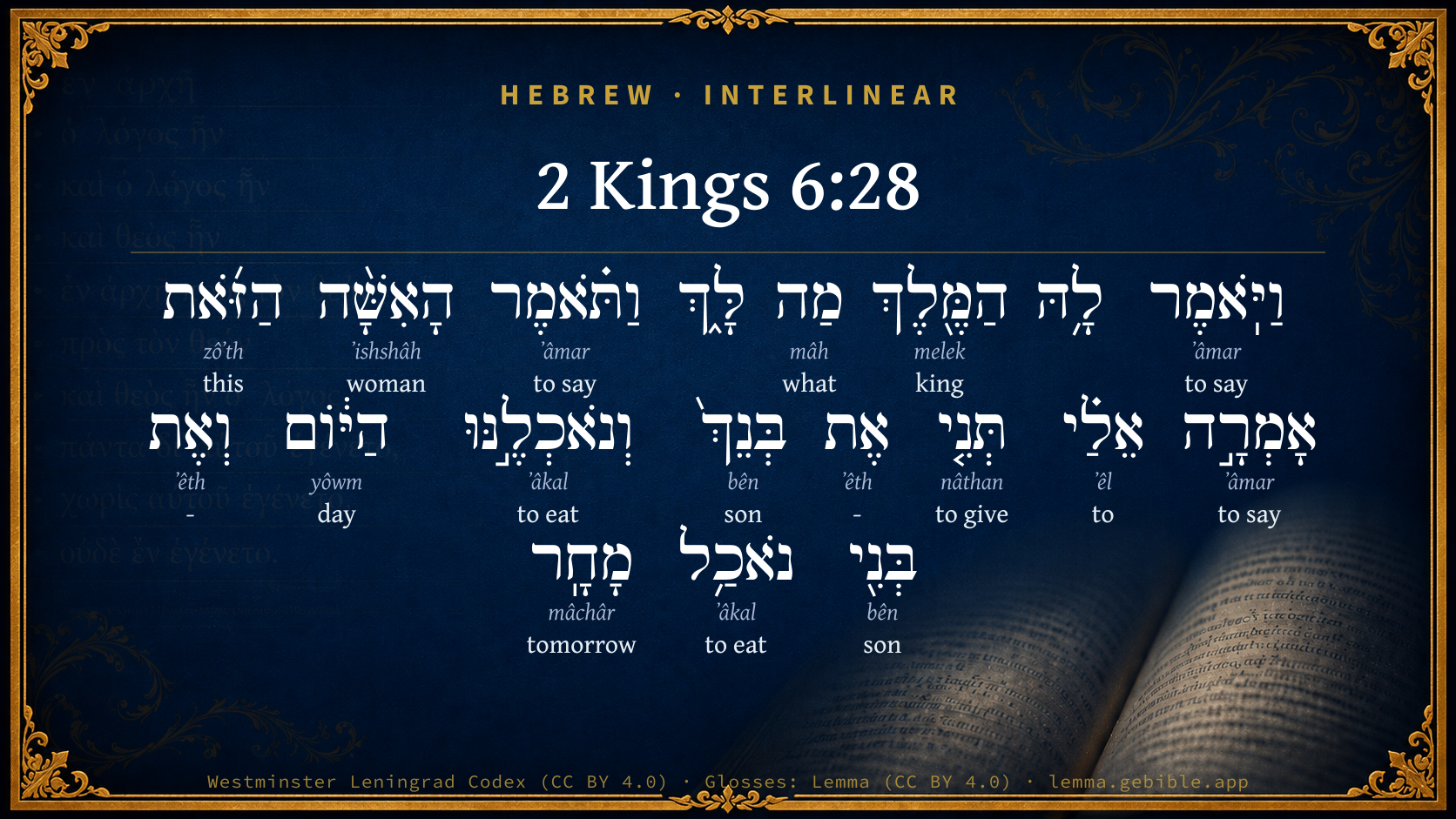
2 Kings 6:28

Hebrew (Westminster Leningrad Codex) 2 Kings 6:28 appears in the Hebrew Old Testament. The text above is from the Westminster Leningrad Codex. Each word links to its Strong’s number, a concise gloss, and parsing drawn from the Open Scriptures Hebrew Bible morphology. Click any word for its full Brown-Driver-Briggs (BDB) entry.
Download image
Cite this verse

2 Kings 6:28 (World English Bible). Public Domain. Lemma interlinear Bible study tool, https://lemma.gebible.app/v/2-kings/6/28.

Show BibTeX & RIS
BibTeX
RIS
English Translation
The king said to her, What ails you? She answered, This woman said to me, Give your son, that we may eat him today, and we will eat my son tomorrow.
World English Bible · Public Domain
Download a study sheet

One document with this verse’s original text, its word-by-word gloss line, the meaning frame, cross-references with their text, attributed commentary, and full source and license credits — printable, and it pastes into notes with its structure intact.

This verse Autodidact and up

Study sheet (.html) Plain text (.txt)

A passage Seminary Student

Up to 50 verses in one chapter. A passage sheet keeps up to 6 commentary sources and 12 cross-references per verse, in the order this page ranks them, and says so on the sheet whenever that leaves anything out. Ask for a single verse and you get the Autodidact verse sheet above.

Everything on this page stays free to read, with no account — the sheet is a download of what is already on screen, not access to it.

Want to remove ads? Support Godless Engineer
Compare translations 3

The same verse in 3 English versions, stacked beneath the original-language interlinear above. Click any original word for its lexicon entry.

Each is an independent rendering of the whole verse — the interlinear is not word-aligned to these translations.

Highlighted words mark where these versions differ — a whole-verse word diff, not a word-by-word alignment.

  • World English Bible Public Domain
    The king said to her, What ails you? She answered, This woman said to me, Give your son, that we may eat him today, and we will eat my son tomorrow.
  • King James Version Public Domain
    And the king said unto her, What aileth thee? And she answered, This woman said unto me, Give thy son, that we may eat him to day, and we will eat my son to morrow.
  • unfoldingWord Literal Text CC BY-SA 4.0
    And the king said to her, “What to you?” And she said, “This woman said to me, ‘Give your son, and we will eat him today, and we will eat my son tomorrow.’

unfoldingWord Literal Text — © unfoldingWord, licensed CC BY-SA 4.0. Word-aligned USFM3 via Door43 (git.door43.org/unfoldingWord/en_ult).

Versions to compare (up to 4)

3 of 4 selected

Show all 18 translations

Every available English version of this verse, each an independent rendering of the whole verse.

  • World English Bible Public Domain
    The king said to her, What ails you? She answered, This woman said to me, Give your son, that we may eat him today, and we will eat my son tomorrow.
  • Berean Standard Bible Public Domain
    Then the king asked her, “What is the matter?” And she answered, “This woman said to me, ‘Give up your son, that we may eat him, and tomorrow we will eat my son.’
  • Majority Standard Bible Public Domain
    Then the king asked her, “What is the matter?” And she answered, “This woman said to me, ‘Give up your son, that we may eat him, and tomorrow we will eat my son.’
  • King James Version Public Domain
    And the king said unto her, What aileth thee? And she answered, This woman said unto me, Give thy son, that we may eat him to day, and we will eat my son to morrow.
  • American Standard Version (1901) Public Domain
    And the king said unto her, What aileth thee? And she answered, This woman said unto me, Give thy son, that we may eat him to-day, and we will eat my son to-morrow.
  • Revised Version (1885) Public Domain
    And the king said unto her, What aileth thee? And she answered, This woman said unto me, Give thy son, that we may eat him today, and we will eat my son tomorrow.
  • Geneva Bible (1599) Public Domain
    Also the King said vnto her, What ayleth thee? And she answered, This woman sayde vnto me, Giue thy sonne, that we may eate him to day, and we will eate my sonne to morowe,
  • Douay-Rheims (1899) Public Domain
    This woman said to me: Give thy son, that we may eat him to day, and we will eat my son to morrow.
  • Young's Literal Translation Public Domain
    And the king saith to her, `What -- to thee?' and she saith, `This woman said unto me, Give thy son, and we eat him to-day, and my son we eat to-morrow;
  • Literal Standard Version CC BY-SA 4.0
    And the king says to her, “What is [troubling] you?” And she says, “This woman said to me, Give your son, and we eat him today, and we eat my son tomorrow;
  • Unlocked Literal Bible CC BY-SA 4.0
    The king continued, “What is troubling you?” She answered, “This woman said to me, 'Give your son so that we may eat him today, and we will eat my son tomorrow.'”
  • unfoldingWord Literal Text CC BY-SA 4.0
    And the king said to her, “What to you?” And she said, “This woman said to me, ‘Give your son, and we will eat him today, and we will eat my son tomorrow.’
  • Darby Bible Public Domain
    And the king said to her, What aileth thee? And she said, This woman said to me, Give thy son, that we may eat him to-day, and we will eat my son to-morrow.
  • World Messianic Bible Public Domain
    Then the king asked her, “What is your problem?” She answered, “This woman said to me, ‘Give your son, that we may eat him today, and we will eat my son tomorrow.’
  • Webster's Bible Public Domain
    And the king said to her, What aileth thee? and she answered, This woman said to me, Give thy son, that we may eat him to-day, and we will eat my son to-morrow.
  • Free Bible Version CC BY-SA 4.0
    But then he asked her, “What's the problem?” “This woman told me, ‘Give up your son and we'll eat him today, and tomorrow we'll eat my son,’” she answered.
  • Bible in Basic English Public Domain
    And the king said to her, What is troubling you? And she said in answer, This woman said to me, Give your son to be our food today, and we will have my son tomorrow.
  • JPS Tanakh (1917) Public Domain
    And the king said unto her: 'What aileth thee?' And she answered: 'This woman said unto me: Give thy son, that we may eat him to-day, and we will eat my son to-morrow.

Literal Standard Version (2020), Covenant Press — licensed CC BY-SA 4.0. Text via the HelloAO Bible API (eBible.org). Unlocked Literal Bible (unfoldingWord) — licensed CC BY-SA 4.0. Text via the HelloAO Bible API (eBible.org). unfoldingWord Literal Text — © unfoldingWord, licensed CC BY-SA 4.0. Word-aligned USFM3 via Door43 (git.door43.org/unfoldingWord/en_ult). Free Bible Version, Dr. Jonathan Gallagher — licensed CC BY-SA 4.0. Text via the HelloAO Bible API (eBible.org).

Word by word

More ways to search: Search by grammar → Find every occurrence → Compare this word →

Practice this passage: Drill this verse → Learn its vocabulary →

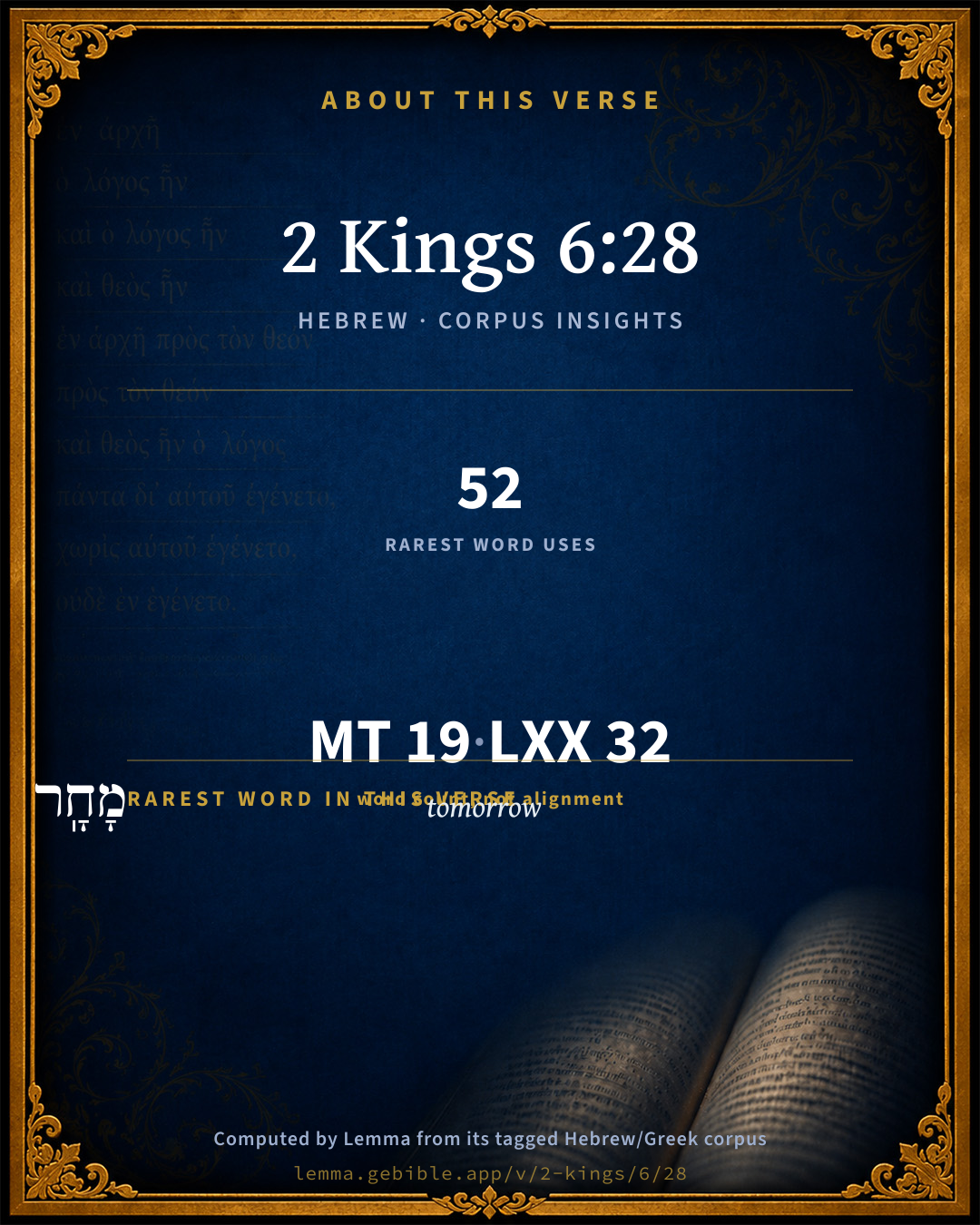
מָחָֽר
mâchâr
H4279
“tomorrow”
Noun, Common, Masculine, Singular, Absolute
Part of Speech
Noun
Type
Common
Gender
Masculine
Number
Singular
State
Absolute
Full BDB Definition

Origin: probably from H309

TWOT: 1185a

tomorrow, in time to come, in the future - tomorrow (as the day following the present day) - in future time
  1. וַיֹּֽאמֶר ʼâmar H559 “and · to say” Conjunction + Verb, Qal, Sequential Imperfect, 3rd Person, Masculine, Singular
  2. הַמֶּ֖לֶךְ melek H4428 “the · king” Particle, Definite Article + Noun, Common, Masculine, Singular, Absolute
  3. מַה mâh H4100 “what” Particle, Interrogative
  4. וַתֹּ֗אמֶר ʼâmar H559 “and · to say” Conjunction + Verb, Qal, Sequential Imperfect, 3rd Person, Feminine, Singular
  5. הָאִשָּׁ֨ה ʼishshâh H802 “the · woman” Particle, Definite Article + Noun, Common, Feminine, Singular, Absolute
  6. הַזֹּ֜את zôʼth H2063 “the · this” Particle, Definite Article + Pronoun, Demonstrative, Feminine, Singular
  7. אָמְרָ֣ה ʼâmar H559 “to say” Verb, Qal, Perfect, 3rd Person, Feminine, Singular
  8. אֵלַ֗י ʼêl H413 “to · me” Preposition + Suffix, Personal, 1st Person, Common, Singular
  9. תְּנִ֤י nâthan H5414 “give” Verb, Qal, Imperative, 2nd Person, Feminine, Singular
  10. אֶת ʼêth H853 “-” Particle, Direct Object
  11. בְּנֵךְ֙ bên H1121 “son · your” Noun, Common, Masculine, Singular, Construct + Suffix, Personal, 2nd Person, Feminine, Singular
  12. וְנֹאכְלֶ֣נּוּ ʼâkal H398 “and · to eat · him” Conjunction + Verb, Qal, Imperfect, 1st Person, Common, Plural + Suffix, Personal, 3rd Person, Masculine, Singular
  13. הַיּ֔וֹם yôwm H3117 “the · day” Particle, Definite Article + Noun, Common, Masculine, Singular, Absolute
  14. וְאֶת ʼêth H853 “and · -” Conjunction + Particle, Direct Object
  15. בְּנִ֖י bên H1121 “son · my” Noun, Common, Masculine, Singular, Construct + Suffix, Personal, 1st Person, Common, Singular
  16. נֹאכַ֥ל ʼâkal H398 “to eat” Verb, Qal, Imperfect, 1st Person, Common, Plural

About this verse

These counts appear in no published source. They are computed here, from the morphology-tagged text and Lemma’s own curated glosses. What Lemma adds →

19
words
12
distinct lemmas
Historical
section

Shared distinctive vocabulary

מָחָֽר tomorrow H4279 occurs in 52 verses of the Hebrew Bible. Also found in:

Grammatical profile

  • 6 verbs
  • 6 nouns
  • 1 pronoun
  • 3 prepositions
  • 3 particles

Verb forms

  • וַיֹּֽאמֶר Qal · Sequential Imperfect
  • וַתֹּ֗אמֶר Qal · Sequential Imperfect
  • אָמְרָ֣ה Qal · Perfect
  • תְּנִ֤י Qal · Imperative
  • וְנֹאכְלֶ֣נּוּ Qal · Imperfect
  • נֹאכַ֥ל Qal · Imperfect

Repetition

Words recur within this verse — often emphatic in Hebrew:

  • וַיֹּֽאמֶר to say H559 ×3
  • בְּנֵךְ֙ son H1121 ×2
  • וְנֹאכְלֶ֣נּוּ to eat H398 ×2

Hebrew & Septuagint length

In English translation the verse runs 31 words from the Hebrew and 39 from the Septuagint (LXX English) — closely comparable.

A rough comparison of the two English renderings, which tokenize alike — not a word-level alignment.

Word counts can differ between the Hebrew and the Greek without any difference in meaning — e.g. the Hebrew direct-object marker אֵת has no separate Greek word, and Greek often adds the article ὁ.

In the original languages it is 19 Hebrew tokens and 32 Greek tokens — but the two are counted differently (Hebrew bundles its prefixes and suffixes into one token; the Greek is in lemma form), so that isn’t a like-for-like length.

Cross-references

14

Topical passages linked to 2 Kings 6:28 in the Treasury of Scripture Knowledge — connected by theme and wording, ordered by reader-vote popularity; previews shown in the World English Bible.

  • 2 Samuel 14:5 The king said to her, What ails you? She answered, Of a truth I am a widow, and my husband is dead.
  • Judges 18:23 They cried to the children of Dan. They turned their faces, and said to Micah, What ails you, that you come with such a company?
  • Lamentations 4:10 The hands of the pitiful women have boiled their own children; They were their food in the destruction of the daughter of my people.
  • Genesis 21:17 God heard the voice of the boy. The angel of God called to Hagar out of the sky, and said to her, "What ails you, Hagar? Don't be afraid. For God has heard the voice of the boy where he is.
  • Leviticus 26:29 You will eat the flesh of your sons, and you will eat the flesh of your daughters.
  • Deuteronomy 28:53–57 You shall eat the fruit of your own body, the flesh of your sons and of your daughters, whom Yahweh your God has given you, in the siege and in the distress with which your enemies shall distress you.
  • 1 Samuel 1:8 Elkanah her husband said to her, Hannah, why weep you? and why don't you eat? and why is your heart grieved? am I not better to you than ten sons?
  • Psalms 114:5 What was it, you sea, that you fled? You Jordan, that you turned back?
  • Isaiah 9:20–21 One shall snatch on the right hand, and be hungry; and he shall eat on the left hand, and they shall not be satisfied: they shall eat every man the flesh of his own arm:
  • Isaiah 22:1 The burden of the valley of vision. What ails you now, that you are wholly gone up to the housetops?
  • Isaiah 49:15 Can a woman forget her sucking child, that she should not have compassion on the son of her womb? yes, these may forget, yet I will not forget you.
  • Ezekiel 5:10 Therefore the fathers shall eat the sons in the midst of you, and the sons shall eat their fathers; and I will execute judgments on you; and the whole remnant of you will I scatter to all the winds.
  • Matthew 24:18–21 Let him who is in the field not return back to get his clothes.
  • Luke 23:29 For behold, the days are coming in which they will say, 'Blessed are the barren, the wombs that never bore, and the breasts that never nursed.'

Cross-references courtesy of OpenBible.info (CC BY 4.0).

Hebrew and Greek witnesses Masoretic Hebrew ↔ Greek Septuagint

The same verse in the two great witnesses to the Old Testament, shown verse-for-verse.

These are two independent witnesses, not word-aligned to each other, and the Septuagint is shown in lemma (dictionary) form.

Hebrew 2 Kings 6:28 Masoretic · Westminster Leningrad Codex

וַיֹּֽאמֶר לָ֥הּ הַמֶּ֖לֶךְ מַה לָּ֑ךְ וַתֹּ֗אמֶר הָאִשָּׁ֨ה הַזֹּ֜את אָמְרָ֣ה אֵלַ֗י תְּנִ֤י אֶת בְּנֵךְ֙ וְנֹאכְלֶ֣נּוּ הַיּ֔וֹם וְאֶת בְּנִ֖י נֹאכַ֥ל מָחָֽר

The king said to her, What ails you? She answered, This woman said to me, Give your son, that we may eat him today, and we will eat my son tomorrow.

World English Bible · Public Domain

Greek LXX 2 Kings 6:28 Septuagint · lemma form

καί εἶπον αὐτός ὁ βασιλεύς τίς εἰμί σύ καί εἶπον ὁ γυνή οὗτος εἶπον πρός ἐγώ δίδωμι ὁ υἱός σύ καί ἐσθίω αὐτός σήμερον καί ὁ υἱός ἐγώ καί ἐσθίω αὐτός αὔριον

And the king said to her, What is the matter with you? And the woman said to him, This woman said to me, Give your son, and we will eat him today, and we will eat my son to-morrow.

LXX2012 (modern English Septuagint) · Public Domain

Hebrew: Westminster Leningrad Codex (CC BY 4.0). Greek: Septuagint (public domain); English from LXX2012 (modern English Septuagint) (Public Domain). How the Septuagint differs from the Hebrew →

Targum (Aramaic paraphrase)

1

The Targum is the ancient Jewish Aramaic paraphrase of the Hebrew Scriptures — an interpretive translation, not the Hebrew text itself. Onkelos (literal) and Pseudo-Jonathan (expansive) render the Torah, and Jonathan the Prophets. Coverage is partial: where no permissively-licensed English translation exists for a verse, only the Aramaic is shown. This is verse-level text, not a word-by-word alignment to the Hebrew.

  1. Targum Jonathan Prophets (Joshua–Malachi)
    וַאֲמַר לָהּ מַלְכָּא מַה לִיךְ וַאֲמַרַת אִתְּתָא הָדָא אֲמַרַת לִי הָבִי יַת בְּרִיךְ וְנֵיכְלִינֵיהּ יוֹמָא דֵין וְיַת בְּרִי נֵיכוּל מְחָר:

    (no public-domain English translation for this verse)

    Targum Jonathan — Aramaic: “Mikraot Gedolot” (public domain). English: “Sefaria Community Translation” (CC0 1.0 (public-domain dedication)); “London "Chaldee Paraphrase," 1871” (public domain). Text via Sefaria.

Commentary

Notes on 2 Kings 6:28 from classic Christian and Jewish commentators (each source and its license shown beneath its notes). The classic Christian expositions comment on the surrounding passage and are grouped to its opening verse, so a note may address several verses; the Jewish commentaries on the Tanakh (Rashi and others) are per-verse, so they appear only where the commentator wrote on this verse.

Lemma curates 59 commentaries, every one of them public domain or Creative Commons licensed, each selected and text-cleaned for this edition rather than reprinted as found. About our sources →

Trapp's Complete Commentary

John Trapp

2Ki 6:28 And the king said unto her, What aileth thee? And she answered, This woman said unto me, Give thy son, that we may eat him to day, and we will eat my son to morrow.

Ver. 28. Give thy son, that we may eat him.] The like fell out among the Turks and Tartars in Hungary; {a} the Germans in Transylvania, 1604; the Tunetans in Africa; and the English here in Edward II’s time, A.D. 1316: so terrible was the famine, that horses, dogs, yea, men and children, were stolen for food; and the thieves newly brought into the jails were torn in pieces, and eaten presently, half-alive, by such as had been longer there. {b}

{a} Turk. Hist., 1060.

{b} Purch., Pilgrim., 289. Speed, 674.

John Trapp, A Commentary or Exposition upon All the Books of the Old and New Testament (1647–1656) — public domain. Text from a community e-Sword module.

Joseph Benson's Commentary

2Ki 6:28-29. The king said, What aileth thee? — Is there any thing singular in thy case? Dost thou fare worse than thy neighbours? Truly, yes: she and one of her neighbours had made a barbarous agreement, that, all provisions failing, they should boil and eat her son first, and then her neighbour’s: hers was eaten, (who can think on it without horror?) and now her neighbour hid hers. This shocking story is a terrible effect of the divine vengeance, which Moses, about six hundred years before, had warned the Israelites would fall upon them in case of their apostacy from, and rebellion against, God; as the reader may see in the passages referred to in the margin. The same dreadful calamity befell them at two other times besides this; at the siege of Jerusalem, under Nebuchadnezzar, Lam 2:20; Eze 5:10; and that under Titus. See Joseph., Jewish War, lib. 7, c. 10.

Joseph Benson's Commentary on the Old and New Testaments (1811–1818) — public domain. Text from a community e-Sword module.

Ellicott's Commentary for English Readers

(28) And the king said.—When she had explained what she wanted. With the hideous facts here recorded, comp. Deu_28:56, seq. Similar things were done during the sieges of Jerusalem by Nebuchadnezzar (1Sa_4:10; Eze_5:10), and by Vespasian and Titus (Josephus, Bell. Jud. vi. 3, 4).

A Bible Commentary for English Readers, edited by Charles John Ellicott (1878–1897) — public domain. Text from a community e-Sword module.

The Cambridge Bible for Schools and Colleges

gen. ed. J. J. S. Perowne

28. What aileth thee?] The woman’s cry is not stopped by his answer. She has more to speak about than to ask him for food.

This woman said unto me] It would appear as if she had brought her neighbour along with her, that what she deemed justice might be done her at once. That they should be brought to such hardships and horrors as are here described had been foretold to Israel in early times (Lev_26:29; Deu_28:53-57); cf. also Lament. 2Ki_2:20; 2Ki_4:10; Eze_5:10. Josephus relates the like dreadful sufferings in the siege of Jerusalem by Titus (B. J. 6:3. 4).

my son] According to the history the children were both sons. Josephus represents only one of them as a boy.

The Cambridge Bible for Schools and Colleges (gen. ed. J. J. S. Perowne; Cambridge University Press, 1878–1918) — public domain. Text from a community e-Sword module.

John Gill's Exposition

And it came to pass, when the king heard the words of the woman, that he rent his clothes,.... At the horror of the fact reported, and through grief that his people were brought into such distress through famine:

and he passed by upon the wall; returning to his palace:

and the people looked, and, behold, he had sackcloth upon his flesh; which, in token of humiliation for averting the calamities he was under, he had put there before, and now was seen through the rending of his clothes.

John Gill's Exposition of the Whole Bible (1746–1763) — public domain (CC PDM 1.0). Text via the HelloAO Bible API.

Albert Barnes' Notes on the Bible

The king had assumed that the cry of the woman was for food. Her manner indicated that it was not so. He therefore proceeded to inquire what she wanted of him.

This woman - Both women, it would seem, were present; and the aggrieved one pointed to the other.

Albert Barnes' Notes on the Bible (1834–1885) — public domain. Text from a community e-Sword/MySword module.

The Pulpit Commentary

And the king said unto her, What aileth thee? Probably, as Bahr suggests, the woman explained to the king that she did not appear before him to beg food, but to claim his interposition as judge, in a case in which she considered herself to be wronged. Such an appeal the king was bound to hear; and he therefore asks," What aileth thee?" i.e. "What is thy ground of complaint?" Then she tells her story. And she answered, This woman said unto me, Give thy son, that we may eat him today, and we will eat my son tomorrow. Compare the prophecy in Deuteronomy, "The tender and delicate woman among you, which would not adventure to set the sole of her foot upon the ground for delicateness and tenderness, her eye shall be evil towards the husband of her bosom, and toward her son, and toward her daughter, and toward her young one that cometh out from between her feet, and toward her children which she shall bear: for she shall eat them for want of all things secretly in the siege and straitness, wherewith thine enemy shall distress thee in thy gates". (Deu_28:56, Deu_28:57) There is historical testimony that the prophecy was three times fulfilled; viz.

(1) in Samaria on the present occasion;

(2) in Jerusalem during the last siege by Nebuchadnezzar; (Lam_4:10) and (3) in Jerusalem during the last siege by Titus (Josephus, "Bell. Jud:," 6:3. In modern sieges surrender is made before the population is driven to such straits.

The Pulpit Commentary (1880–1919), ed. H.D.M. Spence-Jones & Joseph S. Exell — public domain. Text from a community e-Sword module.

Lesson kit

Teaching starters — assembled from the data on this page, not authored interpretation. Every prompt links to the verse data it draws on. Edit before teaching.

2 Kings, in the Historical, opens this verse with 19 words (12 distinct Hebrew lemmas). Its most distinctive word is mâchâr (“tomorrow”). A historical commentator’s framing appears above. Read the whole chapter for the surrounding context.

Discussion questions

  1. The word mâchâr carries the sense “tomorrow.” How does it shape the verse?
  2. Genesis 30:33 shares the word «tomorrow» with this verse. How do the two illuminate each other?
  3. “to say” occurs 3× in this one verse. What is the effect of the repetition?
  4. The translations on this page render this verse differently — a whole-verse word diff, not a word-by-word alignment. What might account for the different wordings?
  5. The verb «וַיֹּֽאמֶר» is Qal Sequential Imperfect. How does its form color the action?
  6. Reading how Trapp's Complete Commentary and Joseph Benson's Commentary read this verse, where do the two commentators agree and where do they part?

Things to notice

Reading settings

Reading text

Shown beneath each verse's original-language words.

Old Testament
Old Testament edition

Read the OT as the Masoretic Hebrew (MT) or the Greek Septuagint (LXX).

English shown for the Greek Septuagint (in the Hebrew ↔ Greek comparison).

Comparing translations? Open the Compare panel on any verse page to stack up to four side by side.