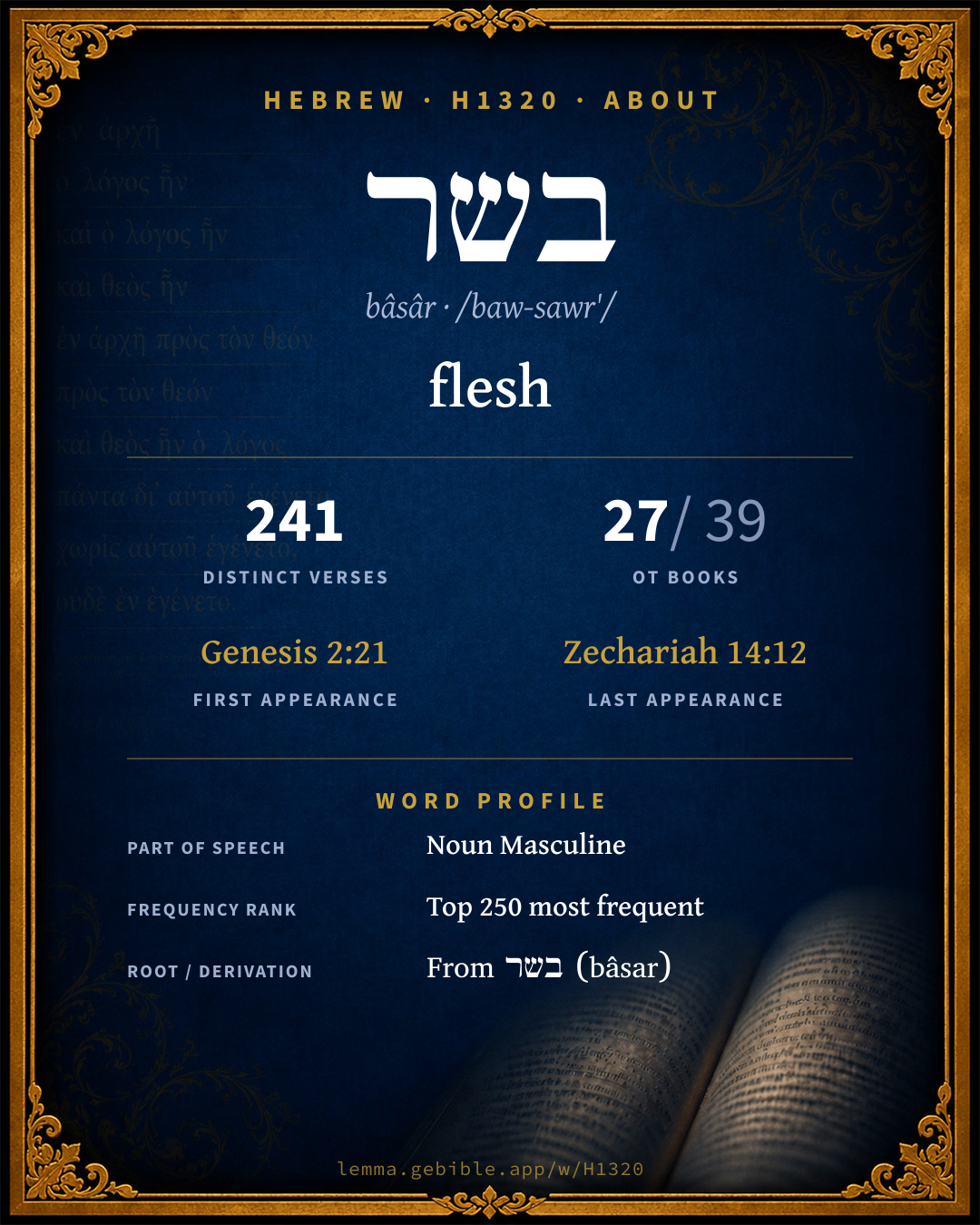
בָּשָׂר
flesh
‘flesh’ is one of 10 main senses fuller range ↓
Full lexicon entry — Brown-Driver-Briggs (BDB)
From Brown-Driver-Briggs (BDB)
Where this word appears
See every Absolute-state word in the Hebrew Bible →
Grammar key — what these labels mean
Part of speech
- Noun
- A naming word — a person, place, thing, or idea.
Noun type
- Common
- A common noun — a general class of person, place, or thing (“king,” “city,” “water”), not a specific name.
State
- Absolute
- The independent form of a noun, not bound to a following word.
- Construct
- A noun bound to a following noun in a possessive / “of” relationship (the construct chain).
Gender
- Masculine
- Grammatically masculine.
Number
- Singular
- One.
- Plural
- More than one (in Hebrew, generally three or more).
15 verses where H1320 appears in the Absolute state in the Book of Ezekiel. Filtered view — show all forms. Click any verse to open its interlinear word-by-word view. Verse text shown in the World English Bible for context — . Each verse’s Hebrew form is shown with its reference; the English is not keyword-highlighted, since the data carries no word-level English alignment. Use “Compare translations” on any verse to read it across multiple English versions. This concordance covers the Hebrew Bible; Septuagint (Greek Old Testament) occurrences are not indexed here.
Ezekiel
- Ezekiel 11:3 הַ/בָּשָֽׂר ptcl def.art + n c ms who say, [The time] is not near to build houses: this [city] is the caldron, and we are the flesh.
- Ezekiel 11:7 הַ/בָּשָׂ֖ר ptcl def.art + n c ms Therefore thus says the Lord Yahweh: Your slain whom you have laid in the midst of it, they are the flesh, and this [city] is the caldron; but you shall be brought forth out of the midst of it.
- Ezekiel 11:11 לְ/בָשָׂ֑ר prep + n c ms This [city] shall not be your caldron, neither shall you be the flesh in the midst of it; I will judge you in the border of Israel;
- Ezekiel 11:19 מִ/בְּשָׂרָ֔/ם בָּשָֽׂר prep + n c ms cs + sfx pers 3mp n c ms I will give them one heart, and I will put a new spirit within you; and I will take the stony heart out of their flesh, and will give them a heart of flesh;
- Ezekiel 16:26 בָשָׂ֑ר n c ms You have also committed sexual immorality with the Egyptians, your neighbors, great of flesh; and have multiplied your prostitution, to provoke me to anger.
- Ezekiel 20:48 בָּשָׂ֔ר n c ms All flesh shall see that I, Yahweh, have kindled it; it shall not be quenched.
- Ezekiel 21:4 בָּשָׂ֖ר n c ms Seeing then that I will cut off from you the righteous and the wicked, therefore shall my sword go forth out of its sheath against all flesh from the south to the north:
- Ezekiel 21:5 בָּשָׂ֔ר n c ms and all flesh shall know that I, Yahweh, have drawn forth my sword out of its sheath; it shall not return any more.
- Ezekiel 24:10 הַ/בָּשָׂ֑ר ptcl def.art + n c ms Heap on the wood, make the fire hot, boil well the flesh, and make thick the broth, and let the bones be burned.
- Ezekiel 36:26 מִ/בְּשַׂרְ/כֶ֔ם בָּשָֽׂר prep + n c ms cs + sfx pers 2mp n c ms A new heart also will I give you, and a new spirit will I put within you; and I will take away the stony heart out of your flesh, and I will give you a heart of flesh.
- Ezekiel 37:6 בָּשָׂ֗ר n c ms I will lay sinews on you, and will bring up flesh on you, and cover you with skin, and put breath in you, and you shall live; and you shall know that I am Yahweh.
- Ezekiel 37:8 וּ/בָשָׂ֣ר conj + n c ms I saw, and, behold, there were sinews on them, and flesh came up, and skin covered them above; but there was no breath in them.
- Ezekiel 39:17 בָּשָׂ֖ר n c ms You, son of man, thus says the Lord Yahweh: Speak to the birds of every sort, and to every animal of the field, Assemble yourselves, and come; gather yourselves on every side to my sacrifice that I do sacrifice for you, even a great sacrifice on the mountains of Israel, that you may eat flesh and drink blood.
- Ezekiel 44:7 בָשָׂ֔ר n c ms in that you have brought in foreigners, uncircumcised in heart and uncircumcised in flesh, to be in my sanctuary, to profane it, even my house, when you offer my bread, the fat and the blood, and they have broken my covenant, [to add] to all your abominations.
- Ezekiel 44:9 בָּשָׂ֔ר n c ms Thus says the Lord Yahweh, No foreigner, uncircumcised in heart and uncircumcised in flesh, shall enter into my sanctuary, of any foreigners who are among the children of Israel.
About this entry
At a glance — auto-summarized from this page’s data, not written by a person. Every figure links to its source below. This summary describes the numbers; it doesn’t interpret them.
בשר (bâsâr) is a Hebrew noun most often rendered “flesh.” Not a single-sense word: explore its full sense range. The Hebrew Bible uses it across 241 verses — common. It first appears in Genesis 2:21. Sharing its root, it stands alongside בשר, בשורה and בשר. For the data behind this summary, explore the sense tree and the renderings breakdown below.
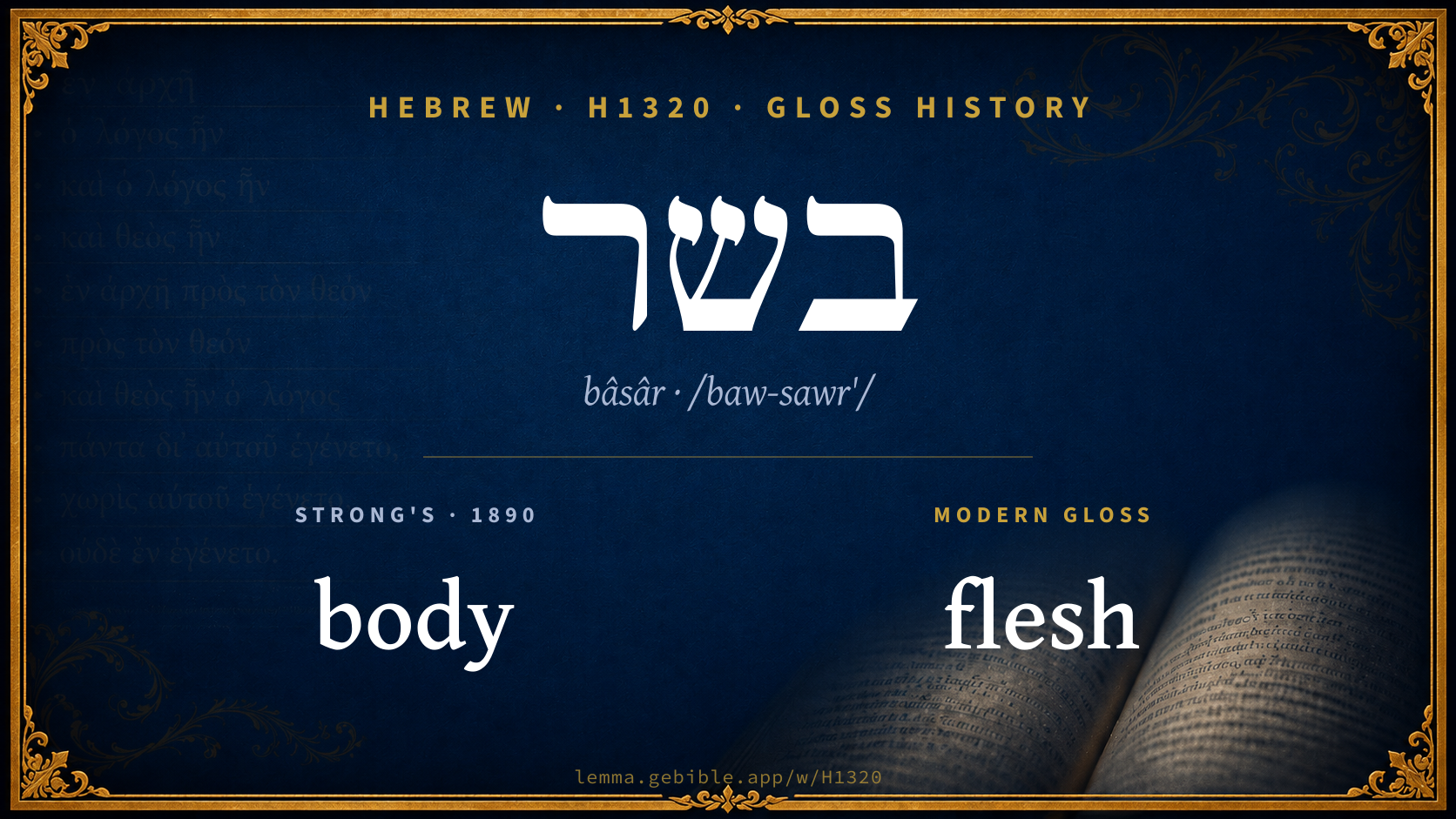
Gloss history
Strong's 1890 vs modern scholarship
About this word
Strong's H1320 catalogs a Hebrew word from the Hebrew Old Testament.
These counts are not copied from any lexicon or concordance. They are computed here, from the morphology-tagged Hebrew Old Testament. What Lemma adds →
- 241
- distinct verses
- The word appears in 241 distinct verses.
- 27 / 39
- OT books
- The word appears in 27 of 39 Old Testament books.
- #184
- by frequency
- Top 250 most frequent Hebrew words (rank 184 of 8,640 Hebrew words by occurrence).
View all 241 occurrences in the concordance →
By section of the Old Testament
By traditional corpus
Conventional, traditional groupings — biblical authorship is debated, so this is a traditional corpus grouping, not an authorship claim. Each share is this word’s portion of its verses in that division of the Hebrew canon. Each figure is a share of the word’s 241 distinct verses.
- Torah (Pentateuch) 120 verses · 50%
- Prophets (Nevi'im) 72 verses · 30%
- Writings (Ketuvim) 49 verses · 20%
How translations render this word
Counts come from each version’s own published word-to-Strong’s tagging or interlinear alignment — an approximate guide to how each version renders this word, not a word-level alignment the data otherwise carries. Because each total is that version’s own tagged count, the per-version totals vary from one another and need not match the appearance or distinct-verse counts above. These counts may also differ from a printed concordance because Lemma counts each distinctly tagged rendering and does not collapse phrase taggings into a single head-word total. This is a fixed set of word-tagged versions (KJV, ASV, BSB, ULT) and does not change with the reading translation you choose elsewhere. Each version’s license is shown beside its name below (and on Sources).
- King James Version: Flesh 181×, All flesh 29×, All his flesh 3×
- American Standard Version: Flesh 159×, All flesh 28×, 's flesh 2×
- Berean Standard Bible: Flesh 80×, Meat 52×, Body 20×
- unfoldingWord Literal Text: Flesh 174×, Meat 36×, Flesh of 26×
King James Version Public Domain
Renders H1320 across 263 tagged occurrences — most commonly:
Plus 40 renderings that appear only once — usually multi-word phrases or single function words the recovered tagging swept in, not distinct renderings. Not rendered by a distinct English word in 6 further occurrences.
American Standard Version Public Domain
Renders H1320 across 264 tagged occurrences — most commonly:
Plus 65 renderings that appear only once — usually multi-word phrases or single function words the recovered tagging swept in, not distinct renderings.
Berean Standard Bible Public Domain
Renders H1320 across 231 tagged occurrences — most commonly:
Plus other, less common renderings. Plus 32 renderings that appear only once — usually multi-word phrases or single function words the recovered tagging swept in, not distinct renderings. Not rendered by a distinct English word in 38 further occurrences.
unfoldingWord Literal Text CC BY-SA 4.0
Renders H1320 across 279 tagged occurrences — most commonly:
Plus 25 renderings that appear only once — usually multi-word phrases or single function words the recovered tagging swept in, not distinct renderings.
11 senses and sub-senses in the full BDB
What do BDB’s symbols mean?
BDB uses these scholarly abbreviations:
| Symbol | Meaning |
|---|---|
| 𝔊 | the Septuagint (the ancient Greek translation, LXX) |
| 𝔙 | the Vulgate (the Latin translation) |
| 𝔖 | the Syriac version (the Peshitta) |
| 𝔗 | the Targum (the Aramaic translation) |
| ψ | the Psalms |
| √ | root (the underlying root or stem) |
| ‖ | parallel passage (a synonymous or contrasted parallel) |
| † | the dagger: every passage where the word occurs is cited |
The 11 senses and sub-senses the full Brown-Driver-Briggs lexicon distinguishes for this word, in lexicon order (not ranked by frequency), with BDB’s own verbatim wording and sub-sense lettering. Shown in Hebrew script with BDB’s own scholarly abbreviations. The condensed entry is in the Lexicon Entry tab. See also the Forms in the corpus table below.
- 1. of the body:
- a. of animals Gn 41:2–19; Ex 21:28; 22:30; Nu 12:12 (E) Nu 11:4–33 (JE) Gn 9:4 + (P 30 times) Dt 12:15 + (D 9 times) Ju 6:19–21; 1 S 2:13, 15; 1 K 17:6; 19:21; Jb 31:31; 41:15 ψ 50:13; Pr 23:20; Is 22:13; 44:16, 19; 65:4; 66:17; Je 7:21; 11:15; Ez 4:14 + 6 times Dn 10:3; Ho 8:13 Mi 3:3; Hg 2:12; Zc 11:9, 16. e.g. Genesis 41:2
- b. of men Gn 40:19 (E) 2:21; Ex 4:7 (J) Lv 12:3; 13:2 + 16 times 26:29 (P) Dt 28:53, 55; 32:42; Ju 8:7; 1 S 17:44; 2 K 4:34; 5:10, 14; 6:30; 9:36; Jb 2:5; 4:15; 6:12; 7:5; 10:11; 13:14; 19:20, 22; 21:6; 33:21, 25 ψ 27:2; 38:4, 8; 79:2; 102:6; 109:24; Pr 4:22; 5:11 Is 9:19; 17:4; 49:26; Je 19:9; La 3:4; Ez 32:5; 37:6, 8; 39:17, 18 Dn 1:15; Zc 14:12. The flesh of the body is contrasted with stone Ez 11:19; 36:26. e.g. Genesis 40:19
- 2. flesh for the body itself (especially in P): על בשׂר אדם לא ייסך upon the body of man it shall not be poured Ex 30:32 (P); מכנסי בד ילבשׁ על בשׂרו linen drawers shall he put on his body Lv 6:3; 16:4 (P); וישׂם שׂק על בשׂרו 1 K 21:27; ורחץ את בשׂרו and he shall bathe his body Lv 14:9; 15:13, 16; 16:24, 26, 28; 17:16; 22:6; Nu 19:7, 8 (P); שׂרט לנפשׁ לא תתנו בכשׂרכם ye shall not put any cutting for any one in your body Lv 19:28; cf. Lv 21:5 (P); והעבירו תער על כל בשׂרם and they shall pass a razor over all their body Nu 8:7 (P). Ec. uses בשׂר only in this sense 2:3; 4:5; 5:5; 11:10; 12:12; elsewhere this usage only in poetry; the body antith. to נפשׁ Jb 14:22; Is 10:18 ψ 63:2; לב ψ 16:9; 84:3; Pr 14:30 (only here emphatic pl. = entire body Bö§ 695, Leiblichkeit De); מִבְּשָׂרִי apart from my body, in disembodied state Jb 19:26; סמר מפחדך בשׂרי my body trembleth for fear of thee ψ 119:120. e.g. Exodus 30:32
- 3. male organ of generation (euphemism): בְּשַׂר עָרְלַתְכֶם Gn 17:11, 14, 23, 24, 25 (P); בשׂר ערוה Ex 28:42 (P), but בשׂר Gn 17:14; Lv 15:2–19 (P); Ez 16:26; 23:20; 44:7, 9. e.g. Genesis 17:11
- 4. flesh for kindred, blood-relations: עצם מעצמי ובשׂר מבשׂרי bone of my bone and flesh of my flesh Gn 2:23 (J); והיו לבשׂר אחד and they shall become one flesh Gn 2:24 (J); עצמי ובשׂרי Gn 29:14 (J); Ju 9:2; 2 S 5:1 = 1 Ch 11:1; 19:13, 14; בשׂר with sf. in same sense Gn 37:27 (J); Ne 5:5; Is 58:7, for which שְׁאֵר בשׂרו near of kin, man or woman Lv 18:6; 25:49 (both H; 25:49 ‖ מִשְׁפָּחָה, cf. RSK 149). e.g. Genesis 2:23
- 5. man over against God as frail or erring Gn 6:3 (J) ψ 56:5; 78:39; eyes of flesh Jb 10:4; arm of flesh 2 Ch 32:8; Je 17:5; horses are flesh not spirit Is 31:3. e.g. Genesis 6:3
- 6. the phrase כָּל־בָּשָׂר:
- a. all living beings Gn 6:17, 19; 7:21; 9:11, 15, 16, 17 Lv 17:14(×3); Nu 18:15 (P); Jb 34:15 ψ 136:25. e.g. Genesis 6:17
- b. animals Gn 7:15, 16; 8:17 (P). e.g. Genesis 7:15
- c. mankind Gn 6:12, 13; Nu 16:22; 27:16 (P); Dt 5:23 ψ 65:3; 145:21; Is 40:5, 6; 49:26; 66:16, 23, 24; Je 12:12; 25:31; 32:27; 45:5; Ez 21:4, 9, 10; Jo 3:1; Zc 2:17; cf. כל בשׂר אישׁ Jb 12:10. e.g. Genesis 6:12
Senses from the full Brown-Driver-Briggs lexicon (Brown, Driver, Briggs; Oxford 1906 — public domain), digitized via Sefaria, supplemented by the OpenScriptures HebrewLexicon (CC BY 4.0). Full attribution on Sources.
Word origin
n.m. flesh (cf. Arabic بَشَرٌ skin, Syriac ܒܶܣܪܳܐ, Assyrian bišru, blood-relation, Dl Assyrian Stud. i. 143, cf. Pr 170, Sab. בשר תורם flesh of bulls)—Gn 2:21 + 126 times; cstr. בְּשַׂר Gn 17:11 + 40 times; sf. בְּשָׂרִי etc. ψ 16:9 + 96 times; pl. בְּשָׂרִים Pr 14:30;—
— Brown-Driver-Briggs (Oxford 1906, public domain), digitized via Sefaria, supplemented by the OpenScriptures HebrewLexicon (CC BY 4.0). See Sources.
Derived from בשר (bâsar) (H1319) — to preach.
Jastrow Dictionary
A second Hebrew/Aramaic lexicon for comparison, covering Aramaic and post-biblical (Talmudic, Targumic, Midrashic) usage that the biblical-Hebrew BDB does not. Matched by lemma rather than by Strong’s number, so a lemma may carry more than one Jastrow headword (shown separately below), and the entries cover usage well beyond the Bible.
בָּשַׂר
- (v. בָּסַר II a. בָּסַם)to be sweet, pleasant.
- to gladden, to bring good tidings to; in gen. to announce. Ḥull. 87ᵃ מְבַשֵּׂר טובות וכ׳ I am bringing good news. Sabb. 63ᵃ, v. בְּשׂוֹרָה; a. fr.—Part. pass. מְבוּשָּׂר informed of good news, assured. Y. Kil. IX, 32ᵇ top יהא מב׳ מחיי העו"הב he shall receive a message from the life in the world to come, i.e. he may be assured of salvation; Y. Keth. XII, 35ᵃ מכושר לחיי וכ׳ … (corr. acc.); Y. Shek. III, end, 47ᶜ יהא מב׳ שבן עו"הב הוא. Ex. R. s. 46 אתה מב׳ שמחלתי וכ׳ thou art informed that I have forgiven thee &c. Y. Ber. V, end, 9ᵈ; a. e.
- to be gladdened, to receive good tidings. Pesik. R. s. 42 נ׳ בבנים he was assured that he would have children. Gen. R. s. 47; s. 53 נתבשרה בחלב she was assured that she would nurse her child. [V. בָּסַר II.]
בְּשַׂר
- 1. to be glad;—
- *2. = Pa. Targ. Y. Gen. XXI, 7. Targ. Y. II ib. XLIX, 21 למִיבְשַׂר.
- as preced. Pi. Targ. Y. I Gen. XLIX, 21. Targ. Jer. XX, 15; a. fr. [Targ. Y. II, Deut. IV, 34, v. בַּשְׁקַר.]
- as preced. Nithpa. Targ. Ruth I, 6; a. e.
בְּשַׂר ²
- , v. בִּשְׂרָא
בָּשָׂר
- v. preced.) [ripe, warm, sweet, well-looking; v. Freitag Arab. Dict. s. v. bšr, a. cmp. לֶחֶם] body (b. h.); flesh, meat. Ḥull. VIII, 1 כל הב׳ any kind of meat. Ib. 16ᵇ בְּשַׂר תאוה meat eaten for satisfying the appetite, i.e. secular meal of meat, opp. to sacrificial meals (v. Deut. XII, 20). Ib. 17ᵃ, v. נְחִירָה; a. fr.—ב׳ ודם (abbr. ב"וד) flesh and blood, i.e. mortal man. Ber. 33ᵃ; a. v. fr. e.g. Deuteronomy 12:20
A Dictionary of the Targumim, the Talmud Babli and Yerushalmi, and the Midrashic Literature (Marcus Jastrow; London, Luzac, 1903) — Public Domain. Digitized via Sefaria. Digitized via Sefaria. Full attribution on Sources.
Forms in the corpus
The 125 distinct written forms H1320 takes in the Hebrew Bible, most frequent first — each parse links to that state’s occurrences in the concordance. Hebrew forms include their vowel points and cantillation, so a single lemma takes many written forms.
The 60 most common forms are shown; 65 rarer forms follow in the full concordance.
Same root — word family
Other BDB entries built from the same root as H1320, grouped by Strong’s listed origin. These share a root / origin per the lexicon — not necessarily a shared meaning. Each links to that word’s own entry.
Derives from
Shares the same root
Derived from this word
Proper names from this root
People and places named from this root — a name, not an additional meaning of the word.
Compare all same-root words → Showing 4 of 5 — not the complete family. 1 of the same-root words is a proper name (a person or place). They share a root, not necessarily a meaning.
Septuagint verse parallels
This word appears in 228 verses that also exist in the Greek Old Testament (Septuagint), out of the 241 Hebrew verses it occurs in. You can read those verses in Greek by switching the Old Testament edition to the Septuagint.
Read these verses in the Septuagint
- Genesis 2:21
- Exodus 4:7
- Leviticus 4:11
- Numbers 8:7
- Deuteronomy 5:26
- Judges 6:19
- 1 Samuel 2:13
- 2 Samuel 5:1
- 1 Kings 17:6
- 2 Kings 4:34
- 1 Chronicles 11:1
- 2 Chronicles 32:8
This is a verse-level parallel only — the same verses exist in both the Hebrew and Greek Old Testaments. No word-level Hebrew↔Greek correspondence is claimed: the data carries no such alignment, so no Greek word is shown as this Hebrew word’s translation. Coverage is not total — the Septuagint omits the deuterocanon and renumbers the Psalms, so some Hebrew verses have no direct Greek parallel.