
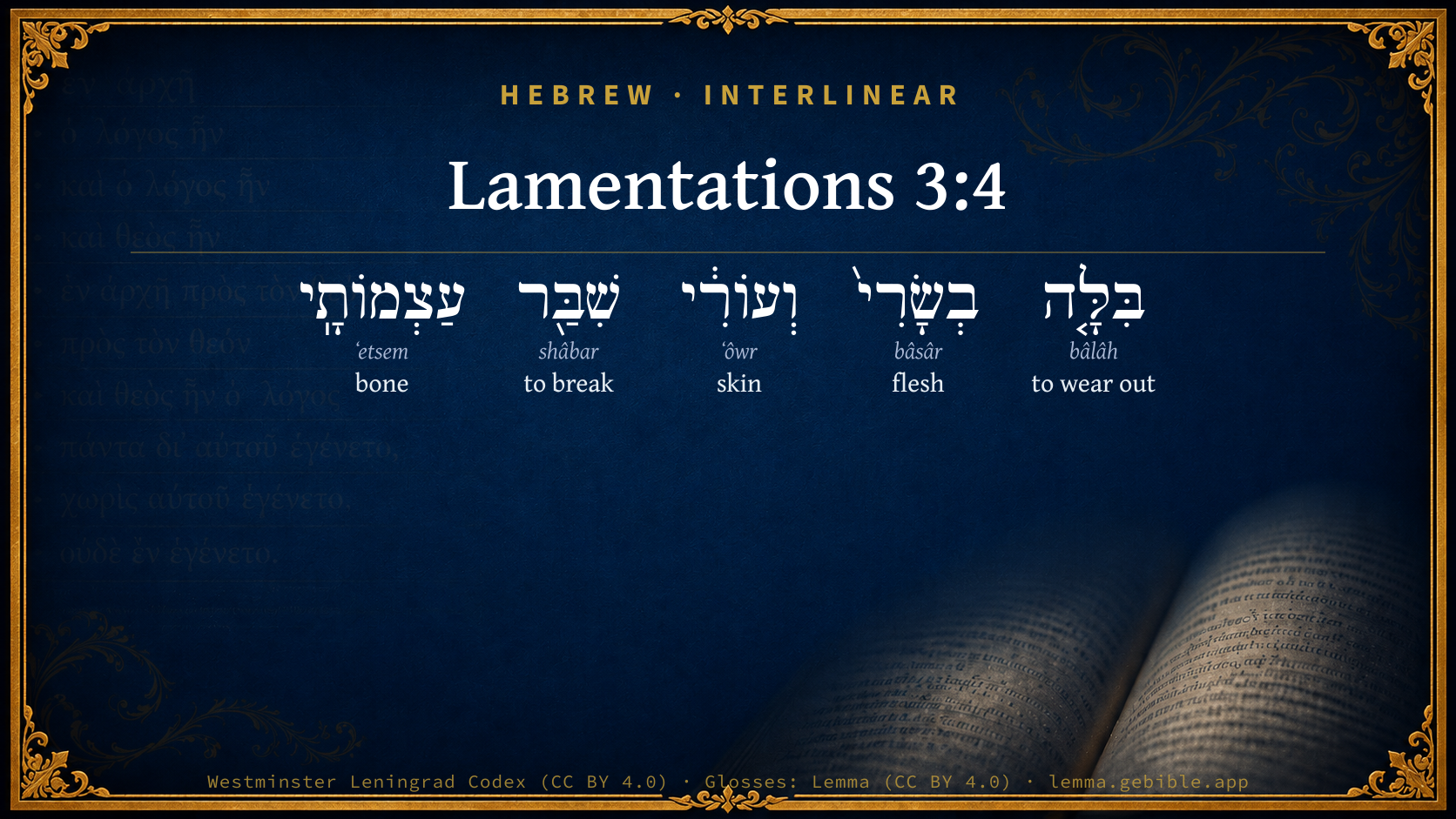
Lamentations 3:4

Hebrew (Westminster Leningrad Codex) Lamentations 3:4 appears in the Hebrew Old Testament. The text above is from the Westminster Leningrad Codex. Each word links to its Strong’s number, a concise gloss, and parsing drawn from the Open Scriptures Hebrew Bible morphology. Click any word for its full Brown-Driver-Briggs (BDB) entry.
Download image
Cite this verse

Lamentations 3:4 (World English Bible). Public Domain. Lemma interlinear Bible study tool, https://lemma.gebible.app/v/lamentations/3/4.

Show BibTeX & RIS
BibTeX
RIS
English Translation
My flesh and my skin has he made old; he has broken my bones.
World English Bible · Public Domain
Download a study sheet

One document with this verse’s original text, its word-by-word gloss line, the meaning frame, cross-references with their text, attributed commentary, and full source and license credits — printable, and it pastes into notes with its structure intact.

This verse Autodidact and up

Study sheet (.html) Plain text (.txt)

A passage Seminary Student

Up to 50 verses in one chapter. A passage sheet keeps up to 6 commentary sources and 12 cross-references per verse, in the order this page ranks them, and says so on the sheet whenever that leaves anything out. Ask for a single verse and you get the Autodidact verse sheet above.

Everything on this page stays free to read, with no account — the sheet is a download of what is already on screen, not access to it.

Want to remove ads? Support Godless Engineer
Compare translations 3

The same verse in 3 English versions, stacked beneath the original-language interlinear above. Click any original word for its lexicon entry.

Each is an independent rendering of the whole verse — the interlinear is not word-aligned to these translations.

Highlighted words mark where these versions differ — a whole-verse word diff, not a word-by-word alignment.

  • World English Bible Public Domain
    My flesh and my skin has he made old; he has broken my bones.
  • King James Version Public Domain
    My flesh and my skin hath he made old; he hath broken my bones.
  • unfoldingWord Literal Text CC BY-SA 4.0
    He wore out my flesh and my skin; he shattered my bones.

unfoldingWord Literal Text — © unfoldingWord, licensed CC BY-SA 4.0. Word-aligned USFM3 via Door43 (git.door43.org/unfoldingWord/en_ult).

Versions to compare (up to 4)

3 of 4 selected

Show all 18 translations

Every available English version of this verse, each an independent rendering of the whole verse.

  • World English Bible Public Domain
    My flesh and my skin has he made old; he has broken my bones.
  • Berean Standard Bible Public Domain
    He has worn away my flesh and skin; He has shattered my bones.
  • Majority Standard Bible Public Domain
    He has worn away my flesh and skin; He has shattered my bones.
  • King James Version Public Domain
    My flesh and my skin hath he made old; he hath broken my bones.
  • American Standard Version (1901) Public Domain
    My flesh and my skin hath he made old; he hath broken my bones.
  • Revised Version (1885) Public Domain
    My flesh and my skin hath he made old; he hath broken my bones.
  • Geneva Bible (1599) Public Domain
    My flesh and my skinne hath he caused to waxe olde, and he hath broken my bones.
  • Douay-Rheims (1899) Public Domain
    Beth. My skin and my flesh he hath made old, he hath broken my bones.
  • Young's Literal Translation Public Domain
    He hath worn out my flesh and my skin. He hath broken my bones.
  • Literal Standard Version CC BY-SA 4.0
    He has worn out my flesh and my skin. He has broken my bones.
  • Unlocked Literal Bible CC BY-SA 4.0
    He made my flesh and my skin waste away; he broke my bones.
  • unfoldingWord Literal Text CC BY-SA 4.0
    He wore out my flesh and my skin; he shattered my bones.
  • Darby Bible Public Domain
    My flesh and my skin hath he wasted away, he hath broken my bones.
  • World Messianic Bible Public Domain
    He has made my flesh and my skin old. He has broken my bones.
  • Webster's Bible Public Domain
    My flesh and my skin hath he made old; he hath broken my bones.
  • Free Bible Version CC BY-SA 4.0
    He has worn me out; he has broken me in pieces.
  • Bible in Basic English Public Domain
    My flesh and my skin have been used up by him and my bones broken.
  • JPS Tanakh (1917) Public Domain
    My flesh and my skin hath He worn out; He hath broken my bones.

Literal Standard Version (2020), Covenant Press — licensed CC BY-SA 4.0. Text via the HelloAO Bible API (eBible.org). Unlocked Literal Bible (unfoldingWord) — licensed CC BY-SA 4.0. Text via the HelloAO Bible API (eBible.org). unfoldingWord Literal Text — © unfoldingWord, licensed CC BY-SA 4.0. Word-aligned USFM3 via Door43 (git.door43.org/unfoldingWord/en_ult). Free Bible Version, Dr. Jonathan Gallagher — licensed CC BY-SA 4.0. Text via the HelloAO Bible API (eBible.org).

Word by word

More ways to search: Search by grammar → Find every occurrence → Compare this word →

Practice this passage: Drill this verse → Learn its vocabulary →

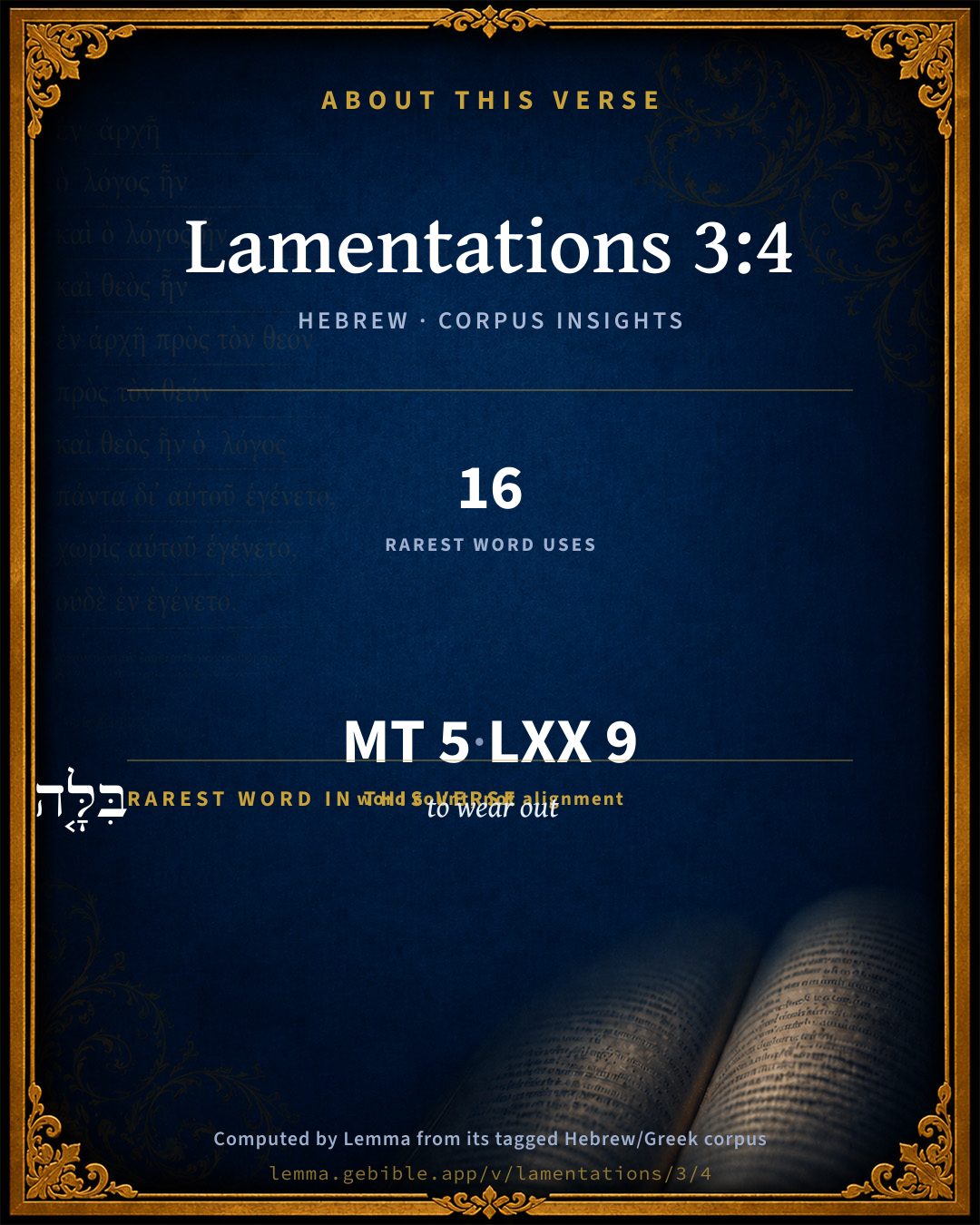
About this verse

These counts appear in no published source. They are computed here, from the morphology-tagged text and Lemma’s own curated glosses. What Lemma adds →

5
words
5
distinct lemmas
Prophets
section

Notable vocabulary

The rarest word here is בִּלָּ֤ה to wear out H1086 — appearing just 16 times in the whole Hebrew Bible.

Shared distinctive vocabulary

בִּלָּ֤ה to wear out H1086 occurs in 15 verses of the Hebrew Bible. Also found in:

Grammatical profile

  • 2 verbs
  • 3 nouns

Verb forms

  • בִּלָּ֤ה Piel · Perfect
  • שִׁבַּ֖ר Piel · Perfect

Hebrew & Septuagint length

In English translation the verse runs 14 words from the Hebrew and 14 from the Septuagint (LXX English) — the same length.

A rough comparison of the two English renderings, which tokenize alike — not a word-level alignment.

Word counts can differ between the Hebrew and the Greek without any difference in meaning — e.g. the Hebrew direct-object marker אֵת has no separate Greek word, and Greek often adds the article ὁ.

In the original languages it is 5 Hebrew tokens and 9 Greek tokens — but the two are counted differently (Hebrew bundles its prefixes and suffixes into one token; the Greek is in lemma form), so that isn’t a like-for-like length.

Cross-references

9

Topical passages linked to Lamentations 3:4 in the Treasury of Scripture Knowledge — connected by theme and wording, ordered by reader-vote popularity; previews shown in the World English Bible.

  • Psalms 51:8 Let me hear joy and gladness, That the bones which you have broken may rejoice.
  • Isaiah 38:13 I quieted [myself] until morning; as a lion, so he breaks all my bones: From day even to night will you make an end of me.
  • Psalms 31:9–10 Have mercy on me, Yahweh, for I am in distress. My eye, my soul, and my body waste away with grief.
  • Psalms 38:2–8 For your arrows have pierced me, Your hand presses hard on me.
  • Jeremiah 50:17 Israel is a hunted sheep; the lions have driven him away: first, the king of Assyria devoured him; and now at last Nebuchadrezzar king of Babylon has broken his bones.
  • Psalms 102:3–5 For my days consume away like smoke. My bones are burned as a firebrand.
  • Job 16:8–9 You have shriveled me up. This is a witness against me. My leanness rises up against me, It testifies to my face.
  • Psalms 22:14 I am poured out like water. All my bones are out of joint. My heart is like wax; It is melted within me.
  • Psalms 32:3 When I kept silence, my bones wasted away through my groaning all day long.

Cross-references courtesy of OpenBible.info (CC BY 4.0).

Hebrew and Greek witnesses Masoretic Hebrew ↔ Greek Septuagint

The same verse in the two great witnesses to the Old Testament, shown verse-for-verse.

These are two independent witnesses, not word-aligned to each other, and the Septuagint is shown in lemma (dictionary) form.

Hebrew Lamentations 3:4 Masoretic · Westminster Leningrad Codex

בִּלָּ֤ה בְשָׂרִי֙ וְעוֹרִ֔י שִׁבַּ֖ר עַצְמוֹתָֽי

My flesh and my skin has he made old; he has broken my bones.

World English Bible · Public Domain

Greek LXX Lamentations 3:4 Septuagint · lemma form

παλαιόω σάρξ ἐγώ καί δέρμα ἐγώ ὀστέον ἐγώ συντρίβω

He has made old my flesh and my skin; he has broken my bones.

LXX2012 (modern English Septuagint) · Public Domain

Hebrew: Westminster Leningrad Codex (CC BY 4.0). Greek: Septuagint (public domain); English from LXX2012 (modern English Septuagint) (Public Domain). How the Septuagint differs from the Hebrew →

Commentary

Notes on Lamentations 3:4 from classic Christian and Jewish commentators (each source and its license shown beneath its notes). The classic Christian expositions comment on the surrounding passage and are grouped to its opening verse, so a note may address several verses; the Jewish commentaries on the Tanakh (Rashi and others) are per-verse, so they appear only where the commentator wrote on this verse.

Lemma curates 59 commentaries, every one of them public domain or Creative Commons licensed, each selected and text-cleaned for this edition rather than reprinted as found. About our sources →

Trapp's Complete Commentary

John Trapp

Lam 3:4 My flesh and my skin hath he made old; he hath broken my bones.

Ver. 4. My flesh and my skin hath he made old.] Withered it and wanzed it, so that I am not like myself; facta videbor anus, as she said. See Psa 32:3.

He hath broken my bones.] Decayed and impaired, and that with greatest torment, as befalleth when bones are broken.

John Trapp, A Commentary or Exposition upon All the Books of the Old and New Testament (1647–1656) — public domain. Text from a community e-Sword module.

The Preacher's Complete Homiletical Commentary

Joseph S. Exell (gen. ed.)

EXEGETICAL NOTES.—

(ב) Lam_3:4. Details as to how the writer suffered. My flesh and my skin he has worn out, he has broken my bones. Bodily exhaustion and racking pains consume the vital forces.

Lam_3:5. Obstruction is placed so that I may not find a change. He has builded against me, shut me in as if He was besieging me behind and before with hurting and wearying obstacles, gall and travail.

Lam_3:6. Darkness was added. He has made me to dwell in dark places, dismal and without hope, as those in which lay the for ever dead, those who had gone into Sheol, and for whom there is no way of return.

(נ) Lam_3:7. Freedom is taken away by close confinement and a heavy chain.

Lam_3:8. Prisoner though I am, I can make entreaties for relief. I cry and call for help, but no response is given; he shutteth out my prayer; he had used means to prevent the petitions reaching him, as if the barriers were not fabricated by the sins of the petitioner!

Lam_3:9. As a traveller, I am brought to a standstill. He has fenced up my ways with hewn stone, and there is a necessity to turn aside to crooked paths, which lead to and fro without purpose.

HOMILETICS

THE BEWILDERMENT OF GRIEF

(Lam_3:4-9)

I. Is accompanied with intense physical suffering. “My flesh and my skin hath He made old; He hath broken my bones” (Lam_3:4). The skin is wrinkled and worn, in this case not with age, but with excessive grief; and the suffering which in the preceding verses was represented as a slow wasting of strength, has now reached the stage of acute pain, such as is caused by the breaking of bones. It is a pitiable sight to see a nation or an individual growing prematurely old. This is not done by hard, honest, healthy work, but by sorrow and suffering. The strongest and most beautiful physical form rapidly shrinks and withers under the stroke of a great and overwhelming grief. A sudden calamity has been known to turn the hair grey in a single night, and to impose the wreck of years on the bewildered and moaning sufferer.

II. Is as of one immured in prison, from which all efforts to escape are futile (Lam_3:5; Lam_3:7; Lam_3:9). The prisoner is enclosed and fenced in with a solid wall as of hewn stone, but it is a wall of bitterness and weariness. There are paths, dark and tortuous, and as he gropes along them with the dim hope of finding an outlet, he finds himself in a maze which brings him back, after long and weary wandering, to the place whence he started. Like Byron’s Prisoner of Chillon—

“It was liberty to stride

Along my cell from side to side,

And up and down, and then athwart,

And tread it over every part;

And round the pillars one by one,

Returning where my walk begun.”

Grief fetters the soul as with a heavy chain. It may chafe and fret and tug to very weariness in the effort to obtain release; but in vain: the bondage remains. If we walk in the crooked paths of sin, we shall ultimately find ourselves enclosed within the crooked paths of sorrow, from which we shall be powerless to escape.

III. Is as of one buried in a dismal sepulchre. “He hath set me in dark places, as they that be dead of old” (Lam_3:6). Grief has worn down the sufferer to the semblance of a skeleton, and he regards himself as a corpse laid in the dark chambers of the grave—dead, buried, and forgotten.

“For all was blank and bleak and gray,

It was not night, it was not day,

It was not even the dungeon-light,

So hateful to my heavy sight,

But vacancy absorbing space,

And fixedness without a place;

There were no stars, no earth, no time,

No check, no change, no good, no crime;

But silence and a stirless breath,

Which neither was of life nor death;

A sea of stagnant idleness,

Blind, boundless, mute, and motionless!”—Byron.

Excessive grief darkens and dulls every faculty, and robs life of all its charm. There are some sorrows from which death is a merciful release.

IV. The loudest calls for help are disregarded. “Also when I cry and shout, he shutteth out my prayer” (Lam_3:8). The walls of his prison are so thick that the loudest cries cannot pierce them; they are unheard and unheeded. It intensifies the bewilderment of grief when the most earnest cries for help bring no relief. A short time ago the dead body of a stalwart Scotch shepherd was found buried in the snow on the Ayrshire hills, within a short distance of his own home. Two days before, when walking homewards, he was overtaken with a snowstorm, and it is supposed must have been dazed by the fury of the tempest, and lost his way. It is distressing to think of his desperate struggles for life and his exhausting shouts for help, but all in vain. It is a painful phase in the mystery of suffering when God seems so indifferent to our prayers, and so slow to help. But even in this we are led by-and-bye to recognise the Divine justice and mercy.

LESSONS.—

1. The body sympathises with the sufferings of the soul.

2. Much of the suffering of life must be borne alone.

3. It is the bitterest ingredient in suffering when there is no prospect of relief.

GERM NOTES ON THE VERSES

Lam_3:4-6. The ravages of sorrow: I. Destroy the freshness and bloom of youth. “My flesh and my skin hath He made old.” II. Inflict acutest pain. “He hath broken my bones” (Lam_3:4). III. Oppress the soul with bitterness and toil. “He hath builded against me, and compassed me with gall and travel” (Lam_3:5). IV. Overshadow the individual life with the gloom of the grave. “He hath set me in dark places, as they that be dead of old” (Lam_3:6).

Lam_3:7-9. A baffled sufferer: I. He is enclosed and fettered. “He hath hedged me about that I cannot get out; He hath made my chain heavy” (Lam_3:7). II. His cries for help are unavailing. “Also when I cry and shout, He shutteth out my prayer” (Lam_3:8). III. He is in a maze of tortuous paths, from which there is no outlet. “He hath in-closed my ways with hewn stone, He hath made my paths crooked” (Lam_3:9).

ILLUSTRATIONS.—Causes of grief. We fancy that all our afflictions are sent us directly from above; sometimes we think it in piety and contrition, but oftener in moroseness and discontent. It would be well, however, if we attempted to trace the causes of them; we should probably find their origin in some region of the heart which we never had well explored, or in which we had secretly deposited our worst indulgences. The clouds that intercept the heavens from us come not from the heavens, but from the earth.—Landor.

A great sorrow. Henry I., on his return from Normandy, was accompanied by a crowd of nobles and his son William. The White Ship, in which the prince embarked, lingered behind the rest of the royal fleet, while the young nobles, excited with wine, hung over the ship’s side taunting the priest who came to give the customary benediction. At last the guards of the king’s treasure pressed the vessel’s departure, and, driven by the arms of fifty rowers, it swept swiftly out to sea. All at once the ship’s side struck on a rock at the mouth of the harbour, and in an instant it sank beneath the waves. One terrible cry, ringing through the stillness of the night, was heard by the royal fleet, but it was not till the morning that the fatal news reached the king. He fell unconscious to the ground, and rose never to smile again!

Secret grief. If the internal griefs of every man could be read, written on his forehead, how many who now excite envy would appear to be objects of pity!—Metastasio.

Grief irksome, but needful. A friend was asked concerning a beautiful horse feeding on the pasture with a clog on its foot, “Why do you clog such a noble animal?” The reply was, “I would a great deal sooner clog him than lose him; he is given to leap hedges.” That is why God clogs His people. He would rather clog them than lose them; for if He did not, they would leap and be gone.—Spurgeon.

The sufferer baffled by temptation. A time of affliction is a time of temptation. Satan will not be wanting in any opportunity or advantage of setting upon the soul. When Pharaoh heard that the people were entangled in the wilderness, he pursued them; and when Satan sees a soul entangled with its distresses and troubles, he thinks it his time and hour to assault it. He seeks to winnow, and comes when the corn is under the flail. Reckon, therefore, that, when trouble cometh, the prince of this world cometh also. Then is the time to take the shield of faith, that we may be able to quench his fiery darts. If they be neglected, they will inflame the soul.—John Owen.

Grief, its uses. What! would you choose that you alone may fare better than all God’s saints? that God should strew carpets for your nice feet only, to walk into your heaven, and make that way smooth for you which all patriarchs, prophets, evangelists, confessors, Christ Himself, have found rugged and bloody! Away with this self-love, and come down, you ambitious sons of Zebedee, and, ere you think of sitting near the throne, be content to be called unto the cross. Now is your trial. Let your Saviour see how much of His bitter portion you can pledge. Then shall you see how much of His glory He can afford you. Be content to drink of His vinegar and gall, and yon shall drink new wine with Him in His kingdom.—Bishop Hall.

—As snow is of itself cold, yet warms and refreshes the earth, so afflictions, though in themselves grievous, yet keep the soul of the Christian warm and make it fruitful Let the most afflicted know and remember that it is better to be preserved in brine than to rot in honey.—Salter.

—After a forest fire, has raged furiously, it has been found that many pine cones have had their seeds released by the heat, which ordinarily would have remained unsown. The future forest sprang from the ashes of the former. Some Christian graces, such as humility, patience, sympathy, have been evolved from the sufferings of the saints. The furnace has been used to fructify.

The Preacher's Complete Homiletical Commentary (gen. ed. Joseph S. Exell; Funk & Wagnalls, c. 1892) — public domain (pre-1929). A full-Bible homiletical/sermon-outline anthology covering 65 of 66 books (2 John is absent from the source module). Text from a community e-Sword module.

Jamieson, Fausset & Brown

Robert Jamieson, A. R. Fausset & David Brown

(Job 16:8).

Jamieson, Fausset & Brown — Commentary Critical and Explanatory on the Whole Bible (1871) — public domain (CC PDM 1.0). Text via the HelloAO Bible API.

John Calvin's Commentaries

These, as it evidently appears, are metaphorical words. Illness often makes people to look old, for from pain proceeds leanness: thus the skin is contracted, and the wrinkles of old age appear even in youths. As, then, sorrows exhaust moisture and strength, hence he is said to grow old who pines away in mourning. This is what the Prophet now means. God, he says, has made my flesh and my skin, to grow old, that is, he hath worn me out, within and without, so that I am almost wasted away.

He then adds, He hath broken my bones This seems to be hyperbolical; but we have said elsewhere that this simile does not in every instance express the greatness of the sorrow which the faithful feel under a sense of God’s wrath. Both David and Hezekiah spoke in this way; nay, Hezekiah compares God to a lion,

“As a lion,” he says, “has he broken my bones.” (Isaiah 38:13.)

And David says at one time that his bones wasted away, at another that they were broken, and at another that they were reduced to ashes; for there is nothing more dreadful than to feel that God is angry with us. The Prophet, then, did not only regard outward calamities, but the evidence of God’s vengeance; for the people could see nothing else in their distresses except that God was their enemy — and this was true; for God had often exhorted them to repentance; but upon those whom he had found incurable, he at length, as it was just, poured forth his vengeance to the uttermost. This, then, was the reason why the Prophet said, that God had broken his bones. He then adds, —

John Calvin's Commentaries (1540-1563) — public domain. Text from the Calvin Translation Society English edition (1840s-50s) via the Christian Classics Ethereal Library (ccel.org). Calvin's coverage is partial (roughly two-thirds of the Bible); uncommented books and verses are honest gaps, never fabricated. The 19th-century editor's footnotes and remarks are omitted so the notes are faithfully Calvin's own voice.

Ellicott's Commentary for English Readers

(4) Hath he made old.—Better, He hath wasted, the verb describing the wear and tear of life rather than the effects of age. “Flesh,” “skin,” “bones,” are grouped together as representing the whole being of the mourner.

A Bible Commentary for English Readers, edited by Charles John Ellicott (1878–1897) — public domain. Text from a community e-Sword module.

The Cambridge Bible for Schools and Colleges

gen. ed. J. J. S. Perowne

4. Here commences a series of figures illustrating the miseries endured. They find many parallels in the Psalms and Job. For instances of the latter see Lam_3:7.

he hath broken my bones] For this phrase cp. Isa_38:13; Jer_50:17.

The Cambridge Bible for Schools and Colleges (gen. ed. J. J. S. Perowne; Cambridge University Press, 1878–1918) — public domain. Text from a community e-Sword module.

John Gill's Exposition

My flesh and my skin hath he made old,.... His flesh with blows, and his skin with smiting, as the Targum; his flesh was so emaciated, and his skin so withered and wrinkled, that he looked like an old man; as our Lord, when little more than thirty years of age, what with his sorrows and troubles, looked like one about fifty:

he hath broken my bones; that is, his strength was greatly weakened, which lay in his bones; and he could not stir to help himself, any more than a man whose bones are broken; and was in as much pain and distress as if this had been his case; otherwise it was not literally true, either of the Jews, or of Jeremiah, or of Christ.

John Gill's Exposition of the Whole Bible (1746–1763) — public domain (CC PDM 1.0). Text via the HelloAO Bible API.

Albert Barnes' Notes on the Bible

Made old - Or, wasted: his strength slowly wasted as he pined away in sorrow.

He hath broken my bones - This clause completes the representation of the sufferer’s physical agonies. Here the idea is that of acute pain.

Albert Barnes' Notes on the Bible (1834–1885) — public domain. Text from a community e-Sword/MySword module.

Haydock's Catholic Bible Commentary

Old and wrinkled, the effect of misery.

George Leo Haydock (1774–1849), Haydock's Catholic Family Bible and Commentary, 1859 edition — public domain. Excludes Psalms (Douay-Rheims chapter numbering differs from Protestant) and Deuterocanonical books (Catholic canon only).

Matthew Poole's English Annotations

I was a virgin, young and fair, but I am quite altered, and am now as an old woman whose flesh is decayed, and my skin wrinkled; all my beauty is gone, and all my strength is gone; my bones, those in whom my strength consisted, are slain and broken.

Matthew Poole's English Annotations on the Holy Bible (1683–1685) — public domain. Text from a community e-Sword/MySword module.

Whedon's Commentary on the Bible

Daniel D. Whedon

4. Flesh and… skin… made old — The verb means to wear out by rubbing. Flesh, skin, and bones make up the whole body; the softer and the firmer parts.

Daniel D. Whedon (gen. ed.), Commentary on the Old and New Testaments (1874–1909) — public domain. Text from a community e-Sword module.

The Pulpit Commentary

Made old; more literally, worn away, as a garment. (comp. Isa_50:9 Isa_51:6) Broken my bones. So Job complains, "His wrath teareth and persecuteth me"; (Job_16:9) and, a still closer parallel, Hezekiah, "As a lion, so will he break all my bones". (Isa_38:13) Psa_51:8, "The bones which thou hast broken."

The Pulpit Commentary (1880–1919), ed. H.D.M. Spence-Jones & Joseph S. Exell — public domain. Text from a community e-Sword module.

John Wesley's Explanatory Notes

Made old - All my beauty is gone, and all my strength.

John Wesley, Explanatory Notes Upon the Whole Bible (1754–1765) — public domain. Text via the GEBible commentary corpus.

Rashi

Rabbi Shlomo Yitzchaki (Rashi)

He has made my flesh and my skin waste away Heb. בִּלָה, like (Isa. 44:19): “to rotten wood (לְבוּל עֵץ).” Another explanation: He has made my flesh and my skin waste away, like (ibid. 51:6): “And the earth shall rot away (תִּבְלֶה) like a garment,” i.e., both young and old lay on the ground with neither pillow nor cushion, and their flesh wore out when they were going into exile.

Rashi on the Tanakh — English translations: “The Judaica Press complete Tanach with Rashi, translated by A. J. Rosenberg” (CC BY 4.0); “Pentateuch with Rashi's commentary by M. Rosenbaum and A.M. Silbermann, 1929-1934” (public domain); “The Metsudah Tanach series, Lakewood, N.J” (CC BY 4.0); and “The Book of Joshua, Metsudah Publications, 1997” (CC BY 4.0). Text via Sefaria.

Lesson kit

Teaching starters — assembled from the data on this page, not authored interpretation. Every prompt links to the verse data it draws on. Edit before teaching.

Lamentations, in the Prophets, opens this verse with 5 words (5 distinct Hebrew lemmas). Its most distinctive word is bâlâh (“to wear out”). A historical commentator’s framing appears above. Read the whole chapter for the surrounding context.

Discussion questions

  1. The word bâlâh carries the sense “to wear out.” How does it shape the verse?
  2. Genesis 18:12 shares the word «to wear out» with this verse. How do the two illuminate each other?
  3. The translations on this page render this verse differently — a whole-verse word diff, not a word-by-word alignment. What might account for the different wordings?
  4. The verb «בִּלָּ֤ה» is Piel Perfect. How does its form color the action?
  5. Reading how Trapp's Complete Commentary and The Preacher's Complete Homiletical Commentary read this verse, where do the two commentators agree and where do they part?

Things to notice

Reading settings

Reading text

Shown beneath each verse's original-language words.

Old Testament
Old Testament edition

Read the OT as the Masoretic Hebrew (MT) or the Greek Septuagint (LXX).

English shown for the Greek Septuagint (in the Hebrew ↔ Greek comparison).

Comparing translations? Open the Compare panel on any verse page to stack up to four side by side.