
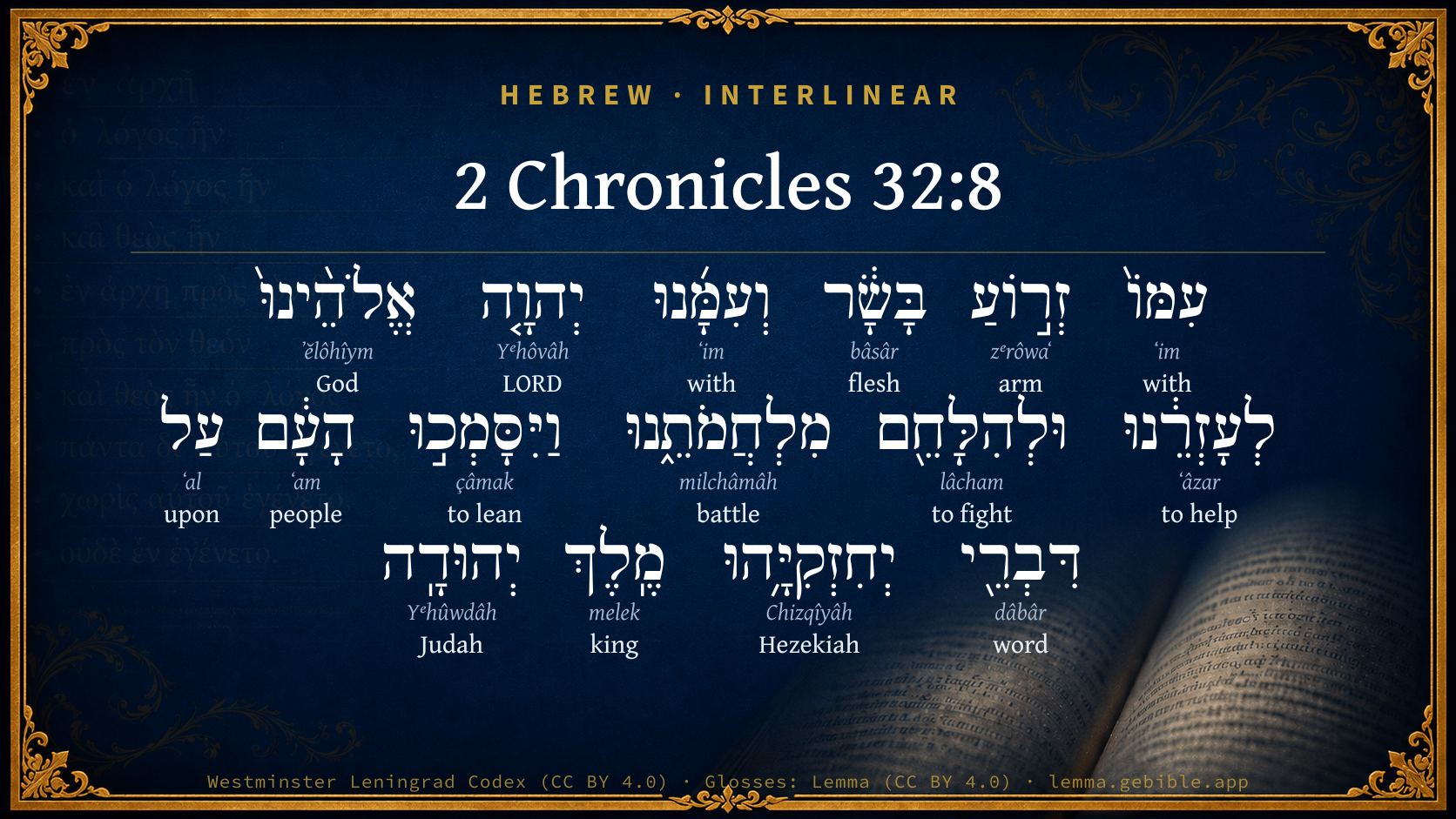
2 Chronicles 32:8

Hebrew (Westminster Leningrad Codex) 2 Chronicles 32:8 appears in the Hebrew Old Testament. The text above is from the Westminster Leningrad Codex. Each word links to its Strong’s number, a concise gloss, and parsing drawn from the Open Scriptures Hebrew Bible morphology. Click any word for its full Brown-Driver-Briggs (BDB) entry.
Download image
Cite this verse

2 Chronicles 32:8 (World English Bible). Public Domain. Lemma interlinear Bible study tool, https://lemma.gebible.app/v/2-chronicles/32/8.

Show BibTeX & RIS
BibTeX
RIS
English Translation
with him is an arm of flesh; but with us is Yahweh our God to help us, and to fight our battles. The people rested themselves on the words of Hezekiah king of Judah.
World English Bible · Public Domain
Download a study sheet

One document with this verse’s original text, its word-by-word gloss line, the meaning frame, cross-references with their text, attributed commentary, and full source and license credits — printable, and it pastes into notes with its structure intact.

This verse Autodidact and up

Study sheet (.html) Plain text (.txt)

A passage Seminary Student

Up to 50 verses in one chapter. A passage sheet keeps up to 6 commentary sources and 12 cross-references per verse, in the order this page ranks them, and says so on the sheet whenever that leaves anything out. Ask for a single verse and you get the Autodidact verse sheet above.

Everything on this page stays free to read, with no account — the sheet is a download of what is already on screen, not access to it.

Want to remove ads? Support Godless Engineer
Compare translations 3

The same verse in 3 English versions, stacked beneath the original-language interlinear above. Click any original word for its lexicon entry.

Each is an independent rendering of the whole verse — the interlinear is not word-aligned to these translations.

Highlighted words mark where these versions differ — a whole-verse word diff, not a word-by-word alignment.

  • World English Bible Public Domain
    with him is an arm of flesh; but with us is Yahweh our God to help us, and to fight our battles. The people rested themselves on the words of Hezekiah king of Judah.
  • King James Version Public Domain
    With him is an arm of flesh; but with us is the LORD our God to help us, and to fight our battles. And the people rested themselves upon the words of Hezekiah king of Judah.
  • unfoldingWord Literal Text CC BY-SA 4.0
    With him, an arm of flesh, but with us, Yahweh, our God, to help us and to fight our battles.” And the people leaned on the words of Hezekiah, the king of Judah.

unfoldingWord Literal Text — © unfoldingWord, licensed CC BY-SA 4.0. Word-aligned USFM3 via Door43 (git.door43.org/unfoldingWord/en_ult).

Versions to compare (up to 4)

3 of 4 selected

Show all 18 translations

Every available English version of this verse, each an independent rendering of the whole verse.

  • World English Bible Public Domain
    with him is an arm of flesh; but with us is Yahweh our God to help us, and to fight our battles. The people rested themselves on the words of Hezekiah king of Judah.
  • Berean Standard Bible Public Domain
    With him is only the arm of flesh, but with us is the LORD our God to help us and to fight our battles.” So the people were strengthened by the words of Hezekiah king of Judah.
  • Majority Standard Bible Public Domain
    With him is only the arm of flesh, but with us is the LORD our God to help us and to fight our battles.” So the people were strengthened by the words of Hezekiah king of Judah.
  • King James Version Public Domain
    With him is an arm of flesh; but with us is the LORD our God to help us, and to fight our battles. And the people rested themselves upon the words of Hezekiah king of Judah.
  • American Standard Version (1901) Public Domain
    with him is an arm of flesh; but with us is Jehovah our God to help us, and to fight our battles. And the people rested themselves upon the words of Hezekiah king of Judah.
  • Revised Version (1885) Public Domain
    with him is an arm of flesh; but with us is the LORD our God to help us, and to fight our battles. And the people rested themselves upon the words of Hezekiah king of Judah.
  • Geneva Bible (1599) Public Domain
    With him is an arme of flesh, but with vs is the Lord our God for to helpe vs, and to fight our battels. Then the people were confirmed by the wordes of Hezekiah King of Iudah.
  • Douay-Rheims (1899) Public Domain
    For with him is an arm of flesh: with us the Lord our God, who is our helper, and fighteth for us. And the people were encouraged with these words of Ezechias king of Juda.
  • Young's Literal Translation Public Domain
    With him `is' an arm of flesh, and with us `is' Jehovah our God, to help us, and to fight our battles;' and the people are supported by the words of Hezekiah king of Judah.
  • Literal Standard Version CC BY-SA 4.0
    With him [is] an arm of flesh, but with us [is] our God YHWH to help us and to fight our battles”; and the people are supported by the words of Hezekiah king of Judah.
  • Unlocked Literal Bible CC BY-SA 4.0
    With him is only an arm of flesh, but with us is Yahweh, our God, to help us, and to fight our battles.” Then the people comforted themselves with the words of Hezekiah, king of Judah.
  • unfoldingWord Literal Text CC BY-SA 4.0
    With him, an arm of flesh, but with us, Yahweh, our God, to help us and to fight our battles.” And the people leaned on the words of Hezekiah, the king of Judah.
  • Darby Bible Public Domain
    with him is an arm of flesh, but with us is Jehovah our God to help us and to fight our battles. And the people depended upon the words of Hezekiah king of Judah.
  • World Messianic Bible Public Domain
    An arm of flesh is with him, but the LORD our God is with us to help us and to fight our battles.” The people rested themselves on the words of Hezekiah king of Judah.
  • Webster's Bible Public Domain
    With him is an arm of flesh; but with us is the LORD our God to help us, and to fight our battles. And the people rested themselves upon the words of Hezekiah king of Judah.
  • Free Bible Version CC BY-SA 4.0
    He has human help, but we have the Lord God on our side to help us and fight our battles.” The people were encouraged by this speech of Hezekiah, king of Judah.
  • Bible in Basic English Public Domain
    With him is an arm of flesh; but we have the Lord our God, helping us and fighting for us. And the people put their faith in what Hezekiah, king of Judah, said.
  • JPS Tanakh (1917) Public Domain
    with him is an arm of flesh; but with us is the LORD our God to help us, and to fight our battles.' And the people rested themselves upon the words of Hezekiah king of Judah.

Literal Standard Version (2020), Covenant Press — licensed CC BY-SA 4.0. Text via the HelloAO Bible API (eBible.org). Unlocked Literal Bible (unfoldingWord) — licensed CC BY-SA 4.0. Text via the HelloAO Bible API (eBible.org). unfoldingWord Literal Text — © unfoldingWord, licensed CC BY-SA 4.0. Word-aligned USFM3 via Door43 (git.door43.org/unfoldingWord/en_ult). Free Bible Version, Dr. Jonathan Gallagher — licensed CC BY-SA 4.0. Text via the HelloAO Bible API (eBible.org).

Word by word

More ways to search: Search by grammar → Find every occurrence → Compare this word →

Practice this passage: Drill this verse → Learn its vocabulary →

וַיִּסָּמְכ֣וּ
çâmak
H5564
“and · to lean”
Conjunction + Verb, Niphal, Sequential Imperfect, 3rd Person, Masculine, Plural
Part of Speech
Conjunction + Verb
Stem
Niphal
Form
Sequential Imperfect
Person
3rd Person
Gender
Masculine
Number
Plural
Full BDB Definition

Origin: a primitive root

TWOT: 1514

to lean, lay, rest, support, put, uphold, lean upon - (Qal) - to lean or lay upon, rest upon, lean against - to support, uphold, sustain - (Niphal) to support or brace oneself - (Piel) to sustain, refresh, revive
  1. עִמּוֹ֙ ʻim H5973 “with · him” Preposition + Suffix, Personal, 3rd Person, Masculine, Singular
  2. זְר֣וֹעַ zᵉrôwaʻ H2220 “arm of” Noun, Common, Both, Singular, Construct
  3. בָּשָׂ֔ר bâsâr H1320 “flesh” Noun, Common, Masculine, Singular, Absolute
  4. וְעִמָּ֜נוּ ʻim H5973 “and · with · us” Conjunction + Preposition + Suffix, Personal, 1st Person, Common, Plural
  5. יְהוָ֤ה Yᵉhôvâh H3068 “LORD” Noun, Proper
  6. אֱלֹהֵ֨ינוּ֙ ʼĕlôhîym H430 “God(s) · our” Noun, Common, Masculine, Plural, Construct + Suffix, Personal, 1st Person, Common, Plural
  7. לְעָזְרֵ֔נוּ ʻâzar H5826 “to help · us” Preposition + Verb, Qal, Infinitive Construct + Suffix, Personal, 1st Person, Common, Plural
  8. וּלְהִלָּחֵ֖ם lâcham H3898 “and · to fight” Conjunction + Preposition + Verb, Niphal, Infinitive Construct
  9. מִלְחֲמֹתֵ֑נוּ milchâmâh H4421 “battles · our” Noun, Common, Feminine, Plural, Construct + Suffix, Personal, 1st Person, Common, Plural
  10. הָעָ֔ם ʻam H5971 “the · people” Particle, Definite Article + Noun, Common, Masculine, Singular, Absolute
  11. עַל ʻal H5921 “upon” Preposition
  12. דִּבְרֵ֖י dâbâr H1697 “words of” Noun, Common, Masculine, Plural, Construct
  13. יְחִזְקִיָּ֥הוּ Chizqîyâh H2396 “Hezekiah” Noun, Proper
  14. מֶֽלֶךְ melek H4428 “king of” Noun, Common, Masculine, Singular, Construct
  15. יְהוּדָֽה Yᵉhûwdâh H3063 “Judah” Noun, Proper

About this verse

These counts appear in no published source. They are computed here, from the morphology-tagged text and Lemma’s own curated glosses. What Lemma adds →

16
words
15
distinct lemmas
Historical
section

Shared distinctive vocabulary

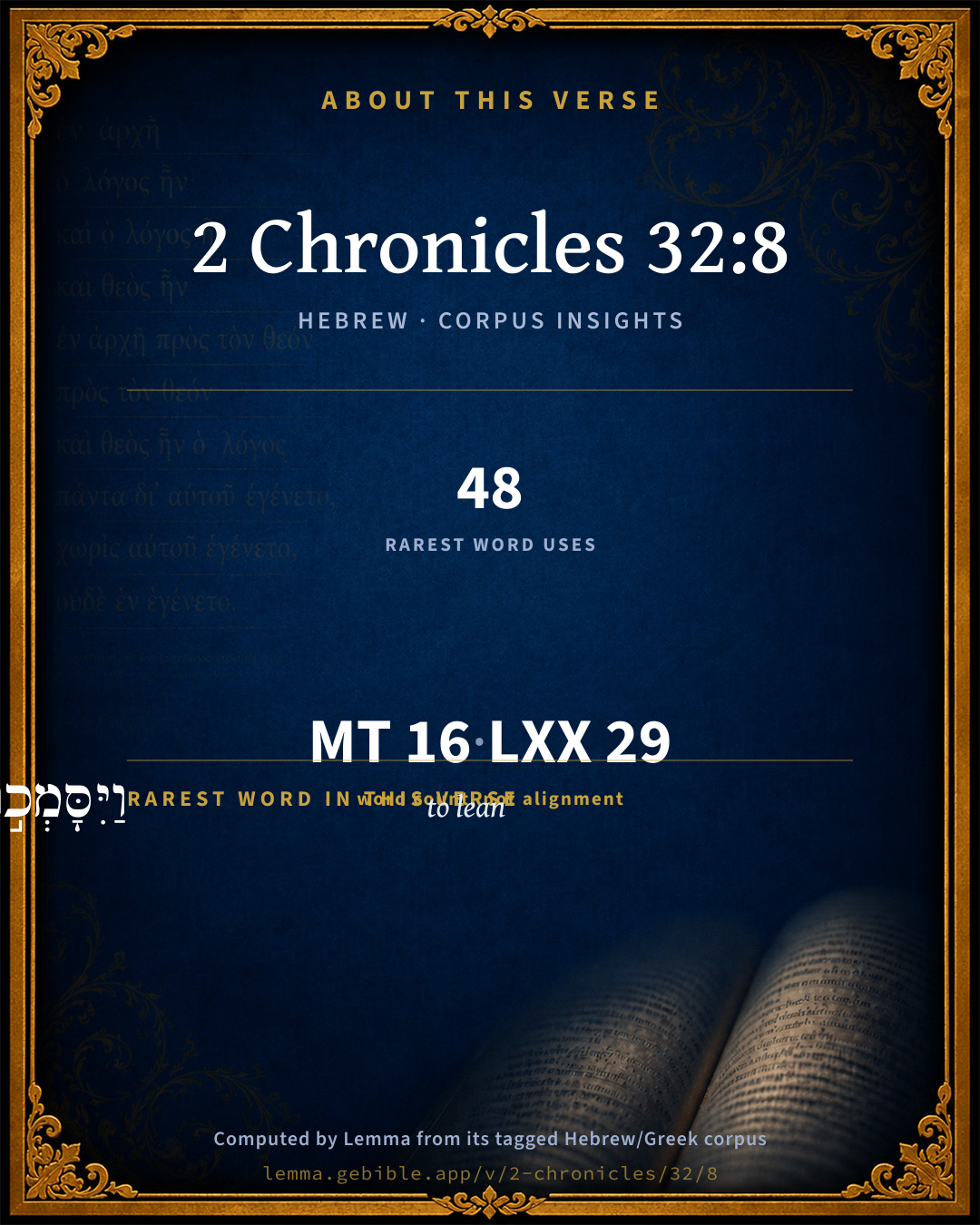
וַיִּסָּמְכ֣וּ to lean H5564 occurs in 47 verses of the Hebrew Bible. Also found in:

Grammatical profile

  • 3 verbs
  • 10 nouns
  • 3 prepositions

Verb forms

  • לְעָזְרֵ֔נוּ Qal · Infinitive Construct
  • וּלְהִלָּחֵ֖ם Niphal · Infinitive Construct
  • וַיִּסָּמְכ֣וּ Niphal · Sequential Imperfect

Repetition

A word recurs within this verse — often emphatic in Hebrew:

  • עִמּוֹ֙ with H5973 ×2

Hebrew & Septuagint length

In English translation the verse runs 34 words from the Hebrew and 35 from the Septuagint (LXX English) — closely comparable.

A rough comparison of the two English renderings, which tokenize alike — not a word-level alignment.

Word counts can differ between the Hebrew and the Greek without any difference in meaning — e.g. the Hebrew direct-object marker אֵת has no separate Greek word, and Greek often adds the article ὁ.

In the original languages it is 16 Hebrew tokens and 29 Greek tokens — but the two are counted differently (Hebrew bundles its prefixes and suffixes into one token; the Greek is in lemma form), so that isn’t a like-for-like length.

Cross-references

21

Topical passages linked to 2 Chronicles 32:8 in the Treasury of Scripture Knowledge — connected by theme and wording, ordered by reader-vote popularity; previews shown in the World English Bible.

  • Jeremiah 17:5 Thus says Yahweh: Cursed is the man who trusts in man, and makes flesh his arm, and whose heart departs from Yahweh.
  • 2 Chronicles 20:17 You shall not need to fight in this [battle]: set yourselves, stand you still, and see the salvation of Yahweh with you, O Judah and Jerusalem; don't be afraid, nor be dismayed: tomorrow go out against them: for Yahweh is with you.
  • Acts 18:10 for I am with you, and no one will attack you to harm you, for I have many people in this city."
  • 2 Timothy 4:17 But the Lord stood by me, and strengthened me, that through me the message might be fully proclaimed, and that all the Gentiles might hear; and I was delivered out of the mouth of the lion.
  • 2 Chronicles 20:15 and he said, Listen you, all Judah, and you inhabitants of Jerusalem, and you king Jehoshaphat: Thus says Yahweh to you, Don't be afraid you, neither be dismayed by reason of this great multitude; for the battle is not yours, but God's.
  • Isaiah 41:10 Don't you be afraid, for I am with you; don't be dismayed, for I am your God; I will strengthen you; yes, I will help you; yes, I will uphold you with the right hand of my righteousness.
  • Psalms 46:11 Yahweh of Hosts is with us. The God of Jacob is our refuge. Selah.
  • 1 John 4:4 You are of God, little children, and have overcome them; because greater is he who is in you than he who is in the world.
  • Deuteronomy 20:1 When you go forth to battle against your enemies, and see horses, and chariots, [and] a people more than you, you shall not be afraid of them; for Yahweh your God is with you, who brought you up out of the land of Egypt.
  • 2 Chronicles 13:12 Behold, God is with us at our head, and his priests with the trumpets of alarm to sound an alarm against you. Children of Israel, don't you fight against Yahweh, the God of your fathers; for you shall not prosper.
  • 2 Chronicles 14:11 Asa cried to Yahweh his God, and said, Yahweh, there is none besides you to help, between the mighty and him who has no strength: help us, Yahweh our God; for we rely on you, and in your name are we come against this multitude. Yahweh, you are our God; don't let man prevail against you.
  • Deuteronomy 20:4 for Yahweh your God is he who goes with you, to fight for you against your enemies, to save you.
  • 2 Chronicles 20:20 They rose early in the morning, and went forth into the wilderness of Tekoa: and as they went forth, Jehoshaphat stood and said, Hear me, Judah, and you inhabitants of Jerusalem: believe in Yahweh your God, so shall you be established; believe his prophets, so shall you prosper.
  • Job 40:9 Or have you an arm like God? Can you thunder with a voice like him?
  • Proverbs 12:25 Anxiety in a man's heart weighs it down, But a kind word makes it glad.
  • Isaiah 8:10 Take counsel together, and it shall be brought to nothing; speak the word, and it shall not stand: for God is with us.
  • Joshua 10:42 All these kings and their land did Joshua take at one time, because Yahweh, the God of Israel, fought for Israel.
  • Psalms 46:7 Yahweh of Hosts is with us. The God of Jacob is our refuge. Selah.
  • Isaiah 36:18 Beware lest Hezekiah persuade you, saying, Yahweh will deliver us. Has any of the gods of the nations delivered his land out of the hand of the king of Assyria?
  • 2 Timothy 4:22 The Lord Jesus Christ be with your spirit. Grace be with you. Amen.
  • 2 Chronicles 32:15 Now therefore don't let Hezekiah deceive you, nor persuade you after this manner, neither believe you him; for no god of any nation or kingdom was able to deliver his people out of my hand, and out of the hand of my fathers: how much less shall your God deliver you out of my hand?

Cross-references courtesy of OpenBible.info (CC BY 4.0).

Hebrew and Greek witnesses Masoretic Hebrew ↔ Greek Septuagint

The same verse in the two great witnesses to the Old Testament, shown verse-for-verse.

These are two independent witnesses, not word-aligned to each other, and the Septuagint is shown in lemma (dictionary) form.

Hebrew 2 Chronicles 32:8 Masoretic · Westminster Leningrad Codex

עִמּוֹ֙ זְר֣וֹעַ בָּשָׂ֔ר וְעִמָּ֜נוּ יְהוָ֤ה אֱלֹהֵ֨ינוּ֙ לְעָזְרֵ֔נוּ וּלְהִלָּחֵ֖ם מִלְחֲמֹתֵ֑נוּ וַיִּסָּמְכ֣וּ הָעָ֔ם עַל דִּבְרֵ֖י יְחִזְקִיָּ֥הוּ מֶֽלֶךְ יְהוּדָֽה

with him is an arm of flesh; but with us is Yahweh our God to help us, and to fight our battles. The people rested themselves on the words of Hezekiah king of Judah.

World English Bible · Public Domain

Greek LXX 2 Chronicles 32:8 Septuagint · lemma form

μετά αὐτός βραχίων σάρκινος μετά ἐγώ δέ κύριος ὁ θεός ἐγώ ὁ σώζω καί ὁ πολεμέω ὁ πόλεμος ἐγώ καί καταθαρσύνω ὁ λαός ἐπί ὁ λόγος εζεκιας βασιλεύς ἰουδά

With him are arms of flesh; but with us is the Lord our God to save us, and to fight our battle. And the people were encouraged at the words of Ezekias king of Juda.

LXX2012 (modern English Septuagint) · Public Domain

Hebrew: Westminster Leningrad Codex (CC BY 4.0). Greek: Septuagint (public domain); English from LXX2012 (modern English Septuagint) (Public Domain). How the Septuagint differs from the Hebrew →

Commentary

Notes on 2 Chronicles 32:8 from classic Christian and Jewish commentators (each source and its license shown beneath its notes). The classic Christian expositions comment on the surrounding passage and are grouped to its opening verse, so a note may address several verses; the Jewish commentaries on the Tanakh (Rashi and others) are per-verse, so they appear only where the commentator wrote on this verse.

Lemma curates 59 commentaries, every one of them public domain or Creative Commons licensed, each selected and text-cleaned for this edition rather than reprinted as found. About our sources →

Trapp's Complete Commentary

John Trapp

2Ch 32:8 With him [is] an arm of flesh; but with us [is] the LORD our God to help us, and to fight our battles. And the people rested themselves upon the words of Hezekiah king of Judah.

Ver. 8. With him is an arm of flesh.] Flesh is frail: and God can make the strongest sinew in his arm to crack quickly.

But with us is the Lord our God.] The import of "Immanuel"; by which name Christ now began to be known amongst them.

John Trapp, A Commentary or Exposition upon All the Books of the Old and New Testament (1647–1656) — public domain. Text from a community e-Sword module.

Geneva Bible (1599)

Geneva Bible translators

This declareth that Hezekiah did ever put his trust in God, and yet made himself strong and used lawful means, lest he should seem to tempt God.

That is, the power of man.

Geneva Bible (1599) marginal notes — public domain. Text via Bolls.life.

Ellicott's Commentary for English Readers

(8) With him is an arm of flesh.—A reminiscence of Jer_17:5, “the man that maketh flesh his arm.” (Comp. Isa_31:3 : “Their horses are flesh and not spirit.”) His power is human, ours superhuman.

To fight our battles.—1Sa_8:20, “a king . . . to fight our battles.”

Rested themselves upon.—Leaned on—e.g., a staff, Isa_36:6; and so trusted in, Isa_48:2.

A Bible Commentary for English Readers, edited by Charles John Ellicott (1878–1897) — public domain. Text from a community e-Sword module.

The Cambridge Bible for Schools and Colleges

gen. ed. J. J. S. Perowne

8. an arm of flesh] Cp. Jer_17:5. Contrast the frequent phrase “a mighty hand and a stretched out arm” (of Jehovah). An “arm” is an ally or helper.

with us is the Lord] Cp. 2Ch_15:2; 2Ch_20:17; Isa_8:10.

The Cambridge Bible for Schools and Colleges (gen. ed. J. J. S. Perowne; Cambridge University Press, 1878–1918) — public domain. Text from a community e-Sword module.

John Gill's Exposition

After this did Sennacherib king of Assyria send his servants to Jerusalem,.... Who are mentioned by name, Kg2 18:17 this was after Hezekiah had given him a large quantity of silver and gold to depart, and he did depart from him, Kg2 18:14

but he himself laid siege against Lachish, and all his power with him; one of the cities of Judah, see Isa 36:2, from hence he dispatched them

unto Hezekiah king of Judah, and unto all Judah that were at Jerusalem; who had retired thither for safety, upon the invasion of their country by the king of Assyria.

John Gill's Exposition of the Whole Bible (1746–1763) — public domain (CC PDM 1.0). Text via the HelloAO Bible API.

Albert Barnes' Notes on the Bible

The faith, which Hezekiah’s words express, presently wavered, died away, and was succeeded by despair and submission (compare 2Ki 18:14-16 notes).

Albert Barnes' Notes on the Bible (1834–1885) — public domain. Text from a community e-Sword/MySword module.

The Pulpit Commentary

(see 2Ki_6:16; Jer_17:5) The admirable language of Hezekiah here quickens our desire to feel sure that this was after (and after genuine repentance for) his faithlessness. (2Ki_18:14-16)

Resting upon words.

the people rested themselves upon the words of Hezekiah." How far are we right and wise in building upon words, upon the words of another?

I THE FOLLY OF RESTING ON THE USE OF FORMULAE. There are some sacred forms or phrases, theological or scriptural, which have been much urged upon men, as if they had some very special potency in them; as if we could be perfectly at rest, in regard to human souls, if they did but pronounce those particular phrases with their lips. Such superstition as this is pitiable and perilous. It is utterly without warrant, and it is likely to withdraw the soul from that true trust in which life is to be found. To believe in Jesus Christ can never be resolved into the use of any form of words, how ever excellent or scriptural such form may be.

II THE CONFIDENCE WHICH IS FATAL, viz. to rest upon the words of those who are unworthy of our trust. How many of the children of men have lost everything that is most precious because they have made this fatal mistake! Of those whose words should never be built upon are:

1. The ignorant, whose range of knowledge is very small, and who have not had the opportunity of learning the ascertainable truth and wisdom of God.

2. The prejudiced and obdurate, who will not learn, and therefore do not know and cannot counsel.

3. The superficial, who are contented with a knowledge which does not reach "the deep heart of truth.

4. The false, who only say what they think is palatable and profitable.

5. The fickle, who have one doctrine to-day, but may have a different one to-morrow.

III THE TRUST WHICH IS SOUND AND WISE. There are words on which we may build. When God speaks to us we know that we may rest on his Word absolutely; we know that we should heed his warnings, and that we may build on his promises. "Heaven and earth shall pass away," etc. But how shall we know when Christ is speaking to us? Many speak in his name who do not speak on his authority.

1. We should pay regard to the words of those who profess to speak forhim, and whose character for purity and unselfishness sustains their claim. (Mat_7:15-20)

1. We should heed the words of those of his disciples who urge that whichmeets our spiritual necessities and accords with the deepest convictions of our nature.

2. We should con sult the Master"s own recorded words, always remembering that they are to be interpreted in the spirit, and not in the letter. If we do this we shall not only be "resting on words," we shall be building on the rock, for we shall be abiding in the truth; we shall be grounded on the very wisdom of God itself, or (we may say) on the Wisdom of God himself. C. (1Co_1:24, 1Co_1:30)

The Pulpit Commentary (1880–1919), ed. H.D.M. Spence-Jones & Joseph S. Exell — public domain. Text from a community e-Sword module.

Lesson kit

Teaching starters — assembled from the data on this page, not authored interpretation. Every prompt links to the verse data it draws on. Edit before teaching.

2 Chronicles, in the Historical, opens this verse with 16 words (15 distinct Hebrew lemmas). Its most distinctive word is çâmak (“to lean”). A historical commentator’s framing appears above. Read the whole chapter for the surrounding context.

Discussion questions

  1. What does “to lean” (çâmak) contribute to the verse as a whole?
  2. How does Genesis 27:37, which shares the word «to lean», read alongside this verse?
  3. What does the repetition of “with” (2× in this one verse) do in this verse?
  4. These translations render this verse differently. What is at stake in choosing one wording over another?
  5. «לְעָזְרֵ֔נוּ» is a Qal Infinitive Construct verb. How does that grammatical form shape the action described?
  6. Compare how Trapp's Complete Commentary and Geneva Bible (1599) read this verse. Where do they agree or differ?

Things to notice

Reading settings

Reading text

Shown beneath each verse's original-language words.

Old Testament
Old Testament edition

Read the OT as the Masoretic Hebrew (MT) or the Greek Septuagint (LXX).

English shown for the Greek Septuagint (in the Hebrew ↔ Greek comparison).

Comparing translations? Open the Compare panel on any verse page to stack up to four side by side.