Daniel 1:15

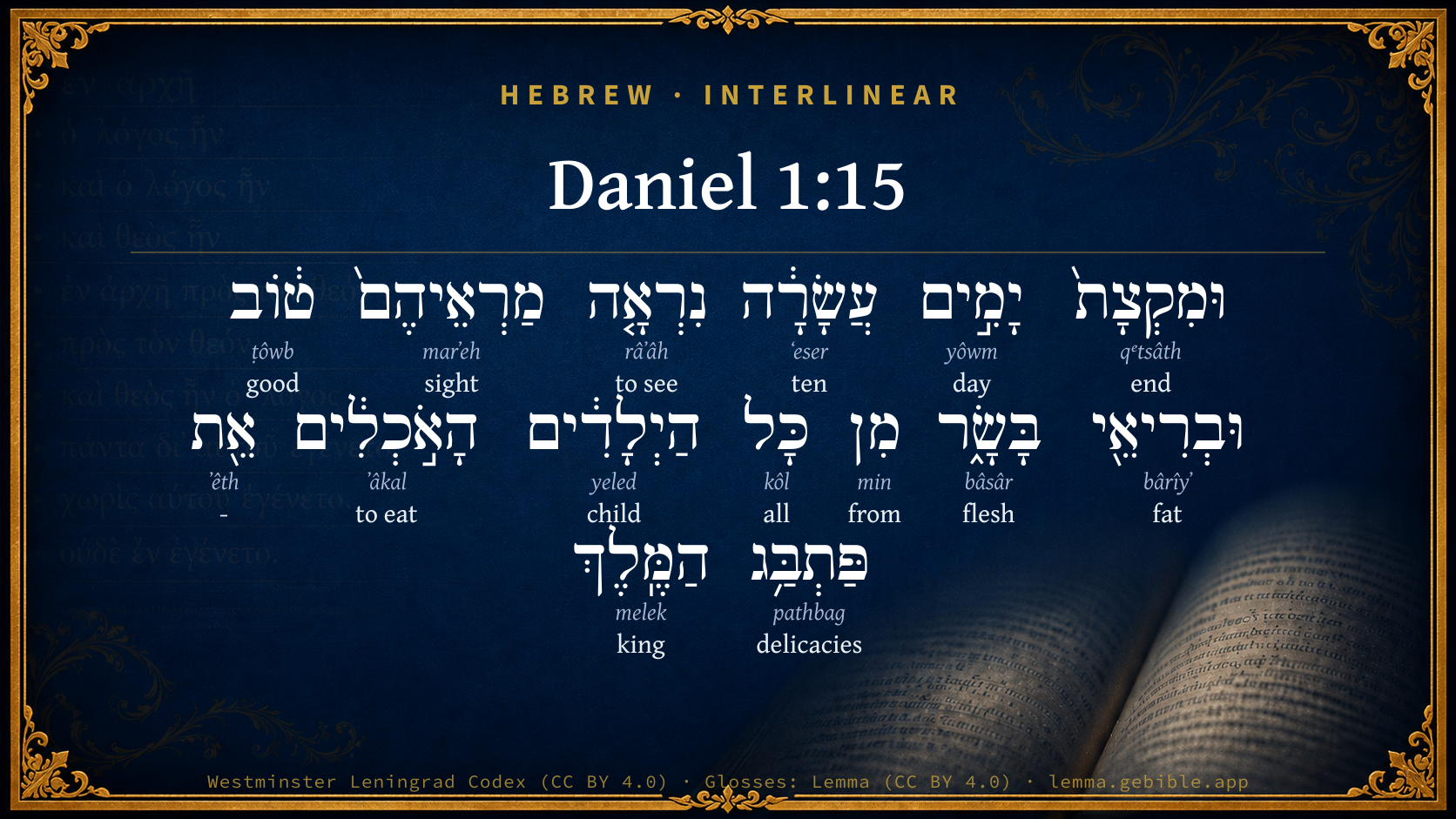
Hebrew (Westminster Leningrad Codex) Daniel 1:15 appears in the Hebrew Old Testament. The text above is from the Westminster Leningrad Codex. Each word links to its Strong’s number, a concise gloss, and parsing drawn from the Open Scriptures Hebrew Bible morphology. Click any word for its full Brown-Driver-Briggs (BDB) entry.
Download image
Cite this verse

Daniel 1:15 (World English Bible). Public Domain. Lemma interlinear Bible study tool, https://lemma.gebible.app/v/daniel/1/15.

Show BibTeX & RIS
BibTeX
RIS
English Translation
At the end of ten days their faces appeared fairer, and they were fatter in flesh, than all the youths who ate of the king's dainties.
World English Bible · Public Domain
Download a study sheet

One document with this verse’s original text, its word-by-word gloss line, the meaning frame, cross-references with their text, attributed commentary, and full source and license credits — printable, and it pastes into notes with its structure intact.

This verse Autodidact and up

Study sheet (.html) Plain text (.txt)

A passage Seminary Student

Up to 50 verses in one chapter. A passage sheet keeps up to 6 commentary sources and 12 cross-references per verse, in the order this page ranks them, and says so on the sheet whenever that leaves anything out. Ask for a single verse and you get the Autodidact verse sheet above.

Everything on this page stays free to read, with no account — the sheet is a download of what is already on screen, not access to it.

Want to remove ads? Support Godless Engineer
Compare translations 3

The same verse in 3 English versions, stacked beneath the original-language interlinear above. Click any original word for its lexicon entry.

Each is an independent rendering of the whole verse — the interlinear is not word-aligned to these translations.

Highlighted words mark where these versions differ — a whole-verse word diff, not a word-by-word alignment.

  • World English Bible Public Domain
    At the end of ten days their faces appeared fairer, and they were fatter in flesh, than all the youths who ate of the king's dainties.
  • King James Version Public Domain
    And at the end of ten days their countenances appeared fairer and fatter in flesh than all the children which did eat the portion of the king's meat.
  • unfoldingWord Literal Text CC BY-SA 4.0
    At the end of ten days their appearance appeared better, and they were fatter in flesh than all the youths who ate the choice food of the king.

unfoldingWord Literal Text — © unfoldingWord, licensed CC BY-SA 4.0. Word-aligned USFM3 via Door43 (git.door43.org/unfoldingWord/en_ult).

Versions to compare (up to 4)

3 of 4 selected

Show all 18 translations

Every available English version of this verse, each an independent rendering of the whole verse.

  • World English Bible Public Domain
    At the end of ten days their faces appeared fairer, and they were fatter in flesh, than all the youths who ate of the king's dainties.
  • Berean Standard Bible Public Domain
    And at the end of ten days, they looked healthier and better nourished than all the young men who were eating the king’s food.
  • Majority Standard Bible Public Domain
    And at the end of ten days, they looked healthier and better nourished than all the young men who were eating the king’s food.
  • King James Version Public Domain
    And at the end of ten days their countenances appeared fairer and fatter in flesh than all the children which did eat the portion of the king's meat.
  • American Standard Version (1901) Public Domain
    And at the end of ten days their countenances appeared fairer, and they were fatter in flesh, than all the youths that did eat of the king's dainties.
  • Revised Version (1885) Public Domain
    And at the end of ten days their countenances appeared fairer, and they were fatter in flesh, than all the youths which did eat of the king’s meat.
  • Geneva Bible (1599) Public Domain
    And at the end of ten dayes, their countenances appeared fayrer, and in better liking then all the childrens, which did eate the portion of the Kings meate.
  • Douay-Rheims (1899) Public Domain
    And after ten days their faces appeared fairer and fatter than all the children that ate of the king's meat.
  • Young's Literal Translation Public Domain
    and at the end of ten days their appearance hath appeared better and fatter in flesh then any of the lads who are eating the king's portion of food.
  • Literal Standard Version CC BY-SA 4.0
    and at the end of ten days their appearance has appeared better and fatter in flesh then any of the boys who are eating the king’s portion of food.
  • Unlocked Literal Bible CC BY-SA 4.0
    At the end of ten days their appearance was more healthy, and they were better nourished, than all the young men who ate the king's delicacies.
  • unfoldingWord Literal Text CC BY-SA 4.0
    At the end of ten days their appearance appeared better, and they were fatter in flesh than all the youths who ate the choice food of the king.
  • Darby Bible Public Domain
    And at the end of ten days their countenances appeared fairer and were fatter in flesh than all the youths that ate of the king's delicate food.
  • World Messianic Bible Public Domain
    At the end of ten days, their faces appeared fairer and they were fatter in flesh than all the youths who ate of the king’s delicacies.
  • Webster's Bible Public Domain
    And at the end of ten days their countenances appeared fairer and fatter in flesh than all the children who ate the portion of the king's provision.
  • Free Bible Version CC BY-SA 4.0
    When the ten days were up they looked healthier and better fed than all the young men who had eaten the king's rich food.
  • Bible in Basic English Public Domain
    And at the end of ten days their faces seemed fairer and they were fatter in flesh than all the young men who had their food from the king's table.
  • JPS Tanakh (1917) Public Domain
    And at the end of ten days their countenances appeared fairer, and they were fatter in flesh, than all the youths that did eat of the king's food.

Literal Standard Version (2020), Covenant Press — licensed CC BY-SA 4.0. Text via the HelloAO Bible API (eBible.org). Unlocked Literal Bible (unfoldingWord) — licensed CC BY-SA 4.0. Text via the HelloAO Bible API (eBible.org). unfoldingWord Literal Text — © unfoldingWord, licensed CC BY-SA 4.0. Word-aligned USFM3 via Door43 (git.door43.org/unfoldingWord/en_ult). Free Bible Version, Dr. Jonathan Gallagher — licensed CC BY-SA 4.0. Text via the HelloAO Bible API (eBible.org).

Word by word

More ways to search: Search by grammar → Find every occurrence → Compare this word →

Practice this passage: Drill this verse → Learn its vocabulary →

וּמִקְצָת֙
qᵉtsâth
H7117
“and · from · end of”
Conjunction + Preposition + Noun, Common, Feminine, Singular, Construct
Part of Speech
Conjunction + Preposition + Noun
Type
Common
Gender
Feminine
Number
Singular
State
Construct
Full BDB Definition

Origin: from H7096

TWOT: 2053e

end, part - end - of corners, of earth - from the end of - at the end of
  1. יָמִ֣ים yôwm H3117 “days” Noun, Common, Masculine, Plural, Absolute
  2. עֲשָׂרָ֔ה ʻeser H6235 “ten” Adjective, Cardinal number, Masculine, Singular, Absolute
  3. נִרְאָ֤ה râʼâh H7200 “to see” Verb, Niphal, Perfect, 3rd Person, Masculine, Singular
  4. מַרְאֵיהֶם֙ marʼeh H4758 “sight · their” Noun, Common, Masculine, Singular, Construct + Suffix, Personal, 3rd Person, Masculine, Plural
  5. ט֔וֹב ṭôwb H2896 “good” Adjective, Adjective, Masculine, Singular, Absolute
  6. וּבְרִיאֵ֖י bârîyʼ H1277 “and · fat of” Conjunction + Adjective, Adjective, Masculine, Plural, Construct
  7. בָּשָׂ֑ר bâsâr H1320 “flesh” Noun, Common, Masculine, Singular, Absolute
  8. מִן min H4480 “from” Preposition
  9. כָּל kôl H3605 “all of” Noun, Common, Masculine, Singular, Construct
  10. הַיְלָדִ֔ים yeled H3206 “the · children” Particle, Definite Article + Noun, Common, Masculine, Plural, Absolute
  11. הָאֹ֣כְלִ֔ים ʼâkal H398 “the · eating” Particle, Definite Article + Verb, Qal, Participle Active, Masculine, Plural, Absolute
  12. אֵ֖ת ʼêth H853 “-” Particle, Direct Object
  13. פַּתְבַּ֥ג pathbag H6598 “delicacies of” Noun, Common, Masculine, Singular, Construct
  14. הַמֶּֽלֶךְ melek H4428 “the · king” Particle, Definite Article + Noun, Common, Masculine, Singular, Absolute

About this verse

These counts appear in no published source. They are computed here, from the morphology-tagged text and Lemma’s own curated glosses. What Lemma adds →

15
words
15
distinct lemmas
Prophets
section

Notable vocabulary

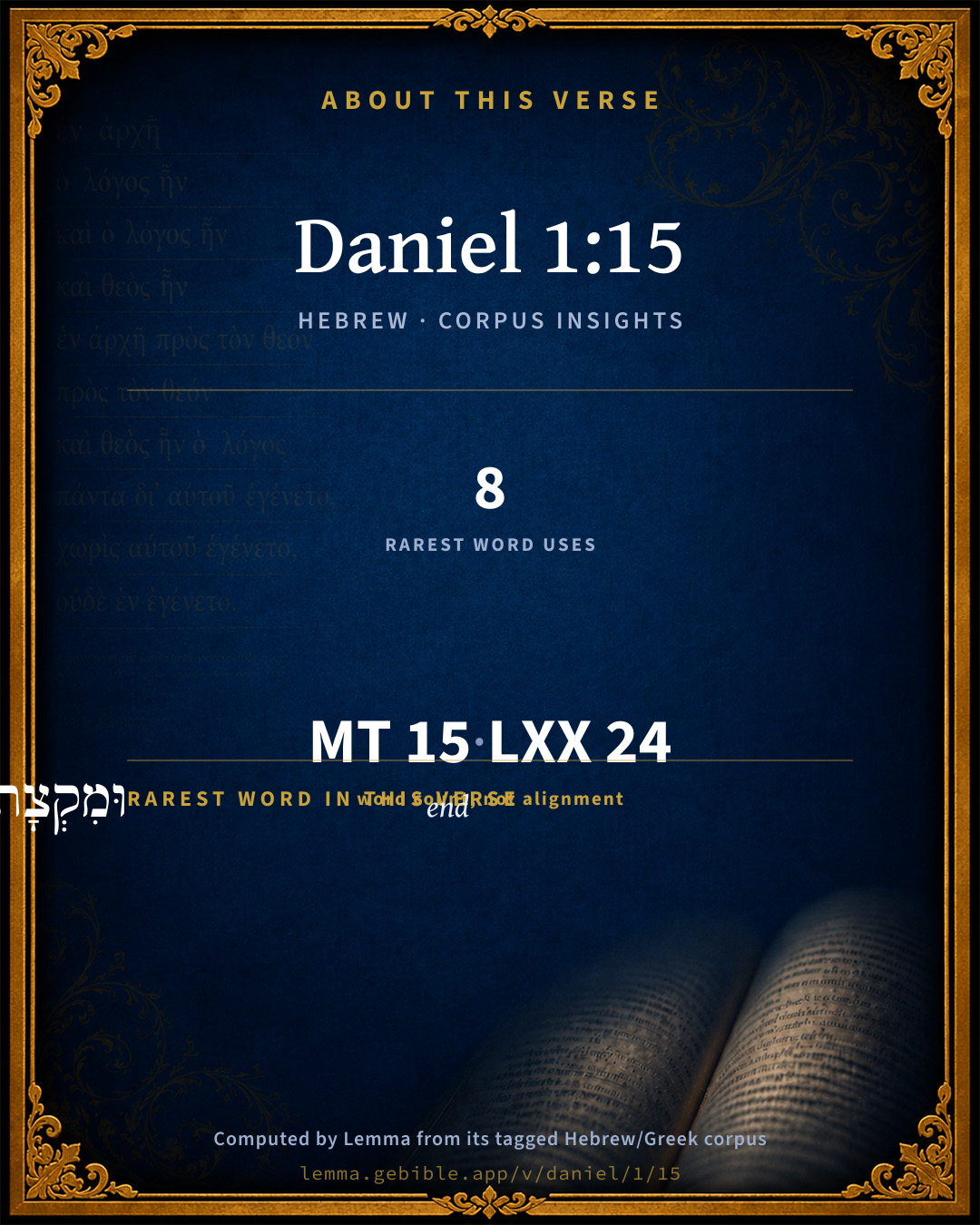
The rarest word here is וּמִקְצָת֙ end H7117 — appearing just 8 times in the whole Hebrew Bible.

Shared distinctive vocabulary

וּמִקְצָת֙ end H7117 occurs in 8 verses of the Hebrew Bible. Also found in:

Grammatical profile

  • 2 verbs
  • 8 nouns
  • 3 adjectives
  • 1 preposition
  • 1 particle

Verb forms

  • נִרְאָ֤ה Niphal · Perfect
  • הָאֹ֣כְלִ֔ים Qal · Participle Active

Hebrew & Septuagint length

In English translation the verse runs 26 words from the Hebrew and 25 from the Septuagint (LXX English) — closely comparable.

A rough comparison of the two English renderings, which tokenize alike — not a word-level alignment.

Word counts can differ between the Hebrew and the Greek without any difference in meaning — e.g. the Hebrew direct-object marker אֵת has no separate Greek word, and Greek often adds the article ὁ.

In the original languages it is 15 Hebrew tokens and 24 Greek tokens — but the two are counted differently (Hebrew bundles its prefixes and suffixes into one token; the Greek is in lemma form), so that isn’t a like-for-like length.

Cross-references

10

Topical passages linked to Daniel 1:15 in the Treasury of Scripture Knowledge — connected by theme and wording, ordered by reader-vote popularity; previews shown in the World English Bible.

  • Exodus 23:25 You shall serve Yahweh your God, and he will bless your bread and your water, and I will take sickness away from your midst.
  • Proverbs 10:22 Yahweh's blessing brings wealth, And he adds no trouble to it.
  • 2 Kings 4:42–44 There came a man from Baal Shalishah, and brought the man of God bread of the first fruits, twenty loaves of barley, and fresh ears of grain in his sack. He said, Give to the people, that they may eat.
  • Haggai 1:6 You have sown much, and bring in little. You eat, but you don't have enough. You drink, but you aren't filled with drink. You clothe yourselves, but no one is warm, and he who earns wages earns wages to put them into a bag with holes in it."
  • Matthew 4:4 But he answered, "It is written, 'Man shall not live by bread alone, but by every word that proceeds out of the mouth of God.'"
  • Deuteronomy 28:1–14 It shall happen, if you shall listen diligently to the voice of Yahweh your God, to observe to do all his commandments which I command you this day, who Yahweh your God will set you on high above all the nations of the earth:
  • Psalms 37:16 Better is a little that the righteous has, Than the abundance of many wicked.
  • Haggai 1:9 "You looked for much, and, behold, it came to little; and when you brought it home, I blew it away. Why?" says Yahweh of Hosts, "Because of my house that lies waste, while each of you is busy with his own house.
  • Malachi 2:2 If you will not listen, and if you will not lay it to heart, to give glory to my name," says Yahweh of Hosts, "then will I send the curse on you, and I will curse your blessings. Indeed, I have cursed them already, because you do not lay it to heart.
  • Mark 6:41–42 He took the five loaves and the two fish, and looking up to heaven, he blessed and broke the loaves, and he gave to his disciples to set before them, and he divided the two fish among them all.

Cross-references courtesy of OpenBible.info (CC BY 4.0).

Hebrew and Greek witnesses Masoretic Hebrew ↔ Greek Septuagint

The same verse in the two great witnesses to the Old Testament, shown verse-for-verse.

These are two independent witnesses, not word-aligned to each other, and the Septuagint is shown in lemma (dictionary) form.

Hebrew Daniel 1:15 Masoretic · Westminster Leningrad Codex

וּמִקְצָת֙ יָמִ֣ים עֲשָׂרָ֔ה נִרְאָ֤ה מַרְאֵיהֶם֙ ט֔וֹב וּבְרִיאֵ֖י בָּשָׂ֑ר מִן כָּל הַיְלָדִ֔ים הָאֹ֣כְלִ֔ים אֵ֖ת פַּתְבַּ֥ג הַמֶּֽלֶךְ

At the end of ten days their faces appeared fairer, and they were fatter in flesh, than all the youths who ate of the king's dainties.

World English Bible · Public Domain

Greek LXX Daniel 1:15 Septuagint · lemma form

μετά δέ ὁ δέκα ἡμέρα φαίνω ὁ ὄψις αὐτός καλός καί ὁ ἕξις ὁ σῶμα κρείσσων ὁ ἄλλος νεανίσκος ὁ ἐσθίω ὁ βασιλικός δεῖπνον

And at the end of the ten days their countenances appeared fairer and stouter in flesh, than the children that fed at the king's table.

LXX2012 (modern English Septuagint) · Public Domain

On this verse, The Pulpit Commentary discusses the Septuagint’s reading. Read the note in Commentary ↓

Hebrew: Westminster Leningrad Codex (CC BY 4.0). Greek: Septuagint (public domain); English from LXX2012 (modern English Septuagint) (Public Domain). How the Septuagint differs from the Hebrew →

Commentary

Notes on Daniel 1:15 from classic Christian and Jewish commentators (each source and its license shown beneath its notes). The classic Christian expositions comment on the surrounding passage and are grouped to its opening verse, so a note may address several verses; the Jewish commentaries on the Tanakh (Rashi and others) are per-verse, so they appear only where the commentator wrote on this verse.

Lemma curates 59 commentaries, every one of them public domain or Creative Commons licensed, each selected and text-cleaned for this edition rather than reprinted as found. About our sources →

Trapp's Complete Commentary

John Trapp

Dan 1:15 And at the end of ten days their countenances appeared fairer and fatter in flesh than all the children which did eat the portion of the king’s meat.

Ver. 15. Their countenances appeared fairer.] They had both better health (for Tenuis mensa sanitatis mater, saith Chrysostom, Spare diet is very healthful), {a} and their good conscience or merry heart was a continual feast to them. They had also God’s blessing upon their coarser fare, and this was the main matter that made the difference.

{a} Gustato spiritu desipit omnis caro. - Bern.

John Trapp, A Commentary or Exposition upon All the Books of the Old and New Testament (1647–1656) — public domain. Text from a community e-Sword module.

Joseph Benson's Commentary

Dan 1:15. At the end of ten days their countenances appeared fairer, &c. — The poor pulse, seeds, and roots, nourished and strengthened Daniel and his companions more than the rich food which the others ate from the king’s table nourished them. Although this might, in part, be the natural effect of their temperance, yet it must chiefly be ascribed to the special blessing of God, which will make a little go a great way, and a dinner of herbs more nutritive and strengthening than a stalled ox.

Joseph Benson's Commentary on the Old and New Testaments (1811–1818) — public domain. Text from a community e-Sword module.

Tyndale Open Study Notes

Tyndale Open Resources

1:15-21 In their training, Daniel and his friends completed a tough curriculum in the context of the most threatening pagan culture of the day, yet they remained faithful to the Lord. As they mastered language, literature, and science, they pursued excellence and honored God, who added many gifts to their skills and learning.

Tyndale Open Study Notes — © Tyndale Open Resources, licensed CC BY-SA 4.0. Text via the HelloAO Bible API.

Ibn Ezra

Rabbi Abraham ibn Ezra

[Daniel 1:15] U-mi-ketzat... nir’ah (וּמִקְצָת... נִרְאָה - And at the end of... appeared): The meaning is: their entire appearance [looked good]. And the Gaon [Saadia Gaon] said: This was a great miracle. But [Ibn Ezra argues] there is no need [to assume a miracle], because they could have been eating rice (orez - אוֹרֶז), which is called in the Arabic language aruz (ארוז). And it [rice] is very esteemed/excellent, and more pleasing/palatable than wheat, and produces pure blood [according to medieval medicine]. It is the food of the people of India, who do not have wheat, and cooked dishes are made from it. And this rice flourishes/increases greatly [in volume] when it is cooked with milk. In general, a small amount of it [rice] satiates, and it is heavy in weight. Its grains are very slender and not round, and its nature [in humoral terms, i.e., its inherent quality according to medieval science] is hot and moist. And it is astonishing [coming] from a great Sage that he said it [the zero’im] was millet (dochan - דֹּחַן), whose grains are round. It lasts for many years and does not rot, but it is a poor food, and its nature is cold and dry [the opposite qualities needed for looking healthy, according to humoral theory]. Also, among the types of legumes (kitniyot - קִטְנִיּוֹת) are peas (afunim - אֲפוּנִים) – but not those [types] found in France, because those are cold [in nature], bad [food], and cause flatulence. Rather, the peas [Ibn Ezra refers to] are those found in Spain, Egypt, Rome [area], and Provence. They are of three types: some white, some red, and some black – and this [black] type is the most esteemed of all. All three types are hot and moist [in nature]. And their cooking water is a remedy for the liver. They brighten the face more than wine. (And a person can recognize that those [peas] in France are without a 'mouth' [perhaps referring to a distinct seam or characteristic shape], whereas the three [good] types have a 'mouth'). And behold, rice and [these good] peas are [types of] legumes/seeds (zero’im), and they make the flesh healthy (mavri’im et ha-basar - מַבְרִיאִים אֶת הַבָּשָׂר) [echoing the verse's phrase beri’ei basar (בְּרִיאֵי בָשָׂר), healthy of flesh]. Furthermore, any food that is desired by the soul/appetite is more beneficial than food that the soul/appetite does not like, even if [the disliked food] is hot and moist according to the [ideal] nature of living things [i.e., even if it matches the body's ideal humoral balance]. And behold, these [youths] were eating something that their soul/appetite desired [since they chose it over the king's food], and [therefore] it was beneficial for them.

Ibn Ezra on the Tanakh — English translations: “Sefaria Community Translation” (CC0 1.0 (public-domain dedication)); “Yalkut, Sifsei Chachomim Chumash, Metsudah Publications, 2009” (CC BY 4.0); and “Commentary of Ibn Ezra on Isaiah - trans. by M. Friedlander, 1873” (public domain). Text via Sefaria.

Geneva Bible (1599)

Geneva Bible translators

Hebrew, fatter in flesh.

This bare feeding and that also of Moses, when he fled from the court of Egypt, declareth that we must live in such sobriety as God doth call us unto, seeing he will make it more profitable unto us than all dainties: for his blessing only sufficeth.

Geneva Bible (1599) marginal notes — public domain. Text via Bolls.life.

John Calvin's Commentaries

Now this surprising event took place, — Daniel contracted neither leanness nor debility from that mean food, but his face was as shirting as if he had continued to feed most delicately; hence we gather as I have already said, that he was divinely impelled to persist firmly in his own design, and not to pollute himself with the royal diet. God, therefore, testified by the result that he had advised Daniel and his companions in this their prayer and proposal. It is clear enough that there is no necessary virtue in bread to nourish us; for we are nourished by God’s secret blessing, as Moses says, Man lives not by bread alone, (Deuteronomy 8:3,) implying that the bread itself does not impart strength to men, for the bread has no life in it; how then can it afford us life? As bread possesses no virtue by itself, we are nourished by the word of God; and because God has determined that our life shall be sustained by nourishment, he has breathed its virtue into the bread — but, meanwhile, we ought to consider our life sustained neither by bread nor any other food, but by the secret blessing of God. For Moses does not speak here of either doctrine or spiritual life, but says our bodily life is cherished by God’s favor, who has endued bread and other food with their peculiar properties. This, at least, is certain, — whatever food we feed on, we are nourished and sustained by God’s gratuitous power. But the example which Daniel here mentions was singular. Hence God, as I have said, shews, by the event, how Daniel could not remain pure and spotless with his companions, otherwise than by being content with pulse and water. We must observe, for our improvement, in the first place, — we should be very careful not to become slaves of the palate, and thus be drawn off from our duty and from obedience and the fear of God, when we ought to live sparingly and be free from all luxuries. We see a this day how many feel it a very great cross if they cannot indulge at the tables of the rich, which are filled with abundance and variety of food. Others are so hardened in the enjoyment of luxuries, that they cannot be content with moderation; hence they are always wallowing in their own filth, being quite unable to renounce the delights of the palate. But Daniel sufficiently shews us, when God not only reduces us to want, but when, if necessary, all indulgences must be spontaneously rejected. Daniel indeed, as we saw yesterday, does not attach any virtue to abstinence from one kind of food or another; and all we have hitherto learnt has no other object than to teach him to guard against imminent danger, to avoid passing over to the morals of a strange nation, and so to conduct himself at Babylon as not to forget himself as a son of Abraham. But still it was necessary to renounce the luxuries of the court. Although delicate viands were provided, he rejected them of his own accord; since, as we have seen, it would be deadly pollution, not in itself but in its consequences. Thus Moses, when he fled from Egypt, passed into a new life far different from his former one; for he had lived luxuriously and honorably in the king’s palace, as if he had been the king’s grandson. But he lived sparingly in the Desert afterwards, and obtained his support by very toilsome labor. He preferred, says the Apostle, the cross of Christ to the riches of Egypt. (Hebrews 11:26.) How so? Because he could not be esteemed an Egyptian and retain the favor which had been promised to the sons of Abraham. It was a kind of self-denial always to remain in the king’s palace.

We may take this test as a true proof of our frugality and temperance, if we are able to satisfy the appetite when God compels us to endure poverty and want; nay, if we can spurn the delicacies which are at hand but tend to our destruction. For it would be very frivolous to subsist entirely on pulse and water; as greater intemperance sometimes displays itself in pulse than in the best and most dainty dishes. If any one in weak health desires pulse and other such food which is injurious, he will surely be condemned for intemperance. But if he feeds on nourishing diet, as they say, and thus sustains himself, frugality will have its praise. If any one through desire of water, and being too voracious, rejects wine, this as we well know would not be praiseworthy. Hence we ought not to subsist on this kind of food to discover the greatness of Daniel’s virtue. But we ought always to direct our minds to the object of his design, namely, what he wished and what was in his power — so to live under the sway of the king of Babylon, that his whole condition should be distinct from that of the nation at large, and never to forget himself as an Israelite — and unless there had been this great difference, Daniel would have been unable to sharpen himself and to shake off his torpor, or to rouse himself from it. Daniel necessarily kept before his mind some manifest and remarkable difference which separated him from the Chaldeans; he desired pulse and water, through the injurious effects of good living.

Lastly, this passage teaches us, although we should meet with nothing but the roots and leaves of trees, and even if the earth herself should deny us the least blade of grass, yet God by his blessing can make us healthy and active no less than those who abound in every comfort. God’s liberality, however, is never to be despised when he nourishes us with bread and wine and other diet; for Paul enumerates, among things worthy of praise, his knowing how to bear both abundance and penury. (Philippians 4:12) When, therefore, God bountifully offers us both meat and drink, we may soberly and frugally drink wine and cat savory food; but when he takes away from us bread and water, so that we suffer from famine, we shall find his blessing sufficient for us instead of all nutriment. For we see that Daniel and his companions were ruddy and plump, and even remarkably robust by feeding on nothing but pulse. How could this occur, unless the Lord, who nourished his people in the Desert on manna alone, when other diet was deficient, even at this day turns our food into manna, which would otherwise be injurious to us. (Exodus 16:4.) For if any one asks the medical profession, whether pulse and other leguminous plants are wholesome? they will tell us they are very injurious, since they know them to be so. But at the same time, when we have no choice of viands and cannot obtain what would conduce most to our health, if we are content with herbs and roots, the Lord, as I have said, can nourish us no less than if he put before us a table well supplied with every dainty. Temperance does not exist in the food itself, but in the palate — since we are equally intemperate if pleasure entices us to gratify the appetite on inferior food — so, again, we may remain perfectly temperate though feeding on the best diet. We must form the same opinion of the properties of various viands, which do not support us by their own inherent qualities, but by God’s blessing, as he sees fit. We sometimes see the children of the rich very emaciated, although they may receive the greatest attention. We see also the children of the country people most beautiful in form, ruddy in countenance, and healthy in condition; and yet they feed on any kind of food, and sometimes upon what is injurious. But although they are deprived of tasty sauces, yet God gives them his blessing, and their unripe fruit, pork, lard, and even herbs, which seem most unwholesome, become more nourishing than if the people abounded in every delicacy. This, therefore, must be remarked in the words of Daniel. It follows —

John Calvin's Commentaries (1540-1563) — public domain. Text from the Calvin Translation Society English edition (1840s-50s) via the Christian Classics Ethereal Library (ccel.org). Calvin's coverage is partial (roughly two-thirds of the Bible); uncommented books and verses are honest gaps, never fabricated. The 19th-century editor's footnotes and remarks are omitted so the notes are faithfully Calvin's own voice.

Ellicott's Commentary for English Readers

(15) Appeared fairer.—Thus was God beginning to assert His power among the Babylonians. This change in the appearance of Daniel was the effect of his free grace, not of the meat that came from the king’s palace. May it not have been that the young exiles thought of the words of Isaiah (Isa_52:11), “Depart ye, depart ye, go ye out thence, touch no unclean thing”?

A Bible Commentary for English Readers, edited by Charles John Ellicott (1878–1897) — public domain. Text from a community e-Sword module.

The Cambridge Bible for Schools and Colleges

gen. ed. J. J. S. Perowne

15. and (they were) falter in fleshy &c.] the expression as Gen_41:2; Gen_41:18 (of the kine) ‘fat-fleshed.’

the children, &c.] the youths which did eat the king’s delicacies.

The Cambridge Bible for Schools and Colleges (gen. ed. J. J. S. Perowne; Cambridge University Press, 1878–1918) — public domain. Text from a community e-Sword module.

John Gill's Exposition

And at the end of ten days their countenances appeared fairer, and fatter in flesh,.... At the time fixed for the trial of them, when they came to be examined, they appeared to be of a better complexion, and a more healthful look, and even plumper and fatter, with good solid flesh, and not swelled up as persons in a dropsy:

than all the children which did eat the portion of the king's meat: who appeared at the same time, and were compared with them, being under the care of the same persons: now this was owing to the blessing of divine Providence, as Jacchiades observes; for, how healthful soever pulse may be, or the several things designed by it, particularly rice, of which Aben Ezra on the place gives great encomiums, as very salutary and nourishing, and a purifier of the blood; yet neither that, nor any of the things before mentioned, tend to make persons fat in flesh, as these were.

John Gill's Exposition of the Whole Bible (1746–1763) — public domain (CC PDM 1.0). Text via the HelloAO Bible API.

Albert Barnes' Notes on the Bible

And at the end of ten days their countenances appeared fairer - Hebrew, “good;” that is, they appeared more beautiful and healthful. The experiment was successful. There was no diminution of beauty, of vigour, or of the usual indications of health. One of the results of a course of temperance appears in the countenance, and it is among the wise appointments of God that it should be so. He has so made us, that while the other parts of the body may be protected from the gaze of men, it is necessary that the “face” should be exposed. Hence, he has made the countenance the principal scat of expression, for the chief muscles which indicate expression have their location there. See the valuable work of Sir Charles Bell on the “Anatomy of Expression,” London, 1844. Hence, there are certain marks of guilt and vice which always are indicated in the countenance. God has so made us that the drunkard and the glutton must proclaim their own guilt and shame.

The bloated face, the haggard aspect, the look of folly, the “heaviness of the eye, the disposition to squint, and to see double, and a forcible elevation of the eyebrow to counteract the dropping of the upper eyelid, and preserve the eyes from closing,” are all marks which God has appointed to betray and expose the life of indulgence. “Arrangements are made for these expressions in the very anatomy of the face, and no art of man can prevent it.” - Bell on the “Anatomy of Expression,” p. 106. God meant that if man “would” be intemperate he should himself proclaim it to the world, and that his fellow-men should be apprised of his guilt. This was intended to be one of the safeguards of virtue. The young man who will be intemperate “knows” what the result must be. He is apprised of it in the loathsome aspect of every drunkard whom he meets. He knows that if he yields himself to indulgence in intoxicating drink, he must soon proclaim it himself to the wide world.

No matter how beautiful, or fresh, or blooming, or healthful, he may now be; no matter how bright the eye, or ruddy the cheek, or eloquent the tongue; the eye, and the cheek, and the tongue will soon become indices of his manner of life, and the loathsomeness and offensiveness of the once beautiful and blooming countenance must pay the penalty of his folly. And in like manner, and for the same reason, the countenance is an indication of temperance and purity. The bright and steady eye, the blooming cheek, the lips that eloquently or gracefully utter the sentiments of virtue, proclaim the purity of the life, and are the natural indices to our fellow-men that we live in accordance with the great and benevolent laws of our nature, and are among the rewards of temperance and virtue.

Albert Barnes' Notes on the Bible (1834–1885) — public domain. Text from a community e-Sword/MySword module.

Matthew Poole's English Annotations

There be three things here to be observed.

1. The hand of God, in persuading Melzar to incline to Daniel’s request.

2. The goodness of God, to make good Daniel’s words.

3. That the blessing of God upon homely fare affords oftentimes more healthful nourishment and strength, than more costly fare to them that eat the fat and drink the sweet.

Matthew Poole's English Annotations on the Holy Bible (1683–1685) — public domain. Text from a community e-Sword/MySword module.

The Pulpit Commentary

At the end of ten days their countenances appeared fairer and fatter in flesh than all the children which did eat the portion of the king"s meat. The Septuagint is a little paraphrastic, and renders, "After ten days their countenance appeared beautiful and their habit of body better than that of the other young men who ate of the king"s meat." Theodotion is painfully faithful to the Massoretic text. The Peshitta translates bwf (tob), "good," "fair," by sha-peera , "beautiful." We have here the result of the experiment. At the end of the ten days these youths who had lived plainly are fairer and fatter than those who partook of the royal dainties a result that implies nothing miraculous; it was simply the natural result of living on food suited to the climate. The grammar of the passage is peculiar; mareehem, which so far as form goes might be plural, is construed with a singular verb and adjective, but bere"eem, "fatter," is plural. The explanation is that while "countenance," the substantive, is in the singular, it is not the substantive to the adjective "fat," but "they" understood. The sentence is not intended to assert that their faces merely were fatter than those of the other youths of their rank and circum stances, but that their whole body was so. This contrast of reference is brought out in the Septuagint paraphrase. Any one looking on the Assyrian and Babylonian sculptures, and comparing them with the sculptures and paintings of Egypt, will observe the relatively greater stoutness of the Assyrians. In the eunuchs especially, one cannot fail to notice the full round faces and the double chins of those in immediate attendance on the king. Among savage nations and semi-civilized ones, corpulence is regarded as a sign of nobility. The frequent long fasts, due to failure of their scanty crops or the difficulty of catching game, would keep the ordinary savage spare; only one who could employ the sinews and possessions of others would be sure of being always well fed, consequently the corpulent man was incontestably the wealthy nobleman. In semicivilized countries, as Babylon, this was probably a survival. On the sculptures the kings are not unwieldy with corpulence, but the eunuchs have an evident tendency to this. A king, abstemious himself, might feel his consequence increased by having as his attendants those who bore about in their persons the evidence of how well those were nourished who fed at his table. There is no reason to imagine that Nebuchadnezzar was superior to his contemporaries in regard to this. The melzar, having thus seen the result of the experiment, must see that, so far as externals were concerned, the Hebrews who fed on pulse were better than their companions. The period of ten days was a short one, but not too short for effects such as those mentioned to be manifested. Jephet-ibn-Ali thinks that special leanness was inflicted on those who were unfaithful or had failed in courage. That, however, is an unnecessary supposition.

The Pulpit Commentary (1880–1919), ed. H.D.M. Spence-Jones & Joseph S. Exell — public domain. Text from a community e-Sword module.

John Wesley's Explanatory Notes

Fairer and fatter - The blessing of God upon homely fare, affords often more health and strength, than more costly fare to them that eat the fat, and drink the sweet.

John Wesley, Explanatory Notes Upon the Whole Bible (1754–1765) — public domain. Text via the GEBible commentary corpus.

Lesson kit

Teaching starters — assembled from the data on this page, not authored interpretation. Every prompt links to the verse data it draws on. Edit before teaching.

Daniel, in the Prophets, opens this verse with 15 words (15 distinct Hebrew lemmas). Its most distinctive word is qᵉtsâth (“end”). A historical commentator’s framing appears above. Read the whole chapter for the surrounding context.

Discussion questions

  1. How does “end” (qᵉtsâth) shape what this verse is saying?
  2. Exodus 37:8 shares the word «end» with this verse. How do the two illuminate each other?
  3. These translations render this verse differently. What is at stake in choosing one wording over another?
  4. The verb «נִרְאָ֤ה» is Niphal Perfect. How does its form color the action?
  5. Reading how Trapp's Complete Commentary and Joseph Benson's Commentary read this verse, where do the two commentators agree and where do they part?

Things to notice

Reading settings

Reading text

Shown beneath each verse's original-language words.

Old Testament
Old Testament edition

Read the OT as the Masoretic Hebrew (MT) or the Greek Septuagint (LXX).

English shown for the Greek Septuagint (in the Hebrew ↔ Greek comparison).

Comparing translations? Open the Compare panel on any verse page to stack up to four side by side.