
Proverbs 14:30

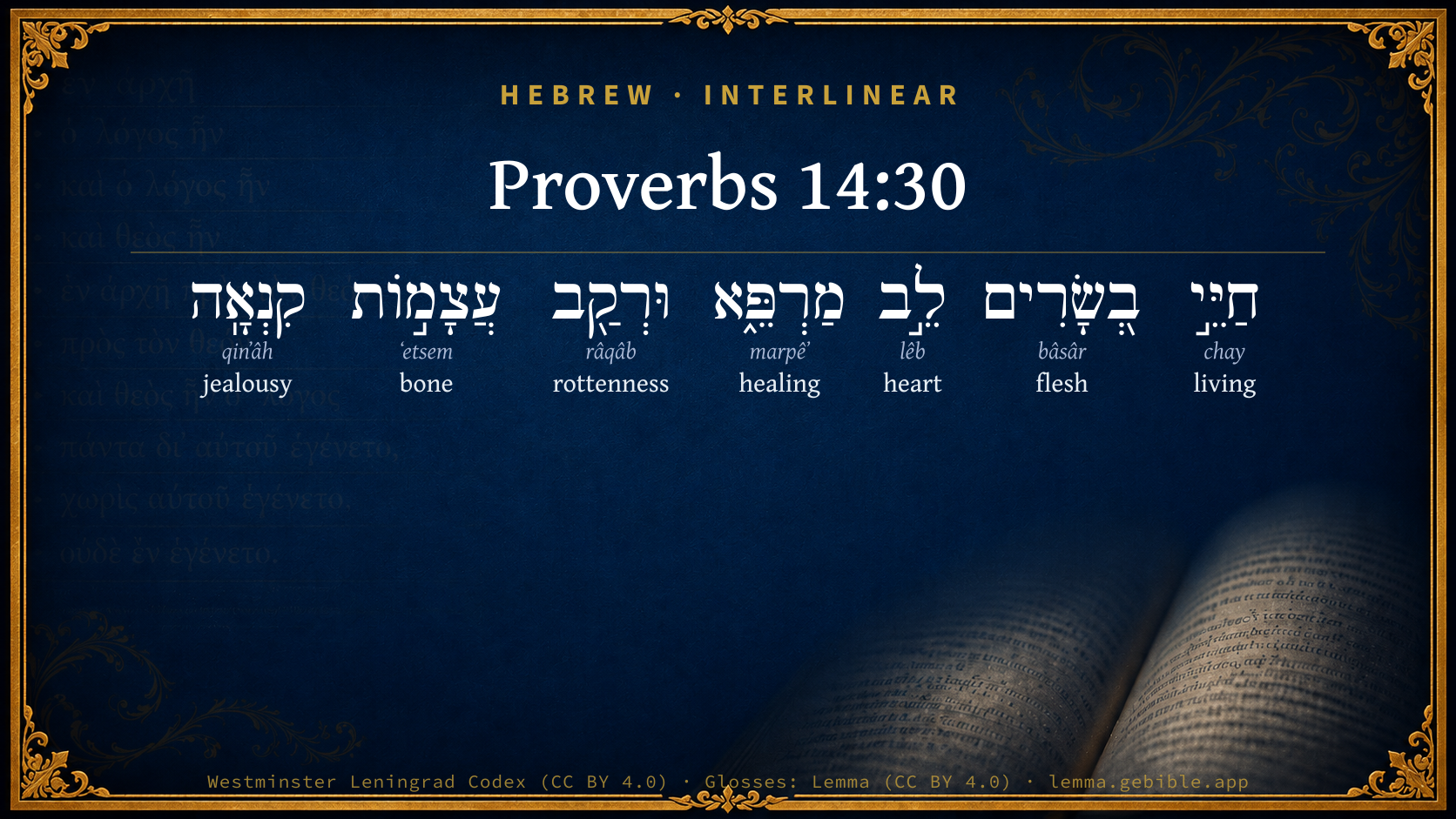
Hebrew (Westminster Leningrad Codex) Proverbs 14:30 appears in the Hebrew Old Testament. The text above is from the Westminster Leningrad Codex. Each word links to its Strong’s number, a concise gloss, and parsing drawn from the Open Scriptures Hebrew Bible morphology. Click any word for its full Brown-Driver-Briggs (BDB) entry.
Download image
Cite this verse

Proverbs 14:30 (World English Bible). Public Domain. Lemma interlinear Bible study tool, https://lemma.gebible.app/v/proverbs/14/30.

Show BibTeX & RIS
BibTeX
RIS
English Translation
The life of the body is a heart at peace, But envy rots the bones.
World English Bible · Public Domain
Download a study sheet

One document with this verse’s original text, its word-by-word gloss line, the meaning frame, cross-references with their text, attributed commentary, and full source and license credits — printable, and it pastes into notes with its structure intact.

This verse Autodidact and up

Study sheet (.html) Plain text (.txt)

A passage Seminary Student

Up to 50 verses in one chapter. A passage sheet keeps up to 6 commentary sources and 12 cross-references per verse, in the order this page ranks them, and says so on the sheet whenever that leaves anything out. Ask for a single verse and you get the Autodidact verse sheet above.

Everything on this page stays free to read, with no account — the sheet is a download of what is already on screen, not access to it.

Want to remove ads? Support Godless Engineer
Compare translations 3

The same verse in 3 English versions, stacked beneath the original-language interlinear above. Click any original word for its lexicon entry.

Each is an independent rendering of the whole verse — the interlinear is not word-aligned to these translations.

Highlighted words mark where these versions differ — a whole-verse word diff, not a word-by-word alignment.

  • World English Bible Public Domain
    The life of the body is a heart at peace, But envy rots the bones.
  • King James Version Public Domain
    A sound heart is the life of the flesh: but envy the rottenness of the bones.
  • unfoldingWord Literal Text CC BY-SA 4.0
    A heart of healing life to bodies, but envy the decay of bones.

unfoldingWord Literal Text — © unfoldingWord, licensed CC BY-SA 4.0. Word-aligned USFM3 via Door43 (git.door43.org/unfoldingWord/en_ult).

Versions to compare (up to 4)

3 of 4 selected

Show all 18 translations

Every available English version of this verse, each an independent rendering of the whole verse.

  • World English Bible Public Domain
    The life of the body is a heart at peace, But envy rots the bones.
  • Berean Standard Bible Public Domain
    A tranquil heart is life to the body, but envy rots the bones.
  • Majority Standard Bible Public Domain
    A tranquil heart is life to the body, but envy rots the bones.
  • King James Version Public Domain
    A sound heart is the life of the flesh: but envy the rottenness of the bones.
  • American Standard Version (1901) Public Domain
    A tranquil heart is the life of the flesh; But envy is the rottenness of the bones.
  • Revised Version (1885) Public Domain
    A sound heart is the life of the flesh: but envy is the rottenness of the bones.
  • Geneva Bible (1599) Public Domain
    A sounde heart is the life of the flesh: but enuie is the rotting of the bones.
  • Douay-Rheims (1899) Public Domain
    Soundness of heart is the life of the flesh: but envy is the rottenness of the bones.
  • Young's Literal Translation Public Domain
    A healed heart `is' life to the flesh, And rottenness to the bones `is' envy.
  • Literal Standard Version CC BY-SA 4.0
    A healed heart [is] life to the flesh, || And rottenness to the bones [is] envy.
  • Unlocked Literal Bible CC BY-SA 4.0
    A tranquil heart is life for the body, but envy rots the bones.
  • unfoldingWord Literal Text CC BY-SA 4.0
    A heart of healing life to bodies, but envy the decay of bones.
  • Darby Bible Public Domain
    A sound heart is the life of the flesh; but envy the rottenness of the bones.
  • World Messianic Bible Public Domain
    The life of the body is a heart at peace, but envy rots the bones.
  • Webster's Bible Public Domain
    A sound heart is the life of the flesh: but envy the rottenness of the bones.
  • Free Bible Version CC BY-SA 4.0
    A peaceful mind makes your body healthy, but jealousy makes your bones rot.
  • Bible in Basic English Public Domain
    A quiet mind is the life of the body, but envy is a disease in the bones.
  • JPS Tanakh (1917) Public Domain
    A tranquil heart is the life of the flesh; but envy is the rottenness of the bones.

Literal Standard Version (2020), Covenant Press — licensed CC BY-SA 4.0. Text via the HelloAO Bible API (eBible.org). Unlocked Literal Bible (unfoldingWord) — licensed CC BY-SA 4.0. Text via the HelloAO Bible API (eBible.org). unfoldingWord Literal Text — © unfoldingWord, licensed CC BY-SA 4.0. Word-aligned USFM3 via Door43 (git.door43.org/unfoldingWord/en_ult). Free Bible Version, Dr. Jonathan Gallagher — licensed CC BY-SA 4.0. Text via the HelloAO Bible API (eBible.org).

Word by word

More ways to search: Search by grammar → Find every occurrence → Compare this word →

Practice this passage: Drill this verse → Learn its vocabulary →

About this verse

These counts appear in no published source. They are computed here, from the morphology-tagged text and Lemma’s own curated glosses. What Lemma adds →

7
words
7
distinct lemmas
Wisdom
section

Notable vocabulary

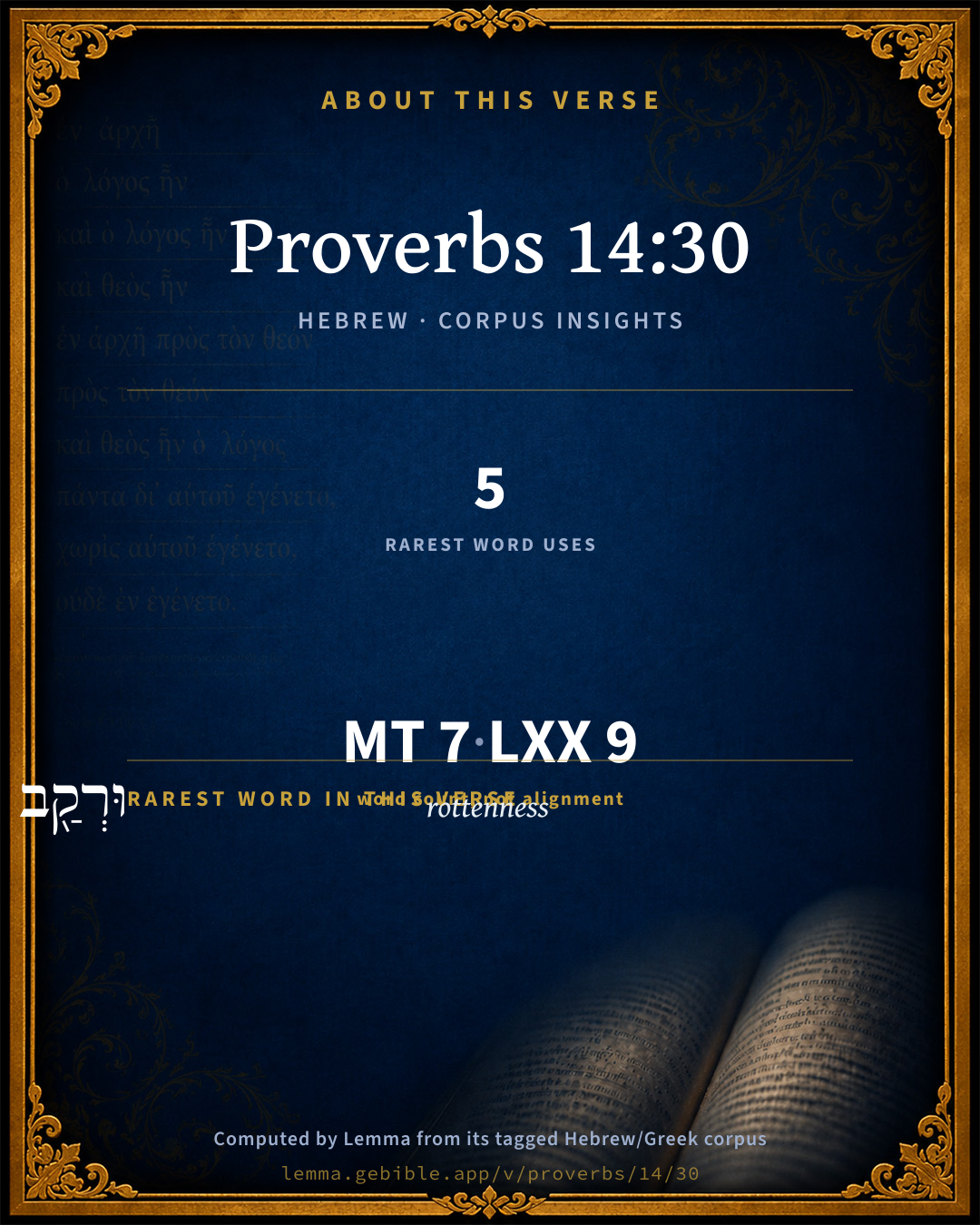
The rarest word here is וּרְקַ֖ב rottenness H7538 — appearing just 5 times in the whole Hebrew Bible.

Shared distinctive vocabulary

וּרְקַ֖ב rottenness H7538 occurs in 5 verses of the Hebrew Bible. Also found in:

Grammatical profile

  • 7 nouns

Hebrew & Septuagint length

In English translation the verse runs 15 words from the Hebrew and 19 from the Septuagint (LXX English) — closely comparable.

A rough comparison of the two English renderings, which tokenize alike — not a word-level alignment.

Word counts can differ between the Hebrew and the Greek without any difference in meaning — e.g. the Hebrew direct-object marker אֵת has no separate Greek word, and Greek often adds the article ὁ.

In the original languages it is 7 Hebrew tokens and 9 Greek tokens — but the two are counted differently (Hebrew bundles its prefixes and suffixes into one token; the Greek is in lemma form), so that isn’t a like-for-like length.

Cross-references

11

Topical passages linked to Proverbs 14:30 in the Treasury of Scripture Knowledge — connected by theme and wording, ordered by reader-vote popularity; previews shown in the World English Bible.

  • Proverbs 17:22 A cheerful heart makes good medicine, But a crushed spirit dries up the bones.
  • Job 5:2 For resentment kills the foolish man, And jealousy kills the simple.
  • Proverbs 3:8 It will be health to your body, And nourishment to your bones.
  • Proverbs 4:23 Keep your heart with all diligence, For out of it is the wellspring of life.
  • Proverbs 12:4 A worthy woman is the crown of her husband, But a disgraceful wife is as rottenness in his bones.
  • Psalms 112:10 The wicked will see it, and be grieved. He shall gnash with his teeth, and melt away. The desire of the wicked will perish.
  • Psalms 119:80 Let my heart be blameless toward your decrees, That I may not be disappointed.
  • Romans 1:29 being filled with all unrighteousness, sexual immorality, wickedness, covetousness, maliciousness; full of envy, murder, strife, deceit, evil habits, secret slanderers,
  • 2 Timothy 1:7 For God didn't give us a spirit of fear, but of power, love, and self-control.
  • Acts 7:9 "The patriarchs, moved with jealousy against Joseph, sold him into Egypt. God was with him,
  • James 4:5 Or do you think that the Scripture says in vain, "The Spirit who lives in us yearns jealously"?

Cross-references courtesy of OpenBible.info (CC BY 4.0).

Hebrew and Greek witnesses Masoretic Hebrew ↔ Greek Septuagint

The same verse in the two great witnesses to the Old Testament, shown verse-for-verse.

These are two independent witnesses, not word-aligned to each other, and the Septuagint is shown in lemma (dictionary) form.

Hebrew Proverbs 14:30 Masoretic · Westminster Leningrad Codex

חַיֵּ֣י בְ֭שָׂרִים לֵ֣ב מַרְפֵּ֑א וּרְקַ֖ב עֲצָמ֣וֹת קִנְאָֽה

The life of the body is a heart at peace, But envy rots the bones.

World English Bible · Public Domain

Greek LXX Proverbs 14:30 Septuagint · lemma form

πραΰθυμος ἀνήρ καρδία ἰατρός σός δέ ὀστέον καρδία αἰσθητική

A meek-spirited man is a healer of the heart: but a sensitive heart is a corruption of the bones.

LXX2012 (modern English Septuagint) · Public Domain

On this verse, Haydock's Catholic Bible Commentary discusses the Septuagint’s reading. Read the note in Commentary ↓

Hebrew: Westminster Leningrad Codex (CC BY 4.0). Greek: Septuagint (public domain); English from LXX2012 (modern English Septuagint) (Public Domain). How the Septuagint differs from the Hebrew →

Commentary

Notes on Proverbs 14:30 from classic Christian and Jewish commentators (each source and its license shown beneath its notes). The classic Christian expositions comment on the surrounding passage and are grouped to its opening verse, so a note may address several verses; the Jewish commentaries on the Tanakh (Rashi and others) are per-verse, so they appear only where the commentator wrote on this verse.

Lemma curates 59 commentaries, every one of them public domain or Creative Commons licensed, each selected and text-cleaned for this edition rather than reprinted as found. About our sources →

Trapp's Complete Commentary

John Trapp

Pro 14:30 A sound heart [is] the life of the flesh: but envy the rottenness of the bones.

Ver. 30. A sound heart is the life of the flesh.] A heart well freed from passions and perturbations holds out long, and enjoys good health; neither causeth it molestation of mind or want of welfare to others. It is the life of fleshes (in the plural); {a} not only its own, but other men’s bodies are the better, at least not the worse, for it; whereas the envious and angry man rangeth and rageth; and like a mad dog biting all he meets, sets them, as much as in him lies, all a-madding, and undoes them.

But envy is the rottenness of the bones.] A corroding and corrupting disease it is, like that which the physicians call Corruptio totius substantiae, it dries up the marrow; and because it cannot come at another man’s heart, this hell-hag feeds upon its own, tormenting the poor carcase without and within. It is the moth of the soul, and the worm, as the Hebrew word signifies, of the bones, those stronger parts of the body. It is the same to the whole man that rust is to iron, as Antisthenes affirmeth; it devoureth itself first, as the worm doth the nut it grows in. Socrates called it serram animae, the soul’s saw; and wished that envious men had more ears and eyes than others, that they might have the more torment by beholding and hearing of other men’s happinesses; for invidia simul peccat et plectitur, expedita iustitia. Like the viper, it is born by eating through the dam’s belly; like the bee, it loseth its sting and life together; like the little fly, to put out the candle, it burns itself; like the serpent Porphyrius, it drinks the most part of its own venom; like the viper that leaped upon St Paul’s hand to hurt him, but perished in the fire; or as the snake in the fable, that licked off her own tongue; as envying teeth to the file in the forge. In fine, "Envy slayeth the silly soul"; {Job 5:2} as it did that fellow in Pausanias, who, envying the glory of Theagenes, a famous wrestler, whipped his statue - set up in honour of him after his death - every night so long, till at length it fell upon him, and killed him. {b}

{a} Rabbi Levi.

{b} Pausan. Eliac., p. 188.

John Trapp, A Commentary or Exposition upon All the Books of the Old and New Testament (1647–1656) — public domain. Text from a community e-Sword module.

The Biblical Illustrator

Joseph S. Exell

Pro_14:30

A sound heart is the life of the flesh.

Heart and health

A sound heart is a heart that gives its supreme affection to the supremely good. All other hearts are more or less rotten. Such a heart, the text informs us, is the condition of physical health; it is the very life of the flesh. True, science can demonstrate this fact in many ways. Physical health requires attention to certain laws; these laws to be attended to must be understood; the understanding of these laws requires study; the proper study of them is only insured by a supreme sympathy of heart with the law-giver. Every mans experience, as well as science, attests this fact. The influence of the emotions of the heart upon the state of the body even the dullest recognises. The passions of grief, disappointment, anger, jealousy and revenge, in proportion to their strength derange the bodily system. On the other hand, pleasurable emotions give buoyancy and vigour to the body.

I. That a mans bodily health, where the organisation is normally good, is very much in his own hands. Heaven has given us the means and the motives to cultivate happy conditions of the heart. Keep thy heart with all diligence. We infer from this fact--

II. That christianity is an indispensable agent in removing mans physical diseases.

III. That medical science will always be ineffective until it practically concerns itself with the moral diseases and cures of the mind. The medical practitioner should know--

(1) That it is unscientific to ignore the fact that moral evil is the source of all physical evil, and--

(2) That it is unscientific to ignore the fact that there is no agent to remove moral evil but Christianity. We infer--

IV. That as the true morality of the world advances, the physical health of the world will improve. A drainage to carry away all the foul passions of the heart is the desideratum. The man who is most successful in his efforts, through Christianity, to promote a moral renovation of hearts is the greatest philanthropist. (D. Thomas, D.D.)

But envy is the rottenness of the bones.

The nature and character of envy

All the laws of nature, as far as they comprehend the duties we owe to one another, may be reduced to this one great principle of universal benevolence, viz., that we lay it down as the fixed and fundamental rule of all our actions, to do all manner of good, and to abstain from all manner of evil. The motives to this conduct, besides the beauty and agreeableness of it, are these--

1. That all mankind in reality consult their own interest best, when they contribute to the good of the whole.

2. That there is an intrinsic pleasure resulting from the practice of virtue.

3. That it recommends us to the love and esteem of all mankind. Anguish of heart, hatred, disesteem, and insecurity, are the natural rewards of iniquity, even in this world. This is nowhere more conspicuous than in the passion of vice and envy. A sound heart, is literally a heart of lenity or medicine. Envy is a leaven that sours and corrupts, sets all the humours upon the fret, and is the bane of all that is good and beautiful and desirable in life.

I. The nature and origin of envy; and who are they that are most subject to it. Envy is a pain or uneasiness, arising from an apprehension of the prosperity and good fortune of others; not because we suffer for their welfare, but merely because their condition is bettered. There is a strong jealousy of preeminence and superiority implanted in our nature by Almighty God, for wise and noble purposes. When this principle takes root in a good mind, it is called emulation. But when this principle meets with an evil, corrupt disposition, it degenerates into envy, the most malignant and hateful passion in human nature, the worst weed of the worst soil. This passion affects us chiefly in relation to our equals. If we find we have equalled or exceeded those of like birth, the natural consequence is joy and complacency; but if we are exceeded by them, emulation or envy. The persons most subject to envy are the covetous; men of little or mean spirits; men of extraordinary endowments and abilities, who cannot bear a rival; proud men; and old men.

II. The symptoms by which envy may be known.

1. When we find ourselves averse from doing a person good offices.

2. When we are pleased with the evil of others.

3. When we manifest a censorious disposition; silencing the good actions of others, or exposing the bad.

4. When we have a discontented, querulous, and quarrelsome disposition.

III. The ill effects of envy.

1. To the envious person it is rottenness in his bones. It wastes the body, and keeps the mind in a ferment. It kills our quiet and our virtue also.

2. It exposes a man to the just hatred and aversion of all mankind; and spreads its malignant influence wherever it comes.

IV. The best remedies for the cure of this pernicious passion.

1. Settle our opinion of things, and endeavour to take a right estimate of them, according to the law of God.

2. Make a right judgment of our own worth and abilities.

3. Reflect seriously upon the vanity and insignificancy of all worldly advantages.

4. Think of God, who takes pleasure in the happiness of all His creatures. (J. Delany.)

The Biblical Illustrator, edited by Joseph S. Exell (c. 1880s–1900s) — public domain. Text from a community e-Sword module.

Joseph Benson's Commentary

Pro 14:30. A sound heart — Free from envy, and such like inordinate passions, which are commonly called the diseases of the soul, even in heathen, as well as in the sacred writers. Or, as others render לב מרפא, a healing heart, mild, merciful, and kind to others, which is opposed to envy; is the life of the flesh — Procures and maintains the health and vigour of the whole body; but envy the rottenness of the bones — It wasteth the spirits, or consumeth even the strongest and most inward parts of the body.

Joseph Benson's Commentary on the Old and New Testaments (1811–1818) — public domain. Text from a community e-Sword module.

The Preacher's Complete Homiletical Commentary

Joseph S. Exell (gen. ed.)

CRITICAL NOTES.—

Pro_14:30. A sound heart, “a quiet heart.” Envy, “passion,” “perturbation.”

MAIN HOMILETICS OF Pro_14:30

A SOUND HEART

The blessed effects of a contented spirit. The “sound heart” being here placed in contrast to “envy,” shows that it means a spirit that is content with its lot in life—that is not ever reaching after the unattainable—that is not jealous of others who are in more favourable circumstances. Such a quietness of spirit is—

Pro_14:1. Favourable to bodily health. The mind of a passionate man wears out the bodily frame, and no passion that can possess the soul is more imperious and agitating, and consequently more injurious to health than envy. Jealousy is said to be as “cruel as the grave” (Son_8:6), and it is cruel not only to the objects of it, but also to him who allows it a dwelling-place in his spirit. Its withering effects are felt even in the body, it is “rottenness of the bones” in this sense. But a contented spirit goes a long way to promote and to preserve bodily health. A quiet spirit is a stranger to all those restless feelings which give sleepless nights and anxious days to the envious man.

II. It is indispensable to the attainment of a noble character. Calmness of spirit gives room for the development of all the graces and virtues which go to make up the “perfect man” (Eph_4:13). Growth in nature demands some degree of quietness and calmness to develop itself. The mighty forest oak of a hundred years has attained its present noble dimensions by processes which have gone on for the most part in days and nights of stillness. So a character of moral strength and beauty can be formed only in the atmosphere of a calm and well-governed spirit.

OUTLINES AND SUGGESTIVE COMMENTS

“Envy” excitement of any kind; perturbation; a wise saw, perhaps, of the old hygiene, but true spiritually. Religion rejoices in peace. Mad passion may be overruled; but so can our lusts be. As much as lieth in us, we should have peace. The soul is a temple (1Co_3:17), and “holiness becometh Thy house, O Lord, for ever” (Psa_93:5).—Miller.

The word sound signifies healthful, free from moral distempers—the distempers of “the inner man,” such as discontent, malice, and envy. Strictly speaking a “sound heart”—a heart entirely free from the evil passions that belong to fallen nature—is not to be found. But in Scripture a sound heart, and even a perfect heart, are phrases used to signify the real sincerity and predominant rule of right principles and actions. Envy, perhaps the most odious in itself, and the most corroding and torturing to the spirit, is here called “rottenness of the bones”—not a mere surface sore, but a deep-seated disease; like caries, or inflammation in the substance of the bone itself.—Wardlaw.

I. The nature of envy. It is a pain, or uneasiness, arising from an apprehension of the prosperity and good fortune of others; not because we suffer from their welfare, nor that our condition may be bettered by our uneasiness, but merely because their condition is bettered. There is a strong jealousy of pre-eminence and superiority implanted in our nature by Almighty God, for wise and noble purposes, to excite to the pursuit of laudable attainments, and the imitation of good and great actions. This principle is emulation. It is also an uneasiness occasioned by the good fortunes of others; but not because we repine at their prosperity, but because we ourselves have not attained the same good success. Its effect is to excite us to great designs, but when it meets with a corrupt disposition it degenerates into envy, the most malignant passion in human nature, the worst weed of the worst soil. So far from stirring up to imitation, envy labours to taint and depreciate what it does not so much as attempt to equal.

II. The cure for envy.

1. That we endeavour to take a right estimate of things. The laws of God are the eternal standards of good and evil; what they declare valuable, or enjoin as wise, are truly so, and what they disclaim as hurtful or worthless are, in fact, to be so regarded.

2. That we try to make a right judgment of our own worth and abilities. If we do this, we shall find that there are others in the world at least as wise and as good as we are, and perhaps we shall also find, that if merit were the standard of honour and affluence, we should not abound altogether as much as we do.

3. Reflect seriously upon the vanity of all worldly advantage. Shall we envy him whose breath is in his nostrils? whose glory fadeth as the flower of grass?—Delany.

Envy is called a passion, and passion means suffering. The patient who is ill of envy is a sinner and a sufferer too. He is an object of pity. It is a mysterious and terrible disease. The nerves of sensation within the man are attached by some unseen hand to his neighbours all around him, so that every step of advancement which they make tears the fibres that lie next his heart. The wretch enjoys a moment’s relief when the mystic cord is temporarily slackened by his neighbour’s fall; but his agony immediately begins again, for he anticipates another twitch as soon as the fallen is restored to prosperity.… The cure of envy, as wrought by the love of Christ, is not only a deliverance from pain, it is, even in the present world, an unspeakable gain. That man will speedily grow rich who gets and puts into his bag not only all his own winnings, but also all the winnings of his neighbours.… The Nile, contrary to the analogy of other great streams, flows more than a thousand miles without receiving the waters of a single tributary; the consequence is, that it grows no greater as it courses over that vast line. Other rivers are every now and then receiving converging streams from the right and left, and thereby their volume continually increases until it reaches the sea. The happiness of man is like the flow of water in a river. If you enjoy nothing but what is your own, your tiny rivulet of contentment, so far from increasing, grows smaller by degrees, until it sinks unseen into the sand, and leaves you in a desert of despair; but when all the acquisitions of your neighbours go to swell its bulk, your enjoyment will flow like a river enriched by many affluents, growing ever greater as life approaches its close. It is some such river that makes glad the city of God.—Arnot.

Socrates called envy the soul’s saw; and wished that envious men had more eyes and ears than others, that they might have the more torment by beholding and hearing other men’s happiness.—Trapp.

Envy at last crawls forth from hell’s dire throng,

Of all the direfull’st! Her black locks hung long,

Attired with curling serpents; her pale skin

Was almost dropped from her sharp bones within;

And at her breasts stuck vipers, which did prey

Upon her panting heart both night and day,

Sucking black blood from thence, which to repair,

Both day and night they left fresh poisons there.

Her garments were deep-stained in human gore,

And torn by her own hands, in which she bore

A knotted whip and bowl, which to the brim

Did with green gall and juice of wormwood swim;

With which, when she was drunk, she furious grew,

And lashed herself; thus from the accursed crew

Envy, the worst of fiends, herself presents,

Envy, good only when she herself torments.

Cowley.

The Preacher's Complete Homiletical Commentary (gen. ed. Joseph S. Exell; Funk & Wagnalls, c. 1892) — public domain (pre-1929). A full-Bible homiletical/sermon-outline anthology covering 65 of 66 books (2 John is absent from the source module). Text from a community e-Sword module.

Tyndale Open Study Notes

Tyndale Open Resources

14:30 A peaceful heart has resolved its inner tensions. Freedom from jealousy is beneficial to physical health.

Tyndale Open Study Notes — © Tyndale Open Resources, licensed CC BY-SA 4.0. Text via the HelloAO Bible API.

Geneva Bible (1599)

Geneva Bible translators

Or, body.

Geneva Bible (1599) marginal notes — public domain. Text via Bolls.life.

Matthew Henry's Commentary

The foregoing verse showed how much our reputation, this how much our health, depends on the good government of our passions and the preserving of the temper of the mind. 1. A healing spirit, made up of love and meekness, a hearty, friendly, cheerful disposition, is the life of the flesh; it contributes to a good constitution of body; people grow fat with good humour. 2. A fretful, envious, discontented spirit, is its own punishment; it consumes the flesh, preys upon the animal spirits, makes the countenance pale, and is the rottenness of the bones. Those that see the prosperity of others and are grieved, let them gnash with their teeth and melt away, Psa 112:10.

Rumpatur, quisquis rumpitur invidia.

Whoever bursts for envy, let him burst.

Matthew Henry's Commentary on the Whole Bible (1708–1710) — public domain (CC PDM 1.0). Text via the HelloAO Bible API.

Jamieson, Fausset & Brown

Robert Jamieson, A. R. Fausset & David Brown

A sound heart--both literally and figuratively, a source of health; in the latter sense, opposed to the known effect of evil passions on health.

Jamieson, Fausset & Brown — Commentary Critical and Explanatory on the Whole Bible (1871) — public domain (CC PDM 1.0). Text via the HelloAO Bible API.

Adam Clarke's Commentary

Verse 30. A sound heart is the life of the flesh] A healthy state of the blood, and a proper circulation of that stream of life, is the grand cause, in the hand of God, of health and longevity. If the heart be diseased, life cannot be long continued.

Adam Clarke's Commentary on the Bible (1810–1826) — public domain. Text from a community e-Sword/MySword module.

Ellicott's Commentary for English Readers

(30) A sound heart—i.e., one in healthy condition, of which the passions and emotions are under control.

A Bible Commentary for English Readers, edited by Charles John Ellicott (1878–1897) — public domain. Text from a community e-Sword module.

The Cambridge Bible for Schools and Colleges

gen. ed. J. J. S. Perowne

30. sound] Or, tranquil, R.V. marg. (deriving the word from another root). See Pro_15:4 and comp. Ecc_10:4, where the same Heb. word is rendered, yielding, or gentleness, A.V. and R.V.

envy] Or, jealousy, R.V. marg. See for illustrations, Gen_4:4-5; Gen_37:4; 1Sa_18:8; Est_5:13.

The Cambridge Bible for Schools and Colleges (gen. ed. J. J. S. Perowne; Cambridge University Press, 1878–1918) — public domain. Text from a community e-Sword module.

John Gill's Exposition

A sound heart is the life of the flesh,.... A heart made so by the grace of God, in which are sound principles of truth, righteousness, and holiness; these preserve from sin, and so from many diseases; whereby the life of the flesh or body is kept safe and sound, or that is kept in health and vigour; or a "quiet heart" (h); a heart free from wrath, anger, and envy, and such like passions and perturbations; this contributes much to the health of the body, and the comfort of life: or a "healing heart", or "spirit" (i); that is humane, kind, and friendly; that pities and heals the distresses of others, and makes up differences between persons at variance: such an one is "the life of fleshes" (k), as in the original text; or of men, of the same flesh and blood; the life of others, as well as of his own flesh; such an one contributes to the comfortable living of others as well as of himself;

but envy the rottenness of the bones; a man that envies the happiness and prosperity of others, this preys upon his own spirits, and not only wastes his flesh, but weakens and consumes the stronger parts of his body, the bones; it is as a "moth" within him, as the Arabic version: the Targum is,

"as rottenness in wood, so is envy in the bones;''

hence Ovid (l) calls it "livor edax", and so Martial (m).

(h) "cor leve", Baynus; "cor lene", Mercerus; "cor lenitatis", Gejerus, so Ben Melech. (i) "Animus sanans", Junius & Tremellius, so the Tigurine version; "sanator", Gussetius, p. 800. (k) "vitae carnium", Montanus; "vita carnium", V. L. Pagninus, Michaelis. (l) Amorum, l. 1. Eleg. 15. v. 1. & de Remed. Amor. l. 1. in fine. (m) Epigr. l. 11. Ep. 21.

John Gill's Exposition of the Whole Bible (1746–1763) — public domain (CC PDM 1.0). Text via the HelloAO Bible API.

Albert Barnes' Notes on the Bible

Sound heart - literally, “heart of health,” that in which all emotions and appetites are in a healthy equilibrium. The contrast with this is the envy which eats, like a consuming disease, into the very bones and marrow of a man’s moral life.

Albert Barnes' Notes on the Bible (1834–1885) — public domain. Text from a community e-Sword/MySword module.

Haydock's Catholic Bible Commentary

Bones. As a sound heart preserves the rest of the body, so a good intention often excuses from mortal sin, when the error is not gross. But envy corrupts the works which seem good, and which cannot bear a strict examination. (St. Gregory, Mor. v. 34.) (Worthington) --- Envy ruins the health. (Menan. ap. Gort.[Grotius?]) --- Septuagint, "a too sensible heart is the," &c. This is beautiful; but not quite conformable to the Hebrew.

George Leo Haydock (1774–1849), Haydock's Catholic Family Bible and Commentary, 1859 edition — public domain. Excludes Psalms (Douay-Rheims chapter numbering differs from Protestant) and Deuterocanonical books (Catholic canon only).

Matthew Poole's English Annotations

A sound heart; free from envy and such-like inordinate passions, which are commonly called the diseases of the soul, not only in sacred, but even in heathen writers. Or, as others render it, a healing heart; mild, and merciful, and kind to others, which is opposed to envy.

Is the life of the flesh; procureth and maintaineth the health and rigour of the whole body. But envy the rottenness of the bones; it wasteth the spirits, and consumeth even the strongest and most inward parts of the body.

Matthew Poole's English Annotations on the Holy Bible (1683–1685) — public domain. Text from a community e-Sword/MySword module.

Whedon's Commentary on the Bible

Daniel D. Whedon

30. A sound heart is… life of the flesh — Literally, a heart of healing. “A tranquil heart.” — Conant. “A soothing heart.” — Stuart. “A quiet heart.” — Noyes. “A quiet spirit.” — Zockler. The health of the heart, and the proper circulation of the blood, are the means of life and health to every part of the body. If the heart be diseased there can be no sound health nor great length of life. But the heart is here taken tropically for the moral state, moral or spiritual health, soundness of moral or religions principles, and the proper regulation of the passions and appetites. Such a state tends to life — natural, spiritual, and eternal.

But envy — Standing here, perhaps, as the representative of any intense evil passion.

The rottenness of the bones — An eating, corroding principle, acting slowly but surely; preventing and counteracting the effects of nourishment. On “envy,” compare Job_5:2; Psa_112:10; Act_7:9; Rom_1:29; Jas_4:5. On “rottenness of bones,” compare Pro_12:4; Pro_17:22.

Daniel D. Whedon (gen. ed.), Commentary on the Old and New Testaments (1874–1909) — public domain. Text from a community e-Sword module.

The Pulpit Commentary

A sound heart is the life of the flesh. The heart that is healthy, morally and physically, spreads its beneficent influence over the whole body in all its functions and relations; this is expressed by the word for "flesh" ( besarim), being in the plural number, as the Vulgate renders, vita carnium, but the contrast is better developed by taking aprm in its other signification of "calm," "gentle," "meek," as Ecc_10:4. Thus the Septuagint, "The man of gentle mind (prauyumov ) is the physician of the heart." The tranquil, well controlled heart gives health and vigor to the whole frame. (see on Pro_15:4) But envy is the rottenness of the bones. (Pro_12:4) Envy, like a canker, eats away a man"s life and strength; it tells on his physical as well as his moral condition. We hays parallel expressions in classical authors. Thus Horace, "Epist.," 1:257"Invidus alterius macrescit rebus opimis.

Martial, "Epigr.," 5:28"Rubiginosis cuncta dentibus rodit; Hominem malignum forsan esse tu credas, Ego esse miserum credo, cui placet nemo.

Bengal proverb, "In seeing another"s wealth it is not good to have the eyes smart." Arabic. "Envy is a raging fever, and has no rest" (Lane). "O invidia," cries St. Jerome ("Epist.," 45), "primum mordax tui." "When the foul sore of envy corrupts the vanquished heart," says St. Gregory ("Moral.," 5:85). "the very exterior itself shows how forcibly the mind is urged by madness. For paleness seizes the complexion, the eyes are weighed down, the spirit is inflamed, while the limbs are chilled, there is frenzy in the heart, there is gnashing with the teeth, and while the growing bate is buried in the depths of the heart, the pent wound works into the conscience with a blind grief" Septuagint, "A sensitive heart ( kardia aisyhtikh ) is a worm (shv ) in the bones." A heart that feels too acutely and is easily affected by external circumstances, prepares for itself constant vexation and grief.

A quiet spirit.

Translate the first clause of the verse thus: "The life of the body is a quiet spirit.

I THE CHARACTERISTICS OF A QUIET SPIRIT. The habit and disposition of quietness need not be accompanied by torpor. There is, indeed, a quietness of sleep, as there is also a silence of the grave. But in the passage before us the quiet spirit is directly connected with life. The body may be busy while the spirit is quiet; nay, the mind may be nimble and alert, even full of activity, while yet the spirit is at rest. Observe, then, the marks of a quiet spirit.

1. Peace. There is peace within the soul, and therefore quiet. The turbulent spirit is like a mutinous crew that may make tumult on board the ship while the sea is as still as glass, and the peaceful spirit is like a well conducted crew that works in quiet while the sea is torn with tempest.

2. Patience. The quiet spirit does not complain under chastisement, nor does it angrily resent unkindness. The psalmist was "dumb" under calamity. Christ was led as a lamb to the slaughter. (Isa_53:7)

3. Unostentatiousness. Some give more show than service, and make more noise than profit. Eager to attract attention, they "sound a trumpet before them". (Mat_6:2) Not so the quiet in spirit, who labour in silence, content to be obscure so long as they know they are not living in vain.

II THE BLESSEDNESS OF A QUIET SPIRIT. It is here set forth as a source of life. No doubt fretful restlessness wears out the life of the bad. Placidity makes for health. Moreover, the life that is dissipated in noise produces no good, and therefore does not collect the means of its own support. The quiet in spirit best make a livelihood. Further, certain special advantages of this quietness may be noted.

1. Depth. "Still waters run deep." We can look far into the quiet lake, while only the surface waves of one that is fretted with cross winds can be seen. The calm, brooding soul knows depths of thought and secret experience that are unfathomable to the foolish, restless, noisy soul.

2. Strength. The silent forest grows strong. The mind is made vigorous by patient endurance. One who is calm is master of the situation, while another who is fretted and flurried feels lost and helpless.

3. Fruitfulness. The calm, strong, silent soul, vigorous and yet unostentatious, ripens best the fruits of experience. Such a one does most real work.

4. Beneficence. Noise vexes the world, and a restless, complaining spirit is a weariness to men. The quiet spirit breathes a perpetual benediction. Its very presence is soothing and healing.

III THE ATTAINMENT OF A QUIET SPIRIT. No doubt there are great constitutional differences in this respect, and while some are naturally or by ill health restless, irritable, demonstrative, others are naturally quiet, self-possessed, even reserved. Due allowance must be made for these differences before we attempt to judge our brethren. Still, there is a measure of quietness attainable by the use of the right means, viz.:

1. Self-mastery. When a man has conquered himself, the tumult of civil war in his breast ceases.

2. Faith. To trust God, to know that he is doing all well, to seek and obtain the help of his Holy Spirit, are to find the secret of peace and quietness of soul.

3. Love. Selfishness makes us restless. "A heart at leisure from itself" can learn to be patient and calm.

The Pulpit Commentary (1880–1919), ed. H.D.M. Spence-Jones & Joseph S. Exell — public domain. Text from a community e-Sword module.

John Wesley's Explanatory Notes

A sound heart - Free from envy and inordinate passions. Is life - Procures and maintains the health and vigour of the body.

John Wesley, Explanatory Notes Upon the Whole Bible (1754–1765) — public domain. Text via the GEBible commentary corpus.

Keil & Delitzsch

C. F. Keil & F. Delitzsch

30 A quiet heart is the life of the body,

But covetousness is rottenness in the bones.

Heart, soul, flesh, is the O.T. trichotomy, Psa 84:3; Psa 16:9; the heart is the innermost region of the life, where all the rays of the bodily and the soul-life concentrate, and whence they again unfold themselves. The state of the heart, i.e., of the central, spiritual, soul-inwardness of the man, exerts therefore on all sides a constraining influence on the bodily life, in the relation to the heart the surrounding life. Regarding לב מרפּא, vid., at Pro 12:18. Thus is styled the quiet heart, which in its symmetrical harmony is like a calm and clear water-mirror, neither interrupted by the affections, nor broken through or secretly stirred by passion. By the close connection in which the corporeal life of man stands to the moral-religious determination of his intellectual and mediately his soul-life - this threefold life is as that of one personality, essentially one - the body has in such quiet of spirit the best means of preserving the life which furthers the well-being, and co-operates to the calming of all its disquietude; on the contrary, passion, whether it rage or move itself in stillness, is like the disease in the bones (Pro 12:4), which works onward till it breaks asunder the framework of the body, and with it the life of the body. The plur. בּשׂרים occurs only here; Bttcher, 695, says that it denotes the whole body; but בּשׂר also does not denote the half, בשׂרים is the surrogate of an abstr.: the body, i.e., the bodily life in the totality of its functions, and in the entire manifoldness of its relations. Ewald translates bodies, but בשׂר signifies not the body, but its material, the animated matter; rather cf. the Arab. âbshâr, "corporeal, human nature," but which (leaving out of view that this plur. belongs to a later period of the language) has the parallelism against it. Regarding קנאה (jealousy, zeal, envy, anger) Schultens is right: affectus inflammans aestuque indignationis fervidus, from קנא, Arab. ḳanâ, to be high red.

Keil & Delitzsch — Biblical Commentary on the Old Testament (1861–1891) — public domain (CC PDM 1.0). Text via the HelloAO Bible API. (Old Testament only.)

Bridges on Proverbs

Charles Bridges

Many will admit religion to be good for the soul. But they conceive its fancied gloom to be injurious to the body. The wise man, however, teaches, that it is the life of the flesh. (Pro 3:7-8 .) And surely a sound heart, freed from corroding passions, and imbued with Christian habits, though it will not bring immortality, must be eminently conductive to health.†1 The contrast, however, here distinguishes a sound heart by the absence of selfishness,†2 and rejoicing in another’s happiness or honour. (Num 11:29 .) Envy, on the other hand, is wounded by our neighbour’s prosperity. (Gen 26:14 . 1Sa 18:9 .) His ruin, or at least his injury, would give pleasure. It sickens at hearing of his praises, and repines at his very virtues. Something is always wrong in his conduct, something at least, which, if it does not deserve blame, greatly detracts from his intolerable praise. This evil is indeed the deadliest fruit of selfishness. Nothing flourishes under its shade. (Jas 3:16 .) Often is it a fretting sickness (Est 6:6, Est 6:12 .), or a pining despondency (Psa 112:10 ), like the destruction of the bodily system by the rottenness of the bones. ’Truly’ — as Bishop Hall observes — ’this vice is executioner enough to itself!’†3 Such a hell does the man carry in his own bosom! Alas! that this plant should be the growth of our own soil.†4 So contrary is it to the mind of Christ (Rom 13:13 ), and to the spirit of his gospel. (1Co 13:4 .) So surely will it exclude from heaven! (Gal 5:21 .)

Footnotes:

†1 The soul disburdened of passions and perturbations, helpeth strength an liveliness of body very much. — Diodati.

†2 ’Cor sanator’ — Schultens — a benevolent heart.

†3 Sermon on Rom 12:2 . — Works, v. 251.

†4 Mar 7:22, ’evil eye,’ Jas 4:5 .

Charles Bridges, An Exposition of the Book of Proverbs (1846) — public domain. Text from a community e-Sword module.

Kretzmann's Popular Commentary

Paul E. Kretzmann

v. 30. A sound heart is the life of the flesh, literally, "life of the members is a heart of composure"; for it is the tranquil spirit which is able to judge calmly and correctly, weighing all factors dispassionately; but envy the rottenness of the bones, for every form of passionate, violent seal sets aside calm consideration, indulges in foolish acts, and results in harm to the quick-tempered person’s health and spiritual well-being.

Paul E. Kretzmann, Popular Commentary of the Bible (1921–1924) — public domain. Text from a community e-Sword module.

unfoldingWord translationNotes

Door43 World Missions Community

A tranquil heart

"A peaceful mindset" or "An attitude that is at peace"

rots the bones

The word "rots" represents the decay of a person and "bones" represents the whole person. AT: "causes a person to be unhealthy in body and spirit" (See: Metaphor)

The one who ... the one who

"The person who ... the person who"

curses

This means to express a desire that bad things will happen to someone.

the poor ... the needy

"a poor person ... a needy person"

shows favor to

"is kind to" or "helps"

translationWords

heart

life

body

envy

oppress

curse

favor

honor

unfoldingWord translationNotes — © Distant Shores Media and the Door43 World Missions Community, licensed CC BY-SA 4.0. Source: git.door43.org/Door43/en_tn.

Rashi

Rabbi Shlomo Yitzchaki (Rashi)

A healing heart is the life of the flesh A heart of flesh, which heals the evil and passes over his retaliations, is the life of the creatures of the Holy One, blessed be He, who are flesh and blood.

but anger is the rot of the bones A man who is often angry is the rot of everyone’s bones.

Rashi on the Tanakh — English translations: “The Judaica Press complete Tanach with Rashi, translated by A. J. Rosenberg” (CC BY 4.0); “Pentateuch with Rashi's commentary by M. Rosenbaum and A.M. Silbermann, 1929-1934” (public domain); “The Metsudah Tanach series, Lakewood, N.J” (CC BY 4.0); and “The Book of Joshua, Metsudah Publications, 1997” (CC BY 4.0). Text via Sefaria.

Lesson kit

Teaching starters — assembled from the data on this page, not authored interpretation. Every prompt links to the verse data it draws on. Edit before teaching.

Proverbs, in the Wisdom, opens this verse with 7 words (7 distinct Hebrew lemmas). Its most distinctive word is râqâb (“rottenness”). A historical commentator’s framing appears above. Read the whole chapter for the surrounding context.

Discussion questions

  1. How does “rottenness” (râqâb) shape what this verse is saying?
  2. How does Job 13:28, which shares the word «rottenness», read alongside this verse?
  3. These translations render this verse differently; the difference is in the English rendering, not the original. What questions does that raise?
  4. Compare how Trapp's Complete Commentary and The Biblical Illustrator read this verse. Where do they agree or differ?

Things to notice

Reading settings

Reading text

Shown beneath each verse's original-language words.

Old Testament
Old Testament edition

Read the OT as the Masoretic Hebrew (MT) or the Greek Septuagint (LXX).

English shown for the Greek Septuagint (in the Hebrew ↔ Greek comparison).

Comparing translations? Open the Compare panel on any verse page to stack up to four side by side.