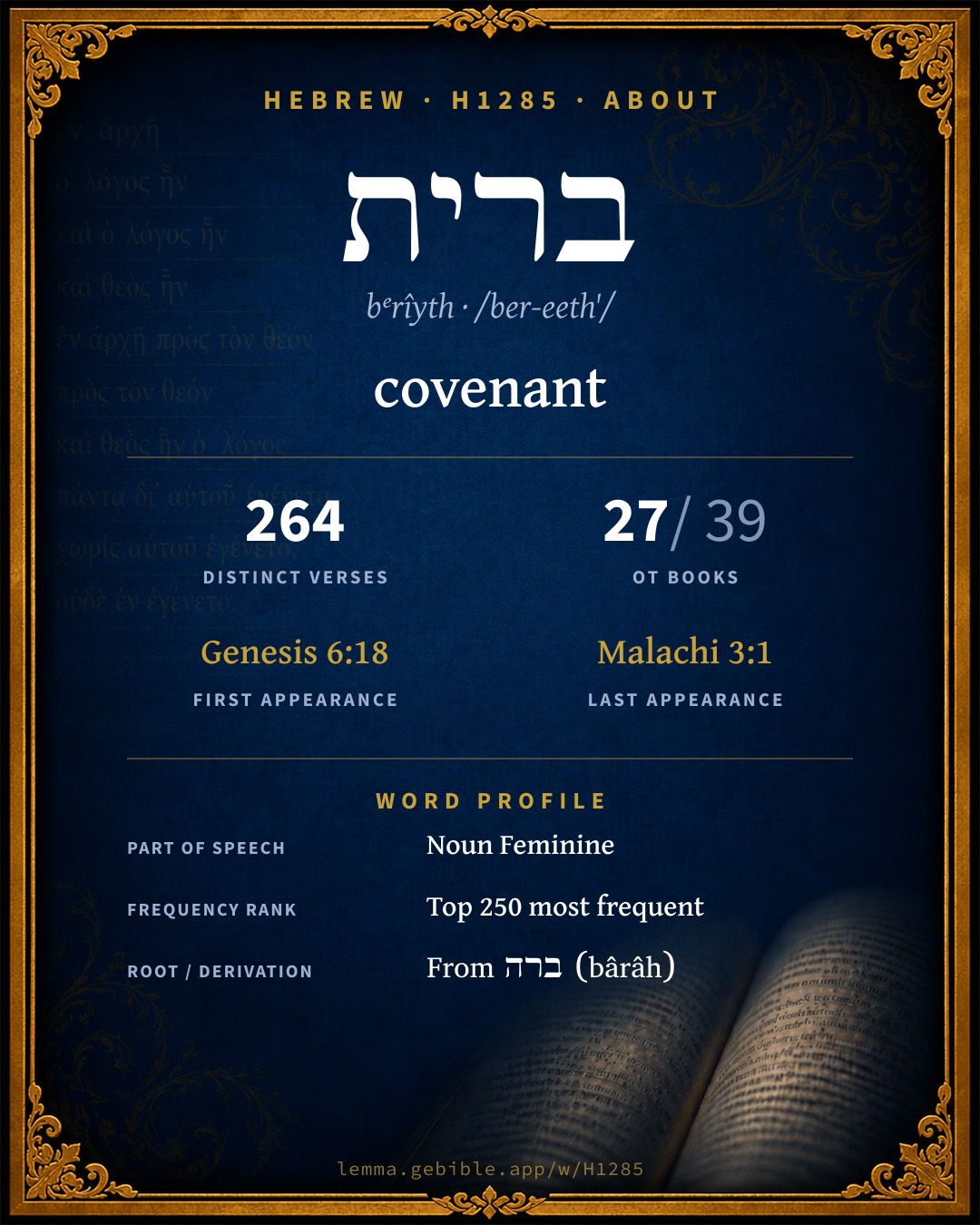
בְּרִית
covenant
also: alliance, pledge fuller range ↓
Full lexicon entry — Brown-Driver-Briggs (BDB)
From Brown-Driver-Briggs (BDB)
Where this word appears
See every Absolute-state word in the Hebrew Bible →
Grammar key — what these labels mean
Part of speech
- Noun
- A naming word — a person, place, thing, or idea.
Noun type
- Common
- A common noun — a general class of person, place, or thing (“king,” “city,” “water”), not a specific name.
State
- Construct
- A noun bound to a following noun in a possessive / “of” relationship (the construct chain).
- Absolute
- The independent form of a noun, not bound to a following word.
Gender
- Feminine
- Grammatically feminine.
Number
- Singular
- One.
Every verse where H1285 appears in the Book of 2 Chronicles — 15 distinct verses. Click any verse to open its interlinear word-by-word view. Verse text shown in the World English Bible for context — . Each verse’s Hebrew form is shown with its reference; the English is not keyword-highlighted, since the data carries no word-level English alignment. Use “Compare translations” on any verse to read it across multiple English versions. This concordance covers the Hebrew Bible; Septuagint (Greek Old Testament) occurrences are not indexed here.
2 Chronicles
- 2 Chronicles 5:2 בְּרִית n c fs cs Then Solomon assembled the elders of Israel, and all the heads of the tribes, the princes of the fathers' [houses] of the children of Israel, to Jerusalem, to bring up the ark of the covenant of Yahweh out of the city of David, which is Zion.
- 2 Chronicles 5:7 בְּרִית n c fs cs The priests brought in the ark of the covenant of Yahweh to its place, into the oracle of the house, to the most holy place, even under the wings of the cherubim.
- 2 Chronicles 6:11 בְּרִ֣ית n c fs cs There have I set the ark, in which is the covenant of Yahweh, which he made with the children of Israel.
- 2 Chronicles 6:14 הַ/בְּרִית֙ ptcl def.art + n c fs and he said, Yahweh, the God of Israel, there is no God like you, in heaven, or on earth; who keep covenant and loving kindness with your servants, who walk before you with all their heart;
- 2 Chronicles 13:5 בְּרִ֥ית n c fs cs Ought you not to know that Yahweh, the God of Israel, gave the kingdom over Israel to David forever, even to him and to his sons by a covenant of salt?
- 2 Chronicles 15:12 בַ/בְּרִ֔ית prep det + n c fs They entered into the covenant to seek Yahweh, the God of their fathers, with all their heart and with all their soul;
- 2 Chronicles 16:3 בְּרִית֙ בְּרִֽיתְ/ךָ֗ n c fs n c fs cs + sfx pers 2ms [There is] a league between me and you, as [there was] between my father and your father: behold, I have sent you silver and gold; go, break your league with Baasha king of Israel, that he may depart from me.
- 2 Chronicles 21:7 הַ/בְּרִ֔ית ptcl def.art + n c fs However Yahweh would not destroy the house of David, because of the covenant that he had made with David, and as he promised to give a lamp to him and to his children always.
- 2 Chronicles 23:1 בַ/בְּרִֽית prep det + n c fs In the seventh year Jehoiada strengthened himself, and took the captains of hundreds, Azariah the son of Jeroham, and Ishmael the son of Jehohanan, and Azariah the son of Obed, and Maaseiah the son of Adaiah, and Elishaphat the son of Zichri, into covenant with him.
- 2 Chronicles 23:3 בְּרִ֛ית n c fs All the assembly made a covenant with the king in the house of God. He said to them, Behold, the king's son shall reign, as Yahweh has spoken concerning the sons of David.
- 2 Chronicles 23:16 בְּרִ֔ית n c fs Jehoiada made a covenant between himself, and all the people, and the king, that they should be Yahweh's people.
- 2 Chronicles 29:10 בְּרִ֔ית n c fs Now it is in my heart to make a covenant with Yahweh, the God of Israel, that his fierce anger may turn away from us.
- 2 Chronicles 34:30 הַ/בְּרִ֔ית ptcl def.art + n c fs The king went up to the house of Yahweh, and all the men of Judah and the inhabitants of Jerusalem, and the priests, and the Levites, and all the people, both great and small: and he read in their ears all the words of the book of the covenant that was found in the house of Yahweh.
- 2 Chronicles 34:31 הַ/בְּרִית֮ הַ/בְּרִ֔ית ptcl def.art + n c fs ptcl def.art + n c fs The king stood in his place, and made a covenant before Yahweh, to walk after Yahweh, and to keep his commandments, and his testimonies, and his statutes, with all his heart, and with all his soul, to perform the words of the covenant that were written in this book.
- 2 Chronicles 34:32 כִּ/בְרִ֥ית prep + n c fs cs He caused all who were found in Jerusalem and Benjamin to stand [to it]. The inhabitants of Jerusalem did according to the covenant of God, the God of their fathers.
About this entry
At a glance — auto-summarized from this page’s data, not written by a person. Every figure links to its source below. This summary describes the numbers; it doesn’t interpret them.
ברית — transliterated bᵉrîyth — is a Hebrew noun carrying the sense “covenant.” Alongside “covenant” the lexicon also lists “alliance” and “pledge” — part of its full sense range. Spanning 264 verses in 27 books, it ranks among the common words of the Hebrew Bible. Its earliest occurrence is Genesis 6:18. Sharing its root, it stands alongside ברה, ברות and ברי. Each statement above links to its evidence; the full detail follows below.
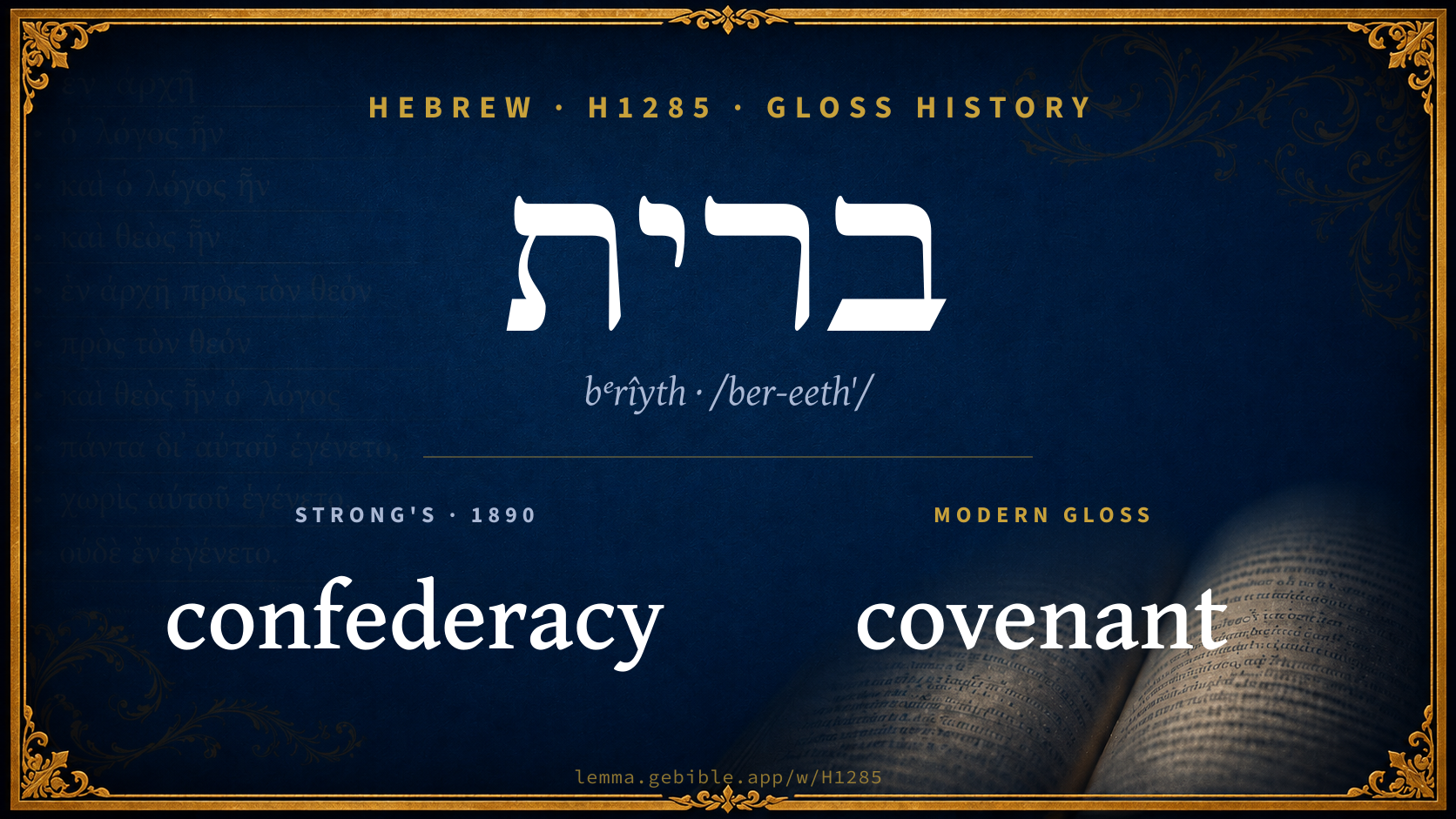
Gloss history
Strong's 1890 vs modern scholarship
About this word
Strong's H1285 catalogs a Hebrew word from the Hebrew Old Testament.
These counts are not copied from any lexicon or concordance. They are computed here, from the morphology-tagged Hebrew Old Testament. What Lemma adds →
- 264
- distinct verses
- The word appears in 264 distinct verses.
- 27 / 39
- OT books
- The word appears in 27 of 39 Old Testament books.
- #175
- by frequency
- Top 250 most frequent Hebrew words (rank 175 of 8,640 Hebrew words by occurrence).
View all 264 occurrences in the concordance →
Most concentrated in
- Deuteronomy 26 verses 10%
- Genesis 24 verses 9%
- Joshua 21 verses 8%
By section of the Old Testament
By traditional corpus
Conventional, traditional groupings — biblical authorship is debated, so this is a traditional corpus grouping, not an authorship claim. Each share is this word’s portion of its verses in that division of the Hebrew canon. Each figure is a share of the word’s 264 distinct verses.
- Prophets (Nevi'im) 124 verses · 47%
- Torah (Pentateuch) 76 verses · 29%
- Writings (Ketuvim) 64 verses · 24%
How translations render this word
Counts come from each version’s own published word-to-Strong’s tagging or interlinear alignment — an approximate guide to how each version renders this word, not a word-level alignment the data otherwise carries. Because each total is that version’s own tagged count, the per-version totals vary from one another and need not match the appearance or distinct-verse counts above. These counts may also differ from a printed concordance because Lemma counts each distinctly tagged rendering and does not collapse phrase taggings into a single head-word total. This is a fixed set of word-tagged versions (KJV, ASV, BSB, ULT) and does not change with the reading translation you choose elsewhere. Each version’s license is shown beside its name below (and on Sources).
BDB lists this Strong’s number as 2 distinct words (homographs). Each count above pools all of them and is not split by sense — see the Senses section below. A low-frequency rendering may belong to a different one of those words, not the primary meaning.
- King James Version†: Covenant 246×, League 11×, According to the covenant 2×
- American Standard Version†: Covenant 209×, League 4×, Ark of the covenant 3×
- Berean Standard Bible†: Covenant 254×, Treaty 16×, Be a covenant 2×
- unfoldingWord Literal Text†: Covenant 192×, Covenant of 65×, The 5×
King James Version Public Domain
Renders H1285 across 283† tagged occurrences — most commonly:
Plus 14 renderings that appear only once — usually multi-word phrases or single function words the recovered tagging swept in, not distinct renderings. Not rendered by a distinct English word in 1 further occurrence.
American Standard Version Public Domain
Renders H1285 across 283† tagged occurrences — most commonly:
Plus 55 renderings that appear only once — usually multi-word phrases or single function words the recovered tagging swept in, not distinct renderings.
Berean Standard Bible Public Domain
Renders H1285 across 283† tagged occurrences — most commonly:
Plus 9 renderings that appear only once — usually multi-word phrases or single function words the recovered tagging swept in, not distinct renderings. Not rendered by a distinct English word in 1 further occurrence.
unfoldingWord Literal Text CC BY-SA 4.0
Renders H1285 across 281† tagged occurrences — most commonly:
Plus 8 renderings that appear only once — usually multi-word phrases or single function words the recovered tagging swept in, not distinct renderings.
23 senses and sub-senses in the full BDB
What do BDB’s symbols mean?
BDB uses these scholarly abbreviations:
| Symbol | Meaning |
|---|---|
| 𝔊 | the Septuagint (the ancient Greek translation, LXX) |
| 𝔙 | the Vulgate (the Latin translation) |
| 𝔖 | the Syriac version (the Peshitta) |
| 𝔗 | the Targum (the Aramaic translation) |
| ψ | the Psalms |
| √ | root (the underlying root or stem) |
| ‖ | parallel passage (a synonymous or contrasted parallel) |
| † | the dagger: every passage where the word occurs is cited |
The 23 senses and sub-senses the full Brown-Driver-Briggs lexicon distinguishes for this word, in lexicon order (not ranked by frequency), with BDB’s own verbatim wording and sub-sense lettering. Shown in Hebrew script with BDB’s own scholarly abbreviations. The condensed entry is in the Lexicon Entry tab. See also the Forms in the corpus table below.
- I. between men.
- 1. treaty, alliance, league: Abraham and Amorites Gn 14:13; Edom and its allies Ob 7; with Philistines Gn 21:27, 32 (E) 26:28 (J); Jacob and Laban Gn 31:44 (J); Joshua and Gibeonites Jos 9:6, 7, 11, 15, 16 (J); Israel and Canaanites Ex 23:32; 34:12, 15 (JE) Dt 7:2 Ju 2:2; Ammonites and Jabesh 1 S 11:1; Solomon and Hiram 1 K 5:26; Ahab and Benhadad 1 K 20:34; Syria and Israel 1 K 15:19 = 2 Ch 16:3; Nebuchadnezzar and Zedekiah Ez 17:13–19; nations against Israel ψ 83:6; nations with Egypt Ez 30:5; Ephraim and Assyria Ho 12:2; Judah and Israel Ez 16:61; Judah and Tyre Am 1:9; Assyria and Judah Is 33:8; נגיד ברית a prince in league (with him) Dn 11:22 (so He Ew; Hi Meinh Bev ref. to h. p. Onias III & translate prince of cov’t, cf. AV RV); fig., with death Is 28:15, 18; with stones of the field Jb 5:23. e.g. Genesis 14:13
- 2. constitution, ordinance, between monarch and subjects: David and Abner 2 S 3:12, 13, 21; David and the elders of Israel 2 S 5:3 = 1 Ch 11:3; Zedekiah and his people Je 34:8–18; hostile prince and Israelites Dn 9:27. e.g. 2 Samuel 3:12
- 3. agreement, pledge: Jehoiada and captains 2 K 11:4 = 2 Ch 23:1; with oneself Jb 31:1; with Leviathan to be a servant Jb 40:28; between man and man Ho 10:4 cf. בעל ברית Ju 8:33; 9:4 = אל ברית Ju 9:46. e.g. 2 Kings 11:4
- 4. alliance of friendship between David and Jonathan 1 S 18:3; 20:8; 23:18 cf. ψ 55:21. e.g. 1 Samuel 18:3
- 5. alliance of marriage Pr 2:17 Mal 2:14.—In all cases כרת ברית is the technical phrase for making covenant except Je 34:10 באו בברית; Dn 9:27 הגביר ברית לְ. Various preps. are used, most often לְ Ex 23:32 +, but also עִם Gn 26:28 +, אֵת 2 S 3:12 +, בֵּין 2 Ch 16:3. e.g. Proverbs 2:17
- II. between God and man.
- 1. alliance of friendship (‖ סוֹד) ψ 25:14. e.g. Psalms 25:14
- 2. covenant, as a divine constitution or ordinance with signs or pledges (vid. אוֹת).
- a. with Noah Gn 9:9–17 (P) Is 54:10 Je 33:20, 25; a divine promise that there would be no other deluge. e.g. Genesis 9:9
- b. with Abraham, Isaac and Jacob Gn 15:18 (J) 17:2–21 Ex 2:24; 6:4, 5; Lv 26:42 (P) 2 K 13:23; 1 Ch 16:15 = ψ 105:8, 10, Ne 9:8 Je 34:18; a promise to multiply their seed, give them the land of Canaan, and make them a blessing to the nations. e.g. Genesis 15:18
- c. with Israel at Sinai = Horeb, with a covenant sacrifice Ex 19:5; 24:7, 8 (E) 34:10, 27, 28 (J) 31:16; Lv 2:13 (P) 24:8; 26:9, 15, 25, 44, 45 (H) Dt 4:13; renewed in plains of Moab Dt 28:69; with blessings and curses Dt 29:20; frequently referred to in other books 2 Ch 34:32 ψ 25:10; 44:18; 50:5, 16; 74:20; 78:10, 37; 103:18; 106:45; 111:5, 9 Is 56:4, 6; Je 1:2, 3, 6, 8, 10; 14:21; 22:9; 31:32; Ez 16:8, 59, 60; 44:7; Dn 9:4; 11:28, 30, 32; Ho 6:7; 8:1 Zc 9:11; 11:10; a divine constitution given to Israel with promises on condition of obedience and penalties for disobedience, in the form of tables of the covenant Dt 9:9, 11, 15, inscribed with the ten words, placed in (י׳) ארון ברית the ark of the covenant Nu 10:33 + 40 times (vid. ארון; in 1 S 4:3, 4(×2), 5 om. ברית after ארון 𝔊 We Dr); set forth in דברי הברית words of the covenant Ex 34:28 (J) Dt 28:69; 29:8; 2 K 23:3 (= 2 Ch 34:31) Je 11:2–8, written in ספר הברית the book of the covenant Ex 24:7 (E, cf. 34:27 J) 2 K 23:2, 21 (cf. 2 Ch 34:30). e.g. Exodus 19:5
- d. with Phinehas Nu 25:12, 13 (P), a constitution, establishing an everlasting priesthood in his line; cf. ברית הכהנים Ne 13:29 & ברית הלוי Mal 2:4, 8. e.g. Numbers 25:12
- e. with Joshua and Israel Jos 24:25 (E), an ordinance or constitutional agreement to serve Yahweh only. e.g. Joshua 24:25
- f. with David ψ 89:4, 29, 34, 39; 132:12; Je 33:21 (cf. 2 S 7 = 1 Ch 17); a divine promise to the seed of David of an everlasting kingdom, the relation of sonship, and the superintendence of the temple (cf. ψ 2). e.g. Psalms 89:4
- g. Jehoiada and the people 2 K 11:17 = 2 Ch 23:3, a constitutional agreement to be the people of Yahweh. e.g. 2 Kings 11:17
- h. Hezekiah and the people 2 Ch 29:10, a constitutional agreement to reform the worship. e.g. 2 Chronicles 29:10
- i. Josiah and the people 2 K 23:3, a constitutional agreement to obey the book of the covenant. e.g. 2 Kings 23:3
- j. Ezra and the people Ezr 10:3, a constitutional agreement to put away foreign wives and observe the Law. k. the prophetic covenant, a divine promise through a series of prophets to establish a new constitution ברית חדשׁה Je 31:31, with new institutions and precepts Is 42:6, 49:8; 55:3; 59:21; 61:8 Je 31:31, 33; 32:40; 50:5; Ez 16:60, 62; 20:37; 34:25; 37:26; Ho 2:20. In Is 2 the Messianic servant is ברית עם Is 42:6; 49:8, cf. מלאך הברית Mal 3:1. e.g. Ezra 10:3
- III. Phrases.
- 1. covenant making: כרת ברית Gn 15:18; Ex 34:10, 27 (J) Jos 24:25 (E) Dt 5:2, 3; 28:69; 29:13, 24; 1 K 5:26; 2 K 11:17; 17:35, 38; 23:3 2 Ch 21:7; 23:3, 16; 29:10; 34:30 Ezr 10:3; Ne 9:8; ψ 50:5; 89:4; Is 55:3; 61:8; Je 11:10; 31:31, 32, 33; 32:40; 34:13 Ez 34:25; 37:26; Hos 2:20; הקים ברית establish a covenant Gn 6:18; 9:9, 11, 17; 17:7, 19, 21; Ex 6:4 (P) Ez 16:60, 62, confirm covenant Lv 26:9 (?; H) Dt 8:18; נתן ברית Gn 17:2 (cf. 9:12) Nu 25:12 (P); שׂם ברית 2 S 23:5; עבר בברית Dt 29:11; בא בברית 2 Ch 15:12; Ez 16:8; צוה ברית ψ 111:9; נשׂא ברית על פי ψ 50:16. (Cf. further on these DrJ Ph. xi. 1882, 210 ff.) e.g. Genesis 15:18
- 2. covenant keeping: on the part of man שׁמר ברית 1 K 11:11 Ne 1:5; 9:32 ψ 78:10; 103:18; 132:12 Dn 9:4, נצר ברית Dt 33:9 ψ 25:10, מחזיקים בברית Is 56:4, 6; on the part of God זכר ברית Gn 9:15, 16 Ex 2:24; 6:5 (all P), Lv 26:42(×3) (H; on sf. cf. Di Ges§ 128, 1 R b) v 45 (H) ψ 105:8; 106:45; 111:5 1 Ch 16:15 Ez 16:60. Thus we have נאמנת ψ 89:29; ברית עולם Gn 9:16; 17:7, 13, 18, 19 Ex 31:16 Lv 24:8 Nu 18:19; 25:13 (P) 2 S 23:5 (poet.) 1 Ch 16:17 (= ψ 105:10) Is 24:5; 55:3; 61:8 Je 32:40; 50:5 Ez 16:60; 37:26; ברית מלח Lv 2:13 2 Ch 13:5; 21:7 (a cov’t. with sacrificial meal and salt; on cov’t. with salt in Arabia cf. WeSkizzen iii. 124); ברית שׁלום Nu 25:12 (P) Is 54:10 Ez 34:25; 37:26; הברית והחסד Dt 7:9, 12 1 K 8:23 (= 2 Ch 6:14) Ne 1:5; 9:32; Dn 9:4; ברית קדשׁ Dn 11:28, 30; מסרת הברית Ez 20:27. e.g. 1 Kings 11:11
- 3. covenant violation: עבר ברית Dt 17:2; Jos 7:11, 15; 23:16 (D) Ju 2:20; 2 K 18:12; Ho 6:7; 8:1; הפר ברית Gn 17:14; Lv 26:15, 44 (H) Dt 31:16, 20 (J) Ju 2:1; Is 24:5(×2) Je 11:10; 14:21; 31:32; 33:20, 21; Ez 16:59; 17:18, 19; 44:7; Zc 11:10; עזב ב׳ Dt 29:24 1 K 19:10, 14; Je 22:9 Dn 11:30; מאס ברית 2 K 17:15; נאר ברית ψ 89:39; חלל ברית ψ 89:34 Mal 2:10 (cf. v 4); שׁקר בב׳ ψ 44:18; שׁכח ברית Dt 4:23, 21; Je 50:5. e.g. Deuteronomy 17:2
Senses from the full Brown-Driver-Briggs lexicon (Brown, Driver, Briggs; Oxford 1906 — public domain), digitized via Sefaria, supplemented by the OpenScriptures HebrewLexicon (CC BY 4.0). Full attribution on Sources.
Word origin
I. n.f. covenant (‖ Aramaic קְיָם, διαθήκη; constitutio)—ב׳ Gn 9:13 + 199 times; sf. בְּרִיתִי Gn 6:18 + 50 times; בְּרִיתְךָ Dt 33:9; בְּרִיתֶ֑ךָ ψ 44:18 + 11 times; בְּרִיתְכֶם Is 28:18; בְּרִיתֵךְ Ez 16:61; בְּרִיתוֹ Ex 2:24 + 18 times;—pact, compact, covenant.
II. v. sub ii. ברה; also ii. אֵל 3, בַּעַל 4.
— Brown-Driver-Briggs (Oxford 1906, public domain), digitized via Sefaria, supplemented by the OpenScriptures HebrewLexicon (CC BY 4.0). See Sources.
Derived from ברה (bârâh) (H1262) — to eat.
Jastrow Dictionary
A second Hebrew/Aramaic lexicon for comparison, covering Aramaic and post-biblical (Talmudic, Targumic, Midrashic) usage that the biblical-Hebrew BDB does not. Matched by lemma rather than by Strong’s number, so a lemma may carry more than one Jastrow headword (shown separately below), and the entries cover usage well beyond the Bible.
בְּרִית
- prop. circle, ring, chain, hence oath (of fidelity), solemn injunction; covenant treatise. [כרת ב׳ to cut a ring out; to make a covenant; בא בב׳ to enter into the ring, to promise fidelity; הפר ב׳ to break the ring, to break one’s oath &c.] Sabb. 137ᵇ; בריתו של אברהם אבינו (sign of) the covenant of Abraham, circumcision. Ab. III, 11; a. fr. Y. Peah VIII, 21ᵃ מפני ב׳ של א"א on account of the covenant of Abraham (for the sake of human dignity). Num. R. s. 18, a. fr. ב׳ כרותה לשפתים a law is made for the lips, i.e. words are ominous (ref. to לא נעלה, Num. XVI, 12). Gen. R. s. 34, v. אָוִיר; a. fr.—הַבְּ׳ וכ׳ by the covenant (an oath), indeed. Tosef. Ḥall. I, 6 ב׳ וכ׳ (Var. הב׳); Pes. 38ᵇ indeed, those are the very words &c.; (some explain) indeed?, are those the very &c. (is it a tradition for which no reason needs to be given)?; Y. Peah V, 19ᵇ bot. הב׳.—Pl. בְּרִיתוֹת. Ber. 48ᵇ sq. שלש ב׳ three covenants (three times the word b’rith, Deut. XXVIII, 69; XXIX, 8). Tosef. Sot. VIII, 10; 11 ב׳ Var. (ed. Zuck. כְּרִיתוֹת); Sot. 37ᵇ; a. fr. e.g. Numbers 16:12
בֵּרִית
- a ring, band, v. בֵּירִית. [Y. M. Kat. I, 80ᵇ top, v. כְּרִית.]
A Dictionary of the Targumim, the Talmud Babli and Yerushalmi, and the Midrashic Literature (Marcus Jastrow; London, Luzac, 1903) — Public Domain. Digitized via Sefaria. Digitized via Sefaria. Full attribution on Sources.
Forms in the corpus
The 100 distinct written forms H1285 takes in the Hebrew Bible, most frequent first — each parse links to that state’s occurrences in the concordance. Hebrew forms include their vowel points and cantillation, so a single lemma takes many written forms.
The 60 most common forms are shown; 40 rarer forms follow in the full concordance.
Same root — word family
Other BDB entries built from the same root as H1285, grouped by Strong’s listed origin. These share a root / origin per the lexicon — not necessarily a shared meaning. Each links to that word’s own entry.
Derives from
Shares the same root
Proper names from this root
People and places named from this root — a name, not an additional meaning of the word.
Compare all same-root words → Showing 4 of 6 — not the complete family. 1 of the same-root words is a proper name (a person or place). They share a root, not necessarily a meaning.
Septuagint verse parallels
This word appears in 246 verses that also exist in the Greek Old Testament (Septuagint), out of the 264 Hebrew verses it occurs in. You can read those verses in Greek by switching the Old Testament edition to the Septuagint.
Read these verses in the Septuagint
- Genesis 6:18
- Exodus 2:24
- Leviticus 2:13
- Numbers 10:33
- Deuteronomy 4:13
- Joshua 3:3
- Judges 2:1
- 1 Samuel 4:3
- 2 Samuel 3:12
- 1 Kings 3:15
- 2 Kings 11:4
- 1 Chronicles 11:3
This is a verse-level parallel only — the same verses exist in both the Hebrew and Greek Old Testaments. No word-level Hebrew↔Greek correspondence is claimed: the data carries no such alignment, so no Greek word is shown as this Hebrew word’s translation. Coverage is not total — the Septuagint omits the deuterocanon and renumbers the Psalms, so some Hebrew verses have no direct Greek parallel.