
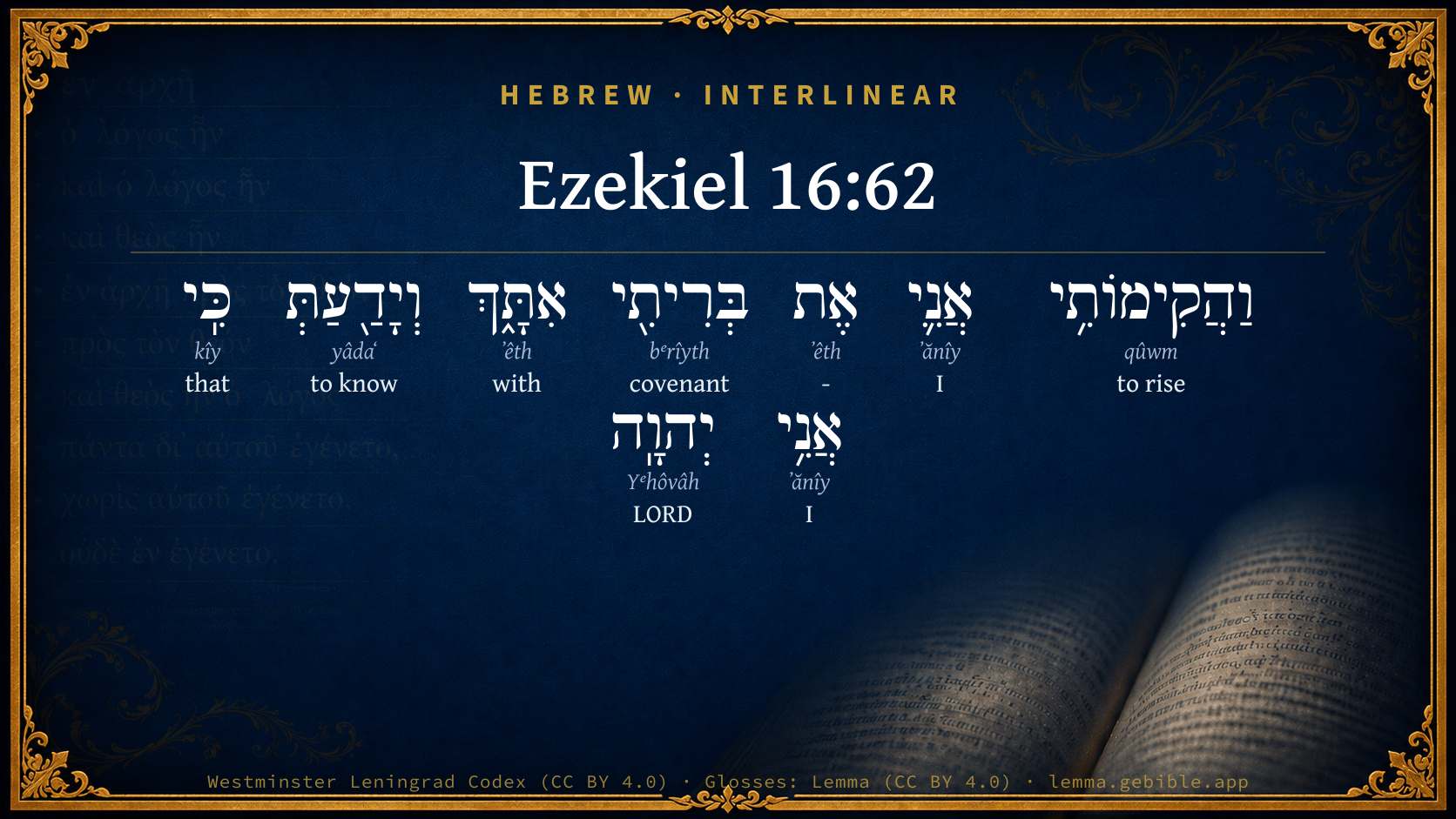
Ezekiel 16:62

Hebrew (Westminster Leningrad Codex) Ezekiel 16:62 appears in the Hebrew Old Testament. The text above is from the Westminster Leningrad Codex. Each word links to its Strong’s number, a concise gloss, and parsing drawn from the Open Scriptures Hebrew Bible morphology. Click any word for its full Brown-Driver-Briggs (BDB) entry.
Download image
Cite this verse

Ezekiel 16:62 (World English Bible). Public Domain. Lemma interlinear Bible study tool, https://lemma.gebible.app/v/ezekiel/16/62.

Show BibTeX & RIS
BibTeX
RIS
English Translation
I will establish my covenant with you; and you shall know that I am Yahweh;
World English Bible · Public Domain
Download a study sheet

One document with this verse’s original text, its word-by-word gloss line, the meaning frame, cross-references with their text, attributed commentary, and full source and license credits — printable, and it pastes into notes with its structure intact.

This verse Autodidact and up

Study sheet (.html) Plain text (.txt)

A passage Seminary Student

Up to 50 verses in one chapter. A passage sheet keeps up to 6 commentary sources and 12 cross-references per verse, in the order this page ranks them, and says so on the sheet whenever that leaves anything out. Ask for a single verse and you get the Autodidact verse sheet above.

Everything on this page stays free to read, with no account — the sheet is a download of what is already on screen, not access to it.

Want to remove ads? Support Godless Engineer
Compare translations 3

The same verse in 3 English versions, stacked beneath the original-language interlinear above. Click any original word for its lexicon entry.

Each is an independent rendering of the whole verse — the interlinear is not word-aligned to these translations.

Highlighted words mark where these versions differ — a whole-verse word diff, not a word-by-word alignment.

  • World English Bible Public Domain
    I will establish my covenant with you; and you shall know that I am Yahweh;
  • King James Version Public Domain
    And I will establish my covenant with thee; and thou shalt know that I am the LORD:
  • unfoldingWord Literal Text CC BY-SA 4.0
    I myself will establish my covenant with you, and you will know that I am Yahweh.

unfoldingWord Literal Text — © unfoldingWord, licensed CC BY-SA 4.0. Word-aligned USFM3 via Door43 (git.door43.org/unfoldingWord/en_ult).

Versions to compare (up to 4)

3 of 4 selected

Show all 18 translations

Every available English version of this verse, each an independent rendering of the whole verse.

  • World English Bible Public Domain
    I will establish my covenant with you; and you shall know that I am Yahweh;
  • Berean Standard Bible Public Domain
    So I will establish My covenant with you, and you will know that I am the LORD,
  • Majority Standard Bible Public Domain
    So I will establish My covenant with you, and you will know that I am the LORD,
  • King James Version Public Domain
    And I will establish my covenant with thee; and thou shalt know that I am the LORD:
  • American Standard Version (1901) Public Domain
    And I will establish my covenant with thee; and thou shalt know that I am Jehovah;
  • Revised Version (1885) Public Domain
    And I will establish my covenant with thee; and thou shalt know that I am the LORD:
  • Geneva Bible (1599) Public Domain
    And I wil establish my couenant with thee, and thou shalt knowe that I am the Lord,
  • Douay-Rheims (1899) Public Domain
    And I will establish my covenant with thee: and thou shalt know that I am the Lord,
  • Young's Literal Translation Public Domain
    And I -- I have established My covenant with thee, And thou hast known that I `am' Jehovah.
  • Literal Standard Version CC BY-SA 4.0
    And I have established My covenant with you, || And you have known that I [am] YHWH.
  • Unlocked Literal Bible CC BY-SA 4.0
    I myself will establish my covenant with you, and you will know that I am Yahweh.
  • unfoldingWord Literal Text CC BY-SA 4.0
    I myself will establish my covenant with you, and you will know that I am Yahweh.
  • Darby Bible Public Domain
    And I will establish my covenant with thee, and thou shalt know that I [am] Jehovah;
  • World Messianic Bible Public Domain
    I will establish my covenant with you. Then you will know that I am the LORD;
  • Webster's Bible Public Domain
    And I will establish my covenant with thee; and thou shalt know that I am the LORD:
  • Free Bible Version CC BY-SA 4.0
    This is how I will endorse my agreement with you, and you will know that I am the Lord,
  • Bible in Basic English Public Domain
    And I will make my agreement with you; and you will be certain that I am the Lord:
  • JPS Tanakh (1917) Public Domain
    And I will establish My covenant with thee, and thou shalt know that I am the LORD;

Literal Standard Version (2020), Covenant Press — licensed CC BY-SA 4.0. Text via the HelloAO Bible API (eBible.org). Unlocked Literal Bible (unfoldingWord) — licensed CC BY-SA 4.0. Text via the HelloAO Bible API (eBible.org). unfoldingWord Literal Text — © unfoldingWord, licensed CC BY-SA 4.0. Word-aligned USFM3 via Door43 (git.door43.org/unfoldingWord/en_ult). Free Bible Version, Dr. Jonathan Gallagher — licensed CC BY-SA 4.0. Text via the HelloAO Bible API (eBible.org).

Word by word

More ways to search: Search by grammar → Find every occurrence → Compare this word →

Practice this passage: Drill this verse → Learn its vocabulary →

בְּרִיתִ֖י
bᵉrîyth
H1285
“covenant · my”
Noun, Common, Feminine, Singular, Construct + Suffix, Personal, 1st Person, Common, Singular
Part of Speech
Noun
Type
Common
Gender
Feminine
Number
Singular
State
Construct
Full BDB Definition

Origin: from H1262 (in the sense of cutting [like H1254 ])

TWOT: 282a

covenant, alliance, pledge - between men - treaty, alliance, league (man to man) - constitution, ordinance (monarch to subjects) - agreement, pledge (man to man) - alliance (of friendship) - alliance (of marriage) - between God and man - alliance (of friendship) - covenant (divine ordinance with signs or pledges) - (phrases) - covenant making - covenant keeping - covenant violation
  1. וַהֲקִימוֹתִ֥י qûwm H6965 “and · to rise” Conjunction + Verb, Hiphil, Sequential Perfect, 1st Person, Common, Singular
  2. אֲנִ֛י ʼănîy H589 “I” Pronoun, Personal, 1st Person, Common, Singular
  3. אֶת ʼêth H853 “-” Particle, Direct Object
  4. אִתָּ֑ךְ ʼêth H854 “with · you” Preposition + Suffix, Personal, 2nd Person, Feminine, Singular
  5. וְיָדַ֖עַתְּ yâdaʻ H3045 “and · to know” Conjunction + Verb, Qal, Sequential Perfect, 2nd Person, Feminine, Singular
  6. כִּֽי kîy H3588 “that” Conjunction
  7. אֲנִ֥י ʼănîy H589 “I” Pronoun, Personal, 1st Person, Common, Singular
  8. יְהוָֽה Yᵉhôvâh H3068 “LORD” Noun, Proper

About this verse

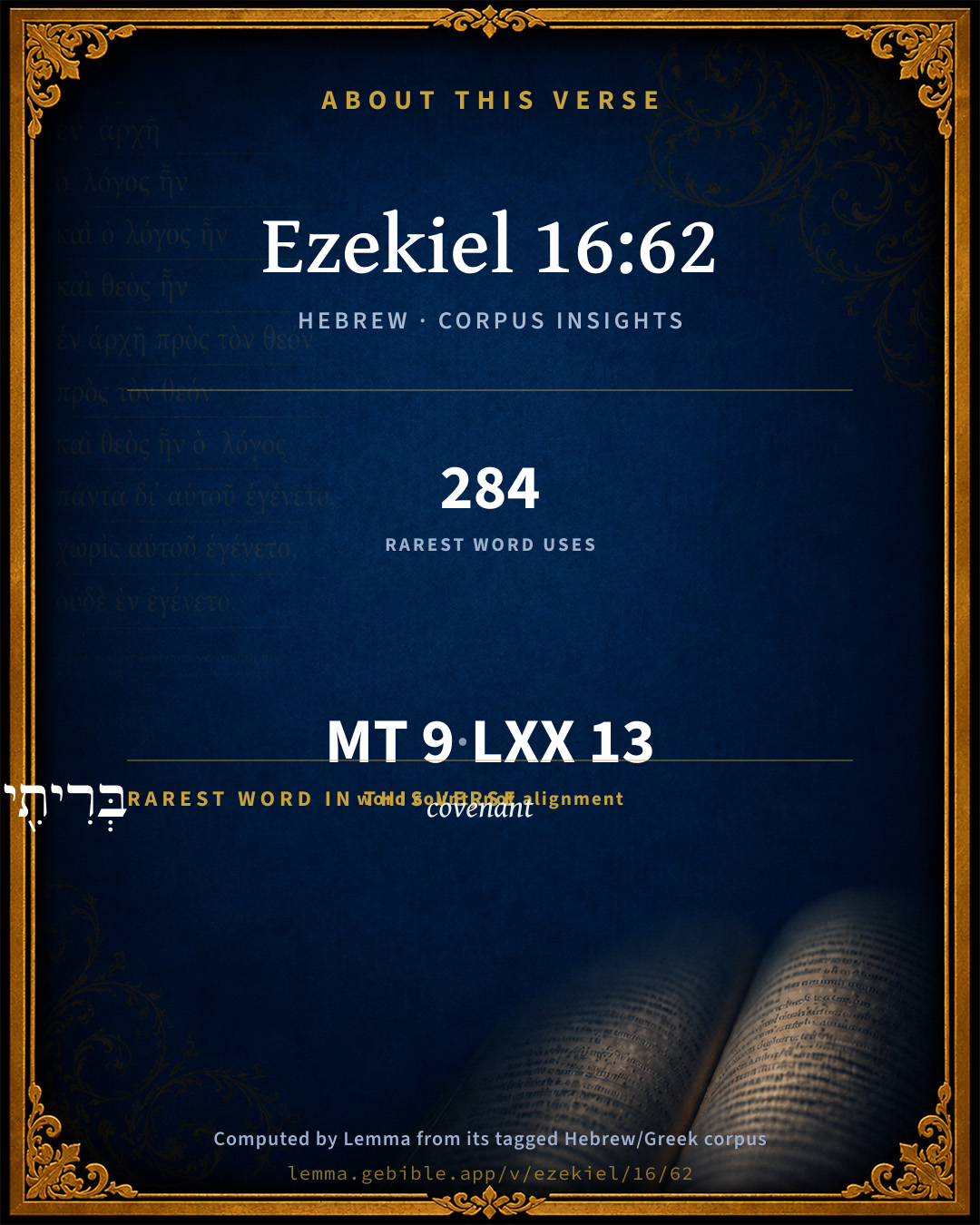
These counts appear in no published source. They are computed here, from the morphology-tagged text and Lemma’s own curated glosses. What Lemma adds →

9
words
8
distinct lemmas
Prophets
section

Grammatical profile

  • 2 verbs
  • 2 nouns
  • 2 pronouns
  • 1 preposition
  • 1 conjunction
  • 1 particle

Verb forms

  • וַהֲקִימוֹתִ֥י Hiphil · Sequential Perfect
  • וְיָדַ֖עַתְּ Qal · Sequential Perfect

Repetition

A word recurs within this verse — often emphatic in Hebrew:

  • אֲנִ֛י I H589 ×2

Hebrew & Septuagint length

In English translation the verse runs 15 words from the Hebrew and 17 from the Septuagint (LXX English) — closely comparable.

A rough comparison of the two English renderings, which tokenize alike — not a word-level alignment.

Word counts can differ between the Hebrew and the Greek without any difference in meaning — e.g. the Hebrew direct-object marker אֵת has no separate Greek word, and Greek often adds the article ὁ.

In the original languages it is 9 Hebrew tokens and 13 Greek tokens — but the two are counted differently (Hebrew bundles its prefixes and suffixes into one token; the Greek is in lemma form), so that isn’t a like-for-like length.

Cross-references

9

Topical passages linked to Ezekiel 16:62 in the Treasury of Scripture Knowledge — connected by theme and wording, ordered by reader-vote popularity; previews shown in the World English Bible.

  • Jeremiah 24:7 I will give them a heart to know me, that I am Yahweh: and they shall be my people, and I will be their God; for they shall return to me with their whole heart.
  • Ezekiel 6:7 The slain shall fall in the midst of you, and you shall know that I am Yahweh.
  • Ezekiel 16:60 Nevertheless I will remember my covenant with you in the days of your youth, and I will establish to you an everlasting covenant.
  • Ezekiel 20:37 I will cause you to pass under the rod, and I will bring you into the bond of the covenant;
  • Ezekiel 20:43–44 There shall you remember your ways, and all your doings, in which you have polluted yourselves; and you shall loathe yourselves in your own sight for all your evils that you have committed.
  • Ezekiel 39:22 So the house of Israel shall know that I am Yahweh their God, from that day and forward.
  • Hosea 2:18–23 In that day I will make a covenant for them with the animals of the field, And with the birds of the sky, And with the creeping things of the ground. I will break the bow, the sword, and the battle out of the land, And will make them lie down safely.
  • Joel 3:17 "So you will know that I am Yahweh, your God, Dwelling in Zion, my holy mountain. Then Jerusalem will be holy, And no strangers will pass through her any more.
  • Daniel 9:27 He shall make a firm covenant with many for one week: and in the midst of the week he shall cause the sacrifice and the offering to cease; and on the wing of abominations [shall come] one who makes desolate; and even to the full end, and that determined, shall [wrath] be poured out on the desolate.

Cross-references courtesy of OpenBible.info (CC BY 4.0).

Hebrew and Greek witnesses Masoretic Hebrew ↔ Greek Septuagint

The same verse in the two great witnesses to the Old Testament, shown verse-for-verse.

These are two independent witnesses, not word-aligned to each other, and the Septuagint is shown in lemma (dictionary) form.

Hebrew Ezekiel 16:62 Masoretic · Westminster Leningrad Codex

וַהֲקִימוֹתִ֥י אֲנִ֛י אֶת בְּרִיתִ֖י אִתָּ֑ךְ וְיָדַ֖עַתְּ כִּֽי אֲנִ֥י יְהוָֽה

I will establish my covenant with you; and you shall know that I am Yahweh;

World English Bible · Public Domain

Greek LXX Ezekiel 16:62 Septuagint · lemma form

καί ἀναἵστημι ἐγώ ὁ διαθήκη ἐγώ μετά σύ καί ἐπιγιγνώσκω ὅτι ἐγώ κύριος

And I will establish my covenant with you; and you shall know that I am the Lord:

LXX2012 (modern English Septuagint) · Public Domain

Hebrew: Westminster Leningrad Codex (CC BY 4.0). Greek: Septuagint (public domain); English from LXX2012 (modern English Septuagint) (Public Domain). How the Septuagint differs from the Hebrew →

Targum (Aramaic paraphrase)

1

The Targum is the ancient Jewish Aramaic paraphrase of the Hebrew Scriptures — an interpretive translation, not the Hebrew text itself. Onkelos (literal) and Pseudo-Jonathan (expansive) render the Torah, and Jonathan the Prophets. Coverage is partial: where no permissively-licensed English translation exists for a verse, only the Aramaic is shown. This is verse-level text, not a word-by-word alignment to the Hebrew.

  1. Targum Jonathan Prophets (Joshua–Malachi)
    וַאֲקֵים אֲנָא יַת קְיָמִי עִמָךְ וְתִידְעוּן אֲרֵי אֲנָא יְיָ:

    Look - this was the debt of Sodom your sister: pride, plenty of bread, and ease and tranquility were hers and her villages, yet the hand of the poor and hungry she did not strengthen.

    Targum Jonathan — Aramaic: “Mikraot Gedolot” (public domain). English: “Sefaria Community Translation” (CC0 1.0 (public-domain dedication)); “London "Chaldee Paraphrase," 1871” (public domain). Text via Sefaria.

Commentary

Notes on Ezekiel 16:62 from classic Christian and Jewish commentators (each source and its license shown beneath its notes). The classic Christian expositions comment on the surrounding passage and are grouped to its opening verse, so a note may address several verses; the Jewish commentaries on the Tanakh (Rashi and others) are per-verse, so they appear only where the commentator wrote on this verse.

Lemma curates 59 commentaries, every one of them public domain or Creative Commons licensed, each selected and text-cleaned for this edition rather than reprinted as found. About our sources →

Trapp's Complete Commentary

John Trapp

Eze 16:62 And I will establish my covenant with thee; and thou shalt know that I [am] the LORD:

Ver. 62. And I will establish my covenant.] My new spiritual and eternal covenant, grounded upon the Messias, and made with the whole Israel according to faith. {Jer 31:31-34 2Co 3:3 Heb 8:8}

John Trapp, A Commentary or Exposition upon All the Books of the Old and New Testament (1647–1656) — public domain. Text from a community e-Sword module.

The Biblical Illustrator

Joseph S. Exell

Eze_16:62-63

I will establish My covenant with thee.

Gods pardoning mercy

I. The way in which God reveals His pardoning mercy. I will establish My covenant with thee. The covenant of grace is the grand repository of the redemption of man. It comprehends all the items, all the particulars of Christ Jesus our Lord, in His person, His name, and all the characters and offices He has fulfilled in the work of mans redemption--which holds up all the effects of that work, all the fruits of that love, all the blessings of that redemption, and withal tracing it in all its refined ramifications to the covenant of grace.

II. The character in which He thus reveals it. Thou shalt know that I am the Lord. Thus to know the Lord is to know Him as a covenant God--to know Him as a God in Jesus Christ. God out of Christ is a consuming fire--I dare not approach Him but in Christ. I find Him to be a God of sympathy and compassion, because I find God in my nature is the very High Priest who intercedeth for sinners. God in my nature can be touched with the feeling of my infirmities, and knows how to sympathise with me. It is in this character as God in Christ that He reveals the blessings of His salvation.

III. The effect that is produced on the heart by this pardoning mercy. That thou mayest remember, and be confounded, etc. If there is not a more pure or a more exalted motive to obedience than the love of God, there is not a more powerful motive to walking in the ways of God, than the assurance of His pardoning love and mercy. How quickly does it excite the attention of a poor trembling sinner to hear the sound of mercy, when he knows that that sound comes from God who can pardon! (J. Holloway.)

The lasting covenant

I. What this covenant is, as revealed to a people among the Jews in the youthful period of that nation. Now, then, nevertheless, notwithstanding all this heathenism, I will remember My covenant with thee in the days of thy youth. The covenant was made with a people among the Jews in the youthful time of that nation. First, in the 3rd verse of the 12th of Genesis, the Lord said to Abraham--and that was the infancy, the commencement of the nation,--In thee shall all families of the earth be blessed; which is afterwards explained to mean that in Jesus Christ shall all families of the earth be blessed. That is Gods covenant. Now, just look at the suitability of this. It is in Christ Jesus. What is it that we need? Why, the very first thing that every man needs is a Saviour. We are by sin lost. And so, in the very first chapter of Matthew, Thou shalt call His name Jesus, for He shall save His people from their sins. Here, then, this covenant is nothing else but a positive engagement on the Lords part to bring about eternal salvation. He has done that. And how suited this is! suited not only in itself, but in its manner--that whosoever shall call upon the name of the Lord shall be saved; that is, brought to see what Jesus Christ is as the Mediator of this covenant. Let your confidence be in His person, in His righteousness, in His atonement, and in the promises that are by Him; and if you can do nothing else but go on from time to time with Lord, save me; Lord, have mercy upon me; Lord, look upon me; Lord, teach me; Lord, direct me;--if you have these desires, together with an acquaintance with the Lord Jesus Christ, in whom the blessings are, then thou wilt not be lost, for whosoever shall call upon the name of the Lord shall be saved.

II. How this covenant is an everlasting covenant. The covenant the Lord made with the Jews, that He was to be their God, and that they were to have the land of Canaan, and the great advantages of national distinction, as described in the Word of God--Leviticus, Deuteronomy, and many other places--they were to continue to enjoy all these on the ground of their conformity to that covenant; they were to continue in the purity of it. But instead of this they forsook Gods covenant, threw down His altars, the altar of sacrifice and the altar of incense; and the next thing, of course, was to slay those prophets and ministers that preached even this national covenant. There was no righteousness belonging to that temporal covenant that was eternal, and that could therefore perpetuate the covenant. There was no sacrifice in that covenant that could take away sin, and that could consequently perpetuate that covenant. If the people apostatised, or gave way, then everything was gone. But here the Lord says, I will establish unto thee an everlasting covenant. Here is a testamentary will wherein God has willed everything by Christ Jesus. Now, Jesus Christ has brought in everlasting righteousness, for His righteousness is everlasting, and this perpetuates the covenant. This covenant and the promises cannot fail while Christs righteousness remains what it is; and as His atonement is perfect, and He has perfected forever all them that are sanctified, here it is the covenant is perpetuated. It must remain.

III. The note of time. Now, when you are brought to receive this covenant, there is a certain temper of mind. Then thou shalt remember thy ways, and be ashamed. Saul of Tarsus, before he was brought to this covenant, remembered his ways and was delighted. (J. Walls.)

That thou mayest remember, and be confounded, and never open thy mouth any more, because of thy shame.

The heart full and the mouth closed

I. Review the blessed condition into which every believer in the Lord Jesus Christ has been brought by the sovereign act of Gods mercy. The Hebrew word which here sets forth forgiveness and pardon properly signifies to cover a thing with that which adheres and sticks to the thing covered; not with dry dust or leaves, which could be easily removed, but with glue or pitch, so that the thing hidden cannot easily be brought to sight again. O believer, God is pacified towards you, for your sin is covered; it is put away, all of it, and altogether. Since you have believed in Jesus Christ your sin has not become dimly visible, neither by searching may it be seen as a shadow in the distance, but God seeth it no more forever. God is pacified towards His people, for all that they have done, altogether pacified, for their sins have ceased to be. And this is not occasionally true, but always true, not only so in happier moments, when we enjoy a sense of it, but always, whether we have a sense of it or not. At all times, in the dark as well as in the light, in down castings as well as in upliftings, the Lord is pacified towards His people. I would to God that the Lords people grasped this more fully, and lived in the power of it more completely. May God grant we may! There is peace, there is nothing but peace, between my soul and God. Oh, what a joyous thought this is! Grasp it, Christian, and let your spirit exult in it. And all this, remember, is written in our text concerning a people who had plunged into wondrous sins. The greatness of the sin reveals the greatness of the redeeming sacrifice, and the direful nature of the disease declares the infinity of that Physicians skill who is able to put it all away.

II. What we have learned in the process of reaching this peaceful standing.

1. First, we have learned salvation by a covenant. The thought is charming, for we were lost by a covenant. Here, then, was the way to restore us again. As we sinned representatively, it was possible for us to satisfy the law by a representative. Here was the opening for the way of salvation. By a second covenant head man may be redeemed, and therefore Jesus Christ comes, the second Adam, and God makes a covenant with Him, which covenant runs thus--If He will bear the penalty of sin--if He will keep the law, then, all that are in Him shall be delivered from every sin, and the righteousness of the second Adam shall be imputed to them, and they shall be loved and blessed as if they were righteous. Oh, matchless mystery of love!

2. The next thing we have learned while reaching our happy condition of peace with God is the lesson that Jehovah is indeed God. Thou shalt know that I am the Lord. To be saved in a way that makes us know that God is God is to be taught aright. That God is God is easy to say but hard to know.

(1) I have learned His justice, and if ever I hear men talking about the injustice of everlasting punishment for sin, I have found no echo in my conscience to that observation, because, if I could be lifted up into Gods place, I feel that the very first thing I should have to do would be to eternally condemn such a guilty thing as I myself have been and am. I feel it.

(2) I have also been made to learn His sovereignty. This I know, that He is God, and doeth as He pleases with His grace.

(3) And oh, how we have to learn His power. Who but Thyself could have chained my imperious passions and broken the iron yoke from off my neck?

(4) Above all, we learn that precious word, God is love; but there is no understanding it until you are actually broken down under a sense of sin, and are led to see that your sin deserves the hottest hell.

3. We have learned ourselves. To remember and to be confounded--that is not comfortable. Who likes to remember and be confounded? Once you could have found twenty excuses, and had your choice out of them; but now that the Lord has forgiven you, you cannot find one, and as you turn them all up--those old excuses of yours--those fig leaves of yours, with which you once hoped to cover your nakedness, you despise them, and think you never saw such flimsy things.

III. The silence which is forever induced. Thou shalt never open thy mouth any more because of thy shame. If any man who believes himself to have been moral and sinless will only begin to look at the reasons why he has been so innocent, and search himself, he will often discover that inside all that purity of his there has been a mass of pride, self-conceit, self-seeking, indifference to God, and every detestable thing. When the Lord shows the man all this, and casts him down into the ditch till he abhors himself, and then cleanses him in the precious blood till he is pacified towards Him, he will never open his mouth about that matter any more. Neither will a man who has been cleansed in this way open his mouth any more against Divine sovereignty. He is the man above all others who loves to hear of God as absolute. He knows how gracious, how strong, how truly good He is. So, also, this way of salvation shuts a mans mouth as to all murmuring and complaining against God upon any score whatever; for, saith he, If the Lord has pardoned me, let Him do what He wills with me. (C. H. Spurgeon.)

Humiliation and reconciliation

I. The first doctrine in our text is that of humiliation. It is no small mercy for us that we are allowed to distinguish between the voice of Gods law and the voice of Gods gospel. Hence the Apostle Paul saith, We know that what things soever the law saith, it saith to them who are under the law; that every mouth may be stopped, and all the world may become guilty before God. Now, the humility here that clothes us with confusion of face and with shame in our own estimation, this humility is a real internal grace of the Holy Spirit, and not a mere put-on thing. It is not a mere humility of manner, though that is very good and useful in its place; but it is a vital, real humility, arising from what is felt within. Now, the law of God is spiritual, always spiritual. Are you? The Christian cannot, he dare not, say that he is always spiritual; but thank God he is not under the law, but under grace, where the spirituality of One who is perfect is set to his account. But to the natural man we say, The law is always spiritual, you are always carnal; the law is always holy, you are always unholy; the law is always good, you are always evil; the law is always just, you are always unjust; the law is always upright, and you are always as deceitful as the devil. Your heart is deceitful above all things, and desperately wicked. When thou seest the law to be thus spiritual, thou wilt remember thy foolish ways, how thou hast sinned against the Lord. You have not one reason to assign why the Lord should show mercy to you, or show you any favour whatever. Now, can you say this is the case?

II. The reconciliation. Now, what the law saith it saith to them that are under the law. Satan is our enemy; sin is our enemy; take both these in one. Without sin being put away by Jesus Christ, and Satan conquered by Jesus Christ--without this everything is against us; but when this is done, things then are made to take that wonderful turn that everything is in our favour by faith. Those of us that know thus our condition, we do most solemnly, most firmly and understandingly, and we can say lovingly, sincerely, and decisively, believe in what Jesus Christ hath done. We see by what He hath done all the sins of which we are the subjects put away, and we are delivered from them all. We are no longer reckoned sinners, but saints; no longer reckoned enemies, but friends--Abraham My friend;--and so the Lords people are the seed of Abraham, and are Gods friends by faith in what Jesus Christ has done. And so great is the change He has wrought that now the Lord doth not behold iniquity in Jacob, nor see perverseness in Israel. (J. Wells.)

The effect of Gods mercy on, the renewed soul

I. The extent of mans wickedness.

I. Give a brief summary of the chapter; mark how this image was applicable to Judah and Jerusalem; to us also it may be applied.

II. The exceeding riches of Gods grace; vile as the Jews had been, He promised to restore them to favour. This promise is no doubt to be extended to us.

II. The effect of this grace upon every soul of man. It is thought by some calculated to puff up pride and conceit in all who receive it. But this is--

1. Contrary to reason;

2. Contrary to fact. Remember--

(1) Your covenant mercies;

(2) Your covenant engagements. (C. Simeon, M. A.)

The silence of penitents

This is plainly a prophecy of the way in which the remnant of Judah shall be saved in the last days after the fulness of the Gentiles has come in. Some believe it to mean that in the awful times of Antichrist the Christian Jews shall be the heroes of the faith and the bulwark of the Church. Others have seen in the chapter the reunion of Christendom. However interesting these interpretations may be, we cannot overlook the extraordinary language of the last verse, which points out the frame of mind appropriate to the redeemed Jew, or whosoever shall stand for the figurative Jerusalem in those final days of this world. It is being confounded, and never cloning the mouth, because of shame. There can be no doubt that we are all too much disposed to underrate the exceeding shamefulness of wilful transgression against the light. There are those, indeed, who would eliminate the exercises of penance altogether from the Christian system. They hold that to expect a man to do penance for his sins after they have been forgiven him by our Lord is to take away from the perfection of His atonement, to limit the possibilities of His grace. But there is also to be considered the temporal punishment due for sin that justice may be satisfied and the world governed righteously. What right-minded soul does not yearn to make up in such wise as it can for past acts of coldness and disobedience? Suppose a son that has been estranged from his mother for years, has neglected her, thought hardly of her, perhaps spoken against her. And then after a long season he is brought back to her again, to find her poor and old and wellnigh helpless, going down to the grave uncared for and unloved save by strangers. The old love of early life comes back to him. Now he counts nothing too hard to do for her: he watches her day by day to find out in what small ways he may lighten her heavy burden and brighten her few remaining years. He knows this does not make up for the past,--only her dear pardon so generously given can do that; but it is all the reparation he can make, and he strives with his whole nature to make it. In like manner the true penitent knows that he cannot give back to God the love and obedience withheld so many years as one might pay back the money he had stolen; but at least he can show that he truly grieves for those years of sin, and has the heart to undo them had he but the power. When, therefore, we consider the relation of love in which we stand to Almighty God, and the duty of obedience which we know so well, we must acknowledge that only ignorance or thoughtlessness can make the penitent all full of joy without intermingling of pain. There is also another aspect of the matter. This consciousness of ones own shame, which belongs to the life of true penitence, must materially affect our judgments of our fellows. If when we are most earnest and stern voiced in rebuking our fellows we could be suddenly brought face to face with the words of this text, do you think we should not be silenced by them? What are we that we should sit in judgment upon our fellow men? Have we not sinned as grievously as any of them; or if not outwardly, when our greater light and opportunities of grace are taken into account, is there much in our favour? This is by no means to say that we ought not to denounce sin, and to stand out for the very highest type of Christian living. We are to be absolutely inflexible in maintaining in all points the doctrine of Christ our Lord. But when it comes to passing judgment upon individual sinners, let us not lose sight of the solemn words put by God in the mouth of the prophet concerning penitent Jerusalem. How can the Christian who has any vivid consciousness of his own past speak uncharitably of his neighbours and sharply condemn their failings, not making allowance for their circumstances and temptations; ay, often not even considering his own probable ignorance of some of the facts about which he so sternly speaks? What if our Master had judged us as we judge and had not pardoned us instead? Even when we have learned in some measure to control our tongues and lips, how often do we find rising up in our souls the self-righteousness of the Pharisee. What a hateful thing it is! How unlike the spirit of our gracious Master? Is there no way in which it may be conquered, and banished from our souls? I think there is a way. It is that of daily calling to mind, and that not perfunctorily but very thoroughly, the many evil things in our past lives of which we have repented and for which we have received Gods pardon. (Arthur Ritchie.)

.

The Biblical Illustrator, edited by Joseph S. Exell (c. 1880s–1900s) — public domain. Text from a community e-Sword module.

Jamieson, Fausset & Brown

Robert Jamieson, A. R. Fausset & David Brown

(Hos 2:19-20).

thou shalt know that I am the Lord--not, as elsewhere, by the judgments falling on thee, but by My so marvellously restoring thee through grace.

Jamieson, Fausset & Brown — Commentary Critical and Explanatory on the Whole Bible (1871) — public domain (CC PDM 1.0). Text via the HelloAO Bible API.

John Calvin's Commentaries

The Prophet here confirms his former teaching, namely, that although the Jews rendered God’s covenant vain as far as they possibly could, yet it should be firm and fixed. But we must hold what I have mentioned, that this discourse is specially limited to the elect, because the safety of the whole people was already desperate. Hence God shows that the covenant which he had made with Abraham could not be abolished by the, perfidy of man. And this is what Paul says in the third chapter of the Epistle to the Romans, (Romans 3:4,) Even if the whole world were liars, yet God must always remain true. But we see that the covenant of which we are now teaching was new, and yet had its origin from the old, because we are so reconciled to God by Christ that we ought to be grafted into the body of the ancient Church, and be made sons of Abraham, since, as we saw before, he is not called the father of the faithful in vain. God says, therefore, that his own covenant should be firm with the people, not with that people which had been already deserted through its perfidy, but with the true and genuine children of Abraham, who followed their father in faith and piety, as it is said in the 102d Psalm, (Psalm 102:18,) A people shall be created to the praise of God. For the Prophet now shows that God’s covenant could not be otherwise constituted afresh unless a new Church were formed, and God was to create a new world: for this is the meaning of the words, A people when created shall praise God. The Spirit, therefore, obliquely reproves the Israelites, as if he had said that the praises of God were abolished among them: but when the new people shall come forth, then God should be glorified. He adds, and you shall know that I am Jehovah. This phrase is often repeated, but in a different sense. For when a prophet threatened the people, he always added this particle, and thus a contrast must be understood between the people’s stupidity and good sense; for all their prophecies were neglected by the people. God’s servants indeed uttered their voice, and severely blamed the impious and wicked, but without any effect. Since, therefore, they so wantonly played with reproaches and threats, it was often said to them, You shall begin to feel me to be God when I shall cease to speak to you, and shall instruct you by scourges. But now the Prophet, as we see, preaches concerning the gratuitous reconciliation of the people with God. Hence they really felt him to be God, because he stood firm to his promises, although, through the fault of man, his covenant had fallen to pieces and become invalid. The Prophet here announces that they should feel God to be unlike themselves, that is, not to change his counsels, or to vary with the levity and inconstancy of men: as also it is said in Isaiah, My thoughts are not as your thoughts: as far as the heavens are distant from the earth, so are my thoughts distant from yours, and my ways from your ways. (Isaiah 55:8,9.) God here means that the Jews acted wrong in estimating his pity by their own common sense: for he says that he differed very much from them, since his pity was unfathomable, and his truth incomprehensible.

Now, therefore, we understand what the Prophet means in this verse. In the first clause he pronounces, that the covenant which God would make with his new and elect people should be firm: then he adds, that the Jews should know that they were dealing with God, because they could not take away what God was then promising. Now we can understand the reason why God’s covenant in Christ was perpetual: because, as we read in Jeremiah, he inscribed his law on the hearts of the righteous, and remitted their iniquities. (Jeremiah 31:33.) This, then, was the cause of its perpetuity. Besides, although the Prophet magnifies God’s grace in the second clause, yet at the same time he recalls the Jews from every perverse imagination which might entirely shake their confidence. For when they thought themselves plunged in an abyss, they were ready to collect that there was no further remedy. But if God wished to preserve them, why did he not send them help in time? But when he suffered them to be led into exile, and to be plunged into the lowest depths, there was no hope of restoration. For this cause Ezekiel announces that the faithful ought not to persist in their own thoughts, but rather to raise their minds to heaven, and to expect what seemed altogether out of place, since they thought to judge according to the nature of God, and to measure the effects of his promises by the immensity of his power rather than by their own perceptions.

John Calvin's Commentaries (1540-1563) — public domain. Text from the Calvin Translation Society English edition (1840s-50s) via the Christian Classics Ethereal Library (ccel.org). Calvin's coverage is partial (roughly two-thirds of the Bible); uncommented books and verses are honest gaps, never fabricated. The 19th-century editor's footnotes and remarks are omitted so the notes are faithfully Calvin's own voice.

Ellicott's Commentary for English Readers

(62) Establish my covenant with thee.—The old covenant, having failed, is merged in the new and better covenant promised in 11:19; 18:31; and more fully in Jer_31:31-34. This new covenant, established through a perfect Mediator, can alone perfectly fulfil God’s gracious designs for man, although the way for it must necessarily have been prepared by the less perfect covenant of old.

A Bible Commentary for English Readers, edited by Charles John Ellicott (1878–1897) — public domain. Text from a community e-Sword module.

The Cambridge Bible for Schools and Colleges

gen. ed. J. J. S. Perowne

62. I will establish] “I” is emphatic, in opposition to “not by thy covenant.” The new covenant will shew that which Jehovah is better than all his chastisements.

The Cambridge Bible for Schools and Colleges (gen. ed. J. J. S. Perowne; Cambridge University Press, 1878–1918) — public domain. Text from a community e-Sword module.

John Gill's Exposition

That thou mayest remember, and be confounded,.... The more souls are led into the covenant of grace, and the more they know of God in Christ, and of him as their covenant God and Father, the more they remember of their former evil ways, and reflect upon them with shame and confusion:

and never open thy mouth any more; against God, and the dispensations of his providence; against his Gospel, truths, and ordinances; against his people, the followers of Christ, and particularly the Gentiles; seeing they will now see themselves as bad and worse than ever they were; for this may have a special regard to the conversion of the Jews in the latter day, when they shall look on him whom they have pierced, and mourn, Zac 12:10; and remember the evil ways of their ancestors, and their own stubbornness and infidelity, and be ashamed thereof; and say not one word by way of complaint of the judgments of God that have been upon them as a nation so long:

because of thy shame; because they will now be ashamed of their opposition to Christ and his Gospel; of their rejection and treatment of him; and of the evil things they have been guilty of:

when I am pacified toward thee for all that thou hast done, saith the Lord God; God may be said to be pacified, or propitious, when he is at peace with men, his anger is turned away, his law and justice are satisfied, reconciliation and atonement are made for sin, and he signifies that for Christ's sake; and especially when his pardoning love and grace is manifested and applied: and this pacification is made, not by men themselves, by their obedience, or repentance, or faith; but by the blood and sacrifice of Christ; which, when made known to the conscience; or when this atonement, propitiation, and pacification is received by faith; or there is a comfortable sense of pardon, through the blood of Christ, for all sins and transgressions that have been committed in heart and life; it has such an effect, as to cause men to remember and call to mind their former evil ways, and to fill them with shame for them, and to put them to silence, so as never more to open their mouths to excuse their sins; or commend themselves and their own righteousness; or to murmur against God, or censure others. This is the nature of pardoning grace and mercy.

Next: Ezekiel Chapter 17

John Gill's Exposition of the Whole Bible (1746–1763) — public domain (CC PDM 1.0). Text via the HelloAO Bible API.

Matthew Poole's English Annotations

This promise you have Eze 16:60.

My covenant, in distinction from that is called thy covenant, Eze 16:61.

With thee, O Israel, first, and then with the Gentiles, as thy children, with all the genuine children of Abraham, father of the faithful.

Thou shalt know that I am the Lord: this short sentence contains the sum of all our duty and privileges; it is summarily a promise of grace and glory; it is a sanctifying knowledge to fit us for obedience, and it is a justifying knowledge to deliver us from punishment; it is evangelical knowledge of God, a knowledge which is unto eternal life.

Matthew Poole's English Annotations on the Holy Bible (1683–1685) — public domain. Text from a community e-Sword/MySword module.

Whedon's Commentary on the Bible

Daniel D. Whedon

62. I will establish — “I” is emphatic in opposition to “not by thy covenant.”

Daniel D. Whedon (gen. ed.), Commentary on the Old and New Testaments (1874–1909) — public domain. Text from a community e-Sword module.

unfoldingWord translationNotes

Door43 World Missions Community

know that I am Yahweh

When Yahweh says that people will know that he is Yahweh, he is implying that they will know that he is the one true God who has supreme authority and power. See how you translated this in Ezekiel 6:7. AT: "understand that I am Yahweh, the one true God" or "realize that I, Yahweh, have supreme power and authority" (See: Assumed Knowledge and Implicit Information)

call everything to mind

This idiom means to remember. AT: "remember everything" (See: Idiom)

you will no longer open your mouth to speak because of your shame

This means that Jerusalem will be too ashamed to speak.

translationWords

covenant

Yahweh

forgive

Lord Yahweh

declare

unfoldingWord translationNotes — © Distant Shores Media and the Door43 World Missions Community, licensed CC BY-SA 4.0. Source: git.door43.org/Door43/en_tn.

Lesson kit

Teaching starters — assembled from the data on this page, not authored interpretation. Every prompt links to the verse data it draws on. Edit before teaching.

Ezekiel, in the Prophets, opens this verse with 9 words (8 distinct Hebrew lemmas). Its most distinctive word is bᵉrîyth (“covenant”). A historical commentator’s framing appears above. Read the whole chapter for the surrounding context.

Discussion questions

  1. The word bᵉrîyth carries the sense “covenant.” How does it shape the verse?
  2. Jeremiah 24:7 shares this passage’s theme. How do the two illuminate each other?
  3. “I” occurs 2× in this one verse. What is the effect of the repetition?
  4. These translations render this verse differently. What is at stake in choosing one wording over another?
  5. The verb «וַהֲקִימוֹתִ֥י» is Hiphil Sequential Perfect. How does its form color the action?
  6. Reading how Trapp's Complete Commentary and The Biblical Illustrator read this verse, where do the two commentators agree and where do they part?

Things to notice

Reading settings

Reading text

Shown beneath each verse's original-language words.

Old Testament
Old Testament edition

Read the OT as the Masoretic Hebrew (MT) or the Greek Septuagint (LXX).

English shown for the Greek Septuagint (in the Hebrew ↔ Greek comparison).

Comparing translations? Open the Compare panel on any verse page to stack up to four side by side.