Ezekiel 30:5

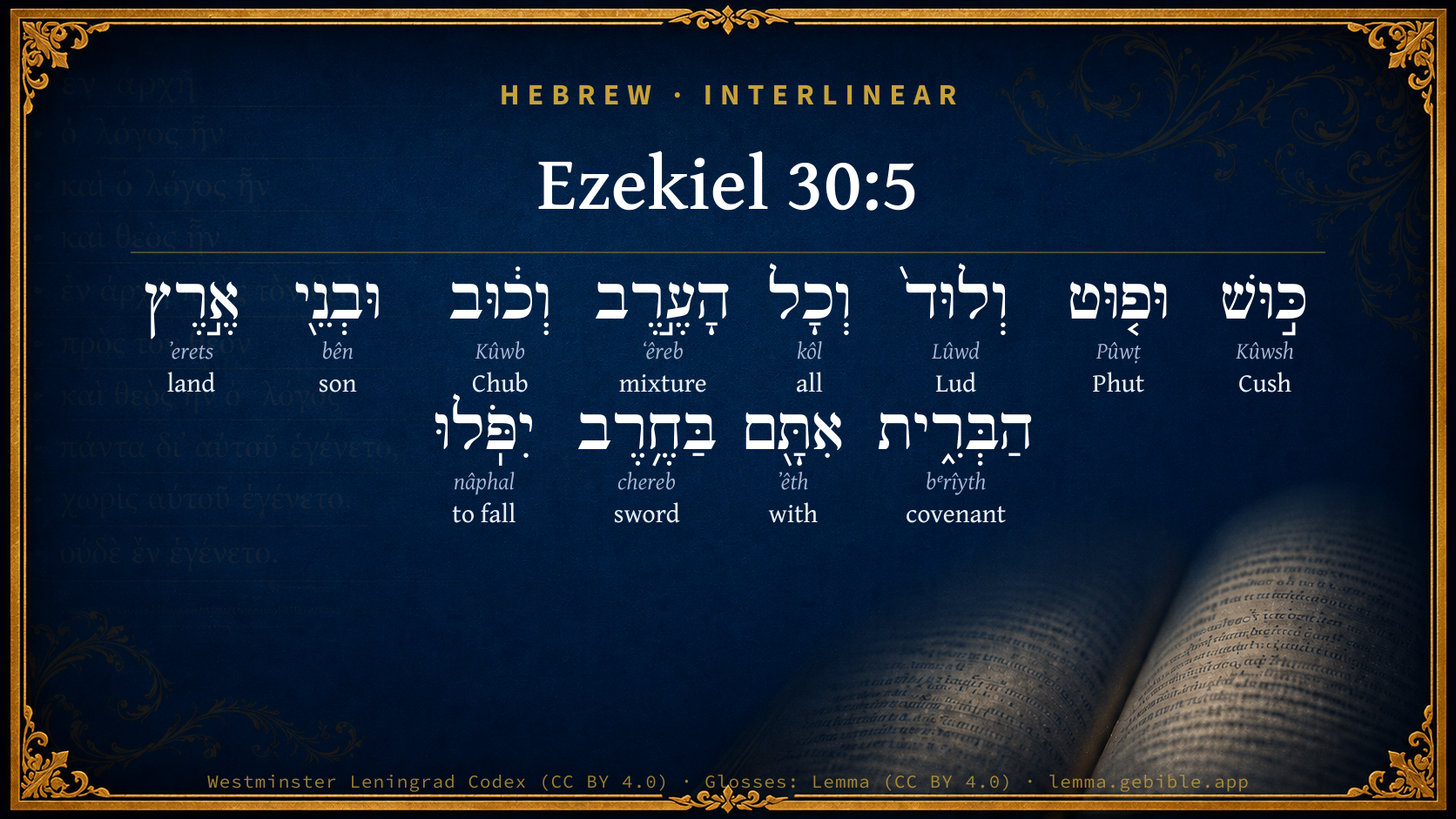
Hebrew (Westminster Leningrad Codex) Ezekiel 30:5 appears in the Hebrew Old Testament. The text above is from the Westminster Leningrad Codex. Each word links to its Strong’s number, a concise gloss, and parsing drawn from the Open Scriptures Hebrew Bible morphology. Click any word for its full Brown-Driver-Briggs (BDB) entry.
Download image
Cite this verse

Ezekiel 30:5 (World English Bible). Public Domain. Lemma interlinear Bible study tool, https://lemma.gebible.app/v/ezekiel/30/5.

Show BibTeX & RIS
BibTeX
RIS
English Translation
Ethiopia, and Put, and Lud, and all the mixed people, and Cub, and the children of the land that is in league, shall fall with them by the sword.
World English Bible · Public Domain
Highlights
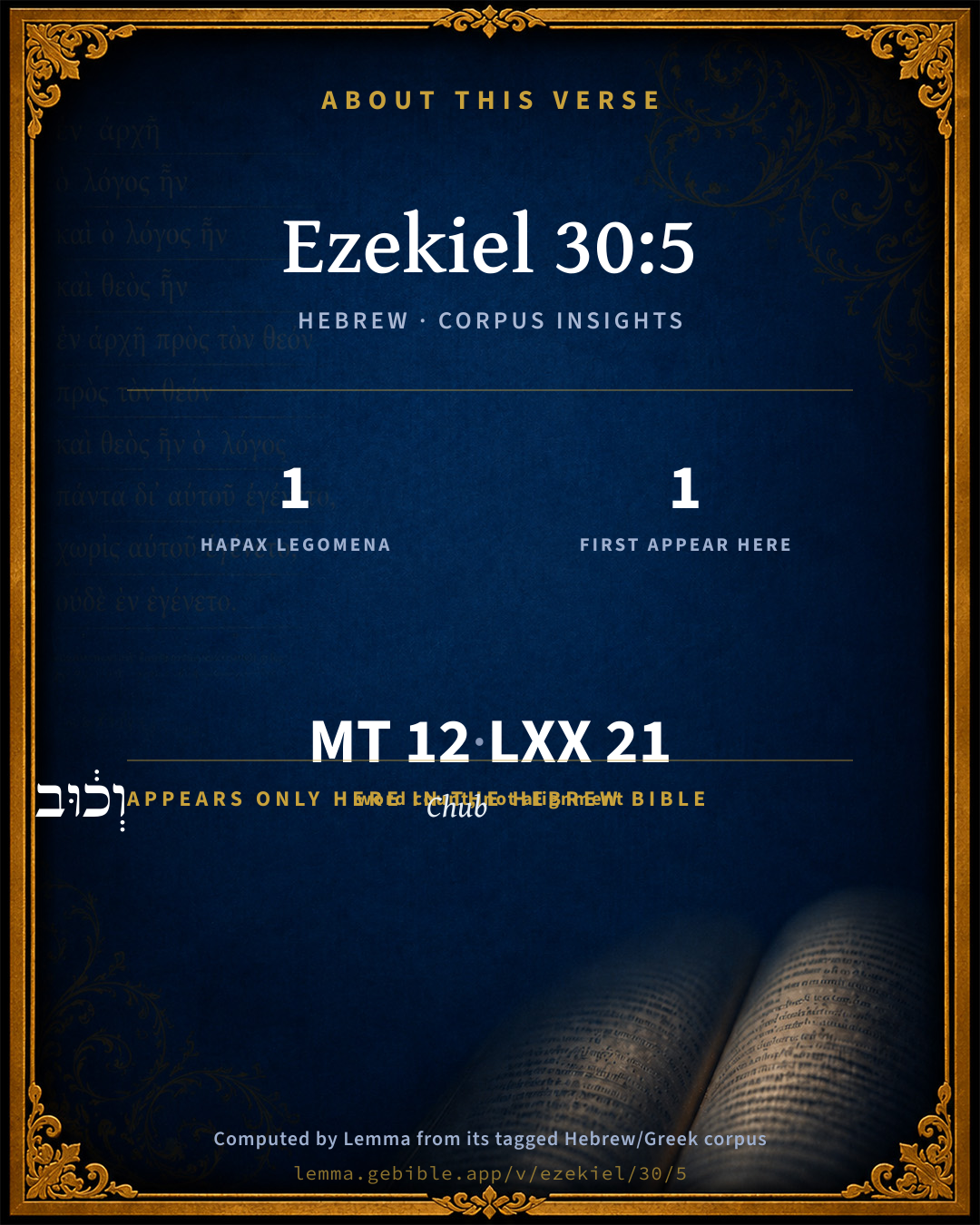
  • 1 hapax legomenon — only here in the Hebrew Bible
  • 1 first appearance in the Hebrew Bible
Full analysis ↓
Download a study sheet

One document with this verse’s original text, its word-by-word gloss line, the meaning frame, cross-references with their text, attributed commentary, and full source and license credits — printable, and it pastes into notes with its structure intact.

This verse Autodidact and up

Study sheet (.html) Plain text (.txt)

A passage Seminary Student

Up to 50 verses in one chapter. A passage sheet keeps up to 6 commentary sources and 12 cross-references per verse, in the order this page ranks them, and says so on the sheet whenever that leaves anything out. Ask for a single verse and you get the Autodidact verse sheet above.

Everything on this page stays free to read, with no account — the sheet is a download of what is already on screen, not access to it.

Want to remove ads? Support Godless Engineer
Compare translations 3

The same verse in 3 English versions, stacked beneath the original-language interlinear above. Click any original word for its lexicon entry.

Each is an independent rendering of the whole verse — the interlinear is not word-aligned to these translations.

Highlighted words mark where these versions differ — a whole-verse word diff, not a word-by-word alignment.

  • World English Bible Public Domain
    Ethiopia, and Put, and Lud, and all the mixed people, and Cub, and the children of the land that is in league, shall fall with them by the sword.
  • King James Version Public Domain
    Ethiopia, and Libya, and Lydia, and all the mingled people, and Chub, and the men of the land that is in league, shall fall with them by the sword.
  • unfoldingWord Literal Text CC BY-SA 4.0
    Cush and Put, Lydia and all Arabia, and Libya, together with the people belonging to the covenant—they will all fall by the sword.

unfoldingWord Literal Text — © unfoldingWord, licensed CC BY-SA 4.0. Word-aligned USFM3 via Door43 (git.door43.org/unfoldingWord/en_ult).

Versions to compare (up to 4)

3 of 4 selected

Show all 18 translations

Every available English version of this verse, each an independent rendering of the whole verse.

  • World English Bible Public Domain
    Ethiopia, and Put, and Lud, and all the mixed people, and Cub, and the children of the land that is in league, shall fall with them by the sword.
  • Berean Standard Bible Public Domain
    Cush, Put, and Lud, and all the various peoples, as well as Libya and the men of the covenant land, will fall with Egypt by the sword.
  • Majority Standard Bible Public Domain
    Cush, Put, and Lud, and all the various peoples, as well as Libya and the men of the covenant land, will fall with Egypt by the sword.
  • King James Version Public Domain
    Ethiopia, and Libya, and Lydia, and all the mingled people, and Chub, and the men of the land that is in league, shall fall with them by the sword.
  • American Standard Version (1901) Public Domain
    Ethiopia, and Put, and Lud, and all the mingled people, and Cub, and the children of the land that is in league, shall fall with them by the sword.
  • Revised Version (1885) Public Domain
    Ethiopia, and Put, and Lud, and all the mingled people, and Cub, and the children of the land that is in league, shall fall with them by the sword.
  • Geneva Bible (1599) Public Domain
    Ethiopia and Phut, and Lud, and all the common people, and Cub, and the men of the land, that is in league, shall fall with them by the sword.
  • Douay-Rheims (1899) Public Domain
    Ethiopia, and Libya, and Lydia, and all the rest of the crowd, and Chub, and the children of the land of the covenant, shall fall with them by the sword.
  • Young's Literal Translation Public Domain
    Cush, and Phut, and Lud, and all the mixture, and Chub, And the sons of the land of the covenant with them by sword do fall,
  • Literal Standard Version CC BY-SA 4.0
    Cush, and Phut, and Lud, and all the mixture, and Chub, || And the sons of the land of the covenant fall by sword with them,
  • Unlocked Literal Bible CC BY-SA 4.0
    Cush and Put, Lydia and all Arabia, and Libya, together with the people belonging to the covenant—they will all fall by the sword.
  • unfoldingWord Literal Text CC BY-SA 4.0
    Cush and Put, Lydia and all Arabia, and Libya, together with the people belonging to the covenant—they will all fall by the sword.
  • Darby Bible Public Domain
    Cush, and Phut, and Lud, and all the mingled people, and Chub, and the children of the land that is in league, shall fall with them by the sword.
  • World Messianic Bible Public Domain
    “‘“Ethiopia, Put, Lud, all the mixed people, Cub, and the children of the land that is allied with them, will fall with them by the sword.”
  • Webster's Bible Public Domain
    Cush, and Libya, and Lydia, and all the mingled people, and Kub, and the men of the land that is in league, shall fall with them by the sword.
  • Free Bible Version CC BY-SA 4.0
    Cush, Put, and Lud, and many other peoples, as well as Arabia, Kub, and the people of the promised land, they all, like Egypt, will be killed by the sword.
  • Bible in Basic English Public Domain
    Ethiopia and Put and Lud and all the mixed people and Libya and the children of the land of the Cherethites will all be put to death with them by the sword.
  • JPS Tanakh (1917) Public Domain
    Ethiopia, and Put, and Lud, and all the mingled people, and Cub, and the children of the land that is in league, shall fall with them by the sword.

Literal Standard Version (2020), Covenant Press — licensed CC BY-SA 4.0. Text via the HelloAO Bible API (eBible.org). Unlocked Literal Bible (unfoldingWord) — licensed CC BY-SA 4.0. Text via the HelloAO Bible API (eBible.org). unfoldingWord Literal Text — © unfoldingWord, licensed CC BY-SA 4.0. Word-aligned USFM3 via Door43 (git.door43.org/unfoldingWord/en_ult). Free Bible Version, Dr. Jonathan Gallagher — licensed CC BY-SA 4.0. Text via the HelloAO Bible API (eBible.org).

Word by word

More ways to search: Search by grammar → Find every occurrence → Compare this word →

Practice this passage: Drill this verse → Learn its vocabulary →

וְכ֔וּב
Kûwb
H3552
“and · Chub”
Conjunction + Noun, Proper
Part of Speech
Conjunction + Noun
Type
Proper
Full BDB Definition

Origin: of foreign derivation

TWOT: None

Chub = "a horde" - the name of a people in alliance with Nebuchadnezzar and probably located in northern Africa; maybe same as 'Lybia' or 'Lub'
  1. כּ֣וּשׁ Kûwsh H3568 “Cush” Noun, Proper
  2. וּפ֤וּט Pûwṭ H6316 “and · Phut” Conjunction + Noun, Proper
  3. וְלוּד֙ Lûwd H3865 “and · Lud” Conjunction + Noun, Proper
  4. וְכָל kôl H3605 “and · all of” Conjunction + Noun, Common, Masculine, Singular, Construct
  5. הָעֶ֣רֶב ʻêreb H6154 “the · mixture” Particle, Definite Article + Noun, Common, Masculine, Singular, Absolute
  6. וּבְנֵ֖י bên H1121 “and · sons of” Conjunction + Noun, Common, Masculine, Plural, Construct
  7. אֶ֣רֶץ ʼerets H776 “land of” Noun, Common, Both, Singular, Construct
  8. הַבְּרִ֑ית bᵉrîyth H1285 “the · covenant” Particle, Definite Article + Noun, Common, Feminine, Singular, Absolute
  9. אִתָּ֖ם ʼêth H854 “with · them” Preposition + Suffix, Personal, 3rd Person, Masculine, Plural
  10. בַּחֶ֥רֶב chereb H2719 “in/at the · sword” Preposition, Determined + Noun, Common, Feminine, Singular, Absolute
  11. יִפֹּֽלוּ nâphal H5307 “to fall” Verb, Qal, Imperfect, 3rd Person, Masculine, Plural

About this verse

These counts appear in no published source. They are computed here, from the morphology-tagged text and Lemma’s own curated glosses. What Lemma adds →

12
words
12
distinct lemmas
Prophets
section

Notable vocabulary

1 hapax legomenon — a word that appears only here in the entire Hebrew Bible:

  • וְכ֔וּב Chub H3552

First appearance in Scripture

This word makes its first canonical appearance in the Hebrew Bible here:

  • וְכ֔וּב Chub H3552

Shared distinctive vocabulary

וְלוּד֙ Lud H3865 occurs in 5 verses of the Hebrew Bible. Also found in:

Grammatical profile

  • 1 verb
  • 10 nouns
  • 1 preposition

Verb forms

  • יִפֹּֽלוּ Qal · Imperfect

Hebrew & Septuagint length

In English translation the verse runs 29 words from the Hebrew and 26 from the Septuagint (LXX English) — closely comparable.

A rough comparison of the two English renderings, which tokenize alike — not a word-level alignment.

Word counts can differ between the Hebrew and the Greek without any difference in meaning — e.g. the Hebrew direct-object marker אֵת has no separate Greek word, and Greek often adds the article ὁ.

In the original languages it is 12 Hebrew tokens and 21 Greek tokens — but the two are counted differently (Hebrew bundles its prefixes and suffixes into one token; the Greek is in lemma form), so that isn’t a like-for-like length.

Cross-references

9

Topical passages linked to Ezekiel 30:5 in the Treasury of Scripture Knowledge — connected by theme and wording, ordered by reader-vote popularity; previews shown in the World English Bible.

  • Jeremiah 25:20 and all the mixed people, and all the kings of the land of the Uz, and all the kings of the Philistines, and Ashkelon, and Gaza, and Ekron, and the remnant of Ashdod;
  • Ezekiel 27:10 Persia and Lud and Put were in your army, your men of war: they hanged the shield and helmet in you; they set forth your comeliness.
  • Jeremiah 25:24 and all the kings of Arabia, and all the kings of the mixed people who dwell in the wilderness;
  • Isaiah 18:1 Ah, the land of the rustling of wings, which is beyond the rivers of Ethiopia;
  • Isaiah 20:4 so shall the king of Assyria lead away the captives of Egypt, and the exiles of Ethiopia, young and old, naked and barefoot, and with buttocks uncovered, to the shame of Egypt.
  • Jeremiah 44:27 Behold, I watch over them for evil, and not for good; and all the men of Judah who are in the land of Egypt shall be consumed by the sword and by the famine, until there be an end of them.
  • Jeremiah 46:9 Go up, you horses; and rage, you chariots; and let the mighty men go forth: Cush and Put, who handle the shield; and the Ludim, who handle and bend the bow.
  • Jeremiah 50:37 A sword is on their horses, and on their chariots, and on all the mixed people who are in the midst of her; and they shall become as women: a sword is on her treasures, and they shall be robbed.
  • Nahum 3:8–9 Are you better than No-Amon, who was situated among the rivers, who had the waters around her; whose rampart was the sea, and her wall was of the sea?

Cross-references courtesy of OpenBible.info (CC BY 4.0).

Hebrew and Greek witnesses Masoretic Hebrew ↔ Greek Septuagint

The same verse in the two great witnesses to the Old Testament, shown verse-for-verse.

These are two independent witnesses, not word-aligned to each other, and the Septuagint is shown in lemma (dictionary) form.

Hebrew Ezekiel 30:5 Masoretic · Westminster Leningrad Codex

כּ֣וּשׁ וּפ֤וּט וְלוּד֙ וְכָל הָעֶ֣רֶב וְכ֔וּב וּבְנֵ֖י אֶ֣רֶץ הַבְּרִ֑ית אִתָּ֖ם בַּחֶ֥רֶב יִפֹּֽלוּ

Ethiopia, and Put, and Lud, and all the mixed people, and Cub, and the children of the land that is in league, shall fall with them by the sword.

World English Bible · Public Domain

Greek LXX Ezekiel 30:5 Septuagint · lemma form

πέρσης καί κρῆτες καί λυδοί καί λίβυες καί πᾶς ὁ ἐπίμικτος καί ὁ υἱός ὁ διαθήκη ἐγώ μάχαιρα πίπτω ἐν αὐτός

Persians, and Cretans, and Lydians, and Libyans, and all the mixed multitude, and they of the children of my covenant, shall fall by the sword therein.

LXX2012 (modern English Septuagint) · Public Domain

On this verse, Trapp's Complete Commentary discusses the Septuagint’s reading. Read the note in Commentary ↓

Hebrew: Westminster Leningrad Codex (CC BY 4.0). Greek: Septuagint (public domain); English from LXX2012 (modern English Septuagint) (Public Domain). How the Septuagint differs from the Hebrew →

Targum (Aramaic paraphrase)

1

The Targum is the ancient Jewish Aramaic paraphrase of the Hebrew Scriptures — an interpretive translation, not the Hebrew text itself. Onkelos (literal) and Pseudo-Jonathan (expansive) render the Torah, and Jonathan the Prophets. Coverage is partial: where no permissively-licensed English translation exists for a verse, only the Aramaic is shown. This is verse-level text, not a word-by-word alignment to the Hebrew.

  1. Targum Jonathan Prophets (Joshua–Malachi)
    כּוּשָׁאֵי וּפוּטָאֵי וְלוּדָאֵי וְכָל סוּמְכָוָתָא וְכוּב וּבְנֵי אַרְעָא קְיָמָא עִמְהוֹן בְּחַרְבָּא יִתְקַטְלוּן:

    (no public-domain English translation for this verse)

    Targum Jonathan — Aramaic: “Mikraot Gedolot” (public domain). English: “Sefaria Community Translation” (CC0 1.0 (public-domain dedication)); “London "Chaldee Paraphrase," 1871” (public domain). Text via Sefaria.

Commentary

Notes on Ezekiel 30:5 from classic Christian and Jewish commentators (each source and its license shown beneath its notes). The classic Christian expositions comment on the surrounding passage and are grouped to its opening verse, so a note may address several verses; the Jewish commentaries on the Tanakh (Rashi and others) are per-verse, so they appear only where the commentator wrote on this verse.

Lemma curates 59 commentaries, every one of them public domain or Creative Commons licensed, each selected and text-cleaned for this edition rather than reprinted as found. About our sources →

Trapp's Complete Commentary

John Trapp

Eze 30:5 Ethiopia, and Libya, and Lydia, and all the mingled people, and Chub, and the men of the land that is in league, shall fall with them by the sword.

Ver. 5. Chub.] Certain Africans, who shall be worse put to it than were those succeeding Africans, who had a prophecy (but not of like credit with this of Ezekiel), that when the Romans sent an army into their country, Mundus cum tota sua prole periret, which made them think the world should then be at an end. But afterwards the Romans sent an army thither under the conduct of one Mundus, who in battle was slain, together with his sons, by the Africans, and discovered the illusion of the devil. The Septuagint render Chub Spaniards, which I like the better, saith Lavater, {a} because Strabo saith Nebuchadnezzar came with his victorious army as far as Spain.

{a} Lib. xv.

John Trapp, A Commentary or Exposition upon All the Books of the Old and New Testament (1647–1656) — public domain. Text from a community e-Sword module.

Joseph Benson's Commentary

Eze 30:5. Ethiopia, and Libya, and Lydia — The names in Hebrew are Cush, Phut, and Lud, which are mentioned together as the Egyptian allies, Jer 46:9. Cush probably signifies Ethiopia here, being joined with Phut and Lud, which were nations of Africa. And all the mingled people — All their mercenary soldiers, consisting of various nations. If we distinguish these from the men of the land, mentioned afterward, they may mean that mixture of Carians, Ionians, and other nations lying upon the Mediterranean sea, which Apries got together to encounter Amasis, who, together with him, were destroyed. And Chub — The Cubii are mentioned by Ptolemy as a people of Mareotis, a province of Egypt. There is no mention of this people anywhere else in the Scriptures. According to Michaelis, the ancient geographers have a mercantile town, Kubee, on the Indian sea, under the eighth degree of north latitude.

Joseph Benson's Commentary on the Old and New Testaments (1811–1818) — public domain. Text from a community e-Sword module.

Geneva Bible (1599)

Geneva Bible translators

By Put and Lud are meant Africa and Libya.

Geneva Bible (1599) marginal notes — public domain. Text via Bolls.life.

Jamieson, Fausset & Brown

Robert Jamieson, A. R. Fausset & David Brown

the mingled people--the mercenary troops of Egypt from various lands, mostly from the interior of Africa (compare Eze 27:10; Jer 25:20, Jer 25:24; Jer 46:9, Jer 46:21).

Chub--the people named Kufa on the monuments [HAVERNICK], a people considerably north of Palestine [WILKINSON]; Coba or Chobat, a city of Mauritania [MAURER].

men of the land that is in league--too definite an expression to mean merely, "men in league" with Egypt; rather, "sons of the land of the covenant," that is, the Jews who migrated to Egypt and carried Jeremiah with them (Jer. 42:1-44:30). Even they shall not escape (Jer 42:22; Jer 44:14).

Jamieson, Fausset & Brown — Commentary Critical and Explanatory on the Whole Bible (1871) — public domain (CC PDM 1.0). Text via the HelloAO Bible API.

Adam Clarke's Commentary

Verse 5. Lydia] This place is not well known. The Ludim were contiguous to Egypt, Ge 10:13.

Chub] The Cubians, placed by Ptolemy in the Mareotis. But probably instead of וכוב vechub, "and Chub," we should read וכל vechol, "and ALL the men of the land," &c. The Septuagint adds "the Persians and the Cretans."

Adam Clarke's Commentary on the Bible (1810–1826) — public domain. Text from a community e-Sword/MySword module.

Ellicott's Commentary for English Readers

(5) Ethiopia, and Libya, and Lydia.—Ethiopia and Egypt were closely connected, and during much of their history were often under one government. Ethiopian soldiers served in great numbers in the Egyptian armies. Libya and Lydia are an unfortunate substitution for the original terms, Phut and Lud, which are preserved in Eze_27:10, where see Note. They are there mentioned as furnishing mercenaries to the Tyrian army; and it is known historically that they supplied them to a still greater extent to the Egyptian army.

All the mingled people, and Chub.—There is the same expression, “mingled people,” in reference to Egypt, in Jer_25:20. In the connection here it may be understood especially of the foreign mercenaries from various quarters in the Egyptian armies. Chub is a name entirely unknown. Various conjectures have been hazarded, and various changes in the text proposed, but none are supported by sufficient evidence. It evidently denotes some ally of Egypt, possibly Nubia.

Men of the land that is in league.—Literally, sons of the land of the covenant. The ancient interpreters, St. Jerome and Theodoret, understood this expression of the Jews who had sought refuge from Nebuchadnezzar in Egypt after the murder of Gedaliah (Jeremiah 42, 43, 44), to whom Jeremiah had expressly prophesied that the sword and famine of which they were afraid should overtake them there (Jer_42:16-18). This interpretation is supported by the translation of the Septuagint, made in Egypt, “land of my covenant.” The objection made to this view, that Palestine is never called “the land of the covenant,” and that this must therefore signify some unknown country in alliance with Egypt at the time, seems rather specious than real. If it happens that this expression is never used of Palestine, yet that was unquestionably the land of the people of the covenant, and a particular expression may very well be used once without occurring again.

A Bible Commentary for English Readers, edited by Charles John Ellicott (1878–1897) — public domain. Text from a community e-Sword module.

The Cambridge Bible for Schools and Colleges

gen. ed. J. J. S. Perowne

5. See on Eze_27:10; Heb. is Cush and Phut and Lud. For Cush LXX. reads Persians as Eze_27:10, for Phut Cretans, and for Lud Lydians.

the mingled people] perhaps foreigners. In Jer_25:24 these so named (ereb) are represented as having kings and dwelling in the desert (cf. 1Ki_10:15), and in Eze_30:20 they are named next to the kings of Uz. On the other hand in Jer_50:37 they are spoken of as being in the midst of Babylon. Hence the sense of “mercenaries” has been suggested. In the present passage some distinct people seems intended.

the land that is in league] Lit., children of the land of the covenant. Reference can hardly be to the land of Israel, or to refugees from Israel in Egypt. Either some definite country is meant, the name of which would be suggested by the prophet’s description, or “land” is used collectively—all allied lands. The name Chub does not occur again; LXX. Libyans, and in Nah_3:9 the Lubim appear beside Cush, Egypt and Phut.

The Cambridge Bible for Schools and Colleges (gen. ed. J. J. S. Perowne; Cambridge University Press, 1878–1918) — public domain. Text from a community e-Sword module.

John Gill's Exposition

Ethiopia, Lybia, and Lydia,.... Or, "Cush, Phut, and Lud". Cush and Phut were both sons of Ham, from whom Egypt is sometimes called the land of Ham; and Lud or Ludim was the son of Mizraim, the son of Ham, the common name of Egypt in Scripture, Gen 10:6. Cush is by us rendered Ethiopia; and is thought by some to be a part of Arabia, which lay near to Egypt. Phut and Lud are properly enough rendered Lybia and Lydia; and both these, with Ethiopia, are represented as the allies and confederates of Egypt, Jer 46:9.

And all the mingled people; the Syriac version renders it, "all Arabia": and so Symmachus, according to Jerom; though others think they are the Carians, Ionians, and other Greeks, which Pharaohapries got together to fight with Amasis (g): and "Chub"; or "Cub"; the inhabitants of this piece are thought to be the Cobii of Ptolemy (h), who dwelt in Mareotis, a country of Egypt; though some, by a change of a letter, would have them to be the Nubians, a people in Africa; and so the Arabic version here reads it. Of these Strabo (i) says, on the left of the stream of the Nile dwell the Nubians, a large nation in Lybia; and which he afterwards mentions along with the Troglodytes, Blemmyes, Megabarians, and Ethiopians, that dwell above Syene: and so Ptolemy (k) speaks of them along with the Megabarians, and as inhabiting to the west of the Avalites: and Pliny (l) calls them Nubian Ethiopians, whom he places near the Nile: and a late traveller (m) in those parts informs us that the confines of Egypt and Nubia are about eight miles above the first cataract (of the Nile); Nubia begins at the villages of Ellkalabsche, and of Teffa; the first is to the east of the Nile, and the second to the west.

And the men of the land that is in league shall fall with them by the sword; all the nations above mentioned, with whomsoever should be found that were confederates with Egypt, should share the same fate with them. The Septuagint render it, "and those of the children of my covenant"; as if the Jews were meant that were in Egypt, who are sometimes called "the children of the covenant", and of "the promise", Act 3:25, and so some interpret the place; but it takes in all the allies of Egypt, and does not design the Jews, at least not them only.

(g) See Prideaux's Connexion, part 1. p. 93. (h) Geograph. l. 4. c. 5. (i) Geograph. l. 17. p. 541, 563. (k) Geograph. l. 5. c. 8. (l) Nat. Hist. l. 6. c. 30. (m) Norden's Travels in Egypt and Nubia, vol. 2. p. 131, 132.

John Gill's Exposition of the Whole Bible (1746–1763) — public domain (CC PDM 1.0). Text via the HelloAO Bible API.

Albert Barnes' Notes on the Bible

Libya, and Lydia - Or, as in Eze 27:10, Phut and Lud.

The mingled people - Foreigners, who settled in Egypt. The Saite dynasty of Egyptian kings were especially favorable to foreign immigrants. Hophra employed many of them in his armies, and in this way, according to Herodotus, lost the affections of his Egyptian subjects. See Jer 25:20 note.

Chub - The word occurs here only. It was some tribe in alliance with Egypt, either of African race like Lud and Phut, or settlers like the “mingled people.” A not-improbable suggestion connects it with Coptos, of which the Egyptian form was Qeb, Qebt or Qabt.

The men of the land that is in league - Rather, the children of the land of the covenant, i. e., of Israel (see Eze 16:8). After the destruction of Jerusalem Jews withdrew into Egypt Jer 43:7. Many of them would naturally enough be found in the Egyptian armies. This is in favor of the later date assigned to this section.

Albert Barnes' Notes on the Bible (1834–1885) — public domain. Text from a community e-Sword/MySword module.

Haydock's Catholic Bible Commentary

Lydia. Hebrew, "Phut," near Egypt. (Calmet) --- These troops were paid. (Haydock) --- Chub, in Mareotis. --- Covenant: the Jews or auxiliaries. Septuagint add, "the Persians and Cretans." (Calmet) --- There were Persians in Africa who followed Hercules. (Pliny, [Natural History?] v. 8.)

George Leo Haydock (1774–1849), Haydock's Catholic Family Bible and Commentary, 1859 edition — public domain. Excludes Psalms (Douay-Rheims chapter numbering differs from Protestant) and Deuterocanonical books (Catholic canon only).

Matthew Poole's English Annotations

Ethiopia, Heb. Cush, which are commonly thought to be the Ethiopians in Africa, but some more inquisitive geographers have found them originally and chiefly in Arabia, which was either subject or ally to Egypt in its prosperity; and these were, as Eze 30:4, in a panic that, lest the Babylonian should pass the sea, and take them in his way home.

Libya, Heb. Phut; hence the Putaens or Phutaans, who afterwards were better known by Libyans, a part of whose country was near to Egypt.

Lydia; Lydians, not the Asiatic, but the Africans, placed between some part of Cyrene and Egypt.

All the mingled people; the hired soldiers from all parts, a confused mixture of nations, such as the Libyans had got together; or all Arabia, so the word 2Ch 9:14; Isa 13:20; or all that ravenous sort of people, that like crows fly to slaughters; so soldiers of fortune follow the wars, and the Hebrew word is crow, Lev 11:15; Deu 14:14; Psa 147:9, as well as mixed.

Chub; Ethiopians beyond Egypt south, the inhabitants of the inmost Libya, which reached to the Nigritae; perhaps they may be the Nubians at this day, a letter easily changed.

The men of the land that is in league; the sons of the land of the covenant: some refer to the Jews, children of the covenant, but this is forced; it is all the people of Egypt’s league, all the allies of the Egyptian kingdom. With them; with the Egyptians.

By the sword; in war by the sword of Babylon.

Matthew Poole's English Annotations on the Holy Bible (1683–1685) — public domain. Text from a community e-Sword/MySword module.

Whedon's Commentary on the Bible

Daniel D. Whedon

5. Ethiopia, and Libya, and Lydia — R.V., “Ethiopia [or, Cush], and Put, and Lud.” (See notes Eze_27:10; compare Eze_38:5.) LXX. reads “Persia” for Ethiopia, but Ethiopia about this time had especial prominence in the world’s annals. The Assyrian monarch conquered Tirhakah of Egypt (about 671 B.C.), and called him on a stele of Senjerli “king of Ethiopia” (Kuss), and represented him on the tablet as a little negro with curly hair (B. and O. Record, July, 1891).

Mingled people — It is not known to what people this refers (compare Jer_25:24), if indeed it does not refer to the mercenaries and allies in Hophra’s army.

Chub — R.V., “Cub.” Naville compares with the Egyptian Keneb, the name for the Ethiopians and negroes; Brugsch with Qeb, Qabt (Coptos); Smend reads Lub, with LXX., that is, “Libyans” (compare Nah_3:9; 2Ch_16:8), which is the most probable, with present knowledge.

Men of the land that is in league — Literally, the children of the land of the covenant, but probably not referring here to the Israelites. Toy reads “Cherethites.” (Compare Eze_25:16.) One version reads “Cretans.” (Compare the khab-iri, “confederates,” mentioned in the Tel-el-Amarna tablets.)

Daniel D. Whedon (gen. ed.), Commentary on the Old and New Testaments (1874–1909) — public domain. Text from a community e-Sword module.

The Pulpit Commentary

Libya. Here the Authorized Version gives (rightly enough, though inconsistently) the Greek equivalent of the Hebrew Phut, which is reproduced in the Revised Version. The Lydians, in like manner, stand for Lud; but we have to remember, as before, (Eze_27:10) that they are the African, and not the Asiatic, people of that name. In Jer_46:9 the two nations are named among the auxiliaries of Egypt. Possibly the similarity of name may have led to the term being used also for the Lydian and Ionian forces enlisted by Psam-metichus I (Herod., 3:4); but there seems more reason for including these in the mingled people that are next mentioned. Chub, or Cub (Revised Version), is found here only, and has consequently given occasion to many guesses Havernick connects it with the Kufa, a district of Media, often named in Egyptian monuments; Michaelis, with Kobe on the Ethiopian coast of the Indian Ocean; Maurer, with Cob, a city of Mauretania; Gesenius, Ewald, and Bunsen suggest the reading Nub, and identify it with Nubia; Keil and Smend adopt the form Lub, found in the Lubim of 2Ch_16:8 and Nah_3:9. On the whole, there are no adequate data for the solution of the problem. The men of the land that is in league. Here, again, we are in a region of many conjectures.

(1) Hitzig and Kliefoth (following Jerome and the LXX, which gives, "the land of my covenant") take it of Canaan, as being the land in covenant with Jehovah. (Psa_74:2, Psa_74:20; Dan_11:28; Act_3:25)

(2) Hengstenberg, for the Sabeans, as being members of the Judaeo-Egyptian confederacy implied in Eze_23:42.

(3) Keil, Ewald, and Smend, of a people among.the allies of Egypt, unknown to us, but sufficiently designated by Ezekiel for his readers.

Vers. 5-8. The fate of the allies.

Egypt was not alone in her forgetfulness of the principles of righteousness, in her defiance of God; and she was not alone in her chastisement and desolation. She had allies, who were included by the prophet in the denunciation he was directed to utter against Pharaoh and his people.

I POLITICAL AND NATIONAL ALLIANCES ARE OFTEN BASED UPON INTEREST RATHER THAN UPON MORAL PRINCIPLES. The weak seek the support of the strong; the strong would be stronger through the support of their neighbors. A common hope of profit and aggrandizement in many cases accounts for the leagues into which states enter with one another.

II SUCH ALLIANCES ARE EASILY DISSOLVED WHEN THEIR OBJECTS ARE FOUND INCAPABLE OF REALIZATION. They do not deserve to endure, and as a matter of fact they do not endure. There is no guarantee of permanence in such combinations, and it is well for the world that this is so. The political center of gravity shifts, and the instability of alliances based upon interest is made apparent.

III CONJOINT HUMAN POWERS ARE EVER VAIN WHEN THEY OPPOSE THE PURPOSES OF GOD. Such was proved to be the case with regard to the alliances between Egypt and the neighboring states mentioned by the prophet. "Though hand join in hand, the wicked shall not be unpunished." Add together as many finites as you will, and you are no nearer the Infinite; and all the resources of all the nations upon earth are as nothing, are less than the dust of the balance, when weighed against the incalculable, inexhaustible, irresistible power of the Omnipotent. "Why do the nations rage, and the peoples imagine a vain thing?

IV THOSE WHO SHARE IN SIN SHALL SHARE IN PUNISHMENT. "They also that uphold Egypt shall fall." "All her helpers are destroyed." The leagues of the righteous and godly shall contribute to the common strength; the measure of the Church"s influence in the world is determined by the Church"s unity. But as there is no cohesion in wickedness, the blow which falls dissolves the superficial combination, and overwhelms all the elements in a common destruction. Notwithstanding all recrimination, there is no escape and no consolation; confidence is destroyed, succor there is none; one ruin overtakes all.

V A COMMON FATE IMPRESSES THE SAME LESSON UPON SOCIETY. The downfall of one proud, self-confident nation is impressive and instructive; but when a league is dissolved, and disaster comes upon those who have encouraged one another in injustice and impiety, the attention of the world is arrested, and men are the more disposed to earn how vain are all merely human projects, how unstable are all alliances based upon worldly principles, and how utterly powerless are the nations when they array themselves together against the truth, the Word, the Church, of the living God. When God arises, his enemies are scattered. There is none that can stand before him. Might is feebleness, wisdom is folly, and unions fall to pieces, when they are directed against him who is mighty to punish as he is mighty to save. T.

The Pulpit Commentary (1880–1919), ed. H.D.M. Spence-Jones & Joseph S. Exell — public domain. Text from a community e-Sword module.

John Wesley's Explanatory Notes

Lydia - Not the Asiatic, but the Africans placed between some part of Cyrene and Egypt. The mingled people - The hired soldiers from all parts, a confused mixture of nations. And Chub - The inhabitants of the inmost Libya; perhaps they may be the Nubians at this day. The men - All the allies of Egypt. With them - With the Egyptians.

John Wesley, Explanatory Notes Upon the Whole Bible (1754–1765) — public domain. Text via the GEBible commentary corpus.

Rashi

Rabbi Shlomo Yitzchaki (Rashi)

and all who support her [Heb. וְכָל הָעֶרֶב.]Jonathan renders: וְכָל סוּמְכָוָתָא, all those who guarantee the security of Egypt, garantie in French, guarantee.

[and the people of] the allied land Those who made a treaty with Egypt to aid her.

Rashi on the Tanakh — English translations: “The Judaica Press complete Tanach with Rashi, translated by A. J. Rosenberg” (CC BY 4.0); “Pentateuch with Rashi's commentary by M. Rosenbaum and A.M. Silbermann, 1929-1934” (public domain); “The Metsudah Tanach series, Lakewood, N.J” (CC BY 4.0); and “The Book of Joshua, Metsudah Publications, 1997” (CC BY 4.0). Text via Sefaria.

Lesson kit

Teaching starters — assembled from the data on this page, not authored interpretation. Every prompt links to the verse data it draws on. Edit before teaching.

Ezekiel, in the Prophets, opens this verse with 12 words (12 distinct Hebrew lemmas). Its most distinctive word is Kûwb (“Chub”). A historical commentator’s framing appears above. Read the whole chapter for the surrounding context.

Discussion questions

  1. What does “Chub” (Kûwb) contribute to the verse as a whole?
  2. 1 word here appears nowhere else in the Hebrew Bible. Why might the author reach for such rare wording?
  3. This is the first place “Chub” appears in Scripture (first appears here). What does its debut here establish?
  4. How does Genesis 10:22, which shares the word «Lud», read alongside this verse?
  5. The translations on this page render this verse differently — a whole-verse word diff, not a word-by-word alignment. What might account for the different wordings?
  6. «יִפֹּֽלוּ» is a Qal Imperfect verb. How does that grammatical form shape the action described?
  7. Compare how Trapp's Complete Commentary and Joseph Benson's Commentary read this verse. Where do they agree or differ?

Things to notice

Reading settings

Reading text

Shown beneath each verse's original-language words.

Old Testament
Old Testament edition

Read the OT as the Masoretic Hebrew (MT) or the Greek Septuagint (LXX).

English shown for the Greek Septuagint (in the Hebrew ↔ Greek comparison).

Comparing translations? Open the Compare panel on any verse page to stack up to four side by side.