
Ezekiel 16:8

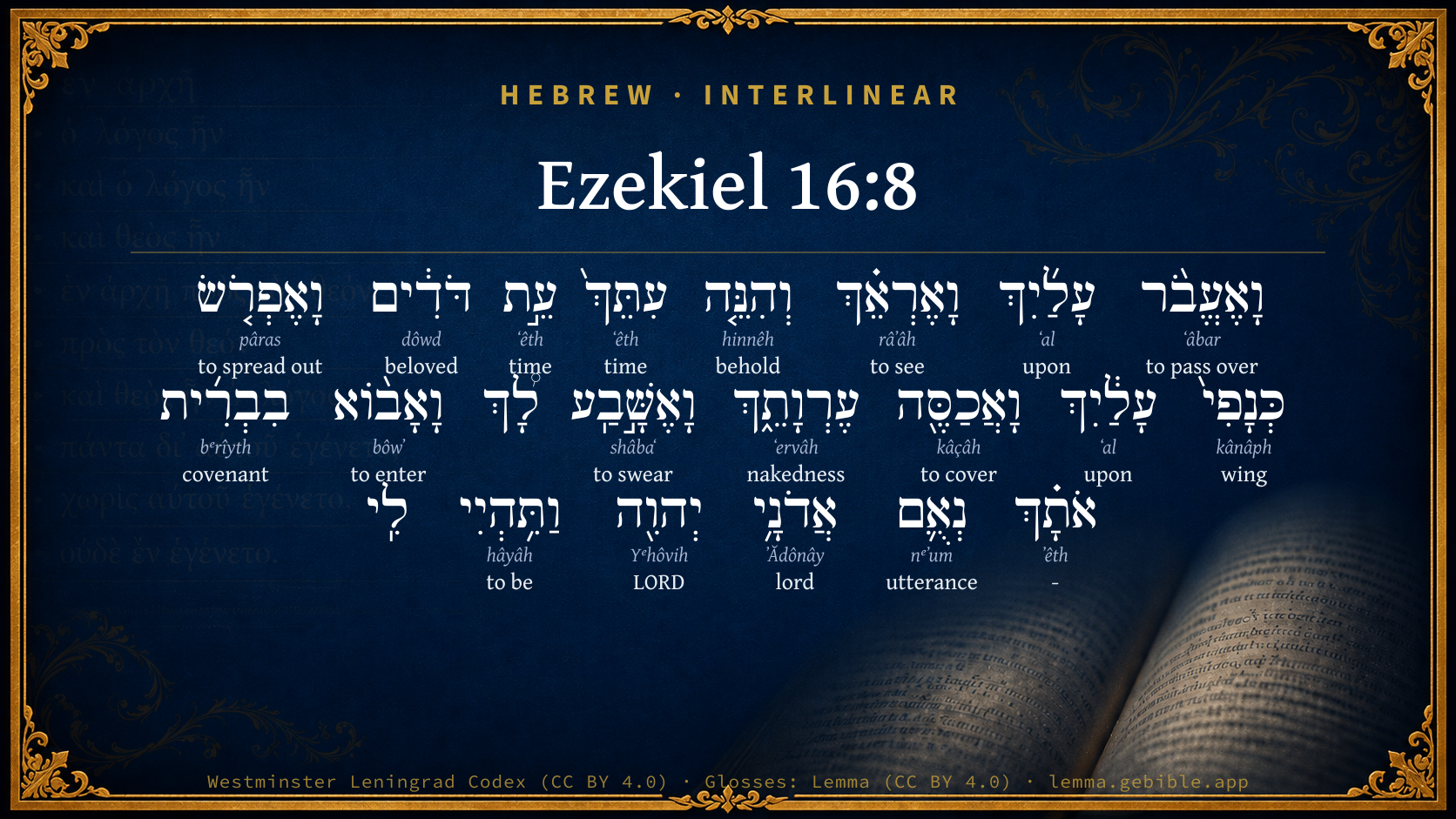
Hebrew (Westminster Leningrad Codex) Ezekiel 16:8 appears in the Hebrew Old Testament. The text above is from the Westminster Leningrad Codex. Each word links to its Strong’s number, a concise gloss, and parsing drawn from the Open Scriptures Hebrew Bible morphology. Click any word for its full Brown-Driver-Briggs (BDB) entry.
Download image
Cite this verse

Ezekiel 16:8 (World English Bible). Public Domain. Lemma interlinear Bible study tool, https://lemma.gebible.app/v/ezekiel/16/8.

Show BibTeX & RIS
BibTeX
RIS
English Translation
Now when I passed by you, and looked at you, behold, your time was the time of love; and I spread my skirt over you, and covered your nakedness: yes, I swore to you, and entered into a covenant with you, says the Lord Yahweh, and you became mine.
World English Bible · Public Domain
Download a study sheet

One document with this verse’s original text, its word-by-word gloss line, the meaning frame, cross-references with their text, attributed commentary, and full source and license credits — printable, and it pastes into notes with its structure intact.

This verse Autodidact and up

Study sheet (.html) Plain text (.txt)

A passage Seminary Student

Up to 50 verses in one chapter. A passage sheet keeps up to 6 commentary sources and 12 cross-references per verse, in the order this page ranks them, and says so on the sheet whenever that leaves anything out. Ask for a single verse and you get the Autodidact verse sheet above.

Everything on this page stays free to read, with no account — the sheet is a download of what is already on screen, not access to it.

Want to remove ads? Support Godless Engineer
Compare translations 3

The same verse in 3 English versions, stacked beneath the original-language interlinear above. Click any original word for its lexicon entry.

Each is an independent rendering of the whole verse — the interlinear is not word-aligned to these translations.

Highlighted words mark where these versions differ — a whole-verse word diff, not a word-by-word alignment.

  • World English Bible Public Domain
    Now when I passed by you, and looked at you, behold, your time was the time of love; and I spread my skirt over you, and covered your nakedness: yes, I swore to you, and entered into a covenant with you, says the Lord Yahweh, and you became mine.
  • King James Version Public Domain
    Now when I passed by thee, and looked upon thee, behold, thy time was the time of love; and I spread my skirt over thee, and covered thy nakedness: yea, I sware unto thee, and entered into a covenant with thee, saith the Lord GOD, and thou becamest mine.
  • unfoldingWord Literal Text CC BY-SA 4.0
    I passed by you again, and I saw you. See! The time of love came for you, so I spread my robe over you and covered your nakedness. Then I swore to you and brought you into a covenant—this is the Lord Yahweh’s declaration—and you became mine.

unfoldingWord Literal Text — © unfoldingWord, licensed CC BY-SA 4.0. Word-aligned USFM3 via Door43 (git.door43.org/unfoldingWord/en_ult).

Versions to compare (up to 4)

3 of 4 selected

Show all 18 translations

Every available English version of this verse, each an independent rendering of the whole verse.

  • World English Bible Public Domain
    Now when I passed by you, and looked at you, behold, your time was the time of love; and I spread my skirt over you, and covered your nakedness: yes, I swore to you, and entered into a covenant with you, says the Lord Yahweh, and you became mine.
  • Berean Standard Bible Public Domain
    Then I passed by and saw you, and you were indeed old enough for love. So I spread My cloak over you and covered your nakedness. I pledged Myself to you, entered into a covenant with you, and you became Mine, declares the Lord GOD.
  • Majority Standard Bible Public Domain
    Then I passed by and saw you, and you were indeed old enough for love. So I spread My cloak over you and covered your nakedness. I pledged Myself to you, entered into a covenant with you, and you became Mine, declares the Lord GOD.
  • King James Version Public Domain
    Now when I passed by thee, and looked upon thee, behold, thy time was the time of love; and I spread my skirt over thee, and covered thy nakedness: yea, I sware unto thee, and entered into a covenant with thee, saith the Lord GOD, and thou becamest mine.
  • American Standard Version (1901) Public Domain
    Now when I passed by thee, and looked upon thee, behold, thy time was the time of love; and I spread my skirt over thee, and covered thy nakedness: yea, I sware unto thee, and entered into a covenant with thee, saith the Lord Jehovah, and thou becamest mine.
  • Revised Version (1885) Public Domain
    Now when I passed by thee, and looked upon thee, behold, thy time was the time of love; and I spread my skirt over thee, and covered thy nakedness: yea, I sware unto thee, and entered into a covenant with thee, saith the Lord GOD, and thou becamest mine.
  • Geneva Bible (1599) Public Domain
    Nowe when I passed by thee, and looked vpon thee, beholde, thy time was as the time of loue, and I spred my skirtes ouer thee, and couered thy filthines: yea, I sware vnto thee, and entred into a couenant with thee, saith the Lord God, and thou becamest mine.
  • Douay-Rheims (1899) Public Domain
    And I passed by thee, and saw thee: and behold thy time was the time of lovers: and I spread my garment over thee, and covered thy ignominy. And I swore to thee, and I entered into a covenant with thee, saith the Lord God: and thou becamest mine.
  • Young's Literal Translation Public Domain
    And I pass over by thee, and I see thee, And lo, thy time `is' a time of loves, And I spread My skirt over thee, And I cover thy nakedness, And I swear to thee, and come in to a covenant with thee, An affirmation of the Lord Jehovah, And thou dost become Mine.
  • Literal Standard Version CC BY-SA 4.0
    And I pass over by you, and I see you, || And behold, your time [is] a time of loves, || And I spread My skirt over you, || And I cover your nakedness, || And I swear to you, and come into a covenant with you, || A declaration of Lord YHWH, || And you become Mine.
  • Unlocked Literal Bible CC BY-SA 4.0
    I passed by you again, and I saw you. See! the time of love came for you, so I spread my robe over you and covered your nakedness. Then I swore to you and brought you into a covenant—this is the Lord Yahweh's declaration—and you became mine.
  • unfoldingWord Literal Text CC BY-SA 4.0
    I passed by you again, and I saw you. See! The time of love came for you, so I spread my robe over you and covered your nakedness. Then I swore to you and brought you into a covenant—this is the Lord Yahweh’s declaration—and you became mine.
  • Darby Bible Public Domain
    And I passed by thee, and looked upon thee, and behold, thy time was the time of love; and I spread my skirt over thee, and covered thy nakedness; and I swore unto thee, and entered into a covenant with thee, saith the Lord Jehovah, and thou becamest mine.
  • World Messianic Bible Public Domain
    “‘“Now when I passed by you, and looked at you, behold, your time was the time of love; and I spread my garment over you and covered your nakedness. Yes, I pledged myself to you and entered into a covenant with you,” says the Lord GOD, “and you became mine.
  • Webster's Bible Public Domain
    Now when I passed by thee, and looked upon thee, behold, thy time was the time of love; and I spread my skirt over thee, and covered thy nakedness: yes, I swore to thee, and entered into a covenant with thee, saith the Lord GOD, and thou becamest mine.
  • Free Bible Version CC BY-SA 4.0
    When I passed by again, I looked at you and saw that you were old enough for lovemaking. So I spread my robe over you and covered up your naked body. I committed myself to you and made a solemn agreement with you, and made you mine, declares the Lord God.
  • Bible in Basic English Public Domain
    Now when I went past you, looking at you, I saw that your time was the time of love; and I put my skirts over you, covering your unclothed body: and I gave you my oath and made an agreement with you, says the Lord, and you became mine.
  • JPS Tanakh (1917) Public Domain
    Now when I passed by thee, and looked upon thee, and, behold, thy time was the time of love, I spread my skirt over thee, and covered thy nakedness; yea, I swore unto thee, and entered into a covenant with thee, saith the Lord GOD, and thou becamest Mine.

Literal Standard Version (2020), Covenant Press — licensed CC BY-SA 4.0. Text via the HelloAO Bible API (eBible.org). Unlocked Literal Bible (unfoldingWord) — licensed CC BY-SA 4.0. Text via the HelloAO Bible API (eBible.org). unfoldingWord Literal Text — © unfoldingWord, licensed CC BY-SA 4.0. Word-aligned USFM3 via Door43 (git.door43.org/unfoldingWord/en_ult). Free Bible Version, Dr. Jonathan Gallagher — licensed CC BY-SA 4.0. Text via the HelloAO Bible API (eBible.org).

Word by word

More ways to search: Search by grammar → Find every occurrence → Compare this word →

Practice this passage: Drill this verse → Learn its vocabulary →

עֶרְוָתֵ֑ךְ
ʻervâh
H6172
“nakedness · your”
Noun, Common, Feminine, Singular, Construct + Suffix, Personal, 2nd Person, Feminine, Singular
Part of Speech
Noun
Type
Common
Gender
Feminine
Number
Singular
State
Construct
Full BDB Definition

Origin: from H6168

TWOT: 1692b

nakedness, nudity, shame, pudenda - pudenda (implying shameful exposure) - nakedness of a thing, indecency, improper behaviour - exposed, undefended (figuratively)
  1. וָאֶעֱבֹ֨ר ʻâbar H5674 “and · to pass over” Conjunction + Verb, Qal, Sequential Imperfect, 1st Person, Common, Singular
  2. עָלַ֜יִךְ ʻal H5921 “upon · you” Preposition + Suffix, Personal, 2nd Person, Feminine, Singular
  3. וָאֶרְאֵ֗ךְ râʼâh H7200 “and · to see · you” Conjunction + Verb, Qal, Sequential Imperfect, 1st Person, Common, Singular + Suffix, Personal, 2nd Person, Feminine, Singular
  4. וְהִנֵּ֤ה hinnêh H2009 “and · behold” Conjunction + Particle, Demonstrative
  5. עִתֵּךְ֙ ʻêth H6256 “time · your” Noun, Common, Both, Singular, Construct + Suffix, Personal, 2nd Person, Feminine, Singular
  6. עֵ֣ת ʻêth H6256 “time of” Noun, Common, Both, Singular, Construct
  7. דֹּדִ֔ים dôwd H1730 “love” Noun, Common, Masculine, Plural, Absolute
  8. וָאֶפְרֹ֤שׂ pâras H6566 “and · to spread out” Conjunction + Verb, Qal, Sequential Imperfect, 1st Person, Common, Singular
  9. כְּנָפִי֙ kânâph H3671 “wing · my” Noun, Common, Feminine, Singular, Construct + Suffix, Personal, 1st Person, Common, Singular
  10. עָלַ֔יִךְ ʻal H5921 “upon · you” Preposition + Suffix, Personal, 2nd Person, Feminine, Singular
  11. וָאֲכַסֶּ֖ה kâçâh H3680 “and · to cover” Conjunction + Verb, Piel, Sequential Imperfect, 1st Person, Common, Singular
  12. וָאֶשָּׁ֣בַֽע shâbaʻ H7650 “and · to swear” Conjunction + Verb, Niphal, Sequential Imperfect, 1st Person, Common, Singular
  13. וָאָב֨וֹא bôwʼ H935 “and · to enter” Conjunction + Verb, Qal, Sequential Imperfect, 1st Person, Common, Singular
  14. בִבְרִ֜ית bᵉrîyth H1285 “in/at · covenant” Preposition + Noun, Common, Feminine, Singular, Absolute
  15. אֹתָ֗ךְ ʼêth H853 “- · you” Particle, Direct Object + Suffix, Personal, 2nd Person, Feminine, Singular
  16. נְאֻ֛ם nᵉʼum H5002 “utterance of” Noun, Common, Masculine, Singular, Construct
  17. אֲדֹנָ֥י ʼĂdônây H136 “Lord · my” Noun, Common, Masculine, Plural, Construct + Suffix, Personal, 1st Person, Common, Singular
  18. יְהוִ֖ה Yᵉhôvih H3069 “LORD” Noun, Proper
  19. וַתִּ֥הְיִי hâyâh H1961 “and · to be” Conjunction + Verb, Qal, Sequential Imperfect, 2nd Person, Feminine, Singular

About this verse

These counts appear in no published source. They are computed here, from the morphology-tagged text and Lemma’s own curated glosses. What Lemma adds →

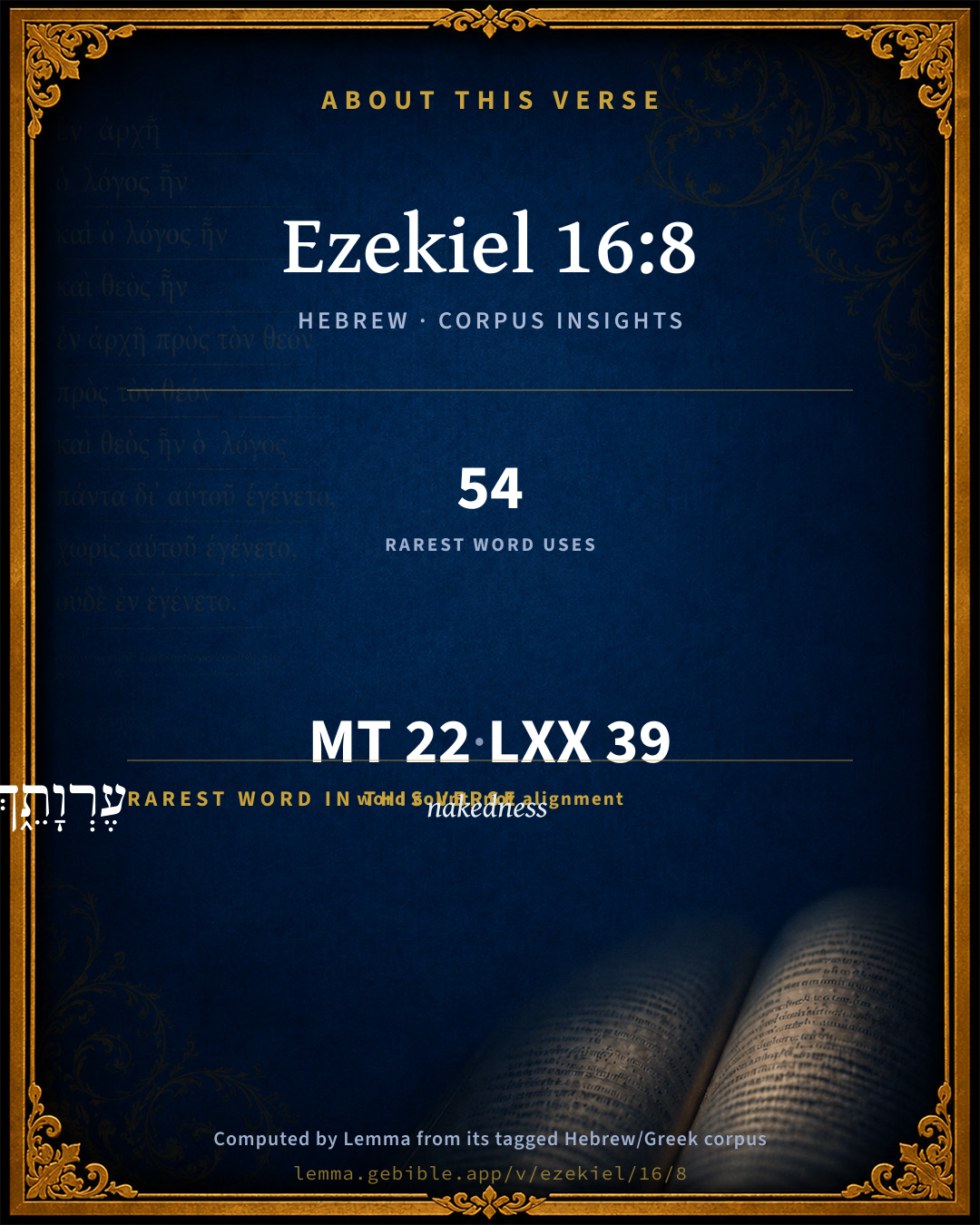
22
words
18
distinct lemmas
Prophets
section

Shared distinctive vocabulary

עֶרְוָתֵ֑ךְ nakedness H6172 occurs in 40 verses of the Hebrew Bible. Also found in:

Grammatical profile

  • 7 verbs
  • 9 nouns
  • 4 prepositions
  • 2 particles

Verb forms

  • וָאֶעֱבֹ֨ר Qal · Sequential Imperfect
  • וָאֶרְאֵ֗ךְ Qal · Sequential Imperfect
  • וָאֶפְרֹ֤שׂ Qal · Sequential Imperfect
  • וָאֲכַסֶּ֖ה Piel · Sequential Imperfect
  • וָאֶשָּׁ֣בַֽע Niphal · Sequential Imperfect
  • וָאָב֨וֹא Qal · Sequential Imperfect
  • וַתִּ֥הְיִי Qal · Sequential Imperfect

Repetition

Words recur within this verse — often emphatic in Hebrew:

  • עָלַ֜יִךְ upon H5921 ×2
  • עִתֵּךְ֙ time H6256 ×2

Hebrew & Septuagint length

In English translation the verse runs 49 words from the Hebrew and 48 from the Septuagint (LXX English) — closely comparable.

A rough comparison of the two English renderings, which tokenize alike — not a word-level alignment.

Word counts can differ between the Hebrew and the Greek without any difference in meaning — e.g. the Hebrew direct-object marker אֵת has no separate Greek word, and Greek often adds the article ὁ.

In the original languages it is 22 Hebrew tokens and 39 Greek tokens — but the two are counted differently (Hebrew bundles its prefixes and suffixes into one token; the Greek is in lemma form), so that isn’t a like-for-like length.

Cross-references

20

Topical passages linked to Ezekiel 16:8 in the Treasury of Scripture Knowledge — connected by theme and wording, ordered by reader-vote popularity; previews shown in the World English Bible.

  • Ruth 3:9 He said, Who are you? She answered, I am Ruth your handmaid: spread therefore your skirt over your handmaid; for you are a near kinsman.
  • Jeremiah 2:2–3 Go, and cry in the ears of Jerusalem, saying, Thus says Yahweh, I remember for you the kindness of your youth, the love of your weddings; how you went after me in the wilderness, in a land that was not sown.
  • Romans 5:8 But God commends his own love toward us, in that while we were yet sinners, Christ died for us.
  • Isaiah 43:4 Since you have been precious in my sight, [and] honorable, and I have loved you; therefore will I give men in your place, and peoples instead of your life.
  • Exodus 32:13 Remember Abraham, Isaac, and Israel, your servants, to whom you swore by your own self, and said to them, 'I will multiply your seed as the stars of the sky, and all this land that I have spoken of I will give to your seed, and they shall inherit it forever.'"
  • Exodus 19:4–8 'You have seen what I did to the Egyptians, and how I bore you on eagles' wings, and brought you to myself.
  • Deuteronomy 4:31 for Yahweh your God is a merciful God; he will not fail you, neither destroy you, nor forget the covenant of your fathers which he swore to them.
  • Deuteronomy 7:6–8 For you are a holy people to Yahweh your God: Yahweh your God has chosen you to be a people for his own possession, above all peoples who are on the face of the earth.
  • 1 Samuel 12:22 For Yahweh will not forsake his people for his great name's sake, because it has pleased Yahweh to make you a people to himself.
  • Hosea 11:1 "When Israel was a child, then I loved him, And called my son out of Egypt.
  • Ezekiel 16:6 When I passed by you, and saw you weltering in your blood, I said to you, [Though you are] in your blood, live; yes, I said to you, [Though you are] in your blood, live.
  • Isaiah 41:8–9 But you, Israel, my servant, Jacob whom I have chosen, the seed of Abraham my friend,
  • Jeremiah 31:3 Yahweh appeared of old to me, [saying], Yes, I have loved you with an everlasting love: therefore with loving kindness have I drawn you.
  • Malachi 1:2 "I have loved you," says Yahweh. Yet you say, "How have you loved us?" "Wasn't Esau Jacob's brother?" says Yahweh, "Yet I loved Jacob;
  • Exodus 24:1–8 He said to Moses, "Come up to Yahweh, you, and Aaron, Nadab, and Abihu, and seventy of the elders of Israel; and worship from a distance.
  • Isaiah 63:7–9 I will make mention of the loving kindnesses of Yahweh, [and] the praises of Yahweh, according to all that Yahweh has bestowed on us, and the great goodness toward the house of Israel, which he has bestowed on them according to his mercies, and according to the multitude of his loving kindnesses.
  • Jeremiah 31:32 not according to the covenant that I made with their fathers in the day that I took them by the hand to bring them out of the land of Egypt; which my covenant they broke, although I was a husband to them, says Yahweh.
  • Ezekiel 20:5–6 and tell them, Thus says the Lord Yahweh: In the day when I chose Israel, and swore to the seed of the house of Jacob, and made myself known to them in the land of Egypt, when I swore to them, saying, I am Yahweh your God;
  • Hosea 2:18–20 In that day I will make a covenant for them with the animals of the field, And with the birds of the sky, And with the creeping things of the ground. I will break the bow, the sword, and the battle out of the land, And will make them lie down safely.
  • Romans 9:10–13 Not only so, but Rebecca also conceived by one, by our father Isaac.

Cross-references courtesy of OpenBible.info (CC BY 4.0).

Hebrew and Greek witnesses Masoretic Hebrew ↔ Greek Septuagint

The same verse in the two great witnesses to the Old Testament, shown verse-for-verse.

These are two independent witnesses, not word-aligned to each other, and the Septuagint is shown in lemma (dictionary) form.

Hebrew Ezekiel 16:8 Masoretic · Westminster Leningrad Codex

וָאֶעֱבֹ֨ר עָלַ֜יִךְ וָאֶרְאֵ֗ךְ וְהִנֵּ֤ה עִתֵּךְ֙ עֵ֣ת דֹּדִ֔ים וָאֶפְרֹ֤שׂ כְּנָפִי֙ עָלַ֔יִךְ וָאֲכַסֶּ֖ה עֶרְוָתֵ֑ךְ וָאֶשָּׁ֣בַֽע לָ֠ךְ וָאָב֨וֹא בִבְרִ֜ית אֹתָ֗ךְ נְאֻ֛ם אֲדֹנָ֥י יְהוִ֖ה וַתִּ֥הְיִי לִֽי

Now when I passed by you, and looked at you, behold, your time was the time of love; and I spread my skirt over you, and covered your nakedness: yes, I swore to you, and entered into a covenant with you, says the Lord Yahweh, and you became mine.

World English Bible · Public Domain

Greek LXX Ezekiel 16:8 Septuagint · lemma form

καί διαἔρχομαι διά σύ καί ὁράω σύ καί ἰδού καιρός σύ καιρός καταλύω καί διαπετάζω ὁ πτέρυξ ἐγώ ἐπί σύ καί καλύπτω ὁ ἀσχημοσύνη σύ καί ὄμνυμι σύ καί εἰςἔρχομαι ἐν διαθήκη μετά σύ λέγω κύριος καί γίγνομαι ἐγώ

And I passed by you and saw you, and, behold, it was your time and a time of resting; and I spread my wings over you, and covered your shame, and swear to you: and I entered into covenant with you, says the Lord, and you became mine.

LXX2012 (modern English Septuagint) · Public Domain

Hebrew: Westminster Leningrad Codex (CC BY 4.0). Greek: Septuagint (public domain); English from LXX2012 (modern English Septuagint) (Public Domain). How the Septuagint differs from the Hebrew →

Targum (Aramaic paraphrase)

1

The Targum is the ancient Jewish Aramaic paraphrase of the Hebrew Scriptures — an interpretive translation, not the Hebrew text itself. Onkelos (literal) and Pseudo-Jonathan (expansive) render the Torah, and Jonathan the Prophets. Coverage is partial: where no permissively-licensed English translation exists for a verse, only the Aramaic is shown. This is verse-level text, not a word-by-word alignment to the Hebrew.

  1. Targum Jonathan Prophets (Joshua–Malachi)
    וְאִתְגְלֵיתִי עַל מֹשֶׁה בְּאַסְנָא אֲרֵי גְלֵי קֳדָמָי אֲרֵי מְטָא זְמַן פּוּרְקָנֵיכוֹן וְאַגְנֵית בְּמֵימְרִי עֲלֵיכוֹן וְאַעֲדֵיתִי חוֹבֵיכוֹן וְקַיֵמִית בְּמֵימְרִי לְמִפְרַק יַתְכוֹן כְּמָא דְקַיֵמֵית לַאֲבָהָתְכוֹן אֲמַר יְיָ אֱלֹהִים לְמֶהֱוֵיכוֹן עַם מְשַׁמֵשׁ קֳדָמַי:

    And I revealed myself to Moses in the bush, for it was revealed before Me that the time had come for your liberation, and I protected you by My word, and I removed your sins, and I swore by My word to liberate you, as I had sworn to your ancestors — said the LORD GOd — to be a people serving before Me.

    Targum Jonathan — Aramaic: “Mikraot Gedolot” (public domain). English: “Sefaria Community Translation” (CC0 1.0 (public-domain dedication)); “London "Chaldee Paraphrase," 1871” (public domain). Text via Sefaria.

Commentary

Notes on Ezekiel 16:8 from classic Christian and Jewish commentators (each source and its license shown beneath its notes). The classic Christian expositions comment on the surrounding passage and are grouped to its opening verse, so a note may address several verses; the Jewish commentaries on the Tanakh (Rashi and others) are per-verse, so they appear only where the commentator wrote on this verse.

Lemma curates 59 commentaries, every one of them public domain or Creative Commons licensed, each selected and text-cleaned for this edition rather than reprinted as found. About our sources →

Trapp's Complete Commentary

John Trapp

Eze 16:8 Now when I passed by thee, and looked upon thee, behold, thy time [was] the time of love; and I spread my skirt over thee, and covered thy nakedness: yea, I sware unto thee, and entered into a covenant with thee, saith the Lord GOD, and thou becamest mine.

Ver. 8. Behold, thy time was the time of love.] When thou wast both fit for marriage, and desirous of it. For as the man misseth his rib, so the woman would be in her old place again, under the man’s arm or wing. See Rth 3:1; Rth 3:9.

And I spread my skirt over thee.] See Rth 3:9. {See Trapp on "Rth 3:9"} I covered thy nakedness, and took thee into my care and company as a wife. A marriage rite is imported by this expression.

Yea, I sware unto thee, &c.] So much ado God hath with us to make us believe. The apostle mentioneth "the work of faith." She hath somewhat to do before she can fasten.

John Trapp, A Commentary or Exposition upon All the Books of the Old and New Testament (1647–1656) — public domain. Text from a community e-Sword module.

The Biblical Illustrator

Joseph S. Exell

Eze_16:8

Yea, I sware unto thee, and entered into a covenant with thee, saith the Lord God, and thou becamest Mine.

Two immutable, things

Biographies are generally interesting, if they are biographies; that is to say, if the events of the persons life are truly told; but the most interesting biography to any man is his own life. Turn over the pages of the book of memory, and think of those first times when you sought and found the Saviour, when you repented, when you believed, when you yielded yourself up to Jesus, when He took you to be His, and you took Him to be yours. I am sure that this exercise will awaken many happy thoughts, and I feel equally certain that it will suggest many regrets; but the happiness will be good for you if it excites your gratitude, and the regrets will be good for you if they deepen your penitence. Beloved, tim time of our conversion, the time when we joyously realised that we were saved, was a covenanting time. It is a somewhat singular thing that, in this chapter, God does not say anything about Israels part of the covenant; He seems to pass that over as though it were never worth mentioning. So, at this time, I shall not say much about the covenant that you made with God; do not forget it, and do not forget that you have often forgotten it.

I. It was a covenant freely made.

1. It was a covenant which He made at His own suggestion, out of the greatness of His own love; for the nation of Israel, of which He speaks, had nothing in its pedigree to suggest it. There are some who do not believe in the depravity of human nature. I must believe in it if I am myself a fair specimen of human nature; and every man who has watched his own heart,, and has any idea of the sin which dwells within him, will know that his origin is tainted, that from the very first there is a tendency to evil, and only evil; and, therefore, that there is nothing in him as to his birth that can command or deserve the favour of God.

2. There was nothing in our condition to commend it. This poor child had never been washed or clothed--it was left in all its filthiness to die; there was nothing about it to commend it to the attention of the passer-by. And what were we by nature?

3. It was also a covenant freely made because there was nothing in our beauty to warrant it. Whatever there was there, was undeveloped and, worse still, unclean. And in that day when Jesus took us to Himself, and we took Him to be our Saviour, there was nothing as yet apparent of that which His grace has now wrought in us; it was totally absent then.

II. It was a covenant entirely of love.

1. Taking our text in its connection, we learn that this covenant was a marriage covenant.

2. That it was a covenant which was meant to be entirely of love is proved by the way in which it was carried out (Eze_16:9-13). This is a covenant all of love, for these are all love-tokens, love-gifts to the beloved one. Now, will you go back in thought, and recollect when you used to receive those gifts from the Lord?

3. It must be a covenant all of love which God has made with such creatures as we are, because it could bring the Lord no profit.

III. It was a most sure covenant: I sware unto thee, and entered into a covenant with thee.

1. The covenant which God makes with believers is intended to remain forever. It is not something which may be broken in a few hours, like a childs toys; it is an everlasting covenant (Eze_16:60).

2. In proof that He intended it to remain, He ratified it by an oath.

3. To make a covenant even surer than by an oath, men were accustomed to seal it by a sacrifice. Now, beloved, you who believe have the precious blood of the Lord Jesus Christ, as of a lamb without blemish and without spot, to confirm the covenant of grace.

4. I would have you notice, in our text, that the covenant is remembered by God. It is He who Says, I sware unto thee, and entered into a covenant with thee.

5. Yet once more, this covenant will be remembered by Him forever (Eze_16:60; Eze_16:62).

IV. This covenant involves very gracious consequences. Thou becamest Mine.

1. If God has entered into covenant with us, we have become the Lords. Whose were you before? The worlds? Your own? The devils? Well, we will not dispute with the many claimants; but now you can say, O Lord our God, other lords beside Thee have had dominion over us: but by Thee only will we make mention of Thy name.

2. Now, we ought to be the Lords more and more.

3. If that be our feeling, it will lead us practically to renew the bond of the covenant.

4. And you who have never done so, may you come to Jesus this very moment! Your only hope lies in Him. (C. H. Spurgeon.)

Gods covenant with the reclaimed soul

In Canada they build palaces of ice in the winter time, and very beautiful things they are; but then, when spring comes where are those palaces? And in summer, the very foundation upon which they were built has melted back into the St. Lawrence. God does not make with His believing people covenants like those ice palaces; His covenant stands secure, though earths old columns bow. If God has promised to save thee,--as He has done if thou believest in Jesus,--He will save thee in the teeth of death and hell. Rest thou sure of this, and say with David, He hath made with me an everlasting covenant, ordered in all things and sure. Here is something to rest upon: I sware unto thee, and entered into a covenant with thee. He intended it to remain. (C. H. Spurgeon.)

The moment of being possessed by Christ

Thou becamest Mine. Do you recollect the spot--perhaps it was your own little room--where, as a youth, you sat after having long prayed and wept? And at last you felt that Jesus was yours; and you sat still, and you said to yourself Yes, I am His, every bit of me. He has bought me with His blood, I am His. Do you remember those first few days in which you felt half afraid to do anything lest you should grieve that dear Lover of your soul? Then you wanted to do everything that you might please Him whose servant you had become. I remember a verse of Scripture which, as a young believer, I used often to repeat; for it was very dear to me. I daresay you love it too; it is this: Bind the sacrifice with cords, even unto the horns of the altar. We did feel then that we were wholly Christs; do we feel it as much now? Thou becamest Mine. To come back to the marriage covenant of which the Lord speaks,--when the husband put the ring upon his brides finger, he said to her, Thou hast become mine. Do you remember when you felt upon your finger the ring of infinite, everlasting, covenant love that Christ put there. Thou becamest Mine. Oh, it was a joyful day, a blessed day! Happy day, happy day, when His choice was known to me, and fixed my choice on Him! (C. H. Spurgeon.)

Owned by God

It is a great privilege not to be ones own. A vessel is drifting on the Atlantic hither and thither, and its end no man knoweth. It is derelict, deserted by all its crew; it is the property of no man; it is the prey of every storm and the sport of every wind; rocks, quicksands, and shoals wait to destroy it; the ocean yearns to engulf it. It drifts onward to no mans land, and no man will mourn its shipwreck. But mark well yonder bark of the Thames, which its owner surveys with pleasure. In its attempt to reach the sea it may run ashore, or come into collision with other vessels, or in a thousand ways suffer damage; but there is no fear, it will pass through the floating forest of the Pool; it will thread the winding channel and reach the Nore, because the owner will secure it pilotage, skilful and apt. How thankful you and I should be that we are not derelict today! We are not our own, not left on the wild waste of chance to be tossed to and fro by fortuitous circumstances, but there is a Hand upon the helm; we have on board a Pilot who owns us, and will surely steer us into the Fair Heavens of eternal rest. (C. H. Spurgeon.)

The adornments of Christs Church

It was observed of Queen Elizabeth (as of her father before her), that she loved to go very richly arrayed. Her sister Queen Mary had, at her coronation, her head so laden with:jewels that she could hardly hold it up. King Richard II had one coat of gold and stone valued at 30,000 marks. This was much, but nothing to the Churchs beauty and bravery, which yet was all but borrowed, as is said in the next verse. (J. Trapp.)

How to obtain Christs beauty

Gods beauty which He puts upon His people is His own moral loveliness. This attribute of Divine goodness, while enshrined in the teaching of the Word of God, is most effectively seen in the person of the Lord Jesus. It is from Him we catch it, if at all. As the sun imprints the image upon the sensitive plate in the camera when it is exposed to it, so Christs beauty is put upon us if we are exposed to Him by a life of communion. We do not, however, own Christs beauty merely passively, there must be a constant deliberate imitation of His holy example. I must go home and deepen the colouring of my infant Hercules, exclaimed Sir Joshua Reynolds after gazing on the beautiful sunburnt face of a peasant boy. Frequent communings with Christ make one dissatisfied with his poor copying of so beautiful a character. I must be more Christlike must be the great resolve as we go forth from His presence if we would own Christs beauty. (Charles Deal.)

The transformation grace works

John Ruskin was one day walking along the streets of London. The weather had been very wet, and the mud was plentiful and most sticky. The thought occurred to him that he would have the mud analysed to find out exactly the inorganic elements in it. This was accordingly done, and the London mud was found to consist of sand, clay, soot, and water. Musing upon that fact, it struck him that these are the very substances from which our precious jewels and gems are formed. From the sand or silica come the onyx, chrysolite, agate, beryl, cornelian, chalcedony, jasper, sardine, amethyst; from the clay come the sapphire, ruby, emerald, topaz; and from the soot is formed the diamond. London mud composed of priceless jewels! Man cannot transform the mud into those glittering points of light, but God transforms and recreates the mud of depraved humanity into the glory of redeemed and beautiful souls. (John Robertson.)

The Biblical Illustrator, edited by Joseph S. Exell (c. 1880s–1900s) — public domain. Text from a community e-Sword module.

Joseph Benson's Commentary

Eze 16:8-12. Now when I passed by thee, &c. — This second passing by may be understood of God’s visiting them in Egypt, and calling them out. Behold, thy time, &c. — The time of thy misery was the time of my love toward thee. And I spread my skirt over thee — I espoused thee and took thee under my protection as a husband doth his wife, Rth 3:9. And covered thy nakedness — Enriched thee with the spoils and possessions of the Egyptians and Canaanites: see Eze 16:10-11. Yea, I entered into covenant with thee — This was done in mount Sinai, when the covenant between God and Israel was sealed and ratified. Those to whom God gives spiritual life, he takes into covenant with himself. By this covenant they become his, his subjects and servants, which speaks their duty: and at the same time his portion and treasure, which speaks their privilege. Then I washed thee with water — It was a very ancient custom among the eastern people to purify virgins who were to be espoused. And I anointed thee with oil — Thus also were women, on some occasions, prepared for their nuptials. The washings and purifications of the law are probably intended to be signified by these metaphorical expressions; and the priesthood by the anointing with oil here spoken of. I clothed thee also with broidered work — Or, with needlework of divers colours. The expression may refer to the rich garments of the priests, and the covering and hangings of the tabernacle; or it may denote the gifts and graces bestowed upon them. And shod thee with badgers’ skins — Or, with sandals of a purple colour, as Bochart expounds the word תחשׁ. The eastern people had an art of curiously dressing and colouring the skins of badgers, of which they made their neatest shoes, for the richest and greatest personages. “This and the following verses allude to those parts of women’s attire which serve not only for use but for ornament also; and import that God did not only provide the Jews with necessaries, but likewise with superfluities.” I decked thee also with ornaments — This and the following expressions are descriptive of the great wealth and felicity of the Jewish people, particularly under David and Solomon. I put bracelets upon thy hands, &c. — Ornaments which none but persons of better quality used to wear, Gen 24:47; Pro 1:9. And I put a jewel on thy forehead — The same which is called a nose-jewel, Isa 3:21. And a beautiful crown upon thy head — “Crowns, or garlands, were used in times of public rejoicing; from whence is derived that expression of St. Paul, A crown of rejoicing, 1Th 2:19 : compare Isa 25:10. Virgins were sometimes adorned with crowns; and they were commonly put upon the heads of persons newly married, Son 3:11.” — Lowth.

Joseph Benson's Commentary on the Old and New Testaments (1811–1818) — public domain. Text from a community e-Sword module.

Tyndale Open Study Notes

Tyndale Open Resources

16:8 At this time, the Lord wrapped his cloak around her, an act that represented a commitment to marriage (cp. Ruth 3:9). The Lord made a covenant with Jerusalem, and in the terms of the metaphor, he married her. When the Lord entered into a covenant with David and his descendants, he also chose Jerusalem as the place for his name to be honored (see 1 Kgs 9:3-4; Ps 132).

Tyndale Open Study Notes — © Tyndale Open Resources, licensed CC BY-SA 4.0. Text via the HelloAO Bible API.

Geneva Bible (1599)

Geneva Bible translators

That thou shouldest be a chaste wife unto me, and that I should maintain thee and endue thee with all graces.

These words, as blood, pollution, nakedness, and filthiness, are oftentimes repeated to beat down their pride, and to cause them to consider what they were before God received them to mercy, favored them and covered their shame.

Geneva Bible (1599) marginal notes — public domain. Text via Bolls.life.

Jamieson, Fausset & Brown

Robert Jamieson, A. R. Fausset & David Brown

thy time of love--literally, "loves" (compare Sol 2:10-13). Thou wast of marriageable age, but none was willing to marry thee, naked as thou wast. I then regarded thee with a look of grace when the full time of thy deliverance was come (Gen 15:13-14; Act 7:6-7). It is not she that makes the advance to God, but God to her; she has nothing to entitle her to such notice, yet He regards her not with mere benevolence, but with love, such as one cherishes to the person of his wife (Sol 1:3-6; Jer 31:3; Mal 1:2).

spread my skirt over thee--the mode of espousals (Rut 3:9). I betrothed thee (Deu 4:37; Deu 10:15; Hos 11:1). The cloak is often used as a bed coverlet in the East. God explains what He means, "I entered into . . . covenant with thee," that is, at Sinai. So Israel became "the wife of God's covenant" (Isa 54:5; Jer 3:14; Hos 2:19-20; Mal 2:14).

thou . . . mine-- (Exo 19:5; Jer 2:2).

Jamieson, Fausset & Brown — Commentary Critical and Explanatory on the Whole Bible (1871) — public domain (CC PDM 1.0). Text via the HelloAO Bible API.

Adam Clarke's Commentary

Verse 8. Was the time of love] Thou wast marriageable.

I spread my skirt over thee] I espoused thee. This was one of their initiatory marriage ceremonies. See Ru 3:9.

I-entered into a covenant with thee] Married thee. Espousing preceded marriage.

Adam Clarke's Commentary on the Bible (1810–1826) — public domain. Text from a community e-Sword/MySword module.

John Calvin's Commentaries

God now reproaches the Jews with his kindness towards them, since he had clothed them in splendid ornaments, and yet they afterwards cast themselves into the vilest lusts, as we shall see. But we must remember that the Prophet is now speaking of the time of their liberation. But God says that he passed by again and saw the state of the people, — not that he had ever forgotten it. For we know that even when he dissembles and seems to shut his eyes and turn them from us or even to sleep, yet he is always anxious for our safety. And we have already said that there was need of his present power, that the people might prolong their lives, since if he had not breathed life into them, a hundred deaths would have immediately prevailed. But it is sufficiently common and customary to mark an open declaration of help by God’s aspect. When God appears so openly to deliver us that it may be comprehended by our senses, then he is said to look down upon us, to rise up, and to turn himself towards us. He passed by, then, near the people, namely, when he called Moses out of the desert and appointed him the minister of his favor, (Exodus 3,) he then saw his people, and proved by their trial that he had not utterly cast them away. I looked, then, and behold thy time, thy time of years. Here God speaks grossly, yet according to the people’s comprehension. For he personates a man struck with the beauty of a girl and offering her marriage. But God is not affected as men are, as we well know, so that it is not according to his nature to love as young men do. But such was the people’s stupidity, that they could not be usefully taught, unless the Prophet accommodated himself to their grossness. Add also that the people had been by no means lovely, unless God had embraced them by his kindness, so that his love depended on his good pleasure towards them. So by the time of loves, we ought to understand the complete time of their redemption, for God had determined to bring the people out of Egypt when he pleased, and that had been promised to Abraham: after four hundred years I will be their avenger. (Genesis 15:13, 14; Acts 7:6, 7,) We see, then, that the years were previously fixed in which God would redeem the people. He now compares that union to a marriage. Hence if God would bind his people to himself by a marriage, so also he would pledge himself to conjugal fidelity. But I cannot proceed further — I must leave the rest till tomorrow.

John Calvin's Commentaries (1540-1563) — public domain. Text from the Calvin Translation Society English edition (1840s-50s) via the Christian Classics Ethereal Library (ccel.org). Calvin's coverage is partial (roughly two-thirds of the Bible); uncommented books and verses are honest gaps, never fabricated. The 19th-century editor's footnotes and remarks are omitted so the notes are faithfully Calvin's own voice.

Ellicott's Commentary for English Readers

(8) Now when I passed by thee.—Here, as in Eze_16:6, omit the when, and render, “and I passed by thee.” Two separate visits are spoken of: the one in Israel’s infancy in Egypt, when God blessed and multiplied her (Eze_16:6); the other when she had become a nation, and God entered into covenant with her in the Exodus and at Sinai. The verse describes this covenant in terms of the marriage relation, a figure very frequent in Scripture. On the phrase “spread my skirt,” comp. Rth_3:9, and on “becamest mine,” Rth_4:10.

A Bible Commentary for English Readers, edited by Charles John Ellicott (1878–1897) — public domain. Text from a community e-Sword module.

The Cambridge Bible for Schools and Colleges

gen. ed. J. J. S. Perowne

8–14. The child, now an adult virgin, taken to Himself in marriage by Jehovah:—the redemption of the people from Egypt, and covenant with them at Sinai to be their God

8. Now when I passed] Better in continuance of the historical narrative, and I passed by.

the time of love] The outcast child was now a marriageable woman.

spread my skirt] Cf. Rth_3:9—a figure for marriage.

a covenant with thee] The marriage relation is a covenant, Pro_2:17; Mal_2:14. On the “oath,” cf. Eze_16:59.

thou becamest mine] She became his wife, Rth_4:13; Hos_3:3.

The Cambridge Bible for Schools and Colleges (gen. ed. J. J. S. Perowne; Cambridge University Press, 1878–1918) — public domain. Text from a community e-Sword module.

John Gill's Exposition

Then washed I thee with water,.... Brought the Israelites out of the mean, abject, servile, and sordid state in which they were, when among the mortar, bricks, and pots, into a state of liberty; so the Targum,

"and I redeemed you from the servitude of the Egyptians; and I removed the strength of dominion from you, and brought you into liberty;''

perhaps some reference may be had to the ceremonial ablutions enjoined them; they were washed before the covenant was made with them at Mount Sinai, just referred to; their priests, sacrifices, vessels, and all unclean persons, were to be washed, and purifications were prescribed them:

yea, I thoroughly washed away thy blood from thee: as with an inundation overflowing; so the word (p) signifies; very fitly is this mentioned, since in Eze 16:6; they are said to be "polluted in their blood", and now washed from it: all men are defiled with sin, originally, naturally, internally, and universally; nor can they cleanse themselves by anything they can do, God only can; and this he promises to do; and this he does, not with water baptism, which does not take away sin, original or actual; nor with the washing of regeneration, or by regenerating grace; though that is sometimes compared to water; which, among other things, is of a cleansing nature; and of which men are born again, and by it sanctified; and which is done by the Spirit, who is a spirit of judgment and burning, by whom the faith of the daughter of Zion is washed away; and because this is done by the word and ordinances as means, hence these are called waters; see Eze 36:25; yet hereby men are not "thoroughly" washed; though a clean heart is created in them, a new man is formed in righteousness and true holiness; yet the filthiness of the old man remains, which appears in thoughts, words, and actions; but the thorough washing is by the blood of Christ; that is the fountain opened for sin and uncleanness; with this men are washed by Christ from their sins; this has a purgative and cleansing nature; and it cleanses from all sin, and justifies from everyone; so that hereby a man thoroughly washed is clear of all sin, none to be found or seen in him; he is without spot or wrinkle, or any such thing; and has solid peace in his soul; his heart being sprinkled with this blood from an evil conscience, and, being purged, has no more conscience of sin; so that this is expressive of the fulness of justifying and pardoning grace:

and I anointed thee with oil; alluding to the anointing oil, with which the priests, tabernacle, and vessels, were anointed; or to the land of Canaan, a land of oil olive, into which the Israelites were brought; or to the custom of washing and anointing women before marriage; see Rut 3:3; and to the use of oil in baths, which was frequent: this may spiritually design the grace of the Spirit, which, like the oil on Aaron's head, is exceeding "precious", as are faith, hope, and love; and, like the "pure" oil for the candlestick, productive of purity of heart, lip, and life; of a delightful smell, as are the church's ointments she has from Christ, Sol 1:3; and very cheering and refreshing, and therefore called oil of gladness, Psa 45:7; and ornamental and beautifying, as all grace is; and oil will not mix with another liquor, as grace will not with sin and corruption, and is of an abiding nature: now it is God that anoints with this; this oil comes from the God of all grace; is fro, in Christ the Holy One, and out of his fulness; from him the head it descends to all his members, and is applied by the blessed Spirit; see Co2 1:21.

(p) "ut inundans eluerem sanguinem tuum", Junius & Tremellius, Polanus; "inundavi sanguines tuos", Montanus; "affundendo ablui", Cocceius.

John Gill's Exposition of the Whole Bible (1746–1763) — public domain (CC PDM 1.0). Text via the HelloAO Bible API.

Albert Barnes' Notes on the Bible

Now when ... - Or, Then I passed by thee ... and behold. The espousal of the damsel represents God’s entering into covenant with the people in the wilderness at Mt. Sinai Exo 34:27.

Albert Barnes' Notes on the Bible (1834–1885) — public domain. Text from a community e-Sword/MySword module.

Haydock's Catholic Bible Commentary

Lovers. Hebrew dodim, "breasts, (Haydock) or espousals;" (Aquila) "loving." (Symmachus) --- Garment, as a husband, Ruth iii. 9., and Jeremias ii. 2.

George Leo Haydock (1774–1849), Haydock's Catholic Family Bible and Commentary, 1859 edition — public domain. Excludes Psalms (Douay-Rheims chapter numbering differs from Protestant) and Deuterocanonical books (Catholic canon only).

Matthew Poole's English Annotations

When I passed by thee: see Eze 16:6, of the phrase. This second passing by may well be understood of God’s visiting them and calling them out of Egypt.

Looked upon thee: see the phrase Eze 16:6.

Thy time was the time of love; the time of thy misery was the time of love and pity in me towards thee, and the time of thy grown beautified state was the time of my love of delight, when I rejoiced in thee, and espoused thee to be my wife. Thy time, i.e. the season fittest for the discovery of my purposes towards thee, was the time of love, which is expressed in what follows in the verse,

I spread my skirt over thee, i.e. betrothed thee, as Rth 3:9; Deu 22:30, engaged by marriage to love, cherish, protect, and safeguard.

Covered thy nakedness; what was and would be thy reproach my love and bounty covered, I clothed thee with spoils of Egypt, and gave time flocks, with the wool whereof thou mightest clothe thyself. If you take it figuratively, I covered all thy filthiness, and washed it away.

I sware unto thee; gave thee the greatest, most inviolable, and solemn assurance of my conjugal love, care, and faithfulness.

Entered into a covenant with thee: this was done at Mount Sinai, Exo 19:5.

Saith the Lord God: the truth of all which the Lord doth avow in this form of asseveration.

Thou becamest mine; by the obligations of my kindness thou couldst be no less, by thy own voluntary act and consent, by promise and profession, Exo 19:7,8.

Matthew Poole's English Annotations on the Holy Bible (1683–1685) — public domain. Text from a community e-Sword/MySword module.

Whedon's Commentary on the Bible

Daniel D. Whedon

8. Spread my skirt — The customary symbol for marriage. (See Ruth 3:19.)

Thou becamest mine — The marriageable age, the time of love had arrived, and the divine Friend now becomes a Lover. With the patriarchs God made a covenant of friendship, but in the Exodus he married himself to Israel. He himself says he “chose Israel” then (Eze_20:5; compare Exo_3:7; Exo_3:9; Deu_7:7-8; <19A512>Psa_105:12, etc.).

Daniel D. Whedon (gen. ed.), Commentary on the Old and New Testaments (1874–1909) — public domain. Text from a community e-Sword module.

The Pulpit Commentary

The words point to the time of the love of the espousals of Jer_2:2, interpreting the parable, when Israel had grown to the maturity of a nation"s life, and gave promise, in spite of previous degradation, of capacities that would render it worthy of the love of the Divine Bridegroom. I spread my skirt over thee. Garments were often used as coverlets, and the act described was therefore, as in Rth_3:9, the received symbol of a completed marriage. (comp. Deu_22:30 Deu_27:20) The historical fact represented by the symbol here was probably the formal covenant between Jehovah and Israel. (Exo_24:6, Exo_24:7) It was then that he became her God, and that she became his people.

The Pulpit Commentary (1880–1919), ed. H.D.M. Spence-Jones & Joseph S. Exell — public domain. Text from a community e-Sword module.

John Wesley's Explanatory Notes

When I passed - This second passing by, may be understood of God's visiting and calling them out of Egypt. Thy time - The time of thy misery was the time of love in me towards thee. I spread my skirt - Espoused thee, as Ruth iii, 9. Entered into a covenant - This was done at Mount Sinai, when the covenant between God and Israel was sealed and ratified. Those to whom God gives spiritual life, he takes into covenant with himself. By this covenant they become his, his subjects and servants; that speaks their duty: and at the same time his portion, his treasure; that speaks their privilege.

John Wesley, Explanatory Notes Upon the Whole Bible (1754–1765) — public domain. Text via the GEBible commentary corpus.

unfoldingWord translationNotes

Door43 World Missions Community

General Information:

Yahweh continues to speak about Jerusalem as if the city were a young woman. The city represents the people who live there. (See: Metaphor and Metonymy)

See!

The word "see" here alerts us to pay attention to the surprising information that follows.

the time of love came for you

This is to say that Yahweh sees the young woman is old enough to be married.

this is the Lord Yahweh's declaration

Yahweh speaks of himself by name to express the certainty of what he is declaring. See how you translated this in Ezekiel 5:11. AT: "this is what the Lord Yahweh has declared" or "this is what I, the Lord Yahweh, have declared" (See: First, Second, or Third Person)

translationWords

love

robe

covenant

declare

unfoldingWord translationNotes — © Distant Shores Media and the Door43 World Missions Community, licensed CC BY-SA 4.0. Source: git.door43.org/Door43/en_tn.

Rashi

Rabbi Shlomo Yitzchaki (Rashi)

love Heb. דֹדִים, amities in French; friendship, love.

Rashi on the Tanakh — English translations: “The Judaica Press complete Tanach with Rashi, translated by A. J. Rosenberg” (CC BY 4.0); “Pentateuch with Rashi's commentary by M. Rosenbaum and A.M. Silbermann, 1929-1934” (public domain); “The Metsudah Tanach series, Lakewood, N.J” (CC BY 4.0); and “The Book of Joshua, Metsudah Publications, 1997” (CC BY 4.0). Text via Sefaria.

Lesson kit

Teaching starters — assembled from the data on this page, not authored interpretation. Every prompt links to the verse data it draws on. Edit before teaching.

Ezekiel, in the Prophets, opens this verse with 22 words (18 distinct Hebrew lemmas). Its most distinctive word is ʻervâh (“nakedness”). A historical commentator’s framing appears above. Read the whole chapter for the surrounding context.

Discussion questions

  1. What does “nakedness” (ʻervâh) contribute to the verse as a whole?
  2. Genesis 9:22 shares the word «nakedness» with this verse. How do the two illuminate each other?
  3. “upon” occurs 2× in this one verse. What is the effect of the repetition?
  4. These translations render this verse differently; the difference is in the English rendering, not the original. What questions does that raise?
  5. The verb «וָאֶעֱבֹ֨ר» is Qal Sequential Imperfect. How does its form color the action?
  6. Reading how Trapp's Complete Commentary and The Biblical Illustrator read this verse, where do the two commentators agree and where do they part?

Things to notice

Reading settings

Reading text

Shown beneath each verse's original-language words.

Old Testament
Old Testament edition

Read the OT as the Masoretic Hebrew (MT) or the Greek Septuagint (LXX).

English shown for the Greek Septuagint (in the Hebrew ↔ Greek comparison).

Comparing translations? Open the Compare panel on any verse page to stack up to four side by side.