Jeremiah 14:21

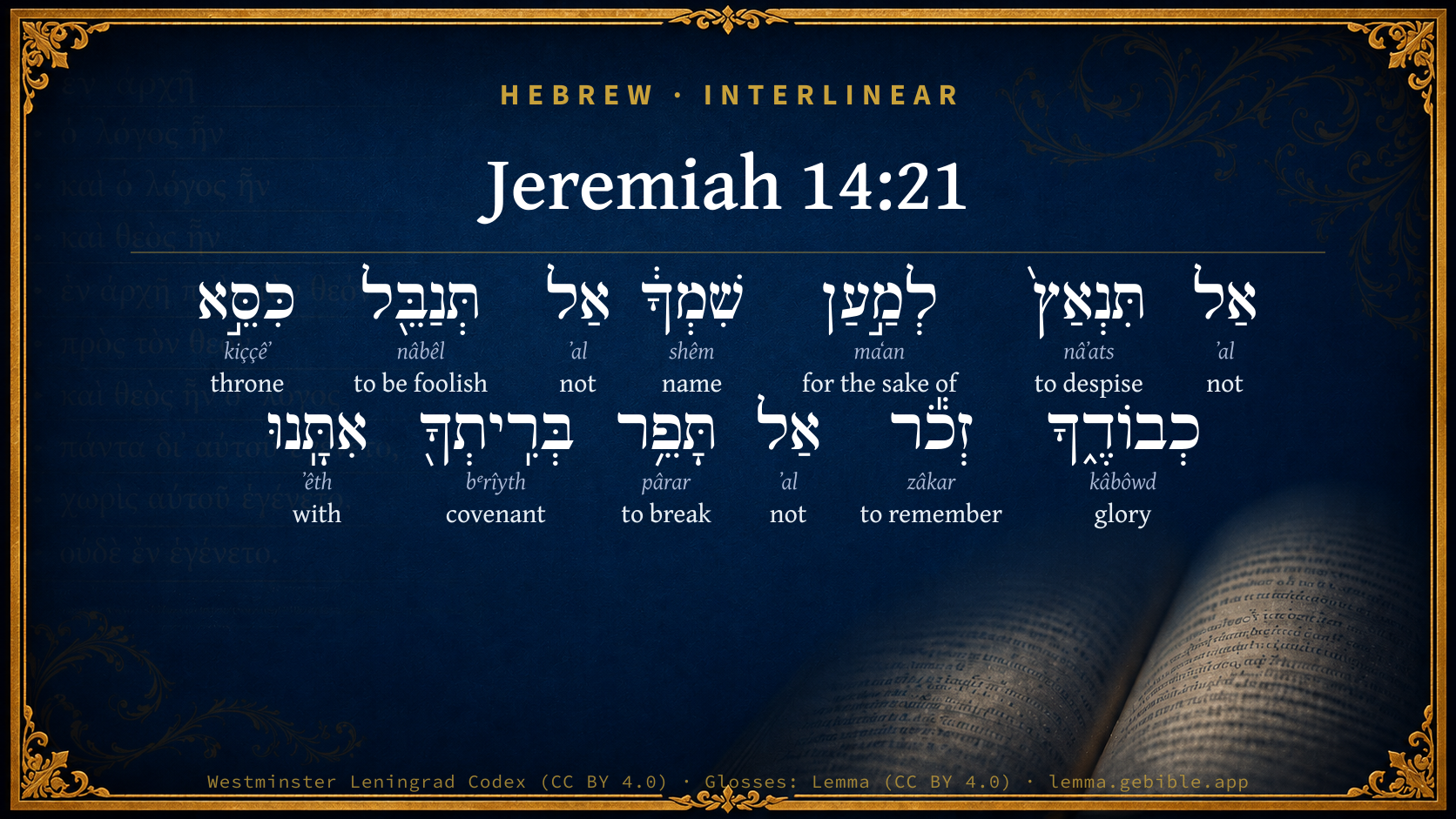
Hebrew (Westminster Leningrad Codex) Jeremiah 14:21 appears in the Hebrew Old Testament. The text above is from the Westminster Leningrad Codex. Each word links to its Strong’s number, a concise gloss, and parsing drawn from the Open Scriptures Hebrew Bible morphology. Click any word for its full Brown-Driver-Briggs (BDB) entry.
Download image
Cite this verse

Jeremiah 14:21 (World English Bible). Public Domain. Lemma interlinear Bible study tool, https://lemma.gebible.app/v/jeremiah/14/21.

Show BibTeX & RIS
BibTeX
RIS
English Translation
Do not abhor [us], for your name's sake; do not disgrace the throne of your glory: remember, don't break your covenant with us.
World English Bible · Public Domain
Download a study sheet

One document with this verse’s original text, its word-by-word gloss line, the meaning frame, cross-references with their text, attributed commentary, and full source and license credits — printable, and it pastes into notes with its structure intact.

This verse Autodidact and up

Study sheet (.html) Plain text (.txt)

A passage Seminary Student

Up to 50 verses in one chapter. A passage sheet keeps up to 6 commentary sources and 12 cross-references per verse, in the order this page ranks them, and says so on the sheet whenever that leaves anything out. Ask for a single verse and you get the Autodidact verse sheet above.

Everything on this page stays free to read, with no account — the sheet is a download of what is already on screen, not access to it.

Want to remove ads? Support Godless Engineer
Compare translations 3

The same verse in 3 English versions, stacked beneath the original-language interlinear above. Click any original word for its lexicon entry.

Each is an independent rendering of the whole verse — the interlinear is not word-aligned to these translations.

Highlighted words mark where these versions differ — a whole-verse word diff, not a word-by-word alignment.

  • World English Bible Public Domain
    Do not abhor [us], for your name's sake; do not disgrace the throne of your glory: remember, don't break your covenant with us.
  • King James Version Public Domain
    Do not abhor us, for thy name's sake, do not disgrace the throne of thy glory: remember, break not thy covenant with us.
  • unfoldingWord Literal Text CC BY-SA 4.0
    For the sake of your name do not spurn us; do not disgrace the throne of your glory. Remember, do not break your covenant with us.

unfoldingWord Literal Text — © unfoldingWord, licensed CC BY-SA 4.0. Word-aligned USFM3 via Door43 (git.door43.org/unfoldingWord/en_ult).

Versions to compare (up to 4)

3 of 4 selected

Show all 18 translations

Every available English version of this verse, each an independent rendering of the whole verse.

  • World English Bible Public Domain
    Do not abhor [us], for your name's sake; do not disgrace the throne of your glory: remember, don't break your covenant with us.
  • Berean Standard Bible Public Domain
    For the sake of Your name do not despise us; do not disgrace Your glorious throne. Remember Your covenant with us; do not break it.
  • Majority Standard Bible Public Domain
    For the sake of Your name do not despise us; do not disgrace Your glorious throne. Remember Your covenant with us; do not break it.
  • King James Version Public Domain
    Do not abhor us, for thy name's sake, do not disgrace the throne of thy glory: remember, break not thy covenant with us.
  • American Standard Version (1901) Public Domain
    Do not abhor `us', for thy name's sake; do not disgrace the throne of thy glory: remember, break not thy covenant with us.
  • Revised Version (1885) Public Domain
    Do not abhor us, for thy name’s sake; do not disgrace the throne of thy glory: remember, break not thy covenant with us.
  • Geneva Bible (1599) Public Domain
    Doe not abhorre vs: for thy Names sake cast not downe the throne of thy glory: remember and breake not thy couenant with vs.
  • Douay-Rheims (1899) Public Domain
    Give us not to be a reproach, for thy name's sake, and do not disgrace in us the throne of thy glory: remember, break not thy covenant with us.
  • Young's Literal Translation Public Domain
    Do not despise, for Thy name's sake, Dishonour not the throne of Thine honour, Remember, break not Thy covenant with us.
  • Literal Standard Version CC BY-SA 4.0
    Do not despise, for Your Name’s sake, || Do not dishonor the throne of Your glory, || Remember, do not break Your covenant with us.
  • Unlocked Literal Bible CC BY-SA 4.0
    Do not reject us! For the sake of your name, do not make your glorious throne a disgrace. Remember and do not break your covenant with us.
  • unfoldingWord Literal Text CC BY-SA 4.0
    For the sake of your name do not spurn us; do not disgrace the throne of your glory. Remember, do not break your covenant with us.
  • Darby Bible Public Domain
    For thy name's sake, do not spurn [us], do not disgrace the throne of thy glory: remember, break not thy covenant with us.
  • World Messianic Bible Public Domain
    Do not abhor us, for your name’s sake. Do not disgrace the throne of your glory. Remember, and don’t break your covenant with us.
  • Webster's Bible Public Domain
    Do not abhor us, for thy name's sake; do not disgrace the throne of thy glory: remember, break not thy covenant with us.
  • Free Bible Version CC BY-SA 4.0
    Because of your own reputation please don't hate us; don't bring dishonor on your glorious throne. Please remember your agreement with us; don't break it.
  • Bible in Basic English Public Domain
    Do not be turned from us in disgust, because of your name; do not put shame on the seat of your glory: keep us in mind, let not your agreement with us be broken.
  • JPS Tanakh (1917) Public Domain
    Do not contemn us, for Thy name's sake, do not dishonour the throne of Thy glory; remember, break not Thy covenant with us.

Literal Standard Version (2020), Covenant Press — licensed CC BY-SA 4.0. Text via the HelloAO Bible API (eBible.org). Unlocked Literal Bible (unfoldingWord) — licensed CC BY-SA 4.0. Text via the HelloAO Bible API (eBible.org). unfoldingWord Literal Text — © unfoldingWord, licensed CC BY-SA 4.0. Word-aligned USFM3 via Door43 (git.door43.org/unfoldingWord/en_ult). Free Bible Version, Dr. Jonathan Gallagher — licensed CC BY-SA 4.0. Text via the HelloAO Bible API (eBible.org).

Word by word

More ways to search: Search by grammar → Find every occurrence → Compare this word →

Practice this passage: Drill this verse → Learn its vocabulary →

תִּנְאַץ֙
nâʼats
H5006
“to despise”
Verb, Qal, Jussive, 2nd Person, Masculine, Singular
Part of Speech
Verb
Stem
Qal
Form
Jussive
Person
2nd Person
Gender
Masculine
Number
Singular
Full BDB Definition

Origin: a primitive root

TWOT: 1274

to spurn, contemn, despise, abhor - (Qal) to spurn, contemn - (Piel) - to spurn - to cause to contemn - (Hiphil) to spurn - (Hithpolel) to be contemned
  1. אַל ʼal H408 “not” Particle, Negative
  2. לְמַ֣עַן maʻan H4616 “for the sake of” Preposition
  3. שִׁמְךָ֔ shêm H8034 “name · your” Noun, Common, Masculine, Singular, Construct + Suffix, Personal, 2nd Person, Masculine, Singular
  4. אַל ʼal H408 “not” Particle, Negative
  5. תְּנַבֵּ֖ל nâbêl H5034 “to be foolish” Verb, Piel, Jussive, 2nd Person, Masculine, Singular
  6. כִּסֵּ֣א kiççêʼ H3678 “throne of” Noun, Common, Masculine, Singular, Construct
  7. כְבוֹדֶ֑ךָ kâbôwd H3519 “glory · your” Noun, Common, Both, Singular, Construct + Suffix, Personal, 2nd Person, Masculine, Singular
  8. זְכֹ֕ר zâkar H2142 “remember” Verb, Qal, Imperative, 2nd Person, Masculine, Singular
  9. אַל ʼal H408 “not” Particle, Negative
  10. תָּפֵ֥ר pârar H6565 “to break” Verb, Hiphil, Jussive, 2nd Person, Masculine, Singular
  11. בְּרִֽיתְךָ֖ bᵉrîyth H1285 “covenant · your” Noun, Common, Feminine, Singular, Construct + Suffix, Personal, 2nd Person, Masculine, Singular
  12. אִתָּֽנוּ ʼêth H854 “with · us” Preposition + Suffix, Personal, 1st Person, Common, Plural

About this verse

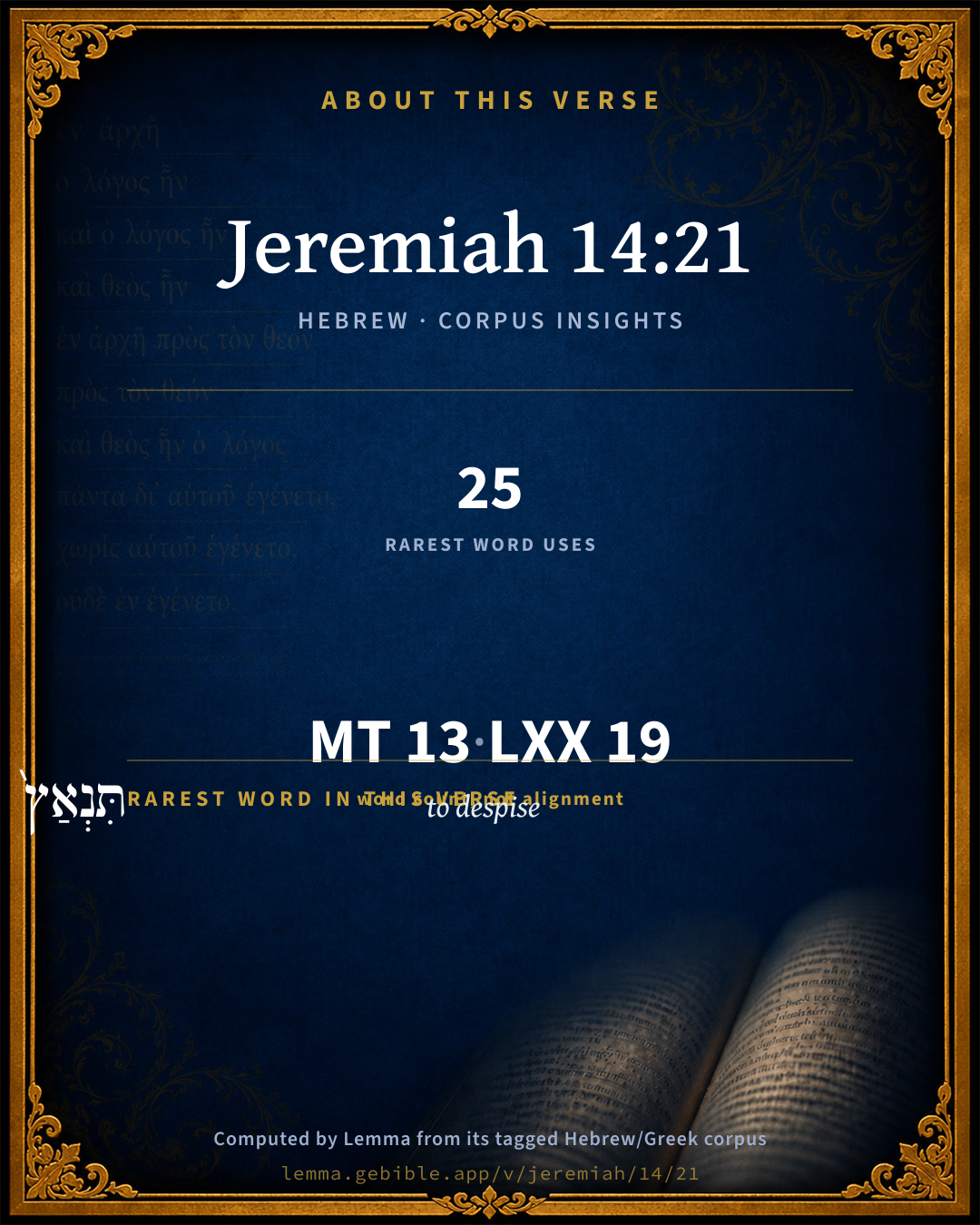
These counts appear in no published source. They are computed here, from the morphology-tagged text and Lemma’s own curated glosses. What Lemma adds →

13
words
11
distinct lemmas
Prophets
section

Notable vocabulary

The rarest word here is תִּנְאַץ֙ to despise H5006 — appearing just 25 times in the whole Hebrew Bible.

Shared distinctive vocabulary

תִּנְאַץ֙ to despise H5006 occurs in 24 verses of the Hebrew Bible. Also found in:

Grammatical profile

  • 4 verbs
  • 4 nouns
  • 2 prepositions
  • 3 particles

Verb forms

  • תִּנְאַץ֙ Qal · Jussive
  • תְּנַבֵּ֖ל Piel · Jussive
  • זְכֹ֕ר Qal · Imperative
  • תָּפֵ֥ר Hiphil · Jussive

Repetition

A word recurs within this verse — often emphatic in Hebrew:

  • אַל not H408 ×3

Hebrew & Septuagint length

In the original languages it is 13 Hebrew tokens and 19 Greek tokens — but the two are counted differently (Hebrew bundles its prefixes and suffixes into one token; the Greek is in lemma form), so that isn’t a like-for-like length.

Cross-references

34

Topical passages linked to Jeremiah 14:21 in the Treasury of Scripture Knowledge — connected by theme and wording, ordered by reader-vote popularity; previews shown in the World English Bible.

  • Jeremiah 14:7 Though our iniquities testify against us, work you for your name's sake, Yahweh; for our backslidings are many; we have sinned against you.
  • Psalms 106:45 He remembered for them his covenant, And repented according to the multitude of his loving kindnesses.
  • Jeremiah 3:17 At that time they shall call Jerusalem the throne of Yahweh; and all the nations shall be gathered to it, to the name of Yahweh, to Jerusalem: neither shall they walk any more after the stubbornness of their evil heart.
  • Psalms 89:39–40 You have renounced the covenant of your servant. You have defiled his crown in the dust.
  • Jeremiah 17:12 A glorious throne, [set] on high from the beginning, is the place of our sanctuary.
  • Ezekiel 36:22–23 Therefore tell the house of Israel, Thus says the Lord Yahweh: I don't do [this] for your sake, house of Israel, but for my holy name, which you have profaned among the nations, where you went.
  • Daniel 9:15–19 Now, Lord our God, who has brought your people forth out of the land of Egypt with a mighty hand, and have gotten you renown, as at this day; we have sinned, we have done wickedly.
  • Exodus 32:13 Remember Abraham, Isaac, and Israel, your servants, to whom you swore by your own self, and said to them, 'I will multiply your seed as the stars of the sky, and all this land that I have spoken of I will give to your seed, and they shall inherit it forever.'"
  • Leviticus 26:11 I will set my tent among you: and my soul won't abhor you.
  • Leviticus 26:42–45 then I will remember my covenant with Jacob; and also my covenant with Isaac, and also my covenant with Abraham; and I will remember the land.
  • Deuteronomy 32:19 Yahweh saw [it], and abhorred [them], Because of the provocation of his sons and his daughters.
  • Psalms 51:11 Don't throw me from your presence, And don't take your holy Spirit from me.
  • Psalms 74:2–7 Remember your congregation, which you purchased of old, Which you have redeemed to be the tribe of your inheritance; Mount Zion, in which you have lived.
  • Psalms 74:18–20 Remember this, that the enemy has mocked you, Yahweh. Foolish people have blasphemed your name.
  • Psalms 79:9–10 Help us, God of our salvation, for the glory of your name. Deliver us, and forgive our sins, for your name's sake.
  • Psalms 106:40 Therefore Yahweh burned with anger against his people. He abhorred his inheritance.
  • Isaiah 64:9–12 Don't be angry very sore, Yahweh, neither remember iniquity forever: see, look, we beg you, we are all your people.
  • Jeremiah 14:19 Have you utterly rejected Judah? has your soul loathed Zion? why have you struck us, and there is no healing for us? We looked for peace, but no good came; and for a time of healing, and, behold, dismay!
  • Lamentations 1:10 The adversary has spread out his hand on all her pleasant things: For she has seen that the nations are entered into her sanctuary, Concerning whom you did command that they should not enter into your assembly.
  • Lamentations 2:6–7 He has violently taken away his tent, as if it were of a garden; he has destroyed his place of assembly: Yahweh has caused solemn assembly and Sabbath to be forgotten in Zion, Has despised in the indignation of his anger the king and the priest.
  • Lamentations 2:20 Look, Yahweh, and see to whom you have done thus! Shall the women eat their fruit, the children that are dandled in the hands? Shall the priest and the prophet be killed in the sanctuary of the Lord?
  • Ezekiel 7:20–22 As for the beauty of his ornament, he set it in majesty; but they made the images of their abominations [and] their detestable things therein: therefore have I made it to them as an unclean thing.
  • Ezekiel 24:21 Speak to the house of Israel, Thus says the Lord Yahweh: Behold, I will profane my sanctuary, the pride of your power, the desire of your eyes, and that which your soul pities; and your sons and your daughters whom you have left behind shall fall by the sword.
  • Ezekiel 39:25 Therefore thus says the Lord Yahweh: Now will I bring back the captivity of Jacob, and have mercy on the whole house of Israel; and I will be jealous for my holy name.
  • Ezekiel 43:7 He said to me, Son of man, [this is] the place of my throne, and the place of the soles of my feet, where I will dwell in the midst of the children of Israel forever. The house of Israel shall no more defile my holy name, neither they, nor their kings, by their prostitution, and by the dead bodies of their kings [in] their high places;
  • Daniel 8:11–13 Yes, it magnified itself, even to the prince of the host; and it took away from him the continual [burnt offering], and the place of his sanctuary was cast down.
  • Daniel 9:7 Lord, righteousness belongs to you, but to us confusion of face, as at this day; to the men of Judah, and to the inhabitants of Jerusalem, and to all Israel, who are near, and who are far off, through all the countries where you have driven them, because of their trespass that they have trespassed against you.
  • Amos 6:8 "The Lord Yahweh has sworn by himself," says Yahweh, the God of hosts: "I abhor the pride of Jacob, And detest his fortresses. Therefore I will deliver up the city with all that is in it.
  • Zechariah 11:10–11 I took my staff Favor, and cut it apart, that I might break my covenant that I had made with all the peoples.
  • Luke 1:72 To show mercy towards our fathers, To remember his holy covenant,
  • Luke 21:24 They will fall by the edge of the sword, and will be led captive into all the nations. Jerusalem will be trampled down by the Gentiles, until the times of the Gentiles are fulfilled.
  • Ephesians 2:7 that in the ages to come he might show the exceeding riches of his grace in kindness toward us in Christ Jesus;
  • Hebrews 8:6–13 But now he has obtained a more excellent ministry, by so much as he is also the mediator of a better covenant, which has been enacted on better promises.
  • Revelation 11:2 Leave out the court which is outside of the temple, and don't measure it, for it has been given to the gentiles. They will tread the holy city under foot for forty-two months.

Cross-references courtesy of OpenBible.info (CC BY 4.0).

Hebrew and Greek witnesses Masoretic Hebrew ↔ Greek Septuagint

The same verse in the two great witnesses to the Old Testament, shown verse-for-verse.

These are two independent witnesses, not word-aligned to each other, and the Septuagint is shown in lemma (dictionary) form.

Hebrew Jeremiah 14:21 Masoretic · Westminster Leningrad Codex

אַל תִּנְאַץ֙ לְמַ֣עַן שִׁמְךָ֔ אַל תְּנַבֵּ֖ל כִּסֵּ֣א כְבוֹדֶ֑ךָ זְכֹ֕ר אַל תָּפֵ֥ר בְּרִֽיתְךָ֖ אִתָּֽנוּ

Do not abhor [us], for your name's sake; do not disgrace the throne of your glory: remember, don't break your covenant with us.

World English Bible · Public Domain

Greek LXX Structure differs

In the Septuagint, Jeremiah is about an eighth shorter than the Hebrew and arranges its material differently — the Oracles Against the Nations (Hebrew chapters 46–51) appear in the middle of the Greek book, after 25:13. Because the chapter and verse boundaries do not line up, a verse-for-verse comparison with the Hebrew is not shown.

A verse-for-verse comparison isn’t shown here because the chapters and verses don’t line up. Switch to the LXX edition with the MT / LXX toggle above to read the Greek directly.

Hebrew: Westminster Leningrad Codex (CC BY 4.0). Greek: Septuagint (public domain); English from a public-domain English Septuagint. How the Septuagint differs from the Hebrew →

Targum (Aramaic paraphrase)

1

The Targum is the ancient Jewish Aramaic paraphrase of the Hebrew Scriptures — an interpretive translation, not the Hebrew text itself. Onkelos (literal) and Pseudo-Jonathan (expansive) render the Torah, and Jonathan the Prophets. Coverage is partial: where no permissively-licensed English translation exists for a verse, only the Aramaic is shown. This is verse-level text, not a word-by-word alignment to the Hebrew.

  1. Targum Jonathan Prophets (Joshua–Malachi)
    לָא תְרַחֲקֵינָנָא בְּדִיל שְׁמָךְ לָא תְנַבֵּל אֲתַר בֵּית כּוּרְסֵי יְקָרָךְ יֵיעוֹל דוּכְרָן קְיָם אֲבָהָתָנָא קֳדָמָךְ לָא תְשַׁנֵי קְיָמָךְ עִמָנָא:

    (no public-domain English translation for this verse)

    Targum Jonathan — Aramaic: “Mikraot Gedolot” (public domain). English: “Sefaria Community Translation” (CC0 1.0 (public-domain dedication)); “London "Chaldee Paraphrase," 1871” (public domain). Text via Sefaria.

Commentary

Notes on Jeremiah 14:21 from classic Christian and Jewish commentators (each source and its license shown beneath its notes). The classic Christian expositions comment on the surrounding passage and are grouped to its opening verse, so a note may address several verses; the Jewish commentaries on the Tanakh (Rashi and others) are per-verse, so they appear only where the commentator wrote on this verse.

Lemma curates 59 commentaries, every one of them public domain or Creative Commons licensed, each selected and text-cleaned for this edition rather than reprinted as found. About our sources →

Trapp's Complete Commentary

John Trapp

Jer 14:21 Do not abhor [us], for thy name’s sake, do not disgrace the throne of thy glory: remember, break not thy covenant with us.

Ver. 21. Do not abhor us, for thy name’s sake.] This was to "continue instant in prayer." {Rom 12:12} This was to pray on, and not to faint. {Luk 18:1} If thy suit be not honest, never begin it; and if it be, never leave it.

Do not disgrace the throne of thy glory.] The temple, and the ark in it. The Romans held the extinction of the Vestal fire a sign of the destruction of their city, be the cause thereof what it will. {a} We may well think the same of the loss of God’s ordinances, which therefore we must deprecate, as here, with all our might; for as Bodin said well of obtaining, so likewise for retaining, religion, Non disputationibus sed rogationibus, &c., the business will be the better ejected by requests than disputes. Pray therefore for the peace of Jerusalem, yea, take no nay. Deus ipse qui nullis contra se viribus superari potest, precibus vincitur. {b} The invincible God is overcome by the power of prayer. There is a kind of omnipotence in it, saith Luther.

Remember, break not thy covenant with us.] Lo, this is to be God’s faithful remembrancer, {Isa 62:6-7} suggesting unto him seasonable items.

{a} εφ ης ποτε αν αιτιας γενηται. - Dion. Halicar., lib. ii.

{b} Jerome.

John Trapp, A Commentary or Exposition upon All the Books of the Old and New Testament (1647–1656) — public domain. Text from a community e-Sword module.

The Biblical Illustrator

Joseph S. Exell

Jer_14:21

Do not abhor us.

Marks of a people in danger of the Divine abhorrence

I. The leading indications of a people exposed to that alarming condition which the prophet here so pathetically deprecates.

1. Unfruitfulness under the means of religious and moral improvement (Luk_13:6). When the recipients of so many favours, instead of being fruitful, bring forth no good fruit at all, or fruit that is positively bad; when, instead of acting suitably to such high advantages, they shew that they are insensible of them; when, instead of being devout, they are impious; when, instead of standing in awe of God, they profane His holy name; when, instead of regarding His ordinances, they despise them; when, instead of being humble, meek, and merciful, they are proud, overbearing, and injurious; and, instead of ascribing to the bounteous Giver of all good, the glory that is due to Him for His liberality towards them, by a holy, reverential, and submissive deportment, they disregard His authority:--most assuredly, if there is any justice in the Divine nature, and any discernment in the Divine administration, such a people are nigh unto cursing, and are rapidly advancing towards that state which is deprecated in the text.

2. A public and general contempt of religion. All things go well so long as God and Him service are reverenced; because there is a firmness, an energy, and a greatness in every effort put forth for the public weal, which, through the blessing of God, can scarcely fail to render it effectual. But, on the other hand, when God is despised; when His existence and authority are treated as merely ideal; when no influence is produced upon human agency by the greatness and purity of His character, or the rectitude and perfection of His counsels; when it acknowledges no higher principle than self-interest, or the gratification of the inferior appetites of our nature--then all things run into confusion. In confirmation of this, we have the remarkable testimony even of the heathen Polybius, one of the most judicious historians of ancient Rome. When the Romans, says he, left off consulting the gods, when they began to disregard the institutions of religion, or to laugh at things sacred, then fell the glory of the empire. The wisdom of the senator forsook him, and the heart of the soldier melted at the face of the foe. The State had no friend, because every man was a friend only to himself, and the gods forsook them because they were despised.

3. Levity and insensibility under the Divine judgments. How natural to conclude, when a child continues thoughtless, perverse, and obstinate, under the frowns of an indulgent parent, that he is fast approaching to destruction: and how just, as well as natural, is the conclusion; since the parent having tried all means, but in vain, to reclaim him, seems in a measure compelled to throw him off, and since the child himself seems bent on renouncing parental protection, were it even forced upon him. And no less just and natural is it to draw a similar conclusion in the case of nations, when they despise the chastenings of Omnipotence. To these He has recourse, only when all other means have proved ineffectual. If, then, when He strikes they feel it not, and instead of being brought to repentance, obstinately persist in their folly and inconsideration, what is to be looked for but their perdition?

II. How suitable the language and temper of the prayer in the text is to us, O Lord, do not abhor us for Thy names sake.

1. It is expressive of that temper of mind, which is most suited to the guilt which we have contracted, and the dangers to which we are exposed.

(1) It supposes, that as children, who have long resisted the kind intentions of our heavenly Father, trifled with His goodness, and abused His grace, we see ourselves about to be cast off by an awful exertion of His justice; and that, deeply alarmed at our situation, sensible of our unworthiness, and that the very fate which we dread, is what we actually merit, we run to Him at the very moment, and cry, O Lord, abhor us not; cast us not off forever. We deserve it, but stay Thy hand. Foolish, and rebellious, and perverse as we have been, we cannot bear the frowns of Thine indignation, or to be finally excluded from Thy favour.

(2) It implies the utmost earnestness, and the very feeling of present and immediate repentance. It supposes that the individuals who use it are actually lying low in the dust, under the sense of immediate danger, and calling out for immediate relief. And most assuredly there is no room for procrastinating.

2. It also peculiarly becomes us, because it is enforced by the only argument fit to be urged by guilty creatures, and the only argument which we can urge with effect.

(1) Review all the circumstances in your case. Single out what you conceive to be the most alleviating, and the most favourable--and then say, is there one of these which you can use as an argument why a pure and holy God should not abhor you?

(2) But beware of using this language in a cold and formal manner, and without those distressing apprehensions of danger, and those bitter feelings of repentance, which Jeremiah so evidently cherished when he uttered it. This, instead of appeasing the Divine wrath which has gone forth against us, will rather provoke it more than ever; and instead of averting the Divine judgments, will rather accelerate their accomplishment. (J. Somerville, D. D.)

The Biblical Illustrator, edited by Joseph S. Exell (c. 1880s–1900s) — public domain. Text from a community e-Sword module.

Jamieson, Fausset & Brown

Robert Jamieson, A. R. Fausset & David Brown

us--"the throne of Thy glory" may be the object of "abhor not" ("reject not"); or "Zion" (Jer 14:19).

throne of thy glory--Jerusalem, or, the temple, called God's "footstool" and "habitation" (Ch1 28:2; Psa 132:5).

thy covenant-- (Psa 106:45; Dan 9:19).

Jamieson, Fausset & Brown — Commentary Critical and Explanatory on the Whole Bible (1871) — public domain (CC PDM 1.0). Text via the HelloAO Bible API.

Adam Clarke's Commentary

Verse 21. Do not disgrace the throne of thy glory] The temple. Let not this sacred place be profaned by impious and sacrilegious hands.

Break not thy covenant] See Ex 24:7-8; Ex 19:5. They had already broken the covenant, and they wish God to fulfil his part. They ceased to be his people, for they abandoned themselves to idolatry; and yet they wished Jehovah to be their Lord; to defend, support, and fill them with all good things! But when the conditions of a covenant are broken by one of the contracting parties, the other party is not bound; and the covenant is necessarily annulled.

Adam Clarke's Commentary on the Bible (1810–1826) — public domain. Text from a community e-Sword/MySword module.

John Calvin's Commentaries

Jeremiah goes on with the same prayer; and he made it from love, and also for the purpose of encouraging the faithful, who remained among the people, to seek forgiveness; for he undertakes here to represent the true Church, which was then very small. All indeed boasted that they were the children of God, and gloried in the covenant made with Abraham; but hardly one in a thousand called on God in truth and from the heart. The Prophet then represented the common feeling of a very small number; and yet he proceeded, as I have said, with his prayer.

Hence he says, Reject not, overthrow not, the throne of thy glory; or the meaning of the two verbs may be the same, which seems to me more probable. But the Prophet joined together two verbs, not so much for the sake of ornament as rhetoricians do, as for the purpose of expressing the intenseness of his concern and anxiety; for he saw that the kingdom of Judah was in extreme danger. He then did not in an ordinary way try to turn aside God’s vengeance, but he hastened as one to extinguish a fire; for the obtaining of pardon was difficult.

He calls Jerusalem the throne of God’s glory, because God had chosen that city where he was to be worshipped, not that he was confined to the Temple, but because the memorial of his name was there, according to what had been usually said, especially by Moses. (Exodus 20:24) Nor was the ark a vain Symbol of his covenant, for God really dwelt there; for the presence of his power and grace was evidenced by the clearest proofs. But as this mode of speaking is often found in the Prophets, it was sufficient for Jeremiah briefly to notice the subject. God indeed, as it is well known, fins heaven and earth, but he gives symbols of his presence wherever he pleases; and as it was his will to be worshipped in the Temple, it is called iris throne, and it is elsewhere called his footstool; for the Scripture describes the same thing in various ways. The Temple is often called the rest of God, his dwelling, his sanctuary, the place of his habitation; it is also called his footstool,

“We will worship at his footstool.” (Psalm 132:7)

But these various forms are used for the same purpose, though they are apparently different; for where the Temple is called the habitation of God, his palace or his throne, the presence of his power is set forth, as though God dwelt as a friend among his worshippers; but when it is called his footstool, it is for the purpose of checking a superstition which might have crept in; for God raises the minds of the godly higher, lest they should think that his presence is confined to any place.

We then perceive what the Scripture intends and what it means, whenever it calls Jerusalem or the Temple the throne or the house of God.

But we nmst carefully notice what is here mentioned by the Prophet, For thy name’s sake We know that whenever the saints pray to be heard for the sake of God’s name, they cast aside every confidence in their own worthiness and righteousness. Whosoever then pleads God’s name, in order to obtain what he asks, renounces all other things, and fully confesses that he is unworthy to find God propitious to him; for this form of speaking necessarily implies a contrast. As then the Prophet flees to God’s name as his only refuge, there is included in the words a confession, such as we have before noticed, — that the Jews, inasmuch as they had acted wickedly towards God, were unworthy of any mercy; nor could they pacify him by any of their own satisfactions, nor have anytiling by which they could obtain his favor. This then is the meaning; and as this doctrine has been elsewhere more fully handled, it; seems to me sufficient briefly to shew the design of the Prophet.

He calls it the throne of glory, to intimate that God’s name would be unknown and unnoticed, or even despised and exposed to reproaches, if he did not spare the people whom he had chosen. The genitive case is used in Hebrew, we know, instead of an adjective; and to enlarge on the subject is useless, as this is one of its primary elements. The Prophet then in calling the Temple the glorious throne of God, in which his majesty shone forth, in a manner reminds God himself not to expose his name to reproaches; for instantly the ungoldly, according to their evil dispositions, would vomit forth their blasphemies; and thus God’s name would be reproached.

He afterwards adds, Remember, make not void, thy covenant with us Here also the Prophet strengthens his prayer by calling to mind the covenant: for it might have been said, that the Jews had nothing to do with the holy name of God, with his glory, or with his throne; and doubtless they were worthy of being wholly forsaken by God. As then they had divorced themselves from God, and were wholly destitute of all holiness, the Prophet here brings before God his covenant, as though he had said, “I have already prayed thee to regard thine own glory and to spare thine own throne, as thou hast favored the place with so much honor as to reign among us: now, though our impiety is so great that thou mayest justly cast us away yet thou didst not make a covenant with Mount Sion, or with the stones of the Temple, or with material things, but with us; render not void then this thy covenant.”

We hence see that there is great emphasis in the words of the Prophet, when he implores God not to make void, or not to undo, the covenant, which he had made with the people. For though God would have continued true and faithful, had he obliterated the name of the whole people, yet it was necessary that his goodness should contend with their wickedness, his fidelity with their perfidiousness, inasmuch as the covenant of God did not depend on the people’s faithfulness or integrity. It was, as it may be said, a mutual stipulation; for God made a covenant with Abraham on this condition — that he should walk perfectly with him: this is indeed true; and the same stipulation was in force in the time of the Prophets. Yet at the same time Jeremiah assumed this principle — that the grace of God cannot be wholly obliterated; for he had chosen the race of Abraham, from whom the Redeemer was at length to be born. But Jeremiah intended to extend God’s grace still farther, according to what has been already said, and we shall again presently see the same thing. However this may be, he had a just reason for praying, “Undo not thy covenant with us.” But God had hidden means of accomplishing his purpose; for he did, according to the common apprehension of men, abolish the covenant by which the Jews thought him to be bound to them; and yet he remained true; for his truth shone forth at length from darkness, after the time of exile was completed. It now follows —

John Calvin's Commentaries (1540-1563) — public domain. Text from the Calvin Translation Society English edition (1840s-50s) via the Christian Classics Ethereal Library (ccel.org). Calvin's coverage is partial (roughly two-thirds of the Bible); uncommented books and verses are honest gaps, never fabricated. The 19th-century editor's footnotes and remarks are omitted so the notes are faithfully Calvin's own voice.

Ellicott's Commentary for English Readers

(21) Do not abhor us . . .—Even in the English, and yet more in the Hebrew, we seem to hear the broken accents, words and sobs intermingled, of the agony of the prayer. “Abhor us not . . . disgrace not . . . remember, break not.” The prophet can make no plea of extenuation, but he can appeal to the character of God, and urge, with a bold anthropomorphism, that mercy is truer to that character than rigorous justice, and that His covenant with Israel pledges Him to that mercy.

The throne of thy glory.—This is, of course, the Temple (see Jer_17:12). Shall that become a bye-word of reproach, scorned (so the word means) as a fool is scorned?

A Bible Commentary for English Readers, edited by Charles John Ellicott (1878–1897) — public domain. Text from a community e-Sword module.

The Cambridge Bible for Schools and Colleges

gen. ed. J. J. S. Perowne

21. the throne of thy glory] Jerusalem, or more particularly the Temple, where the visible glory was enthroned above the Ark.

The Cambridge Bible for Schools and Colleges (gen. ed. J. J. S. Perowne; Cambridge University Press, 1878–1918) — public domain. Text from a community e-Sword module.

John Gill's Exposition

Do not abhor us, for thy name's sake,.... Which was called upon them, and which they called upon; they deserved to be abhorred, they had done those things which might justly render them abominable, being what was abhorrent to him; and they deprecate this, not, for their own sake, who were unworthy of any favour, but for his own sake, for the sake of his honour and glory, which, as it is dear to the Lord, so to his people.

Do not disgrace the throne of thy glory; either Jerusalem, as Kimchi, which was the city of the great King, where he had his throne and palace, and which is called the throne of the Lord, Jer 3:17 or the house of the sanctuary, the temple, as Jarchi; see Jer 17:12, respect seems to be had to the mercy seat upon the ark, over which were the cherubim of glory, between which the Lord dwelt; and they pray, that though they were worthy of disgrace themselves, and to be taken and carried captive into a strange land, yet they entreat that the Lord would not disgrace his own glorious habitation, by suffering the city and the temple, and the ark in it, to be destroyed:

remember; thy people, Zion, as before; or the promises made to them, the covenant, as follows:

break not thy covenant with us: God never breaks his covenant, though man does; it may sometimes seem to be broken, when his church and people are in distress and affliction; but he will never break the covenant he has made, or suffer his faithfulness to fail; yet, though he does not, it is proper and necessary oftentimes to pray in this manner to God, for the encouragement of faith in him, and expectation of good things from him.

John Gill's Exposition of the Whole Bible (1746–1763) — public domain (CC PDM 1.0). Text via the HelloAO Bible API.

Haydock's Catholic Bible Commentary

Glory; heaven, the temple or Jerusalem. How will infidels blaspheme!

George Leo Haydock (1774–1849), Haydock's Catholic Family Bible and Commentary, 1859 edition — public domain. Excludes Psalms (Douay-Rheims chapter numbering differs from Protestant) and Deuterocanonical books (Catholic canon only).

Matthew Poole's English Annotations

The thing which the prophet deprecateth is, the judgments come already and further coming upon this people, the famine, sword, and pestilence, with the drought, under the sad consequents of which they at present laboured; but he prays for the removal of these judgments, and the prevention of such as were yet to come, in this phrase, Do not abhor us; noting to us that the love of God to a people is the root of all good which they can expect, and his hatred and displeasure the root of all the evil that can betide them. Here are divers arguments brought to back this petition.

1. For thy name’s sake; that is, thine honour and glory sake; an argument often made use of in holy writ, in the prayers of God’s people, Jos 7:9, &c., and upon a very good foundation, whether we consider God’s concern for his own glory, or the tenure of God’s promises, promising mercy for his own name’s sake. He also argueth with God from his former love and kindness to this people, which he had made

the throne of his glory. The words are either to be understood of the throne of the house of David, called the Lord’s throne, 1Ch 29:23, or else the temple, and the ark in it, the more special symbol of God’s presence: hence he is said to have dwelt betwixt the cherubims, Psa 80:1; so Jer 17:12, the prophet saith, A glorious high throne from the beginning is our sanctuary. Lord, (saith the prophet,) we have deserved all the disgrace thou canst throw upon us, but do not thou disgrace the throne of thine own glory.

Remember, break not thy covenant with us. Did not Jeremiah then know that God could not break his covenant?

Answ. He did know it; but he also knew that it is our duty to pray to God to fulfil it; or possibly he would extend it a little further, and for God’s covenant’ sake made with the faithful in Israel he would have obtained mercy for the whole body of the nation.

Matthew Poole's English Annotations on the Holy Bible (1683–1685) — public domain. Text from a community e-Sword/MySword module.

The Pulpit Commentary

The throne of thy glory; i.e. the temple, (Jer_17:12 Eze_43:7) or Jerusalem. (Jer_3:17) It is the same conception where Jehovah is said to "dwell between" or, "sit upon "the cherubim". (Isa_37:16 Psa_80:1 Psa_99:1)

Invoking the honor of God.

Not along ago this phrase," Do not disgrace the throne of thy glory," was employed in prayer by a convert in a certain religious meeting. Shortly after a letter was sent to the papers, inveighing against the "pro-faulty" of the idea; in apparently complete ignorance of its scriptural origin and warrant. Often the language of humility may conceal a conception of real arrogance, and so, on the other hand, the most daring appeals to the promises, the character, and the honor of God may have their root in the profoundest reverence and faith. It is high ground go take, simply because no other ground is available.

I AS SINNERS HAVE NO REASON FOR MERCY IN THEMSELVES, THEY MUST APPEAL TO GOD. Mere pity would be inadmissible as a motive to which to appeal. There is no ground of acceptance in the sinner himself, and consequently there remains only that course of action which will illustrate and glorify the character of God. That God had chosen Israel as his servant, and Jerusalem as the seat and center of the theocracy, are the only reasons that are valid in approaching him for mercy. Any course of action which would fail to give due respect to the attributes of his character or the purposes of his grace in the world is already forbidden when it is stated. God has been at pains to pledge himself to the ultimate salvation of men. His Name is itself a promise that no compromise shall be entered into or ineffectual means of salvation adopted. Therefore the necessity of Christ"s sacrifice and resurrection. In him the justice of God is honored, and his Name revealed in the hearts of men. It is only as the gospel is perceived as the offspring of the purest, highest motives on the part of God that it can call into existence corresponding motives in the sinner himself.

II TO THE SAINT THE HONOR OF GOD SHOULD EVER BE OF MORE ACCOUNT THAN HIS OWN WELFARE. "For Christ"s sake" is a formula in which much of this feeling is implicitly expressed. The exigencies of God"s kingdom, the furtherance of his purposes of love and grace, the recognition of the principles of righteousness, are essential to a true Christian life as to true prayer. And the keenest susceptibility should be felt to any conduct on the part of God"s servants which would seem to injure his cause in the world or to misrepresent his character.

III GOD"S NAME IS PLEDGED TO AND BOUND UP WITH THE SALVATION OF MEN. It seems a daring and wondrous plea to urge in the presence of him with whom we have to do; but it is the only one which we can truly offer, and it is of infinite avail. If we accept Christ as representing the honor and righteousness of God, are we not assured that every prayer truly offered in his name shall be answered? The welfare and usefulness of God"s servants are guaranteed by such a consideration, and we cannot offer it too often or insist upon it with too great earnestness. M.

A dreadful apprehension.

That God should abhor" us. Such apprehension filled the prophet"s mind, as it has other minds.

I BUT THIS GOD NEVER DOES. He is our Father; he so loved us as to give Christ for us. It is impossible, therefore, let our apprehensions be what they may, that he can abhor us.

II BUT HE MAY SEEM TO.

1. No one will think thus of God by reason only of temporal calamities. These have again and again come and do come to God"s servants, but produce no such distressing thought as this. (cf. Ps 22, "He hath not despised nor abhorred," etc.)

2. Nor will spiritual distress alone cause it. There may be loss of comfort in God; no enjoyment in prayer or worship. Sin may again reassert its mastery, and fill the soul with sorrow. Doubts may insinuate themselves into the soul. But none of these will of themselves lead to the thought that God abhors us.

3. They may do so, however, if the presence of sorrow, temporal or spiritual, be so severe as to throw the mind off its balance. (Cf. former homily.) Despair has for a while under such circumstances wrought this harm, and that in the holiest minds. Even our blessed Lord knew somewhat of this awful experience (cf. the agony in the garden, and the cry on the cross, My God, my God," etc.). Elijah, John the Baptist, Jeremiah here, and others have been instances. Cowper the poet also, and the not infrequent cases of religious melancholy leading either to settled gloom or even suicide. The tenderest pity and compassion are to be felt for such.

4. Persistent disobedience and repeated backsliding are the chief causes of this apprehension. When the world, the flesh, and the devil fill the heart, especially the heart which has once been cleansed, then "the last state of that man is worse than the first" (cf. Saul, Judas, Ahithophel). Yes; such sin has power to turn the sun into darkness and the moon into blood, and to make the very stars fall from heaven. God becomes the horror of the soul, and men will "make their bed in hell" if but they may flee from his dreadful presence.

III THE GREAT DESTROYER OF THIS DREAD. It is suggested by the prophet"s own words: "Abhor us not, for thy Names sake." This is the antidote of all such fearful dread. The Name of God, i.e. that by which he has made himself known. And what has been the verdict of all the witness concerning God, which his words and works and ways have borne, but this, that he is plenteous in mercy to all that call upon him to all that call upon him in truth? He is the "God of all grace." And if Israel of old had proof of this, how much more have we in Christ! Behold God in him; he is the Name of God to us men. Then, where this dread apprehension exists, let Christ be preached, meditated upon, sought in prayer, confessed with the lip, served and followed in the life, waited on continually, and soon this dread shall pass away. C.

The Pulpit Commentary (1880–1919), ed. H.D.M. Spence-Jones & Joseph S. Exell — public domain. Text from a community e-Sword module.

John Wesley's Explanatory Notes

The throne - The words are either to be understood of the throne of the house of David, called the Lord's throne, 1 Chron. xxix, 23, or else the temple, and the ark in it, the more special symbol of God's presence.

John Wesley, Explanatory Notes Upon the Whole Bible (1754–1765) — public domain. Text via the GEBible commentary corpus.

unfoldingWord translationNotes

Door43 World Missions Community

General Information:

Jeremiah continues his prayer to Yahweh.

For the sake of your name

Here Yahweh's "name" refers to his reputation. AT: "For the sake of your reputation" or "In order that everyone can see that you are very great and keep your promises" (See: Metonymy)

your glorious throne

Yahweh's "throne" is represented by Zion, that is Jerusalem. His "throne" also represents the place where he rules as king. AT: "do disgrace Zion where you glorious throne is" or "do not disgrace Zion, where you rule as king" (See: Metonymy)

can the skies themselves send down showers

"Can the skies decide when they make the rain to fall?"

translationWords

glory

throne

covenant

false god

nation

heaven

God

unfoldingWord translationNotes — © Distant Shores Media and the Door43 World Missions Community, licensed CC BY-SA 4.0. Source: git.door43.org/Door43/en_tn.

Rashi

Rabbi Shlomo Yitzchaki (Rashi)

for Your name’s sake that you are called merciful.

the throne of Your glory The Temple. And according to Midrash Aggadah, Israel who is engraved on the throne of Your glory.

Rashi on the Tanakh — English translations: “The Judaica Press complete Tanach with Rashi, translated by A. J. Rosenberg” (CC BY 4.0); “Pentateuch with Rashi's commentary by M. Rosenbaum and A.M. Silbermann, 1929-1934” (public domain); “The Metsudah Tanach series, Lakewood, N.J” (CC BY 4.0); and “The Book of Joshua, Metsudah Publications, 1997” (CC BY 4.0). Text via Sefaria.

Lesson kit

Teaching starters — assembled from the data on this page, not authored interpretation. Every prompt links to the verse data it draws on. Edit before teaching.

Jeremiah, in the Prophets, opens this verse with 13 words (11 distinct Hebrew lemmas). Its most distinctive word is nâʼats (“to despise”). A historical commentator’s framing appears above. Read the whole chapter for the surrounding context.

Discussion questions

  1. The word nâʼats carries the sense “to despise.” How does it shape the verse?
  2. How does Numbers 14:11, which shares the word «to despise», read alongside this verse?
  3. What does the repetition of “not” (3× in this one verse) do in this verse?
  4. These translations render this verse differently. What is at stake in choosing one wording over another?
  5. «תִּנְאַץ֙» is a Qal Jussive verb. How does that grammatical form shape the action described?
  6. Compare how Trapp's Complete Commentary and The Biblical Illustrator read this verse. Where do they agree or differ?

Things to notice

Reading settings

Reading text

Shown beneath each verse's original-language words.

Old Testament
Old Testament edition

Read the OT as the Masoretic Hebrew (MT) or the Greek Septuagint (LXX).

English shown for the Greek Septuagint (in the Hebrew ↔ Greek comparison).

Comparing translations? Open the Compare panel on any verse page to stack up to four side by side.