Daniel 11:22

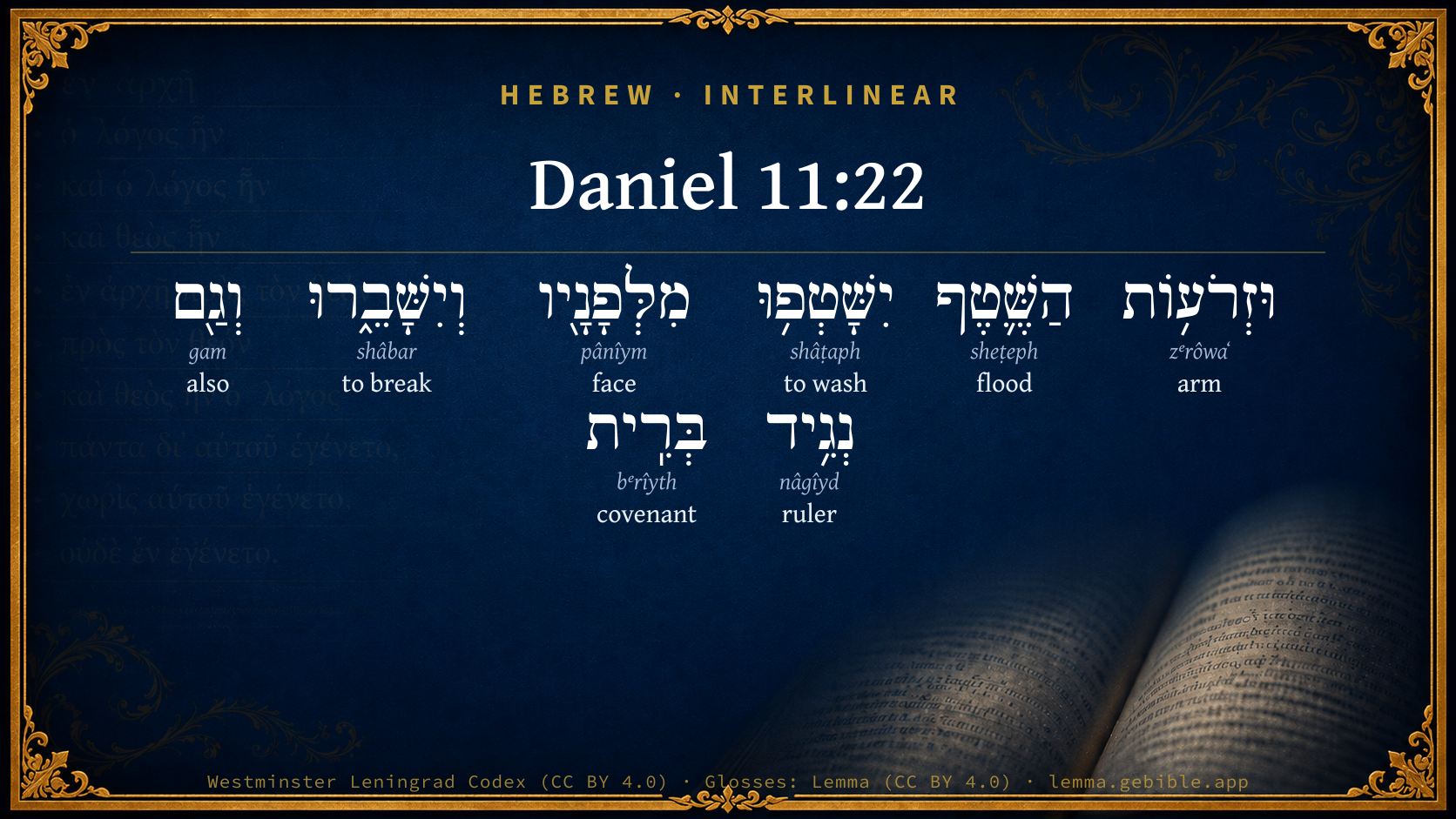
Hebrew (Westminster Leningrad Codex) Daniel 11:22 appears in the Hebrew Old Testament. The text above is from the Westminster Leningrad Codex. Each word links to its Strong’s number, a concise gloss, and parsing drawn from the Open Scriptures Hebrew Bible morphology. Click any word for its full Brown-Driver-Briggs (BDB) entry.
Download image
Cite this verse

Daniel 11:22 (World English Bible). Public Domain. Lemma interlinear Bible study tool, https://lemma.gebible.app/v/daniel/11/22.

Show BibTeX & RIS
BibTeX
RIS
English Translation
The overwhelming forces shall be overwhelmed from before him, and shall be broken; yes, also the prince of the covenant.
World English Bible · Public Domain
Download a study sheet

One document with this verse’s original text, its word-by-word gloss line, the meaning frame, cross-references with their text, attributed commentary, and full source and license credits — printable, and it pastes into notes with its structure intact.

This verse Autodidact and up

Study sheet (.html) Plain text (.txt)

A passage Seminary Student

Up to 50 verses in one chapter. A passage sheet keeps up to 6 commentary sources and 12 cross-references per verse, in the order this page ranks them, and says so on the sheet whenever that leaves anything out. Ask for a single verse and you get the Autodidact verse sheet above.

Everything on this page stays free to read, with no account — the sheet is a download of what is already on screen, not access to it.

Want to remove ads? Support Godless Engineer
Compare translations 3

The same verse in 3 English versions, stacked beneath the original-language interlinear above. Click any original word for its lexicon entry.

Each is an independent rendering of the whole verse — the interlinear is not word-aligned to these translations.

Highlighted words mark where these versions differ — a whole-verse word diff, not a word-by-word alignment.

  • World English Bible Public Domain
    The overwhelming forces shall be overwhelmed from before him, and shall be broken; yes, also the prince of the covenant.
  • King James Version Public Domain
    And with the arms of a flood shall they be overflown from before him, and shall be broken; yea, also the prince of the covenant.
  • unfoldingWord Literal Text CC BY-SA 4.0
    And the overflowing forces will be swept away before him and broken, and also the prince of the covenant.

unfoldingWord Literal Text — © unfoldingWord, licensed CC BY-SA 4.0. Word-aligned USFM3 via Door43 (git.door43.org/unfoldingWord/en_ult).

Versions to compare (up to 4)

3 of 4 selected

Show all 18 translations

Every available English version of this verse, each an independent rendering of the whole verse.

  • World English Bible Public Domain
    The overwhelming forces shall be overwhelmed from before him, and shall be broken; yes, also the prince of the covenant.
  • Berean Standard Bible Public Domain
    Then a flood of forces will be swept away before him and destroyed, along with a prince of the covenant.
  • Majority Standard Bible Public Domain
    Then a flood of forces will be swept away before him and destroyed, along with a prince of the covenant.
  • King James Version Public Domain
    And with the arms of a flood shall they be overflown from before him, and shall be broken; yea, also the prince of the covenant.
  • American Standard Version (1901) Public Domain
    And the overwhelming forces shall be overwhelmed from before him, and shall be broken; yea, also the prince of the covenant.
  • Revised Version (1885) Public Domain
    And with the arms of a flood shall they be swept away from before him, and shall be broken; yea, also the prince of the covenant.
  • Geneva Bible (1599) Public Domain
    And the armes shall be ouerthrowen with a flood before him, and shall be broken: and also the prince of the couenant.
  • Douay-Rheims (1899) Public Domain
    And the arms of the fighter shall be overcome before his face, and shall be broken; yea also the prince of the covenant.
  • Young's Literal Translation Public Domain
    And the arms of the flood are overflowed from before him, and are broken; and also the leader of the covenant.
  • Literal Standard Version CC BY-SA 4.0
    And the arms of the flood are overflowed from before him, and are broken; and also the leader of the covenant.
  • Unlocked Literal Bible CC BY-SA 4.0
    An army will be swept away like a flood from before him. Both that army and the leader of the covenant will be destroyed.
  • unfoldingWord Literal Text CC BY-SA 4.0
    And the overflowing forces will be swept away before him and broken, and also the prince of the covenant.
  • Darby Bible Public Domain
    And the overflowing forces shall be overflowed from before him, and shall be broken: yea, also the prince of the covenant.
  • World Messianic Bible Public Domain
    The overwhelming forces will be overwhelmed from before him, and will be broken. Yes, also the prince of the covenant.
  • Webster's Bible Public Domain
    And with the arms of a flood shall they be overflowed from before him, and shall be broken; yes, also the prince of the covenant.
  • Free Bible Version CC BY-SA 4.0
    Great armies will be swept away before him. They will be broken, as well as the prince of the agreement.
  • Bible in Basic English Public Domain
    And his forces will be completely taken away from before him and broken; and even the ruler of the agreement will have the same fate.
  • JPS Tanakh (1917) Public Domain
    And the arms of the flood shall be swept away from before him, and shall be broken; yea, also the prince of the covenant.

Literal Standard Version (2020), Covenant Press — licensed CC BY-SA 4.0. Text via the HelloAO Bible API (eBible.org). Unlocked Literal Bible (unfoldingWord) — licensed CC BY-SA 4.0. Text via the HelloAO Bible API (eBible.org). unfoldingWord Literal Text — © unfoldingWord, licensed CC BY-SA 4.0. Word-aligned USFM3 via Door43 (git.door43.org/unfoldingWord/en_ult). Free Bible Version, Dr. Jonathan Gallagher — licensed CC BY-SA 4.0. Text via the HelloAO Bible API (eBible.org).

Word by word

More ways to search: Search by grammar → Find every occurrence → Compare this word →

Practice this passage: Drill this verse → Learn its vocabulary →

About this verse

These counts appear in no published source. They are computed here, from the morphology-tagged text and Lemma’s own curated glosses. What Lemma adds →

8
words
8
distinct lemmas
Prophets
section

Notable vocabulary

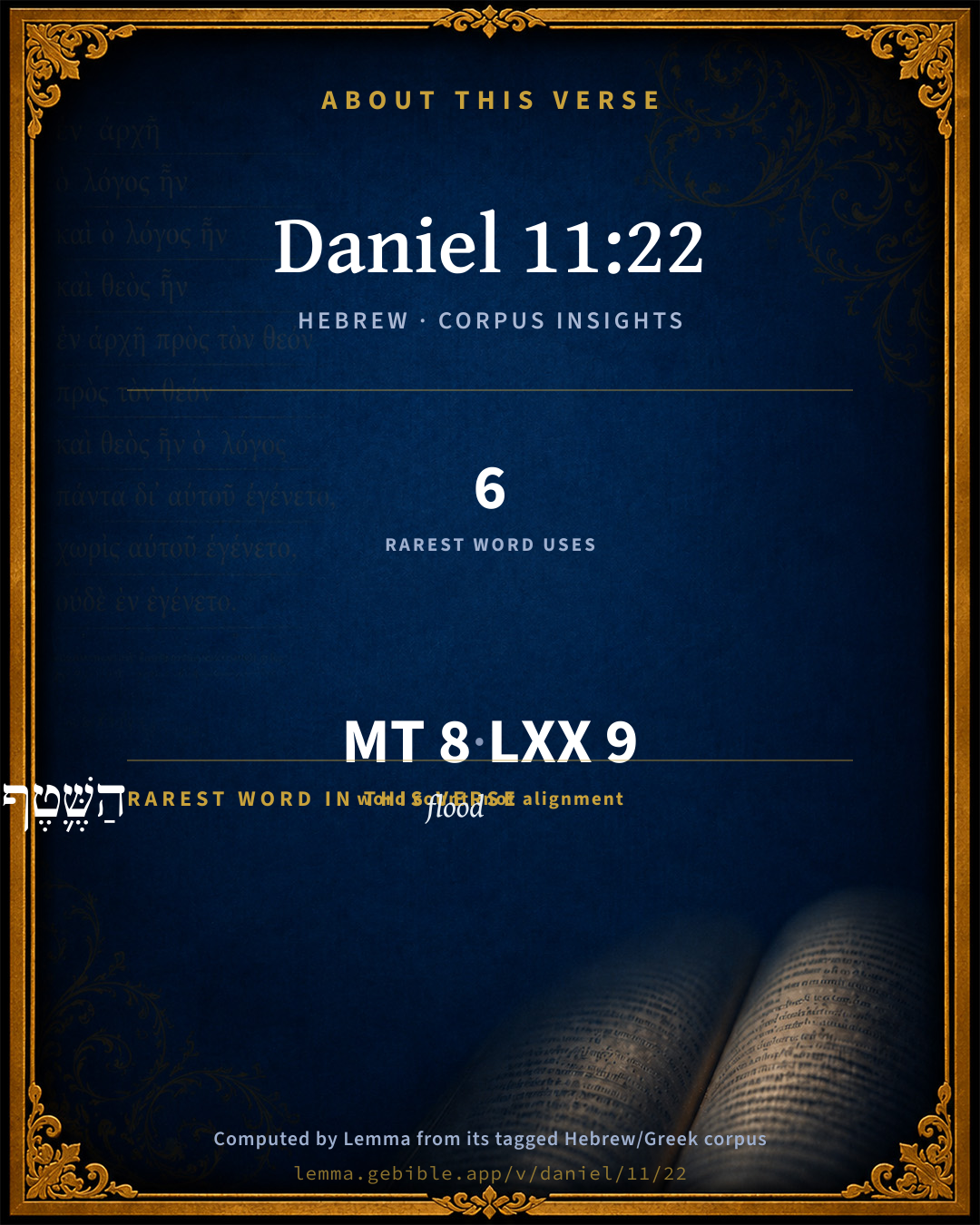
The rarest word here is הַשֶּׁ֛טֶף flood H7858 — appearing just 6 times in the whole Hebrew Bible.

Shared distinctive vocabulary

הַשֶּׁ֛טֶף flood H7858 occurs in 6 verses of the Hebrew Bible. Also found in:

Grammatical profile

  • 2 verbs
  • 5 nouns
  • 1 particle

Verb forms

  • יִשָּׁטְפ֥וּ Niphal · Imperfect
  • וְיִשָּׁבֵ֑רוּ Niphal · Imperfect

Hebrew & Septuagint length

In English translation the verse runs 20 words from the Hebrew and 31 from the Septuagint (LXX English) — the Septuagint runs noticeably longer here. See the side-by-side →

A rough comparison of the two English renderings, which tokenize alike — not a word-level alignment.

Word counts can differ between the Hebrew and the Greek without any difference in meaning — e.g. the Hebrew direct-object marker אֵת has no separate Greek word, and Greek often adds the article ὁ.

In the original languages it is 8 Hebrew tokens and 9 Greek tokens — but the two are counted differently (Hebrew bundles its prefixes and suffixes into one token; the Greek is in lemma form), so that isn’t a like-for-like length.

Cross-references

9

Topical passages linked to Daniel 11:22 in the Treasury of Scripture Knowledge — connected by theme and wording, ordered by reader-vote popularity; previews shown in the World English Bible.

  • Daniel 8:10–11 It grew great, even to the host of the sky; and some of the host and of the stars it cast down to the ground, and trampled on them.
  • Daniel 9:26 After the sixty-two weeks the Anointed One shall be cut off, and shall have nothing: and the people of the prince who shall come shall destroy the city and the sanctuary; and the end of it shall be with a flood, and even to the end shall be war; desolations are determined.
  • Daniel 11:10 His sons shall war, and shall assemble a multitude of great forces, which shall come on, and overflow, and pass through; and they shall return and war, even to his fortress.
  • Daniel 8:25 Through his policy he shall cause craft to prosper in his hand; and he shall magnify himself in his heart, and in [their] security shall he destroy many: he shall also stand up against the prince of princes; but he shall be broken without hand.
  • Isaiah 8:7–8 now therefore, behold, the Lord brings up on them the waters of the River, strong and many, [even] the king of Assyria and all his glory: and it shall come up over all its channels, and go over all its banks;
  • Amos 8:8 Won't the land tremble for this, And everyone mourn who dwells in it? Yes, it will rise up wholly like the River; And it will be stirred up and sink again, like the River of Egypt.
  • Amos 9:5 For the Lord, Yahweh of Hosts, is he who touches the land and it melts, and all who dwell in it will mourn; and it will rise up wholly like the River, and will sink again, like the River of Egypt.
  • Nahum 1:8 But with an overflowing flood, he will make a full end of her place, and will pursue his enemies into darkness.
  • Revelation 12:15–16 The serpent spewed water out of his mouth after the woman like a river, that he might cause her to be carried away by the stream.

Cross-references courtesy of OpenBible.info (CC BY 4.0).

Hebrew and Greek witnesses Masoretic Hebrew ↔ Greek Septuagint

The same verse in the two great witnesses to the Old Testament, shown verse-for-verse.

Here the Septuagint runs noticeably longer than the Hebrew — LXX2012 (modern English Septuagint) 31 words vs World English Bible 20. A rough length comparison of the two English translations, not a word-level alignment — read both below.

These are two independent witnesses, not word-aligned to each other, and the Septuagint is shown in lemma (dictionary) form.

Hebrew Daniel 11:22 Masoretic · Westminster Leningrad Codex

וּזְרֹע֥וֹת הַשֶּׁ֛טֶף יִשָּׁטְפ֥וּ מִלְּפָנָ֖יו וְיִשָּׁבֵ֑רוּ וְגַ֖ם נְגִ֥יד בְּרִֽית

The overwhelming forces shall be overwhelmed from before him, and shall be broken; yes, also the prince of the covenant.

World English Bible · Public Domain

Greek LXX Daniel 11:22 Septuagint · lemma form

καί ὁ βραχίων ὁ συντρίβω συντρίβω ἀπό πρόσωπον αὐτός

And the arms of him that overflows shall be washed away as with a flood from before him, and shall be broken, and so shall be the head of the covenant.

LXX2012 (modern English Septuagint) · Public Domain

On this verse, Joseph Benson's Commentary discusses the Septuagint’s reading. Read the note in Commentary ↓

Hebrew: Westminster Leningrad Codex (CC BY 4.0). Greek: Septuagint (public domain); English from LXX2012 (modern English Septuagint) (Public Domain). How the Septuagint differs from the Hebrew →

Commentary

Notes on Daniel 11:22 from classic Christian and Jewish commentators (each source and its license shown beneath its notes). The classic Christian expositions comment on the surrounding passage and are grouped to its opening verse, so a note may address several verses; the Jewish commentaries on the Tanakh (Rashi and others) are per-verse, so they appear only where the commentator wrote on this verse.

Lemma curates 59 commentaries, every one of them public domain or Creative Commons licensed, each selected and text-cleaned for this edition rather than reprinted as found. About our sources →

Trapp's Complete Commentary

John Trapp

Dan 11:22 And with the arms of a flood shall they be overflown from before him, and shall be broken; yea, also the prince of the covenant.

Ver. 22. And with the arms of a flood shall they be overflown.] The Egyptians shall, by the forces of Antiochus Epiphanes, who, in the minority of his sister Cleopatra’s son, Ptolemy Philometor, invaded Egypt, and overthrew his two captains, Euleus and Leneus, as with a storm or flood.

Yea, also the prince of the covenant.] Tryphon, the chief contriver of a covenant between the two kings, after the former overthrow. He was removed by Antiochus, that himself might do what he wished in Egypt, when his nephew Philometor was yet a minor.

John Trapp, A Commentary or Exposition upon All the Books of the Old and New Testament (1647–1656) — public domain. Text from a community e-Sword module.

Joseph Benson's Commentary

Dan 11:22-24. And with the arms of a flood, &c. — By arms here is signified force, or strength, and by an inundation, or flood, a great army. By which is here to be understood the forces of Attalus and Eumenes, who favoured Antiochus: by these they should be overflown, and broken, who were his competitors for the crown, namely, Heliodorus, the murderer of Seleucus, and his partisans, as well as those of the king of Egypt, Ptolemy Philometor, who had formed some designs upon Syria. Yea, also the prince of the covenant — That is, the high-priest of the Jews was broken. Thus Theodoret: “He speaks of the pious high-priest, Onias, the brother of Jason, and foretels that even he should be turned out of his office.” As soon as Antiochus was seated in his throne, he removed Onias from the high-priesthood, and preferred Jason, Onias’s brother, to that dignity, not for any crime committed against him by the former, but for the great sums of money which were offered to him by the latter. For Jason offered to give no less than three hundred and sixty talents of silver for the high- priesthood, besides eighty more upon another account: and good Onias was not only displaced to make way for a wicked usurper, but after a few years, living at Antioch, he was, with as great treachery as cruelty, murdered by the king’s deputy. But though Antiochus had made a league with Jason the new high-priest, yet he did not faithfully adhere to it, but acted deceitfully; and substituted his brother Menelaus in his room, by means of an armed force, because he offered him three hundred talents more than that which he had received from Jason. For — Or rather, And he shall come up, (for the words do not assign a reason for any thing that precedes,) and shall become strong with a small people — Antiochus had been many years a hostage at Rome; and, coming from thence with only a few attendants, he appeared in Syria little at first, but soon received a great increase. He shall enter peaceably into the fattest places of the province — By the friendship of Eumenes and Attalus he entered peaceably upon the upper provinces, and likewise upon the provinces of Cœlosyria and Palestine. And wherever he came he outdid his fathers, and his fathers’ fathers, in liberality and profusion. He scattered among them the prey, and spoil, and riches — The prey of his enemies, the spoil of temples, and the riches of his friends, as well as his own revenues, were expended in public shows, and bestowed in largesses among the people. In the first book of Maccabees, chap. Dan 3:30, it is affirmed, that in the liberal giving of gifts he abounded above the kings that were before him. Polybius relates, that sometimes, meeting accidentally with people whom he had never seen before, he would enrich them with unexpected presents; and sometimes, standing in the public streets, he would throw about his money, and cry aloud, “Let him take it to whom fortune shall give it.” His generosity was the more requisite, to fix the provinces of Cœlosyria and Palestine in his interest, because they were claimed as of right belonging to the king of Egypt. Antiochus rejected this claim, and foreseeing that these demands would prove the occasion of a new war between the two crowns, came to Joppa to take a view of the frontiers, and to put them into a proper posture of defence. In his progress he came to Jerusalem, and, as it was evening, he was ushered into the city by torch-light with great rejoicing. From thence he went to Phenicia to fortify his own strong holds, and to forecast his devices against those of the enemy; the LXX. and Arabic read, against Egypt. Thus he acted even for a time, and employed some years in his hostile preparations.

Joseph Benson's Commentary on the Old and New Testaments (1811–1818) — public domain. Text from a community e-Sword module.

Tyndale Open Study Notes

Tyndale Open Resources

11:22 The covenant prince was Onias III, the high priest (cp. study notes on 9:25-26). He was removed by Antiochus IV in 175 BC and replaced by his brother Jason (2 Maccabees 4:7-10). In 171 BC, Onias was murdered by Menelaus, who then became high priest (171–162 BC). Menelaus supported Antiochus IV’s program of hellenization (see study note on 9:27).

Tyndale Open Study Notes — © Tyndale Open Resources, licensed CC BY-SA 4.0. Text via the HelloAO Bible API.

Geneva Bible (1599)

Geneva Bible translators

Meaning, Ptolemais Philopater’s son who was this child’s cousin germane, and is here called the prince of the covenant, because he was the chief, and all others followed his conduct.

He showeth that great foreign powers shall come to help the young son of Seleucus against his uncle Antiochus: and yet shall be overthrown.

Geneva Bible (1599) marginal notes — public domain. Text via Bolls.life.

Jamieson, Fausset & Brown

Robert Jamieson, A. R. Fausset & David Brown

shall they be overflown . . . before him--Antiochus Epiphanes shall invade Egypt with overwhelming forces.

prince of the covenant--Ptolemy Philometer, the son of Cleopatra, Antiochus' sister, who was joined in covenant with him. Ptolemy's guardians, while he was a boy, sought to recover from Epiphanes Cœlo-Syria and Palestine, which had been promised by Antiochus the Great as Cleopatra's dowry in marrying Ptolemy Epiphanes. Hence arose the war. Philometer's generals were vanquished, and Pelusium, the key of Egypt, taken by Antiochus, 171 B.C.

Jamieson, Fausset & Brown — Commentary Critical and Explanatory on the Whole Bible (1871) — public domain (CC PDM 1.0). Text via the HelloAO Bible API.

Adam Clarke's Commentary

Verse 22. And with the arms of a flood] The arms which were overflown before him were his competitors for the crown. They were vanquished by the forces of Eumenes and Attalus; and were dissipated by the arrival of Antiochus from Athens, whose presence disconcerted all their measures.

The prince of the covenant] This was Onias, the high priest, whom he removed, and put Jason in his place, who had given him a great sum of money; and then put wicked Menelaus in his room, who had offered him a larger sum. Thus he acted deceitfully in the league made with Jason.

Adam Clarke's Commentary on the Bible (1810–1826) — public domain. Text from a community e-Sword/MySword module.

John Calvin's Commentaries

We may naturally conjecture that the dominions of Antiochus were not immediately at peace, because a portion of his court favored the lawful heir. As it always happens in every change of government, there were many tumults in Syria before Antiochus could remove his adversaries out of his way. For although the kingdom of Egypt was then destitute of a head, as Ptolemy, called Philometor, was then only a boy, his counselors were in favor of the son of Seleucus, and so by secret supplies afforded their aid to the faction opposed to Antiochus. He had much trouble not only with his own people, but also with the neighboring nations. All pitied the lot of his ward, and his being quite undeserving of it moved many to render him every possible help. The boy was aided by the favor of Egypt, and of other nations. Thus Antiochus was subject to many severe commotions, but the angel announces his final conquest. The arms, he says, shall be inundated This is a metaphorical expression; for whatever aid the son of Seleucus acquired, was not by his own efforts, for he could use none, but by that of his friends. The arms, then, meaning, all the auxiliaries which should assist in the restoration of the son of Seleucus, should be overwhelmed by an inundation This is another metaphor, signifying, they shall be drowned as by a deluge; and by this figure the angel hints not only at the victory of Antiochus, but at its great facility. It was like a deluge, not by its own strength, but because God wished to use the hand of this tyrant in afflicting the Israelites, as we shall afterwards see, and also in harassing both Egypt and Syria. Antiochus was in truth God’s scourge, and is thus compared to a deluge. Hence he says, out of his sight. He shews the terror of Antiochus to be so great, that at his very appearance he should dispirit and prostrate his enemies, although he was without forces, and was neither a bold nor a persevering warrior.

And they shall be broken, says he, and also the leader of the covenant; meaning, Ptolemy shall take the part of His relative in vain. For the son of Seleueus was the cousin of Ptolemy Philometor, since, as we have said, Cleopatra had married Ptolemy Philopator, whence this Philometor was sprung, and Seleueus was the brother of Cleopatra. He, then, was the leader of the covenant Ptolemy, indeed, who was but a boy, could neither undertake nor accomplish anything by his own counsel, but such was his dignity in the kingdom of Egypt, that he was deservedly called leader of the covenant, since all others followed the power of that king. The event fully proved with what ill success all who endeavored to eject Antiochus from his possessions, contended against him. It now follows, —

John Calvin's Commentaries (1540-1563) — public domain. Text from the Calvin Translation Society English edition (1840s-50s) via the Christian Classics Ethereal Library (ccel.org). Calvin's coverage is partial (roughly two-thirds of the Bible); uncommented books and verses are honest gaps, never fabricated. The 19th-century editor's footnotes and remarks are omitted so the notes are faithfully Calvin's own voice.

Ellicott's Commentary for English Readers

(22) With the arms.—More correctly, and the arms in a flood; that is, the overwhelming forces of invading armies are swept away by the troops of this terrible king. But besides the enemy, the “prince of the covenant” is to be destroyed also. This expression is most readily explained by observing that it stands in contrast with the hostile armies mentioned in the first clause. It is an expression similar to “men of covenant,” “lords of covenant,” and means “those who were at peace with him,” “prince” being used as a collective noun (see Dan_11:18). This has been supposed to refer to the murder of Onias III. (2Ma_4:1, &c., 2Ma_4:33, &c.); but there is no reason for supposing that the high priest was ever called by such a title as “prince of the covenant.”

A Bible Commentary for English Readers, edited by Charles John Ellicott (1878–1897) — public domain. Text from a community e-Sword module.

The Cambridge Bible for Schools and Colleges

gen. ed. J. J. S. Perowne

22. And the arms of the flood] fig. for opposing forces. The metaphor is a mixed one: for ‘arms,’ cf. Dan_11:15; for the fig. of the flood, Dan_11:10; Dan_11:26; Dan_11:40; Isa_8:8; Isa_28:2; Isa_28:15; Jer_47:2. The reference is ambiguous: it might of course be to the forces of Ptolemy Philometor; but more probably the domestic or other enemies who opposed Antiochus’ rise to power are meant. According to Jerome there was a party in Syria which favoured the claims of Philometor.

shall be flooded (or swept) away from before him] he will prevail against them.

be broken] cf., of an army, 2Ch_14:12.

and also the prince of the covenant] most probably the high-priest, Onias III., who was deposed from his office by Antiochus in 175, and whose death was at least an indirect consequence of action taken by Antiochus (see above, on Dan_9:26). The words might, however, be also rendered a confederate prince (cf. Gen_14:13; Oba_1:7; Heb.): the reference would then be to Ptolemy Philometor; but it is an objection to this view that the king of Egypt is regularly throughout the chapter called the ‘king of the south’; nor are the relations which (so far as we know) subsisted between Antiochus and Philometor such as would be described naturally as a ‘covenant’ or ‘league.’

22–24. General description of Antiochus’ character and dealings. The verses have often (from Jerome onwards) been referred to Antiochus’ first Egyptian campaign; but though occurrences in that campaign may be alluded to in them, they cannot, as a whole, be understood naturally as a description of it[378]. Observe also that the ‘king of the south’ is for the first time mentioned explicitly in Dan_11:25.

[378] The terms in which Jerome (p. 713) describes the campaign (though the facts, he says, are derived from Porphyry) are manifestly coloured by the phraseology of these verses of Daniel.

The Cambridge Bible for Schools and Colleges (gen. ed. J. J. S. Perowne; Cambridge University Press, 1878–1918) — public domain. Text from a community e-Sword module.

John Gill's Exposition

And with the arms of a flood shall they be overflown from before him, and shall be broken,.... That is, by the help of the forces of Eumenes and Attalus, which were like an inundation of water, the party that were on the side of Heliodorus the usurper were bore down, crushed, and destroyed; and thereby Antiochus had a peaceable settlement in the kingdom: or, "the arms of a flood shall be overflowed from before him, and be broken" (r); either the arms of Heliodorus, the forces he had got together; or the armies of the Egyptians, which, like an overflowing flood, had used to run over Judea, Coelesyria, Phoenicia, and other places, and carry all before them, now should be overflowed, and bore down themselves; of which see more on Dan 11:25,

yea, also the prince of the covenant; which some understand of Judas Maccabaeus, as Jerome and Jacchiades; others more probably of Onias the high priest, whom Antiochus deposed in the first year of his reign, and sold the priesthood to Jason his younger brother for four hundred and forty talents of silver; and who also promised to give him one hundred and fifty more for a license to erect a place of exercise for the training up of youth, according to the fashion of the Greeks; which Antiochus greedily embraced, the public treasury being empty through the large tribute paid to the Romans the last twelve years; in the Apocrypha:

"7 But after the death of Seleucus, when Antiochus, called Epiphanes, took the kingdom, Jason the brother of Onias laboured underhand to be high priest, 8 Promising unto the king by intercession three hundred and threescore talents of silver, and of another revenue eighty talents: 9 Beside this, he promised to assign an hundred and fifty more, if he might have licence to set him up a place for exercise, and for the training up of youth in the fashions of the heathen, and to write them of Jerusalem by the name of Antiochians. 34 Wherefore Menelaus, taking Andronicus apart, prayed, him to get Onias into his hands; who being persuaded thereunto, and coming to Onias in deceit, gave him his right hand with oaths; and though he were suspected by him, yet persuaded he him to come forth of the sanctuary: whom forthwith he shut up without regard of justice. 35 For the which cause not only the Jews, but many also of other nations, took great indignation, and were much grieved for the unjust murder of the man.'' (2 Maccabees 4)

Others think Seleucus Philopator his brother is meant, which is not probable, his death being before described; rather Demetrius his nephew, with whom he covenanted to hold the kingdom for him, or through whom the covenant and peace with the Romans was continued so long, he being an hostage at Rome; though others are of opinion that Trypho, a peer of the realm of Egypt, is designed, who was the principal person concerned in a covenant made between Antiochus and Ptolemy Philometor king of Egypt; though it is more likely that Ptolemy himself is the person intended.

(r) "et brachia inundationis inundabantur", Cocceius, Michaelis "brachia inundantia", Piscator.

John Gill's Exposition of the Whole Bible (1746–1763) — public domain (CC PDM 1.0). Text via the HelloAO Bible API.

Albert Barnes' Notes on the Bible

And with the arms of a flood - The refercnce here is to some mighty invasion of some country by Antiochus, which would sweep everything before him. There seems to be some confusion of metaphor in the phrase, “the arms of a flood.” The idea in the mind of the writer appears to have been this: He saw an invasion of some country by hosts of men under the command of Antiochus. This it was not unnatural to compare with an “inundation of waters” spreading over a land. See Isa 8:8. Nor was it altogether unnatural to speak of an inundation as having “arms” extending far and near; sweeping everything to itself, or carrying it away. Thus we speak of an arm of the sea, an arm of a river, etc. In this manner the inundation - the invasion - seemed to spread itself out like waters, sweeping all away.

Shall they be overflown, from before him - The prophet does not specify “who” they would be that would thus be overthrown. Some have supposed that the reference is to the Hebrews, but the more correct interpretation is what refers it to Egypt, See the notes at Dan 11:25. As a matter of fact, the forces of Heliodorus, the forces of the Hebrews, and the forces of the Egyptians, were alike broken and scattered before him. The eye of the prophet, however, seems rather here to be on the invasion of Egypt, which was one of the earliest and most prominent acts of Antiochus, and into the history of which the prophet goes most into detail.

Yea, also the prince of the covenant - He also shall be broken and overcome. There has been some diversity of opinion as to who is meant by “the prince of the covenant” here. Many suppose that it is the high priest of the Jews, as being the chief prince or ruler under the “covenant” which God made with them, or among the “covenant” people. But this appellation is not elsewhere given to the Jewish high priest, nor is it such as could with much propriety be applied to him. The reference is rather to the king of Egypt, with whom a covenant or compact had been made by Antiochus the Great, and who was supposed to be united, therefore, to the Syrians by a solemn treaty. See Lengerke, in loc. So Elliott, “Rev.” iv. 133.

Albert Barnes' Notes on the Bible (1834–1885) — public domain. Text from a community e-Sword/MySword module.

Haydock's Catholic Bible Commentary

Fighter. That is, of them that shall oppose him, and shall fight against him. (Challoner) --- Heliodorus, who had murdered his brother and usurped the throne, and Ptolemy Epiphanes, were discomfited. The latter was making preparations against Seleucus, and said that his riches were in the purses of his friends, upon which they poisoned him. (St. Jerome) (Calmet) --- Covenant, or of the league. The chief of them that conspired against him; or the king of Egypt, his most powerful adversary. (Challoner) --- This title belongs to antichrist, who will join the Jews, and be received as their Messias. (St. Irenæus v. 25.; St. Jerome, &c. Jo. 543.) (Worthington)

George Leo Haydock (1774–1849), Haydock's Catholic Family Bible and Commentary, 1859 edition — public domain. Excludes Psalms (Douay-Rheims chapter numbering differs from Protestant) and Deuterocanonical books (Catholic canon only).

Matthew Poole's English Annotations

They shall be overflown, i.e. the Egyptian force near Pelusium, where they fell by the power of Antiochus, with a great slaughter; and it was near the river Nilus, to which the Holy Ghost alludes here by the phrase,

arms of a flood.

The prince of the covenant, i.e. the high priest with his place and honour, for he put out Onias, and set up in his stead Jason his brother, ambitious of that honour. Thus he opposed the people and worship of God with the same stratagems as he did the king of Egypt.

Matthew Poole's English Annotations on the Holy Bible (1683–1685) — public domain. Text from a community e-Sword/MySword module.

Whedon's Commentary on the Bible

Daniel D. Whedon

22. The arms of a flood — It is not clear whether this phrase has reference to the suddenness and farsighted diplomacy with which Antiochus disposed of all his opponents, who were “swept away” from before him as with a deluge, or to the vast armies of Egypt which had been accustomed formerly to overflow Syria, but were now swept back by him. According to the first view this passage refers to his successful opposition to all enemies in Syria during the opening years of his reign (175-171 B.C.); according to the second, it refers to his later campaigns against Egypt. The former view seems preferable.

The prince of the covenant — Or, his covenant. The reference may be to some allied prince, perhaps Ptolemy Philometer, with whom Antiochus may have had some sort of a compact, or, more likely, to the death of Onias III, the Jewish high priest — a hero of unblamable life — who was assassinated by him (171 or 170 B.C.); he having rebuked Menelaus, a creature of Antiochus, for stealing some of the sacred vessels of the temple (2 Macc. iv).

Daniel D. Whedon (gen. ed.), Commentary on the Old and New Testaments (1874–1909) — public domain. Text from a community e-Sword module.

The Pulpit Commentary

And with the arms of a flood shall they be overflown from before him, and shall be broken; yea, also the prince of the covenant. The rendering of the LXX is very wide of this, "And the broken arms he shall break from before him." Although this is much shorter than the Massoretic text, yet the contradictory assertion that arms already broken are broken before him is conclusive against accepting the evidence of the Septuagint absolutely. Theodotion agrees with the Massoretic, not with the English versinns, "And the arms of the overflowing shall be overflowed from before him, and be broken, even the leader of the covenant." The Peshitta is widely different, alike from the Massoretic text and that of the Septuagint, "; And their mighty ones of the city he shall carry away, and they shall be broken from before him, even the leader of the covenant." The Vulgate stands in a closer relation with the above than with the Massoretic text or the Greek versions, "The arms (brachia) of one fighting shall be driven out (expugnabuntur) from his face, and shall be broken besides, and (insuper et) the leader of the covenant." The reference here seems to be to the campaign if there was a campaign by which Epiphanes secured possession of the throne of Syria. The prince of the covenant. Who this can be it is impossible to say. The idea supported by Hitzig, Bevan, Behrmann, that Onias III is referred to, is founded on the utterly unhistorical narrative in RAPC 2Ma 4. The view of Moses Stuart is that it is some sovereign who had a league of amity with Epiphanes. The reference thus might be to Eumenes or Attalus, who supported the claims of Anthochs. Negeed bereeth may be explanatory of the prenominal suffix in milpanayo, "before him. " As Stuart acutely remarks, had the reference in be reeth been to the Divine covenant with the Jews, we should have had habbeereth.

The Pulpit Commentary (1880–1919), ed. H.D.M. Spence-Jones & Joseph S. Exell — public domain. Text from a community e-Sword module.

John Wesley's Explanatory Notes

Overflown - The Egyptian force near Pelusium, where they fell by the power of Antiochus, with a great slaughter, near the river Nile. The prince - The high-priest with his place and honour, for he put out Onias, and set up in his stead, Jason his brother.

John Wesley, Explanatory Notes Upon the Whole Bible (1754–1765) — public domain. Text via the GEBible commentary corpus.

Rashi

Rabbi Shlomo Yitzchaki (Rashi)

And the arms of inundation And the mighty of the kingdom, who previously were inundating and powerful, will be inundated before the Romans and be broken.

and also the king with whom they made a covenant Also the king of Israel, who will form a treaty with them, will ultimately be inundated from before him, for [the Romans] will violate the treaty and betray them, as our Sages of blessed memory said: “Twenty-six years they kept their trust with Israel, but later they subjugated them.”

Rashi on the Tanakh — English translations: “The Judaica Press complete Tanach with Rashi, translated by A. J. Rosenberg” (CC BY 4.0); “Pentateuch with Rashi's commentary by M. Rosenbaum and A.M. Silbermann, 1929-1934” (public domain); “The Metsudah Tanach series, Lakewood, N.J” (CC BY 4.0); and “The Book of Joshua, Metsudah Publications, 1997” (CC BY 4.0). Text via Sefaria.

Lesson kit

Teaching starters — assembled from the data on this page, not authored interpretation. Every prompt links to the verse data it draws on. Edit before teaching.

Daniel, in the Prophets, opens this verse with 8 words (8 distinct Hebrew lemmas). Its most distinctive word is sheṭeph (“flood”). The Greek Septuagint runs longer here. A historical commentator’s framing appears above. Read the whole chapter for the surrounding context.

Discussion questions

  1. What does “flood” (sheṭeph) contribute to the verse as a whole?
  2. How does Job 38:25, which shares the word «flood», read alongside this verse?
  3. The Septuagint runs longer here than the Hebrew. What might account for the difference?
  4. The translations on this page render this verse differently — a whole-verse word diff, not a word-by-word alignment. What might account for the different wordings?
  5. «יִשָּׁטְפ֥וּ» is a Niphal Imperfect verb. How does that grammatical form shape the action described?
  6. Compare how Trapp's Complete Commentary and Joseph Benson's Commentary read this verse. Where do they agree or differ?

Things to notice

Reading settings

Reading text

Shown beneath each verse's original-language words.

Old Testament
Old Testament edition

Read the OT as the Masoretic Hebrew (MT) or the Greek Septuagint (LXX).

English shown for the Greek Septuagint (in the Hebrew ↔ Greek comparison).

Comparing translations? Open the Compare panel on any verse page to stack up to four side by side.