
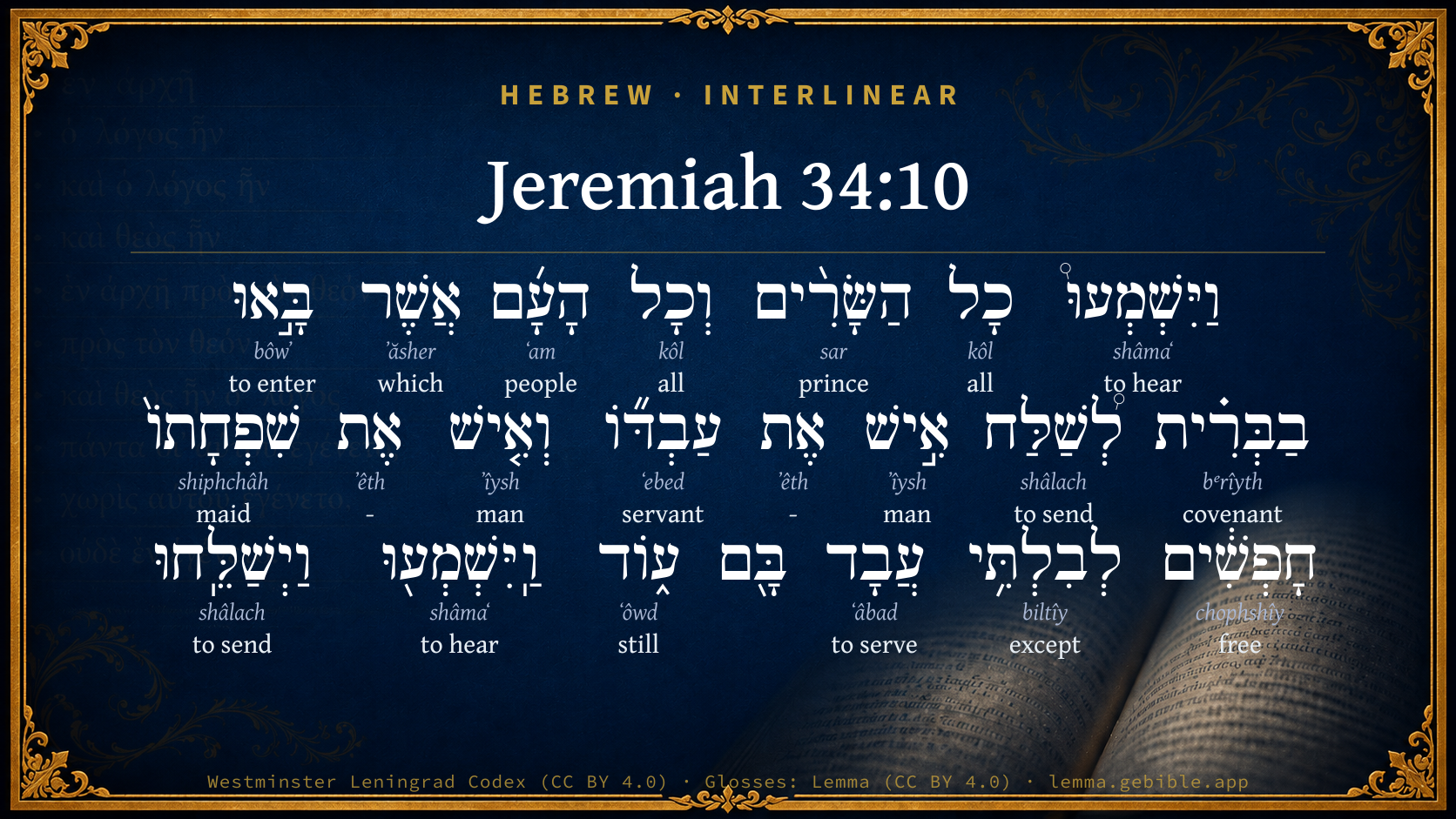
Jeremiah 34:10

Hebrew (Westminster Leningrad Codex) Jeremiah 34:10 appears in the Hebrew Old Testament. The text above is from the Westminster Leningrad Codex. Each word links to its Strong’s number, a concise gloss, and parsing drawn from the Open Scriptures Hebrew Bible morphology. Click any word for its full Brown-Driver-Briggs (BDB) entry.
Download image
Cite this verse

Jeremiah 34:10 (World English Bible). Public Domain. Lemma interlinear Bible study tool, https://lemma.gebible.app/v/jeremiah/34/10.

Show BibTeX & RIS
BibTeX
RIS
English Translation
All the princes and all the people obeyed, who had entered into the covenant, that everyone should let his man-servant, and everyone his maid-servant, go free, that none should make bondservants of them any more; they obeyed, and let them go:
World English Bible · Public Domain
Download a study sheet

One document with this verse’s original text, its word-by-word gloss line, the meaning frame, cross-references with their text, attributed commentary, and full source and license credits — printable, and it pastes into notes with its structure intact.

This verse Autodidact and up

Study sheet (.html) Plain text (.txt)

A passage Seminary Student

Up to 50 verses in one chapter. A passage sheet keeps up to 6 commentary sources and 12 cross-references per verse, in the order this page ranks them, and says so on the sheet whenever that leaves anything out. Ask for a single verse and you get the Autodidact verse sheet above.

Everything on this page stays free to read, with no account — the sheet is a download of what is already on screen, not access to it.

Want to remove ads? Support Godless Engineer
Compare translations 3

The same verse in 3 English versions, stacked beneath the original-language interlinear above. Click any original word for its lexicon entry.

Each is an independent rendering of the whole verse — the interlinear is not word-aligned to these translations.

Highlighted words mark where these versions differ — a whole-verse word diff, not a word-by-word alignment.

  • World English Bible Public Domain
    All the princes and all the people obeyed, who had entered into the covenant, that everyone should let his man-servant, and everyone his maid-servant, go free, that none should make bondservants of them any more; they obeyed, and let them go:
  • King James Version Public Domain
    Now when all the princes, and all the people, which had entered into the covenant, heard that every one should let his manservant, and every one his maidservant, go free, that none should serve themselves of them any more, then they obeyed, and let them go.
  • unfoldingWord Literal Text CC BY-SA 4.0
    So all the leaders and people entered into the covenant that each person would free his male and female slaves so that they would not be enslaved any longer. They obeyed and set them free.

unfoldingWord Literal Text — © unfoldingWord, licensed CC BY-SA 4.0. Word-aligned USFM3 via Door43 (git.door43.org/unfoldingWord/en_ult).

Versions to compare (up to 4)

3 of 4 selected

Show all 18 translations

Every available English version of this verse, each an independent rendering of the whole verse.

  • World English Bible Public Domain
    All the princes and all the people obeyed, who had entered into the covenant, that everyone should let his man-servant, and everyone his maid-servant, go free, that none should make bondservants of them any more; they obeyed, and let them go:
  • Berean Standard Bible Public Domain
    So all the officials and all the people who entered into this covenant agreed that they would free their menservants and maidservants and no longer hold them in bondage. They obeyed and released them,
  • Majority Standard Bible Public Domain
    So all the officials and all the people who entered into this covenant agreed that they would free their menservants and maidservants and no longer hold them in bondage. They obeyed and released them,
  • King James Version Public Domain
    Now when all the princes, and all the people, which had entered into the covenant, heard that every one should let his manservant, and every one his maidservant, go free, that none should serve themselves of them any more, then they obeyed, and let them go.
  • American Standard Version (1901) Public Domain
    And all the princes and all the people obeyed, that had entered into the covenant, that every one should let his man-servant, and every one his maid-servant, go free, that none should make bondmen of them any more; they obeyed, and let them go:
  • Revised Version (1885) Public Domain
    And all the princes and all the people obeyed, which had entered into the covenant, that every one should let his manservant, and every one his maidservant, go free, that none should serve themselves of them any more; they obeyed, and let them go:
  • Geneva Bible (1599) Public Domain
    Now when all the princes, and all the people which had agreed to the couenant, heard that euery one should let his seruant go free, and euery one his handmaide, and that none should serue them selues of them any more, they obeyed and let them go.
  • Douay-Rheims (1899) Public Domain
    And all the princes, and all the people who entered into the covenant, heard that every man should let his manservant, and every man his maidservant go free, and should no more have dominion over them: and they obeyed, and let them go free.
  • Young's Literal Translation Public Domain
    and hearken do all the heads, and all the people who have come in to the covenant to send forth each his man-servant and each his maid-servant free, so as not to lay service on them any more, yea, they hearken, and send them away;
  • Literal Standard Version CC BY-SA 4.0
    and all the heads listen, and all the people who have come into the covenant to each send forth his manservant and each his maidservant free, so as not to lay service on them anymore, indeed, they listen, and send them away;
  • Unlocked Literal Bible CC BY-SA 4.0
    So all the leaders and people entered into the covenant that each person would free his male and female slaves so that they would not be enslaved any longer. They obeyed and set them free.
  • unfoldingWord Literal Text CC BY-SA 4.0
    So all the leaders and people entered into the covenant that each person would free his male and female slaves so that they would not be enslaved any longer. They obeyed and set them free.
  • Darby Bible Public Domain
    And all the princes and all the people that had entered into the covenant obeyed, every man letting his bondman and every man his bondmaid go free, that none should exact service of them any more: they obeyed, and let [them] go.
  • World Messianic Bible Public Domain
    All the princes and all the people obeyed who had entered into the covenant, that everyone should let his male servant and everyone his female servant go free, that no one should make bondservants of them any more. They obeyed and let them go,
  • Webster's Bible Public Domain
    Now when all the princes, and all the people who had entered into the covenant, heard that every one should liberate his man-servant, and every one his maid-servant, that none should retain them in service any more, then they obeyed, and let them go.
  • Free Bible Version CC BY-SA 4.0
    All the officials and all the people who accepted this agreement did what they said. They freed their male and female slaves, not forcing them to remain slaves any longer. They obeyed and let them go free.
  • Bible in Basic English Public Domain
    And this was done by all the rulers and the people who had taken part in the agreement, and every one let his man-servant and his servant-girl go free, not to be used as servants any longer; they did so, and let them go.
  • JPS Tanakh (1917) Public Domain
    and all the princes and all the people hearkened, that had entered into the covenant to let every one his man-servant, and every one his maid-servant, go free, and not to make bondmen of them any more; they hearkened, and let them go;

Literal Standard Version (2020), Covenant Press — licensed CC BY-SA 4.0. Text via the HelloAO Bible API (eBible.org). Unlocked Literal Bible (unfoldingWord) — licensed CC BY-SA 4.0. Text via the HelloAO Bible API (eBible.org). unfoldingWord Literal Text — © unfoldingWord, licensed CC BY-SA 4.0. Word-aligned USFM3 via Door43 (git.door43.org/unfoldingWord/en_ult). Free Bible Version, Dr. Jonathan Gallagher — licensed CC BY-SA 4.0. Text via the HelloAO Bible API (eBible.org).

Word by word

More ways to search: Search by grammar → Find every occurrence → Compare this word →

Practice this passage: Drill this verse → Learn its vocabulary →

חָפְשִׁ֔ים
chophshîy
H2670
“free”
Adjective, Adjective, Masculine, Plural, Absolute
Part of Speech
Adjective
Type
Adjective
Gender
Masculine
Number
Plural
State
Absolute
Full BDB Definition

Origin: from H2666

TWOT: 717c

free - free (from slavery) - free (from taxes or obligations)
  1. וַיִּשְׁמְעוּ֩ shâmaʻ H8085 “and · to hear” Conjunction + Verb, Qal, Sequential Imperfect, 3rd Person, Masculine, Plural
  2. כָל kôl H3605 “all of” Noun, Common, Masculine, Singular, Construct
  3. הַשָּׂרִ֨ים sar H8269 “the · princes” Particle, Definite Article + Noun, Common, Masculine, Plural, Absolute
  4. וְכָל kôl H3605 “and · all of” Conjunction + Noun, Common, Masculine, Singular, Construct
  5. הָעָ֜ם ʻam H5971 “the · people” Particle, Definite Article + Noun, Common, Masculine, Singular, Absolute
  6. אֲשֶׁר ʼăsher H834 “which” Particle, Relative
  7. בָּ֣אוּ bôwʼ H935 “to enter” Verb, Qal, Perfect, 3rd Person, Common, Plural
  8. בַבְּרִ֗ית bᵉrîyth H1285 “in/at the · covenant” Preposition, Determined + Noun, Common, Feminine, Singular, Absolute
  9. לְ֠שַׁלַּח shâlach H7971 “to send” Preposition + Verb, Piel, Infinitive Construct
  10. אִ֣ישׁ ʼîysh H376 “man” Noun, Common, Masculine, Singular, Absolute
  11. אֶת ʼêth H853 “-” Particle, Direct Object
  12. עַבְדּ֞וֹ ʻebed H5650 “servant · his” Noun, Common, Masculine, Singular, Construct + Suffix, Personal, 3rd Person, Masculine, Singular
  13. וְאִ֤ישׁ ʼîysh H376 “and · man” Conjunction + Noun, Common, Masculine, Singular, Absolute
  14. אֶת ʼêth H853 “-” Particle, Direct Object
  15. שִׁפְחָתוֹ֙ shiphchâh H8198 “maid · his” Noun, Common, Feminine, Singular, Construct + Suffix, Personal, 3rd Person, Masculine, Singular
  16. לְבִלְתִּ֥י biltîy H1115 “to/for · except” Preposition + Conjunction
  17. עֲבָד ʻâbad H5647 “to serve” Verb, Qal, Infinitive Construct
  18. ע֑וֹד ʻôwd H5750 “still” Adverb
  19. וַֽיִּשְׁמְע֖וּ shâmaʻ H8085 “and · to hear” Conjunction + Verb, Qal, Sequential Imperfect, 3rd Person, Masculine, Plural
  20. וַיְשַׁלֵּֽחוּ shâlach H7971 “and · to send” Conjunction + Verb, Piel, Sequential Imperfect, 3rd Person, Masculine, Plural

About this verse

These counts appear in no published source. They are computed here, from the morphology-tagged text and Lemma’s own curated glosses. What Lemma adds →

22
words
16
distinct lemmas
Prophets
section

Notable vocabulary

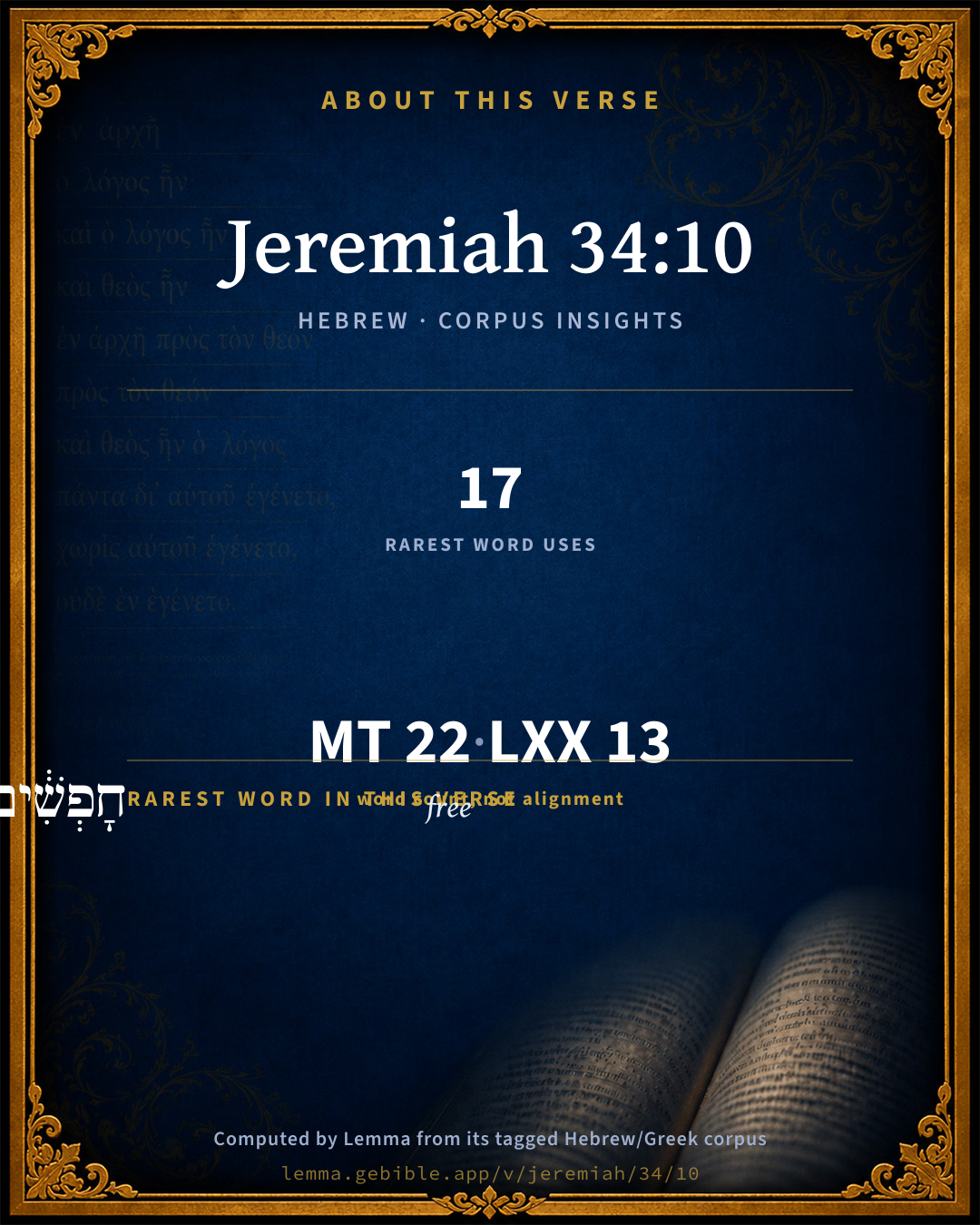
The rarest word here is חָפְשִׁ֔ים free H2670 — appearing just 17 times in the whole Hebrew Bible.

Shared distinctive vocabulary

חָפְשִׁ֔ים free H2670 occurs in 17 verses of the Hebrew Bible. Also found in:

Grammatical profile

  • 6 verbs
  • 9 nouns
  • 1 adjective
  • 1 preposition
  • 1 conjunction
  • 1 adverb
  • 3 particles

Verb forms

  • וַיִּשְׁמְעוּ֩ Qal · Sequential Imperfect
  • בָּ֣אוּ Qal · Perfect
  • לְ֠שַׁלַּח Piel · Infinitive Construct
  • עֲבָד Qal · Infinitive Construct
  • וַֽיִּשְׁמְע֖וּ Qal · Sequential Imperfect
  • וַיְשַׁלֵּֽחוּ Piel · Sequential Imperfect

Repetition

Words recur within this verse — often emphatic in Hebrew:

  • וַיִּשְׁמְעוּ֩ to hear H8085 ×2
  • כָל all H3605 ×2
  • לְ֠שַׁלַּח to send H7971 ×2
  • אִ֣ישׁ man H376 ×2

Hebrew & Septuagint length

In the original languages it is 22 Hebrew tokens and 13 Greek tokens — but the two are counted differently (Hebrew bundles its prefixes and suffixes into one token; the Greek is in lemma form), so that isn’t a like-for-like length.

Cross-references

8

Topical passages linked to Jeremiah 34:10 in the Treasury of Scripture Knowledge — connected by theme and wording, ordered by reader-vote popularity; previews shown in the World English Bible.

  • Jeremiah 26:10 When the princes of Judah heard these things, they came up from the king's house to the house of Yahweh; and they sat in the entry of the new gate of Yahweh's [house].
  • Jeremiah 26:16 Then said the princes and all the people to the priests and to the prophets: This man is not worthy of death; for he has spoken to us in the name of Yahweh our God.
  • Isaiah 29:13 The Lord said, Because this people draw near [to me], and with their mouth and with their lips to honor me, but have removed their heart far from me, and their fear of me is a commandment of men which has been taught [them];
  • Jeremiah 3:10–11 Yet for all this her treacherous sister Judah has not returned to me with her whole heart, but only in pretense, says Yahweh.
  • Jeremiah 36:12 he went down into the king's house, into the scribe's chamber: and, behold, all the princes were sitting there, [to wit], Elishama the scribe, and Delaiah the son of Shemaiah, and Elnathan the son of Achbor, and Gemariah the son of Shaphan, and Zedekiah the son of Hananiah, and all the princes.
  • Jeremiah 36:24–25 They were not afraid, nor tore their garments, neither the king, nor any of his servants who heard all these words.
  • Jeremiah 38:4 Then the princes said to the king, Let this man, we pray you, be put to death; because he weakens the hands of the men of war who remain in this city, and the hands of all the people, in speaking such words to them: for this man doesn't seek the welfare of this people, but the hurt.
  • Mark 6:20 for Herod feared John, knowing that he was a righteous and holy man, and kept him safe. When he heard him, he did many things, and he heard him gladly.

Cross-references courtesy of OpenBible.info (CC BY 4.0).

Hebrew and Greek witnesses Masoretic Hebrew ↔ Greek Septuagint

The same verse in the two great witnesses to the Old Testament, shown verse-for-verse.

These are two independent witnesses, not word-aligned to each other, and the Septuagint is shown in lemma (dictionary) form.

Hebrew Jeremiah 34:10 Masoretic · Westminster Leningrad Codex

וַיִּשְׁמְעוּ֩ כָל הַשָּׂרִ֨ים וְכָל הָעָ֜ם אֲשֶׁר בָּ֣אוּ בַבְּרִ֗ית לְ֠שַׁלַּח אִ֣ישׁ אֶת עַבְדּ֞וֹ וְאִ֤ישׁ אֶת שִׁפְחָתוֹ֙ חָפְשִׁ֔ים לְבִלְתִּ֥י עֲבָד בָּ֖ם ע֑וֹד וַֽיִּשְׁמְע֖וּ וַיְשַׁלֵּֽחוּ

All the princes and all the people obeyed, who had entered into the covenant, that everyone should let his man-servant, and everyone his maid-servant, go free, that none should make bondservants of them any more; they obeyed, and let them go:

World English Bible · Public Domain

Greek LXX Structure differs

In the Septuagint, Jeremiah is about an eighth shorter than the Hebrew and arranges its material differently — the Oracles Against the Nations (Hebrew chapters 46–51) appear in the middle of the Greek book, after 25:13. Because the chapter and verse boundaries do not line up, a verse-for-verse comparison with the Hebrew is not shown.

A verse-for-verse comparison isn’t shown here because the chapters and verses don’t line up. Switch to the LXX edition with the MT / LXX toggle above to read the Greek directly.

On this verse, The Cambridge Bible for Schools and Colleges discusses the Septuagint’s reading. Read the note in Commentary ↓

Hebrew: Westminster Leningrad Codex (CC BY 4.0). Greek: Septuagint (public domain); English from a public-domain English Septuagint. How the Septuagint differs from the Hebrew →

Targum (Aramaic paraphrase)

1

The Targum is the ancient Jewish Aramaic paraphrase of the Hebrew Scriptures — an interpretive translation, not the Hebrew text itself. Onkelos (literal) and Pseudo-Jonathan (expansive) render the Torah, and Jonathan the Prophets. Coverage is partial: where no permissively-licensed English translation exists for a verse, only the Aramaic is shown. This is verse-level text, not a word-by-word alignment to the Hebrew.

  1. Targum Jonathan Prophets (Joshua–Malachi)
    וּשְׁמָעוּ כָל רַבְרְבַיָא וְכָל עַמָא דְעָלוּ בִּקְיָמָא לְשַׁלָחָא גְבַר יַת עַבְדֵיהּ וּגְבַר יַת אַמְתֵיהּ בְּנֵי חוֹרִין בְּדִיל דְלָא יִפְלְחוּן בְּהוֹן עוֹד וְקַבִּילוּ וּשְׁלָחוּ:

    (no public-domain English translation for this verse)

    Targum Jonathan — Aramaic: “Mikraot Gedolot” (public domain). English: “Sefaria Community Translation” (CC0 1.0 (public-domain dedication)); “London "Chaldee Paraphrase," 1871” (public domain). Text via Sefaria.

Commentary

Notes on Jeremiah 34:10 from classic Christian and Jewish commentators (each source and its license shown beneath its notes). The classic Christian expositions comment on the surrounding passage and are grouped to its opening verse, so a note may address several verses; the Jewish commentaries on the Tanakh (Rashi and others) are per-verse, so they appear only where the commentator wrote on this verse.

Lemma curates 59 commentaries, every one of them public domain or Creative Commons licensed, each selected and text-cleaned for this edition rather than reprinted as found. About our sources →

Trapp's Complete Commentary

John Trapp

Jer 34:10 Now when all the princes, and all the people, which had entered into the covenant, heard that every one should let his manservant, and every one his maidservant, go free, that none should serve themselves of them any more, then they obeyed, and let [them] go.

Ver. 10. Then they obeyed, and let them go.] They seemed to be very good as long as it lasted. See on Jer 34:8. So when God lays siege to men by sickness or otherwise, then covenants are made and kept for a while concerning the putting away of their sins; but no sooner doth God slack his wrath but they retract their vows, and return to their wonted wickedness:

“ Aegrotus surgit, sed pia vota iacent. ”

John Trapp, A Commentary or Exposition upon All the Books of the Old and New Testament (1647–1656) — public domain. Text from a community e-Sword module.

Joseph Benson's Commentary

Jer 34:10-11. Now when all the princes, &c., heard — This verse is better translated by Blaney and others thus, And all the princes hearkened, or, consented, and all the people who entered into covenant to let every one his bondman, and every one his bond-woman go free, and not to exact service of them any more, they hearkened, I say, and let them go. That is, they conformed to the obligations of the covenant, which they had entered into at the instigation of their prince. But afterward they turned, and brought them into subjection, &c. — Namely, upon the advance of the Egyptian army, which caused Nebuchadnezzar to raise the siege of Jerusalem. When they thought themselves safe from their enemies, as if they had also got out of God’s hand, they repented of their repentance, and returned to their old oppressions. Now this was not only a contempt of the divine law, as if it were of no force at all, but they might either keep it or break it as they thought fit; but it was a contempt of the covenant which they had, in a very solemn manner, (see Jer 34:18-20,) made with him, and of that wrath which they had imprecated upon themselves in case they should break that covenant. It was jesting with God Almighty, as if he could be imposed on by fallacious promises, which, when they had gained their point, they would think themselves no longer obliged by. It was lying to God with their mouths, and flattering him with their tongues. It was likewise a contempt of the judgments of God, and setting them at defiance; as if when once the course of them was stopped a little, and interrupted, they would never proceed again, nor be revived: whereas, reprieves are so far from being pardons, that if they be abused thus, and sinners take encouragement from them to return to sin, they are but preparatives for heavier strokes of divine vengeance.

Joseph Benson's Commentary on the Old and New Testaments (1811–1818) — public domain. Text from a community e-Sword module.

John Calvin's Commentaries

He says, that all the princes and all the people heard, who had come to the covenant, that every one should let his servant free, etc.; and then he adds, And they obeyed The verb שמע, shemo, is to be taken in a twofold sense; at the beginning of the verse it refers to the simple act of hearing, and at the end of the verse, to obedience. Then he says that they obeyed, and that every one set free his servant. By saying that the princes, as well as all the people, heard, he took away every pretense as to ignorance; so that they could not make an excuse, that they relapsed through want of knowledge or through inconsideration. How so? because they had heard; nor is it to be doubted, but that the Law of God to which we have referred, had been set before them, that they might be ashamed of the iniquity and tyrannical violence which they had exercised towards their servants. The hearing then mentioned here, proves that the Jews were wholly inexcusable, for they saw that God’s Law had been long disregarded by them. And hence we learn, that each of them had sinned the more grievously, as he had been taught what was right, and had, as it were, designedly cast off the yoke. So also Christ teaches us, that the servant who knows his master’s will and does it not, shall be more severely punished than one who offends through ignorance. (Luke 12:47)

John Calvin's Commentaries (1540-1563) — public domain. Text from the Calvin Translation Society English edition (1840s-50s) via the Christian Classics Ethereal Library (ccel.org). Calvin's coverage is partial (roughly two-thirds of the Bible); uncommented books and verses are honest gaps, never fabricated. The 19th-century editor's footnotes and remarks are omitted so the notes are faithfully Calvin's own voice.

The Cambridge Bible for Schools and Colleges

gen. ed. J. J. S. Perowne

10, 11. The MT. is somewhat awkward, and the LXX (preferred by Co. and Du.) clearer and briefer. But we cannot accept the latter with entire confidence.

The Cambridge Bible for Schools and Colleges (gen. ed. J. J. S. Perowne; Cambridge University Press, 1878–1918) — public domain. Text from a community e-Sword module.

John Gill's Exposition

Now when all the princes, and all the people, which had entered into the covenant,.... The king had made with the people. Here the princes are mentioned, who were not before, but included in the people; they and the rest of the people are here meant, who having agreed to the covenant,

heard that everyone should let his manservant, and everyone his maidservant, go free, that none should serve themselves of them any more; or any longer, which they had done, contrary to law: when they understood that this was the sum of the covenant they had entered into, and this the intent of the proclamation they agreed unto; or when they heard the law read and explained by the prophet, concerning the manumission of the Hebrew servants, when the time of their servitude was expired,

then they obeyed, and let them go; dismissed them from their service, in obedience to the law of God, agreeably to their own covenant, and the proclamation of liberty they assented to. The whole might be rendered thus, "and all the princes and all the people obeyed, which had entered into the covenant, to let everyone his manservant, and everyone his maidservant, go free, not to serve themselves of them any more, and they obeyed, I say, to let them go"; so far they did well, and were praiseworthy, that they kept the law of God, and their own covenant.

John Gill's Exposition of the Whole Bible (1746–1763) — public domain (CC PDM 1.0). Text via the HelloAO Bible API.

Matthew Poole's English Annotations

The princes and the people, having first with the king agreed to the thing, upon the issuing out of his proclamation they at first yielded obedience to it.

Matthew Poole's English Annotations on the Holy Bible (1683–1685) — public domain. Text from a community e-Sword/MySword module.

The Pulpit Commentary

Now when all the princes, etc. This verse should rather be rendered thus: Then all the princes, and all the people, etc., obeyed, every one letting his slave, and every one his handmaid, go free, not serving them. selves of them any more; they even obeyed, and let them go.

The Pulpit Commentary (1880–1919), ed. H.D.M. Spence-Jones & Joseph S. Exell — public domain. Text from a community e-Sword module.

unfoldingWord translationNotes

Door43 World Missions Community

Connecting Statement:

Jeremiah continues giving the background information that began in Jeremiah 34:8.

translationWords

obey

send

mind

unfoldingWord translationNotes — © Distant Shores Media and the Door43 World Missions Community, licensed CC BY-SA 4.0. Source: git.door43.org/Door43/en_tn.

Lesson kit

Teaching starters — assembled from the data on this page, not authored interpretation. Every prompt links to the verse data it draws on. Edit before teaching.

Jeremiah, in the Prophets, opens this verse with 22 words (16 distinct Hebrew lemmas). Its most distinctive word is chophshîy (“free”). A historical commentator’s framing appears above. Read the whole chapter for the surrounding context.

Discussion questions

  1. The word chophshîy carries the sense “free.” How does it shape the verse?
  2. How does Exodus 21:2, which shares the word «free», read alongside this verse?
  3. What does the repetition of “to hear” (2× in this one verse) do in this verse?
  4. The translations on this page render this verse differently — a whole-verse word diff, not a word-by-word alignment. What might account for the different wordings?
  5. «וַיִּשְׁמְעוּ֩» is a Qal Sequential Imperfect verb. How does that grammatical form shape the action described?
  6. Compare how Trapp's Complete Commentary and Joseph Benson's Commentary read this verse. Where do they agree or differ?

Things to notice

Reading settings

Reading text

Shown beneath each verse's original-language words.

Old Testament
Old Testament edition

Read the OT as the Masoretic Hebrew (MT) or the Greek Septuagint (LXX).

English shown for the Greek Septuagint (in the Hebrew ↔ Greek comparison).

Comparing translations? Open the Compare panel on any verse page to stack up to four side by side.