Daniel 11:32

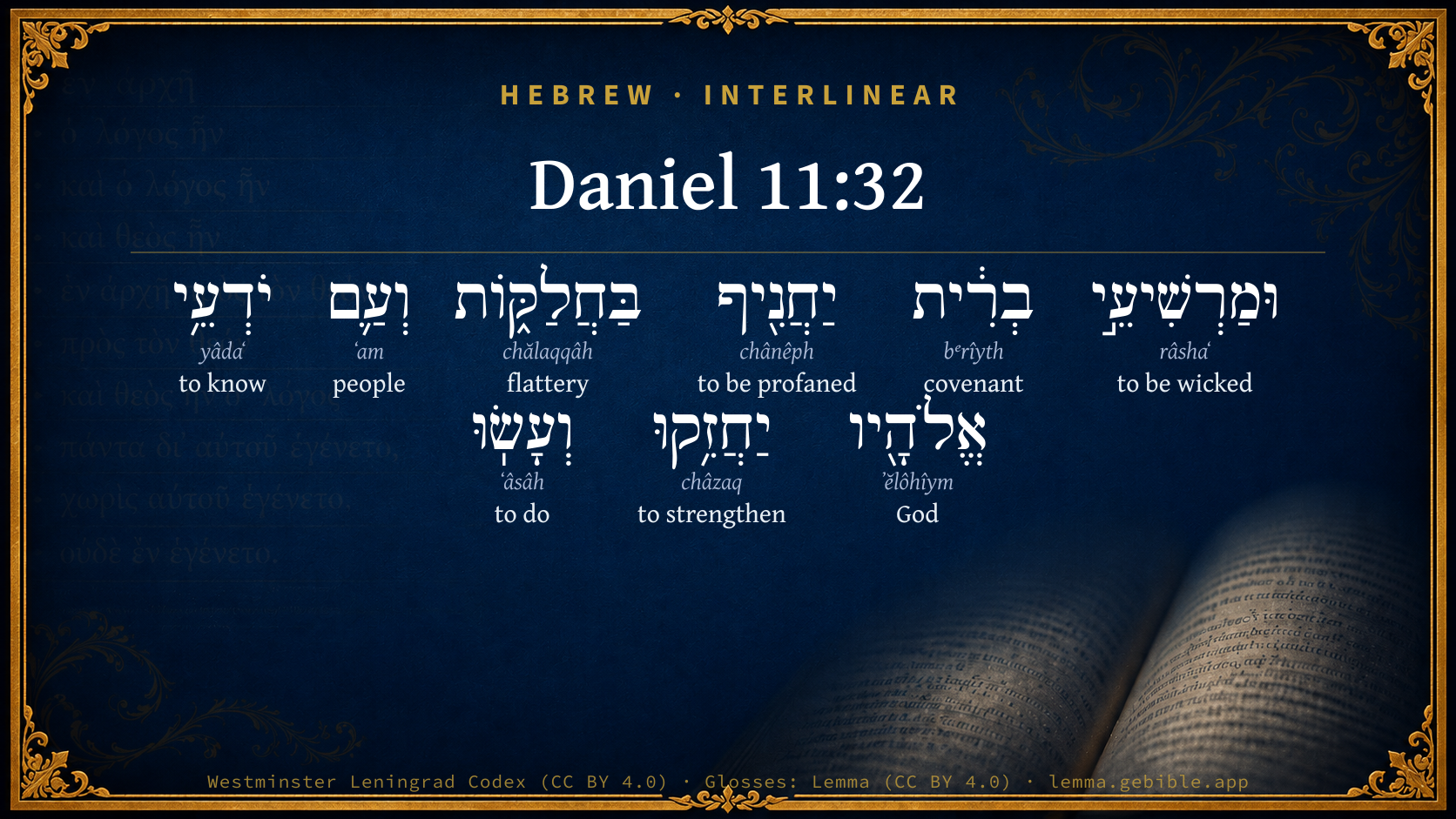
Hebrew (Westminster Leningrad Codex) Daniel 11:32 appears in the Hebrew Old Testament. The text above is from the Westminster Leningrad Codex. Each word links to its Strong’s number, a concise gloss, and parsing drawn from the Open Scriptures Hebrew Bible morphology. Click any word for its full Brown-Driver-Briggs (BDB) entry.
Download image
Cite this verse

Daniel 11:32 (World English Bible). Public Domain. Lemma interlinear Bible study tool, https://lemma.gebible.app/v/daniel/11/32.

Show BibTeX & RIS
BibTeX
RIS
English Translation
Such as do wickedly against the covenant shall he pervert by flatteries; but the people who know their God shall be strong, and do [exploits].
World English Bible · Public Domain
Highlights
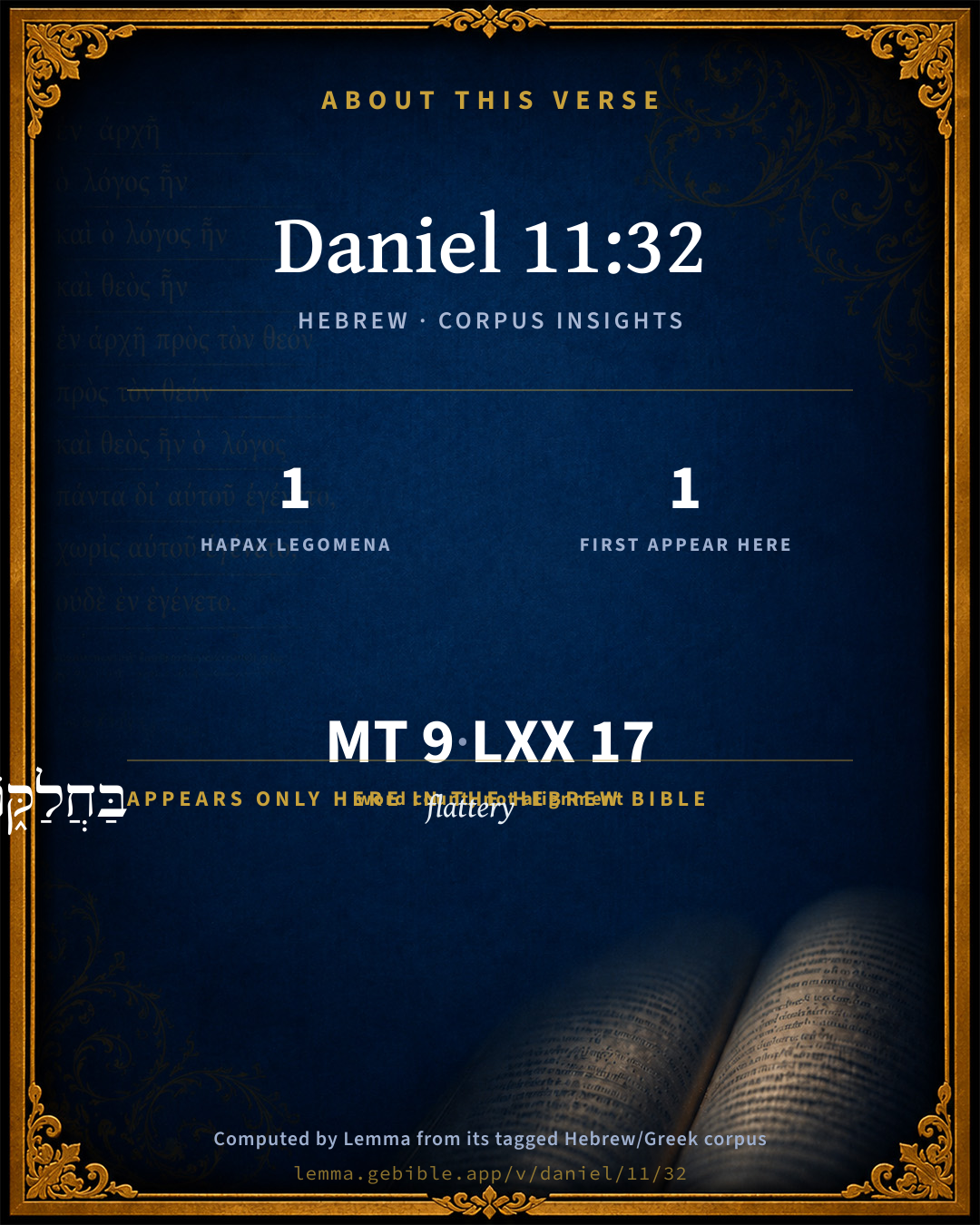
  • 1 hapax legomenon — only here in the Hebrew Bible
  • 1 first appearance in the Hebrew Bible
Full analysis ↓
Download a study sheet

One document with this verse’s original text, its word-by-word gloss line, the meaning frame, cross-references with their text, attributed commentary, and full source and license credits — printable, and it pastes into notes with its structure intact.

This verse Autodidact and up

Study sheet (.html) Plain text (.txt)

A passage Seminary Student

Up to 50 verses in one chapter. A passage sheet keeps up to 6 commentary sources and 12 cross-references per verse, in the order this page ranks them, and says so on the sheet whenever that leaves anything out. Ask for a single verse and you get the Autodidact verse sheet above.

Everything on this page stays free to read, with no account — the sheet is a download of what is already on screen, not access to it.

Want to remove ads? Support Godless Engineer
Compare translations 3

The same verse in 3 English versions, stacked beneath the original-language interlinear above. Click any original word for its lexicon entry.

Each is an independent rendering of the whole verse — the interlinear is not word-aligned to these translations.

Highlighted words mark where these versions differ — a whole-verse word diff, not a word-by-word alignment.

  • World English Bible Public Domain
    Such as do wickedly against the covenant shall he pervert by flatteries; but the people who know their God shall be strong, and do [exploits].
  • King James Version Public Domain
    And such as do wickedly against the covenant shall he corrupt by flatteries: but the people that do know their God shall be strong, and do exploits.
  • unfoldingWord Literal Text CC BY-SA 4.0
    He will corrupt with flattery those who act wickedly toward the covenant. But the people who know their God will be strong and take action.

unfoldingWord Literal Text — © unfoldingWord, licensed CC BY-SA 4.0. Word-aligned USFM3 via Door43 (git.door43.org/unfoldingWord/en_ult).

Versions to compare (up to 4)

3 of 4 selected

Show all 18 translations

Every available English version of this verse, each an independent rendering of the whole verse.

  • World English Bible Public Domain
    Such as do wickedly against the covenant shall he pervert by flatteries; but the people who know their God shall be strong, and do [exploits].
  • Berean Standard Bible Public Domain
    With flattery he will corrupt those who violate the covenant, but the people who know their God will firmly resist him.
  • Majority Standard Bible Public Domain
    With flattery he will corrupt those who violate the covenant, but the people who know their God will firmly resist him.
  • King James Version Public Domain
    And such as do wickedly against the covenant shall he corrupt by flatteries: but the people that do know their God shall be strong, and do exploits.
  • American Standard Version (1901) Public Domain
    And such as do wickedly against the covenant shall he pervert by flatteries; but the people that know their God shall be strong, and do `exploits'.
  • Revised Version (1885) Public Domain
    And such as do wickedly against the covenant shall he pervert by flatteries: but the people that know their God shall be strong, and do exploits.
  • Geneva Bible (1599) Public Domain
    And such as wickedly breake ye couenant, shall he cause to sinne by flatterie: but the people that do know their God, shall preuaile and prosper.
  • Douay-Rheims (1899) Public Domain
    And such as deal wickedly against the covenant shall deceitfully dissemble: but the people that know their God shall prevail and succeed.
  • Young's Literal Translation Public Domain
    And those acting wickedly `against' the covenant, he defileth by flatteries; and the people knowing their God are strong, and have wrought.
  • Literal Standard Version CC BY-SA 4.0
    And those acting wickedly [against] the covenant, he defiles by flatteries; and the people knowing their God are strong, and have worked.
  • Unlocked Literal Bible CC BY-SA 4.0
    As for those who acted wickedly against the covenant, he will deceive them and corrupt them. But the people who know their God will be strong and will take action.
  • unfoldingWord Literal Text CC BY-SA 4.0
    He will corrupt with flattery those who act wickedly toward the covenant. But the people who know their God will be strong and take action.
  • Darby Bible Public Domain
    And such as do wickedly against the covenant shall he pervert by flatteries; but the people that know their God shall be strong, and shall act.
  • World Messianic Bible Public Domain
    He will corrupt those who do wickedly against the covenant by flatteries; but the people who know their God will be strong and take action.
  • Webster's Bible Public Domain
    And such as do wickedly against the covenant shall he corrupt by flatteries: but the people that know their God shall be strong, and do exploits.
  • Free Bible Version CC BY-SA 4.0
    The king will use flattery to corrupt those who break the solemn agreement, but the people who know their God will stand firm in their resistance.
  • Bible in Basic English Public Domain
    And those who do evil against the agreement will be turned to sin by his fair words: but the people who have knowledge of their God will be strong and do well.
  • JPS Tanakh (1917) Public Domain
    And such as do wickedly against the covenant shall be corrupt by blandishments; but the people that know their God shall show strength, and prevail.

Literal Standard Version (2020), Covenant Press — licensed CC BY-SA 4.0. Text via the HelloAO Bible API (eBible.org). Unlocked Literal Bible (unfoldingWord) — licensed CC BY-SA 4.0. Text via the HelloAO Bible API (eBible.org). unfoldingWord Literal Text — © unfoldingWord, licensed CC BY-SA 4.0. Word-aligned USFM3 via Door43 (git.door43.org/unfoldingWord/en_ult). Free Bible Version, Dr. Jonathan Gallagher — licensed CC BY-SA 4.0. Text via the HelloAO Bible API (eBible.org).

Word by word

More ways to search: Search by grammar → Find every occurrence → Compare this word →

Practice this passage: Drill this verse → Learn its vocabulary →

בַּחֲלַקּ֑וֹת
chălaqqâh
H2514
“in/at · flattery”
Preposition + Adjective, Adjective, Feminine, Plural, Absolute
Part of Speech
Preposition + Adjective
Type
Adjective
Gender
Feminine
Number
Plural
State
Absolute
Full BDB Definition

Origin: from H2505

TWOT: 670e

flattery, smoothness, fine promises
  1. וּמַרְשִׁיעֵ֣י râshaʻ H7561 “and · being wicked” Conjunction + Verb, Hiphil, Participle Active, Masculine, Plural, Construct
  2. בְרִ֔ית bᵉrîyth H1285 “covenant” Noun, Common, Feminine, Singular, Absolute
  3. יַחֲנִ֖יף chânêph H2610 “to be profaned” Verb, Hiphil, Imperfect, 3rd Person, Masculine, Singular
  4. וְעַ֛ם ʻam H5971 “and · people of” Conjunction + Noun, Common, Masculine, Singular, Construct
  5. יֹדְעֵ֥י yâdaʻ H3045 “knowing” Verb, Qal, Participle Active, Masculine, Plural, Construct
  6. אֱלֹהָ֖יו ʼĕlôhîym H430 “God(s) · his” Noun, Common, Masculine, Plural, Construct + Suffix, Personal, 3rd Person, Masculine, Singular
  7. יַחֲזִ֥קוּ châzaq H2388 “to strengthen” Verb, Hiphil, Imperfect, 3rd Person, Masculine, Plural
  8. וְעָשֽׂוּ ʻâsâh H6213 “and · to do” Conjunction + Verb, Qal, Sequential Perfect, 3rd Person, Common, Plural

About this verse

These counts appear in no published source. They are computed here, from the morphology-tagged text and Lemma’s own curated glosses. What Lemma adds →

9
words
9
distinct lemmas
Prophets
section

Notable vocabulary

1 hapax legomenon — a word that appears only here in the entire Hebrew Bible:

  • בַּחֲלַקּ֑וֹת flattery H2514

First appearance in Scripture

This word makes its first canonical appearance in the Hebrew Bible here:

  • בַּחֲלַקּ֑וֹת flattery H2514

Shared distinctive vocabulary

יַחֲנִ֖יף to be profaned H2610 occurs in 9 verses of the Hebrew Bible. Also found in:

Grammatical profile

  • 5 verbs
  • 3 nouns
  • 1 adjective

Verb forms

  • וּמַרְשִׁיעֵ֣י Hiphil · Participle Active
  • יַחֲנִ֖יף Hiphil · Imperfect
  • יֹדְעֵ֥י Qal · Participle Active
  • יַחֲזִ֥קוּ Hiphil · Imperfect
  • וְעָשֽׂוּ Qal · Sequential Perfect

Hebrew & Septuagint length

In English translation the verse runs 25 words from the Hebrew and 22 from the Septuagint (LXX English) — closely comparable.

A rough comparison of the two English renderings, which tokenize alike — not a word-level alignment.

Word counts can differ between the Hebrew and the Greek without any difference in meaning — e.g. the Hebrew direct-object marker אֵת has no separate Greek word, and Greek often adds the article ὁ.

In the original languages it is 9 Hebrew tokens and 17 Greek tokens — but the two are counted differently (Hebrew bundles its prefixes and suffixes into one token; the Greek is in lemma form), so that isn’t a like-for-like length.

Cross-references

24

Topical passages linked to Daniel 11:32 in the Treasury of Scripture Knowledge — connected by theme and wording, ordered by reader-vote popularity; previews shown in the World English Bible.

  • 1 Chronicles 28:9 You, Solomon my son, know the God of your father, and serve him with a perfect heart and with a willing mind; for Yahweh searches all hearts, and understands all the imaginations of the thoughts: if you seek him, he will be found of you; but if you forsake him, he will cast you off forever.
  • Psalms 9:10 Those who know your name will put their trust in you, For you, Yahweh, have not forsaken those who seek you.
  • Zechariah 10:12 I will strengthen them in Yahweh; And they will walk up and down in his name," says Yahweh.
  • John 17:3 This is eternal life, that they should know you, the only true God, and him whom you sent, Jesus Christ.
  • Micah 5:7–9 The remnant of Jacob will be in the midst of many peoples, Like dew from Yahweh, Like showers on the grass, That don't wait for man, Nor wait for the sons of men.
  • 2 Timothy 2:1–3 You therefore, my child, be strengthened in the grace that is in Christ Jesus.
  • 1 John 2:3–4 This is how we know that we know him: if we keep his commandments.
  • Zechariah 9:13–16 For indeed I bend Judah as a bow for me. I have filled the bow with Ephraim; And I will stir up your sons, Zion, Against your sons, Greece, And will make you like the sword of a mighty man.
  • Zechariah 12:3–7 It will happen in that day, that I will make Jerusalem a burdensome stone for all the peoples. All who burden themselves with it will be severely wounded, and all the nations of the earth will be gathered together against it.
  • Zechariah 10:3–6 My anger is kindled against the shepherds, And I will punish the male goats; For Yahweh of Hosts has visited his flock, the house of Judah, And will make them as his horse in the battle that he is proud of.
  • Jeremiah 31:34 and they shall teach no more every man his neighbor, and every man his brother, saying, Know Yahweh; for they shall all know me, from the least of them to the greatest of them, says Yahweh: for I will forgive their iniquity, and their sin will I remember no more.
  • 2 Thessalonians 2:9–12 even he whose coming is according to the working of Satan with all power and signs and lying wonders,
  • Hebrews 10:32–33 But remember the former days, in which, after you were enlightened, you endured a great struggle with sufferings;
  • 1 John 5:20 We know that the Son of God has come, and has given us an understanding, that we know him who is true, and we are in him who is true, in his Son Jesus Christ. This is the true God, and eternal life.
  • Proverbs 26:28 A lying tongue hates those it hurts; And a flattering mouth works ruin.
  • Malachi 4:2 But to you who fear my name shall the sun of righteousness arise with healing in its wings. You will go out, and leap like calves of the stall.
  • 2 Corinthians 4:3–6 Even if our Gospel is veiled, it is veiled in those who perish;
  • Revelation 13:12–15 He exercises all the authority of the first beast in his presence. He makes the earth and those who dwell in it to worship the first beast, whose fatal wound was healed.
  • Revelation 7:9–10 After these things I looked, and behold, a great multitude, which no man could number, out of every nation and of all tribes, peoples, and languages, standing before the throne and before the Lamb, dressed in white robes, with palm branches in their hands.
  • Proverbs 19:5 A false witness shall not be unpunished. He who pours out lies shall not go free.
  • Micah 7:15–17 "As in the days of your coming forth out of the land of Egypt, I will show them marvelous things."
  • Zechariah 14:1–4 Behold, a day of Yahweh comes, when your spoil will be divided in your midst.
  • Revelation 6:11 A long white robe was given to each of them. They were told that they should rest yet for a while, until their fellow servants and their brothers, who would also be killed even as they were, should complete their course.
  • Revelation 12:7–11 There was war in the sky. Michael and his angels made war on the dragon. The dragon and his angels made war.

Cross-references courtesy of OpenBible.info (CC BY 4.0).

Hebrew and Greek witnesses Masoretic Hebrew ↔ Greek Septuagint

The same verse in the two great witnesses to the Old Testament, shown verse-for-verse.

These are two independent witnesses, not word-aligned to each other, and the Septuagint is shown in lemma (dictionary) form.

Hebrew Daniel 11:32 Masoretic · Westminster Leningrad Codex

וּמַרְשִׁיעֵ֣י בְרִ֔ית יַחֲנִ֖יף בַּחֲלַקּ֑וֹת וְעַ֛ם יֹדְעֵ֥י אֱלֹהָ֖יו יַחֲזִ֥קוּ וְעָשֽׂוּ

Such as do wickedly against the covenant shall he pervert by flatteries; but the people who know their God shall be strong, and do [exploits].

World English Bible · Public Domain

Greek LXX Daniel 11:32 Septuagint · lemma form

καί ἐν ἁμαρτία διαθήκη μιαίνω ἐν σκληρός λαός καί ὁ δῆμος ὁ γιγνώσκω οὗτος καταἰσχύω καί ποιέω

And the transgressors shall bring about a covenant by deceitful ways: but a people knowing their God shall prevail, and do valiantly.

LXX2012 (modern English Septuagint) · Public Domain

On this verse, The Pulpit Commentary discusses the Septuagint’s reading. Read the note in Commentary ↓

Hebrew: Westminster Leningrad Codex (CC BY 4.0). Greek: Septuagint (public domain); English from LXX2012 (modern English Septuagint) (Public Domain). How the Septuagint differs from the Hebrew →

Commentary

Notes on Daniel 11:32 from classic Christian and Jewish commentators (each source and its license shown beneath its notes). The classic Christian expositions comment on the surrounding passage and are grouped to its opening verse, so a note may address several verses; the Jewish commentaries on the Tanakh (Rashi and others) are per-verse, so they appear only where the commentator wrote on this verse.

Lemma curates 59 commentaries, every one of them public domain or Creative Commons licensed, each selected and text-cleaned for this edition rather than reprinted as found. About our sources →

Trapp's Complete Commentary

John Trapp

Dan 11:32 And such as do wickedly against the covenant shall he corrupt by flatteries: but the people that do know their God shall be strong, and do [exploits].

Ver. 32. And such as do wickedly against the covenant.] Apostates sin not common sins, as Korah and his complices died not common deaths. Forsakers of the covenant {Dan 11:30} will soon become wicked doers against the covenant, as here, till they become altogether filthy. {Psa 53:3 1Pe 2:20; 1Pe 2:22 Mat 12:43; Mat 12:45 Luk 9:62}

“ - non debet aratro,

Dignum opus exercens, vultum in sua terga referre. ”

- Sedulius.

But the people that do know their God.] The faithful Hassideans and zealots, who know and worship their God aright, these shall persevere, and overcome all allurements and fears of the world; Irritamenta et terriculamenta.

John Trapp, A Commentary or Exposition upon All the Books of the Old and New Testament (1647–1656) — public domain. Text from a community e-Sword module.

The Biblical Illustrator

Joseph S. Exell

Dan_11:32

But the people that do know their God shall be strong.

Strength in God

The follies and vices which disfigure human life, do not always proceed from a principle of depravity. The indiscretions and vices into which men fall, proceed often from weakness of mind rather than from a badness of heart. There is a certain feebleness in the springs of actions, a facility of disposition, a silliness of soul which marks the characters, and runs through the life of many men, as pernicious to them in the conduct of life, as the principle of actual depravity could be. This weakness of mind is not only pernicious but criminal. There are mental defects that are inconsistent with a state of virtue. In the Scriptures a sound mind, as well as a good heart, is mentioned as an ingredient in the character of a saint. Religion and virtue go under the name of wisdom; vice and wickedness under the name of folly. In opposition to the feeble-minded, it it said in the text, that they who know their God, or are truly religious, are strong. Religion, when rightly understood, and virtue, when properly practised, give nerves and vigour to the mind, and infuse into the soul a secret strength. This strength

1. Makes us superior to the opinion and fashion of the world. In certain companies, men are ashamed of their religion. They lend a pleased ear to arguments that shake the foundations of their faith. The truly religions man performs his duty through evil report and through good report. The applause of such fools as make a mock of sin he despises. His standard of moral conduct is his own conscience well informed by the word of God.

2. Makes us superior to the difficulties and dangers we meet with in the world. The feeble-minded man is intimidated on the slightest occasion. Happy to catch at any subterfuge, he finds or makes a thousand obstacles to the discharge of his duty. What infinite mischief has this pusillanimity done in the world! Very different is the character of him who is strong in the Lord. When he is assured he is in the right path, he sees no obstacles in the way. Nothing is difficult to a determined mind. Through Christ strengthening him, the man of God can do all things. Through the divine aid, resolution is omnipotent. See St. Pauls words to the elders of Ephesus. This was not the vain boast of men who are brave when the day of battle is distant, and who, in the midst of tranquility, talk of despising danger. It was the speech of one who acted what he spoke. (J. Logan, F.R.S.E.)

Aspect of the Times

The universal consciousness of humanity acquiesces in the admission of the divine existence. God is as much a necessity of the intellect in these advanced days of enlightenment as in the worlds early childhood. The great thought forms, as Mr. Morell calls them, have as much necessity for God as for space and time. Sometimes men assume the air of dictatorship, and venture to say if there be a God, he should have revealed himself thus and thus, assuming that they know the best methods of divine manifestation, and can calculate how much light the human mind can bear. We cannot find out the Almighty to perfection. It takes lifetime after lifetime to find out the history of the rocks; it takes weary years to know enough of astronomy to trace the very footprints of Creatorship; and yet men expect to know him who is from everlasting to everlasting, in the space of a few brief years. He, then, who aspires to know God, must begin with humility. The main faculties for apprehending God are not intellectual, but moral. When it pleases God to reveal himself to men, it is mainly to the conscience and the heart. Such a revelation, Paul tells us, has been made in the universal conscience; in the great moral laws of Hebrew revelation, but mainly in the Son who came forth from the Father to give life to the world. See the revelations between this knowledge and the well-being of man.

1. This was the strength of the early Church. In the days of the Churchs strong faith and martyr-like devotion, what was it that made the Christians the men they were? I boldly answer:--The knowledge of God which is in Christ Jesus our Lord.

2. This was the strength of the Reformation age. It was giving back to the world the truth concerning God. The people that do not know God, their god shall be weak, puerile, enslaved. True knowledge of God makes men strong, makes nations strong.

3. This is our strength in the present era of time. We cannot reach large enough generalisations of facts to know exactly what is our state compared with past eras. We may exalt political economy into a science; and when relations between man and man are out of order we may shrug our shoulders, and talk of the philosophy of things, and the inevitableness of injustice in the present day. We may point to great empires, and say success is with the mightiest armies; but who that troubles to think but must know that if nations are to be great and honourable, it must be, as Mr. Pressense says, by a return to the uninviting virtues of simpler times; yes to a purer and more practical faith in the living God who is the Saviour of all men. (W. M. Statham.)

The Sources of Courage

What is called courage is sometimes a blind folly that cannot see danger, or a lack of sense to see it as it is. Or it is a mere love of encounter, of distinction, or of destroying. You have the picture of it in Job (Job_39:19-25), where the war-horse is described. That is courage, but a thing to be checked as much as to be cheered, as much a mischief as a virtue, and it is perhaps hard to say to which it most inclines. The sublimest courage, the loftiest heroism is an inspiration. How can you measure the courage? By the measure of the love. The highest courage is sacred to love. A definition of courage may be this the life held for another s good. And this is Christianity. Its source, its strength, its life, its all, is love. Everything that can create and sustain the truest love is found in the religion of Jesus Christ, and there only. Why then have we so many so-called Christians who do not exhibit much love or courage either, but are just as selfish and fearful as other people? Because we have come to make religion an appeal to selfishness, instead of appealing to the generous appreciation of that which is love-worthy. They that do know their God shall do exploits. This is the source of courage as it is the source of love; and more--this is life eternal, to know the only true God, and Jesus Christ whom He hath sent. Think of the different motives that prompt men to endurance and valour, and see how they meet in Jesus Christ.

1. I can think that soldiers find some courage in the greatness of their nation, they have a pride in the vastness of the dominion. But what king can vie with our King? Well may the children of Zion be joyful in their King. Does the antiquity of the kingdom add to the stateliness and renown? The ancient kings are all in the dust, but our King--Before the mountains were brought forth, or ever Thou hadst formed the earth and the world, even from everlasting to everlasting, Thou art God. Think, too, of the blessedness of His way; and of the victories He hath won. Lift up your head, walk with firm step. Better not be His at all than be His without a courage worthy of His greatness and renown.

2. Do men find courage in Him whom they serve? Is the Spirit of the Leader able to kindle enthusiastic devotion, and daring unto death? Then how shall we speak of Our glorious Lord and Saviour? I wonder with shame and grief at myself that I can know Him at all, and yet be halfhearted in His service; that we can call Him Lord without finding an enthusiasm that fills and fires the whole heart. For such a King and Captain shall we have a timid, faltering service? It cannot be. (Mark Guy Pearse.)

The Influence of Religion on Military Courage

These words are part of a prophecy which relates, as some think, to a very important period of the history of the Jews, when the Maccabees, at the head of handfuls of men, destroyed great armies of aliens, and were the happy instruments, in the hands of Divine Providence, of saving their church and nation from destruction, and of raising it to a degree of consideration and renown, equal to what they had enjoyed under the administration of some of those good kings that sprung from David. Concerning this glorious period the prophet Zechariah speaks, when the Lord says by his mouth, I have bent Judah for me, filled the bow with Ephraim, and raised up thy sons, O Zion! against thy sons, O Greece! and made thee as the sword of a mighty man. The Lord of hosts shall defend them, and they shall devour and subdue with sling-stones, and they shall drink, and make a noise as through wine; and they shall be filled like bowls, and as the corners of the altar; and the Lord their God shall save them in that day as the flock of his people; for they shall be as the stones of a crown, lifted up as an ensign upon His land. Others refer this prophecy to the Christian church, and to the courage displayed by the followers of Christ in holding fast his name, and spreading the favour of it all around, in defiance of those Roman tyrants who endeavoured to extirpate Christianity out of the world.

I. WHO THEY ARE THAT KNOW THEIR GOD. In the language of scripture, no wicked man knows the Lord.. The sons of Eli, it is said, were sons of Belial; they knew not the Lord. But the Lord is known by all the upright; for the fear of the Lord is the beginning of wisdom; a good understanding have all they that do his commandments. Those who know the Lord know something concerning the perfections of his nature. It is but a little portion that they hear of him, and the thunder of his power who can understand?--But they know at least, that he is the Most High over all the earth,glorious in holiness, invariable in justice, irresistible in power. They know him to be excellent and amiable in all his perfections, and would abhor themselves if they felt a latent wish that he were anything else than he is. They who know their God know that, although there is but one God, yet there are three persons to whom the glory of deity equally belongs. This knowledge of God is attended with suitable dispositions of heart. All who know God to salvation, trust in him as their God. They rejoice in his kindness, and count it their glory and joy to call him their God. They that know their God keep his commandment. Disobedience to his voice they count the worst of all evils.

II. HOW THE KNOWLEDGE OF GOD FITS MEN FOR DOING EXPLOITS, IS NOW TO BE CONSIDERED. The word exploits is a supplement of our translation. But the words plainly signify, that those who know their God shall be strong, and do such things as could not be expected from persons not under the influence of a religious principle. The exploits done by those that know their God must be undoubtedly consistent with justice. Heroical actions have been performed for the gratification of ambition, or other corrupt dispositions of the human heart. But those who know their God would not, for the world, do an unjust action, or to risk the loss of their souls, by disobeying God. The noble army of martyrs laid down their lives, not only for their heavenly Father, but for their brethren, when they sealed the truth with their blood. But how does the knowledge of our God prepare us for doing what we may be called to do, in the defence of our country, and of ourselves?

1. They that know their God, know his will, and are disposed to do it. And this is one article of the revealed will of God, that we should be ready, when we are called by providence, to defend our king and country, our liberties, and our religion. Honour the king. Be subject to every ordinance of man, for the Lords sake. The difference between those who know their God and other men, is, that most other men will do some things that God requires, but they are not ready for every good work. Where their life, their interest, their credit, may suffer by obeying the will of God, they must be excused; but the lovers of God delight to show their obedience, where self-denial must be practised.

2. They that know their God are strengthened to do exploits, by their confidence in God as their God. They that know his name will put their trust in him; and through him they will do valiantly. Our confidence in God is founded on the mediation of our Lord Jesus Christ. He is the way: no man cometh to the Father but by him. Now, when we believe in Jesus Christ for the remission of sins, and life everlasting, what have we to fear? God. We may die, but we cannot be hurt. It is a consciousness of guilt that disqualifies us for dangerous duties.

3. The people that do know God, have learned patiently to do his will. None can hope to do exploits that is unqualified to bear those things that are unpleasant to the flesh. Hardness must be endured by every good soldier of Jesus Christ. If we faint in the day of adversity, our strength is but small.

4. The people that do know their God, are prepared for extraordinary services, by the ordinary course of their service to God. When men are daily adding sin to sin by obstinate impenitence, they prepare thorns and briars to tear their consciences, when an evil day comes. How can such men be unappalled, when they find themselves placed in a situation that exposes them to a premature death? All that know their God, have learned to keep up an intercourse with him by prayer; and in the time of distress and danger, they pray more earnestly. Great are the victories which prayer hath obtained.

5. That the people who do know their God are strong to do exploits, because God is their helper. The Lord is good unto all, but he loves all that walk in his ways. He is their arm every morning, their salvation in the day of trouble. How were all the heroes of Israel, in ancient times, enabled to do those mighty works for which they are held in everlasting remembrance? The Lord was with them. They were strong in his strength.

He protected them by the shield of his salvation. What shall we say at the conclusion of the whole matter?

1. Seek the knowledge of God. Let those who yet know not God seek the knowledge of his excellency, of his grace, of his will. Use the means of knowledge with which God hath furnished you in great plenty. Pray for the spirit of wisdom and revelation.

2. If any of you say that you know God, consider by what course of actions you ought to verify their pretentions; for if you say that you know God, and keep not his commandments, you are liars. Great exploits were done by the heroes of Gods people. You must cut off right hands and right feet, when they make you to offend. You must crucify the flesh, with the afflictions and lusts.

3. To animate us to such exploits as we may be called to perform, let us call to remembrance the exploits performed by believers in ancient times. Paul put us in mind of the many mighty works done through faith, that we may be ready, when we are called by divine providence, to follow their example. Are you called to practise virtue and holiness, admit the opposition to be expected from a crooked and perverse generation? Are you called to risk your lives in battle? Remember Abraham, who, with a little army, fought bravely and successfully against four victorious kings, to rescue his beloved nephew.

4. Those who are barren and unfruitful in the knowledge of God ought to consider their ways. Yon cannot go as missionaries to spread the light of the gospel amongst the heathen; but you may be fellow-helpers to them by your contributions and prayers. You are not called to the field of battle; but you may assist the defenders of your country by your cheerful payment of those taxes that are necessary for their support, and by your prayers to God that he may cover their heads in the day of battle. All that know the Lord love him. All that love him will desire to approve their love by those works that are pleasing in his sight. Exploits in the service of Satan indicate not only ignorance of God, but enmity against him. You must not imagine that the best means will give you the saving and sanctifying knowledge of God, without divine illumination. There are some, says Paul, that have not the knowledge of God; I speak this to your shame. There are some of the military order, as well as men of other descriptions that have not the knowledge of God. None know God who dare to profane his name by needless oaths and execrations. (G. Lawson.)

And do exploits.

Great exploits

An exploit I would define to be a heroic act, a brave feat, a great achievement. There are three opportunities open to us that are grand, thrilling, far-reaching, stupendous and overwhelming. In these you may do exploits. The three greatest things on earth to do are to save a man, or save a woman, or save a child. During the course of his life, almost every man gets into an exigency, is caught between two fires, is ground between two millstones, sits on the edge of some precipice, or in some other way comes near demolition. There are exigencies in the life of a woman. The embarrassed and humiliated woman seems to cheer up in Christian confidence. And there is another exploit you may do. You may not only save a man, and a woman, you may save a child. (T. De Witt Talmage, D.D.)

Untold possibilities of a man of faith

During one of Mr. Moodys early visits to England, as he was about to return, a friend said to him: The world has yet to see what God could do with a man who would let Him use him. This made such a deep impression upon Mr. Moody that he was led to put himself in the hands of the Lord for service as never before, and the blessing which attended the great evangelists teaching, in some measure, let the world see how much God could use a man who is willing to be used. A life given to Jesus Christ as Saviour, and that life consecrated to him for service, with a realisation of the mighty power of prayer, will certainly accomplish great things for God. The Christian Hero:

I. SOME ACCOUNT OF THAT KNOWLEDGE WHICH CHRISTIANS POSSESS OF THEIR GOD.

1. By his word and spirit they know him as a God of infinite perfection. The idols of the heathen are far inferior to their makers. The Christian knows, that the God whose he is, and whom he worships and serves, is possessed of every perfection, and that in its highest degree.

2. As a reconciled God in Christ. Christ gave himself for his people. God devised the plan of our reconciliation and peace with him.

3. They know him as their own God in Christ. He hath made himself over to them, and they have accepted him, and they live in the sure possession, and in the sweet enjoyment of him.

4. They know him as their God, with whom they live in the closest correspondence. He commands, and they obey.

II. SOME OF THOSE EXPLOITS WHICH CHRISTIANS SHALL PERFORM IN CONSEQUENCE OF THEM KNOWING GOD.

1. They shall be strong, and perform the most difficult pieces of duty.

2. They shall subdue strong corruptions.

3. They shall be strong in resisting strong temptations.

4. In patiently bearing heavy burdens.

5. In suspending the divine judgments, and holding back the arm of omnipotence itself.

III. THE INFLUENCE WHICH THE KNOWLEDGE THAT THEY HAVE OF THEIR GOD HATH UPON THEIR BEING STRONG, AND DOING EXPLOITS.

1. By their knowledge, that the command of God is their warrant for doing these exploits.

2. That they have Jehovah Jesus for their commander.

3. They have the whole armour of God, as their military accoutrements, in the day of battle.

4. They know that they have the fulness of God, and of Christ, for their supplies.

5. They know that they are assured of complete victory over their enemies.

6. They know they shall receive a glorious reward. Admonish such

(1) To make no peace with their spiritual enemies.

(2) Abhor their ways.

(3) Defy their force. (John Jardine)

The Heroism and Achievements of those who know and confide in God

These words are found in a prophecy respecting Antiochus Epiphanes, the bitter enemy and persecutor of the Jews. I am not going to harrow up your feelings by a recital of his cruelties. Persecution has always served to enable us to discern the righteous from the wicked, and him who serveth God from him who serveth him not. And so we find it here. The faithless Jews, by the promise of place and wealth and power, would be led to sacrifice their consciences; And such as do wickedly against the covenant shall be corrupt by flatteries. Not so those who are upright in heart. Their principles shall be unyielding and triumphant, but the people that do know their God shall be strong and do exploits. Consider three things with regard to the persons here spoken of.

I. THEIR KNOWLEDGE. Knowledge is the prerogative--the distinction--of humanity. The principal object of this knowledge must be God himself, whether we consider the perfections of his nature, or the various relations in which he stands to us. God in nature is God above us; God in providence is God beyond us; God in law is God against us; but God in Christ is God for us, and God with us, and God in us. We must know him in the person of his dear Son. This knowledge is not merely speculative, it is experimental. There is a great difference between knowing a thing only in theory, and knowing it in experienced by the confidence of the heart, the bias of the will, and the glowing of the affections. Lasting is very distinguishable from reading, and hearing, and talking about a thing. The true knowledge is ever accompanied with three things, confidence, affection and obedience. This knowledge is also appropriating. Where this appropriation is not actually realised, it is always desired.

II. THEIR STRENGTH. Shall be strong. Their strength is not natural. The fall has left us as much without strength as without righteousness. It is much easier to convince men of their guilt than of their weakness. Even Christians themselves acquire the knowledge of this weakness slowly and gradually. At first, they are found to rely much upon their convictions, purposes, and resolutions, and, perhaps, vows too; but their iniquities, like the wind, after all, carry them away. By their failings and falls, they are taught that they only are safe, Who are kept by the power of God, through faith unto salvation. Christians, by experience, learn more and more where alone their strength lies, and they are led to trust in the Lord only. Two things with regard to this strength you must remember. The supplies of it are communicated seasonably. And it is obtained by the use of means. Some have a stupid notion that we should not engage in the exercises of religion, unless we feel in a suitable and lively frame for them. If we are in a bad frame, we need to come to God by prayer, and in the use of the means he has appointed, that we may get into a good and lively frame.

III. THEIR EXPLOITS. Exploits are rare, difficult, curious, marvellous, illustrious acts anal achievements. There are many important things belonging to real religion, which are not deemed worthy of the name by the men of the world. A man who walks by faith, not by sight, will be led to the conclusion that there is nothing really great but what relates to the soul, or eternity, or God. We are not to confine these exploits to particular ranks and conditions of men. View Christians under six characteristics,

(1) as scholars.

(2) As merchants.

(3) As helpers.

(4) As travellers.

(5) As sufferers.

(6) As Soldiers.

Christians are no ordinary characters. They are a peculiar people, they are men wondered at. They profess, and they do, more than others, and you should glory in their characters. (Willam Jay.)

And they that understand among the people shall instruct many.

Knowledge Commended

The uninspired book of the Maccabees is perhaps the best interpreter of this passage in Daniel. The prophet, we think, refers to the great persecution under Antiochus, when the followers of Judas Maccabaeus, knowing their God and keeping close to Him amidst general defection, refused to bow before the idols of Syria; these were strong by Gods grace, and did great exploits; wonders of valour we road of in the history of Judas and his brethren, and wonders of heroic Buffering never surpassed are recounted of the mother and sons and those other martyrs who, under tortures of the most amazing character, held fast their faith even to the end. In that age there were some who were stoned, who were sawn asunder, who felt the violence of fire, and yet were not separated from their God by all that the foe could do. Those by whom the exploits were performed were not ignorant, but a people who did know their God; and those who helped to keep up the light of Israel in the midst of the thick darkness were not uninstructed themselves, but they were a people who did understand. Our subject this morning is knowledge, especially knowledge of the things of God. The question is very often put to us in a very general and vague manner, Is knowledge a good thing or not? We are expected to give an answer promptly and without reserve; and if we do we shall very likely be caught in a trap. Knowledge: is it a good thing in itself or not? That depends upon several things. You might as well ask me whether air is a good thing. Why, of course, speaking loosely, it is; but then there is much bad air in old wells and cellars, and so on, which will destroy life, and therefore you cannot expect me to say at once, if I know you are on the catch, either Yes, or No. Air is a good thing, as a general rule; the lungs require it, man must have it; it is a good thing. So is knowledge. Knowledge heaves the intellectual lungs: it is a good thing; but then there is noxious knowledge, which it were infinitely better for us never to receive, just as there is pestilential air. Is water a good thing? Again I answer, Yes, in the abstract. So many watery particles are absolutely necessary to the building up and sustenance of the human frame, that every thirsty man knows that water is good. Yet there is bad water; there have been poisoned wells; water stagnates and becomes putrid and injurious to life; water is good take it abstractedly. But yet there is a knowledge which, like stagnant or poisoned water, may destroy the soul. The tree of the knowledge of good and evil stood in Paradise, mark that--but it ruined Paradise, mark that, too! A man may know much, and he may still stand in his integrity; but the chances are, that while men are what they are, there will be a serpent in the tree of knowledge, seeking the ruin of souls. If you want to judge concerning the good or evil of knowledge, you must ask yourself, What is its source? To have ones lips touched with a live coal is a choice blessing if the seraph bring that coal from off the altar; but there are tongues which are set on fire of hell--and who desires to feel such accursed flame? You must know whence cometh the coal before you may consent that it shall touch your lips. Knowledge may be tested by considering its character. Some knowledge is like the light of the moon--clear, cold, barren, if not deleterious to health; but heavenly knowledge is fructifying, healthful, and genial, chasing away disease like the warm rays of the sun. You may make knowledge good or evil, by the way in which you use it. If it be a torch, you may carry it with you to kindle the flame of Tophets fire; or, on the other hand, by that heaven-lit torch you may, through grace, find your way to the gates of Paradise. Judge of knowledge, therefore, ever with discretion, and while you seek it as in the abstract an eminently good thing, yet be not in haste to plunge yourself into every abyss to find its bottom, nor into every burning crater to fathom its depth. I know enough of poison without drinking it, and enough of sin without running into it.

I. First, then, there is is A SPECIAL KNOWLEDGE REFERRED TO, the people who do know their God. To know God is the highest and best form of knowledge. But what can we know of God? Nothing but what He has been pleased to reveal to us. He hath revealed something of Himself in the Book of Nature, and much more in the Book of Revelation; and He hath been pleased to cast a vivid light upon the Book of Revelation by manifesting Himself unto His people as He doth not unto the world. Those who know the Lord should believe in the unity of His essence and subsistence, Hear, O Israel: the Lord our God is one Lord. We should know the Lord in the plurality of His persons. God said, Let us make man in our own image. Let not man be content until he knows something of the us from whom his being was derived. Endeavour to know the Father. Seek to know much of the Son of God who is the brightness of His Fathers glory and the express image of His person, and yet in unspeakable condescension of grace became man for our sakes. Forget not the Holy Spirit: endeavour to get as clear a view as you can of His nature and character, His attributes, and His works. Let us study to be well instructed in the divine attributes, and ask for grace to know them all. Be not like those who dream of a God who is all love, and nothing else. Do not be content with a maimed and distorted view of Gods attributes; feel Him to be omnipresent: let it be your delight to know that you have not to call upon Him as one who is afar off, but ever near at hand. Recognise Him as omnipotent; know that there is nothing which He cannot do, and therefore doubt Him not. Whatever else you do not know do know the character of your God. They that know Thy name will put their trust in Thee. Then labour to know God in His actions; study well the past. Do not be ignorant of the great work of creation; if you have the skill, look at that creation in the light of modern science so far as that light is really derived from facts and not from conjectures. Pry into Gods great works in providence; begin your pilgrimage of study at the gates of Eden and travel onward to the present time; float safely in your meditations with Noah in the ark; study the wonderful justice of God in thus sweeping away the race of men. If you have mastered all this, seek to know something of the teaching of the Spirit of God concerning the plan of salvation. Do not be content to be saved in the dark; try to find out how it is that you are saved. I have thus brought out what I think is the idea of the text about the people knowing their God; but we must not overlook that little word their--They that know their God. It is not they that know God, but their God. To know anything of Him aright, you must get a firm hold of God; He must be your God. There is no praying, said one old man who used to be much in prayer, till you come to a close grip.

II. THE HAPPY INFLUENCE OF THIS KIND OF KNOWLEDGE: next requires our notice. The text shows that it strengthens, gives courage, energy, vigour, resolution daring, success. They who know their God are strong, and do exploits. Knowledge strengthens the spiritual man, because, in the first place, it is that on which faith has to feed. Where there is faith, knowledge is a great gain. This will be clear to all of you who read attentively your Bible, because the words to know and to believe are frequently used in Scripture almost synonymously. If you turn to the tenth chapter of St. Johns gospel, you will find there at the thirty-eighth verse, that the Saviour said, But if I do, though ye believe not Me, believe the works; that ye may know, and believe, that the Father is in Me, and I in Him. And then in the first epistle of St. John, in the second chapter, at the third verse, we have an expression which is tantamount to the one I have already referred to. And hereby we do know that we know Him if we keep His commandments. We are sure of our faith and of our knowledge by walking in obedience to Him. The source from which Christian faith comes proves the importance of knowledge. How does faith come to the Christian? Faith cometh by hearing, and hearing by the Word of God. There is the whole history of faith--the Word of God gives the teaching which blesses us with knowledge, and then comes faith. You see, then, that if knowledge be under God the Holy Ghost truly the food of faith, then, in order to be strong, since faith is the very sinew of human strength, we must get much knowledge of the things of God. The people who do know their God shall be strong in faith, and shall do great exploits. Think again, of the influence of faith upon all the other graces. Love is the sweetest of all; but how can I love till knowledge gives me a view of Christ? Knowledge opens the door, and then through that door I see my Saviour. Look at hope again. How can I hope for a thing if I do not know of its existence? Hope may be the telescope, but then till I get knowledge there is something in front of the glass, I can see nothing whatever; but knowledge takes away the impediment, and then when 1 look through the optic glass I can see the glory to be revealed; but I cannot hope for that of which I know nothing whatever. I must know there is a heaven, or I cannot hope for it. Then, take patience. How shall I have patience unless I have heard, as James says, of the patience of Job; unless I know something of the sympathy of Christ, and understand the good which is to come out of the correction which my heavenly Father gives me? Knowledge gives me reasons for patience. Again, from the connection of the text, it appears that many were led astray in the days of Antiochus. Such as do wickedly against the covenant shall he corrupt by flatteries; but the people that do know their God shall be strong, and so on. It seems, then, that to know God is a means of steadfastness. Who are the people that are greatly troubled by new systems of philosophy and infidelity which are constantly springing up? Why, the people who do not know their God. Knowledge will clearly be seen by you to be a great means for enabling you to do great exploits, if you think of its bearing upon usefulness. A Christian without knowledge, for instance, is an admirable man in the holiness of his life; but to what other end, to what other purpose can you put him? He must not enter the pulpit--if he be already there, he had better retire. Do not be content to be always children--you will never be men unless you are children first; do not be content to be stunted in your understanding, but ask to grow in grace and in the knowledge of our Lord and Saviour Jesus Christ, for the sake of your own usefulness.

III. We come, in the third place, TO NOTICE HOW THIS KNOWLEDGE MAY BE OBTAINED. Time has fled, and therefore we will not enlarge, but just give the outline. Search the Scriptures. Do not merely read them--search them; look out the parallel passages; collate them; try to get the meaning of the Spirit upon any one truth by looking to all the texts which refer to it. Read the Bible consecutively; do not merely read a verse here and there--that is not fair. Pray after you have read it as much as you like, but do not make a penance of what ought to be a pleasure. Next, use good helps to your Bible. Next, be sure to attend a teaching ministry. Do not be always after sweets. Then I should say, if you want to understand much, be much in prayer.

IV. And now I want to say ONE WORD BY WAY OF CAUTION. Remember that knowledge of itself with all its excellencies and virtues when God blesses it--has a danger in it to you. Knowledge, says the apostle, puffeth up. So it does. You may get proud of what you know, and then God forgive you, and deliver you from it! And, moreover, you may get so positive about what you know, that you may have made up your mind never to know any more. Do not get into that state. Your knowledge may even make you supercilious to the people of God. You may look down with contempt on some who do not know so much as you, and yet they nay have twice your holiness and be doing more service to God.

V. THE DUTY OF SPREADING THIS KNOWLEDGE WHEN WE HAVE IT. They that understand among the people shall instruct many. It is a prophecy which is fulfilled, but it is also a suggestion of a duty which we have to carry out. Are we instructing many, those of us who know the Lord? If God has lighted your candle, try to shine and let other candles be lit by you. (C. H. Spurgeon.)

The Biblical Illustrator, edited by Joseph S. Exell (c. 1880s–1900s) — public domain. Text from a community e-Sword module.

Joseph Benson's Commentary

Dan 11:32. Such as do wickedly shall he corrupt by flatteries — This is a declaration, that there would be many wicked persons who would be enticed to this idolatry by Antiochus’s persuasions. Jason and Menelaus, who were made high-priests by Antiochus for a sum of money, afterward became his instruments, and consented to the setting up of this idol: see 1Ma 1:52; 2Ma 4:13-15; and 2Ma 5:15; and 2Ma 6:21. But the people that do know their God — That are savingly acquainted with him, and adhere to his true worship and service, shall be strong and do exploits — When others yield to the tyrant’s demands, and surrender their consciences to his impositions, these shall bravely keep their ground, resist the temptation, and make the tyrant himself ashamed of his attempt upon them. Good old Eleazar, one of the principal scribes, was one of these, rather choosing to suffer torments and death than defile himself by eating any thing unclean: see 2Ma 6:19. The mother and her seven sons resolutely adhered to their religion, though they knew they must be put to death for so doing, 2 Maccabees 7. This might well be called doing exploits; for to choose to suffer rather than to sin is a great exploit. And it was by being strong in faith that they did those exploits; and bore to be tortured, not accepting deliverance, as the apostle speaks, Heb 11:25. “And many in Israel were fully resolved and confirmed in themselves not to eat any thing unclean, whereupon they chose rather to die, that they might not be defiled with meats, and that they might not profane the holy covenant,” 1Ma 1:62-63. Or, it may refer to the military courage and achievements of Judas Maccabeus and others, in opposition to Antiochus. Observe, reader, the right knowledge of God is and will be the strength of the soul, and through it gracious persons do exploits. They that know his name will put their trust in him, and by that trust will do great things.

Joseph Benson's Commentary on the Old and New Testaments (1811–1818) — public domain. Text from a community e-Sword module.

Keil & Delitzsch

C. F. Keil & F. Delitzsch

The consequences to the people of Israel which result from this sin against the holy covenant. - The ungodly shall become heathen, i.e., shall wholly apostatize from the true God; but, on the other hand, the pious shall be strengthened in their confidence in the Lord. This is in general the import of Dan 11:32, the first half of which, however, has been very differently interpreted. בּרית מרשׁיעי signifies neither "those who sinfully make a covenant" (Hvernick), nor "sinners among the covenant people" (v. Lengerke), nor "those who condemn the covenant," i.e., those who reject the sign of the covenant, circumcision (Hitzig). The latter meaning is altogether arbitrary. Against the second is the fact that רשׁעים is in use for sinners; against the first, that בּרית הרשׁיע could only mean: "to declare the covenant punishable." הרשׁיע means to act wickedly, to sin, and בּרית can only be the accusative of reference, which is subordinated to the participle for the purpose of limitation (Ewald, 288); literally, "the acting wickedly with reference to the covenant." The absence of the article in בּרית is no proof against he reference of the word to the holy covenant. The article is wanting in Daniel where otherwise the determination is found from the connection, e.g., Dan 8:13. Sinning against the covenant is, it is true, a stronger expression than בּרית עזב (to forsake the covenant), but it does not include the idea of the entire apostasy from God, but only insolent violation of the covenant law, so that of בּרית מרשׁיעי it can very well be predicated יחניף. החניף does not mean to pollute (Kran.), but to desecrate, to make profane; and spoken of persons, to make them as heathen, as frequently in the Syriac. חלקּות, flatteries, here deceitful promises of earthly advantage; cf. under Dan 11:21. For the subject spoken of here, see 1 Macc. 2:18. אלהיו ידעי are the true confessors of the Lord. The suffix to אלהיו is neither to be interpreted distributively nor to be referred to עם. To יחזיקוּ we are to supply בּבּרית from the context: "to hold fast to the covenant." ועשׂוּ, as Dan 11:17, Dan 11:28, Dan 11:30, to carry out the design. In what way this is done is explained in Dan 11:33 and Dan 11:34.

Dan 11:33

משׂכּילי is not the teachers, but intelligentes, those who have insight or understanding. The pious are meant by the word, those who know their God (Dan 11:32). This is seen from the contrast רשׁעים, Dan 12:10. According to the O.T. view, wisdom, insight, are correlative ideas with the fear of God, piety, Psa 14:1; Job 28:28; and לרבּים with the article, the many, the great multitude of the people who bring themselves forward to view by the judicious appearance of the pious, are moved to hold fast by the law of the Lord. Yet they who understand shall for a time fall by the sword, etc. The subject to נכשׁלוּ is not the רבּים, or those with the teachers (Hitzig), but the עם משׂכּילי, but not all, but, according to Dan 11:35, a number of them; for in Dan 11:35 falling is not first specially predicated of the teachers, as Hitzig thinks, but only the effect which that would have on the whole people. The words point to a warlike rising up of the faithful members of the covenant people against the hostile king, and have had their first historical fulfilment in the insurrection of the Maccabees against Antiochus Epiphanes; cf. 1 Macc. 2ff. In 1 Macc. 1:57; 2:38; 3:41; 5:13, 2 Macc. 6:11, there are examples of this falling by the sword. The רבּים after ימים in several Codd. is a worthless gloss.

Dan 11:34

Through the fall of the pious in war little help shall come to the people of God. מעט (little) is not "spoken contemptuously" (Hitzig), but the help is so named in comparison with the great deliverance which shall come to the people of God in the time of the end by the complete destruction of the oppressor. We may not therefore, with Hitzig and others, limit this expression to the circumstance that with the victories of Judas Maccabaeus (1 Macc. 3:11ff., 23ff., 4:14, etc.) they were far from gaining all, for they also met with a defeat (1 Macc. 5:60f.). For with the overthrow of Antiochus and the liberation of the Jews from the Syrian yoke, full help was not yet rendered to the people of God. The "little help" consists in this, that by the rising up and the wars of those that had understanding among the people the theocracy was preserved, the destruction of the service of Jehovah and of the church of God, which was aimed at by the hostile king, was prevented, and, as the following clauses express, the purifying of the people of God is brought about. This purifying is the design and the fruit of the oppression which God brings upon His people by means of the hostile king. The attaining of this end is a "little help" in comparison with the complete victory over the arch-enemy of the time of the end. Many shall connect themselves with the משׂכּילים (intelligentes, Dan 11:33) with flatteries (as Dan 11:21). "The successes of Judas, and the severity with which he and Mattathias treated the apostates (1 Macc. 2:44; 3:5, 8), had the result of causing many to join them only through hypocrisy (1 Macc. 7:6; 2 Macc. 14:6), who again forsook them as soon as opportunity offered; 1 Macc. 6:21ff., 9:23" (Hitzig, Kliefoth).

Dan 11:35

Such has been the experience in all periods of the church's history. Therefore does the church need to pass through the purifying process of affliction, in which not only the lukewarm fall away in the time of conflict, but also many even מן־המּשׂכּילים. מן is here partitive. יכּשׁלוּ (they shall fall) is to be understood (cf. Dan 11:33, בח נכשׁלוּ) not merely of death in battle, but of other calamities, such as being imprisoned, plundered, etc. בּהם לצרוף to melt, i.e., to purify by them, not as to them; for ב rof ;meht does not represent the accusative, as Kranichfeld thinks, referring in confirmation to Ewald, 282. The use of ב there spoken of is of a different nature. The suffix in בּהם refers neither to "those that understand" alone (Hv.), nor to the "many," Dan 11:33 (v. Leng.), still less to the flatterers in Dan 11:34 (Maurer), but to all of these together, or to the whole company of the people of God in the sum of their individuals. The verbs וללבּן לברר serve to strengthen the expression (ללבּן for ללבּין on account of the assonance). קץ עד־עת (to the time of the end) is connected with יכּשׁלוּ, the chief idea of the passage. The stumbling and falling of "those who understand" (the pious) shall continue to the time of the end, to bring about the purification of the people for their glorification in the time of the end. For the end stretches itself out yet to the time appointed (cf. Dan 11:27); i.e., it does not come in with the "little help" which Israel received by the rising up of "those who understand" against the hostile king, thus not with the afflictions that came upon them by Antiochus, but it shall come afterwards at the time appointed by God. The assertion that "the end is connected with the death of king Antiochus Epiphanes" (Hitzig, Bleek, and others) is founded on a misunderstanding of the following section, Dan 11:36-45. On the contrary, Kranichfeld has rightly remarked, that "the statements made in Dan 11:36-39 incl. regarding the king of the north, now fall, in accordance with the context, into the period which shall expire at that time of the end are then to be prophesied.

Keil & Delitzsch — Biblical Commentary on the Old Testament (1861–1891) — public domain (CC PDM 1.0). Text via the HelloAO Bible API. (Old Testament only.)

Tyndale Open Study Notes

Tyndale Open Resources

11:32-35 The wise are those who know their God and his laws and follow them, even in a hostile and deceptive environment. Many were martyred for their faithfulness to God and his laws during this time (1 Maccabees 1:11; 7:19; 2 Maccabees 6–7).

Tyndale Open Study Notes — © Tyndale Open Resources, licensed CC BY-SA 4.0. Text via the HelloAO Bible API.

Geneva Bible (1599)

Geneva Bible translators

Meaning, such as bare the name of Jews, but indeed were nothing less, for they sold their souls, and betrayed their brethren for gain.

Geneva Bible (1599) marginal notes — public domain. Text via Bolls.life.

Jamieson, Fausset & Brown

Robert Jamieson, A. R. Fausset & David Brown

(1 Maccabees 1:52).

corrupt--seduce to apostasy.

by flatteries--promises of favor.

people that . . . know their God--the Maccabees and their followers (1 Maccabees 1:62, 63).

Jamieson, Fausset & Brown — Commentary Critical and Explanatory on the Whole Bible (1871) — public domain (CC PDM 1.0). Text via the HelloAO Bible API.

Adam Clarke's Commentary

Verse 32. Such as do wickedly against the covenant] This if understood of the Christian Jews; for the NEW had now succeeded to the OLD, the whole of the Jewish ritual having been abolished, and Jerusalem filled with heathen temples. And he-the Roman power, did all he could by flatteries, as well as threats, to corrupt the Christians, and cause them to sacrifice to the statues of the emperors.

But the people that do know their God] The genuine Christians.

Shall be strong] Shall be strengthened by his grace and Spirit.

And do exploits.] Continue steadfast in all temptations, hold fast their faith, and enjoy a good conscience.

Adam Clarke's Commentary on the Bible (1810–1826) — public domain. Text from a community e-Sword/MySword module.

John Calvin's Commentaries

We stated in the last Lecture, the seriousness of the test by which God proved the faithfulness of his people, in allowing Antiochus such unbounded liberty to pollute the Temple, and to abolish, for a time, all the sacrifices and services. He next set up in the midst of the Temple that abomination which cast down the spirits of the pious; for that prodigy could not be witnessed without the most profound astonishment. No one could suppose it possible, that God would expose his own sanctuary to such dishonor, as it was the only one which he had chosen in the whole world. It now follows, And he shall deceive the transgressors of the covenant with blandishment, but a people knowing their God will retain it firmly and practice it Here Daniel more clearly expresses what he had previously said of the corruption and overthrow of God’s worship, as Antiochus should enticingly win over to himself a perfidious portion of those who were nominally, at, least, God’s people. He thus repeats what we observed before. These hypocrites were like the arms of Antiochus; for had he captured the city by the force of arms, still he would not have dared to offer these insults to God’s Temple, unless he had received assistance from those apostates who rejected all fear of the Almighty, and whom ambition and avarice alone had impelled to unite with that impious tyrant, who was the avowed and professed enemy of their religion. The angel, then, here confirms what he had previously said, shewing how the wicked and impious despisers of the covenant should be tools in the hand of this robber. For the first word of verse 32 is derived from רשע reshegn, “to do wickedly,” and refers to that special act of sinfulness, their despising God’s covenant. This refers to those intestine enemies who had previously boasted themselves to be sons of Abraham, and who were masked by circumcision, the sign of that covenant. He does not here point out any of the mere dregs of the people, but the impious priests, Menelaus, Jason, and others like them, as the passage has already been explained. He says then, these should be deceived by the blandishments of Antiochus He doubtless offered to the priests and to others what he thought they would value most; one he set over the Temple, another he deceived with vain and fallacious promises for a time, by distributing a variety of gifts among them. In this way he corrupted them all by his flatteries. To these the Prophet opposes the sincere worshippers of God, and the Hebrew copula ought to be understood here as implying this contrast. He had already spoken of many as deceived by vain promises, and had called them transgressors of the covenant: he now adds, But the people who know God shall strengthen themselves and shall do it The angel means that the perfidy of those of whom he had spoken, should not prevail with the pious to lead them into the same alliance of wickedness, and to hurl them headlong into the same snares. Although such was the perfidy of these revolters, yet all who know God, says he, shall strengthen themselves

This passage is specially worthy of notice, as experience teaches how very few stand their ground, when many fall away. The example of one often draws with it a hundred into the same rule; but the constancy of a hundred is scarcely sufficient to retain one in his position. In this case we behold the depth of our natural depravity. For we are not only moved, but shaken by the very slightest breezes, and even when God sets before us a firm resting-place, still we do not cease our vacillation. When an Apostle sets before us the examples of the saints, he says, a cloud of witnesses is ever gazing upon us, with the view of retaining us in the fear of God, and in the pure confession of our faith. (Hebrews 12:1.) But that cloud vanishes too soon from our view. Meanwhile, if any trifler whom we know to be a man of no weight, and whom we have ourselves condemned, — if such a one should decline even so little from the right way, we think such an example sufficient to excuse us. Wherefore, I had good reason for stating how this passage lays open to us our perverse and malignant disposition. We can scarcely be attracted towards God by a multiplicity of appliances, but we are easily dragged towards the devil to our own destruction. Hence we ought diligently to meditate upon this passage, and continually to reflect upon the Prophet’s language. Although apostates may be deceived by flatteries and reject God’s worship, betray the Church and throw off all semblance of piety, yet all the pious shall stand fast in the faith. Let no one therefore quote the example of the thoughtless to excuse his fault, if he trait are the perfidious, the double-minded, and the hypocritical. The angel here depicts to us a picture of the Church, by shewing how many should prove backsliders; but this levity, inconsistency, and perfidy ought never to be an obstacle to the foes of God to impede their progress in faith and piety.

We should also notice the epithet which designates the pious. They are called a people knowing their God. The people may be supposed to mean the vulgar, but this is forced. It may also be simply opposed to the profane Gentiles; but I think there is here an implied contrast between the true and genuine sons of Abraham, and the false Israelites, who boasted themselves to be members of the Church when they had nothing but the empty title. For in the prophets as in the writings of Moses, the name “people” is often used in a favorable sense for that elect nation which God had adopted as peculiarly his own. All the Israelites who were descendants of Abraham after the flesh, used to boast with much vanity in their being the elect people, and thus the word was ever on their lips. Wherefore the Prophet reproves the foolish boasting of those who were accustomed to shelter themselves under the name of God, and without having anything real in themselves. Hence the people, meaning God’s people, shall strengthen themselves; but, by way of correcting any erroneous view, he adds, who shall know God, as in the 73d Psalm, (Psalm 73:1.) How good is the God of Israel to those who are upright in heart! Here the Prophet restricts the name of Israel to the elect sons of Abraham who cultivate piety seriously and heartily, as it had become a prevalent habit carelessly to misuse this name of God. So here, the people who shall know their God, means his true people — those whom he acknowledges as his elect. The angel here makes a distinction between the pious sons of Abraham and the pious worshippers of God. It is worthy of careful observation, that the angel assigns their knowledge of God as the cause and foundation of their constancy. How then, we may ask, does it come to pass, that some few are left, when the apostates thus prostitute themselves? Because their knowledge of God shall prevail, and enable them to overcome these attacks, and bravely to repel them, and to become superior to any temptations. We see, then, the source whence our own fortitude is derived — the knowledge of God. This acknowledgment is no vain and cold imagination, but springs from that faith which spreads its living root in our hearts. Hence it follows, we do not really acknowledge God, unless we boldly contend when we are put to the test, and remain firm and stable, although Satan endeavors, by various machinations, to weaken our faithfulness. And unless we persist in that firmness which is here described, it is quite clear, that God has never been truly and really acknowledged by us. The relation too is not without its weight in the phrase, the people who shall know their God Here is a silent reproof, since God revealed himself to the Israelites as far as was sufficient to retain their allegiance. No one, therefore, could offer any excuse without being guilty of impiety, sacrilege, and perfidy, after being so fully instructed by the Law and the prophets. This instruction must now be applied to our own times.

We observe in these days how many fall off from the Church. Persecution sifts all those who profess to belong to Christ, and thus many are winnowed like chaff, and but a small portion remain steadfast. Their backsliding ought not to overthrow our faithfulness when they so carelessly forsake all piety, either through being enticed by the allurements of Satan, or deceived by the conduct of the ungodly. Let us bear in mind the assertion of the angel, and thus the true knowledge of God will reign supreme in our hearts, and we shall still proceed in the course we have pursued. And to shew how consistently the faithful progress in the teaching of the Law and the Gospel, he says, they shall strengthen themselves and shall do it. Here the word “to do” is taken in the sense of to “execute” — “exploiter,” as we say in France; meaning, they shall summon their courage to discharge their duty; for the word “to do,” or “to execute,” is referred to the vocation of the pious; they should not be sluggish or slothful in the discharge of their duty, says the Prophet, but should gather courage for these contests. And whence? from the acknowledgment of God. We observe, too, that faith is no idle feeling or cold imagination, lying suffocated in our minds, but an energizing principle. For we may say that from faith springs strength, and from strength execution, and thus we avoid all slothfulness hi our calling. It follows —

John Calvin's Commentaries (1540-1563) — public domain. Text from the Calvin Translation Society English edition (1840s-50s) via the Christian Classics Ethereal Library (ccel.org). Calvin's coverage is partial (roughly two-thirds of the Bible); uncommented books and verses are honest gaps, never fabricated. The 19th-century editor's footnotes and remarks are omitted so the notes are faithfully Calvin's own voice.

Ellicott's Commentary for English Readers

(32) Such as do wickedly.—In these verses are traced the effects of the apostasy upon the people of God. These persons have been already spoken of in Dan_11:30. They had begun with indifference to true religion, they have now become intolerant of it.

Corrupt.—Literally, make profane. On the Hebrew notion of profanity, see Cheyne’s Isaiah, vol. 1, p. 3. These persons have now become as the heathen. (See 1Ma_2:17-18.)

But the people. . . .—While the large mass of people becomes obedient to the persecutor, there is a party of true believers remaining, who are “strong,” or rather, confirm the covenant, and “do,” i.e., succeed in their attempt. That such a party existed in the time of Antiochus Epiphanes appears from 1Ma_1:62, &c., 1Ma_2:3, &c. Similarly in all times of persecution there will be a remnant, though it may be very small. which will remain firm to their covenant with God. (Comp. 1Ki_19:18.)

A Bible Commentary for English Readers, edited by Charles John Ellicott (1878–1897) — public domain. Text from a community e-Sword module.

The Cambridge Bible for Schools and Colleges

gen. ed. J. J. S. Perowne

32. And such as do wickedly (Dan_9:5, Dan_12:10) against the covenant] the disloyal Jews.

shall he make profane (Jer_23:11)] by abetting them in their designs, he will lead them from bad to worse. In Syr. the root here used acquired the special sense of gentile (e.g. Mat_6:7; Mat_18:17, Pesh.), apostate, and represents, for instance, Hellenic, Greek (2Ma_4:10; 2Ma_11:24, Pesh.); and possibly the word may have the definite sense of make apostates here (cf. R.V. pervert).

by flatteries] by specious representations, or promises, pointing out for example the advantages that would accrue to those who renounced their Judaism. Cf. the promises held out (1Ma_2:18) to Mattathias (‘thou and thy house shall be in the number of the king’s friends, and thou and thy sons shall be honoured with silver and gold and many gifts’). Mattathias turned a deaf ear to such inducements; but the prospect of Antiochus’ favour might easily influence men who were less staunch in their convictions.

but the people that do know their God shall shew strength] i.e. exhibit firmness, constancy (cf. Deu_12:23 ‘be strong, firm, not to eat the blood’; Jos_1:7; 1Ch_28:7), neither to yield to temptation nor to desert their religion for fear of the consequences. The decree of Antiochus led to numerous martyrdoms, many of the loyal Israelites submitting to death, even with torture, rather than renounce their faith. Cf. 1Ma_1:62 f. ‘And many in Israel were strong (i.e. firm: the Greek word used stands for חזק in 1Sa_30:6; Ezr_10:4, and elsewhere), and were fortified (like a strong city,—ὀχυρώθησαν) in themselves, not to eat unclean things (κοινά). And they chose to die, that they might not be defiled with the meats, nor profane the holy covenant; and they died.’

and do] they also will do, or act, in the pregnant sense of the word (cf. on Dan_8:12), in their cause, not less than the ambitious heathen king (Dan_8:12; Dan_8:24, Dan_11:28; Dan_11:30) in his.

The Cambridge Bible for Schools and Colleges (gen. ed. J. J. S. Perowne; Cambridge University Press, 1878–1918) — public domain. Text from a community e-Sword module.

John Gill's Exposition

And such as do wickedly against the covenant shall be corrupted by flatteries,.... That forsook the law of God, the book of the covenant, and did things contrary to it; and particularly violated the covenant of circumcision, drawing on the foreskin, and becoming uncircumcised; as well as rejected other ordinances of religious worship the Jews by covenant were obliged to observe: these apostates Antiochus corrupted by good words and fair speeches, by gifts and presents; and they became his tools, to do his pleasure, and were his instruments to seduce the Jews to renounce their religion, and give in to his idolatry; such as Jason, Menelaus, and others; in the Apocrypha:

"Now when the kingdom was established before Antiochus, he thought to reign over Egypt that he might have the dominion of two realms.'' (1 Maccabees 1:16)

"Now such was the height of Greek fashions, and increase of heathenish manners, through the exceeding profaneness of Jason, that ungodly wretch, and no high priest;'' (2 Maccabees 4:13)

"Yet was he not content with this, but presumed to go into the most holy temple of all the world; Menelaus, that traitor to the laws, and to his own country, being his guide:'' (2 Maccabees 5:15)

"But they that had the charge of that wicked feast, for the old acquaintance they had with the man, taking him aside, besought him to bring flesh of his own provision, such as was lawful for him to use, and make as if he did eat of the flesh taken from the sacrifice commanded by the king;'' (2 Maccabees 6:21)

but the people that do know their God shall be strong and do exploits; such who knew the Lord God of Israel to be the true God, and owned and acknowledged him as such; and not only professed him, but served and worshipped him, having a spiritual knowledge of him, and communion with him; and therefore could not be drawn off from him and his worship by flatteries or frowns, by promises or menaces: these were strong in the Lord, and in the power of his might; they held fast their religion, and the profession of it, and were proof against all allurements or threatenings, and endured racks and tortures, all sorts of punishment, and death in every shape, with the greatest constancy and courage; such as Eleazar, the mother and her seven sons, and others; as well as others did many valiant actions in the defence of themselves and country, as Mattathias, Judas Maccabaeus, and his brethren; to which heroic actions the apostle refers in Heb 11:34, so Josephus (i) says,

"that many of the Jews indeed, some willingly, and others through fear of punishment, obeyed the king's commands; but the more approved, and those of generous minds, had a greater regard to the customs of their country than to the punishment threatened to the disobedient; and for this being continually harassed, and enduring grievous punishments, died; some were scourged, and their bodies mutilated, and being yet alive and breathing, were crucified; women and their children, whom they crucified, were by the king's orders strangled, and hanged about the necks of their parents that were crucified;''

In the Apocrypha:

"60 At which time according to the commandment they put to death certain women, that had caused their children to be circumcised. 61 And they hanged the infants about their necks, and rifled their houses, and slew them that had circumcised them. 62 Howbeit many in Israel were fully resolved and confirmed in themselves not to eat any unclean thing. 63 Wherefore the rather to die, that they might not be defiled with meats, and that they might not profane the holy covenant: so then they died. 64 And there was very great wrath upon Israel.'' (1 Maccabees 1)

(i) Antiqu. l. 12. c. 5. sect. 4.

John Gill's Exposition of the Whole Bible (1746–1763) — public domain (CC PDM 1.0). Text via the HelloAO Bible API.

Albert Barnes' Notes on the Bible

And such as do wickedly against the covenant - That is, among the Jews. They who apostatized, and who became willing to receive the religion of foreigners. There “was” such a party in Jerusalem, and it was numerous. See Jahn, “Heb. Commonwealth,” pp. 258, 259. Compare 1 Macc. 1:52: “Then many of the people were gathered unto them, to wit, every one that forsook the law; and so they committed evils in the land.”

Shall he corrupt by flatteries - By flattering promises of his favor, of office, of national prosperity .... See the notes at Dan 11:21. The margin is, “or, cause to dissemble.” The meaning of the Hebrew word חנף chânêph is, rather, “to profane, to pollute, to defile;” and the idea here is, that he would cause them to become defiled; that is, that he would seduce them to impiety and apostasy.

But the people that do know their God - They who adhere to the service and worship of the true God, and who are incapable of being seduced to apostasy and sin. The reference here is, undoubtedly, to Judas Maccabeus and his followers - a full account of whose doings is to be found in the books of the Maccabees. See also Prideaux, “Con.” iii. 245, following, and Jahn, “Heb. Commonwealth,” pp. 268, following.

Shall be, strong - Shall evince great valor, and shall show great vigour in opposing him.

And do exploits - The word “exploits,” as in Dan 11:28, is supplied by the translators, but not improperly. The meaning is, that they would show great prowess, and perform illustrious deeds in battle. See Prideaux, “Con.” iii. pp. 262, 263.

Albert Barnes' Notes on the Bible (1834–1885) — public domain. Text from a community e-Sword/MySword module.

Haydock's Catholic Bible Commentary

Dissemble. Thus acted the officers and apostate Jews. --- Know. Such were the Assideans, Eleazar, and the Machabees.

George Leo Haydock (1774–1849), Haydock's Catholic Family Bible and Commentary, 1859 edition — public domain. Excludes Psalms (Douay-Rheims chapter numbering differs from Protestant) and Deuterocanonical books (Catholic canon only).

Matthew Poole's English Annotations

By gifts, preferments, and promises he drew away great multitudes of this wretched people of Judea, always bent to backsliding, to his idolatrous and heathenish practices and interest: but they that adhere to the true worship of God, and are zealous for it, shall scorn Antiochus’s gifts, and abhor his ways, and defy his force, not loving their lives to the death; as you have many instances, 1Ma 1:62,63; 2Mac 5; 6; 7; 8;; and also how Judas Maccabeus and his few followers did exploits against Nicanor and others.

Matthew Poole's English Annotations on the Holy Bible (1683–1685) — public domain. Text from a community e-Sword/MySword module.

Whedon's Commentary on the Bible

Daniel D. Whedon

32. Corrupt — Rather, pervert, that is, “make profane.” The Books of the Maccabees contain the mention of many of the wiles and bribes by which he induced multitudes of Jews to become renegades. But the effect upon those who did not apostatize was to arouse the spirit of heroic martyrdom (1Ma_3:3; 2 Macc. vi, vii). At first they offered no resistance, but died triumphantly and gladly for their faith; but finally Mattathias, an aged priest, the head of a distinguished sacerdotal family, killed a brutal officer of Antiochus, and fleeing to the mountains set up the standard of war. Upon his death (166 B.C.) his sons continued the struggle and with marvelous success (1 Macc. ii; Josephus, Antiquities, XII, Dan_6:2). The exploits of these heroes struggling for their altars and their homes are among the most romantic and soul-inspiring which human history recounts. Although doubtless in the minority even among their own countrymen, they succeeded in drawing to their side a great part of the nation and in turning back the evil influences which were threatening to destroy the national and moral life of Judaism. As Ezekiel by his visions of God’s presence and sovereignty even in Babylon, and by his inspired proclamation of the divine decrees concerning Israel, saved his people from becoming Babylonians, so the Maccabees (encouraged by this prophecy of Daniel) saved their countrymen from becoming Greeks. The events recorded in this verse mark the conditions at the beginning of this Maccabean rebellion.

Daniel D. Whedon (gen. ed.), Commentary on the Old and New Testaments (1874–1909) — public domain. Text from a community e-Sword module.

The Pulpit Commentary

And such as do wickedly against the covenant shall he corrupt by flatteries: but the people that do know their God shall be strong, and do exploits. The LXX translates, "And by sins of the covenant shall they defile themselves with a hard people, and the people knowing these things shall have the mastery and do (exploits)." The m, the preformative of the participle hiphil, has been taken for the preposition mi. written defectively, and probably hveq lBi for tqolj. Theodotion does not require special notice, as his version here agrees closely with the Massoretic. The Peshitta is somewhat shorter and having a different significance, "And those who transgress against the covenant he shall condemn them. And the people who know the fear shall be strong." The Vulgate rendering is, "And the impious against the covenant shall feign falsely (simulabunt fraudu-lenter), but the people knowing their God shall possess and do (exploits)." Men like Alcimus, the high priest after Menelaus, were transgressors of the sacred covenant, and were corrupted by the flatteries of Epiphanes. He used them to gain the people over to his views. But the people that do know their God shall be strong, and do exploits. Even when Epiphanes seemed most nearly successful, there was a deep-seated opposition to this Hellenizing process. Especially prominent were those who were zealous for the Law, the Hasidim, or, to give them the name they have in the Book of Maccabees, the Assidseans. These religionists, headed by Mattathias and his sons, especially by the heroic Judas Maccabaeus, certainly knew their God, and as certainly did exploits.

Ver. 32 (last clause).

Strength in the knowledge of God.

I SPIRITUAL STRENGTH.

1. Spiritual strength must be distinguished

(1) from physical power, as in the case of Samson, who had very little strength of soul;

(2) from intellectual energy which can solve mysteries of thought, and construct lofty arguments, but cannot resist temptation and accomplish spiritual work; and

(3) from strength of human will such as is manifested by a Napoleon which may exist apart from moral self-control and capacity for the higher efforts of life.

2. Spiritual strength is strength of the inner and higher nature. It is capacity of the character and will, raised to spiritual energy, to resist evil and to do good. It implies

(1) self-control; (1Co_9:27)

(2) power to resist external influences of fashion and of tyranny, of seduction and of terror; (Neh_6:9)

(3) capacity and energy for doing spiritual work, i.e. for overcoming the evil in the world and extending the good, as in reaching the conscience of men, convincing of sin, and persuading them to be reconciled to God. (2Co_5:20) It is seen in moral courage, patience, zeal and persevering activity in God"s service.

II THE SOURCE OF SPIRITUAL STRENGTH.

1. It is derived from God. It is not innate, nor acquired by our own efforts, nor attained by any worldly means. It is given to us in our natural weakness, (Isa_40:29) when we are most conscious of this and distrustful ofourselves, (2Co_12:10) and in response to prayer. (Psa_138:3)

2. The knowledge of God is a condition for the receiving of spiritual strength.

(1) This is necessary that we may have understanding and faith to ask strength of God.

(2) It is necessary as a means for attaining the strength; because ideas of the greatness, goodness, and might of God are bracing and invigorating.

(3) It is necessary as a moral condition. If we seek to know God, he will give us strength, but if we are neglectful of this duty, it is not right that God should honour us with such favour.

3. Union with God in living sympathy is the direct means for receiving this strength. The people referred to in the text know God as their God. This appropriation of God secures to us his strength.

III THE USE OF SPIRITUAL STRENGTH. It is the Divine aid for the needs of life. We often pray for relief of the burden and release from the task. God leaves the burden and task undiminished, but gives strength by which to do and bear. This method of help involves less disarrangement of the order of the outside world, and is for us a nobler and more fruitful blessing. Thus when we seek peace through relaxation and ease, God gives it in inspiration and energy. (2Co_12:8, 2Co_12:9)

1. It is needed for the resistance of temptation. Temptation is too strong for our unaided powers. In God"s strength we are conquerors. (1Co_10:13)

2. It is useful for the endurance of trouble. The necessary trouble must be gone through in any case. But spiritual strength is essential to patient, calm, unmurmuring endurance. (Php_4:13)

3. It is helpful for active service. We often fail in work for want of energy of soul. Divine strength brings zeal, capacity, and successful activity. (2Ch_15:7)

4. It is needful for growth of the spiritual nature. As we are strong in soulwe can know more of Divine truth, and enlarge and elevate the life of the inner man. This growth is the result of the working out of indwelling spiritual energy. (Luk_1:80)

The Pulpit Commentary (1880–1919), ed. H.D.M. Spence-Jones & Joseph S. Exell — public domain. Text from a community e-Sword module.

Scofield Reference Notes

C. I. Scofield

strong

e.g. the Maccabees. B.C. 168 and following.

The Scofield Reference Bible (1917 edition), notes by C. I. Scofield — public domain. Text from a community e-Sword module.

Rashi

Rabbi Shlomo Yitzchaki (Rashi)

And those who deal wickedly against the covenant The renegades of Israel, who will join him and deal wickedly against their covenant with their fellows, he will flatter with smooth speech.

but the people that knows its God but the devout of Israel, who will adhere to the fear of their God will grasp it and not abandon it.

and perform their Torah.

Rashi on the Tanakh — English translations: “The Judaica Press complete Tanach with Rashi, translated by A. J. Rosenberg” (CC BY 4.0); “Pentateuch with Rashi's commentary by M. Rosenbaum and A.M. Silbermann, 1929-1934” (public domain); “The Metsudah Tanach series, Lakewood, N.J” (CC BY 4.0); and “The Book of Joshua, Metsudah Publications, 1997” (CC BY 4.0). Text via Sefaria.

Lesson kit

Teaching starters — assembled from the data on this page, not authored interpretation. Every prompt links to the verse data it draws on. Edit before teaching.

Daniel, in the Prophets, opens this verse with 9 words (9 distinct Hebrew lemmas). Its most distinctive word is chălaqqâh (“flattery”). A historical commentator’s framing appears above. Read the whole chapter for the surrounding context.

Discussion questions

  1. What does “flattery” (chălaqqâh) contribute to the verse as a whole?
  2. This verse holds 1 word here found nowhere else in the Hebrew Bible. What might the rare word draw attention to?
  3. The word “flattery” first appears here in Scripture. What is being introduced at this debut?
  4. Numbers 35:33 shares the word «to be profaned» with this verse. How do the two illuminate each other?
  5. These translations render this verse differently. What is at stake in choosing one wording over another?
  6. The verb «וּמַרְשִׁיעֵ֣י» is Hiphil Participle Active. How does its form color the action?
  7. Reading how Trapp's Complete Commentary and The Biblical Illustrator read this verse, where do the two commentators agree and where do they part?

Things to notice

Reading settings

Reading text

Shown beneath each verse's original-language words.

Old Testament
Old Testament edition

Read the OT as the Masoretic Hebrew (MT) or the Greek Septuagint (LXX).

English shown for the Greek Septuagint (in the Hebrew ↔ Greek comparison).

Comparing translations? Open the Compare panel on any verse page to stack up to four side by side.