
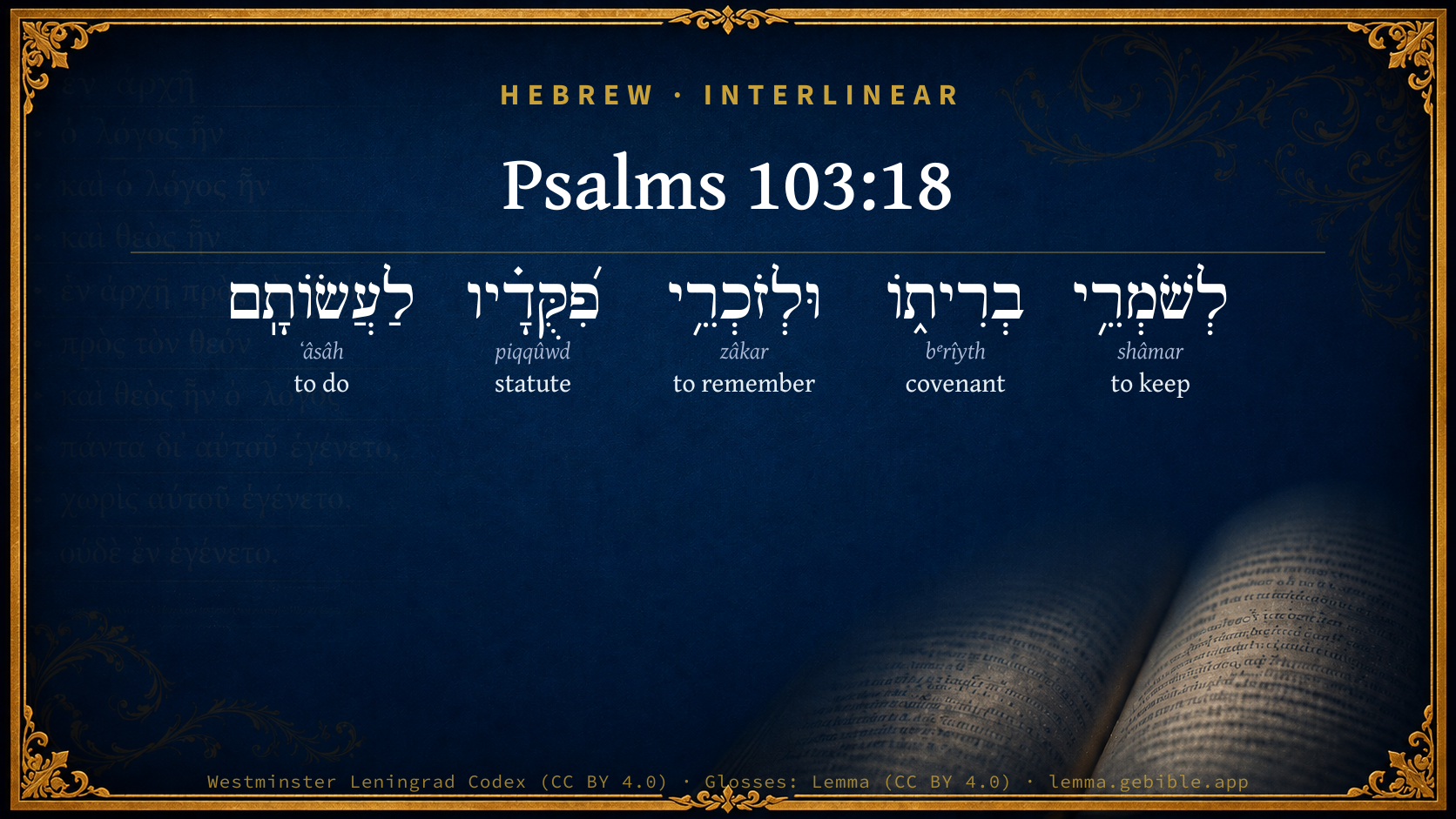
Psalms 103:18

Hebrew (Westminster Leningrad Codex) Psalms 103:18 appears in the Hebrew Old Testament. The text above is from the Westminster Leningrad Codex. Each word links to its Strong’s number, a concise gloss, and parsing drawn from the Open Scriptures Hebrew Bible morphology. Click any word for its full Brown-Driver-Briggs (BDB) entry.
Download image
Cite this verse

Psalms 103:18 (World English Bible). Public Domain. Lemma interlinear Bible study tool, https://lemma.gebible.app/v/psalms/103/18.

Show BibTeX & RIS
BibTeX
RIS
English Translation
To those who keep his covenant, To those who remember to obey his precepts.
World English Bible · Public Domain
Download a study sheet

One document with this verse’s original text, its word-by-word gloss line, the meaning frame, cross-references with their text, attributed commentary, and full source and license credits — printable, and it pastes into notes with its structure intact.

This verse Autodidact and up

Study sheet (.html) Plain text (.txt)

A passage Seminary Student

Up to 50 verses in one chapter. A passage sheet keeps up to 6 commentary sources and 12 cross-references per verse, in the order this page ranks them, and says so on the sheet whenever that leaves anything out. Ask for a single verse and you get the Autodidact verse sheet above.

Everything on this page stays free to read, with no account — the sheet is a download of what is already on screen, not access to it.

Want to remove ads? Support Godless Engineer
Compare translations 3

The same verse in 3 English versions, stacked beneath the original-language interlinear above. Click any original word for its lexicon entry.

Each is an independent rendering of the whole verse — the interlinear is not word-aligned to these translations.

Highlighted words mark where these versions differ — a whole-verse word diff, not a word-by-word alignment.

  • World English Bible Public Domain
    To those who keep his covenant, To those who remember to obey his precepts.
  • King James Version Public Domain
    To such as keep his covenant, and to those that remember his commandments to do them.
  • unfoldingWord Literal Text CC BY-SA 4.0
    to the ones keeping his covenant, and to the ones remembering his precepts, to do them.

unfoldingWord Literal Text — © unfoldingWord, licensed CC BY-SA 4.0. Word-aligned USFM3 via Door43 (git.door43.org/unfoldingWord/en_ult).

Versions to compare (up to 4)

3 of 4 selected

Show all 18 translations

Every available English version of this verse, each an independent rendering of the whole verse.

  • World English Bible Public Domain
    To those who keep his covenant, To those who remember to obey his precepts.
  • Berean Standard Bible Public Domain
    to those who keep His covenant and remember to obey His precepts.
  • Majority Standard Bible Public Domain
    to those who keep His covenant and remember to obey His precepts.
  • King James Version Public Domain
    To such as keep his covenant, and to those that remember his commandments to do them.
  • American Standard Version (1901) Public Domain
    To such as keep his covenant, And to those that remember his precepts to do them.
  • Revised Version (1885) Public Domain
    To such as keep his covenant, and to those that remember his precepts to do them.
  • Geneva Bible (1599) Public Domain
    Vnto them that keepe his couenant, and thinke vpon his commandements to doe them.
  • Douay-Rheims (1899) Public Domain
    to such as keep his covenant, And are mindful of his commandments to do them.
  • Young's Literal Translation Public Domain
    To those keeping His covenant, And to those remembering His precepts to do them.
  • Literal Standard Version CC BY-SA 4.0
    To those keeping His covenant, || And to those remembering His precepts to do them.
  • Unlocked Literal Bible CC BY-SA 4.0
    They keep his covenant and remember to obey his instructions.
  • unfoldingWord Literal Text CC BY-SA 4.0
    to the ones keeping his covenant, and to the ones remembering his precepts, to do them.
  • Darby Bible Public Domain
    To such as keep his covenant and to those that remember his precepts to do them.
  • World Messianic Bible Public Domain
    to those who keep his covenant, to those who remember to obey his precepts.
  • Webster's Bible Public Domain
    To such as keep his covenant, and to those that remember his commandments to do them.
  • Free Bible Version CC BY-SA 4.0
    to those who keep his agreement and who remember to follow his commandments.
  • Bible in Basic English Public Domain
    If they keep his agreement, and have his laws in mind to do them.
  • JPS Tanakh (1917) Public Domain
    To such as keep His covenant, and to those that remember His precepts to do them.

Literal Standard Version (2020), Covenant Press — licensed CC BY-SA 4.0. Text via the HelloAO Bible API (eBible.org). Unlocked Literal Bible (unfoldingWord) — licensed CC BY-SA 4.0. Text via the HelloAO Bible API (eBible.org). unfoldingWord Literal Text — © unfoldingWord, licensed CC BY-SA 4.0. Word-aligned USFM3 via Door43 (git.door43.org/unfoldingWord/en_ult). Free Bible Version, Dr. Jonathan Gallagher — licensed CC BY-SA 4.0. Text via the HelloAO Bible API (eBible.org).

Word by word

More ways to search: Search by grammar → Find every occurrence → Compare this word →

Practice this passage: Drill this verse → Learn its vocabulary →

About this verse

These counts appear in no published source. They are computed here, from the morphology-tagged text and Lemma’s own curated glosses. What Lemma adds →

5
words
5
distinct lemmas
Wisdom
section

Notable vocabulary

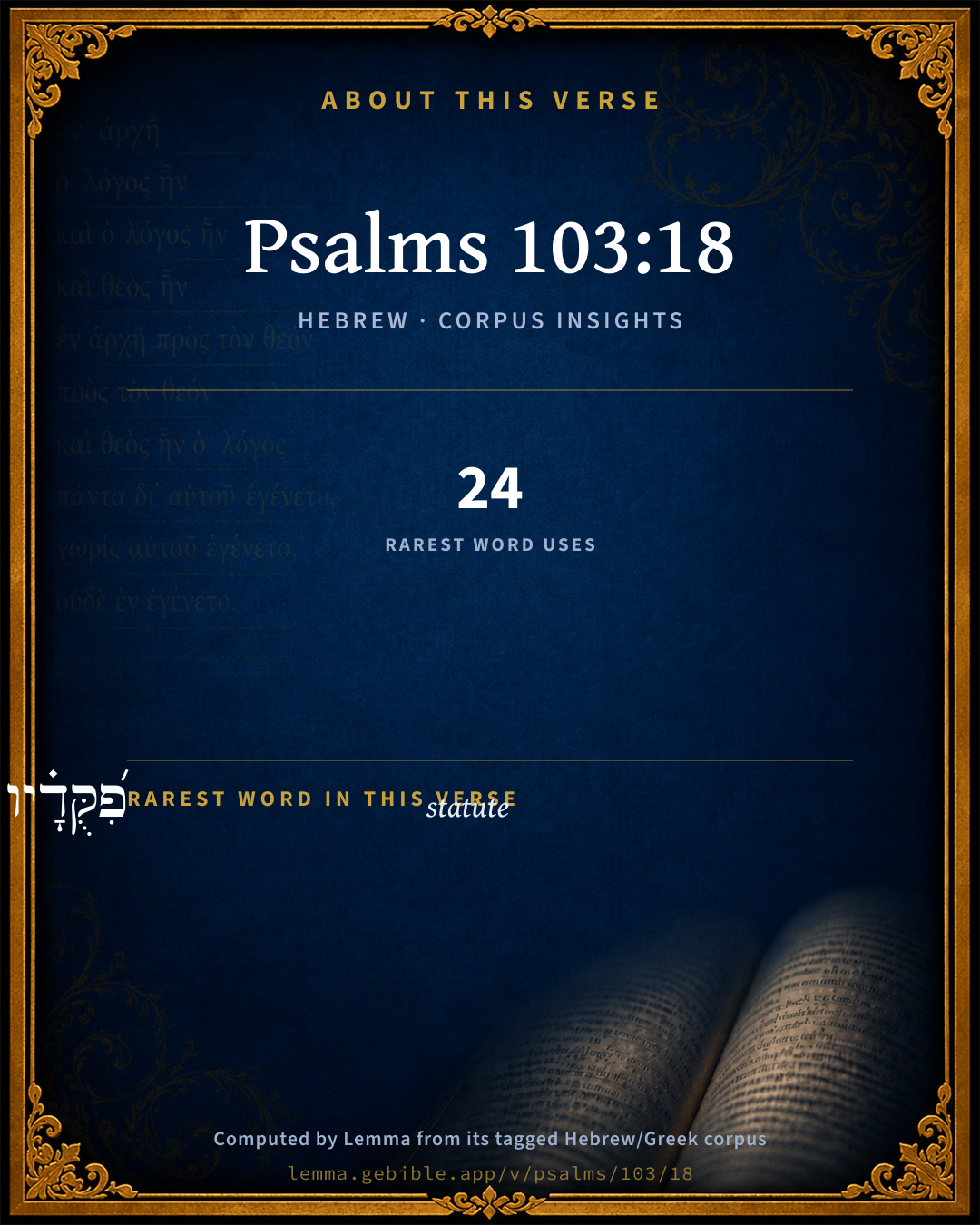
The rarest word here is פִ֝קֻּדָ֗יו statute H6490 — appearing just 24 times in the whole Hebrew Bible.

Shared distinctive vocabulary

פִ֝קֻּדָ֗יו statute H6490 occurs in 24 verses of the Hebrew Bible. Also found in:

Grammatical profile

  • 3 verbs
  • 2 nouns

Verb forms

  • לְשֹׁמְרֵ֥י Qal · Participle Active
  • וּלְזֹכְרֵ֥י Qal · Participle Active
  • לַעֲשׂוֹתָֽם Qal · Infinitive Construct

Hebrew & Septuagint length

In English translation the verse runs 14 words from the Hebrew and 13 from the Septuagint (LXX English) — closely comparable.

A rough comparison of the two English renderings, which tokenize alike — not a word-level alignment.

Word counts can differ between the Hebrew and the Greek without any difference in meaning — e.g. the Hebrew direct-object marker אֵת has no separate Greek word, and Greek often adds the article ὁ.

Cross-references

16

Topical passages linked to Psalms 103:18 in the Treasury of Scripture Knowledge — connected by theme and wording, ordered by reader-vote popularity; previews shown in the World English Bible.

  • Deuteronomy 7:9 Know therefore that Yahweh your God, he is God, the faithful God, who keeps covenant and loving kindness with them who love him and keep his commandments to a thousand generations,
  • Exodus 24:8 Moses took the blood, and sprinkled it on the people, and said, "Look, this is the blood of the covenant, which Yahweh has made with you concerning all these words."
  • Psalms 25:10 All the paths of Yahweh are loving kindness and truth To such as keep his covenant and his testimonies.
  • Psalms 132:12 If your children will keep my covenant, My testimony that I will teach them, Their children also will sit on your throne forevermore."
  • Proverbs 3:1 My son, don't forget my teaching; But let your heart keep my commandments:
  • Matthew 28:20 teaching them to observe all things that I commanded you. Behold, I am with you always, even to the end of the age." Amen.
  • Luke 1:6 They were both righteous before God, walking blamelessly in all the commandments and ordinances of the Lord.
  • Exodus 19:5 Now therefore, if you will indeed obey my voice, and keep my covenant, then you shall be my own possession from among all peoples; for all the earth is mine;
  • Deuteronomy 6:6–9 These words, which I command you this day, shall be on your heart;
  • Psalms 119:9–11 How can a young man keep his way pure? By living according to your word.
  • Acts 24:16 Herein I also practice always having a conscience void of offense toward God and men.
  • Genesis 17:9–10 God said to Abraham, "As for you, you will keep my covenant, you and your seed after you throughout their generations.
  • Deuteronomy 4:23 Take heed to yourselves, lest you forget the covenant of Yahweh your God, which he made with you, and make you an engraved image in the form of anything which Yahweh your God has forbidden you.
  • 2 Chronicles 34:31 The king stood in his place, and made a covenant before Yahweh, to walk after Yahweh, and to keep his commandments, and his testimonies, and his statutes, with all his heart, and with all his soul, to perform the words of the covenant that were written in this book.
  • Hebrews 8:6–13 But now he has obtained a more excellent ministry, by so much as he is also the mediator of a better covenant, which has been enacted on better promises.
  • 1 Thessalonians 4:1 Finally then, brothers, we beg and exhort you in the Lord Jesus, that as you received from us how you ought to walk and to please God, that you abound more and more.

Cross-references courtesy of OpenBible.info (CC BY 4.0).

Hebrew and Greek witnesses Masoretic Hebrew ↔ Greek Septuagint

The same verse in the two great witnesses to the Old Testament, shown verse-for-verse.

You’re reading Greek Psalm 102 (Hebrew Psalm 103). The Septuagint counts the superscription, so verse numbers can differ from the Hebrew — chapter-level alignment, not verse-by-verse. Numbering follows Rahlfs.

These are two independent witnesses, not word-aligned to each other, and the Septuagint is shown in lemma (dictionary) form.

Hebrew Psalms 103:18 Masoretic · Westminster Leningrad Codex

לְשֹׁמְרֵ֥י בְרִית֑וֹ וּלְזֹכְרֵ֥י פִ֝קֻּדָ֗יו לַעֲשׂוֹתָֽם

To those who keep his covenant, To those who remember to obey his precepts.

World English Bible · Public Domain

Greek LXX Greek Psalm 102:18 Septuagint · lemma form

ὁ φυλάσσω ὁ διαθήκη αὐτός καί μιμνήσκω ὁ ἐντολή αὐτός ὁ ποιέω αὐτός

to them that keep his covenant, and remember his commandments to do them.

LXX2012 (modern English Septuagint) · Public Domain

Hebrew: Westminster Leningrad Codex (CC BY 4.0). Greek: Septuagint (public domain); English from LXX2012 (modern English Septuagint) (Public Domain). How the Septuagint differs from the Hebrew →

Commentary

Notes on Psalms 103:18 from classic Christian and Jewish commentators (each source and its license shown beneath its notes). The classic Christian expositions comment on the surrounding passage and are grouped to its opening verse, so a note may address several verses; the Jewish commentaries on the Tanakh (Rashi and others) are per-verse, so they appear only where the commentator wrote on this verse.

Lemma curates 59 commentaries, every one of them public domain or Creative Commons licensed, each selected and text-cleaned for this edition rather than reprinted as found. About our sources →

Trapp's Complete Commentary

John Trapp

Psa 103:18 To such as keep his covenant, and to those that remember his commandments to do them.

Ver. 18. To such as keep his covenant] For else they shall know God’s breach of promise, as it is Num 14:3-4. Neither shall it benefit them to have been born of godly parents.

To those that remember his commandments] That resolve to do them, though in many things they fail, Qui faciunt praecepta etiamsi non perficiant, that wish well to that which they can never compass, Psa 119:4-5. If they cannot open the door, yet if they give a pluck at the bolt or a lift of the latch, there is comfort.

John Trapp, A Commentary or Exposition upon All the Books of the Old and New Testament (1647–1656) — public domain. Text from a community e-Sword module.

The Biblical Illustrator

Joseph S. Exell

Psa_103:18

To such as keep His covenant.

Keeping the covenant

Saints are to look upon themselves as wholly the Lords, in opposition to all competitors. The Lord will not divide with rivals; if ye take Him these must go. The soul till it comes Within the covenant is in a restless case, like a bee going from flower to flower, or a bird from bush to bush; but when it is married to Christ it is settled with Him, and breaks its league with all others. Remember, the covenant ye have entered into is an offensive and defensive league. You are to have common friends and common foes with the Lord. His people must be your people, and His enemies your enemies. (Thomas Boston.)

The Biblical Illustrator, edited by Joseph S. Exell (c. 1880s–1900s) — public domain. Text from a community e-Sword module.

J. A. Alexander on Psalms

Joseph Addison Alexander

18. (Psa 103:18) To the keepers of his covenant, and to the rememberers of his laws, to do them. This is the necessary qualification of a promise which might otherwise have seemed too absolute. Even to the descendants of those fearing him the promise availed nothing, unless they themselves were faithful to his covenant and obedient to his law. The last words (to do them) shew that the remembrance of the law required was not merely intellectual but practical and tending to obedience.

Joseph Addison Alexander, The Psalms Translated and Explained (1850) — public domain. Text from a community e-Sword module.

Tyndale Open Study Notes

Tyndale Open Resources

103:18 To obey God means to be faithful and loyal to him.

Tyndale Open Study Notes — © Tyndale Open Resources, licensed CC BY-SA 4.0. Text via the HelloAO Bible API.

Geneva Bible (1599)

Geneva Bible translators

To whom he giveth grace to fear him, and to obey his word.

Geneva Bible (1599) marginal notes — public domain. Text via Bolls.life.

Adam Clarke's Commentary

Verse 18. To such as keep his covenant] The spirit of which was, I will be your GOD; WE will be thy PEOPLE. From the covenant came the commandments, and their obligation to remember and do them; and on such keepers of the covenant, and doers of the commandments, God promises to pour out his mercy through all generations.

Adam Clarke's Commentary on the Bible (1810–1826) — public domain. Text from a community e-Sword/MySword module.

John Calvin's Commentaries

Farther, as nothing is more easy than for hypocrites to flatter themselves under a false pretext, that they are in favor with God, or for degenerate children groundlessly to apply to themselves the promises made to their fathers, it is again stated, by way of exception, in the 18th verse, that God is merciful only to those who, on their part, keep his covenant, which the unbelieving make of none effect by their wickedness. The keeping, or observing of the covenant, which is here put instead of the fear of God, mentioned in the preceding verse, is worthy of notice; for thus David intimates that none are the true worshippers of God but those who reverently obey his Word. Very far from this are the Papists, who, thinking themselves equal to the angels in holiness, nevertheless shake off the yoke of God, like wild beasts, by trampling under foot his Holy Word. David, therefore, rightly judges of men’s godliness, by their submitting themselves to the Word of God, and following the rule which he has prescribed to them. As the covenant begins with a solemn article containing the promise of grace, faith and prayer are required, above all things, to the proper keeping of it. Nor is the additional clause superfluous — who remember his statutes; for, although God is continually putting us in mind of them, yet we soon slide away to worldly cares — are confused by a multiplicity of avocations, and are lulled asleep by many allurements. Thus forgetfulness extinguishes the light of truth, unless the faithful stir up themselves from time to time. David tells us that this remembrance of God’s statutes has an invigorating effect when men employ themselves in doing them. Many are sufficiently forward to discourse upon them with their tongues whose feet are very slow, and whose hands are well nigh dead, in regard to active service.

John Calvin's Commentaries (1540-1563) — public domain. Text from the Calvin Translation Society English edition (1840s-50s) via the Christian Classics Ethereal Library (ccel.org). Calvin's coverage is partial (roughly two-thirds of the Bible); uncommented books and verses are honest gaps, never fabricated. The 19th-century editor's footnotes and remarks are omitted so the notes are faithfully Calvin's own voice.

The Cambridge Bible for Schools and Colleges

gen. ed. J. J. S. Perowne

18. his commandments] R.V. his precepts.

The Cambridge Bible for Schools and Colleges (gen. ed. J. J. S. Perowne; Cambridge University Press, 1878–1918) — public domain. Text from a community e-Sword module.

John Gill's Exposition

Bless the Lord, ye his angels,.... For their creation, being made by him; for their preservation, living, moving, and having their being in him; and for their happiness, in which they are continued, owing to their being chosen of God in Christ, and to their confirmation by Christ. These are always employed in the work of blessing and praising the Lord nor are they in the least backward to it, nor remiss it; nor does this address unto them suppose anything of this kind. The design of the psalmist is only to show how great and good the Lord is; that angels, the more excellent order of creatures, are under obligation to him, and are bound to praise him: and his further view is, to stir up himself and others to this work, from such a consideration, that such noble creatures are employed in the same, and who are further described:

that excel in strength; or, "are mighty in strength" (e); they are called mighty angels, Th2 1:7 an instance of the might and power of an angel see in Kg2 19:35. These, not having sinned, have lost nothing of their original strength and power, and therefore must greatly excel fallen man; who is become a very weak creature, and unable to do the will and work of God, which angels are, as follows:

that do his commandments; or "his word" (f); what he orders to be done: this they do readily and willingly, constantly, perfectly, and completely; see Mat 6:10.

Hearkening to the voice of his word; they stand before the Lord, waiting his orders; listening with great attention to what he says, and then readily execute it. Or, "at hearing the voice of his word"; that is, as soon as they hear the voice of his word, or hear him speaking (g), immediately they apply themselves to the performance of it.

(e) "fortes robore", Pagninus, Montanus; "valentissimi robore", Junius & Tremellius. (f) "verbum ejus", Pagninus, Montanus, Junius & Tremellius, Piscator. (g) So Muis.

John Gill's Exposition of the Whole Bible (1746–1763) — public domain (CC PDM 1.0). Text via the HelloAO Bible API.

Albert Barnes' Notes on the Bible

To such as keep his covenant - To such as adhere to the arrangements of his covenant, or who are faithful on their part. God will be faithful to his part of the covenant; and where there is fidelity on the part of his people, the blessings implied in the covenant will be conferred on them and on their children. The promise is ample, and the fidelity of God is certain, but still it is true that in those promises, and in that fidelity, it is implied that his people on their part must be faithful also, or the blessings will not be bestowed. There are no promises of blessings to the unfaithful, nor have those who are unfaithful any reason to hope that they or theirs will be partakers of the blessings of the covenant of mercy. Our only hope that we or our children will be partakers of the blessings of the covenant is to be found in the fact that we ourselves are faithful to God.

And to those that remember his commandments to do them - Who do not “forget” his law. If they do forget it, they have no right to expect the blessing. Obedience and fidelity are our only reasonable grounds of expectation of the blessing of God.

Albert Barnes' Notes on the Bible (1834–1885) — public domain. Text from a community e-Sword/MySword module.

Matthew Poole's English Annotations

To such as keep his covenant; to them that perform the condition of God’s covenant, that sincerely love and obey him. Such restrictions are oft added, as in the general to overthrow the presumptuous hopes of ungodly men, so particularly to admonish the Israelites not to rest too much upon the privileges of their parents, or the covenant made with them, nor to expect any benefit by it, but upon condition of their continuance in God’s covenant.

That remember his commandments to do them; that have them much in their thoughts, and practise them in the course of their lives.

Matthew Poole's English Annotations on the Holy Bible (1683–1685) — public domain. Text from a community e-Sword/MySword module.

The Treasury of David

Charles H. Spurgeon

Ver. 18. Children of the righteous are not, however, promised the Lord's mercy without stipulation, and this verse completes the statement of the last by adding: To such as keep his covenant, and to those that remember his commandments to do them. The parents must be obedient and the children too. We are here bidden to abide by the covenant, and those who run off to any other confidence than the finished work of Jesus are not among those who obey this precept; those with whom the covenant is really made stand firm to it, and having begun in the Spirit, they do not seek to be made perfect in the flesh. The truly godly keep the Lord's commands carefullythey "remember"; they observe them practically"to do them": moreover they do not pick and choose, but remember "his commandments" as such, without exalting one above another as their own pleasure or convenience may dictate. May our offspring be a thoughtful, careful, observant race, eager to know the will of the Lord, and prompt to follow it fully, then will his mercy enrich and honour them from generation to generation.

This verse also suggests praise, for who would wish the Lord to smile on those who will not regard his ways? That were to encourage vice. From the manner in which some men unguardedly preach the covenant, one might infer that God would bless a certain set of men however they might live, and however they might neglect his laws. But the word teaches not so. The covenant is not legal, but it is holy. It is all of grace from first to last, yet it is no panderer to sin; on the contrary, one of its greatest promises is, "I will put my laws in their hearts and in their minds will I write them"; its general aim is the sanctifying of a people unto God, zealous for good works, and all its gifts and operations work in that direction. Faith keeps the covenant by looking alone to Jesus, while at the same time by earnest obedience it remembers the Lord's commandments to do them.

Ver. 18. To do them. Commands are to be remembered in order to practice; a vain speculation is not the intent of the publication of them. Stephen Charnock.

Ver. 18. The covenant, in what respects we can keep it, in what frame of mind it must be kept, and what is the practical proof of so doing.

Psalms 103:19*

Charles H. Spurgeon's The Treasury of David (1869–1885) — public domain. Psalms only. Text from a community e-Sword/MySword module.

The Pulpit Commentary

To such as keep his covenant; i.e. "to the faithful to those who, notwithstanding many lapses and many shortcomings, are yet sincere in heart, and seek to do his will. Such persons remember his commandments to do them.

The blessedness of covenant keepers.

Prayer book Version, "Even upon such as keep his covenant." A distinctly Israelite point of view. If this be regarded as a psalm of the returned Exiles, the reference is a striking one. Judgment had fallen upon the nation because it had forsaken the national covenant. The restoration was a resuming of the old covenant relations. And therefore the supreme anxiety of the Exiles would concern "keeping this new, this restored covenant." It may be observed that the Lord"s gracious dealings are always to be thought of as strictly conditional. "The blessings of the covenant are no inalienable right. Children"s children can only inherit its blessings by cleaving to it.

I COVENANT KEEPERS REMEMBER THEIR PLEDGE. It may have been taken by themselves. It may have been taken in their names by their fathers. It may be freshly taken after a time of lapse. It is a ground of obligation. It is a source of inspiration. It should be kept ever in mind. Illustrate by the oath of loyalty taken by the servants of a king; or by the pledge taken in marriage; or by covenants entered into by those who unite in a common undertaking. See the value of special seasons sacramental seasons when covenant pledges are forcibly brought to mind. There is a new covenant in Christ Jesus. It is to that covenant we are pledged; and that covenant we do well to keep in mind. (Some useful covenant reminders may be indicated)

II COVENANT KEEPERS AIM AT OBEDIENCE. Sentiment, however good, cannot suffice them. Feelings, as mere feelings, cannot honour God. True covenant keepers try to "remember God"s commandments," his requirements under the covenant, with the distinct and full intention to do them, and not merely know what they are, or feel that they are wise and good. The Lord Jesus searchingly said, "If ye know these things, happy are ye if ye do them!

REVIEW.

1. Set forth what the Lord"s covenant was for Israel, and is for us.

2. Point out how the responsibilities of the covenant may be kept ever before our minds and hearts.

3. Impress that the only acceptable keeping of the covenant is the constant, loving, hearty obedience of all its requirements. R.T.

The Pulpit Commentary (1880–1919), ed. H.D.M. Spence-Jones & Joseph S. Exell — public domain. Text from a community e-Sword module.

Lesson kit

Teaching starters — assembled from the data on this page, not authored interpretation. Every prompt links to the verse data it draws on. Edit before teaching.

Psalms, in the Wisdom, opens this verse with 5 words (5 distinct Hebrew lemmas). Its most distinctive word is piqqûwd (“statute”). A historical commentator’s framing appears above. Read the whole chapter for the surrounding context.

Discussion questions

  1. The word piqqûwd carries the sense “statute.” How does it shape the verse?
  2. How does Psalms 19:8, which shares the word «statute», read alongside this verse?
  3. These translations render this verse differently. What is at stake in choosing one wording over another?
  4. «לְשֹׁמְרֵ֥י» is a Qal Participle Active verb. How does that grammatical form shape the action described?
  5. Compare how Trapp's Complete Commentary and The Biblical Illustrator read this verse. Where do they agree or differ?

Things to notice

Reading settings

Reading text

Shown beneath each verse's original-language words.

Old Testament
Old Testament edition

Read the OT as the Masoretic Hebrew (MT) or the Greek Septuagint (LXX).

English shown for the Greek Septuagint (in the Hebrew ↔ Greek comparison).

Comparing translations? Open the Compare panel on any verse page to stack up to four side by side.