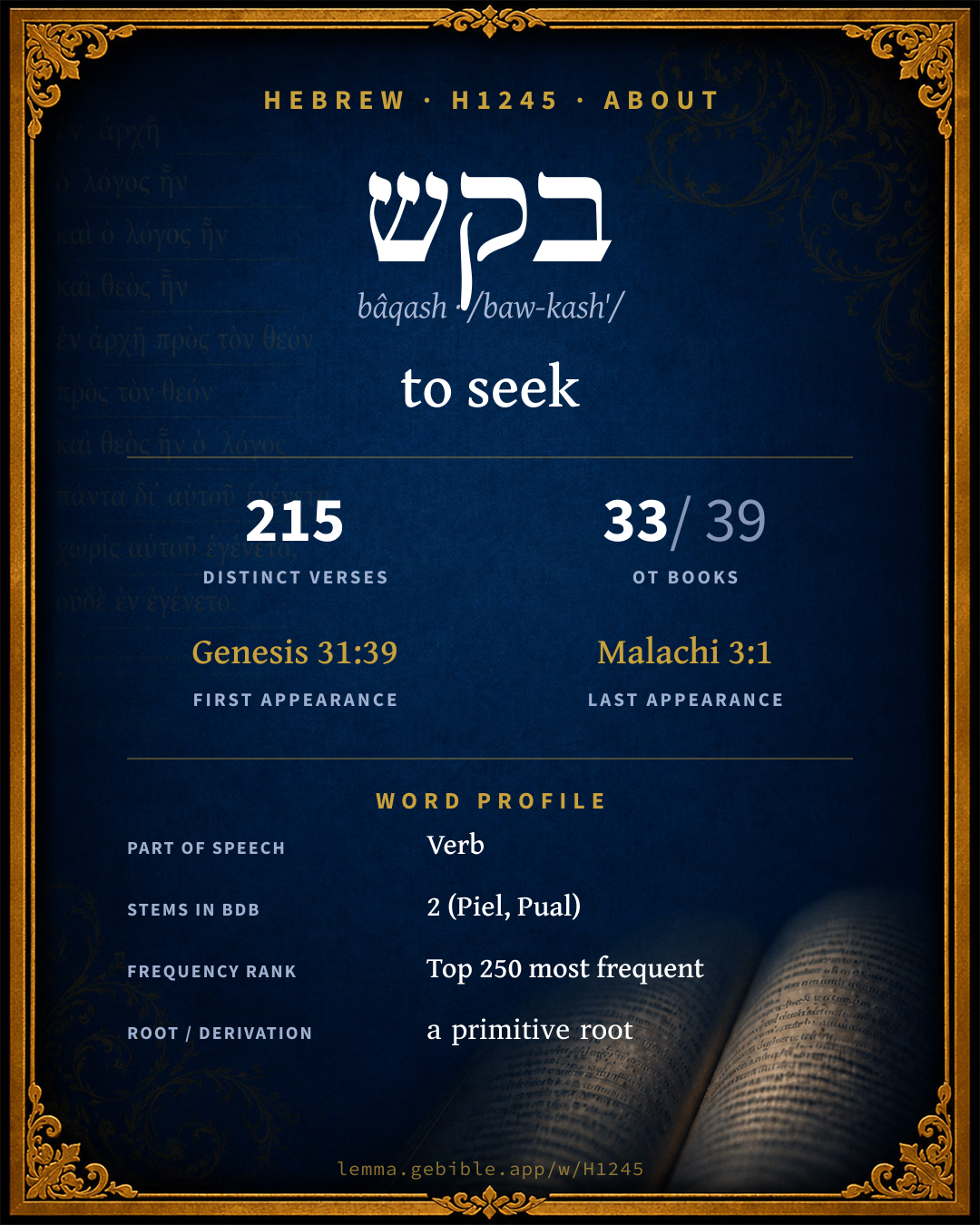
בָּקַשׁ
to seek
also: require, desire, exact, request fuller range ↓
Full lexicon entry — Brown-Driver-Briggs (BDB)
From Brown-Driver-Briggs (BDB)
Where this word appears
See every Piel verb in the Hebrew Bible →
Grammar key — what these labels mean
Part of speech
- Verb
- An action or state-of-being word.
Stem
- Piel
- An intensive or resultative active stem. Here: ‘seek to find’
- Pual
- The passive counterpart of the Piel.
Form
- Infinitive Construct
- A bound verbal noun, frequently with prepositions (“to write / in writing”).
- Participle Active
- A verbal adjective expressing ongoing or characteristic action (“writing / one who writes”).
- Sequential Imperfect
- An imperfect with prefixed waw — the standard past-narrative form (waw-consecutive imperfect).
- Imperfect
- An incomplete, ongoing, or future action (“he will / would write”).
- Perfect
- A completed action or state — Hebrew marks aspect (completeness) more than strict tense (“he wrote”).
- Imperative
- A direct command (“write!”).
- Sequential Perfect
- A perfect with prefixed waw continuing a preceding imperfect or command (waw-consecutive perfect).
- Jussive
- A third- or second-person volitional form expressing wish or command (“let him write”).
- Cohortative
- A first-person volitional form expressing wish or resolve (“let me / let us write”).
State
- Absolute
- The independent form of a noun, not bound to a following word.
- Construct
- A noun bound to a following noun in a possessive / “of” relationship (the construct chain).
Person
- 3rd Person
- The one spoken about (“he / she / it / they”).
- 1st Person
- The speaker (“I / we”).
- 2nd Person
- The one addressed (“you”).
Gender
- Masculine
- Grammatically masculine.
- Common
- Either gender — not distinguished for this form.
- Feminine
- Grammatically feminine.
Number
- Singular
- One.
- Plural
- More than one (in Hebrew, generally three or more).
19 verses where H1245 appears in the Piel stem in the Book of Jeremiah. Filtered view — show all forms. Click any verse to open its interlinear word-by-word view. Verse text shown in the World English Bible for context — . Each verse’s Hebrew form is shown with its reference; the English is not keyword-highlighted, since the data carries no word-level English alignment. Use “Compare translations” on any verse to read it across multiple English versions. This concordance covers the Hebrew Bible; Septuagint (Greek Old Testament) occurrences are not indexed here.
Jeremiah
- Jeremiah 2:24 מְבַקְשֶׁ֨י/הָ֙ Piel ptcp.act mp cs + sfx pers 3fs a wild donkey used to the wilderness, that snuffs up the wind in her desire; in her occasion who can turn her away? all those who seek her will not weary themselves; in her month they shall find her.
- Jeremiah 2:33 לְ/בַקֵּ֣שׁ prep + Piel inf.cs How trimmest you your way to seek love! therefore even the wicked women have you taught your ways.
- Jeremiah 4:30 יְבַקֵּֽשׁוּ Piel impf 3mp You, when you are made desolate, what will you do? Though you clothe yourself with scarlet, though you deck you with ornaments of gold, though you enlarge your eyes with paint, in vain do you make yourself beautiful; [your] lovers despise you, they seek your life.
- Jeremiah 5:1 וּ/בַקְשׁ֣וּ מְבַקֵּ֣שׁ conj + Piel impv 2mp Piel ptcp.act ms Run you back and forth through the streets of Jerusalem, and see now, and know, and seek in the broad places of it, if you can find a man, if there are any who does justly, who seeks truth; and I will pardon her.
- Jeremiah 11:21 הַֽ/מְבַקְשִׁ֥ים ptcl def.art + Piel ptcp.act mp Therefore thus says Yahweh concerning the men of Anathoth, who seek your life, saying, You shall not prophesy in the name of Yahweh, that you not die by our hand;
- Jeremiah 19:7 מְבַקְשֵׁ֣י Piel ptcp.act mp cs I will make void the counsel of Judah and Jerusalem in this place; and I will cause them to fall by the sword before their enemies, and by the hand of those who seek their life: and their dead bodies will I give to be food for the birds of the sky, and for the animals of the earth.
- Jeremiah 19:9 וּ/מְבַקְשֵׁ֥י conj + Piel ptcp.act mp cs I will cause them to eat the flesh of their sons and the flesh of their daughters; and they shall eat everyone the flesh of his friend, in the siege and in the distress, with which their enemies, and those who seek their life, shall distress them.
- Jeremiah 21:7 מְבַקְשֵׁ֣י Piel ptcp.act mp cs Afterward, says Yahweh, I will deliver Zedekiah king of Judah, and his servants, and the people, even such as are left in this city from the pestilence, from the sword, and from the famine, into the hand of Nebuchadrezzar king of Babylon, and into the hand of their enemies, and into the hand of those who seek their life: and he shall strike them with the edge of the sword; he shall not spare them, neither have pity, nor have mercy.
- Jeremiah 22:25 מְבַקְשֵׁ֣י Piel ptcp.act mp cs and I will give you into the hand of those who seek your life, and into the hand of them of whom you are afraid, even into the hand of Nebuchadrezzar king of Babylon, and into the hand of the Chaldeans.
- Jeremiah 26:21 וַ/יְבַקֵּ֥שׁ conj + Piel wimpf 3ms and when Jehoiakim the king, with all his mighty-men, and all the princes, heard his words, the king sought to put him to death; but when Uriah heard it, he was afraid, and fled, and went into Egypt:
- Jeremiah 29:13 וּ/בִקַּשְׁתֶּ֥ם conj + Piel wpf 2mp You shall seek me, and find me, when you shall search for me with all your heart.
- Jeremiah 34:20 מְבַקְשֵׁ֣י Piel ptcp.act mp cs I will even give them into the hand of their enemies, and into the hand of those who seek their life; and their dead bodies shall be for food to the birds of the sky, and to the animals of the earth.
- Jeremiah 34:21 מְבַקְשֵׁ֣י Piel ptcp.act mp cs Zedekiah king of Judah and his princes will I give into the hand of their enemies, and into the hand of those who seek their life, and into the hand of the king of Babylon's army, who have gone away from you.
- Jeremiah 38:16 מְבַקְשִׁ֖ים Piel ptcp.act mp So Zedekiah the king swore secretly to Jeremiah, saying, As Yahweh lives, who made us this soul, I will not put you to death, neither will I give you into the hand of these men who seek your life.
- Jeremiah 44:30 מְבַקְשֵׁ֣י וּ/מְבַקֵּ֥שׁ Piel ptcp.act mp cs conj + Piel ptcp.act ms Thus says Yahweh, Behold, I will give Pharaoh Hophra king of Egypt into the hand of his enemies, and into the hand of those who seek his life; as I gave Zedekiah king of Judah into the hand of Nebuchadrezzar king of Babylon, who was his enemy, and sought his life.
- Jeremiah 45:5 תְּבַקֶּשׁ תְּבַקֵּ֑שׁ Piel impf 2ms Piel juss 2ms Seek you great things for yourself? Don't seek them; for, behold, I will bring evil on all flesh, says Yahweh; but your life will I give to you for a prey in all places where you go.
- Jeremiah 46:26 מְבַקְשֵׁ֣י Piel ptcp.act mp cs and I will deliver them into the hand of those who seek their lives, and into the hand of Nebuchadrezzar king of Babylon, and into the hand of his servants; and afterwards it shall be inhabited, as in the days of old, says Yahweh.
- Jeremiah 49:37 מְבַקְשֵׁ֣י Piel ptcp.act mp cs I will cause Elam to be dismayed before their enemies, and before those who seek their life; and I will bring evil on them, even my fierce anger, says Yahweh; and I will send the sword after them, until I have consumed them;
- Jeremiah 50:4 יְבַקֵּֽשׁוּ Piel impf 3mp In those days, and in that time, says Yahweh, the children of Israel shall come, they and the children of Judah together; they shall go on their way weeping, and shall seek Yahweh their God.
About this entry
At a glance — auto-summarized from this page’s data, not written by a person. Every figure links to its source below. This summary describes the numbers; it doesn’t interpret them.
“to seek” is the headline sense of the Hebrew verb בקש (bâqash). First canonically at Genesis 31:39, it enters the text early. It appears 215 verses across 33 books of the Hebrew Bible, among its common vocabulary. Across 2 stems, its meaning turns on the binyan (Piel, Pual). Related forms include בקשה. See the sense tree, 215-verse concordance, and the renderings breakdown below.
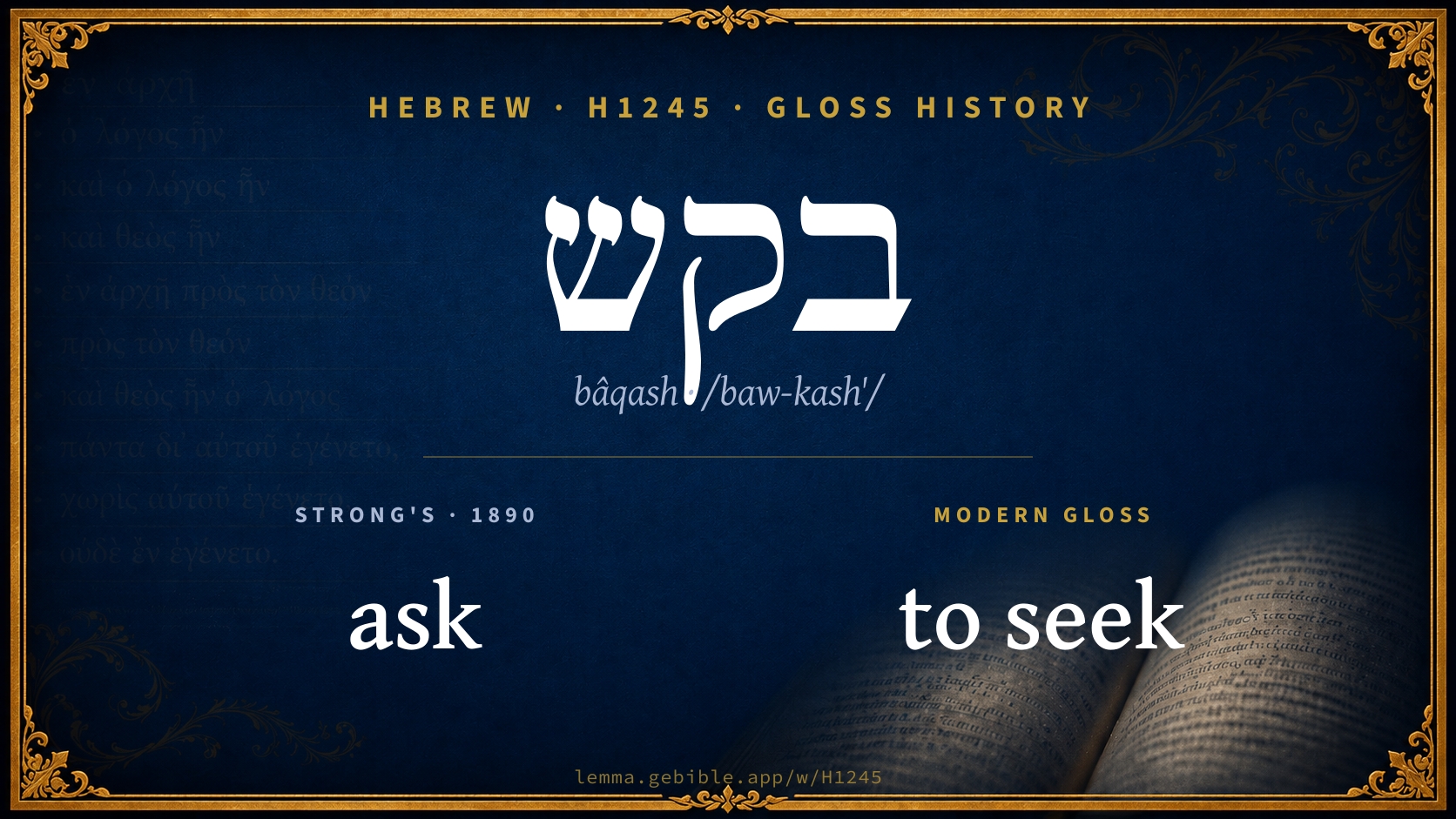
Gloss history
Strong's 1890 vs modern scholarship
About this word
Strong's H1245 catalogs a Hebrew word from the Hebrew Old Testament.
These counts are not copied from any lexicon or concordance. They are computed here, from the morphology-tagged Hebrew Old Testament. What Lemma adds →
- 215
- distinct verses
- The word appears in 215 distinct verses.
- 33 / 39
- OT books
- The word appears in 33 of 39 Old Testament books.
- #210
- by frequency
- Top 250 most frequent Hebrew words (rank 210 of 8,640 Hebrew words by occurrence).
View all 215 occurrences in the concordance →
By section of the Old Testament
By traditional corpus
Conventional, traditional groupings — biblical authorship is debated, so this is a traditional corpus grouping, not an authorship claim. Each share is this word’s portion of its verses in that division of the Hebrew canon. Each figure is a share of the word’s 215 distinct verses.
- Prophets (Nevi'im) 110 verses · 51%
- Writings (Ketuvim) 90 verses · 42%
- Torah (Pentateuch) 15 verses · 7%
How translations render this word
Counts come from each version’s own published word-to-Strong’s tagging or interlinear alignment — an approximate guide to how each version renders this word, not a word-level alignment the data otherwise carries. Because each total is that version’s own tagged count, the per-version totals vary from one another and need not match the appearance or distinct-verse counts above. These counts may also differ from a printed concordance because Lemma counts each distinctly tagged rendering and does not collapse phrase taggings into a single head-word total. This is a fixed set of word-tagged versions (KJV, ASV, BSB, ULT) and does not change with the reading translation you choose elsewhere. Each version’s license is shown beside its name below (and on Sources).
- King James Version: Seek 67×, Sought 28×, Seeketh 13×
- American Standard Version: Seek 59×, Sought 24×, Seeketh 11×
- Berean Standard Bible: Seek 44×, Seeks 8×, Sought 8×
- unfoldingWord Literal Text: Seek 51×, Sought 16×, Seeks 12×
King James Version Public Domain
Renders H1245 across 225 tagged occurrences — most commonly:
Plus other, less common renderings. Plus 68 renderings that appear only once — usually multi-word phrases or single function words the recovered tagging swept in, not distinct renderings.
American Standard Version Public Domain
Renders H1245 across 224 tagged occurrences — most commonly:
Plus other, less common renderings. Plus 80 renderings that appear only once — usually multi-word phrases or single function words the recovered tagging swept in, not distinct renderings.
Berean Standard Bible Public Domain
Renders H1245 across 222 tagged occurrences — most commonly:
Plus other, less common renderings. Plus 96 renderings that appear only once — usually multi-word phrases or single function words the recovered tagging swept in, not distinct renderings. Not rendered by a distinct English word in 3 further occurrences.
unfoldingWord Literal Text CC BY-SA 4.0
Renders H1245 across 243 tagged occurrences — most commonly:
Plus other, less common renderings. Plus 57 renderings that appear only once — usually multi-word phrases or single function words the recovered tagging swept in, not distinct renderings.
23 senses and sub-senses in the full BDB
Hebrew verbs can shift meaning by stem (binyan): Qal is the basic action, Niphal is often passive or reflexive, Piel often intensifies or makes it factitive, and Hiphil is typically causative. The senses below are grouped under the stem BDB assigns to each. This entry also uses Pual (the passive of Piel).
What do BDB’s symbols mean?
BDB uses these scholarly abbreviations:
| Symbol | Meaning |
|---|---|
| 𝔊 | the Septuagint (the ancient Greek translation, LXX) |
| 𝔙 | the Vulgate (the Latin translation) |
| 𝔖 | the Syriac version (the Peshitta) |
| 𝔗 | the Targum (the Aramaic translation) |
| ψ | the Psalms |
| √ | root (the underlying root or stem) |
| ‖ | parallel passage (a synonymous or contrasted parallel) |
| † | the dagger: every passage where the word occurs is cited |
The 23 senses and sub-senses the full Brown-Driver-Briggs lexicon distinguishes for this word, in lexicon order (not ranked by frequency), with BDB’s own verbatim wording and sub-sense lettering. Shown in Hebrew script with BDB’s own scholarly abbreviations. The condensed entry is in the Lexicon Entry tab. See also the Forms in the corpus table below.
Piel
- Pf. בִּקֵּשׁ Dt 13:11 + 15 times; בִּקְשָׁה Ex 7:28 Est 2:15; sf. בִּקְשָׁתַם Ho 2:9; בִּקַּשְׁתִּיו Ct 3:1, 2 cf. 5:6; בִּקְשׁוּ Ezr 2:62 + 12 times; sf. בִּקְשֻׁנִי Is 65:1 + 2 times; Impf. יְבַקֵּשׁ Jos 22:23 + 37 times; יְבַקֶּשׁ־ Pr 15:14 + 2 times; אֲבַקְשָׁה ψ 122:9 + 3 times, sf. יְבַקְשֵׁהוּ 1 S 23:14 + 7 times; יְבַקְשׁוּ 1 S 16:16 + 23 times; Imv. בַּקֵּשׁ 1 S 9:3 + 3 times בַּקְּשׁוּ; 1 S 28:7 + 8 times; Inf. לְבַקֵּשׁ 1 S 10:2 + 29 times; Pt. מְבַקֵּשׁ Gn 37:16 + 23 times; pl. מְבַקְשִׁים Ex 10:11 + 38 times;— e.g. Deuteronomy 13:11
- 1. seek to find:
- a. abs. Ju 6:29 2 K 2:17 Je 5:1 Ez 34:6 Ec 3:6; 8:17 (yet v. Ew). e.g. Judges 6:29
- b. acc. Gn 37:15, 16 Jos 2:22 (J) Ju 4:22; 14:4 1 S 9:3; 10:2, 14, 21; 16:16 1 S 23:14, 25; 24:3; 26:2; 27:1, 4 + 26:20 obj. a flea, but read נַפְשִׁי 𝔊 Th We Kirkp Klo Dr; 2 S 17:3, 20 1 K 1:3; 2:40; 18:10 2 K 2:16; 6:19 1 Ch 4:39 2 Ch 22:9 Ezr 2:62 (= Ne 7:64) Ne 12:27 ψ 37:25, 36; 119:176 Pr 2:4; 21:6; 23:35; Ec 7:28; Ct 3:1, 2; 5:6; 6:1 Is 41:12, 17 Je 2:24, 33 La 1:11 Ez 7:25; 22:30; 34:4, 16 Ho 2:9 Na 3:11 Zc 11:16 Mal 2:15 Ec 3:15. e.g. Genesis 37:15
- c. with לְ Jb 10:6. e.g. Job 10:6
- d. acc. rei לְ pers. Ju 18:1 1 S 13:14; 28:7 1 K 1:2 Ru 3:1 Est 2:2 ψ 122:9 Is 40:20 La 1:19 Na 3:7. e.g. Judges 18:1
- 2. seek to secure:
- a. acc. the priesthood Nu 16:10 (P); David for king 2 S 3:17; in battle 2 S 5:17 (= 1 Ch 14:8); ψ 27:4 Je 45:5 (cf. v 5); בקשׁ נפשׁ seek to take one’s life Ex 4:19 (J) 1 S 20:1; 22:23(×2); 23:15; 25:29 2 S 4:8; 16:11 1 K 19:10, 14 ψ 35:4; 38:13; 40:15; 54:5; 63:10; 70:3; 86:14 Pr 29:10 Je 4:30; 11:21; 19:7, 9; 21:7; 22:25; 34:20, 21; 38:16; 44:30(×2); 46:26; 49:37. e.g. Numbers 16:10
- b. aim at, practise: בקשׁ רעה seek hurt of Nu 35:23 (P) 1 S 24:10; 25:26 (אֶל) 1 K 20:7 ψ 71:13, 24 Est 9:2; ב׳ כזב ψ 4:3 cf. Pr 17:11, שׁבר Pr 17:19, רצון Pr 11:27, טובה Ne 2:10, אמונה Je 5:1, צדק, ענוה Zp 2:3(×2) שׁלום ψ 34:15, חכמה Pr 14:6 Ec 7:25, בינה Dn 8:15, דעת Pr 15:14; 18:15, תורה Mal 2:7, אהבה Pr 17:9, תאוה 18:1 (ל of dir. obj.), חשׁבנות Ec 7:29. e.g. Numbers 35:23
- c. Inf. Ex 4:24 (J) Je 26:21. e.g. Exodus 4:24
- d. לְ & Inf. Gn 43:30 Ex 2:15 (JE) Dt 13:11 1 S 14:4; 19:2, 10; 23:10 2 S 20:19; 21:2 1 K 11:22, 40 Est 2:21; 3:6; 6:2 ψ 37:32 Ec 12:10 Zc 6:7; 12:9. e.g. Genesis 43:30
- 3. seek the face
- a. of rulers 1 K 10:24 (= 2 Ch 9:23) Pr 29:26. e.g. 1 Kings 10:24
- b. of God (from resorting to sacred places) Ho 5:15 1 Ch 16:11 (= ψ 105:4) 2 Ch 7:14 2 S 21:1 ψ 24:6; 27:8(×2); without פְּנֵי e.g. Hosea 5:15
- c. יהוה Dt 4:29 Zp 1:6; 2:3 Ho 3:5; 5:6 Ex 33:7 (J) 1 Ch 16:10 (= ψ 105:3) 2 Ch 11:16; 20:4 Is 51:1 Pr 28:5 Zc 8:21, 22 Je 50:4; אלהים 2 S 12:16, cf. Ezr 8:22 Is 45:19; 65:1 2 Ch 15:4, 15 Ho 7:10 Je 29:13 Mal 3:1 ψ 40:17; 70:5; 69:7 Dn 9:3; דבר י׳ Am 8:12; שׁמד ψ 83:17. e.g. Deuteronomy 4:29
- d. sq. Inf. c. לְ, of resort to wizards, but no obj. Lv 19:31 (H). e.g. Leviticus 19:31
- 4. desire, demand:
- a. acc. Ex 10:11 1 Ch 21:3. e.g. Exodus 10:11
- b. acc. rei מִן pers. Ez 7:26 Dn 1:20. e.g. Ezekiel 7:26
- 5.
- a. require, exact, acc. rei מִיַּד pers. Is 1:12; מִן pers. Ne 5:12, acc. rei v 18. e.g. Isaiah 1:12
- b. exact equivalent or penalty for, acc. rei, מִיַּד pers. Gn 31:39; 43:9 (JE) 1 S 20:16 2 S 4:11 Ez 3:18, 20; 33:8, cf. דרשׁ; no obj. expr. Jos 22:23 (P). e.g. Genesis 31:39
- 6. (late) ask, request, acc. rei Est 2:15; עַל rei Ne 2:4; עַל rei מִן pers. Est 7:7 Ezr 8:23; עַל rei מִלִּפְנֵי pers. Est 4:8; acc. rei מִן pers. Dn 1:8 (obj. cl. c. אשׁר), ψ 104:21; מִן pers. 2 Ch 20:4. e.g. Esther 2:15
Pual
- Impf. יְבֻקַּשׁ Je 50:20, וַיְב׳ Est 2:23; תֲּבֻקְשִׁי Ez 26:21 be sought. e.g. Jeremiah 50:20
Senses from the full Brown-Driver-Briggs lexicon (Brown, Driver, Briggs; Oxford 1906 — public domain), digitized via Sefaria, supplemented by the OpenScriptures HebrewLexicon (CC BY 4.0). Full attribution on Sources.
Word origin
vb. seek (Ph. בקש)—
— Brown-Driver-Briggs (Oxford 1906, public domain), digitized via Sefaria, supplemented by the OpenScriptures HebrewLexicon (CC BY 4.0). See Sources.
Origin: a primitive root
Jastrow Dictionary
A second Hebrew/Aramaic lexicon for comparison, covering Aramaic and post-biblical (Talmudic, Targumic, Midrashic) usage that the biblical-Hebrew BDB does not. Matched by lemma rather than by Strong’s number, so a lemma may carry more than one Jastrow headword (shown separately below), and the entries cover usage well beyond the Bible.
בָּקַשׁ
- , v. בקא; corresp. to ch. בעי); Pi. בִּיקֵּשׁ, בִּקֵּשׁ to seek, desire, beg, ask. Kidd. 65ᵃ מְבַקְּשִׁין וכ׳ the court begs him to give her a letter of divorce, opp. to כופין. Ber. 12ᵇ בִּקְּשׁוּ לקבוע וכ׳ they (the Rabbis) intended to insert the chapter about Balak &c. Gen. R. s. 84 ב׳ לישב וכ׳ he intended to live in peace; a. fr.—ב׳ רחמים to pray (for mercy), v. בעי. Ber. l. c. B. Bath. 91ᵇ; a. fr.
- , Nithpa. נִתְבַּקֵּשׁ to be sought, to be hunted for (by detectives); to be summoned. Taan. 29ᵃ (a disguised warning given to R. Gamliel) בעל החוטם מִתְבַּקֵּשׁ the well-known man is wanted; v. חוֹטֶם. B. Mets. 86ᵃ, v. יְשִׁיבָה.
קַשׁ
- old, v. קְשַׁשׁ.
קַשׁ ²
- קשש to be hard, stiff; cmp. קָשֶׁה) straw, stubble. Sabb. III, 1 בקש ובגבבא with straw or rakings. Ib. 66ᵃ כוורת של קש; Kel. XV, 1 כוורת הקש, v. כְּוֶורֶת. Ib. XVII, 17, v. שְׁפוֹפֶרֶת. Y. Peah IV, beg. 18ᵃ הנח … בקַשָּׁהּ leave for them (the poor) the grain with its straw (stalks); a. fr.—[Tosef. Sabb. IX (X), 2 הקש שבחזיר some ed. the stiff bristle &c., v. קָשֶׁה.]—Pl. קַשִּׁים, קַשִּׁין. Y. Peah V, end, 19ᵃ בזוכר את הק׳ when he recalls the straw (with which he covered the sheaves). Taan. 6ᵃ בקַשֶּׁיהָ, v. מַלְקוֹשׁ.
A Dictionary of the Targumim, the Talmud Babli and Yerushalmi, and the Midrashic Literature (Marcus Jastrow; London, Luzac, 1903) — Public Domain. Digitized via Sefaria. Digitized via Sefaria. Full attribution on Sources.
Forms in the corpus
The 146 distinct written forms H1245 takes in the Hebrew Bible, most frequent first — each parse links to that stem’s occurrences in the concordance. Hebrew forms include their vowel points and cantillation, so a single lemma takes many written forms.
The 60 most common forms are shown; 86 rarer forms follow in the full concordance.
Same root — word family
Other BDB entries built from the same root as H1245, grouped by Strong’s listed origin. These share a root / origin per the lexicon — not necessarily a shared meaning. Each links to that word’s own entry.
Derived from this word
Compare all same-root words → They share a root, not necessarily a meaning.
Septuagint verse parallels
This word appears in 194 verses that also exist in the Greek Old Testament (Septuagint), out of the 215 Hebrew verses it occurs in. You can read those verses in Greek by switching the Old Testament edition to the Septuagint.
Read these verses in the Septuagint
- Genesis 31:39
- Exodus 2:15
- Leviticus 19:31
- Numbers 16:10
- Deuteronomy 4:29
- Joshua 2:22
- Judges 4:22
- Ruth 3:1
- 1 Samuel 9:3
- 2 Samuel 3:17
- 1 Kings 1:2
- 2 Kings 2:16
This is a verse-level parallel only — the same verses exist in both the Hebrew and Greek Old Testaments. No word-level Hebrew↔Greek correspondence is claimed: the data carries no such alignment, so no Greek word is shown as this Hebrew word’s translation. Coverage is not total — the Septuagint omits the deuterocanon and renumbers the Psalms, so some Hebrew verses have no direct Greek parallel.