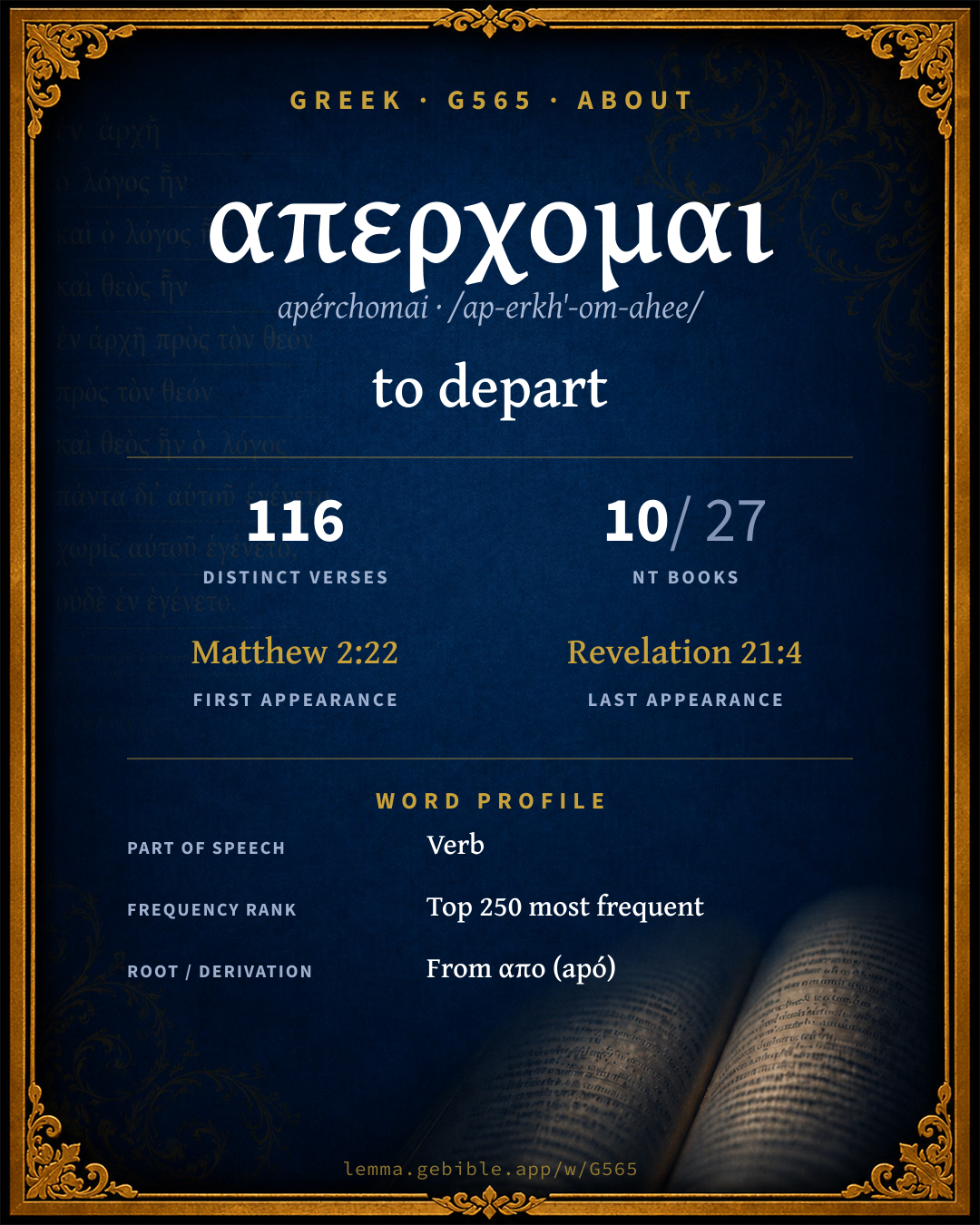
ἀπέρχομαι
to depart
‘to depart’ is one of 4 main senses fuller range ↓
Full lexicon entry — Thayer's Greek Lexicon
From Thayer's Greek Lexicon
Where this word appears
Grammar key — what these labels mean
Part of speech
- Verb
- An action or state-of-being word.
Tense
- Aorist
- Action viewed as a simple whole, without regard to duration — often past (perfective aspect).
- Present
- Ongoing or general action in present time (imperfective aspect).
- Perfect
- A completed past action with continuing present results.
- Future
- Action expected in future time.
- Pluperfect
- A past action completed before another past point (“had written”).
Voice
- Active
- The subject performs the action.
- Middle or Passive deponent
- Middle/passive in form but active in meaning.
- Middle deponent
- Middle in form but active in meaning.
Mood
- Indicative
- States a fact or asks a factual question (the mood of reality).
- Participle
- A verbal adjective (“writing,” “having written”).
- Infinitive
- A verbal noun (“to write”), unmarked for person or number.
- Subjunctive
- Expresses probability, purpose, or possibility (the mood of contingency).
Case
- Nominative
- The case of the subject (and the predicate nominative).
- Dative
- The case of the indirect object, means, or location — “to / for / with / in.”
- Genitive
- The case of source, possession, or “of” — answers “whose / from what.”
Person
- 3rd person
- The one spoken about (“he / she / it / they”).
- 1st person
- The speaker (“I / we”).
- 2nd person
- The one addressed (“you”).
Gender
- Masculine
- Grammatically masculine.
- Feminine
- Grammatically feminine.
Number
- Singular
- One.
- Plural
- More than one.
Every verse where G565 appears in the Book of Mark — 23 distinct verses. Click any verse to open its interlinear word-by-word view. Verse text shown in the World English Bible for context — . Each verse’s Greek form is shown with its reference; the English is not keyword-highlighted, since the data carries no word-level English alignment. Use “Compare translations” on any verse to read it across multiple English versions. This concordance covers the Greek New Testament; Septuagint (Greek Old Testament) occurrences of this word are not indexed here.
Mark
- Mark 1:20 ἀπῆλθον aor act ind 3pl Immediately he called them, and they left their father, Zebedee, in the boat with the hired servants, and went after him.
- Mark 1:35 ἀπῆλθεν aor act ind 3sg Early in the night, he rose up and went out, and departed into a deserted place, and prayed there.
- Mark 1:42 ἀπῆλθεν aor act ind 3sg When he had said this, immediately the leprosy departed from him, and he was made clean.
- Mark 3:13 ἀπῆλθον aor act ind 3pl He went up into the mountain, and called to himself those whom he wanted, and they went to him.
- Mark 5:17 ἀπελθεῖν aor act inf They began to beg him to depart from their region.
- Mark 5:20 ἀπῆλθεν aor act ind 3sg He went his way, and began to proclaim in Decapolis how Jesus had done great things for him, and everyone marveled.
- Mark 5:24 ἀπῆλθεν aor act ind 3sg He went with him, and a great multitude followed him, and they pressed upon him on all sides.
- Mark 6:28 ἀπελθὼν aor act ptcp nom sg masc and brought his head on a platter, and gave it to the young lady; and the young lady gave it to her mother.
- Mark 6:32 ἀπῆλθον aor act ind 3pl They went away in the boat to a desert place by themselves.
- Mark 6:36 ἀπελθόντες aor act ptcp nom pl masc Send them away, that they may go into the surrounding country and villages, and buy themselves bread, for they have nothing to eat."
- Mark 6:37 ἀπελθόντες aor act ptcp nom pl masc But he answered them, "You give them something to eat." They asked him, "Shall we go and buy two hundred denarii worth of bread, and give them something to eat?"
- Mark 6:46 ἀπῆλθεν aor act ind 3sg After he had taken leave of them, he went up the mountain to pray.
- Mark 7:24 ἀπῆλθεν aor act ind 3sg From there he arose, and went away into the borders of Tyre and Sidon. He entered into a house, and didn't want anyone to know it, but he couldn't escape notice.
- Mark 7:30 ἀπελθοῦσα aor act ptcp nom sg fem She went away to her house, and found the child having been laid on the bed, with the demon gone out.
- Mark 8:13 ἀπῆλθεν aor act ind 3sg He left them, and again entering into the boat, departed to the other side.
- Mark 9:43 ἀπελθεῖν aor act inf If your hand causes you to stumble, cut it off. It is better for you to enter into life maimed, rather than having your two hands to go into Gehenna, into the unquenchable fire,
- Mark 10:22 ἀπῆλθεν aor act ind 3sg But his face fell at that saying, and he went away sorrowful, for he was one who had great possessions.
- Mark 11:4 ἀπῆλθον aor act ind 3pl They went away, and found a young donkey tied at the door outside in the open street, and they untied him.
- Mark 12:12 ἀπῆλθον aor act ind 3pl They tried to seize him, but they feared the multitude; for they perceived that he spoke the parable against them. They left him, and went away.
- Mark 14:10 ἀπῆλθεν aor act ind 3sg Judas Iscariot, who was one of the twelve, went away to the chief priests, that he might deliver him to them.
- Mark 14:12 ἀπελθόντες aor act ptcp nom pl masc On the first day of unleavened bread, when they sacrificed the Passover, his disciples asked him, "Where do you want us to go and make ready that you may eat the Passover?"
- Mark 14:39 ἀπελθὼν aor act ptcp nom sg masc Again he went away, and prayed, saying the same words.
- Mark 16:13 ἀπελθόντες aor act ptcp nom pl masc They went away and told it to the rest. They didn't believe them, either.
About this entry
At a glance — auto-summarized from this page’s data, not written by a person. Every figure links to its source below. This summary describes the numbers; it doesn’t interpret them.
“to depart” is the headline sense of the Greek verb απερχομαι (apérchomai). Where the King James Version says “went,” newer translations reach for “having gone away” (unfoldingWord Literal Text); the renderings breakdown has the detail. The Greek New Testament uses it across 116 verses — common. More than a quarter of its appearances fall in Matthew. Catalogued under 4 senses, its meaning is not single-sense. See the sense tree, 116-verse concordance, and the renderings breakdown below.
Gloss history
Strong's 1890 vs modern scholarship

About this word
Strong's G565 catalogs a Greek word from the Greek New Testament.
These counts are not copied from any lexicon or concordance. They are computed here, from the morphology-tagged Greek New Testament. What Lemma adds →
- 116
- distinct verses
- The word appears in 116 distinct verses.
- 10 / 27
- NT books
- The word appears in 10 of 27 New Testament books.
- #140
- by frequency
- Top 250 most frequent Greek words (rank 140 of 5,347 Greek words by occurrence).
View all 116 occurrences in the concordance →
By section of the New Testament
By traditional corpus
Conventional, traditional groupings — biblical authorship is debated, so this is a traditional corpus grouping, not an authorship claim. Some books belong to more than one corpus (Luke is in both the Gospels and the Lukan corpus, and so on), so these shares overlap and need not total 100%. Each figure is a share of the word’s 116 distinct verses.
- Gospels 98 verses · 84%
- Johannine 28 verses · 24%
- Lukan (Luke–Acts) 26 verses · 22%
- Revelation 8 verses · 7%
- Pauline corpus 2 verses · 2%
- General (Catholic) Epistles 2 verses · 2%
How translations render this word
Counts come from each version’s own published word-to-Strong’s tagging or interlinear alignment — an approximate guide to how each version renders this word, not a word-level alignment the data otherwise carries. Because each total is that version’s own tagged count, the per-version totals vary from one another and need not match the appearance or distinct-verse counts above. These counts may also differ from a printed concordance because Lemma counts each distinctly tagged rendering and does not collapse phrase taggings into a single head-word total. This is a fixed set of word-tagged versions (KJV, ASV, BSB, ULT) and does not change with the reading translation you choose elsewhere. Each version’s license is shown beside its name below (and on Sources).
- King James Version: Went 22×, Departed 15×, Go 10×
- American Standard Version: Went 16×, Departed 12×, Go 11×
- Berean Standard Bible: Went 17×, Go 11×, Went away 11×
- unfoldingWord Literal Text: Having gone away 17×, Went away 16×, He went away 11×
King James Version Public Domain
Renders G565 across 122 tagged occurrences — most commonly:
Plus other, less common renderings. Plus 20 renderings that appear only once — usually multi-word phrases or single function words the recovered tagging swept in, not distinct renderings.
American Standard Version Public Domain
Renders G565 across 120 tagged occurrences — most commonly:
Plus other, less common renderings. Plus 31 renderings that appear only once — usually multi-word phrases or single function words the recovered tagging swept in, not distinct renderings.
Berean Standard Bible Public Domain
Renders G565 across 114 tagged occurrences — most commonly:
Plus other, less common renderings. Plus 34 renderings that appear only once — usually multi-word phrases or single function words the recovered tagging swept in, not distinct renderings. Not rendered by a distinct English word in 2 further occurrences.
unfoldingWord Literal Text CC BY-SA 4.0
Renders G565 across 126 tagged occurrences — most commonly:
Plus other, less common renderings. Plus 25 renderings that appear only once — usually multi-word phrases or single function words the recovered tagging swept in, not distinct renderings.
Senses in Thayer's
The 4 senses Thayer's distinguishes for this word, in lexicon order (not ranked by frequency or importance). The full entry — with sub-senses — is in the Lexicon Entry tab.
- to go away in order to follow any one, go after him, to follow his party, follow him as a leader
- of departing evils and sufferings
- of good things taken away from one
- of an evanescent state of things
Word origin
Derived from απο (apó) (G575) — from.
Forms in the corpus
The 25 distinct written forms G565 takes in the Greek New Testament, most frequent first — each parse links to that tense’s occurrences in the concordance.
Same root — word family
Other Thayer's entries built from the same root as G565, grouped by Strong’s listed origin. These share a root / origin per the lexicon — not necessarily a shared meaning. Each links to that word’s own entry.
Derives from
Shares the same root
- απαγγελλω apangéllō G518 to report
- απαγχομαι apánchomai G519 to strangle
- απαγω apágō G520 to lead away
- απαιρω apaírō G522 to take away
- απαιτεω apaitéō G523 to demand back
- απαλγεω apalgéō G524 to cease grieving
- απαλλασσω apallássō G525 to depart
- απαλλοτριοω apallotrióō G526 to estrange
- απανταω apantáō G528 to meet
- απαρνεομαι aparnéomai G533 to deny
- απαρτι apárti G534 henceforth
- απαρχη aparchḗ G536 to offer firstfruits
- απαυγασμα apaúgasma G541 brightness
- απειδω apeídō G542 to look away
- απειμι ápeimi G548 to depart
- απειμι ápeimi G549 to depart
- απειπομην apeipómēn G550 to declare
- απεκδεχομαι apekdéchomai G553 waiting for
- απεκδυομαι apekdýomai G554 to despoil
- απελαυνω apelaúnō G556 to drive away
- απελεγμος apelegmós G557 censure
- απελευθερος apeleútheros G558 freedman
- απελπιζω apelpízō G560 not despairing
- απεναντι apénanti G561 opposite
+85 more words share this root (not shown).
Compare all same-root words → Showing 4 of 111 — not the complete family. They share a root, not necessarily a meaning.
Septuagint usage
The same Greek word απερχομαι appears 170 times in the Greek Old Testament (Septuagint), across 160 verses in 20 books.
- 170
- LXX occurrences
- Tagged occurrences of this Greek word in the Septuagint.
- 160
- verses
- Distinct Septuagint verses containing this word.
- 20 / 39
- OT books
- The word appears in 20 of the 39 Old Testament books.
Sample Septuagint occurrences
- Genesis 3:19 ἀποἔρχομαι
- Exodus 3:21 ἀποἔρχομαι
- Leviticus 25:10 ἀποἔρχομαι
- Numbers 11:30 ἀποἔρχομαι
- Deuteronomy 16:7 ἀποἔρχομαι
- Joshua 1:15 ἀποἔρχομαι
- Judges 4:6 ἀποἔρχομαι
- 1 Samuel 2:11 ἀποἔρχομαι
- 2 Samuel 2:29 ἀποἔρχομαι
- 1 Kings 1:49 ἀποἔρχομαι
- 2 Kings 4:5 ἀποἔρχομαι
- 2 Chronicles 10:5 ἀποἔρχομαι
Septuagint occurrences (same lexeme)
Every verse where the same Strong’s number (G565) appears in the Greek Septuagint — showing the first 50 of 160. Verse text shown in the World English Bible for context; the Greek form is the matched word — the English is not keyword-highlighted.
- Genesis 3:19 ἀποἔρχομαι By the sweat of your face will you eat bread until you return to the ground, for out of it you were taken. For you are dust, and to dust you shall return."
- Genesis 14:11 ἀποἔρχομαι They took all the goods of Sodom and Gomorrah, and all their food, and went their way.
- Genesis 15:15 ἀποἔρχομαι But you will go to your fathers in peace. You will be buried in a good old age.
- Genesis 18:33 ἀποἔρχομαι Yahweh went his way, as soon as he had finished communing with Abraham, and Abraham returned to his place.
- Genesis 19:2 ἀποἔρχομαι and he said, "See now, my lords, please turn aside into your servant's house, stay all night, wash your feet, and you will rise up early, and go on your way." They said, "No, but we will stay in the street all night."
- Genesis 21:14 ἀποἔρχομαι Abraham rose up early in the morning, and took bread and a bottle of water, and gave it to Hagar, putting it on her shoulder, and gave her the child, and sent her away. She departed, and wandered in the wilderness of Beersheba.
- Genesis 21:16 ἀποἔρχομαι She went and sat down opposite him, a good way off, about a bow shot away. For she said, "Don't let me see the death of the child." She sat over against him, and lifted up her voice, and wept.
- Genesis 24:54 ἀποἔρχομαι They ate and drank, he and the men who were with him, and stayed all night. They rose up in the morning, and he said, "Send me away to my master."
- Genesis 24:55 ἀποἔρχομαι Her brother and her mother said, "Let the young lady stay with us a few days, at least ten. After that she will go."
- Genesis 24:56 ἀποἔρχομαι He said to them, "Don't hinder me, seeing Yahweh has prospered my way. Send me away that I may go to my master."
- Genesis 24:61 ἀποἔρχομαι Rebekah arose with her ladies. They rode on the camels, and followed the man. The servant took Rebekah, and went his way.
- Genesis 26:16 ἀποἔρχομαι Abimelech said to Isaac, "Go from us, for you are much mightier than we."
- Genesis 26:17 ἀποἔρχομαι Isaac departed from there, encamped in the valley of Gerar, and lived there.
- Genesis 29:7 ἀποἔρχομαι He said, "Behold, it is still the middle of the day, not time to gather the cattle together. Water the sheep, and go and feed them."
- Genesis 30:25 ἀποἔρχομαι It happened, when Rachel had borne Joseph, that Jacob said to Laban, "Send me away, that I may go to my own place, and to my country.
- Genesis 30:26 ἀποἔρχομαι Give me my wives and my children for whom I have served you, and let me go: for you know my service with which I have served you."
- Genesis 31:13 ἀποἔρχομαι I am the God of Bethel, where you anointed a pillar, where you vowed a vow to me. Now arise, get out from this land, and return to the land of your birth."
- Genesis 31:18 ἀποἔρχομαι and he carried away all his cattle, and all his substance which he had gathered, the cattle of his getting, which he had gathered in Paddan Aram, to go to Isaac his father to the land of Canaan.
- Genesis 31:30 ἀποἔρχομαι Now, you want to be gone, because you sore longed after your father's house, but why have you stolen my gods?"
- Genesis 32:1 ἀποἔρχομαι Jacob went on his way, and the angels of God met him.
- Genesis 32:2 ἀποἔρχομαι When he saw them, Jacob said, "This is God's host." He called the name of that place Mahanaim.
- Genesis 34:17 ἀποἔρχομαι But if you will not listen to us, to be circumcised, then we will take our sister, and we will be gone."
- Genesis 38:11 ἀποἔρχομαι Then Judah said to Tamar, his daughter-in-law, "Remain a widow in your father's house, until Shelah, my son, is grown up;" for he said, "Lest he also die, like his brothers." Tamar went and lived in her father's house.
- Genesis 38:19 ἀποἔρχομαι She arose, and went away, and put off her veil from her, and put on the garments of her widowhood.
- Genesis 42:26 ἀποἔρχομαι They loaded their donkeys with their grain, and departed from there.
- Genesis 42:33 ἀποἔρχομαι The man, the lord of the land, said to us, 'Hereby will I know that you are honest men. Leave one of your brothers with me, and take grain for the famine of your houses, and go your way.
- Genesis 45:17 ἀποἔρχομαι Pharaoh said to Joseph, "Tell your brothers, 'Do this. Load your animals, and go, travel to the land of Canaan.
- Exodus 3:21 ἀποἔρχομαι I will give this people favor in the sight of the Egyptians, and it will happen that when you go, you shall not go empty-handed.
- Exodus 4:19 ἀποἔρχομαι Yahweh said to Moses in Midian, "Go, return into Egypt; for all the men who sought your life are dead."
- Exodus 4:26 ἀποἔρχομαι So he let him alone. Then she said, "You are a bridegroom of blood," because of the circumcision.
- Exodus 5:4 ἀποἔρχομαι The king of Egypt said to them, "Why do you, Moses and Aaron, take the people from their work? Get back to your burdens!"
- Exodus 8:25 ἀποἔρχομαι Pharaoh called for Moses and for Aaron, and said, "Go, sacrifice to your God in the land!"
- Exodus 10:28 ἀποἔρχομαι Pharaoh said to him, "Get away from me! Be careful to see my face no more; for in the day you see my face you shall die!"
- Exodus 12:21 ἀποἔρχομαι Then Moses called for all the elders of Israel, and said to them, "Draw out, and take lambs according to your families, and kill the Passover.
- Exodus 12:28 ἀποἔρχομαι The children of Israel went and did so; as Yahweh had commanded Moses and Aaron, so they did.
- Exodus 18:27 ἀποἔρχομαι Moses let his father-in-law depart, and he went his way into his own land.
- Exodus 19:13 ἀποἔρχομαι No hand shall touch him, but he shall surely be stoned or shot through; whether it is animal or man, he shall not live.' When the trumpet sounds long, they shall come up to the mountain."
- Exodus 21:2 ἀποἔρχομαι If you buy a Hebrew servant, he shall serve six years and in the seventh he shall go out free without paying anything.
- Exodus 21:7 ἀποἔρχομαι "If a man sells his daughter to be a maid-servant, she shall not go out as the men-servants do.
- Leviticus 25:10 ἀποἔρχομαι You shall make the fiftieth year holy, and proclaim liberty throughout the land to all its inhabitants. It shall be a jubilee to you; and each of you shall return to his own property, and each of you shall return to his family.
- Leviticus 25:27 ἀποἔρχομαι then let him reckon the years since the sale of it, and restore the surplus to the man to whom he sold it; and he shall return to his property.
- Leviticus 25:28 ἀποἔρχομαι But if he isn't able to get it back for himself, then what he has sold shall remain in the hand of him who has bought it until the Year of Jubilee: and in the Jubilee it shall be released, and he shall return to his propery.
- Leviticus 25:41 ἀποἔρχομαι then he shall go out from you, he and his children with him, and shall return to his own family, and to the possession of his fathers.
- Numbers 11:30 ἀποἔρχομαι Moses got him into the camp, he and the elders of Israel.
- Numbers 12:9 ἀποἔρχομαι The anger of Yahweh was kindled against them; and he departed.
- Numbers 22:26 ἀποἔρχομαι The angel of Yahweh went further, and stood in a narrow place, where was no way to turn either to the right hand or to the left.
- Numbers 24:25 ἀποἔρχομαι Balaam rose up, and went and returned to his place; and Balak also went his way.
- Deuteronomy 16:7 ἀποἔρχομαι You shall roast and eat it in the place which Yahweh your God shall choose: and you shall turn in the morning, and go to your tents.
- Deuteronomy 24:2 ἀποἔρχομαι When she is departed out of his house, she may go and be another man's [wife].
- Deuteronomy 28:41 ἀποἔρχομαι You shall father sons and daughters, but they shall not be yours; for they shall go into captivity.
These are occurrences of the same Greek lexeme (G565) in the Septuagint — not a translation of any one Hebrew word. The store carries no word-level Hebrew↔Greek alignment, so no Hebrew original is asserted here. Counts come from the recovered LXX Strong's tagging — high-frequency vocabulary is well covered, while rare or late forms may be untagged — so they reflect tagged occurrences and may slightly undercount.