Leviticus 25:27

Hebrew (Westminster Leningrad Codex) Leviticus 25:27 appears in the Hebrew Old Testament. The text above is from the Westminster Leningrad Codex. Each word links to its Strong’s number, a concise gloss, and parsing drawn from the Open Scriptures Hebrew Bible morphology. Click any word for its full Brown-Driver-Briggs (BDB) entry.
Download image
Cite this verse

Leviticus 25:27 (World English Bible). Public Domain. Lemma interlinear Bible study tool, https://lemma.gebible.app/v/leviticus/25/27.

Show BibTeX & RIS
BibTeX
RIS
English Translation
then let him reckon the years since the sale of it, and restore the surplus to the man to whom he sold it; and he shall return to his property.
World English Bible · Public Domain
Download a study sheet

One document with this verse’s original text, its word-by-word gloss line, the meaning frame, cross-references with their text, attributed commentary, and full source and license credits — printable, and it pastes into notes with its structure intact.

This verse Autodidact and up

Study sheet (.html) Plain text (.txt)

A passage Seminary Student

Up to 50 verses in one chapter. A passage sheet keeps up to 6 commentary sources and 12 cross-references per verse, in the order this page ranks them, and says so on the sheet whenever that leaves anything out. Ask for a single verse and you get the Autodidact verse sheet above.

Everything on this page stays free to read, with no account — the sheet is a download of what is already on screen, not access to it.

Want to remove ads? Support Godless Engineer
Compare translations 3

The same verse in 3 English versions, stacked beneath the original-language interlinear above. Click any original word for its lexicon entry.

Each is an independent rendering of the whole verse — the interlinear is not word-aligned to these translations.

Highlighted words mark where these versions differ — a whole-verse word diff, not a word-by-word alignment.

  • World English Bible Public Domain
    then let him reckon the years since the sale of it, and restore the surplus to the man to whom he sold it; and he shall return to his property.
  • King James Version Public Domain
    Then let him count the years of the sale thereof, and restore the overplus unto the man to whom he sold it; that he may return unto his possession.
  • unfoldingWord Literal Text CC BY-SA 4.0
    then he shall calculate the years of its sale and return the excess to the man that he sold to him, and he shall return to his possession.

unfoldingWord Literal Text — © unfoldingWord, licensed CC BY-SA 4.0. Word-aligned USFM3 via Door43 (git.door43.org/unfoldingWord/en_ult).

Versions to compare (up to 4)

3 of 4 selected

Show all 18 translations

Every available English version of this verse, each an independent rendering of the whole verse.

  • World English Bible Public Domain
    then let him reckon the years since the sale of it, and restore the surplus to the man to whom he sold it; and he shall return to his property.
  • Berean Standard Bible Public Domain
    he shall calculate the years since its sale, repay the balance to the man to whom he sold it, and return to his property.
  • Majority Standard Bible Public Domain
    he shall calculate the years since its sale, repay the balance to the man to whom he sold it, and return to his property.
  • King James Version Public Domain
    Then let him count the years of the sale thereof, and restore the overplus unto the man to whom he sold it; that he may return unto his possession.
  • American Standard Version (1901) Public Domain
    then let him reckon the years of the sale thereof, and restore the overplus unto the man to whom he sold it; and he shall return unto his possession.
  • Revised Version (1885) Public Domain
    then let him count the years of the sale thereof, and restore the overplus unto the man to whom he sold it; and he shall return unto his possession.
  • Geneva Bible (1599) Public Domain
    Then shall he count the yeeres of his sale, and restore the ouerplus to the man, to whome he solde it: so shall he returne to his possession.
  • Douay-Rheims (1899) Public Domain
    The value of the fruits shall be counted from that time when he sold it: and the overplus he shall restore to the buyer, and so shall receive his possession again.
  • Young's Literal Translation Public Domain
    then he hath reckoned the years of its sale, and hath given back that which is over to the man to whom he sold `it', and he hath returned to his possession.
  • Literal Standard Version CC BY-SA 4.0
    then he has reckoned the years of its sale, and has given back that which is over to the man to whom he sold [it], and he has returned to his possession.
  • Unlocked Literal Bible CC BY-SA 4.0
    then he may calculate the years since the land was sold and repay the balance to the man to whom he sold it. Then he may return to his own property.
  • unfoldingWord Literal Text CC BY-SA 4.0
    then he shall calculate the years of its sale and return the excess to the man that he sold to him, and he shall return to his possession.
  • Darby Bible Public Domain
    then shall he reckon the years since the sale thereof, and restore the overplus unto the man to whom he sold it; and so return unto his possession.
  • World Messianic Bible Public Domain
    then let him reckon the years since its sale, and restore the surplus to the man to whom he sold it; and he shall return to his property.
  • Webster's Bible Public Domain
    Then let him count the years of the sale of it, and restore the overplus to the man to whom he sold it; that he may return to his possession.
  • Free Bible Version CC BY-SA 4.0
    they will work however many years it has been since the sale, and pay back the balance to the person who bought it, and go back to their property
  • Bible in Basic English Public Domain
    Then let him take into account the years from the time when he gave it up, and make up the loss for the rest of the years to him who took it, and so get back his property.
  • JPS Tanakh (1917) Public Domain
    then let him count the years of the sale thereof, and restore the overplus unto the man to whom he sold it; and he shall return unto his possession.

Literal Standard Version (2020), Covenant Press — licensed CC BY-SA 4.0. Text via the HelloAO Bible API (eBible.org). Unlocked Literal Bible (unfoldingWord) — licensed CC BY-SA 4.0. Text via the HelloAO Bible API (eBible.org). unfoldingWord Literal Text — © unfoldingWord, licensed CC BY-SA 4.0. Word-aligned USFM3 via Door43 (git.door43.org/unfoldingWord/en_ult). Free Bible Version, Dr. Jonathan Gallagher — licensed CC BY-SA 4.0. Text via the HelloAO Bible API (eBible.org).

Word by word

More ways to search: Search by grammar → Find every occurrence → Compare this word →

Practice this passage: Drill this verse → Learn its vocabulary →

הָ֣עֹדֵ֔ף
ʻădaph
H5736
“the · being in excess”
Particle, Definite Article + Verb, Qal, Participle Active, Masculine, Singular, Absolute
Part of Speech
Particle + Verb
Stem
Qal
Form
Participle Active
Gender
Masculine
Number
Singular
State
Absolute
Full BDB Definition

Origin: a primitive root

TWOT: 1569

to remain over, be in excess - (Qal) - to be in excess - excess (substantive) - surplus (participle) - (Hiphil) to have a surplus
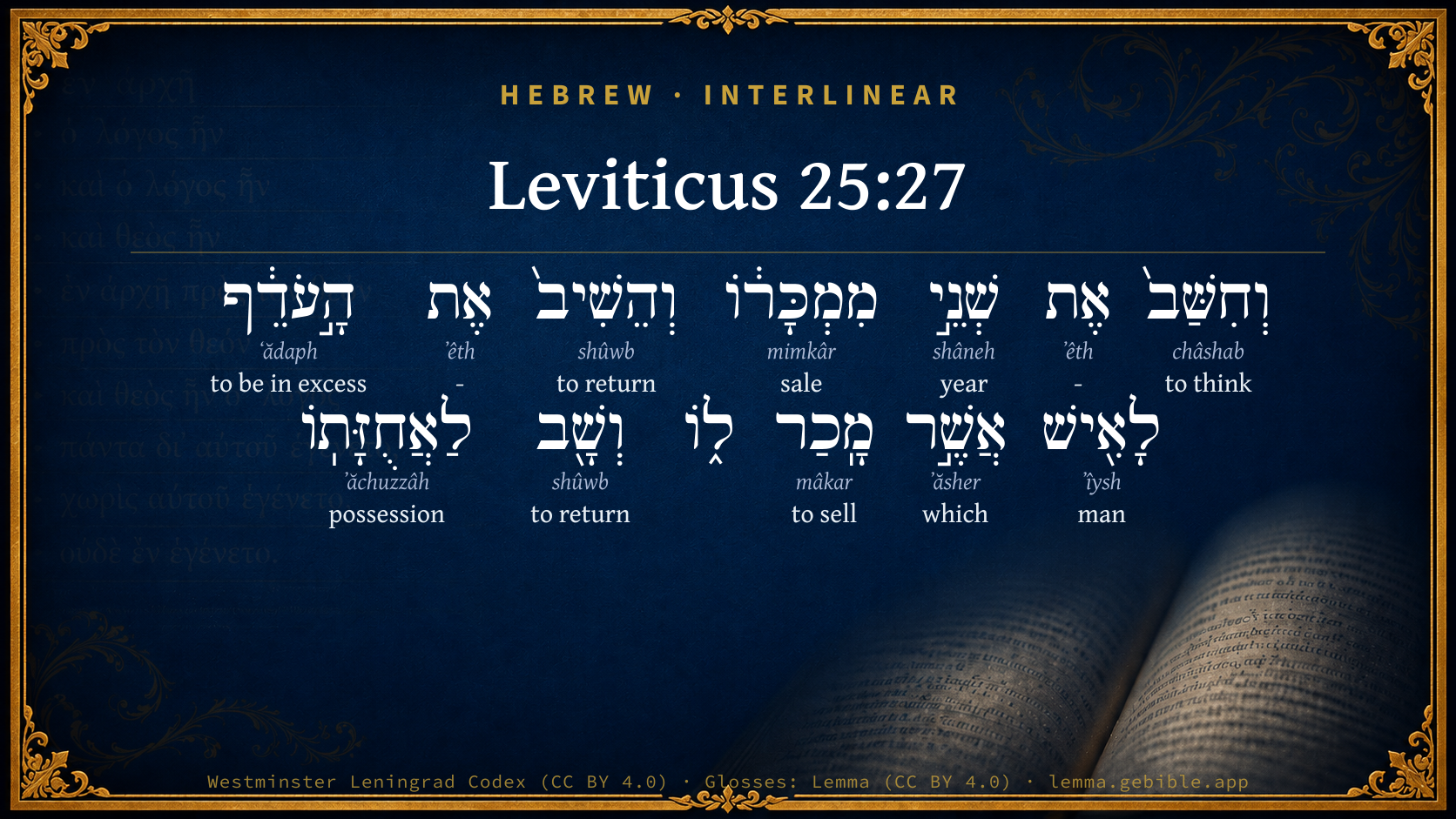
  1. וְחִשַּׁב֙ châshab H2803 “and · to think” Conjunction + Verb, Piel, Sequential Perfect, 3rd Person, Masculine, Singular
  2. אֶת ʼêth H853 “-” Particle, Direct Object
  3. שְׁנֵ֣י shâneh H8141 “year” Adjective, Cardinal number, Masculine, Dual, Construct
  4. מִמְכָּר֔וֹ mimkâr H4465 “sale · his” Noun, Common, Masculine, Singular, Construct + Suffix, Personal, 3rd Person, Masculine, Singular
  5. וְהֵשִׁיב֙ shûwb H7725 “and · to return” Conjunction + Verb, Hiphil, Sequential Perfect, 3rd Person, Masculine, Singular
  6. אֶת ʼêth H853 “-” Particle, Direct Object
  7. לָאִ֖ישׁ ʼîysh H376 “to/for the · man” Preposition, Determined + Noun, Common, Masculine, Singular, Absolute
  8. אֲשֶׁ֣ר ʼăsher H834 “which” Particle, Relative
  9. מָֽכַר mâkar H4376 “to sell” Verb, Qal, Perfect, 3rd Person, Masculine, Singular
  10. וְשָׁ֖ב shûwb H7725 “and · to return” Conjunction + Verb, Qal, Sequential Perfect, 3rd Person, Masculine, Singular
  11. לַאֲחֻזָּתֽוֹ ʼăchuzzâh H272 “to/for · possession · his” Preposition + Noun, Common, Feminine, Singular, Construct + Suffix, Personal, 3rd Person, Masculine, Singular

About this verse

These counts appear in no published source. They are computed here, from the morphology-tagged text and Lemma’s own curated glosses. What Lemma adds →

13
words
10
distinct lemmas
Pentateuch
section

Notable vocabulary

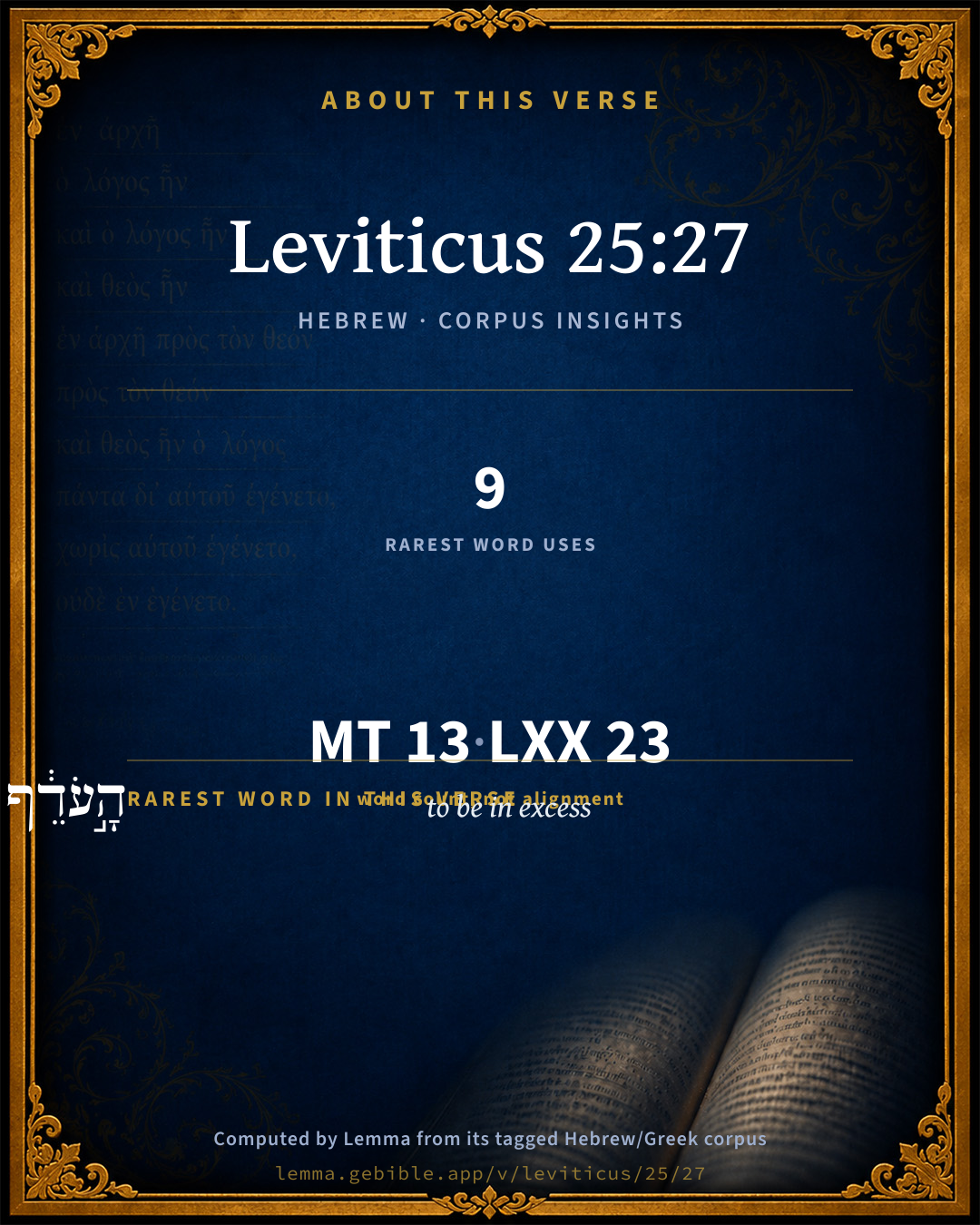
The rarest word here is הָ֣עֹדֵ֔ף to be in excess H5736 — appearing just 9 times in the whole Hebrew Bible.

Shared distinctive vocabulary

הָ֣עֹדֵ֔ף to be in excess H5736 occurs in 8 verses of the Hebrew Bible. Also found in:

Grammatical profile

  • 5 verbs
  • 3 nouns
  • 1 adjective
  • 1 preposition
  • 3 particles

Verb forms

  • וְחִשַּׁב֙ Piel · Sequential Perfect
  • וְהֵשִׁיב֙ Hiphil · Sequential Perfect
  • הָ֣עֹדֵ֔ף Qal · Participle Active
  • מָֽכַר Qal · Perfect
  • וְשָׁ֖ב Qal · Sequential Perfect

Repetition

A word recurs within this verse — often emphatic in Hebrew:

  • וְהֵשִׁיב֙ to return H7725 ×2

Hebrew & Septuagint length

In English translation the verse runs 30 words from the Hebrew and 31 from the Septuagint (LXX English) — closely comparable.

A rough comparison of the two English renderings, which tokenize alike — not a word-level alignment.

Word counts can differ between the Hebrew and the Greek without any difference in meaning — e.g. the Hebrew direct-object marker אֵת has no separate Greek word, and Greek often adds the article ὁ.

In the original languages it is 13 Hebrew tokens and 23 Greek tokens — but the two are counted differently (Hebrew bundles its prefixes and suffixes into one token; the Greek is in lemma form), so that isn’t a like-for-like length.

Hebrew and Greek witnesses Masoretic Hebrew ↔ Greek Septuagint

The same verse in the two great witnesses to the Old Testament, shown verse-for-verse.

These are two independent witnesses, not word-aligned to each other, and the Septuagint is shown in lemma (dictionary) form.

Hebrew Leviticus 25:27 Masoretic · Westminster Leningrad Codex

וְחִשַּׁב֙ אֶת שְׁנֵ֣י מִמְכָּר֔וֹ וְהֵשִׁיב֙ אֶת הָ֣עֹדֵ֔ף לָאִ֖ישׁ אֲשֶׁ֣ר מָֽכַר ל֑וֹ וְשָׁ֖ב לַאֲחֻזָּתֽוֹ

then let him reckon the years since the sale of it, and restore the surplus to the man to whom he sold it; and he shall return to his property.

World English Bible · Public Domain

Greek LXX Leviticus 25:27 Septuagint · lemma form

καί συνλογίζω ὁ ἔτος ὁ πρᾶσις αὐτός καί ἀποδίδωμι ὅς ὑπερἔχω ὁ ἄνθρωπος ὅς ἀποδίδωμι ἑαυτοῦ αὐτός καί ἀποἔρχομαι εἰς ὁ κατάσχεσις αὐτός

then shall he calculate the years of his sale, and he shall give what is due to the man to whom he sold it, and he shall return to his possession.

LXX2012 (modern English Septuagint) · Public Domain

Hebrew: Westminster Leningrad Codex (CC BY 4.0). Greek: Septuagint (public domain); English from LXX2012 (modern English Septuagint) (Public Domain). How the Septuagint differs from the Hebrew →

Targum (Aramaic paraphrase)

2

The Targum is the ancient Jewish Aramaic paraphrase of the Hebrew Scriptures — an interpretive translation, not the Hebrew text itself. Onkelos (literal) and Pseudo-Jonathan (expansive) render the Torah, and Jonathan the Prophets. Coverage is partial: where no permissively-licensed English translation exists for a verse, only the Aramaic is shown. This is verse-level text, not a word-by-word alignment to the Hebrew.

  1. Targum Onkelos Torah (Genesis–Deuteronomy)
    וִיחַשֵׁב יָת שְׁנֵי זְבִינוֹהִי וְיָתֵב יָת מוֹתָרָא לִגְבַר דִי זַבֶּן לֵהּ וִיתוּב לְאַחֲסַנְתֵּהּ

    (no public-domain English translation for this verse)

    Targum Onkelos — Aramaic: “Onkelos Genesis” (public domain); “Onkelos Exodus” (public domain); “Onkelos Leviticus” (public domain); “Onkelos Numbers” (public domain); “Onkelos Deuteronomy” (public domain). English: “Sefaria Community Translation” (CC0 1.0 (public-domain dedication)); “J.W. Etheridge. The Targums of Onkelos and Jonathan Ben Uzziel on the Pentateuch. London: Longmans, Green, 1862” (public domain). Text via Sefaria.

  2. Targum Pseudo-Jonathan Torah (Genesis–Deuteronomy)
    וִידַיֵיק יַת סְכוֹם שְׁנֵי זְבִינוֹי וְיָתֵיב יַת מוֹתָרָא לִגְבַר דְזַבִּין לֵיהּ וְיֵתוּב לְאַחֲסַנְתֵּיהּ

    then let him count the sum of the years of its sale, and give the amount to the man who bought it, and return to his possession.

    Targum Pseudo-Jonathan — Aramaic: “Targum Jonathan on Genesis” (public domain); “Targum Jonathan on Exodus” (public domain); “Targum Jonathan on Leviticus” (public domain); “Targum Jonathan on Numbers” (public domain); “Targum Jonathan on Deuteronomy” (public domain). English: “The Targum of Jonathan ben Uzziel, trans. J. W. Etheridge, London, 1862” (public domain). Text via Sefaria.

Commentary

Notes on Leviticus 25:27 from classic Christian and Jewish commentators (each source and its license shown beneath its notes). The classic Christian expositions comment on the surrounding passage and are grouped to its opening verse, so a note may address several verses; the Jewish commentaries on the Tanakh (Rashi and others) are per-verse, so they appear only where the commentator wrote on this verse.

Lemma curates 59 commentaries, every one of them public domain or Creative Commons licensed, each selected and text-cleaned for this edition rather than reprinted as found. About our sources →

Joseph Benson's Commentary

Lev 25:27-28. The years of the sale — That is, from the time of the sale to the jubilee. See above, Lev 25:15-16. The overplus — That is, a convenient price for the years from the time of this redemption to the jubilee. Go out — That is, out of the buyer’s hand, without any redemption-money.

Joseph Benson's Commentary on the Old and New Testaments (1811–1818) — public domain. Text from a community e-Sword module.

Geneva Bible (1599)

Geneva Bible translators

Abating the money of the years past, and paying for the rest of the years to come.

Geneva Bible (1599) marginal notes — public domain. Text via Bolls.life.

Ellicott's Commentary for English Readers

(27) Count the years of the sale thereof.—To regulate the price of the redemption money the crops were valued which the purchaser had enjoyed since he had acquired the property. This was deducted from what he originally paid for the plot of land, and the difference was returned to him by the vendor, to whom the patrimony reverted. Thus, for instance, if there were thirty years from the time the purchase was effected to the year of jubile, and the vendor or his next of kin redeemed the inheritance either ten or fifteen years after the transaction, he had to return to the purchaser either one-third or half of the purchase money, when the soil was restored to the seller or his next of kin. In the interest of the purchaser, however, it was enacted during the second Temple that the redemption should not take place before he had the benefit of the field for two productive years (see Lev_25:15), and that he could claim compensation for outlay on improvements.

Restore the overplus unto the man to whom he sold it.—That is, an equitable estimate is to be made of what the land is likely to yield from the time of its redemption by the vendor to the jubile, which is to be allowed to the purchaser.

A Bible Commentary for English Readers, edited by Charles John Ellicott (1878–1897) — public domain. Text from a community e-Sword module.

The Cambridge Bible for Schools and Colleges

gen. ed. J. J. S. Perowne

27. the overplus] i.e. a proportion of the original price obtained, corresponding to the number of years which were still to intervene between the redemption and the next Jubile year.

The Cambridge Bible for Schools and Colleges (gen. ed. J. J. S. Perowne; Cambridge University Press, 1878–1918) — public domain. Text from a community e-Sword module.

John Gill's Exposition

Then let him count the years of the sale thereof,.... How many years had passed since it was sold, how many it had been in the hands of the purchaser, and how many were yet to come to the year of the jubilee, by which means the price of redemption might easily be settled; thus, for instance, if the years were alike and there was just half the time gone, then half of the price it was sold at was repaid to the purchaser; and if not alike, then in proportion to what had passed and were to come:

and restore the overplus unto the man to whom he sold it; for the years that were yet to come; if, as Jarchi says, he has eaten of or enjoyed the fruit of the field three or four years, deduct the price of them from the account, and take the rest; this is the meaning, "and restore the overplus", out of the price of the sale, according to what is eaten, and give it to the buyer: Maimonides (e) explains it thus; that if there were ten years to the year of the jubilee, and the field was sold for an hundred pieces, if he that bought it has eaten of it three years, then the seller that redeems it must give him seventy pieces, and he must restore his field; if he has eaten of it six years, he is to give forty pieces, and the other restores him the field: in the Misnah it is put thus; if he sell it (his field) to the first for an hundred pence, and the first sells it to a second for two hundred, he must not reckon but with the first, as it is said, "unto the man to whom he sold it"; if he sold it to the first for two hundred, and the first sells it to a second for an hundred, he shall not count but with the last, as it is said, "to a man", i.e. to the man which is in the midst of it, or is possessed of it; nor may he sell it for a distant time, that he may redeem it near, nor when in a bad condition, that he may redeem it when in a good one; nor may he borrow to redeem it, nor redeem it by halves (f):

that he may return to his possession; and enjoy it again.

(e) Hilchot Shemittah Vejobel, ut supra, (c. 11.) sect. 5. (f) Misn. Eracin, ut supra. (c. 9. 1.)

John Gill's Exposition of the Whole Bible (1746–1763) — public domain (CC PDM 1.0). Text via the HelloAO Bible API.

Haydock's Catholic Bible Commentary

Fruits. An estimation shall be made of what the buyer would probably have gotten for the fruits of the land, till the year of jubilee, and that sum shall be given to him; (Calmet) or what benefit he has already derived from the land shall be computed; so that, if he purchased it for 100 sicles, and had received the value of 80, he should be content with the addition of 20 more, ver. 53. (Haydock)

George Leo Haydock (1774–1849), Haydock's Catholic Family Bible and Commentary, 1859 edition — public domain. Excludes Psalms (Douay-Rheims chapter numbering differs from Protestant) and Deuterocanonical books (Catholic canon only).

Matthew Poole's English Annotations

The years of the sale thereof, i.e. from the time of the sale to the jubilee. See Poole "Lev 25:15" See Poole "Lev 25:16". The overplus, i.e. a convenient price for the years from this redemption to the jubilee.

Matthew Poole's English Annotations on the Holy Bible (1683–1685) — public domain. Text from a community e-Sword/MySword module.

Whedon's Commentary on the Bible

Daniel D. Whedon

27. Count the years — The fruit-bearing years. Thus a possession sold in the twentieth year before the jubilee would have seventeen fruit-bearing years. If redeemed in the tenth year there are eight such years, which the redeemer must pay for in equity as the overplus.

Daniel D. Whedon (gen. ed.), Commentary on the Old and New Testaments (1874–1909) — public domain. Text from a community e-Sword module.

John Wesley's Explanatory Notes

The years of the sale - That is, from the time of the sale to the jubilee. See above, ver. 15, 16. The overplus - That is, a convenient price for the years from this redemption to the jubilee.

John Wesley, Explanatory Notes Upon the Whole Bible (1754–1765) — public domain. Text via the GEBible commentary corpus.

Rashi

Rabbi Shlomo Yitzchaki (Rashi)

וחשב את שני ממכרו THEN LET HIM RECKON THE YEARS OF THE SALE THEREOF — [let him reckon thus:] How many years were there until the Jubilee? So-and-so many! At what price did I sell it to you? At such-and-such a price! Now in the Jubilee year you would have to restore it to me; it follows therefore that you have actually bought a number of crops only (and not the land itself) at a certain sum for every year. You have eaten it (used it) three or four years; deduct therefore their value from the sum total of the purchase money and you take the remainder. And this is the meaning of: “he shall restore the overplus” — viz., the excess of the purchase-money over the value of the crops which he (the purchaser) has enjoyed, and he shall restore it to the purchaser.

לאיש אשר מכר לו [AND HE SHALL RESTORE THE OVERPLUS] TO THE MAN TO WHOM HE HAD SOLD IT — i. e. to whom he — this seller who now comes to redeem it — had sold it (but not to any other person who is now in the possession of the field, having in his turn bought it from that man to whom he — the seller — had originally sold it) (Sifra, Behar, Chapter 5 3; Arakhin 30a).

Rashi on the Tanakh — English translations: “The Judaica Press complete Tanach with Rashi, translated by A. J. Rosenberg” (CC BY 4.0); “Pentateuch with Rashi's commentary by M. Rosenbaum and A.M. Silbermann, 1929-1934” (public domain); “The Metsudah Tanach series, Lakewood, N.J” (CC BY 4.0); and “The Book of Joshua, Metsudah Publications, 1997” (CC BY 4.0). Text via Sefaria.

Lesson kit

Teaching starters — assembled from the data on this page, not authored interpretation. Every prompt links to the verse data it draws on. Edit before teaching.

Leviticus, in the Pentateuch, opens this verse with 13 words (10 distinct Hebrew lemmas). Its most distinctive word is ʻădaph (“to be in excess”). A historical commentator’s framing appears above. Read the whole chapter for the surrounding context.

Discussion questions

  1. How does “to be in excess” (ʻădaph) shape what this verse is saying?
  2. Exodus 16:18 shares the word «to be in excess» with this verse. How do the two illuminate each other?
  3. “to return” occurs 2× in this one verse. What is the effect of the repetition?
  4. These translations render this verse differently; the difference is in the English rendering, not the original. What questions does that raise?
  5. The verb «וְחִשַּׁב֙» is Piel Sequential Perfect. How does its form color the action?
  6. Reading how Joseph Benson's Commentary and Geneva Bible (1599) read this verse, where do the two commentators agree and where do they part?

Things to notice

Reading settings

Reading text

Shown beneath each verse's original-language words.

Old Testament
Old Testament edition

Read the OT as the Masoretic Hebrew (MT) or the Greek Septuagint (LXX).

English shown for the Greek Septuagint (in the Hebrew ↔ Greek comparison).

Comparing translations? Open the Compare panel on any verse page to stack up to four side by side.