Leviticus 25:41

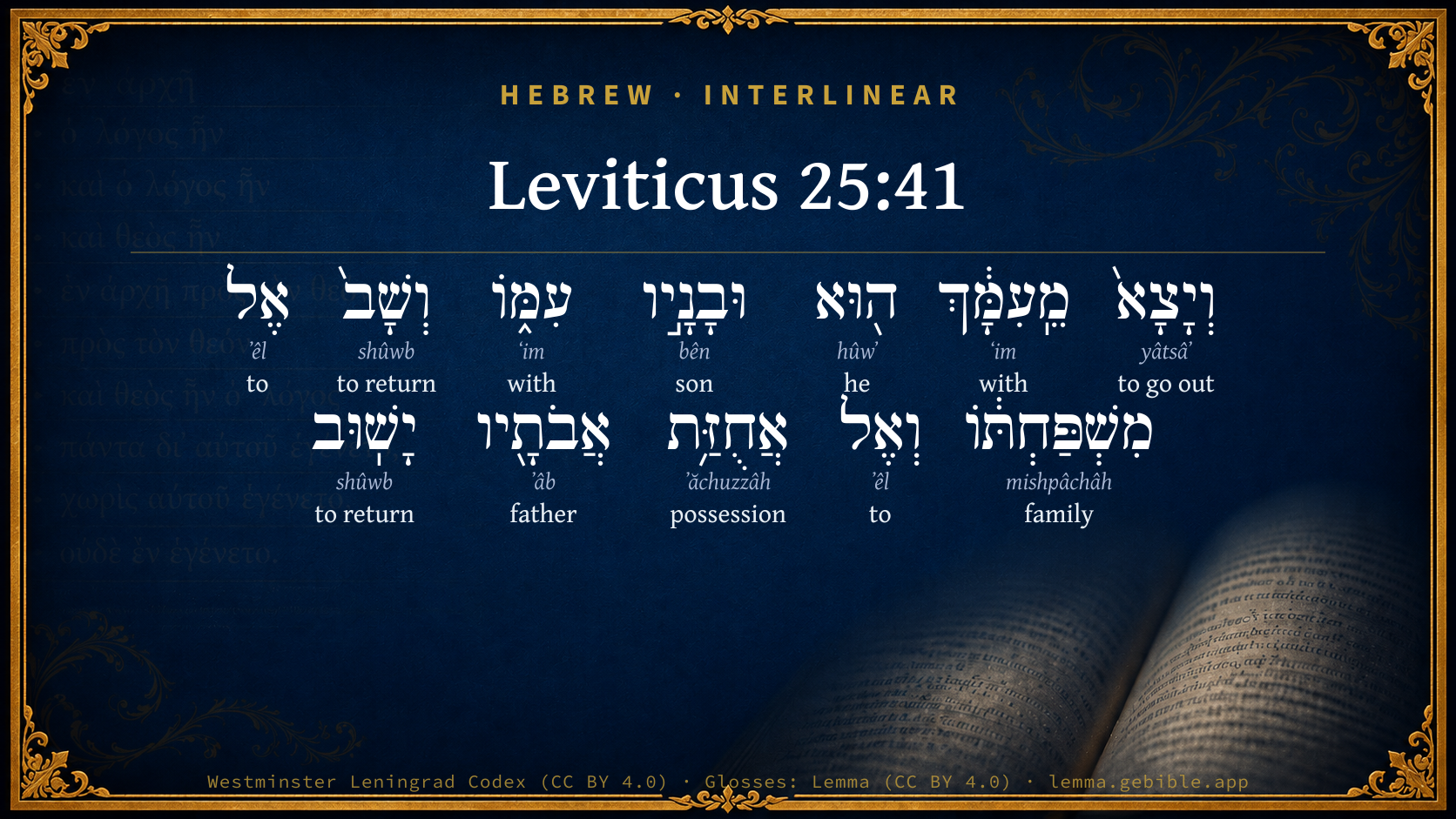
Hebrew (Westminster Leningrad Codex) Leviticus 25:41 appears in the Hebrew Old Testament. The text above is from the Westminster Leningrad Codex. Each word links to its Strong’s number, a concise gloss, and parsing drawn from the Open Scriptures Hebrew Bible morphology. Click any word for its full Brown-Driver-Briggs (BDB) entry.
Download image
Cite this verse

Leviticus 25:41 (World English Bible). Public Domain. Lemma interlinear Bible study tool, https://lemma.gebible.app/v/leviticus/25/41.

Show BibTeX & RIS
BibTeX
RIS
English Translation
then he shall go out from you, he and his children with him, and shall return to his own family, and to the possession of his fathers.
World English Bible · Public Domain
Download a study sheet

One document with this verse’s original text, its word-by-word gloss line, the meaning frame, cross-references with their text, attributed commentary, and full source and license credits — printable, and it pastes into notes with its structure intact.

This verse Autodidact and up

Study sheet (.html) Plain text (.txt)

A passage Seminary Student

Up to 50 verses in one chapter. A passage sheet keeps up to 6 commentary sources and 12 cross-references per verse, in the order this page ranks them, and says so on the sheet whenever that leaves anything out. Ask for a single verse and you get the Autodidact verse sheet above.

Everything on this page stays free to read, with no account — the sheet is a download of what is already on screen, not access to it.

Want to remove ads? Support Godless Engineer
Compare translations 3

The same verse in 3 English versions, stacked beneath the original-language interlinear above. Click any original word for its lexicon entry.

Each is an independent rendering of the whole verse — the interlinear is not word-aligned to these translations.

Highlighted words mark where these versions differ — a whole-verse word diff, not a word-by-word alignment.

  • World English Bible Public Domain
    then he shall go out from you, he and his children with him, and shall return to his own family, and to the possession of his fathers.
  • King James Version Public Domain
    And then shall he depart from thee, both he and his children with him, and shall return unto his own family, and unto the possession of his fathers shall he return.
  • unfoldingWord Literal Text CC BY-SA 4.0
    Then he shall go out from with you, he and his children with him, and he shall return to his family, and to the possession of his fathers he shall return.

unfoldingWord Literal Text — © unfoldingWord, licensed CC BY-SA 4.0. Word-aligned USFM3 via Door43 (git.door43.org/unfoldingWord/en_ult).

Versions to compare (up to 4)

3 of 4 selected

Show all 18 translations

Every available English version of this verse, each an independent rendering of the whole verse.

  • World English Bible Public Domain
    then he shall go out from you, he and his children with him, and shall return to his own family, and to the possession of his fathers.
  • Berean Standard Bible Public Domain
    Then he and his children are to be released, and he may return to his clan and to the property of his fathers.
  • Majority Standard Bible Public Domain
    Then he and his children are to be released, and he may return to his clan and to the property of his fathers.
  • King James Version Public Domain
    And then shall he depart from thee, both he and his children with him, and shall return unto his own family, and unto the possession of his fathers shall he return.
  • American Standard Version (1901) Public Domain
    then shall he go out from thee, he and his children with him, and shall return unto his own family, and unto the possession of his fathers shall he return.
  • Revised Version (1885) Public Domain
    then shall he go out from thee, he and his children with him, and shall return unto his own family, and unto the possession of his fathers shall he return.
  • Geneva Bible (1599) Public Domain
    Then shall he depart from thee, both hee, and his children with him, and shall returne vnto his familie, and vnto the possession of his fathers shall he returne:
  • Douay-Rheims (1899) Public Domain
    And afterwards he shall go out with his children, and shall return to his kindred and to the possession of his fathers,
  • Young's Literal Translation Public Domain
    then he hath gone out from thee, he and his sons with him, and hath turned back unto his family; even unto the possession of his fathers he doth turn back.
  • Literal Standard Version CC BY-SA 4.0
    then he has gone out from you, he and his sons with him, and has turned back to his family; and he turns back to the possession of his fathers.
  • Unlocked Literal Bible CC BY-SA 4.0
    Then he will go away from you, he and his children with him, and he will return to his own family and to his fathers' property.
  • unfoldingWord Literal Text CC BY-SA 4.0
    Then he shall go out from with you, he and his children with him, and he shall return to his family, and to the possession of his fathers he shall return.
  • Darby Bible Public Domain
    Then shall he depart from thee, he and his children with him, and shall return unto his own family, and unto the possession of his fathers shall he return.
  • World Messianic Bible Public Domain
    Then he shall go out from you, he and his children with him, and shall return to his own family, and to the possession of his fathers.
  • Webster's Bible Public Domain
    And then shall he depart from thee, both he and his children with him, and shall return to his own family, and to the possession of his fathers shall he return.
  • Free Bible Version CC BY-SA 4.0
    Then they and their children must be freed, and they can go back to their family and to their family's property.
  • Bible in Basic English Public Domain
    Then he will go out from you, he and his children with him, and go back to his family and to the property of his fathers.
  • JPS Tanakh (1917) Public Domain
    Then shall he go out from thee, he and his children with him, and shall return unto his own family, and unto the possession of his fathers shall he return.

Literal Standard Version (2020), Covenant Press — licensed CC BY-SA 4.0. Text via the HelloAO Bible API (eBible.org). Unlocked Literal Bible (unfoldingWord) — licensed CC BY-SA 4.0. Text via the HelloAO Bible API (eBible.org). unfoldingWord Literal Text — © unfoldingWord, licensed CC BY-SA 4.0. Word-aligned USFM3 via Door43 (git.door43.org/unfoldingWord/en_ult). Free Bible Version, Dr. Jonathan Gallagher — licensed CC BY-SA 4.0. Text via the HelloAO Bible API (eBible.org).

Word by word

More ways to search: Search by grammar → Find every occurrence → Compare this word →

Practice this passage: Drill this verse → Learn its vocabulary →

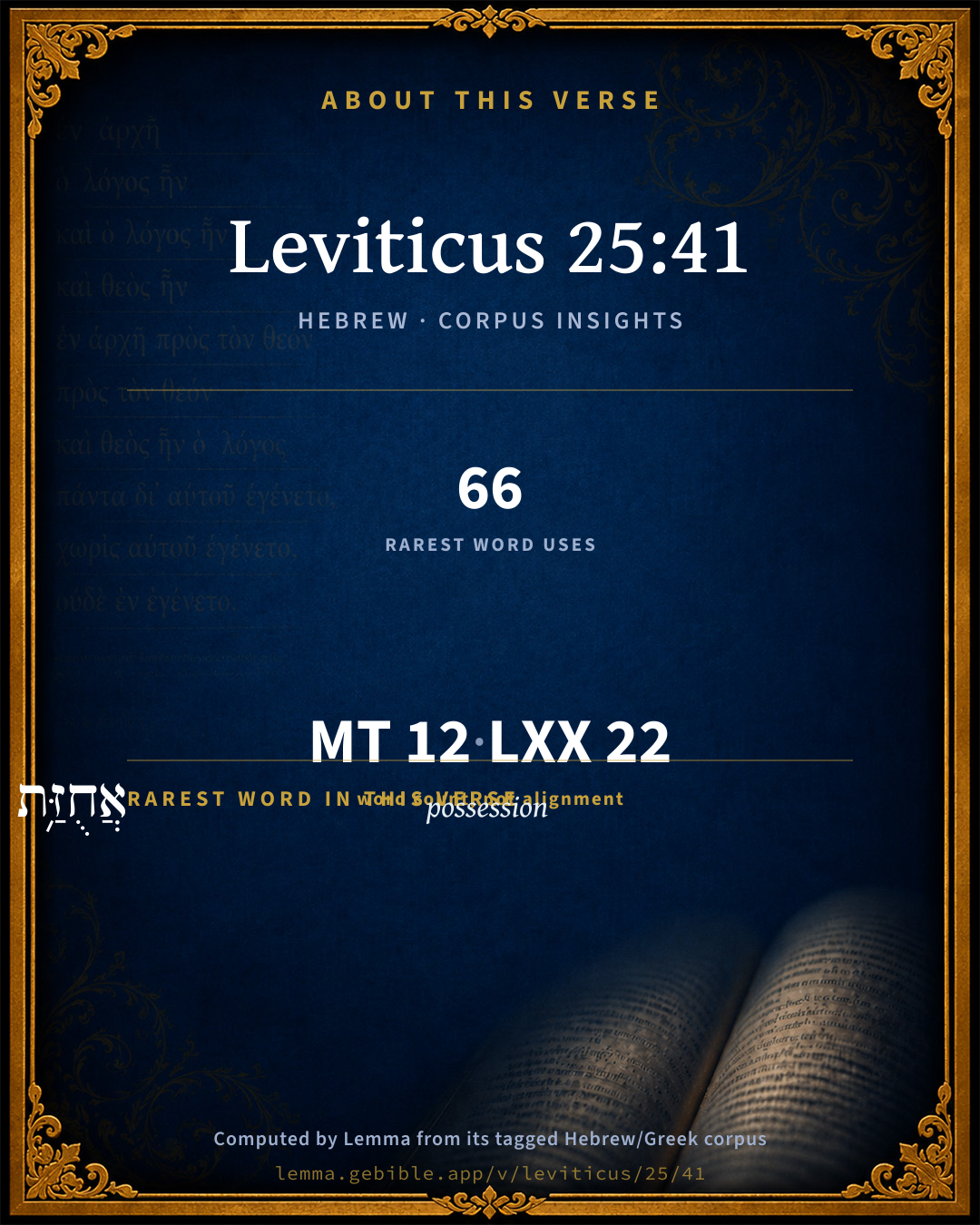
אֲחֻזַּ֥ת
ʼăchuzzâh
H272
“possession of”
Noun, Common, Feminine, Singular, Construct
Part of Speech
Noun
Type
Common
Gender
Feminine
Number
Singular
State
Construct
Full BDB Definition

Origin: from passive participle from H270

TWOT: 64a

possession, property - land - possession by inheritance
  1. וְיָצָא֙ yâtsâʼ H3318 “and · to go out” Conjunction + Verb, Qal, Sequential Perfect, 3rd Person, Masculine, Singular
  2. מֵֽעִמָּ֔ךְ ʻim H5973 “from · with · you” Preposition + Preposition + Suffix, Personal, 2nd Person, Feminine, Singular
  3. ה֖וּא hûwʼ H1931 “he” Pronoun, Personal, 3rd Person, Masculine, Singular
  4. וּבָנָ֣יו bên H1121 “and · sons · his” Conjunction + Noun, Common, Masculine, Plural, Construct + Suffix, Personal, 3rd Person, Masculine, Singular
  5. עִמּ֑וֹ ʻim H5973 “with · him” Preposition + Suffix, Personal, 3rd Person, Masculine, Singular
  6. וְשָׁב֙ shûwb H7725 “and · to return” Conjunction + Verb, Qal, Sequential Perfect, 3rd Person, Masculine, Singular
  7. אֶל ʼêl H413 “to” Preposition
  8. מִשְׁפַּחְתּ֔וֹ mishpâchâh H4940 “family · his” Noun, Common, Feminine, Singular, Construct + Suffix, Personal, 3rd Person, Masculine, Singular
  9. וְאֶל ʼêl H413 “and · to” Conjunction + Preposition
  10. אֲבֹתָ֖יו ʼâb H1 “fathers · his” Noun, Common, Masculine, Plural, Construct + Suffix, Personal, 3rd Person, Masculine, Singular
  11. יָשֽׁוּב shûwb H7725 “to return” Verb, Qal, Imperfect, 3rd Person, Masculine, Singular

About this verse

These counts appear in no published source. They are computed here, from the morphology-tagged text and Lemma’s own curated glosses. What Lemma adds →

12
words
9
distinct lemmas
Pentateuch
section

Grammatical profile

  • 3 verbs
  • 4 nouns
  • 1 pronoun
  • 4 prepositions

Verb forms

  • וְיָצָא֙ Qal · Sequential Perfect
  • וְשָׁב֙ Qal · Sequential Perfect
  • יָשֽׁוּב Qal · Imperfect

Repetition

Words recur within this verse — often emphatic in Hebrew:

  • וְשָׁב֙ to return H7725 ×2
  • מֵֽעִמָּ֔ךְ with H5973 ×2
  • אֶל to H413 ×2

Hebrew & Septuagint length

In English translation the verse runs 27 words from the Hebrew and 27 from the Septuagint (LXX English) — the same length.

A rough comparison of the two English renderings, which tokenize alike — not a word-level alignment.

Word counts can differ between the Hebrew and the Greek without any difference in meaning — e.g. the Hebrew direct-object marker אֵת has no separate Greek word, and Greek often adds the article ὁ.

In the original languages it is 12 Hebrew tokens and 22 Greek tokens — but the two are counted differently (Hebrew bundles its prefixes and suffixes into one token; the Greek is in lemma form), so that isn’t a like-for-like length.

Cross-references

6

Topical passages linked to Leviticus 25:41 in the Treasury of Scripture Knowledge — connected by theme and wording, ordered by reader-vote popularity; previews shown in the World English Bible.

  • Leviticus 25:28 But if he isn't able to get it back for himself, then what he has sold shall remain in the hand of him who has bought it until the Year of Jubilee: and in the Jubilee it shall be released, and he shall return to his propery.
  • Exodus 21:3 If he comes in by himself, he shall go out by himself. If he is married, then his wife shall go out with him.
  • Leviticus 25:10 You shall make the fiftieth year holy, and proclaim liberty throughout the land to all its inhabitants. It shall be a jubilee to you; and each of you shall return to his own property, and each of you shall return to his family.
  • John 8:32 You will know the truth, and the truth will make you free."
  • Romans 6:14 For sin will not have dominion over you. For you are not under law, but under grace.
  • Titus 2:14 who gave himself for us, that he might redeem us from all iniquity, and purify for himself a people for his own possession, zealous for good works.

Cross-references courtesy of OpenBible.info (CC BY 4.0).

Hebrew and Greek witnesses Masoretic Hebrew ↔ Greek Septuagint

The same verse in the two great witnesses to the Old Testament, shown verse-for-verse.

These are two independent witnesses, not word-aligned to each other, and the Septuagint is shown in lemma (dictionary) form.

Hebrew Leviticus 25:41 Masoretic · Westminster Leningrad Codex

וְיָצָא֙ מֵֽעִמָּ֔ךְ ה֖וּא וּבָנָ֣יו עִמּ֑וֹ וְשָׁב֙ אֶל מִשְׁפַּחְתּ֔וֹ וְאֶל אֲחֻזַּ֥ת אֲבֹתָ֖יו יָשֽׁוּב

then he shall go out from you, he and his children with him, and shall return to his own family, and to the possession of his fathers.

World English Bible · Public Domain

Greek LXX Leviticus 25:41 Septuagint · lemma form

καί ἐκἔρχομαι ὁ ἄφεσις καί ὁ τέκνον αὐτός μετά αὐτός καί ἀποἔρχομαι εἰς ὁ γενεά αὐτός εἰς ὁ κατάσχεσις ὁ πατρικός ἀποτρέχω

and he shall go out in the release, and his children with him; and he shall go to his family, he shall hasten back to his patrimony.

LXX2012 (modern English Septuagint) · Public Domain

Hebrew: Westminster Leningrad Codex (CC BY 4.0). Greek: Septuagint (public domain); English from LXX2012 (modern English Septuagint) (Public Domain). How the Septuagint differs from the Hebrew →

Targum (Aramaic paraphrase)

2

The Targum is the ancient Jewish Aramaic paraphrase of the Hebrew Scriptures — an interpretive translation, not the Hebrew text itself. Onkelos (literal) and Pseudo-Jonathan (expansive) render the Torah, and Jonathan the Prophets. Coverage is partial: where no permissively-licensed English translation exists for a verse, only the Aramaic is shown. This is verse-level text, not a word-by-word alignment to the Hebrew.

  1. Targum Onkelos Torah (Genesis–Deuteronomy)
    וְיִפּוֹק מֵעִמָךְ הוּא וּבְנוֹהִי עִמֵהּ וִיתוּב לְזַרְעִיתֵהּ וּלְאַחֲסָנַת אֲבָהָתוֹהִי יְתוּב

    (no public-domain English translation for this verse)

    Targum Onkelos — Aramaic: “Onkelos Genesis” (public domain); “Onkelos Exodus” (public domain); “Onkelos Leviticus” (public domain); “Onkelos Numbers” (public domain); “Onkelos Deuteronomy” (public domain). English: “Sefaria Community Translation” (CC0 1.0 (public-domain dedication)); “J.W. Etheridge. The Targums of Onkelos and Jonathan Ben Uzziel on the Pentateuch. London: Longmans, Green, 1862” (public domain). Text via Sefaria.

  2. Targum Pseudo-Jonathan Torah (Genesis–Deuteronomy)
    וְיִפּוֹק לְבַר חוֹרִין מֵעִמָךְ הוּא וּבְנוֹי עִמֵיהּ וִיתֵיב לִגְנִיסָתֵיהּ וּלְאַחֲסָנַת אַבְהָתוֹי יְתוּב

    Then shall he go out from thee at liberty, he and his children with him, and return to his family, and to the heritage of his fathers shall he return.

    Targum Pseudo-Jonathan — Aramaic: “Targum Jonathan on Genesis” (public domain); “Targum Jonathan on Exodus” (public domain); “Targum Jonathan on Leviticus” (public domain); “Targum Jonathan on Numbers” (public domain); “Targum Jonathan on Deuteronomy” (public domain). English: “The Targum of Jonathan ben Uzziel, trans. J. W. Etheridge, London, 1862” (public domain). Text via Sefaria.

Commentary

Notes on Leviticus 25:41 from classic Christian and Jewish commentators (each source and its license shown beneath its notes). The classic Christian expositions comment on the surrounding passage and are grouped to its opening verse, so a note may address several verses; the Jewish commentaries on the Tanakh (Rashi and others) are per-verse, so they appear only where the commentator wrote on this verse.

Lemma curates 59 commentaries, every one of them public domain or Creative Commons licensed, each selected and text-cleaned for this edition rather than reprinted as found. About our sources →

Trapp's Complete Commentary

John Trapp

Lev 25:41 And [then] shall he depart from thee, [both] he and his children with him, and shall return unto his own family, and unto the possession of his fathers shall he return.

Ver. 41. And then shall he depart from thee.] Yea, and though he had been bored through the ear, in token of perpetual servitude. {Exo 21:2; Exo 21:6}

John Trapp, A Commentary or Exposition upon All the Books of the Old and New Testament (1647–1656) — public domain. Text from a community e-Sword module.

Joseph Benson's Commentary

Lev 25:41-43. Then shall he depart — Thou shalt not suffer him or his to abide longer in thy service, as thou mightest do in the year of release, Exo 21:2; Exo 21:6. They are my servants — They, no less than you, are members of my church and people; such as I have chosen out of all the world to serve me here, and to enjoy me hereafter, and therefore are not to be oppressed, neither are you absolute lords over them to deal with them as you please. Fear thy God — Though thou dost not fear them who are in thy power, and unable to right themselves, yet fear that God who hath commanded thee to use them kindly, and who can and will avenge their cause, if thou oppress them.

Joseph Benson's Commentary on the Old and New Testaments (1811–1818) — public domain. Text from a community e-Sword module.

Ellicott's Commentary for English Readers

(41) And then shall he depart from thee.—At the same time that he regains his liberty, and takes with him his family, the patrimony which he sold also reverts to him.

A Bible Commentary for English Readers, edited by Charles John Ellicott (1878–1897) — public domain. Text from a community e-Sword module.

John Gill's Exposition

And then shall he depart from thee, both he and his children with him,.... His sons and daughters, and his wife also, who is included in himself: if a man had a wife and children when he sold himself, or married afterwards, with his master's consent, he was obliged to maintain them (t); though they were not sold to him, nor properly his servants, and so had a right to go out with him:

and shall return unto his own family; his father's family, and that of his near relations, having been out of it during his time of servitude, and which the year of jubilee restored him to, Lev 25:10,

and unto the possession of his fathers shall he return; the estate his father left him by inheritance, and which he was obliged to sell in the time of his poverty, or which fell to him since by the death of his father; to this also he was restored in the year of jubilee, as is expressed in the text referred to.

(t) Maimon. in Misn. Kiddushin, c. 3. sect. 1.

John Gill's Exposition of the Whole Bible (1746–1763) — public domain (CC PDM 1.0). Text via the HelloAO Bible API.

Matthew Poole's English Annotations

Then shall he depart from thee; thou shalt not suffer him or his to abide longer in thy service, as thou mightest do in the year of release, Exo 21:2,6.

Matthew Poole's English Annotations on the Holy Bible (1683–1685) — public domain. Text from a community e-Sword/MySword module.

Whedon's Commentary on the Bible

Daniel D. Whedon

41. Unto the possession of his fathers — These words afford a key to the difficulty which we have just discussed. The release here spoken of is that which restores the servant to his landed inheritance. This in no way is in conflict with the release of servants occurring every seventh year after their respective terms of six years, a release unattended by the restoration of their ancestral lands.

Daniel D. Whedon (gen. ed.), Commentary on the Old and New Testaments (1874–1909) — public domain. Text from a community e-Sword module.

John Wesley's Explanatory Notes

Then shall he depart - Thou shalt not suffer him or his to abide longer in thy service, as thou mightest do in the year of release, Exod. xxi, 2, 6.

John Wesley, Explanatory Notes Upon the Whole Bible (1754–1765) — public domain. Text via the GEBible commentary corpus.

Rashi

Rabbi Shlomo Yitzchaki (Rashi)

הוא ובניו עמו [AND HE SHALL GO AWAY FROM THEE] BOTH HE AND HIS CHILDREN WITH HIM — Rabbi Simeon asked: If he sold himself who sold his children that Scripture has to state they shall leave the master together with him? But we may learn from this that the master is bound to provide his (the servant’s) children with food (Kiddushin 22a; cf. Rashi on Exodus 21:3) although they are not his slaves.

ואל אחזת אבתיו AND UNTO THE POSSESSION OF HIS FATHERS [SHALL HE RETURN] — This means, he shall return to the dignity held by his ancestors and people shall not hold him in low esteem because of this (because he had previously been a slave);

אחזת thus means as much as חזקת “the status of” (Makkot 13a).

Rashi on the Tanakh — English translations: “The Judaica Press complete Tanach with Rashi, translated by A. J. Rosenberg” (CC BY 4.0); “Pentateuch with Rashi's commentary by M. Rosenbaum and A.M. Silbermann, 1929-1934” (public domain); “The Metsudah Tanach series, Lakewood, N.J” (CC BY 4.0); and “The Book of Joshua, Metsudah Publications, 1997” (CC BY 4.0). Text via Sefaria.

Lesson kit

Teaching starters — assembled from the data on this page, not authored interpretation. Every prompt links to the verse data it draws on. Edit before teaching.

Leviticus, in the Pentateuch, opens this verse with 12 words (9 distinct Hebrew lemmas). Its most distinctive word is ʼăchuzzâh (“possession”). A historical commentator’s framing appears above. Read the whole chapter for the surrounding context.

Discussion questions

  1. What does “possession” (ʼăchuzzâh) contribute to the verse as a whole?
  2. Leviticus 25:28 shares this passage’s theme. How do the two illuminate each other?
  3. “to return” occurs 2× in this one verse. What is the effect of the repetition?
  4. The translations on this page render this verse differently — a whole-verse word diff, not a word-by-word alignment. What might account for the different wordings?
  5. The verb «וְיָצָא֙» is Qal Sequential Perfect. How does its form color the action?
  6. Reading how Trapp's Complete Commentary and Joseph Benson's Commentary read this verse, where do the two commentators agree and where do they part?

Things to notice

Reading settings

Reading text

Shown beneath each verse's original-language words.

Old Testament
Old Testament edition

Read the OT as the Masoretic Hebrew (MT) or the Greek Septuagint (LXX).

English shown for the Greek Septuagint (in the Hebrew ↔ Greek comparison).

Comparing translations? Open the Compare panel on any verse page to stack up to four side by side.