
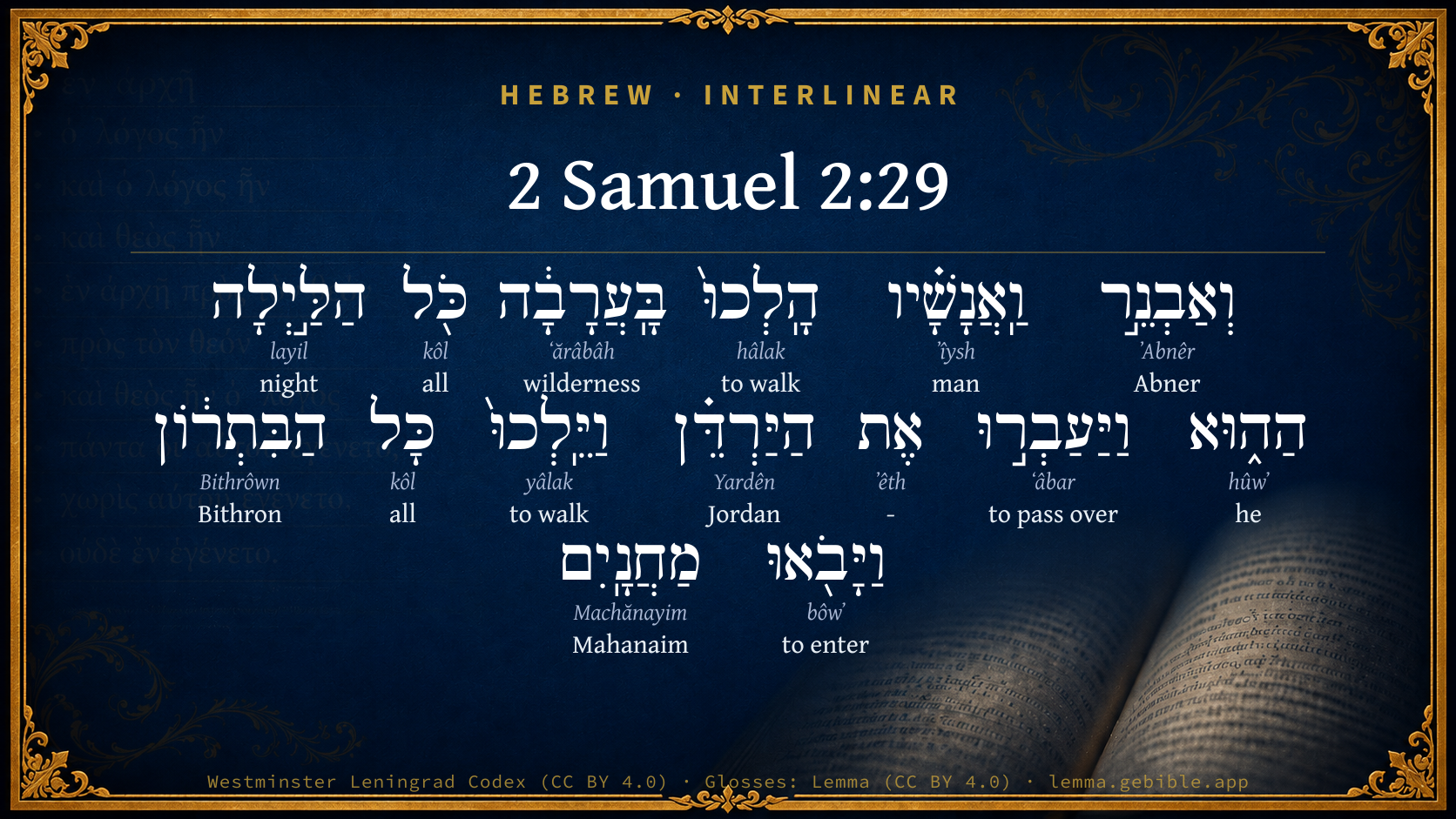
2 Samuel 2:29

Hebrew (Westminster Leningrad Codex) 2 Samuel 2:29 appears in the Hebrew Old Testament. The text above is from the Westminster Leningrad Codex. Each word links to its Strong’s number, a concise gloss, and parsing drawn from the Open Scriptures Hebrew Bible morphology. Click any word for its full Brown-Driver-Briggs (BDB) entry.
Download image
Cite this verse

2 Samuel 2:29 (World English Bible). Public Domain. Lemma interlinear Bible study tool, https://lemma.gebible.app/v/2-samuel/2/29.

Show BibTeX & RIS
BibTeX
RIS
English Translation
Abner and his men went all that night through the Arabah; and they passed over the Jordan, and went through all Bithron, and came to Mahanaim.
World English Bible · Public Domain
Highlights
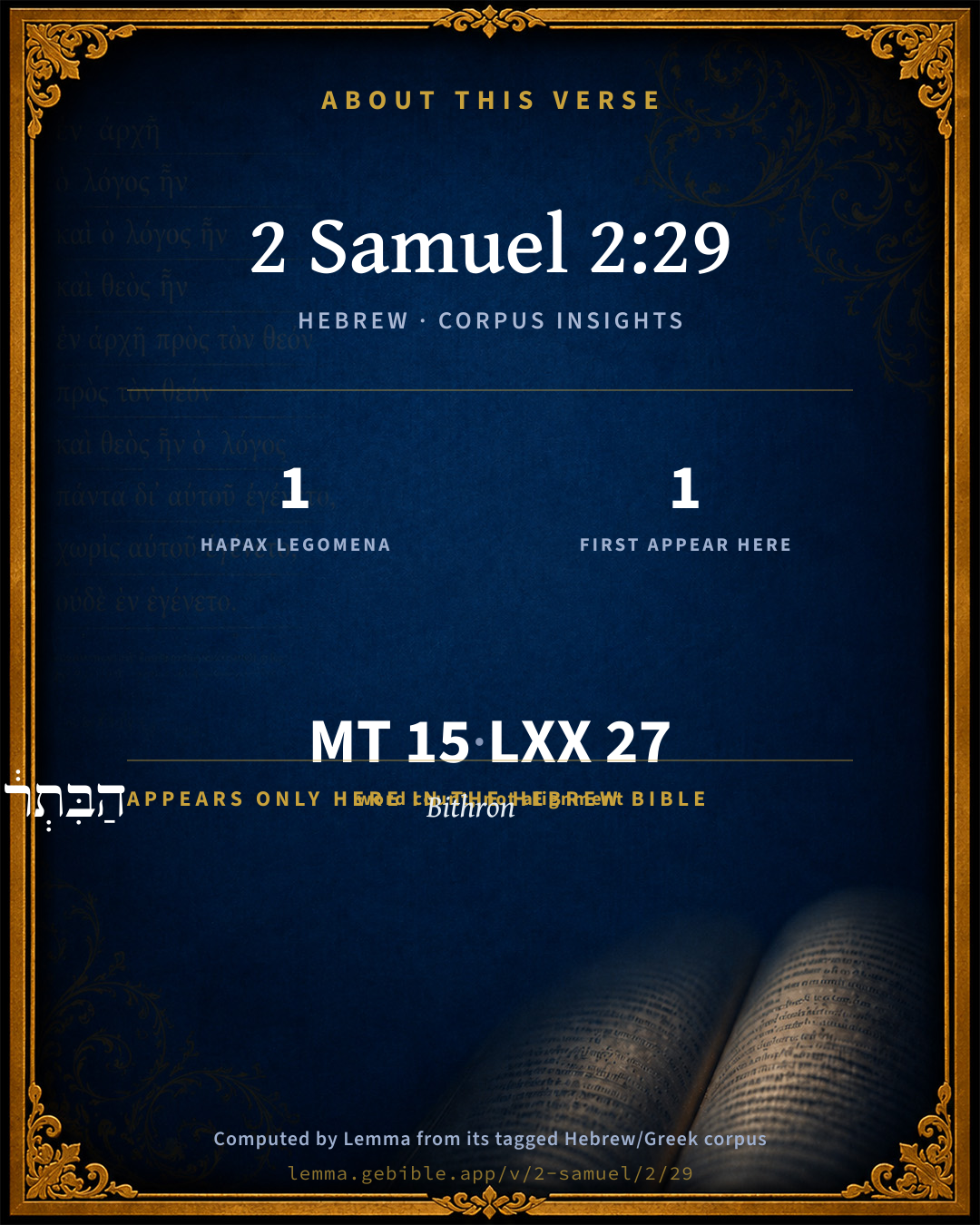
  • 1 hapax legomenon — only here in the Hebrew Bible
  • 1 first appearance in the Hebrew Bible
Full analysis ↓
Download a study sheet

One document with this verse’s original text, its word-by-word gloss line, the meaning frame, cross-references with their text, attributed commentary, and full source and license credits — printable, and it pastes into notes with its structure intact.

This verse Autodidact and up

Study sheet (.html) Plain text (.txt)

A passage Seminary Student

Up to 50 verses in one chapter. A passage sheet keeps up to 6 commentary sources and 12 cross-references per verse, in the order this page ranks them, and says so on the sheet whenever that leaves anything out. Ask for a single verse and you get the Autodidact verse sheet above.

Everything on this page stays free to read, with no account — the sheet is a download of what is already on screen, not access to it.

Want to remove ads? Support Godless Engineer
Compare translations 3

The same verse in 3 English versions, stacked beneath the original-language interlinear above. Click any original word for its lexicon entry.

Each is an independent rendering of the whole verse — the interlinear is not word-aligned to these translations.

Highlighted words mark where these versions differ — a whole-verse word diff, not a word-by-word alignment.

  • World English Bible Public Domain
    Abner and his men went all that night through the Arabah; and they passed over the Jordan, and went through all Bithron, and came to Mahanaim.
  • King James Version Public Domain
    And Abner and his men walked all that night through the plain, and passed over Jordan, and went through all Bithron, and they came to Mahanaim.
  • unfoldingWord Literal Text CC BY-SA 4.0
    And Abner and his men walked through the Arabah all of that night, and they crossed the Jordan, and they walked all of the morning, and they came Mahanaim.

unfoldingWord Literal Text — © unfoldingWord, licensed CC BY-SA 4.0. Word-aligned USFM3 via Door43 (git.door43.org/unfoldingWord/en_ult).

Versions to compare (up to 4)

3 of 4 selected

Show all 18 translations

Every available English version of this verse, each an independent rendering of the whole verse.

  • World English Bible Public Domain
    Abner and his men went all that night through the Arabah; and they passed over the Jordan, and went through all Bithron, and came to Mahanaim.
  • Berean Standard Bible Public Domain
    And all that night Abner and his men marched through the Arabah. They crossed the Jordan, marched all morning, and arrived at Mahanaim.
  • Majority Standard Bible Public Domain
    And all that night Abner and his men marched through the Arabah. They crossed the Jordan, marched all morning, and arrived at Mahanaim.
  • King James Version Public Domain
    And Abner and his men walked all that night through the plain, and passed over Jordan, and went through all Bithron, and they came to Mahanaim.
  • American Standard Version (1901) Public Domain
    And Abner and his men went all that night through the Arabah; and they passed over the Jordan, and went through all Bithron, and came to Mahanaim.
  • Revised Version (1885) Public Domain
    And Abner and his men went all that night through the Arabah; and they passed over Jordan, and went through all Bithron, and came to Mahanaim.
  • Geneva Bible (1599) Public Domain
    And Abner and his men walked all that night through the plaine, and went ouer Iorden, and past through all Bithron till they came to Mahanaim.
  • Douay-Rheims (1899) Public Domain
    And Abner and his men walked all that night through the plains: and they passed the Jordan, and having gone through all Beth-horon, came to the camp.
  • Young's Literal Translation Public Domain
    And Abner and his men have gone through the plain all that night, and pass over the Jordan, and go on `through' all Bithron, and come in to Mahanaim.
  • Literal Standard Version CC BY-SA 4.0
    And Abner and his men have gone through the plain all that night, and pass over the Jordan, and go on [through] all Bithron, and come to Mahanaim.
  • Unlocked Literal Bible CC BY-SA 4.0
    Abner and his men traveled all that night through the Arabah. They crossed the Jordan, marched all the next morning, and then reached Mahanaim.
  • unfoldingWord Literal Text CC BY-SA 4.0
    And Abner and his men walked through the Arabah all of that night, and they crossed the Jordan, and they walked all of the morning, and they came Mahanaim.
  • Darby Bible Public Domain
    And Abner and his men walked all that night through the plain, and passed over the Jordan, and went through all Bithron, and they came to Mahanaim.
  • World Messianic Bible Public Domain
    Abner and his men went all that night through the Arabah; and they passed over the Jordan, and went through all Bithron, and came to Mahanaim.
  • Webster's Bible Public Domain
    And Abner and his men walked all that night through the plain, and passed over Jordan, and went through all Bithron, and they came to Mahanaim.
  • Free Bible Version CC BY-SA 4.0
    All through the night Abner and his men marched through the Jordan Valley. They crossed the Jordan River, and continued all morning until they arrived back at Mahanaim.
  • Bible in Basic English Public Domain
    And all that night Abner and his men went through the Arabah; they went over Jordan and through all Bithron and came to Mahanaim.
  • JPS Tanakh (1917) Public Domain
    And Abner and his men went all that night through the Arabah; and they passed over the Jordan, and went through all Bithron, and came to Mahanaim.

Literal Standard Version (2020), Covenant Press — licensed CC BY-SA 4.0. Text via the HelloAO Bible API (eBible.org). Unlocked Literal Bible (unfoldingWord) — licensed CC BY-SA 4.0. Text via the HelloAO Bible API (eBible.org). unfoldingWord Literal Text — © unfoldingWord, licensed CC BY-SA 4.0. Word-aligned USFM3 via Door43 (git.door43.org/unfoldingWord/en_ult). Free Bible Version, Dr. Jonathan Gallagher — licensed CC BY-SA 4.0. Text via the HelloAO Bible API (eBible.org).

Word by word

More ways to search: Search by grammar → Find every occurrence → Compare this word →

Practice this passage: Drill this verse → Learn its vocabulary →

הַבִּתְר֔וֹן
Bithrôwn
H1338
“the · Bithron”
Particle, Definite Article + Noun, Proper
Part of Speech
Particle + Noun
Type
Proper
Full BDB Definition

Origin: from H1334

TWOT: None

Bithron = "division" or " cleft" or " ravine" - a territory or district in the Jordan valley east of the Jordan
  1. וְאַבְנֵ֣ר ʼAbnêr H74 “and · Abner” Conjunction + Noun, Proper
  2. וַֽאֲנָשָׁ֗יו ʼîysh H376 “and · men · his” Conjunction + Noun, Common, Masculine, Plural, Construct + Suffix, Personal, 3rd Person, Masculine, Singular
  3. הָֽלְכוּ֙ hâlak H1980 “to walk” Verb, Qal, Perfect, 3rd Person, Common, Plural
  4. בָּֽעֲרָבָ֔ה ʻărâbâh H6160 “in/at the · wilderness” Preposition, Determined + Noun, Common, Feminine, Singular, Absolute
  5. כֹּ֖ל kôl H3605 “all of” Noun, Common, Masculine, Singular, Construct
  6. הַלַּ֣יְלָה layil H3915 “the · night” Particle, Definite Article + Noun, Common, Masculine, Singular, Absolute
  7. הַה֑וּא hûwʼ H1931 “the · he” Particle, Definite Article + Pronoun, Personal, 3rd Person, Masculine, Singular
  8. וַיַּעַבְר֣וּ ʻâbar H5674 “and · to pass over” Conjunction + Verb, Qal, Sequential Imperfect, 3rd Person, Masculine, Plural
  9. אֶת ʼêth H853 “-” Particle, Direct Object
  10. הַיַּרְדֵּ֗ן Yardên H3383 “the · Jordan” Particle, Definite Article + Noun, Proper
  11. וַיֵּֽלְכוּ֙ yâlak H3212 “and · to walk” Conjunction + Verb, Qal, Sequential Imperfect, 3rd Person, Masculine, Plural
  12. כָּל kôl H3605 “all of” Noun, Common, Masculine, Singular, Construct
  13. וַיָּבֹ֖אוּ bôwʼ H935 “and · to enter” Conjunction + Verb, Qal, Sequential Imperfect, 3rd Person, Masculine, Plural
  14. מַחֲנָֽיִם Machănayim H4266 “Mahanaim” Noun, Proper

About this verse

These counts appear in no published source. They are computed here, from the morphology-tagged text and Lemma’s own curated glosses. What Lemma adds →

15
words
14
distinct lemmas
Historical
section

Notable vocabulary

1 hapax legomenon — a word that appears only here in the entire Hebrew Bible:

  • הַבִּתְר֔וֹן Bithron H1338

First appearance in Scripture

This word makes its first canonical appearance in the Hebrew Bible here:

  • הַבִּתְר֔וֹן Bithron H1338

Shared distinctive vocabulary

מַחֲנָֽיִם Mahanaim H4266 occurs in 13 verses of the Hebrew Bible. Also found in:

Grammatical profile

  • 4 verbs
  • 9 nouns
  • 1 pronoun
  • 1 particle

Verb forms

  • הָֽלְכוּ֙ Qal · Perfect
  • וַיַּעַבְר֣וּ Qal · Sequential Imperfect
  • וַיֵּֽלְכוּ֙ Qal · Sequential Imperfect
  • וַיָּבֹ֖אוּ Qal · Sequential Imperfect

Repetition

A word recurs within this verse — often emphatic in Hebrew:

  • כֹּ֖ל all H3605 ×2

Hebrew & Septuagint length

In English translation the verse runs 26 words from the Hebrew and 30 from the Septuagint (LXX English) — closely comparable.

A rough comparison of the two English renderings, which tokenize alike — not a word-level alignment.

Word counts can differ between the Hebrew and the Greek without any difference in meaning — e.g. the Hebrew direct-object marker אֵת has no separate Greek word, and Greek often adds the article ὁ.

In the original languages it is 15 Hebrew tokens and 27 Greek tokens — but the two are counted differently (Hebrew bundles its prefixes and suffixes into one token; the Greek is in lemma form), so that isn’t a like-for-like length.

Cross-references

2

Topical passages linked to 2 Samuel 2:29 in the Treasury of Scripture Knowledge — connected by theme and wording, ordered by reader-vote popularity; previews shown in the World English Bible.

  • 2 Samuel 2:8 Now Abner the son of Ner, captain of Saul's host, had taken Ish-bosheth the son of Saul, and brought him over to Mahanaim;
  • Song of Solomon 2:17 Until the day is cool, and the shadows flee away, Turn, my beloved, And be like a roe or a young hart on the mountains of Bether.

Cross-references courtesy of OpenBible.info (CC BY 4.0).

Hebrew and Greek witnesses Masoretic Hebrew ↔ Greek Septuagint

The same verse in the two great witnesses to the Old Testament, shown verse-for-verse.

These are two independent witnesses, not word-aligned to each other, and the Septuagint is shown in lemma (dictionary) form.

Hebrew 2 Samuel 2:29 Masoretic · Westminster Leningrad Codex

וְאַבְנֵ֣ר וַֽאֲנָשָׁ֗יו הָֽלְכוּ֙ בָּֽעֲרָבָ֔ה כֹּ֖ל הַלַּ֣יְלָה הַה֑וּא וַיַּעַבְר֣וּ אֶת הַיַּרְדֵּ֗ן וַיֵּֽלְכוּ֙ כָּל הַבִּתְר֔וֹן וַיָּבֹ֖אוּ מַחֲנָֽיִם

Abner and his men went all that night through the Arabah; and they passed over the Jordan, and went through all Bithron, and came to Mahanaim.

World English Bible · Public Domain

Greek LXX 2 Samuel 2:29 Septuagint · lemma form

καί αβεννηρ καί ὁ ἀνήρ αὐτός ἀποἔρχομαι εἰς δυσμή ὅλος ὁ νύξ ἐκεῖνος καί διαβαίνω ὁ ἰορδάνης καί πορεύομαι ὅλος ὁ παρατείνω καί ἔρχομαι εἰς ὁ παρεμβολή

And Abenner and his men departed at evening, and went all that night, and crossed over Jordan, and went along the whole adjacent country, and they come to the camp.

LXX2012 (modern English Septuagint) · Public Domain

On this verse, Haydock's Catholic Bible Commentary discusses the Septuagint’s reading. Read the note in Commentary ↓

Hebrew: Westminster Leningrad Codex (CC BY 4.0). Greek: Septuagint (public domain); English from LXX2012 (modern English Septuagint) (Public Domain). How the Septuagint differs from the Hebrew →

Targum (Aramaic paraphrase)

1

The Targum is the ancient Jewish Aramaic paraphrase of the Hebrew Scriptures — an interpretive translation, not the Hebrew text itself. Onkelos (literal) and Pseudo-Jonathan (expansive) render the Torah, and Jonathan the Prophets. Coverage is partial: where no permissively-licensed English translation exists for a verse, only the Aramaic is shown. This is verse-level text, not a word-by-word alignment to the Hebrew.

  1. Targum Jonathan Prophets (Joshua–Malachi)
    וְאַבְנֵר וְגַבְרוֹהִי הֲלִיכוּ בְּמֵישְׁרָא כָּל לֵילְיָא הַהוּא וַעֲבָרוּ יַת יַרְדְנָא וַאֲזַלוּ כָּל בִּתְרוֹן וַאֲתוֹ לְמַחֲנָיִם:

    (no public-domain English translation for this verse)

    Targum Jonathan — Aramaic: “Mikraot Gedolot” (public domain). English: “Sefaria Community Translation” (CC0 1.0 (public-domain dedication)); “London "Chaldee Paraphrase," 1871” (public domain). Text via Sefaria.

Commentary

Notes on 2 Samuel 2:29 from classic Christian and Jewish commentators (each source and its license shown beneath its notes). The classic Christian expositions comment on the surrounding passage and are grouped to its opening verse, so a note may address several verses; the Jewish commentaries on the Tanakh (Rashi and others) are per-verse, so they appear only where the commentator wrote on this verse.

Lemma curates 59 commentaries, every one of them public domain or Creative Commons licensed, each selected and text-cleaned for this edition rather than reprinted as found. About our sources →

Trapp's Complete Commentary

John Trapp

2Sa 2:29 And Abner and his men walked all that night through the plain, and passed over Jordan, and went through all Bithron, and they came to Mahanaim.

Ver. 29. And went through all Bithron,] i.e., Through the separate or divided country: sundered from Canaan by the river Jordan, as Junius rendereth it. They went back to Mahanaim, by weeping cross. Dubia est Martis alea, nec raro utrique parti noxia.

John Trapp, A Commentary or Exposition upon All the Books of the Old and New Testament (1647–1656) — public domain. Text from a community e-Sword module.

The Biblical Illustrator

Joseph S. Exell

2Sa_2:29

And Abner and his men walked all that night through the plain.

The cost of success

We would remind ourselves of such events in order that we may see what has been accomplished by military discipline, by the subordination of merely personal whims and desires. Even conquerors have no easy time in life. We think of success, of triumph, of coronation, but we forget that before these things, and as necessary to them, there must be discipline, suffering, loss, trial of every kind. We read with glowing hearts the accounts of explorers, discoverers, adventurers, who have gone into regions unknown and undreamed of; and here, again, we forget the night watchings, the night marchings, the continual perils and difficulties of the road. Self-denial is not confined to Christian experience. Whoever would be great in any department or relation of life must over know the pain of self-mortification--must, in other words, achieve the mastery himself--must, so to say, stand upon himself in an attitude of triumph. (J. Parker, D. D.)

The Biblical Illustrator, edited by Joseph S. Exell (c. 1880s–1900s) — public domain. Text from a community e-Sword module.

Tyndale Open Study Notes

Tyndale Open Resources

2:29 Abner was wise to put as much distance as possible between his troops and Joab’s forces, recognizing that their desire for blood vengeance could overpower the truce.

Tyndale Open Study Notes — © Tyndale Open Resources, licensed CC BY-SA 4.0. Text via the HelloAO Bible API.

Geneva Bible (1599)

Geneva Bible translators

Or, wilderness.

Or, to the tents.

Geneva Bible (1599) marginal notes — public domain. Text via Bolls.life.

Adam Clarke's Commentary

Verse 29. They came to Mahanaim.] So they returned to the place whence they set out. See 2Sa 2:12. This was the commencement of the civil wars between Israel and Judah, and properly the commencement of the division of the two kingdoms, through which both nations were deluged with blood.

Adam Clarke's Commentary on the Bible (1810–1826) — public domain. Text from a community e-Sword/MySword module.

Ellicott's Commentary for English Readers

(29) Through the plain (or the Arabah).—The wilderness of Gibeon lay to the east of the town, and Abner’s flight had thus carried him towards the Jordan. He now passed up the valley of the Jordan (which the word here used generally designates), and, crossing at a ford, went “through all Bithron to Mahanaim.” Bithron is evidently the name of a district on the east of the Jordan, but is not further known.

A Bible Commentary for English Readers, edited by Charles John Ellicott (1878–1897) — public domain. Text from a community e-Sword module.

The Cambridge Bible for Schools and Colleges

gen. ed. J. J. S. Perowne

29. walked all that night] Fearing a renewal of hostilities they made good their retreat at once.

through the plain] The Arâbâh, or “desert tract which extends along the valley of the Jordan from the Dead Sea to the Lake of Gennesareth, now called by the Arabs El-Ghor.” Stanley, Sinai and Pal. p. 487.

through all Bithron] Probably, as the name (derived from a root meaning to cut) implies, some ravine, or district intersected by ravines, between the Jordan and Mahanaim.

The Cambridge Bible for Schools and Colleges (gen. ed. J. J. S. Perowne; Cambridge University Press, 1878–1918) — public domain. Text from a community e-Sword module.

John Gill's Exposition

And Abner and his men walked all that night through the plain,.... The plain of Jordan. He marched with his men all night, lest Joab should return, and pursue him, and take vengeance on him for the death of his brother:

and passed over Jordan; at one of the fords of it:

and went through all Bithron; the name of a province or country, as Jarchi, called so perhaps from its being separated from the rest of the tribes of Israel by the river Jordan; some think the mountains of Bether were in this country, Sol 2:17. From Gibeon, where the battle was fought, to Bithron, according to Bunting (o), was twenty eight miles, the which he says was in the tribe of Gad, twenty eight miles from Jerusalem northeastward, lying between Dibon and Jordan:

and they came to Mahanaim: from whence they came, and where they had left Ishbosheth, Sa2 2:8. From Bithron to this place, according to the same writer (p), was sixteen miles.

(o) Travels, &c. p. 145, 146. (p) Ibid.

John Gill's Exposition of the Whole Bible (1746–1763) — public domain (CC PDM 1.0). Text via the HelloAO Bible API.

Albert Barnes' Notes on the Bible

Through the plain - See 1Sa 23:24. Bithron is unknown. From the expression all (the) Bithron, it seems likely that it is a tract of country, intersected by ravines lying on the east side of Jordan.

Albert Barnes' Notes on the Bible (1834–1885) — public domain. Text from a community e-Sword/MySword module.

Haydock's Catholic Bible Commentary

Beth-horon. Septuagint, "the extended plain." Hebrew Bithrun, (Haydock) or the country towards the Jordan. (Calmet) --- Thus the battle ended in his disgrace; (Haydock) and many from all Israel began to flock to the standard of David, 1 Paralipomenon xii. 22. (Tirinus)

George Leo Haydock (1774–1849), Haydock's Catholic Family Bible and Commentary, 1859 edition — public domain. Excludes Psalms (Douay-Rheims chapter numbering differs from Protestant) and Deuterocanonical books (Catholic canon only).

Matthew Poole's English Annotations

Bithron; otherwise called the mountains of Bether, Son 2:17, which were beyond Jordan; or some other country now not known by that name, which is the case of hundreds of places.

Matthew Poole's English Annotations on the Holy Bible (1683–1685) — public domain. Text from a community e-Sword/MySword module.

Whedon's Commentary on the Bible

Daniel D. Whedon

29. Through the plain — The valley of the Jordan.

Bithron — Literally, the broken or divided place. As no locality bearing this name is ever afterwards mentioned, and the Hebrew word has the article — all the Bithron — it probably designates not a single place, but the broken and intersected region beyond the Jordan through which one must pass in order to go from the river to Mahanaim.

Daniel D. Whedon (gen. ed.), Commentary on the Old and New Testaments (1874–1909) — public domain. Text from a community e-Sword module.

The Pulpit Commentary

And Abner and his men walked all that night. At the end of the chapter we learn that Joab did the same. Each army had about twenty-six miles to march, and the night was less exhausting for a long walk than the day. As soon, then, as Abner saw Joab and his men occupied with the removal of Asahel"s body, he withdrew from the hill of Ammah, and, passing through the Arabah, or plain of Jordan, crossed the river by the same ford which he had used when starting on his unfortunate errand, and so returned home. The phrase, all Bithron, shows that this was a district, but nothing more of it is known.

The Pulpit Commentary (1880–1919), ed. H.D.M. Spence-Jones & Joseph S. Exell — public domain. Text from a community e-Sword module.

Keil & Delitzsch

C. F. Keil & F. Delitzsch

Abner proceeded with his troops through the Arabah, i.e., the valley of the Jordan, marching the whole night; and then crossing the river, went through the whole of Bithron back to Mahanaim. Bithron is a district upon the eastern side of the Jordan, which is only mentioned here. Aquila and the Vulgate identify it with Bethhoron; but there is no more foundation for this than for the suggestion of Thenius, that it is the same place as Bethharam, the later Libias, at the mouth of the Nahr Hesbn (see at Num 32:36). It is very evident that Bithron is not the name of a city, but of a district, from the fact that it is preceded by the word all, which would be perfectly unmeaning in the case of a city. The meaning of the word is a cutting; and it was no doubt the name given to some ravine in the neighbourhood of the Jabbok, between the Jordan and Mahanaim, which was on the north side of the Jabbok.

Keil & Delitzsch — Biblical Commentary on the Old Testament (1861–1891) — public domain (CC PDM 1.0). Text via the HelloAO Bible API. (Old Testament only.)

Rashi

Rabbi Shlomo Yitzchaki (Rashi)

The Bisron. The name of a region.

Rashi on the Tanakh — English translations: “The Judaica Press complete Tanach with Rashi, translated by A. J. Rosenberg” (CC BY 4.0); “Pentateuch with Rashi's commentary by M. Rosenbaum and A.M. Silbermann, 1929-1934” (public domain); “The Metsudah Tanach series, Lakewood, N.J” (CC BY 4.0); and “The Book of Joshua, Metsudah Publications, 1997” (CC BY 4.0). Text via Sefaria.

Lesson kit

Teaching starters — assembled from the data on this page, not authored interpretation. Every prompt links to the verse data it draws on. Edit before teaching.

2 Samuel, in the Historical, opens this verse with 15 words (14 distinct Hebrew lemmas). Its most distinctive word is Bithrôwn (“Bithron”). A historical commentator’s framing appears above. Read the whole chapter for the surrounding context.

Discussion questions

  1. How does “Bithron” (Bithrôwn) shape what this verse is saying?
  2. This verse holds 1 word here found nowhere else in the Hebrew Bible. What might the rare word draw attention to?
  3. The word “Bithron” first appears here in Scripture. What is being introduced at this debut?
  4. Genesis 32:2 shares the word «Mahanaim» with this verse. How do the two illuminate each other?
  5. “all” occurs 2× in this one verse. What is the effect of the repetition?
  6. These translations render this verse differently; the difference is in the English rendering, not the original. What questions does that raise?
  7. The verb «הָֽלְכוּ֙» is Qal Perfect. How does its form color the action?
  8. Reading how Trapp's Complete Commentary and The Biblical Illustrator read this verse, where do the two commentators agree and where do they part?

Things to notice

  • 1 word in this verse appears nowhere else in the Hebrew Bible.
  • 1 word makes its first canonical appearance in Scripture here.
  • This verse counts 15 Hebrew ↔ 27 Greek words.
  • These translations choose different wording for 9 words in this verse.
  • “all” occurs 2× in this single verse.

Reading settings

Reading text

Shown beneath each verse's original-language words.

Old Testament
Old Testament edition

Read the OT as the Masoretic Hebrew (MT) or the Greek Septuagint (LXX).

English shown for the Greek Septuagint (in the Hebrew ↔ Greek comparison).

Comparing translations? Open the Compare panel on any verse page to stack up to four side by side.