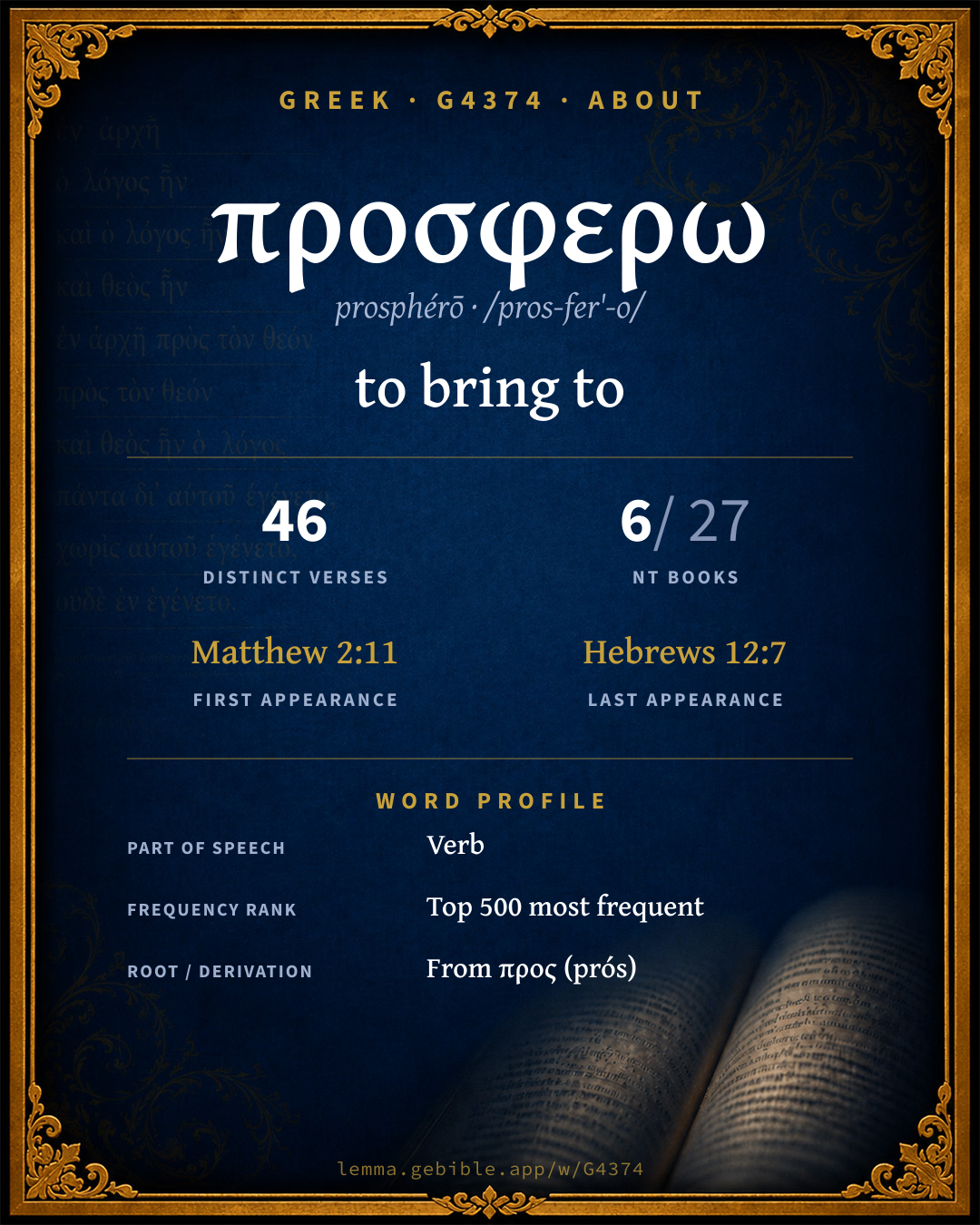
προσφέρω
to bring to
‘to bring to’ is one of 4 main senses fuller range ↓
Full lexicon entry — Thayer's Greek Lexicon
From Thayer's Greek Lexicon
Where this word appears
See every Aorist-tense verb in the Greek New Testament →
Grammar key — what these labels mean
Part of speech
- Verb
- An action or state-of-being word.
Tense
- Aorist
- Action viewed as a simple whole, without regard to duration — often past (perfective aspect).
- Imperfect
- Continuous or repeated action in past time (“was writing”).
- Present
- Ongoing or general action in present time (imperfective aspect).
- Perfect
- A completed past action with continuing present results.
Voice
- Active
- The subject performs the action.
- Passive
- The subject receives the action.
Mood
- Indicative
- States a fact or asks a factual question (the mood of reality).
- Imperative
- Expresses a command or request.
- Participle
- A verbal adjective (“writing,” “having written”).
- Infinitive
- A verbal noun (“to write”), unmarked for person or number.
- Subjunctive
- Expresses probability, purpose, or possibility (the mood of contingency).
Case
- Nominative
- The case of the subject (and the predicate nominative).
- Genitive
- The case of source, possession, or “of” — answers “whose / from what.”
Person
- 3rd person
- The one spoken about (“he / she / it / they”).
- 2nd person
- The one addressed (“you”).
- 1st person
- The speaker (“I / we”).
Gender
- Masculine
- Grammatically masculine.
- Feminine
- Grammatically feminine.
Number
- Plural
- More than one.
- Singular
- One.
Grammatical forms 26 distinct
- Verb, Aorist, Active, Indicative, 3rd person, Plural 7 times (14%)
- Verb, Aorist, Active, Indicative, 3rd person, Singular 4 times (8%)
- Verb, Aorist, Active, Imperative, 2nd person, Singular 3 times (6%)
- Verb, Aorist, Active, Participle, Nominative, Singular, Masculine 3 times (6%)
- Verb, Aorist, Passive, Indicative, 3rd person, Singular 3 times (6%)
- Verb, Imperfect, Active, Indicative, 3rd person, Plural 3 times (6%)
- Verb, Present, Active, Infinitive 3 times (6%)
- Verb, Aorist, Active, Indicative, 2nd person, Plural 2 times (4%)
+18 more forms (21 occurrences)
Parsed forms decoded from the imported morphology (Robinson–Tischendorf, public domain), counted across 49 parsed occurrences — not distinct verses.
Every verse where G4374 appears — 46 distinct verses across 6 books. Click any verse to open its interlinear word-by-word view. Verse text shown in the World English Bible for context — . Each verse’s Greek form is shown with its reference; the English is not keyword-highlighted, since the data carries no word-level English alignment. Use “Compare translations” on any verse to read it across multiple English versions. This concordance covers the Greek New Testament; Septuagint (Greek Old Testament) occurrences of this word are not indexed here.
Matthew 15 verses
- Matthew 2:11 προσήνεγκαν aor act ind 3pl They came into the house and saw the young child with Mary, his mother, and they fell down and worshiped him. Opening their treasures, they offered to him gifts: gold, frankincense, and myrrh.
- Matthew 4:24 προσήνεγκαν aor act ind 3pl The report about him went out into all Syria. They brought to him all who were sick, afflicted with various diseases and torments, possessed with demons, epileptics, and paralytics; and he healed them.
- Matthew 5:23 προσφέρῃς pres act subj 2sg "If therefore you are offering your gift at the altar, and there remember that your brother has anything against you,
- Matthew 5:24 πρόσφερε pres act impv 2sg leave your gift there before the altar, and go your way. First be reconciled to your brother, and then come and offer your gift.
- Matthew 8:4 προσένεγκον aor act impv 2sg Jesus said to him, "See that you tell nobody, but go, show yourself to the priest, and offer the gift that Moses commanded, as a testimony to them."
- Matthew 8:16 προσήνεγκαν aor act ind 3pl When evening came, they brought to him many possessed with demons. He cast out the spirits with a word, and healed all who were sick;
- Matthew 9:2 προσέφερον impf act ind 3pl Behold, they brought to him a man who was paralyzed, lying on a bed. Jesus, seeing their faith, said to the paralytic, "Son, cheer up! Your sins are forgiven you."
- Matthew 9:32 προσήνεγκαν aor act ind 3pl As they went out, behold, a mute man who was demon possessed was brought to him.
- Matthew 12:22 προσηνέχθη aor pass ind 3sg Then one possessed by a demon, blind and mute, was brought to him and he healed him, so that the blind and mute man both spoke and saw.
- Matthew 14:35 προσήνεγκαν aor act ind 3pl When the men of that place recognized him, they sent into all that surrounding region, and brought to him all who were sick,
- Matthew 17:16 προσήνεγκα aor act ind 1sg So I brought him to your disciples, and they could not cure him."
- Matthew 18:24 προσηνέχθη aor pass ind 3sg When he had begun to reconcile, one was brought to him who owed him ten thousand talents.
- Matthew 19:13 προσηνέχθησαν aor pass ind 3pl Then little children were brought to him, that he should lay his hands on them and pray; and the disciples rebuked them.
- Matthew 22:19 προσήνεγκαν aor act ind 3pl Show me the tax money." They brought to him a denarius.
- Matthew 25:20 προσήνεγκεν aor act ind 3sg He who received the five talents came and brought another five talents, saying, 'Lord, you delivered to me five talents. Behold, I have gained another five talents besides them.'
Mark 3 verses
- Mark 1:44 προσένεγκε aor act impv 2sg and said to him, "See you say nothing to anybody, but go show yourself to the priest, and offer for your cleansing the things which Moses commanded, for a testimony to them."
- Mark 2:4 προσενέγκαι aor act inf When they could not come near to him for the crowd, they removed the roof where he was. When they had broken it up, they let down the mat that the paralytic was lying on.
- Mark 10:13 προσέφερον προσφέρουσιν impf act ind 3pl pres act ind 3pl They were bringing to him little children, that he should touch them, but the disciples rebuked those who were bringing them.
Luke 4 verses
- Luke 5:14 προσένεγκε aor act impv 2sg He charged him to tell no one, "But go your way, and show yourself to the priest, and offer for your cleansing according to what Moses commanded, for a testimony to them."
- Luke 18:15 Προσέφερον impf act ind 3pl They were also bringing their babies to him, that he might touch them. But when the disciples saw it, they rebuked them.
- Luke 23:14 προσηνέγκατέ aor act ind 2pl and said to them, "You brought this man to me as one that perverts the people, and see, I have examined him before you, and found no basis for a charge against this man concerning those things of which you accuse him.
- Luke 23:36 προσφέροντες pres act ptcp nom pl masc The soldiers also mocked him, coming to him and offering him vinegar,
John 2 verses
- John 16:2 προσφέρειν pres act inf They will put you out of the synagogues. Yes, the time comes that whoever kills you will think that he offers service to God.
- John 19:29 προσήνεγκαν aor act ind 3pl Now a vessel full of vinegar was set there; so they put a sponge full of the vinegar on hyssop, and held it at his mouth.
Acts 3 verses
- Acts 7:42 προσηνέγκατέ aor act ind 2pl But God turned, and gave them up to serve the host of the sky, as it is written in the book of the prophets, 'Did you offer to me slain animals and sacrifices Forty years in the wilderness, O house of Israel?
- Acts 8:18 προσήνεγκεν aor act ind 3sg Now when Simon saw that the Holy Spirit was given through the laying on of the apostles' hands, he offered them money,
- Acts 21:26 προσηνέχθη aor pass ind 3sg Then Paul took the men, and the next day, purified himself and went with them into the temple, declaring the fulfillment of the days of purification, until the offering was offered for every one of them.
Hebrews 19 verses
- Hebrews 5:1 προσφέρῃ pres act subj 3sg For every high priest, being taken from among men, is appointed for men in things pertaining to God, that he may offer both gifts and sacrifices for sins.
- Hebrews 5:3 προσφέρειν pres act inf Because of this, he must offer sacrifices for sins for the people, as well as for himself.
- Hebrews 5:7 προσενέγκας aor act ptcp nom sg masc He, in the days of his flesh, having offered up prayers and petitions with strong crying and tears to him who was able to save him from death, and having been heard for his godly fear,
- Hebrews 7:27 προσενέγκας aor act ptcp nom sg masc who doesn't need, like those high priests, to daily offer up sacrifices, first for his own sins, and then for the sins of the people. For this he did once for all, when he offered up himself.
- Hebrews 8:3 προσφέρειν προσενέγκῃ pres act inf aor act subj 3sg For every high priest is appointed to offer both gifts and sacrifices. Therefore it is necessary that this high priest also have something to offer.
- Hebrews 8:4 προσφερόντων pres act ptcp gen pl masc For if he were on earth, he would not be a priest at all, seeing there are priests who offer the gifts according to the law;
- Hebrews 9:7 προσφέρει pres act ind 3sg but into the second the high priest alone, once in the year, not without blood, which he offers for himself, and for the errors of the people.
- Hebrews 9:9 προσφέρονται pres pass ind 3pl which is a symbol of the present age, where gifts and sacrifices are offered that are incapable, concerning the conscience, of making the worshipper perfect;
- Hebrews 9:14 προσήνεγκεν aor act ind 3sg how much more will the blood of Christ, who through the eternal Spirit offered himself without blemish to God, cleanse your conscience from dead works to serve the living God?
- Hebrews 9:25 προσφέρῃ pres act subj 3sg nor yet that he should offer himself often, as the high priest enters into the holy place year by year with blood not his own,
- Hebrews 9:28 προσενεχθεὶς aor pass ptcp nom sg masc so Christ also, having been once offered to bear the sins of many, will appear a second time, without sin, to those who are eagerly waiting for him for salvation.
- Hebrews 10:1 προσφέρουσιν pres act ind 3pl For the law, having a shadow of the good to come, not the very image of the things, can never with the same sacrifices year by year, which they offer continually, make perfect those who draw near.
- Hebrews 10:2 προσφερόμεναι pres pass ptcp nom pl fem Or else wouldn't they have ceased to be offered, because the worshippers, having been once cleansed, would have had no more consciousness of sins?
- Hebrews 10:8 προσφέρονται pres pass ind 3pl Previously saying, "Sacrifices and offerings and whole burnt offerings and sacrifices for sin you didn't desire, neither had pleasure in them" (those which are offered according to the law),
- Hebrews 10:11 προσφέρων pres act ptcp nom sg masc Every priest indeed stands day by day ministering and often offering the same sacrifices, which can never take away sins,
- Hebrews 10:12 προσενέγκας aor act ptcp nom sg masc but he, when he had offered one sacrifice for sins for ever, sat down on the right hand of God;
- Hebrews 11:4 προσήνεγκεν aor act ind 3sg By faith, Abel offered to God a more excellent sacrifice than Cain, through which he had testimony given to him that he was righteous, God bearing witness with respect to his gifts; and through it he, being dead, still speaks.
- Hebrews 11:17 προσενήνοχεν προσέφερεν perf act ind 3sg attic impf act ind 3sg By faith, Abraham, being tested, offered up Isaac. Yes, he who had gladly received the promises was offering up his one and only son;
- Hebrews 12:7 προσφέρεται pres pass ind 3sg It is for discipline that you endure. God deals with you as with children, for what son is there whom his father doesn't discipline?
About this entry
At a glance — auto-summarized from this page’s data, not written by a person. Every figure links to its source below. This summary describes the numbers; it doesn’t interpret them.
“to bring to” is the headline sense of the Greek verb προσφερω (prosphérō). Lexicons map it across 4 senses. The Greek New Testament uses it across 46 verses — moderately common. More than a third of its appearances fall in Hebrews. Its earliest occurrence is Matthew 2:11. The sections below give every sense, occurrence, and version rendering.
Gloss history
Strong's 1890 vs modern scholarship
About this word
Strong's G4374 catalogs a Greek word from the Greek New Testament.
These counts are not copied from any lexicon or concordance. They are computed here, from the morphology-tagged Greek New Testament. What Lemma adds →
- 46
- distinct verses
- The word appears in 46 distinct verses.
- 6 / 27
- NT books
- The word appears in 6 of 27 New Testament books.
- #316
- by frequency
- Top 500 most frequent Greek words (rank 316 of 5,347 Greek words by occurrence).
View all 46 occurrences in the concordance →
By section of the New Testament
By traditional corpus
Conventional, traditional groupings — biblical authorship is debated, so this is a traditional corpus grouping, not an authorship claim. Some books belong to more than one corpus (Luke is in both the Gospels and the Lukan corpus, and so on), so these shares overlap and need not total 100%. Each figure is a share of the word’s 46 distinct verses.
- Gospels 24 verses · 52%
- Hebrews 19 verses · 41%
- Lukan (Luke–Acts) 7 verses · 15%
- Johannine 2 verses · 4%
How translations render this word
Counts come from each version’s own published word-to-Strong’s tagging or interlinear alignment — an approximate guide to how each version renders this word, not a word-level alignment the data otherwise carries. Because each total is that version’s own tagged count, the per-version totals vary from one another and need not match the appearance or distinct-verse counts above. These counts may also differ from a printed concordance because Lemma counts each distinctly tagged rendering and does not collapse phrase taggings into a single head-word total. This is a fixed set of word-tagged versions (KJV, ASV, BSB, ULT) and does not change with the reading translation you choose elsewhere. Each version’s license is shown beside its name below (and on Sources).
- King James Version: Offer 8×, They brought 7×, Brought 3×
- American Standard Version: Offer 8×, They brought 4×, Brought 3×
- Berean Standard Bible: Offer 9×, Brought 3×, Offered 3×
- unfoldingWord Literal Text: Offer 8×, They brought 4×, Offered 3×
King James Version Public Domain
Renders G4374 across 47 tagged occurrences — most commonly:
Plus 18 renderings that appear only once — usually multi-word phrases or single function words the recovered tagging swept in, not distinct renderings. Not rendered by a distinct English word in 1 further occurrence.
American Standard Version Public Domain
Renders G4374 across 47 tagged occurrences — most commonly:
Plus 20 renderings that appear only once — usually multi-word phrases or single function words the recovered tagging swept in, not distinct renderings.
Berean Standard Bible Public Domain
Renders G4374 across 46 tagged occurrences — most commonly:
Plus 20 renderings that appear only once — usually multi-word phrases or single function words the recovered tagging swept in, not distinct renderings. Not rendered by a distinct English word in 1 further occurrence.
unfoldingWord Literal Text CC BY-SA 4.0
Renders G4374 across 51 tagged occurrences — most commonly:
Plus 20 renderings that appear only once — usually multi-word phrases or single function words the recovered tagging swept in, not distinct renderings.
Senses in Thayer's
The 4 senses Thayer's distinguishes for this word, in lexicon order (not ranked by frequency or importance). The full entry — with sub-senses — is in the Lexicon Entry tab.
- one to a person who can heal him or is ready to show him some kindness, one to a person who is to judge him
- to bring a present or a thing, to reach or hand a thing to one
- to put to
- to be borne towards one, to attack, assail
Word origin
Derived from προς (prós) (G4314).
Forms in the corpus
The 28 distinct written forms G4374 takes in the Greek New Testament, most frequent first — each parse links to that tense’s occurrences in the concordance.
Same root — word family
Other Thayer's entries built from the same root as G4374, grouped by Strong’s listed origin. These share a root / origin per the lexicon — not necessarily a shared meaning. Each links to that word’s own entry.
Derives from
Shares the same root
- προσαγορευω prosagoreúō G4316 to address
- προσαγω proságō G4317 to bring
- προσαιτεω prosaitéō G4319 to ask alms
- προσαναβαινω prosanabaínō G4320 to go up higher
- προσαναλισκω prosanalískō G4321 to spend additionally
- προσαναπληροω prosanaplēróō G4322 to fill up
- προσανατιθημι prosanatíthēmi G4323 to lay upon
- προσαπειλεω prosapeiléō G4324 to threaten further
- προσδαπαναω prosdapanáō G4325 to spend besides
- προσδεομαι prosdéomai G4326 to need additionally
- προσδεχομαι prosdéchomai G4327 to receive to oneself
- προσδοκαω prosdokáō G4328 to expect
- προσεαω proseáō G4330 to permit approach
- προσεγγιζω prosengízō G4331 to approach
- προσεδρευω prosedreúō G4332 to sit near
- προσεργαζομαι prosergázomai G4333 to work besides
- προσερχομαι prosérchomai G4334 to draw near
- προσευχομαι proseúchomai G4336 to pray
- προσεχω proséchō G4337 to attend to
- προσηλοω prosēlóō G4338 to nail to
- προσκαιρος próskairos G4340 temporary
- προσκαλεομαι proskaléomai G4341 to call to
- προσκαρτερεω proskarteréō G4342 to adhere to
- προσκεφαλαιον proskephálaion G4344 pillow
+27 more words share this root (not shown).
Derived from this word
Compare all same-root words → Showing 4 of 54 — not the complete family. They share a root, not necessarily a meaning.
Septuagint usage
The same Greek word προσφερω appears 136 times in the Greek Old Testament (Septuagint), across 124 verses in 19 books.
- 136
- LXX occurrences
- Tagged occurrences of this Greek word in the Septuagint.
- 124
- verses
- Distinct Septuagint verses containing this word.
- 19 / 39
- OT books
- The word appears in 19 of the 39 Old Testament books.
Sample Septuagint occurrences
- Genesis 4:7 προςφέρω
- Exodus 29:3 προςφέρω
- Leviticus 1:2 προςφέρω
- Numbers 3:4 προςφέρω
- Deuteronomy 23:19 προςφέρω
- Judges 3:17 προςφέρω
- 2 Samuel 17:29 προςφέρω
- 1 Kings 2:46 προςφέρω
- 2 Kings 16:15 προςφέρω
- 1 Chronicles 16:1 προςφέρω
- 2 Chronicles 29:7 προςφέρω
- Ezra 6:10 προςφέρω
Septuagint occurrences (same lexeme)
Every verse where the same Strong’s number (G4374) appears in the Greek Septuagint — showing the first 50 of 124. Verse text shown in the World English Bible for context; the Greek form is the matched word — the English is not keyword-highlighted.
- Genesis 4:7 προςφέρω If you do well, will it not be lifted up? If you don't do well, sin crouches at the door. Its desire is for you, but you are to rule over it."
- Genesis 27:31 προςφέρω He also made savory food, and brought it to his father. He said to his father, "Let my father arise, and eat of his son's venison, that your soul may bless me."
- Genesis 43:26 προςφέρω When Joseph came home, they brought him the present which was in their hand into the house, and bowed down themselves to him to the earth.
- Exodus 29:3 προςφέρω You shall put them into one basket, and bring them in the basket, with the bull and the two rams.
- Exodus 32:6 προςφέρω They rose up early on the next day, and offered burnt offerings, and brought peace-offerings; and the people sat down to eat and to drink, and rose up to play.
- Exodus 34:26 προςφέρω You shall bring the first of the first fruits of your ground to the house of Yahweh your God. You shall not boil a young goat in its mother's milk."
- Exodus 36:3 προςφέρω and they received from Moses all the offering which the children of Israel had brought for the work of the service of the sanctuary, with which to make it. They brought yet to him freewill-offerings every morning.
- Exodus 36:6 προςφέρω Moses gave commandment, and they caused it to be proclaimed throughout the camp, saying, "Let neither man nor woman make anything else for the offering for the sanctuary." So the people were restrained from bringing.
- Leviticus 1:2 προςφέρω "Speak to the children of Israel, and tell them, 'When anyone of you offers an offering to Yahweh, you shall offer your offering of the cattle, from the herd and from the flock.
- Leviticus 1:3 προςφέρω "'If his offering is a burnt offering from the herd, he shall offer a male without blemish. He shall offer it at the door of the Tent of Meeting, that he may be accepted before Yahweh.
- Leviticus 1:5 προςφέρω He shall kill the bull before Yahweh. Aaron's sons, the priests, shall present the blood and sprinkle the blood around on the altar that is at the door of the Tent of Meeting.
- Leviticus 1:13 προςφέρω but the innards and the legs he shall wash with water. The priest shall offer the whole, and burn it on the altar. It is a burnt offering, an offering made by fire, of a sweet savor to Yahweh.
- Leviticus 1:14 προςφέρω "'If his offering to Yahweh is a burnt offering of birds, then he shall offer his offering of turtledoves, or of young pigeons.
- Leviticus 1:15 προςφέρω The priest shall bring it to the altar, and wring off its head, and burn it on the altar; and its blood shall be drained out on the side of the altar;
- Leviticus 2:1 προςφέρω "'When anyone offers an offering of a meal offering to Yahweh, his offering shall be of fine flour; and he shall pour oil on it, and put frankincense on it.
- Leviticus 2:4 προςφέρω "'When you offer an offering of a meal offering baked in the oven, it shall be unleavened cakes of fine flour mixed with oil, or unleavened wafers anointed with oil.
- Leviticus 2:8 προςφέρω You shall bring the meal offering that is made of these things to Yahweh: and it shall be presented to the priest, and he shall bring it to the altar.
- Leviticus 2:11 προςφέρω "'No meal offering, which you shall offer to Yahweh, shall be made with yeast; for you shall burn no yeast, nor any honey, as an offering made by fire to Yahweh.
- Leviticus 2:12 προςφέρω As an offering of firstfruits you shall offer them to Yahweh: but they shall not come up for a sweet savor on the altar.
- Leviticus 2:13 προςφέρω Every offering of your meal offering you shall season with salt; neither shall you allow the salt of the covenant of your God to be lacking from your meal offering. With all your offerings you shall offer salt.
- Leviticus 2:14 προςφέρω "'If you offer a meal offering of first fruits to Yahweh, you shall offer for the meal offering of your first fruits grain in the ear parched with fire, bruised grain of the fresh ear.
- Leviticus 3:6 προςφέρω "'If his offering for a sacrifice of peace offerings to Yahweh is from the flock; male or female, he shall offer it without blemish.
- Leviticus 3:9 προςφέρω He shall offer from the sacrifice of peace offerings an offering made by fire to Yahweh; its fat, the entire tail fat, he shall take away close to the backbone; and the fat that covers the inwards, and all the fat that is on the inwards,
- Leviticus 4:23 προςφέρω if his sin, in which he has sinned, is made known to him, he shall bring as his offering a goat, a male without blemish.
- Leviticus 4:32 προςφέρω "'If he brings a lamb as his offering for a sin offering, he shall bring a female without blemish.
- Leviticus 6:13 προςφέρω Fire shall be kept burning on the altar continually; it shall not go out.
- Leviticus 7:3 προςφέρω He shall offer all of its fat: the fat tail, and the fat that covers the innards,
- Leviticus 7:8 προςφέρω The priest who offers any man's burnt offering, even the priest shall have for himself the skin of the burnt offering which he has offered.
- Leviticus 7:9 προςφέρω Every meal offering that is baked in the oven, and all that is dressed in the frying pan, and on the baking pan, shall be the priest's who offers it.
- Leviticus 7:11 προςφέρω "'This is the law of the sacrifice of peace offerings, which one shall offer to Yahweh.
- Leviticus 7:12 προςφέρω If he offers it for a thanksgiving, then he shall offer with the sacrifice of thanksgiving unleavened cakes mixed with oil, and unleavened wafers anointed with oil, and cakes mixed with oil.
- Leviticus 7:13 προςφέρω With cakes of leavened bread he shall offer his offering with the sacrifice of his peace offerings for thanksgiving.
- Leviticus 7:18 προςφέρω If any of the flesh of the sacrifice of his peace offerings is eaten on the third day, it will not be accepted, neither shall it be imputed to him who offers it. It will be an abomination, and the soul who eats any of it will bear his iniquity.
- Leviticus 7:29 προςφέρω "Speak to the children of Israel, saying, 'He who offers the sacrifice of his peace offerings to Yahweh shall bring his offering to Yahweh out of the sacrifice of his peace offerings.
- Leviticus 7:30 προςφέρω With his own hands he shall bring the offerings of Yahweh made by fire. He shall bring the fat with the breast, that the breast may be waved for a wave offering before Yahweh.
- Leviticus 7:33 προςφέρω He among the sons of Aaron who offers the blood of the peace offerings, and the fat, shall have the right thigh for a portion.
- Leviticus 7:38 προςφέρω which Yahweh commanded Moses in Mount Sinai, in the day that he commanded the children of Israel to offer their offerings to Yahweh, in the wilderness of Sinai.
- Leviticus 8:6 προςφέρω Moses brought Aaron and his sons, and washed them with water.
- Leviticus 9:2 προςφέρω and he said to Aaron, "Take a calf from the herd for a sin offering, and a ram for a burnt offering, without blemish, and offer them before Yahweh.
- Leviticus 9:9 προςφέρω The sons of Aaron presented the blood to him; and he dipped his finger in the blood, and put it on the horns of the altar, and poured out the blood at the base of the altar:
- Leviticus 9:12 προςφέρω He killed the burnt offering; and Aaron's sons delivered the blood to him, and he sprinkled it on the altar round about.
- Leviticus 9:13 προςφέρω They delivered the burnt offering to him, piece by piece, and the head: and he burned them upon the altar.
- Leviticus 9:15 προςφέρω He presented the people's offering, and took the goat of the sin offering which was for the people, and killed it, and offered it for sin, like the first.
- Leviticus 9:16 προςφέρω He presented the burnt offering, and offered it according to the ordinance.
- Leviticus 9:17 προςφέρω He presented the meal offering, and filled his hand from there, and burned it upon the altar, besides the burnt offering of the morning.
- Leviticus 9:18 προςφέρω He also killed the ox and the ram, the sacrifice of peace offerings, which was for the people: and Aaron's sons delivered to him the blood, which he sprinkled on the altar round about,
- Leviticus 10:1 προςφέρω Nadab and Abihu, the sons of Aaron, each took his censer, and put fire in it, and laid incense on it, and offered strange fire before Yahweh, which he had not commanded them.
- Leviticus 10:15 προςφέρω The heaved thigh and the waved breast they shall bring with the offerings made by fire of the fat, to wave it for a wave offering before Yahweh: and it shall be yours, and your sons' with you, as a portion forever; as Yahweh has commanded."
- Leviticus 12:6 προςφέρω "'When the days of her purification are completed, for a son, or for a daughter, she shall bring to the priest at the door of the Tent of Meeting, a year old lamb for a burnt offering, and a young pigeon, or a turtledove, for a sin offering:
- Leviticus 12:7 προςφέρω and he shall offer it before Yahweh, and make atonement for her; and she shall be cleansed from the fountain of her blood. "'This is the law for her who bears, whether a male or a female.
These are occurrences of the same Greek lexeme (G4374) in the Septuagint — not a translation of any one Hebrew word. The store carries no word-level Hebrew↔Greek alignment, so no Hebrew original is asserted here. Counts come from the recovered LXX Strong's tagging — high-frequency vocabulary is well covered, while rare or late forms may be untagged — so they reflect tagged occurrences and may slightly undercount.