
John 19:29

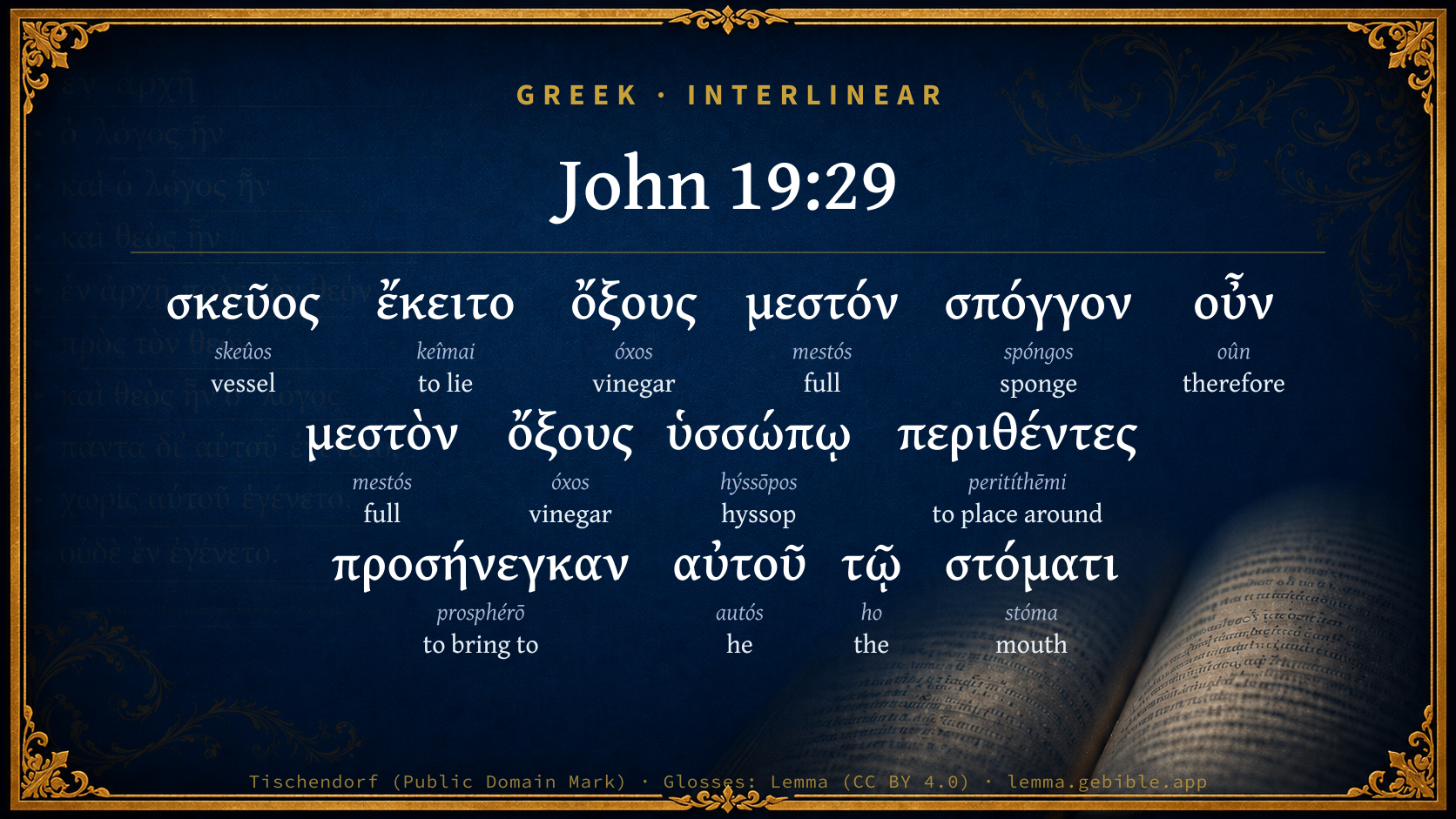
Greek (Tischendorf 8th ed.) John 19:29 appears in the Greek New Testament. The text above is from the Tischendorf 8th edition. Each word links to its Strong’s number and a concise gloss. Click any word for its full Thayer’s Greek Lexicon entry.
Download image
Cite this verse

John 19:29 (World English Bible). Public Domain. Lemma interlinear Bible study tool, https://lemma.gebible.app/v/john/19/29.

Show BibTeX & RIS
BibTeX
RIS
English Translation
Now a vessel full of vinegar was set there; so they put a sponge full of the vinegar on hyssop, and held it at his mouth.
World English Bible · Public Domain
Highlights
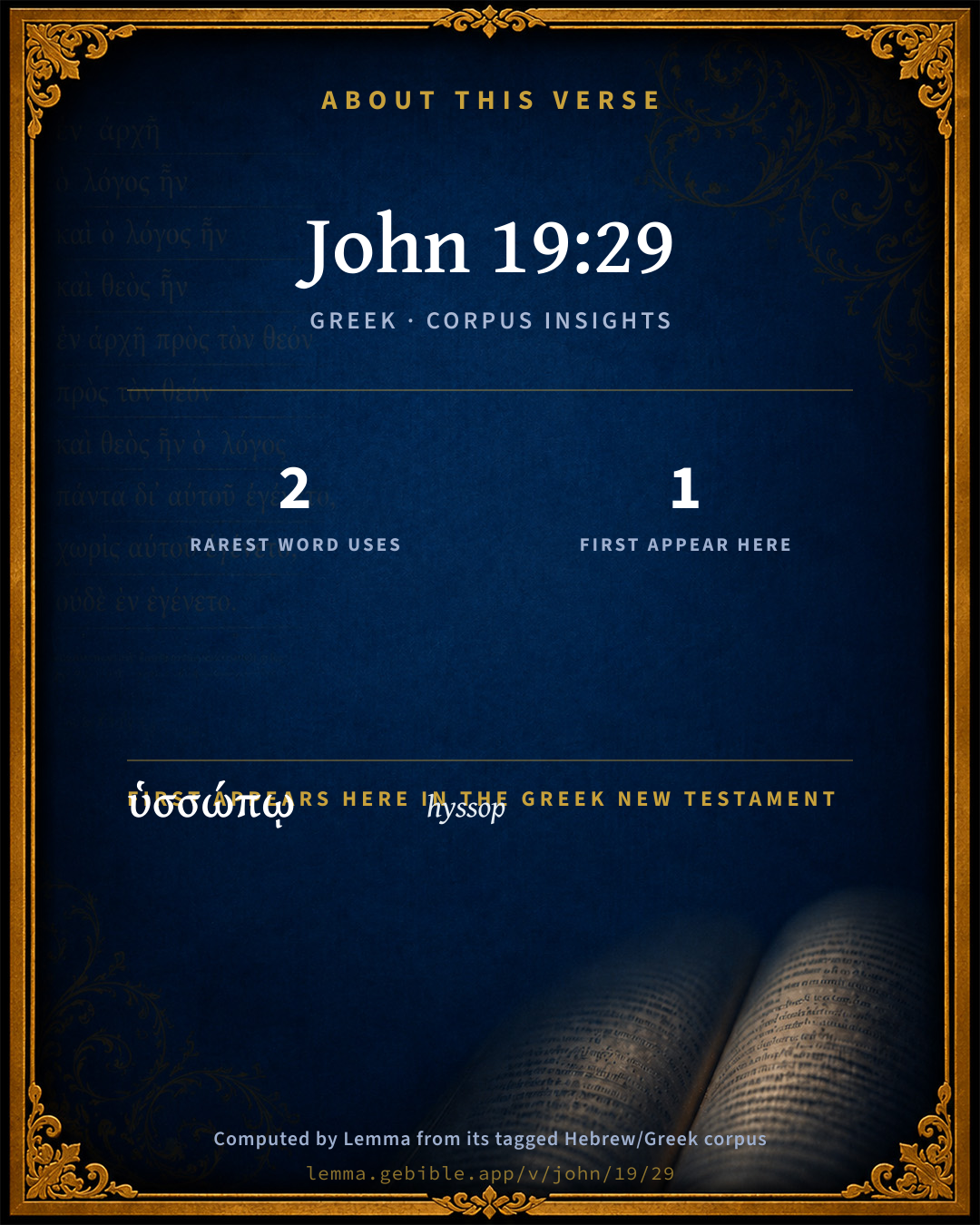
  • 1 first appearance in the Greek New Testament
Full analysis ↓
Download a study sheet

One document with this verse’s original text, its word-by-word gloss line, the meaning frame, cross-references with their text, attributed commentary, and full source and license credits — printable, and it pastes into notes with its structure intact.

This verse Autodidact and up

Study sheet (.html) Plain text (.txt)

A passage Seminary Student

Up to 50 verses in one chapter. A passage sheet keeps up to 6 commentary sources and 12 cross-references per verse, in the order this page ranks them, and says so on the sheet whenever that leaves anything out. Ask for a single verse and you get the Autodidact verse sheet above.

Everything on this page stays free to read, with no account — the sheet is a download of what is already on screen, not access to it.

Want to remove ads? Support Godless Engineer
Compare translations 3

The same verse in 3 English versions, stacked beneath the original-language interlinear above. Click any original word for its lexicon entry.

Each is an independent rendering of the whole verse — the interlinear is not word-aligned to these translations.

Highlighted words mark where these versions differ — a whole-verse word diff, not a word-by-word alignment.

  • World English Bible Public Domain
    Now a vessel full of vinegar was set there; so they put a sponge full of the vinegar on hyssop, and held it at his mouth.
  • King James Version Public Domain
    Now there was set a vessel full of vinegar: and they filled a spunge with vinegar, and put it upon hyssop, and put it to his mouth.
  • unfoldingWord Literal Text CC BY-SA 4.0
    A container full of sour wine was placed there, so having put a sponge full of the sour wine on a hyssop, they lifted it up to his mouth.

unfoldingWord Literal Text — © unfoldingWord, licensed CC BY-SA 4.0. Word-aligned USFM3 via Door43 (git.door43.org/unfoldingWord/en_ult).

Versions to compare (up to 4)

3 of 4 selected

Show all 19 translations

Every available English version of this verse, each an independent rendering of the whole verse.

  • World English Bible Public Domain
    Now a vessel full of vinegar was set there; so they put a sponge full of the vinegar on hyssop, and held it at his mouth.
  • Berean Standard Bible Public Domain
    A jar of sour wine was sitting there. So they soaked a sponge in the wine, put it on a stalk of hyssop, and lifted it to His mouth.
  • Majority Standard Bible Public Domain
    A jar of sour wine was sitting there. So they soaked a sponge in the wine, put it on a stalk of hyssop, and lifted it to His mouth.
  • King James Version Public Domain
    Now there was set a vessel full of vinegar: and they filled a spunge with vinegar, and put it upon hyssop, and put it to his mouth.
  • American Standard Version (1901) Public Domain
    There was set there a vessel full of vinegar: so they put a sponge full of the vinegar upon hyssop, and brought it to his mouth.
  • Revised Version (1885) Public Domain
    There was set there a vessel full of vinegar: so they put a sponge full of the vinegar upon hyssop, and brought it to his mouth.
  • Geneva Bible (1599) Public Domain
    And there was set a vessell full of vineger: and they filled a spondge with vineger: and put it about an Hyssope stalke, and put it to his mouth.
  • Douay-Rheims (1899) Public Domain
    Now there was a vessel set there full of vinegar. And they, putting a sponge full of vinegar and hyssop, put it to his mouth.
  • Young's Literal Translation Public Domain
    a vessel, therefore, was placed full of vinegar, and they having filled a sponge with vinegar, and having put `it' around a hyssop stalk, did put `it' to his mouth;
  • Literal Standard Version CC BY-SA 4.0
    a vessel, therefore, was placed full of vinegar, and having filled a sponge with vinegar, and having put [it] around a hyssop stalk, they put [it] to His mouth;
  • Unlocked Literal Bible CC BY-SA 4.0
    A container full of sour wine was placed there, so they put a sponge full of the sour wine on a hyssop staff and lifted it up to his mouth.
  • unfoldingWord Literal Text CC BY-SA 4.0
    A container full of sour wine was placed there, so having put a sponge full of the sour wine on a hyssop, they lifted it up to his mouth.
  • Darby Bible Public Domain
    There was a vessel therefore there full of vinegar, and having filled a sponge with vinegar, and putting hyssop round it, they put it up to his mouth.
  • World Messianic Bible Public Domain
    Now a vessel full of vinegar was set there; so they put a sponge full of the vinegar on hyssop, and held it at his mouth.
  • Webster's Bible Public Domain
    Now there was set a vessel full of vinegar: and they filled a spunge with vinegar, and put it upon hyssop, and put it to his mouth.
  • Free Bible Version CC BY-SA 4.0
    A jar of wine vinegar was standing there, so they soaked a sponge in the vinegar, put it on a hyssop stick, and held it to his lips.
  • Bible in Basic English Public Domain
    Now there was a vessel ready, full of bitter wine, and they put a sponge full of it on a stick and put it to his mouth.
  • Text-Critical English NT CC BY 4.0
    A jar full of sour wine was there, so they filled a sponge with sour wine, put it around a hyssop branch, and brought it up to his mouth.
  • Tyndale New Testament (1534) Public Domain
    Ther stode a vessell full of veneger by. And they filled a sponge with veneger and wounde it about with ysope and put it to his mouth.

Literal Standard Version (2020), Covenant Press — licensed CC BY-SA 4.0. Text via the HelloAO Bible API (eBible.org). Unlocked Literal Bible (unfoldingWord) — licensed CC BY-SA 4.0. Text via the HelloAO Bible API (eBible.org). unfoldingWord Literal Text — © unfoldingWord, licensed CC BY-SA 4.0. Word-aligned USFM3 via Door43 (git.door43.org/unfoldingWord/en_ult). Free Bible Version, Dr. Jonathan Gallagher — licensed CC BY-SA 4.0. Text via the HelloAO Bible API (eBible.org).

Word by word

More ways to search: Search by grammar → Find every occurrence → Compare this word →

Practice this passage: Drill this verse → Learn its vocabulary →

ὑσσώπῳ
hýssōpos
G5301
“hyssop”
Noun, Dative, Singular, Masculine
Part of Speech
Noun
Case
Dative
Number
Singular
Gender
Masculine
Full Thayer's Definition

Origin: of foreign origin H231

TDNT: None

1. hyssop 2. a plant used by the Hebrews in their ritual sprinklings
  1. σκεῦος skeûos G4632 “vessel” Noun, Nominative, Singular, Neuter
  2. ἔκειτο keîmai G2749 “to lie” Verb, Imperfect, Middle or Passive deponent, Indicative, 3rd person, Singular
  3. ὄξους óxos G3690 “vinegar” Noun, Genitive, Singular, Neuter
  4. μεστόν mestós G3324 “full” Adjective, Nominative, Singular, Neuter
  5. σπόγγον spóngos G4699 “sponge” Noun, Accusative, Singular, Masculine
  6. οὖν oûn G3767 “therefore” Conjunction
  7. μεστὸν mestós G3324 “full” Adjective, Nominative, Singular, Neuter
  8. ὄξους óxos G3690 “vinegar” Noun, Genitive, Singular, Neuter
  9. περιθέντες peritíthēmi G4060 “to place around” Verb, Aorist, Active, Participle, Nominative, Plural, Masculine
  10. προσήνεγκαν prosphérō G4374 “to bring to” Verb, Aorist, Active, Indicative, 3rd person, Plural
  11. αὐτοῦ autós G846 “he” Personal pronoun, Genitive, Singular, Masculine
  12. τῷ ho G3588 “the” Article, Dative, Singular, Neuter
  13. στόματι stóma G4750 “mouth” Noun, Dative, Singular, Neuter

About this verse

These counts appear in no published source. They are computed here, from the morphology-tagged text and Lemma’s own curated glosses. What Lemma adds →

14
words
12
distinct lemmas
Gospels
section

Notable vocabulary

The rarest word here is ὑσσώπῳ hyssop G5301 — appearing just 2 times in the whole Greek New Testament.

First appearance in Scripture

This word makes its first canonical appearance in the Greek New Testament here:

  • ὑσσώπῳ hyssop G5301

Shared distinctive vocabulary

ὑσσώπῳ hyssop G5301 occurs in 2 verses of the Greek New Testament. Also found in:
Repetition

Words recur within this verse:

  • ὄξους vinegar G3690 ×2
  • μεστόν full G3324 ×2

Cross-references

8

Topical passages linked to John 19:29 in the Treasury of Scripture Knowledge — connected by theme and wording, ordered by reader-vote popularity; previews shown in the World English Bible.

  • Numbers 19:18 and a clean person shall take hyssop, and dip it in the water, and sprinkle it on the tent, and on all the vessels, and on the persons who were there, and on him who touched the bone, or the slain, or the dead, or the grave:
  • Luke 23:36 The soldiers also mocked him, coming to him and offering him vinegar,
  • Mark 15:36 One ran, and filling a sponge full of vinegar, put it on a reed, and gave it to him to drink, saying, "Let him be. Let's see whether Elijah comes to take him down."
  • Exodus 12:22 You shall take a bunch of hyssop, and dip it in the blood that is in the basin, and strike the lintel and the two side-posts with the blood that is in the basin; and none of you shall go out of the door of his house until the morning.
  • Matthew 27:48 Immediately one of them ran, and took a sponge, and filled it with vinegar, and put it on a reed, and gave him a drink.
  • Psalms 51:7 Purify me with hyssop, and I will be clean. Wash me, and I will be whiter than snow.
  • Matthew 27:34 They gave him sour wine to drink mixed with gall. When he had tasted it, he would not drink.
  • 1 Kings 4:33 He spoke of trees, from the cedar that is in Lebanon even to the hyssop that springs out of the wall; he spoke also of animals, and of birds, and of creeping things, and of fish.

Cross-references courtesy of OpenBible.info (CC BY 4.0).

Where the printed editions differ

2 variants

Places in this verse where the major printed Greek editions disagree on the wording in a way that affects the translation — a comparison of editions, not a manuscript-by-manuscript collation. The editions are the modern critical texts (Nestlé-Aland 28/27, SBL, Westcott-Hort, Tregelles, Tyndale House) and the traditional texts behind the KJV (the Textus Receptus and the Byzantine/Majority text). It is not a claim about which reading is original.

  1. Extra text
    οὖν

    “therefore”

    In TRByz Not in NA28NA27TynSBLWHTreg

    οὖν (oun) 'therefore' is only in traditional manuscripts (TR+Byz)

  2. Different wording
    οὖν μεστὸν τοῦ

    “therefore full of the”

    In NA28NA27TynSBLWHTreg Not in TRByz

    δέ (de) 'now' occurs in traditional manuscripts (TR+Byz) instead of οὖν (oun) 'therefore' in older manuscripts (NA28+NA27+Tyn+SBL+WH+Treg)

Textual data: Translators Amalgamated Greek New Testament (STEPBible TAGNT) · CC BY 4.0.

Commentary

Notes on John 19:29 from classic Christian and Jewish commentators (each source and its license shown beneath its notes). The classic Christian expositions comment on the surrounding passage and are grouped to its opening verse, so a note may address several verses; the Jewish commentaries on the Tanakh (Rashi and others) are per-verse, so they appear only where the commentator wrote on this verse.

Lemma curates 59 commentaries, every one of them public domain or Creative Commons licensed, each selected and text-cleaned for this edition rather than reprinted as found. About our sources →

Tyndale Open Study Notes

Tyndale Open Resources

19:29 The hyssop bush had been used in Egypt to brush lamb’s blood on the doorposts and lintels during the first Passover (Exod 12:22). Jesus is God’s Passover lamb (John 1:29, 36), and his blood likewise saves.

Tyndale Open Study Notes — © Tyndale Open Resources, licensed CC BY-SA 4.0. Text via the HelloAO Bible API.

Bengel's Gnomon

Johann Albrecht Bengel

Joh 19:29. Ὑσσώπῳ) The hyssop in those regions being larger than that of our country, suitably held with its small branches a sponge full of vinegar.—περιθέντες, putting upon the hyssop) viz. the sponge.

Bengel's Gnomon of the New Testament — English translation (T&T Clark, Edinburgh, 1860) — public domain. Text from a community e-Sword module.

Meyer's Critical & Exegetical Commentary

Heinrich August Wilhelm Meyer

Joh_19:29-30. Ἔκειτο] as in Joh_2:6. The vessel was in readiness for the purpose of quenching the thirst of those crucified (who had always to suffer much therefrom), with sponge and stalk of hyssop, which were to serve for handing it up.

ὄξους] vinegar, i.e. small sour wine (from the skins of grapes already pressed), which served as a drink for labourers and soldiers; Wetstein on Mat_27:34; Hermann, Privatalterth. § 26. 10. Of the bitter stupifying drink, which Jesus had disdained to receive (Mat_27:34-35; Mar_15:23-24), John says nothing. On the drink tendered to him, Luk_23:36, see in loc.

The subject of σπόγγον, κ.τ.λ. is not named; yet there can be no doubt about who are meant, the soldiers.

ὑσσώπῷ] More exactly than in Mat_27:48, and since the hyssop grows stalks from 1 to 1½ feet high (Bochart, Hieroz. I. 2. 50; Celsius, Hierobot I. p. 407 f.), such an one was fully sufficient to reach to the mouth of Jesus on the not lofty (Salmasius, de cruce, p. 284) cross.[249]

αὐτοῦ τῷ στόματι] to His mouth. That the stalk was precisely of hyssop, is accidental; as hyssop of scorning, in opposition to the hyssop of reconciliation, Psalms 51. (Hengstenberg), it is not to be thought of, since the tender of the drink in the present passage is certainly not an act of scorn. Moreover, it is precisely such non-essential special statements as these which have flowed from the most vivid recollection of an eye-witness.

τετέλεσται] Quite as in Joh_19:28, to be referred to the work of Jesus. Comp. Joh_17:4. It is by Him brought to completion with this act of the last death-suffering. Further, Bengel aptly remarks: hoc verbum in corde Jesu erat, Joh_19:28, nunc ore profertur.

παρέδ. τὸ πν.] He gave over (to God) His spirit, characteristic designation of dying, in conformity with that which dying was in Jesus case. It is the actual surrender of His self-conscious Ego on the decease of the body; the verbal surrender, Luk_23:46,[250] appears, since John has, instead of it, the simply grand concluding word τετέλεσται, to belong to the enlarging representations of tradition, but, after the bowing of the head, would be no longer suitable, and hence must be assumed as taking place after τετέλεσται.

Note further, that the εἶναι εἰς τ. κόλπον τοῦ πατρός meant in Joh_1:18 did not now take place, but first by means of the ascension (Joh_20:17).

[249] Least of all with a dogmatic background, although Steinmeyer assumes that διψῶ is a request to His enemies, and thereby illustrates the love, which completed the act of atonement. This request, he thinks, only the dying Mediator could have made.

[250] Of the seven words on the cross, only Mat_27:46, according to Schenkels too rash conclusion, is to be considered as altogether beyond doubt. Mark also has only this one (Mar_15:34), Luke has three (Luk_23:34; Luk_23:43; Luk_23:46), and John likewise three (Joh_19:26-28; Joh_19:30).

Meyer — Critical and Exegetical Commentary on the New Testament — English translation by Peter Christie, edited by Frederick Crombie (T&T Clark, 1880) — public domain. Text from a community e-Sword module.

Expositor's Greek Testament

ed. W. Robertson Nicoll

Joh 19:29 . Σκεῦος … μεστόν “There was set a vessel full of vinegar”; the mention of the vessel betrays the eye-witness. “The Synoptists do not mention the σκεῦος , but John had stood beside it.” Plummer. ὄξος , the vinegar used by soldiers. [Ulpian says: “vinum atque acetum milites nostri solent percipere, uno die vinum, alio die acetum”. Keim, vi. 162.] Here it seems to have been provided for the crucified, for as Weiss and Plummer observe, there were a sponge and a hyssop-reed also at hand. οἱ δὲ , i.e. , the soldiers, but cf. Mar 15:36 ; πλήσαντες … They filled a sponge, because a cup was impracticable, and put it round a stalk of hyssop, and thus applied the restorative to His mouth. The plant called “hyssop” has not been identified. All that was requisite was a reed ( cf. περιθεὶς καλάμῳ , Mat 27:48 , Mar 15:36 ) of two or three feet long, as the crucified was only slightly elevated.

The Expositor's Greek Testament, edited by W. Robertson Nicoll (1897–1910) — public domain. Text from a community e-Sword module.

Geneva Bible (1599)

Geneva Bible translators

Galatinus witnesseth out of the book called Sanhedrin, that the Jews were wont to give them that were executed, vinegar mixed with frankincense to drink, to make their brains somewhat troubled: so charitably the Jews provided for the poor men’s consciences which were executed.

Geneva Bible (1599) marginal notes — public domain. Text via Bolls.life.

Jamieson, Fausset & Brown

Robert Jamieson, A. R. Fausset & David Brown

filled a sponge with vinegar, and put it upon--a stalk of

hyssop, and put it to his mouth--Though a stalk of this plant does not exceed eighteen inches in length, it would suffice, as the feet of crucified persons were not raised high. "The rest said, Let be"--[that is, as would seem, 'Stop that officious service'] "let us see whether Elias will come to save Him" (Mat 27:49). This was the last cruelty He was to suffer, but it was one of the most unfeeling. "And when Jesus had cried with a loud voice" (Luk 23:46). This "loud voice," noticed by three of the Evangelists, does not imply, as some able interpreters contend, that our Lord's strength was so far from being exhausted that He needed not to die then, and surrendered up His life sooner than Nature required, merely because it was the appointed time. It was indeed the appointed time, but time that He should be "crucified through weakness" (Co1 13:4), and Nature was now reaching its utmost exhaustion. But just as even His own dying saints, particularly the martyrs of Jesus, have sometimes had such gleams of coming glory immediately before breathing their last, as to impart to them a strength to utter their feelings which has amazed the by-standers, so this mighty voice of the expiring Redeemer was nothing else but the exultant spirit of the Dying Victor, receiving the fruit of His travail just about to be embraced, and nerving the organs of utterance to an ecstatic expression of its sublime feelings (not so much in the immediately following words of tranquil surrender, in Luke, as in the final shout, recorded only by John): "FATHER, INTO THY HANDS I COMMEND MY SPIRIT!" (Luk 23:46). Yes, the darkness is past, and the true light now shineth. His soul has emerged from its mysterious horrors; "My God" is heard no more, but in unclouded light He yields sublime into His Father's hands the infinitely precious spirit--using here also the words of those matchless Psalms (Psa 31:5) which were ever on His lips. "As the Father receives the spirit of Jesus, so Jesus receives those of the faithful" (Act 7:59) [BENGEL]. And now comes the expiring mighty shout.

Jamieson, Fausset & Brown — Commentary Critical and Explanatory on the Whole Bible (1871) — public domain (CC PDM 1.0). Text via the HelloAO Bible API.

Adam Clarke's Commentary

Verse 29. A vessel full of vinegar] This was probably that tart small wine which we are assured was the common drink of the Roman soldiers. Our word vinegar comes from the French vin aigre, sour or tart wine; and, although it is probable that it was brought at this time for the use of the four Roman soldiers who were employed in the crucifixion of our Lord, yet it is as probable that it might have been furnished for the use of the persons crucified; who, in that lingering kind of death, must necessarily be grievously tormented with thirst. This vinegar must not be confounded with the vinegar and gall mentioned Mt 27:34, and Mr 15:23. That, being a stupifying potion, intended to alleviate his pain, he refused to drink; but of this he took a little, and then expired, Joh 19:30.

And put it upon hyssop] Or, according to others, putting hyssop about it. A great variety of conjectures have been produced to solve the difficulty in this text, which is occasioned by supposing that the sponge was put on a stalk of hyssop, and that this is the reed mentioned by Matthew and Mark. It is possible that the hyssop might grow to such a size in Judea as that a stalk of it might answer the end of a reed or cane in the case mentioned here; but still it appears to me more natural to suppose that the reed was a distinct thing and that the hyssop was used only to bind the sponge fast to the reed; unless we may suppose it was added for some mystical purpose, as we find it frequently used in the Old Testament in rites of purification. The various conjectures on this point may be seen in Bowyer's Conject. and in Calmet.

Adam Clarke's Commentary on the Bible (1810–1826) — public domain. Text from a community e-Sword/MySword module.

John Calvin's Commentaries

29. And, having filled a sponge with vinegar, they fixed it on hyssop. When he says that they fixed the sponge on hyssop, the meaning is, that they fastened it to the end of a bunch of hyssop, that it might be raised to Christ’s mouth; for, in that country, hyssops grow as large as small shrubs,

John Calvin's Commentaries (1540-1563) — public domain. Text from the Calvin Translation Society English edition (1840s-50s) via the Christian Classics Ethereal Library (ccel.org). Calvin's coverage is partial (roughly two-thirds of the Bible); uncommented books and verses are honest gaps, never fabricated. The 19th-century editor's footnotes and remarks are omitted so the notes are faithfully Calvin's own voice.

Ellicott's Commentary for English Readers

(29) Now there was set a vessel full of vinegar.—This vessel of the ordinary sour wine drunk by the Roman soldiers, was placed near in order to be given to those who were crucified. Thirst was always an accompaniment of death by crucifixion, and that the vessel of wine was prepared for this purpose is made probable by the mention of the sponge and hyssop (Comp. Note on Mat_27:48.)

And put it upon hyssop.—This detail is peculiar to St. John. Bochart (Hierozoicon, i. 2, 50) thinks that the plant was marjoram, or some plant like it, and he is borne out by ancient tradition. The stalks, from a foot to a foot and a half high, would be sufficient to reach to the cross. The plant is named in one other passage in the New Testament (Heb_9:19), and is frequent in the Greek of the Old Testament. The Hebrew word is çzôv, and the identification must always be uncertain, because we cannot know whether the Greek translation is based upon an identification of the plant, or upon a similarity in the sound of the names.

A Bible Commentary for English Readers, edited by Charles John Ellicott (1878–1897) — public domain. Text from a community e-Sword module.

The Cambridge Bible for Schools and Colleges

gen. ed. J. J. S. Perowne

29. Now … vinegar] Omit ‘now.’ S. John’s precise knowledge appears once more: the other three do not mention the vessel, but he had stood close to it. The ‘vinegar’ was probably the sour wine or posca in a large jar ‘set’ by the soldiers for their own use while on guard. Criminals sometimes lived for many hours, even a day or two, on the cross.

and they filled, &c.] The true text gives, having placed therefore a sponge full of the vinegar upon hyssop they put it to his mouth. The difference between the two verbs rendered ‘put’ is very graphic; the one expresses the placing of the sponge round the stalk (comp. Mat_21:33; Mat_27:28; Mat_27:48), the other the offering (Joh_16:2) and applying (Mar_10:13) it to his lips.

hyssop] The plant cannot be identified with certainty. The caper-plant, which is as likely as any, has stalks which run to two or three feet, and this would suffice. It is not probable that Christ’s feet were on a level with the spectators’ heads, as pictures represent: this would have involved needless trouble and expense. Moreover the mockery of the soldiers recorded by S. Luke (see on Luk_23:36) is more intelligible if we suppose that they could almost put a vessel to His lips. S. John alone mentions the hyssop; another mark of exact knowledge.

put it to his mouth] The actors and their motive are left doubtful. Probably soldiers, but possibly Jews, and probably in compassion rather than mockery; or perhaps in compassion under cover of mockery (comp. Mar_15:36).

The Cambridge Bible for Schools and Colleges (gen. ed. J. J. S. Perowne; Cambridge University Press, 1878–1918) — public domain. Text from a community e-Sword module.

John Gill's Exposition

Now there was set a vessel full of vinegar,.... In a place near at hand, as Nonnus observes; not on purpose, for the sake of them that were crucified, either to refresh their spirits, or stop a too great effusion of blood, that they might continue the longer in their misery; but for the use of the soldiers who crucified Christ, vinegar being part of the allowance of Roman soldiers (m), and what they used to drink: sometimes it was mixed with water; which mixed liquor they called "Posca" (n), and was what even their generals sometimes used; as Scipio, Metellus, Trajan, Adrian, and others: vinegar was also used by the Jews for drink, as appears from Rut 2:14 and "dip thy morsel in the vinegar", which Boaz's reapers had with them in the field; "because of heat", as the commentators say (o); that being good to cool, and to extinguish thirst; for which reason the soldiers here offer it to Christ; though the Chaldee paraphrase of the above place makes it to be a kind of sauce or pap boiled in vinegar; and such an "Embamma" made of vinegar the Romans had, in which they dipped their food (p); but this here seems to be pure vinegar, and to be different from that which the other evangelists speak of, which was mingled with gall, or was sour wine with myrrh, Mat 27:34. Vinegar indeed is good to revive the spirits, and hyssop, which is after mentioned, is an herb of a sweet smell; and if the reed, which the other evangelists make mention of, was the sweet calamus, as some have thought, they were all of them things of a refreshing nature: vinegar was also used for stopping blood (q), when it flowed from wounds in a large quantity; and of the same use were sponges; hence Tertullian (r) mentions "spongias retiariorum", the sponges of the fencers, which they had with them to stop any effusion of blood that should be made in their exercises; but then it can hardly be thought that these things should be in common prepared at crucifixions for such ends, on purpose to linger out a miserable life a little longer, which would be shocking barbarity; and especially such a provision would never be, made at this time, on such an account, since the Jews sabbath drew nigh, and they were in haste to have the executions over before that came on, that the bodies might not remain on the cross on that day; for which reason they would do nothing, at this time, however, to prolong the lives of the malefactors; wherefore it is most reasonable, that this vessel of vinegar was not set for any such purpose, but was for the use of the soldiers; and therefore this being at hand when Christ signified his thirst, they offered some of it in the following manner:

and they filled a sponge with vinegar; it being the nature of a sponge (which Nonnus here calls , "a branch of the sea", because it grows there) to swallow up anything that is liquid, and which may be again squeezed and sucked out of it; hence the Jews say (s) of it, , "the sponge which swallows up liquids"; and used it for such a purpose; "and put it upon hyssop"; meaning not the juice of hyssop, into which some have thought the sponge with vinegar was put, but the herb, and a stalk of it: the other evangelists say, it was put "upon a reed"; meaning either that the sponge with the hyssop were put about a reed, and so given him; or rather it was a stalk of hyssop, which was like a reed or cane; and in this country of Judea grew very large, sufficient for such a purpose. The hyssop with the Jews was not reckoned among herbs, but trees; see Kg1 4:33 and they speak (t) of hyssop which they gather "for wood"; the stalks of which therefore must be of some size; yea, they call (u) a stalk which has a top to it, "a reed", or cane; which observation seems to reconcile the other evangelists with this: and they distinguish their hyssop which was right for use from that which had an epithet joined to it; as, Roman hyssop, Grecian hyssop, wild and bastard hyssop (w): and some writers (x) observe even of our common hyssop, that it has sometimes stalks of nine inches long, or longer, and hard and woody, nay, even a foot and a half; with one of which a man with his arms stretched out might possibly reach the mouth of a person on a cross: how high crosses usually were is not certain, nor was there any fixed measure for them; sometimes they were higher, and sometimes lower; the cross or gallows made by Haman for Mordecai was very high indeed, and the mouth of a person could not have been reached with an hyssop stalk; but such an one might, as was erected for Saul's sons, whose bodies on it could be reached by the beasts of the field, Sa2 21:10 and so low was the cross on which Blandina the martyr suffered, as the church at Lyons relates (y), when on the cross she was exposed to beasts of prey, and became food for them: so that there is no need to suppose any fault in the text, and that instead of "hyssop" it should be read "hyssos"; which was a kind of javelin the Romans call "Pilum", about five or six foot long, which, it is supposed, one of the soldiers might have, and on it put the hyssop with the sponge and vinegar; but this conjecture is not supported by any copy, or ancient version; the Syriac version, which is a very ancient one, reads "hyssop". The Arabic and Persic versions render it, "a reed", as in the other evangelists; and the Ethiopic version has both, "they filled a sponge with vinegar, and it was set round with hyssop, and they bound it upon a reed"; and so some have thought that a bunch of hyssop was stuck round about the sponge of vinegar, which was fastened to the top of a reed; and the words will bear to be rendered; "setting it about with hyssop": this they might have out of the gardens, which were near this place, or it might grow upon the mountain itself; for we are told (z), it grew in great plenty upon the mountains about Jerusalem, and that its branches were almost a cubit long. Josephus (a) makes mention of a village beyond Jordan called Bethezob, which, as he says, signifies the house of hyssop; perhaps so called from the large quantity of hyssop that grew near it:

and put it to his mouth; whether Christ drank of it or no is not certain; it seems by what follows as if he did; at least he took it, being offered to him: the Jews themselves say (b), that Jesus said, give me a little water to drink, and they gave him , "sharp vinegar"; which so far confirms the evangelic history.

(m) Julian. Imperator. Epist. 27. p. 161. Vid. Lydium de re militari, l. 6. c. 7. p. 245. (n) Salmuth. in Panciroll. rerum memorab. par. 1. Tit. 53. p. 274. (o) Jarchi & Aben Ezra in loc. (p) Salmuth. ib. par. 2. Tit. 2. p. 83. (q) Plin. Nat. Hist. l. 31. c. 11. (r) De Spectaculis, c. 25. (s) Maimon. in Misn. Sabbat, c. 21. sect. 3. Misn. Celim, c. 9. sect. 4. (t) Misn. Parah, c. 11. sect. 8. Maimon. Hilch. Parah Adumah, c. 11. sect. 7. (u) Gloss. in T. Bab. Succa, fol. 13. 1. (w) Misn. Parah, c. 11. sect. 7. Negaim, c. 14. 6. T. Bab. Succa, fol. 13. 1. & Cholin, fol. 62. 2. (x) Dodonaeus, l. 4. c. 19. (y) Apud Euseb. Eccl. Hist. l. 5. c. 1. p. 161. Vid. Lipsium de Cruce, l. 3. c. 11. (z) Arabes Lexicograph. apud de Dieu in loc. (a) De Bello Jud. l. 6. c. 3. sect. 4. (b) Toklos Jesu, p. 17.

John Gill's Exposition of the Whole Bible (1746–1763) — public domain (CC PDM 1.0). Text via the HelloAO Bible API.

Trapp's Complete Commentary

John Trapp

29 Now there was set a vessel full of vinegar: and they filled a spunge with vinegar, and put it upon hyssop, and put it to his mouth.

Ver. 29. Now there was set a vessel full of vinegar] Cold comfort: they used to give others wine to comfort them, according to Pro 31:6, and mingled myrrh with the wine ( granum thuris in calice vini), that might attenuate their blood, and so help to despatch them; as also to cause a giddiness in them, that they might be the less sensible of their pain. But they dealt much worse with our Saviour, mingling for him, in mockery, vinegar and gall, to add to his other misery. This he drank, that we might drink of the heavenly nepenthes, that torrent of pleasure, Psa 16:11.

John Trapp, A Commentary or Exposition upon All the Books of the Old and New Testament (1647–1656) — public domain. Text from a community e-Sword module.

Whedon's Commentary on the Bible

Daniel D. Whedon

29. Hyssop—It is not well known what plant is here specified. But a sort of hyssop is described with a seedy stalk about a foot and a half long. Such a stalk would have been long enough to reach the mouth of a crucified person, inasmuch as the cross was not usually very elevated.

Daniel D. Whedon (gen. ed.), Commentary on the Old and New Testaments (1874–1909) — public domain. Text from a community e-Sword module.

The Pulpit Commentary

There was set therea vessel full of vinegar, probably for the use of the soldiers, and occasionally offered to the sufferers to soothe a part of their torment. John clearly associates this fact with the unconscious fulfillment of prophecy. Matthew gives it, with strange lack of connection, as following the cry, "My God, my God, why hast thou forsaken me?" So they (Matthew, "one") having placeda sponge full of the vinegar upon hyssop. This hyssop plant, if identical with the caper plant, does produce stems three or four feet long, and may therefore be identical with the "reed" mentioned in Matthew and Mark, while Luke (Luk_23:36) refers the act to the soldiers offering him vinegar to drink, saying, "Let us see whether Elias will come and save him." They put it, brought it, presented it to his mouth. This was not the stupefying draught which he refused, but an exhilarating one.

The Pulpit Commentary (1880–1919), ed. H.D.M. Spence-Jones & Joseph S. Exell — public domain. Text from a community e-Sword module.

John Wesley's Explanatory Notes

A stalk of hyssop - Which in those countries grows exceeding large and strong. Psalm lxix, 21.

John Wesley, Explanatory Notes Upon the Whole Bible (1754–1765) — public domain. Text via the GEBible commentary corpus.

Cambridge Greek Testament for Schools and Colleges

29. σπόγγον οὖν μεστὸν τοῦ ὄξους (אBLX) for οἱ δὲ πλήσαντες σπόγγον ὄξους καὶ (A), a combination with Mat 27:48 and Mar 15:36, which caused οὖν to be transferred to the previous clause,—σκεῦος οὖν ἔκειτο.

29. S. John’s exact knowledge appears again. The Synoptists do not mention the σκεῦος, but he had stood beside it. The ὄξος was either the posca or sour wine for the soldiers during their long watch, or something prepared for the sufferers. The sponge and the stalk of hyssop being ready at hand is in favour of the latter. Criminals sometimes lived a day or two on the cross. Vinegar is degenerate wine, and may symbolize the fallen nature of those who offered it. Hyssop cannot be identified with certainty. The caper-plant, which is as likely as any, has stalks which run to two or three feet, and this would suffice. It is not probable that Christ’s feet were on a level with the spectators’ heads, as pictures represent: this would have involved needless trouble and expense. Moreover the mockery of the soldiers recorded by S. Luke (see on Luk 23:36) is more intelligible if we suppose that they could almost put a vessel to His lips. S. John alone mentions the hyssop; another mark of exact knowledge. Did he see in it a coincidence with Exo 12:22?

περιθέντες προσήνεγκαν. Very graphic; περιθ. expresses the placing of the sponge round the stalk (Mat 21:33; Mat 27:28; Mat 27:48), προσήν. the offering (Joh 16:2) and applying (Mar 10:13) to His lips. The actors and their motive are left doubtful. Probably they were soldiers and acted in compassion rather than in mockery; or in compassion under cover of mockery (Mar 15:36; Psa 69:22).

Cambridge Greek Testament for Schools and Colleges (Cambridge University Press, 1896; 21 vols, various authors incl. Carr, Maclear, Plummer, Farrar, Lumby, Moule, M. R. James, Simcox) — public domain. Text from a community e-Sword module.

Alford’s Greek Testament

Henry Alford

29.] The ὄξος was the posca, the sour wine, or vinegar and water, the common drink of the Roman soldiers.

ὑσσώπῳ—an aromatic plant growing on walls, common in the south of England and on the Continent, with blue or white flowers, and having stalks about 1½ foot long, which would in this case be long enough, the feet of the crucified person not being ordinarily raised above that distance from the ground. It was much used for sprinkling, Exo 12:22: Lev 14:4 &c.: Psa 51:7.

Henry Alford, The Greek Testament (1849–1861) — public domain. Text from a community e-Sword module.

International Critical Commentary

29. σκεῦος ἔκειτο ὄξους μεστόν. So ABLW 33, but the rec., with DsuppNΓΔΘ, adds οὖν after σκεῦος. For the next clause, σπόγγον οὖν μέστον τοῦ ὄξους (אcBLW 33), the rec., with ADsuppNΓΔΘ, substitutes οἱ δὲ πλήσαντες σπόγγον ὄξους, καὶ … Θ fam. 13 interpolate μετὰ χολῆς καὶ ὑσσώπου after ὄξους, and Θ proceeds καὶ περιθέντες καλάμῳ προσήνεγκαν κτλ., these variants in the rec. text being derived from Mar 15:36, Mat 27:34, Mat 27:48. The change in Θ of ὑσσώπῳ to καλάμῳ is evidently due to the difficulty felt by the scribe in the words ὑσσώπῳ περιθέντες.

ὐσσώπῳ περιθέντες. This would mean that the sponge filled with vinegar or sour wine was placed “on hyssop” and so conveyed to the mouth of Jesus as He hung on the Cross. But hyssop is not a plant which commonly provides sticks or reeds (if at all); bunches of it were used for sprinkling purposes (Exo 12:22, Heb 9:19), but while a sponge could be attached to a bunch of hyssop, some rod or stick would yet be needed to raise it up to the Cross. The Synoptists say nothing about hyssop, but both in Mat 27:49 and Mar 15:36 (cf. Luk 23:37) we read σπόγγον ὄξους περιθεὶς καλάμῳ, i.e. they say that a bystander put the sponge on a reed or cane or stick, as it was natural to do.

Now in the eleventh century cursive No. 476 we find ὓσσῳ περιθέντες, the corruption of μχχωπεριθεντεχ into μχχωπωπεριθεντεχ being due to the repetition by the scribe of two letters ωπ. ὕσσος is the Latin pilum, of which each Roman soldier carried two; and the meaning of ὕσσῳ περιθέντες is that the bystanders put the sponge on the end of a soldier’s javelin or pilum, several of which were ready to hand (see on v. 34). This not only brings Jn. into correspondence with the περιθεὶς καλάμῳ of the Synoptists, but it reveals the personal observer. The man behind the story knew, for he had seen, to what kind of a stick the sponge was fastened; it was a ὓσσος, a soldier’s javelin.1

International Critical Commentary — older volumes (1896–1929), various authors — public domain. Text from a community e-Sword module.

Vincent's Word Studies in the New Testament

Marvin R. Vincent

Vinegar. See on Mt 27:48.

Hyssop. Matthew and Mark have kalamw, a reed. Luke says merely that they offered Him vinegar. The vinegar mingled with gall (Mt 27:34), or the wine mingled with myrrh (Mr 14:23) was offered to Jesus before his crucifixion as a stupefying draught. The hyssop gives a hint of the height of the cross, as the greatest length of the hyssop reed was not more than three or four feet. The vinegar in this case was offered in order to revive Christ. John does not mention the stupefying draught.

Marvin R. Vincent, Word Studies in the New Testament (1887–1900) — public domain. Text from a community e-Sword/MySword module.

Lesson kit

Teaching starters — assembled from the data on this page, not authored interpretation. Every prompt links to the verse data it draws on. Edit before teaching.

John, in the Gospels, opens this verse with 14 words (12 distinct Greek lemmas). Its most distinctive word is hýssōpos (“hyssop”). A historical commentator’s framing appears above. Read the whole chapter for the surrounding context.

Discussion questions

  1. What does “hyssop” (hýssōpos) contribute to the verse as a whole?
  2. The word “hyssop” first appears here in Scripture. What is being introduced at this debut?
  3. Hebrews 9:19 shares the word «hyssop» with this verse. How do the two illuminate each other?
  4. “vinegar” occurs 2× in this one verse. What is the effect of the repetition?
  5. These translations render this verse differently; the difference is in the English rendering, not the original. What questions does that raise?
  6. Reading how Tyndale Open Study Notes and Bengel's Gnomon read this verse, where do the two commentators agree and where do they part?

Things to notice

  • 1 word makes its first canonical appearance in Scripture here.
  • These translations choose different wording for 16 words in this verse.
  • “vinegar” occurs 2× in this single verse.
  • 12 distinct Greek lemmas span 14 words in this verse.

Reading settings

Reading text

Shown beneath each verse's original-language words.

Old Testament
Old Testament edition

Read the OT as the Masoretic Hebrew (MT) or the Greek Septuagint (LXX).

English shown for the Greek Septuagint (in the Hebrew ↔ Greek comparison).

Comparing translations? Open the Compare panel on any verse page to stack up to four side by side.