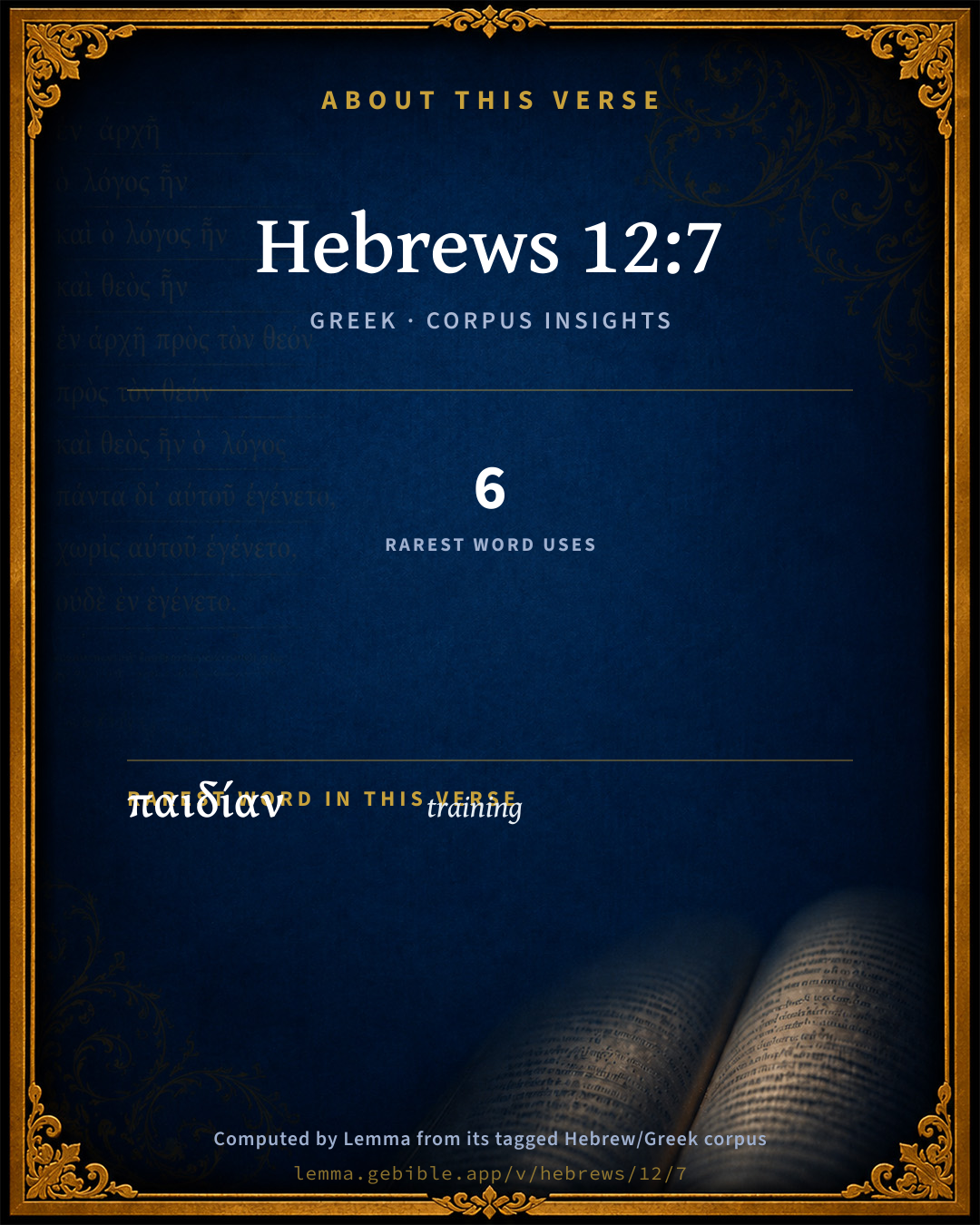
Hebrews 12:7

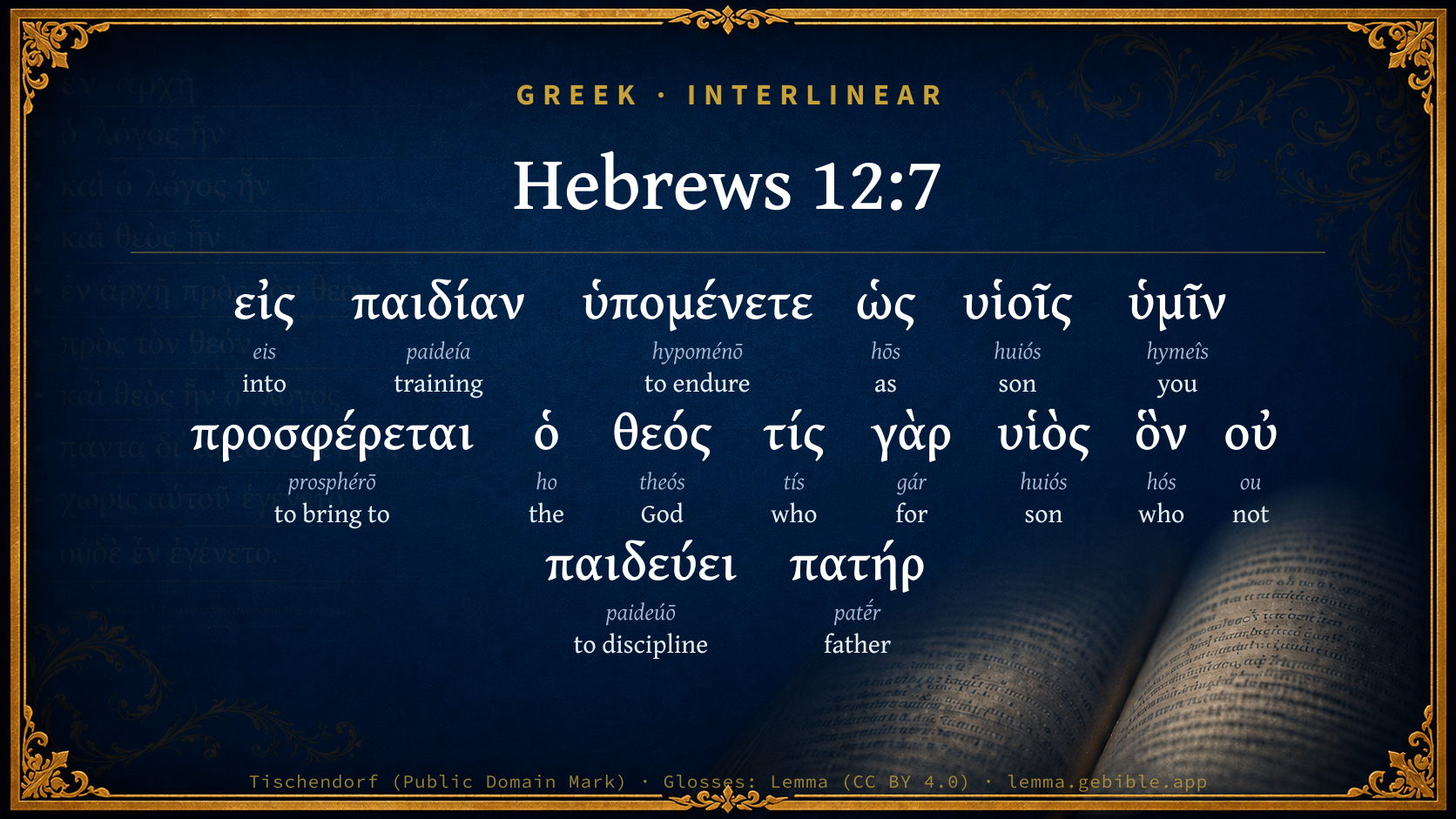
Greek (Tischendorf 8th ed.) Hebrews 12:7 appears in the Greek New Testament. The text above is from the Tischendorf 8th edition. Each word links to its Strong’s number and a concise gloss. Click any word for its full Thayer’s Greek Lexicon entry.
Download image
Cite this verse

Hebrews 12:7 (World English Bible). Public Domain. Lemma interlinear Bible study tool, https://lemma.gebible.app/v/hebrews/12/7.

Show BibTeX & RIS
BibTeX
RIS
English Translation
It is for discipline that you endure. God deals with you as with children, for what son is there whom his father doesn't discipline?
World English Bible · Public Domain
Download a study sheet

One document with this verse’s original text, its word-by-word gloss line, the meaning frame, cross-references with their text, attributed commentary, and full source and license credits — printable, and it pastes into notes with its structure intact.

This verse Autodidact and up

Study sheet (.html) Plain text (.txt)

A passage Seminary Student

Up to 50 verses in one chapter. A passage sheet keeps up to 6 commentary sources and 12 cross-references per verse, in the order this page ranks them, and says so on the sheet whenever that leaves anything out. Ask for a single verse and you get the Autodidact verse sheet above.

Everything on this page stays free to read, with no account — the sheet is a download of what is already on screen, not access to it.

Want to remove ads? Support Godless Engineer
Compare translations 3

The same verse in 3 English versions, stacked beneath the original-language interlinear above. Click any original word for its lexicon entry.

Each is an independent rendering of the whole verse — the interlinear is not word-aligned to these translations.

Highlighted words mark where these versions differ — a whole-verse word diff, not a word-by-word alignment.

  • World English Bible Public Domain
    It is for discipline that you endure. God deals with you as with children, for what son is there whom his father doesn't discipline?
  • King James Version Public Domain
    If ye endure chastening, God dealeth with you as with sons; for what son is he whom the father chasteneth not?
  • unfoldingWord Literal Text CC BY-SA 4.0
    Endure for discipline; God is treating you as sons. For what son whom his father does not discipline?

unfoldingWord Literal Text — © unfoldingWord, licensed CC BY-SA 4.0. Word-aligned USFM3 via Door43 (git.door43.org/unfoldingWord/en_ult).

Versions to compare (up to 4)

3 of 4 selected

Show all 19 translations

Every available English version of this verse, each an independent rendering of the whole verse.

  • World English Bible Public Domain
    It is for discipline that you endure. God deals with you as with children, for what son is there whom his father doesn't discipline?
  • Berean Standard Bible Public Domain
    Endure suffering as discipline; God is treating you as sons. For what son is not disciplined by his father?
  • Majority Standard Bible Public Domain
    Endure suffering as discipline; God is treating you as sons. For what son is not disciplined by his father?
  • King James Version Public Domain
    If ye endure chastening, God dealeth with you as with sons; for what son is he whom the father chasteneth not?
  • American Standard Version (1901) Public Domain
    It is for chastening that ye endure; God dealeth with you as with sons; for what son is there whom `his' father chasteneth not?
  • Revised Version (1885) Public Domain
    It is for chastening that ye endure; God dealeth with you as with sons; for what son is there whom his father chasteneth not?
  • Geneva Bible (1599) Public Domain
    If ye endure chastening, God offereth him selfe vnto you as vnto sonnes: for what sonne is it whom the father chasteneth not?
  • Douay-Rheims (1899) Public Domain
    Persevere under discipline. God dealeth with you as with his sons; for what son is there, whom the father doth not correct?
  • Young's Literal Translation Public Domain
    if chastening ye endure, as to sons God beareth Himself to you, for who is a son whom a father doth not chasten?
  • Literal Standard Version CC BY-SA 4.0
    if you endure discipline, God bears Himself to you as to sons, for who is a son whom a father does not discipline?
  • Unlocked Literal Bible CC BY-SA 4.0
    Endure suffering as discipline. God deals with you as with sons. For what son is there whom his father does not discipline?
  • unfoldingWord Literal Text CC BY-SA 4.0
    Endure for discipline; God is treating you as sons. For what son whom his father does not discipline?
  • Darby Bible Public Domain
    Ye endure for chastening, God conducts himself towards you as towards sons; for who is the son that the father chastens not?
  • World Messianic Bible Public Domain
    It is for discipline that you endure. God deals with you as with children, for what son is there whom his father doesn’t discipline?
  • Webster's Bible Public Domain
    If ye endure chastening, God dealeth with you as with sons: for what son is he whom the father chasteneth not?
  • Free Bible Version CC BY-SA 4.0
    Be patient as you experience God's discipline because he is treating you as his children. What child doesn't experience a father's discipline?
  • Bible in Basic English Public Domain
    It is for your training that you undergo these things; God is acting to you as a father does to his sons; for what son does not have punishment from his father?
  • Text-Critical English NT CC BY 4.0
    For the sake of discipline you must endure. God is treating you as sons. For what son is not disciplined by his father?
  • Tyndale New Testament (1534) Public Domain
    Yf ye endure chastninge God offereth him selfe vnto you as vnto sonnes. What sonne is that whom the father chasteneth not?

Literal Standard Version (2020), Covenant Press — licensed CC BY-SA 4.0. Text via the HelloAO Bible API (eBible.org). Unlocked Literal Bible (unfoldingWord) — licensed CC BY-SA 4.0. Text via the HelloAO Bible API (eBible.org). unfoldingWord Literal Text — © unfoldingWord, licensed CC BY-SA 4.0. Word-aligned USFM3 via Door43 (git.door43.org/unfoldingWord/en_ult). Free Bible Version, Dr. Jonathan Gallagher — licensed CC BY-SA 4.0. Text via the HelloAO Bible API (eBible.org).

Word by word

More ways to search: Search by grammar → Find every occurrence → Compare this word →

Practice this passage: Drill this verse → Learn its vocabulary →

παιδίαν
paideía
G3809
“training”
Noun, Accusative, Singular, Feminine
Part of Speech
Noun
Case
Accusative
Number
Singular
Gender
Feminine
Full Thayer's Definition

Origin: from G3811

TDNT: 14:56,8

1. the whole training and education of children (which relates to the cultivation of mind and morals, and employs for this purpose now commands and admonitions, now reproof and punishment) It also includes the training and care of the body 2. whatever in adults also cultivates the soul, esp. by correcting mistakes and curbing passions. a. instruction which aims at increasing virtue b. chastisement, chastening, (of the evils with which God visits men for their amendment)
  1. εἰς eis G1519 “into” Preposition
  2. ὑπομένετε hypoménō G5278 “to endure” Verb, Present, Active, Indicative, 2nd person, Plural
  3. ὡς hōs G5613 “as” Adverb
  4. υἱοῖς huiós G5207 “son” Noun, Dative, Plural, Masculine
  5. ὑμῖν hymeîs G5210 “you” Personal pronoun, 2nd person, Dative, Plural
  6. προσφέρεται prosphérō G4374 “to bring to” Verb, Present, Passive, Indicative, 3rd person, Singular
  7. ὁ ho G3588 “the” Article, Nominative, Singular, Masculine
  8. θεός theós G2316 “God” Noun, Nominative, Singular, Masculine
  9. τίς tís G5101 “who” Interrogative pronoun, Nominative, Singular, Masculine
  10. γὰρ gár G1063 “for” Conjunction
  11. υἱὸς huiós G5207 “son” Noun, Nominative, Singular, Masculine
  12. ὃν hós G3739 “who” Relative pronoun, Accusative, Singular, Masculine
  13. οὐ ou G3756 “not” Particle, Negative
  14. παιδεύει paideúō G3811 “to discipline” Verb, Present, Active, Indicative, 3rd person, Singular
  15. πατήρ patḗr G3962 “father” Noun, Nominative, Singular, Masculine

About this verse

These counts appear in no published source. They are computed here, from the morphology-tagged text and Lemma’s own curated glosses. What Lemma adds →

16
words
15
distinct lemmas
General Epistles
section

Notable vocabulary

The rarest word here is παιδίαν training G3809 — appearing just 6 times in the whole Greek New Testament.

Shared distinctive vocabulary

παιδίαν training G3809 occurs in 6 verses of the Greek New Testament. Also found in:

Repetition

A word recurs within this verse:

  • υἱοῖς son G5207 ×2

Cross-references

15

Topical passages linked to Hebrews 12:7 in the Treasury of Scripture Knowledge — connected by theme and wording, ordered by reader-vote popularity; previews shown in the World English Bible.

  • Proverbs 19:18 Discipline your son, for there is hope; Don't be a willing party to his death.
  • Deuteronomy 8:5 You shall consider in your heart that as a man chastens his son, so Yahweh your God chastens you.
  • Proverbs 13:24 One who spares the rod hates his son, But one who loves him is careful to discipline him.
  • Proverbs 29:15 The rod of correction gives wisdom, But a child left to himself causes shame to his mother.
  • Proverbs 29:17 Correct your son, and he will give you peace; Yes, he will bring delight to your soul.
  • Proverbs 23:13–14 Don't withhold correction from a child. If you punish him with the rod, he will not die.
  • 2 Samuel 7:14 I will be his father, and he shall be my son: if he commit iniquity, I will chasten him with the rod of men, and with the stripes of the children of men;
  • Job 34:31–32 "For has any said to God, 'I am guilty, but I will not offend any more.
  • 1 Samuel 3:13 For I have told him that I will judge his house forever, for the iniquity which he knew, because his sons did bring a curse on themselves, and he didn't restrain them.
  • 1 Kings 2:24–25 Now therefore as Yahweh lives, who has established me, and set me on the throne of David my father, and who has made me a house, as he promised, surely Adonijah shall be put to death this day.
  • 1 Samuel 2:29 Why kick you at my sacrifice and at my offering, which I have commanded in [my] habitation, and honor your sons above me, to make yourselves fat with the best of all the offerings of Israel my people?
  • 1 Samuel 2:34 This shall be the sign to you, that shall come on your two sons, on Hophni and Phinehas: in one day they shall die both of them.
  • 1 Kings 1:6 His father had not displeased him at any time in saying, Why have you done so? and he was also a very goodly man; and he was born after Absalom.
  • Proverbs 22:15 Folly is bound up in the heart of a child: The rod of discipline drives it far from him.
  • Acts 14:22 confirming the souls of the disciples, exhorting them to continue in the faith, and that through many afflictions we must enter into the Kingdom of God.

Cross-references courtesy of OpenBible.info (CC BY 4.0).

Commentary

Notes on Hebrews 12:7 from classic Christian and Jewish commentators (each source and its license shown beneath its notes). The classic Christian expositions comment on the surrounding passage and are grouped to its opening verse, so a note may address several verses; the Jewish commentaries on the Tanakh (Rashi and others) are per-verse, so they appear only where the commentator wrote on this verse.

Lemma curates 59 commentaries, every one of them public domain or Creative Commons licensed, each selected and text-cleaned for this edition rather than reprinted as found. About our sources →

Jamieson, Fausset & Brown

Robert Jamieson, A. R. Fausset & David Brown

In Heb 12:7-8 the need of "chastening" or "discipline" is inculcated; in Heb 12:9, the duty of those to whom it is administered.

If--The oldest manuscripts read, "With a view to chastening (that is, since God's chastisement is with a view to your chastening, that is, disciplinary amelioration) endure patiently"; so Vulgate. ALFORD translates it as indicative, not so well, "It is for chastisement that ye are enduring."

dealeth with you--"beareth Himself toward you" in the very act of chastening.

what son is he--"What son is there" even in ordinary life? Much more God as to His sons (Isa 48:10; Act 14:22). The most eminent of God's saints were the most afflicted. God leads them by a way they know not (Isa 42:16). We too much look at each trial by itself, instead of taking it in connection with the whole plan of our salvation, as if a traveller were to complain of the steepness and roughness of one turn in the path, without considering that it led him into green pastures, on the direct road to the city of habitation. The New Testament alone uses the Greek term for education (paideia), to express "discipline" or correction, as of a child by a wise father.

Jamieson, Fausset & Brown — Commentary Critical and Explanatory on the Whole Bible (1871) — public domain (CC PDM 1.0). Text via the HelloAO Bible API.

The Biblical Illustrator

Joseph S. Exell

Heb_12:7-8

If ye endure chastening

Chastening: what is it?

It is for chastening that ye endure--such is the reading and translation in the R.V. That is the purpose sought and prized; an end that sufficiently justifies God in such dealing with His sons, and that sustains His sons in experience of His dealing.

1. But what is chastening? Supposing we had a word that meant child-training, son.training, and this under the direction of a father who would spare no pains necessary for its perfect realisation, we should have exactly the corresponding term. But unfortunately we have not, and so we are driven to put up with the poor substitute chastening. The father knows his child, his capacities, and, therefore, all the possibilities that are locked up in his being; his opportunities as they lie in the pathway of life, and therefore his obligations; his propensities and habits, and therefore his perils; his hindrances and helps, and therefore his chances. The father yearns over his boy; labours to secure the highest outcome of his life; guards and directs him; will do anything and bear anything for his advancement. He wants him to be an ideal son; his pride and joy in every faculty and feature of excellence. He wants to make a man of him; so that the terms father and son, son and father, may never jar, as they dwell on each others lips, but may be as choice music to the ear, as beauty to the eye. For that end, with that hope, all is planned, all is done. It is at once the fathers care, he trains; and the sons ambition, he endures for the training. The application is obvious. It is for chastening that ye endure; to be sons, not in name only, but in deed and in truth; to come up, to be urged up to the standard. Such an issue may well reconcile us to all the pains and humiliations of the chastening. To have the mind enlarged, the heart purified, the life exalted, refined, transfigured! To lose all that is dross; to cast out all that is low and selfish!

2. Now for the word endure. This is no tame word. It Jeans something widely different from insensibility, or proud defiance. These Hebrews had joyfully taken the spoiling of their goods, not that they did not value them, not that their loss was no privation, but that they knew in themselves they had a better and an enduring substance in heaven. They had a boldness, a confidence, an exultation even. Endurance in them was the triumph of active faith in the recompense of reward. They were exercised, much exercised in their afflictions, and the exercise, like a Divine alchemy, was turning every constituent of distress into gold.

I. WHO DOUBTS THE NEED OF CHASTENING? Sin in one or other of its myriad forms has aggravated all the imperfections of inexperience, so that we require far surer correction and direction than a childhood and youth of innocence had ever called for.

II. WHO DOUBTS SHE SPIRIT IN WHICH THIS CHASTENING IS INFLICTED? Dictated by love, directed by wisdom, aimed at the highest ends, it has every quality to keep us alike from despising it or fainting under it.

III. WHO IS NOT DRIVEN TO RIGOROUS SELF-EXAMINATION? There is no talismanic power in afflictions, in pains and penalties, that of itself can correct and transform. Would we realise the profit our Father seeks, we must be exercised by our chastening. It calls for thought, for reflection, for faithful survey of our life, with its temper, aims, and spirit.

IV. WHO DOES NOT REJOICE IN THE ADVANCE OF CORRECTION AND GROWTH? The mastery of our evil tendencies, the due regulation of our desires, the elevation of our motives and aims, the higher and completer discharge of the claims of life, the stricter integrity, purity, and spirituality of our characters, the closer our likeness to Christ and our fellowship with God, these and kindred issues may well reconcile us to the pain, and sacrifice, and cost of the chastening, and make us kiss the rod with all praise. (G. B. Johnson.)

Gods medicine:

If a man be visited with a providential reverse of circumstances, if he be under oppression, if he be attacked by disease, if the delight of his eyes be taken away, methinks I hear God saying, Take this medicine; it is exactly suited to your case; weighed out by My own hand; take this medicine from Me. (R. Cecil.)

God dealeth with you as with sons

Life an education

I. GOD EDUCATES US BY MEANS OF OUR PHYSICAL NEEDS. Man is born naked and defenceless; if he would live he must obtain shelter from torrid suns and piercing cold; he must provide himself with food and raiment; he must, by means of his wits, be able to defend himself against enemies infinitely more powerful than himself. How is it that man alone, of all Gods creatures, is sent into the world unprovided with any of those things which are necessary to the support of physical life? It is because God dealeth with us as with sons. It is because life is meant to be to us, and to us alone, an education; and from the first we are pricked on by these goads of necessity. God has taken security that our work shall not be easy, that it shall not be mechanical; but that it shall tax our ingenuity and educe our mental powers to the uttermost. For man is born not only without instinct and without clothing, but without tools. Nature provides the lion with the claws and fangs which make it easy to seize its prey; the bee has in itself all the apparatus necessary for extracting honey, and carrying it, and building its cells, and acting out all its life-history; the spider has its wonderful film ready wound about its body, and the machinery for spinning many threads into one, and affixing it, and weaving its web; but man must first provide himself with external aid if he would hold his own, be it but a sharpened flint or a fishbone! Moreover, God has made man relatively one of the weakest of living things. His bodily powers are poor indeed compared with those of other creatures. What does it all mean? It means this, that God would educate us not chiefly in body, but in mind; it is by the brain that man has subdued the earth and become lord over all creation; it is the necessity of surmounting difficulties and guarding against dangers that has called forth all his resources and educated his faculties and perfected his powers. See, then, how large a part of mans education is due to his bare bodily necessities! In the endeavour to meet these he has invented all the industrial arts and sciences. And it is not only mental gifts which labour educes. Patience, endurance, forethought, courage--these and many other moral qualities are the outcome of that necessity for work which God lays upon us all.

II. GOD EDUCATES MEN BY MEANS OF THEIR MENTAL NEEDS. He has implanted in nature that which awakens curiosity in man, and He has implanted in man a hunger and thirst after knowledge and truth, and the result is education. Mans intellectual needs are not less imperative than his physical requirements; they must be satisfied at any cost. He must know all about the flowers at his feet; the science of botany is the result. He raises his eyes to the stars above; their mystery perplexes him; generation after generation he struggles with this mystery till little by little the secrets of the sky are discovered, and the great science of astronomy is pieced together. Curiosity awakened by shells and fossils has led to geology; curiosity about the antecedents of our race has led to history, and so forth. It is thus with all those departments of knowledge which are not purely utilitarian; they are all the result of the desire for knowledge implanted in us by God, acted upon by external nature. And there is in man another intellectual appetite nobler than any of these, which is most powerful in evolving his higher nature--I mean the love of the beautiful. God has clothed hill and vale, mountain and lake, sea and sky, with splendour of colour and form of which the eye never wearies. And further He has put something in the human heart to which these things appeal; there is a strange correspondence between the human soul and the beauties of nature; they were made for one another; there was meant to be action and re-action between them. When gazing on a sunset sky or a lovely scene we realise our immortality as at no other time; we feel that they have a message from God for us.

III. GOD EDUCATES US BY THE SORROWS AND TRIALS OF LIFE. In this matter also mans position is unique. The lower animals are almost exempt from suffering. It is true that they are liable to physical pain, but there is abundant evidence to prove that this pain is much less acute than in human beings, and in their case there is neither anticipation nor retrospection. But man, to whom was given the dominion over the brutes, man, who was made but a little lower than the angels, how different is his lot! He is born to sorrow as the sparks fly upward. He alone has to endure those mental and spiritual griefs compared with which bodily sufferings are as nothing. All his life is leavened with pain, with forebodings, with vain regrets, with unsatisfied longings. Why is this? Because life is an education; because God dealeth with us as with sons. Men ask why sorrows are permitted. As well might the flower ask why clouds and stormy days are permitted. As well might one expect blossoms and fruit without rain as expect that men can bring forth the fruits of righteousness without the discipline of sorrow. The saintliest of men have been always those who have suffered most; and it behoved even the great Captain of our salvation to be made perfect through suffering in order to teach us that only be who drinks the bitter cup and bears the cross of shame can hope to wear the crown of glory.

IV. GOD EDUCATES US BY OUR SPIRITUAL NEEDS. The most imperative want of our nature is to know God. Everywhere there is a belief in a God or gods, the instinct of worship, conscience more or less developed. Everywhere is felt the necessity of propitiating and being reconciled to the Invisible Power whom transgression has offended. And the more a man advances in holiness and moral greatness, the more is he impelled to make the thought of the Psalmist his own: Like as the hart desireth the water brooks, so longeth my soul after Thee, O God; My heart and my flesh cry out for the living God. And while he is ever hungering after God with a hunger which nothing on earth can appease, conscience is ever urging him to a closer and closer walk with God, and yet he never feels that he has fully attained or is already perfect. What is the reason why these strange desires and instincts have been implanted in man? What but the truth our text teaches that God dealeth with us as with sons? Just as God has given in the book of Nature that which educes and partly satisfies mans intellectual needs, so He has given us in Holy Scripture that which educes and ministers to our spiritual needs. The correspondence between our craving for knowledge, and the revelation by which that craving is met, affords the clearest proof that both are from God, and that in sacred things as in secular the main purpose of our life is education.

1. It throws light upon the mystery of the present. This earth is but the lowest room in Gods school; in other spheres and at other times the education which circumstances thwarted and hindered here will be carried on under happier circumstances.

2. And it throws light upon the mystery of the future. It affords one of the strongest arguments for a future life. For, of course, the education which is commenced here can be at best but in its initial stage when death removes us. (A. M. Mackay, B. A.)

Correcting a son:

Like as if two children should fight, and a man passing by should part them, and afterwards beat the one and let the other go free, every one that seeth this will say that the child which he beat is his own son: even so when God chastiseth us, if we submit. (Cawdray.)

Adversity a purifier

God often uses adversity as a purifier. The wintry snows that lie before my window here (at Saratoga) this morning will kill the vermin; so God sends wintry seasons upon His children to kill certain species of besetting sins. (T. L. Cuyler.)

Severe discipline

A child was taken ill with that dangerous disorder the croup. It was a child most ardently beloved, and, ordinarily, very obedient; but, in this state of uneasiness and pain, he refused to take the medicine which it was needful, without delay, to administer. The father, finding him resolute, immediately punished his sick and suffering son. Under these circumstances, and fearing that his son might soon die, it must have been a most severe trial to the father: but the consequence was, that the child was taught that sickness was no excuse for disobedience; and, while his sickness continued, he promptly took whatever medicine was prescribed, and was patient and submissive. Soon the child was well. Does any one say that this was cruel? It was one of the noblest acts of kindness which could have been performed. If the father had shrunk from duty here, it is by no means improbable that the life of the child would have been the forfeit. (W. Abbott.)

The stripes of love:

Fear not: these stripes are the tokens of His love. He is no son that is not beaten; yea, till he smart, and cry; if not, till he bleed. No parent corrects anothers child; and he is no good parent that corrects not his own. O rod, worthy to be kissed, that assures us of His love, of our adoption. (Bp. Hall.)

The Biblical Illustrator, edited by Joseph S. Exell (c. 1880s–1900s) — public domain. Text from a community e-Sword module.

Tyndale Open Study Notes

Tyndale Open Resources

12:7-8 disciplined by its father: Fathers from Greco-Roman as well as Jewish families were involved in day-to-day aspects of raising their children. Discipline was seen as a necessary, healthy, and important component of preparing the child for adulthood. A lack of fatherly discipline—in this case, a lack of hardships in life—is a mark of illegitimacy, not a blessing.

Tyndale Open Study Notes — © Tyndale Open Resources, licensed CC BY-SA 4.0. Text via the HelloAO Bible API.

Bengel's Gnomon

Johann Albrecht Bengel

Heb 12:7. Εἰ, if) The necessity of discipline is asserted here, and in the following verse; but the duty of those who receive discipline at Heb 12:9, etc. Therefore in Heb 12:7, discipline is rather regarded than patience. In Heb 12:7; Heb 12:9, discipline at the same time comprehends rebuke; but in Heb 12:5, discipline is distinguished from rebuke.—υἱοῖς) not merely τέκνοις. The condition of sons is most glorious.—προσφέρεται) shows Himself in the very act of chastising.—τίς γὰρ, for who) It is taken for granted, that all need chastisement for a fault.

Heb 12:7. The washing is analogous to this washing in the New Testament which is attributed to pure water, (and) to the Holy Spirit, 1Co 6:11; Heb 10:23; also to the blood of Jesus Christ: He has washed us from our sins in His own blood, Rev 1:5: They have washed their robes, and made them white in the blood of the Lamb, Rev 7:14.

Bengel's Gnomon of the New Testament — English translation (T&T Clark, Edinburgh, 1860) — public domain. Text from a community e-Sword module.

Meyer's Critical & Exegetical Commentary

Heinrich August Wilhelm Meyer

Heb_12:7-8. Application of the word of scripture to the readers.

Εἰ παιδείαν ὑπομένετε] If ye endure chastening. The opposite of this is formed by the εἰ δὲ χωρίς ἐστε παιδείας, Heb_12:8. The emphasis falls, therefore, upon παιδείαν; and to explain ὑπομένειν as a stedfast or persevering enduring (Theodoret, Erasm. Paraphr., Stein, Ebrard, Bloomfield, al.) is inadmissible.

ὡς υἱοῖς ὑμῖν προσφέρεται ὁ θεός] God deals with you as with sons, treats you as sons. By as harsh a construction as possible (comp. ὑμῖν ὡς υἱοῖς, Heb_12:5), Ebrard will have ὡς taken as a conjunction, and translates,espousing the incorrect reading (see the critical obs.) εἰς παιδείαν,for your instruction endure manfully, even as (or when, so long as) God offers Himself to you as to sons!

For the genuine Greek formula προσφέρεσθαί τινι, which does not occur elsewhere in the N. T., see examples in Wetstein.

τίς γὰρ υἱὸς κ.τ.λ.] sc. ἐστίν: for what son is there, i.e. where is there a son, whom the father chastens not? This comprehending together of τίς υἱός (Bleek, de Wette, Tholuck, Alford, Maier, Kurtz, Ewald) is more natural than that one should regard τίς alone as the subject: who is indeed a son, whom, etc. (Delitzsch, Moll, and others); or, with Böhme, as the predicate: of what kind is a son, whom, etc.

Meyer — Critical and Exegetical Commentary on the New Testament — English translation by Peter Christie, edited by Frederick Crombie (T&T Clark, 1880) — public domain. Text from a community e-Sword module.

Expositor's Greek Testament

ed. W. Robertson Nicoll

Heb 12:7 . The inference from the passage cited is obvious, εἰς παιδείαν ὑπομένετε , “it is for training ye are enduring (are called to endure), as sons God is dealing with you”. [ προσφέρεται is common; as in Xenophon, οὐ γὰρ ὡς φίλοι προσεφέροντο ἡμῖν ; and in Josephus, ὡς πολεμίοις προσεφέροντο .] Their sufferings are evidence that God considers them His sons and treats them as such; for what son is there whom his father does not correct? τίς γὰρ υἱὸς … similar in form to Mat 7:9 , τίς ἐστιν ἐξ ὑμῶν ἄνθρωπος ; εἰ δὲ χωρίς .… Whereas did they receive no such treatment, were they free from that discipline of which all (God’s children) have become partakers (as illustrated in chap. 11) then in this case they are bastards and not sons; their freedom from the discipline which God uniformly accords His children would prove that they were not genuine sons.

The Expositor's Greek Testament, edited by W. Robertson Nicoll (1897–1910) — public domain. Text from a community e-Sword module.

Adam Clarke's Commentary

Verse 7. If ye endure chastening] If ye submit to his authority, humble yourselves under his hand, and pray for his blessing, you will find that he deals with you as beloved children, correcting you that he may make you partakers of his holiness.

God dealeth with you as with sons] He acknowledges by this that you belong to the family, and that he, as your Father, has you under proper discipline. It is a maxim among the Jewish rabbins that "the love which is not conjoined with reproof is not genuine."

Adam Clarke's Commentary on the Bible (1810–1826) — public domain. Text from a community e-Sword/MySword module.

John Calvin's Commentaries

7. For what son is he, etc. He reasons from the common practice of men, that it is by no means right or meet that God’s children should be exempt from the discipline of the cross; for if no one is to be found among us, at least no prudent man and of a sound judgment, who does not correct his children — for without discipline they cannot be led to a right conduct — how much less will God neglect so necessary a remedy, who is the best and the wisest Father?

If any one raises an objection, and says that corrections of this kind cease among men as soon as children arrive at manhood: to this I answer, that as long as we live we are with regard to God no more than children, and that this is the reason why the rod should ever be applied to our backs. Hence the Apostle justly infers, that all who seek exemption from the cross do as it were withdraw themselves from the number of his children.

It hence follows that the benefit of adoption is not valued by us as it ought to be, and that the grace of God is wholly rejected when we seek to withdraw ourselves from his scourges; and this is what all they do who bear not their afflictions with patience. But why does he call those who refuse correction bastards rather than aliens? Even because he was addressing those who were members of the Church, and were on this account the children of God. He therefore intimates that the profession of Christ would be false and deceitful if they withdrew themselves from the discipline of the Father, and that they would thus become bastards, and be no more children.

John Calvin's Commentaries (1540-1563) — public domain. Text from the Calvin Translation Society English edition (1840s-50s) via the Christian Classics Ethereal Library (ccel.org). Calvin's coverage is partial (roughly two-thirds of the Bible); uncommented books and verses are honest gaps, never fabricated. The 19th-century editor's footnotes and remarks are omitted so the notes are faithfully Calvin's own voice.

Ellicott's Commentary for English Readers

(7) If ye endure chastening.—The whole weight of ancient evidence is in favour of a change in the first Greek word. Two translations are then possible: (1) “It is for chastening that ye endure:” the troubles that come upon you are for discipline—are not sent in anger, but in fatherly love. (2) “Endure for chastening:” bear the trial, instead of seeking to avoid it by unworthy and dangerous concession; endure it, that it may effect its merciful purpose.

What son is he.—Or, what son is there whom his father chasteneth not?

A Bible Commentary for English Readers, edited by Charles John Ellicott (1878–1897) — public domain. Text from a community e-Sword module.

The Cambridge Bible for Schools and Colleges

gen. ed. J. J. S. Perowne

7. If ye endure chastening] The true reading is not ei, “if,” but eis, “unto.” “It is for training that ye endure,” or better, “Endure ye, for training,” i.e. “regard your trials as a part of the moral training designed for you by your Father in Heaven.”

what son is he whom the father chasteneth not] The thought, and its application to our relationship towards God are also found in Deu_8:5; 2Sa_7:14; Pro_13:24.

The Cambridge Bible for Schools and Colleges (gen. ed. J. J. S. Perowne; Cambridge University Press, 1878–1918) — public domain. Text from a community e-Sword module.

John Gill's Exposition

If ye endure chastening,.... In faith, with patience, with courage and constancy, with humility and reverence: there are many things which may encourage and animate the saints to endure it in such a manner; as that it is but a chastening, and the chastening of a father; it should be considered from whence it comes, and for what ends; that it comes from the Lord, and is for his glory, and their good; the example of Christ, and of other saints, should excite unto it. The Jews have a saying (q), that

"the doctrine of chastisements is silence;''

that is, they are to be patiently bore, and not murmured at. The Vulgate Latin, and all the Oriental versions, read the words as an exhortation; the former of these renders it, "persevere in discipline"; the Syriac version, "endure correction"; the Arabic version, "be ye patient in chastisement"; and the Ethiopic version, "endure your chastening": but then the word, "for", should be supplied in the next clause, as it is in the Syriac and Ethiopic versions, making that to be a reason, enforcing this,

for God dealeth with you as with sons: chastening is owning of them for his children, and it discovers them to be so, and shows that they continue such; he does not chasten them but when it is necessary; and whenever he does, it is in love and mercy, and for good, and in the best time, seasonably, and in measure:

for what son is he whom the father chasteneth not? no one can be named, not the Son of God himself; he had the chastisement of our peace upon him; nor the more eminent among the children of God, as Abraham, David, and others; nor any in any catalogue, or list of them, such as in the preceding chapter; not one in any age or period of time whatever, in any bodies, societies, or communities of them, either under the Old or New Testament.

(q) T. Bab. Beracot, fol. 62. 1.

John Gill's Exposition of the Whole Bible (1746–1763) — public domain (CC PDM 1.0). Text via the HelloAO Bible API.

Trapp's Complete Commentary

John Trapp

7 If ye endure chastening, God dealeth with you as with sons; for what son is he whom the father chasteneth not?

Ver. 7. God dealeth with you, &c.] Corrections are pledges of our adoption and badges of our sonship. One Son God hath without sin, but none without sorrow. As God corrects none but his own, so all that are his shall be sure to have it; and they shall take it for a favour too, 1Co 11:32.

John Trapp, A Commentary or Exposition upon All the Books of the Old and New Testament (1647–1656) — public domain. Text from a community e-Sword module.

Albert Barnes' Notes on the Bible

If ye endure chastening - That is, if you undergo, or are called to experience correction. It does not mean here, “if you endure it patiently; or if you bear up under it;” but “if you are chastised or corrected by God.” The affirmation does not relate to the manner of bearing it, but to the fact that we are disciplined.

God dealeth with you as with sons - He does not cast you off and regard you as if you were in no way related to him.

For what son is he whom the father chasteneth not - That is, he evinces toward his son the care which shows that he sustains the relation of a father. If he deserves correction, he corrects him; and he aims by all proper means to exhibit the appropriate care and character of a father. And as we receive such attention from an earthly parent, we ought to expect to receive similar notice from our Father in heaven.

Albert Barnes' Notes on the Bible (1834–1885) — public domain. Text from a community e-Sword/MySword module.

Matthew Poole's English Annotations

If ye endure chastening, God dealeth with you as with sons: his reason he illustrateth from the convertibility of sufferring affliction and chastening from God the Father, and being his child; If ye have a child-like sense of chastening, such afflictions and sufferings from him as the Father ordereth to you, so as quietly and patiently to bear them, and by faith expecting a saving issue from them; God the Father in love chastening you, beareth, carrieth, and offereth himself to you as a father to his son, full of grace and love, Lev 26:41; Job 13:15; Psa 89:30; Mic 7:9.

For what son is he whom the father chasteneth not? No son or child of God can be instanced in, who was capable of chastening, but more or less have felt it; even God’s only and best beloved One, Heb 5:8, for our sakes felt it, Isa 53:5. The interrogation is a vehement assertion, and so to be resolved.

Matthew Poole's English Annotations on the Holy Bible (1683–1685) — public domain. Text from a community e-Sword/MySword module.

Whedon's Commentary on the Bible

Daniel D. Whedon

7. If—More properly an affirmation without an if: It is for discipline that ye are suffering; God is dealing with you as with sons. These Hebrew Christians were the sons, and the persecutions they endured were a divine discipline.

Daniel D. Whedon (gen. ed.), Commentary on the Old and New Testaments (1874–1909) — public domain. Text from a community e-Sword module.

The Pulpit Commentary

Vers. 7, 8. For chastening ye endure; i.e. It is for chastening that ye endure. The reading eiv paideian upomenete , supported by almost the whole weight of manuscripts (including all the uncials that contain the text), of ancient versions, and commentators (Theophylact being the only certain exception), is decidedly to be accepted instead of the ei paideian upomenete (equivalent to "if ye endure chastening") of the Textus Receptus. Moreover, it is required for the sense of the passage in regard to the proper meaning of the verb upomenete ("endure"), which is to "submit to," or "endure patiently," not simply "to undergo." For to say, "if ye endure chastisement patiently, God dealeth with you as sons," has no meaning; our being treated as sons depends, not on the way we take our chastisement, but on our being chastised at all. The use of the preposition eiv to express purpose is common in this Epistle (cf. Heb_1:14, eiv diakonian : Heb_3:5, eiv marturion : Heb_4:16, eiv bohyeian : Heb_6:16, eiv bebaiwsin): and the essential sense of paideia is discipline or education. The drift is the same, whether we take upomenete as an indicative or an imperative. Thus the next clause of the verse follows suitably: God dealeth with you as with sons; for what son is there (or, who is a son) whom his father chasteneth not? But if ye be without chastening, whereof all (i.e. all God"s children, with reference to Hebrews 11) have been made partakers, then are ye bastards, and not sons (ye are not your father"s real children whom he cares for as such).

The Pulpit Commentary (1880–1919), ed. H.D.M. Spence-Jones & Joseph S. Exell — public domain. Text from a community e-Sword module.

John Wesley's Explanatory Notes

Whom his father chasteneth not - When he offends.

John Wesley, Explanatory Notes Upon the Whole Bible (1754–1765) — public domain. Text via the GEBible commentary corpus.

Burkitt's Expository Notes on the New Testament

William Burkitt

Observe, 1. He does not say, if ye be chastised, but if ye endure chastisements, God dealeth with you as with sons; if ye endure them with faith and patience, with submission and perseverance, so as not to faint under them.

Learn hence, That a patient endurance of chastisements is of great price in the sight of God, as well as of singular use and advantage unto us. Afflictions and chastisements are no pledges or assurances of our adoption, but when and where they are endured with patience.

Observe farther, from those words, What son is he whom the father chasteneth not?

1. That every one of God’s sons, more or less, stands in need of his fatherly chastisements.

2. That God is very careful, as a wise and tender father, to correct and chasten all his children.

3. That God, in correcting of his children, dealeth with them as with sons: He is the world’s sovereign but the believers father; as he is the governor of the world, he treats men righteously in his judgments; as he is the father of believers, he treats them graciously in afflictions.

Observe again from those words, If ye be without chastisement, whereof all are partakers, (that is, all sons are partakers.) That all true children are under God’s fatherly discipline, are not his children, then are ye bastards and not sons.

Learn hence, 1. That God’s family or visible church in this world, has some bastards in it; sons that may have gifts and outward enjoyments, but are not heirs, and have no right to the heavenly inheritance.

Learn, 2. That this is a great evidence of it, that they are not the genuine sons of God, because they go unchastised; not that they are altogether without affliction, for they are in trouble like other men, but they are not sensible of divine chastisement in their afflictions, they do not receive them, bear them, and improve them, as such, but are impaired by their afflictions, rather than improved by them; they come cankered out of the furnace, and leprous out of Jordan; affliction, that should refine them form their dross, and purify them from their filth, boils their scum and impurity more into them.

Learn, lastly, That a joyous state of freedom from affliction, is such as we ought to watch over with great jealousy and fear, lest it should be a leaving us out of the discipline of the family of God; not that we may desire afflictions as such, much less excruciate and torment our selves; but we may pray that we may not want any pledge of our adoption, leaving the ordering and disposal of all things to the will of God.

William Burkitt's Expository Notes on the New Testament (1700–1703) — public domain. Text from a community e-Sword module.

The People's New Testament

B. W. Johnson

7. If ye endure chastening. If you are called on to suffer, it shows that God is treating you as his children.

B. W. Johnson's The People's New Testament with Notes (1889–1891) — public domain. Electronic text from the Christian Classics Ethereal Library (CCEL) ThML edition.

unfoldingWord translationNotes

Door43 World Missions Community

Endure suffering as discipline

"Understand that during suffering God teaches us discipline"

God deals with you as with sons

This compares God disciplining his people to a father disciplining his sons. You can state clearly the understood information. AT: "God deals with you the same way a father deals with his sons" (See: Simile and Ellipsis)

sons ... son

All occurrences of these words may be stated to include males and females. AT: "children ... child" (See: When Masculine Words Include Women)

what son is there whom his father does not discipline?

The author makes the point throught this question that every good father disciplines his children. This can be expressed as a statement. AT: "every father disciplines his children!" (See: Rhetorical Question)

But if you are without discipline, which all people share in

You can restate the abstract noun "discipline" as the verb "disciplining." AT: "So if you have not experienced God disciplining you like he disciplines all his children" (See: Abstract Nouns)

then you are illegitimate and not his sons

Those whom God does not discipline are spoken of as if they are sons born to a man and a woman who are not married each other. (See: Metaphor)

translationWords

endure

suffer

discipline

God

son

ancestor

unfoldingWord translationNotes — © Distant Shores Media and the Door43 World Missions Community, licensed CC BY-SA 4.0. Source: git.door43.org/Door43/en_tn.

Cambridge Greek Testament for Schools and Colleges

7. εἰς אADKL, Vulg. Syr. Copt., &c.

7. εἰς παιδίαν ὑπομένετε. The true reading is not εἰ, “if” (which is followed by the A. V., but for which there is hardly any good authority), but εἰς, “unto.” “It is for training that ye endure,” or better, “Endure ye, for training,” i.e. “regard your trials as a part of the moral training designed for you in love and mercy by your Father in Heaven.”

ὑμῖν προσφέρεται. “In dealing with you.” Here only in the N. T. in this sense.

τίς γὰρ υἱός. The thought and its application to our relationship towards God are also found in Deu 8:5; 2Sa 7:14; Pro 13:24.

Cambridge Greek Testament for Schools and Colleges (Cambridge University Press, 1896; 21 vols, various authors incl. Carr, Maclear, Plummer, Farrar, Lumby, Moule, M. R. James, Simcox) — public domain. Text from a community e-Sword module.

Alford’s Greek Testament

Henry Alford

7.] First, as to the reading. As between εἰς and εἰ, the case stands thus: εἰ is found in “minuscc. multis ut videtur,” Tischdf. (edn. 7 [8]): in Chrys. (but more than doubtful: see below), in Thdrt. (also doubtful), in Thl. (certain). This is really all the authority that can be cited for it. εἰς is found in the six uncial mss. which contain the passage, in about thirty cursive mss., in all the ancient versions (apparently): in all the Fathers who cite and explain the words: e. g. Chrys. (in whose text in this Homily (xxix.) the εἰ παιδείαν ὑπομένετε is evidently a correction to the later reading: for, after quoting the text as in rec., his sentence runs, εἰ παιδεύει, ἄρα εἰς διόρθωσιν, ἀλλʼ οὐκ εἰς κόλασιν, οὐδὲ εἰς τιμωρίαν, οὐδὲ εἰς τὸ κακῶς παθεῖν: where it must be obvious to any one that εἰ παιδεύει ought to be εἰς παιδείαν, or the sentence is without coherence. In the Catena, this appears still more decisively: where he says, εἰς παιδείαν ὑπομένετε, φησίν· οὐκ εἰς κόλασιν, οὐδὲ εἰς τιμωρίαν),—Thdrt. (in all probability: his present text runs thus: εἰ παιδείαν ὑπομένετε· εἰ φέρετε γενναίως τὰς ἐπιφερομένας παιδείας. But it is hardly possible that εἰ φέρετε γενναίως should be the exposition of εἰ ὑπομένετε, in the sense which the verb must bear in the rec. text, and it is here again to be suspected, as even Bleek confesses, that the εἰ has been a correction to the rec.),—Œc. (ὑπομένετε, φησί, τὴν παιδείαν). Of modern critical editors, Matthæi regards εἰς as the right reading, Griesbach puts it in his inner margin, Lachmann of course adopts it, and Tregelles: also Tischendorf edd. 7, 8, but in his 2nd edn. he retained the rec.: as do Bleek, Tholuck, and Lünem.: and among ourselves, Dr. Bloomfield, who tries to explain the (angebliche) correction into εἰς by saying that εἰ “seldom begins a sentence.” In the N. T., where εἰ stands alone without μή, it begins a sentence at least nine times out of ten. See Brüder. εἰς is adopted and strongly defended, by Ebrard and Delitzsch. And it seems to me the only defensible reading. The mere fact that εἰ appears at first sight to yield a better sense, should never be allowed to weigh against the almost unanimous consent of antiquity. And if we examine closer this supposed better sense, we shall find it fail us. For first, the verb ὑπομένειν is not one which will bear the mere accidental sense thus given to it. The sense which we want, with εἰ, is, ‘If ye are suffering chastisement:’ asserting a mere matter of fact. παιδείαν ὑπομένειν can only signify, ‘patiently to endure chastisement.’ Then, taking this only possible meaning, what have we? ‘If ye patiently endure chastisement, God is dealing with you as with sons:’ i. e. ‘your method of endurance is a sign of God’s method of treatment:’ a sentence which stultifies itself. Next, what is the sense with εἰς? I see no reason for departing from that given by Chrys. in the Catena (see above): “It is for chastisement that ye are enduring, not for punishment, not for any evil purpose.” “Your ὑπομονή, like His ὑπομονή, will not be thrown away. He had joy before Him, you have life (καὶ ζήσομεν, ver. 9) before you.” Or if we please we may take ὑπομένετε, as Œc. above, imperatively: “Endure with a view to chastisement:” which sense however is not so good nor so natural, nor is it so likely, from the collocation of the words: for thus ὑπομένετε would come first, and it would probably be εἰς τὸ παιδεύεσθαι.

It is for chastisement that ye are enduring: as with sons, God is dealing with you (προσφέρεσθαι, see reff., united with οὕτως, τούτῳ τῷ τρόπῳ, βέλτιον, φιλικῶς, and similar adverbs, is common in good Greek of all ages. Bleek brings forward several passages very similar in construction to this: αἷς ἐὰν ὡς μιᾷ προσφέρῃ.… ἐὰν δὲ ὡς πολλαῖς κ.τ.λ., Plato, Rep. p. 435 a: Πυθαγόρας ἐρωτηθείς, πῶς δεῖ ἀγνωμονούσῃ πατρίδι προσφέρεσθαι, εἶπεν· ὡς μητρί, &c., Stobæus, c. 39). For what son is there (two other ways of taking the words are possible: 1. as Luther, adopted by Delitzsch, to make τίς the subject and υἱός the predicate, “who is a son?” 2. as Böhme, to make υἱός the subject and τίς the predicate, “of what sort is a son?” Both of these are bad: the former, from the exceeding harshness and oddity of the question, “what man is a son, whom, &c.?” the second, from the forcing of τίς, where its natural sense serves, and from the absence of the art. before υἱός. As usually rendered, the question is exactly like τίς [ἐστιν] ἐξ ὑμῶν ἄνθρωπος; Mat 7:9; Mat 12:11. See also 1Co 2:11, τίς γὰρ οἶδεν ἀνθρώπων;) whom a father (possibly, ‘his father:’ for πατήρ (not υἱός) is one of those words which, from their being singular in their kind, often lose the article) chasteneth not?

Henry Alford, The Greek Testament (1849–1861) — public domain. Text from a community e-Sword module.

Vincent's Word Studies in the New Testament

Marvin R. Vincent

If ye endure chastening [εις παιδειαν υπομενετε] . Rend. "it is for chastening that ye endure." A. V. follows the reading of T. R. eij if. Do not faint at affliction. Its purpose is disciplinary. Paideia is here the end or result of discipline. In ver. 5 it is the process.

God dealeth with you as with sons [ως υιοις υμιν προσφερεται ο θεος] . The verb means to bring to : often to bring an offering to the altar, as Mt 5:23, 24; Mt 8:4. In the passive voice with the dative, to be born toward one; hence, to attack, assail, deal with, behave toward. See Thucyd. 1 140; Eurip. Cycl. 176; Hdt 7:6. The afflictive dealing of God with you is an evidence that you are sons.

What son is he whom the father, etc. [τις υιος] . Some interpreters render, "who is a son whom the father ?" etc. That is, no one is a son who is without paternal chastening. The A. V. is better. The idea expressed by the other rendering appears in the next verse.

Marvin R. Vincent, Word Studies in the New Testament (1887–1900) — public domain. Text from a community e-Sword/MySword module.

Lesson kit

Teaching starters — assembled from the data on this page, not authored interpretation. Every prompt links to the verse data it draws on. Edit before teaching.

Hebrews, in the General Epistles, opens this verse with 16 words (15 distinct Greek lemmas). Its most distinctive word is paideía (“training”). A historical commentator’s framing appears above. Read the whole chapter for the surrounding context.

Discussion questions

  1. What does “training” (paideía) contribute to the verse as a whole?
  2. Ephesians 6:4 shares the word «training» with this verse. How do the two illuminate each other?
  3. “son” occurs 2× in this one verse. What is the effect of the repetition?
  4. The translations on this page render this verse differently — a whole-verse word diff, not a word-by-word alignment. What might account for the different wordings?
  5. Reading how Jamieson, Fausset & Brown and The Biblical Illustrator read this verse, where do the two commentators agree and where do they part?

Things to notice

Reading settings

Reading text

Shown beneath each verse's original-language words.

Old Testament
Old Testament edition

Read the OT as the Masoretic Hebrew (MT) or the Greek Septuagint (LXX).

English shown for the Greek Septuagint (in the Hebrew ↔ Greek comparison).

Comparing translations? Open the Compare panel on any verse page to stack up to four side by side.