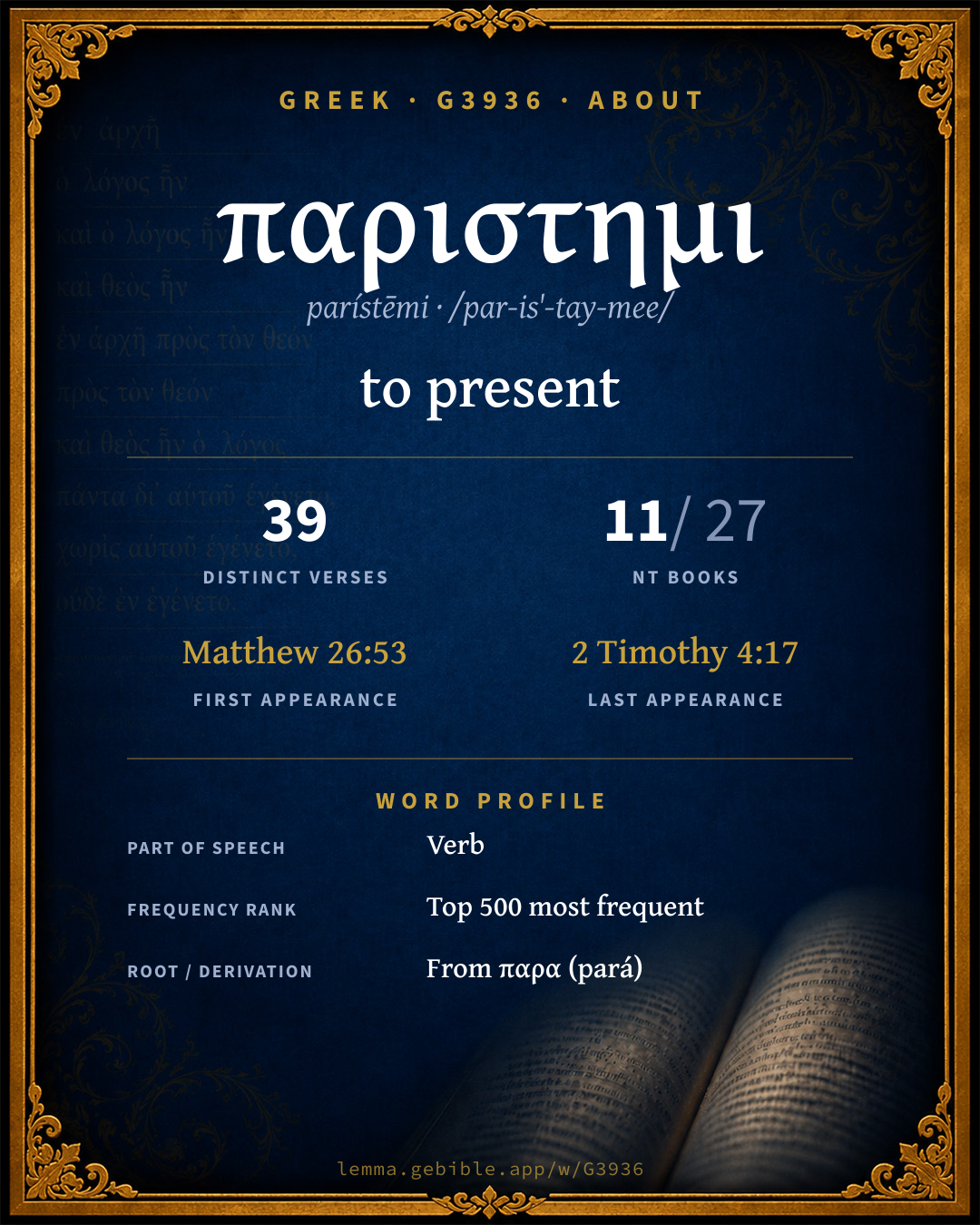
παριστημι
to present
‘to present’ is one of 3 main senses fuller range ↓
Full lexicon entry — Thayer's Greek Lexicon
From Thayer's Greek Lexicon
Where this word appears
See every Aorist-tense verb in the Greek New Testament →
Grammar key — what these labels mean
Part of speech
- Verb
- An action or state-of-being word.
Tense
- Aorist
- Action viewed as a simple whole, without regard to duration — often past (perfective aspect).
- Future
- Action expected in future time.
- Perfect
- A completed past action with continuing present results.
- Pluperfect
- A past action completed before another past point (“had written”).
- Present
- Ongoing or general action in present time (imperfective aspect).
Voice
- Active
- The subject performs the action.
- Middle deponent
- Middle in form but active in meaning.
Mood
- Infinitive
- A verbal noun (“to write”), unmarked for person or number.
- Indicative
- States a fact or asks a factual question (the mood of reality).
- Participle
- A verbal adjective (“writing,” “having written”).
- Imperative
- Expresses a command or request.
- Subjunctive
- Expresses probability, purpose, or possibility (the mood of contingency).
Case
- Dative
- The case of the indirect object, means, or location — “to / for / with / in.”
- Nominative
- The case of the subject (and the predicate nominative).
- Genitive
- The case of source, possession, or “of” — answers “whose / from what.”
- Accusative
- The case of the direct object and of extent.
Person
- 3rd person
- The one spoken about (“he / she / it / they”).
- 2nd person
- The one addressed (“you”).
- 1st person
- The speaker (“I / we”).
Gender
- Masculine
- Grammatically masculine.
Number
- Plural
- More than one.
- Singular
- One.
Grammatical forms 19 distinct
- Verb, Aorist, Active, Infinitive 8 times (20%)
- Verb, Aorist, Active, Indicative, 3rd person, Singular 4 times (10%)
- Verb, Aorist, Active, Indicative, 3rd person, Plural 3 times (7%)
- Verb, Future, Active, Indicative, 3rd person, Singular 3 times (7%)
- Verb, Perfect, Active, Participle, Dative, Plural, Masculine 3 times (7%)
- Verb, Perfect, Active, Participle, Nominative, Singular, Masculine 3 times (7%)
- Verb, Aorist, Active, Imperative, 2nd person, Plural 2 times (5%)
- Verb, Perfect, Active, Indicative, 3rd person, Singular 2 times (5%)
+11 more forms (13 occurrences)
Parsed forms decoded from the imported morphology (Robinson–Tischendorf, public domain), counted across 41 parsed occurrences — not distinct verses.
Every verse where G3936 appears — 39 distinct verses across 11 books. Click any verse to open its interlinear word-by-word view. Verse text shown in the World English Bible for context — . Each verse’s Greek form is shown with its reference; the English is not keyword-highlighted, since the data carries no word-level English alignment. Use “Compare translations” on any verse to read it across multiple English versions. This concordance covers the Greek New Testament; Septuagint (Greek Old Testament) occurrences of this word are not indexed here.
Matthew 1 verse
Mark 6 verses
- Mark 4:29 παρέστηκεν perf act ind 3sg But when the fruit is ripe, immediately he puts forth the sickle, because the harvest has come."
- Mark 14:47 παρεστηκότων perf act ptcp gen pl masc But a certain one of those who stood by drew his sword, and struck the servant of the high priest, and cut off his ear.
- Mark 14:69 παρεστῶσιν perf act ptcp dat pl masc The maid saw him, and began again to tell those who stood by, "This is one of them."
- Mark 14:70 παρεστῶτες perf act ptcp nom pl masc But he again denied it. After a little while again those who stood by said to Peter, "You truly are one of them, for you are a Galilean, and your speech shows it."
- Mark 15:35 παρεστώτων perf act ptcp gen pl masc Some of those who stood by, when they heard it, said, "Behold, he is calling Elijah."
- Mark 15:39 παρεστηκὼς perf act ptcp nom sg masc When the centurion, who stood by opposite him, saw that he cried out like this and breathed his last, he said, "Truly this man was the Son of God!"
Luke 3 verses
- Luke 1:19 παρεστηκὼς perf act ptcp nom sg masc The angel answered him, "I am Gabriel, who stands in the presence of God. I was sent to speak to you, and to bring you this good news.
- Luke 2:22 παραστῆσαι aor act inf When the days of their purification according to the law of Moses were fulfilled, they brought him up to Jerusalem, to present him to the Lord
- Luke 19:24 παρεστῶσιν perf act ptcp dat pl masc He said to those who stood by, 'Take the mina away from him, and give it to him who has the ten minas.'
John 2 verses
- John 18:22 παρεστηκὼς perf act ptcp nom sg masc When he had said this, one of the officers standing by slapped Jesus with his hand, saying, "Do you answer the high priest like that?"
- John 19:26 παρεστῶτα perf act ptcp acc sg masc Therefore when Jesus saw his mother, and the disciple whom he loved standing there, he said to his mother, "Woman, behold your son!"
Acts 13 verses
- Acts 1:3 παρέστησεν aor act ind 3sg To these he also showed himself alive after he suffered, by many proofs, appearing to them over a period of forty days, and speaking about God's Kingdom.
- Acts 1:10 παρειστήκεισαν plup act ind 3pl While they were looking steadfastly into the sky as he went, behold, two men stood by them in white clothing,
- Acts 4:10 παρέστηκεν perf act ind 3sg be it known to you all, and to all the people of Israel, that in the name of Jesus Christ of Nazareth, whom you crucified, whom God raised from the dead, in him does this man stand here before you whole.
- Acts 4:26 παρέστησαν aor act ind 3pl The kings of the earth take a stand, And the rulers take council together, Against the Lord, and against his Christ.'
- Acts 9:39 παρέστησαν aor act ind 3pl Peter got up and went with them. When he had come, they brought him into the upper chamber. All the widows stood by him weeping, and showing the coats and garments which Dorcas had made while she was with them.
- Acts 9:41 παρέστησεν aor act ind 3sg He gave her his hand, and raised her up. Calling the saints and widows, he presented her alive.
- Acts 23:2 παρεστῶσιν perf act ptcp dat pl masc The high priest, Ananias, commanded those who stood by him to strike him on the mouth.
- Acts 23:4 παρεστῶτες perf act ptcp nom pl masc Those who stood by said, "Do you malign God's high priest?"
- Acts 23:24 παραστῆσαι aor act inf He asked them to provide animals, that they might set Paul on one, and bring him safely to Felix the governor.
- Acts 23:33 παρέστησαν aor act ind 3pl When they came to Caesarea and delivered the letter to the governor, they also presented Paul to him.
- Acts 24:13 παραστῆσαι aor act inf Nor can they prove to you the things of which they now accuse me.
- Acts 27:23 παρέστη aor act ind 3sg For there stood by me this night an angel, belonging to the God whose I am and whom I serve,
- Acts 27:24 παραστῆναι aor act inf saying, 'Don't be afraid, Paul. You must stand before Caesar. Behold, God has granted you all those who sail with you.'
Romans 6 verses
- Romans 6:13 παριστάνετε παραστήσατε pres act impv 2pl aor act impv 2pl Neither present your members to sin as instruments of unrighteousness, but present yourselves to God, as alive from the dead, and your members as instruments of righteousness to God.
- Romans 6:16 παριστάνετε pres act ind 2pl Don't you know that to whom you present yourselves as servants to obedience, his servants you are whom you obey; whether of sin to death, or of obedience to righteousness?
- Romans 6:19 παρεστήσατε παραστήσατε aor act ind 2pl aor act impv 2pl I speak in human terms because of the weakness of your flesh, for as you presented your members as servants to uncleanness and to wickedness upon wickedness, even so now present your members as servants to righteousness for sanctification.
- Romans 12:1 παραστῆσαι aor act inf Therefore I urge you, brothers, by the mercies of God, to present your bodies a living sacrifice, holy, acceptable to God, which is your spiritual service.
- Romans 14:10 παραστησόμεθα fut mid.dep ind 1pl But you, why do you judge your brother? Or you again, why do you despise your brother? For we will all stand before the judgment seat of Christ.
- Romans 16:2 παραστῆτε aor act subj 2pl that you receive her in the Lord, in a way worthy of the saints, and that you assist her in whatever matter she may need from you, for she herself also has been a helper of many, and of my own self.
1 Corinthians 1 verse
2 Corinthians 2 verses
- 2 Corinthians 4:14 παραστήσει fut act ind 3sg knowing that he who raised the Lord Jesus will raise us also with Jesus, and will present us with you.
- 2 Corinthians 11:2 παραστῆσαι aor act inf For I am jealous over you with a godly jealousy. For I married you to one husband, that I might present you as a pure virgin to Christ.
Ephesians 1 verse
Colossians 2 verses
- Colossians 1:22 παραστῆσαι aor act inf yet now he has reconciled in the body of his flesh through death, to present you holy and without blemish and blameless before him,
- Colossians 1:28 παραστήσωμεν aor act subj 1pl whom we proclaim, admonishing every man and teaching every man in all wisdom, that we may present every man perfect in Christ Jesus;
2 Timothy 2 verses
- 2 Timothy 2:15 παραστῆσαι aor act inf Give diligence to present yourself approved by God, a workman who doesn't need to be ashamed, properly handling the Word of Truth.
- 2 Timothy 4:17 παρέστη aor act ind 3sg But the Lord stood by me, and strengthened me, that through me the message might be fully proclaimed, and that all the Gentiles might hear; and I was delivered out of the mouth of the lion.
About this entry
At a glance — auto-summarized from this page’s data, not written by a person. Every figure links to its source below. This summary describes the numbers; it doesn’t interpret them.
“to present” is the headline sense of the Greek verb παριστημι (parístēmi). Scripture first uses it in Matthew 26:53. It appears 39 verses across 11 books of the Greek New Testament, among its moderately common vocabulary. More than a third of its appearances fall in Acts. Catalogued under 3 senses, its meaning is not single-sense. The sections below give every sense, occurrence, and version rendering.
Gloss history
Strong's 1890 vs modern scholarship

About this word
Strong's G3936 catalogs a Greek word from the Greek New Testament.
These counts are not copied from any lexicon or concordance. They are computed here, from the morphology-tagged Greek New Testament. What Lemma adds →
- 39
- distinct verses
- The word appears in 39 distinct verses.
- 11 / 27
- NT books
- The word appears in 11 of 27 New Testament books.
- #364
- by frequency
- Top 500 most frequent Greek words (rank 364 of 5,347 Greek words by occurrence).
View all 39 occurrences in the concordance →
By section of the New Testament
By traditional corpus
Conventional, traditional groupings — biblical authorship is debated, so this is a traditional corpus grouping, not an authorship claim. Some books belong to more than one corpus (Luke is in both the Gospels and the Lukan corpus, and so on), so these shares overlap and need not total 100%. Each figure is a share of the word’s 39 distinct verses.
- Lukan (Luke–Acts) 16 verses · 41%
- Pauline corpus 14 verses · 36%
- Gospels 12 verses · 31%
- Johannine 2 verses · 5%
How translations render this word
Counts come from each version’s own published word-to-Strong’s tagging or interlinear alignment — an approximate guide to how each version renders this word, not a word-level alignment the data otherwise carries. Because each total is that version’s own tagged count, the per-version totals vary from one another and need not match the appearance or distinct-verse counts above. These counts may also differ from a printed concordance because Lemma counts each distinctly tagged rendering and does not collapse phrase taggings into a single head-word total. This is a fixed set of word-tagged versions (KJV, ASV, BSB, ULT) and does not change with the reading translation you choose elsewhere. Each version’s license is shown beside its name below (and on Sources).
- King James Version: Stood by 9×, Present 2×, Presented 2×
- American Standard Version: Stood by 8×, Present 7×, Stood 3×
- Berean Standard Bible: Present 8×, Standing nearby 6×, Offer 2×
- unfoldingWord Literal Text: Present 7×, Standing by 4×, Having stood by 2×
King James Version Public Domain
Renders G3936 across 43 tagged occurrences — most commonly:
Plus 24 renderings that appear only once — usually multi-word phrases or single function words the recovered tagging swept in, not distinct renderings.
American Standard Version Public Domain
Renders G3936 across 41 tagged occurrences — most commonly:
Plus 19 renderings that appear only once — usually multi-word phrases or single function words the recovered tagging swept in, not distinct renderings.
Berean Standard Bible Public Domain
Renders G3936 across 41 tagged occurrences — most commonly:
Plus 21 renderings that appear only once — usually multi-word phrases or single function words the recovered tagging swept in, not distinct renderings.
unfoldingWord Literal Text CC BY-SA 4.0
Renders G3936 across 50 tagged occurrences — most commonly:
Plus 31 renderings that appear only once — usually multi-word phrases or single function words the recovered tagging swept in, not distinct renderings.
Senses in Thayer's
The 3 senses Thayer's distinguishes for this word, in lexicon order (not ranked by frequency or importance). The full entry — with sub-senses — is in the Lexicon Entry tab.
- to set at hand
- to present (show) by argument, to prove
- to stand beside, stand by or near, to be at hand, be present
Word origin
Derived from παρα (pará) (G3844) — from.
From G3488 and G2476 ; to stand beside that is (transitively) to exhibit proffer (specifically) recommend (figuratively) substantiate ; or (intransitively) to be at hand (or ready ) aid : - assist bring before command commend give presently present prove provide shew stand (before by here up with) yield.
— Strong’s Exhaustive Concordance (1890), public domain.
Forms in the corpus
The 21 distinct written forms G3936 takes in the Greek New Testament, most frequent first — each parse links to that tense’s occurrences in the concordance.
Same root — word family
Other Thayer's entries built from the same root as G3936, grouped by Strong’s listed origin. These share a root / origin per the lexicon — not necessarily a shared meaning. Each links to that word’s own entry.
Derives from
Shares the same root
- παραβαινω parabaínō G3845 to neglect
- παραβαλλω parabállō G3846 to place beside
- παραβιαζομαι parabiázomai G3849 to compel
- παραβουλευομαι parabouleúomai G3851 to consult wrongly
- παραγγελλω parangéllō G3853 to announce
- παραγινομαι paragínomai G3854 to appear
- παραγω parágō G3855 to pass by
- παραδειγματιζω paradeigmatízō G3856 to make example
- παραδεχομαι paradéchomai G3858 to receive
- παραδιατριβη paradiatribḗ G3859 empty business
- παραδιδωμι paradídōmi G3860 to deliver
- παραδοξος parádoxos G3861 strange
- παραζηλοω parazēlóō G3863 to provoke
- παραθαλασσιος parathalássios G3864 by the sea
- παραθεωρεω paratheōréō G3865 to compare
- παραινεω parainéō G3867 to exhort
- παραιτεομαι paraitéomai G3868 to beg pardon
- παρακαθιζω parakathízō G3869 to sit beside
- παρακαλεω parakaléō G3870 to call beside
- παρακαλυπτω parakalýptō G3871 to cover up
- παρακαταθηκη parakatathḗkē G3872 deposit
- παρακειμαι parákeimai G3873 to lie beside
- παρακολουθεω parakolouthéō G3877 to follow after
- παρακουω parakoúō G3878 to disobey
+51 more words share this root (not shown).
Proper names from this root
People and places named from this root — a name, not an additional meaning of the word.
Compare all same-root words → Showing 4 of 78 — not the complete family. 1 of the same-root words is a proper name (a person or place). They share a root, not necessarily a meaning.
Septuagint usage
The same Greek word παριστημι appears 70 times in the Greek Old Testament (Septuagint), across 66 verses in 19 books.
- 70
- LXX occurrences
- Tagged occurrences of this Greek word in the Septuagint.
- 66
- verses
- Distinct Septuagint verses containing this word.
- 19 / 39
- OT books
- The word appears in 19 of the 39 Old Testament books.
Sample Septuagint occurrences
- Genesis 18:8 παραἵστημι
- Exodus 9:31 παραἵστημι
- Numbers 1:5 παραἵστημι
- Deuteronomy 1:38 παραἵστημι
- Judges 20:28 παραἵστημι
- 1 Samuel 4:20 παραἵστημι
- 1 Kings 1:2 παραἵστημι
- 2 Kings 3:14 παραἵστημι
- 2 Chronicles 6:3 παραἵστημι
- Esther 4:5 παραἵστημι
- Job 1:6 παραἵστημι
- Psalms 2:2 παραἵστημι
Septuagint occurrences (same lexeme)
Every verse where the same Strong’s number (G3936) appears in the Greek Septuagint — showing the first 50 of 66. Verse text shown in the World English Bible for context; the Greek form is the matched word — the English is not keyword-highlighted.
- Genesis 18:8 παραἵστημι He took butter, milk, and the calf which he had dressed, and set it before them. He stood by them under the tree, and they ate.
- Genesis 40:4 παραἵστημι The captain of the guard assigned them to Joseph, and he took care of them. They stayed in prison many days.
- Genesis 45:1 παραἵστημι Then Joseph couldn't control himself before all those who stood before him, and he cried, "Cause every man to go out from me!" There stood no man with him, while Joseph made himself known to his brothers.
- Exodus 9:31 παραἵστημι The flax and the barley were struck, for the barley was in the ear, and the flax was in bloom.
- Exodus 18:13 παραἵστημι It happened on the next day, that Moses sat to judge the people, and the people stood around Moses from the morning to the evening.
- Exodus 18:14 παραἵστημι When Moses' father-in-law saw all that he did to the people, he said, "What is this thing that you do for the people? Why do you sit alone, and all the people stand around you from morning to evening?"
- Exodus 18:23 παραἵστημι If you will do this thing, and God commands you so, then you will be able to endure, and all of these people also will go to their place in peace."
- Exodus 19:17 παραἵστημι Moses led the people out of the camp to meet God; and they stood at the lower part of the mountain.
- Exodus 24:13 παραἵστημι Moses rose up with Joshua, his servant, and Moses went up onto God's Mountain.
- Exodus 34:5 παραἵστημι Yahweh descended in the cloud, and stood with him there, and proclaimed the name of Yahweh.
- Numbers 1:5 παραἵστημι These are the names of the men who shall stand with you: Of Reuben: Elizur the son of Shedeur.
- Numbers 7:2 παραἵστημι that the princes of Israel, the heads of their fathers' houses, offered. These were the princes of the tribes. These are they who were over those who were numbered:
- Numbers 11:28 παραἵστημι Joshua the son of Nun, the minister of Moses, one of his chosen men, answered, My lord Moses, forbid them.
- Numbers 16:9 παραἵστημι [seems it but] a small thing to you, that the God of Israel has separated you from the congregation of Israel, to bring you near to himself, to do the service of the tent of Yahweh, and to stand before the congregation to minister to them;
- Numbers 23:3 παραἵστημι Balaam said to Balak, Stand by your burnt offering, and I will go: perhaps Yahweh will come to meet me; and whatever he shows me I will tell you. He went to a bare height.
- Numbers 23:15 παραἵστημι He said to Balak, Stand here by your burnt offering, while I meet [Yahweh] yonder.
- Deuteronomy 1:38 παραἵστημι Joshua the son of Nun, who stands before you, he shall go in there: encourage you him; for he shall cause Israel to inherit it.
- Deuteronomy 10:8 παραἵστημι At that time Yahweh set apart the tribe of Levi, to bear the ark of the covenant of Yahweh, to stand before Yahweh to minister to him, and to bless in his name, to this day.
- Deuteronomy 17:12 παραἵστημι The man who does presumptuously, in not listening to the priest who stands to minister there before Yahweh your God, or to the judge, even that man shall die: and you shall put away the evil from Israel.
- Deuteronomy 18:5 παραἵστημι For Yahweh your God has chosen him out of all your tribes, to stand to minister in the name of Yahweh, him and his sons for ever.
- Deuteronomy 18:7 παραἵστημι then he shall minister in the name of Yahweh his God, as all his brothers the Levites do, who stand there before Yahweh.
- Deuteronomy 21:5 παραἵστημι The priests the sons of Levi shall come near; for them Yahweh your God has chosen to minister to him, and to bless in the name of Yahweh; and according to their word shall every controversy and every stroke be.
- Judges 20:28 παραἵστημι and Phinehas, the son of Eleazar, the son of Aaron, stood before it in those days), saying, Shall I yet again go out to battle against the children of Benjamin my brother, or shall I cease? Yahweh said, Go up; for tomorrow I will deliver him into your hand.
- 1 Samuel 4:20 παραἵστημι About the time of her death the women who stood by her said to her, Don't be afraid; for you have brought forth a son. But she didn't answer, neither did she regard it.
- 1 Samuel 5:2 παραἵστημι The Philistines took the ark of God, and brought it into the house of Dagon, and set it by Dagon.
- 1 Samuel 16:21 παραἵστημι David came to Saul, and stood before him: and he loved him greatly; and he became his armor bearer.
- 1 Samuel 16:22 παραἵστημι Saul sent to Jesse, saying, Please let David stand before me; for he has found favor in my sight.
- 1 Samuel 22:6 παραἵστημι Saul heard that David was discovered, and the men who were with him: now Saul was sitting in Gibeah, under the tamarisk tree in Ramah, with his spear in his hand, and all his servants were standing about him.
- 1 Samuel 22:7 παραἵστημι Saul said to his servants who stood about him, Hear now, you Benjamites; will the son of Jesse give everyone of you fields and vineyards, will he make you all captains of thousands and captains of hundreds,
- 1 Samuel 25:27 παραἵστημι Now this present which your servant has brought to my lord, let it be given to the young men who follow my lord.
- 1 Kings 1:2 παραἵστημι Therefore his servants said to him, Let there be sought for my lord the king a young virgin: and let her stand before the king, and cherish him; and let her lie in your bosom, that my lord the king may keep warm.
- 1 Kings 10:8 παραἵστημι Happy are your men, happy are these your servants, who stand continually before you, [and] who hear your wisdom.
- 1 Kings 12:6 παραἵστημι King Rehoboam took counsel with the old men, who had stood before Solomon his father while he yet lived, saying, What counsel give you me to return answer to this people?
- 1 Kings 12:8 παραἵστημι But he forsook the counsel of the old men which they had given him, and took counsel with the young men who had grown up with him, who stood before him.
- 1 Kings 12:10 παραἵστημι The young men who had grown up with him spoke to him, saying, Thus shall you tell this people who spoke to you, saying, Your father made our yoke heavy, but make you it lighter to us; thus shall you speak to them, My little finger is thicker than my father's loins.
- 1 Kings 12:32 παραἵστημι Jeroboam ordained a feast in the eighth month, on the fifteenth day of the month, like the feast that is in Judah, and he went up to the altar; so did he in Bethel, sacrificing to the calves that he had made: and he placed in Bethel the priests of the high places that he had made.
- 1 Kings 17:1 παραἵστημι Elijah the Tishbite, who was of the foreigners of Gilead, said to Ahab, As Yahweh, the God of Israel, lives, before whom I stand, there shall not be dew nor rain these years, but according to my word.
- 1 Kings 18:15 παραἵστημι Elijah said, As Yahweh of Hosts lives, before whom I stand, I will surely show myself to him today.
- 2 Kings 3:14 παραἵστημι Elisha said, As Yahweh of Hosts lives, before whom I stand, surely, were it not that I regard the presence of Jehoshaphat the king of Judah, I would not look toward you, nor see you.
- 2 Kings 5:16 παραἵστημι But he said, As Yahweh lives, before whom I stand, I will receive none. He urged him to take it; but he refused.
- 2 Kings 8:11 παραἵστημι He settled his gaze steadfastly [on him], until he was ashamed: and the man of God wept.
- 2 Chronicles 6:3 παραἵστημι The king turned his face, and blessed all the assembly of Israel: and all the assembly of Israel stood.
- 2 Chronicles 9:7 παραἵστημι Happy are your men, and happy are these your servants, who stand continually before you, and hear your wisdom.
- Esther 4:5 παραἵστημι Then called Esther for Hathach, one of the king's chamberlains, whom he had appointed to attend on her, and charged him to go to Mordecai, to know what this was, and why it was.
- Esther 8:4 παραἵστημι Then the king held out to Esther the golden scepter. So Esther arose, and stood before the king.
- Job 1:6 παραἵστημι Now it happened on the day when the sons of God came to present themselves before Yahweh, that Satan also came among them.
- Job 2:1 παραἵστημι Again it happened on the day when the sons of God came to present themselves before Yahweh, that Satan came also among them to present himself before Yahweh.
- Job 37:20 παραἵστημι Shall it be told him that I would speak? Or should a man wish that he were swallowed up?
- Psalms 2:2 παραἵστημι The kings of the earth take a stand, And the rulers take counsel together, Against Yahweh, and against his anointed, saying,
- Psalms 5:4 παραἵστημι For you are not a God who has pleasure in wickedness. Evil can't live with you.
These are occurrences of the same Greek lexeme (G3936) in the Septuagint — not a translation of any one Hebrew word. The store carries no word-level Hebrew↔Greek alignment, so no Hebrew original is asserted here. Counts come from the recovered LXX Strong's tagging — high-frequency vocabulary is well covered, while rare or late forms may be untagged — so they reflect tagged occurrences and may slightly undercount.