2 Timothy 2:15

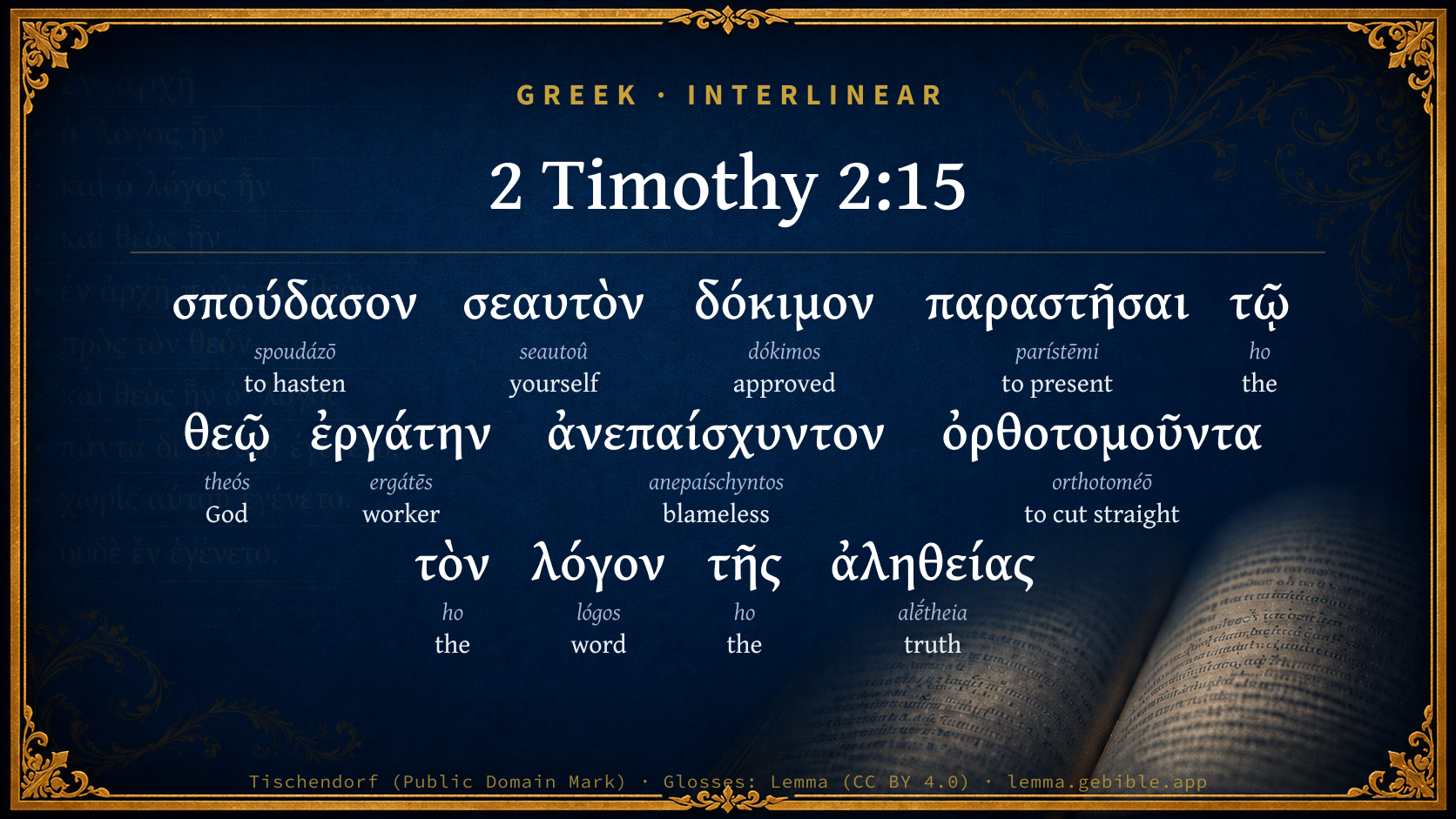
Greek (Tischendorf 8th ed.) 2 Timothy 2:15 appears in the Greek New Testament. The text above is from the Tischendorf 8th edition. Each word links to its Strong’s number and a concise gloss. Click any word for its full Thayer’s Greek Lexicon entry.
Download image
Cite this verse

2 Timothy 2:15 (World English Bible). Public Domain. Lemma interlinear Bible study tool, https://lemma.gebible.app/v/2-timothy/2/15.

Show BibTeX & RIS
BibTeX
RIS
English Translation
Give diligence to present yourself approved by God, a workman who doesn't need to be ashamed, properly handling the Word of Truth.
World English Bible · Public Domain
Highlights
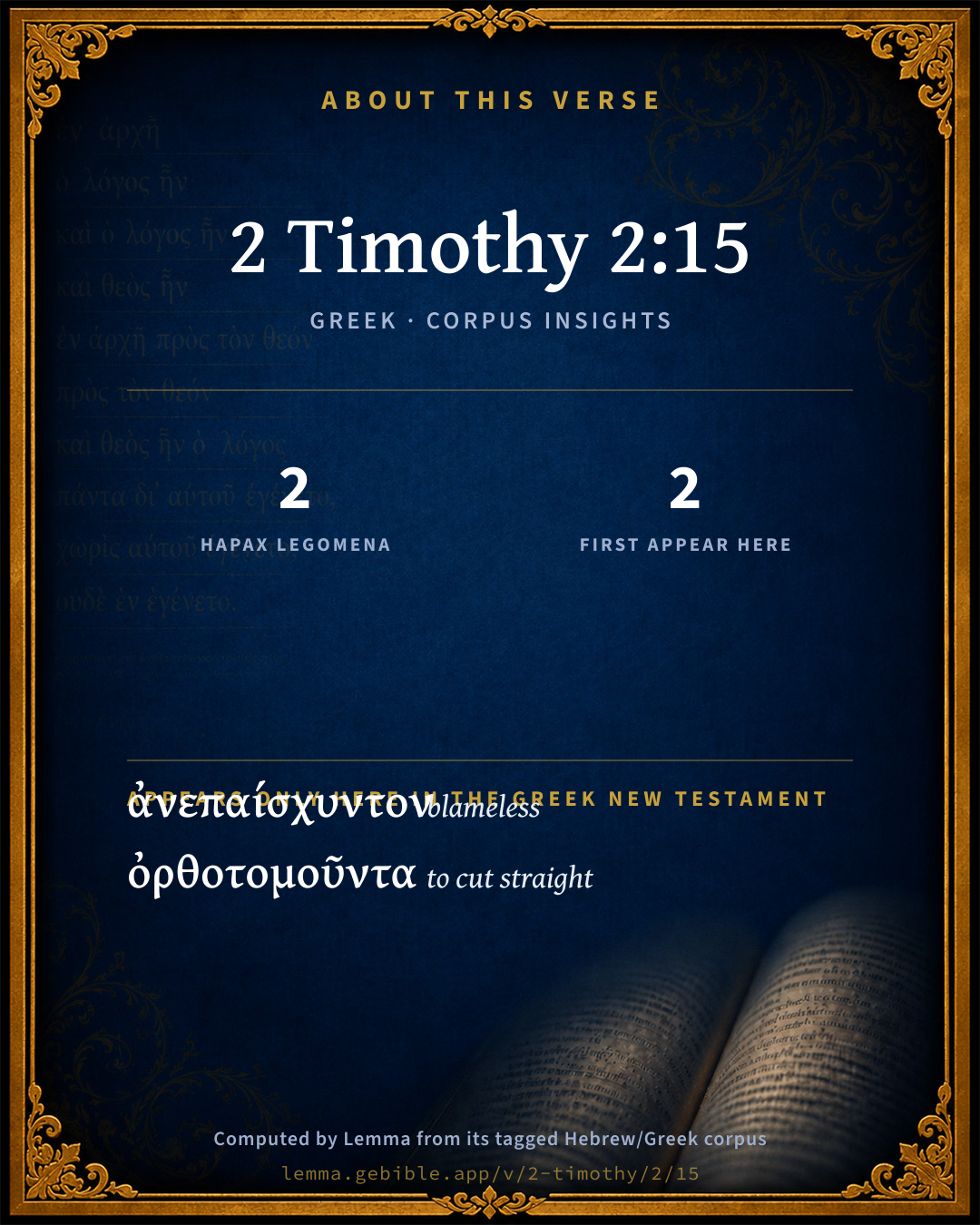
  • 2 hapax legomena — only here in the Greek New Testament
  • 2 first appearances in the Greek New Testament
Full analysis ↓
Download a study sheet

One document with this verse’s original text, its word-by-word gloss line, the meaning frame, cross-references with their text, attributed commentary, and full source and license credits — printable, and it pastes into notes with its structure intact.

This verse Autodidact and up

Study sheet (.html) Plain text (.txt)

A passage Seminary Student

Up to 50 verses in one chapter. A passage sheet keeps up to 6 commentary sources and 12 cross-references per verse, in the order this page ranks them, and says so on the sheet whenever that leaves anything out. Ask for a single verse and you get the Autodidact verse sheet above.

Everything on this page stays free to read, with no account — the sheet is a download of what is already on screen, not access to it.

Want to remove ads? Support Godless Engineer
Compare translations 3

The same verse in 3 English versions, stacked beneath the original-language interlinear above. Click any original word for its lexicon entry.

Each is an independent rendering of the whole verse — the interlinear is not word-aligned to these translations.

Highlighted words mark where these versions differ — a whole-verse word diff, not a word-by-word alignment.

  • World English Bible Public Domain
    Give diligence to present yourself approved by God, a workman who doesn't need to be ashamed, properly handling the Word of Truth.
  • King James Version Public Domain
    Study to shew thyself approved unto God, a workman that needeth not to be ashamed, rightly dividing the word of truth.
  • unfoldingWord Literal Text CC BY-SA 4.0
    Strive to present yourself approved to God, a worker not ashamed, cutting the word of truth straight.

unfoldingWord Literal Text — © unfoldingWord, licensed CC BY-SA 4.0. Word-aligned USFM3 via Door43 (git.door43.org/unfoldingWord/en_ult).

Versions to compare (up to 4)

3 of 4 selected

Show all 19 translations

Every available English version of this verse, each an independent rendering of the whole verse.

  • World English Bible Public Domain
    Give diligence to present yourself approved by God, a workman who doesn't need to be ashamed, properly handling the Word of Truth.
  • Berean Standard Bible Public Domain
    Make every effort to present yourself approved to God, an unashamed workman who accurately handles the word of truth.
  • Majority Standard Bible Public Domain
    Make every effort to present yourself approved to God, an unashamed workman who accurately handles the word of truth.
  • King James Version Public Domain
    Study to shew thyself approved unto God, a workman that needeth not to be ashamed, rightly dividing the word of truth.
  • American Standard Version (1901) Public Domain
    Give diligence to present thyself approved unto God, a workman that needeth not to be ashamed, handling aright the word of truth.
  • Revised Version (1885) Public Domain
    Give diligence to present thyself approved unto God, a workman that needeth not to be ashamed, handling aright the word of truth.
  • Geneva Bible (1599) Public Domain
    Studie to shewe thy selfe approued vnto God, a workeman that needeth not to be ashamed, diuiding the worde of trueth aright.
  • Douay-Rheims (1899) Public Domain
    Carefully study to present thyself approved unto God, a workman that needeth not to be ashamed, rightly handling the word of truth.
  • Young's Literal Translation Public Domain
    be diligent to present thyself approved to God -- a workman irreproachable, rightly dividing the word of the truth;
  • Literal Standard Version CC BY-SA 4.0
    be diligent to present yourself approved to God—a workman not ashamed, straightly cutting the word of truth;
  • Unlocked Literal Bible CC BY-SA 4.0
    Do your best to present yourself to God as one approved, a worker who has no reason to be ashamed, who accurately teaches the word of truth.
  • unfoldingWord Literal Text CC BY-SA 4.0
    Strive to present yourself approved to God, a worker not ashamed, cutting the word of truth straight.
  • Darby Bible Public Domain
    Strive diligently to present thyself approved to God, a workman that has not to be ashamed, cutting in a straight line the word of truth.
  • World Messianic Bible Public Domain
    Give diligence to present yourself approved by God, a workman who doesn’t need to be ashamed, properly handling the Word of Truth.
  • Webster's Bible Public Domain
    Study to show thyself approved to God, a workman that needeth not to be ashamed, rightly dividing the word of truth.
  • Free Bible Version CC BY-SA 4.0
    Make sure you work hard so you can present yourself to God and gain his approval. Be a worker that doesn't need to be embarrassed, using the word of truth correctly.
  • Bible in Basic English Public Domain
    Let it be your care to get the approval of God, as a workman who has no cause for shame, giving the true word in the right way.
  • Text-Critical English NT CC BY 4.0
    Be diligent to present yoʋrself to God as a proven worker who does not need to be ashamed and who correctly teaches the word of truth.
  • Tyndale New Testament (1534) Public Domain
    Study to shewe thy silfe laudable vnto god a workman that nedeth not to be a shamed dividynge the worde of trueth iustly.

Literal Standard Version (2020), Covenant Press — licensed CC BY-SA 4.0. Text via the HelloAO Bible API (eBible.org). Unlocked Literal Bible (unfoldingWord) — licensed CC BY-SA 4.0. Text via the HelloAO Bible API (eBible.org). unfoldingWord Literal Text — © unfoldingWord, licensed CC BY-SA 4.0. Word-aligned USFM3 via Door43 (git.door43.org/unfoldingWord/en_ult). Free Bible Version, Dr. Jonathan Gallagher — licensed CC BY-SA 4.0. Text via the HelloAO Bible API (eBible.org).

Word by word

More ways to search: Search by grammar → Find every occurrence → Compare this word →

Practice this passage: Drill this verse → Learn its vocabulary →

ἀνεπαίσχυντον
anepaíschyntos
G422
“blameless”
Adjective, Accusative, Singular, Masculine
Part of Speech
Adjective
Case
Accusative
Number
Singular
Gender
Masculine
Full Thayer's Definition

Origin: from G1 (as a negative particle) and a presumed derivative of a compound of G1909 and G153

TDNT: None

1. having no cause to be ashamed
  1. σπούδασον spoudázō G4704 “to hasten” Verb, Aorist, Active, Imperative, 2nd person, Singular
  2. σεαυτὸν seautoû G4572 “yourself” Reflexive pronoun, 2nd person, Accusative, Singular, Masculine
  3. δόκιμον dókimos G1384 “approved” Adjective, Accusative, Singular, Masculine
  4. παραστῆσαι parístēmi G3936 “to present” Verb, Aorist, Active, Infinitive
  5. τῷ ho G3588 “the” Article, Dative, Singular, Masculine
  6. θεῷ theós G2316 “God” Noun, Dative, Singular, Masculine
  7. ἐργάτην ergátēs G2040 “worker” Noun, Accusative, Singular, Masculine
  8. ὀρθοτομοῦντα orthotoméō G3718 “to cut straight” Verb, Present, Active, Participle, Accusative, Singular, Masculine
  9. τὸν ho G3588 “the” Article, Accusative, Singular, Masculine
  10. λόγον lógos G3056 “word” Noun, Accusative, Singular, Masculine
  11. τῆς ho G3588 “the” Article, Genitive, Singular, Feminine
  12. ἀληθείας alḗtheia G225 “truth” Noun, Genitive, Singular, Feminine

About this verse

These counts appear in no published source. They are computed here, from the morphology-tagged text and Lemma’s own curated glosses. What Lemma adds →

13
words
11
distinct lemmas
Pauline Epistles
section

Notable vocabulary

2 hapax legomena — words that appear only here in the entire Greek New Testament:

  • ἀνεπαίσχυντον blameless G422
  • ὀρθοτομοῦντα to cut straight G3718

First appearance in Scripture

These words make their first canonical appearance in the Greek New Testament here:

  • ἀνεπαίσχυντον blameless G422
  • ὀρθοτομοῦντα to cut straight G3718

Shared distinctive vocabulary

δόκιμον approved G1384 occurs in 7 verses of the Greek New Testament. Also found in:

Repetition

A word recurs within this verse:

Cross-references

27

Topical passages linked to 2 Timothy 2:15 in the Treasury of Scripture Knowledge — connected by theme and wording, ordered by reader-vote popularity; previews shown in the World English Bible.

  • 1 Thessalonians 2:4 But even as we have been approved by God to be entrusted with the Gospel, so we speak; not as pleasing men, but God, who tests our hearts.
  • 2 Peter 1:10 Therefore, brothers, be more diligent to make your calling and election sure. For if you do these things, you will never stumble.
  • 1 Timothy 4:6 If you instruct the brothers of these things, you will be a good servant of Christ Jesus, nourished in the words of the faith, and of the good doctrine which you have followed.
  • 2 Corinthians 10:18 For it isn't he who commends himself who is approved, but whom the Lord commends.
  • 2 Corinthians 5:9 Therefore also we make it our aim, whether at home or absent, to be well pleasing to him.
  • 1 Timothy 4:12–16 Let no man despise your youth; but be an example to those who believe, in word, in your way of life, in love, in spirit, in faith, and in purity.
  • 2 Peter 3:14 Therefore, beloved, seeing that you look for these things, be diligent to be found in peace, without blemish and blameless in his sight.
  • Galatians 1:10 For am I now seeking the favor of men, or of God? Or am I striving to please men? For if I were still pleasing men, I wouldn't be a servant of Christ.
  • 2 Corinthians 4:2 But we have renounced the hidden things of shame, not walking in craftiness, nor handling the word of God deceitfully; but by the manifestation of the truth commending ourselves to every man's conscience in the sight of God.
  • 2 Peter 1:15 Yes, I will make every effort that you may always be able to remember these things even after my departure.
  • Hebrews 5:11–14 About him we have many words to say, and hard to interpret, seeing you have become dull of hearing.
  • Ephesians 1:13 in whom you also, having heard the word of the truth, the Gospel of your salvation,--in whom, having also believed, you were sealed with the Holy Spirit of promise,
  • 2 Corinthians 3:6 who also made us sufficient as servants of a new covenant; not of the letter, but of the Spirit. For the letter kills, but the Spirit gives life.
  • Hebrews 4:11 Let us therefore give diligence to enter into that rest, lest anyone fall after the same example of disobedience.
  • Romans 14:18 For he who serves Christ in these things is acceptable to God and approved by men.
  • 1 Thessalonians 5:14 We exhort you, brothers, admonish the disorderly, encourage the fainthearted, support the weak, be patient toward all.
  • 1 Corinthians 2:6 We speak wisdom, however, among those who are full grown; yet a wisdom not of this world, nor of the rulers of this world, who are coming to nothing.
  • Matthew 13:52 He said to them, "Therefore, every scribe who has been made a disciple in the Kingdom of Heaven is like a man who is a householder, who brings out of his treasure new and old things."
  • James 1:18 Of his own will he brought us forth by the word of truth, that we should be a kind of first fruits of his creatures.
  • Acts 2:22 "Men of Israel, hear these words! Jesus of Nazareth, a man approved by God to you by mighty works and wonders and signs which God did by him in the midst of you, even as you yourselves know,
  • 1 Corinthians 3:1–2 Brothers, I couldn't speak to you as to spiritual, but as to fleshly, as to babies in Christ.
  • Luke 12:42 The Lord said, "Who then is the faithful and wise steward, whom his lord will set over his household, to give them their portion of food at the right times?
  • Acts 20:27 for I didn't shrink from declaring to you the whole counsel of God.
  • John 21:15–17 So when they had eaten their breakfast, Jesus said to Simon Peter, "Simon, son of Jonah, do you love me more than these?" He said to him, "Yes, Lord; you know that I have affection for you." He said to him, "Feed my lambs."
  • Romans 16:10 Greet Apelles, the approved in Christ. Greet those who are of the household of Aristobulus.
  • 2 Corinthians 6:3–4 We give no occasion of stumbling in anything, that our service may not be blamed,
  • Mark 4:33 With many such parables he spoke the word to them, as they were able to hear it.

Cross-references courtesy of OpenBible.info (CC BY 4.0).

Commentary

Notes on 2 Timothy 2:15 from classic Christian and Jewish commentators (each source and its license shown beneath its notes). The classic Christian expositions comment on the surrounding passage and are grouped to its opening verse, so a note may address several verses; the Jewish commentaries on the Tanakh (Rashi and others) are per-verse, so they appear only where the commentator wrote on this verse.

Lemma curates 59 commentaries, every one of them public domain or Creative Commons licensed, each selected and text-cleaned for this edition rather than reprinted as found. About our sources →

The Biblical Illustrator

Joseph S. Exell

2Ti_2:15

Study to show thyself approved unto God.

Approved

The word which he uses (σπουδάζειν) is one which scarcely occurs in the New Testament, except in the writings of St. Paul. And the corresponding substantive is also much more common in his Epistles than it is elsewhere. It indicates that ceaseless, serious, earnest zeal, which was one of his chief characteristics. And certainly if the proposed standard is to be reached, or even seriously aimed at, abundance of this zeal will be required. For the end proposed is not the admiration or affection of the congregation, or of ones superiors, nor yet success in influencing and winning souls; but that of presenting ones self to God in such a way as to secure His approval, without fear of incurring the reproach of being a workman who has shirked or scamped his work. The apostles charge is a most wholesome one, and if it is acted upon it secures diligence without fussiness, and enthusiasm without fanaticism. The being approved implies being tried and proved as precious metals are proved before they are accepted as genuine. (A. Plummer, D. D.)

The minister approved of God

I. In what way and manner a minister ought to show himself approved of God. It appears to me that something more is required to convince men that a minister has the smile of God than his own belief. Our text evidently implies that by his work a minister must show that God is with him. In his work four things will be found which tend to show this.

1. Its quality. It must be such as God commands.

2. Its quantity; which shall evince diligence.

3. The difficulties attending its performance; which is the trial of sincerity.

4. The spirit in which it is done. It is a work which requires a spirit of compassion and kindness.

II. What are the signs of a ministers approval of God which should be accepted by persons?

1. I would place conversions as an evidence of Divine approval. They show Divine favour. The moral miracle of a true conversion evinces the Divine presence and power equally with any other miracle.

2. The convictions of truth and duty, which are made by his preaching to the consciences of sinners.

3. The last sign we shall notice of Gods approbation of His minister, is the effects of his preaching on the hearts of them that believe. Those that are spiritual can judge whether his preaching is scriptural. (W. Moore.)

Gods approval

Advert continually to His presence with reverence and godly fear; consider Him as always looking on the heart; trust in His almighty protection; believe in Him as a holy sin-hating God and reconciled to sinners of mankind only in Jesus Christ; value His favour above all the world, and make it the settled sole aim of your lives to approve yourselves to His pure eyes. (T. Adam.)

Desire for Gods approbation

If you were an ambitious man, said a person one day to a minister of talent and education, who was settled in a retired and obscure parish, you would not stay in such a place as this. How do you know that I am not an ambitious man? said the pastor. You do not act like one. I have my plans as well as others--the results may not appear as soon, perhaps. Are you engaged in some great work? I am; but the work does not relate to literature or science. I am not ambitious, perhaps, in the ordinary sense of the term. I do not desire to occupy the high places of the earth, but I do desire to get near my Masters throne in glory. I care but little for popular applause, but I desire to secure the approbation of God. The salvation of souls is the work He is most interested in, and to the successful prosecution of which He has promised the largest rewards. (H. L. Hastings.)

Vibration in unison

Something is the matter with your telephone; we can hardly hear you, was the response, that in a faint voice came to us from the Central Office when we had answered their signal ring with the usual Halloo! A few minutes afterwards a young man from head-quarters stepped into our study, and taking the telephone in his hand commenced to investigate. Yes, here it is, he exclaimed, as he began to unscrew the ear-piece. The diaphragm is bulged, and dust has collected around it to such an extent that it does not vibrate in unison with ours up in the office, and that spoils the sound. You see, he added, while brushing the instrument, that the telephones at both ends of the wire must act in harmony or there will be no voice. There, he said, it is all right now. And sure enough the lowest word could be distinctly heard, There was, of course, nothing remarkable in this incident, and yet the words vibrate in unison, must act in harmony or there will be no voice, suggested higher thoughts as well. The human heart is Gods telephone in man. Through it He purposes to speak to our inner consciousness; and when our conscience, our affections, and our desires vibrate in unison with the breath of His lips we can hear His voice within us.

A workman that needeth not to be ashamed.

The single word which represents that needeth not to be ashamed (ἀνεπαίσχυντος). is a rare formation, which occurs nowhere else in the New Testament. Its precise meaning is not quite certain. The more simple and frequent form (ἀναίσχυντος) means shameless, i.e., one who does not feel shame when he ought to do so. Such a meaning, if taken literally, would be utterly unsuitable here. And we then have choice of two interpretations, either

(1) that which is adopted in both A.V. and R.V., who need not feel shame, because his work will bear examination, or

(2) who does not feel shame, although his work is of a kind which the world holds in contempt. The latter is the interpretation which Chrysostom adopts, and there is much to be said in its favour. Three times already in this letter has the apostle spoken of not being ashamed of the gospel (2Ti_1:8; 2Ti_1:12; 2Ti_1:16). Does he not, therefore, mean here also, Present thyself to God as a workman who is not ashamed of being in His service and of doing whatever work may be assigned to him? This brings us very close to what would be the natural meaning of the word, according to the analogy of the simpler form. If you are to work for God, says Paul, you must be in a certain sense shameless. There are some men who set public opinion at defiance, in order that they may follow their own depraved desires. The Christian minister must be prepared sometimes to set public opinion at defiance, in order flint he may follow the commands of God. The vox populi, even when taken in its most comprehensive sense, is anything but an infallible guide. Public opinion is nearly always against the worst forms of selfishness, dishonesty, and sensuality; and to set it at defiance in such matters is to be shameless in the worst sense. But sometimes public opinion is very decidedly against some of the noblest types of holiness; and to be shameless under such circumstances is a necessary qualification for ones duty. It is by no means certain that this is not St. Pauls meaning. If we translate A workman that feeleth no shame, we shall have a phrase that would cover either interpretation. (A. Plummer, D. D.)

The gospel workman

I. Look, first, at the designation the Christian minister must try to earn for himself, to be a workman approved of God, one whose work will bear trying in the fire; having nothing counterfeit about it, but discovering the fine gold of an unadulterated service--truthful, hearty, honest towards God and man.

1. Such a man will strive to be approved of God for his diligence, his earnestness, the anxious concentration upon the duties of the ministry of all the powers which God has given him.

2. Approved of God, again, a minister should strive to be for his faithfulness. Now, this faithfulness, in relation to the stewardship of souls, consists in a bold and unfaltering adherence to the terms of our gospel commission; in a jealousy, before all things, for the honour of the Lord we serve; in a deter mination that, neither in public nor in private, will we exercise any timid reservations whether men will hear or whether they will forbear.

II. But the text invites us, in the next place, to consider the Christian minister in His office as a public teacher.

1. Where note, first, it is the word of truth he has to divide; an expression with which we may compare the language of the same apostle on another occasion, where he says, When ye received the word of God which ye heard of us, ye received it not as the word of men, but as is in truth the word of God. This mode of speaking of Holy Scripture seems well calculated to meet that irrepressible craving for certainty on moral subjects, which is the first need of the awakened mind.

2. But this word or truth, we are told, is to be rightly divided; that is, we may interpret the expression, to have all its parts distributed and disposed after some law of connection and coherence and scientific unity. The general spirit of this injunction goes to reprove all that mutilated or partial teaching in which, through an over-fondness for particular aspects of theological truth, a man is betrayed into negligence, if not into culpable reticence, about all the rest.

III. But I proceed to the last point which calls for notice in our text, or that which leads us to contemplate the Christian minister in his personal character and qualifications.

1. Needeth not to be ashamed, in regard of his mental culture, and attainments,, and general fitness to cope with the demands of an intellectual age.

2. Needeth not be ashamed, once more, in regard of his personal and experimental acquaintance with the truths he is ordained to teach. Every profession in life has its appropriate and distinctive excellence. We look for courage in the soldier; integrity in the merchant; wise consistency in the statesman; unswerving uprightness in the judge. What is that which, before all things, should distinguish the Christian minister, if it be not pre-eminent sanctity of deportment, and the spirit of piety and prayer? (D. Moore, M. A.)

Rightly dividing the word of truth.--

Cutting straight

Literally cutting straight. The figure has been very variously derived; from a priest dividing the victim, the steward distributing the bread or stores, a stonemason, a carpenter, a ploughman, a road-cutter. The last has been most frequently adopted. Perhaps they are right, who, like Luther and Alford, consider that the figure had become almost lost sight of in common usage, and that the word had come to mean little more than to manage or administer. (Speakers Commentary.)

Fearless faithfulness

The metaphor is taken from cutting roads. The characteristic of the Roman roads would be well known to the apostle, and this idea is given in the margin of the revision holding a straight course in the word of truth. The expression denotes a fearless faithfulness--a simple straightforwardness in the proclamation of the truth of God, whatever may be the opinions or the conduct of men. The Word has to be preached whether men will hear or whether they will forbear. (R. H. S.)

Defection dangerous

I am disposed to think that we may perhaps class this among the medical words with which these Epistles abound, and see in it a reference to the work of the surgeon, in which any deflection from the true line of incision might be perilous or even fatal. The reference in 2Ti_2:17 to the gangrene or cancer seems to carry on the train of thought. (E. H. Plumptre, D. D.)

Right handling

The idea of rightness seems to be the dominant one; that of cutting quite secondary; so that the Revisers are quite justified in following the example of the Vulgate (recte tractantem), and translating simply rightly handling. But this right handling may be understood as consisting in seeing that the word of truth moves in the right direction, and progresses in the congregation by a legitimate development. (A. Plummer, D. D.)

Straight-forwardness

St. Paul summons Timothy to a right straightforward method of dealing with the Divine word. He would have him set out clear lines for the intellect, a plain path for the feet, a just appeal to the emotions, a true stimulant of the conscience. (H. R. Reynolds, D. D.)

Rightly dividing the word of truth

I. The Vulgate version translates it--and with a considerable degree of accuracy--Rightly handling the word of truth. What is the right way, then, to handle the word of truth?

1. It is like a sword, and it was not meant to be played with. It must be used in earnest and pushed home.

2. He that rightly handles the word of God will never use it to defend men in their sins, but to slay their sins.

3. The gospel ought never to be used for frightening sinners from Christ.

4. Moreover, if we rightly handle the word of God we shall not preach it so as to send Christians into a sleepy state. We may preach the consolations of the gospel till each professor feels I am safe enough: there is no need to watch, no need to fight, no need for any exertion whatever. My battle is fought, my victory is won, I have only to fold my arms and go to sleep.

5. And, oh, beloved, there is one thing that I dread above all others--lest I should ever handle the word of God so as to persuade some of you that you are saved when you are not.

II. But my text has another meaning. It has an idea in it which I can only express by a figure. Rightly dividing, or straight cutting. A ploughman stands here with his plough, and he ploughs right along from this end of the field to the other, making a straight furrow. And so Paul would have Timothy make a straight furrow right through the word of truth. I believe there is no preaching that God will ever accept but that which goes decidedly through the whole line of troth from end to end, and is always thorough, earnest, and downright. As truth is a straight line, so must our handling of the truth be straightforward and honest, without shifts or tricks.

III. There is a third meaning to the text. Rightly dividing the word of truth is, as some think, an expression taken from the priests dividing the sacrifices. When they had a lamb or a sheep, a ram or a bullock, to offer, after they had killed it, it was cut in pieces, carefully and properly; and it requires no little skill to find out where the joints are, so as to cut up the animal discreetly. Now, the word of truth has to be taken to pieces wisely; it is not to be hacked or torn as by a wild beast, but rightly divided. There has to be discrimination and dissection.

1. Every gospel minister must divide between the covenant of works and the covenant of grace.

2. We need also to keep up a clear distinction between the efforts of nature and the work of grace. It is commendable for men to do all they can to improve themselves, and everything by which people are made more sober, more honest, more frugal, better citizens, better husbands, better wives, is a good thing; but that is nature and not grace. Reformation is not regeneration.

3. It is always well, too, for Christian men to be able to distinguish one truth from another. Let the knife penetrate between the joints of the work of Christ for us, and the work of the Holy Spirit in us. Justification, by which the righteousness of Christ is imputed to us, is one blessing; sanctification, by which we ourselves are made personally righteous, is another blessing.

4. One other point of rightly dividing should never be forgotten, we must always distinguish between the root and the fruit. I want to feel a great change of heart, and then I will believe. Just so; you wish to make the fruit the root.

IV. The next interpretation of the apostles expression is, practically cutting out the word for holy uses. This is the sense given by Chrysostom. I will show you what I mean here. Suppose I have a skin of leather before me, and I want to make a saddle. I take a knife, and begin cutting out the shape. I do not want those parts which are dropping off on the right, and round tiffs corner; they are very good leather, but I cannot just now make use of them. I have to cut out my saddle, and I make that my one concern. The preacher, to be successful, must also have his wits about him, and when he has the Bible before him lie must use those portions which will have a bearing upon his grand aim.

V. One thing the preacher has to do is to allot to each one his portion; and here the figure changes. According to Calvin, the intention of the Spirit here is to represent one who is the steward of the house, and has to apportion food to the different members of the family. He has rightly to divide the loaves so as not to give the little children and the babes all the crust; rightly to supply each ones necessities, not giving the strong men milk, and the babes hard diet; not casting the childrens bread to the dogs, nor giving the swines husks to the children, but placing before each his own portion.

VI. Rightly to divide the word of truth means to tell each man what his lot and heritage will be in eternity. Just as when Canaan was conquered, it was divided by lot among the tribes, so the preacher has to tell of Canaan, that happy land, and he has to tell of the land of darkness and of death-shade, and to let each man know where his last abode will be. (C. H. Spurgeon.)

Appropriate truth

Paul no doubt meant by this simile, that as a father at the dinner-table cuts and carves the meat, and divides it in proper shares to his family--a big piece for the grown-up son who works hard, and a small tender bit for the wee bairn who is propped up in a high chair next the mother--so all Christian workmen should divide religious truth, according to the capacity and the wants of the people amongst whom they labour. We are told in a fable that a half-witted man invited a number of creatures to a feast, at which he gave straw to the dog, and a bone to the ass. So, unless we think and reason, we shall be giving the wrong sort of food to the people who look to us for spiritual nourishment. When you are invited to visit the death-bed of a man whose life has been self-indulgent and occasionally vicious, and you see the tears of repentance in his eyes, it is a blunder to read him an account of the last judgment in the 25th of Matthew; but it is rightly dividing the truth to open the 15th chapter of Luke, and tell him the touching story of the fathers love to his penitent prodigal son. If you are asked to preach religious truth to a sceptic, do not ask him to believe that the whale swallowed Jonah; or that, one day, the sun stood still while an army fought out its battle. It would be like giving straw to a hungry god. Tell the sceptic the Divine parable of the humane Samaritan, and say, If you copy the spirit of that man, you shall find it one of the gateways to God. Would you influence for good a young man who is leaving home for the great city? Then, tell him the story of virtue as exhibited in the life of Joseph, who as a son, a brother, a slave, a servant, a overseer, a prisoner, and a prince, benefited man and glorified God. If you have to speak to children, tell them of the child Samuel, who prayed to God, and was consecrated to His service in one of the most illustrious lives of the Old Testament; and when you wish to impress upon a child that he should trust in God, read and expound to him the psalm which begins with the thrilling words, The Lord is my shepherd, I shall not want; and tell him of the sacred Saviour who took the little ones in His arms and blessed them, saying, Of such little children is the kingdom of heaven. If you are asked to go to a prison and speak to the convicted wretches, tell them of the poor, naked, dying thief on the cross who saw Jesus, believed in Him, prayed to Him, and the same day was received into paradise. And are you moved to give a word to the outcasts? Then, give them their share of suitable spiritual food. Tell them of Mary Magdalene whose heart was cleansed from its impure demons and filled instead with sacred love. And when the penitent outcasts weep while you speak of the Divine love, one may reply, But, sir, no good woman will befriend such as we have been! Then, tell them that when Mary Magdalene was converted she became the companion of the mother of Christ; and that if they trust in God and do the right, He will make a sacred path for them through the world and make them perhaps as useful and as honoured as the Magdalene whose service to Christ and His mother is the charm of the world. Yes; there is in this grand gospel history a share of food for everybody; and it should be for us to find it and bestow it according to the needs of the people. (W. Birch.)

Rightly dividing the word of truth

Truth is of various kinds--physical, mathematical, moral, etc.; but here one particular kind of truth is referred to, called the word of truth--that is, the truth of the Word of God--the truth of Divine revelation--theological truth. The Bible was not given to teach men philosophy, or the arts which have respect to this life; its object is to teach the true knowledge of God, and the true and only method of salvation.

1. The truths of Gods Word must be carefully distinguished from error.

2. But it is necessary to divide the truth not only from error, but from philosophy, and mere human opinions and speculations.

3. The skilful workman must be able to distinguish between fundamental truths, and such as are not fundamental.

4. Rightly to divide the word of truth, we must arrange it in such order as that it may be most easily and effectually understood. In every system some things stand in the place of principles, on which the rest are built. He who would be a skilful workman in Gods building must take much pains with the foundation; but he must not dwell for ever on the first principles of the doctrine of Christ, but should endeavour to lead His people on to perfection in the knowledge of the truth.

5. A good workman will so divide the word of truth, as clearly to distinguish between the law and the gospel; between the covenant of works and the covenant of grace.

6. Another thing very necessary to a correct division of the word of truth is that the promises and threatenings contained in the Scriptures be applied to the characters to which they properly belong.

7. But finally, the word of God should be so handled that it may be adapted to Christians in different states and stages of the Divine life; for while some Christians are like strong men, others are but babes in Christ, who must be fed with milk, and not with strong meat. (A. Alexander. D. D.)

The right division of truth

We will suppose a workman dealing with the yet unrenewed and unshapen material--with the unconverted of his hearers; and we will study to show you how, if he would rightly divide the word of truth, and approve himself of his Master, he must use different modes according to the different characters upon which he has to act. To illustrate this we may refer to a passage in St. Jude, where the apostle thus expresses himself Of some have compassion, making a difference; and others save with fear, pulling them out of the fire. Here you have gentle treatment prescribed; and you have also harsh treatment. Let us see how both will be employed by a workman, that needeth not to be ashamed. Of some, the minister is to have compassion. Is he not to have compassion of all? Indeed he is. Let him lay aside instantly the ministerial office; let him be pronounced utterly wanting in the very first qualification for its discharge, if there be the sinner whom he does not pity, for whom he is not anxious, or whose danger does not excite in him solicitude. All are to be regarded with a feeling of pity, but all are not to be treated with the same mildness and forbearance. Behold that young man whose family is irreligious, who, with perhaps a sense of the necessity of providing for the soul, is laughed out of his seriousness by those who ought to be urging him to piety--hurried to amusements which are only fitted to confirm him in enmity to God, and initiated into practices which can issue in nothing but the ruin of the soul. I could not treat that young person sternly. I could not fail, in any intercourse with him, to bear in mind his peculiar disadvantages. And though it would be my duty--else could I be studying to approve myself unto God?--to remonstrate with him on the madness of allowing others to make him miserable for eternity, the very tone of my voice must show that I spake in sorrow, and not in anger. Or, behold, again, that man in distressed circumstances, on whom press the cares of a large family, and who is tempted perhaps to gain the means of subsistence through practices which his conscience condemns--Sunday trading, for example. Could I go to the man in harshness and with severity? I must not, indeed, spare his fault. I must not allow that his difficulties are any excuse for the offence. I had need to be ashamed as a workman, if I did this; but, surely, when I think on his peculiar temptations, and hear the cries of his young ones who are asking him for bread, you will expect me to feel great concern for the man, and so to divide the word of truth, as to show that concern, by the manner in which I reprove his misdoing. Or, once more, a man of no very strong intellect, and no very great reading, is thrown into the society of sceptical men perhaps of brilliant powers, and no inconsiderable acquirements. Why, he will be no match for these apostles of infidelity! His little stock of evidence on the side of Christianity will soon be exhausted; and he will not be able to detect the falsehoods, and show the sophistries of the showy reasoners; and presently, by a very natural, though most unfair process, he will be disposed to conclude that what he cannot prove wrong must be right. Towards a man thus seduced our prevailing feeling will be compassion--a feeling which you cannot expect us to extend towards those who have seduced him, except in the broad sense that we are aware of their danger, and would snatch them from ruin. Again, it is melancholy to think how many an inquirer may have been repulsed, how many a backslider confirmed in apostasy, how many a softening heart hardened, how many a timid spirit scared by the mode in which the truth has been pressed on their attention. It requires great delicacy and address to deal successfully with a very sensitive nature; more especially where--to use the language of the world--there is much to excuse the faults which we are bound to rebuke. But if there be a right division of the word of truth, it is evident that whilst some of you may require the gentle treatment, others will need the more severe. There are cases of hardened and reckless men, reckless men, of the openly dissolute and profane--men living in habitual sin, and showing unblushing contempt for the truth of God. And we must not so speak as to lead you to suppose us sure that there are none amongst yourselves requiring the harsh treatment. There are men who cannot possibly be in any doubt as to the wrongness of their conduct, who cannot plead ignorance in excuse, or the suddenness of temptation, or the pressure of circumstances; but who have a decided preference for iniquity, and a settled determination to gratify their passions, or aggrandise their families--pursuing a course against which conscience remonstrates, and who would not themselves venture to advance any justification. And if we would rightly divide the word of truth, what treatment must we try with such men? Oh! these men may yet be saved! The word of truth does not shut them up to inevitable destruction. We are not despairing of any one amongst you, and we will not. We can yet again bring you the message of pardon. And thus whilst directed to make an effort to save you, and, therefore, assured that you are not past recovery, the word of truth enjoins severe and peremptory dealing. These are those of whom St. Jude uses the remarkable expression--Others save with fear, pulling them out of the fire. (H. Melvill, B. D.)

Adaptation in preaching

King Oswald, of Northumbria, sent for missionaries from the monastery of Iona. The first one despatched in answer to his call obtained but little success. He declared on his return that among a people so stubborn and barbarous success was impossible. Was it their stubbornness or your severity? asked Ardan, a brother sitting by; did you forget Gods word to give them the milk first and then the meat? (H. O. Mackey.)

Adaptation

A divine ought to calculate his sermon, as an astronomer does his almanac, to the meridian of the place and people where he lives. (J. Palmer.)

Close preaching

Do you not know that a man may be preached to liturgically and doctrinally, and never be touched by the truth, or understand that to which he listens? Suppose I were to preach to you in Hebrew, how much would you understand? Now, when I preach so that a banker, who has all along been sitting under the doctrinal preaching, but has never felt its application to his particular business, feels the next day, when counting his coin, a twinge of conscience and says, I wish I could either practice that sermon or forget it, I have preached the gospel to him in such a way that he has understood it. I have applied it to the sphere of life in which he lives. When the gospel is preached so that a man feels that it is applied to his own life, he has it translated to him. And it needs to be translated to merchants and lawyers, and mechanics, and every other class in society, in order that all may receive their portion in due season. (H. W. Beecher.)

Eccentric souls to be saved

Success in soul winning is only given to skill, earnestness, sympathy, perseverance. Men are saved, not in masses, but by careful study and well-directed effort. It is said that such is the eccentric flight of the snipe when they rise from the earth, that it completely puzzles the sportsman, and some who are capital shots at other birds are utterly baffled here. Eccentricity seems to be their special quality, and this can only be mastered by incessant practice with the gun. But the eccentricity of souls is beyond this, and he had need be a very spiritual Nimrod, a mighty hunter before the Lord who would capture them for Christ. (H. O. Mackey.)

False exposition

Few sermons are more false or dangerous than those in which the teacher professes to impress his audience by showing how much there is in a verse. If he examined his own heart closely before beginning, he would find that his real desire was to show how much he, the expounder, could make out of the verse. But entirely honest and earnest men often fall into the same error. They have been taught that they should always look deep, and that Scripture is full of hidden meanings; and they easily yield to the flattering conviction that every chance idea which comes into their heads in looking at a word is put there by Divine agency. Hence they wander away into what they believe to be an inspired meditation, but which is, in reality, a meaning less jumble of ideas, perhaps very proper ideas, but with which the text in question has nothing whatever to do. (John Ruskin.)

Pray that sermon

A young beginner at preaching, after throwing off a highly wrought, and, as he thought, eloquent gospel sermon in the pulpit, in the presence of a venerable pastor, solicited of his experienced friend the benefit of his criticisms upon the performance. I have but just one remark to make, was his reply, and that is, to request you to pray that sermon. What do you mean, sir? I mean, literally, just what I say; pray it, if you can, and you will find the attempt a better criticism than any I can make upon it. The request still puzzled the young man beyond measure; the idea of praying a sermon was a thing he never heard or conceived of; and the singularity of the suggestion wrought powerfully on his imagination and feelings. He resolved to attempt the task. He laid his manuscript before him, and on his knees before God, undertook to make it into a prayer. But it would not pray; the spirit of prayer was not in it, and that, for the very good reason--as he then clearly saw for the first time--that the spirit of prayer and piety did not compose it. For the first time he saw that his heart was not right with God; and this conviction left him no peace until he had Christ formed in him the hope of glory. With a renewed heart he applied himself anew to the work of composing sermons for the pulpit; preached again in the presence of the pious pastor who had given such timely advice; and again solicited the benefit of his critical remarks. I have no remarks to make, was his complacent reply, you can pray that sermon. (Sword and Trowel.)

In the closet

Of Mr. John Shepherd, of the United States, it is recorded that he was greatly distinguished for his success in the pulpit. When on his death-bed he said to some young ministers who were present, The secret of my success is in these three things:

1. The studying of my sermons very frequently cost me tears.

2. Before I preached a sermon to others I derived good from it myself.

3. I have always gone into the pulpit as if I were immediately after to render an account to my Master. All who knew that devoted man would have united in expressing his secret in three words, In the closet. (Sword and Trowel.)

Nor by the depth either

A young minister having preached for Doctor Emmons one day, he was anxious to get a word of applause for his labour of love. The grave doctor, however, did not introduce the subject, and the young brother was obliged to bait the hook for him. I hope, sir, I did not weary your people by the length of my sermon to-day? No, sir, not at all; nor by the depth either. (Sword and Trowel.)

A useful preacher

I know a clergyman who valued as one of the best testimonies to his pulpit ministry the remark of a servant, overheard by a friend, after a sermon specially addressed to servants: One would think he had been a servant himself. (J. C. Miller, D. D.)

Advice to preachers

On the fly-leaf of a Greek Testament used by Dr. John Gregg, Bishop of York, are carefully written out the following memoranda for his own guidance. They will be found interesting to those who aim at speaking in appropriate language on a subject previously studied and thought over, and they will know that the hints given are the results of much experience: Much depends on vitality and vigour of body, much depends on the mood and spirit in which you are; therefore pray, and feed your mind with truth, and attend to health. Much depends on subject; therefore select carefully. Much on preparation; therefore be diligent. Much on kind and number of hearers. Much on method; therefore arrange. Much on manner; therefore be simple and solemn, spirit earnest, tender and affectionate. Much on language; therefore be choice. All on the Spirit; therefore invoke His presence, and rely on His power, that you may expect docere, placere, movere. Energy depends on the state of mind and body, ease on calmness and self-possession; lifts on constant intercourse with people and variety of ranks, and much practice. Read aloud various passages and portions. Think much, and read select authors. Converse with refined and well-informed persons. Prepare well for each public occasion. Exercise your powers in public often, and always do your best. Let your public manner be an enlargement of your private, and let that be natural and simple, graceful without awkwardness or affectation.

The Biblical Illustrator, edited by Joseph S. Exell (c. 1880s–1900s) — public domain. Text from a community e-Sword module.

Joseph Benson's Commentary

2Ti 2:15. Study to show thyself approved, &c. — Greek, σπουδασον σεαυτον δοκιμον παραστησαι τω Θεω, literally, be zealous, make haste, or diligently endeavour, to present thyself approved to God, what ever men may judge of thee and thy services; a workman that needeth not to be ashamed — Either on account of unfaithfulness, unskilfulness, lukewarmness, negligence, or sloth; rightly dividing the word of truth — Greek, ορθοτομουντα, literally, rightly cutting up the word — In allusion, as some think, to the action of the Jewish priests in dissecting the victims, and separating the parts in a proper manner, as some were to be laid on God’s altar, and others to be given to those who were to share in the sacrifices. Or rather, the metaphor may be taken from the distribution made by a steward in delivering out to each person under his care such things as his office and their necessities require; or to the action of one who carves at a table, and distributes meat to the guests, according to their ages, and their state of health. In this manner the apostle himself divided the word to the Corinthians, feeding them with milk, as babes in Christ, and not with meat, as not being then able to bear it. See Heb 5:12-14. The Vulgate version renders the clause, recte tractantem, rightly handling the word, which gives the apostle’s meaning very well. Thus those ministers handle it who duly explain and apply the whole gospel, so as to give each hearer his due portion. But they that give one part of the gospel to all, (the promises and comforts, suppose, to unawakened, hardened, and scoffing sinners,) have real need to be ashamed. To divide or handle the word of truth aright, implies that it be done, 1st, With evidence and demonstration, so as to convince the conscience, Act 2:37; 1Co 2:4. 2d, With sincerity and faithfulness, delivering the whole counsel of God, Act 20:27. 3d, With power and authority, Mat 7:29; 1Th 1:5. 4th, With wisdom and seasonableness, as men are able to bear it, Mar 4:33; Joh 16:12. 5th, With meekness, gentleness, love, and all winning insinuations, 2Ti 2:24-25; 1Th 2:7. 6th, With courage and boldness, Jer 1:17; Eph 6:19.

Joseph Benson's Commentary on the Old and New Testaments (1811–1818) — public domain. Text from a community e-Sword module.

Tyndale Open Study Notes

Tyndale Open Resources

2:15 who correctly explains (literally who guides along a straight path): The NLT relates this verse to right interpretation of the word of truth. Another possibility is that Timothy should keep to his purpose in teaching the word (see 1 Tim 1:4) and not turn aside by engaging in the false teachers’ controversies (2 Tim 2:16).

Tyndale Open Study Notes — © Tyndale Open Resources, licensed CC BY-SA 4.0. Text via the HelloAO Bible API.

Bengel's Gnomon

Johann Albrecht Bengel

2Ti 2:15. Σπούδασον, be diligent [study]) A word suited to the character of the whole epistle.—σεαυτὸν, thyself) An antithesis to the work [2Ti 2:21], of which workman is the conjugate.—δόκιμον) approved unto God; not reprobate unto every good work, Tit 1:16, but having his work perfect, Jas 1:4. Hesychius: δόκιμον, χρήσιμον, τέλειον.—ἐργάτην ἀνεπαίσχυντον, a workman not ashamed) to whom thy own conscience can occasion no shame. The Scholiast quoted by Pricæus explains ἀνεπαίσχυντον by παῤῥησιαζόμενον; comp. Php 1:20. Ὀρθοτομοῦντα follows, viz. one who will extend the word of truth among all others.—ὀρθοτομοῦντα) Here many are of opinion that the idea of cutting is implied; but the Vulgate translates it, “recte tractantem,” rightly treating or handling: an excellent rendering; comp. LXX, Pro 3:6; Pro 11:5, ὀρθοτομεῖν ὁδοὺς, the same as in Latin, secare viam, “to travel a road,” to make one’s way.[6] Nor do κενοτομία, κερτομία, mean cutting in the literal sense (κεαρ, the heart is cut, metaphorically, by κερτομίαν), nor καινοτομέω, ῥυμοτομέω ἰθύτομος οἷμος. The literal meaning and force of the ὀρθὸς is rather to be retained in ὀρθοτομοῦντα: for in the passages quoted [where ὀρθοτομεῖν is in the LXX.] we find the Hebrew word יַשֵׁר, and this form of the verb might have been expressed by the same Greek verb in 2Ch 32:30, concerning a water-course, and Psa 119:128, concerning the Divine word itself. Therefore the meaning of Paul is, that Timothy may prepare a right course (may make ready a straight way) for the word of truth, and may himself walk straight forward according to this line, turning neither to the right nor to the left hand, teaching no other doctrine, 1Ti 1:3; and in this view the antithesis of the word, will go forward,[7] which presently occurs, 2Ti 2:16, is more clearly perceived.—τὸν λόγον τῆς ἀληθείας, the word of truth) The antithesis occurs presently after, κενοφωνίας, of which the first part of the compound, signifying empty, is opposed to truth (ἀληθείας); the last part, involving vehemence of voice, is opposed to the temperate word (τὸν λόγον).

[6] In which the idea of cutting does not enter; so τέμνειν ὁδόν.—ED.

[7] Προκόψουσιν, Engl. Vers., “will increase.” The metaphor is from pioneers clearing the way before an army, by cutting down all obstacles; πρὸ and κόπτω; hence, to make progress, to advance.—ED.

Bengel's Gnomon of the New Testament — English translation (T&T Clark, Edinburgh, 1860) — public domain. Text from a community e-Sword module.

Meyer's Critical & Exegetical Commentary

Heinrich August Wilhelm Meyer

2Ti_2:15. Continuation of the exhortation to Timothy.

σπούδασον σεαυτὸν δόκιμον παραστῆσαι τῷ Θεῷ] σπουδάζειν expresses the eager striving, as in Eph_4:3, 1Th_2:17, etc., and has a suggestion of making haste, 2Ti_4:9; 2Ti_4:21; Tit_3:12.

δόκιμον, equivalent to probatus, tried, is absolute, and should not be taken with ἐργάτην (Luther, Mack). A more precise limitation is given in the next words: παραστῆσαι τῷ Θεῷ; comp. Rom_6:13; Rom_6:16, and other passages in the Pauline epistles; here it has the additional meaning: for the service of. Hofmann gives an unsuitable construction by joining τῷ Θεῷin spite of παραστῆσαιwith δόκιμον (= approved by one), separating ἐργάτην ἀνεπαίσχυντον from one another, and connecting ἐργάτην with δόκιμον, so that ἀνεπαίσχυντον forms a second predicate to ἐργάτην, ὀρθοτομοῦντα κ.τ.λ. being added as a third. All this not only assigns to δόκιμος a meaning which it never has in the N. T. (not Rom_14:18; comp. Meyer on the passage), but separates παραστῆσαι from the τῷ Θεῷ standing next to it, although Paul almost never uses the word without adding a dative of the person (comp. in particular, Rom_6:13; Rom_12:1; 1Co_8:8; 2Co_11:2; Eph_5:27).

ἐργάτην ἀνεπαισχυντον] ἐργάτης specially de opere rustico; used, besides, of the work in the field of Gods kingdom (2Co_11:13; Php_3:2).

ἀνεπαίσχυντος; in the N. T. a ἅπαξ λεγ., and in classic Greek used only in Sp. as an adverb with the signification: immodestly, shamelessly. It is synonymous with ἀναίσχυντος, which in classic Greek is used only in a bad sense: one who is not ashamed when he ought to be. It cannot, of course, have this meaning here. The most reliable interpretation is to keep by the fundamental meaning of the word taken in a good sense: who is not ashamed, because he has nothing to be ashamed of. Bengel: cui tua ipsius conscientia nullum pudorem incutiat; de Wette, Wiesinger, van Oosterzee, Plitt translate it simply: who has nothing to be ashamed of. Hofmann arbitrarily explains it as equivalent to: of whom God is not ashamed, a meaning suitable to the context only if δόκιμος be taken in the sense he maintains. The next words make the definition still more precise: ὀρθοτομοῦντα τὸν λόγον τῆς ἀληθείας] ὀρθοτομεῖν, ἅπαξ λεγ., is rightly explained by most as recte tractare (which is the actual translation of the Vulgate); but there is very great variety in the derivation of the notion. Melanchthon, Beza, and others derive the expression ab illa legali victimarum sectione ac distributione Lev_1:6; Vitringa, from the business τοῦ οἰκόνμου, cui competat panem cibosque frangere, distribuere filiis familias; Pricaeus, a lapicidis; Lamb. Bos, from the ploughers, qui arantes τέμνειν τὴν γῆν, σχίζειν et ἐπισχίζειν ἀροῦρας dicuntur, yet in such a way that is committed to those qui rectas vias insistunt. De Wette (Wiesinger agreeing with him) maintains the latter; recte secare viam, λόγον being put for ὁδόν. Certainly τέμνειν is often joined with ὁδός, κέλευθος; but it does not follow that in ὀρθοτομεῖν by itself there is contained a reference to the way.[32] As little can we say that any other of the references is contained in it. The word in itself means: cut rightly, or, according to Pape: cut straight, in straight direction; then, the notion of τέμνειν falling into the background, as is often the case with καινοτομεῖν, it has the more general signification: deal rightly with something so as not to falsify it.[33]

Hofmanns explanation is curious: cut straight through the word of truth, i.e. cut it, so that it is a straight cut, passing into the heart of it, whereas a slanting cut would not reach the inner part of the word of God, but only touch the outwork. This explanationapart from other reasonsis refuted by the fact that ὀρθοτομεῖν has not the signification: cut through the middle point. The Gloss. ordinar. explains it: secundum competentiam singulorum, ut: altis spiritualia, lac distribuere parvulis, so that Paul is directing Timothy to preach the word according to his hearers capacity of understanding. This is the meaning also according to Luthers translation: who rightly parts the word of truth; but the thought is entirely foreign to the context.[34]

Chrysostom explains it by τέμνειν τὰ νόθα καὶ τὰ τοιαῦτα ἐκκόπτειν; so, too, Oecumenius; but this is unsuitable, for there is nothing false in the λόγος τῆς ἀληθ., and therefore nothing to be separated from it.

The expositors are quite wrong who refer the expression to a life in accordance with Gods word = κατὰ τὸ εὐαγγέλιον ὀρθότατα βιοῦν.

The right interpretation makes it the simple opposite of καπηλεύειν τὸν λόγον τοῦ Θεοῦ, 2Co_2:17.[35]

[32] De Wette, indeed, appeals to LXX. Pro_3:6; Pro_11:5; but in these passages ὁδόν appears, and the verb, like the יִשֵׁר, has the transitive signification: make straight, smooth.Nor does the passage in Eurip. Rhes. v. 422: εὐδεῖαν λόγων τέμνων κέλευθον, justify de Wettes explanation. The possibility of substituting λόγον for ὁδόν is not proved simply by remarking that the word is a way. We certainly do speak of walking in the path of the divine word, of virtue, etc., but not of walking in the divine word, in virtue.

[33] Perhaps the expression may be explained in this way, that the imparting of the λόγος τῆς ἀληθείας makes it necessary to part it, since only a part of it can be delivered each time; it therefore amounts to saying that this parting is to be done rightly, so that the λόγος τῆς ἀληθείας may receive no injury.

[34] In Bezas explanation: nihil praetermittere, quod dicendum sit, nil adjicere de suo, nil mutilare, discerpere, torquere, deinde diligenter spectare, quid ferat auditorum captus, the first part alone is to the point.

[35] In the Fathers the word ὀρθοτομία is sometimes found synonymous with ὀρθοδοξία. Clemens Alex. Stromata, vii. p. 762: τὴν ἀποστολικὴν ἐκκλησιαστικὴν σώζων ὀρθοτομίαν τῶν δογμάτων; but this usage took its rise from the above passage.

Meyer — Critical and Exegetical Commentary on the New Testament — English translation by Peter Christie, edited by Frederick Crombie (T&T Clark, 1880) — public domain. Text from a community e-Sword module.

Expositor's Greek Testament

ed. W. Robertson Nicoll

2Ti 2:15 . σπούδασον : Give diligence to present thyself (as well as thy work) to God, approved .

ἀνεπαίσχυντον : Chrys. takes this to mean a workman that does not scorn to put his hand to anything ; but it is better explained as a workman who has no cause for shame when his work is being inspected . In any case, the word must be so explained as to qualify ἐργάτης naturally; and therefore it cannot be interpreted by a reference to 2Ti 1:8 ( μὴ ἐπαισχυνθῇς ), of the shame that may deter a man from confessing Christ.

ὀρθοτομοῦντα : ὀρθοτομέω is found in reff. as the translation of ישׁר (Piel) direct, make straight, make plain . “He shall direct thy paths,” “The righteousness of the perfect shall direct his way”. This use of the word suggests that the metaphor passes from the general idea of a workman to the particular notion of the minister as one who “makes straight paths” ( τροχιὰς ὀρθάς ) for the feet of his people to tread in (Heb 12:13 ). The word of truth is “The Way” (Act 9:2 , etc.). Theodoret explains it of a ploughman who drives a straight furrow. Similarly R.V. m. (1), Holding a straight course in the word of truth . Chrys., of cutting away what is spurious or bad. Alf. follows Huther in supposing that the idea of cutting has passed out of this word, as it has out of καινοτομεῖν , and renders, rightly administering , as opposed to “adulterating the word of God” (2Co 2:17 ). Other examples of words which have wholly lost their derivational meaning are πρόσφατος and συκοφαντέω . The imagery underlying the A.V., R.V.m. (2), rightly dividing , is either that of the correct cutting up of a Levitical victim (Beza), or a father (Calvin), or steward (Vitringa), cutting portions for the food of the household. The R.V., handling aright , follows the Vulg., recte tractantem , and gives the general sense well enough. The use of ὀρθοτομία in the sense of orthodoxy , in Clem. Al. Strom . vii. xvi., and Eus. H. E . iv. 3, is probably based on this passage.

The Expositor's Greek Testament, edited by W. Robertson Nicoll (1897–1910) — public domain. Text from a community e-Sword module.

Vincent's Word Studies in the New Testament

Marvin R. Vincent

:2Ti2_15 2Ti 2:15Study [σπουδασον] . Originally, make haste. In Paul, Gal 2:10; Eph 4:3 (note); 1Th 2:17.

To shew thyself approved [σεαυτον δοκιμον παραστησαι] .

Parasthsai, better, present. In Pastorals only here and chapter 2Ti 4:17. Often in Acts and Paul. See on Act 1:3; Rom 16:2; Eph 5:27. Dokimon approved, only here in Pastorals, five times by Paul. See on Jas 1:12. On dokimh approvedness, Rom 5:4; and on dokimazein to approve on test, 1Pe 1:7.

A workman [εργατης] . In Paul, 2Co 11:13; Phi 3:2. In Pastorals, 1Ti 5:18.

That needeth not to be ashamed [ανεπαισχυντον] . N. T. o. o LXX, o Class. Lit. not made ashamed, as Phi 1:20. A workman whose work does not disgrace him.

Rightly dividing [ορθοτομουντα] . N. T. o. o Class. In LXX, Pro 3:6; Pro 11:5; both times in the sense of directing the way. From ojrqov straight and temnein to cut. Hence, to cut straight, as paths; to hold a straight course; generally, to make straight; to handle rightly. Vulg. recte tractare. The thought is that the minister of the gospel is to present the truth rightly, not abridging it, not handling it as a charlatan (see on 2Co 2:17), not making it a matter of wordy strife verse 14), but treating it honestly and fully, in a straightforward manner. Various homiletic fancies have been founded on the word, as, to divide the word of truth, giving to each hearer what he needs : or, to separate it into its proper parts : or, to separate it from error : or, to cut straight through it, so that its inmost contents may be laid bare. Others, again, have found in it the figure of dividing the bread, which is the office of the household steward; or of dividing the sacrificial victims; or of cutting a straight furrow with the plough.

Marvin R. Vincent, Word Studies in the New Testament (1887–1900) — public domain. Text from a community e-Sword/MySword module.

Geneva Bible (1599)

Geneva Bible translators

By adding nothing to it, neither overslipping anything, neither mangling it, nor renting it in sunder, nor wresting of it: but marking diligently what his hearers are able to hear, and what is fit to edifying.

The fifth admonition: A minister must not be an idle disputer, but a faithful steward in dividing aright the word of truth, insomuch that he must stop the mouths of other vain babblers.

Geneva Bible (1599) marginal notes — public domain. Text via Bolls.life.

Jamieson, Fausset & Brown

Robert Jamieson, A. R. Fausset & David Brown

Study--Greek, "Be earnest," or "diligent."

to show--Greek, "present," as in Rom 12:1.

thyself--as distinguished from those whom Timothy was to charge (Ti2 2:14).

approved--tested by trial: opposed to "reprobate" (Tit 1:16).

workman--alluding to Mat 20:1, &c.

not to be ashamed--by his work not being "approved" (Phi 1:20). Contrast "deceitful workers" (Co2 11:13).

rightly dividing--"rightly handling" [Vulgate]; "rightly administering" [ALFORD]; literally, cutting "straight" or "right": the metaphor being from a father or a steward (Co1 4:1) cutting and distributing bread among his children [VITRINGA and CALVIN], (Luk 12:42). The Septuagint, Pro 3:6; Pro 11:5, use it of "making one's way": so BENGEL here takes Paul to mean that Timothy may make ready a straight way for "the word of truth," and may himself walk straight forward according to this line, turning neither to the right nor to the left, "teaching no other doctrine" (Ti1 1:3). The same image of a way appears in the Greek for "increase" (see on Ti2 2:16). The opposite to "rightly handling," or "dispensing," is, Co2 2:17, "corrupt the word of God."

truth--Greek, "the truth" (compare Ti2 2:18).

Jamieson, Fausset & Brown — Commentary Critical and Explanatory on the Whole Bible (1871) — public domain (CC PDM 1.0). Text via the HelloAO Bible API.

Adam Clarke's Commentary

Verse 15. Study to show thyself approved unto God] Endeavour so to cultivate and improve thy heart and mind, that thou mayest not be a reproach to him from whom thou professest to receive thy commission.

Rightly dividing the word of truth.] It is generally supposed that the apostle alludes here to the care taken to divide the sacrifices under the law; the priests studied, in dividing the victim down the spine, to do it so scrupulously that one half of the spinal marrow should be found on each side the backbone. Probably nothing was much farther from the apostle's thoughts than this view, which is now commonly taken of the subject. Indeed this scrupulously dividing does not appear to have been any original ordinance among the Jews; much stress was laid upon it in later times, but from the beginning it was not so. The word ορθοτομειν signifies,

1. Simply to cut straight, or to rectify.

2. To walk in the right way; it is thus used by Gregory Nazianzen, who, in Orat. Apol. fugae, opposes ορθοτομειν to κακωςοδευειν, walking in a right way to walking in a bad way. Thus, καινοτομειν signifies to walk in a new way, and κατευθυνειν to walk in a straight way. See Kypke.

Therefore, by rightly dividing the word of truth, we are to understand his continuing in the true doctrine, and teaching that to every person; and, according to our Lord's simile, giving each his portion of meat in due season-milk to babes, strong meat to the full grown, comfort to the disconsolate, reproof to the irregular and careless; in a word, finding out the necessities of his hearers, and preaching so as to meet those necessities.

Adam Clarke's Commentary on the Bible (1810–1826) — public domain. Text from a community e-Sword/MySword module.

John Calvin's Commentaries

15 Study to shew thyself to be approved by God Since all disputes about doctrine arise from this source, that men are desirous to make a boast of ingenuity before the world, Paul here applies the best and most excellent remedy, when he commands Timothy to keep his eyes fixed on God; as if he had said; “Some aim at the applause of a crowded assembly, but do thou study to approve thyself and thy ministry to God.” And indeed there is nothing that tends more to check a foolish eagerness for display, than to reflect that we have to deal with God.

A workman that doth not blush Erasmus translates ἀνεπαίσχυντον “that ought not to blush.” I do not find fault with that rendering, but prefer to explain it actively, “that doth not blush;”, both because that is the more ordinary meaning of the word as used by Greek writers, and because I consider it to agree better with the present passage. There is an implied contrast. Those who disturb the Church by contentions break out into that fierceness, because they are ashamed of being overcome, and because they reckon it disgraceful that there should be anything that they do not know. Paul, on the contrary, bids them appeal to the judgment of God.

And first, he bids them be not lazy disputants, but workmen. By this term he indirectly reproves the foolishness of those who so greatly torment themselves by doing nothing. Let us therefore be “workmen” in building the Church, and let us be employed in the work of God in such a manner that some fruit shall be seen then we shall have no cause to “blush;” for, although in debating we be not equal to talkative boasters, yet it will be enough that we excel them in the desire of edification, in industry, in courage, and in the efficacy of doctrine. In short, he bids Timothy labor diligently, that he may not be ashamed before God; whereas ambitious men dread only this kind of shame, to lose nothing of their reputation for acuteness or profound knowledge.

Dividing aright the word of truth. This is a beautiful metaphor, and one that skillfully expresses the chief design of teaching. “Since we ought to be satisfied with the word of God alone, what purpose is served by having sermons every day, or even the office of pastors? Has not every person an opportunity of reading the Bible?” But Paul assigns to teachers the duty of dividing or cutting, as if a father, in giving food to his children, were dividing the bread, by cutting it into small pieces.

He advises Timothy to “cut aright,” lest, when he is employed in cutting the surface, as unskillful people are wont to do, he leave the pith and marrow untouched. Yet by this term I understand, generally, an allotment of the word which is judicious, and which is well suited to the profit of the hearers. Some mutilate it, others tear it, others torture it, others break it in pieces, others, keeping by the outside, (as we have said,) never come to the soul of doctrine. To all these faults he contrasts time “dividing aright,” that is, the manner of explaining which is adapted to edification; for that is the rule by which we must try all interpretation of Scripture.

John Calvin's Commentaries (1540-1563) — public domain. Text from the Calvin Translation Society English edition (1840s-50s) via the Christian Classics Ethereal Library (ccel.org). Calvin's coverage is partial (roughly two-thirds of the Bible); uncommented books and verses are honest gaps, never fabricated. The 19th-century editor's footnotes and remarks are omitted so the notes are faithfully Calvin's own voice.

Ellicott's Commentary for English Readers

(15) Study to shew thyself approved unto God, a workman that needeth not to be ashamed.—Timothy, and those in the position of Timothy, were to show themselves approved unto God, by turning others, over whom they possessed influence, from the pursuit of vain and unprofitable things. Then their work would be the work of workmen tested by trial, and would be found to have stood the test. (Comp. here 1Co_3:10-15, where the final testing of the work done by God’s workmen, such as Timothy, is spoken of in very clear, heart-searching language.) His own words in the First Epistle to the Corinthians were evidently in St. Paul’s mind when he wrote down this direction to Timothy.

Rightly dividing the word of truth.—Better rendered rightly laying out the word of truth. The Greek word translated in the English version “rightly dividing,” literally signifies “cutting a straight line.” It seems most correct to regard it as a metaphor from laying out a road (see Pro_3:6, in the LXX. rendering, where the word is so used), “or drawing a furrow, the merit of which consists in the straightness with which the work of cutting, or laying out, is performed. The word of truth is, as it were, a road which is to be laid out straightly and truly.” So Ellicott. To affirm (see Alford and Huther-Meyer) that the notion of “cutting” had been gradually lost, and that the word already in the time of St. Paul signified simply “to manage rightly,” “to treat truthfully without falsifying,” and that the exact opposite is to corrupt or adulterate the Word of God (2Co_2:17), seems premature. (Comp. Eur. Rhesus, 422, ed. Dindorf.)

In the third century, Clement of Alexandria (Stromata, 7), for instance, certainly uses the word in a sense in which the idea of “cutting” has been lost, when he writes orthotomia (a substantive) as an equivalent for orthodoxia—orthodoxy. It is not improbable that the use of the word here by St. Paul gave the word a fresh starting-point, and that gradually the original meaning passed out of sight.

A Bible Commentary for English Readers, edited by Charles John Ellicott (1878–1897) — public domain. Text from a community e-Sword module.

The Cambridge Bible for Schools and Colleges

gen. ed. J. J. S. Perowne

15. ‘Let your own example back your precepts to your teachers.’ The stress therefore is to be laid on ‘thyself.’

Study to shew thyself] Take pains to present thyself; both verbs are aorists, because that tense gives the verbal idea always, and the force intended here is ‘Have for your ideal in work and aim “thorough.” ’

approved unto God] Or ‘one who has stood God’s testing’; so the substantive in Php_2:22 ‘ye know the proof,’ i.e. the approved character ‘of Timothy.’ In one respect, that is, the Philippians had themselves tested Timothy, viz. how he had served with St Paul in furtherance of the Gospel. The opposite word, ‘unable to stand the test’ occurs Tit_1:16 where see note; and ch. 2Ti_3:8.

a workman] Implying zeal and activity, as, in a bad cause, Php_3:2.

that needeth not to be ashamed] Only here in N.T.; in Joseph. Antt. xviii. 7. 1 in the same sense ‘nor think that one should-not-be-ashamed to be inferior.’ In classical Greek ‘shameless’ ‘impudent’ is the force of the cognate word. Both senses come from the proper meaning of the verbal ending ‘that which cannot be made ashamed.’ Vulg. ‘operarium inconfusibilem.’

rightly dividing] This is the literal meaning, whether we refer the dividing to the sacrificial division of victims or to the distributing of bread or to the cutting of a road; or better, with R.V. apparently, take Theodoret’s interpretation ‘we praise those husbandmen who cut their furrows straight,’ and so get for our second rendering ‘holding a straight course in the word of truth’ (R.V. margin) and for our third (R.V. text) handling aright the word of truth. The word does not occur again in N.T. or classical Greek; but in LXX. Pro_3:6; Pro_11:5, ‘he shall direct thy paths,’ ‘the righteousness of the perfect shall direct his way.’ Vulg. ‘recte tractantem.’

the word of truth] The facts, the doctrines, the creeds, through which God’s true work and will for man are revealed.

The Cambridge Bible for Schools and Colleges (gen. ed. J. J. S. Perowne; Cambridge University Press, 1878–1918) — public domain. Text from a community e-Sword module.

John Gill's Exposition

Study to show thyself approved unto God,.... The Alexandrian copy reads, "to Christ"; see Rom 16:10. Not unto men, as pleasing them; for such who study to please men, are not the servants of Christ; and sometimes those that are approved to and by men, are disapproved of by God and Christ: but unto God, showing all fidelity and uprightness; speaking out the Gospel openly, and freely, with all sincerity, as in the sight of God; commending themselves to him, and to every man's conscience, by manifestation of the truth; and such will hear, "Well done, good and faithful servant" another day.

A workman that needeth not to be ashamed; the ministry of the word is a work, and it is a good work; and those that perform it aright are worthy of honour and esteem; and it requires industry, diligence, and application, and for which no man is sufficient without the grace of God; and those who are employed in it are workmen, workers together with God, and labourers in his vineyard: and such who are faithful and diligent ones, "need not to be ashamed"; such do not cause shame, neither in themselves nor in others, as false teachers do, who foam out their own shame, and as negligent ministers of the word, and such whose lives are not agreeable to the doctrines they preach; nor have they any reason to be ashamed, neither of the Gospel, which they preach, nor of their sufferings, which they endure for the sake of it, nor of their upright ministrations of the word; and as they are not afraid to suffer shame for the sake of Christ now, they will not be ashamed before him at his coming.

rightly dividing, or "cutting"

the word of truth; that is, the Scriptures of truth, Dan 10:21 which come from the God of truth, are concerning Christ, who is the truth, and are dictated and led into by the spirit of truth, and contain in them nothing but truth: to divide the word, is not merely to divide the text into its proper parts, though care should be taken that this be done aright; and some think that the allusion is to the verses of the Hebrew Bible, which are called "divisions", sections, or cuttings, from the word "to cut" or "divide", being cut or divided one from another; hence those that were employed in the law, and were conversant with the sacred writings, and exercised therein, were called , "cutters", or "dividers of the law" (e); and so is one that is well versed in the Bible, and knows every part of it, and readily uses it, in speaking or writing; and such an one was Timothy, Ti2 3:15 though I rather think the apostle refers to a wrong way of dividing the Scriptures by the Jews, to which he opposes the right dividing of them. They had used not only to take away a letter out of one word, and add it to another, and so expound the text, but to remove words in it, and make that which went before to go behind, and that which was behind to go before; and this they call a sharp knife, which , "cuts and divides the Scriptures" (f): but this way, which his countrymen used, the apostle would not have Timothy, and other Gospel ministers, make use of; for this is not rightly to divide, but to mangle and tear in pieces the word of truth. Moreover, to divide the word of truth, or to cut it, is to cut it open, and dissect its several parts, and search and look into the inside and bottom of it, for to find out every truth contained in it, and lay them open to others; and may be, as some have thought, an allusion to the cutting open the sacrifices, and laying the parts of them aright, and in a decent manner: to which may be added, that since ministers of the Gospel are stewards, and who, when wise and faithful, give to everyone of the household their portion of meat in due season; the metaphor may be taken from such, and from masters and governors of families, who cut up the food, and distribute it to each, according to their age and appetite; and so the ministers of the Gospel are to distribute the spiritual food of the word to babes in Christ, and to grown Christians, according to their capacities, and suitable to their cases and circumstances, dividing to everyone what is proper for him: in short, one that divides the word of truth rightly, is, as the Vulgate Latin version renders it, one that "rightly handles"; or, as the Syriac version, that "rightly preaches the word of truth"; who gives the true sense of Scripture, does not pervert and wrest it, and take from it, or add to it; who points out the truth in it, and shows unto men the way of salvation, and plainly and faithfully preaches the Gospel contained in it, without keeping back anything that is profitable, but declares the whole counsel of God. This same Greek word is used by the Septuagint in Pro 3:6 where it answers to the Hebrew word which signifies to direct the way, and make it plain; and may here design a plain and open interpretation of the word of God: and to answer these several characters in the text should be the studious concern of every Gospel minister; and study is necessary thereunto; it requires great care that a man take heed to himself, and to his doctrine; and great industry, diligence, and application, and much reading, meditation, and prayer.

(e) Vid. Fuller Miscell. Saora, l. 3. c. 16. (f) Halichot Olim, port. 4. c. 3. p. 192.

John Gill's Exposition of the Whole Bible (1746–1763) — public domain (CC PDM 1.0). Text via the HelloAO Bible API.

Trapp's Complete Commentary

John Trapp

15 Study to shew thyself approved unto God, a workman that needeth not to be ashamed, rightly dividing the word of truth.

Ver. 15. Study to show thyself] There are crept into God’s sanctuary such Levites to divide the word, that are not worthy the place of Gibeonites to cleave wood; like those unlearned logicians in Plato, Lacerant doctrinas, sicut caniculi panniculos, saith he; they tear up a text, and torment it, they wrest the Scriptures and wrong them, set them upon the rack, and make them speak what they never meant. These should be driven from the work, as those bastard Levites were by the Tirshatha, Ezr 2:63.

Rightly dividing the word of God] The Syriac renders it, "Rightly preaching the word." Aeschines saith, an orator’s oration and the law (so a preacher’s sermon and the word) must be unisons. {a} And if Galen could say, that in anatomizing man’s brain, physicians must carry themselves as men do in the temple, how much more must divines do so, in dividing God’s Holy Word! The metaphor seems to be taken either from the priests of the law, who were to cut up the sacrifices accurately, and to lay them upon the altar orderly; or else from householders, that cut and carve to every one at table their share of meat. So must ministers, and not do as he in the emblem, that gave straw to the dog and a bone to the ass, but see that every one have their proper portion: this is workmanlike, such as need not be ashamed.

{a} χρη το αυτο φθεγγεσθαι τον ρητορα και τον νομον. Aesch.

John Trapp, A Commentary or Exposition upon All the Books of the Old and New Testament (1647–1656) — public domain. Text from a community e-Sword module.

Albert Barnes' Notes on the Bible

Study to show thyself approved unto God - Give diligence 2Pe 2:10, or make an effort so to discharge the duties of the ministerial office as to meet the divine approbation. The object of the ministry is not to please men. Such doctrines should be preached, and such plans formed, and such a manner of life pursued, as God will approve. To do this demands study or care - for there are many temptations to the opposite course; there are many things the tendency of which is to lead a minister to seek popular favor rather than the divine approval. If any man please God, it will be as the result of deliberate intention and a careful life.

A workman that needeth not to be ashamed - A man faithfully performing his duty, so that when he looks over what he has done, he may not blush.

Rightly dividing the word of truth - The word here rendered “rightly dividing,” occurs nowhere else in the New Testament. It means, properly, “to cut straight, to divide right;” and the allusion here may be to a steward who makes a proper distribution to each one under his care of such things as his office and their necessities require; compare the notes at Mat 13:52. Some have supposed that there is an allusion here to the Jewish priest, cutting or dividing the sacrifice into proper parts; others, that the allusion is to the scribes dividing the law into sections; others, to a carver distributing food to the guests at a feast. Robinson (Lexicon) renders it, “rightly proceeding as to the word of truth;” that is, rightfully and skillfully teaching the word of truth. The idea seems to be, that the minister of the gospel is to make a proper distribution of that word, adapting his instructions to the circumstances and wants of his hearers, and giving to each that which will be fitted to nourish the soul for heaven.

Albert Barnes' Notes on the Bible (1834–1885) — public domain. Text from a community e-Sword/MySword module.

Haydock's Catholic Bible Commentary

Thyself approved,[5] or acceptable to God. --- Rightly handling.[6] In the Greek, cutting or dividing the word of truth, according to the capacities of the hearers, and for the good of all. (Witham) --- The Protestant version has, dividing the word of truth. All Christians challenge the Scriptures, but the whole is in the rightly handling them. Heretics change and adulterate them, as the same apostle affirms, 2 Corinthians xi. and 4. These he admonishes us (as he did before, 1 Timothy vi. 20.) to avoid, for they have a popular way of expression, by which the unlearned are easily beguiled. "Nothing is so easy," says St. Jerome, "as with a facility and volubility of speech to deceive the illiterate, who are apt to admire what they cannot comprehend." (Ep. ii. ad Nepot. chap. 10)

===============================

[BIBLIOGRAPHY]

Probabilem, Greek: dokimon.

===============================

[BIBLIOGRAPHY]

Recte tractantem, Greek: opthotomounta.

George Leo Haydock (1774–1849), Haydock's Catholic Family Bible and Commentary, 1859 edition — public domain. Excludes Psalms (Douay-Rheims chapter numbering differs from Protestant) and Deuterocanonical books (Catholic canon only).

Matthew Poole's English Annotations

Study to show thyself approved unto God; let it be thy study, not to please men, to get their hum and applause for speaking quaintly, learnedly, or smoothly, but to approve thyself to God, who is thy Master in this work, and whom thou oughtest to serve.

A workman that needeth not to be ashamed; a workman that doth his work so well, and faithfully, that he need not be ashamed, whoever looketh and judgeth upon it.

Rightly dividing the word of truth; ορθοτομουντα, rightly cutting out; we translate it rightly dividing: it is not material whether the metaphor be drawn from the priests right cutting out their sacrifices, so as all had their shares in them; or from carpenters cutting out their timber, cutting off the sappy part, and by a right line dividing the other parts; or from cooks, or carvers, or parents rightly dividing a dish of meat among several guests or children; or from those that use to cut out ways; or from husbandmen cutting out furrows, &c. The sense is, rightly handling the word of God, and giving to all their portion. For their notion who would make the sense of it, cutting out a right way for others by thy example, because the word ορθοτομειν sometimes signifies to cut a right way, it no way agreeth to the text, for whatever the verb signifies alone, he is meanly skilled in the Greek that knows not it cannot have that sense, being joined (as here) with τον λογον της αληθειας, the word of truth.

Matthew Poole's English Annotations on the Holy Bible (1683–1685) — public domain. Text from a community e-Sword/MySword module.

Whedon's Commentary on the Bible

Daniel D. Whedon

15. Study—Be earnest or zealous.

A workman—A labourer, whether husbandman or artisan.

Rightly dividing the word—Commentators greatly differ as to the figure. Melanchthon supposed the allusion to be made to the priest dividing the sacrificial victim; but this suits not the word workman. A similar objection lies against Calvin’s applying it to a carving carver cutting bread. The applying it to a ploughman cutting a furrow makes no apposite illustration. The most suitable is the image of a carpenter or architect rightly, with square and compass, dividing the parts of a timber. The thought as regards the preacher is not so much that he divides for each class of persons their own appropriate share; but that he so distributes the doctrines of the gospel as to give each its proportion, place, and measure, so as to preserve the symmetry of Christian truth, in order to assign to each class of errorists their proper representation and antidote.

Daniel D. Whedon (gen. ed.), Commentary on the Old and New Testaments (1874–1909) — public domain. Text from a community e-Sword module.

The Pulpit Commentary

Give diligence to present for study to show, A.V; handling aright for rightly dividing, A.V Give diligence. The A.V "study," if we give it its proper force, as in the Latin studeo, studium, studiosus, expresses the sense of spoudason exactly. Zeal, earnest desire, effort, and haste, are all implied in it. (comp. 2Ti_4:9, 2Ti_4:21; Tit_3:12; 2Pe_1:10, 15 3:14) To present thyself (parasthsai, to present); Luk_2:22; Act_1:3 Act_9:41. Inkimon 1Co_8:8 it has the sense of "to commend," nearly the same as do) parasthsai. The rendering, to show thyself, of the A.V is a very good one, and is preserved in the R.V ofkimon; Act_1:3. Approved (do) (Rom_16:10; 1Co_11:19, etc.) one that has been tried and tested and found to be sterling; properly of metals. This, with the two following qualifications, "a workman that needeth not to be ashamed," and "one that rightly handles the Word of truth," is the character which Timothy is exhorted to appear in before God. The dative tw Qew is governed by parasthsai, not by dokimon. A workman (ejrgathn). How natural is such a figure in the mouth of Paul, who wrought at his trade with Aquila and Priscilla, (Act_18:3) and was working night and day at Thessalonica, that he might earn his own living! That needeth not to be ashamed (ajnepaiscunton); not found anywhere else, either in the New Testament or in the LXX, or in classical Greek. Bengel hits the right force of the word when he renders it "non pudefactum," only that by the common use of the passive participial form (compare ajnexicniastov ajnexereunhtov ajnaribmhtov, etc.), it means further "that cannot be put to shame." The workman whose work is skimped is put to shame when, upon its being tested, it is found to be bad, dishonest work; the workman whose work, like himself, is dokimov, honest, conscientious, good work, and moreover sound and skilful work, never has been, and never can be, put to shame. St. Paul shows how to secure its being good work, viz. by its being done for the eye of God. Handling aright the Word of truth (ojrqotomounta togon thv ajlhqeiav). The verb ojrqotomein occurs only here in the New Testament. In the LXX, in Pro_3:6, it stands for "he shall direct or "make straight thy paths;" and so in Pro_11:5. The idea is the same as that in." Heb_12:13, "Make straight paths for your feet (trociav ojrqasate) But this does not at all suit the context. We must look, therefore, at the etymology of the word. jOrqotomew must mean "to cut straight," and, as the apostle is speaking of a good workman, he must be thinking of some work in which the workman"s skill consists in cutting straight: why not his own trade, in which it was all-important to cut the pieces straight that were afterwards to be joined to each other (see ojrqotomov and ojrqotomia)? Hence, by an easy metaphor, "divide rightly," or "handle rightly, the Word of truth," preserving the true measure of the different portions of Divine truth.

Vers. 15-26.

The skilful workman.

Besides the concentration of purpose, and the willingness to endure, which are necessary to the faithful minister of Christ, two other qualifications are no less needed. The one is skill in his work; the other is gentleness and patience in dealing with those that oppose themselves. By skill in his work we mean both the knowing what to avoid and shun, and the effective handling of the Word of truth. The minister of Christ who wastes his time, and spends his strength in foolish and unlearned questions and profane babblings; who strives about words to no profit; who dabbles with philosophy and vain deceit, after the traditions of men, and not after Christ; who intrudes into things which he hath not seen, bringing in strange doctrines and carnal ordinances, and laying burdens upon the consciences of his hearers, which God has not laid; however earnest he may be, and however willing he may be to endure trouble in defence of his teaching, is not a workman approved unto God, or one that needeth not to be ashamed of his work. He builds upon the foundation hay and stubble, instead of gold and costly stones. But the skilful workman shuns this. He will not allow himself to be enticed into unprofitable controversies, or fritter away his zeal upon things of no moment. But he bends all the powers of his mind to divide rightly the Word of truth. Holy Scripture is his model. What is made much of in Scripture he makes much of in his teaching. He endeavours to preserve the relative proportion of doctrines which he finds in the inspired pages; to treat of doctrine and of practice in the same way that they are treated of in the Word to speak as do the oracles of God. His aim is neither to exaggerate nor to attenuate; to speak soberly, hut not to speak coldly; to say nothing that ought not to be said, and to leave unsaid nothing that ought to be said. Thus will he be a workman that needeth not to be ashamed, "rightly dividing the Word of truth." The other qualification is scarcely less important. "The Lord"s servant must not strive." He must meet contradiction, opposition, gainsaying, with gentleness, meekness, and love. The voice of his Master was not heard in the street, lifted up in anger, or crying out in wrangling and disputes. He neither reviled his revilers nor threatened his persecutors. His servant must be like him. Loving, forbearing, patient, apt to teach, with a burning desire to save his opponents, he must go on his work, despairing of none, wearied out by none, praying for all, if God peradventure will give them repentance to the acknowledging of the truth, and bring them out of the captivity of sin into the glorious liberty of the children of God.

The qualifications of the gospel preacher.

diligence to present thyself approved unto God, a workman that needeth not to be ashamed.

I HE MUST BE LABORIOUS. The term "workman" implies this fact as well as the direct admonition to "give diligence" to his ministry. The ministry is a good work, demanding industry, study, and care, and no man is sufficient for it without the grace of God. It is a comfort as well as an honour to think that ministers are "workers with God". (1Co_3:9)

II THEY MUST SEEK GOD"S APPROVAL IN THEIR WORK. They must not study to please men, else they will not be the servants of Christ; but they must approve themselves to God, showing all good fidelity, and commend themselves to every man"s conscience in the sight of God.

III THEY MUST WORK WITH A SINCERITY AND EFFICIENCY THAT WILL NOT BRING SHAME UPON THEMSELVES. The negligent, or unskilled, or ignorant workman will produce work which may well put him to shame. But the true workman loves to produce good and abiding work, such as will stand the fiery test of the last day (1Co_3:13). He may often fee his insufficiency; but he will never be ashamed of the gospel, nor of his sufferings, nor of his faithful ministrations of the Word.

IV HE MUST HAVE SKILL IN THE USE OF THE WORD OF GOD. "Handling aright the Word of truth.

1. His one book, his one weapon, his one interest, is the Divine Word. His mind, his heart, his will, must be concentrated upon this Word. It must form the matter of his preaching, the mould of his thoughts, the inspiration of his imagination.

2. He must be able to handle it aright, with due regard for the authority ofGod, to its own intrinsic claims, and to the welfare of the souls of men. He must be able to "divide it aright," distributing to babes in Christ and to full grown men according to their capacities and their circumstances; he must not pervert it or wrest it from its true sense; he must not keep back anything that is profitable, but declare the whole counsel of God. He must not wander to the right or left, but keep a straight course forward in the path of truth. T.C.

The Pulpit Commentary (1880–1919), ed. H.D.M. Spence-Jones & Joseph S. Exell — public domain. Text from a community e-Sword module.

John Wesley's Explanatory Notes

A workman that needeth not to be ashamed - Either of unfaithfulness or unskilfulness. Rightly dividing the word of truth - Duly explaining and applying the whole scripture, so as to give each hearer his due portion. But they that give one part of the gospel to all (the promises and comforts to unawakened, hardened, scoffing men) have real need to be ashamed.

John Wesley, Explanatory Notes Upon the Whole Bible (1754–1765) — public domain. Text via the GEBible commentary corpus.

Fairbairn on Ezekiel, Jonah & the Pastoral Epistles

Patrick Fairbairn

Ver. 15. Give diligence to present thyself to God approved: δόκιμον, one who can stand, or has actually stood, the test appointed by God, and come forth stamped with His approval. The object of the exhortation was to lead Timothy, in contrast to the frivolous disputes mentioned before, to realize himself as a servant of God, and to guide his course through the trying and perilous circumstances around him, so as to be able to appear before the Divine Majesty as one that had proved faithful to the trust reposed in him. A workman not ashamed: ἀνεπαίσχυντον, in New Testament Scripture found only here, and in classical Greek signifying shameless, impudent, but used by Josephus in the sense of not being ashamed of, or having no occasion to blush for (Ant. xviii. 7. 1, μηδὲ δευτερεύειν ἀνεπαίσχυντον ἡγοῦ: “nor think that one should not be ashamed to be inferior to”. . .; so also in Agapetus, quoted by Wetstein). The sentiment is the same as that expressed by Paul respecting himself in Php 1:20, ἐν οὐδενὶ αἰσχυνθήσομαι, In nothing shall I be ashamed—meaning that his behaviour would be such as to afford no occasion for such a feeling. And as the more special ground of this confidence, we have the still further characteristic—rightly handling the word of truth. Here again there is a word of singular occurrence in the New Testament— ὀρθοτομοῦντα, primarily signifying to cut straight, with reference, as is supposed by some, to the cutting and distributing of bread (Calvin, Vitringa); by others, to the right division of the victims in sacrifice (Beza, Mel.); by others, to the drawing of straight furrows in ploughing (Theodoret); but by the majority to the cutting of a line of road, in which sense it occurs figuratively in Pro 11:5, Sept. The question is, how the word may most naturally be understood when applied, as it is here, to the treatment of God’s word? To divide rightly, in one point of view, might give an appropriate meaning, but scarcely one quite suited to the connection; for as the subject under discussion is the true as opposed to the false, the serious and earnest as opposed to the frivolous and unprofitable, dealing with spiritual things by a minister of the gospel, one does not so naturally think of the mode of distributing or administering the word of truth among the hearers (a matter of tact and wisdom rather than of fidelity), as of a fair and conscientious or straightforward handling of the word itself. This, as opposed to all kinds of tortuous interpretations, or by-plays of ingenuity for sinister purposes, is pre-eminently what becomes the teacher who would stand approved in the judgment of God: like a sincere and honest workman, he must go right on in his use of the word, maintaining it in its integrity, and applying it to the great spiritual ends for which it has been given. This appears at once the simplest and the most suitable explanation of the phrase; it is that which substantially was expressed by the Vulgate, recte tractantem, and is acquiesced in by Huther, Alford, and others. (Deyling has the merit of establishing the correct view in a very full dissertation on the verse; Obs. Sac. vol. iv. p. 2, c. 3. After examining the other views, and stating that here, as in many other compound words, we cannot adhere to the etymological sense of cutting, he adds: Nam quemadmodum καινοτομεῖν non est res novas secare, sed res novas moliri, ita similiter ὀρθοτομεῖν est recte tractare, et ὀρθοτομία, tractatio recte, prout decet, instituta, traducta significatione a specie ad genus. Idem confirmat versio Syriaca pervetus, quae ὀρθοτ. τὸν λόγον transtulit recte praedicare sermonem veritatis, hoc est, recte tractare et exponere Scripturam sacram, etc.)

Patrick Fairbairn — An Exposition of Ezekiel (1851), Jonah (1849), and The Pastoral Epistles (1874) — public domain. Text from a community e-Sword module.

The People's New Testament

B. W. Johnson

15. Study to show thyself. To this end the utmost diligence must be used. Approved unto God. Such a preacher that his work will please the Heavenly Father. A workman that needeth not to be ashamed. Whose life and work are such as to honor Christ and the gospel. This requires a pure life as well as judicious work. Rightly dividing the word of truth. The Revision reads, “Handling aright.” The Greek word means, literally, “cutting straight.” The thought, probably, is to present the truth clearly, truthfully, without blunders, and with an exactness which cannot be gainsaid.

B. W. Johnson's The People's New Testament with Notes (1889–1891) — public domain. Electronic text from the Christian Classics Ethereal Library (CCEL) ThML edition.

Cambridge Greek Testament for Schools and Colleges

15. σπούδασον σεαυτὸν δόκιμον παραστῆσαι τῷ θεῷ. Give diligence to present thyself approved unto God. For the phrase παριστάνειν τῷ θεῷ cp. 1Co 8:8; and for a salutary warning as to the true meaning of δόκιμος cp. 2Co 10:18, οὐ γὰρ ὁ ἑαυτὸν συνιστάνων, ἐκεῖνός ἐστιν δόκιμος, ἀλλὰ ὅν ὁ Κύριος συνίστησιν.

ἐργάτην ἀνεπαίσχυντον, a workman who is not to be put to shame, sc. by the poor quality of his work. ἀνεπαίσχυντος (ἄπ. λεγ. in the Greek Bible) is thus taken passively by Chrysostom, and the resulting sense seems to be more harmonious with the context than the rendering of the English versions, “that needeth not to be ashamed.”

ὀρθοτομοῦντα τὸν λόγον τῆς ἀληθείας, rightly dividing the word of truth. The exact meaning of ὀρθοτομεῖν here (it does not occur elsewhere in the N.T.) is uncertain. The analogy of the only two places where it is found in the LXX. (Pro 3:6; Pro 11:5) has suggested to some that the metaphor is that of laying down a straight road, the road of Truth, from which heretics diverge on this side and on that. But we cannot read the idea of ὅδος into λόγον where it is not suggested by the context. The image here seems rather to be that of a man cutting the λόγος τῆς ἀληθείας into its right pattern, the standard provided being the Gospel. This is practically involved in the vaguer rendering given by the Revisers handling aright the word of truth (the Vulgate has recte tractantem); but the literal and primary meaning of ὀρθοτομεῖν cannot be to handle aright. The words at once recall 2Co 2:17, καπηλεύοντες τὸν λόγον τοῦ θεοῦ, but the metaphor employed there is quite different from that in the writer’s mind here.

St Paul offers what amounts to a definition of ὁ λόγος τῆς ἀληθείας in Eph 1:13, viz. τὸ εὐαγγέλιον τῆς σωτηρίας ὑμῶν; cp. 2Co 6:7.

Cambridge Greek Testament for Schools and Colleges (Cambridge University Press, 1896; 21 vols, various authors incl. Carr, Maclear, Plummer, Farrar, Lumby, Moule, M. R. James, Simcox) — public domain. Text from a community e-Sword module.

Alford’s Greek Testament

Henry Alford

15.] The connexion is close:—by averting them from vain and unprofitable things, approve thine own work, so that it may stand in the day of the Lord. Strive (reff.) to present thyself (emphatic, as distinguished from those alluded to in the preceding verse) to God approved (reff.: tested by trial, and found to have stood the test. Not to be joined with ἐργάτην, as Mack), a workman (a general word, of any kind of labourer, used (see reff.) of teachers perhaps from the parable in Mat_20) unshamed (by his work being found unworthy: cf. Php 1:20,—ἐν οὐδενὶ αἰσχυνθήσομαι, and 1Co 4:4: “cui tua ipsius conscientia nullum pudorem incutiat.” Beng. Kypke quotes from Jos. Antt. xviii. 9 [it should be xviii. 7. 1, see Moulton’s Winer, p. 296, note 1], μηδὲ δευτερεύειν ἀνεπαίσχυντον ἡγοῦ, ‘neque credas id pudore vacare, si secundum teneas locum.’ Chrys., al., would take the word actively, ‘not being ashamed of his work,’ τουτέστι, μηδὲν ὅλως αἰσχύνου πράττειν τῶν εἰς εὐσέβειαν ἡκόντων, κἂν δουλεῦσαι δέῃ, κἂν ὁτιοῦν παθεῖν, Chrys.: and so Agapetus, in Wetst., παρʼ ἄλλῳ εὑρεθέντα μηδαμῶς παρορᾷ, ἀλλὰ μανθάνει μὲν ἀνεπαισχύντως: but the above seems more according to the context. The opposite to ἐργ. ἀνεπαίσχυντος is ἐργάτης δόλιος, 2Co 11:13), rightly administering (the meaning of ὀρθοτομέω is very variously derived and explained,—‘recte secare’ being unquestionably the rendering. (1) Melanchthon, Beza, Grot., al., suppose the meaning deduced from the right division of the victims, Lev 1:6 ff.: (2) Vitringa (de Synagog. p. 714, De W.), Calv., al., from the cutting and distributing of bread by the steward or father of a household: ‘ac si pater alendis filiis panem in frusta secando distribueret.’ (3) Pricæus, ‘a lapicidis, quos melius ἐργάτας vocaveris quam victimarios illos. Eurip. de Neptuno Trojam ædificante, λαΐνους πύργους πέριξ ὀρθοῖς ἔτεμνε κανόσιν,’—Apuleius, ‘non, inquit, e monte meo afferam lapidem directim cœsum, i.e. ὀρθοτετμημένον. Glossarium, directum, κατὰ κανόνα ὀρθωθέν:’ (4) Thdrt. (ἐπαινοῦμεν τῶν γεωργῶν τοὺς εὐθείας τὰς αὔλακας ἀνατέμνοντας), Lamb-Bos, al., from plowers, who are said τέμνειν τὴν γῆν, σχίζειν and ἐπισχίζειν ἀρούρας: (5) Most Commentators, from the more general form of the last explanation, the cutting a way or a road: as ‘καινοτομεῖν, novam viam secare, nova via incedere,’ so ‘ὀρθοτομεῖν, rectam viam secare,’ but here used transitively, the λόγος τῆς ἀληθείας being itself the ὁδός: so in Pro 11:5, δικαιοσύνη ἀμώμους ὀρθοτομεῖ ὁδούς, and Eurip. Rhes. 422, εὐθεῖαν λόγων τέμνων κέλευθον: Gal 2:14, ὀρθοποδεῖν πρὸς τὴν ἀλήθειαν τοῦ εὐαγγελίου. So De W.: but Huther objects, and I think with reason, that in all these places the idea of a way is expressly introduced, and that without such expression we cannot supply the idea in λόγον. (6) Huther’s own view, that, the original meaning being ‘rightly to divide,’ the idea of τέμνειν was gradually lost, as in καινοτομεῖν, so that the word came to signify ‘to manage rightly,’ ‘to treat truthfully without falsifying’, seems to approach the nearest to the requirements of the context: the opposite being, as he observes, καπηλεύειν τὸν λόγον τοῦ θεοῦ, 2Co 2:17. (7) The meaning given by Chrys. and Œc.—τέμνε τὰ νόθα, καὶ τὰ τοιαῦτα μετὰ πολλῆς τῆς σφοδρότητος ἐφίστασο καὶ ἔκκοπτε, does not seem to belong to the word. (8) It is plain that the patristic usages of it, as e.g. in the Clementine Constt. vii. 33 (Grot.) ὀρθοτομοῦντας ἐν τοῖς κυρίου δόγμασι,—Clem. Alex., Strom. vii. 16 (104), p. 896 P., τὴν ἀποστολικὴν καὶ ἐκκλησιαστικὰν ὀρθοτομίαν τῶν δογμάτων,—Greg.-Naz. apol. fugæ, pp. 23, 28 (Kypke, from Fuller), opposing to ὀρθοτομεῖν, κακῶς ὁδεύειν,—have sprung from this passage, and cannot be cited as precedents, only as interpretations) the word of the (the art. seems here better expressed: cf. ver. 18 below, and the usage throughout these Epistles, e.g. 1Ti 3:15; 1Ti 4:3; 1Ti 6:5; ch. 3:8; 4:4; Tit 1:14) truth.

Henry Alford, The Greek Testament (1849–1861) — public domain. Text from a community e-Sword module.

International Critical Commentary

15. παραστῆσαι] to present yourself for service, cf. 21 and Rom 6:13-16; perhaps also, with the further thought, present yourself for judgment, cf. 1Co 8:8, the solemn appeal in 14 having suggested the thought of God as Judge.

ἐργάτην] with a slight antithesis to λογομαχεῖν, cf. 1Co 4:19. 1Co 4:20.

ἀνεπαίσχυντον] perhaps a conscious reminiscence of 1:8. 12. 17 “a workman who is not ashamed of his task or of his master”; but more probably “a workman who will never be put to shame by being shown to have done bad work” (“inconfusibilem,” Vulg.; “non impudoratum,” Ambros.); cf. Php 1:20 ἐν οὐδενὶ αἰσχυνθήσομαι, and 1Co 3:10-15. This carries on the thought of δόκιμον, and leads up to 21.

ὀρθοτομοῦντα] “recte tractantem,” Vulg., rightly teaching, keeping the word free from logomachies. The stress is on ὀρθο-: it is doubtful whether in Hellenistic Greek the metaphor in -τομοῦντα is consciously present (cf. καινοτομεῖν). If it is, it may be that of a plough driving a straight furrow (Chrys.), or of a road-maker driving his road straight; cf. Pro 3:6, Pro 11:5 δικαιοσύνη ἀμώμους ὀρθοτομεῖ ὁδούς, or of a mason squaring and cutting a stone to fit it into its proper place (Parry). The whole phrase is used frequently in the Liturgies as describing the duty of the bishop, cf. Introd., p. xxxix; and ὀρθοτομία is used of orthodoxy, Clem. Alex. Strom. vii. 16. 104, τὴν ἐκκλησιαστικὴν . . . ὀρθοτομίαν τῶν δογμάτων.

International Critical Commentary — older volumes (1896–1929), various authors — public domain. Text from a community e-Sword module.

Lesson kit

Teaching starters — assembled from the data on this page, not authored interpretation. Every prompt links to the verse data it draws on. Edit before teaching.

2 Timothy, in the Pauline Epistles, opens this verse with 13 words (11 distinct Greek lemmas). Its most distinctive word is anepaíschyntos (“blameless”). A historical commentator’s framing appears above. Read the whole chapter for the surrounding context.

Discussion questions

  1. What does “blameless” (anepaíschyntos) contribute to the verse as a whole?
  2. This verse holds 2 words here found nowhere else in the Greek New Testament. What might the rare words draw attention to?
  3. 2 words here appear for the first time in Scripture. What is being introduced at this debut?
  4. Romans 14:18 shares the word «approved» with this verse. How do the two illuminate each other?
  5. “the” occurs 3× in this one verse. What is the effect of the repetition?
  6. These translations render this verse differently. What is at stake in choosing one wording over another?
  7. Reading how The Biblical Illustrator and Joseph Benson's Commentary read this verse, where do the two commentators agree and where do they part?

Things to notice

  • 2 words in this verse appear nowhere else in the Greek New Testament.
  • 2 words make their first canonical appearance in Scripture here.
  • These translations choose different wording for 20 words in this verse.
  • “the” occurs 3× in this single verse.
  • 11 distinct Greek lemmas span 13 words in this verse.

Reading settings

Reading text

Shown beneath each verse's original-language words.

Old Testament
Old Testament edition

Read the OT as the Masoretic Hebrew (MT) or the Greek Septuagint (LXX).

English shown for the Greek Septuagint (in the Hebrew ↔ Greek comparison).

Comparing translations? Open the Compare panel on any verse page to stack up to four side by side.