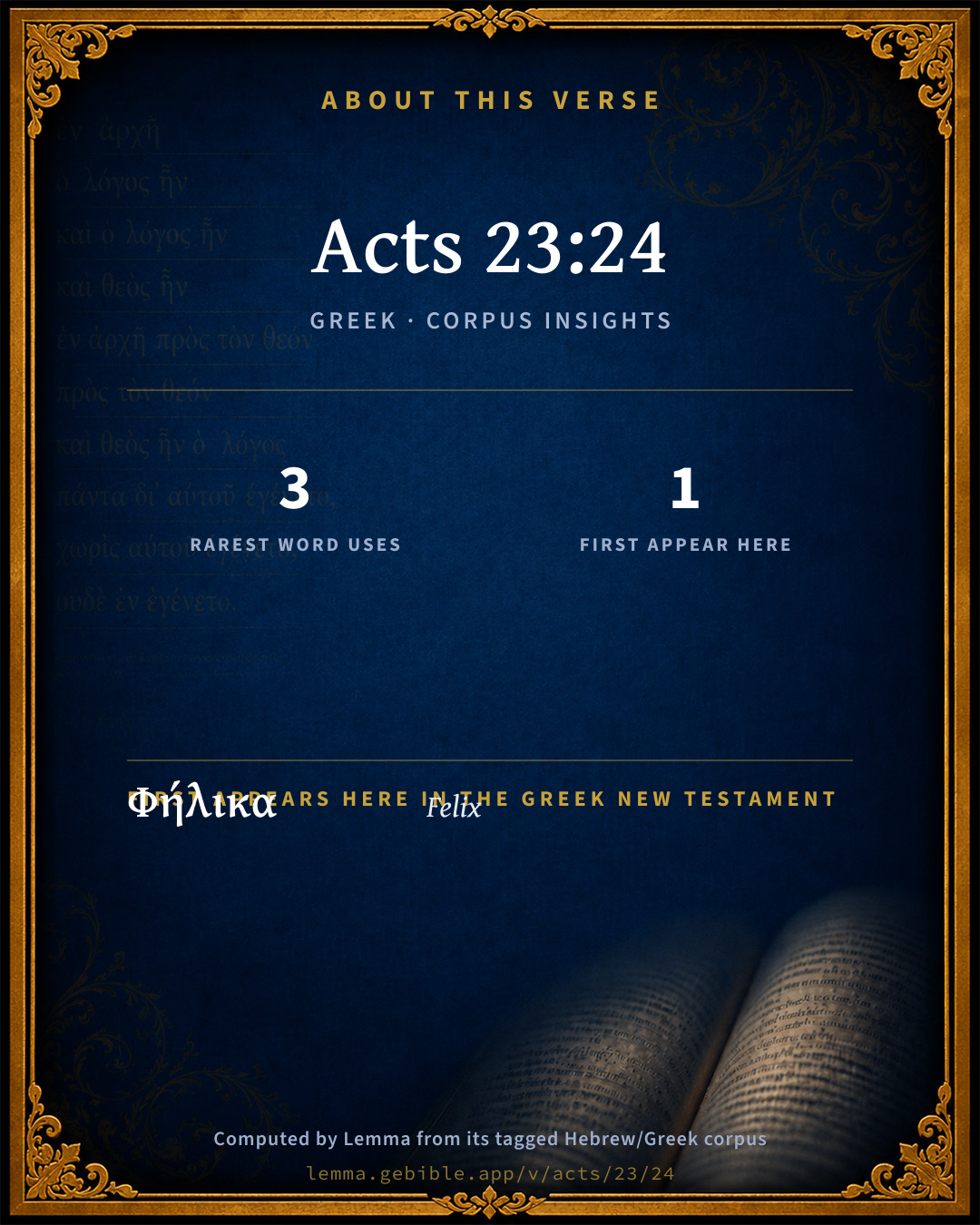
Acts 23:24

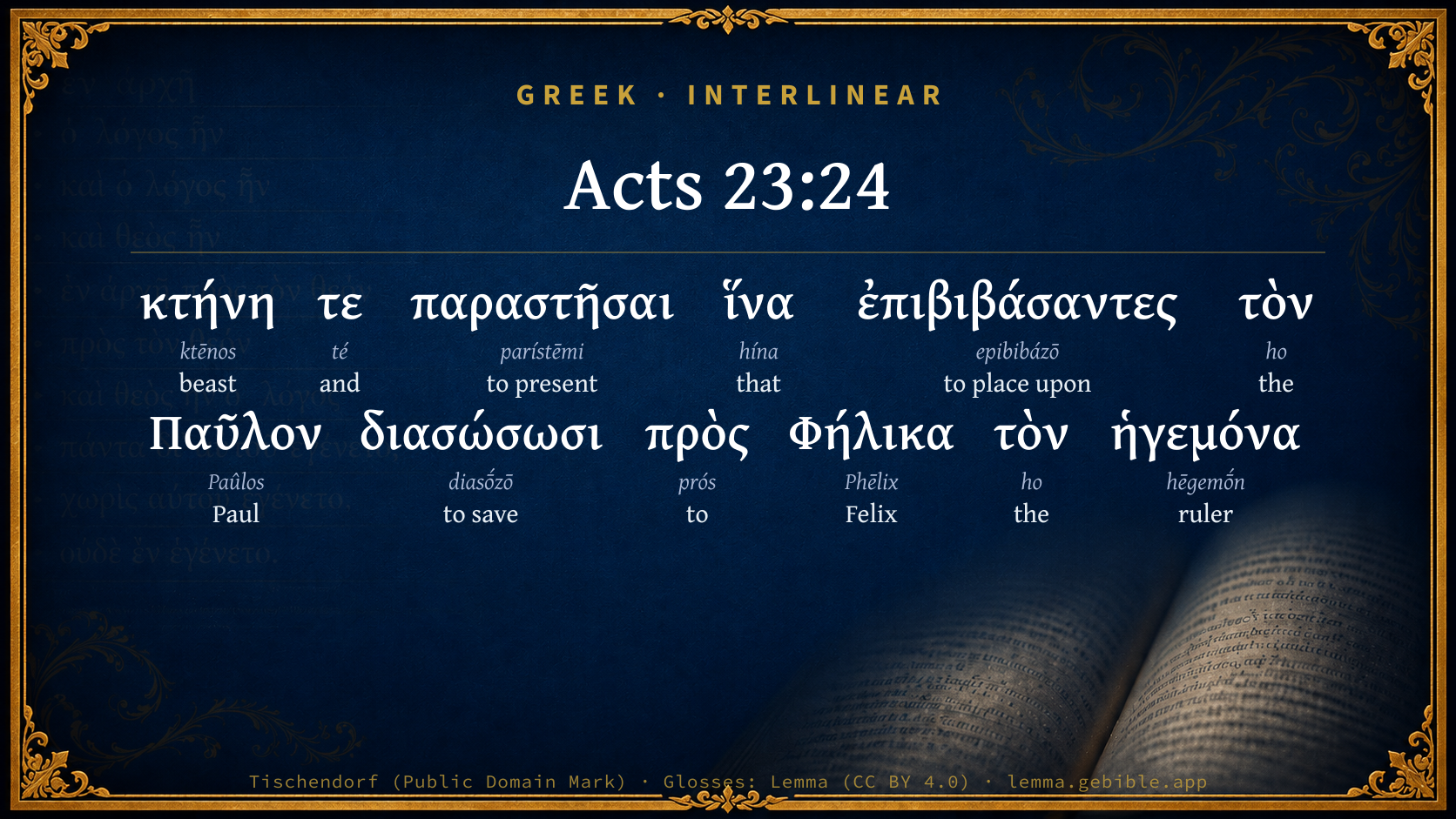
Greek (Tischendorf 8th ed.) Acts 23:24 appears in the Greek New Testament. The text above is from the Tischendorf 8th edition. Each word links to its Strong’s number and a concise gloss. Click any word for its full Thayer’s Greek Lexicon entry.
Download image
Cite this verse

Acts 23:24 (World English Bible). Public Domain. Lemma interlinear Bible study tool, https://lemma.gebible.app/v/acts/23/24.

Show BibTeX & RIS
BibTeX
RIS
English Translation
He asked them to provide animals, that they might set Paul on one, and bring him safely to Felix the governor.
World English Bible · Public Domain
Highlights
  • 1 first appearance in the Greek New Testament
Full analysis ↓
Download a study sheet

One document with this verse’s original text, its word-by-word gloss line, the meaning frame, cross-references with their text, attributed commentary, and full source and license credits — printable, and it pastes into notes with its structure intact.

This verse Autodidact and up

Study sheet (.html) Plain text (.txt)

A passage Seminary Student

Up to 50 verses in one chapter. A passage sheet keeps up to 6 commentary sources and 12 cross-references per verse, in the order this page ranks them, and says so on the sheet whenever that leaves anything out. Ask for a single verse and you get the Autodidact verse sheet above.

Everything on this page stays free to read, with no account — the sheet is a download of what is already on screen, not access to it.

Want to remove ads? Support Godless Engineer
Compare translations 3

The same verse in 3 English versions, stacked beneath the original-language interlinear above. Click any original word for its lexicon entry.

Each is an independent rendering of the whole verse — the interlinear is not word-aligned to these translations.

Highlighted words mark where these versions differ — a whole-verse word diff, not a word-by-word alignment.

  • World English Bible Public Domain
    He asked them to provide animals, that they might set Paul on one, and bring him safely to Felix the governor.
  • King James Version Public Domain
    And provide them beasts, that they may set Paul on, and bring him safe unto Felix the governor.
  • unfoldingWord Literal Text CC BY-SA 4.0
    and to provide animals so that, having set Paul on them, they may bring him safely to Felix the governor,

unfoldingWord Literal Text — © unfoldingWord, licensed CC BY-SA 4.0. Word-aligned USFM3 via Door43 (git.door43.org/unfoldingWord/en_ult).

Versions to compare (up to 4)

3 of 4 selected

Show all 19 translations

Every available English version of this verse, each an independent rendering of the whole verse.

  • World English Bible Public Domain
    He asked them to provide animals, that they might set Paul on one, and bring him safely to Felix the governor.
  • Berean Standard Bible Public Domain
    Provide mounts for Paul to take him safely to Governor Felix.”
  • Majority Standard Bible Public Domain
    Provide mounts for Paul to take him safely to Governor Felix.”
  • King James Version Public Domain
    And provide them beasts, that they may set Paul on, and bring him safe unto Felix the governor.
  • American Standard Version (1901) Public Domain
    and `he bade them' provide beasts, that they might set Paul thereon, and bring him safe unto Felix the governor.
  • Revised Version (1885) Public Domain
    and he bade them provide beasts, that they might set Paul thereon, and bring him safe unto Felix the governor.
  • Geneva Bible (1599) Public Domain
    And let them make readie an horse, that Paul being set on, may be brought safe vnto Felix the Gouernour.
  • Douay-Rheims (1899) Public Domain
    And provide beasts, that they may set Paul on, and bring him safe to Felix the governor.
  • Young's Literal Translation Public Domain
    beasts also provide, that, having set Paul on, they may bring him safe unto Felix the governor;'
  • Literal Standard Version CC BY-SA 4.0
    also provide beasts, that, having set Paul on, they may bring him safe to Felix the governor”;
  • Unlocked Literal Bible CC BY-SA 4.0
    He also ordered them to provide animals which Paul could ride, and to take him safely to Felix the governor.
  • unfoldingWord Literal Text CC BY-SA 4.0
    and to provide animals so that, having set Paul on them, they may bring him safely to Felix the governor,
  • Darby Bible Public Domain
    And [he ordered them] to provide beasts, that they might set Paul on them and carry [him] safe through to Felix the governor,
  • World Messianic Bible Public Domain
    He asked them to provide mounts, that they might set Paul on one, and bring him safely to Felix the governor.
  • Webster's Bible Public Domain
    And provide for them beasts, that they may set Paul on, and bring him safe to Felix the governor.
  • Free Bible Version CC BY-SA 4.0
    Provide horses for Paul to ride to make sure he gets to Governor Felix safely.”
  • Bible in Basic English Public Domain
    And get beasts so that they may put Paul on them, and take him safely to Felix, the ruler.
  • Text-Critical English NT CC BY 4.0
    Provide mounts so that they may set Paul on one and bring him safely to Felix the governor.”
  • Tyndale New Testament (1534) Public Domain
    And delyvre them beastes that they maye put Paul on and bringe him safe vnto Felix the hye debite

Literal Standard Version (2020), Covenant Press — licensed CC BY-SA 4.0. Text via the HelloAO Bible API (eBible.org). Unlocked Literal Bible (unfoldingWord) — licensed CC BY-SA 4.0. Text via the HelloAO Bible API (eBible.org). unfoldingWord Literal Text — © unfoldingWord, licensed CC BY-SA 4.0. Word-aligned USFM3 via Door43 (git.door43.org/unfoldingWord/en_ult). Free Bible Version, Dr. Jonathan Gallagher — licensed CC BY-SA 4.0. Text via the HelloAO Bible API (eBible.org).

Word by word

More ways to search: Search by grammar → Find every occurrence → Compare this word →

Practice this passage: Drill this verse → Learn its vocabulary →

ἐπιβιβάσαντες
epibibázō
G1913
“to place upon”
Verb, Aorist, Active, Participle, Nominative, Plural, Masculine
Part of Speech
Verb
Tense
Aorist
Voice
Active
Mood
Participle
Case
Nominative
Number
Plural
Gender
Masculine
Full Thayer's Definition

Origin: from G1909 and a redupl. deriv. of the base of G939 [cf G307 ]

TDNT: None

1. to cause to mount 2. to place upon
  1. κτήνη ktēnos G2934 “beast” Noun, Accusative, Plural, Neuter
  2. τε té G5037 “and” Particle
  3. παραστῆσαι parístēmi G3936 “to present” Verb, Aorist, Active, Infinitive
  4. ἵνα hína G2443 “that” Conjunction
  5. τὸν ho G3588 “the” Article, Accusative, Singular, Masculine
  6. Παῦλον Paûlos G3972 “Paul” Noun, Accusative, Singular, Masculine
  7. διασώσωσι diasṓzō G1295 “to save” Verb, Aorist, Active, Subjunctive, 3rd person, Plural
  8. πρὸς prós G4314 “to” Preposition
  9. Φήλικα Phēlix G5344 “Felix” Noun, Accusative, Singular, Masculine
  10. τὸν ho G3588 “the” Article, Accusative, Singular, Masculine
  11. ἡγεμόνα hēgemṓn G2232 “ruler” Noun, Accusative, Singular, Masculine

About this verse

These counts appear in no published source. They are computed here, from the morphology-tagged text and Lemma’s own curated glosses. What Lemma adds →

12
words
11
distinct lemmas
Acts
section

Notable vocabulary

The rarest word here is ἐπιβιβάσαντες to place upon G1913 — appearing just 3 times in the whole Greek New Testament.

First appearance in Scripture

This word makes its first canonical appearance in the Greek New Testament here:

  • Φήλικα Felix G5344

Shared distinctive vocabulary

ἐπιβιβάσαντες to place upon G1913 occurs in 3 verses of the Greek New Testament. Also found in:

Repetition

A word recurs within this verse:

Cross-references

10

Topical passages linked to Acts 23:24 in the Treasury of Scripture Knowledge — connected by theme and wording, ordered by reader-vote popularity; previews shown in the World English Bible.

  • Acts 23:26 "Claudius Lysias to the most excellent governor Felix: Greetings.
  • Acts 24:10 When the governor had beckoned to him to speak, Paul answered, "Because I know that you have been a judge of this nation for many years, I cheerfully make my defense,
  • Acts 25:14 As he stayed there many days, Festus laid Paul's case before the king, saying, "There is a certain man left a prisoner by Felix;
  • Acts 23:33–24:3 When they came to Caesarea and delivered the letter to the governor, they also presented Paul to him.
  • Nehemiah 2:12 I arose in the night, I and some few men with me; neither told I any man what my God put into my heart to do for Jerusalem; neither was there any animal with me, except the animal that I rode on.
  • Esther 8:12 on one day in all the provinces of king Ahasuerus, [namely], on the thirteenth [day] of the twelfth month, which is the month Adar.
  • Matthew 27:2 and they bound him, and led him away, and delivered him up to Pontius Pilate, the governor.
  • Luke 3:1 Now in the fifteenth year of the reign of Tiberius Caesar, Pontius Pilate being governor of Judea, and Herod being tetrarch of Galilee, and his brother Philip tetrarch of the region of Ituraea and Trachonitis, and Lysanias tetrarch of Abilene,
  • Luke 10:34 came to him, and bound up his wounds, pouring on oil and wine. He set him on his own animal, and brought him to an inn, and took care of him.
  • Acts 24:22–27 But Felix, having more exact knowledge concerning the Way, deferred them, saying, "When Lysias, the commanding officer, comes down, I will decide your case."

Cross-references courtesy of OpenBible.info (CC BY 4.0).

Commentary

Notes on Acts 23:24 from classic Christian and Jewish commentators (each source and its license shown beneath its notes). The classic Christian expositions comment on the surrounding passage and are grouped to its opening verse, so a note may address several verses; the Jewish commentaries on the Tanakh (Rashi and others) are per-verse, so they appear only where the commentator wrote on this verse.

Lemma curates 59 commentaries, every one of them public domain or Creative Commons licensed, each selected and text-cleaned for this edition rather than reprinted as found. About our sources →

Ellicott's Commentary for English Readers

(24) Felix the governor.—The career of the procurator so named is not without interest as an illustration of the manner in which the Roman empire was at this time governed. In the household of Antonia, the mother of the Emperor Claudius, there were two brothers, first slaves, then freed-men, Antonius Felix and Pallas. The latter became the chosen companion and favourite minister of the emperor, and through his influence Felix obtained the procuratorship of Judæa. There, in the terse epigrammatic language of Tacitus, he governed as one who thought, in his reliance on his brother’s power, that he could commit any crime with impunity, and wielded “the power of a tyrant in the temper of a slave” (Tacit. Ann. xii. 54; Hist. v. 9). His career was infamous alike for lust and cruelty. Another historian, Suetonius (Claud. c. 28), describes him as the husband of three queens, whom he had married in succession:—(1) Drusilla, the daughter of Juba, King of Mauritania and Selene, the daughter of Autonius and Cleopatra. (2) Drusilla, the daughter of Agrippa I. and sister of Agrippa II. (See Act_23:24.) She had left her first husband, Azizus, King of Emesa, to marry Felix (Jos. Ant. xx. 7. § 1). Their son, also an Agrippa, died in an eruption of Vesuvius in A.D. 79 (Jos. Ant. xx. 7, § 2). The name of the third princess is unknown.

A Bible Commentary for English Readers, edited by Charles John Ellicott (1878–1897) — public domain. Text from a community e-Sword module.

Tyndale Open Study Notes

Tyndale Open Resources

23:24 Antonius Felix was procurator (Governor) of Judea about AD 52–59, with responsibility for both military and civil affairs. Felix had a bad reputation (see 24:24-27) and was eventually recalled to Rome by Nero.

Tyndale Open Study Notes — © Tyndale Open Resources, licensed CC BY-SA 4.0. Text via the HelloAO Bible API.

Bengel's Gnomon

Johann Albrecht Bengel

Act 23:24. Κτήνη τε παραστῆσαι, and to get ready beasts) From the recitative style a transition is here made to the relative (narrative), differently from what had been begun with in Act 23:22: for in the recitative style the form of expression should be διασώζητε, that ye may bring him safe, not διασώσωσι, that they might bring him safe. Moreover the relative (narrative) style is appropriate to the subject itself: because the tribune (chief captain) did not immediately intimate what was the cause of their journey.—ἐπιβιβάσαντες, having set on) We read but once of Paul having been mounted on horseback, and that not of his own accord: comp. ch. Act 20:13.—ἡγεμόνα, the governor) There is subjoined in more recent Latin copies, “Timuit enim, ne forte raperent eum Judæi et occiderent, et ipse postea calumniam sustineret, tanquam accepturus pecuniam.” And so the Germ. Bible of Mentz, printed in A.D. 1462, with these words omitted, “tanquam accepturus pecuniam.”[135]

[135] It is only later copies of Vulg. and the later Syr. with an asterisk which have this addition. Vulg. Amiatinus and the best MSS. are without it.—E. and T.

Bengel's Gnomon of the New Testament — English translation (T&T Clark, Edinburgh, 1860) — public domain. Text from a community e-Sword module.

Meyer's Critical & Exegetical Commentary

Heinrich August Wilhelm Meyer

Act_23:24. Κτήνη τε παραστῆσαι] still depends on εἶπεν, Act_23:23. The speech passes from the direct to the indirect form. See on Act_19:27.

κτήνη] sarcinaria jumenta, Caes. Bell. civ. i. 81. Whether they were asses or pack-horses, cannot be determined. Their destination was: that they (the centurions to whom the command was given) should make Paul mount on them, and so should bring him uninjured to Felix the procurator. The plural number of the animals is not, with Kuinoel, to be explained in usum Pauli et militis ipsius custodis, but, as ἵνα ἐπιβ. τ. Παῦλ. requires, only in usum Pauli, for whom, as the convoy admitted of no halt (Act_23:31-32), one or other of the κτήνη was to accompany it as a reserve, in order to be used by him in case of need.

On Felix, the freedman of Claudiusby his third wife son-in-law of Agrippa I. and brother-in-law of Agrippa II., and brother of Pallas the favourite of Nero,that worthless person, who per omnem saevitiam ac libidinem jus regium servili ingenio in Judaea provincia exercuit (Tac. Hist. v. 9), and after his procuratorship was accused to Nero by the Jews of Caesarea, but was acquitted through the intercession of Pallas, see Walch, Diss, de Felice Judaeor. procur. Jen. 1747; Ewald, p. 549 ff.; Gerlach, d. Röm. Statt-halter in Syr. u. Jud. p. 75 ff.

Meyer — Critical and Exegetical Commentary on the New Testament — English translation by Peter Christie, edited by Frederick Crombie (T&T Clark, 1880) — public domain. Text from a community e-Sword module.

Expositor's Greek Testament

ed. W. Robertson Nicoll

Act 23:24 . παραστῆσαι : depending on ειπεν , Act 23:23 ; a change to indirect speech, cf. references in Act 23:22 . κτήνη ( κτάομαι ): jumenta , Vulgate, almost always in plural, property in general, herds or flocks, cattle; in LXX, where it is very frequent, and in N.T. it is used of beasts of burden or for riding, cf. Luk 10:34 , Rev 18:13 , sometimes quite generally in LXX, as in 1Co 15:39 . ἐπιβ .: only in Luke and Acts in N.T., Luk 10:34 ; Luk 19:35 , in each case in same sense; so in classical Greek and LXX. The reason why the plural κτήνη is used vix satis perspicitur (Blass); the word has sometimes been taken to apply to the soldiers, as if they were all mounted, but taking the word in relation to Paul, one or more beasts might be required for relays or for baggage, so Weiss, Wendt, Hackett, or, as the prisoner was chained to a soldier, another κτήνος would be required (Kuinoel, Felten). διασώσωσι : five times in Acts, once in Luke’s Gospel, only twice elsewhere in N.T., “ut . salvum perducerent,” Vulgate, frequent in LXX, cf. its use in Polyb. and Jos., see further on Act 27:44 . φήλικα , see on Act 24:3 . τὸν ἡγεμόνα : used of a leader of any kind, or of an emperor or king; in N.T. of the procurator, of Pilate, Felix, Festus, so by Josephus of Pilate, Ant. , xviii., 3, 1, of governors more generally, Luk 21:12 , 1Pe 2:14 , etc.

The Expositor's Greek Testament, edited by W. Robertson Nicoll (1897–1910) — public domain. Text from a community e-Sword module.

Jamieson, Fausset & Brown

Robert Jamieson, A. R. Fausset & David Brown

beasts . . . set Paul on--as relays, and to carry baggage.

unto Felix, the governor--the procurator. See on Act 24:24-25.

Jamieson, Fausset & Brown — Commentary Critical and Explanatory on the Whole Bible (1871) — public domain (CC PDM 1.0). Text via the HelloAO Bible API.

Adam Clarke's Commentary

Verse 24. Provide them beasts] One for Paul, and some others for his immediate keepers.

Felix the governor.] This Felix was a freed man of the Emperor Claudius, and brother of Pallas, chief favourite of the emperor. Tacitus calls him Antonius Felix; and gives us to understand that he governed with all the authority of a king, and the baseness and insolence of a quondam slave. E libertis Antonius Felix per omnem saevitiam ac libidinem jus regium servili ingenio exercuit. Hist. v. 9. He had, according to Suetonius, in his life of Claudius, chap. 28, three queens to his wives; that is, he was married thrice, and each time to the daughter or niece of a king. Drusilla, the sister of Agrippa, was his wife at this time; see Ac 24:24. He was an unrighteous governor; a base, mercenary, and bad man: see Ac 24:2.

Adam Clarke's Commentary on the Bible (1810–1826) — public domain. Text from a community e-Sword/MySword module.

The Cambridge Bible for Schools and Colleges

gen. ed. J. J. S. Perowne

24. and provide them beasts] Here is an infinitive, in dependence on the verb in the previous verse, to mark which the Rev. Ver. inserts he bade them.

Felix the governor] He was made procurator of Judæa by Claudius in a.d. 53. He was the brother of Pallas, the favourite freedman of Claudius, and it was by the interest of his brother, that Felix was advanced, and retained in his position even after the death of Claudius. The character of Felix, as gathered both from Roman and Jewish historians, is that of a mean, profligate and cruel ruler, and even the troublous times in which he lived are not sufficient to excuse the severity of his conduct. After his return to Rome, on the appointment of Festus to be governor in his stead, Felix was accused by the Jews of Cæsarea and only saved by the influence which his brother Pallas had with Nero, as he had had with his predecessor. Felix was connected with the Herodian family by his marriage with Drusilla the daughter of Herod Agrippa I. He continued to hold office at Cæsarea for two years after St Paul’s coming there (Act_24:27) and during the whole of that time the Apostle was his prisoner.

The Cambridge Bible for Schools and Colleges (gen. ed. J. J. S. Perowne; Cambridge University Press, 1878–1918) — public domain. Text from a community e-Sword module.

John Gill's Exposition

And he wrote a letter after this manner. The chief captain wrote a letter to Felix the governor, the form and sum of which were as follow; this letter he sent by one of the centurions to him.

And he wrote a letter after this manner. The chief captain wrote a letter to Felix the governor, the form and sum of which were as follow; this letter he sent by one of the centurions to him.

Acts 23:26

act 23:26

act 23:26

act 23:26Claudius Lysias, unto the most excellent Governor Felix,.... This is the inscription of the letter, and by it we learn the name of the chief captain, so often spoken of in this and the two preceding chapters, which was Claudius Lysias; the first of these names is a Roman one, and which he might take from the Emperor Claudius, for he was not a Roman born; and the latter seems to be a Greek name, and was his proper name, and, he himself very likely was a Greek, since he purchased his freedom with money; one of this name was Archon of Athens (p); and another is reckoned by Cicero (q), among the famous orators of Greece, and is often cited by Harpocratian (r); one of Antiochus's noblemen, and who was of the blood royal, and acted as a general against the Jews, was of this name (s).

"So he left Lysias, a nobleman, and one of the blood royal, to oversee the affairs of the king from the river Euphrates unto the borders of Egypt:'' (1 Maccabees 3:32)

The chief captain calls Felix the governor

the most excellent, which was a title of honour that belonged to him as a governor; the same is given to Theophilus, Luk 1:3 sendeth greeting; or wishes all health and prosperity.

(p) Fabrieii Bibliograph. Antiqu. p. 213. (q) De Claris Orator. vel Brutus, c. 32. (r) Lex Decem Orator. (s) 1 Maccab. iii. 32.

John Gill's Exposition of the Whole Bible (1746–1763) — public domain (CC PDM 1.0). Text via the HelloAO Bible API.

Trapp's Complete Commentary

John Trapp

24 And provide them beasts, that they may set Paul on, and bring him safe unto Felix the governor.

Ver. 24. That they may bring him safe] The Vulgate Latin adds, For he feared lest the Jews would take him away by violence aud kill him, and so he should suffer blame, as if he had been hired to permit it. But this the Greek hath not.

John Trapp, A Commentary or Exposition upon All the Books of the Old and New Testament (1647–1656) — public domain. Text from a community e-Sword module.

Albert Barnes' Notes on the Bible

And provide them beasts - One for Paul, and one for each of his attendants. The word translated “beasts” κτήνη ktēnē is of a general character, and may be applied either to horses, camels, or donkeys. The latter were most commonly employed in Judea.

Unto Felix the governor - The governor of Judea. His place of residence was Caesarea, about 60 miles from Jerusalem. See the notes on Act 8:40. His name was Antonius Felix. He was a freedman of Antonia, the mother of the Emperor Claudius. He was high in the favor of Claudius, and was made by him governor of Judea. Josephus calls him Claudius Felix. He had married three wives in succession that were of royal families, one of whom was Drusilla, afterward mentioned in Act 24:24, who was sister to King Agrippa. Tacitus (History, v. 9) says that he governed with all the authority of a king, and the baseness and insolence of a slave. “He was an unrighteous governor, a base, mercenary, and bad man” (Clarke). See his character further described in the notes on Act 24:25.

Albert Barnes' Notes on the Bible (1834–1885) — public domain. Text from a community e-Sword/MySword module.

Haydock's Catholic Bible Commentary

Felix. This man had been a slave of the emperor Claudius. The high priest, Jonathan, had procured him to be made governor of Judea. He governed the country with great cruelty and outrage; exercising the power of a king, says Tacitus, with all the insolence and meanness of a slave, who is neither restrained by fear nor shame. (Tacitus, Hist. lib. v.)

George Leo Haydock (1774–1849), Haydock's Catholic Family Bible and Commentary, 1859 edition — public domain. Excludes Psalms (Douay-Rheims chapter numbering differs from Protestant) and Deuterocanonical books (Catholic canon only).

Matthew Poole's English Annotations

What a strong guard and retinue does God by his providence get together for the safe guarding of Paul! None of all these intended the least good unto him; but God can make use of them as effectually as if they had had the greatest good will for him.

Matthew Poole's English Annotations on the Holy Bible (1683–1685) — public domain. Text from a community e-Sword/MySword module.

Whedon's Commentary on the Bible

Daniel D. Whedon

24. Beasts—The Greek word denotes any riding beast, as horses, mules, or camels. More than one would be needed for a single person for change. Each horseman both rode and led a horse.

Felix the governor—The procurator, to whom the chiliarch was subordinate, and he to the prefect of Syria. (For account of FELIX, see Hist. Rev_21:17.)

Daniel D. Whedon (gen. ed.), Commentary on the Old and New Testaments (1874–1909) — public domain. Text from a community e-Sword module.

The Pulpit Commentary

He bade them provide for provide, A.V., (the infinitive parasthsai); might for may, A.V.; thereon for on, A.V. Beasts (kthnh); here "riding-horses," as Luk_10:34 in Rev_18:13 it is applied to "cattle;" in 1Co_15:39 it means "beasts" generally. In the LXX it is used for all kinds of beasts cattle, sheep, beasts of burden, etc. Beasts is in the plural, because one or more would be required for those who guarded Paul.

The Pulpit Commentary (1880–1919), ed. H.D.M. Spence-Jones & Joseph S. Exell — public domain. Text from a community e-Sword module.

John Wesley's Explanatory Notes

Provide beasts - If a change should be necessary, to set Paul on - So we read of his riding once; but not by choice.

John Wesley, Explanatory Notes Upon the Whole Bible (1754–1765) — public domain. Text via the GEBible commentary corpus.

McGarvey & Pendleton's Commentaries

J. W. McGarvey

See notes on verse 23

J. W. McGarvey (with Philip Y. Pendleton), Commentaries on the New Testament (The Fourfold Gospel, 1914; Acts; and the epistles) — public domain. Text from a community e-Sword/MySword module.

Cambridge Greek Testament for Schools and Colleges

24. κτήνη τε παραστῆσαι. Here we have the contrary change to that noted in Act 23:22. With ἑτοιμάσετε began a direct order, and this is continued in the oratio recta down to the close of Act 23:23. But with 24 the construction is oblique, as if some verb like ἐκέλευσεν had preceded παραστῆσαι. Consequently the Rev. Vers. has inserted in italics he bade them.

πρὸς Φήλικα τὸν ἡγεμόνα, to Felix the governor. Felix was made procurator of Judæa by Claudius in A.D. 53. He was the brother of Pallas, the favourite freedman of Claudius, and it was by the interest of his brother that Felix was advanced, and retained in his position even after the death of Claudius. The character of Felix, as gathered both from Roman and Jewish historians, is that of a mean, profligate and cruel ruler, and even the troublous times in which he lived are not sufficient to excuse the severity of his conduct. After his return to Rome, on the appointment of Festus to be governor in his stead, Felix was accused by the Jews of Cæsarea and only saved by the influence which his brother Pallas had with Nero, as he had had with his predecessor. Felix was connected with the Herodian family by his marriage with Drusilla the daughter of Herod Agrippa I. He continued to hold office at Cæsarea for two years after St Paul’s coming there (Act 24:27), and during the whole of that time the Apostle was his prisoner.

Cambridge Greek Testament for Schools and Colleges (Cambridge University Press, 1896; 21 vols, various authors incl. Carr, Maclear, Plummer, Farrar, Lumby, Moule, M. R. James, Simcox) — public domain. Text from a community e-Sword module.

Alford’s Greek Testament

Henry Alford

24. διασώσωσιν] escort safe the whole way.

Φήλικα] Felix was a freedman of the Emperor Claudius: Suidas and Zonaras gave him the prænomen of Claudius, but Tacit. (Ann. xii. 54) calls him Antonius Felix, perhaps from Antonia, the mother of Claudius, as he was brother of Pallas, who was a freedman of Antonia (Tacit. ib. and Jos. Antt. xx. 7. 1). He was made sole procurator of Judæa after the deposition of Cumanus (having before been three years joint procurator with him, Tacit. ib.) principally by the influence of the high priest Jonathan (Antt. xx. 8. 5), whom he afterwards procured to be murdered (ibid.). Of his character Tacitus says, ‘Antonius Felix per omnem sævitiam et libidinem jus regium servili ingenio exercuit,’ Hist. v. 9. His procuratorship was one series of disturbances, false messiahs, sicarii and robbers, and civil contests, see Jos. Antt. xx. 8. 5, 6, and 7. He was eventually (a.d. 60) recalled, and accused by the Cæsarean Jews, but acquitted at the instance of his brother Pallas (Antt. xx. 8. 10). On his wife Drusilla, see note, ch. 24:24.

Henry Alford, The Greek Testament (1849–1861) — public domain. Text from a community e-Sword module.

Vincent's Word Studies in the New Testament

Marvin R. Vincent

Beasts [κτηνη] . See on Luk 10:34.

Marvin R. Vincent, Word Studies in the New Testament (1887–1900) — public domain. Text from a community e-Sword/MySword module.

Lesson kit

Teaching starters — assembled from the data on this page, not authored interpretation. Every prompt links to the verse data it draws on. Edit before teaching.

Acts, in the Acts, opens this verse with 12 words (11 distinct Greek lemmas). Its most distinctive word is epibibázō (“to place upon”). A historical commentator’s framing appears above. Read the whole chapter for the surrounding context.

Discussion questions

  1. How does “to place upon” (epibibázō) shape what this verse is saying?
  2. The word “Felix” first appears here in Scripture. What is being introduced at this debut?
  3. Luke 10:34 shares the word «to place upon» with this verse. How do the two illuminate each other?
  4. “the” occurs 2× in this one verse. What is the effect of the repetition?
  5. The translations on this page render this verse differently — a whole-verse word diff, not a word-by-word alignment. What might account for the different wordings?
  6. Reading how Ellicott's Commentary for English Readers and Tyndale Open Study Notes read this verse, where do the two commentators agree and where do they part?

Things to notice

  • 1 word makes its first canonical appearance in Scripture here.
  • These translations choose different wording for 9 words in this verse.
  • “the” occurs 2× in this single verse.
  • 11 distinct Greek lemmas span 12 words in this verse.

Reading settings

Reading text

Shown beneath each verse's original-language words.

Old Testament
Old Testament edition

Read the OT as the Masoretic Hebrew (MT) or the Greek Septuagint (LXX).

English shown for the Greek Septuagint (in the Hebrew ↔ Greek comparison).

Comparing translations? Open the Compare panel on any verse page to stack up to four side by side.