Genesis 40:4

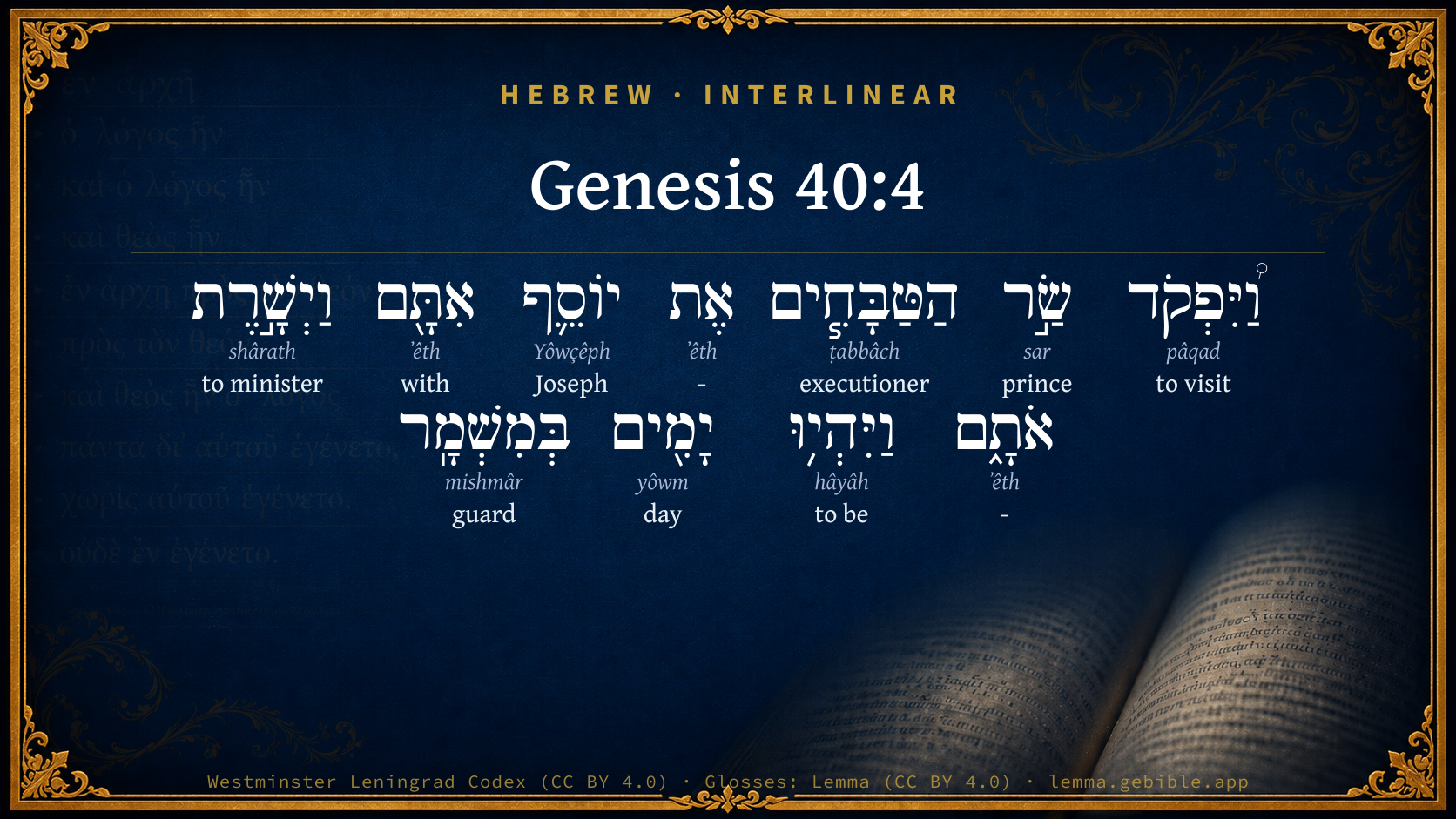
Hebrew (Westminster Leningrad Codex) Genesis 40:4 appears in the Hebrew Old Testament. The text above is from the Westminster Leningrad Codex. Each word links to its Strong’s number, a concise gloss, and parsing drawn from the Open Scriptures Hebrew Bible morphology. Click any word for its full Brown-Driver-Briggs (BDB) entry.
Download image
Cite this verse

Genesis 40:4 (World English Bible). Public Domain. Lemma interlinear Bible study tool, https://lemma.gebible.app/v/genesis/40/4.

Show BibTeX & RIS
BibTeX
RIS
English Translation
The captain of the guard assigned them to Joseph, and he took care of them. They stayed in prison many days.
World English Bible · Public Domain
Download a study sheet

One document with this verse’s original text, its word-by-word gloss line, the meaning frame, cross-references with their text, attributed commentary, and full source and license credits — printable, and it pastes into notes with its structure intact.

This verse Autodidact and up

Study sheet (.html) Plain text (.txt)

A passage Seminary Student

Up to 50 verses in one chapter. A passage sheet keeps up to 6 commentary sources and 12 cross-references per verse, in the order this page ranks them, and says so on the sheet whenever that leaves anything out. Ask for a single verse and you get the Autodidact verse sheet above.

Everything on this page stays free to read, with no account — the sheet is a download of what is already on screen, not access to it.

Want to remove ads? Support Godless Engineer
Compare translations 3

The same verse in 3 English versions, stacked beneath the original-language interlinear above. Click any original word for its lexicon entry.

Each is an independent rendering of the whole verse — the interlinear is not word-aligned to these translations.

Highlighted words mark where these versions differ — a whole-verse word diff, not a word-by-word alignment.

  • World English Bible Public Domain
    The captain of the guard assigned them to Joseph, and he took care of them. They stayed in prison many days.
  • King James Version Public Domain
    And the captain of the guard charged Joseph with them, and he served them: and they continued a season in ward.
  • unfoldingWord Literal Text CC BY-SA 4.0
    And the chief of the guards assigned Joseph to them, so he attended them, and they were in custody days.

unfoldingWord Literal Text — © unfoldingWord, licensed CC BY-SA 4.0. Word-aligned USFM3 via Door43 (git.door43.org/unfoldingWord/en_ult).

Versions to compare (up to 4)

3 of 4 selected

Show all 18 translations

Every available English version of this verse, each an independent rendering of the whole verse.

  • World English Bible Public Domain
    The captain of the guard assigned them to Joseph, and he took care of them. They stayed in prison many days.
  • Berean Standard Bible Public Domain
    The captain of the guard assigned them to Joseph, and he became their personal attendant. After they had been in custody for some time,
  • Majority Standard Bible Public Domain
    The captain of the guard assigned them to Joseph, and he became their personal attendant. After they had been in custody for some time,
  • King James Version Public Domain
    And the captain of the guard charged Joseph with them, and he served them: and they continued a season in ward.
  • American Standard Version (1901) Public Domain
    And the captain of the guard charged Joseph with them, and he ministered unto them: and they continued a season in ward.
  • Revised Version (1885) Public Domain
    And the captain of the guard charged Joseph with them, and he ministered unto them: and they continued a season in ward.
  • Geneva Bible (1599) Public Domain
    And the chiefe steward gaue Ioseph charge ouer them, and he serued them: and they continued a season in warde.
  • Douay-Rheims (1899) Public Domain
    But the keeper of the prison delivered them to Joseph, and he served them. Some little time passed, and they were kept in custody.
  • Young's Literal Translation Public Domain
    and the chief of the executioners chargeth Joseph with them, and he serveth them; and they are days in charge.
  • Literal Standard Version CC BY-SA 4.0
    and the chief of the executioners charges Joseph with them, and he serves them; and they are in confinement [for some] days.
  • Unlocked Literal Bible CC BY-SA 4.0
    The captain of the guard assigned Joseph to them, and he served them. They remained in custody for some time.
  • unfoldingWord Literal Text CC BY-SA 4.0
    And the chief of the guards assigned Joseph to them, so he attended them, and they were in custody days.
  • Darby Bible Public Domain
    And the captain of the life-guard appointed Joseph to them, that he should attend on them. And they were [several] days in custody.
  • World Messianic Bible Public Domain
    The captain of the guard assigned them to Joseph, and he took care of them. They stayed in prison many days.
  • Webster's Bible Public Domain
    And the captain of the guard charged Joseph with them, and he served them; and they continued a season in custody.
  • Free Bible Version CC BY-SA 4.0
    The commander of the guard assigned Joseph to them as their personal attendant. They were kept in prison for some time.
  • Bible in Basic English Public Domain
    And the captain put them in Joseph's care, and he did what was needed for them; and they were kept in prison for some time.
  • JPS Tanakh (1917) Public Domain
    And the captain of the guard charged Joseph to be with them, and he ministered unto them; and they continued a season in ward.

Literal Standard Version (2020), Covenant Press — licensed CC BY-SA 4.0. Text via the HelloAO Bible API (eBible.org). Unlocked Literal Bible (unfoldingWord) — licensed CC BY-SA 4.0. Text via the HelloAO Bible API (eBible.org). unfoldingWord Literal Text — © unfoldingWord, licensed CC BY-SA 4.0. Word-aligned USFM3 via Door43 (git.door43.org/unfoldingWord/en_ult). Free Bible Version, Dr. Jonathan Gallagher — licensed CC BY-SA 4.0. Text via the HelloAO Bible API (eBible.org).

Word by word

More ways to search: Search by grammar → Find every occurrence → Compare this word →

Practice this passage: Drill this verse → Learn its vocabulary →

בְּמִשְׁמָֽר
mishmâr
H4929
“in/at · guard”
Preposition + Noun, Common, Masculine, Singular, Absolute
Part of Speech
Preposition + Noun
Type
Common
Gender
Masculine
Number
Singular
State
Absolute
Full BDB Definition

Origin: from H8104

TWOT: 2414f

place of confinement, prison, guard, jail, guard post, watch, observance - jail, prison, guard-house - guard, guard post, act of guarding - observances
  1. וַ֠יִּפְקֹד pâqad H6485 “and · to visit” Conjunction + Verb, Qal, Sequential Imperfect, 3rd Person, Masculine, Singular
  2. שַׂ֣ר sar H8269 “prince of” Noun, Common, Masculine, Singular, Construct
  3. הַטַּבָּחִ֧ים ṭabbâch H2876 “the · executioners” Particle, Definite Article + Noun, Common, Masculine, Plural, Absolute
  4. אֶת ʼêth H853 “-” Particle, Direct Object
  5. יוֹסֵ֛ף Yôwçêph H3130 “Joseph” Noun, Proper
  6. אִתָּ֖ם ʼêth H854 “with · them” Preposition + Suffix, Personal, 3rd Person, Masculine, Plural
  7. וַיְשָׁ֣רֶת shârath H8334 “and · to minister” Conjunction + Verb, Piel, Sequential Imperfect, 3rd Person, Masculine, Singular
  8. אֹתָ֑ם ʼêth H853 “- · them” Particle, Direct Object + Suffix, Personal, 3rd Person, Masculine, Plural
  9. וַיִּהְי֥וּ hâyâh H1961 “and · to be” Conjunction + Verb, Qal, Sequential Imperfect, 3rd Person, Masculine, Plural
  10. יָמִ֖ים yôwm H3117 “days” Noun, Common, Masculine, Plural, Absolute

About this verse

These counts appear in no published source. They are computed here, from the morphology-tagged text and Lemma’s own curated glosses. What Lemma adds →

11
words
10
distinct lemmas
Pentateuch
section

Notable vocabulary

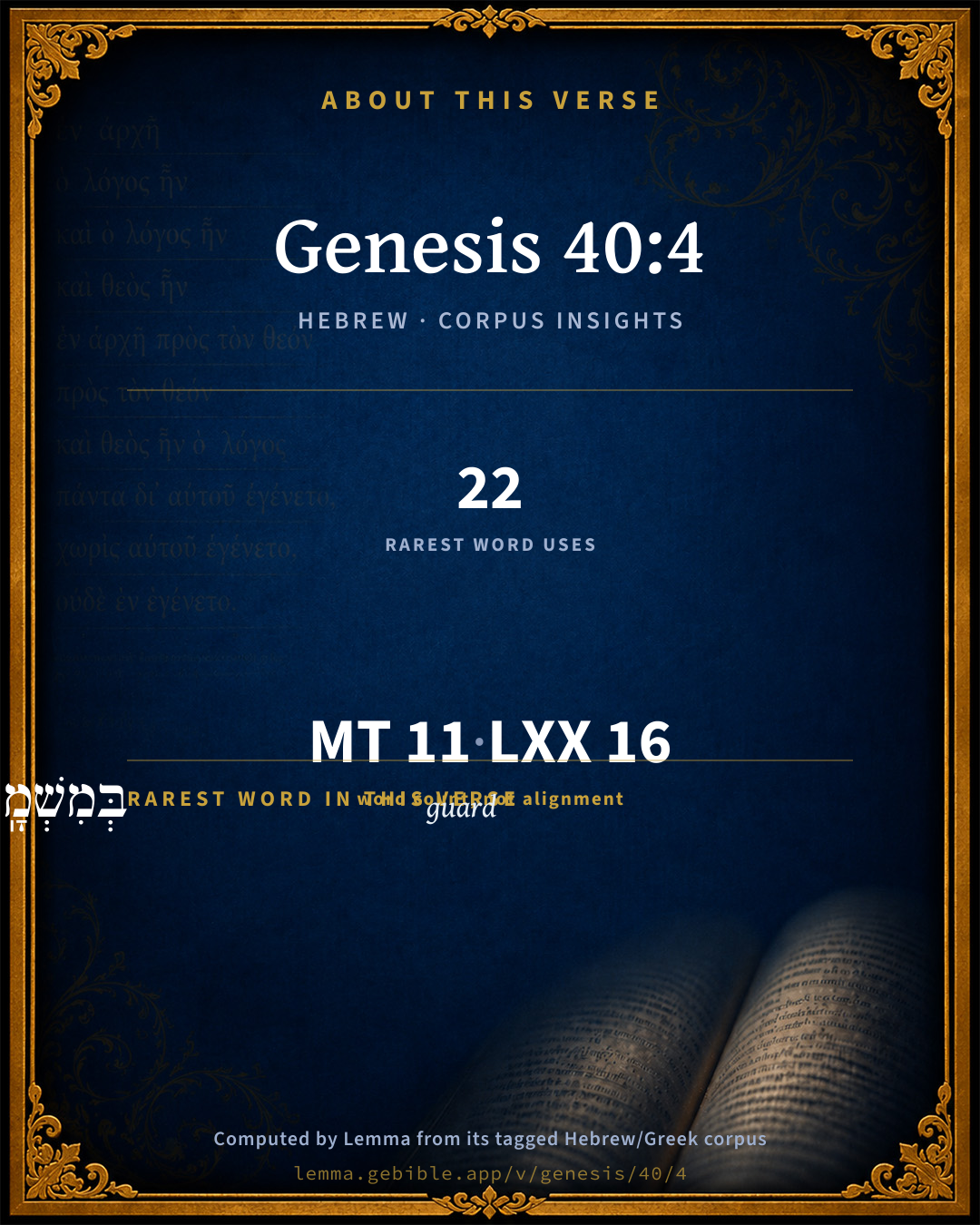
The rarest word here is בְּמִשְׁמָֽר guard H4929 — appearing just 22 times in the whole Hebrew Bible.

Shared distinctive vocabulary

בְּמִשְׁמָֽר guard H4929 occurs in 20 verses of the Hebrew Bible. Also found in:

Grammatical profile

  • 3 verbs
  • 5 nouns
  • 1 preposition
  • 2 particles

Verb forms

  • וַ֠יִּפְקֹד Qal · Sequential Imperfect
  • וַיְשָׁ֣רֶת Piel · Sequential Imperfect
  • וַיִּהְי֥וּ Qal · Sequential Imperfect

Hebrew & Septuagint length

In English translation the verse runs 21 words from the Hebrew and 24 from the Septuagint (LXX English) — closely comparable.

A rough comparison of the two English renderings, which tokenize alike — not a word-level alignment.

Word counts can differ between the Hebrew and the Greek without any difference in meaning — e.g. the Hebrew direct-object marker אֵת has no separate Greek word, and Greek often adds the article ὁ.

In the original languages it is 11 Hebrew tokens and 16 Greek tokens — but the two are counted differently (Hebrew bundles its prefixes and suffixes into one token; the Greek is in lemma form), so that isn’t a like-for-like length.

Cross-references

4

Topical passages linked to Genesis 40:4 in the Treasury of Scripture Knowledge — connected by theme and wording, ordered by reader-vote popularity; previews shown in the World English Bible.

  • Genesis 37:36 The Midianites sold him into Egypt to Potiphar, an officer of Pharaoh's, the captain of the guard.
  • Genesis 39:1 Joseph was brought down to Egypt. Potiphar, an officer of Pharaoh's, the captain of the guard, an Egyptian, bought him from the hand of the Ishmaelites that had brought him down there.
  • Genesis 39:21–23 But Yahweh was with Joseph, and showed kindness to him, and gave him favor in the sight of the keeper of the prison.
  • Psalms 37:5 Commit your way to Yahweh. Trust also in him, and he will do this:

Cross-references courtesy of OpenBible.info (CC BY 4.0).

Hebrew and Greek witnesses Masoretic Hebrew ↔ Greek Septuagint

The same verse in the two great witnesses to the Old Testament, shown verse-for-verse.

These are two independent witnesses, not word-aligned to each other, and the Septuagint is shown in lemma (dictionary) form.

Hebrew Genesis 40:4 Masoretic · Westminster Leningrad Codex

וַ֠יִּפְקֹד שַׂ֣ר הַטַּבָּחִ֧ים אֶת יוֹסֵ֛ף אִתָּ֖ם וַיְשָׁ֣רֶת אֹתָ֑ם וַיִּהְי֥וּ יָמִ֖ים בְּמִשְׁמָֽר

The captain of the guard assigned them to Joseph, and he took care of them. They stayed in prison many days.

World English Bible · Public Domain

Greek LXX Genesis 40:4 Septuagint · lemma form

καί συνἵστημι ὁ ἀρχιδεσμώτης ὁ ιωσηφ αὐτός καί παραἵστημι αὐτός εἰμί δέ ἡμέρα ἐν ὁ φυλακή

And the chief keeper of the prison committed them to Joseph, and he stood by them; and they were some days in the prison.

LXX2012 (modern English Septuagint) · Public Domain

Hebrew: Westminster Leningrad Codex (CC BY 4.0). Greek: Septuagint (public domain); English from LXX2012 (modern English Septuagint) (Public Domain). How the Septuagint differs from the Hebrew →

Targum (Aramaic paraphrase)

2

The Targum is the ancient Jewish Aramaic paraphrase of the Hebrew Scriptures — an interpretive translation, not the Hebrew text itself. Onkelos (literal) and Pseudo-Jonathan (expansive) render the Torah, and Jonathan the Prophets. Coverage is partial: where no permissively-licensed English translation exists for a verse, only the Aramaic is shown. This is verse-level text, not a word-by-word alignment to the Hebrew.

  1. Targum Onkelos Torah (Genesis–Deuteronomy)
    וּמַנִּי רַב קָטוֹלַיָּא יָת יוֹסֵף עִמְּהוֹן וְשַׁמֵּשׁ יָתְהוֹן וַהֲווֹ יוֹמִין בְּמַטְּרָא

    (no public-domain English translation for this verse)

    Targum Onkelos — Aramaic: “Onkelos Genesis” (public domain); “Onkelos Exodus” (public domain); “Onkelos Leviticus” (public domain); “Onkelos Numbers” (public domain); “Onkelos Deuteronomy” (public domain). English: “Sefaria Community Translation” (CC0 1.0 (public-domain dedication)); “J.W. Etheridge. The Targums of Onkelos and Jonathan Ben Uzziel on the Pentateuch. London: Longmans, Green, 1862” (public domain). Text via Sefaria.

  2. Targum Pseudo-Jonathan Torah (Genesis–Deuteronomy)
    וּמַנִי רַב סְפּוֹקְלַטוֹרְיָא יַת יוֹסֵף עִמְהוֹן וְשַׁמֵשׁ יַתְהוֹם וַהֲווֹ יוֹמִין בְּבֵית מַטְרָא

    And the chief executioner intrusted Joseph with them, and he served them, and they were certain days in the house of custody.

    Targum Pseudo-Jonathan — Aramaic: “Targum Jonathan on Genesis” (public domain); “Targum Jonathan on Exodus” (public domain); “Targum Jonathan on Leviticus” (public domain); “Targum Jonathan on Numbers” (public domain); “Targum Jonathan on Deuteronomy” (public domain). English: “The Targum of Jonathan ben Uzziel, trans. J. W. Etheridge, London, 1862” (public domain). Text via Sefaria.

Commentary

Notes on Genesis 40:4 from classic Christian and Jewish commentators (each source and its license shown beneath its notes). The classic Christian expositions comment on the surrounding passage and are grouped to its opening verse, so a note may address several verses; the Jewish commentaries on the Tanakh (Rashi and others) are per-verse, so they appear only where the commentator wrote on this verse.

Lemma curates 59 commentaries, every one of them public domain or Creative Commons licensed, each selected and text-cleaned for this edition rather than reprinted as found. About our sources →

Trapp's Complete Commentary

John Trapp

Gen 40:4 And the captain of the guard charged Joseph with them, and he served them: and they continued a season in ward.

Ver. 4. And the captain of the guard, &c.] This was Potiphar probably: who by this time saw his own error, and Joseph’s innocency; yet kept him still in prison, perhaps to save his wife’s honesty. Truth is the daughter of Time; {a} it wil1 not always lie hid. Splendet cure obscuratur; vincit cum opprimitur, Hinc, ut Pacis templum in media urbe extruxerunt olim Romani, ita Veritatis statuam in suis urbibus olim coluerunt Aegyptii. {b}

{a} The word Aληθεια is from α and ληθειν

{b} Caseus, in Ethic

John Trapp, A Commentary or Exposition upon All the Books of the Old and New Testament (1647–1656) — public domain. Text from a community e-Sword module.

Joseph Benson's Commentary

Gen 40:4-5. The captain of the guard — Namely, Potiphar, Gen 37:36, who, probably being informed by his under-keeper of Joseph’s great care and faithfulness, began to have a better opinion of him, although for his own quiet and his wife’s reputation, he left him still in prison.

According to the interpretation of his dream — By Joseph. The dream and the interpretation answered each other.

Joseph Benson's Commentary on the Old and New Testaments (1811–1818) — public domain. Text from a community e-Sword module.

Jamieson, Fausset & Brown

Robert Jamieson, A. R. Fausset & David Brown

The captain of the guard charged Joseph with them--not the keeper, though he was most favorably disposed; but Potiphar himself, who, it would seem, was by this time satisfied of the perfect innocence of the young Hebrew; though, probably, to prevent the exposure of his family, he deemed it prudent to detain him in confinement (see Psa 37:5).

They continued a season in ward--literally, "days," how long, is uncertain; but as they were called to account on the king's birthday, it has been supposed that their offense had been committed on the preceding anniversary [CALVIN].

Jamieson, Fausset & Brown — Commentary Critical and Explanatory on the Whole Bible (1871) — public domain (CC PDM 1.0). Text via the HelloAO Bible API.

Adam Clarke's Commentary

Verse 4. They continued a season] ימים yamim, literally days; how long we cannot tell. But many suppose the word signifies a complete year; and as Pharaoh called them to an account on his birthday, Ge 40:20, Calmet supposes they had offended on the preceding birthday, and thus had been one whole year in prison.

Adam Clarke's Commentary on the Bible (1810–1826) — public domain. Text from a community e-Sword/MySword module.

The Cambridge Bible for Schools and Colleges

gen. ed. J. J. S. Perowne

4. charged Joseph with them] i.e. put them under the care of Joseph, who is to be in attendance on them, not as a fellow-prisoner, but as a servant in his master’s house. Compare the words of “the chief butler” in Gen_41:12 (also from E), “there was with us there a young man, an Hebrew, servant to the captain of the guard.” This is different from the idea given in Gen_39:22, where he is a prisoner, and appointed by the “keeper of the prison” to look after the other prisoners.

a season] Lit. “days.”

The Cambridge Bible for Schools and Colleges (gen. ed. J. J. S. Perowne; Cambridge University Press, 1878–1918) — public domain. Text from a community e-Sword module.

John Gill's Exposition

And the captain of the guard charged Joseph with them,.... Committed them to his care and custody, he being very probably recommended to him by the keeper of the prison for his prudence and fidelity; and if it was Potiphar, he knew his character full well, and might be now reconciled unto him, as having had a more full and clear account of the affair between him and his wife from the keeper of the prison; and therefore though he might not think fit for his own and his wife's reputation to remove him from prison as yet, nevertheless might be inclined to do him what service he could, as well as honour, as this was, to have two such state prisoners committed to his care. Some render it, "he committed Joseph with them" (x); to be with them, as Jarchi interprets it; they were put together, not merely for the sake of company, but that Joseph might wait upon them, which might be beneficial as well as creditable, as it follows:

and he served them; he ministered unto them, and brought them every thing they wanted:

and they continued a season in ward; or "days" (y); some certain days, many days, a year, as Jarchi and Ben Gersom interpret it, and which is sometimes the use of the word. The story of the butler and baker is told, partly to show the divine faculty of interpreting dreams Joseph was possessed of; and partly to observe the remarkable steps in Providence, though secret, towards his advancement in Pharaoh's court.

(x) "et commisit Josephum cum eis", Junius & Tremellius. (y) "per annum", Pagninus, Vatablus, Schmidt.

John Gill's Exposition of the Whole Bible (1746–1763) — public domain (CC PDM 1.0). Text via the HelloAO Bible API.

Matthew Poole's English Annotations

A season, Heb. days, i.e. either many days, or a year, as that word sometimes signifies. See Gen 24:55.

Matthew Poole's English Annotations on the Holy Bible (1683–1685) — public domain. Text from a community e-Sword/MySword module.

Whedon's Commentary on the Bible

Daniel D. Whedon

4. Charged Joseph with them — Being royal officers, it would be natural to charge a Hebrew slave to serve them, though he had charge of all the prison. Gen_39:22.

Daniel D. Whedon (gen. ed.), Commentary on the Old and New Testaments (1874–1909) — public domain. Text from a community e-Sword module.

The Pulpit Commentary

And the captain of the guard charged Joseph with them (literally, set Joseph with them, i.e. as a companion or servant; to wait upon them, since they were high officers of State, not to keep watch over them as criminals), and he served them (i.e. acted as their attendant): and they continued a season in ward (literally, and they were days, i.e. an indefinite period, in prison).

The Pulpit Commentary (1880–1919), ed. H.D.M. Spence-Jones & Joseph S. Exell — public domain. Text from a community e-Sword module.

John Wesley's Explanatory Notes

The captain of the guard, which was Potiphar, charged Joseph with them - Which intimates that he began now to be reconciled to him.

John Wesley, Explanatory Notes Upon the Whole Bible (1754–1765) — public domain. Text via the GEBible commentary corpus.

unfoldingWord translationNotes

Door43 World Missions Community

They remained in custody for some time

"They remained in prison for a long time"

translationWords

dream

interpret

unfoldingWord translationNotes — © Distant Shores Media and the Door43 World Missions Community, licensed CC BY-SA 4.0. Source: git.door43.org/Door43/en_tn.

Rashi

Rabbi Shlomo Yitzchaki (Rashi)

ויפקד שר הטבחים את יוסף AND THE OFFICER OF THE EXECUTIONERS APPOINTED JOSEPH — to be WITH THEM (i.e. supply the word להיות to complete the sense).

ויהיו ימים במשמר AND THEY WERE A YEAR IN WARD — ימים means twelve months (cf. Rashi on Genesis 24:55).

Rashi on the Tanakh — English translations: “The Judaica Press complete Tanach with Rashi, translated by A. J. Rosenberg” (CC BY 4.0); “Pentateuch with Rashi's commentary by M. Rosenbaum and A.M. Silbermann, 1929-1934” (public domain); “The Metsudah Tanach series, Lakewood, N.J” (CC BY 4.0); and “The Book of Joshua, Metsudah Publications, 1997” (CC BY 4.0). Text via Sefaria.

Radak

Rabbi David Kimhi (Radak)

ויפקוד, he appointed Joseph to be their constant companion and personal valet. We are told this so that we can understand why Joseph enjoyed their confidence and they told him their dreams.

ימים, the Torah does not give further details about how many days. It is possible that the word ימים means “a year,” as it appears in that sense in Leviticus 25,29.

Radak on the Tanakh — English translations: “Sefaria Community Translation” (CC0 1.0 (public-domain dedication)); “Eliyahu Munk, HaChut Hameshulash” (CC BY 4.0); “Rabbi Mike Feuer, Jerusalem Anthology” (CC BY 4.0); and “R. David Kimhi on the first book of Psalms, Translated by R.G. Finch, London, 1919” (public domain). Text via Sefaria.

Lesson kit

Teaching starters — assembled from the data on this page, not authored interpretation. Every prompt links to the verse data it draws on. Edit before teaching.

Genesis, in the Pentateuch, opens this verse with 11 words (10 distinct Hebrew lemmas). Its most distinctive word is mishmâr (“guard”). A historical commentator’s framing appears above. Read the whole chapter for the surrounding context.

Discussion questions

  1. How does “guard” (mishmâr) shape what this verse is saying?
  2. Genesis 40:3 shares the word «guard» with this verse. How do the two illuminate each other?
  3. These translations render this verse differently; the difference is in the English rendering, not the original. What questions does that raise?
  4. The verb «וַ֠יִּפְקֹד» is Qal Sequential Imperfect. How does its form color the action?
  5. Reading how Trapp's Complete Commentary and Joseph Benson's Commentary read this verse, where do the two commentators agree and where do they part?

Things to notice

Reading settings

Reading text

Shown beneath each verse's original-language words.

Old Testament
Old Testament edition

Read the OT as the Masoretic Hebrew (MT) or the Greek Septuagint (LXX).

English shown for the Greek Septuagint (in the Hebrew ↔ Greek comparison).

Comparing translations? Open the Compare panel on any verse page to stack up to four side by side.