
Numbers 23:15

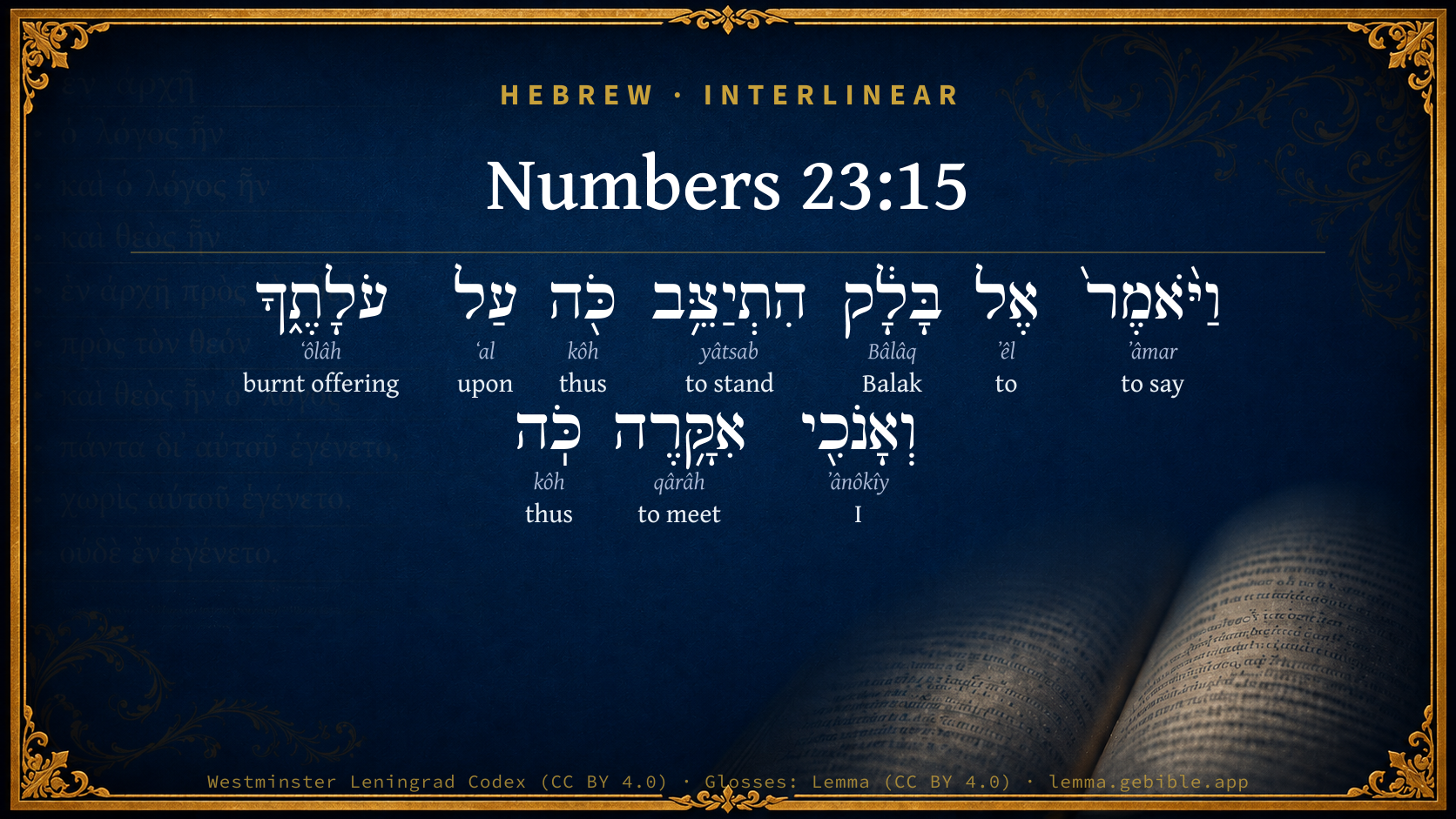
Hebrew (Westminster Leningrad Codex) Numbers 23:15 appears in the Hebrew Old Testament. The text above is from the Westminster Leningrad Codex. Each word links to its Strong’s number, a concise gloss, and parsing drawn from the Open Scriptures Hebrew Bible morphology. Click any word for its full Brown-Driver-Briggs (BDB) entry.
Download image
Cite this verse

Numbers 23:15 (World English Bible). Public Domain. Lemma interlinear Bible study tool, https://lemma.gebible.app/v/numbers/23/15.

Show BibTeX & RIS
BibTeX
RIS
English Translation
He said to Balak, Stand here by your burnt offering, while I meet [Yahweh] yonder.
World English Bible · Public Domain
Download a study sheet

One document with this verse’s original text, its word-by-word gloss line, the meaning frame, cross-references with their text, attributed commentary, and full source and license credits — printable, and it pastes into notes with its structure intact.

This verse Autodidact and up

Study sheet (.html) Plain text (.txt)

A passage Seminary Student

Up to 50 verses in one chapter. A passage sheet keeps up to 6 commentary sources and 12 cross-references per verse, in the order this page ranks them, and says so on the sheet whenever that leaves anything out. Ask for a single verse and you get the Autodidact verse sheet above.

Everything on this page stays free to read, with no account — the sheet is a download of what is already on screen, not access to it.

Want to remove ads? Support Godless Engineer
Compare translations 3

The same verse in 3 English versions, stacked beneath the original-language interlinear above. Click any original word for its lexicon entry.

Each is an independent rendering of the whole verse — the interlinear is not word-aligned to these translations.

Highlighted words mark where these versions differ — a whole-verse word diff, not a word-by-word alignment.

  • World English Bible Public Domain
    He said to Balak, Stand here by your burnt offering, while I meet [Yahweh] yonder.
  • King James Version Public Domain
    And he said unto Balak, Stand here by thy burnt offering, while I meet the LORD yonder.
  • unfoldingWord Literal Text CC BY-SA 4.0
    And he said to Balak, “Station yourself here beside your burnt offering, and I will be met over there.” p

unfoldingWord Literal Text — © unfoldingWord, licensed CC BY-SA 4.0. Word-aligned USFM3 via Door43 (git.door43.org/unfoldingWord/en_ult).

Versions to compare (up to 4)

3 of 4 selected

Show all 18 translations

Every available English version of this verse, each an independent rendering of the whole verse.

  • World English Bible Public Domain
    He said to Balak, Stand here by your burnt offering, while I meet [Yahweh] yonder.
  • Berean Standard Bible Public Domain
    Balaam said to Balak, “Stay here beside your burnt offering while I meet the LORD over there.”
  • Majority Standard Bible Public Domain
    Balaam said to Balak, “Stay here beside your burnt offering while I meet the LORD over there.”
  • King James Version Public Domain
    And he said unto Balak, Stand here by thy burnt offering, while I meet the LORD yonder.
  • American Standard Version (1901) Public Domain
    And he said unto Balak, Stand here by thy burnt-offering, while I meet `Jehovah' yonder.
  • Revised Version (1885) Public Domain
    And he said unto Balak, Stand here by thy burnt offering, while I meet the LORD yonder.
  • Geneva Bible (1599) Public Domain
    After, he sayde vnto Balak, Stande here by thy burnt offring, and I wil meete the Lord yonder.
  • Douay-Rheims (1899) Public Domain
    He said to Balac: Stand here by thy burnt offering while I go to meet him.
  • Young's Literal Translation Public Domain
    And he saith unto Balak, `Station thyself here by thy burnt-offering, and I -- I meet `Him' there;'
  • Literal Standard Version CC BY-SA 4.0
    And he says to Balak, “Station yourself here by your burnt-offering, and I meet [Him] there”;
  • Unlocked Literal Bible CC BY-SA 4.0
    Then Balaam said to Balak, “Stand here by your burnt offering, while I meet with Yahweh over there.”
  • unfoldingWord Literal Text CC BY-SA 4.0
    And he said to Balak, “Station yourself here beside your burnt offering, and I will be met over there.” p
  • Darby Bible Public Domain
    And [Balaam] said to Balak, Stand here by thy burnt-offering, and I will go to meet yonder.
  • World Messianic Bible Public Domain
    He said to Balak, “Stand here by your burnt offering, while I meet God over there.”
  • Webster's Bible Public Domain
    And he said to Balak, Stand here by thy burnt-offering, while I meet the LORD yonder.
  • Free Bible Version CC BY-SA 4.0
    Balaam told Balak, “Wait here beside your burnt offering while I meet the Lord over there.”
  • Bible in Basic English Public Domain
    Then he said to Balak, Take your place here by your burned offering, while I go over there to the Lord.
  • JPS Tanakh (1917) Public Domain
    And he said unto Balak: 'Stand here by thy burnt-offering, while I go toward a meeting yonder.'

Literal Standard Version (2020), Covenant Press — licensed CC BY-SA 4.0. Text via the HelloAO Bible API (eBible.org). Unlocked Literal Bible (unfoldingWord) — licensed CC BY-SA 4.0. Text via the HelloAO Bible API (eBible.org). unfoldingWord Literal Text — © unfoldingWord, licensed CC BY-SA 4.0. Word-aligned USFM3 via Door43 (git.door43.org/unfoldingWord/en_ult). Free Bible Version, Dr. Jonathan Gallagher — licensed CC BY-SA 4.0. Text via the HelloAO Bible API (eBible.org).

Word by word

More ways to search: Search by grammar → Find every occurrence → Compare this word →

Practice this passage: Drill this verse → Learn its vocabulary →

אִקָּ֥רֶה
qârâh
H7136
“to meet”
Verb, Niphal, Imperfect, 1st Person, Common, Singular
Part of Speech
Verb
Stem
Niphal
Form
Imperfect
Person
1st Person
Gender
Common
Number
Singular
Full BDB Definition

Origin: a primitive root

TWOT: 2068 , 2068e

to encounter, meet, befall, happen, come to meet - (Qal) - to encounter, meet - to befall - (Niphal) - to encounter, meet (without pre-arrangement) - to chance to be present - to come to meet - (Hiphil) to cause to meet, appoint - to build with beams - (Piel) to lay the beams of, furnish with beams
  1. וַיֹּ֨אמֶר֙ ʼâmar H559 “and · to say” Conjunction + Verb, Qal, Sequential Imperfect, 3rd Person, Masculine, Singular
  2. אֶל ʼêl H413 “to” Preposition
  3. בָּלָ֔ק Bâlâq H1111 “Balak” Noun, Proper
  4. הִתְיַצֵּ֥ב yâtsab H3320 “stand” Verb, Hithpael, Imperative, 2nd Person, Masculine, Singular
  5. כֹּ֖ה kôh H3541 “thus” Adverb
  6. עַל ʻal H5921 “upon” Preposition
  7. עֹלָתֶ֑ךָ ʻôlâh H5930 “burnt offering · your” Noun, Common, Feminine, Singular, Construct + Suffix, Personal, 2nd Person, Masculine, Singular
  8. וְאָנֹכִ֖י ʼânôkîy H595 “and · I” Conjunction + Pronoun, Personal, 1st Person, Common, Singular
  9. כֹּֽה kôh H3541 “thus” Adverb

About this verse

These counts appear in no published source. They are computed here, from the morphology-tagged text and Lemma’s own curated glosses. What Lemma adds →

10
words
9
distinct lemmas
Pentateuch
section

Shared distinctive vocabulary

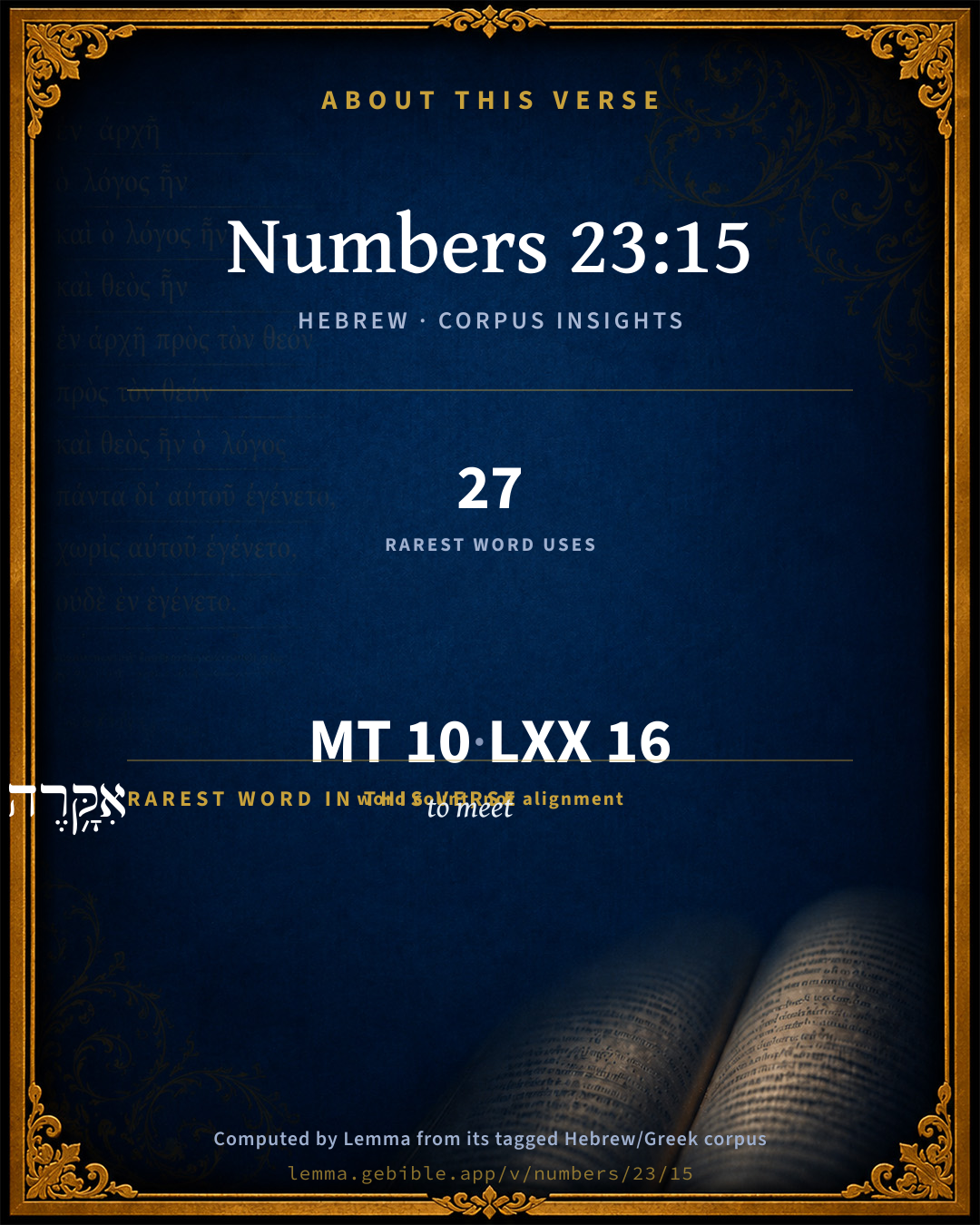
אִקָּ֥רֶה to meet H7136 occurs in 27 verses of the Hebrew Bible. Also found in:

Grammatical profile

  • 3 verbs
  • 2 nouns
  • 1 pronoun
  • 2 prepositions
  • 2 adverbs

Verb forms

  • וַיֹּ֨אמֶר֙ Qal · Sequential Imperfect
  • הִתְיַצֵּ֥ב Hithpael · Imperative
  • אִקָּ֥רֶה Niphal · Imperfect

Repetition

A word recurs within this verse — often emphatic in Hebrew:

  • כֹּ֖ה thus H3541 ×2

Hebrew & Septuagint length

In English translation the verse runs 15 words from the Hebrew and 17 from the Septuagint (LXX English) — closely comparable.

A rough comparison of the two English renderings, which tokenize alike — not a word-level alignment.

Word counts can differ between the Hebrew and the Greek without any difference in meaning — e.g. the Hebrew direct-object marker אֵת has no separate Greek word, and Greek often adds the article ὁ.

In the original languages it is 10 Hebrew tokens and 16 Greek tokens — but the two are counted differently (Hebrew bundles its prefixes and suffixes into one token; the Greek is in lemma form), so that isn’t a like-for-like length.

Cross-references

2

Topical passages linked to Numbers 23:15 in the Treasury of Scripture Knowledge — connected by theme and wording, ordered by reader-vote popularity; previews shown in the World English Bible.

  • Numbers 23:3 Balaam said to Balak, Stand by your burnt offering, and I will go: perhaps Yahweh will come to meet me; and whatever he shows me I will tell you. He went to a bare height.
  • Numbers 22:8 He said to them, Lodge here this night, and I will bring you word again, as Yahweh shall speak to me: and the princes of Moab abode with Balaam.

Cross-references courtesy of OpenBible.info (CC BY 4.0).

Hebrew and Greek witnesses Masoretic Hebrew ↔ Greek Septuagint

The same verse in the two great witnesses to the Old Testament, shown verse-for-verse.

These are two independent witnesses, not word-aligned to each other, and the Septuagint is shown in lemma (dictionary) form.

Hebrew Numbers 23:15 Masoretic · Westminster Leningrad Codex

וַיֹּ֨אמֶר֙ אֶל בָּלָ֔ק הִתְיַצֵּ֥ב כֹּ֖ה עַל עֹלָתֶ֑ךָ וְאָנֹכִ֖י אִקָּ֥רֶה כֹּֽה

He said to Balak, Stand here by your burnt offering, while I meet [Yahweh] yonder.

World English Bible · Public Domain

Greek LXX Numbers 23:15 Septuagint · lemma form

καί εἶπον βαλααμ πρός βαλακ παραἵστημι ἐπί ὁ θυσία σύ ἐγώ δέ πορεύομαι ἐπιἐρωτάω ὁ θεός

And Balaam said to Balac, Stand by your sacrifice, and I will go to enquire of God.

LXX2012 (modern English Septuagint) · Public Domain

Hebrew: Westminster Leningrad Codex (CC BY 4.0). Greek: Septuagint (public domain); English from LXX2012 (modern English Septuagint) (Public Domain). How the Septuagint differs from the Hebrew →

Targum (Aramaic paraphrase)

2

The Targum is the ancient Jewish Aramaic paraphrase of the Hebrew Scriptures — an interpretive translation, not the Hebrew text itself. Onkelos (literal) and Pseudo-Jonathan (expansive) render the Torah, and Jonathan the Prophets. Coverage is partial: where no permissively-licensed English translation exists for a verse, only the Aramaic is shown. This is verse-level text, not a word-by-word alignment to the Hebrew.

  1. Targum Onkelos Torah (Genesis–Deuteronomy)
    וַאֲמַר לְבָלָק אִתְעַתֵּד הָכָא עַל עֲלָתָךְ וַאֲנָא אִתְמְטֵי עַד כָּא

    (no public-domain English translation for this verse)

    Targum Onkelos — Aramaic: “Onkelos Genesis” (public domain); “Onkelos Exodus” (public domain); “Onkelos Leviticus” (public domain); “Onkelos Numbers” (public domain); “Onkelos Deuteronomy” (public domain). English: “Sefaria Community Translation” (CC0 1.0 (public-domain dedication)); “J.W. Etheridge. The Targums of Onkelos and Jonathan Ben Uzziel on the Pentateuch. London: Longmans, Green, 1862” (public domain). Text via Sefaria.

  2. Targum Pseudo-Jonathan Torah (Genesis–Deuteronomy)
    וַאֲמַר לְבָלָק אִתְעַתַּד הָכָא עַל עֲלָתָךְ וַאֲנָא אֶתְעָרַא עַד הָכָא

    And he said to Balak, Stand thou here by thy burnt offering and I will meet (Him) yonder.

    Targum Pseudo-Jonathan — Aramaic: “Targum Jonathan on Genesis” (public domain); “Targum Jonathan on Exodus” (public domain); “Targum Jonathan on Leviticus” (public domain); “Targum Jonathan on Numbers” (public domain); “Targum Jonathan on Deuteronomy” (public domain). English: “The Targum of Jonathan ben Uzziel, trans. J. W. Etheridge, London, 1862” (public domain). Text via Sefaria.

Commentary

Notes on Numbers 23:15 from classic Christian and Jewish commentators (each source and its license shown beneath its notes). The classic Christian expositions comment on the surrounding passage and are grouped to its opening verse, so a note may address several verses; the Jewish commentaries on the Tanakh (Rashi and others) are per-verse, so they appear only where the commentator wrote on this verse.

Lemma curates 59 commentaries, every one of them public domain or Creative Commons licensed, each selected and text-cleaned for this edition rather than reprinted as found. About our sources →

Joseph Benson's Commentary

Num 23:15. While I meet the Lord — To consult him and receive an answer from him, if peradventure these renewed sacrifices will prevail with him to comply with our desires.

Joseph Benson's Commentary on the Old and New Testaments (1811–1818) — public domain. Text from a community e-Sword module.

John Gill's Exposition

And he said unto Balak, stand here by thy burnt offering,.... As he had before directed him, Num 23:3.

while I meet the Lord yonder; pointing to some place at a little distance, where he expected to meet the Lord, and have some instructions from him, which he seemed confident of, having met with him once already.

John Gill's Exposition of the Whole Bible (1746–1763) — public domain (CC PDM 1.0). Text via the HelloAO Bible API.

Matthew Poole's English Annotations

To consult him, and to receive an answer from him, if peradventure those renewed sacrifices will melt him into some compliance with our desires.

Matthew Poole's English Annotations on the Holy Bible (1683–1685) — public domain. Text from a community e-Sword/MySword module.

Whedon's Commentary on the Bible

Daniel D. Whedon

15. Stand here — Rather, Do thou stand thus, as thou art.

While I meet — In the Hebrew this verb meet has no object. It is technically used for going out for auguries, (Num_24:1,) or for the words of Jehovah. Literally, I will meet thus, that is, in the required manner.

Daniel D. Whedon (gen. ed.), Commentary on the Old and New Testaments (1874–1909) — public domain. Text from a community e-Sword module.

The Pulpit Commentary

While I meet the Lord yonder. Rather, "and I will go and meet thus." hKo hrQai ykinOaw. Balaam does not say whom or what he is going to meet, but from the use of the same term in Nu 24. It is evident that he employed the language of soothsayers looking for auguries.

He may have spoken vaguely on purpose, because he was in truth acting a part with Balak.

Vers. 15-25. The Star out of Jacob and the Scepter out of Israel.

The final prophecy, unsolicited by Balak, which indeed he would have been glad to stop, goes far beyond the concerns of his kingdom and his reign. It stretches over an ever-widening extent of space and time. As long as there is any Moab kind of nation to be destroyed, Israel must continue to prevail". The kingdoms of this world not only will become the kingdoms of our Lord and of his Christ, but no other conclusion is easily conceivable. The power by which Israel conquers one enemy enables it to conquer all; and the disposition which leads it against one enemy must lead it against all. It will again and again be attacked, and must defend where it is attacked. It must expand by the ever-strengthening life within. The more it grows, the more room it will require, until at last the kingdoms of the world become its own. Notice

I THE ADVANCE IN THIS PROPHECY UPON THE PRECEDING ONE, AS SHOWN BY THE DIFFERENT FIGURE EMPLOYED. The lion destroys, and that most effectually, but he can do nothing more than destroy. The horse or the ox will draw the cart, and thus serve constructive purposes. Even the tiniest bird can build its compact and symmetrical nest, but the lion can do nothing save destroy. You may cage it and curb its savage propensities a little, but it is not tamed; the lion-nature is there, and the smallest taste of blood will cause it to burst forth in all its fury. The lion being thus a destroyer, and nothing but a destroyer, it is needful to present Israel as able to do more able to destroy in order that there may be room for the construction of something more worthy to endure. It does not become God to stay the current of prophecy with a menace of dreadful destruction as the last word, and so he makes Balaam to speak of the star and the scepter. The lion, as it rages about, can make a solitude; it can take away wickedness by taking away all wicked men; but a solitude is not a kingdom. The true kingdom of God is only gained when he gets willing hearts. The destruction which is spoken of with such energy and almost fierceness of illustration is for the purpose of completely taking away the evil out of human society, so that only the good may remain to serve and glorify the Maker of mankind.

II THE SIGNIFICANCE OF THE STAR, AS INDICATING THE METHOD IN WHICH GOD WILL WORK TO CONQUER EVIL AND ESTABLISH GOOD. The star, it is said, is mentioned here as the symbol of governing power, according to the astrological notions of antiquity. It is further said that the joining of the scepter with the star shows that authority and supremacy are the main things to be indicated by the mention of the star. Certainly the prophecy is full of the idea of supremacy and authority; but if this idea was the only thing to be considered, the mention of the scepter would be enough. The star is a symbol of power, but it is also a symbol of many great realities besides. Let us ask not only why the scepter is joined with the star, but why the star is joined with the scepter. The very first thing that a star indicates is light. God will establish his rule by sending the Star out of Jacob to rise in the darkness. Christ, the fulfillment of the star, has come a light into the world, a rival to-existent lights, and destined to outshine them all. He is a light ever protesting against the darkness, not comprehended by it, not swallowed up and lost in it. Rejoice in this, that the Star out of Jacob is inaccessible to the meddling of those who hate its inconvenient revelations. Christ comes to destroy, and at the same time to construct by letting light in upon all dark, idolatrous chambers and all self-deceiving hearts. The light is from him who knows what is in man, his wickedness, his weakness, and his wants. He brings reality where others only bring appearance. He brings truth where they, even in their very sincerity, bring error. There is no room for a Balaam in his kingdom. The Demas who makes a few steps within soon retreats from a light far too trying for the darkness of his heart. Notice, further, that the light of the star is in some respects more significant of the work of Christ than would be the light of the sun. We must have a figure which will keep before us both the light and the darkness. To us, individually, Christ may be as the sun (and may he be!), filling our hearts with light. We know, alas, that he is far from being a sun to many. Their light is still darkness, but the Star of Bethlehem shines in the firmament, waiting for the hour when in humility they may betake themselves to it. After all the search for truth, and whatever knowledge may be gained, there is still the sense of incompleteness; the knowledge stops with the intellect; it does not find its way to enlighten and comfort the whole heart. We can by no means dispense with the Star out of Jacob, the Star that shines from every page of the Scriptures.

III THE SIGNIFICANCE OF THE SCEPTRE, AS INDICATING THE REALITY OF THE DOMINION. The scepter is that of Christ"s truth, wielded with all the power of God"s Holy Spirit. We must have much assurance, not only of the illumination that comes from Christ, but of the consequent actual illumination in accepting human hearts.

We must ever be ready in our approaches to God to say, "Thine is the kingdom and the power. Thine is not only the rightful authority, but also the actual authority." What is a more offensive sight than a merely nominal submission to Christ? How soon it becomes evident to the discerning eye that there is an utter want of harmony! Those who are really Christ"s subjects soon justify their loyalty by the commotion they make among the accepted customs and traditions of the world. There is a sense in which they may covet often to hear the word, "They that have turned the world upside down have come hither also." As we read the acts of the Apostles, we feel that there was not only a new teaching being diffused among men, but, above all things, a new power. It was not only fresh thought they brought to men, but a new and gladdening life.

IV THE SIGNIFICANCE OF THE MANY NATIONS REFERRED TO, AS INDICATING THE EXTENT AND COMPLETENESS OF THE DOMINION. The details connected with each nation have of course their peculiar significance, but the significance of the details is not quite so clear as that of the great common element which runs through them all. All the details point forward to a time when the Star out of Jacob shall outshine the star out of every other nation, when the Scepter out of Israel shall break every other scepter. The kingdoms of the world are to fall the kingdoms of mammon, of pleasure, of unbelief in Christ, of science falsely so called, of rationalism, of atheism, of individual self-assertion. These are kingdoms that now stretch their authority far and wide, in all continents, and in all ranks of men, and many are subjects of more than one of the kingdoms. In the kingdoms of this world it is largely true that there is neither Jew nor Greek, bond nor free, male nor female. The Star out of Jacob then has a large work to do in subduing and transforming the many and mighty kingdoms of this world. And all the glorious burden of prophecy heaves and swells with the emphatic assurance that he will do it. The day is to come when we shall all learn that to be king over one"s own nature is more than to sway the most populous and wealthy territory among men. Then indeed will the description," King of kings, and Lord of lords," fully apply, when God in Christ Jesus reigns over kings and lords such as these. The cry concerning man will no longer be, "Lord of himself, that heritage of woe! but, lord of a heritage reclaimed, purified, and made docile by the work of Jesus as he inspires in the breast every loving, righteous, and truthful motive. Y.

The unchangeable faithfulness of God.

Two truths are suggested in contrast.

I IT IS NATURAL TO MEN TO CHANGE THEIR MINI) AND BREAK THEIR WORD.

1. They repent, i.e., they change their mind, frequently, hastily, because of ignorance, or short-sightedness, or prejudice, or narrow-mindedness. Picture a man, fickle, irresolute, and therefore "unstable". (Jam_1:8) When he does not repent it may be a sign of obstinacy rather than of laudable firmness. (Jer_8:6)

2. They lie. Children of Satan, (Joh_8:44) often trained from childhood in ways of falsehood, (Psa_58:3) they help to undermine the foundations of society, (Isa_59:13-15) and to tempt truthful men to universal distrust. (Psa_116:11) Such men are apt to think that God is like themselves, changeable and unfaithful. They project an image of themselves, like idolaters, and call it God. (Psa_115:8) E.g., Balak (verses 13, 27), and Balaam himself at first. (Num_22:8, Num_22:19)

II IT IS "IMPOSSIBLE FOR GOD TO LIE." Some of God"s threats and promises are conditional, though in form they may seem absolute. E.g., Num_14:11, 12 Eze_33:12-20. But others are fixed and absolute. We see this in

1. Threats. E.g., exclusion of Hebrews from Canaan; (Num_14:20-22) Saul"s loss of the kingdom; (1Sa_15:22-29) exclusion of the impure from heaven. (Heb_12:14 Rev_21:27) Hence learn the folly of those who hope that God may change his mind, while theirs is unchanged; that God may repent instead of themselves. (Illustrate from Simon Magus, who desired to escape God"s wrath while he gave no hint of abandoning his sins Act_8:24)

2. Promises. E.g.,

(1) To Abraham, hundreds of years before. (Gen_12:1-3) Therefore Balaam says, verses 19, 20. So we may trace the effects of the promise down to the latest of the Old Testament prophets (Mal_3:6) and the greatest of the Christian apostles. (Rom_11:28, Rom_11:29)

(2) To believers in Christ. Because with God there is "no variableness," &c., therefore we have "strong consolation," &c., ; (Heb_6:18, 19 Jam_1:17) and hope of the fullness of "eternal life, which God, who cannot lie, promised," &c. ; (Mat_24:35 Tit_1:2)

(3) To suppliants who claim God"s promises. God can as soon cease to exist as refuse to "make good" any promise claimed with faith through Jesus Christ our Lord. P.

The Pulpit Commentary (1880–1919), ed. H.D.M. Spence-Jones & Joseph S. Exell — public domain. Text from a community e-Sword module.

John Wesley's Explanatory Notes

While I meet the Lord - To consult him, and to receive an answer from him.

John Wesley, Explanatory Notes Upon the Whole Bible (1754–1765) — public domain. Text via the GEBible commentary corpus.

Rashi

Rabbi Shlomo Yitzchaki (Rashi)

אקרה כה — This means, I WILL BE MET YONDER by the Holy One, blessed be He, for אקרה has a passive sense.

Rashi on the Tanakh — English translations: “The Judaica Press complete Tanach with Rashi, translated by A. J. Rosenberg” (CC BY 4.0); “Pentateuch with Rashi's commentary by M. Rosenbaum and A.M. Silbermann, 1929-1934” (public domain); “The Metsudah Tanach series, Lakewood, N.J” (CC BY 4.0); and “The Book of Joshua, Metsudah Publications, 1997” (CC BY 4.0). Text via Sefaria.

Lesson kit

Teaching starters — assembled from the data on this page, not authored interpretation. Every prompt links to the verse data it draws on. Edit before teaching.

Numbers, in the Pentateuch, opens this verse with 10 words (9 distinct Hebrew lemmas). Its most distinctive word is qârâh (“to meet”). A historical commentator’s framing appears above. Read the whole chapter for the surrounding context.

Discussion questions

  1. How does “to meet” (qârâh) shape what this verse is saying?
  2. How does Genesis 24:12, which shares the word «to meet», read alongside this verse?
  3. What does the repetition of “thus” (2× in this one verse) do in this verse?
  4. These translations render this verse differently. What is at stake in choosing one wording over another?
  5. «וַיֹּ֨אמֶר֙» is a Qal Sequential Imperfect verb. How does that grammatical form shape the action described?
  6. Compare how Joseph Benson's Commentary and John Gill's Exposition read this verse. Where do they agree or differ?

Things to notice

Reading settings

Reading text

Shown beneath each verse's original-language words.

Old Testament
Old Testament edition

Read the OT as the Masoretic Hebrew (MT) or the Greek Septuagint (LXX).

English shown for the Greek Septuagint (in the Hebrew ↔ Greek comparison).

Comparing translations? Open the Compare panel on any verse page to stack up to four side by side.