
2 Corinthians 9:13

Greek (Tischendorf 8th ed.) 2 Corinthians 9:13 appears in the Greek New Testament. The text above is from the Tischendorf 8th edition. Each word links to its Strong’s number and a concise gloss. Click any word for its full Thayer’s Greek Lexicon entry.
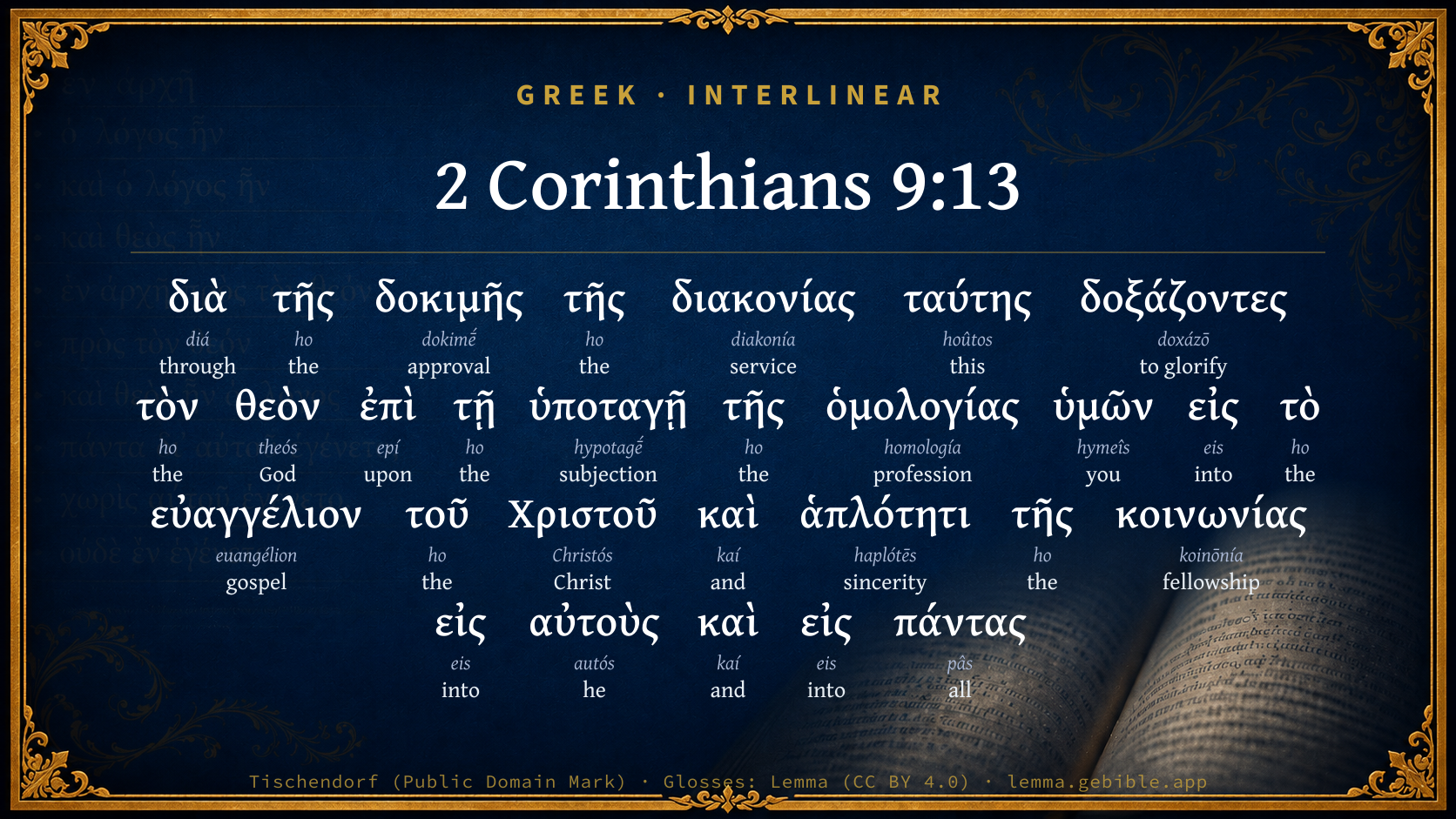
Download image
Cite this verse

2 Corinthians 9:13 (World English Bible). Public Domain. Lemma interlinear Bible study tool, https://lemma.gebible.app/v/2-corinthians/9/13.

Show BibTeX & RIS
BibTeX
RIS
English Translation
seeing that through the proof given by this service, they glorify God for the obedience of your confession to the Gospel of Christ, and for the liberality of your contribution to them and to all;
World English Bible · Public Domain
Highlights
  • 2 first appearances in the Greek New Testament
Full analysis ↓
Download a study sheet

One document with this verse’s original text, its word-by-word gloss line, the meaning frame, cross-references with their text, attributed commentary, and full source and license credits — printable, and it pastes into notes with its structure intact.

This verse Autodidact and up

Study sheet (.html) Plain text (.txt)

A passage Seminary Student

Up to 50 verses in one chapter. A passage sheet keeps up to 6 commentary sources and 12 cross-references per verse, in the order this page ranks them, and says so on the sheet whenever that leaves anything out. Ask for a single verse and you get the Autodidact verse sheet above.

Everything on this page stays free to read, with no account — the sheet is a download of what is already on screen, not access to it.

Want to remove ads? Support Godless Engineer
Compare translations 3

The same verse in 3 English versions, stacked beneath the original-language interlinear above. Click any original word for its lexicon entry.

Each is an independent rendering of the whole verse — the interlinear is not word-aligned to these translations.

Highlighted words mark where these versions differ — a whole-verse word diff, not a word-by-word alignment.

  • World English Bible Public Domain
    seeing that through the proof given by this service, they glorify God for the obedience of your confession to the Gospel of Christ, and for the liberality of your contribution to them and to all;
  • King James Version Public Domain
    Whiles by the experiment of this ministration they glorify God for your professed subjection unto the gospel of Christ, and for your liberal distribution unto them, and unto all men;
  • unfoldingWord Literal Text CC BY-SA 4.0
    Through the proof of this ministry, they are glorifying God on the basis of the obedience of your confession to the gospel of Christ and the generosity of the fellowship toward them and toward everyone,

unfoldingWord Literal Text — © unfoldingWord, licensed CC BY-SA 4.0. Word-aligned USFM3 via Door43 (git.door43.org/unfoldingWord/en_ult).

Versions to compare (up to 4)

3 of 4 selected

Show all 19 translations

Every available English version of this verse, each an independent rendering of the whole verse.

  • World English Bible Public Domain
    seeing that through the proof given by this service, they glorify God for the obedience of your confession to the Gospel of Christ, and for the liberality of your contribution to them and to all;
  • Berean Standard Bible Public Domain
    Because of the proof this ministry provides, the saints will glorify God for your obedient confession of the gospel of Christ, and for the generosity of your contribution to them and to all the others.
  • Majority Standard Bible Public Domain
    Because of the proof this ministry provides, the saints will glorify God for your obedient confession of the gospel of Christ, and for the generosity of your contribution to them and to all the others.
  • King James Version Public Domain
    Whiles by the experiment of this ministration they glorify God for your professed subjection unto the gospel of Christ, and for your liberal distribution unto them, and unto all men;
  • American Standard Version (1901) Public Domain
    seeing that through the proving `of you' by this ministration they glorify God for the obedience of your confession unto the gospel of Christ, and for the liberality of `your' contribution unto them and unto all;
  • Revised Version (1885) Public Domain
    seeing that through the proving of you by this ministration they glorify God for the obedience of your confession unto the gospel of Christ, and for the liberality of your contribution unto them and unto all;
  • Geneva Bible (1599) Public Domain
    (Which by the experiment of this ministration praise God for your voluntarie submission to the Gospell of Christ, and for your liberall distribution to them, and to all men)
  • Douay-Rheims (1899) Public Domain
    By the proof of this ministry, glorifying God for the obedience of your confession unto the gospel of Christ, and for the simplicity of your communicating unto them, and unto all.
  • Young's Literal Translation Public Domain
    through the proof of this ministration glorifying God for the subjection of your confession to the good news of the Christ, and `for' the liberality of the fellowship to them and to all,
  • Literal Standard Version CC BY-SA 4.0
    through the proof of this ministry glorifying God for the subjection of your confession to the good news of the Christ, and [for] the liberality of the fellowship to them and to all,
  • Unlocked Literal Bible CC BY-SA 4.0
    Because of your being tested and proved by this service, you will also glorify God by obedience to your confession of the gospel of Christ. You will also glorify God by the generosity of your gift to them and to everyone.
  • unfoldingWord Literal Text CC BY-SA 4.0
    Through the proof of this ministry, they are glorifying God on the basis of the obedience of your confession to the gospel of Christ and the generosity of the fellowship toward them and toward everyone,
  • Darby Bible Public Domain
    they glorifying God through the proof of this ministration, by reason of your subjection, by profession, to the glad tidings of the Christ, and your free-hearted liberality in communicating towards them and towards all;
  • World Messianic Bible Public Domain
    seeing that through the proof given by this service, they glorify God for the obedience of your confession to the Good News of Messiah and for the generosity of your contribution to them and to all,
  • Webster's Bible Public Domain
    While by the experiment of this ministration they glorify God for your professed subjection to the gospel of Christ, and for your liberal distribution to them, and to all men;
  • Free Bible Version CC BY-SA 4.0
    By giving this offering you show your true nature, and those who receive it will thank God for your obedience, since it shows your commitment to the good news of Christ and your generosity in giving to them and everyone else.
  • Bible in Basic English Public Domain
    For when, through this work of giving, they see what you are, they give glory to God for the way in which you have given yourselves to the good news of Christ, and for the wealth of your giving to them and to all;
  • Text-Critical English NT CC BY 4.0
    By their approval of this ministry, the saints in Jerusalem will glorify God because of your submission to the gospel of Christ that you confess, and also because of your generous contribution to them and to all.
  • Tyndale New Testament (1534) Public Domain
    whiche prayse god for the obedience of youre professynge the gospell of Christ and for youre synglenes in distributynge to them and to all me:

Literal Standard Version (2020), Covenant Press — licensed CC BY-SA 4.0. Text via the HelloAO Bible API (eBible.org). Unlocked Literal Bible (unfoldingWord) — licensed CC BY-SA 4.0. Text via the HelloAO Bible API (eBible.org). unfoldingWord Literal Text — © unfoldingWord, licensed CC BY-SA 4.0. Word-aligned USFM3 via Door43 (git.door43.org/unfoldingWord/en_ult). Free Bible Version, Dr. Jonathan Gallagher — licensed CC BY-SA 4.0. Text via the HelloAO Bible API (eBible.org).

Word by word

More ways to search: Search by grammar → Find every occurrence → Compare this word →

Practice this passage: Drill this verse → Learn its vocabulary →

ὑποταγῇ
hypotagḗ
G5292
“subjection”
Noun, Dative, Singular, Feminine
Part of Speech
Noun
Case
Dative
Number
Singular
Gender
Feminine
Full Thayer's Definition

Origin: from G5293

TDNT: 08:46,1

1. the act of subjecting 2. obedience, subjection
  1. διὰ diá G1223 “through” Preposition
  2. τῆς ho G3588 “the” Article, Genitive, Singular, Feminine
  3. δοκιμῆς dokimḗ G1382 “approval” Noun, Genitive, Singular, Feminine
  4. τῆς ho G3588 “the” Article, Genitive, Singular, Feminine
  5. διακονίας diakonía G1248 “service” Noun, Genitive, Singular, Feminine
  6. ταύτης hoûtos G3778 “this” Demonstrative pronoun, Genitive, Singular, Feminine
  7. δοξάζοντες doxázō G1392 “to glorify” Verb, Present, Active, Participle, Nominative, Plural, Masculine
  8. τὸν ho G3588 “the” Article, Accusative, Singular, Masculine
  9. θεὸν theós G2316 “God” Noun, Accusative, Singular, Masculine
  10. ἐπὶ epí G1909 “upon” Preposition
  11. τῇ ho G3588 “the” Article, Dative, Singular, Feminine
  12. τῆς ho G3588 “the” Article, Genitive, Singular, Feminine
  13. ὁμολογίας homología G3671 “profession” Noun, Genitive, Singular, Feminine
  14. ὑμῶν hymeîs G5210 “you” Personal pronoun, 2nd person, Genitive, Plural
  15. εἰς eis G1519 “into” Preposition
  16. τὸ ho G3588 “the” Article, Accusative, Singular, Neuter
  17. εὐαγγέλιον euangélion G2098 “gospel” Noun, Accusative, Singular, Neuter
  18. τοῦ ho G3588 “the” Article, Genitive, Singular, Masculine
  19. Χριστοῦ Christós G5547 “Christ” Noun, Genitive, Singular, Masculine
  20. καὶ kaí G2532 “and” Conjunction
  21. ἁπλότητι haplótēs G572 “sincerity” Noun, Dative, Singular, Feminine
  22. τῆς ho G3588 “the” Article, Genitive, Singular, Feminine
  23. κοινωνίας koinōnía G2842 “fellowship” Noun, Genitive, Singular, Feminine
  24. εἰς eis G1519 “into” Preposition
  25. αὐτοὺς autós G846 “he” Personal pronoun, Accusative, Plural, Masculine
  26. καὶ kaí G2532 “and” Conjunction
  27. εἰς eis G1519 “into” Preposition
  28. πάντας pâs G3956 “all” Adjective, Accusative, Plural, Masculine

About this verse

These counts appear in no published source. They are computed here, from the morphology-tagged text and Lemma’s own curated glosses. What Lemma adds →

29
words
19
distinct lemmas
Pauline Epistles
section

Notable vocabulary

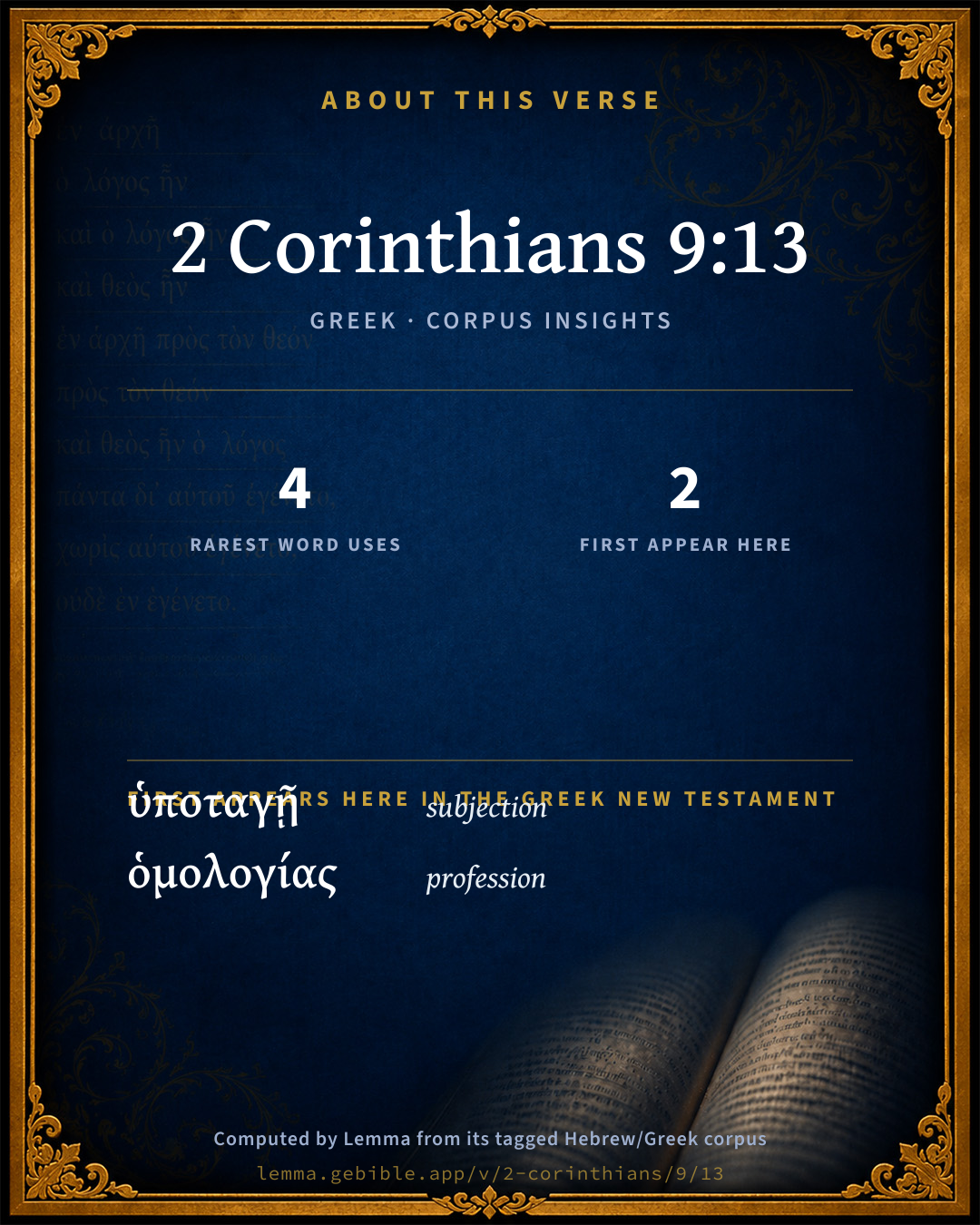
The rarest word here is ὑποταγῇ subjection G5292 — appearing just 4 times in the whole Greek New Testament.

First appearance in Scripture

These words make their first canonical appearance in the Greek New Testament here:

  • ὑποταγῇ subjection G5292
  • ὁμολογίας profession G3671

Shared distinctive vocabulary

ὑποταγῇ subjection G5292 occurs in 4 verses of the Greek New Testament. Also found in:
Repetition

Words recur within this verse:

Cross-references

21

Topical passages linked to 2 Corinthians 9:13 in the Treasury of Scripture Knowledge — connected by theme and wording, ordered by reader-vote popularity; previews shown in the World English Bible.

  • Matthew 5:16 Even so, let your light shine before men; that they may see your good works, and glorify your Father who is in heaven.
  • Hebrews 13:16 But don't forget to be doing good and sharing, for with such sacrifices God is well pleased.
  • 2 Corinthians 2:12 Now when I came to Troas for the Gospel of Christ, and when a door was opened to me in the Lord,
  • Galatians 1:24 And they glorified God in me.
  • Psalms 50:23 Whoever offers the sacrifice of thanksgiving glorifies me, And prepares his way so that I will show God's salvation to him."
  • Matthew 9:8 But when the multitudes saw it, they marveled and glorified God, who had given such authority to men.
  • Luke 6:46 "Why do you call me, 'Lord, Lord,' and don't do the things which I say?
  • John 15:8 "In this is my Father glorified, that you bear much fruit; and so you will be my disciples.
  • Acts 4:21 When they had further threatened them, they let them go, finding no way to punish them, because of the people; for everyone glorified God for that which was done.
  • Acts 11:18 When they heard these things, they held their peace, and glorified God, saying, "Then God has also granted to the Gentiles repentance to life!"
  • Acts 21:19–20 When he had greeted them, he reported one by one the things which God had worked among the Gentiles through his ministry.
  • Romans 16:26
  • 2 Corinthians 8:4 begging us with much entreaty to receive this grace and the fellowship in the service to the saints.
  • 2 Corinthians 10:5 throwing down imaginations and every high thing that is exalted against the knowledge of God, and bringing every thought into captivity to the obedience of Christ;
  • 1 Timothy 6:12 Fight the good fight of faith. Lay hold of the eternal life to which you were called, and you confessed the good confession in the sight of many witnesses.
  • Hebrews 3:1 Therefore, holy brothers, partakers of a heavenly calling, consider the Apostle and High Priest of our confession, Jesus;
  • Hebrews 4:14 Having then a great high priest, who has passed through the heavens, Jesus, the Son of God, let us hold tightly to our confession.
  • Hebrews 5:9 Having been made perfect, he became to all of those who obey him the author of eternal salvation,
  • Hebrews 10:23 let us hold fast the confession of our hope unyieldingly. For he who promised is faithful.
  • 1 Peter 2:9 But you are a chosen race, a royal priesthood, a holy nation, a people for God's own possession, that you may show forth the excellencies of him who called you out of darkness into his marvelous light:
  • 1 Peter 4:11 If any man speaks, let it be as it were oracles of God. If any man serves, let it be as of the strength which God supplies, that in all things God may be glorified through Jesus Christ, to whom belong the glory and the dominion forever and ever. Amen.

Cross-references courtesy of OpenBible.info (CC BY 4.0).

Commentary

Notes on 2 Corinthians 9:13 from classic Christian and Jewish commentators (each source and its license shown beneath its notes). The classic Christian expositions comment on the surrounding passage and are grouped to its opening verse, so a note may address several verses; the Jewish commentaries on the Tanakh (Rashi and others) are per-verse, so they appear only where the commentator wrote on this verse.

Lemma curates 59 commentaries, every one of them public domain or Creative Commons licensed, each selected and text-cleaned for this edition rather than reprinted as found. About our sources →

The Biblical Illustrator

Joseph S. Exell

2Co_9:13-14

By the experiment of this ministration they glorify God for your professed subjection unto the gospel of Christ.

Professed subjection unto the gospel of Christ

We have here--

I. A summary of Christian principles--The gospel of Christ. And what is the gospel? It is, in short, a proclamation.

1. A full salvation.

2. A finished salvation.

3. A free salvation.

4. An infallible and eternal salvation.

II. An epitome of Christian experience. Your subjection.

1. This carries with it a supposition that man likes not the gospel of Christ naturally. And never will depravity give way until it is brought into subjection to the gospel of Christ.

2. The proof of this subjection is the being made willing to submit to the humiliating plan of salvation, and this is illustrated in the case of St. Paul.

III. An exhibition of Christian practice--your professed subjection. There is then to be a profession of religion. If retirement, if solitary communion with God had been all that was necessary, He would have appointed us to live in solitude rather than in communities. (R. C. Dillon, D. D.)

What is essential to Church membership

I wish to direct attention to the declaration of those who profess obedience to Christ by joining the Church. Such a one professes to have--

I. A clear understanding of the first principles of the gospel of Christ. One cannot make a profession truly unless he makes it intelligently. There is a difference between knowledge and faith, yet when there is faith there must be some knowledge. Ignorance marks credulity, but not faith. True, there is a difference between apprehension and comprehension. We often apprehend what we cannot explain. To be a Christian it is not necessary to be a theologian; yet there must be a clear conception that Jesus Christ is the Lord, that He has suffered and died to make salvation possible. In the present reaction against creeds we must see that we do not let go our hold on the essential truths.

II. A personal experience of the gospels power. Men should first come to Christ, then into the Church. I do not claim that the Church member should be able to tell the moment when he was born into the kingdom of the Saviour, or the details of his conversion. The watchman may not be able to tell when the first faint gleam of the day was on the eastern sky, etc. What I ought to know is that the day has dawned in my heart. It is not claimed that the Christian is to be perfect. The little one in the primer class is just as much a student as the youth with his calculus. So no one is to be excluded from Christs school because he is but learning the alphabet of His doctrine.

III. A willingness to sacrifice everything that is inconsistent with a Christian life. The Christian has one Lord, Christ Jesus. If he enters where there is another ruler, call it pride, fashion, or what you will, he becomes a traitor to his Lord. Remember, the Christian can have but one king. And think of Pauls warning, that he that doubteth is condemned already.

IV. A willingness to work with the Church in behalf of Christianity. The Church has a work to do in the world.

1. To those who have professed this subjection, Have you kept this profession?

2. To those who have not made profession, Why have you not professed Christ? (W. M. Taylor, D. D.)

The Christians surrender to Christ

The apostle expresses his thought in military language. He speaks of the confession of Christ which the Corinthian Christians had made as a surrender, in which they grounded the arms of their opposition and enlisted under His banner. He speaks of their subjection as a subordination to military authority. This is Pauls idea of Church membership.

I. The gospel is a great body of truth received from heaven by immediate revelation, and for this reason of a higher order and more binding authority than any truth which comes to us in a natural way. To this system of revealed truth we are to subject our understandings. We are to receive it as the Word of God.

II. The gospel is the revelation of a method of salvation--a new method, one of which man never could have conceived--an exclusive method, so that a man must discard all others if he accepts this. Church membership implies, in this second sense, subjection of the heart to the method of redemption revealed in the gospel--the renunciation of all self-righteousness.

III. The gospel prescribes a rule of practical living. So, then, he is to subject his life to the guidance and control of the Holy Spirit.

IV. The gospel is Gods great agency for the regeneration, the purification, the enlightenment of the world. Church membership involves the subjection of ones resources to the service of Christ. A mans time, his influence, his money, all are to be laid upon the altar to be used as the Lord has need. This is the kind of Church membership we need to-day. (T. D. Witherspoon, D. D.)

Thanks be unto God for His unspeakable gift.--

Gods unspeakable gift

Consider Christ as--

I. The gift of God.

1. What is not implied--

(1) That there is any posteriority on the part of the Son to the Father. The Sons goings forth are from of old--even from everlasting. Before Abraham was, I am.

(2) That there is any inferiority in nature, perfections, or blessedness on the part of the Son; for what the Father is that the Son is.

(3) Still less that there was any involuntariness on the part of the Son to come to us. The Son was as willing to be given as the Father was to give Him.

2. What is implied--

(1) The Saviours appointment by the Father to the work of substitution for sinners.

(2) The Saviours subjection, as the sinners Substitute, to all the consequences which His situation entailed, having undertaken to make satisfaction for us.

(3) The application of the Son to the sinners soul as his portion, with all the blessings that are consequent upon His mission.

II. The unspeakable gift of God. Now this word unspeakable occurs only twice elsewhere (2Co_12:4; 1Pe_1:8).

1. It is unspeakably great. Its greatness surpasses all human expression, it is a Divine gift. Divinity is the sun that lightens and gilds every passage of inspiration.

2. It is unspeakably free. And, after all, it is the freeness of this gift that makes it so worthy of God to bestow, and so fit for us to accept.

3. It is unspeakably necessary. We were lost, and none but Christ could find us; dead, and none but Christ could raise us; sunk, and none but Christ could recover us; afar off, and none but Christ could bring us in; guilty, and none but Christ could procure for us a pardon.

4. It is unspeakably efficacious. A gift may be exceedingly valuable in itself--it may have been bestowed by great kindness, but, somehow or other, it may fail of answering the end intended. But here is a gift that is efficacious.

III. A gift for which thanks are to re returned to God. These thanks must be--

1. Personal.

2. Fervent and lively.

3. Practical.

As Philip Henry says, thanksgiving is good, but thanks-living is better. (J. Beaumont, M. D.)

Gods unspeakable gift

I. The gift of God.

1. Its nature. It is the gift of His beloved Son. The prophets foretold Him as the gift of God--Unto us a Son is given. Jesus describes Himself as the gift of God--God so loved the world that He gave, etc. The apostles announce Jesus as the gift of God (1 Rom_6:23; 1Jn_5:2.)

2. Its excellence. It is unspeakable in--

(1) Its source. The love of God. Who can tell why God hath loved us? who can calculate how God hath loved us? or who can comprehend the beginning or the end of the love of God in Christ Jesus? Who can tell its duration or its perfections, its tenderness, or its strength? Angels stoop from their throne in glory to contemplate and to adore the manifestation of redeeming love in Christ.

(2) Its value. To form some faint idea of the value of this gift, consider--

(a) the divinity of the Redeemers person.

(b) The depth of the Redeemers sufferings.

(3) Its character. All wisdom, mysteries, and blessings unite in Christ crucified.

(4) Its application is--

(a) Free. Jesus invites all, and casts out none.

(b) Spiritual. Though offered to all freely, the Holy Spirit alone can effectually apply it.

(5) Its effects. Pardon, peace, holiness, heaven.

II. The duty of man. To thank God for the gift of His Son.

1. With the gratitude of our hearts.

2. With the praises of our lips.

3. By the obedience of our lives. (J. Cawood, M. A.)

Gods unspeakable gift

All the gifts of God are good; but there is one which, in its intrinsic value and the importance of its blessings, infinitely transcends them all, so that, without exaggeration, it is unspeakable. That gift is Jesus Christ. It is unspeakable--

I. In the freeness of its bestowment.

1. It was unmerited; it was a gift to those who never had the shadow of a claim. It was a gift to man, not in a state of allegiance and innocence, but of rebellion and apostasy.

2. Never was gift so entirely unsolicited. The grace which was given us in Christ Jesus God gave us before the world began.

II. In its value.

1. In itself it is unspeakable. The wondrous union of the Divine with the human nature in the person of Immanuel is infinitely more than our feeble powers can comprehend. Yet it is a truth most clearly revealed. From this union arises His ability to save; hence the incalculable value of His sacrifice. On the one hand, being human, He can obey and suffer; on the other hand, being Divine, there is an infinite merit impressed upon His obedience and sufferings.

2. Its relative value. Think of the relation in which the Redeemer stood--

(1) To the Father. Think of the glory which He had with Him before the world was.

(2) To the universe, as the Creator, the Proprietor, and the Sovereign Lord.

III. In the results of its bestowment.

1. The salvation of men. This was the great object of the Redeemers mission. It is a salvation from--

(1) The pollution of sin. Purity is an essential part of it.

(2) The power of sin. Sin shall not have dominion over them who, being justified by faith, are no longer under the law, but under grace.

(3) The wrath of God. God is angry with the wicked every day.

(4) The sting of death.

(5) The resurrection of damnation, the terrors of judgment, and the pains of hell.

2. The honour of God. (T. Raffles, D. D.)

The unspeakable gift

Let me--

I. Illustrate this interesting doctrine. By the gift of Christ we receive--

1. The gift of religious truth.

2. The gift of conscience. Where there is no truth there is no conscience; men seem asleep; in their trespasses and sins they are dead. Such was the state of the pagan world.

3. The gift of righteousness by faith. It is only by Christ that we come to know the fact that the God whom we have offended is placable, and that it is in His gracious purpose to forgive.

4. A new order of affections.

5. The privilege of public worship.

II. Improve it.

1. This unspeakable gift, with all its resulting blessings, may have been offered to us in vain.

2. In it see the love of God; His readiness to save.

3. If the gift be unspeakable, from the very fulness and variety of its blessings, then have we presented to us the noblest view of the true life of a Christian. In every other form of religion, or in those framed out of a corrupted form of the true religion, we soon see all that they can give; the spring is soon dry, or, rather, it never flows but in the imagination of the deluded votary. But here the fulness is inexhaustible, and spreads innumerable blessings before us in time and eternity. (R. Watson.)

The unspeakable gift

It is unspeakable because--

I. It is most precious (1Pe_2:7). Suppose I put into your hand a large jewel worth ten thousand pounds; then I show you another, and say there are only four to be seen on the face of the earth. The one is costly, the other rare, and both are precious. Christ is precious because--

1. He is most valuable. His humanity is adorned with every grace; His Divinity is enriched with every perfection.

2. He is most rare. There is only one Bible, and that is enough. We have only one sun. So we have only one Saviour, and we need no other.

II. It is most comprehensive (Rom_8:32). It comprehends all we need for time and for eternity. They who receive this gift receive--

1. God the Father, God the Son, God the Holy Ghost.

2. All spiritual privileges.

3. Heaven (Joh_14:1).

III. It is most suitable. They who receive this Gift receive raiment for their naked souls (Rev_7:13). Those who are spiritually hungry receive the Bread of Life (Joh_6:48). Water is to satisfy the thirsty; they who receive this Gift receive the water of life (Joh_4:1-54). They who receive this Gift receive freedom from the captivity of Satan and of the world (Isa_61:1).

IV. It is most satisfying. The world never satisfies. That large bag of gold contains twenty thousand sovereigns. What is that written on the outside? Satisfieth not. But what is Christ? A Gift so precious that they who receive it are satisfied for ever.

V. It is eternal (Rom_6:20). You see inscribed upon all earthly things the words, Only for a time. (A. Fletcher, D. D.)

The unspeakable gift

I. Before we consider what this unspeakable gift is, let us consider those which can be easily spoken of.

1. What a wonderful world is this! What beauty, variety, majestic presence of law, vast order, infinite adaptations to the purposes of life! Go out on a summer morning. Man goes forth to his work and his labour, creating another world of art and use, a microcosm in the macrocosm. He also is allowed to be a creator in his little sphere.

2. Life is a little day, but how it is filled with opportunity for knowledge, for work, for love!

3. And what a wonderful gift is the human soul! What mysterious powers are hidden therein, slowly evolved into grand activities! For all this we may well thank God every day and every hour. But why? He does not need words of praise. He cannot love praise as men desire it. To this many would answer, He wishes our praise, not for His own sake, but only for ours. It does us good to be grateful. This is true as far as it goes, but only half the truth. There is a sense in which God may enjoy the thanks of His creatures. If those thanksgivings of ours come from love, then even the Infinite Majesty of Heaven may find joy in the grateful heart of creation, for love unites the high and the low. Who can ever despise or be indifferent to sincere love?

II. Love, then, is the unspeakable gift.

1. The gift which makes the value of all other gifts. We do not value a gift from man unless we see in it some love. Ingratitude is inability or unwillingness to recognise love in a giver.

2. Love is unspeakable, for who can describe even human love, much less infinite love? But what we cannot describe we can see and know. Who can describe the perfume of a violet? Yet we know it. Who can describe the melody in the song of a nightingale or the music of a gentle voice? But we know these, and can recall them after long years. So we may know, though we cannot describe, this unspeakable gift of Divine love. Men may receive all Gods other gifts, and if no love is seen in them they will awaken no gratitude. A man of taste may be gratified, but hardly grateful, in the sight of outward beauty. The sight of vast laws may gratify our desire for knowledge; a man may do right simply because it is right, and will find satisfaction in so doing. But the unspeakable gift may not be in any of these blessings. It is not till we see love in Gods gifts that we are grateful; and when we see love we cannot help being grateful.

3. But is not this the wonder of wonders, that the Infinite Being should not be above the reach of love? We see power, wisdom, benevolent adaptations everywhere; but before the personal being, the great heart of the universe, there hangs an impenetrable veil. To the intellect this mystery is unfathomable. But one has drawn aside that veil--one who from the first spoke of God as Father. We can come to the Infinite Being by the broad highway of reason. But who except Jesus has revealed the deeper mystery of Divine love? There have, indeed, been mystics in all religions who have sought by ascetic practices to purify themselves so as to meet God in their souls. But Jesus brings Gods love to all, not to the thinker or the monk, but to the humblest child of the Infinite Friend. The sailor on the high and giddy mast can feel beneath him the everlasting arms. The young soldier, dying in pain on the battle-field, can say, My Father! and be at peace. The sinner in the midst of temptation can utter in his heart a cry for help, and be pardoned and saved. The little child can talk with this dear Father, and its childish prattle will reach the Infinite ear.

4. And this unspeakable gift is given to you and to me. To us the word of this salvation is sent. Salvation! for what can be more safe than to feel ourselves in the embrace of an infinite love? Sacrifice and offering He does not require. He says only this, My son, give Me thine heart. And to enable us to do this He shows how He so loved the world as to give His only Son to bring the same sense of a Fathers love to the rest of His children. (J. Freeman Clarke, D. D.)

The gift unspeakable

Nothing can so excite Gods people to give to Him as the remembrance of what God has given to them. Freely ye have received, freely give. Gospel graces are best stimulated by gospel motives. The gospel is founded upon giving, and its spirit is giving. God gives us Jesus--everything in fact; and then, moved by love to Him, we give ourselves back to Him and to His people.

I. Christ is the gift unspeakable.

1. No man can doctrinally lay down the whole meaning of the gift of Christ to men. The devout and studious have themselves cried out, Oh, the depths, but they have not pretended to fathom this abyss of mystery. It is idle to attempt a definition of infinity. Theology can speak on many themes, and she hath much to say on this, but her voice fails to speak the whole.

2. No man can ever set forth the manner of this gift.

(1) The manner of the Fathers giving the Only-Begotten to us. We swim in mysteries when we speak of the Father and the Son. How, then, shall any explain how God could give the Son to die, He being one with Himself? Or, if he could explain, can he tell us what it cost?

(2) Our Lords sufferings when He was made sin for us. None can declare the greatness of His sufferings. Incarnation is but the first step, but of that first descent of love who shall declare the mystery? Thine unknown sufferings, says the Greek Liturgy, and unknown they must for ever be.

3. None can describe the boons which have come to us through the gift of Christ. There is, first of all, the forgiveness of sins according to the riches of His grace. Then comes adoption, and all that that means. All things are yours, etc. Other gifts may amaze us, but this overwhelms us. If the stream be fathomless who shall find a plummet wherewith to measure the fountain?

4. When it is best realised speech about it fails. Utterance belongs not to the deepest emotion. Some feelings are too big for expression. A dear lover of Christ wished to join a certain church, but her testimony was too little to satisfy the brethren, and they told her so; when, bursting through all bonds, she cried out, I cannot speak for Him, but I could die for Him.

5. Even when the Spirit of God helps men to speak upon it, they yet feel it to be unspeakable. You shall not be able to soar amongst the mysteries and then come back and say, I can declare it all to you. No, Paul heard things which it were not lawful for a man to utter.

II. Christ is a gift to be very much spoken of.

1. By thanks to God.

2. By deeds of praise. If our words have failed let us try actions, which speak more loudly than words.

(1) Give yourself away to your Lord. If God has given you Christ, give Him yourself. Ye are not your own.

(2) Then, having given yourself, give of your substance to God, and give freely. Nothing can be too good or great for Him.

(3) Deeds of patience are among the thanks which best speak out our gratitude to God. If you have lost everything but Christ, yet if you have Christ left you what have you lost? Why fret for pins when God gives pearls?

3. By always holding a thankful creed. Believe nothing which would rob God of thanks or Christ of glory. Hold a theology which magnifies Christ, which teaches that Christ is Gods unspeakable gift.

4. By bringing others to accept Gods unspeakable gift. Seek out those who do not know Christ, and tell them the old, old story of Jesus and His love. (C. H. Spurgeon.)

The gift of gifts

It is unutterably precious because--

I. Of the giver.

II. It includes other gifts.

III. It improves other gifts. Through it man values--

1. Nature.

2. Human nature.

3. The Bible more.

IV. It makes us givers.

V. It is a gift to all.

1. Not a loan.

2. Not a purchase.

3. A gift, and a gift to all. (T. R. Stevenson.)

Praise for the gift of gifts

I. Salvation is altogether the gift of God.

1. It comes to us by Jesus, and what else could Jesus be?

2. Over and over again we are told that salvation is not of works, and these are themselves a gift, the work of the grace of God.

3. If salvation were not a free gift how else could a sinner get it? I know that there would have been no hope of heaven for me if salvation had not been the free gift of God to those who deserved it not.

4. Look at the privileges which come to us through salvation! They are so many and so glorious as to be altogether beyond the limit of our furthest search and the height of our utmost reach.

(1) Pardon.

(2) Sonship.

(3) Heirship.

(4) Oneness with Christ.

(5) The Divine indwelling.

(6) Peace which passeth understanding.

(7) Victory over death.

(8) Heaven.

II. This gift is unspeakable. Not that we cannot speak about it. How many times have I, for one, spoken upon it. It is like an artesian well that springeth up for ever and ever. We can speak about it, yet it is unspeakable. Christ is unspeakable--

1. In His person. He is perfect man and glorious God.

2. In His condescension. Can any one measure or describe how far Christ stooped?

3. In His death.

4. In His glory. When we think of His resurrection, of His ascending to the right hand of God, words languish on our lips.

5. In His chosen. All the Father gave Him, all for whom He died, He will glorify with Himself, and they shall be with Him where He is.

6. In the heart here. Throughout a long life and even in heaven Christ will be a gift unspeakable. Eternitys too short to utter half Thy praise.

III. For this gift thanks should be rendered.

1. Some cannot say Thanks be to God, etc., because--

(1) They never think of it. There must be think at the bottom of thank.

(2) Some are always delaying.

(3) Some do not know whether they have it or not.

2. Join me in this exercise.

(1) Thank God for this gift. Put out of your mind the idea that you ought to thank Christ, but not the Father. It was the Father that gave Christ. He gave His Son because He already loved us.

(2) Thank God only. Do not be thinking by whose means you were converted.

(3) Thank God spontaneously. Imitate Paul. When he sounded this peal of praise his mind was occupied about the collection, but, collection or no collection, he will thank God for His unspeakable gift.

(4) Thank God practically. Do something to prove your thanks.

(a) Look for His lost children.

(b) Succour His poor saints.

(c) Bear with the evil ones.

(d) Watch for His Son from heaven. (C. H. Spurgeon.)

Gratitude to God for the mediation of Christ

I. We are, then, to show that God is entitled to the greatest gratitude because of the unspeakable gift of His Son Christ Jesus. Gratitude is that affection of the soul which is excited by acts of kindness done to us. It should always bear proportion to the kindness shown. But how can we estimate the degrees of kindness? In the case of a gift we may do this in the following manner: In proportion as that which is given is valued by the person who gives, in proportion as it is of advantage to the persons to whom it is given, and in proportion to its being undeserved or more or less strictly gratuitous, in the same proportion is the degree of kindness shown, and in the same proportion, consequently, is the degree of gratitude due.

1. Let us first consider the great value which God must have set on the gift. It was not one of the most exalted of our own order whom God gave to men as their Saviour, neither was it one of the angelic spirits who are far more exalted beings than the most exalted of the children of men. Now, if God has such a love to good and holy men as He is represented in Scripture to have, His love to so glorious a person as Christ above must be unspeakably greater. But this is not all. The particular name by which this glorious person is distinguished in Scripture plainly intimates the nature and strength of that love which the God of love must ever feel towards Him. He is called His Son, His own Son, His only begotten and well-beloved Son. If God has such an extraordinary love to those who are His adopted sons, as we find in Scripture He has, how inconceivably greater love must He always bear to the Son of His nature, who was ever with Him, and ever did the things which pleased Him! What unspeakable kindness towards men, then, did God discover in giving His own Son, a person of such worth, and so dear to Himself, to be their Saviour! How grateful a sense of His kindness ought such a gift to produce in us!

2. Let us, in the next place, consider the vast value of this gift to men. Many and valuable are the gifts which we have received from God, but of them all there is none so valuable as the gift of His Son, and of eternal life through Him. Its great superiority appears in this circumstance, that the bestowal of it was necessary in order to convert all other gifts into blessings. For what would the gift of life in this world, with all prosperity, have proved if the Son of God had not also been given that He might become the author of eternal salvation to as many as obeyed Him?

3. But let us, in the last place, on this part of the subject, consider our entire want of claim on God for this gift.

II. To inquire what some of the causes are of that base ingratitude with which the great body of the hearers of the gospel are chargeable, notwithstanding this unspeakable gift.

1. The first cause of this base ingratitude which we shall mention is ignorance of the nature and excellence of the gift. Knowledge is the light of the soul, and by it are the various powers and faculties of the mind directed in their operation. It is the perception of what is grand that excites our admiration; it is the perception of loveliness that excites our esteem; and it is the perception or knowledge of kindness shown to ourselves that excites our gratitude, Where there is no such perception or knowledge of kindness there can be no gratitude. Whether you neglect the Bible, or contemn and deny it, in order, as you may think, to show your superior wisdom and understanding, your ignorance of the nature and excellence of the gift of God made known to you in it must be highly criminal, and consequently the ingratitude which flows from your ignorance cannot be excused.

2. The next cause of this base ingratitude which we shall mention is error, or such opinions respecting this gift as derogate from its greatness and excellence. The gift is depreciated by making Christ a mere man, which lessen also the value of it to men by denying that they are so miserable as the Scriptures represent them to be, and which depreciate it further by magnifying the merit of human conduct, as if it deserved much favour.

3. Another great cause of ingratitude is insensibility of heart. This is the principal cause. It is the parent of the indolence and inattention which produce ignorance of Divine things in general, and of this gift in particular. It is also a prime reason of that perversion of understanding which embraces error for truth.

4. The only other cause of this ingratitude which we shall mention is pride. Pride, being a high sense of our own worth, is most unfriendly to the exercise of gratitude, because it always disposes us to look upon ourselves as entitled to those favours which we receive.

We come now to conclude the subject with a few reflections on what has been said.

1. In the first place, then, from this subject we may learn that God is entitled to our warmest gratitude for such an unspeakable gift as the gift of His only begotten and well-beloved Son.

2. In the next place, from this subject we must be convinced of the propriety of the feeling and language of Paul, and of those who, like him, are ready to say, Thanks be unto God for His unspeakable gift!

3. In the last place, from this subject we are led to contemplate the baseness and depravity of our nature. (W. Auld.)

Christ, Gods best gift to man

I. Christ is the gift of god to men. He fulfils all the conditions of a gift.

1. He is something valuable.

2. He is offered to us freely; for God was under no kind of obligation to make us such an offer.

3. He is offered to persons who have no claim to such a favour. We cannot claim the offer of Christ as a recompense for injuries received from God, for He has never injured us; nor can we claim it in return for services performed, or favours bestowed, for we have never done anything for God.

4. Nor does God offer His Son with the expectation of receiving anything in return, for we and all that we possess are already His.

5. Nor does God offer us His Son with any intention of resuming the gift; for the gifts of God are without repentance.

II. This gift may be justly styled unspeakable. Observe--

1. That the love which led God to bestow such a gift upon us, must have been unspeakably great. Though Christ spoke as never man spake, yet even He could not describe it except by its effects. God, says He, so loved the world that He gave His only begotten Son, etc., thus intimating that His love could not be described, and leaving us to judge of its greatness by its effects. And, judging by this rule, how great must His love have been.

2. Christs worth and excellence are unspeakably great. He is the pearl of great price. In Him are hid all the treasures of wisdom and knowledge and grace; His riches are unsearchable. In Him dwells all fulness, even all the fulness of the Godhead. In giving us Christ, therefore, God has given us Himself and all He has; and hence those who receive this gift are said to be filled with the fulness of God.

3. Unspeakable as is the intrinsic value of Christ, He is, if possible, still more unspeakably valuable to us. The value of a gift depends much on circumstances. Money may be a valuable present to any one; but to a man on the point of being dragged to prison for debt it is much more so. Medicine or food may be valuable in itself, but when given to a man ready to perish, its value is very greatly increased. So Christ is unspeakably precious in Himself. But how unspeakably more valuable is such a gift to us, who were on the point of perishing for ever.

III. This is a gift for which we ought to thank God with the most lively gratitude. Is it necessary to prove this? Is it not evident from the preceding consideration? (E. Payson, D. D.)

Unspeakable gifts of God

It may surprise some that concerning this passage there has been considerable difference of opinion among expositors. The point in dispute is this, to what particular gift of God did the apostle refer? Most readers instantly conclude that Christ is the gift. To what other gift of God can you give this title unspeakable. I refer to this reasoning only to remind you how fallacious it is. It has its roots not in an exaggerated idea of the greatness of the gift of Christ, for that is impossible, but it has its roots in unworthy notions of Gods other bounties. We should not say it must be the gift of Christ, because it is called unspeakable, for that is assuming Gods other gifts are such as our finite minds can clearly comprehend. It is true that Christ is an unspeakable gift of God. In the gift of Christ Gods love did transcend all His other manifestations; but it is also true that before Christ came from the heart of God to seek and to save the lost, gifts had been lavished upon the children of men of which we would have said their greatness surpasses our description. If we take the bounties of God and set them before our minds, and try to realise what we should feel, and what our earthly life would have been if those bounties had been denied, instead of saying one of His gifts is unspeakable, we should be more likely to say they are all unspeakable. Now look at some common bounties, as we call them; common, not because we can do without them, but because in the fulness of the Divine love they come constantly and they come to nearly all. In the beginning darkness was upon the earth. God said, Let there be light, and there was light. That command is still heard, and by Divine power every night is turned to day. Can you gaze upon the glories of each new returning morning without feeling that this one gift of light repeated every twenty-four hours through the untold ages is an unspeakable gift? Sometimes you meet a man blind from his birth; you see him groping his way in the midst of the thousand fair things whose varied beauties are a perfect blank to him. When you put that mans darkness by the side of your light, when you put that mans poverty by the side of your wealth, do you not feel that you can with the utmost reason exclaim, Thanks be to God for this unspeakable gift. Sometimes you see a poor stricken sufferer who has borne the burden of pain and weakness well nigh through his life. When you think of his pain and feebleness, and of your own soundness and bodily health, vigour, and animal spirits, would it be exaggeration if you exclaimed, Thanks be to God for this unspeakable gift? Sometimes you meet a poor creature to whom the light of reason is denied, human as to his bodily form, but wanting in the mind, which is mans crown of glory. He has no reason whatever to control his instincts and to subdue the strong passions of his body. He cannot look through nature up to natures God. When you look at him, what name do you give to your own faculties? There is but one name for your faculties; they are an unspeakable gift. Those who know me best will least need to be told that it is not mine to induce you to think less of Christ, the gift of gifts. Not less of Christ, but more of Gods other benefits. Now it is more than time to seek an answer to this question. Seeing that there are so many unspeakable gifts, and the apostle refers to only one, to which did he refer? Many able expositors contend that the gift the apostle refers to was the generous, liberal disposition of the Corinthian Christians to the poor saints at Jerusalem. God has given to you, Corinthians, the heart to feel for others, He has given to you the readiness to help others. God be thanked for this unspeakable gift. Then comes the question: Was the apostle thinking of this when he exclaimed, Thanks be to God for His unspeakable gift. Those to whom I have referred believe that in effect the apostle said, You, Corinthians, have never seen the poor suffering people at Jerusalem, but your hearts have bled with pity for them, and your hands have been held out bountifully. Your bountifulness makes many people believe in the gospel with greater faith and love. I am afraid that such an exposition of the passage is what some selfish people have never dreamt of. They have looked at the words, and they have thought the apostle is speaking of some rich treasure which God has put into the hands of the people for their own use and enjoyment. It never occurred to them that he might mean something which God put into the hearts of the Corinthians to make them think and care for others, to make them deny themselves for the sake of others. A quick, sympathetic nature is an unspeakable gift; they make no effort at all to get that gift. But a great many people seem as if they do wish they could be delivered from the burden of all troublesome thought and affection towards others. If they could be their own creators, they would give themselves thoughts of tenderness towards themselves, and hearts of granite towards other people. He who wrote these words about this gift himself had it in rich abundance. At first he had a proud heart, a cruel nature, and the grace of Christ came and changed that nature, and made him responsive to the touch of everybodys trouble. Yes, we must look at this gift not only in relation to this life, but in relation to the life which is to come. Those to whom God gives a gracious heart like His own, He does not intend to leave them for ever in this world of blended light and darkness, sorrow and joy. He intends very soon to take them where all is peace, and all is perfection, and all is blessedness. I have already given you two classes of exposition of this passage. Suffer me now to say a word about a third. The late Dean Alford took this text for a Whit Sunday sermon, and he said, I hesitate not to say at once that the unspeakable gift is the gift of the Holy Spirit. He contended that the blessing of Pentecost--the gift of the Holy Spirit--was the one even toward which all the other events of Revelation contributed. The other gifts, he said, are means to an end, the indwelling of the Spirit in me is the end itself. Was not Christ exalted that the Spirit might be given to men? No one will question that the gift of the Spirit is an unspeakable gift. This world, with all its light and comforts, we owe to the gift of the Spirit. If the unspeakable gift of the Spirit had not been given to Moses, David, Isaiah, and all the inspired writers, they would never have given us a book which above all others is a lamp to our feet and a light to our path. Not only was the Spirit needed for those who wrote; it is needed also for those who read. We know that he that endureth to the end, the same shall be saved, but how do we lack the patience, perseverance, and power necessary to continue to the end. But when the human knowledge and energy fails, the Divine force may secure the victory, and bring the man off more than conqueror. I daresay some of you, while I have been talking, have been like the dove out on the wild waste of waters, you are glad to get back with a weary wing to the old familiar ark, and you say, After all you have said, it was Christ the apostle meant. Be it so, you cannot go wrong in saying that that gift is unspeakable--unspeakable in the love it reveals unspeakable in the glorious issue it will ultimately have. Does some one say that I have touched upon so many unspeakable gifts that I have left him in confusion and perplexity? I am glad if it is so. I wanted to make you feel that Gods gifts are not one, nor two, nor three gifts only; they are not like two or three pyramids rising out on a flat and dreary desert plain. The region of Gods bounty is a mountainous region. Peak after peak, alps upon alps arise. The higher we climb the broader the vision becomes.. There is one higher than the rest, and I see a cross on its summit. To that summit we should look most frequently. It is there we are nearest to God; it is there we grow most into His likeness; it is there we drink most into His Spirit; it is there where sinful men get their guilt cancelled, and receive their passport to a crown and kingdom of glory that fadeth not away. Thanks be to God for every unspeakable gift. (C. Vince.)

The pricelessness of Christ

It is a peculiarity of St. Paul that the less reminds him of the greater. The most ordinary of facts suggest to him the sublimest of truths. The apostle is here enforcing the duty of liberality by a variety of arguments which reach their climax in the text. This gift of God is unspeakable because--

I. It possesses unspeakable worth.

1. Christ is the embodiment of a perfect humanity, and is precious as perfect purity must be amidst pollution, as perfect obedience must be amidst rebellion, as perfect love must be where each man seeks his own.

2. He is God manifest in the flesh. The hands that men touched fashioned the worlds. The eyes they looked into were those from which there is nothing hid. The voice they listened to commanded the hosts of heaven, and called the dead from their graves. Not till our arithmetic can reckon the wealth of omnipotence can we estimate the preciousness of Christ. He is unspeakably precious as the Picture and Transcript of God.

II. It provides for unspeakable needs.

1. Unspeakable guilt. When the soul sees how in Christ God can be just and the Justifier of the unjust, then it echoes the words, Unto them that believe He is precious. Thanks be unto God, etc.

2. Unspeakable weakness. And he who accepts it discovers that while the chains of justice fall off from his limbs, a new tide of vigour flows all through his being. That is a treasure indeed which contains both the key that unlocks the prison doors and the medicine that restores the released mans health, sending him forth on existence not only free but whole.

3. Unspeakable loneliness. Man is without friendship, or at least such a friendship as he really needs. Circumstances happen when man, however plentiful or loving his friends may be, must feel alone. There are the isolations of individual perplexity, sin, sorrow, and death. Give me the presence of One who is wise enough to say, This is the way, walk ye in it, in my hours of doubt--gracious enough to say, I have seen thy ways and will heal thee, in my hours of remorse--loving enough to say, Cast thy burden upon Me, in my hours of trial--near enough and strong enough to say, When thou passest through the waters I will be with thee, at the time when my feet feel the chill waters of death. Give me the presence of a Comforter like this; then will the heart be satisfied. This need is supplied by Gods unspeakable gift.

III. It conveys unspeakable blessings. Large as the wants are, the provisions are larger; great as mans poverty is, greater still is Gods grace. It is one thing to take a vessel and to fill it; it is another to place it in a boundless sea, where it may ever float, and ever be brimming.

1. God not only gives pardon for guilt. Not as the offence is, so is the free gift; but where sin hath abounded, there grace hath abounded much more; and they whom God pardons He raises to infinite dignity. What other king ever translated rebels from the prison-house straight to the palace, and gave them a share in the childrens heritage?

2. God not only discloses for weakness a sufficiency of strength; in Christ there is the pledge of unspeakable victory. It were much to stand in the evil day; but those who have Christ shall be more than conquerors.

3. God not only proffers companionship for loneliness, but affords unspeakable sympathy. In Christ there is a fellow-feeling so wide that it sweeps the range of every emotion, and so true and so delicate that it can touch the tenderest and not jar.

IV. It is the evidence and embodiment of unspeakable love. Here we reach the spring and the origin of all. (W. A. Gray.)

Gods unspeakable gift

1. Christ brought us truth on the highest questions of all, and taught us that truth most fully. We prize, and justly prize, the great masters who gave us the knowledge of nature--Copernicus, Galileo, Newton; Darwin; but more momentous still are the instructions of Moses, Isaiah, and the great moral masters of the ages. Here Christ is supreme. He vindicated and disclosed the spiritual world and the spirituality of man with surpassing authority and power. He made it impossible henceforth that the race should lose itself in materialism and sensuality. In Christ we have in its fulness the precious doctrine of grace, forgiveness, peace.

2. Christ brought righteousness. He secured to us the power of purity. He inspires the strength by which the highest goodness is attainable.

3. Christ brought us hope. He came into the world in an age of weariness and despair, and He made everything to live by putting into the heart of the race a sure and splendid hope. The advent of Jesus mightily enriched the race in incorruptible treasure--in knowledge, kindness, purity, and hope. How much it enriched us none may tell. The gift is unspeakable. Have we received the unspeakable gift? Men do not readily believe in and accept the highest gifts. They are often strangely blind. Did they welcome Gutenberg? Did they strew flowers for Columbus? The world did not believe in these great donors; the gifts they brought were too grand. So, when the unspeakable gift was given, men stood aloof in insensibility or scorn. Christ came to His own, but they received Him not. The message of Gods redeeming mercy is disregarded by multitudes of nominal Christians. Every now and then we hear of a superb masterpiece being discovered in a house where for years it has been neglected and unknown. The picture has been the butt of wit, it has had penknives through it, it has been relegated to the attic. But in how many houses is the gospel, the masterpiece of God, ignored and despised! The savage living in a land of rich landscapes, of gorgeous birds, of priceless orchids, of reefs of gold, of mines of diamonds, of stores of ivory, and yet unconscious of it all, possessing nothing but a hut and a canoe, is a faint image of thousands in this Christian land who are living utterly unmindful of the boundless spiritual treasure close to their feet. Some of us have received the crowning gift of God; but we have not fully received it. That is a striking passage in Obadiah: The house of Jacob shall possess their possessions. What a great deal belongs to us that we do not possess! It lies beyond us untouched, unseen, unrealised. Our poor experiences are not the measure of the gift of Christ. We have the dust of gold rather than the gold itself, a few rose leaves rather than the garden, grape gleanings rather than the vintage. And let us not miss the great practical lesson of the text. The theme of the chapter is that of ministering to the saints. If God has been so magnificent in His generosity to us, what ought we to deny our brother? Our thanks for Heavens infinite gift must be expressed in our practical sympathy with the sons and daughters of misfortune and suffering. (W. L. Watkinson.)

.

The Biblical Illustrator, edited by Joseph S. Exell (c. 1880s–1900s) — public domain. Text from a community e-Sword module.

Bengel's Gnomon

Johann Albrecht Bengel

2Co 9:13. Δοκιμῆς) [the experiment] the proof afforded by this ministration.—δοξάζοντες, glorifying) This depends on thanksgivings, 2Co 9:12. Again the nominative case, on the same principle as 2Co 8:23, note, [Τίτου, κοινωνὸς—ἀδελφοί.]—πι τῇ ὑποταγῇ τῆς ὁμολογίας ὑμῶν, for the subjection of your profession) They were about to profess by their very acts, that they acknowledged the divine bounty shown to themselves in the Gospel, [and had yielded [victas dedisse sc. manus) to the word of grace.—V. g.]—καὶ εἰς πάντας, and to all) He, who benefits some of the saints, by that very act benefits all; for he shows, that he is favourable to all.

Bengel's Gnomon of the New Testament — English translation (T&T Clark, Edinburgh, 1860) — public domain. Text from a community e-Sword module.

Meyer's Critical & Exegetical Commentary

Heinrich August Wilhelm Meyer

2Co_9:13 is not to be placed in a parenthesis; see on 2Co_9:14. The participle is again anacoluthic (comp. on 2Co_9:11). As if he had said before: by the fact that many give thanks to God, Paul now continues: inasmuch as they, induced by the tried character of this service, praise God on account of the submission, etc.[292] Hofmann considers 2Co_9:13 as co-ordinated with 2Co_9:11, so that the ΔΟΞΆΖΟΝΤΕς Τ. Θ … would be the subjects themselves performing the service, who by this service prove themselves to be Christians. If so, (1) we should have to leap over 2Co_9:12 as a merely relative appendage of 2Co_9:11, and to eliminate it from the continuity of the chain of thought; but it does not lend itself to be so dealt with either in virtue of the position assigned to it by ὍΤΙ, or in virtue of the important contents of its two clauses; (2) we should have to shut our eyes to the fact, that ΔΟΞΆΖΟΝΤΕς Τ. Θ … is obviously correlative to the previous ΔΙᾺ ΠΟΛΛ. ΕὐΧΑΡΙΣΤΙῶΝ Τῷ ΘΕῷ; finally, we should have to make the participial clause afterwards begin, in a very involved fashion, with ἘΠῚ Τῇ ὙΠΟΤΑΓῇ Κ.Τ.Λ., in spite of the fact that this ἘΠΊ could not but at once present itself to, and obtrude itself upon, every reader, as the specification of the ground of the ΔΟΞΆΖΟΝΤΕς Τ. ΘΕΌΝ (comp. 2Co_9:15; Luk_2:20; Act_4:21; Sir_3:2).

The ΔΟΚΙΜῊ Τῆς ΔΙΑΚΟΝ. Τ. is the indoles spectata (see on 2Co_8:2) of this work of giving, according to which it has shown itself such as might have been expected in keeping with the Christian standard (especially of love). So Theophylact: διὰ τῆς δοκίμου ταύτης καὶ μεμαρτυρημένης ἐπὶ φιλανθρωπίᾳ διακονίας. Others take the relation of the genitive as: the attestedness, in which this bounty has exhibited you. So Calvin (erat enim specimen idoneum probandae Corinthiorum caritatis, quod erga fratres procul remotos tam liberales erant), Estius, Rosenmüller, Flatt, Rückert, Olshausen, de Wette, Ewald, Osiander; comp. also Hofman, who takes τῆς διακονίας as epexegetical genitive. But it is only in what follows that the ground of the praise is introduced as subsisting in the Corinthians, and that by a different preposition (ἐπί), and, besides, it is most natural to understand Τῆς ΔΙΑΚΟΝΊΑς Τ. of that which is attested, so that the attested character of the collecting work appears as the occasion (διά, see Winer, p. 357 [E. T. 476]; Bernhardy, p. 235) of Gods being praised on account of the obedience of the Corinthians, etc. Observe, withal, how the actual occasion which primarily brings about the δοξάζειν τ. θ … (ΔΙΆ), and the deeper ground of this δοξάζειν (ἘΠΊ), are distinguished. We may add that Rückert arbitrarily finds here an evidence that Paul in the collection had it as his aim to break down the repugnance of the Jewish-Christians towards the Gentile-Christians by this proof of the latters love. Comp. on 1Co_16:1. The work of collection may have furthered this reconciliation, but this was not its aim.

ἐπὶ τῇ ὑποταγῇ … πάντας] contains two reasons for their praising God. The first refers to the gospel of Christ (concerning Christ, 2Co_2:12): on account of the compliance with your confession (because you are so obedient in fact to your Christian confession of faith), they praise God in reference to the gospel of Christ, which, in fact, produces such compliance of its confessors. The second reason refers to the persons, namely, to them, the receivers themselves, and all Christians in general: and on account of the simplicity of the fellowship (because you held the Christian fellowship in such a sincere and pure manner) they praise God in reference to themselves and to all, as those whom this ἁπλότης τ. κοινωνίας goes to benefit. Paul rightly adds Κ. ΕἸς ΠΆΝΤΑς; for by the beneficence towards the Jews the Corinthians showed, in point of fact, that they excluded no Christians from the sincere fellowship of love. The expositors connect εἰς το εὐαγγ. τ. Χ. either with Τῆς ὉΜΟΛΟΓ. ὙΜῶΝ, so that ὉΜΟΛΟΓ. ΕἸς is said, like ΠΊΣΤΙς ΕἸς (Erasmus Schmid, Wolf, Flatt, Rückert, Ewald, Osiander, and others, including Billroth), or with Τῇ ὙΠΟΤΑΓῇ (Chrysostom, Erasmus, Calvin, Beza, Grotius, and many others), and then ΕἸς ΑὐΤΟῪς Κ. ΕἸς ΠΆΝΤΑς with Τῆς ΚΟΙΝΩΝΊΑς.[293] But this view would require the connecting link of the article both before εἰς τὸ εὐαγγ. and also before ΕἸς ΑὐΤΟΎς, since neither ὙΠΟΤΆΣΣΕΣΘΑΙ nor ὉΜΟΛΟΓΕῖΝ nor ΚΟΙΝΩΝΕῖΝ is construed with ΕἸς, the last not even in Php_1:5 (in opposition to de Wette). The suggestion to which Hofmann has recourse, that the twice used ΕἸς expresses the direction in which boththe ὑποταγὴ τῆς ὁμολογίας and the ἉΠΛΌΤΗς Τῆς ΚΟΙΝΩΝΊΑςtake place, has against it the non-insertion of the connecting article, which only may be rightly omitted when ΕἸς in both cases belongs to the verb (ΔΟΞΆΖΟΝΤΕς Τ. Θ.).[294] Rückerts appeal to the inexactness of the language in this chapter is unfounded and the more to be rejected, that no fault can be found with the meaningby no means tame (Osiander), but rich in significant referencewhich arises from the strictly grammatical construction. Observe especially the quite Pauline way of exhausting, by different prepositions, the different characteristic aspects of the subject-matter (here the ΔΟΞΆΖΕΙΝ ΤῸΝ ΘΕΌΝ), which he does according to the categories of the occasion (ΔΙΆ), the ground (ἘΠΊ), and the point of reference (ΕἸς: with a view to). Comp. 2Co_1:11, Rom_3:25, and many other passages.

On ὉΜΟΛΟΓΊΑ,[295] confession, comp. 1Ti_6:12-13; Heb_3:1; Heb_4:14; Heb_10:23; Hebrews 3 Esr. 2Co_9:8; not so in the Greek writers. The explanation consensus (Erasmus: quod intelligant vos tanto consensu obedire monitis evangelicis, comp. Castalio, Vatablus, and Calvin) accords, no doubt, with the classical usage, but is at once set aside by the fact that the passage must have run: ἐπὶ τῇ ὁμολογίᾳ τῆς ὑποταγῆς.

[292] Luther and Beza connect διὰ τῆς δοκιμῆς τῆς διακονίας ταύτης with ver. 12, for which Beza adduces the reason that otherwise δοξάζοντες is connected with διά and ἐπί without copula,a reason quite untenable, considering the diversity of the relations expressed by the two prepositions! And how very much the symmetry of the passage would be disturbed! As ver. 11 closed with εὐχαρ. τῷ θεῷ, so also the confirmatory clause closes with εὐχαρ. τῷ θεῷ, and the more precise explanation begins with the following διὰ τῆς δοκ. κ.τ.λ.

[293] Rückert and most others interpret: on account of the sincerity of your fellowship with them and with all; but Billroth and Neander: on account of the liberality of communication to them and to all,which, however, is quite wrong, for ἁπλότης does not mean liberality, and of the communication (which, besides, is never the meaning of κοινωνία at least in the N. T.; see on Rom_15:26; Rom_12:13, Gal_6:6) it could not be said that it had taken place to all.

[294] This, indeed, is quite impossible according to Hofmanns mistaken construing of ἐπὶ τῇ ὑποταγή κ.τ.λ. as dependent on the participial clause καὶ αὐτῶν … ἐπιποθούντων.

[295] Many elder commentators quite arbitrarily took τῆς ὁμολογίας for τῇ ὁμολογουμένῃ. So Beza: de vestra testata subjectione in evang. But Erasmus Schmid d Wolf: ob subjectionem vestram, contestatam in evang. (so that εἰς τὸ εὐαγγ. is held to belong to τῆς ὁμολογ.).

Meyer — Critical and Exegetical Commentary on the New Testament — English translation by Peter Christie, edited by Frederick Crombie (T&T Clark, 1880) — public domain. Text from a community e-Sword module.

Expositor's Greek Testament

ed. W. Robertson Nicoll

2Co 9:13 . διὰ τῆς δοκιμῆς τῆς διακ . κ . τ . λ .: inasmuch as they, i.e. , the Judæan Christians, through the proof, sc. , of you, afforded by this ministration ( cf. 2Co 8:2 for a similar gen. after δοκιμή ), glorify God ( cf. Mat 5:16 , 1Pe 2:12 ) for the obedience of your confession in regard to the Gospel of Christ ( cf. 2Co 2:12 ). The sentence is an anacoluthon; δοξάζοντες cannot be taken as in apposition with πλουτιζόμενοι of 2Co 9:11 , for the persons referred to are different. It would be grammatically admissible to take δοξάζ . τὸν Θεὸν with εἰς τὸ εὐαγγ . τοῦ Χρ ., but the order of words and the sense both support the connexion ὁμολογίας εἰς κ . τ . λ . Of the A.V. “by the experiment of this ministration they glorify God for your professed subjection unto the Gospel of Christ” Lightfoot truly remarks that “a concurrence of Latinisms obscures the sense and mars the English”. The contribution of money for the relief of the Christian poor is a ὁμολογία , inasmuch as it is the manifestation to the world of belief in Christ’s Gospel; ὁμολοία is a “confession” or “vow,” and so (as in Deu 12:17 , Amo 4:5 ) = “a free will offering”. καὶ ἁπλότητι τῆς κοινωνίας κ . τ . λ .: and for the liberality of your contribution unto them and unto all . This would suggest that the rich Corinthian Church had been liberal to other Churches besides that of Jerusalem, but we have no knowledge of anything of the sort.

The Expositor's Greek Testament, edited by W. Robertson Nicoll (1897–1910) — public domain. Text from a community e-Sword module.

Geneva Bible (1599)

Geneva Bible translators

In showing with one consent, that you acknowledge that only Gospel which you have willingly submitted yourselves unto, declaring thereby, that you agree with the Church of Jerusalem.

By this proof of your liberality in this helping and succoring of them.

Geneva Bible (1599) marginal notes — public domain. Text via Bolls.life.

Jamieson, Fausset & Brown

Robert Jamieson, A. R. Fausset & David Brown

by--through occasion of.

experiment--Translate, "the experience" [ELLICOTT and others]. Or, "the experimental proof" of your Christian character, afforded by "this ministration."

they--the recipients.

for your professed subjection--Greek, "for the subjection of your profession"; that is, your subjection in accordance with your profession, in relation to the Gospel. Ye yield yourselves in willing subjection to the Gospel precepts, evinced in acts, as well as in profession.

your liberal distribution--Greek, "the liberality of your contribution in relation to them," &c.

Jamieson, Fausset & Brown — Commentary Critical and Explanatory on the Whole Bible (1871) — public domain (CC PDM 1.0). Text via the HelloAO Bible API.

Adam Clarke's Commentary

Verse 13. By the experiment of this ministration] In this, and in the preceding and following verses, the apostle enumerates the good effects that would be produced by their liberal almsgiving to the poor saints at Jerusalem.

1. The wants of the saints would be supplied.

2. Many thanksgivings would thereby be rendered unto God.

3. The Corinthians would thereby give proof of their subjection to the Gospel. And,

4. The prayers of those relieved will ascend up to God in the behalf of their benefactors.

Adam Clarke's Commentary on the Bible (1810–1826) — public domain. Text from a community e-Sword/MySword module.

John Calvin's Commentaries

13. By the experiment of that administration The term experiment here, as in a variety of other places, means proof or trial For it was a sufficient token for bringing the love of the Corinthians to the test, — that they were so liberal to brethren that were at a great distance from them. Paul, however, extends it farther — to their concurrent obedience in the gospel. For by such proofs we truly manifest, that we are obedient to the doctrine of the gospel. Now their concurrence appears from this — that alms are conferred with the common consent of all.

John Calvin's Commentaries (1540-1563) — public domain. Text from the Calvin Translation Society English edition (1840s-50s) via the Christian Classics Ethereal Library (ccel.org). Calvin's coverage is partial (roughly two-thirds of the Bible); uncommented books and verses are honest gaps, never fabricated. The 19th-century editor's footnotes and remarks are omitted so the notes are faithfully Calvin's own voice.

Ellicott's Commentary for English Readers

(13) Whiles by the experiment of this ministration they glorify God.—The construction of the Greek sentence is again that of a participle which has no direct grammatical connection with what precedes, but the English version sufficiently expresses the meaning. Test would, perhaps, be a better word than “experiment.” The word is the same as that rendered, with a needless variation, “experience” in Rom_5:4, “trial” in 2Co_8:2, “proof” in 2Co_13:3.

Your professed subjection.—The English version makes the not unfrequent mistake of merging the genitive in a somewhat weak adjective. Literally, in your obedience to the confession of faith. The latter noun is used in this sense in 1Ti_6:12-13; Heb_3:1; Heb_4:14. The word seems to have acquired a half-technical significance, like that which attaches to “faith” and “religion” used objectively.

For your liberal distribution.—The construction is the same as in the previous clause: for the liberality of your contribution.

A Bible Commentary for English Readers, edited by Charles John Ellicott (1878–1897) — public domain. Text from a community e-Sword module.

The Cambridge Bible for Schools and Colleges

gen. ed. J. J. S. Perowne

13. experiment] Rather, proof (probatio, Vulg.), i.e. the proof afforded by the conduct of the Corinthians that they were Christians, not in name only, but in deed. See ch. 2Co_2:9, 2Co_8:2; 2Co_8:8.

glorify] Cf. Mat_5:16; Joh_15:8; 1Pe_2:12.

your professed subjection] The translators of the A.V. have regarded this sentence as a Hebraism. Literally, it is the subjection of your confession, or profession, i.e. of Christianity. See 1Ti_6:12-13 (margin); Heb_3:1; Heb_4:14; Heb_10:23. The brethren at Jerusalem glorified God for the fact that the profession of Christianity made by the Corinthians was in strict accordance with the precepts of the Gospel. It is obvious that this cannot be predicated of every individual, or even of every Church, and cannot therefore be assumed as a matter of course. It is, however, to be observed (see Meyer’s note) that ‘to the Gospel’ should perhaps be translated ‘towards the Gospel,’ i.e. towards the work of furthering it.

and for your liberal distribution] Literally, and for the liberality of your contribution. The word here rendered distribution in the A. V. is that usually rendered by communion, or fellowship. Here it clearly has the active sense of communication. The Vulgate renders simplicitate communicationis. See notes on 1Co_1:9; 1Co_10:20. For liberality see 2Co_9:11.

and unto all men] Because the principle thus admitted by the Corinthians was equally applicable to all.

The Cambridge Bible for Schools and Colleges (gen. ed. J. J. S. Perowne; Cambridge University Press, 1878–1918) — public domain. Text from a community e-Sword module.

John Gill's Exposition

Whiles by the experiment of this ministration,.... That is, the poor saints at Jerusalem having a specimen, a proof, an experience of the liberality of the Gentile churches ministered to them by the apostles, first,

they glorify God; by giving thanks unto him, acknowledging him to be the author of all the grace and goodness which they, and others, were partakers of; particularly

for your professed subjection to the Gospel of Christ. The Gospel of Christ is the doctrine of grace, life, and salvation by Christ, of which he is the author, as God, the subject matter, as Mediator, and the preacher, as man: subjection to it lies in a hearty receiving of the doctrines of it, and a cheerful submission to his ordinances; and this subjection was professed, declared, and made known to the churches in Judea, by their sending so largely to their relief, which they would never have done, if they had not cordially embraced the Gospel of Christ; for true faith in the doctrine of grace, and a sincere obedience to it, are best declared and known by love to the saints; for faith works by love, both to Christ, and to his people: next they glorified God by giving thanks to him,

for your liberal distribution unto them, and unto all men; which shows, that though they were truly grateful, and heartily thankful for the favours they themselves received, yet not for these only, but for what other poor saints, in other places, were also partakers of; yea, that in the first place they were more sensibly affected with, and more especially thankful for the grace of God bestowed on the Gentiles, in sending the Gospel among them, and bringing them to a subjection to it, than for the temporal good they received from them.

John Gill's Exposition of the Whole Bible (1746–1763) — public domain (CC PDM 1.0). Text via the HelloAO Bible API.

Trapp's Complete Commentary

John Trapp

12 For the administration of this service not only supplieth the want of the saints, but is abundant also by many thanksgivings unto God;

13 Whiles by the experiment of this ministration they glorify God for your professed subjection unto the gospel of Christ, and for your liberal distribution unto them, and unto all men;

Ver. 13. For your professed subjection] While you testify your faith by your works, as they produced the coats that Dorcas made, to prove her a devout woman; and as, Num 13:26, it appeared by the fruits it was a good land. Heathens acknowleged that no people in the world did love one another so as Christians did.

John Trapp, A Commentary or Exposition upon All the Books of the Old and New Testament (1647–1656) — public domain. Text from a community e-Sword module.

Albert Barnes' Notes on the Bible

Whiles by the experiment ... - Or rather, by the experience of this ministration; the proof (δοκιμῆς dokimēs), the evidence here furnished of your liberality. They shall in this ministration have experience or proof of your Christian principle.

They glorify God - They will praise God as the source of your liberality, as having given you the means of being liberal, and having inclined your hearts to it.

For your professed subjection ... - Literally, “For the obedience of your profession of the gospel.” It does not imply merely that there was a profession of religion, but that there was a real subjection to the gospel which they professed. This is not clearly expressed in our translation. Tyndale has expressed it better, “Which praise God for your obedience in acknowledging the gospel of Christ.” There was a real and sincere submission to the gospel of Christ, and that was manifested by their giving liberally to supply the needs of others. The doctrine is, that one evidence of true subjection to the gospel; one proof that our profession is sincere and genuine, is a willingness to contribute to relieve the needs of the poor and afflicted friends of the Redeemer. And unto all people. That is, all others whom you may have the opportunity of relieving.

Albert Barnes' Notes on the Bible (1834–1885) — public domain. Text from a community e-Sword/MySword module.

Matthew Poole's English Annotations

Whiles by the experiment of this ministration, upon their receiving of what you sent them,

they glorify God for your professed subjection unto the gospel of Christ; they will see how ready you are to obey the gospel of Christ, (which hath in so many places called you to this duty), and this will give them occasion of blessing God, who in the day of his power hath made such a willing people, willing at God’s command, and in consideration of the love of Christ, to strip themselves to clothe his naked members, to restrain their own appetites to feed them. The grace of God bestowed on others, is matter of great thanksgiving to every gracious heart.

And for your liberal distribution unto them, and unto all men: another cause of thanksgiving will be God’s moving your hearts towards them; they will see reason to bless God, who hath raised them up such friends in their great straits; so as they will both bless God on your behalf, for his grace bestowed on you, that out of the Gentiles he hath picked out a people so subject to the law of his gospel; and also on their own behalf, that God hath stirred up a people to compassionate them in their deep distresses.

Matthew Poole's English Annotations on the Holy Bible (1683–1685) — public domain. Text from a community e-Sword/MySword module.

Whedon's Commentary on the Bible

Daniel D. Whedon

13. By the experiment of this ministration—By the proof or experience of this your benefaction.

For your professed subjection unto the gospel—Literally, for the subjection of your acknowledgment to the gospel. By this public gift to the saints of Christ there was a public subjection and submission of their acknowledgment, assent, or profession, to the authority of the gospel. The gift was a profession of a faith in subjection to the gospel.

Them—The saints at Jerusalem.

Unto all—To the needy generally. Men is not in the Greek.

Daniel D. Whedon (gen. ed.), Commentary on the Old and New Testaments (1874–1909) — public domain. Text from a community e-Sword module.

The Pulpit Commentary

By the experiment of this ministration; rather, by the test (of your love) furnished by this ministration. (2Co_8:2) For your professed subjection; literally, for the submission of your confession to the gospel of Christ. And for your liberal distribution unto them; rather, and for the simplicity of your fellowship towards them. A large contribution would prove two things; namely,

(1) that the Corinthians showed due subjection to the truths and duties which they theoretically accepted as resulting from the gospel; and

(2) that they were united to their Jewish-Christian brethren and to all others in single-hearted fellowship. It is very doubtful whether haplotes ever means "liberality," and koinonia is here better understood of "communion" than of "communication." Unto all men. For if the Corinthians behaved with such brotherly kindness to the once-despised Jews, who were now their Christian brethren, they would be not likely to refuse fellowship with any others.

The Pulpit Commentary (1880–1919), ed. H.D.M. Spence-Jones & Joseph S. Exell — public domain. Text from a community e-Sword module.

John Wesley's Explanatory Notes

Your avowed subjection - Openly testified by your actions. To all men - Who stand in need of it.

John Wesley, Explanatory Notes Upon the Whole Bible (1754–1765) — public domain. Text via the GEBible commentary corpus.

McGarvey & Pendleton's Commentaries

J. W. McGarvey

seeing that through the proving of you by this ministration they glorify God for the obedience of your confession unto the gospel of Christ, and for the liberality of your contribution unto them, and unto all ;

J. W. McGarvey (with Philip Y. Pendleton), Commentaries on the New Testament (The Fourfold Gospel, 1914; Acts; and the epistles) — public domain. Text from a community e-Sword/MySword module.

The People's New Testament

B. W. Johnson

13. They glorify God. That the Corinthians had become subject to the gospel and God's means of succoring their temporal wants. Some Judaizing Christians at Jerusalem doubted whether the Gentile churches were really churches of Christ. Such a gift would tend to open their minds and remove their prejudices, an object very dear to the heart of Paul.

B. W. Johnson's The People's New Testament with Notes (1889–1891) — public domain. Electronic text from the Christian Classics Ethereal Library (CCEL) ThML edition.

Cambridge Greek Testament for Schools and Colleges

13. Explains why the recipients of the bounty give thanks; and the participle is again, like πλουτιζόμενοι (2Co 9:11), without regular construction; seeing that through the proof (2Co 2:9, 2Co 8:2) of this ministration of yours they glorify God for the subjection of your confession unto the Gospel of the Christ, and for the liberality (2Co 9:11, 2Co 8:2) of your contribution unto them and unto all. Three things are expressed here; (1) the occasion of the recipients’ thankfulness, viz. the tested genuineness of the help given; (2) and (3) two reasons for their thankfulness, viz. (2) Corinthian loyalty as regards the Gospel, and (3) Corinthian generosity in giving so liberally. As regards (2) the Palestinian Christians had had misgivings: it had looked as if Gentile converts were advocates for extreme license. Now Palestine would see the loyalty manifested in Corinth’s adhesion to the Gospel. The construction of εἰς τὸ εὐαγγέλιον is uncertain. It probably is parallel to εἰς αὐτοὺς καὶ εἰς πάντας, and this excludes the connexion with δοξάζοντες, which would be very awkward in the case of εἰς αὐτούς. There remains the doubt whether εἰς τὸ εὐαγγέλιον depends on τῇ ὑποταγῇ or on τῆς ὁμολογίας. The A.V. takes the former; ‘your professed subjection unto the Gospel of Christ’: comp. obedientia consensus vestri in evangelium = consentiens obedientia in evangelio (Calvin), and vos tanto consensu obedire monitis evangelicis (Erasmus). But it is better with the R.V. to adopt a translation which at least makes the connexion of εἰς τ. εὐαγγ. with τ. ὁμολογίας possible; ‘the obedience of your confession unto the gospel of Christ.’ Comp. τῆς εἰς Χριστὸν πίστεως ὑμῶν (Col 2:5); and τῆς εἰς τὸν τῶν ὅλων θεὸν εὐσεβείας (Eus. Hist. Eccles. II. xxv. 1); and the exactly parallel τὴν εἰς τὸν Χριστὸν τοῦ θεοῦ ὁμολογίαν (Just. M. Tryph. xlvii. 266 D). The meaning is, ‘the obedience which consists in your loyalty to the Gospel.’ Similarly, it is better to take εἰς αὐτοὺς καὶ εἰς πάντας after τῆς κοινωνίας rather than after ἁπλότητι: so both A.V. and R.V. For κοινωνία comp. 2Co 8:4 and Rom 15:26: the whole passage, Rom 15:26-31, throws much light on the one before us (see J. A. Robinson on ‘Communion’ in Hastings’ DB. i. p. 461). We have no word in English which combines the ideas of ‘fellowship,’ and ‘contributing’; with εἰς αὐτούς the notion of contributing is uppermost, with εἰς αὐτούς that of fellowship. Nevertheless, in a real sense, what was a boon to the Palestinian Christians was a boon to the whole Church. The addition of εἰς πάντας is another incitement to liberality.

Cambridge Greek Testament for Schools and Colleges (Cambridge University Press, 1896; 21 vols, various authors incl. Carr, Maclear, Plummer, Farrar, Lumby, Moule, M. R. James, Simcox) — public domain. Text from a community e-Sword module.

Alford’s Greek Testament

Henry Alford

13.] they (the recipients) glorifying God (the participle as in ver. 11, an anacoluthon) by means of (the proof, &c., is the occasion, by means of which) the proof (i.e. the tried reality—the substantial help yielded by) of this (your) ministration, for the subjection of your confession as regards the Gospel of Christ (i.e. that your ὁμολογία, (= ‘you who confess Christ,’) ‘is really and truly subject in holy obedience, as regards the gospel of Christ.’ But εἰς must not be joined with ὑποταγῇ, as ‘obedience to,’ or (E. V.) ‘subjection unto,’—which is unexampled, and would more naturally have the art., τῇ εἰς: it is towards, ‘in reference to,’ as in ref.) and liberality of your contribution as regards them and as regards all men (the same remarks apply to εἰς as above). Meyerwould render ἁπλότητι τῆς κοινωνίας, ‘the genuineness of your fellowship:’ but see note on Rom 12:8, and Rom 15:26. He also makes τῇ ὑποταγῇ τῆς ὁμολ., ‘your subjection to your confession,’ which perhaps may be, but disturbs the parallel of ἁπλότητι τ. κοιν.

Henry Alford, The Greek Testament (1849–1861) — public domain. Text from a community e-Sword module.

International Critical Commentary

13. διὰ τῆς δοκιμῆς τῆς διακονίας ταύτης δοξάζοντες τὸν θεόν. We again have an anacoluthon with a nom. participle; see above on πλουτζόμενοι (v. 11), with which, however, δοξάζοντες cannot be connected, for πλουτιζόμενοι refers to the Corinthians and δοξάζοτες to the Christians at Jerusalem, who are the people that offer the many thanksgivings in v. 12. The anacoluthon is simple enough in any case, but it is rather more simple if πολλῶν εὐχαριστίων means ‘thanksgivings of many people’ rather than ‘many thanksgivings.’ In any case this verse explains why Palestine Christians give thanks to God; ‘seeing that through the proof (see on 2:9) of this ministration of yours they glorify God.’ The relief of want is one good point in benevolence, but only one; the glory of God is another; and it is greatly to the glory of God to change the spirits of others from despondency to joyous thankfulness to Him. Affliction tested the reality of the Macedonians’ Christianity (8:2), benevolence will be a proof in the case of the Corinthians.

ἐπὶ τῇ ὑποταγῇ … καὶ ἁπλάτητι τῆς κοινωνίας. In the fulness of his feeling the Apostle gives a compressed fulness of expression, the general meaning of which is certain, but the exact construction of which cannot in all particulars be disentangled with certainty. He has just stated what would be the occasion of the saints’ thankfulness. He now states two reasons for it, Corinthian loyalty to the Gospel, and Corinthian generosity to themselves. They had been suspicious of Corinthian loyalty; many Jewish Christians had feared that converts from heathenism were turning Christian liberty into pagan licentiousness. The brethren in Jerusalem would now see that Gentile converts were as good Christians as Jewish converts; and generosity was generosity from whatever quarter it came. It does not make much difference whether we take εἰς τὸ εὐαγγέλιό with τῇ ὑποταγῇ or τῆς ὁμολογίας, and both Vulg. (in oboedientia eonfessionis vestrae in evangelium Christi) and RV. (‘the obedience of your confession unto the Gospel of Christ’) leave it open. Beza (de vestra testata submissions in evangelium Christ) and AV (‘your professed subjection unto the Gospel of Christ’) decide for τῇ ὑποταγῇ. The other is better; cf. τὴν εἰς τὸν χριστὸν τοῦ θεοῦ ὁμολογίαν (Just. M. Try. 17. 266 D). ‘Confession’ needs some further definition here. Later it was used of the confession made at baptism; see Suicer s.v. and ἀποτάσσομαι.

We have a similar doubt as to whether εἰς αὐτοὺς καὶ εἰς πάντας should be taken with τῆς κοινωνίας or ἁπλόητι, and here again connexion with the nearer noun is better (AV, RV); ‘and for the sincere kindness (v. 11, 8:2) of your contribution (8:4) unto them and unto all.’ Cf. κοινωνίαν τινα ποιήσασθαι εἰς τοὺς πτωχούς (Rom . 15:26), and ἐπὶ τῇ κοινωνίᾳ ὑμῶν εἰς τὸ εὐαγγέλιον (Php 1:5), where the meaning is ‘your co-operation in aid of the Gospel.’ See also Rom 15:26-31, and Hastings, DB. art. ‘Communion.’ Whether καὶ εἱς πάντας be a sudden afterthought or not, it points out to the Corinthians that a benefit conferred on the brethren at Jerusalem is a benefit to the whole body of Christians (1Co 12:26).

International Critical Commentary — older volumes (1896–1929), various authors — public domain. Text from a community e-Sword module.

Vincent's Word Studies in the New Testament

Marvin R. Vincent

Experiment of this ministration [δοκιμης της διακονιας ταυτης] . Commentators differ as to the interpretation; the difference hinging on the question whether the trial (experiment) applies to the service itself, or to those who render it : hence either "the proving of you by this ministration," as Rev., or the tried character of this ministration. Dokimh may mean, either the process of proving or the state of being approved, approvedness. The difference is immaterial.

Your professed subjection [υποταγη της ομολογιας υμων] . A vicious hendiadys. Lit., as Rev., the obedience of your confession; that is, the obedience which results from your christian confession. Omologia is once rendered in A. V. confession, 1Ti 6:13; and elsewhere profession. Both renderings occur in 1Ti 6:12, 13. Rev., in every case, confession. A similar variation occurs in the rendering of oJmologew, though in all but five of the twenty - three instances confess is used. Rev. retains profess in Mt 7:23; Tit 1:16, and changes to confess in 1Ti 6:12. In Mt 14:7, promised (A. V. and Rev., see note), and in Heb 13:15, giving thanks; Rev., which make confession.

Etymologically, confession is the literal rendering of oJmologia, which is from oJmon together, legw to say; con together, fateor to say. The fundamental idea is that of saying the same thing as another; while profess (pro forth, fateor to say) is to declare openly. Hence, to profess Christ is to declare Him publicly as our Lord : to confess Christ is to declare agreement with all that He says. When Christ confesses His followers before the world, He makes a declaration in agreement with what is in His heart concerning them. Similarly, when He declares to the wicked "I never knew you" (" then will I profess, oJmologhsw "), a similar agreement between His thought and His declaration is implied. The two ideas run into each other, and the Rev. is right in the few cases in which it retains profess, since confess would be ambiguous. See, for example, Tit 1:16.

Liberal distribution [απλοτητι της κοινωνιας] . Rev., correctly, liberality of your contribution. Koinwnia communion includes the idea of communication of material things, and hence sometimes means that which is communicated. See on Act 2:42; so Rom 14:26; Heb 13:16. Compare the similar use of koinwnew, Rom 12:13, distributing; Phi 4:15, communicated.

Marvin R. Vincent, Word Studies in the New Testament (1887–1900) — public domain. Text from a community e-Sword/MySword module.

Lesson kit

Teaching starters — assembled from the data on this page, not authored interpretation. Every prompt links to the verse data it draws on. Edit before teaching.

2 Corinthians, in the Pauline Epistles, opens this verse with 29 words (19 distinct Greek lemmas). Its most distinctive word is hypotagḗ (“subjection”). A historical commentator’s framing appears above. Read the whole chapter for the surrounding context.

Discussion questions

  1. How does “subjection” (hypotagḗ) shape what this verse is saying?
  2. 2 words make their first appearance in Scripture here. What does this debut establish?
  3. How does Galatians 2:5, which shares the word «subjection», read alongside this verse?
  4. What does the repetition of “into” (3× in this one verse) do in this verse?
  5. These translations render this verse differently; the difference is in the English rendering, not the original. What questions does that raise?
  6. Compare how The Biblical Illustrator and Bengel's Gnomon read this verse. Where do they agree or differ?

Things to notice

  • 2 words make their first canonical appearance in Scripture here.
  • These translations choose different wording for 26 words in this verse.
  • “into” occurs 3× in this single verse.
  • 19 distinct Greek lemmas span 29 words in this verse.

Reading settings

Reading text

Shown beneath each verse's original-language words.

Old Testament
Old Testament edition

Read the OT as the Masoretic Hebrew (MT) or the Greek Septuagint (LXX).

English shown for the Greek Septuagint (in the Hebrew ↔ Greek comparison).

Comparing translations? Open the Compare panel on any verse page to stack up to four side by side.