
2 Corinthians 12:21

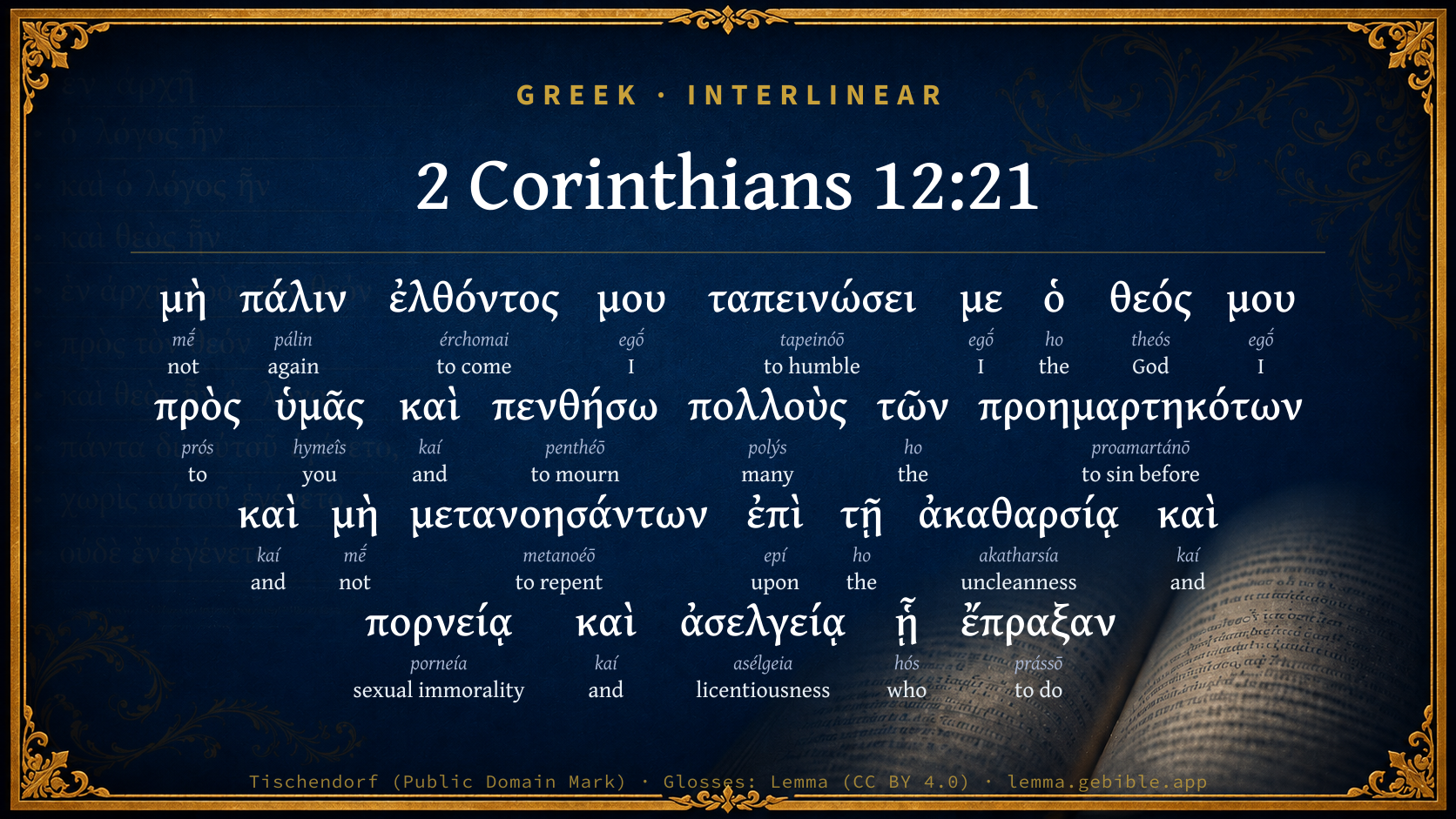
Greek (Tischendorf 8th ed.) 2 Corinthians 12:21 appears in the Greek New Testament. The text above is from the Tischendorf 8th edition. Each word links to its Strong’s number and a concise gloss. Click any word for its full Thayer’s Greek Lexicon entry.
Download image
Cite this verse

2 Corinthians 12:21 (World English Bible). Public Domain. Lemma interlinear Bible study tool, https://lemma.gebible.app/v/2-corinthians/12/21.

Show BibTeX & RIS
BibTeX
RIS
English Translation
that again when I come my God would humble me before you, and I would mourn for many of those who have sinned before now, and not repented of the uncleanness and sexual immorality and lustfulness which they committed.
World English Bible · Public Domain
Highlights
  • 1 first appearance in the Greek New Testament
Full analysis ↓
Download a study sheet

One document with this verse’s original text, its word-by-word gloss line, the meaning frame, cross-references with their text, attributed commentary, and full source and license credits — printable, and it pastes into notes with its structure intact.

This verse Autodidact and up

Study sheet (.html) Plain text (.txt)

A passage Seminary Student

Up to 50 verses in one chapter. A passage sheet keeps up to 6 commentary sources and 12 cross-references per verse, in the order this page ranks them, and says so on the sheet whenever that leaves anything out. Ask for a single verse and you get the Autodidact verse sheet above.

Everything on this page stays free to read, with no account — the sheet is a download of what is already on screen, not access to it.

Want to remove ads? Support Godless Engineer
Compare translations 3

The same verse in 3 English versions, stacked beneath the original-language interlinear above. Click any original word for its lexicon entry.

Each is an independent rendering of the whole verse — the interlinear is not word-aligned to these translations.

Highlighted words mark where these versions differ — a whole-verse word diff, not a word-by-word alignment.

  • World English Bible Public Domain
    that again when I come my God would humble me before you, and I would mourn for many of those who have sinned before now, and not repented of the uncleanness and sexual immorality and lustfulness which they committed.
  • King James Version Public Domain
    And lest, when I come again, my God will humble me among you, and that I shall bewail many which have sinned already, and have not repented of the uncleanness and fornication and lasciviousness which they have committed.
  • unfoldingWord Literal Text CC BY-SA 4.0
    that when I come again, my God might humble me before you, and I would mourn over many of the ones having sinned before and not having repented from the impurity and sexual immorality and debauchery that they did.

unfoldingWord Literal Text — © unfoldingWord, licensed CC BY-SA 4.0. Word-aligned USFM3 via Door43 (git.door43.org/unfoldingWord/en_ult).

Versions to compare (up to 4)

3 of 4 selected

Show all 19 translations

Every available English version of this verse, each an independent rendering of the whole verse.

  • World English Bible Public Domain
    that again when I come my God would humble me before you, and I would mourn for many of those who have sinned before now, and not repented of the uncleanness and sexual immorality and lustfulness which they committed.
  • Berean Standard Bible Public Domain
    I am afraid that when I come again, my God will humble me before you, and I will be grieved over many who have sinned earlier and have not repented of their acts of impurity, sexual immorality, and debauchery.
  • Majority Standard Bible Public Domain
    I am afraid that when I come again, my God will humble me before you, and I will be grieved over many who have sinned earlier and have not repented of their acts of impurity, sexual immorality, and debauchery.
  • King James Version Public Domain
    And lest, when I come again, my God will humble me among you, and that I shall bewail many which have sinned already, and have not repented of the uncleanness and fornication and lasciviousness which they have committed.
  • American Standard Version (1901) Public Domain
    lest again when I come my God should humble me before you, and I should mourn for many of them that have sinned heretofore, and repented not of the uncleanness and fornication and lasciviousness which they committed.
  • Revised Version (1885) Public Domain
    lest, when I come again, my God should humble me before you, and I should mourn for many of them that have sinned heretofore, and repented not of the uncleanness and fornication and lasciviousness which they committed.
  • Geneva Bible (1599) Public Domain
    I feare least when I come againe, my God abase me among you, and I shall bewaile many of them which haue sinned already, and haue not repented of the vncleannesse, and fornication, and wantonnesse which they haue committed.
  • Douay-Rheims (1899) Public Domain
    Lest again, when I come, God humble me among you: and I mourn many of them that sinned before, and have not done penance for the uncleanness, and fornication, and lasciviousness, that they have committed.
  • Young's Literal Translation Public Domain
    lest again having come, my God may humble me in regard to you, and I may bewail many of those having sinned before, and not having reformed concerning the uncleanness, and whoredom, and lasciviousness, that they did practise.
  • Literal Standard Version CC BY-SA 4.0
    lest again having come, my God may humble me in regard to you, and I may mourn many of those having sinned before, and having not changed their mind concerning the uncleanness, and whoredom, and licentiousness, that they practiced.
  • Unlocked Literal Bible CC BY-SA 4.0
    I fear that when I come back, my God might humble me before you. I fear that I might be grieved by many of those who have sinned before now, and who did not repent of the impurity and sexual immorality and lustful indulgence that they practiced.
  • unfoldingWord Literal Text CC BY-SA 4.0
    that when I come again, my God might humble me before you, and I would mourn over many of the ones having sinned before and not having repented from the impurity and sexual immorality and debauchery that they did.
  • Darby Bible Public Domain
    lest my God should humble me as to you when I come again, and that I shall grieve over many of those who have sinned before, and have not repented as to the uncleanness and fornication and licentiousness which they have practised.
  • World Messianic Bible Public Domain
    that again when I come my God would humble me before you, and I would mourn for many of those who have sinned before now, and not repented of the uncleanness, sexual immorality, and lustfulness which they committed.
  • Webster's Bible Public Domain
    And lest, when I come again, my God may humble me among you, and I shall bewail many who have sinned already, and have not repented of the uncleanness, and lewdness, and lasciviousness, which they have committed.
  • Free Bible Version CC BY-SA 4.0
    I'm afraid that when I visit, my God will humble me in your presence, and that I will be weeping over many of those who have sinned previously, and who still have not repented of impurity, sexual immorality, and indecent acts that they committed.
  • Bible in Basic English Public Domain
    And that when I come again, my God may put me to shame among you, and I may have grief for those who have done wrong before and have had no regret for their unclean ways, and for the evil desires of the flesh to which they have given way.
  • Text-Critical English NT CC BY 4.0
    I fear that when I come again my God will humble me before you, and I may have to mourn over many who have previously sinned and not repented of the impurity, fornication, and sensuality they have practiced.
  • Tyndale New Testament (1534) Public Domain
    I feare lest when I come agayne God brynge me lowe amonge you and I be constrayned to bewayle many of the which have synned all redy and have not repented of the vnclennes fornicacion and wantanes which they haue committed.

Literal Standard Version (2020), Covenant Press — licensed CC BY-SA 4.0. Text via the HelloAO Bible API (eBible.org). Unlocked Literal Bible (unfoldingWord) — licensed CC BY-SA 4.0. Text via the HelloAO Bible API (eBible.org). unfoldingWord Literal Text — © unfoldingWord, licensed CC BY-SA 4.0. Word-aligned USFM3 via Door43 (git.door43.org/unfoldingWord/en_ult). Free Bible Version, Dr. Jonathan Gallagher — licensed CC BY-SA 4.0. Text via the HelloAO Bible API (eBible.org).

Word by word

More ways to search: Search by grammar → Find every occurrence → Compare this word →

Practice this passage: Drill this verse → Learn its vocabulary →

προημαρτηκότων
proamartánō
G4258
“to sin before”
Verb, Perfect, Active, Participle, Genitive, Plural, Masculine
Part of Speech
Verb
Tense
Perfect
Voice
Active
Mood
Participle
Case
Genitive
Number
Plural
Gender
Masculine
Full Thayer's Definition

Origin: from G4253 and G264

TDNT: None

1. to sin before a. of those who before receiving baptism had been guilty of the vices especially common among the Gentiles
  1. μὴ mḗ G3361 “not” Particle, Negative
  2. πάλιν pálin G3825 “again” Adverb
  3. ἐλθόντος érchomai G2064 “to come” Verb, Aorist, Active, Participle, Genitive, Singular, Masculine
  4. μου egṓ G1473 “I” Personal pronoun, 1st person, Genitive, Singular
  5. ταπεινώσει tapeinóō G5013 “to humble” Verb, Future, Active, Indicative, 3rd person, Singular
  6. με egṓ G1473 “I” Personal pronoun, 1st person, Accusative, Singular
  7. ὁ ho G3588 “the” Article, Nominative, Singular, Masculine
  8. θεός theós G2316 “God” Noun, Nominative, Singular, Masculine
  9. μου egṓ G1473 “I” Personal pronoun, 1st person, Genitive, Singular
  10. πρὸς prós G4314 “to” Preposition
  11. ὑμᾶς hymeîs G5210 “you” Personal pronoun, 2nd person, Accusative, Plural
  12. καὶ kaí G2532 “and” Conjunction
  13. πενθήσω penthéō G3996 “to mourn” Verb, Aorist, Active, Subjunctive, 1st person, Singular
  14. πολλοὺς polýs G4183 “many” Adjective, Accusative, Plural, Masculine
  15. τῶν ho G3588 “the” Article, Genitive, Plural, Masculine
  16. καὶ kaí G2532 “and” Conjunction
  17. μὴ mḗ G3361 “not” Particle, Negative
  18. μετανοησάντων metanoéō G3340 “to repent” Verb, Aorist, Active, Participle, Genitive, Plural, Masculine
  19. ἐπὶ epí G1909 “upon” Preposition
  20. τῇ ho G3588 “the” Article, Dative, Singular, Feminine
  21. ἀκαθαρσίᾳ akatharsía G167 “uncleanness” Noun, Dative, Singular, Feminine
  22. καὶ kaí G2532 “and” Conjunction
  23. πορνείᾳ porneía G4202 “sexual immorality” Noun, Dative, Singular, Feminine
  24. καὶ kaí G2532 “and” Conjunction
  25. ἀσελγείᾳ asélgeia G766 “licentiousness” Noun, Dative, Singular, Feminine
  26. ᾗ hós G3739 “who” Relative pronoun, Dative, Singular, Feminine
  27. ἔπραξαν prássō G4238 “to do” Verb, Aorist, Active, Indicative, 3rd person, Plural

About this verse

These counts appear in no published source. They are computed here, from the morphology-tagged text and Lemma’s own curated glosses. What Lemma adds →

28
words
20
distinct lemmas
Pauline Epistles
section

Notable vocabulary

The rarest word here is προημαρτηκότων to sin before G4258 — appearing just 2 times in the whole Greek New Testament.

First appearance in Scripture

This word makes its first canonical appearance in the Greek New Testament here:

  • προημαρτηκότων to sin before G4258

Shared distinctive vocabulary

προημαρτηκότων to sin before G4258 occurs in 2 verses of the Greek New Testament. Also found in:
Repetition

Words recur within this verse:

Cross-references

37

Topical passages linked to 2 Corinthians 12:21 in the Treasury of Scripture Knowledge — connected by theme and wording, ordered by reader-vote popularity; previews shown in the World English Bible.

  • 2 Corinthians 13:2 I have said beforehand, and I do say beforehand, as when I was present the second time, so now, being absent, I write to those who have sinned before now, and to all the rest, that, if I come again, I will not spare;
  • 1 Corinthians 5:1 It is actually reported that there is sexual immorality among you, and such sexual immorality as is not even named among the Gentiles, that one has his father's wife.
  • 1 Corinthians 5:9–11 I wrote to you in my letter to have no company with sexual sinners;
  • Galatians 5:19 Now the works of the flesh are obvious, which are: adultery, sexual immorality, uncleanness, lustfulness,
  • Colossians 3:5 Put to death therefore your members which are on the earth: sexual immorality, uncleanness, depraved passion, evil desire, and covetousness, which is idolatry;
  • 1 Peter 4:2–3 that you no longer should live the rest of your time in the flesh for the lusts of men, but for the will of God.
  • Revelation 21:8 But for the cowardly, unbelieving, sinners, abominable, murderers, sexually immoral, sorcerers, idolaters, and all liars, their part is in the lake that burns with fire and sulfur, which is the second death."
  • Jude 1:7 Even as Sodom and Gomorrah, and the cities around them, having, in the same way as these, given themselves over to sexual immorality and gone after strange flesh, are set forth as an example, suffering the punishment of eternal fire.
  • Jude 1:23 and some save, snatching them out of the fire with fear, hating even the clothing stained by the flesh.
  • Revelation 22:15 Outside are the dogs, the sorcerers, the sexually immoral, the murderers, the idolaters, and everyone who loves and practices falsehood.
  • Exodus 32:31 Moses returned to Yahweh, and said, "Oh, this people have sinned a great sin, and have made themselves gods of gold.
  • Deuteronomy 9:15 So I turned and came down from the mountain, and the mountain was burning with fire: and the two tables of the covenant were in my two hands.
  • Deuteronomy 9:25 So I fell down before Yahweh the forty days and forty nights that I fell down, because Yahweh had said he would destroy you.
  • 1 Samuel 15:35 Samuel came no more to see Saul until the day of his death; for Samuel mourned for Saul: and Yahweh repented that he had made Saul king over Israel.
  • Ezra 9:3 When I heard this thing, I tore my garment and my robe, and plucked off the hair of my head and of my beard, and sat down confounded.
  • Ezra 10:1 Now while Ezra prayed and made confession, weeping and casting himself down before the house of God, there was gathered together to him out of Israel a very great assembly of men and women and children; for the people wept very sore.
  • Psalms 119:136 Streams of tears run down my eyes, Because they don't observe your law.
  • Jeremiah 9:1 Oh that my head were waters, and my eyes a spring of tears, that I might weep day and night for the slain of the daughter of my people!
  • Jeremiah 13:17 But if you will not hear it, my soul shall weep in secret for [your] pride; and my eye shall weep sore, and run down with tears, because Yahweh's flock is taken captive.
  • Luke 9:41–42 Jesus answered, "Faithless and perverse generation, how long shall I be with you and bear with you? Bring your son here."
  • Romans 9:2 that I have great sorrow and unceasing pain in my heart.
  • Romans 13:13 Let us walk properly, as in the day; not in reveling and drunkenness, not in sexual promiscuity and lustful acts, and not in strife and jealousy.
  • 1 Corinthians 6:9–11 Or don't you know that the unrighteous will not inherit the Kingdom of God? Don't be deceived. Neither the sexually immoral, nor idolaters, nor adulterers, nor male prostitutes, nor homosexuals,
  • 1 Corinthians 6:15–18 Don't you know that your bodies are members of Christ? Shall I then take the members of Christ, and make them members of a prostitute? May it never be!
  • 2 Corinthians 2:1–11 But I determined this for myself, that I would not come to you again in sorrow.
  • 2 Corinthians 7:9–11 I now rejoice, not that you were made sorry, but that you were made sorry to repentance. For you were made sorry in a godly way, that you might suffer loss by us in nothing.
  • 2 Corinthians 8:24 Therefore show the proof of your love to them in front of the assemblies, and of our boasting on your behalf.
  • 2 Corinthians 9:3–4 But I have sent the brothers that our boasting on your behalf may not be in vain in this respect, that, just as I said, you may be prepared,
  • 2 Corinthians 10:6 and being in readiness to avenge all disobedience, when your obedience will be made full.
  • 2 Corinthians 12:7 By reason of the exceeding greatness of the revelations, that I should not be exalted excessively, there was given to me a thorn in the flesh, a messenger of Satan to buffet me, that I should not be exalted excessively.
  • Ephesians 5:5–6 Know this for sure, that no sexually immoral person, nor unclean person, nor covetous man, who is an idolater, has any inheritance in the Kingdom of Christ and God.
  • Philippians 3:18–19 For many walk, of whom I told you often, and now tell you even weeping, as the enemies of the cross of Christ,
  • 1 Thessalonians 4:3–7 For this is the will of God: your sanctification, that you abstain from sexual immorality,
  • Hebrews 13:4 Let marriage be held in honor among all, and let the bed be undefiled: but God will judge the sexually immoral and adulterers.
  • 2 Peter 2:10–14 but chiefly those who walk after the flesh in the lust of defilement, and despise authority. Daring, self-willed, they are not afraid to speak evil of dignitaries;
  • 2 Peter 2:18 For, uttering great swelling words of emptiness, they entice in the lusts of the flesh, by licentiousness, those who are indeed escaping from those who live in error;
  • Revelation 22:20 He who testifies these things says, "Yes, I come quickly." Amen! Yes, come, Lord Jesus.

Cross-references courtesy of OpenBible.info (CC BY 4.0).

Commentary

Notes on 2 Corinthians 12:21 from classic Christian and Jewish commentators (each source and its license shown beneath its notes). The classic Christian expositions comment on the surrounding passage and are grouped to its opening verse, so a note may address several verses; the Jewish commentaries on the Tanakh (Rashi and others) are per-verse, so they appear only where the commentator wrote on this verse.

Lemma curates 59 commentaries, every one of them public domain or Creative Commons licensed, each selected and text-cleaned for this edition rather than reprinted as found. About our sources →

Tyndale Open Study Notes

Tyndale Open Resources

12:21 Paul fears that God will humble me in your presence—a reprise of the previous visit (2:1), when the Corinthians had rebuffed and humiliated Paul. • The vices listed were among the Corinthians’ old sins (see 6:14–7:1; 1 Corinthians Book Introduction, “Setting”).

Tyndale Open Study Notes — © Tyndale Open Resources, licensed CC BY-SA 4.0. Text via the HelloAO Bible API.

Bengel's Gnomon

Johann Albrecht Bengel

2Co 12:21. Μὴ πάλιν, lest again) There is here an Anaphora,[89] lest haply, lest haply, lest [μὴ πως—μή πως—μή]. And indeed in this verse he speaks with greater severity.—ταπεινώσῃ, will humble) A Metonymy [Substitution] of the consequent [for the antecedent].—ὁ Θεός μον, my God) He by this expression gives the reason, why he considers acts committed against God, as appertaining to himself.—τῶν προημαρτηκότων) who have sinned before my last coming.—ἀκαθαρσίᾳ) the uncleanness; for example, of married persons: 1Th 4:7.—πορνείᾳ, fornication) among the unmarried, ἀσελγείᾳ, lasciviousness) sins contrary to nature.

[89] See App. The frequent repetition of the same word in beginnings.

Bengel's Gnomon of the New Testament — English translation (T&T Clark, Edinburgh, 1860) — public domain. Text from a community e-Sword module.

Meyer's Critical & Exegetical Commentary

Heinrich August Wilhelm Meyer

2Co_12:21. The interrogative interpretation (Lachmann, Lücke) is, viewed in itself, compatible not only with the reading ταπεινώσει (Lachmann), but also with the deliberative subjunctive of the Recepta (Lücke). Comp. Xenophon, Oec. iv. 4 : μὴ αἰσχυνθῶμεν τὸν Περσῶν βασιλέα μιμήσασθαι; see in general, Hartung, Partikell. II. p. 159 f.; Baeumlein, Partik. p. 203. But the usual non-interrogative explanation, which makes μή still dependent on φοβοῦμαι, not only makes the passage appear more emphatic (by the three parallels, μήπως

μήπως

μή), but is also the only interpretation suited to the context, since, in fact, after the apprehension quite definitely expressed in 2Co_12:20, the negative question, in the case of which a No is to be conceived as the answer (comp. 2Co_12:17-18), would be inappropriate.

In μή compared with the previous μήπως there lies a climax as regards the definiteness of the conceptio.

πάλιν] goes along with ἐλθόντος μον ταπεινώσῃ με ὁ θ. μ. πρὸς ὑμ. (comp. on 2Co_2:1), so that Paul reminds them how already at his second visit (comp. 1Co_5:9) he had experienced such humiliation. Connected merely with ἐλθόντος μου (Beza, Grotius, Flatt, de Wette, Wieseler, and many others), it would be without important bearin.

ἐλθόντος μου τάπ. με] a construction also of frequent occurrence in classical writers. Comp. on 2Co_9:14, and see Buttmann, neut. Gr. p. 270 [E. T. 315].

ταπεινώσει με, not of bodily (Hofmann), but of mental bending, as in dejection. Comp. Polyb. iii. 116. 8, iv. 80. 3. Nihil erat, quo magis exultaret apostolus, quam prospero suae praedicationis successu (comp. 1Th_2:20; Php_4:1); contra nihil erat, unde tristiore et demissiore animo redderetur, quam quum cerneret, se frustra laborasse, Beza. Comp. Chrysostcm. The future ταπεινώσει (see the critical remarks), which expresses the apprehension that the sad case of this humiliation will withal actually still occur (see on Col_2:8), stands in a climactic relation to the previous subjunctives; the apprehension increases.

ὁ θεός μου] as Rom_1:8; 1Co_1:4. In the humbling experiences of his office Paul sees paedagogic decrees of his Go.

πρὸς ὑμᾶς] not among you, for how superfluous that would be! but: in reference to you, in my relation to you. So also Rückert, who, however (comp. Chrysostom, Osiander, and several), explains ταπεινώσις of Pauls seeing himself compelled to appear before them not with the joyful pride of a father over his good children, but with the punitive earnestness of a judge. But the punitive earnestness of the judge is in fact no ταπεινώσις, but an act of the apostolic authority, and only follows subsequently, after the ταπεινώσις has taken place by the observation of the punishment-deserving state, which has made him feel that his efforts have been without resul.

πολλοὺς τῶν προημαρτηκότων καὶ μὴ μετανοησάντων], On προημαρτ., comp. Herodian, iii. 14. 8 : ἀπολογεῖσθαι πρὸς τὰ προημαρτημένα. According to Rückert, Paul has written thus inexactly, instead of πολλοὺς τῶν προημαρτ. τοὺς μὴ μετανοήσαντας. How arbitrary! In that case he would have expressed himself with downright inaccuracy. Lücke, l.c. p. 20, explains it more ingeniously: Cogitavit rem ita, ut primum poneret Christianorum ex ethnicis potissimum τῶν προημαρτηκότων καὶ μὴ μετανοησάντων genus universum, cujus generis homines essent ubique ecclesiarum, deinde vero ex isto hominum genere multos eos, qui Corinthi essent, designaret definiretque. But the reference to the unconverted sinners, who ubique ecclesiarum essent, is quite foreign to the context, since Paul had simply to do with the Corinthians (comp. previously πρὸς ὑμᾶς), and hence these could not seek the genus of the προημαρτηκότων κ.τ.λ. here meant elsewhere than just in their own church. The right interpretation results undoubtedly from the order of the thoughts specified at 2Co_12:20, according to which ἐπὶ τῇ ἀκαθαρσίᾳ κ.τ.λ. cannot belong to μετανοησ. (comp. Lucian, de salt 84: μετανοῆσαι ἐφʼ οἷς ἐποίησεν), as it is usually taken, but only to πενθήσω: and that I will lament[388] many of those, who have previously sinned and shall not have repented, on account of the uncleanness, etc. Thus Paul passes over from the sinful states named in 2Co_12:20 to quite another category of sins, and the course of thought accordingly is: I fear that I shall not only meet with contentions, etc., among you, but that I shall have also to bewail many of the then still unconverted sinners among you on account of the sins of impurity which they have committed (Eph_4:30; Heb_13:17). Not all προημαρτηκότες καὶ μὴ μετανοήσαντες in Corinth were impure sinners, but Paul fears that he will encounter many of them as such; hence he could not write at all otherwise than: πολλοὺς τῶν προημαρτηκότων καὶ μὴ μετανοησάντων.[389] This explanation is adopted by Winer, p. 590 [E. T. 792], Bisping, and Kling.

The perfect participle προημαρτ. denotes the continuance of the condition from earlier times; and καὶ μὴ μετανοησάντων has the sense of the futurum exactum: and who shall not have repented at my arrival. The προ in προημαρτ. expresses the sinning that had taken place in earlier times, which Lücke (comp. Olshausen) refers to the time before conversion (comp. the passages of Justin, Apolog. 1:61; Clement, Strom. iv. 12 in Lücke, p. 18 f.). But as the evils adduced in 2Co_12:20 only set in after the conversion, we are not warranted (see the plan of the passage specified at 2Co_12:20) to assume for the sins named in 2Co_12:21 the time before conversion, as, indeed, 1Co_5:1 also points to the time after conversion. But if we ask how far Paul with his προ looks back into the past of the Corinthians that had elapsed since their conversion, it might, if we regard 2Co_12:20-21 by themselves, appear as if he referred not further back than to that time, in which the contentions (2Co_12:20) and the sins of impurity censured in 1Co_5:1 (2Co_12:21) emerged. But as this happened only after his second visit, and as he says in 2Co_13:2 that he had foretold (comp. 2Co_2:1) punishment to the προημαρτηκόσι already at his second visit, it follows that with his προ he glances back from the present to the time before his second visit. After his first visit there had already emerged in Corinth evils, which humbled him at his second visit (2Co_12:21), and on account of which he at that time threatened (see on 2Co_13:2) these προημαρτηκότες with punishment; after his second presence there had now broken out, in addition, the contentions and sins of impurity which we know from his Epistles; and to all this, consequently to the whole time till after his first and before his second visit, he looks back, inasmuch as he says not merely ἡμαρτηκότων, but προημαρτηκότων Consequently Billroth is wrong in restricting the word merely to those whom I already, through my second sojourn among you, know as sinners; and Estius says too indefinitely, and also quite arbitrarily, as regards προ, not starting from the present time: ante scriptam priorem epistolam, while many others, like Rückert, do not enter on the question at al.

ἐπὶ τῇ ἀκαθαρσίᾳ κ.τ.λ.] if connected with μετανοησάντων, would be in respect or on account of. But, apart from the fact that μετανοεῖν (which, we may add, Paul has only here) is in the N. T. never connected with ἐπί (as Joe_2:13; Amo_7:3, LXX.), but with ἀπό (Act_8:22; Heb_6:1) or ἐκ (Rev_2:21 f., Rev_16:11), in this particular case the necessary and correct connection (see previously on πολλ. τ. προημ. κ. μὴ μετανοησ.) is with πενθήσω, the ground of which it specifies: o2Co 12:Just so Aeschin. p. 84, 14; Plut. Agis, 17; Rev_18:11; 1Sa_15:35; Ezr_10:6, al. Ἀκαθαρσία, here of licentious impurity, Rom_1:24; Gal_5:19; Eph_4:19. Then: πορνεία, fornication in specie. Lastly: ἀσέλγεια, licentious wantonness and abandonment (Rom_13:13; Gal_5:19; Eph_4:19; Wis_14:26).

ἔπραξαν] have practised. Comp. on Rom_1:32.

[388] πενθήσω is taken by Theophylact and others, including Billroth, Rückert, Olshausen, and de Wette, as a threatening of punishment; and Grotius even thought that the apostles may have discharged their penal office not without signs of mourning, sicut Romani civem damnaturi sumebant pullam togam. But the whole reference of the word to punishment is in the highest degree arbitrary, and at variance with the context. For it is only at 2Co_13:1 ff. that the threat of punishment follows; and the ταπεινώσῃ με ὁ θεός μου πρὸς ὑμᾶς, with which καὶ πενθήσω is connected, warrants us only to retain for the latter the pure literal meaning lugere aliquem, which is very current in classical writers (Hom. Il. xix. 225, xxiii. 283; Herod. vii. 220; Xen. Hell. ii. 2. 3) and in the LXX. (Gen_37:34; Gen_50:3, al.; Sir_51:19; Jdt_16:24). The word does not at all mean to prepare sorrow, as Vater and Olshausen explain it. Calvin therefore is right in leaving the idea of punishment out of account, and aptly remarks: Veri et germani pastoris affectum nobis exprimit, quum luctu aliorum peccata se prosequuturum dicit. Estius, too, rejects any reference to punishment, and finds in πενθήσω that Paul regards those concerned as Deo mortuos. Comp. Ewald. Under the latter view too much is found in the word, since the context does not speak of spiritual death, but specifies the ground of the mourning by ἐπὶ τῇ ἀκαθαρσίᾳ κ.τ.λ. Hence we must adhere to Calvins exposition as not going beyond either the meaning of the word or the context. Calovius also says very correctly (in opposition to Grotius): Non de poena hic Corinthiorum impoenitentium, sed de moerore suo super impoenitentia. De Wette, followed by Osiander, finds in πενθ. the pain of being obliged to proceed with the special punishment of excommunication, and explains πολλοὺς τῶν προημαρτ. κ. μὴ μεταν. ἐπὶ κ.τ.λ. of the worst among the unconverted sinners guilty of unchastity. In that case the chief points of the meaning must be mentally supplied, for which there is the less warrant, seeing that πενθήσω is parallel to the ταπειν. με ὁ θ., expressing subjectively that which is denoted by ταπειν. κ.τ.λ. objectively.

[389] The objections of de Wette against my explanation will not bear examination. For (1) from the fact that Paul, in order to express his alarm and anxiety regarding the unchaste, mentions withal the category of sinners in general, there does not arise the appearance as if he would not have to mourn over the latter; but out of the collective wickedness in Corinth he singles out the unchastity which was prevalent there as specially grievous. This species of sinners appears under the genus of Corinthian sinners as one of the two chief stains on the church (the other was the party-spirit, ver. 20). Further, (2) the προημαρτηκότες in 2Co_13:2 are not any more than here a species, but likewise the category, to which the kinds denoted in vv. 20 and 21 belonged. (3) The connection of ἐπὶ κ.τ.λ. with πενθήσω is not unnatural, but natural, since πολλοὺς τῶν προημ. κ. μὴ μεταν., taken together, is the object of πενθ., so that Paul has observed the sequence which is simplest of all and most usual (verbobjectground). The objections of Osiander and Hofmann are not more valid. Those of the latter especially amount in the long run to subtleties, for which there is no ground. For Paul certainly fears that he will have to lament the non-repentance of the persons concerned, and the sins which they are still committing at the time. This is clearly enough contained in καὶ μὴ μετανοησάντων; and as to ἧ ἔπραξαν, Paul very naturally writes the aorist, and not ᾗ πράσσουσιν, because he transplants himself, as in μὴ μετανοησ., to the point of time when he arrives and will then judge what they have done up to that time. He might also have written ᾗ πράσσουσιν, but would thereby have deviated from the conformity of his conception of time introduced with κ. μ. μετανοησ. (which is that of the futurum exactum), for which he had no occasion. It is incorrect, with Hofmann, to say that μετανοησάντω refers to the time when Paul was writing this, and that, because there was still space for them to repent up to the time of his arrival, he has not spoken generally of the impenitent, but of many (who, namely, would remain hardened). According to the context, μετανοησάντων can only apply to the time of his impending ἐλθεῖν, when he will have to lament many of the old and still at that time non-repentant sinners, on account of their impurity, etc.

Meyer — Critical and Exegetical Commentary on the New Testament — English translation by Peter Christie, edited by Frederick Crombie (T&T Clark, 1880) — public domain. Text from a community e-Sword module.

Expositor's Greek Testament

ed. W. Robertson Nicoll

2Co 12:21 . μὴ πάλιν ἐλθόντος μου κ . τ . λ .: lest when I come, my God should humble me again before you, sc. , because of the scanty fruit of his preaching (as had been the case on his second visit), and I should mourn for many (observe, not “all”) that have sinned heretofore, i.e. , before my second visit, and did not repent, i.e. , after my second visit (we thus retain the force of the aorist part; for μετανοέω see on 2Co 7:9 , and for μετανοεῖν ἐπὶ cf. Joe 2:13 , Amo 7:3 ), of the uncleanness and fornication and lasciviousness which they committed . There is nothing in the anxiety here expressed which is inconsistent with the language of 2Co 7:9 ff. There he expresses his satisfaction that in the matter of the incestuous person the Corinthians had obeyed his directions; but their proneness to sins of the flesh he is fully alive to. See, e.g. , 2Co 6:14 , 2Co 7:1 .

The Expositor's Greek Testament, edited by W. Robertson Nicoll (1897–1910) — public domain. Text from a community e-Sword module.

Jamieson, Fausset & Brown

Robert Jamieson, A. R. Fausset & David Brown

my God--his God, however trying the humiliation that was in store for him.

will humble me--The indicative implies that the supposition will actually be so. The faithful pastor is "humbled" at, and "bewails" the falls of his people, as though they were his own.

sinned already--before my last coming [BENGEL], that is, before the second visit which he paid, and in which he had much at Corinth to rebuke.

have not repented--shall not have repented [ALFORD].

uncleanness--for example, of married persons (Th1 4:7).

fornication--among the unmarried.

Next: 2 Corinthians Chapter 13

Jamieson, Fausset & Brown — Commentary Critical and Explanatory on the Whole Bible (1871) — public domain (CC PDM 1.0). Text via the HelloAO Bible API.

Adam Clarke's Commentary

Verse 21. Lest, when I come again] And even after all that has been done for you, I fear that when I do come-when I pay you my second visit, my God will humble me-will permit me to be affected with deep sorrow through what I may see among you; as I have been by the buffetings of the apostle of Satan, who has perverted you. Humiliation is repeatedly used for affliction, and here ταπεινωση has certainly that meaning.

Have sinned already] προημαρτηκοτων. Who have sinned before; who were some of the first offenders, and have not yet repented.

Of the uncleanness, c.] There must have been a total relaxation of discipline, else such abominations could not have been tolerated in the Christian Church. And although what is here spoken could only be the ease of a few yet the many were ill disciplined, else these must have been cast out. On the whole, this Church seems to have been a composition of excellences and defects, of vices and virtues; and should not be quoted as a model for a Christian Church.

1. FROM St. Paul we receive two remarkable sayings of our Lord, which are of infinite value to the welfare and salvation of man; which are properly parts of the Gospel, but are not mentioned by any evangelist. The first is in Ac 20:35: I have showed you, the words of the Lord Jesus, how he said, IT IS MORE BLESSED TO GIVE THAN TO RECEIVE. Every liberal heart feels this in bestowing its bounty; and every poor man, who is obliged to receive help, and whose independency of spirit is still whole in him, feels this too. To the genuine poor, it is more burdensome to receive a kindness, than it is to the generous man who gives it. The second is recorded in the ninth verse of this chapter 2Co 12:9: He said unto me, MY GRACE IS SUFFICIENT FOR THEE; FOR MY STRENGTH IS MADE PERFECT IN WEAKNESS. Of these two most blessed sayings, St. Paul is the only evangelist. This last is of general application. In all states and conditions of life God's grace is sufficient for us. If in any case we miscarry, it is because we have not sought God earnestly. Let no man say that he is overcome by sin through want of grace; God's grace was sufficient for him, but he did not apply for it as did St. Paul, and therefore he did not receive it. Men often lay the issue of their own infidelity to the charge of God, they excuse their commission of sin through their scantiness of grace; whereas the whole is owing to their carelessness, and refusal to be saved in God's own way; and in this way alone will God save any man, because it is the only effectual way.

2. The apostle must have been brought into a blessed state of subjection to God, when he could say, I take pleasure in infirmities; that is, in afflictions and sufferings of different kinds. Though this language was spoken on earth, we may justly allow, with one, that he learned it in HEAVEN.

3. St. Paul preached the Gospel without being burdensome. In every case the labourer is worthy of his hire. He who labours for the cause of God should be supported by the cause of God; but wo to that man who aggrandizes himself and grows rich by the spoils of the faithful! And to him especially who has made a fortune out of the pence of the poor! In such a man's heart the love of money must have its throne. As to his professed spirituality, it is nothing; he is a whited sepulchre, and an abomination in the sight of the Lord. If a man will love the world, (and he does love it who makes a fortune by the offerings of the poor,) the love of the Father is not in him.

Adam Clarke's Commentary on the Bible (1810–1826) — public domain. Text from a community e-Sword/MySword module.

John Calvin's Commentaries

21. Lest, when I come, my God should humble me His abasement was reckoned to him as a fault. The blame of it he throws back upon the Corinthians, who, when they should have honored his Apostleship, loaded it, on the contrary, with disgrace; for their proficiency would have been the glory and honor of Paul’s Apostleship. When, therefore, they were, instead of this, overrun with many vices, they heaped disgrace upon him to the utmost of their power. He does not, indeed, charge them all with this crime, but only a few, who had impudently despised all his admonitions. The meaning, then, is this: “They think contemptuously of me, because I appear contemptible. Let them, then, give me no occasion of abasement: nay more, let them, on the contrary, laying aside their forwardness, begin to feel shame; and let them, confounded at their iniquities, prostrate themselves on the ground, instead of looking down upon others with disdain.”

In the mean time, he lets us know the disposition of a true and genuine Pastor, when he says that he will look upon the sins of others with grief. And, undoubtedly, the right way of acting is this — that every Christian shall have his Church inclosed within his heart, and be affected with its maladies, as if they were his own, — sympathize with its sorrows, and bewail its sins. We see, how Jeremiah entreats, that there may be given him a fountain of tears, (Jeremiah 9:1,) that he may bewail the calamity of his people. We see, how pious kings and prophets, to whom the government of the people was committed, were touched with similar feelings. It is, indeed, a thing that is common to all the pious, to be grieved in every case in which God is offended, and to bewail the ruin of brethren, and present themselves before God in their room as in a manner guilty, but it is more particularly requisite on the part of Pastors. Farther, Paul here brings forward a second catalogue of vices, which, however, belong to one general head — unchastity.

John Calvin's Commentaries (1540-1563) — public domain. Text from the Calvin Translation Society English edition (1840s-50s) via the Christian Classics Ethereal Library (ccel.org). Calvin's coverage is partial (roughly two-thirds of the Bible); uncommented books and verses are honest gaps, never fabricated. The 19th-century editor's footnotes and remarks are omitted so the notes are faithfully Calvin's own voice.

Ellicott's Commentary for English Readers

(21) And lest when I come again . . .—The words do not imply more than one previous visit (Act_18:1), but it can scarcely be said that they exclude the supposition of another. (See Note on 2Co_13:1.)

My God will humble me among you.—We lose the force of the Greek verb by not seeing that it reproduces the word which has been so prominent in the Epistle, and which has appeared in 2Co_7:6, as “cast down;” in 2Co_10:1 as “base;” in 2Co_11:7 as “abasing.” There is something almost plaintive in the tone in which the Apostle speaks of the sin of his disciples as the only real “humiliation” which he has to fear. The readings vary; and one of them may be taken as a question: Will God humble me again? There is, however, it is believed, no adequate ground for altering the text.

That I shall bewail many which have sinned already.—Literally, who have sinned beforehand; leaving it uncertain what time is referred to. He may refer to sins before admission into the Church, of which men had never really repented, or to sins before the time of his writing, or before that of his arrival. On the whole, the first interpretation has most to commend it. He has in his thoughts such persons as those described in 1Co_6:9, and suspects that some of them have not really renounced the sins which he there names. Of the three forms of evil, the first is generic and the two latter more specific; the last probably indicating the darker forms of evil. It is obvious that the words cannot refer to the incestuous offender who had repented (2Co_2:7), nor to the Church generally in connection with that offence (2Co_7:9-11). Probably he had in view the party of license, who maintained the indifference of “eating things sacrificed to idols,” and of “fornication,” just as, in the previous verse, he had chiefly in view the party of his Judaising opponents.

A Bible Commentary for English Readers, edited by Charles John Ellicott (1878–1897) — public domain. Text from a community e-Sword module.

The Cambridge Bible for Schools and Colleges

gen. ed. J. J. S. Perowne

21. among you] Or, with some interpreters, in reference to you. The literal translation is to you.

which have sinned already] Literally, those who have sinned before, i.e. either (1) before their conversion and who did not cast off their evil habits when they became Christians, or (2) those who sinned before the Apostle’s letter came, and who did not pay any attention to his rebukes. The latter seems to fall in best with the tenor of the first Epistle and with ch. 2, 7, and 2Co_10:1-6.

and have not repented] This makes it clear that, as 1Co_6:12-20 would imply, there were other offenders in the particular sin here mentioned beside the incestuous person. It also appears that the Apostle was willing to forgive such offenders as soon as they had abandoned their sin. For repentance see ch. 2Co_7:9. The literal rendering of his sentence is many of those who have sinned and did not repent. Many commentators have asked, Why many and not all? But they have overlooked the difference of tense in the original. There were many who had sinned, and who, up to the arrival of the second Epistle, had not repented. But it is quite clear that St Paul hoped that his second Epistle would have much influence upon those whom his first Epistle and the visit of Titus had failed to move.

lasciviousness] The term in the original has reference to the unnatural condition of restless excitement which licentious habits produce in their victim.

The Cambridge Bible for Schools and Colleges (gen. ed. J. J. S. Perowne; Cambridge University Press, 1878–1918) — public domain. Text from a community e-Sword module.

Trapp's Complete Commentary

John Trapp

21 And lest, when I come again, my God will humble me among you, and that I shall bewail many which have sinned already, and have not repented of the uncleanness and fornication and lasciviousness which they have committed.

Ver. 21. That have not repented] Impenitence maketh sin mortal, saith St John, 1Jn 5:16, or rather immortal, as saith St Paul, Rom 2:5. It is not the falling into the water that drowns, but lying in it. God’s people may sink once and again to the bottom, but the third time they rise and recover by repentance.

John Trapp, A Commentary or Exposition upon All the Books of the Old and New Testament (1647–1656) — public domain. Text from a community e-Sword module.

Albert Barnes' Notes on the Bible

And lest, when I come again, my God will humble me ... - Lest I should be compelled to inflict punishment on those whom I suppose to have been converted under my ministry. I had rejoiced in them as true converts: I had counted them as among the fruit of my ministry. Now to be compelled to inflict punishment on them as having no religion would mortify me and humble me. The infliction of punishment on members of the church is a sort of punishment to him who inflicts it as well as to him who is punished. Members of the church should walk uprightly, lest they overwhelm the ministry in shame.

And that I shall bewail many ... - If they repented of their sin he could still rejoice in them. If they continued in their sin until he came, it would be to him a source of deep lamentation. It is evident from the word “many” here that the disorders had prevailed very extensively in the church at Corinth. The word rendered “have sinned already” means “who have sinned before,” and the idea is, that they were old offenders, and that they had not yet repented.

The uncleanness - see note, Rom 1:24.

And fornication and lasciviousness ... - see the notes on 1Co 5:1; 1Co 6:18. This was the sin to which they were particularly exposed in Corinth, as it was the sin for which that corrupt city was particularly distinguished. See the introduction to the First Epistle. Hence, the frequent cautions in these epistles against it; and hence, it is not to be wondered at that some of those who had become professing Christians had fallen into it. It may be added that it is still the sin to which converts from the corruptions and licentiousness of paganism are particularly exposed.

Albert Barnes' Notes on the Bible (1834–1885) — public domain. Text from a community e-Sword/MySword module.

Matthew Poole's English Annotations

From hence it appeareth, that this church of Corinth, though it had many in it, without doubt, who were true and sincere Christians, yet had also many it which were otherwise; yea, many that were scandalous; for such are those mentioned in this verse. Again, the apostle’s mentioning of

many that had committed uncleanness, fornication, and lasciviousness, and not repented; wheras he had only given order for the excommunication of one incestuous person, 1Co 5:1-13, and in this Epistle, 2Co 2:1-17, had given order for the restoring him upon his repentance; lets us know, that the governors of churches ought to use a great deal of prudence in the administering of church censures. We are also further taught, that nothing more afflicteth a godly person, who hath the charge of the souls of others, than to see them go on in courses of sin without repentance. Whether bewailing, in this verse, implieth proceeding to ecclesiastical censures, (as several interpreters think), I doubt; for as the word doth not necessarily imply it, so his sparing use of that rod, which he could (though absent) have as well used against other unclean persons as one incestuous person; and choosing rather that the sentence should be declared against him by the church in his absence, than by himself when present; inclineth me to think, that by bewailing, here, he only means a Christian, afflictive sense of their miscarriages; whereas his desire was, that he might have a cheerful, comfortable journey to and abode with them. But yet, in the next chapter, he seemeth to threaten something more against some particular offenders.

Matthew Poole's English Annotations on the Holy Bible (1683–1685) — public domain. Text from a community e-Sword/MySword module.

Whedon's Commentary on the Bible

Daniel D. Whedon

21. Humble me—In being made to feel the special disgrace of their sexual vices.

Many which have sinned—It may be again noticed that St. Paul addresses alternately the better part and the worse part of the Church as being the whole; yet passages like the present indicate that both the parts are meant, and that each is expected to make the proper application.

Bewail—Weep. As the disgrace would humble him, so the sin and apostasy would melt him with grief. If they have neither shame nor sorrow, he blushes and weeps for them. Thus far he expresses only the overwhelming effect of their sins upon him. Of penalty he will soon speak to them.

Daniel D. Whedon (gen. ed.), Commentary on the Old and New Testaments (1874–1909) — public domain. Text from a community e-Sword module.

The Pulpit Commentary

Humble me among you; rather, in my relation to you. Many which have sinned already, and have not repented; rather, who have sinned before and did not repent. Many had sinned; (1Co_6:12-20) some only had repented.

The humbling of God"s ministers.

fear lest, when I come again, my God will humble me among you." "There is something almost plaintive in the tone in which the apostle speaks of the sin of his disciples as the only real humiliation, which he has to fear." The following points will be readily worked out and illustrated according to the experiences of the preacher:

I SUCH HUMBLINGS COME FROM SEEMING FAILURES. Compare our Lord"s distressful reproach of Capernaum and other towns on the shores of the lake of Galilee. See also St. Paul"s trouble over the failure of the Galatians from their primitive faith: "O foolish Galatians, who hath bewitched you?" etc.

II SUCH HUMBLINGS COME FROM STRIFE AND DIVISIONS. As illustrated in the Corinthian Church (see 1 Corinthians it.). Such strife may arise from

(1) false teaching;

(2) masterful individuals, who make parties;

(3) misunderstandings;

(4) exercise of necessary Church discipline.

III SUCH HUMBLINGS COME FROM INDIVIDUAL BACKSLIDINGS. There is no sadder phase of experience for Christian ministers than the spiritual and moral failure of their converts, and of those whom they have most fully trusted in Christian life and work. So often men fall into temptation and are overcome in their middle life. When ministers look for the ripest fruitage, then there is blight and death; wealth, pleasure, vice, smite and kill the soul, and the pastor weeps over the toil of life that seems to have been all in vain. St. Paul spoke of the Corinthians as "his glory and joy;" and the things which he goes on to mention in this verse put shame on his work, for the gospel call is "not unto uncleanness, but unto holiness." And ministers spend their strength for nought if those who believe are not "careful to maintain good works. R.T.

The Pulpit Commentary (1880–1919), ed. H.D.M. Spence-Jones & Joseph S. Exell — public domain. Text from a community e-Sword module.

John Wesley's Explanatory Notes

Who had sinned before - My last coming to Corinth. Uncleanness - Of married persons. Lasciviousness - Against nature.

John Wesley, Explanatory Notes Upon the Whole Bible (1754–1765) — public domain. Text via the GEBible commentary corpus.

Scofield Reference Notes

C. I. Scofield

sinned

Sin. (See Scofield "Rom 3:23").

The Scofield Reference Bible (1917 edition), notes by C. I. Scofield — public domain. Text from a community e-Sword module.

Godbey's Commentary on the New Testament

William B. Godbey

CALUMNIATIONS, SECRET MALIGNINGS

How frequently these things so prevail in a church as to bring about alienation’s, conflicts and terrible apostasies! The one of these words means open slander, which is so pestilential and ruinous among the members of a church, and the other means private gossip creeping round among the people, undermining and utterly ruining spirituality. I have known churches divided up into factions and filled with parties mutually recriminating each other, until they all become a pandemonium. “Inflation’s,” i. e., people puffed up with pride, vanity, egotism, self-importance, which are flagrantly incompatible with the humility, meekness and lowliness indispensable in Christian character. “Out-fallings.” How few large church organizations can we find without cases of this kind? Members partaking the same sacrament and refusing to speak to each other, and of course eating and drinking damnation to their souls. The Corinthian church was very large, mainly Gentiles, but many Jews in it; thus consisting of heterogeneous elements, easily kindled by Satan into a Hellish conflagration if once they only forfeit the equilibrium of sustaining grace and sanctifying power.

21. “And I again coming, God shall not humble me before you, and I will weep over many of those who had sinned and not repented over their uncleanness, fornication and lasciviousness which they had practiced.” The verb is in the aorist tense, indicating an action complete, recognizing the fact that they had been guilty of these things, but that they were all taken away. Here we have three words indicating different phases of that same dark iniquity which was so prevalent in Corinth, the emporium of prostitution, which was popularized by the worship of Venus, the goddess of love, or more properly sensuality, which was so prominent there that more than a thousand priestesses were connected with her worship and living dissolute lives, thus apologizing for debauchery by the plausibility of religion. This awful state of things, and the fact that evidently very many of his converts were saved from low debauchery and gross sensuality, accounts for the wonderful emphasis laid on this phase of immorality throughout both the epistles.

William B. Godbey, Commentary on the New Testament (1896–1900) — public domain. Text from a community e-Sword module.

McGarvey & Pendleton's Commentaries

J. W. McGarvey

lest again when I come my God should humble me before you, and I should mourn for many of them that have sinned heretofore, and repented not of the uncleanness and fornication and lasciviousness which they committed . [Doubtless all the while you have been reading or listening to my words you have been thinking that you are sitting in judgment on my case, and that I have been making my defense before you, anxiously hoping for a favorable verdict. Be not deceived. We can never be judged by you, but are divinely appointed a judge over you ( Mat_19:28 ). My only object is to speak before God in Christ, that is, to acquaint you with the truth as it appears in God's sight, that you may be instructed and not left in harmful ignorance. For I fear that even yet after all this instruction you may not profit by it, so that when I come I may find you not obedient as I would have you, and that I may be found of you not gentle as you would have me to be. For I expect to find among you the very sins which I have reproved in these epistles, and which were there when I last visited you ( 2Co_2:1 ). I will not spare you this time as I did then, but I shall exercise discipline, and therefore I fear that I shall mourn for many whom I shall be compelled to deliver over to Satan ( 1Co_5:5 ), because they still impenitently persist in their unchaste sins despite all my reproof.]

J. W. McGarvey (with Philip Y. Pendleton), Commentaries on the New Testament (The Fourfold Gospel, 1914; Acts; and the epistles) — public domain. Text from a community e-Sword/MySword module.

The People's New Testament

B. W. Johnson

21. And lest … my God will humble. Lest he be humiliated by the prevalence of sensual sins also. The sins here named are the peculiar Gentile sins which he has rebuked so severely in both epistles.

B. W. Johnson's The People's New Testament with Notes (1889–1891) — public domain. Electronic text from the Christian Classics Ethereal Library (CCEL) ThML edition.

Cambridge Greek Testament for Schools and Colleges

21. ἐλθόντος μου (אABFGP 39, 93) rather than ἐλθόντα με (א3DKL); and perhaps also ταπεινώσῃ με (אA) rather than ταπεινώσει με (BDFGP) or ταπεινώσῃ (K) or ταπεινώσει (D3L). But both ἐλθόντα με and ταπεινώσῃ look like grammatical corrections. Rec. adopts both.

2Co 12:1-10. GLORYING ABOUT A REVELATION GRANTED TO HIM, AND THE SEQUEL OF THE REVELATION

21. μὴ πάλιν ἐλθόντος μου ταπεινώσῃ με ὁ θεός. Even with the subjunctive (see critical note) it is possible to make this also (see on 2Co 12:19) a question, as Lachmann does; but it is much more probable that the μή depends upon φοβοῦμαι: lest, when I come, my God should again humble me before you. He calls it a humiliation, although such a crisis would make him their judge, with strength to punish (2Co 13:3-9). Most English Versions, including A.V. and R.V., take πάλιν with ἐλθόντος (-τα). But this makes πάλιν superfluous, all the more so as ἐλθών, without πάλιν, has just been used of the return to Corinth. By its emphatic position πάλιν must have a meaning, and the only way to give it a meaning is to connect it with the whole sentence, not with ἐλθόντος singly. S. Paul had been humiliated during his short and painful visit (2Co 1:23), and he fears that he may have another experience of a similar kind. Krenkel (Beiträge, pp. 202 ff.) has collected more than twenty instances, from all four groups of the Pauline Epistles, in which ἔρχεσαι, without πάλιν, is used of returning to a place (2Co 1:15; 2Co 1:23, 2Co 2:3, 2Co 8:17, 2Co 12:20; 1Co 4:18-19; 1Co 11:34; 1Co 14:6; 1Co 16:2; 1Co 16:5; 1Co 16:10-12; &c.). Moreover, in Rom 9:9, when quoting Gen 18:10, he substitutes ἐλεύσομαι for the ἐπαναστρέφων ἤξω of the LXX., as if he felt that ἐλεύσομαι by itself sufficiently represented the meaning. Comp. Joh 4:27; Joh 9:7.

πρὸς ὑμᾶς. The meaning is not certain: either in relation to you, or among you, before you; for the latter comp. Mat 26:55; Mar 9:19. The words must not be taken with ἐλθόντος.

καὶ πενθήσω πολλοὺς τῶν προημαρτηκότων καὶ μὴ μετανοησάντων. And I should mourn (1Co 5:2; Jas 4:9; Rev 18:11; Rev 18:15; Rev 18:19) for many of them which were in sin before and did not repent. The προ-, like πάλιν, refers to the former visit. The Corinthians were in sin then, and ‘many’ of them (not all) ‘did not repent,’ when the Apostle came and rebuked them. That was a grievous humiliation. It would be a second humiliation, and yet one to be accepted as coming from God, if he were again to find the Church, which is his καύχημα (2Co 1:14), and his ἐπιστολὴ συστατική (2Co 3:2), and ἡ σφραγὶς τῆς ἀποστολῆς (1Co 9:2), in a condition of heathen impurity and impenitence. The perf. part. marks the continuance of the sinful state, ‘have sinned and continued in sin’: the aor. marks the refusal to repent at the time of S. Paul’s short visit. The rare compound προαμαρτάνειν occurs only here and 2Co 13:2 in Biblical Greek. Perhaps the case of incest is here glanced at, and in 2Co 13:2.

ἐπὶ τῇ ἀκαθαρσίᾳ. Some would take this after πενθήσω (an awkward construction), because in the N.T. μετανοεῖν is commonly followed by ἀπό (Act 8:22; comp. Heb 6:1) or ἐκ (Rev 2:21-22; Rev 9:20-21; Rev 16:11). But nowhere else in the Epistles does μετανοεῖν occur; and in the LXX. it is usually followed by ἐπί (Amo 7:3; Amo 7:6; Joe 2:13; Jon 3:10; Jon 4:2). Moreover the idea of repenting over a fault is quite intelligible: comp. δίδως ἐπὶ ἁμαρτήμασι μετάνοιαν (Wis 12:19): μετεμελήθη ἐπὶ τῇ κακίᾳ (1Ch 21:15).

In Gal 5:19 (see Lightfoot) the order of these three words is πορνεία, ἀκαθαρσία, ἀσέλγεια. The first is a definite kind of uncleanness; the second is impurity of any kind; the third is outrageous disregard of decency, akin to ὕβρις (2Co 12:10). On the proposal to give ἀκαθαρσία the meaning of ‘covetousness’ see Lightfoot on 1Th 2:3. Such a meaning would be inappropriate here, even if it were possible anywhere. Comp. the combinations in Eph 4:19 (where see Ellicott), 2Co 5:3; Col 3:5.

Both Tertullian (de Pudic. 15) and Cyprian (Ep. Leviticus 26) seem to have had a text in which ᾖ (αἶς) ἔπραξαν came after ἀκαθαρσίᾳ (-αις), and Cyprian one in which all three substantives were in the plural: et non egerunt paenitentiam de inmunditiis quas fecerunt et fornicationibus et libidinibus. For ἀσέλγεια the Vulgate has commonly impudicitia, but in 1Pe 4:3; 2Pe 2:2; 2Pe 2:18; Jud 1:4, luxuria; nowhere libido, which Cyprian does not use in other passages. Tertullian has vilitas for ἀσέλγεια here and lascivia in Gal 5:19 (de Pudic. 15, 17). The translator of Irenaeus uses libido in Rom 13:13 (IV. xxvii. 4) and immunditia in Gal 5:19 (V. xi. 1). All which shows that there was no recognized Latin equivalent.

Cambridge Greek Testament for Schools and Colleges (Cambridge University Press, 1896; 21 vols, various authors incl. Carr, Maclear, Plummer, Farrar, Lumby, Moule, M. R. James, Simcox) — public domain. Text from a community e-Sword module.

Alford’s Greek Testament

Henry Alford

21.] μή carries on the μή πως … μή πως, but with more precision, dropping the indefinite πως. The sentence loses much in force and, indeed, becomes inconsistent with the context, if with Lachmann (and Lücke, Conjectanea exeget. i. De W.) it be made interrogative (which it may be grammatically with either reading, ταπεινώσει or -σῃ), in which case the answer would be negative.

πάλιν here, as Meyer observes, must belong to the whole ελθόντος μου ταπεινώσει με ὁ θ. μ. πρὸς ὑμ., because, ἐλθών having been used without πάλιν just before, the emphatic situation of πάλιν as applying to it would be unmeaning: see also the very different way in which it is connected with ἔλθω, ch. 13:2.

ταπεινώσει] ‘Nihil erat quo magis exultaret apostolus, quam prospero suæ prædicationis successu (1Th 2:20): contra nihil erat, unde tristiore et demissiore animo redderetur, quam quum cernerct, se frustra laborasse,’ Beza (Meyer). The fut. (ref.) indicates an assumption that the supposed case will really be. That this humbling, and not that of being obliged to punish, is intended, seems evident: the exercise of judicial authority being no humiliation, but the contrary, and humiliation being the natural result of want of success.

ὁ θεός μου expresses the conviction that whatever humiliation God might have in store for him would be a part of His will respecting him.

πρὸς ὑμᾶς] among you, as the generality of interpreters: ‘in regard to you,’ in my relation to you, as Meyer. Either may be meant: but if we take the former, we must not join it, as Grot., al., with ἐλθόντος: it belongs at all events to ταπεινώσει.

πενθήσω] Theophyl. explains, μὴ ἐλθὼν κολάσῃ αὐτούς, καὶ πενθήσῃ διὰ τοῦτο· τουτέστι, τὰ ἔσχατα λυπηθῇ: so also al. and Billroth, Rückert, Olsh., and De Wette. But punishment seems out of place in this verse, which expresses his fear lest he should be humbled for, and have to lament the case of the impenitent,—and then, as he declares ch. 13:2, be forced to proceed to discipline; but this point is not yet introduced. I much prefer therefore taking it as Chrys., p. 635,—τοὺς μὴ μετανοοῦντας πενθαῖ, τοὺς τὰ ἀνίατα νοσοῦντας, τοὺς ἐν τῷ τραύματι μένοντας. ἐννόησον τοίνυν ἀποστολικὴν ἀρετήν, ὅταν μηδὲν ἑαυτῷ συνειδὼς πονηρόν, ὑρὲρ ἀλλοτρίων θρηνῇ κακῶν, καὶ ὑπὲρ τῶν ἑτέροις πλημμελημένων ταπεινῶται. τοῦτο γὰρ μάλιστα τοῦ διδασκάλου, τὸ οὕτω συναλγεῖν ταῖς τῶν μαθητῶν συμφοραῖς, τὸ κόπτεσθαι καὶ πενθεῖν ἐπὶ τοῖς τραύμασι τῶν ἀρχομένων. Similarly Calvin: ‘veri et germani Pastoris affectum nobis exprimit, quum luctu aliorum peccata se prosequuturum dicit. Et sane ita agendum est, ut suam quisque Pastor Ecclesiam animo inclusam gestet, ejus morbis perinde ac suis afficiatur, miseriis condolescat, peccato lugeat.’ So Estius, but perhaps too minutely fixing the meaning of πενθεῖν to mourning them as “Deo mortuos:” and Calovius (Meyer): “non de pœna hic Corinthiorum impœnitentium, sed de mœrore suo super impœnitentia:” and so likewise Meyer.

πολλ. τ. προημ.] Why πολλούς? Why not all? I believe he uses πολλοὺς τῶν προημαρτηκότων as a mild expression for τοὺς πολλοὺς τοὺς προημαρτηκότας, and that we must not therefore press too closely the enquiry as to what the genus οἱ προημ. is, of which the πολλοί are the species. Lücke (as above) cited by Meyer, explains—“Cogitavit rem ita, ut primum poneret Christianorum ex ethnicis potissimum τῶν προημ. κ. μὴ μετανοησάντων genus universum, cujus generis homines essent ubique ecclesiarum, deinde vero ex isto hominum genere multos eos qui Corinthi essent, designaret definiretque.” But this seems travelling quite out of the way. Meyer explains the genus to be all the sinners spoken of in ver. 20, the species (πολλούς) those designated by ἀκαθαρς., πορν., and ἀσελγ. But this again is unnatural; and does not accurately fit ver. 20, in which not so much the προημαρτημένα as the present state at the Apostle’s coming, is the subject.

The distinction between the two participles, προημ. and μετανοησάντων, should be observed. As Meyer well remarks, the perf. προημαρτηκότων denotes the permanence of the state from the time of the committal of the sin: Whereas the aor. μετανοησάντων has the sense of the ‘futurum exactum,’—“and who at my coming shall not have repented.” To what does προ- refer? to the time before their conversion? Hardly so: for the sins, of the incestuous person 1Co_5, and of these also, which would give the Apostle such pain, must be conceived to have been committed in their Christian state: being in fact those against which we find such repeated cautions in 1 Cor., e.g. ch. 5:11; 6:15, 18; 10:8; 15:33, 34. I would therefore understand the προ- indefinitely, almost pleonastically—pointing to the priority of sin implied in the idea of repentance.

μεταν. ἐπί] Meyer would join together πενθήσω … ἐπί, and indicates this as the natural connexion of verb, object, and ground. But to say nothing of the harshness of πενθήσω πολλοὺς ἐπί, and the almost necessarily reflective form of μετανοης. ἐπὶ τῇ ἀκ.… ᾗ ἔπραξαν,—I conceive the aorist ἔπραξαν to be fatal to this arrangement. Thus taken, it would make the Apostle lament over these impenitents, on account of the impurity, &c., which they ἔπραξαν—i.e. once practised, but which is now gone by. The sense would require πεπράχασι. Whereas if connected with μετανοησάντων, the aorist expresses ‘and shall not have (repented of the ἀκ., &c., which they practised),’ and would thus come rightly after μετανοης., implying the removal of the former state of sin.

μεταν. is usually constructed with ἀπό, Act 8:22 (Heb 6:1), or ἐκ, Rev. only,—2:21 f.; 9:20 f; 16:11: but as Paul only uses the word this once, and as the construction with ἐπί is perfectly legitimate and highly expressive (see reff. LXX), there can be no objection to it here.

Henry Alford, The Greek Testament (1849–1861) — public domain. Text from a community e-Sword module.

International Critical Commentary

21. μὴ πάλιν ἐλθόντος μου ταπεινώσῃ με ὁ Θεός. Almost certainly the μή depends on φοβοῦμαι: ‘least, when I come, my God should again humble me.’* Πάλιν is emphatic by position, and the only way to give it emphasis is to take it, not with ἐλθόντος (AV, RV), but with ταπεινώσῃ. He has just spoken of his return to Corinth as ἐλθών, and it is there that πάλιν would be in place, if it were used at all. But St Paul often uses ἔρχομαι, without πάλιν, for ‘coming back’ (1:15, 23, 2:3, 8:17, 12:20; 1Co 4:18, 1Co 4:19, 1Co 4:11:34, 1Co 4:14:6, 1Co 4:16:2, 1Co 4:5, 1Co 4:10, 1Co 4:11, 1Co 4:12; etc.). It is not his coming again that is emphasized, but the possibility of his being humiliated again, as he was when he was so outraged during his second visit. Alford, Bachmann, Beet, Bernard, Bousset, Cornely, Klöpper, McFadyen, Massie, Meyer, and Waite are among those who see that to take πάλιν with ἐλθόντος is to make it superfluous rather than emphatic. St Paul took great pride in his converts (1:14, 3:2, 7:4, 8:24, 9:2), and he felt that anything which disgraced them was a humiliation to him. But seeing that humiliation is wholesome for him, he accepts it as coming from God’s hand. That fact, however, does not free the Corinthians from responsibility.

πρὸς ὑμᾶς. Perhaps ‘before you,’ apud vos (Vulg.), but more probably ‘in reference to you.’

καὶ πενθήσω πολλοὺς τῶν προημαρτηκότων καὶ μὴ μετανοησάντων. ‘And I should mourn (as over those who are dead) for many of them who continued in sin before (during my second visit) and did not (then) repent.’* The change from perf. to aor. is intelligible. The perf. refers to the persistence in former transgression, the aor. to their refusal to repent when he came to rebuke them. Προαμαρτάνω occurs again 13:2 and nowhere else in Bibl. Grk. It is improbable that προ- refers to their life previous to being converted to Christianity; but those who deny the brief second visit resort to this explanation of the rare compound.

ἐπὶ τῇ ἀκαθαρσίᾳ. It is not impossible to take this after πενθήσω (‘mourn over many because of the uncleanness’), but it is too awkward a constr. to be probable. If there were no πολλούς and τῶν προ. κ.τ.λ. came after ἀσελγείᾳ, πενθήσω ἐπὶ κ.τ.λ would be easy enough, and indeed it is freq. in LXX (2Sa 14:2; 2Sa_1 Esdr. 8:69 (73); Isa 66:10), where we have πενθέω ἐπί τινι and ἐπί τινα as well as the simple acc. Much more probably ἐπὶ τῇ ἀκ belongs to μετανοησάντων. It is no objection to this that no such constr. is found in N.T., for nowhere else in the Epistles does μετανοέω occur, and in the Gospels and Acts it is nearly always absolute, as also is μετάνοια. In LXX, μεταν. ἐπί τινι is normal, and in English we ‘repent over’ a fault as well as ‘of’ it. Cf. Wisd. 12:19; 1Ch 21:15.

In Gal 5:19 πορνεία is mentioned first of the three vices; it is a definite form of ἀκαθαρσία, which means impurity of any kind, while ἀσέλγεια. (Rom 13:13; Gal 5:19; Eph 4:19) adds the idea of wanton defiance of public decency.† Tertullian, Cyprian, and the translator of Irenaeus vary in their renderings of ἀσέλγεια (vilitas and lascivia; immunditia and libido and incestum; immunditia and libido); and in Vulg. Jerome varies also (impudicitia and luxuria).

Neither here nor 1Th 2:3 (see Lightfoot or Milligan) can ἀκαθαρσία mean ‘covetousness’ or ‘impure’ motives in the acquisition of money.’ To a Jew ἀκαθαρσία might mean ‘spiritual impurity,’ viz. idolatry, but not ‘avarice.’

It certainly is startling to find the Apostle giving utterance to these dreadful misgivings respecting the lives of his Corinthian converts in the same letter in which he has so frequently given them the highest praise. In the first nine chapters he says; ‘In your faith ye stand firm’ (1:24); ‘my joy is the joy of you all (2:3); ‘ye are an epistle of Christ’ (3:3); ‘great is my glorying on your behalf’ (7:4); ‘your zeal for me’ (7:7); ‘in everything ye approved yourselves to be pure in the matter’ (7:11); ‘he remembereth the obedience of you all’ (7:15); ‘in everything I am of good courage concerning you’ (7:16); “ye abound in everything, in faith, and utterance, and knowledge, and in all earnestness, and in your love to us (8:7); ‘I know your readiness, of which I glory on your behalf’ (9:2). And yet a few pages later he tells them that he fears to find them indulging in every kind of dissension and enmity, and many of them indulging in vile forms of impurity,—just the two forms of evil which are conspicuous in 1 Corinthians; e.g. 1:11, 5:2, 6:9-11, 13. The incongruity is so glaring that the Apostle can hardly have been unaware of it, and so tactful a teacher would see that such incompatible statements would produce little effect. What was the worth of the commendations of a man, who all the while had these black thoughts at the back of his mind?

If we suppose that these grave fears were expressed first, at a time when the condition of the Corinthian Church was alarming him, and that the generous praise followed, after the crisis had ended happily, all falls into place.

ἐλθόντος μου (א* A B G P) rather than ἐλθόντα με (א3 D K L); and perhaps ταπεινώσῃ (א A K) rather than ταπεινώσει (B D E G P L). But ταπεινώσῃ like ἐλθόντα με, looks like a correction.

* Some make the first sentence interrogative; Gloriari oportet? non expedil quidem, veniam autem, etc. Aquinas remarks; qui gloriatur de bone recepto, incidit in periculum amittendi quod accepit.

† Theophylact distinguishes the two thus; ἡ μὲν μόνον βλέπειν δίδωσιν, αὔτη δὲ καί τι βαθύτερον τοῦ ὁρωμένου ἀπογυμνοῖ.

אԠא (Fourth century). Codex Sinaiticus; now at Petrograd, the only uncial MS. containing the whole N.T.

f d The Latin companion of F

B B (Fourth century). Codex Vaticanus.

D D (Sixth century). Codex Claromontanus; now at Paris. A Graeco-Latin MS. The Latin (d) is akin to the Old Latin. Many subsequent hands (sixth to ninth centuries) have corrected the MS.

F F (Late ninth century). Codex Augiensis (from Reichenau); now at Trinity College, Cambridge.

G G (Late ninth century). Codex Boernerianus; at Dresden. Interlined with the Latin (in minluscules). The Greek text is almost the same as that of F, but the Latin (g) shows Old Latin elements.

L L (Ninth century). Codex Angelicus; now in the Angelica Library at Rome.

P P (Ninth century). Codex Porfirianus Chiovensis, formerly possessed by Bishop Porfiri of Kiev, and now at Petrograd.

d d The Latin companion of D

g d The Latin companion of G

* information respecting the commentator is to be found in the volume on the First Epistle, pp. lxvi f.

17 17. (Evan. 33, Act_13. Ninth century). Now at paris. “The queen of the cursives” and the best for the Pauline Epistles; more than any other it preserves Pre-Syrian readings and agrees with B D L.

67 67. (Eleventh century). At Vienna. Has valuable marginal readings (67 * *) akin to B and M; these readings must have been copied from an ancient MS., but not from the Codex Ruber itself.

K K (Ninth century). Codex Mosquensis; now at Moscow.

m m (Ninth century). Speculum pseudo-Augustinianum; at Rome. Fragments.

* On the rhetorical features of this and many other passages in the Pauline Epistles see the Essay on Paulinische Rhetorik, by J. Weiss, in Theologische Studien, Göttingen, 1897, esp. p. 191; also Farrar, St Paul, 1., Rev_1. and 2.

† It has been thought that some of his opponents may have claimed to have had ‘visions,’ and that he is here pointing to experiences of his own Which are superior to theirs. This cannot be inferred from what is told us here, and no such hypotheses is required in order to make what is told un more intelligible.

* “In Christ points to spiritual contact with Christ as the source of all that follows” (Beet). To suppose that it means no more than that it was after he had become a Christian that he had these favour bestowed on him, is inadequate.

* In any case there is no need to suspect Persian influence, or borrowing from Mazdeism, in the idea of a third heaven, as Clemen (Primitive Christianity, pp.172, 368) suspects.

* In the testament of Abraham (Recension B. vii., viii.) σωματικῶς and ἑν σώματι are used as exact equivalents. Abraham asks to be taken up σωματικῶς, and the Lord tells Michael to take him up ἐν σώματι.

† R. H. Charles (Book of the Secrets of Enouch, pp. xl) and Thackeray (St Paul and Contemporary Jewish Thought, pp. 172 f.) regard it as certain that the Apostle was familiar with these ideas and is here influenced by them. Chrysostom (Hom. in Gen. iv. 3) says that to teach that there asre many heavens is to speak ἀπεναντίως τῇ θείᾳ γραφῇ. Basil (Hexaem. iii. 3) contends for three.

* With this Erasmus agrees in his paraphrase; rapius est in tertium usque soelum, hinc tursum in paradisum.

E E (Ninth century). At Petrograd. A copy of D, and unimportant

* We have something similar in Plato (Sym. 189 B); ἄρρητα ἔστω τὰ εἰρημένα: and in Eophocles (O. C. 1001); ἄρρητον ἔπος.

M M (Ninth century). Codex Ruber, in bright red letters; two leaves in the British Museum contain 2Co 10:13-5.

e d The Latin companion of E

* If Num 33:55 was in St Paul’s mind, that alone would be almost fatal to the σκόλοψ was ophthalmia. In that case he would hardly have omitted ἐν τοις όφθαλμοῖς and kept an equivalent for ἐν ταῖς πλευραῖς

* Other conjectures are sick headache, Malta fever, acute nervous disorder.

* Gregory Nazianzen, who in one place speaks of a malady of his own as the σκόλοψ which was given him by God for his discipline (see above), in another says that it is possibly due to the Satan, which he, like St Paul, carries in his body for his own profit. (Or. xlii. 26). Basil says; “The just Judge has sent me, in accordance with my works, a messenger of Satan who is buffeting me” (Ep. 148).

† Basil uses κατακονδυλίζω.

A (Fifth century). Codex Alexandrinus, now in the British Museum. All of 2 Corinthians from ἐπίστευσα 4:13 to ἐξ ἐμοῦ 12:6 is wanting.

* “You see then that none but sufferers and weak people can fight the Lord’s battles, weak indeed with that weakness, founded on which that centurion of ours in the Gospel said with confidence, For when I am weak then am I strong, and again, For strength is made perfect in weakness” (Cassian).

* These passages are confirmed by Act 15:12. ‘The overmuch apostles’ had nothing of the kind to show.

† The combination σημεῖα καὶ τέρατα is very freq. in LXX. The translation of both is easy; that of δυνάμεις can hardly be made uniform, but we do not need ‘mighty works,’ ‘wonderful works,’ ‘ mighty deeds’ and ‘miracles,’ as in AV

73 73. (Acts 68). At Upsala. Resembles 17.

* Some hold that there is no playfulness or irony; that he is quite serios. Corinthians think that his refusal is a reflexion on their generosity, and he asks forgiveness for seeming to treat them as niggards. Moreover, he had accepted support from other Churches.

* Some take ἔστω to mean ‘Be it so that I am loved the less; I at any rate was not a burden to you;’ which does not fit well with what follows.

* Bruce, St Paul’s Conception of Christianity, p. 88. See on 8:20, 21.

† In this first mission Titus may have been the bearer of r Corinthians (Lightfoot, Biblical Essays, p. 181). He evidently made himself apersonagrata at Corinth, and hence his success in the second mission. See on 1Co 16:11.

* Some, however, would make παρεκάλεσα and συναπέτειλα to be epistolary aorists, ‘I am exhorting T. and am sending with him.’ But this is barely possible, for ἐπλεκτόνησεν cannot be an epistolary aorist. Al three verbs refer to previous missions ot T. to Corinth.

* Lachmann makes the sentence interrogative, which is possible, but harsh and abrupt.

* Contrast the Corinthians’ conduct about the case of incest; οὐχι μᾶλλον ἔπενθήσατε (1Co 5:2). It is not likely that πενθήσω is a euphemism for ‘sorrowfully punish.’ Veri et germani pastoris affectum nobis exprimit, quum luciu aliorum peccata se proseculurum aicit (Calvin).

† Originally this idea was the whole of the meaning, without any special reference to impurity.

International Critical Commentary — older volumes (1896–1929), various authors — public domain. Text from a community e-Sword module.

Vincent's Word Studies in the New Testament

Marvin R. Vincent

Among you [προς υμας] . Better, as Rev., before. In my relation to you.

Shall bewail [πενθησω] . Lament with a true pastor 's sorrow over the sin.

Many [πολλους] . With special reference to the unchaste.

Sinned - already [προημαρτηκοτων] . Rev., heretofore. Only here and ch. 13 2. The perfect tense denotes the continuance of the sin. Heretofore probably refers to the time before his second visit.

Have not repented [μη μετανοησαντων] . The only occurrence of the verb in Paul 's writings. Metanoia repentance, occurs only three times : Rom 2:4; 2Co 7:9, 10.

Of the uncleanness [επι τη ακαθαρσια] . Connect with bewail, not with repent. There are no examples in the New Testament of the phrase metanoein ejpi to repent over, though such occur in the Septuagint. Lasciviousness [ασελγεια] . See on Mr 7:22.

Marvin R. Vincent, Word Studies in the New Testament (1887–1900) — public domain. Text from a community e-Sword/MySword module.

Lesson kit

Teaching starters — assembled from the data on this page, not authored interpretation. Every prompt links to the verse data it draws on. Edit before teaching.

2 Corinthians, in the Pauline Epistles, opens this verse with 28 words (20 distinct Greek lemmas). Its most distinctive word is proamartánō (“to sin before”). A historical commentator’s framing appears above. Read the whole chapter for the surrounding context.

Discussion questions

  1. What does “to sin before” (proamartánō) contribute to the verse as a whole?
  2. The word “to sin before” first appears here in Scripture. What is being introduced at this debut?
  3. 2 Corinthians 13:2 shares the word «to sin before» with this verse. How do the two illuminate each other?
  4. “and” occurs 4× in this one verse. What is the effect of the repetition?
  5. These translations render this verse differently. What is at stake in choosing one wording over another?
  6. Reading how Tyndale Open Study Notes and Bengel's Gnomon read this verse, where do the two commentators agree and where do they part?

Things to notice

  • 1 word makes its first canonical appearance in Scripture here.
  • These translations choose different wording for 27 words in this verse.
  • “and” occurs 4× in this single verse.
  • 20 distinct Greek lemmas span 28 words in this verse.

Reading settings

Reading text

Shown beneath each verse's original-language words.

Old Testament
Old Testament edition

Read the OT as the Masoretic Hebrew (MT) or the Greek Septuagint (LXX).

English shown for the Greek Septuagint (in the Hebrew ↔ Greek comparison).

Comparing translations? Open the Compare panel on any verse page to stack up to four side by side.