2 Corinthians 5:13

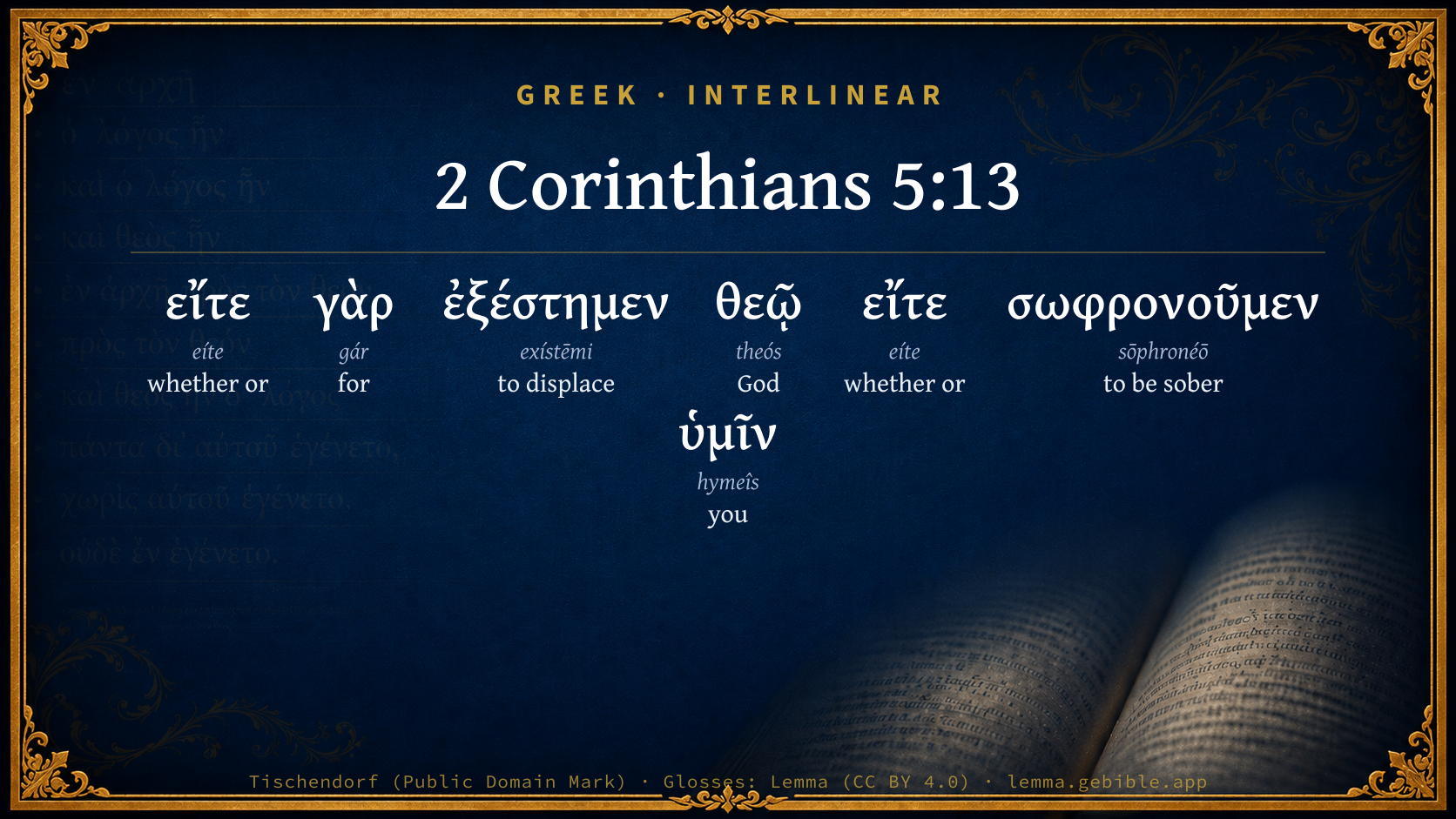
Greek (Tischendorf 8th ed.) 2 Corinthians 5:13 appears in the Greek New Testament. The text above is from the Tischendorf 8th edition. Each word links to its Strong’s number and a concise gloss. Click any word for its full Thayer’s Greek Lexicon entry.
Download image
Cite this verse

2 Corinthians 5:13 (World English Bible). Public Domain. Lemma interlinear Bible study tool, https://lemma.gebible.app/v/2-corinthians/5/13.

Show BibTeX & RIS
BibTeX
RIS
English Translation
For if we are beside ourselves, it is for God. Or if we are of sober mind, it is for you.
World English Bible · Public Domain
Download a study sheet

One document with this verse’s original text, its word-by-word gloss line, the meaning frame, cross-references with their text, attributed commentary, and full source and license credits — printable, and it pastes into notes with its structure intact.

This verse Autodidact and up

Study sheet (.html) Plain text (.txt)

A passage Seminary Student

Up to 50 verses in one chapter. A passage sheet keeps up to 6 commentary sources and 12 cross-references per verse, in the order this page ranks them, and says so on the sheet whenever that leaves anything out. Ask for a single verse and you get the Autodidact verse sheet above.

Everything on this page stays free to read, with no account — the sheet is a download of what is already on screen, not access to it.

Want to remove ads? Support Godless Engineer
Compare translations 3

The same verse in 3 English versions, stacked beneath the original-language interlinear above. Click any original word for its lexicon entry.

Each is an independent rendering of the whole verse — the interlinear is not word-aligned to these translations.

Highlighted words mark where these versions differ — a whole-verse word diff, not a word-by-word alignment.

  • World English Bible Public Domain
    For if we are beside ourselves, it is for God. Or if we are of sober mind, it is for you.
  • King James Version Public Domain
    For whether we be beside ourselves, it is to God: or whether we be sober, it is for your cause.
  • unfoldingWord Literal Text CC BY-SA 4.0
    For if we are out of our mind, for God; if we are of sound mind, for you.

unfoldingWord Literal Text — © unfoldingWord, licensed CC BY-SA 4.0. Word-aligned USFM3 via Door43 (git.door43.org/unfoldingWord/en_ult).

Versions to compare (up to 4)

3 of 4 selected

Show all 19 translations

Every available English version of this verse, each an independent rendering of the whole verse.

  • World English Bible Public Domain
    For if we are beside ourselves, it is for God. Or if we are of sober mind, it is for you.
  • Berean Standard Bible Public Domain
    If we are out of our mind, it is for God; if we are of sound mind, it is for you.
  • Majority Standard Bible Public Domain
    If we are out of our mind, it is for God; if we are of sound mind, it is for you.
  • King James Version Public Domain
    For whether we be beside ourselves, it is to God: or whether we be sober, it is for your cause.
  • American Standard Version (1901) Public Domain
    For whether we are beside ourselves, it is unto God; or whether we are of sober mind, it is unto you.
  • Revised Version (1885) Public Domain
    For whether we are beside ourselves, it is unto God; or whether we are of sober mind, it is unto you.
  • Geneva Bible (1599) Public Domain
    For whether we be out of our wit, we are it to God: or whether we be in our right minde, we are it vnto you.
  • Douay-Rheims (1899) Public Domain
    For whether we be transported in mind, it is to God; or whether we be sober, it is for you.
  • Young's Literal Translation Public Domain
    for whether we were beside ourselves, `it was' to God; whether we be of sound mind -- `it is' to you,
  • Literal Standard Version CC BY-SA 4.0
    for whether we were beside ourselves, [it was] to God; whether we be of sound mind, [it is] to you,
  • Unlocked Literal Bible CC BY-SA 4.0
    For if we are out of our minds, it is for God; and if we are in our right minds, it is for your sake.
  • unfoldingWord Literal Text CC BY-SA 4.0
    For if we are out of our mind, for God; if we are of sound mind, for you.
  • Darby Bible Public Domain
    For whether we are beside ourselves, [it is] to God; or are sober, [it is] for you.
  • World Messianic Bible Public Domain
    For if we are beside ourselves, it is for God. Or if we are of sober mind, it is for you.
  • Webster's Bible Public Domain
    For whether we are beside ourselves, it is to God: or whether we are sober, it is for your cause.
  • Free Bible Version CC BY-SA 4.0
    If we are “crazy people,” it's for God. If we make good sense, it's for you.
  • Bible in Basic English Public Domain
    For if we are foolish, it is to God; or if we are serious, it is for you.
  • Text-Critical English NT CC BY 4.0
    If we are out of our mind, it is for God; if we are in our right mind, it is for you.
  • Tyndale New Testament (1534) Public Domain
    For yf we be to fervent to God are we to fervent. Yf we kepe measure for youre cause kepe we measure.

Literal Standard Version (2020), Covenant Press — licensed CC BY-SA 4.0. Text via the HelloAO Bible API (eBible.org). Unlocked Literal Bible (unfoldingWord) — licensed CC BY-SA 4.0. Text via the HelloAO Bible API (eBible.org). unfoldingWord Literal Text — © unfoldingWord, licensed CC BY-SA 4.0. Word-aligned USFM3 via Door43 (git.door43.org/unfoldingWord/en_ult). Free Bible Version, Dr. Jonathan Gallagher — licensed CC BY-SA 4.0. Text via the HelloAO Bible API (eBible.org).

Word by word

More ways to search: Search by grammar → Find every occurrence → Compare this word →

Practice this passage: Drill this verse → Learn its vocabulary →

About this verse

These counts appear in no published source. They are computed here, from the morphology-tagged text and Lemma’s own curated glosses. What Lemma adds →

7
words
6
distinct lemmas
Pauline Epistles
section

Notable vocabulary

The rarest word here is σωφρονοῦμεν to be sober G4993 — appearing just 6 times in the whole Greek New Testament.

Shared distinctive vocabulary

σωφρονοῦμεν to be sober G4993 occurs in 6 verses of the Greek New Testament. Also found in:

Repetition

A word recurs within this verse:

  • εἴτε whether or G1535 ×2

Cross-references

13

Topical passages linked to 2 Corinthians 5:13 in the Treasury of Scripture Knowledge — connected by theme and wording, ordered by reader-vote popularity; previews shown in the World English Bible.

  • 2 Corinthians 11:16–17 I say again, let no one think me foolish. But if so, yet receive me as foolish, that I also may boast a little.
  • 2 Corinthians 12:6 For if I would desire to boast, I will not be foolish; for I will speak the truth. But I forbear, so that no man may account of me above that which he sees in me, or hears from me.
  • Romans 12:3 For I say, through the grace that was given me, to every man who is among you, not to think of himself more highly than he ought to think; but to think reasonably, as God has apportioned to each person a measure of faith.
  • 2 Corinthians 11:1 I wish that you would bear with me in a little foolishness, but indeed you do bear with me.
  • Acts 26:24–25 As he thus made his defense, Festus said with a loud voice, "Paul, you are crazy! Your great learning is driving you insane!"
  • 1 Corinthians 4:10–13 We are fools for Christ's sake, but you are wise in Christ. We are weak, but you are strong. You have honor, but we have dishonor.
  • 2 Corinthians 12:11 I have become foolish in boasting. You compelled me, for I ought to have been commended by you, for in nothing was I inferior to the very best apostles, though I am nothing.
  • 2 Samuel 6:21–22 David said to Michal, [It was] before Yahweh, who chose me above your father, and above all his house, to appoint me prince over the people of Yahweh, over Israel: therefore will I play before Yahweh.
  • 2 Corinthians 7:12 So although I wrote to you, I wrote not for his cause that did the wrong, nor for his cause that suffered the wrong, but that your earnest care for us might be revealed in you in the sight of God.
  • Colossians 1:24 Now I rejoice in my sufferings for your sake, and fill up on my part that which is lacking of the afflictions of Christ in my flesh for his body's sake, which is the assembly;
  • 1 Thessalonians 1:5 and that our Gospel came to you not in word only, but also in power, and in the Holy Spirit, and with much assurance. You know what kind of men we showed ourselves to be among you for your sake.
  • 1 Thessalonians 2:3–11 For our exhortation is not of error, nor of uncleanness, nor in deception.
  • 2 Timothy 2:10 Therefore I endure all things for the chosen ones' sake, that they also may obtain the salvation which is in Christ Jesus with eternal glory.

Cross-references courtesy of OpenBible.info (CC BY 4.0).

Commentary

Notes on 2 Corinthians 5:13 from classic Christian and Jewish commentators (each source and its license shown beneath its notes). The classic Christian expositions comment on the surrounding passage and are grouped to its opening verse, so a note may address several verses; the Jewish commentaries on the Tanakh (Rashi and others) are per-verse, so they appear only where the commentator wrote on this verse.

Lemma curates 59 commentaries, every one of them public domain or Creative Commons licensed, each selected and text-cleaned for this edition rather than reprinted as found. About our sources →

Joseph Benson's Commentary

2Co 5:13-15. For whether we be beside ourselves — As they affirm we are, because we expose ourselves to so many sufferings, and even to the danger of imprisonment and death, by persevering in our work of preaching the gospel. Or whether we appear to be transported beyond ourselves — By our speaking or writing with uncommon vehemence; it is to God — It is zeal for his glory that animates us; and he understands, if men do not, the emotion which himself inspires. Or whether we be sober — In shunning persecution as much as may be, or proceed in a more calm and sedate manner; it is for your cause — We have your good in view, and proceed in our course in order to promote your best interests. In other words, love to God and benevolence to man, are the grand principles by which we are actuated; and we cannot be cold and unaffected, while we have such grand and noble subjects under our consideration as those which we treat of among you. Mr. Locke, from comparing 2Co 11:1; 2Co 11:16-21; 2Co 12:6; 2Co 12:11, is of opinion that the Corinthians censured Paul as a fool or madman, for what he said in commendation of himself. In that case the meaning is, “You say I am distracted for my present conduct, but this is between God and myself; I am sure you Corinthians ought not to say it, for all my sober thoughts and most painful labours are for you.” For the love of Christ — So illustriously displayed toward us in our redemption, and our love to him in return; constraineth us — Ευνεχει, bears us on, with a strong, steady, prevailing influence, such as winds and tides exert when they waft the vessel to its destined harbour; κριναντας τουτο, judging thus, or while we thus judge — Thus consider and reflect; that if one died for all — Which Jesus assuredly did, even gave himself a ransom for all mankind, without exception, (1Ti 2:6,) yea, tasted death for every man, for every human being; (Heb 2:9;) then were all dead — Even the best of men were in a state of spiritual death entailed upon them by the sin of the first man, (see on Gen 2:17,) and liable to death eternal. For had it been otherwise with any man, Christ would not have had need to die for him. And that he died for all — That all might be saved; that they who live — That all who live upon the earth, or all who, believing in him, are put in possession of spiritual life through his death and grace procured thereby; should not henceforth — From the moment they know and are united to him; live unto themselves — Seek their own honour, profit, or pleasure, or do their own will; but live unto him who died for them — And thereby procured for them pardoning mercy and renewing grace, to enable them so to live; and rose again — That he might receive for them, and confer upon them, these inestimable blessings.

Joseph Benson's Commentary on the Old and New Testaments (1811–1818) — public domain. Text from a community e-Sword module.

Tyndale Open Study Notes

Tyndale Open Resources

5:13 If . . . we are crazy: This statement might imply a charge on Paul’s previous visit to Corinth (2:1-2) that he was out of his mind when he proclaimed the simple Good News there (1 Cor 2:2).

Tyndale Open Study Notes — © Tyndale Open Resources, licensed CC BY-SA 4.0. Text via the HelloAO Bible API.

Bengel's Gnomon

Johann Albrecht Bengel

2Co 5:13. Εἴτε ἐξέστημεν ἔιτε σωφρονοῦμεν) The former is treated of 2Co 5:15-21:—the latter 2Co 6:1-10. The force of the one word is evident from the other, to act without or with moderation. Paul might seem to be without moderation from the Symperasma,[29] which he gave in the preceding verse [namely, adorning his office with so many encominiums.—V. g.]—Θεῷ, it is to God) viz., that we have acted without moderation, although men do not understand us.—ὑμῖν, it is to you) Even godly men bear the moderation of their teachers with a more favourable feeling, than their ἔκστασις, excessive enthusiasm; but it is their duty to obey the Spirit.

[29] See App. A brief and summary conclusion from the previous premisses.—T.

Bengel's Gnomon of the New Testament — English translation (T&T Clark, Edinburgh, 1860) — public domain. Text from a community e-Sword module.

Meyer's Critical & Exegetical Commentary

Heinrich August Wilhelm Meyer

2Co_5:13. And you have reason for making your boast on our behalf over against the adversaries!

That Paul is here dealing, and that not without irony, with an odious accusation of his opponents (perhaps of an overseer of the church, according to Ewald), is evident, since otherwise the peculiar mode of expression used by him would appear quite uncalled for. It must have been asserted that he had gone out of his senses, that he had become mad (observe the aorist),an assertion for which narrow-mindedness as well as malice might find cause enough, or seize pretext, in the extraordinary heroism and divine zeal of his working in general, and especially in his sudden and wonderful conversion, in the ecstasies and visions[225] which he had had, in his anti-Judaism at times unsparing, in his ideal demands on the Christian life, in the prominence given to his consciousness of apostleship, to his sufferings, and the like. In reference to this accusation he now says: For be it, that we have become mad (as our enemies venture to assert), it is a madness standing at the service of God (a holy mania, which deserves respect, not blame!); or be it, that we are of sound understanding, we are so for your service (which can only be found by you praiseworthy). Comp. Aretius, Rückert, de Wette, Osiander, Hilgenfeld (in his Zeitschr. 1864, p. 170), who, however, abides only by the apostles assertion, that he had seen Christ and was a full apostle, as the ground for this opinion of his opponents. As early as the time of Chrysostom (he quotes an explanation: εἰ μὲν μαίνεσθαί τις ἡμᾶς νομίζει κ.τ.λ.) it was recognised that a glance at a hostile accusation was contained in ἐξέστημεν, and this is remarked by most of the older and the modern commentators; but there should have been the less hesitation at taking the word in its full sense (see on Mar_3:21; comp. Act_26:24), whereas it was often weakened into: ultra modum agere,[226] or into: to be foolish (Chrysostom, Morus, Billroth), to seem to act foolishly (Flatt), and the like, in spite of the following σωφρονοῦμεν, which is the exact opposite of having become mad (Plato, Phaedr. p. 244 A). Comp. Act_26:25. As regards the subject-matter, ἐξέστ. was mostly (as by Chrysostom and Theodoret) referred to the self-praise,[227] in which case θεῷ was taken as: to the honour of God, and then ὑμῖν was referred either to the salutary example (ἵνθ μάθητε ταπεινοφρονεῖν, Chrysostom, Flatt) or to the salutary condescension. So Erasmus,[228] Vatablus, Menochius, Estius, Bengel, Emmerling, Olshausen. Billroth takes it differently: If, however, you put a rational construction on it (this boasting), in my case, I wish to have myself boasted of only for your advantage; I do it only in order that you may not be deceived by my opponents regarding me. But the whole reference to the self-praise is after 2Co_5:12, where Paul has absolutely negatived the ἑαυτοὺς συνιστάνομεν ὑμῖν, contrary to the context; and those references of ὙΜῖΝ to the example shown, or to the apostolic condescension, or to a deception of the readers to be prevented, are not in keeping with the parallel ΘΕῷ; and there is no reason in the context for sacrificing the uniformity in compass of meaning of the two datives, so that ὙΜῖΝ is not to be taken otherwise than with Grotius in the comprehensive sense of in vestros usus. According to Hofmann, ἐξέστ. is to be referred to the self-testimony expressed loftily and in the most exalted tone at 2Co_2:14 ff.: If it might there be said that he had gone out of himself, on the other hand, the succeeding explanation (begun in 2Co_3:1) could only produce the impression of sober rationality. But in this way there is in fact assumed a retrospective reference for ἐξέστ., which no reader and, excepting Hofmann, no expositor could have conjectured, and this all the less that from 2Co_3:1 to the present passage Paul has been speaking of himself in a tone to a great extent lofty and exalted (e.g. 2Co_3:2 f., 12 ff., the whole of chap. 4, particularly after 2Co_5:7; also 2Co_5:1 ff.); so that we do not see on what so great a difference of judgment is to be based, as would be yielded by ἐξέστ. and ΣΩΦΡΟΝ. It remains far from clear, we may add, what more precise conception Hofmann has of gone out of himself (whether as insanity or merely as extravagance of emotion).

εἴτε … εἴτε] does not here mark off two different conditions (Baur in the theol. Jahrb. 1850, p. 182 ff.) and times, nor the actual change of moods and modes of behaviour (Osiander) which Paul would scarcely have designated according to different references of aim (comp. rather τὰ πάντα διʼ ὑμᾶς, 2Co_4:15), but two different modes of appearance of the same state, which are both assumed as possibly right, but the latter of which is in 2Co_5:14 proved to be right and the former excluded.

[225] Grotius limits the reference of ἐξέστ. to the trances alone; but the word in itself does not justify this.

[226] So Bengel; and earlier Luther, who gives as gloss: If we do too much, i.e. if we deal at once sharply with the people, we still serve God by it; but if we act gently and moderately with them, we do so for the peoples good, so that in every way we do rightly and well.

[227] Comp. Pindar, Ol. ix 58: τὸ καυχᾶσθαι παρὰ καιρὸν μανίαισιν ὑποκρέκει, Plato, Protag. p. 323 B: ὅ ἐκεῖ σωφροσύνην ἡγοῦντο εἶναι, τἀληθῆ λέγειν, ἐνταῦθα μανίαν.

[228] Si quid gloriatur P., id non ad ipsius, sed ad Dei gloriam pertinet; si mediocria loquitur, id tribuit infirmioribus, quorum affectibus et capacitati se accommodat. Rückert also, who in other respects takes ἐξέστ. and σωφρ. rightly in their pure and full sense, refers ὑμῖν to accommodation.

Meyer — Critical and Exegetical Commentary on the New Testament — English translation by Peter Christie, edited by Frederick Crombie (T&T Clark, 1880) — public domain. Text from a community e-Sword module.

Expositor's Greek Testament

ed. W. Robertson Nicoll

2Co 5:13 . εἴτε γὰρ ἑξέστημεν κ . τ . λ .: for whether (see on 2Co 1:6 for constr.) we are beside ourselves, it is unto God; or whether we are of sober mind, it is unto you (note the dat. commodi ). At a later period Festus told Paul that he was mad (Act 26:24 ), so impressed was he with the Apostle’s enthusiasm; and it is probable that the anti-Pauline party at Corinth were not slow to point to the “visions and revelations of the Lord” which St. Paul claimed for himself (chap. 2Co 12:1-6 ), and to the facility with which he spoke “with tongues” (1Co 14:18 ), as proofs of his madness. A similar accusation was made against his Master (Mar 3:21 ). But St. Paul bids them (2Co 5:12 ) look a little deeper, and not judge by mere outward phenomena such as these. He repeatedly asks them to bear with his seeming foolishness (chap. 2Co 11:1 ; 2Co 11:16-17 , 2Co 12:6 ; 2Co 12:11 ). It is possible that a charge of a contrary nature had been also made by his opponents, and that his regard for other men’s prejudices (1Co 9:20 ), and the “craftiness” with which he caught the Corinthians “with guile” (chap. 2Co 12:16 ), were urged as savouring more of worldly wisdom than of true piety. His answer to both charges is contained in this verse. If he has exceeded the bounds of moderation, it is in his moods of highest devotion, when he is pouring out his soul to God and not to man; if he has exercised a sober prudence in his dealings with his converts, it is all for their sakes, and not for selfish ends.

The Expositor's Greek Testament, edited by W. Robertson Nicoll (1897–1910) — public domain. Text from a community e-Sword module.

Geneva Bible (1599)

Geneva Bible translators

The meaning is: Even when I am mad (as some men think of me) while I seem as a fool to boast myself, I do it for your profit, no less than when I preach the Gospel simply unto you.

Geneva Bible (1599) marginal notes — public domain. Text via Bolls.life.

Jamieson, Fausset & Brown

Robert Jamieson, A. R. Fausset & David Brown

be--rather as Greek, "have been." The contrast is between the single act implied by the past tense, "If we have ever been beside ourselves," and the habitual state implied by the present, "Or whether we be sober," that is, of sound mind. beside ourselves--The accusation brought by Festus against him (Act 26:24). The holy enthusiasm with which he spake of what God effected by His apostolic ministry, seemed to many to be boasting madness.

sober--humbling myself before you, and not using my apostolic power and privileges.

to God . . . for your cause--The glorifying of his office was not for his own, but for God's glory. The abasing of himself was in adaptation to their infirmity, to gain them to Christ (Co1 9:22).

Jamieson, Fausset & Brown — Commentary Critical and Explanatory on the Whole Bible (1871) — public domain (CC PDM 1.0). Text via the HelloAO Bible API.

Adam Clarke's Commentary

Verse 13. Beside ourselves] Probably he was reputed by some to be deranged. Festus thought so: Paul, thou art beside thyself; too much learning hath made thee mad. And his enemies at Corinth might insinuate not only that he was deranged, but attribute his derangement to a less worthy cause than intense study and deep learning.

It is to God] If we do appear, in speaking of the glories of the eternal world, to be transported beyond ourselves, it is through the good hand of our God upon us, and we do it to promote his honour.

Whether we be sober] Speak of Divine things in a more cool and dispassionate manner, it is that we may the better instruct and encourage you.

Adam Clarke's Commentary on the Bible (1810–1826) — public domain. Text from a community e-Sword/MySword module.

John Calvin's Commentaries

13. Whether we are beside ourselves. This is said by way of concession; for Paul’s glorying was sane, or it was, if we may so term it, a sober and most judicious madness; but as he appeared foolish in the eyes of many, he speaks according to their views. Now he declares two things: in the first place, that he makes no account of himself, but has this one object in view — that he may serve God and the Church; and, secondly, that he fears not the opinion of men, so that he is prepared for being reckoned either sane or insane, provided only he transacts faithfully the affairs of God and the Church. The meaning, therefore, is this: “As to my making mention so frequently of my integrity, persons will take this as they choose. It is not, however, for my own sake that I do it, but, on the contrary, I have God and the Church exclusively in view. Hence I am prepared to be silent and to speak, according as the glory of God and the advantage of the Church will require, and I shall be quite contented that the world reckon me beside myself, provided only it is not to myself, but to God, that I am beside myself.” This is a passage that is deserving not merely of notice, but also of constant meditation; for unless we shall have our minds thus regulated, the smallest occasions of offense will from time to time draw us off from our duty.

John Calvin's Commentaries (1540-1563) — public domain. Text from the Calvin Translation Society English edition (1840s-50s) via the Christian Classics Ethereal Library (ccel.org). Calvin's coverage is partial (roughly two-thirds of the Bible); uncommented books and verses are honest gaps, never fabricated. The 19th-century editor's footnotes and remarks are omitted so the notes are faithfully Calvin's own voice.

Ellicott's Commentary for English Readers

(13) For whether we be beside ourselves.—The recollection of one sneer leads on to another. This also had been said of him, and the intense sensitiveness of his nature made him wince under it. Some there were at Corinth who spoke of his visions and revelations, his speaking with tongues as in ecstasy, his prophecies of future judgment, as so many signs of madness. “He was beside himself.” (Comp. Agrippa’s words in Act_26:24, and Note there.) Others, or, perhaps, the same persons, pointed to his tact, becoming all things to all men, perhaps even insinuated that he was making money by his work (2Co_9:12; 2Co_12:10): “he was shrewd enough when it served his turn.” He answers accordingly both the taunts. What people called his “madness”—the ecstasy of adoration, the speaking with tongues (1Co_14:18-23)—that lay between himself and God, and a stranger might not intermeddle with it. What people called his “sober-mindedness”—his shrewd common sense, his sagacity—that he practised not for himself, but for his disciples, to win them to Christ, remove difficulties, strengthen them in the faith.

A Bible Commentary for English Readers, edited by Charles John Ellicott (1878–1897) — public domain. Text from a community e-Sword module.

The Cambridge Bible for Schools and Colleges

gen. ed. J. J. S. Perowne

13. For whether we be besides ourselves] Literally, were beside ourselves, i.e. when we were with you. The reproach of madness was afterwards cast upon St Paul by Festus (Act_26:24), and may well have been cast upon him before this. Cf. Acts 17.

it is to God] Better, for God, i.e. for His cause. See ‘for your cause’ below. Literally, for you.

or whether we be sober] The word here used signifies the quiet self-restraint characteristic of the Christian. Its original meaning is to have one’s thoughts safe, and hence to be of sound, healthy mind (cf. the Latin salvus and our ‘safe and sound’). Cf. Mar_5:15; Luk_8:35 (where the word is opposed to the idea of madness). Also Rom_12:3; Tit_2:2; Tit_2:4; Tit_2:6, &c.

The Cambridge Bible for Schools and Colleges (gen. ed. J. J. S. Perowne; Cambridge University Press, 1878–1918) — public domain. Text from a community e-Sword module.

John Gill's Exposition

For the love of Christ constraineth us,.... Or "containeth us"; holds and keeps us in our station and duty, as soldiers are held and kept together under a banner, or ensign displayed; to which the church refers, when she says, "his banner over me was love", Sol 2:4. Nothing more effectually keeps ministers, or other believers, in the work and service of their Lord, or more strongly obliges and constrains them to a cheerful discharge of their duty to him, and one another, than his love displayed in his covenant engagements, in his assumption of human nature, and particularly in his dying for them, which is the instance given in the text:

because we thus judge; having well weighed, and maturely considered the affair,

that if one died for all, then were all dead; or "seeing one died for all"; for it is rather an assertion than a supposition, upon which the apostle reasons. The person designed, who died for all, is Jesus Christ, though not mentioned, and is to be supplied from the former clause. The doctrine of Christ's dying for men was well known, so that there was no need to mention his name; he is called "one", in distinction to the "all" he died for, and as exclusive of all others, he being sufficient of himself to answer the ends of his death; and therefore is to be looked unto, and believed on, alone for salvation, and to have all the glory of it. The manner of his dying is for, or in the room and stead of all; so that he died not merely as a martyr, or by way of example, or only for their good, but as their substitute, in their room and stead, having all the sins of his people upon him, for which he made satisfaction; and this the nature of his death shows, which was a sacrifice, a ransom, a propitiation and atonement. The persons for whom Christ died are all; not every individual of mankind, but all his people, all his sheep, all the members of his church, or all the sons he, as the great Captain of salvation, brings to glory. Wherefore this text does not make for the doctrine of general redemption; for it should be observed, that it does not say that Christ died for "all men", but for "all"; and so, agreeably to the Scriptures, may be understood of all the persons mentioned. Moreover, in the latter part of the text it is said, that those for whom Christ died, for them he rose again; he died for no more, nor for others, than those for whom he rose again: now those for whom he rose again, he rose for their justification; wherefore, if Christ rose for the justification of all men, all would be justified, or the end of Christ's resurrection would not be answered; but all men are not, nor will they be justified, some will be condemned; hence it follows, that Christ did not rise from the dead for all men, and consequently did not die for all men: besides, the "all" for whom Christ died, died with him, and through his death are dead both to the law and sin; and he died for them, that they might live, not to themselves, but to him; neither of which are true of all the individuals of mankind: to which may be added, that the context explains the all of such who are in Christ, are new creatures, are reconciled to God, whose trespasses are not imputed to them, for whom Christ was made sin, and who are made the righteousness of God in him; which cannot be said of all men. The conclusion from hence is,

then were all dead; meaning, either that those for whom Christ died, were dead in Adam, dead in law, dead in trespasses and sins, which made it necessary for him to die for them; otherwise, there would have been no occasion for his death; yet it does not follow from hence, that Christ died for all that are in such a condition; only that those for whom Christ died were dead in this sense, admitting this to be the sense of the passage; though death in sin seems not to be intended, since that all men are dead in sin, would have been a truth, if Christ had died for none; and much less is this an effect, or what follows upon the death of Christ; nor does it capacitate, but renders men incapable of living to Christ: wherefore a mystical death in, and with Christ, seems rather to he meant; and so the Ethiopic version reads it, "in whom everyone is dead". Christ died as the head and representative of his people, and they all died in him, were crucified with him, and through his death became dead to the law, as to its curse and condemnation; and to sin, as to its damning power, being acquitted, discharged, and justified from it; the consequence of which is a deliverance from the dominion of it, whereby they become capable of living to the glory of Christ. The sense of the passage is not, that Christ died for all that were dead, but that all were dead for whom he died; which is true of them, whether in the former, or in the latter sense: the article is anaphorical or relative, as Beza and Piscator observe; and the meaning is, that if Christ died for all, then all "those" were dead for whom he died.

John Gill's Exposition of the Whole Bible (1746–1763) — public domain (CC PDM 1.0). Text via the HelloAO Bible API.

Trapp's Complete Commentary

John Trapp

13 For whether we be beside ourselves, it is to God: or whether we be sober, it is for your cause.

Ver. 13. It is to God] i.e. When to the world we seem mad of pride and vain glory, yet then we respect only God’s glory.

It is for your sakes] i.e. For your learning, that we are more modest and sparing in commending our apostleship. It is a good rule, Quicquid agas, propter Deum agas, do all for God’s sake.

John Trapp, A Commentary or Exposition upon All the Books of the Old and New Testament (1647–1656) — public domain. Text from a community e-Sword module.

Albert Barnes' Notes on the Bible

For whether we be beside ourselves - This is probably designed to meet some of the charges which the false teachers in Corinth brought against him, and to furnish his friends there with a ready answer, as well as to show them the true principles on which he acted, and his real love for them. It is altogether probable that he was charged with being deranged; that many who boasted themselves of prudence, and soberness, and wisdom, regarded him as acting like a madman. It has not been uncommon, by any means, for the cold and the prudent; for formal professors and for hypocrites to regard the warm-hearted and zealous friends of religion as maniacs. Festus thought Paul was deranged, when he said, “Paul, thou art beside thyself; much learning doth make thee mad,” Act 26:24; and the Saviour himself was regarded by his immediate relatives and friends as beside himself, Mar 3:21. And at all times there have been many, both in the church and out of it, who have regarded the friends of revivals, and of missions, and all those who have evinced any extraordinary zeal in religion, as deranged. The object of Paul here is to show, whatever might be the appearance or the estimate which they affixed to his conduct, what were the real principles which actuated him. These were zeal for God, love to the church, and the constraining influences of the love of Christ, 2Co 5:14-15. The word rendered here as “be beside ourselves” (ἐξέστημεν exestēmen, from ἐξίστημι existēmi) means properly, to put out of place; to be put out of place; and then to be put out of oneself, to astonish, to fill with wonder; Luk 24:22; Act 8:9, Act 8:11; and then to be out of one’s mind, to be deranged. Here it means that they were charged with being deranged, or that others esteemed, or professed to esteem Paul and his fellow-laborers deranged.

It is to God - It is in the Cause of God, and from love to him. It is such a zeal for him; such an absorbing interest in his cause; such love prompting to so great self-denial, and teaching us to act so much unlike other people as to lead them to think that we are deranged. The doctrine here is, that there may be such a zeal for the glory of God, such an active and ardent desire to promote his honor, as to lead others to charge us with derangement. It does not prove however that a man is deranged on the subject of religion because he is unlike others, or because he pursues a course of life that differs materially from that of other professors of religion, and from the man of the world. He may be the truly sane man after all; and all the madness that may exist may be where there is a profession of religion without zeal; a professed belief in the existence of God and in the realities of eternity, that produces no difference in the conduct between the professor and other people; or an utter unconcern about eternal realities when a man is walking on the brink of death and of hell. There are a few people that become deranged by religion; there are millions who have no religion who act as madmen. And the highest instances of madness in the world are those who walk over an eternal hell without apprehension or alarm.

Or whether we be sober - Whether we are sane, or of sound mind; compare Mar 5:15. Tyndale renders this whole passage: “For if we be too fervent, to God we are too fervent; if we keep measure, for our cause keep we measure.” The sense seems to be, “if we are esteemed to be sane, and sober-minded, as we trust you will admit us to be, it is for your sake. Whatever may be the estimate in which we are held, we are influenced by love to God, and love to man. In such a cause, we cannot but evince zeal and self-denial which may expose us to the charge of mental derangement; but still we trust that by you we shall be regarded as influenced by a sound mind. We seek your welfare. We labor for you. And we trust that you will appreciate our motives, and regard us as truly sober-minded.”

Albert Barnes' Notes on the Bible (1834–1885) — public domain. Text from a community e-Sword/MySword module.

Haydock's Catholic Bible Commentary

===============================

[BIBLIOGRAPHY]

Sive enim mente excedimus, Deo, sive sobrii sumus, vobis, Greek: eite gar exestemen, theo eite sophronoumen, umin. See Annotation on Mark iii. 21. p. 147. [There is an applicable annotation in this commentary on Mark iii. 21. but the page reference is unknown.]

George Leo Haydock (1774–1849), Haydock's Catholic Family Bible and Commentary, 1859 edition — public domain. Excludes Psalms (Douay-Rheims chapter numbering differs from Protestant) and Deuterocanonical books (Catholic canon only).

Matthew Poole's English Annotations

It should seem, that some amongst the Corinthians, amongst other reproaches, had reproached Paul for a madman; either taking advantage of the warmth and fervour of his spirit, or of those ecstasies in which he sometimes was; or of his speaking things which they could not apprehend and understand: as the Roman governor, in the Acts, told him:

Much learning hath made thee mad. The apostle tells them, that if indeed he was beside himself in any of their opinion, it was

to God, that is, for the honour and glory of God: or if he was sober, it was for their sake; in what temper soever he was, it was either for service to God, or them.

Matthew Poole's English Annotations on the Holy Bible (1683–1685) — public domain. Text from a community e-Sword/MySword module.

Whedon's Commentary on the Bible

Daniel D. Whedon

13. Beside ourselves—The Greek word is the one from which our term ecstasy is derived. See note on Act_10:10. The apostle here, apparently, ironically alludes to the sneers of his assailant. His extraordinary conversion, his visions of Christ, his trances, as well as his sublimated heroism of character, were the pretext for imputations of mania. So King Agrippa subsequently charged him with madness. And so at the present day an insensible, dying world esteems all intense feeling in regard to eternity as fanaticism. Revivals of religion they will condemn as periods of madness. Yet over some great commercial crisis these very men—nay, whole communities, peoples, and nations—are excited in every nerve and fibre to an all but frenzy. If we could have once in four years a revival in religion as great as we have a revival in politics at every presidential election, we should think the millennium was dawning.

To God—It is the mania of a perfect consecration to the Divine.

For your cause—In order to bring the gospel of salvation to you.

Daniel D. Whedon (gen. ed.), Commentary on the Old and New Testaments (1874–1909) — public domain. Text from a community e-Sword module.

The Pulpit Commentary

For whether we be beside ourselves; rather, for whether we were mad. Evidently some person or some faction had said of St. Paul, "He is beside himself," just as Festus said afterwards, "Paul, thou art mad," and as the Jews said of Paul"s Lord and Master. (Joh_10:20) The fervour of the apostle, his absorption in his work, his visions and ecstasies, his "speaking with tongues more than they all," his indifference to externals, his bursts of emotion, might all have given colour to this charge, which he here ironically accepts. "Mad or self controlled all was for your sakes." It is to God; rather for God. My "enthusiasm," "exaltation," or, if you will, my "madness," was but a phase of my work for him. We be sober. The word "sober" (sophron) is derived from two words which mean" to save the mind." It indicates wise self control, such as was represented also by the many-sided Latin word frugi. It is the exact antithesis to madness. (Act_26:25) What you call my "madness" belongs to the relation between my own soul and God; my practical sense and tact are for you. For your sakes; literally, for you.

The Pulpit Commentary (1880–1919), ed. H.D.M. Spence-Jones & Joseph S. Exell — public domain. Text from a community e-Sword module.

John Wesley's Explanatory Notes

For if we are transported beyond ourselves - Or at least, appear so to others, treated of, 2 Cor. v, 15-21, speaking or writing with uncommon vehemence. It is to God - He understands (if men do not) the emotion which himself inspires. If we be sober - Treated of, chap. vi, 1-10. If I proceed in a more calm, sedate manner. It is for your sakes - Even good men bear this, rather than the other method, in their teachers. But these must obey God, whoever is offended by it.

John Wesley, Explanatory Notes Upon the Whole Bible (1754–1765) — public domain. Text via the GEBible commentary corpus.

Burkitt's Expository Notes on the New Testament

William Burkitt

The holy apostle was sometimes so zealously transported and carried forth in his high actings for Jesus Christ, that the false apostles represented him as a frantic person, crazy, mad, and what not; "Be it so, (says the holy man,) it is unto God, in his cause, and to propagate his glory, and not my own: or if I be sober in my words and actions, it is for your benefit, not my own."

Learn hence, That wicked and carnal men account and represent the holy servants of God as a sort of madmen. Workings of grace are sometimes so far above reason, that they seem to be without reason: there are several acts of holiness, which the profane world esteem as madness; as eminent self-denial, great seriousness in religion, their burning zeal, their holy singularity, their fervours of devotion, their patience and meekness under sufferings and reproaches. All these acts of holiness represent the saints as madmen to carnal men.

William Burkitt's Expository Notes on the New Testament (1700–1703) — public domain. Text from a community e-Sword module.

McGarvey & Pendleton's Commentaries

J. W. McGarvey

For whether we are beside ourselves, it is unto God; or whether we are of sober mind, it is unto you . [Paul could not appeal to the approval of his character in the sight of God without bringing to his own mind and the mind of his readers the striking difference between the manifestations of divine communion, inspiration, etc., which characterized his own life, and the dry, barren formalism which characterized the lives of his critics; yet he well knew that if his friends gloried in those things wherein his life touched upon the divine, his enemies would sneer at them as mere evidences of insanity and madness. To answer this sneer the apostle sets forth his whole life in its two grand divisions or forms of manifestation, viz.: his insanity and sanity. That which his enemies knew as the insane part of it was wholly devoted to God, and that which was generally recognized as the sane part of it was wholly devoted to the church, and at this time especially directed toward Corinth. Hence it appeared that in neither department of his life was there any room for self-seeking. His friends therefore could answer his enemies thus: "Viewed in one aspect, Paul's life is wholly devoted to the glory of God, and viewed in another it is utterly sacrificed for us and our salvation. It is evident, therefore, that having but these two ends in view, he can not be seeking self-exaltation." Paul's opponents looked upon his madness as commencing with his conversion, and in their eyes his ecstasies, visions, revelations, trances, inspiration and mystic intercourse with God and Christ were conclusive evidences that his mind was unbalanced. But the very nature of the phenomena showed a character void of all self-seeking. Paul's sanity consisted in his sound judgment, forbearance, tact, consideration, charity, etc., in the handling of the churches as is displayed in all his epistles. It is true that in this field the apostle maintains his dignity and authority, but in every instance where he does so, it is for the obvious purpose of directing and benefiting others, and not with any design to exalt himself.]

J. W. McGarvey (with Philip Y. Pendleton), Commentaries on the New Testament (The Fourfold Gospel, 1914; Acts; and the epistles) — public domain. Text from a community e-Sword/MySword module.

The People's New Testament

B. W. Johnson

13. If we are beside ourselves. See Acts 26:24. The same charge had probably been made at Corinth. If it were true, it was due to his zeal for God or to the power of God. If at other times he was the opposite, sober, it was all that he might calmly reason with them and win them. His trances, visions and revelations his enemies imputed to madness.

B. W. Johnson's The People's New Testament with Notes (1889–1891) — public domain. Electronic text from the Christian Classics Ethereal Library (CCEL) ThML edition.

unfoldingWord translationNotes

Door43 World Missions Community

if we are out of our minds ... if we are in our right minds

Paul is speaking about the way others think of him and his coworkers. AT: "if people think we are crazy ... if people think we are sane" (See: Idiom)

the love of Christ

Possible meanings are 1) "Our love for Christ" or 2) "Christ's love for us."

died for all

"died for all people"

him who for their sake died and was raised

"him who for their sake died and whom God caused to live again" or "Christ, who died for their sake and whom God raised"

for their sake

Possible meanings are 1) these words refer only to "died" or 2) these words refer to both "died" and "was raised."

translationWords

mind

God

love

Christ

die

life

unfoldingWord translationNotes — © Distant Shores Media and the Door43 World Missions Community, licensed CC BY-SA 4.0. Source: git.door43.org/Door43/en_tn.

Cambridge Greek Testament for Schools and Colleges

13. εἴτε γὰρ ἐξέστημεν, θεῷ· εἴτε σωφρονοῦμεν, ὑμῖν. For whether we went mad (it was) for God; or whether we are in our right mind, (it is) for you. The change from aorist to present must be marked: the datives are commodi, and must be translated alike. S. Paul had his speaking with tongues, his revelations, his ecstasies; and for all that side of his life his critics had said with Festus (Act 26:24), as His critics had said of Christ (Mar 3:21), that he was mad. ‘Be it so,’ he replies; ‘let us allow that at such times I was beside myself; it was to God and in His service that I was so. But now and generally I am in my right mind; and it is to you and in your service that I am so. Take whichever side of my life you like; assume that the whole of it is madness, or the whole of it sanity; where does selfishness come in? There is no room for it either in what is directed to God’s glory or in what is devoted to your edification.’ If ἐξέστημεν refers to one event, and not to the different occasions on which he had exceptional spiritual experiences, it must be referred to the Rapture recorded in 2Co 12:1-5 rather than to his conversion, for the latter, by turning him into an Apostle, was as much ὑμῖν as θεῷ. Assuming that 2Co 12:1-5 was written before this, this may be a direct reference to it. It was one instance of his being ‘beside himself,’ of which he had ‘gloried’ to the Corinthians. See Swete on Mar 5:15. For εἴτε … εἴτε … see on 2Co 1:6.

Cambridge Greek Testament for Schools and Colleges (Cambridge University Press, 1896; 21 vols, various authors incl. Carr, Maclear, Plummer, Farrar, Lumby, Moule, M. R. James, Simcox) — public domain. Text from a community e-Sword module.

Alford’s Greek Testament

Henry Alford

13.] For (ye have good reason to boast of me as your teacher; seeing that) whether we have been mad (there is no need to soften the meaning to ‘inordinately praise ourselves,’ as Chrys., al.; or ‘act foolishly,’ as others; or ‘ultra modum agimus,’ as Bengel, Luther:—μαίνῃ, Παῦλε, was once said, Act 26:24, and doubtless this charge was among the means taken to depreciate his influence at Corinth), it was to God (in God’s work and to His glory): [or] whether we be of sound mind, it is for you (on your behalf). ‘So that you have reason to glory in us either way; if you will ascribe to us madness, it is a holy madness, for God: if you maintain and are convinced of our sobriety, it is a soundness in your service.’

On the interpretation of Chrys. above, he explains the last clause,—ἄν τε μέτριόν τι κ. ταπεινὸν (φθεγξώμεθα), διʼ ὑμᾶς, ἵνα μάθητε ταπεινοφρονεῖν. Hom. xi. p. 513. But he gives our interpretation also, as an alternative: μαίνεσθαί τις ἡμᾶς φησί; διὰ τὸν θεὸν τοιαῦτα μαινόμεθα.

Henry Alford, The Greek Testament (1849–1861) — public domain. Text from a community e-Sword module.

International Critical Commentary

13. εἴτε γὰρ ἐξέστημεν, Θεῷ εἴτε σωφρονοῦμεν, ὑμῖν. ‘I do not commend myself; indeed I do nothing on my own account; for when I was beside myself, it was on God’s account, and when I am sane, it is on yours.’ The selection of this surprising alternative of ἐκστῆναι and σωφρονεῖν was probably caused by the declaration of some of his opponents that he was not only paradoxical and obscure (4:3), but quite crazy. Jews thought that Paul went mad when he was converted on the road to Damascus, and ἐξέστημεν might refer to that. Festus had impulsively said that he was mad (Act 26:24), and his Judaizing critics had brought the same charge (11:1, 16), as the Jewish critics of his Master had done in His case (Mar 3:21; Joh 7:48). The Judaizers’ charge against the Apostle was not pure invention. He claimed to have been ‘caught up even to the third heaven’ (12:2), to ‘speak with Tongues more than all’ of them (1Co 14:18), in which condition he spoke ‘not to men but to God’ (14:2), and his ‘understanding was unfruitful’ (14:14). Speaking with Tongues easily led to the charge of being mad (14:23), and it may have done so in the case of one who was so frequently ecstatic as St Paul. If, as is probable, the ‘stake for the flesh’ from which he suffered was epilepsy, this again would cause his sanity to be questioned. The reply here is pointed and tactful. ‘My ecstasies concerned only God and myself; my normal condition is always at your service. The two together sum up my life, which accordingly is devoted either to God or to you.’ De nobis potestis gloriari, quia quidquid agimus, vel honor Dei est, vel utilitas proximi (Herveius).

Augustine several times refers to this passage, and he always takes ἐξέστημεν (mente excessimus) as meaning ecstasy; but it may refer to other features in the Apostle’s life, as suggested above. In Isa 28:7, ἐξέστησαν is used of prophets beside themselves with strong drink. It is not certain that ἐξέστησεν refers to past time; it may be a timeless aorist; RV has ‘are’ in the text and ‘were’ in the margin. Cf. ἐξέστη, ‘He is beside Himself’ (Mar 3:21). Winer, p. 346; Blass, § 59. 3; J. H. Moulton, p. 134; and see Hort on 1Pe 1:24. For the datives comp. Rom 14:4, and see Blass, § 37:2.

Some think that both alternatives refer to a definite accusation, one that he was mad, the other that he was worldly wise; but σωφρονεῖν never means the latter. A more reasonable suggestion is that ἐξέστημεν refers to his self-commendation, which his critics said amounted to a mania. Cf. τὸ καυχᾶσθαι παρὰ καιρὸν μανίαισιν ὑποκρέκει, “To glory out of season is to sound the same note as madness” (Pind. Ol. ix. 39). Thdrt. adopts this interpretation. Other suggestions are: (1) Ἐξέστημεν refers to the vigour with which the Apostle followed his own advice of being ‘instant εὐκαίρως, ἀκαίρως’ (2Ti 4:2) in proclaiming the word. But his preaching was ὑμῖν as well as Θεῷ. (2) He is referring to the comments made on the letter which he sent between 1 Corinthians and this Epistle,—the severe letter, about the effects of which he was so anxious. If 10-13. formed part of that letter, some Corinthians might easily say, “The man must be mad”; and he himself foresaw the possibility (11:1, 16, 12:6). Herveius seems to agree with Augustine in restricting the reference to ecstasy; sive enim mente omnia temporalia excedimus, ut contemplemur aeterna, Deo id facimus, sive ab illa mentis ebrietate ad communem sensum redimus, hoc fit in vestram utilitatem, ut vos nimirum docere possimus. All that is certain is that ἐξέστημεν refers to exceptional, and σωφρονοῦμεν to ordinary conditions, and that these two cover the whole of his behaviour, which, therefore, is never selfseeking.

International Critical Commentary — older volumes (1896–1929), various authors — public domain. Text from a community e-Sword module.

Vincent's Word Studies in the New Testament

Marvin R. Vincent

We are beside ourselves [εξεστημεν] . See on Luk 24:22; Act 2:7; and on the kindred ekstasiv astonishment, Mr 5:42. Some such charge appears to have been made, as at Act 26:24.

Marvin R. Vincent, Word Studies in the New Testament (1887–1900) — public domain. Text from a community e-Sword/MySword module.

Lesson kit

Teaching starters — assembled from the data on this page, not authored interpretation. Every prompt links to the verse data it draws on. Edit before teaching.

2 Corinthians, in the Pauline Epistles, opens this verse with 7 words (6 distinct Greek lemmas). Its most distinctive word is sōphronéō (“to be sober”). A historical commentator’s framing appears above. Read the whole chapter for the surrounding context.

Discussion questions

  1. What does “to be sober” (sōphronéō) contribute to the verse as a whole?
  2. How does Mark 5:15, which shares the word «to be sober», read alongside this verse?
  3. What does the repetition of “whether or” (2× in this one verse) do in this verse?
  4. These translations render this verse differently; the difference is in the English rendering, not the original. What questions does that raise?
  5. Compare how Joseph Benson's Commentary and Tyndale Open Study Notes read this verse. Where do they agree or differ?

Things to notice

  • These translations choose different wording for 9 words in this verse.
  • “whether or” occurs 2× in this single verse.
  • 6 distinct Greek lemmas span 7 words in this verse.

Reading settings

Reading text

Shown beneath each verse's original-language words.

Old Testament
Old Testament edition

Read the OT as the Masoretic Hebrew (MT) or the Greek Septuagint (LXX).

English shown for the Greek Septuagint (in the Hebrew ↔ Greek comparison).

Comparing translations? Open the Compare panel on any verse page to stack up to four side by side.