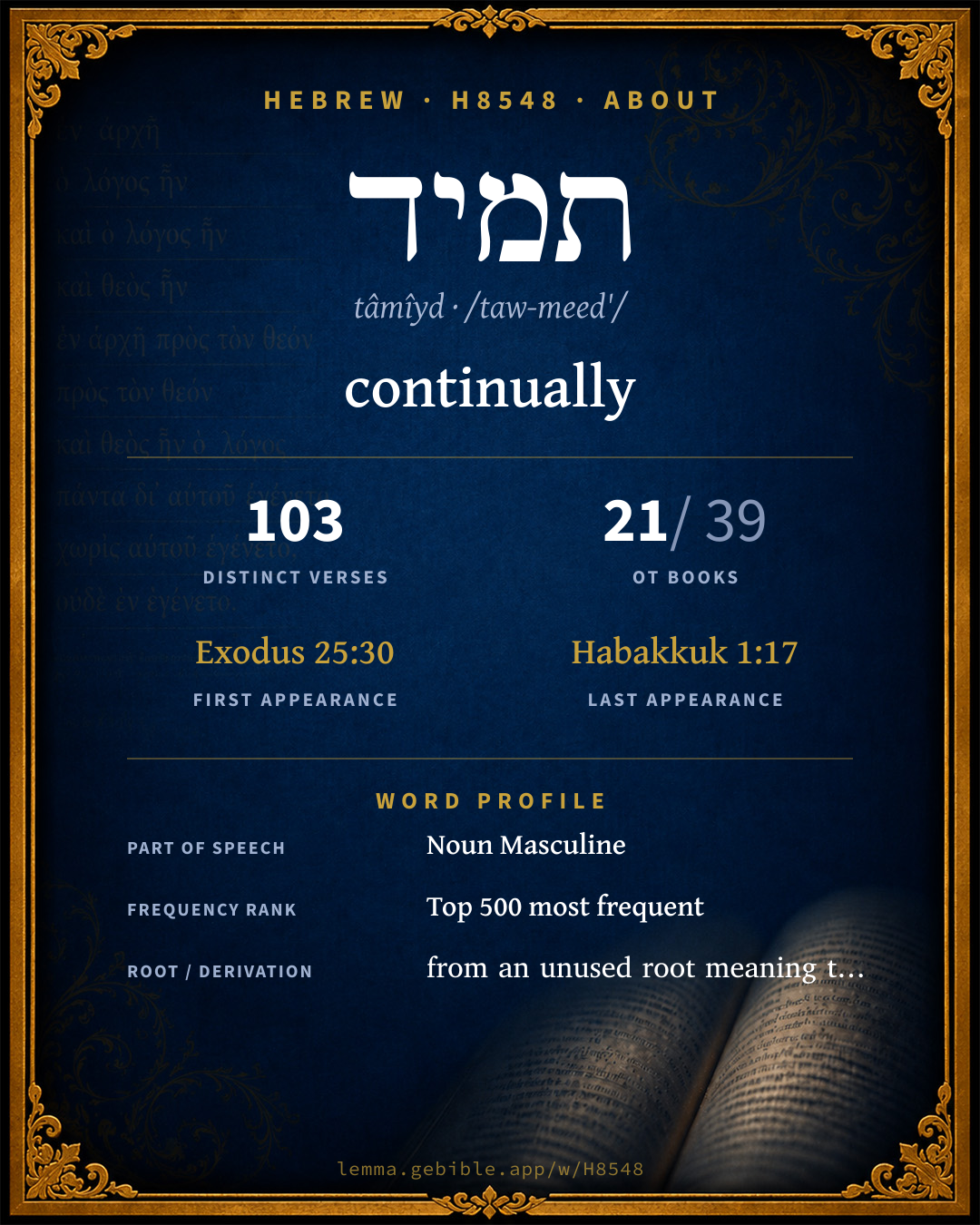
תָּמִיד
continually
‘continually’ is one of 3 main senses fuller range ↓
Full lexicon entry — Brown-Driver-Briggs (BDB)
From Brown-Driver-Briggs (BDB)
Where this word appears
Grammar key — what these labels mean
Part of speech
- Noun
- A naming word — a person, place, thing, or idea.
Noun type
- Common
- A common noun — a general class of person, place, or thing (“king,” “city,” “water”), not a specific name.
State
- Absolute
- The independent form of a noun, not bound to a following word.
Gender
- Masculine
- Grammatically masculine.
Number
- Singular
- One.
Every verse where H8548 appears — 103 distinct verses across 21 books. Click any verse to open its interlinear word-by-word view. Verse text shown in the World English Bible for context — . Each verse’s Hebrew form is shown with its reference; the English is not keyword-highlighted, since the data carries no word-level English alignment. Use “Compare translations” on any verse to read it across multiple English versions. This concordance covers the Hebrew Bible; Septuagint (Greek Old Testament) occurrences are not indexed here.
Exodus 8 verses
- Exodus 25:30 תָּמִֽיד n c ms You shall set bread of the presence on the table before me always.
- Exodus 27:20 תָּמִֽיד n c ms "You shall command the children of Israel, that they bring to you pure olive oil beaten for the light, to cause a lamp to burn continually.
- Exodus 28:29 תָּמִֽיד n c ms Aaron shall bear the names of the children of Israel in the breastplate of judgment on his heart, when he goes in to the holy place, for a memorial before Yahweh continually.
- Exodus 28:30 תָּמִֽיד n c ms You shall put in the breastplate of judgment the Urim and the Thummim; and they shall be on Aaron's heart, when he goes in before Yahweh: and Aaron shall bear the judgment of the children of Israel on his heart before Yahweh continually.
- Exodus 28:38 תָּמִ֔יד n c ms It shall be on Aaron's forehead, and Aaron shall bear the iniquity of the holy things, which the children of Israel shall make holy in all their holy gifts; and it shall be always on his forehead, that they may be accepted before Yahweh.
- Exodus 29:38 תָּמִֽיד n c ms "Now this is that which you shall offer on the altar: two lambs a year old day by day continually.
- Exodus 29:42 תָּמִיד֙ n c ms It shall be a continual burnt offering throughout your generations at the door of the tent of meeting before Yahweh, where I will meet with you, to speak there to you.
- Exodus 30:8 תָּמִ֛יד n c ms When Aaron lights the lamps at evening, he shall burn it, a perpetual incense before Yahweh throughout your generations.
Leviticus 6 verses
- Leviticus 6:13 תָּמִ֛יד n c ms Fire shall be kept burning on the altar continually; it shall not go out.
- Leviticus 6:20 תָּמִ֑יד n c ms "This is the offering of Aaron and of his sons, which they shall offer to Yahweh in the day when he is anointed: the tenth part of an ephah of fine flour for a meal offering perpetually, half of it in the morning, and half of it in the evening.
- Leviticus 24:2 תָּמִֽיד n c ms "Command the children of Israel, that they bring to you pure olive oil beaten for the light, to cause a lamp to burn continually.
- Leviticus 24:3 תָּמִ֑יד n c ms Outside of the veil of the Testimony, in the Tent of Meeting, shall Aaron keep it in order from evening to morning before Yahweh continually: it shall be a statute forever throughout your generations.
- Leviticus 24:4 תָּמִֽיד n c ms He shall keep in order the lamps on the pure gold lampstand before Yahweh continually.
- Leviticus 24:8 תָּמִ֑יד n c ms Every Sabbath day he shall set it in order before Yahweh continually. It is on the behalf of the children of Israel an everlasting covenant.
Numbers 20 verses
- Numbers 4:7 הַ/תָּמִ֖יד ptcl def.art + n c ms On the table of show bread they shall spread a blue cloth, and put on it the dishes, the spoons, the bowls, and the cups with which to pour out; and the continual bread shall be on it.
- Numbers 4:16 הַ/תָּמִ֖יד ptcl def.art + n c ms "The charge of Eleazar the son of Aaron the priest shall be the oil for the light, the sweet incense, the continual meal offering, and the anointing oil, the charge of all the tabernacle, and of all that is in it, the sanctuary, and its furnishings."
- Numbers 9:16 תָמִ֔יד n c ms So it was continually. The cloud covered it, and the appearance of fire by night.
- Numbers 28:3 תָמִֽיד n c ms You shall tell them, This is the offering made by fire which you shall offer to Yahweh: he-lambs a year old without blemish, two day by day, for a continual burnt offering.
- Numbers 28:6 תָּמִ֑יד n c ms It is a continual burnt offering, which was ordained in Mount Sinai for a sweet savor, an offering made by fire to Yahweh.
- Numbers 28:10 הַ/תָּמִ֖יד ptcl def.art + n c ms this is the burnt offering of every Sabbath, besides the continual burnt-offering, and the drink-offering of it.
- Numbers 28:15 הַ/תָּמִ֛יד ptcl def.art + n c ms One male goat for a sin-offering to Yahweh; it shall be offered besides the continual burnt offering, and the drink-offering of it.
- Numbers 28:23 הַ/תָּמִ֑יד ptcl def.art + n c ms You shall offer these besides the burnt offering of the morning, which is for a continual burnt offering.
- Numbers 28:24 הַ/תָּמִ֛יד ptcl def.art + n c ms After this manner you shall offer daily, for seven days, the food of the offering made by fire, of a sweet savor to Yahweh: it shall be offered besides the continual burnt offering, and the drink-offering of it.
- Numbers 28:31 הַ/תָּמִ֛יד ptcl def.art + n c ms Besides the continual burnt offering, and the meal-offering of it, you shall offer them (they shall be to you without blemish), and their drink-offerings.
- Numbers 29:6 הַ/תָּמִיד֙ ptcl def.art + n c ms besides the burnt offering of the new moon, and the meal-offering of it, and the continual burnt offering and the meal-offering of it, and their drink-offerings, according to their ordinance, for a sweet savor, an offering made by fire to Yahweh.
- Numbers 29:11 הַ/תָּמִ֔יד ptcl def.art + n c ms one male goat for a sin-offering; besides the sin-offering of atonement, and the continual burnt offering, and the meal-offering of it, and their drink-offerings.
- Numbers 29:16 הַ/תָּמִ֔יד ptcl def.art + n c ms and one male goat for a sin-offering, besides the continual burnt offering, the meal-offering of it, and the drink-offering of it.
- Numbers 29:19 הַ/תָּמִ֔יד ptcl def.art + n c ms and one male goat for a sin-offering; besides the continual burnt offering, and the meal-offering of it, and their drink-offerings.
- Numbers 29:22 הַ/תָּמִ֔יד ptcl def.art + n c ms and one male goat for a sin-offering; besides the continual burnt offering, and the meal-offering of it, and the drink-offering of it.
- Numbers 29:25 הַ/תָּמִ֔יד ptcl def.art + n c ms and one male goat for a sin-offering; besides the continual burnt offering, the meal-offering of it, and the drink-offering of it.
- Numbers 29:28 הַ/תָּמִ֔יד ptcl def.art + n c ms and one male goat for a sin-offering, besides the continual burnt offering, and the meal-offering of it, and the drink-offering of it.
- Numbers 29:31 הַ/תָּמִ֔יד ptcl def.art + n c ms and one male goat for a sin-offering; besides the continual burnt offering, the meal-offering of it, and the drink-offerings of it.
- Numbers 29:34 הַ/תָּמִ֔יד ptcl def.art + n c ms and one male goat for a sin-offering; besides the continual burnt offering, the meal-offering of it, and the drink-offering of it.
- Numbers 29:38 הַ/תָּמִ֔יד ptcl def.art + n c ms and one male goat for a sin-offering, besides the continual burnt offering, and the meal-offering of it, and the drink-offering of it.
Deuteronomy 1 verse
2 Samuel 3 verses
- 2 Samuel 9:7 תָּמִֽיד n c ms David said to him, "Don't be afraid of him; for I will surely show you kindness for Jonathan your father's sake, and will restore you all the land of Saul your father; and you shall eat bread at my table continually."
- 2 Samuel 9:10 תָּמִ֛יד n c ms You shall till the land for him, you, and your sons, and your servants; and you shall bring in [the fruits], that your master's son may have bread to eat: but Mephibosheth your master's son shall eat bread always at my table." Now Ziba had fifteen sons and twenty servants.
- 2 Samuel 9:13 תָּמִ֖יד n c ms So Mephibosheth lived in Jerusalem; for he ate continually at the king's table. He was lame in both his feet.
1 Kings 1 verse
2 Kings 3 verses
- 2 Kings 4:9 תָּמִֽיד n c ms She said to her husband, See now, I perceive that this is a holy man of God, that passes by us continually.
- 2 Kings 25:29 תָּמִ֛יד n c ms and changed his prison garments. [Jehoiachin] ate bread before him continually all the days of his life:
- 2 Kings 25:30 תָּמִ֧יד n c ms and for his allowance, there was a continual allowance given him of the king, every day a portion, all the days of his life.
1 Chronicles 5 verses
- 1 Chronicles 16:6 תָּמִ֔יד n c ms and Benaiah and Jahaziel the priests with trumpets continually, before the ark of the covenant of God.
- 1 Chronicles 16:11 תָּמִֽיד n c ms Seek you Yahweh and his strength; Seek his face forever more.
- 1 Chronicles 16:37 תָּמִ֖יד n c ms So he left there, before the ark of the covenant of Yahweh, Asaph and his brothers, to minister before the ark continually, as every day's work required;
- 1 Chronicles 16:40 תָּמִ֖יד n c ms to offer burnt offerings to Yahweh on the altar of burnt offering continually morning and evening, even according to all that is written in the law of Yahweh, which he commanded to Israel;
- 1 Chronicles 23:31 תָּמִ֖יד n c ms and to offer all burnt offerings to Yahweh, on the Sabbaths, on the new moons, and on the set feasts, in number according to the ordinance concerning them, continually before Yahweh;
2 Chronicles 3 verses
- 2 Chronicles 2:4 תָּמִ֤יד n c ms Behold, I am about to build a house for the name of Yahweh my God, to dedicate it to him, and to burn before him incense of sweet spices, and for the continual show bread, and for the burnt offerings morning and evening, on the Sabbaths, and on the new moons, and on the set feasts of Yahweh our God. This is [an ordinance] forever to Israel.
- 2 Chronicles 9:7 תָּמִ֔יד n c ms Happy are your men, and happy are these your servants, who stand continually before you, and hear your wisdom.
- 2 Chronicles 24:14 תָּמִ֔יד n c ms When they had made an end, they brought the rest of the money before the king and Jehoiada, of which were made vessels for the house of Yahweh, even vessels with which to minister and to offer, and spoons, and vessels of gold and silver. They offered burnt offerings in the house of Yahweh continually all the days of Jehoiada.
Ezra 1 verse
Nehemiah 1 verse
Psalms 23 verses
- Psalms 16:8 תָמִ֑יד n c ms I have set Yahweh always before me. Because he is at my right hand, I shall not be moved.
- Psalms 25:15 תָּ֭מִיד n c ms My eyes are ever on Yahweh, For he will pluck my feet out of the net.
- Psalms 34:1 תָּ֝מִ֗יד n c ms I will bless Yahweh at all times. His praise will always be in my mouth.
- Psalms 35:27 תָ֭מִיד n c ms Let them shout for joy and be glad, who favor my righteous cause. Yes, let them say continually, "Yahweh be magnified, Who has pleasure in the prosperity of his servant!"
- Psalms 38:17 תָמִֽיד n c ms For I am ready to fall. My pain is continually before me.
- Psalms 40:11 תָּמִ֥יד n c ms Don't withhold your tender mercies from me, Yahweh. Let your loving kindness and your truth continually preserve me.
- Psalms 40:16 תָ֭מִיד n c ms Let all those who seek you rejoice and be glad in you. Let such as love your salvation say continually, "Let Yahweh be exalted!"
- Psalms 50:8 תָמִֽיד n c ms I don't rebuke you for your sacrifices. Your burnt offerings are continually before me.
- Psalms 51:3 תָמִֽיד n c ms For I know my transgressions. My sin is constantly before me.
- Psalms 69:23 תָּמִ֥יד n c ms Let their eyes be darkened, so that they can't see. Let their backs be continually bent.
- Psalms 70:4 תָ֭מִיד n c ms Let all those who seek you rejoice and be glad in you. Let those who love your salvation continually say, "Let God be exalted!"
- Psalms 71:3 תָּמִ֗יד n c ms Be to me a rock of refuge to which I may always go. Give the command to save me, For you are my rock and my fortress.
- Psalms 71:6 תָמִֽיד n c ms I have relied on you from the womb. You are he who took me out of my mother's womb. I will always praise you.
- Psalms 71:14 תָּמִ֣יד n c ms But I will always hope, And will add to all of your praise.
- Psalms 72:15 תָמִ֑יד n c ms They shall live, and to him shall be given of the gold of Sheba. Men shall pray for him continually. They shall bless him all day long.
- Psalms 73:23 תָמִ֣יד n c ms Nevertheless, I am continually with you. You have held my right hand.
- Psalms 74:23 תָמִֽיד n c ms Don't forget the voice of your adversaries. The tumult of those who rise up against you ascends continually.
- Psalms 105:4 תָּמִֽיד n c ms Seek Yahweh and his strength. Seek his face forever more.
- Psalms 109:15 תָּמִ֑יד n c ms Let them be before Yahweh continually, That he may cut off the memory of them from the earth;
- Psalms 109:19 תָּמִ֥יד n c ms Let it be to him as the clothing with which he covers himself, For the belt that is always around him.
- Psalms 119:44 תָמִ֗יד n c ms So I will obey your law continually, Forever and ever.
- Psalms 119:109 תָמִ֑יד n c ms My soul is continually in my hand, Yet I won't forget your law.
- Psalms 119:117 תָמִֽיד n c ms Hold me up, and I will be safe, And will have respect for your statutes continually.
Proverbs 4 verses
- Proverbs 5:19 תָמִֽיד n c ms A loving doe and a graceful deer-- Let her breasts satisfy you at all times. Be captivated always with her love.
- Proverbs 6:21 תָמִ֑יד n c ms Bind them continually on your heart. Tie them around your neck.
- Proverbs 15:15 תָמִֽיד n c ms All the days of the afflicted are wretched, But one who has a cheerful heart enjoys a continual feast.
- Proverbs 28:14 תָּמִ֑יד n c ms Blessed is the man who always fears; But one who hardens his heart falls into trouble.
Isaiah 8 verses
- Isaiah 21:8 תָּמִיד֙ n c ms He cried as a lion: Lord, I stand continually on the watch-tower in the day-time, and am set in my ward whole nights;
- Isaiah 49:16 תָּמִֽיד n c ms Behold, I have engraved you on the palms of my hands; your walls are continually before me.
- Isaiah 51:13 תָּמִ֜יד n c ms and have forgotten Yahweh your Maker, who stretched forth the heavens, and laid the foundations of the earth; and fear continually all the day because of the fury of the oppressor, when he makes ready to destroy? and where is the fury of the oppressor?
- Isaiah 52:5 וְ/תָמִ֥יד conj + n c ms Now therefore, what do I here, says Yahweh, seeing that my people is taken away for nothing? those who rule over them do howl, says Yahweh, and my name continually all the day is blasphemed.
- Isaiah 58:11 תָּמִיד֒ n c ms and Yahweh will guide you continually, and satisfy your soul in dry places, and make strong your bones; and you shall be like a watered garden, and like a spring of water, whose waters don't fail.
- Isaiah 60:11 תָּמִ֛יד n c ms Your gates also shall be open continually; they shall not be shut day nor night; that men may bring to you the wealth of the nations, and their kings led captive.
- Isaiah 62:6 תָּמִ֖יד n c ms I have set watchmen on your walls, Jerusalem; they shall never hold their peace day nor night: you who call on Yahweh, take no rest,
- Isaiah 65:3 תָּמִ֑יד n c ms a people who provoke me to my face continually, sacrificing in gardens, and burning incense on bricks;
Jeremiah 3 verses
- Jeremiah 6:7 תָּמִ֖יד n c ms As a well casts forth its waters, so she casts forth her wickedness: violence and destruction is heard in her; before me continually is sickness and wounds.
- Jeremiah 52:33 תָּמִ֖יד n c ms and changed his prison garments. [Jehoiachin] ate bread before him continually all the days of his life:
- Jeremiah 52:34 תָּמִ֨יד n c ms and for his allowance, there was a continual allowance given him by the king of Babylon, every day a portion until the day of his death, all the days of his life.
Ezekiel 4 verses
- Ezekiel 38:8 תָּמִ֑יד n c ms After many days you shall be visited: in the latter years you shall come into the land that is brought back from the sword, that is gathered out of many peoples, on the mountains of Israel, which have been a continual waste; but it is brought forth out of the peoples, and they shall dwell securely, all of them.
- Ezekiel 39:14 תָמִ֤יד n c ms They shall set apart men of continual employment, who shall pass through the land, and, with those who pass through, those who bury those who remain on the surface of the land, to cleanse it: after the end of seven months shall they search.
- Ezekiel 46:14 תָּמִֽיד n c ms You shall prepare a meal-offering with it morning by morning, the sixth part of an ephah, and the third part of a hin of oil, to moisten the fine flour; a meal-offering to Yahweh continually by a perpetual ordinance.
- Ezekiel 46:15 תָּמִֽיד n c ms Thus shall they prepare the lamb, and the meal-offering, and the oil, morning by morning, for a continual burnt offering.
Daniel 5 verses
- Daniel 8:11 הַ/תָּמִ֔יד ptcl def.art + n c ms Yes, it magnified itself, even to the prince of the host; and it took away from him the continual [burnt offering], and the place of his sanctuary was cast down.
- Daniel 8:12 הַ/תָּמִ֖יד ptcl def.art + n c ms The host was given over [to it] together with the continual [burnt offering] through disobedience; and it cast down truth to the ground, and it did [its pleasure] and prospered.
- Daniel 8:13 הַ/תָּמִיד֙ ptcl def.art + n c ms Then I heard a holy one speaking; and another holy one said to that certain one who spoke, How long shall be the vision [concerning] the continual [burnt-offering], and the disobedience that makes desolate, to give both the sanctuary and the host to be trodden under foot?
- Daniel 11:31 הַ/תָּמִ֔יד ptcl def.art + n c ms Forces shall stand on his part, and they shall profane the sanctuary, even the fortress, and shall take away the continual [burnt offering], and they shall set up the abomination that makes desolate.
- Daniel 12:11 הַ/תָּמִ֔יד ptcl def.art + n c ms From the time that the continual [burnt offering] shall be taken away, and the abomination that makes desolate set up, there shall be one thousand two hundred ninety days.
Hosea 1 verse
Obadiah 1 verse
Nahum 1 verse
Habakkuk 1 verse
About this entry
At a glance — auto-summarized from this page’s data, not written by a person. Every figure links to its source below. This summary describes the numbers; it doesn’t interpret them.
The Hebrew noun תמיד centers on the idea of “continually.” The King James Version usually renders it “continually,” while modern versions prefer “regular” (Berean Standard Bible) — see the renderings breakdown. Spanning 103 verses in 21 books, it ranks among the common words of the Hebrew Bible. Debuting at Exodus 25:30, it then recurs through the corpus. The lexicon spreads it across several senses; see its full sense range. Dig into 103-verse concordance and the renderings breakdown below.
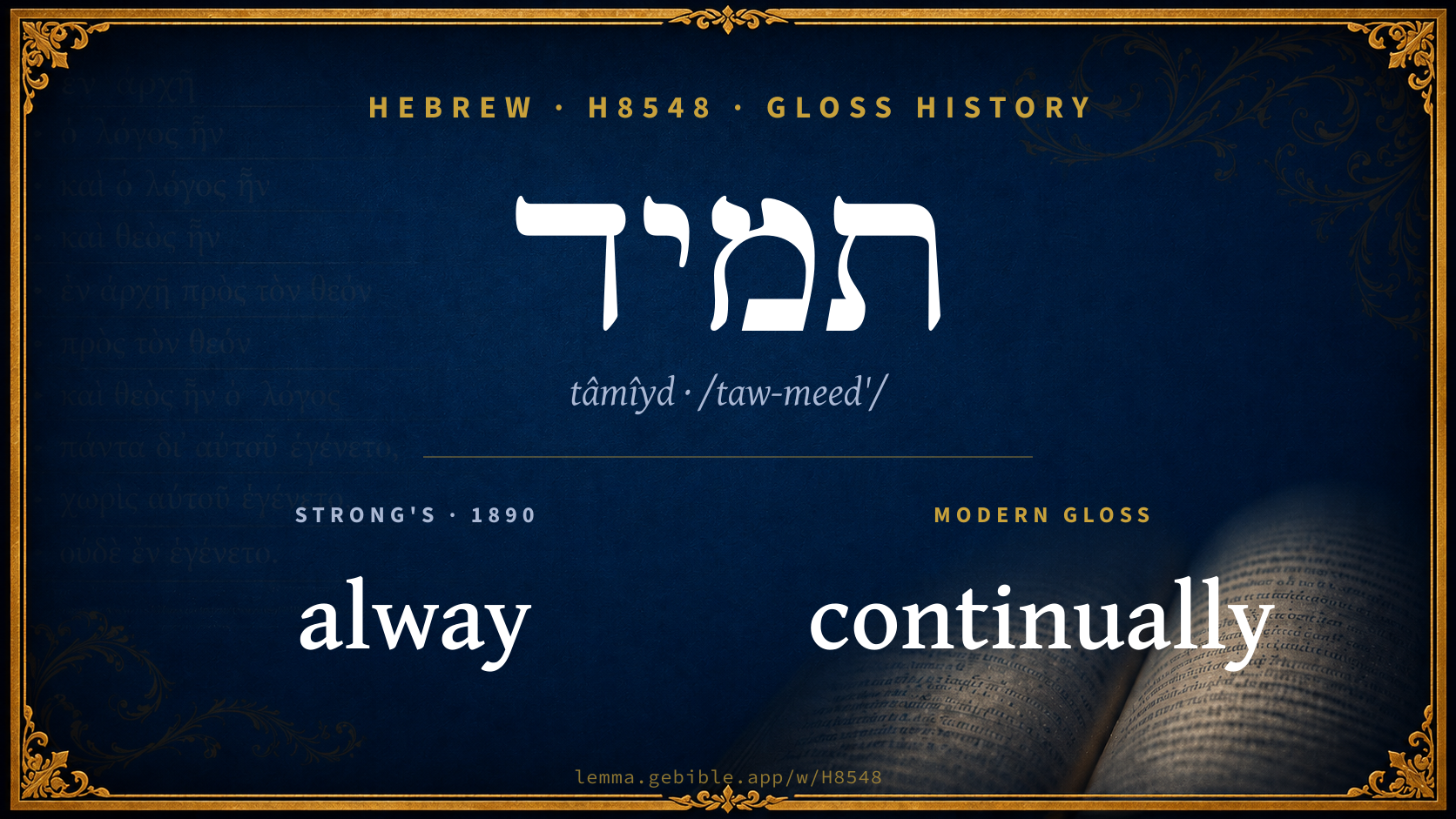
Gloss history
Strong's 1890 vs modern scholarship
About this word
Strong's H8548 catalogs a Hebrew word from the Hebrew Old Testament.
These counts are not copied from any lexicon or concordance. They are computed here, from the morphology-tagged Hebrew Old Testament. What Lemma adds →
- 103
- distinct verses
- The word appears in 103 distinct verses.
- 21 / 39
- OT books
- The word appears in 21 of 39 Old Testament books.
- #410
- by frequency
- Top 500 most frequent Hebrew words (rank 410 of 8,640 Hebrew words by occurrence).
View all 103 occurrences in the concordance →
By section of the Old Testament
By traditional corpus
Conventional, traditional groupings — biblical authorship is debated, so this is a traditional corpus grouping, not an authorship claim. Each share is this word’s portion of its verses in that division of the Hebrew canon. Each figure is a share of the word’s 103 distinct verses.
- Writings (Ketuvim) 42 verses · 41%
- Torah (Pentateuch) 35 verses · 34%
- Prophets (Nevi'im) 26 verses · 25%
How translations render this word
Counts come from each version’s own published word-to-Strong’s tagging or interlinear alignment — an approximate guide to how each version renders this word, not a word-level alignment the data otherwise carries. Because each total is that version’s own tagged count, the per-version totals vary from one another and need not match the appearance or distinct-verse counts above. These counts may also differ from a printed concordance because Lemma counts each distinctly tagged rendering and does not collapse phrase taggings into a single head-word total. This is a fixed set of word-tagged versions (KJV, ASV, BSB, ULT) and does not change with the reading translation you choose elsewhere. Each version’s license is shown beside its name below (and on Sources).
- King James Version: Continually 42×, Beside the continual 12×, Continual 7×
- American Standard Version: Continually 42×, Besides the continual 12×, Continual 9×
- Berean Standard Bible: Regular 19×, Continually 13×, Always 8×
- unfoldingWord Literal Text: Continually 57×, Continuity 18×, Continual 6×
King James Version Public Domain
Renders H8548 across 104 tagged occurrences — most commonly:
Plus 26 renderings that appear only once — usually multi-word phrases or single function words the recovered tagging swept in, not distinct renderings.
American Standard Version Public Domain
Renders H8548 across 104 tagged occurrences — most commonly:
Plus 30 renderings that appear only once — usually multi-word phrases or single function words the recovered tagging swept in, not distinct renderings.
Berean Standard Bible Public Domain
Renders H8548 across 99 tagged occurrences — most commonly:
Plus 28 renderings that appear only once — usually multi-word phrases or single function words the recovered tagging swept in, not distinct renderings. Not rendered by a distinct English word in 4 further occurrences.
unfoldingWord Literal Text CC BY-SA 4.0
Renders H8548 across 103 tagged occurrences — most commonly:
Plus 11 renderings that appear only once — usually multi-word phrases or single function words the recovered tagging swept in, not distinct renderings.
7 senses and sub-senses in the full BDB
What do BDB’s symbols mean?
BDB uses these scholarly abbreviations:
| Symbol | Meaning |
|---|---|
| 𝔊 | the Septuagint (the ancient Greek translation, LXX) |
| 𝔙 | the Vulgate (the Latin translation) |
| 𝔖 | the Syriac version (the Peshitta) |
| 𝔗 | the Targum (the Aramaic translation) |
| ψ | the Psalms |
| √ | root (the underlying root or stem) |
| ‖ | parallel passage (a synonymous or contrasted parallel) |
| † | the dagger: every passage where the word occurs is cited |
The 7 senses and sub-senses the full Brown-Driver-Briggs lexicon distinguishes for this word, in lexicon order (not ranked by frequency), with BDB’s own verbatim wording and sub-sense lettering. Shown in Hebrew script with BDB’s own scholarly abbreviations. The condensed entry is in the Lexicon Entry tab. See also the Forms in the corpus table below.
- 1. earliest and oftenest as adv., continually:
- a. of going on without interruption = continuously, Ho 12:7 Je 6:7 Na 3:19 Is 21:8; 49:16; 51:13 (+ כָּל־הַיּוֹם), 52:5 (+ id.), 58:11; 60:11 (‖ יוֹמָם וָלַיְלָה), 62:6 (+ כָּל־הַיּוֹם וְכָל־הַלַּיְלָה), 65:3 Ob 16 Hb 1:17 Dt 11:12 1 K 10:8 = 2 Ch 9:7, 1 Ch 16:11, 37; especially (sometimes hyperbol.) in ψψ: ψ 16:8; 25:15; 34:2 (‖ בְּכָל־עֵת), 35:27 cf. 40:17; 70:5, 38:18; 40:12; 50:8; 51:5; 69:24; 71:6, 14; 72:15; 73:23; 74:23; 105:4; 109:15, 19; 119:44 (+ לְעוֹלָם וָעֶֽך׃), v 109, 117 (so also ψ 16:5, for MT תומיך, Bi Che; תּוֹסיף Ol Bae); Pr 5:19 (‖ בְּכָל־עֵת), 6:21; 15:15; 28:14; also Ez 38:8 (del. 𝔖 Co ToyHpt. Berthol), Lv 6:6 (P; of fire, ‖ לֹא תִכְבֶּה), Ez 46:14 (but חֻקַּת תּ׳ 𝔊 Co Berthol); also in ritual, Lv 24:8 (H), cf. Ex 25:30 (P; shew-bread), Lv 24:2, 3, 4 (H), cf. Ex 27:20 (P; of lamp), Ex 28:29, 30, 38. e.g. Hosea 12:7
- b. of regular repetition: meals 2 S 9:7, 10, 13; 2 K 25:29 = Je 52:33; journeys 2 K 4:9; cf. Nu 9:16; ψ 71:3; of ritual: sacrifice, לַיּוֹם תָּמִיד Ex 29:38; cf. 1 Ch 16:40; 23:31; 2 Ch 24:14. e.g. 2 Samuel 9:7
- 2. as subst.:
- a. of uninterrupted continuity, אַנְשֵׁי ת׳ Ez 39:14 men of continuity, i.e. men continually employed for the purpose; לֶחֶם הַתּ׳ Nu 4:7 the bread of continuity, i.e. the bread that is always there, so מַעֲרֶכֶת ת׳ 2 Ch 2:3, and perhaps חֲצֹצְרוֹת ת׳ 1 Ch 16:6. e.g. Ezekiel 39:14
- b. of regular repetition אֲרֻחַת מ׳ 2 K 25:30, i.e. a regular allowance, = Je 52:34; especially of ritual: קְטֹרֶת ת׳ Ex 30:8 (P); most often עֹלַת ת׳ Ez 46:15 (every morning), Ex 29:42 (morning and evening, so) Nu 28:6 Ezr 3:5, so read also Nu 28:3 (Di) for MT עוֹלָה ת׳ (לַיּוֹם); עֹלַת הַתּ׳ Nu 28:10, 15, 23, 24, 31; 29:6, 11, 16, 19, 22, 25, 28, 31, 34, 38 Ne 10:34; rarely מִנְחַת ת׳ Nu 4:16 (P), Ne 10:34; as appos., מִנְחָה ת׳ Lv 6:13 meal-offering as a regular observance (cf. Ges§ 131, 2 (b) DaSynt. § 29 (b); on text v. Di, NowArch. ii. 124f.), (and Nu 28:3 MT, but v. supr.) e.g. 2 Kings 25:30
- c. (late) הַתּ׳ alone = daily (morning and evening) burnt-offering (NowArch. ii. 222f.) Dn 8:11, 12, 13; 11:31; 12:11 (so Talm., even in pl. תְּמִידִין). e.g. Daniel 8:11
Senses from the full Brown-Driver-Briggs lexicon (Brown, Driver, Briggs; Oxford 1906 — public domain), digitized via Sefaria, supplemented by the OpenScriptures HebrewLexicon (CC BY 4.0). Full attribution on Sources.
Word origin
n.m. Dn 12:11 continuity (perhaps orig. extent; NH as BH, Ecclus תמיד 45:14);—ת׳ always abs.;—
— Brown-Driver-Briggs (Oxford 1906, public domain), digitized via Sefaria, supplemented by the OpenScriptures HebrewLexicon (CC BY 4.0). See Sources.
Origin: from an unused root meaning to stretch
Jastrow Dictionary
A second Hebrew/Aramaic lexicon for comparison, covering Aramaic and post-biblical (Talmudic, Targumic, Midrashic) usage that the biblical-Hebrew BDB does not. Matched by lemma rather than by Strong’s number, so a lemma may carry more than one Jastrow headword (shown separately below), and the entries cover usage well beyond the Bible.
תָּמִיד
- constant, daily practice; esp. (sub. קרבן) the daily burnt-offering (Num. XXVIII, 3). Pes. V, 1 ת׳ נשחט וכ׳ the afternoon tamid is (ordinarily) slaughtered at eight and a half hours of the day. Taan. IV, 6 בשבעה … ובטל הת׳ on the seventeenth of Tammuz … the daily offerings ceased (when Jerusalem was besieged); a. v. fr.—Pl. תְּמִידִים, תְּמִידִין. Ber. 10ᵇ (ref. to II Kings IV, 9 תמיד) המארח … הקריב ת׳ if one entertains a scholar in his house, the Scripture accounts it to him as if he offered daily sacrifices. Y. Pes. VI, beg. 33ᵃ מאן דאמר מאה ת׳ וכ׳ he who says, a hundred regular sacrifices supersede the Sabbath during one year, refers to the daily burnt-offerings; he who says two hundred, refers to the daily burnt-offerings and the Musaf sacrifices of the Sabbaths &c.; a. fr.—Tamid, name of a treatise, of the Order of Ḳodashim, of the Mishnah, Tosefta, and Talmud Babli. e.g. Numbers 28:3
A Dictionary of the Targumim, the Talmud Babli and Yerushalmi, and the Midrashic Literature (Marcus Jastrow; London, Luzac, 1903) — Public Domain. Digitized via Sefaria. Digitized via Sefaria. Full attribution on Sources.
Forms in the corpus
The 32 distinct written forms H8548 takes in the Hebrew Bible, most frequent first — each parse links to that state’s occurrences in the concordance. Hebrew forms include their vowel points and cantillation, so a single lemma takes many written forms.
| Form | Parsing | Example | Uses |
|---|---|---|---|
| תָּמִֽיד | Noun, Common, Masculine, Singular, Absolute | Exodus 25:30 | 16 |
| הַ/תָּמִ֔יד | Noun, Common, Masculine, Singular, Absolute | Daniel 8:11 | 12 |
| תָמִֽיד | Noun, Common, Masculine, Singular, Absolute | Numbers 28:3 | 9 |
| תָּמִ֑יד | Noun, Common, Masculine, Singular, Absolute | Ezekiel 38:8 | 9 |
| תָּמִ֖יד | Noun, Common, Masculine, Singular, Absolute | 1 Chronicles 16:37 | 7 |
| תָּמִ֔יד | Noun, Common, Masculine, Singular, Absolute | Exodus 28:38 | 5 |
| תָּמִ֛יד | Noun, Common, Masculine, Singular, Absolute | Exodus 30:8 | 5 |
| הַ/תָּמִ֖יד | Noun, Common, Masculine, Singular, Absolute | Daniel 8:12 | 4 |
| תָמִ֑יד | Noun, Common, Masculine, Singular, Absolute | Proverbs 6:21 | 4 |
| הַ/תָּמִ֛יד | Noun, Common, Masculine, Singular, Absolute | Numbers 28:15 | 3 |
| תָ֭מִיד | Noun, Common, Masculine, Singular, Absolute | Psalms 35:27 | 3 |
| תָּמִ֥יד | Noun, Common, Masculine, Singular, Absolute | Psalms 40:11 | 3 |
| תָּמִיד֙ | Noun, Common, Masculine, Singular, Absolute | Exodus 29:42 | 3 |
| הַ/תָּמִיד֙ | Noun, Common, Masculine, Singular, Absolute | Daniel 8:13 | 2 |
| תָּמִ֗יד | Noun, Common, Masculine, Singular, Absolute | Deuteronomy 11:12 | 2 |
| הַ/תָּמִ֑יד | Noun, Common, Masculine, Singular, Absolute | Numbers 28:23 | 1 |
| הַ/תָּמִ֣יד | Noun, Common, Masculine, Singular, Absolute | Nehemiah 10:33 | 1 |
| הַ֠/תָּמִיד | Noun, Common, Masculine, Singular, Absolute | Nehemiah 10:33 | 1 |
| וְ/תָמִ֛יד | Noun, Common, Masculine, Singular, Absolute | Habakkuk 1:17 | 1 |
| וְ/תָמִ֥יד | Noun, Common, Masculine, Singular, Absolute | Isaiah 52:5 | 1 |
| תָמִ֔יד | Noun, Common, Masculine, Singular, Absolute | Numbers 9:16 | 1 |
| תָמִ֗יד | Noun, Common, Masculine, Singular, Absolute | Psalms 119:44 | 1 |
| תָמִ֣יד | Noun, Common, Masculine, Singular, Absolute | Psalms 73:23 | 1 |
| תָמִ֤יד | Noun, Common, Masculine, Singular, Absolute | Ezekiel 39:14 | 1 |
| תָּ֝מִ֗יד | Noun, Common, Masculine, Singular, Absolute | Psalms 34:1 | 1 |
| תָּ֭מִיד | Noun, Common, Masculine, Singular, Absolute | Psalms 25:15 | 1 |
| תָּמִ֜יד | Noun, Common, Masculine, Singular, Absolute | Isaiah 51:13 | 1 |
| תָּמִ֣יד | Noun, Common, Masculine, Singular, Absolute | Psalms 71:14 | 1 |
| תָּמִ֤יד | Noun, Common, Masculine, Singular, Absolute | 2 Chronicles 2:4 | 1 |
| תָּמִ֧יד | Noun, Common, Masculine, Singular, Absolute | 2 Kings 25:30 | 1 |
| תָּמִ֨יד | Noun, Common, Masculine, Singular, Absolute | Jeremiah 52:34 | 1 |
| תָּמִיד֒ | Noun, Common, Masculine, Singular, Absolute | Isaiah 58:11 | 1 |
Septuagint verse parallels
This word appears in 91 verses that also exist in the Greek Old Testament (Septuagint), out of the 103 Hebrew verses it occurs in. You can read those verses in Greek by switching the Old Testament edition to the Septuagint.
Read these verses in the Septuagint
- Exodus 25:30
- Leviticus 6:13
- Numbers 4:7
- Deuteronomy 11:12
- 2 Samuel 9:7
- 1 Kings 10:8
- 2 Kings 4:9
- 1 Chronicles 16:6
- 2 Chronicles 2:4
- Ezra 3:5
- Psalms 16:8
- Proverbs 5:19
This is a verse-level parallel only — the same verses exist in both the Hebrew and Greek Old Testaments. No word-level Hebrew↔Greek correspondence is claimed: the data carries no such alignment, so no Greek word is shown as this Hebrew word’s translation. Coverage is not total — the Septuagint omits the deuterocanon and renumbers the Psalms, so some Hebrew verses have no direct Greek parallel.