Psalms 71:6

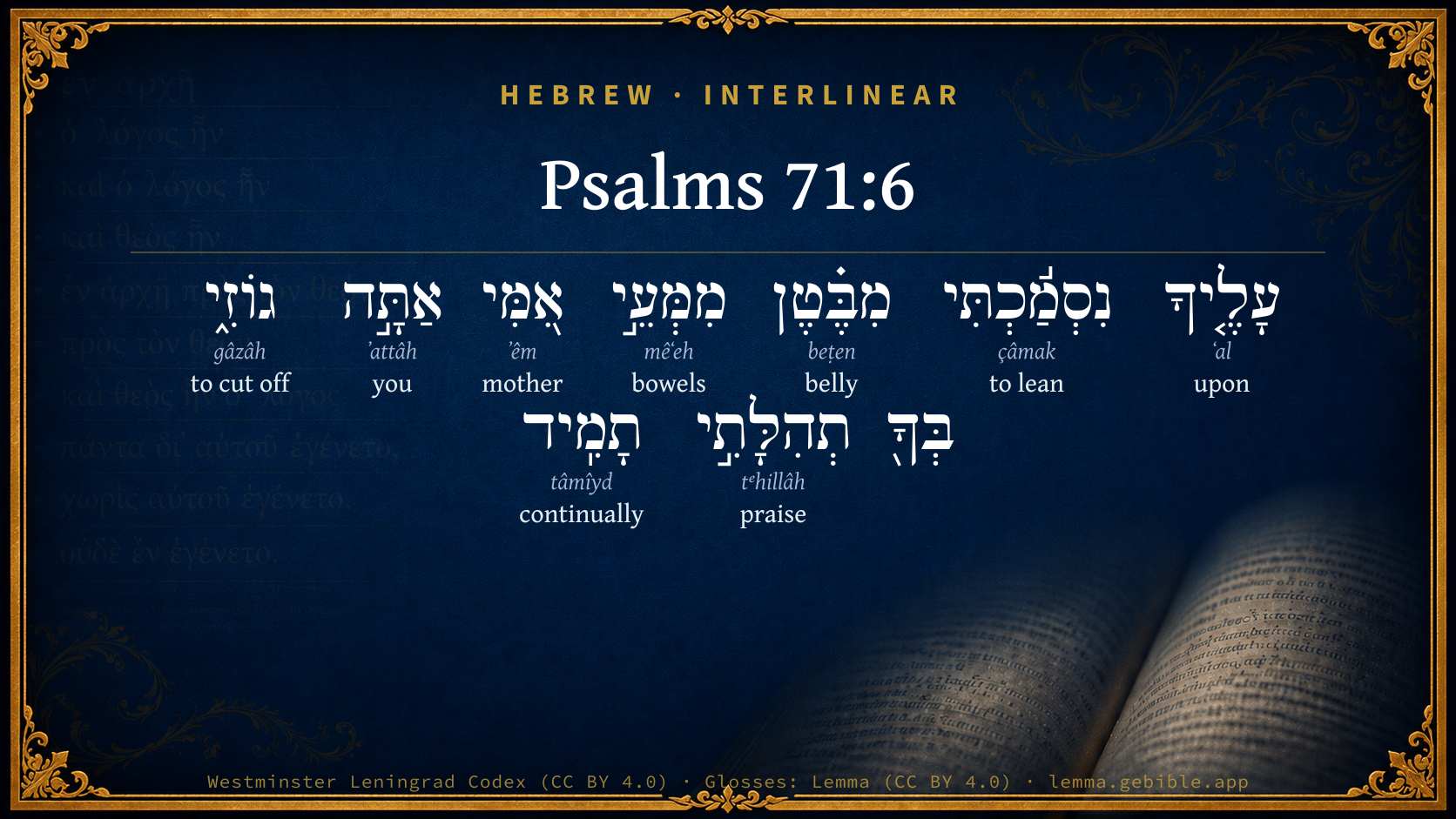
Hebrew (Westminster Leningrad Codex) Psalms 71:6 appears in the Hebrew Old Testament. The text above is from the Westminster Leningrad Codex. Each word links to its Strong’s number, a concise gloss, and parsing drawn from the Open Scriptures Hebrew Bible morphology. Click any word for its full Brown-Driver-Briggs (BDB) entry.
Download image
Cite this verse

Psalms 71:6 (World English Bible). Public Domain. Lemma interlinear Bible study tool, https://lemma.gebible.app/v/psalms/71/6.

Show BibTeX & RIS
BibTeX
RIS
English Translation
I have relied on you from the womb. You are he who took me out of my mother's womb. I will always praise you.
World English Bible · Public Domain
Highlights
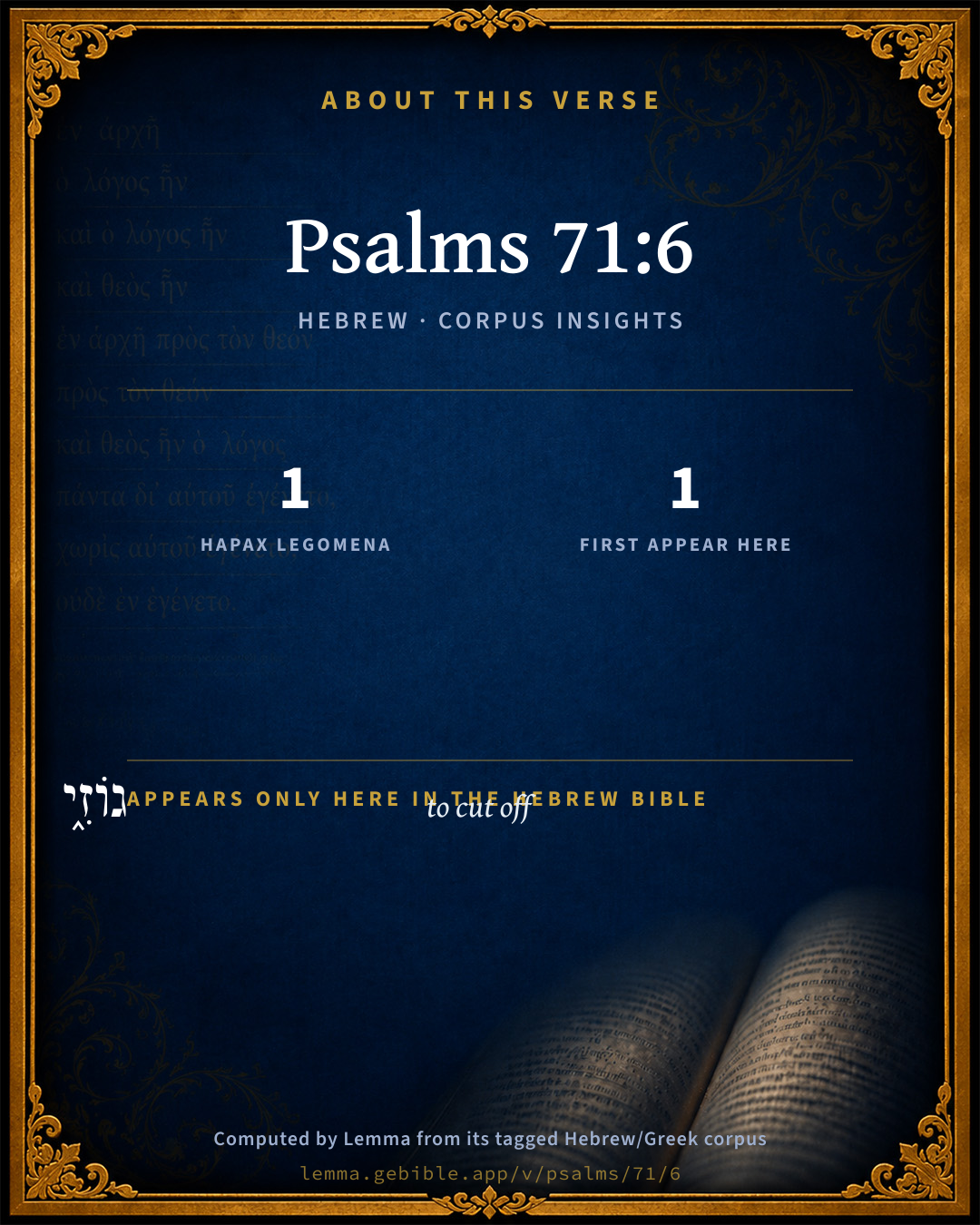
  • 1 hapax legomenon — only here in the Hebrew Bible
  • 1 first appearance in the Hebrew Bible
Full analysis ↓
Download a study sheet

One document with this verse’s original text, its word-by-word gloss line, the meaning frame, cross-references with their text, attributed commentary, and full source and license credits — printable, and it pastes into notes with its structure intact.

This verse Autodidact and up

Study sheet (.html) Plain text (.txt)

A passage Seminary Student

Up to 50 verses in one chapter. A passage sheet keeps up to 6 commentary sources and 12 cross-references per verse, in the order this page ranks them, and says so on the sheet whenever that leaves anything out. Ask for a single verse and you get the Autodidact verse sheet above.

Everything on this page stays free to read, with no account — the sheet is a download of what is already on screen, not access to it.

Want to remove ads? Support Godless Engineer
Compare translations 3

The same verse in 3 English versions, stacked beneath the original-language interlinear above. Click any original word for its lexicon entry.

Each is an independent rendering of the whole verse — the interlinear is not word-aligned to these translations.

Highlighted words mark where these versions differ — a whole-verse word diff, not a word-by-word alignment.

  • World English Bible Public Domain
    I have relied on you from the womb. You are he who took me out of my mother's womb. I will always praise you.
  • King James Version Public Domain
    By thee have I been holden up from the womb: thou art he that took me out of my mother's bowels: my praise shall be continually of thee.
  • unfoldingWord Literal Text CC BY-SA 4.0
    I have supported myself on you from the womb; you were taking me from the belly of my mother. My praise about you continually.

unfoldingWord Literal Text — © unfoldingWord, licensed CC BY-SA 4.0. Word-aligned USFM3 via Door43 (git.door43.org/unfoldingWord/en_ult).

Versions to compare (up to 4)

3 of 4 selected

Show all 18 translations

Every available English version of this verse, each an independent rendering of the whole verse.

  • World English Bible Public Domain
    I have relied on you from the womb. You are he who took me out of my mother's womb. I will always praise you.
  • Berean Standard Bible Public Domain
    I have leaned on You since birth; You pulled me from my mother’s womb. My praise is always for You.
  • Majority Standard Bible Public Domain
    I have leaned on You since birth; You pulled me from my mother’s womb. My praise is always for You.
  • King James Version Public Domain
    By thee have I been holden up from the womb: thou art he that took me out of my mother's bowels: my praise shall be continually of thee.
  • American Standard Version (1901) Public Domain
    By thee have I been holden up from the womb; Thou art he that took me out of my mother's bowels: My praise shall be continually of thee.
  • Revised Version (1885) Public Domain
    By thee have I been holden up from the womb: thou art he that took me out of my mother’s bowels: my praise shall be continually of thee.
  • Geneva Bible (1599) Public Domain
    Vpon thee haue I beene stayed from the wombe: thou art he that tooke me out of my mothers bowels: my praise shalbe alwaies of thee.
  • Douay-Rheims (1899) Public Domain
    By thee have I been confirmed from the womb: from my mother's womb thou art my protector. Of thee shall I continually sing:
  • Young's Literal Translation Public Domain
    By Thee I have been supported from the womb, From my mother's bowels Thou dost cut me out, In Thee `is' my praise continually.
  • Literal Standard Version CC BY-SA 4.0
    I have been supported from the womb by You, || You cut me out from my mother’s bowels, || My praise [is] continually in You.
  • Unlocked Literal Bible CC BY-SA 4.0
    By you I have been supported from the womb; you are he who took me out of my mother's belly; my praise will be always about you.
  • unfoldingWord Literal Text CC BY-SA 4.0
    I have supported myself on you from the womb; you were taking me from the belly of my mother. My praise about you continually.
  • Darby Bible Public Domain
    On thee have I been stayed from the womb; from the bowels of my mother thou didst draw me forth: my praise shall be continually of thee.
  • World Messianic Bible Public Domain
    I have relied on you from the womb. You are he who took me out of my mother’s womb. I will always praise you.
  • Webster's Bible Public Domain
    By thee have I been sustained from my birth: thou art he that brought me into life: my praise shall be continually of thee.
  • Free Bible Version CC BY-SA 4.0
    I have depended on you since birth; you have taken care of me from my mother's womb. That's why I'm always praising you!
  • Bible in Basic English Public Domain
    You have been my support from the day of my birth; you took me out of my mother's body; my praise will be ever of you.
  • JPS Tanakh (1917) Public Domain
    Upon Thee have I stayed myself from birth; Thou art He that took me out of my mother's womb; my praise is continually of Thee.

Literal Standard Version (2020), Covenant Press — licensed CC BY-SA 4.0. Text via the HelloAO Bible API (eBible.org). Unlocked Literal Bible (unfoldingWord) — licensed CC BY-SA 4.0. Text via the HelloAO Bible API (eBible.org). unfoldingWord Literal Text — © unfoldingWord, licensed CC BY-SA 4.0. Word-aligned USFM3 via Door43 (git.door43.org/unfoldingWord/en_ult). Free Bible Version, Dr. Jonathan Gallagher — licensed CC BY-SA 4.0. Text via the HelloAO Bible API (eBible.org).

Word by word

More ways to search: Search by grammar → Find every occurrence → Compare this word →

Practice this passage: Drill this verse → Learn its vocabulary →

גוֹזִ֑י
gâzâh
H1491
“cutting off · me”
Verb, Qal, Participle Active, Masculine, Singular, Construct + Suffix, Personal, 1st Person, Common, Singular
Part of Speech
Verb
Stem
Qal
Form
Participle Active
Gender
Masculine
Number
Singular
State
Construct
Full BDB Definition

Origin: a primitive root [akin to H1468 ]

TWOT: 335

to cut, cut off, sever - (Qal) he that severed (participle)
  1. עָלֶ֤יךָ ʻal H5921 “upon · you” Preposition + Suffix, Personal, 2nd Person, Masculine, Singular
  2. נִסְמַ֬כְתִּי çâmak H5564 “to lean” Verb, Niphal, Perfect, 1st Person, Common, Singular
  3. מִבֶּ֗טֶן beṭen H990 “from · belly” Preposition + Noun, Common, Feminine, Singular, Absolute
  4. מִמְּעֵ֣י mêʻeh H4578 “from · bowels of” Preposition + Noun, Common, Masculine, Plural, Construct
  5. אִ֭מִּי ʼêm H517 “mother · my” Noun, Common, Feminine, Singular, Construct + Suffix, Personal, 1st Person, Common, Singular
  6. אַתָּ֣ה ʼattâh H859 “you” Pronoun, Personal, 2nd Person, Masculine, Singular
  7. תְהִלָּתִ֣י tᵉhillâh H8416 “praise · my” Noun, Common, Feminine, Singular, Construct + Suffix, Personal, 1st Person, Common, Singular
  8. תָמִֽיד tâmîyd H8548 “continually” Noun, Common, Masculine, Singular, Absolute

About this verse

These counts appear in no published source. They are computed here, from the morphology-tagged text and Lemma’s own curated glosses. What Lemma adds →

10
words
9
distinct lemmas
Wisdom
section

Notable vocabulary

1 hapax legomenon — a word that appears only here in the entire Hebrew Bible:

  • גוֹזִ֑י to cut off H1491

First appearance in Scripture

This word makes its first canonical appearance in the Hebrew Bible here:

  • גוֹזִ֑י to cut off H1491

Shared distinctive vocabulary

מִמְּעֵ֣י bowels H4578 occurs in 30 verses of the Hebrew Bible. Also found in:

Grammatical profile

  • 2 verbs
  • 5 nouns
  • 1 pronoun
  • 2 prepositions

Verb forms

  • נִסְמַ֬כְתִּי Niphal · Perfect
  • גוֹזִ֑י Qal · Participle Active

Hebrew & Septuagint length

In English translation the verse runs 24 words from the Hebrew and 25 from the Septuagint (LXX English) — closely comparable.

A rough comparison of the two English renderings, which tokenize alike — not a word-level alignment.

Word counts can differ between the Hebrew and the Greek without any difference in meaning — e.g. the Hebrew direct-object marker אֵת has no separate Greek word, and Greek often adds the article ὁ.

Cross-references

14

Topical passages linked to Psalms 71:6 in the Treasury of Scripture Knowledge — connected by theme and wording, ordered by reader-vote popularity; previews shown in the World English Bible.

  • Jeremiah 1:5 Before I formed you in the belly I knew you, and before you came forth out of the womb I sanctified you; I have appointed you a prophet to the nations.
  • Psalms 22:9–10 But you brought me out of the womb. You made me trust at my mother's breasts.
  • Psalms 139:15–16 My frame wasn't hidden from you, When I was made in secret, Woven together in the depths of the earth.
  • Galatians 1:15 But when it was the good pleasure of God, who separated me from my mother's womb, and called me through his grace,
  • Isaiah 49:1 Listen, isles, to me; and listen, you peoples, from far: Yahweh has called me from the womb; from the bowels of my mother has he made mention of my name:
  • Isaiah 46:3–4 Listen to me, house of Jacob, and all the remnant of the house of Israel, that have been borne [by me] from their birth, that have been carried from the womb;
  • Isaiah 49:5 Now says Yahweh who formed me from the womb to be his servant, to bring Jacob again to him, and that Israel be gathered to him (for I am honorable in the eyes of Yahweh, and my God is become my strength);
  • Psalms 34:1 I will bless Yahweh at all times. His praise will always be in my mouth.
  • Psalms 145:1–2 I will exalt you, my God, the King. I will praise your name forever and ever.
  • Proverbs 8:17 I love those who love me. Those who seek me diligently will find me.
  • Jeremiah 3:4 Will you not from this time cry to me, My Father, you are the guide of my youth?
  • Luke 1:31–32 Behold, you will conceive in your womb, and bring forth a son, and will call his name 'Jesus.'
  • Psalms 71:14 But I will always hope, And will add to all of your praise.
  • Ephesians 5:20 giving thanks always concerning all things in the name of our Lord Jesus Christ, to God, even the Father;

Cross-references courtesy of OpenBible.info (CC BY 4.0).

Hebrew and Greek witnesses Masoretic Hebrew ↔ Greek Septuagint

The same verse in the two great witnesses to the Old Testament, shown verse-for-verse.

You’re reading Greek Psalm 70 (Hebrew Psalm 71). The Septuagint counts the superscription, so verse numbers can differ from the Hebrew — chapter-level alignment, not verse-by-verse. Numbering follows Rahlfs.

These are two independent witnesses, not word-aligned to each other, and the Septuagint is shown in lemma (dictionary) form.

Hebrew Psalms 71:6 Masoretic · Westminster Leningrad Codex

עָלֶ֤יךָ נִסְמַ֬כְתִּי מִבֶּ֗טֶן מִמְּעֵ֣י אִ֭מִּי אַתָּ֣ה גוֹזִ֑י בְּךָ֖ תְהִלָּתִ֣י תָמִֽיד

I have relied on you from the womb. You are he who took me out of my mother's womb. I will always praise you.

World English Bible · Public Domain

Greek LXX Greek Psalm 70:6 Septuagint · lemma form

ἐπί σύ ἐπιστηρίζω ἀπό γαστήρ ἐκ κοιλία μήτηρ ἐγώ σύ ἐγώ εἰμί σκεπαστής ἐν σύ ὁ ὕμνησις ἐγώ διά πᾶς

On you have I been stayed from the womb: from the belly of my mother you are my protector: of you is my praise continually.

LXX2012 (modern English Septuagint) · Public Domain

On this verse, Ellicott's Commentary for English Readers discusses the Septuagint’s reading. Read the note in Commentary ↓

Hebrew: Westminster Leningrad Codex (CC BY 4.0). Greek: Septuagint (public domain); English from LXX2012 (modern English Septuagint) (Public Domain). How the Septuagint differs from the Hebrew →

Commentary

Notes on Psalms 71:6 from classic Christian and Jewish commentators (each source and its license shown beneath its notes). The classic Christian expositions comment on the surrounding passage and are grouped to its opening verse, so a note may address several verses; the Jewish commentaries on the Tanakh (Rashi and others) are per-verse, so they appear only where the commentator wrote on this verse.

Lemma curates 59 commentaries, every one of them public domain or Creative Commons licensed, each selected and text-cleaned for this edition rather than reprinted as found. About our sources →

Trapp's Complete Commentary

John Trapp

Psa 71:6 By thee have I been holden up from the womb: thou art he that took me out of my mother’s bowels: my praise [shall be] continually of thee.

Ver. 6. By thee have I been holden up from the womb] As in the womb I lived upon thee, so from the womb. The same that breedeth us feedeth us; that matter that nourisheth the child in the womb striking up into the breasts, and by a further concoction becoming white, is made milk for it.

Thou art he that took me out of my mother’s bowels] Else I had never been born alive. That a child is born, fieri videmus, saith Galen, sed quomodo fiat, admirari tantum possumus. Avicenna calleth it, Opus supra mirabilia omnia mirabile, the greatest wonder in the world. Surely, if a child were born but once in a hundred years’ time, we should all run to see so strange a work, saith another.

John Trapp, A Commentary or Exposition upon All the Books of the Old and New Testament (1647–1656) — public domain. Text from a community e-Sword module.

The Biblical Illustrator

Joseph S. Exell

Psa_71:6

By Thee have I been holden up from the womb.

God the Creator, Preserver, and Governor of the world

I. Our birth and being are owing to God, as the original cause of them.

II. It is His providence which sustains, preserves, and holds up our goings in life. Even if the materials of our being had, in themselves, a self-subsisting power, yet the form of them by which we are men, by which we are creatures of such a species, this, we know, is liable to various contingencies, and obnoxious to many fatal alterations. Wherefore, as we derive our birth and being from the wisdom and power of our great Creator, so, if we were not nursed up by the care and goodness of His paternal providence, the brittle and tender threads of life had probably long since been broken in us, and we had consequently returned to the dust from whence we were taken.

III. There is a providential direction and disposal of such events as concern us. If we would attend to Gods dealings with us, every man, I doubt not, might find his own experience attesting the truth and fact of this directing, overruling, superintending providence. Conclusion.

1. If God be our Creator, Preserver, and Governor, then we can nowhere fix our dependence so properly, nowhere with such security and safety, as upon His infinite goodness, wisdom, and power.

2. To render this persuasion of our dependence on God more practical, we are not only to recognize His majesty and power in thought and in word, but in deed and in truth.

3. If we owe our life and being to God, as the original cause and donor of them, let His demands upon us to resign them find us in the posture of a ready obedience. (N. Marshall, D. D.)

The Biblical Illustrator, edited by Joseph S. Exell (c. 1880s–1900s) — public domain. Text from a community e-Sword module.

J. A. Alexander on Psalms

Joseph Addison Alexander

Psa 71:6. Upon thee I leaned, or by thee was held up, sustained, from the womb; from the bowels of my mother, a synonymous expression, thou (art) my bringing out, the one that brought me out, a different expression of the same idea as in Psa 22:10. The meaning of the verb here used, both in its transitive and intransitive forms, may be gathered from Psa 90:10, Num 11:31. In thee is my praise always; it originates, revolves, and ends in thee. Compare the analogous expression in Psa 22:25.

Joseph Addison Alexander, The Psalms Translated and Explained (1850) — public domain. Text from a community e-Sword module.

John Calvin's Commentaries

6. Upon thee have I been sustained from the womb. This verse corresponds with the preceding, except that David proceeds farther. He not only celebrates the goodness of God which he had experienced from his childhood, but also those proofs of it which he had received previous to his birth. An almost similar confession is contained in Psalm 22:9, 10, by which is magnified the wonderful power and inestimable goodness of God in the generation of men, the way and manner of which would be altogether incredible, were it not a fact with which we are quite familiar. If we are astonished at that part of the history of the flood, in which Moses declares (Genesis 8:13) that Noah and his household lived ten months amidst the offensive nuisance produced by so many living creatures, when he could not draw the breath of life, have we not equal reason to marvel that the infant, shut up within its mother’s womb, can live in such a condition as would suffocate the strongest man in half an hour? But we thus see how little account we make of the miracles which God works, in consequence of our familiarity with them. The Spirit, therefore, justly rebukes this ingratitude, by commending to our consideration this memorable instance of the grace of God, which is exhibited in our birth and generation. When we are born into the world, although the mother do her office, and the midwife may be present with her, and many others may lend their help, yet did not God, putting, so to speak, his hand under us, receive us into his bosom, what would become of us? and what hope would there be of the continuance of our life? Yea, rather, were it not for this, our very birth would be an entrance into a thousand deaths. God, therefore, is with the highest propriety said to take us out of our mother’s bowels To this corresponds the concluding part of the verse, My praise is continually of thee; by which the Psalmist means that he had been furnished with matter for praising God without intermission.

John Calvin's Commentaries (1540-1563) — public domain. Text from the Calvin Translation Society English edition (1840s-50s) via the Christian Classics Ethereal Library (ccel.org). Calvin's coverage is partial (roughly two-thirds of the Bible); uncommented books and verses are honest gaps, never fabricated. The 19th-century editor's footnotes and remarks are omitted so the notes are faithfully Calvin's own voice.

Ellicott's Commentary for English Readers

(6) Took me out.—Comp. Psa_22:10. The Hebrew is not the same, but the Authorised Version renders by the same word, treating it as a transitive participle of a word that elsewhere only means to go through, a doubtful expedient. The LXX. (and Vulg.) have “protector,” σκεπαστἠς, which is probably an error for ἐκσπαστἠς (following Psa_22:10, ἐκσπάσας), which would support the rendering, “he that severed me,” a rendering for other reasons probable.

This allusion to birth and retrospect of life from the earliest infancy, is not unsuitable to Israel personified as an individual, or rather it suits both the individual and the community of which he is the mouthpiece. So it has often been in application treated as an epitome of the history of the Christian Church.

A Bible Commentary for English Readers, edited by Charles John Ellicott (1878–1897) — public domain. Text from a community e-Sword module.

John Gill's Exposition

By thee have I been holden up from the womb,.... Supported in being, upheld in life, and sustained with food and raiment, and followed with the mercies and blessings of life from thence to this present moment; which the psalmist takes notice of, as he does of what goes before and follows after, to encourage his faith and hope in God as to present deliverance;

thou art he that took me out of my mother's bowels; See Gill on Psa 22:9; the Syriac version is, "thou art my hope from my mother's bowels"; the Arabic version, "thou art my helper"; and the Septuagint and Vulgate Latin versions, "thou art my protector"; the word is only used here, and in Psa 90:10; and is there rendered "cut off"; the Lord was, as it were, his "cutter off" (t); that cut the navel string, and loosed him from his mother, and safely brought him into the world, and preserved him ever since: wherefore he adds,

my praise shall be continually of thee; as the God of nature and providence; and also as the God of grace, who had blessed him both with temporal and spiritual blessings; and these being continued with him, he determines that God should be the subject of his praise always. The Targum is,

"in thy Word my praise is continually.''

(t) "excisor meus", Gejerus.

John Gill's Exposition of the Whole Bible (1746–1763) — public domain (CC PDM 1.0). Text via the HelloAO Bible API.

Albert Barnes' Notes on the Bible

By thee have I been holden up from the womb - From the beginning of my existence. The “idea” in all this is, that, since God had sustained him from his earliest years - since he had shown his power in keeping him, and manifested his care for him, there was ground to pray that God would keep him still, and that he would guard him as old age came on. The sentiment in this verse is substantially the same as in Psa 22:9-10. See the notes at that passage.

My praise shall be continually of thee - My praise shall ascend to thee constantly. I will not cease to praise thee. Compare the notes at Psa 22:25.

Albert Barnes' Notes on the Bible (1834–1885) — public domain. Text from a community e-Sword/MySword module.

Matthew Poole's English Annotations

From the womb, i.e. from the time when I came out of the womb.

My mother’s bowels, i.e. out of her womb; which he justly mentions as a great and wonderful, though a common and neglected, work of God’s power and goodness.

Matthew Poole's English Annotations on the Holy Bible (1683–1685) — public domain. Text from a community e-Sword/MySword module.

The Treasury of David

Charles H. Spurgeon

Ver. 6. By thee have I been holden up from the womb. Before he was able to understand the power which preserved him, he was sustained by it. God knows us before we know anything. The elect of old lay in the bosom of God before they were laid on their mothers' bosoms; and when their infantile weakness had no feet strong enough to carry it, the Lord upheld it. We do well to reflect upon divine goodness to us in childhood, for it is full of food for gratitude.

Thou art he that took me out of my mother's bowels. Even before conscious life, the care of God is over his chosen. Birth is a mystery of mercy, and God is with both mother and babe. If marriages are registered in heaven, we may be sure that births are also. Holy women do well to bless God for his mercy to them in nature's perilous hour; but every one who is born of woman has equal cause for thankfulness. She, whose life is preserved, should render thanks, and so should he whose life is given.

My praise shall be continually of thee. Where goodness has been unceasingly received, praise should unceasingly be offered. God is the circle where praise should begin, continue, and endlessly revolve, since in him we live, and move, and have our being.

Ver. 6. He did not, like most men, recognise the hand of God only when, in an extraordinary manner, it became manifest in life; but his eye of faith regards the ordinary works of God as miracles. The translation from his mother's womb to the light of day is to him an object of praise. (Ps 22:9-10.) And, really, is not the preservation of the embryo, in its narrow confines, a miracle? Is it not a pledge, simultaneously with man's growing into being, of our after experience in life, that we have a God "who bringeth us out of death to light?" (Ps 68:20.) Is not the reason of our finding so little of praise, to be sought in our having no eyes for his daily miracles? The psalmist has eyes for the daily miracles of the Lord; and, therefore, his mouth is daily full of the praise of the Lord. Augustus F. Tholuck.

Ver. 6. Blessed be God that ever I was born. Halyburton.

Ver. 6. This verse corresponds with the preceding, except that David proceeds farther. He not only celebrates the goodness of God, which he had experienced from his childhood, but, also, those proofs of it which he had received previous to his birth. An almost similar confession is contained in Ps 22:9-10, by which is magnified the wonderful power and inestimable goodness of God in the generation of men, the way and manner of which would be altogether incredible, were it not a fact with which we are quite familiar. If we are astonished at that part of the history of the flood, in which Moses declares (Ge 8:13), that Noah and his household lived ten months amidst the offensive nuisance produced by so many living creatures, when he could not draw the breath of life, have we not equal reason to marvel that the infant, shut up within its mother's womb, can live in such a condition as would suffocate the strongest man in half an hour? But we thus see how little account we make of the miracles which God works, in consequence of our familiarity with them. The Spirit, therefore, justly rebukes this ingratitude, by commending to our consideration this memorable instance of the grace of God which is exhibited in our birth and generation. When we are born into the world, although the mother do her office, and the midwife may be present with her, and many others may lend their help, yet did not God, putting, so to speak, his hand under us, receive us into his bosom, what would become of us? and what hope would there be in the continuance of our life? Yea, rather, were it not for this, our very birth would be an entrance into a thousand deaths. God, therefore, is with the highest propriety said to take us out of our mother's bowels. To this corresponds the concluding part of the verse, My praise shall be continually of thee by which the psalmist means that he has been furnished with matter for praising God without intermission. John Calvin.

None.

Psalms 71:7*

Charles H. Spurgeon's The Treasury of David (1869–1885) — public domain. Psalms only. Text from a community e-Sword/MySword module.

Whedon's Commentary on the Bible

Daniel D. Whedon

6. By thee have I been holden up from the womb—From the birth, or since the birth. The tender care of God for him had been like that of a mother, holding up and carrying the child from the moment of birth.

Thou art he that took me out of my mother’s bowels—He has already retrospected God’s care from youth to manhood, and from earliest childhood to youth. He now delicately traces back the divine tenderness during all his unconscious life until the act itself of birth. Psa_139:15-16. After his life-long and life-giving tenderness and care, can God now forsake him in old age?

Daniel D. Whedon (gen. ed.), Commentary on the Old and New Testaments (1874–1909) — public domain. Text from a community e-Sword module.

The Pulpit Commentary

By thee have I been holden up from the womb: thou art he that took me out of my mother"s bowels. (comp. Psa_22:9, Psa_22:10, of which this is plainly an echo or reminiscence) My praise shall be continually of thee (see vers. 14-16, 22-24).

The Pulpit Commentary (1880–1919), ed. H.D.M. Spence-Jones & Joseph S. Exell — public domain. Text from a community e-Sword module.

unfoldingWord translationNotes

Door43 World Missions Community

By you I have been supported from the womb

This can be stated in active form. AT: "You have supported me from the womb" or "You have taken care of me ever since I came out of my mother's womb" (See: Active or Passive)

you are he

"you are the one"

I am an example to many people

"Many people see how I live and want to live as I do"

translationWords

womb

praise

refuge

unfoldingWord translationNotes — © Distant Shores Media and the Door43 World Missions Community, licensed CC BY-SA 4.0. Source: git.door43.org/Door43/en_tn.

Rashi

Rabbi Shlomo Yitzchaki (Rashi)

You drew me You drew me and caused me to pass, as (Num. 11:31): “and drove up (ויגז) quails”; (below 90:10), “for it is cut off (גז) swiftly and we fly away.”

Rashi on the Tanakh — English translations: “The Judaica Press complete Tanach with Rashi, translated by A. J. Rosenberg” (CC BY 4.0); “Pentateuch with Rashi's commentary by M. Rosenbaum and A.M. Silbermann, 1929-1934” (public domain); “The Metsudah Tanach series, Lakewood, N.J” (CC BY 4.0); and “The Book of Joshua, Metsudah Publications, 1997” (CC BY 4.0). Text via Sefaria.

Lesson kit

Teaching starters — assembled from the data on this page, not authored interpretation. Every prompt links to the verse data it draws on. Edit before teaching.

Psalms, in the Wisdom, opens this verse with 10 words (9 distinct Hebrew lemmas). Its most distinctive word is gâzâh (“to cut off”). A historical commentator’s framing appears above. Read the whole chapter for the surrounding context.

Discussion questions

  1. How does “to cut off” (gâzâh) shape what this verse is saying?
  2. This verse holds 1 word here found nowhere else in the Hebrew Bible. What might the rare word draw attention to?
  3. The word “to cut off” first appears here in Scripture. What is being introduced at this debut?
  4. Genesis 15:4 shares the word «bowels» with this verse. How do the two illuminate each other?
  5. These translations render this verse differently; the difference is in the English rendering, not the original. What questions does that raise?
  6. The verb «נִסְמַ֬כְתִּי» is Niphal Perfect. How does its form color the action?
  7. Reading how Trapp's Complete Commentary and The Biblical Illustrator read this verse, where do the two commentators agree and where do they part?

Things to notice

  • 1 word in this verse appears nowhere else in the Hebrew Bible.
  • 1 word makes its first canonical appearance in Scripture here.
  • These translations choose different wording for 20 words in this verse.
  • 9 distinct Hebrew lemmas span 10 words in this verse.

Reading settings

Reading text

Shown beneath each verse's original-language words.

Old Testament
Old Testament edition

Read the OT as the Masoretic Hebrew (MT) or the Greek Septuagint (LXX).

English shown for the Greek Septuagint (in the Hebrew ↔ Greek comparison).

Comparing translations? Open the Compare panel on any verse page to stack up to four side by side.