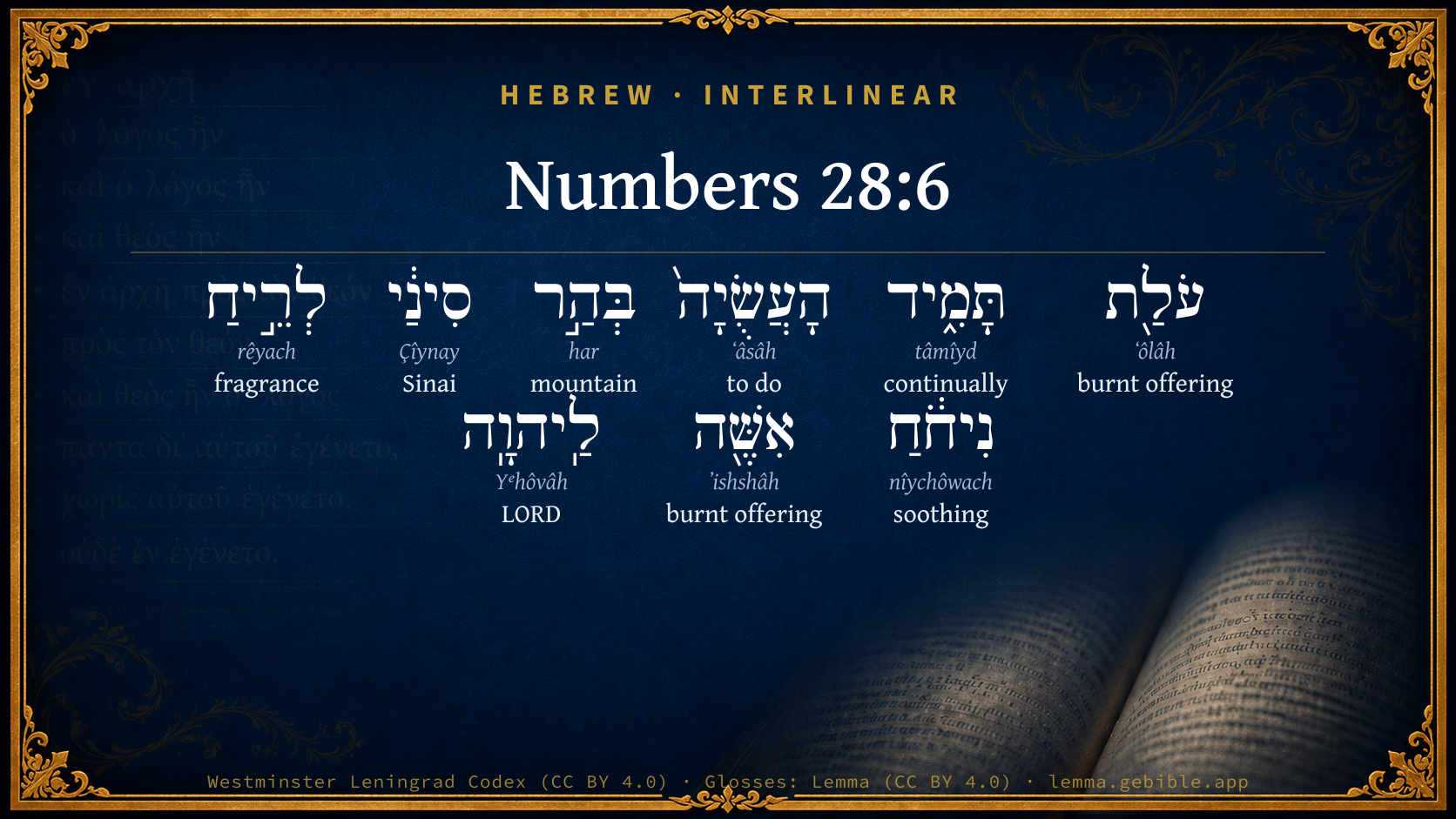
Numbers 28:6

Hebrew (Westminster Leningrad Codex) Numbers 28:6 appears in the Hebrew Old Testament. The text above is from the Westminster Leningrad Codex. Each word links to its Strong’s number, a concise gloss, and parsing drawn from the Open Scriptures Hebrew Bible morphology. Click any word for its full Brown-Driver-Briggs (BDB) entry.
Download image
Cite this verse

Numbers 28:6 (World English Bible). Public Domain. Lemma interlinear Bible study tool, https://lemma.gebible.app/v/numbers/28/6.

Show BibTeX & RIS
BibTeX
RIS
English Translation
It is a continual burnt offering, which was ordained in Mount Sinai for a sweet savor, an offering made by fire to Yahweh.
World English Bible · Public Domain
Download a study sheet

One document with this verse’s original text, its word-by-word gloss line, the meaning frame, cross-references with their text, attributed commentary, and full source and license credits — printable, and it pastes into notes with its structure intact.

This verse Autodidact and up

Study sheet (.html) Plain text (.txt)

A passage Seminary Student

Up to 50 verses in one chapter. A passage sheet keeps up to 6 commentary sources and 12 cross-references per verse, in the order this page ranks them, and says so on the sheet whenever that leaves anything out. Ask for a single verse and you get the Autodidact verse sheet above.

Everything on this page stays free to read, with no account — the sheet is a download of what is already on screen, not access to it.

Want to remove ads? Support Godless Engineer
Compare translations 3

The same verse in 3 English versions, stacked beneath the original-language interlinear above. Click any original word for its lexicon entry.

Each is an independent rendering of the whole verse — the interlinear is not word-aligned to these translations.

Highlighted words mark where these versions differ — a whole-verse word diff, not a word-by-word alignment.

  • World English Bible Public Domain
    It is a continual burnt offering, which was ordained in Mount Sinai for a sweet savor, an offering made by fire to Yahweh.
  • King James Version Public Domain
    It is a continual burnt offering, which was ordained in mount Sinai for a sweet savor, a sacrifice made by fire unto the LORD.
  • unfoldingWord Literal Text CC BY-SA 4.0
    It is a burnt offering of continuity, the one done at Mount Sinai for an aroma of soothing, an offering made by fire to Yahweh.

unfoldingWord Literal Text — © unfoldingWord, licensed CC BY-SA 4.0. Word-aligned USFM3 via Door43 (git.door43.org/unfoldingWord/en_ult).

Versions to compare (up to 4)

3 of 4 selected

Show all 18 translations

Every available English version of this verse, each an independent rendering of the whole verse.

  • World English Bible Public Domain
    It is a continual burnt offering, which was ordained in Mount Sinai for a sweet savor, an offering made by fire to Yahweh.
  • Berean Standard Bible Public Domain
    This is a regular burnt offering established at Mount Sinai as a pleasing aroma, an offering made by fire to the LORD.
  • Majority Standard Bible Public Domain
    This is a regular burnt offering established at Mount Sinai as a pleasing aroma, a food offering to the LORD.
  • King James Version Public Domain
    It is a continual burnt offering, which was ordained in mount Sinai for a sweet savor, a sacrifice made by fire unto the LORD.
  • American Standard Version (1901) Public Domain
    It is a continual burnt-offering, which was ordained in mount Sinai for a sweet savor, an offering made by fire unto Jehovah.
  • Revised Version (1885) Public Domain
    It is a continual burnt offering, which was ordained in mount Sinai for a sweet savour, an offering made by fire unto the LORD.
  • Geneva Bible (1599) Public Domain
    This shalbe a daily burnt offering, as was made in the mount Sinai for a sweete sauour: it is a sacrifice made by fire vnto the Lord.
  • Douay-Rheims (1899) Public Domain
    It is the continual holocaust which you offered in mount Sinai for a most sweet. odour of a sacrifice by fire to the Lord.
  • Young's Literal Translation Public Domain
    a continual burnt-offering, which was made in mount Sinai, for sweet fragrance, a fire-offering to Jehovah;
  • Literal Standard Version CC BY-SA 4.0
    [it is] a continual burnt-offering, which was made in Mount Sinai for refreshing fragrance, [for] a fire-offering to YHWH.
  • Unlocked Literal Bible CC BY-SA 4.0
    This is the regular burnt offering that was commanded at Mount Sinai to produce a sweet aroma, an offering made by fire to Yahweh.
  • unfoldingWord Literal Text CC BY-SA 4.0
    It is a burnt offering of continuity, the one done at Mount Sinai for an aroma of soothing, an offering made by fire to Yahweh.
  • Darby Bible Public Domain
    [it is] the continual burnt-offering which was ordained on mount Sinai for a sweet odour, an offering by fire to Jehovah.
  • World Messianic Bible Public Domain
    It is a continual burnt offering which was ordained in Mount Sinai for a pleasant aroma, an offering made by fire to the LORD.
  • Webster's Bible Public Domain
    It is a continual burnt-offering, which was ordained in mount Sinai for a sweet savor, a sacrifice made by fire to the LORD.
  • Free Bible Version CC BY-SA 4.0
    This is a continual burnt offering that was begun at Mount Sinai as an offering acceptable to the Lord.
  • Bible in Basic English Public Domain
    It is a regular burned offering, as it was ordered in Mount Sinai, for a sweet smell, an offering made by fire to the Lord.
  • JPS Tanakh (1917) Public Domain
    It is a continual burnt-offering, which was offered in mount Sinai, for a sweet savour, an offering made by fire unto the LORD.

Literal Standard Version (2020), Covenant Press — licensed CC BY-SA 4.0. Text via the HelloAO Bible API (eBible.org). Unlocked Literal Bible (unfoldingWord) — licensed CC BY-SA 4.0. Text via the HelloAO Bible API (eBible.org). unfoldingWord Literal Text — © unfoldingWord, licensed CC BY-SA 4.0. Word-aligned USFM3 via Door43 (git.door43.org/unfoldingWord/en_ult). Free Bible Version, Dr. Jonathan Gallagher — licensed CC BY-SA 4.0. Text via the HelloAO Bible API (eBible.org).

Word by word

More ways to search: Search by grammar → Find every occurrence → Compare this word →

Practice this passage: Drill this verse → Learn its vocabulary →

About this verse

These counts appear in no published source. They are computed here, from the morphology-tagged text and Lemma’s own curated glosses. What Lemma adds →

9
words
9
distinct lemmas
Pentateuch
section

Shared distinctive vocabulary

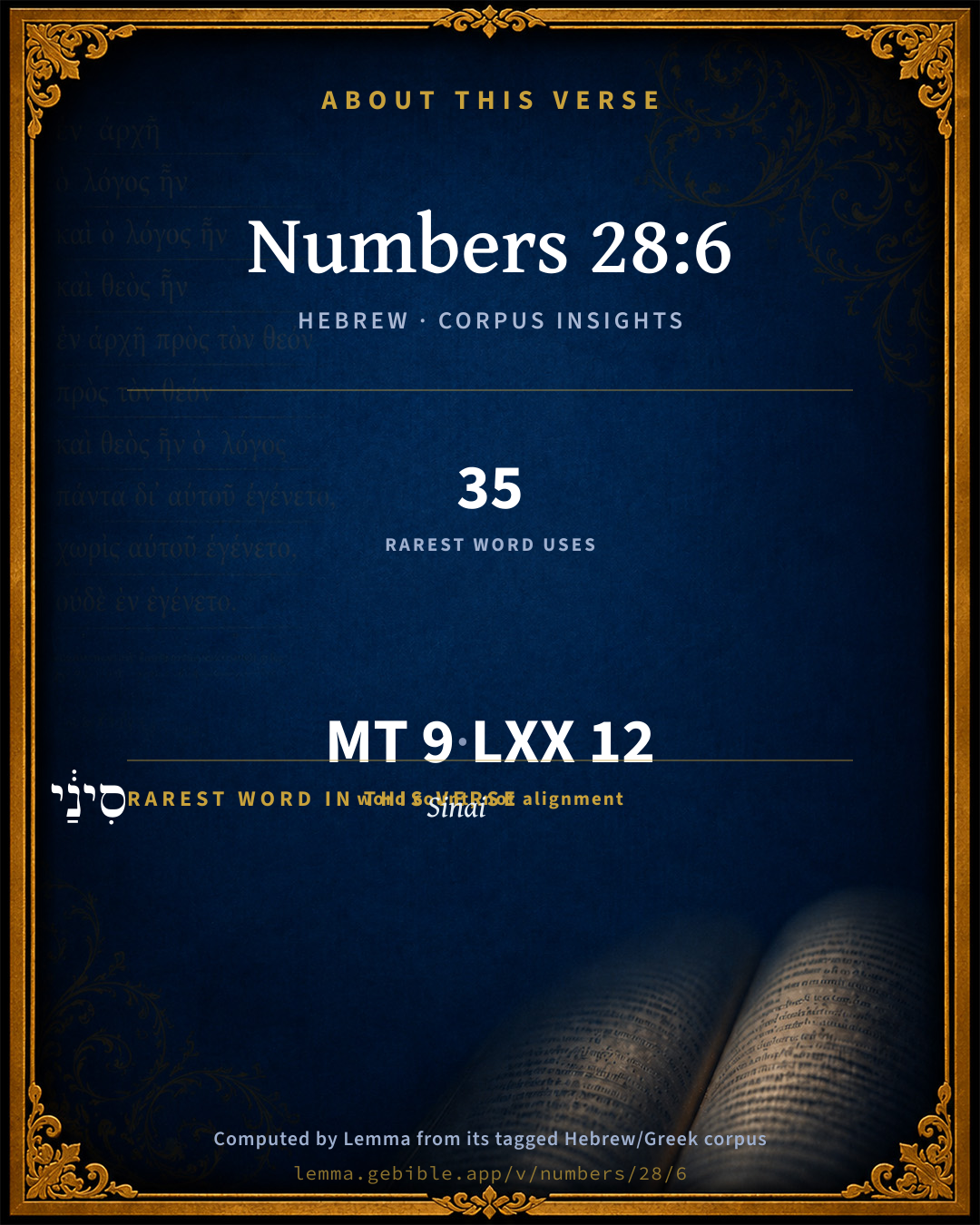
סִינַ֔י Sinai H5514 occurs in 34 verses of the Hebrew Bible. Also found in:

Grammatical profile

  • 1 verb
  • 8 nouns

Verb forms

  • הָעֲשֻׂיָה֙ Qal · Participle Passive

Hebrew & Septuagint length

In English translation the verse runs 23 words from the Hebrew and 23 from the Septuagint (LXX English) — the same length.

A rough comparison of the two English renderings, which tokenize alike — not a word-level alignment.

Word counts can differ between the Hebrew and the Greek without any difference in meaning — e.g. the Hebrew direct-object marker אֵת has no separate Greek word, and Greek often adds the article ὁ.

In the original languages it is 9 Hebrew tokens and 12 Greek tokens — but the two are counted differently (Hebrew bundles its prefixes and suffixes into one token; the Greek is in lemma form), so that isn’t a like-for-like length.

Cross-references

10

Topical passages linked to Numbers 28:6 in the Treasury of Scripture Knowledge — connected by theme and wording, ordered by reader-vote popularity; previews shown in the World English Bible.

  • Amos 5:25 "Did you bring to me sacrifices and offerings in the wilderness forty years, house of Israel?
  • Exodus 29:38–42 "Now this is that which you shall offer on the altar: two lambs a year old day by day continually.
  • Exodus 31:18 He gave to Moses, when he finished speaking with him on Mount Sinai, the two tablets of the testimony, stone tablets, written with God's finger.
  • Leviticus 6:9 "Command Aaron and his sons, saying, 'This is the law of the burnt offering: the burnt offering shall be on the hearth on the altar all night until the morning; and the fire of the altar shall be kept burning on it.
  • 2 Chronicles 2:4 Behold, I am about to build a house for the name of Yahweh my God, to dedicate it to him, and to burn before him incense of sweet spices, and for the continual show bread, and for the burnt offerings morning and evening, on the Sabbaths, and on the new moons, and on the set feasts of Yahweh our God. This is [an ordinance] forever to Israel.
  • 2 Chronicles 31:3 [He appointed] also the king's portion of his substance for the burnt-offerings, [to wit], for the morning and evening burnt offerings, and the burnt offerings for the Sabbaths, and for the new moons, and for the set feasts, as it is written in the law of Yahweh.
  • Ezra 3:4 They kept the feast of tents, as it is written, and [offered] the daily burnt offerings by number, according to the ordinance, as the duty of every day required;
  • Psalms 50:8 I don't rebuke you for your sacrifices. Your burnt offerings are continually before me.
  • Ezekiel 46:14 You shall prepare a meal-offering with it morning by morning, the sixth part of an ephah, and the third part of a hin of oil, to moisten the fine flour; a meal-offering to Yahweh continually by a perpetual ordinance.
  • Exodus 24:18 Moses entered into the midst of the cloud, and went up on the mountain; and Moses was on the mountain forty days and forty nights.

Cross-references courtesy of OpenBible.info (CC BY 4.0).

Hebrew and Greek witnesses Masoretic Hebrew ↔ Greek Septuagint

The same verse in the two great witnesses to the Old Testament, shown verse-for-verse.

These are two independent witnesses, not word-aligned to each other, and the Septuagint is shown in lemma (dictionary) form.

Hebrew Numbers 28:6 Masoretic · Westminster Leningrad Codex

עֹלַ֖ת תָּמִ֑יד הָעֲשֻׂיָה֙ בְּהַ֣ר סִינַ֔י לְרֵ֣יחַ נִיחֹ֔חַ אִשֶּׁ֖ה לַֽיהוָֽה

It is a continual burnt offering, which was ordained in Mount Sinai for a sweet savor, an offering made by fire to Yahweh.

World English Bible · Public Domain

Greek LXX Numbers 28:6 Septuagint · lemma form

ὁλοκαύτωμα ἐνδελεχισμός ὁ γίγνομαι ἐν ὁ ὄρος σινα εἰς ὀσμή εὐωδία κύριος

It is a perpetual whole burnt offering, a sacrifice offered in the mount of Sina for a sweet smelling savor to the Lord.

LXX2012 (modern English Septuagint) · Public Domain

Hebrew: Westminster Leningrad Codex (CC BY 4.0). Greek: Septuagint (public domain); English from LXX2012 (modern English Septuagint) (Public Domain). How the Septuagint differs from the Hebrew →

Targum (Aramaic paraphrase)

2

The Targum is the ancient Jewish Aramaic paraphrase of the Hebrew Scriptures — an interpretive translation, not the Hebrew text itself. Onkelos (literal) and Pseudo-Jonathan (expansive) render the Torah, and Jonathan the Prophets. Coverage is partial: where no permissively-licensed English translation exists for a verse, only the Aramaic is shown. This is verse-level text, not a word-by-word alignment to the Hebrew.

  1. Targum Onkelos Torah (Genesis–Deuteronomy)
    עֲלָתָא תְּדִירָא דְאִתְעֲבִידָא בְּטוּרָא דְסִינַי לְאִתְקַבָּלָא בְרַעֲוָא קוּרְבָּנָא קֳדָם יְיָ

    (no public-domain English translation for this verse)

    Targum Onkelos — Aramaic: “Onkelos Genesis” (public domain); “Onkelos Exodus” (public domain); “Onkelos Leviticus” (public domain); “Onkelos Numbers” (public domain); “Onkelos Deuteronomy” (public domain). English: “Sefaria Community Translation” (CC0 1.0 (public-domain dedication)); “J.W. Etheridge. The Targums of Onkelos and Jonathan Ben Uzziel on the Pentateuch. London: Longmans, Green, 1862” (public domain). Text via Sefaria.

  2. Targum Pseudo-Jonathan Torah (Genesis–Deuteronomy)
    עֲלַת תְּדִירָא הֵיכְמָא דַהֲוַת מִקְרְבָא עַל טַוְורָא דְסִינַי מְטוֹל לְאִתְקַבָּלָא בְּרַעֲוָא קוּרְבָּנָא קֳדָם יְיָ

    It is a perpetual burnt offering, such as was (ordained to be) offered at Mount Sinai, to be received with favour as an oblation before the Lord.

    Targum Pseudo-Jonathan — Aramaic: “Targum Jonathan on Genesis” (public domain); “Targum Jonathan on Exodus” (public domain); “Targum Jonathan on Leviticus” (public domain); “Targum Jonathan on Numbers” (public domain); “Targum Jonathan on Deuteronomy” (public domain). English: “The Targum of Jonathan ben Uzziel, trans. J. W. Etheridge, London, 1862” (public domain). Text via Sefaria.

Commentary

Notes on Numbers 28:6 from classic Christian and Jewish commentators (each source and its license shown beneath its notes). The classic Christian expositions comment on the surrounding passage and are grouped to its opening verse, so a note may address several verses; the Jewish commentaries on the Tanakh (Rashi and others) are per-verse, so they appear only where the commentator wrote on this verse.

Lemma curates 59 commentaries, every one of them public domain or Creative Commons licensed, each selected and text-cleaned for this edition rather than reprinted as found. About our sources →

Joseph Benson's Commentary

Num 28:6. Which was ordained on mount Sinai — This shows that he speaks to those who were so young at the first institution of these laws, that they gave little heed to them, or had forgotten them.

Joseph Benson's Commentary on the Old and New Testaments (1811–1818) — public domain. Text from a community e-Sword module.

Ellicott's Commentary for English Readers

(6) Which was ordained in mount Sinai . . . Or, which was offered (Hebrew, made) in Mount Sinai. Ibn Ezra adduces this passage as a proof that the Israelites ceased to offer burnt sacrifices after they left the encampment at Sinai throughout the time of their wanderings in the wilderness.

A Bible Commentary for English Readers, edited by Charles John Ellicott (1878–1897) — public domain. Text from a community e-Sword module.

John Gill's Exposition

It is a continual burnt offering,.... For the meat offering was burnt as well as the lambs, at least part of it:

which was ordained in Mount Sinai for a sweet savour, a sacrifice made by fire unto the Lord; that is, this law concerning the daily burnt offering was made on Mount Sinai, so long ago as the children of Israel were there; and it was then ordered that they should continually offer such a sacrifice by fire, which would be grateful and acceptable unto God, especially when done in faith of the sacrifice of his Son it was a type of; or which sacrifice was "made" (e) or offered at Mount Sinai, when the law of it was first given there: hence Aben Ezra observes, that this is a sign that they did not offer burnt offerings in the wilderness after they journeyed from Sinai; but then, though sacrifices were not so frequently offered by them as afterwards, yet one would think that the daily sacrifice would not be omitted, which seemed to be always necessary; nor would there be any, or but little use of the altar, and the fire continually burning on it, if this was the case; see Amo 5:25.

(e) "quod obtulistis", V. L. "quod factum est", Pagninus; "quod sacrificatum fucrat", Piscator.

John Gill's Exposition of the Whole Bible (1746–1763) — public domain (CC PDM 1.0). Text via the HelloAO Bible API.

Haydock's Catholic Bible Commentary

Sinai. Hence it seems to have been discontinued for 38 years. (Calmet) (Leviticus ix. 17.) (Menochius)

George Leo Haydock (1774–1849), Haydock's Catholic Family Bible and Commentary, 1859 edition — public domain. Excludes Psalms (Douay-Rheims chapter numbering differs from Protestant) and Deuterocanonical books (Catholic canon only).

Matthew Poole's English Annotations

Ordained, or, prescribed, instituted by God. Or, made, i.e. offered at that place, though since omitted for thirty-eight years.

Matthew Poole's English Annotations on the Holy Bible (1683–1685) — public domain. Text from a community e-Sword/MySword module.

unfoldingWord translationNotes

Door43 World Missions Community

that was commanded at Mount Sinai

This can be stated in active form. AT: "that Yahweh commanded at Mount Sinai" (See: Active or Passive)

made by fire

This can be stated in active form. AT: "that you burned on the altar" (See: Active or Passive)

one-fourth of a hin

"One-fourth" means one part out of four equal parts. This can be written in modern measurements. AT: "a liter" or "one-fourth of a hin (which is almost 1 liter)" (See: Fractions and Biblical Volume)

You must pour out in the holy place a drink offering of strong drink to Yahweh

This sentence describes the drink offering that is to accompany the lamb. The full meaning of this statement can be made clear. AT: "It must be a drink offering of strong drink and you must pour it out in the holy place to Yahweh" (See: Assumed Knowledge and Implicit Information)

like the one offered

This can be stated in active form. AT: "like the one you offered" (See: Active or Passive)

translationWords

burnt offering

command

Sinai

drink offering

holy place

strong drink

unfoldingWord translationNotes — © Distant Shores Media and the Door43 World Missions Community, licensed CC BY-SA 4.0. Source: git.door43.org/Door43/en_tn.

Rashi

Rabbi Shlomo Yitzchaki (Rashi)

העשיה בהר סיני WHICH WAS OFFERED BY MOUNT SINAI — i.e., like those continual burnt offerings which were offered during the days of the installation ceremony (which took place whilst the people were encamped by Mount Sinai). — Another explanation of העשיה בהר סיני is: It compares the continual burnt offering to the burnt offering of Mount Sinai — to that which was offered on the fifth day of the third month, before the Giving of the Torah (see Rashi on Exodus 19:11), of which it is written, (Exodus 24:6) “And he put it (the blood) in basins”: this teaches, therefore, that it (the continual burnt-offering) requires a vessel for the reception of the blood (Sifra, Tzav, Chapter 18 8).

Rashi on the Tanakh — English translations: “The Judaica Press complete Tanach with Rashi, translated by A. J. Rosenberg” (CC BY 4.0); “Pentateuch with Rashi's commentary by M. Rosenbaum and A.M. Silbermann, 1929-1934” (public domain); “The Metsudah Tanach series, Lakewood, N.J” (CC BY 4.0); and “The Book of Joshua, Metsudah Publications, 1997” (CC BY 4.0). Text via Sefaria.

Lesson kit

Teaching starters — assembled from the data on this page, not authored interpretation. Every prompt links to the verse data it draws on. Edit before teaching.

Numbers, in the Pentateuch, opens this verse with 9 words (9 distinct Hebrew lemmas). Its most distinctive word is Çîynay (“Sinai”). A historical commentator’s framing appears above. Read the whole chapter for the surrounding context.

Discussion questions

  1. How does “Sinai” (Çîynay) shape what this verse is saying?
  2. Exodus 16:1 shares the word «Sinai» with this verse. How do the two illuminate each other?
  3. These translations render this verse differently; the difference is in the English rendering, not the original. What questions does that raise?
  4. The verb «הָעֲשֻׂיָה֙» is Qal Participle Passive. How does its form color the action?
  5. Reading how Joseph Benson's Commentary and Ellicott's Commentary for English Readers read this verse, where do the two commentators agree and where do they part?

Things to notice

Reading settings

Reading text

Shown beneath each verse's original-language words.

Old Testament
Old Testament edition

Read the OT as the Masoretic Hebrew (MT) or the Greek Septuagint (LXX).

English shown for the Greek Septuagint (in the Hebrew ↔ Greek comparison).

Comparing translations? Open the Compare panel on any verse page to stack up to four side by side.