Jeremiah 6:7

Hebrew (Westminster Leningrad Codex) Jeremiah 6:7 appears in the Hebrew Old Testament. The text above is from the Westminster Leningrad Codex. Each word links to its Strong’s number, a concise gloss, and parsing drawn from the Open Scriptures Hebrew Bible morphology. Click any word for its full Brown-Driver-Briggs (BDB) entry.
Download image
Cite this verse

Jeremiah 6:7 (World English Bible). Public Domain. Lemma interlinear Bible study tool, https://lemma.gebible.app/v/jeremiah/6/7.

Show BibTeX & RIS
BibTeX
RIS
English Translation
As a well casts forth its waters, so she casts forth her wickedness: violence and destruction is heard in her; before me continually is sickness and wounds.
World English Bible · Public Domain
Download a study sheet

One document with this verse’s original text, its word-by-word gloss line, the meaning frame, cross-references with their text, attributed commentary, and full source and license credits — printable, and it pastes into notes with its structure intact.

This verse Autodidact and up

Study sheet (.html) Plain text (.txt)

A passage Seminary Student

Up to 50 verses in one chapter. A passage sheet keeps up to 6 commentary sources and 12 cross-references per verse, in the order this page ranks them, and says so on the sheet whenever that leaves anything out. Ask for a single verse and you get the Autodidact verse sheet above.

Everything on this page stays free to read, with no account — the sheet is a download of what is already on screen, not access to it.

Want to remove ads? Support Godless Engineer
Compare translations 3

The same verse in 3 English versions, stacked beneath the original-language interlinear above. Click any original word for its lexicon entry.

Each is an independent rendering of the whole verse — the interlinear is not word-aligned to these translations.

Highlighted words mark where these versions differ — a whole-verse word diff, not a word-by-word alignment.

  • World English Bible Public Domain
    As a well casts forth its waters, so she casts forth her wickedness: violence and destruction is heard in her; before me continually is sickness and wounds.
  • King James Version Public Domain
    As a fountain casteth out her waters, so she casteth out her wickedness: violence and spoil is heard in her; before me continually is grief and wounds.
  • unfoldingWord Literal Text CC BY-SA 4.0
    Like a well keeps its waters fresh, thus she keeps her evil fresh. Violence and oppression are heard in her; always before my face sickness and plague.

unfoldingWord Literal Text — © unfoldingWord, licensed CC BY-SA 4.0. Word-aligned USFM3 via Door43 (git.door43.org/unfoldingWord/en_ult).

Versions to compare (up to 4)

3 of 4 selected

Show all 18 translations

Every available English version of this verse, each an independent rendering of the whole verse.

  • World English Bible Public Domain
    As a well casts forth its waters, so she casts forth her wickedness: violence and destruction is heard in her; before me continually is sickness and wounds.
  • Berean Standard Bible Public Domain
    As a well gushes its water, so she pours out her evil. Violence and destruction resound in her; sickness and wounds are ever before Me.
  • Majority Standard Bible Public Domain
    As a well gushes its water, so she pours out her evil. Violence and destruction resound in her; sickness and wounds are ever before Me.
  • King James Version Public Domain
    As a fountain casteth out her waters, so she casteth out her wickedness: violence and spoil is heard in her; before me continually is grief and wounds.
  • American Standard Version (1901) Public Domain
    As a well casteth forth its waters, so she casteth forth her wickedness: violence and destruction is heard in her; before me continually is sickness and wounds.
  • Revised Version (1885) Public Domain
    As a well casteth forth her waters, so she casteth forth her wickedness: violence and spoil is heard in her; before me continually is sickness and wounds.
  • Geneva Bible (1599) Public Domain
    As the fountaine casteth out her waters, so she casteth out her malice: crueltie and spoyle is continually heard in her before me with sorowe and strokes.
  • Douay-Rheims (1899) Public Domain
    As a cistern maketh its water cold, so hath she made her wickedness cold: violence and spoil shall be heard in her, infirmity and stripes are continually before me.
  • Young's Literal Translation Public Domain
    As the digging of a well, is `for' its waters, So she hath digged `for' her wickedness, Violence and spoil is heard in her, Before My face continually `are' sickness and smiting.
  • Literal Standard Version CC BY-SA 4.0
    As the digging of a well, is [for] its waters, || So she has dug [for] her wickedness, || Violence and spoil is heard in her, || Sickness and striking [are] continually before My face.
  • Unlocked Literal Bible CC BY-SA 4.0
    As a well pours out fresh water, so this city keeps producing wickedness. Violence and disorder are heard within her; sickness and wounds are continually before my face.
  • unfoldingWord Literal Text CC BY-SA 4.0
    Like a well keeps its waters fresh, thus she keeps her evil fresh. Violence and oppression are heard in her; always before my face sickness and plague.
  • Darby Bible Public Domain
    As a well poureth forth her waters, so she poureth forth her wickedness: violence and destruction are heard in her; before me continually are grief and wounds.
  • World Messianic Bible Public Domain
    As a well produces its waters, so she produces her wickedness. Violence and destruction is heard in her. Sickness and wounds are continually before me.
  • Webster's Bible Public Domain
    As a fountain casteth out her waters, so she casteth out her wickedness: violence and devastation is heard in her; before me continually are grief and wounds.
  • Free Bible Version CC BY-SA 4.0
    Like a spring gushing out water, so she pours out her evil. The sounds of violence and abuse echo inside her. I see people sick and wounded everywhere.
  • Bible in Basic English Public Domain
    As the spring keeps its waters cold, so she keeps her evil in her: the sound of cruel and violent behaviour is in her; before me at all times are disease and wounds.
  • JPS Tanakh (1917) Public Domain
    As a cistern welleth with her waters, so she welleth with her wickedness; violence and spoil is heard in her; before Me continually is sickness and wounds.

Literal Standard Version (2020), Covenant Press — licensed CC BY-SA 4.0. Text via the HelloAO Bible API (eBible.org). Unlocked Literal Bible (unfoldingWord) — licensed CC BY-SA 4.0. Text via the HelloAO Bible API (eBible.org). unfoldingWord Literal Text — © unfoldingWord, licensed CC BY-SA 4.0. Word-aligned USFM3 via Door43 (git.door43.org/unfoldingWord/en_ult). Free Bible Version, Dr. Jonathan Gallagher — licensed CC BY-SA 4.0. Text via the HelloAO Bible API (eBible.org).

Word by word

More ways to search: Search by grammar → Find every occurrence → Compare this word →

Practice this passage: Drill this verse → Learn its vocabulary →

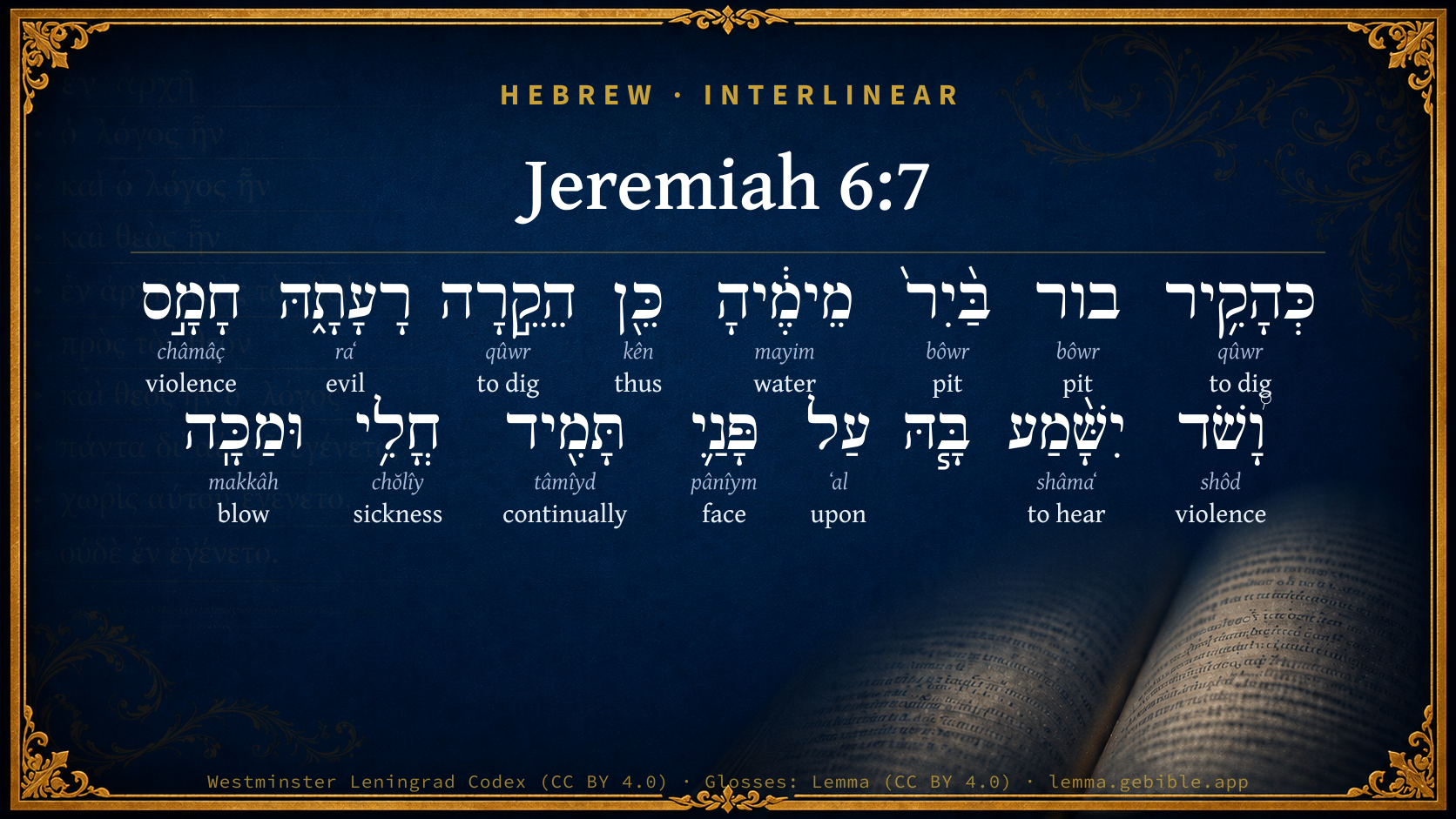
כְּהָקִ֥יר
qûwr
H6979
“like/as · to dig”
Preposition + Verb, Hiphil, Infinitive Construct
Part of Speech
Preposition + Verb
Stem
Hiphil
Form
Infinitive Construct
Full BDB Definition

Origin: a primitive root

TWOT: 2004 , 2077

(Qal) to bore, dig, dig for water - to be cold - (Hiphil) to make or keep cool - (Pilpel) destroy, break down
  1. בור bôwr H953 “pit” Noun, Common, Masculine, Singular, Absolute
  2. בַּ֨יִר֙ bôwr H953 “pit” Noun, Common, Masculine, Singular, Absolute
  3. מֵימֶ֔יהָ mayim H4325 “water(s) · her” Noun, Common, Masculine, Plural, Construct + Suffix, Personal, 3rd Person, Feminine, Singular
  4. כֵּ֖ן kên H3651 “thus” Particle, Demonstrative
  5. הֵקֵ֣רָה qûwr H6979 “to dig” Verb, Hiphil, Perfect, 3rd Person, Feminine, Singular
  6. רָעָתָ֑הּ raʻ H7451 “evil · her” Noun, Common, Feminine, Singular, Construct + Suffix, Personal, 3rd Person, Feminine, Singular
  7. חָמָ֣ס châmâç H2555 “violence” Noun, Common, Masculine, Singular, Absolute
  8. וָ֠שֹׁד shôd H7701 “and · violence” Conjunction + Noun, Common, Masculine, Singular, Absolute
  9. יִשָּׁ֨מַע shâmaʻ H8085 “to hear” Verb, Niphal, Imperfect, 3rd Person, Masculine, Singular
  10. עַל ʻal H5921 “upon” Preposition
  11. פָּנַ֛י pânîym H6440 “face(s) · my” Noun, Common, Both, Plural, Construct + Suffix, Personal, 1st Person, Common, Singular
  12. תָּמִ֖יד tâmîyd H8548 “continually” Noun, Common, Masculine, Singular, Absolute
  13. חֳלִ֥י chŏlîy H2483 “sickness” Noun, Common, Masculine, Singular, Absolute
  14. וּמַכָּֽה makkâh H4347 “and · blow” Conjunction + Noun, Common, Feminine, Singular, Absolute

About this verse

These counts appear in no published source. They are computed here, from the morphology-tagged text and Lemma’s own curated glosses. What Lemma adds →

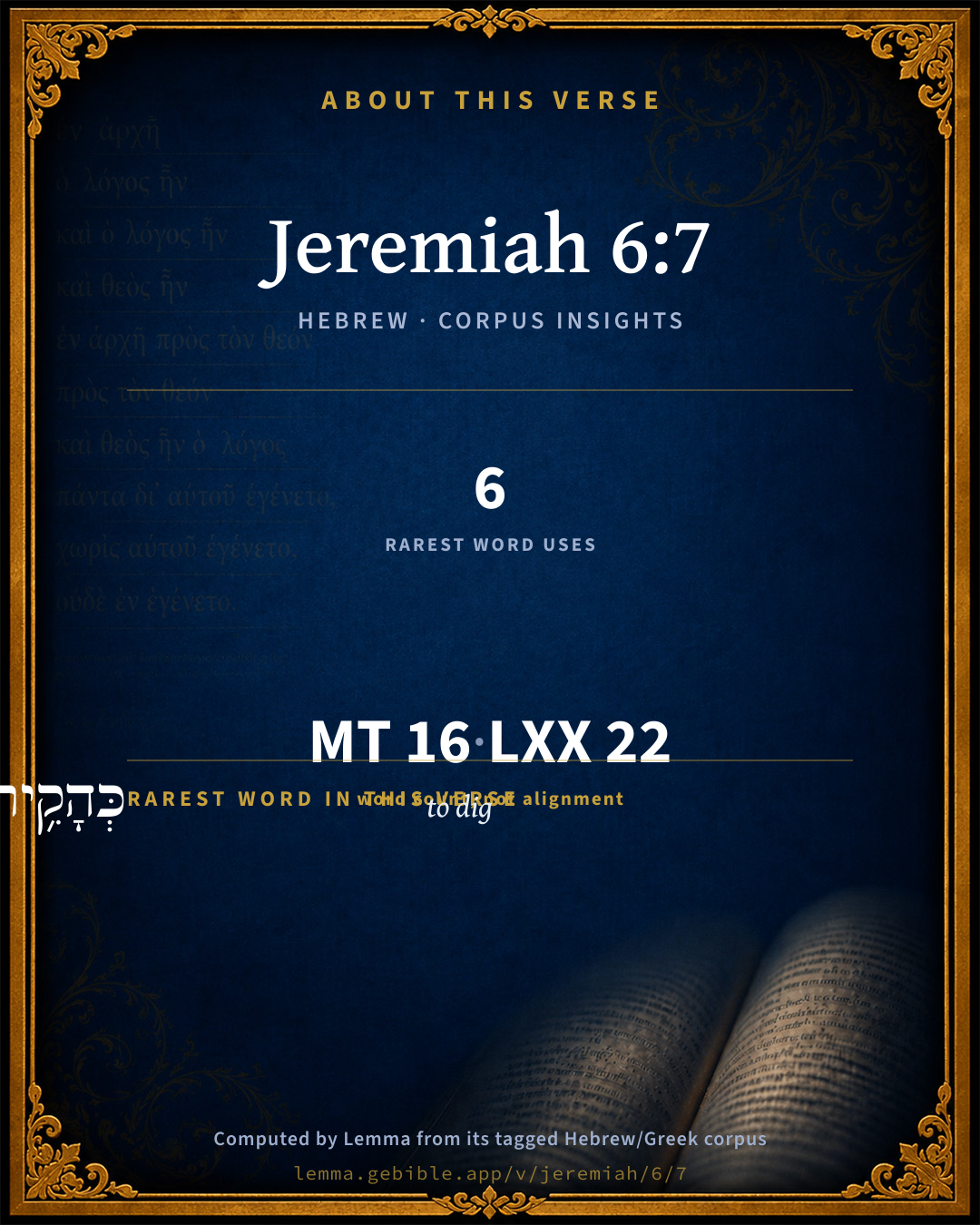
16
words
13
distinct lemmas
Prophets
section

Notable vocabulary

The rarest word here is כְּהָקִ֥יר to dig H6979 — appearing just 6 times in the whole Hebrew Bible.

Shared distinctive vocabulary

כְּהָקִ֥יר to dig H6979 occurs in 5 verses of the Hebrew Bible. Also found in:

Grammatical profile

  • 3 verbs
  • 10 nouns
  • 2 prepositions
  • 1 particle

Verb forms

  • כְּהָקִ֥יר Hiphil · Infinitive Construct
  • הֵקֵ֣רָה Hiphil · Perfect
  • יִשָּׁ֨מַע Niphal · Imperfect

Repetition

Words recur within this verse — often emphatic in Hebrew:

  • כְּהָקִ֥יר to dig H6979 ×2
  • בור pit H953 ×2

Hebrew & Septuagint length

In the original languages it is 16 Hebrew tokens and 22 Greek tokens — but the two are counted differently (Hebrew bundles its prefixes and suffixes into one token; the Greek is in lemma form), so that isn’t a like-for-like length.

Cross-references

14

Topical passages linked to Jeremiah 6:7 in the Treasury of Scripture Knowledge — connected by theme and wording, ordered by reader-vote popularity; previews shown in the World English Bible.

  • Jeremiah 20:8 For as often as I speak, I cry out; I cry, Violence and destruction! because the word of Yahweh is made a reproach to me, and a derision, all the day.
  • Ezekiel 7:11 Violence is risen up into a rod of wickedness; none of them [shall remain], nor of their multitude, nor of their wealth: neither shall there be eminency among them.
  • Ezekiel 7:23 Make the chain; for the land is full of bloody crimes, and the city is full of violence.
  • Isaiah 57:20 But the wicked are like the troubled sea; for it can't rest, and its waters cast up mire and dirt.
  • James 3:10–12 Out of the same mouth comes forth blessing and cursing. My brothers, these things ought not to be so.
  • Psalms 55:9–11 Confuse them, Lord, and confound their language, For I have seen violence and strife in the city.
  • Ezekiel 22:3–12 You shall say, Thus says the Lord Yahweh: A city that sheds blood in the midst of her, that her time may come, and that makes idols against herself to defile her!
  • Micah 2:1–2 Woe to those who devise iniquity And work evil on their beds! When the morning is light, they practice it, Because it is in the power of their hand.
  • Micah 2:8–10 But lately my people have risen up as an enemy. You strip the robe and clothing from those who pass by without a care, returning from battle.
  • Micah 3:1–3 I said, "Please listen, you heads of Jacob, And rulers of the house of Israel: Isn't it for you to know justice?
  • Micah 3:9–12 Please listen to this, you heads of the house of Jacob, And rulers of the house of Israel, Who abhor justice, And pervert all equity.
  • Micah 7:2–3 The godly man has perished out of the earth, And there is no one upright among men. They all lie in wait for blood; Every man hunts his brother with a net.
  • Proverbs 4:23 Keep your heart with all diligence, For out of it is the wellspring of life.
  • Ezekiel 24:7 For her blood is in the midst of her; she set it on the bare rock; she didn't pour it on the ground, to cover it with dust.

Cross-references courtesy of OpenBible.info (CC BY 4.0).

Hebrew and Greek witnesses Masoretic Hebrew ↔ Greek Septuagint

The same verse in the two great witnesses to the Old Testament, shown verse-for-verse.

These are two independent witnesses, not word-aligned to each other, and the Septuagint is shown in lemma (dictionary) form.

Hebrew Jeremiah 6:7 Masoretic · Westminster Leningrad Codex

כְּהָקִ֥יר בור בַּ֨יִר֙ מֵימֶ֔יהָ כֵּ֖ן הֵקֵ֣רָה רָעָתָ֑הּ חָמָ֣ס וָ֠שֹׁד יִשָּׁ֨מַע בָּ֧הּ עַל פָּנַ֛י תָּמִ֖יד חֳלִ֥י וּמַכָּֽה

As a well casts forth its waters, so she casts forth her wickedness: violence and destruction is heard in her; before me continually is sickness and wounds.

World English Bible · Public Domain

Greek LXX Structure differs

In the Septuagint, Jeremiah is about an eighth shorter than the Hebrew and arranges its material differently — the Oracles Against the Nations (Hebrew chapters 46–51) appear in the middle of the Greek book, after 25:13. Because the chapter and verse boundaries do not line up, a verse-for-verse comparison with the Hebrew is not shown.

A verse-for-verse comparison isn’t shown here because the chapters and verses don’t line up. Switch to the LXX edition with the MT / LXX toggle above to read the Greek directly.

On this verse, The Cambridge Bible for Schools and Colleges discusses the Septuagint’s reading. Read the note in Commentary ↓

Hebrew: Westminster Leningrad Codex (CC BY 4.0). Greek: Septuagint (public domain); English from a public-domain English Septuagint. How the Septuagint differs from the Hebrew →

Targum (Aramaic paraphrase)

1

The Targum is the ancient Jewish Aramaic paraphrase of the Hebrew Scriptures — an interpretive translation, not the Hebrew text itself. Onkelos (literal) and Pseudo-Jonathan (expansive) render the Torah, and Jonathan the Prophets. Coverage is partial: where no permissively-licensed English translation exists for a verse, only the Aramaic is shown. This is verse-level text, not a word-by-word alignment to the Hebrew.

  1. Targum Jonathan Prophets (Joshua–Malachi)
    כְּגוֹבָא דִמְקַיֵים מוֹהִי כֵּן אוֹרִיכוּ וְאִתְקַיָמוּ בְּגַוָהּ עָבְדֵי בִישְׁתָא קַל חֲטוֹפִין וּבְזוֹזִין מִשְׁתְּמַע בָהּ קֳדָמַי תְּדִירָא עַל כֵּן אַיְתֵיתִי עֲלָהּ מְרַע וּמָחָא:

    (no public-domain English translation for this verse)

    Targum Jonathan — Aramaic: “Mikraot Gedolot” (public domain). English: “Sefaria Community Translation” (CC0 1.0 (public-domain dedication)); “London "Chaldee Paraphrase," 1871” (public domain). Text via Sefaria.

Commentary

Notes on Jeremiah 6:7 from classic Christian and Jewish commentators (each source and its license shown beneath its notes). The classic Christian expositions comment on the surrounding passage and are grouped to its opening verse, so a note may address several verses; the Jewish commentaries on the Tanakh (Rashi and others) are per-verse, so they appear only where the commentator wrote on this verse.

Lemma curates 59 commentaries, every one of them public domain or Creative Commons licensed, each selected and text-cleaned for this edition rather than reprinted as found. About our sources →

Trapp's Complete Commentary

John Trapp

Jer 6:7 As a fountain casteth out her waters, so she casteth out her wickedness: violence and spoil is heard in her; before me continually [is] grief and wounds.

Ver. 7. As a fountain casteth out her waters.] Incessantly and abundantly. In Ieremia est continua quasi declamatio contra peccatum, &c.

Before me continually.] This showeth their impudence.

John Trapp, A Commentary or Exposition upon All the Books of the Old and New Testament (1647–1656) — public domain. Text from a community e-Sword module.

Geneva Bible (1599)

Geneva Bible translators

He showeth the cause why it should be destroyed, and how it cometh of themselves.

Geneva Bible (1599) marginal notes — public domain. Text via Bolls.life.

Jamieson, Fausset & Brown

Robert Jamieson, A. R. Fausset & David Brown

fountain--rather, a well dug, from which water springs; distinct from a natural spring or fountain.

casteth out--causeth to flow; literally, "causeth to dig," the cause being put for the effect (Kg2 21:16, Kg2 21:24; Isa 57:20).

me--Jehovah.

Jamieson, Fausset & Brown — Commentary Critical and Explanatory on the Whole Bible (1871) — public domain (CC PDM 1.0). Text via the HelloAO Bible API.

Adam Clarke's Commentary

Verse 7. As a fountain casteth out her waters] The inhabitants are incessant in their acts of iniquity; they do nothing but sin.

Adam Clarke's Commentary on the Bible (1810–1826) — public domain. Text from a community e-Sword/MySword module.

John Calvin's Commentaries

The Prophet enlarges on what he had said in the last verse; for he had shewn, by mentioning one kind of evil, that Jerusalem was a den of thieves, as oppression dwelt in the midst of it. But he now, by a comparison, amplifies his former statement, and says, that violence, oppression, devastation, grief, and smiting, streamed forth like waters from a fountain. It is possible for many vices to break out from a place, but repentance afterwards follows; but when men cease not, and heap vices on vices, it then appears that they swell with wickedness, and even burst with it, as they cannot repress it: they are like a fountain, which ever bubbles up, and cannot contain its own waters. We hence see the object of the Prophet.

The word בור, bur, means a fountain, and באר, bar, means also a fountain, or a well, and they are no doubt synonymous: and hence appears the mistake of a very learned man among the Hebrews, who makes a difference between the two, and says that the first is a cistern, which receives waters, but has no streaming. That this is false appears from the words of the Prophet; for a cistern does not cast forth water.

But with regard to what is taught, we sufficiently understand that what the Prophet means is, — that the Jews had so given up themselves to their vices, that they were ever contriving some new way of doing evil, as waters never cease to stream forth from the fountain; and it is a proof, as I have said, that a nation is wholly irreclaimable, when there is no cessation from evil deeds, when there is no intermission of injuries, when men ever indulge in their vices; and as the Jews could not deny that such was the atrocity of their wickedness, the Prophet again assumes the name of God, and says, Heard have been oppressions, and smitings are before me; as though he had said, “They will gain nothing by evasions, for if they make a hundred excuses before men, it will be wholly useless to them when they shall come before God’s tribunal.” And he again adds the adverb dymt, tamid, continually, which answers to the perpetual streaming of waters. It follows —

John Calvin's Commentaries (1540-1563) — public domain. Text from the Calvin Translation Society English edition (1840s-50s) via the Christian Classics Ethereal Library (ccel.org). Calvin's coverage is partial (roughly two-thirds of the Bible); uncommented books and verses are honest gaps, never fabricated. The 19th-century editor's footnotes and remarks are omitted so the notes are faithfully Calvin's own voice.

Ellicott's Commentary for English Readers

(7) As a fountain casteth out her waters.—The English is plain enough, but the Hebrew presents two difficulties: (1) The word rendered “fountain” (better, cistern) is not spelt with the usual vowels, and the etymology of the verb is quite uncertain. It has been rendered, As a cistern “gathers” or “keeps in,” or “keeps its waters cool,” or “lets them flow.” The general meaning is probably given by the Authorised Version. Jerusalem was literally “overflowing” with wickedness.

Grief.—Better, sickness. The word and the imagery are the same as in Isa_1:5.

A Bible Commentary for English Readers, edited by Charles John Ellicott (1878–1897) — public domain. Text from a community e-Sword module.

The Cambridge Bible for Schools and Colleges

gen. ed. J. J. S. Perowne

7. The cherished wickedness of the people is illustrated by a metaphor.

a well casteth forth] MT. has two readings, well and fountain. In the former water is stored to keep it fresh, in the latter it springs out of the ground. In this application accordingly Jeremiah will mean either (a) that sin is an alien thing which has been introduced into the heart as a supply upon which to draw, or (b) that it is innate there. That he held the latter view might seem to draw support from Jer_13:23, which however is not conclusive (see note there), and the former is to be preferred. It has the support of the LXX, who also agree with the mg. “keepeth fresh,” thus deriving the Hebrew form from a verb quite different in sense but akin in letters to the rare one in MT., which, though found elsewhere (2Ki_19:24; Isa_37:25) only in the sense of digging for water, yet according to Rabbinic interpretation bears also the meaning given in E.VV.

sickness and wounds] disease produced by want, and deeds of violence.

The Cambridge Bible for Schools and Colleges (gen. ed. J. J. S. Perowne; Cambridge University Press, 1878–1918) — public domain. Text from a community e-Sword module.

John Gill's Exposition

As a fountain casteth out her waters,.... In great abundance, and continually:

so she casteth out her wickedness; this metaphor expresses the multitude of her sins, the frequent and constant commission of them, and the source and spring of them, the corrupt fountain of the heart; see Mat 12:34,

violence and spoil is heard in her; that is, the cry of those that are oppressed and spoiled is heard, and that by the Lord himself, whose ears are open to the cries of the oppressed, and will avenge them:

before me continually is grief and wounds; the poor, who were grieved and wounded by their oppressors; the Lord was an eye and ear witness of their grievances, and would redress them; nor could their enemies expect to escape his wrath, since they were all known to him; or else the sense is, that because of their violence and spoil of the poor, it was continually before the Lord, in his mind and purpose, and he was just ready to bring upon them, by way of punishment for these things, what would grieve and wound them; so Jarchi interprets it, which Kimchi mentions; and to it the Targum agrees,

"the voice of robbers and plunderers is heard in her before me continually, therefore will I bring upon her evil and smiting.''

John Gill's Exposition of the Whole Bible (1746–1763) — public domain (CC PDM 1.0). Text via the HelloAO Bible API.

Albert Barnes' Notes on the Bible

As a fountain casteth out - Better, As a cistern “cooleth.”

Before me ... - Before My face continually there is disease and wounding: Disease as the result of poverty and want: wounding, or, the commission of deeds of actual violence.

Albert Barnes' Notes on the Bible (1834–1885) — public domain. Text from a community e-Sword/MySword module.

Haydock's Catholic Bible Commentary

Cold. Hebrew, "come forth." All the citizens imitate her vices.

George Leo Haydock (1774–1849), Haydock's Catholic Family Bible and Commentary, 1859 edition — public domain. Excludes Psalms (Douay-Rheims chapter numbering differs from Protestant) and Deuterocanonical books (Catholic canon only).

Matthew Poole's English Annotations

In this verse God aggravates their sin of oppression, mentioned in the former.

As a fountain casteth out her waters, so she casteth out her wickedness; a metaphor, to express how natural all manner of wickedness is to her, how full she is of it, and how incessant in it, noting her impudence, a fountain being not able to retain its water; and the expression of casting it out seems to imply her violence in her filthiness, as it is said of the sea, that it casteth out mire and dirt, Isa 57:20, and favoured by the next clause.

Violence and spoil is heard in her: q.d. This is all she busieth herself about, Jer 20:8. It is the general complaint of her inhabitants.

Before me continually is grief and wounds, viz. that the poor sustain: wherever I go or look, I can hear and see nothing but the sad complaints and grievances of the poor, lamenting over oppression and cruelties that are used against them, Psa 69:26, this being so expressly against God’s command, Exo 22:22-24, &c.; Isa 3:14,15; Jas 5:4; for this refers rather to their sin than to their sufferings from the enemy, as some would carry it.

Matthew Poole's English Annotations on the Holy Bible (1683–1685) — public domain. Text from a community e-Sword/MySword module.

Whedon's Commentary on the Bible

Daniel D. Whedon

7. As a fountain casteth out — The difficulties in the first sentence of this verse are very serious, but the Authorized Version is to be approved. It is much more intelligible and expressive than any other which has been proposed, and is easily vindicated as a translation.

Daniel D. Whedon (gen. ed.), Commentary on the Old and New Testaments (1874–1909) — public domain. Text from a community e-Sword module.

The Pulpit Commentary

As a fountain casteth out; rather, as a cistern keepeth fresh (literally, cool). The wickedness of Jerusalem is so thoroughly ingrained that it seems to pass into act by a law of nature, just as a cistern cannot help always yielding a supply of cool, fresh water. Violence and spoil; rather, injustice and violence. (so Jer_20:8 Amo_3:10 Hab_1:3) Before me, etc.; rather, before my face continually is sickness and wounding. The ear is constantly dinned with the sounds of oppression, and the eye pained with the sight of the bodily sufferings of the victims. The word for" sickness" is applicable to any kind of infirmity, (see Isa_53:3, Isa_53:4) but the context clearly limits it here to bodily trouble.

Ver. 7. Wells of wickedness.

I IF WICKEDNESS IS ABUNDANT AND PERSISTENT, IF MUST COME FROM A DEEP SOURCE. The wickedness of Israel is constantly renewed ever fresh and abundant, like water in a well. Such water must flow out of deep fountains. The continuity of a course of sin proves that its origin is deep seated. The sin of hasty temper is less than that of deliberate calculation, the fall before sudden temptation more excusable than the willful choice of evil, the occasional slip less culpable than the continuous habit of wickedness. This habitual sin must be rooted. in a man"s nature. Springing out under all circumstances, it is seen to be, not an outside defect, but a fruit of his own inner life. Constantly flowing in spite of all restraints of law, social influence, and conscience, it shows how thoroughly corrupt the heart must be. (Mat_15:18)

II IF WICKEDNESS IS DEEP-SEATED IN THE HEART, IT MUST FLOW OUT IN FREQUENT ACTS. The spring cannot restrain its waters; the heart cannot repress its imaginations. These must come forth and express themselves in deeds. Men may aim at living two lives an inner life of sin and an outer life of propriety; but the attempt must ultimately fail. The greater the evil of the heart, the more completely must this color the life.

III DEEP-SEATED AND EVER-FLOWING WICKEDNESS PROVOKES THE SEVEREST JUDGMENT FROM GOD. Jeremiah points to this as the terrible justification for the approaching desolation of the land.

1. In itself it is most heinous, and carries the greatest guilt.

2. It is so radically evil that it impregnates the whole nature of the people in whom it dwells, so that they cannot be regarded as doers of wickedness only, but as wicked; not as those who have committed acts of dishonesty, untruth, violence, etc., but as thieves, liars, murderers, etc.

3. Ever-flowing, it promises no better things for the future. If left to itself, it will but repeat the sickening tale of the past with aggravated depravity.

4. It is the source of evil to others. The sin flows out. It must be checked for the protection of all who come under its influence.

Sin compared to a "fountain.

I THE COMPARISON JUST. For:

1. Naturalness. A fountain or spring bursting out on the hillside excites no surprise as if it were an unheard-of, an extraordinary thing. Nor does the outflow of sin from the human heart.

2. Continence. The streams of each may sing men may come and men may go, But we flow on forever.

3. Having their source from within." Out of the depths both alike come.

4. Unchangeableness in character. What they were once they are always.

5. Spontaneousness. No force is needed to draw forth their streams.

6. Copiousness.

7. Effectiveness. The course of a stream is ever discernible by its effects. It tells on all that it touches, it leaves nothing as it was before it came.

8. Force. The fountain will have way given to it. It will break all barriers that block its way.

II THE LESSON IS OBVIOUS. Shall we divert its streams, and compel them to run only in quiet safe places where they will cause us no worldly harm? This is what most men try to do, and very often succeed in doing. But this is not God"s plan. His charge is, "Make the fountain good." And this he can do; he can create a clean heart and renew a right spirit within us. He that believeth in me," said our Savior, "from within him shall flow rivers of living water;" not, as now, rivers of death, O ChristThou of life the Fountain art, Freely let me take of thee: Spring thou up within my heart, Rise to all eternity. C.

HOMILIES BY D. YOUNG Ver. 7. Jerusalem like a fountain casting forth evil.

A fountain, as mentioned in Scripture, is generally suggestive of a most gracious and abundant supply of the highest good; even as in Jer_2:13 and Joh_4:14. How very noteworthy, then, to find that the fountain, which naturally suggests all that is bright, beautiful, and refreshing, should be so turned away from its common place in poetic use as to become the most impressive illustration of Jerusalem"s polluted heart! Indeed, an imaginative writer would probably get severely criticized if he used the figure of a fountain for such a purpose; and yet, when one thinks it over, this very unexpectedness makes the figure more instructive. The poetry of a prophet must, above all things, have arresting power in it. Think, then, of the fountain. Think of it, first of all, in its usual aspect, pouring forth a bright, pleasant-sounding stream, as inspiring to the mind as it is refreshing to the thirsty mouth. But all this view must be instantly and decidedly put away. Instead of the clear, sparkling water there must come into the mind the thought of a feculent, poisonous flood, and of the force that lies behind it, some deep inward energy hidden in the secret places of the earth. A continuity of most pestiferous evil comes from these secret places, and even by such an image as this is the actual wickedness of Jerusalem set forth. The hearts of its people are gathering-places for a destructive stream, always flowing forth and always replenished. They never get tired of their wickedness and never repent of it. Then one remembers that the hearts of men were destined for a very different purpose. Just as the devout heart perceives that God meant these crevices and great caverns in the earth to gather and pour forth the refreshing streams of water, so he meant the hearts of the children of men to gather and pour forth all manner of loving, hopeful, patiently pursued projects for the good of others and for the glory of God. The woman of Samaria evidently came to Jesus with a heart that was indeed a fountain casting out wickedness, but she heard the delightful news that Jesus could give her water which should be in her "a well of water springing up into eternal life." There is another Jerusalem besides this earthly and polluted one. Jeremiah was not the only one who told people to fly out of it because of impending destruction. Jesus, in his prophetic words, spoke with even greater emphasis a thing to be expected. The earthly Jerusalem, great and glorious as it once was, is now called spiritually Sodom and Egypt, for it is the place where our Lord was crucified. (Rev_11:8) The Jerusalem to be thought of henceforth is the holy Jerusalem, descending out of heaven from God. It has many glories, many beauties, many surpassing gifts of grace for needy men, and not the least is this, that there is "a pure river of water of life, clear as crystal, proceeding out of the throne of God and of the Lamb." And may we not say that this river is constituted by the numberless fountains that flow out of every renewed heart? The glory of the river is God"s, but the service and dedication which bring that river into existence are the privilege of God"s people. We are to let our thoughts dwell on the deplorable fountain Jeremiah speaks of here, only that we may see more clearly and gratefully the spring of true and abiding goodness which he can put in its place. Y.

The Pulpit Commentary (1880–1919), ed. H.D.M. Spence-Jones & Joseph S. Exell — public domain. Text from a community e-Sword module.

Rashi

Rabbi Shlomo Yitzchaki (Rashi)

As...lets...flow Heb. כהקיר, an expression of a spring.

a well Heb. בַּיִר, equivalent to בְּאֵר.

so has she let her evil flow So does their evil flow, constantly increasing and renewing.

sickness and wounds Therefore, I brought upon her sickness and wounds.

Rashi on the Tanakh — English translations: “The Judaica Press complete Tanach with Rashi, translated by A. J. Rosenberg” (CC BY 4.0); “Pentateuch with Rashi's commentary by M. Rosenbaum and A.M. Silbermann, 1929-1934” (public domain); “The Metsudah Tanach series, Lakewood, N.J” (CC BY 4.0); and “The Book of Joshua, Metsudah Publications, 1997” (CC BY 4.0). Text via Sefaria.

Lesson kit

Teaching starters — assembled from the data on this page, not authored interpretation. Every prompt links to the verse data it draws on. Edit before teaching.

Jeremiah, in the Prophets, opens this verse with 16 words (13 distinct Hebrew lemmas). Its most distinctive word is qûwr (“to dig”). A historical commentator’s framing appears above. Read the whole chapter for the surrounding context.

Discussion questions

  1. What does “to dig” (qûwr) contribute to the verse as a whole?
  2. Numbers 24:17 shares the word «to dig» with this verse. How do the two illuminate each other?
  3. “to dig” occurs 2× in this one verse. What is the effect of the repetition?
  4. These translations render this verse differently; the difference is in the English rendering, not the original. What questions does that raise?
  5. The verb «כְּהָקִ֥יר» is Hiphil Infinitive Construct. How does its form color the action?
  6. Reading how Trapp's Complete Commentary and Geneva Bible (1599) read this verse, where do the two commentators agree and where do they part?

Things to notice

Reading settings

Reading text

Shown beneath each verse's original-language words.

Old Testament
Old Testament edition

Read the OT as the Masoretic Hebrew (MT) or the Greek Septuagint (LXX).

English shown for the Greek Septuagint (in the Hebrew ↔ Greek comparison).

Comparing translations? Open the Compare panel on any verse page to stack up to four side by side.