2 Kings 25:30

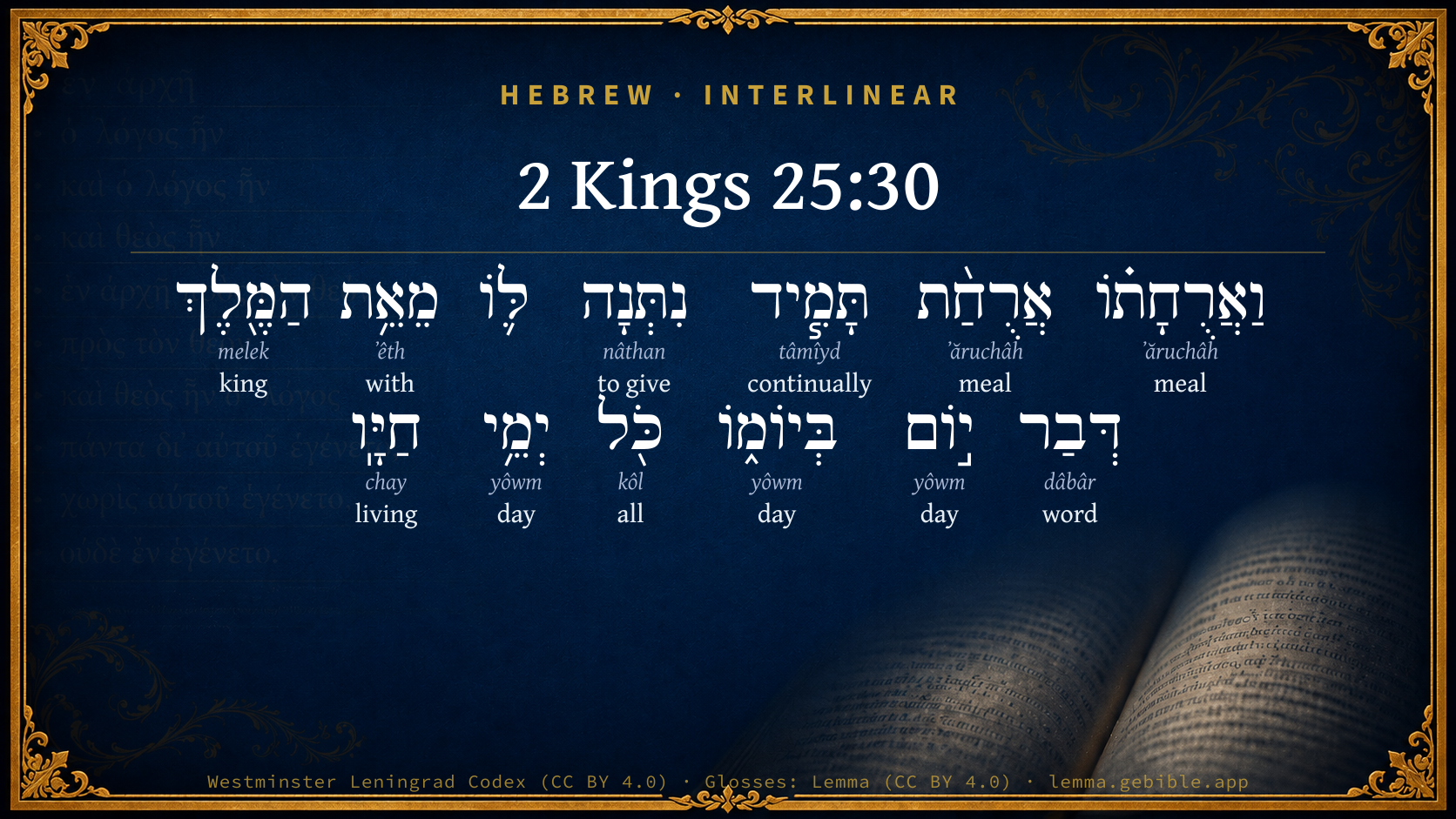
Hebrew (Westminster Leningrad Codex) 2 Kings 25:30 appears in the Hebrew Old Testament. The text above is from the Westminster Leningrad Codex. Each word links to its Strong’s number, a concise gloss, and parsing drawn from the Open Scriptures Hebrew Bible morphology. Click any word for its full Brown-Driver-Briggs (BDB) entry.
Download image
Cite this verse

2 Kings 25:30 (World English Bible). Public Domain. Lemma interlinear Bible study tool, https://lemma.gebible.app/v/2-kings/25/30.

Show BibTeX & RIS
BibTeX
RIS
English Translation
and for his allowance, there was a continual allowance given him of the king, every day a portion, all the days of his life.
World English Bible · Public Domain
Highlights
  • 1 first appearance in the Hebrew Bible
Full analysis ↓
Download a study sheet

One document with this verse’s original text, its word-by-word gloss line, the meaning frame, cross-references with their text, attributed commentary, and full source and license credits — printable, and it pastes into notes with its structure intact.

This verse Autodidact and up

Study sheet (.html) Plain text (.txt)

A passage Seminary Student

Up to 50 verses in one chapter. A passage sheet keeps up to 6 commentary sources and 12 cross-references per verse, in the order this page ranks them, and says so on the sheet whenever that leaves anything out. Ask for a single verse and you get the Autodidact verse sheet above.

Everything on this page stays free to read, with no account — the sheet is a download of what is already on screen, not access to it.

Want to remove ads? Support Godless Engineer
Compare translations 3

The same verse in 3 English versions, stacked beneath the original-language interlinear above. Click any original word for its lexicon entry.

Each is an independent rendering of the whole verse — the interlinear is not word-aligned to these translations.

Highlighted words mark where these versions differ — a whole-verse word diff, not a word-by-word alignment.

  • World English Bible Public Domain
    and for his allowance, there was a continual allowance given him of the king, every day a portion, all the days of his life.
  • King James Version Public Domain
    And his allowance was a continual allowance given him of the king, a daily rate for every day, all the days of his life.
  • unfoldingWord Literal Text CC BY-SA 4.0
    And his allowance, a continual allowance, was given to him from the king, a matter of a day in its day, all of the days of his life.

unfoldingWord Literal Text — © unfoldingWord, licensed CC BY-SA 4.0. Word-aligned USFM3 via Door43 (git.door43.org/unfoldingWord/en_ult).

Versions to compare (up to 4)

3 of 4 selected

Show all 18 translations

Every available English version of this verse, each an independent rendering of the whole verse.

  • World English Bible Public Domain
    and for his allowance, there was a continual allowance given him of the king, every day a portion, all the days of his life.
  • Berean Standard Bible Public Domain
    And the king provided Jehoiachin a daily portion for the rest of his life.
  • Majority Standard Bible Public Domain
    And the king provided Jehoiachin a daily portion for the rest of his life.
  • King James Version Public Domain
    And his allowance was a continual allowance given him of the king, a daily rate for every day, all the days of his life.
  • American Standard Version (1901) Public Domain
    and for his allowance, there was a continual allowance given him of the king, every day a portion, all the days of his life.
  • Revised Version (1885) Public Domain
    and for his allowance, there was a continual allowance given him of the king, every day a portion, all the days of his life.
  • Geneva Bible (1599) Public Domain
    And his portion was a continual portion giuen him by the King, euery day a certaine, all the dayes of his life.
  • Douay-Rheims (1899) Public Domain
    And he appointed him a continual allowance, which was also given him by the king day by day, all the days of his life.
  • Young's Literal Translation Public Domain
    and his allowance -- a continual allowance -- hath been given to him from the king, the matter of a day in its day, all days of his life.
  • Literal Standard Version CC BY-SA 4.0
    and his allowance—a continual allowance—has been given to him from the king, the matter of a day in its day, all [the] days of his life.
  • Unlocked Literal Bible CC BY-SA 4.0
    A regular food allowance was given to him every day for the rest of his life.
  • unfoldingWord Literal Text CC BY-SA 4.0
    And his allowance, a continual allowance, was given to him from the king, a matter of a day in its day, all of the days of his life.
  • Darby Bible Public Domain
    and his allowance was a continual allowance given him by the king, every day a portion, all the days of his life.
  • World Messianic Bible Public Domain
    and for his allowance, there was a continual allowance given him from the king, every day a portion, all the days of his life.
  • Webster's Bible Public Domain
    And his allowance was a continual allowance given him by the king, a daily rate for every day, all the days of his life.
  • Free Bible Version CC BY-SA 4.0
    The king provided Jehoiachin with a daily allowance for the rest of his life.
  • Bible in Basic English Public Domain
    And for his food, the king gave him a regular amount every day for the rest of his life.
  • JPS Tanakh (1917) Public Domain
    And for his allowance, there was a continual allowance given him of the king, every day a portion, all the days of his life.

Literal Standard Version (2020), Covenant Press — licensed CC BY-SA 4.0. Text via the HelloAO Bible API (eBible.org). Unlocked Literal Bible (unfoldingWord) — licensed CC BY-SA 4.0. Text via the HelloAO Bible API (eBible.org). unfoldingWord Literal Text — © unfoldingWord, licensed CC BY-SA 4.0. Word-aligned USFM3 via Door43 (git.door43.org/unfoldingWord/en_ult). Free Bible Version, Dr. Jonathan Gallagher — licensed CC BY-SA 4.0. Text via the HelloAO Bible API (eBible.org).

Word by word

More ways to search: Search by grammar → Find every occurrence → Compare this word →

Practice this passage: Drill this verse → Learn its vocabulary →

וַאֲרֻחָת֗וֹ
ʼăruchâh
H737
“and · meal · his”
Conjunction + Noun, Common, Feminine, Singular, Construct + Suffix, Personal, 3rd Person, Masculine, Singular
Part of Speech
Conjunction + Noun
Type
Common
Gender
Feminine
Number
Singular
State
Construct
Full BDB Definition

Origin: passive participle of H732 (in the sense of appointing)

TWOT: 161b

meal, allowance, ration - food - diet
  1. אֲרֻחַ֨ת ʼăruchâh H737 “meal of” Noun, Common, Feminine, Singular, Construct
  2. תָּמִ֧יד tâmîyd H8548 “continually” Noun, Common, Masculine, Singular, Absolute
  3. נִתְּנָה nâthan H5414 “to give” Verb, Niphal, Perfect, 3rd Person, Feminine, Singular
  4. מֵאֵ֥ת ʼêth H854 “from · with” Preposition + Preposition
  5. הַמֶּ֖לֶךְ melek H4428 “the · king” Particle, Definite Article + Noun, Common, Masculine, Singular, Absolute
  6. דְּבַר dâbâr H1697 “word of” Noun, Common, Masculine, Singular, Construct
  7. י֣וֹם yôwm H3117 “day” Noun, Common, Masculine, Singular, Absolute
  8. בְּיוֹמ֑וֹ yôwm H3117 “in/at · day · his” Preposition + Noun, Common, Masculine, Singular, Construct + Suffix, Personal, 3rd Person, Masculine, Singular
  9. כֹּ֖ל kôl H3605 “all of” Noun, Common, Masculine, Singular, Construct
  10. יְמֵ֥י yôwm H3117 “days of” Noun, Common, Masculine, Plural, Construct
  11. חַיָּֽו chay H2416 “living things · his” Noun, Common, Masculine, Plural, Construct + Suffix, Personal, 3rd Person, Masculine, Singular

About this verse

These counts appear in no published source. They are computed here, from the morphology-tagged text and Lemma’s own curated glosses. What Lemma adds →

13
words
9
distinct lemmas
Historical
section

Notable vocabulary

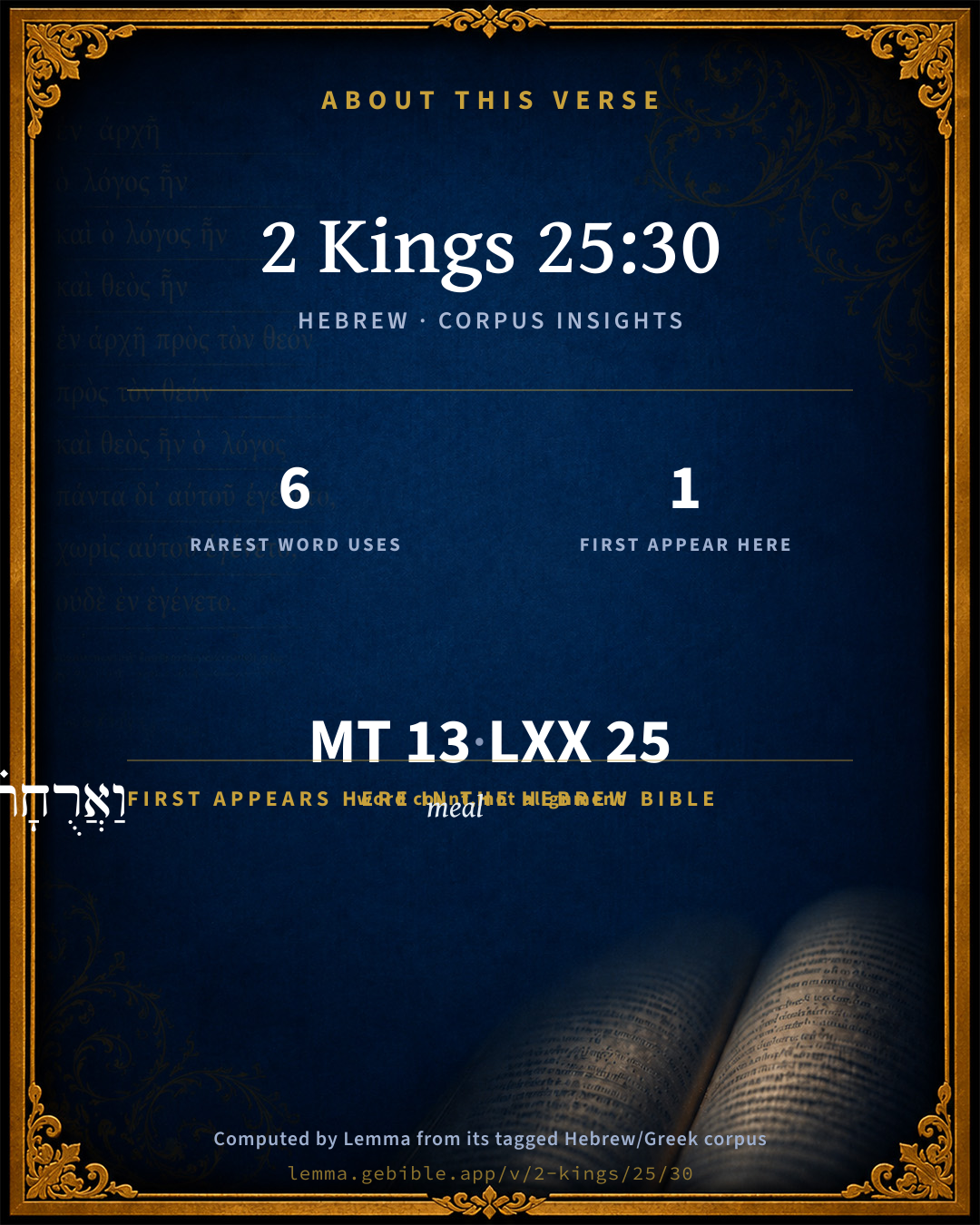
The rarest word here is וַאֲרֻחָת֗וֹ meal H737 — appearing just 6 times in the whole Hebrew Bible.

First appearance in Scripture

This word makes its first canonical appearance in the Hebrew Bible here:

  • וַאֲרֻחָת֗וֹ meal H737

Shared distinctive vocabulary

וַאֲרֻחָת֗וֹ meal H737 occurs in 4 verses of the Hebrew Bible. Also found in:

Grammatical profile

  • 1 verb
  • 10 nouns
  • 2 prepositions

Verb forms

  • נִתְּנָה Niphal · Perfect

Repetition

Words recur within this verse — often emphatic in Hebrew:

  • י֣וֹם day H3117 ×3
  • וַאֲרֻחָת֗וֹ meal H737 ×2

Hebrew & Septuagint length

In English translation the verse runs 24 words from the Hebrew and 28 from the Septuagint (LXX English) — closely comparable.

A rough comparison of the two English renderings, which tokenize alike — not a word-level alignment.

Word counts can differ between the Hebrew and the Greek without any difference in meaning — e.g. the Hebrew direct-object marker אֵת has no separate Greek word, and Greek often adds the article ὁ.

In the original languages it is 13 Hebrew tokens and 25 Greek tokens — but the two are counted differently (Hebrew bundles its prefixes and suffixes into one token; the Greek is in lemma form), so that isn’t a like-for-like length.

Cross-references

7

Topical passages linked to 2 Kings 25:30 in the Treasury of Scripture Knowledge — connected by theme and wording, ordered by reader-vote popularity; previews shown in the World English Bible.

  • Luke 11:3 Give us day by day our daily bread.
  • Nehemiah 11:23 For there was a commandment from the king concerning them, and a settled provision for the singers, as every day required.
  • Matthew 6:11 Give us today our daily bread.
  • Nehemiah 12:47 All Israel in the days of Zerubbabel, and in the days of Nehemiah, gave the portions of the singers and the porters, as every day required: and they set apart [that which was] for the Levites; and the Levites set apart [that which was] for the sons of Aaron.
  • Daniel 1:5 The king appointed for them a daily portion of the king's dainties, and of the wine which he drank, and that they should be nourished three years; that at the end of it they should stand before the king.
  • Genesis 48:15–16 He blessed Joseph, and said, "The God before whom my fathers Abraham and Isaac did walk, the God who has fed me all my life long to this day,
  • Acts 6:1 Now in those days, when the number of the disciples was multiplying, a complaint arose from the Grecian Jews against the Hebrews because their widows were neglected in the daily service.

Cross-references courtesy of OpenBible.info (CC BY 4.0).

Hebrew and Greek witnesses Masoretic Hebrew ↔ Greek Septuagint

The same verse in the two great witnesses to the Old Testament, shown verse-for-verse.

These are two independent witnesses, not word-aligned to each other, and the Septuagint is shown in lemma (dictionary) form.

Hebrew 2 Kings 25:30 Masoretic · Westminster Leningrad Codex

וַאֲרֻחָת֗וֹ אֲרֻחַ֨ת תָּמִ֧יד נִתְּנָה לּ֛וֹ מֵאֵ֥ת הַמֶּ֖לֶךְ דְּבַר י֣וֹם בְּיוֹמ֑וֹ כֹּ֖ל יְמֵ֥י חַיָּֽו

and for his allowance, there was a continual allowance given him of the king, every day a portion, all the days of his life.

World English Bible · Public Domain

Greek LXX 2 Kings 25:30 Septuagint · lemma form

καί ὁ ἑστιατορία αὐτός ἑστιατορία διά πᾶς δίδωμι αὐτός ἐκ οἶκος ὁ βασιλεύς λόγος ἡμέρα ἐν ὁ ἡμέρα αὐτός πᾶς ὁ ἡμέρα ὁ ζωή αὐτός

And his portion, a continual portion, was given him out of the house of the king, a daily rate for every day all the days of his life.

LXX2012 (modern English Septuagint) · Public Domain

Hebrew: Westminster Leningrad Codex (CC BY 4.0). Greek: Septuagint (public domain); English from LXX2012 (modern English Septuagint) (Public Domain). How the Septuagint differs from the Hebrew →

Targum (Aramaic paraphrase)

1

The Targum is the ancient Jewish Aramaic paraphrase of the Hebrew Scriptures — an interpretive translation, not the Hebrew text itself. Onkelos (literal) and Pseudo-Jonathan (expansive) render the Torah, and Jonathan the Prophets. Coverage is partial: where no permissively-licensed English translation exists for a verse, only the Aramaic is shown. This is verse-level text, not a word-by-word alignment to the Hebrew.

  1. Targum Jonathan Prophets (Joshua–Malachi)
    וְשֵׁירוּתֵיהּ שֵׁירוּת תְּדִירָא מִתְיַהֲבָא לֵיהּ מִן קֳדָם מַלְכָּא פִּתְגַם יוֹם בְּיוֹמֵיהּ כָּל יוֹמֵי חַיוֹהִי:

    (no public-domain English translation for this verse)

    Targum Jonathan — Aramaic: “Mikraot Gedolot” (public domain). English: “Sefaria Community Translation” (CC0 1.0 (public-domain dedication)); “London "Chaldee Paraphrase," 1871” (public domain). Text via Sefaria.

Commentary

Notes on 2 Kings 25:30 from classic Christian and Jewish commentators (each source and its license shown beneath its notes). The classic Christian expositions comment on the surrounding passage and are grouped to its opening verse, so a note may address several verses; the Jewish commentaries on the Tanakh (Rashi and others) are per-verse, so they appear only where the commentator wrote on this verse.

Lemma curates 59 commentaries, every one of them public domain or Creative Commons licensed, each selected and text-cleaned for this edition rather than reprinted as found. About our sources →

Trapp's Complete Commentary

John Trapp

2Ki 25:30 And his allowance [was] a continual allowance given him of the king, a daily rate for every day, all the days of his life.

Ver. 30. And his allowance was a continual allowance.] So is or might be every true believers’ portion: who should therefore "eat his bread with joy, and drink his wine with cheerfulness all the days of his life," which are not to be numbered by the hours, but measured by spiritual mirth; as moneys are not by tale, but by value.

All the days of his life.] Evilmerodach reigned little more than two years; being treacherously slain by Neriglissorus, his own sister’s husband; as Berosus, {a} cited by Josephus, {b} writeth: and some hold it probable from this text, that Jechoniah also died about the same time, being seven and fifty years of age.

{a} Rer. Chaldaic., lib. xxx.

{b} Lib. i., cont. Apion.

Soli Deo Gloria

John Trapp, A Commentary or Exposition upon All the Books of the Old and New Testament (1647–1656) — public domain. Text from a community e-Sword module.

Geneva Bible (1599)

Geneva Bible translators

Meaning, that he had an ordinary in the court.

Geneva Bible (1599) marginal notes — public domain. Text via Bolls.life.

Adam Clarke's Commentary

Verse 30. A continual allowance given him of the king] He lived in a regal style, and had his court even in the city of Babylon, being supplied with every requisite by the munificence and friendship of the king. In about two years after this, Evil-merodach was slain in a conspiracy; and it is supposed that Jehoiachin, then about fifty-eight years of age, fell with his friend and protector. Thus terminates the catastrophe of the Jewish kings, people, and state; the consequence of unheard-of rebellions and provocations against the Majesty of heaven.

MASORETIC NOTES ON THE FIRST AND SECOND BOOKS OF KINGS

WE have already seen that the Hebrews consider these two books as one: -

The NUMBER of verses in both is one thousand five hundred and thirty-four.

MASORETIC SECTIONS, thirty-five.

MIDDLE VERSE, 1Kg 21:6. And he said unto her, Because I spake unto Naboth the Jezreelite, and said unto him, Give me, &c.

Adam Clarke's Commentary on the Bible (1810–1826) — public domain. Text from a community e-Sword/MySword module.

Ellicott's Commentary for English Readers

(30) His allowance.—For the maintenance of his little court. Literally, And (as for) his allowance a continual allowance was given him from the king, a day’s portion in its day.

All the days of his (Jehoiachin’s) life.—He may have died before Evil-merodach was murdered. There would be nothing strange in this, considering his age and his thirty-seven years of imprisonment.

The writer evidently dwells with pleasure on this faint gleam of light amid the darkness of the exile. It was a kind of foreshadowing of the pity which afterwards was to be extended to the captive people, when the divine purpose had been achieved, and the exile had done its work of chastisement and purification. (Comp, Psa_106:46; Ezr_9:9; Neh_2:2.)

A Bible Commentary for English Readers, edited by Charles John Ellicott (1878–1897) — public domain. Text from a community e-Sword module.

The Cambridge Bible for Schools and Colleges

gen. ed. J. J. S. Perowne

30. And his [R.V. for his] allowance] i.e. He was assigned a regular amount in money or in kind for the keeping of such attendants as a captive king might be supposed to require.

a daily rate for every day] R.V. every day a portion. This is the A.V. rendering in Jer_52:34, where the history says ‘until the day of his death all the days of his life’, an emphatic mode of expressing that the king’s mind did not change, nor was the arrangement altered by Evil-merodach’s successor.

The Cambridge Bible for Schools and Colleges (gen. ed. J. J. S. Perowne; Cambridge University Press, 1878–1918) — public domain. Text from a community e-Sword module.

Albert Barnes' Notes on the Bible

Allowance - From the treasury, in order to enable him to maintain the state proper to his rank, and in addition to his food at the royal table. Jehoiachin, to the day of his death, lived in peace and comfort at the court of Babylon (compare Jer 52:34).

Albert Barnes' Notes on the Bible (1834–1885) — public domain. Text from a community e-Sword/MySword module.

Haydock's Catholic Bible Commentary

His life, may be referred to Evilmerodach, unless Joachin was involved in his disgrace, and perished at the same time. Perhaps the king of Juda did not always eat at the table of Evilmerodach, but received his meat from it, as was customary. (Syriac, &c.) (Calmet) --- He received all that was necessary to support his household, daily. (Grotius) --- In Jeremias lii. 34., until the day of his death, seems to be an useless "tautology," which is omitted here, and in "our oldest manuscript," says Kennicott; who observes that whoever will compare these passages, "will find many variations, and some corruptions." But most of them may be easily explained, ver. 3, 8, 27, &c. (Haydock)

George Leo Haydock (1774–1849), Haydock's Catholic Family Bible and Commentary, 1859 edition — public domain. Excludes Psalms (Douay-Rheims chapter numbering differs from Protestant) and Deuterocanonical books (Catholic canon only).

Whedon's Commentary on the Bible

Daniel D. Whedon

30. A continual allowance — A daily apportionment for the support of the servants and attendants who ministered to the captive king. All this kind and honourable treatment of the long-imprisoned king of Judah was to the Jewish exiles a consolatory sign that Jehovah would dispose the heart of some king to release them from their exile, and restore them to their fatherland again. And thus this history appropriately closes with a ray of light breaking in upon the future of Judah, and assuring these exiles that Jehovah is “the tower of salvation for his king, and showeth mercy to his anointed, unto David, and to his seed for evermore.” 2Sa_22:51.

Daniel D. Whedon (gen. ed.), Commentary on the Old and New Testaments (1874–1909) — public domain. Text from a community e-Sword module.

The Pulpit Commentary

And his allowance was a continual allowance. Keil supposes that this "allowance" was a daily "ration of food," intended for the maintenance of a certain number of servants or retainers. But it is quite as likely to have been a money payment. The word translated by "allowance tjrua does not point necessarily to food. It is a "portion" of any kind. Given him of the kingi.e. , out of the privy purse, by the king"s commanda daily rate for every day or, a certain amount day by dayall the days of his life (see the comment on the preceding verse). Beth the privileges accorded to Jehoiachin, his sustenance at the king"s table, and his allowance, whether in money or in kind, continued to the day of his death. Neither of them was ever revoked or forfeited. Thus this last representative of the Davidic monarchy, after thirty-six years of chastisement, experienced a happy change of circumstances, and died in peace and comfort. Probably, as Keil says, "this event was intended as a comforting sign to the whole of the captive people, that the Lord would one day put an end to their banishment, if they would acknowledge that it was a well-merited punishment for their sins that they had been driven away from before his face, and would turn again to the Lord their God with all their heart."

The Pulpit Commentary (1880–1919), ed. H.D.M. Spence-Jones & Joseph S. Exell — public domain. Text from a community e-Sword module.

John Wesley's Explanatory Notes

All the days of his life - Let none say, they shall never see good again, because they have long seen little but evil. The most afflicted know not what blessed turn providence may yet give to their affairs.

John Wesley, Explanatory Notes Upon the Whole Bible (1754–1765) — public domain. Text via the GEBible commentary corpus.

Lesson kit

Teaching starters — assembled from the data on this page, not authored interpretation. Every prompt links to the verse data it draws on. Edit before teaching.

2 Kings, in the Historical, opens this verse with 13 words (9 distinct Hebrew lemmas). Its most distinctive word is ʼăruchâh (“meal”). A historical commentator’s framing appears above. Read the whole chapter for the surrounding context.

Discussion questions

  1. The word ʼăruchâh carries the sense “meal.” How does it shape the verse?
  2. The word “meal” first appears here in Scripture. What is being introduced at this debut?
  3. Proverbs 15:17 shares the word «meal» with this verse. How do the two illuminate each other?
  4. “day” occurs 3× in this one verse. What is the effect of the repetition?
  5. These translations render this verse differently. What is at stake in choosing one wording over another?
  6. The verb «נִתְּנָה» is Niphal Perfect. How does its form color the action?
  7. Reading how Trapp's Complete Commentary and Geneva Bible (1599) read this verse, where do the two commentators agree and where do they part?

Things to notice

Reading settings

Reading text

Shown beneath each verse's original-language words.

Old Testament
Old Testament edition

Read the OT as the Masoretic Hebrew (MT) or the Greek Septuagint (LXX).

English shown for the Greek Septuagint (in the Hebrew ↔ Greek comparison).

Comparing translations? Open the Compare panel on any verse page to stack up to four side by side.