
Psalms 69:23

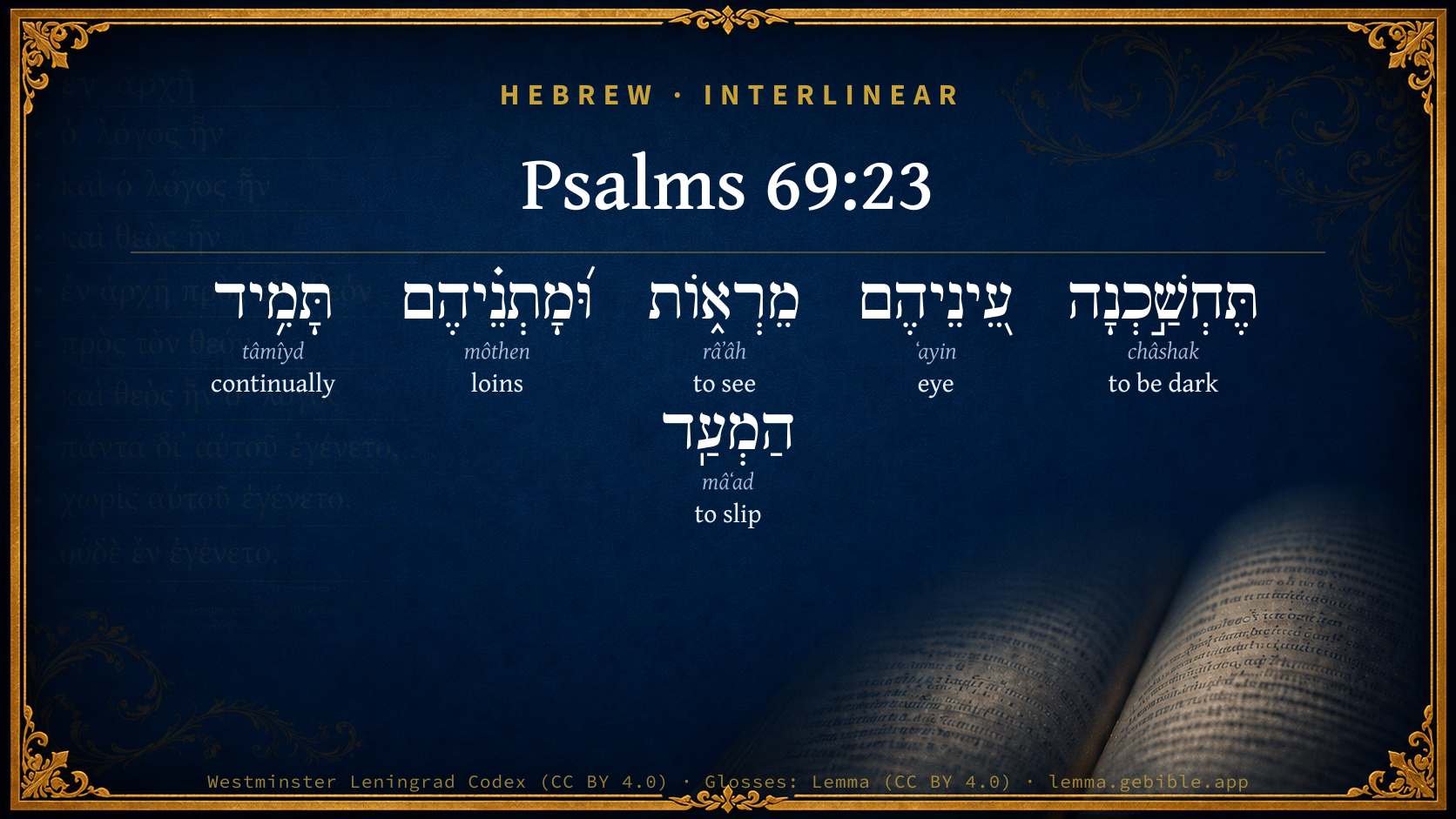
Hebrew (Westminster Leningrad Codex) Psalms 69:23 appears in the Hebrew Old Testament. The text above is from the Westminster Leningrad Codex. Each word links to its Strong’s number, a concise gloss, and parsing drawn from the Open Scriptures Hebrew Bible morphology. Click any word for its full Brown-Driver-Briggs (BDB) entry.
Download image
Cite this verse

Psalms 69:23 (World English Bible). Public Domain. Lemma interlinear Bible study tool, https://lemma.gebible.app/v/psalms/69/23.

Show BibTeX & RIS
BibTeX
RIS
English Translation
Let their eyes be darkened, so that they can't see. Let their backs be continually bent.
World English Bible · Public Domain
Download a study sheet

One document with this verse’s original text, its word-by-word gloss line, the meaning frame, cross-references with their text, attributed commentary, and full source and license credits — printable, and it pastes into notes with its structure intact.

This verse Autodidact and up

Study sheet (.html) Plain text (.txt)

A passage Seminary Student

Up to 50 verses in one chapter. A passage sheet keeps up to 6 commentary sources and 12 cross-references per verse, in the order this page ranks them, and says so on the sheet whenever that leaves anything out. Ask for a single verse and you get the Autodidact verse sheet above.

Everything on this page stays free to read, with no account — the sheet is a download of what is already on screen, not access to it.

Want to remove ads? Support Godless Engineer
Compare translations 3

The same verse in 3 English versions, stacked beneath the original-language interlinear above. Click any original word for its lexicon entry.

Each is an independent rendering of the whole verse — the interlinear is not word-aligned to these translations.

Highlighted words mark where these versions differ — a whole-verse word diff, not a word-by-word alignment.

  • World English Bible Public Domain
    Let their eyes be darkened, so that they can't see. Let their backs be continually bent.
  • King James Version Public Domain
    Let their eyes be darkened, that they see not; and make their loins continually to shake.
  • unfoldingWord Literal Text CC BY-SA 4.0
    Let their eyes darken from seeing, and make their loins tremble continually.

unfoldingWord Literal Text — © unfoldingWord, licensed CC BY-SA 4.0. Word-aligned USFM3 via Door43 (git.door43.org/unfoldingWord/en_ult).

Versions to compare (up to 4)

3 of 4 selected

Show all 18 translations

Every available English version of this verse, each an independent rendering of the whole verse.

  • World English Bible Public Domain
    Let their eyes be darkened, so that they can't see. Let their backs be continually bent.
  • Berean Standard Bible Public Domain
    May their eyes be darkened so they cannot see, and their backs be bent forever.
  • Majority Standard Bible Public Domain
    May their eyes be darkened so they cannot see, and their backs be bent forever.
  • King James Version Public Domain
    Let their eyes be darkened, that they see not; and make their loins continually to shake.
  • American Standard Version (1901) Public Domain
    Let their eyes be darkened, so that they cannot see; And make their loins continually to shake.
  • Revised Version (1885) Public Domain
    Let their eyes be darkened, that they see not; and make their loins continually to shake.
  • Geneva Bible (1599) Public Domain
    Let their eyes be blinded that they see not: and make their loynes alway to tremble.
  • Douay-Rheims (1899) Public Domain
    Let their table become as a snare before them, and a recompense, and a stumblingblock.
  • Young's Literal Translation Public Domain
    Darkened are their eyes from seeing, And their loins continually shake Thou.
  • Literal Standard Version CC BY-SA 4.0
    Their eyes are darkened from seeing, || And their loins continually shake You.
  • Unlocked Literal Bible CC BY-SA 4.0
    Let their eyes be darkened so that they cannot see; and always make their loins shake.
  • unfoldingWord Literal Text CC BY-SA 4.0
    Let their eyes darken from seeing, and make their loins tremble continually.
  • Darby Bible Public Domain
    Let their eyes be darkened, that they see not, and make their loins continually to shake.
  • World Messianic Bible Public Domain
    Let their eyes be darkened, so that they can’t see. Let their backs be continually bent.
  • Webster's Bible Public Domain
    \\69:22\\Let their table become a snare before them: and that which should have been for their welfare, let it become a trap.
  • Free Bible Version CC BY-SA 4.0
    May their eyes become blind so they cannot see, and may their backs always be bent low in dejection.
  • Bible in Basic English Public Domain
    Let their eyes be blind so that they may not see; let their bodies for ever be shaking.
  • JPS Tanakh (1917) Public Domain
    (69-24) Let their eyes be darkened, that they see not; and make their loins continually to totter.

Literal Standard Version (2020), Covenant Press — licensed CC BY-SA 4.0. Text via the HelloAO Bible API (eBible.org). Unlocked Literal Bible (unfoldingWord) — licensed CC BY-SA 4.0. Text via the HelloAO Bible API (eBible.org). unfoldingWord Literal Text — © unfoldingWord, licensed CC BY-SA 4.0. Word-aligned USFM3 via Door43 (git.door43.org/unfoldingWord/en_ult). Free Bible Version, Dr. Jonathan Gallagher — licensed CC BY-SA 4.0. Text via the HelloAO Bible API (eBible.org).

Word by word

More ways to search: Search by grammar → Find every occurrence → Compare this word →

Practice this passage: Drill this verse → Learn its vocabulary →

About this verse

These counts appear in no published source. They are computed here, from the morphology-tagged text and Lemma’s own curated glosses. What Lemma adds →

6
words
6
distinct lemmas
Wisdom
section

Notable vocabulary

The rarest word here is הַמְעַֽד to slip H4571 — appearing just 6 times in the whole Hebrew Bible.

Shared distinctive vocabulary

הַמְעַֽד to slip H4571 occurs in 6 verses of the Hebrew Bible. Also found in:

Grammatical profile

  • 3 verbs
  • 3 nouns

Verb forms

  • תֶּחְשַׁ֣כְנָה Qal · Imperfect
  • מֵרְא֑וֹת Qal · Infinitive Construct
  • הַמְעַֽד Hiphil · Imperative

Hebrew & Septuagint length

In English translation the verse runs 16 words from the Hebrew and 16 from the Septuagint (LXX English) — the same length.

A rough comparison of the two English renderings, which tokenize alike — not a word-level alignment.

Word counts can differ between the Hebrew and the Greek without any difference in meaning — e.g. the Hebrew direct-object marker אֵת has no separate Greek word, and Greek often adds the article ὁ.

Cross-references

12

Topical passages linked to Psalms 69:23 in the Treasury of Scripture Knowledge — connected by theme and wording, ordered by reader-vote popularity; previews shown in the World English Bible.

  • Daniel 5:6 Then the king's face was changed in him, and his thoughts troubled him; and the joints of his loins were loosened, and his knees struck one against another.
  • Romans 11:10 Let their eyes be darkened, that they may not see. Bow down their back always."
  • Isaiah 6:9–10 He said, "Go, and tell this people, 'You hear indeed, But don't understand; And you see indeed, But don't perceive.'
  • 2 Corinthians 3:14 But their minds were hardened, for until this very day at the reading of the old covenant the same veil remains, because in Christ it passes away.
  • Isaiah 21:3–4 Therefore are my loins filled with anguish; pangs have taken hold on me, as the pangs of a woman in travail: I am pained so that I can't hear; I am dismayed so that I can't see.
  • Jeremiah 30:6 Ask now, and see whether a man does travail with child: why do I see every man with his hands on his loins, as a woman in travail, and all faces are turned into paleness?
  • Acts 28:26–27 saying, 'Go to this people, and say, In hearing, you will hear, But will in no way understand. In seeing, you will see, But will in no way perceive.
  • Deuteronomy 28:65–67 Among these nations shall you find no ease, and there shall be no rest for the sole of your foot: but Yahweh will give you there a trembling heart, and failing of eyes, and pining of soul;
  • Isaiah 29:9–10 Stay you and wonder; take your pleasure and be blind: they are drunken, but not with wine; they stagger, but not with strong drink.
  • Matthew 13:14–15 In them the prophecy of Isaiah is fulfilled, which says, 'By hearing you will hear, And will in no way understand; Seeing you will see, And will in no way perceive:
  • John 12:39–40 For this cause they couldn't believe, for Isaiah said again,
  • Romans 11:25 For I don't desire, brothers, to have you ignorant of this mystery, so that you won't be wise in your own conceits, that a partial hardening has happened to Israel, until the fullness of the Gentiles has come in,

Cross-references courtesy of OpenBible.info (CC BY 4.0).

Hebrew and Greek witnesses Masoretic Hebrew ↔ Greek Septuagint

The same verse in the two great witnesses to the Old Testament, shown verse-for-verse.

You’re reading Greek Psalm 68 (Hebrew Psalm 69). The Septuagint counts the superscription, so verse numbers can differ from the Hebrew — chapter-level alignment, not verse-by-verse. Numbering follows Rahlfs.

These are two independent witnesses, not word-aligned to each other, and the Septuagint is shown in lemma (dictionary) form.

Hebrew Psalms 69:23 Masoretic · Westminster Leningrad Codex

תֶּחְשַׁ֣כְנָה עֵ֭ינֵיהֶם מֵרְא֑וֹת וּ֝מָתְנֵ֗יהֶם תָּמִ֥יד הַמְעַֽד

Let their eyes be darkened, so that they can't see. Let their backs be continually bent.

World English Bible · Public Domain

Greek LXX Greek Psalm 68:23 Septuagint · lemma form

γίγνομαι ὁ τράπεζα αὐτός ἐνώπιον αὐτός εἰς παγίς καί εἰς ἀνταπόδοσις καί εἰς σκάνδαλον

Let their eyes be darkened that they should not see; and bow down their back continually.

LXX2012 (modern English Septuagint) · Public Domain

Hebrew: Westminster Leningrad Codex (CC BY 4.0). Greek: Septuagint (public domain); English from LXX2012 (modern English Septuagint) (Public Domain). How the Septuagint differs from the Hebrew →

Commentary

Notes on Psalms 69:23 from classic Christian and Jewish commentators (each source and its license shown beneath its notes). The classic Christian expositions comment on the surrounding passage and are grouped to its opening verse, so a note may address several verses; the Jewish commentaries on the Tanakh (Rashi and others) are per-verse, so they appear only where the commentator wrote on this verse.

Lemma curates 59 commentaries, every one of them public domain or Creative Commons licensed, each selected and text-cleaned for this edition rather than reprinted as found. About our sources →

Trapp's Complete Commentary

John Trapp

Psa 69:23 Let their eyes be darkened, that they see not; and make their loins continually to shake.

Ver. 23. Let their eyes be darkened] Let them be infatuated and besotted, that they may go hoodwinked to hell.

And make their loins continually to shake] Ne fugiant, saith R. Obadiah Gaon, that they may not be able to fly, or otherwise to help themselves; for in the loins and reins of a man lieth his strength, Deu 33:11. The Syriac hath it, Lumbi eorum sint curvi, viz. under their enemies’ burdens. See Rom 11:10, bow down their backs.

John Trapp, A Commentary or Exposition upon All the Books of the Old and New Testament (1647–1656) — public domain. Text from a community e-Sword module.

Joseph Benson's Commentary

Psa 69:23. Let their eyes, &c. — Their eyes shall be darkened — Not the eyes of their bodies, (for, in that sense, the prediction was neither accomplished in David’s nor in Christ’s enemies,) but of their minds, that they will not discern God’s truth, nor their own duty, nor the way of peace and salvation. As they shut their eyes and will not see, so they shall be judicially blinded. This was most solemnly threatened, or rather foretold, Isa 6:9-12, and most awfully fulfilled: see the margin. “They who loved darkness rather than light,” says Dr. Horne, “were permitted by the righteous judgment of God to go on in darkness, while the blind led the blind. And such still continues to be the state of the Jews, notwithstanding that intolerable weight of wo which made their loins to shake, and bowed down their backs to the earth. The veil remaineth yet upon their hearts, in the reading of the Old Testament, nor can they see therein the things which belong to their peace.”

Joseph Benson's Commentary on the Old and New Testaments (1811–1818) — public domain. Text from a community e-Sword module.

J. A. Alexander on Psalms

Joseph Addison Alexander

24. (Psa 69:23). Let their eyes darken, i.e. be or grow dark, from seeing, so as not to see, and their loins do thou cause to bend, give way, or swerve, i.e. paralyse their strength. See above, on Psa 66:9. The first clause probably does not refer to blindness, but either to the dimness of the eyes in death, or to darkness as a figure for calamity in general.

Joseph Addison Alexander, The Psalms Translated and Explained (1850) — public domain. Text from a community e-Sword module.

Geneva Bible (1599)

Geneva Bible translators

Take both judgment and power from them, Acts 1:20.

Geneva Bible (1599) marginal notes — public domain. Text via Bolls.life.

Jamieson, Fausset & Brown

Robert Jamieson, A. R. Fausset & David Brown

continually to shake--literally, "to swerve" or bend in weakness.

Jamieson, Fausset & Brown — Commentary Critical and Explanatory on the Whole Bible (1871) — public domain (CC PDM 1.0). Text via the HelloAO Bible API.

John Calvin's Commentaries

23. Let their eyes be darkened, that they may not see. The Psalmist here refers chiefly to two powers of the body, those of the eyes and of the loins; and I have no hesitation in considering his language as a prayer that God would deprive his enemies of reason and understanding, and at the same time enfeeble their strength, that they might be altogether unfitted for exerting themselves in any way. We know how indispensable it is, in order to the doing of any thing aright, that counsel go before to give light, and that there should also be added the power of putting what is purposed into execution. The curse here expressed impends over the heads of all the enemies of the Church; and, therefore, we have no reason to be terrified at the malice or fury of the wicked. God, whenever he pleases, can strike them suddenly with blindness, that they may see nothing, and by breaking their loins, lay them prostrate in shame and confusion.

John Calvin's Commentaries (1540-1563) — public domain. Text from the Calvin Translation Society English edition (1840s-50s) via the Christian Classics Ethereal Library (ccel.org). Calvin's coverage is partial (roughly two-thirds of the Bible); uncommented books and verses are honest gaps, never fabricated. The 19th-century editor's footnotes and remarks are omitted so the notes are faithfully Calvin's own voice.

Ellicott's Commentary for English Readers

(23) Their eyes.—The darkened eyes and trembling limbs (comp. Nah_2:10; Dan_5:6) are expressive of terror and dismay.

A Bible Commentary for English Readers, edited by Charles John Ellicott (1878–1897) — public domain. Text from a community e-Sword module.

The Cambridge Bible for Schools and Colleges

gen. ed. J. J. S. Perowne

23. Let the eyes which gloated over another’s misfortunes be blinded: let the limbs which are the seat of the strength they have abused be palsied.

The Cambridge Bible for Schools and Colleges (gen. ed. J. J. S. Perowne; Cambridge University Press, 1878–1918) — public domain. Text from a community e-Sword module.

John Gill's Exposition

Let their eyes be darkened, that they see not,.... Not literally, the eyes of their bodies; but figuratively, the eyes of their understanding; which were so darkened, and they given up to such judicial blindness, that they could not discern the signs of the times that the Messiah must be come, Daniel's weeks being up; could not see any glory, excellency, and comeliness in Christ; could not see the evidence of the Messiahship of Jesus in the miracles he wrought; nor in the prophecies of the Old Testament fulfilled in him: that book was a sealed book unto them; the Gospel, and the doctrines of it, were hid from them, even from the wise and prudent among them; yea, also those things which belonged to their temporal peace; they were so blinded and infatuated, they could not see what was for their outward good and happiness: and, in proof of this their blindness, the words are cited by the apostle in Rom 11:7; see Mat 16:3;

and make their loins continually to shake; weaken their loins, in which a man's strength lies, that they may not be able to rise up against their enemies; and that they might not be able to flee and escape from them; see Deu 33:11; or fill them with horror, dread, and trembling, as they will be when Christ shall come in the clouds of heaven; and they shall see him whom they have pierced, Rev 1:7. The apostle renders the words "bow down their back alway"; See Gill on Rom 11:10.

John Gill's Exposition of the Whole Bible (1746–1763) — public domain (CC PDM 1.0). Text via the HelloAO Bible API.

Matthew Poole's English Annotations

Their eyes; not the eyes of their bodies, (for so this was not accomplished in David’s nor in Christ’s enemies,) but of their minds, that they may not discern God’s truth, nor their own duty, nor the way of peace and salvation. Punish them in their own kind; as they shut their eyes and would not see, so do thou judicially blind them. This was threatened and inflicted upon the Jews, Isa 6:10; Joh 12:39,40.

Their loins: this also belongs to the loins of their minds or souls; of which we read Luk 12:35; 1Pe 1:13. The loins of the body are the seat of strength, and the great instrument of bodily motions and actions; which being applied to the mind, the sense may be, either,

1. Take away their courage and alacrity, and give them up to pusillanimity, and terror, and despair; or rather,

2. Take away their strength and ability for spiritual actions. In the former branch, he wisheth that they may not be able to see or choose their way; and here, that they may not be able to walk in it, nor to execute the good counsels which others may give them. As, on the other side, when God gives men strength, they are able not only to walk, but to run in the ways of God, Psa 119:32; Son 1:4; Isa 40:31.

Matthew Poole's English Annotations on the Holy Bible (1683–1685) — public domain. Text from a community e-Sword/MySword module.

The Treasury of David

Charles H. Spurgeon

Ver. 23. Let their eyes be darkened, that they see not. They shall wander in a darkness that may be felt. They have loved darkness rather than light, and in darkness they shall abide. Judicial blindness fell upon Israel after our Lord's death and their persecution of his apostles; they were blinded by the light which they would not accept. Eyes which see no beauty in the Lord Jesus, but flash wrath upon him, may well grow yet more dim, till death spiritual leads to death eternal.

And make their loins continually to shake. Their conscience shall be so ill at ease that they shall continually quiver with fear; their backs shall bend to the earth (so some read it) with grovelling avarice, and their strength shall be utterly paralysed, so that they cannot walk firmly, but shall totter at every step. See the terrifying, degrading, and enfeebling influence of unbelief. See also the retaliation of justice: those who will not see shall not see; those who would not walk in uprightness shall be unable to do so.

Ver. 23-28. He denounces ten plagues, or effects of God's wrath, to come upon them for their wickedness. David Dickson.

Ver. 23. The judicial curse which falls on some despisers of Christ; their understandings fail to perceive the truth; and they tremble because they are unable to receive strengthening comforts.

Psalms 69:24*

Ver. 23-28. He denounces ten plagues, or effects of God's wrath, to come upon them for their wickedness. David Dickson.

Ver. 23-28. He denounces ten plagues, or effects of God's wrath, to come upon them for their wickedness. David Dickson.

Ver. 23-28. He denounces ten plagues, or effects of God's wrath, to come upon them for their wickedness. David Dickson.

Ver. 23-28. He denounces ten plagues, or effects of God's wrath, to come upon them for their wickedness. David Dickson.

Charles H. Spurgeon's The Treasury of David (1869–1885) — public domain. Psalms only. Text from a community e-Sword/MySword module.

Whedon's Commentary on the Bible

Daniel D. Whedon

23. Let their eyes be darkened—The Hebrew verb is simply in Kal, future, as in the preceding verse, and should be rendered, Their eyes shall be darkened; the darkness being that of the mind, and the fruit of perversity. Men become blinded by evil desire, passion, and prejudice, and in this state rush madly on to ruin, God, meanwhile, withdrawing his Spirit in judgment. See Rom_1:21-26; 2Th_2:9-12.

Their loins… shake—That is, through fear and apprehension, as not knowing whom to trust. See Psa_69:22. “Loins” are here mentioned as the foundation of a man’s strength. Paul quotes it: “Bow down their back alway,” which would be only the effect of weakness and trembling of the “loins” and limbs. Rom_11:10

Daniel D. Whedon (gen. ed.), Commentary on the Old and New Testaments (1874–1909) — public domain. Text from a community e-Sword module.

The Pulpit Commentary

Let their eyes be darkened, that they see not. This may be taken either literally, "let blindness come upon those who have so misused their eyes;" or metaphorically, "let their understandings, which they have partially blinded, be wholly darkened." And make their loins continually to shake. Deprive them of the strength whereof they have boasted, and which they have misapplied.

The Pulpit Commentary (1880–1919), ed. H.D.M. Spence-Jones & Joseph S. Exell — public domain. Text from a community e-Sword module.

John Wesley's Explanatory Notes

Eyes - Not the eyes of their bodies, but of their minds: as they that shut their eyes and will not see, so they shall be judicially blinded. To shake - To take away their strength.

John Wesley, Explanatory Notes Upon the Whole Bible (1754–1765) — public domain. Text via the GEBible commentary corpus.

Rashi

Rabbi Shlomo Yitzchaki (Rashi)

and for peace When they hope for peace, may their peace be turned into a snare.

Rashi on the Tanakh — English translations: “The Judaica Press complete Tanach with Rashi, translated by A. J. Rosenberg” (CC BY 4.0); “Pentateuch with Rashi's commentary by M. Rosenbaum and A.M. Silbermann, 1929-1934” (public domain); “The Metsudah Tanach series, Lakewood, N.J” (CC BY 4.0); and “The Book of Joshua, Metsudah Publications, 1997” (CC BY 4.0). Text via Sefaria.

Lesson kit

Teaching starters — assembled from the data on this page, not authored interpretation. Every prompt links to the verse data it draws on. Edit before teaching.

Psalms, in the Wisdom, opens this verse with 6 words (6 distinct Hebrew lemmas). Its most distinctive word is mâʻad (“to slip”). A historical commentator’s framing appears above. Read the whole chapter for the surrounding context.

Discussion questions

  1. What does “to slip” (mâʻad) contribute to the verse as a whole?
  2. 2 Samuel 22:37 shares the word «to slip» with this verse. How do the two illuminate each other?
  3. These translations render this verse differently; the difference is in the English rendering, not the original. What questions does that raise?
  4. The verb «תֶּחְשַׁ֣כְנָה» is Qal Imperfect. How does its form color the action?
  5. Reading how Trapp's Complete Commentary and Joseph Benson's Commentary read this verse, where do the two commentators agree and where do they part?

Things to notice

Reading settings

Reading text

Shown beneath each verse's original-language words.

Old Testament
Old Testament edition

Read the OT as the Masoretic Hebrew (MT) or the Greek Septuagint (LXX).

English shown for the Greek Septuagint (in the Hebrew ↔ Greek comparison).

Comparing translations? Open the Compare panel on any verse page to stack up to four side by side.