
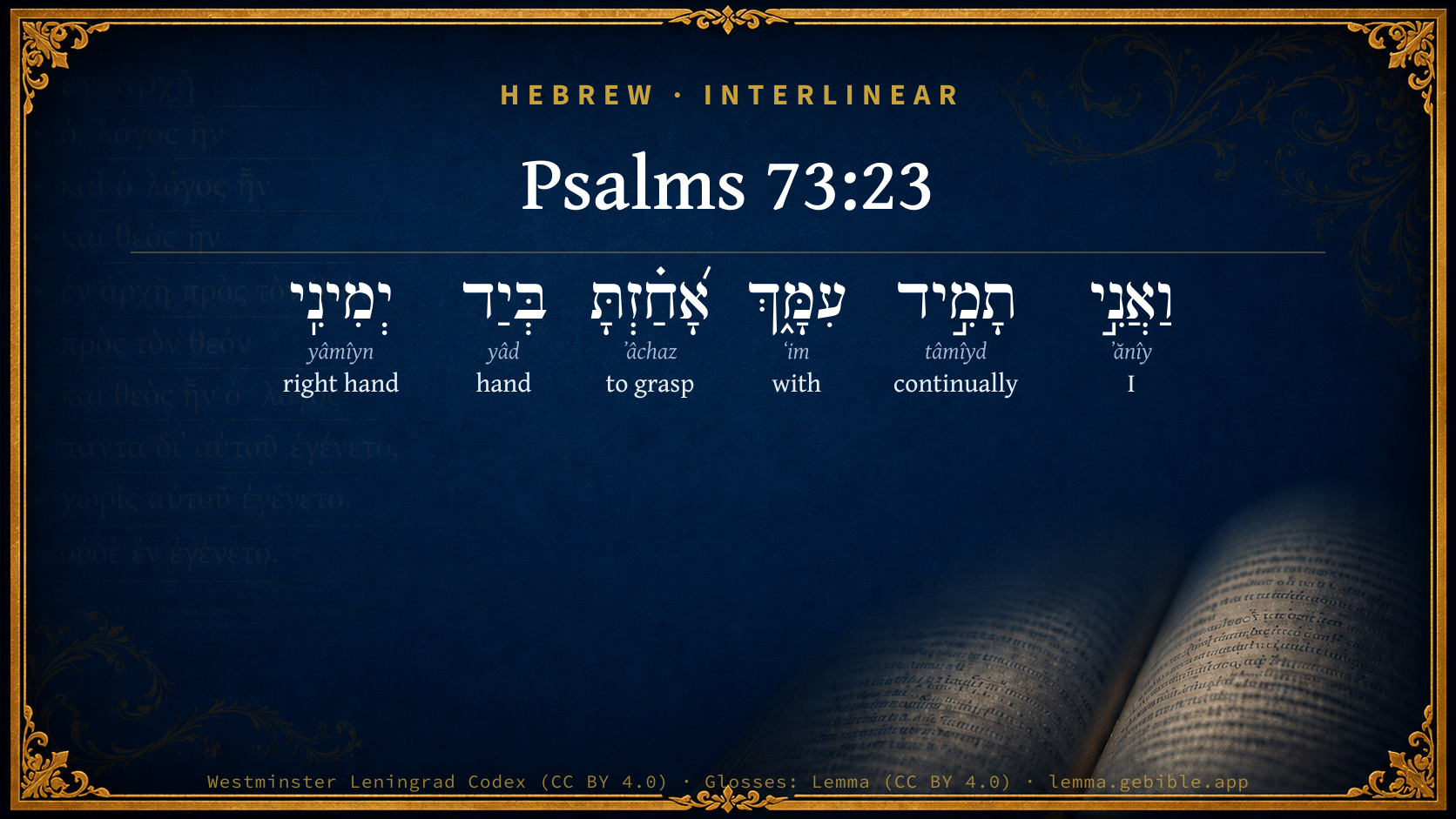
Psalms 73:23

Hebrew (Westminster Leningrad Codex) Psalms 73:23 appears in the Hebrew Old Testament. The text above is from the Westminster Leningrad Codex. Each word links to its Strong’s number, a concise gloss, and parsing drawn from the Open Scriptures Hebrew Bible morphology. Click any word for its full Brown-Driver-Briggs (BDB) entry.
Download image
Cite this verse

Psalms 73:23 (World English Bible). Public Domain. Lemma interlinear Bible study tool, https://lemma.gebible.app/v/psalms/73/23.

Show BibTeX & RIS
BibTeX
RIS
English Translation
Nevertheless, I am continually with you. You have held my right hand.
World English Bible · Public Domain
Download a study sheet

One document with this verse’s original text, its word-by-word gloss line, the meaning frame, cross-references with their text, attributed commentary, and full source and license credits — printable, and it pastes into notes with its structure intact.

This verse Autodidact and up

Study sheet (.html) Plain text (.txt)

A passage Seminary Student

Up to 50 verses in one chapter. A passage sheet keeps up to 6 commentary sources and 12 cross-references per verse, in the order this page ranks them, and says so on the sheet whenever that leaves anything out. Ask for a single verse and you get the Autodidact verse sheet above.

Everything on this page stays free to read, with no account — the sheet is a download of what is already on screen, not access to it.

Want to remove ads? Support Godless Engineer
Compare translations 3

The same verse in 3 English versions, stacked beneath the original-language interlinear above. Click any original word for its lexicon entry.

Each is an independent rendering of the whole verse — the interlinear is not word-aligned to these translations.

Highlighted words mark where these versions differ — a whole-verse word diff, not a word-by-word alignment.

  • World English Bible Public Domain
    Nevertheless, I am continually with you. You have held my right hand.
  • King James Version Public Domain
    Nevertheless I am continually with thee: thou hast holden me by my right hand.
  • unfoldingWord Literal Text CC BY-SA 4.0
    Yet I continuously with you; you hold by my right hand.

unfoldingWord Literal Text — © unfoldingWord, licensed CC BY-SA 4.0. Word-aligned USFM3 via Door43 (git.door43.org/unfoldingWord/en_ult).

Versions to compare (up to 4)

3 of 4 selected

Show all 18 translations

Every available English version of this verse, each an independent rendering of the whole verse.

  • World English Bible Public Domain
    Nevertheless, I am continually with you. You have held my right hand.
  • Berean Standard Bible Public Domain
    Yet I am always with You; You hold my right hand.
  • Majority Standard Bible Public Domain
    Yet I am always with You; You hold my right hand.
  • King James Version Public Domain
    Nevertheless I am continually with thee: thou hast holden me by my right hand.
  • American Standard Version (1901) Public Domain
    Nevertheless I am continually with thee: Thou hast holden my right hand.
  • Revised Version (1885) Public Domain
    Nevertheless I am continually with thee: thou hast holden my right hand.
  • Geneva Bible (1599) Public Domain
    Yet I was alway with thee: thou hast holden me by my right hand.
  • Douay-Rheims (1899) Public Domain
    I am become as a beast before thee: and I am always with thee.
  • Young's Literal Translation Public Domain
    And I `am' continually with Thee, Thou hast laid hold on my right hand.
  • Literal Standard Version CC BY-SA 4.0
    And I [am] continually with You, || You have laid hold on my right hand.
  • Unlocked Literal Bible CC BY-SA 4.0
    Yet I am always with you; you hold my right hand.
  • unfoldingWord Literal Text CC BY-SA 4.0
    Yet I continuously with you; you hold by my right hand.
  • Darby Bible Public Domain
    Nevertheless I am continually with thee: thou hast holden my right hand;
  • World Messianic Bible Public Domain
    Nevertheless, I am continually with you. You have held my right hand.
  • Webster's Bible Public Domain
    Nevertheless I am continually with thee: thou hast held me by my right hand.
  • Free Bible Version CC BY-SA 4.0
    Yet I'm always with you; you hold me by the hand.
  • Bible in Basic English Public Domain
    But still I am ever with you; you have taken me by my right hand.
  • JPS Tanakh (1917) Public Domain
    Nevertheless I am continually with Thee; Thou holdest my right hand.

Literal Standard Version (2020), Covenant Press — licensed CC BY-SA 4.0. Text via the HelloAO Bible API (eBible.org). Unlocked Literal Bible (unfoldingWord) — licensed CC BY-SA 4.0. Text via the HelloAO Bible API (eBible.org). unfoldingWord Literal Text — © unfoldingWord, licensed CC BY-SA 4.0. Word-aligned USFM3 via Door43 (git.door43.org/unfoldingWord/en_ult). Free Bible Version, Dr. Jonathan Gallagher — licensed CC BY-SA 4.0. Text via the HelloAO Bible API (eBible.org).

Word by word

More ways to search: Search by grammar → Find every occurrence → Compare this word →

Practice this passage: Drill this verse → Learn its vocabulary →

About this verse

These counts appear in no published source. They are computed here, from the morphology-tagged text and Lemma’s own curated glosses. What Lemma adds →

6
words
6
distinct lemmas
Wisdom
section

Grammatical profile

  • 1 verb
  • 3 nouns
  • 1 pronoun
  • 1 preposition

Verb forms

  • אָ֝חַ֗זְתָּ Qal · Perfect

Hebrew & Septuagint length

In English translation the verse runs 12 words from the Hebrew and 12 from the Septuagint (LXX English) — the same length.

A rough comparison of the two English renderings, which tokenize alike — not a word-level alignment.

Word counts can differ between the Hebrew and the Greek without any difference in meaning — e.g. the Hebrew direct-object marker אֵת has no separate Greek word, and Greek often adds the article ὁ.

Cross-references

14

Topical passages linked to Psalms 73:23 in the Treasury of Scripture Knowledge — connected by theme and wording, ordered by reader-vote popularity; previews shown in the World English Bible.

  • Isaiah 41:13 For I, Yahweh your God, will hold your right hand, saying to you, Don't be afraid; I will help you.
  • Psalms 63:8 My soul stays close to you. Your right hand holds me up.
  • Matthew 28:20 teaching them to observe all things that I commanded you. Behold, I am with you always, even to the end of the age." Amen.
  • Hebrews 13:5 Be free from the love of money, content with such things as you have, for he has said, "I will in no way leave you, neither will I in any way forsake you."
  • Psalms 16:8 I have set Yahweh always before me. Because he is at my right hand, I shall not be moved.
  • Psalms 23:4 Even though I walk through the valley of the shadow of death, I will fear no evil, for you are with me. Your rod and your staff, they comfort me.
  • Matthew 1:23 "Behold, the virgin shall be with child, And shall bring forth a son. They shall call his name Immanuel;" Which is, being interpreted, "God with us."
  • Isaiah 41:10 Don't you be afraid, for I am with you; don't be dismayed, for I am your God; I will strengthen you; yes, I will help you; yes, I will uphold you with the right hand of my righteousness.
  • Psalms 37:24 Though he stumble, he shall not fall, For Yahweh holds him up with his hand.
  • Isaiah 42:1 Behold, my servant, whom I uphold; my chosen, in whom my soul delights: I have put my Spirit on him; he will bring forth justice to the Gentiles.
  • Psalms 37:17 For the arms of the wicked shall be broken, But Yahweh upholds the righteous.
  • Psalms 139:1–12 Yahweh, you have searched me, And you know me.
  • Genesis 17:1 When Abram was ninety-nine years old, Yahweh appeared to Abram, and said to him, "I am God Almighty. Walk before me, and be blameless.
  • Psalms 139:18 If I would count them, they are more in number than the sand. When I wake up, I am still with you.

Cross-references courtesy of OpenBible.info (CC BY 4.0).

Hebrew and Greek witnesses Masoretic Hebrew ↔ Greek Septuagint

The same verse in the two great witnesses to the Old Testament, shown verse-for-verse.

You’re reading Greek Psalm 72 (Hebrew Psalm 73). The Septuagint counts the superscription, so verse numbers can differ from the Hebrew — chapter-level alignment, not verse-by-verse. Numbering follows Rahlfs.

These are two independent witnesses, not word-aligned to each other, and the Septuagint is shown in lemma (dictionary) form.

Hebrew Psalms 73:23 Masoretic · Westminster Leningrad Codex

וַאֲנִ֣י תָמִ֣יד עִמָּ֑ךְ אָ֝חַ֗זְתָּ בְּיַד יְמִינִֽי

Nevertheless, I am continually with you. You have held my right hand.

World English Bible · Public Domain

Greek LXX Greek Psalm 72:23 Septuagint · lemma form

καί ἐγώ διά πᾶς μετά σύ κρατέω ὁ χείρ ὁ δεξιός ἐγώ

Yet I am continually with you: you have holden my right hand.

LXX2012 (modern English Septuagint) · Public Domain

Hebrew: Westminster Leningrad Codex (CC BY 4.0). Greek: Septuagint (public domain); English from LXX2012 (modern English Septuagint) (Public Domain). How the Septuagint differs from the Hebrew →

Commentary

Notes on Psalms 73:23 from classic Christian and Jewish commentators (each source and its license shown beneath its notes). The classic Christian expositions comment on the surrounding passage and are grouped to its opening verse, so a note may address several verses; the Jewish commentaries on the Tanakh (Rashi and others) are per-verse, so they appear only where the commentator wrote on this verse.

Lemma curates 59 commentaries, every one of them public domain or Creative Commons licensed, each selected and text-cleaned for this edition rather than reprinted as found. About our sources →

Trapp's Complete Commentary

John Trapp

Psa 73:23 Nevertheless I [am] continually with thee: thou hast holden [me] by my right hand.

Ver. 23. Nevertheless I am continually with thee] Or, yet I was always with thee, sc. when at worst. Infirmities discard us not. The marriage knot is not dissolved by every falling out; nor the league between princes broken by the wrongs done by pirates.

Thou hast holden me by my right hand] That I should not utterly fall from thee; there was still a supporting grace, Quando pes meus vacillabat (Aben Ezra).

John Trapp, A Commentary or Exposition upon All the Books of the Old and New Testament (1647–1656) — public domain. Text from a community e-Sword module.

The Biblical Illustrator

Joseph S. Exell

Psa_73:23

Nevertheless I am continually with Thee: Thou hast holden me by my right hand.

The Christians portion

Four privileges of Gods servants are mentioned in the text.

I. His presence with them--His constant presence. I am continually with Thee. It is another way of saying, Thou art continually with me. The Lord is ever side by side with His people.

II. Support. Thou hast holden me--holden me by my right hand. Two men may be travelling together the same road in company, and yet separate one from the other. But (says the psalmist) not so the Lord and I His afflicted servant; He takes hold of my hand, as He walks by my side, and lets me feel His presence, and I am content. With Him the wilderness becomes (as it were) a paradise; and without Him the fairest earthly paradise--oh, how soon does it become a desert to our souls!

III. Guidance. Thou shalt guide me--guide me with Thy counsel. Thou shalt do it. Hitherto we have looked on the Lord, as simply the companion and upholder of the believer on his way; here, you perceive, another character is given Him. He points out that way to him--the way to glory--leads him to it, and directs him along it.

IV. Glory. Thou shalt afterward receive me to glory. The Lords guidance of us is ultimately to end in this. Thither all His dealings with us tend. And now I would say to you two things.

1. Aim to get the psalmists faith and confidence, He saw and felt and rejoiced in his own personal interest in Gods care and love. And--

2. Aim to get the psalmists submissive spirit. (C. Bradley, M. A.)

Gods abiding presence

Here was a man who lived with an abiding sense of the Divine nearness. To him God was not an occasional visitor, but an abiding guest. I am continually with Thee. Now, is this a common experience with religious people? I fear not. Lo, I am with you always, said Jesus, and if we do not realize His presence the fault must be our own. Well, now, let us see what effect this abiding consciousness of God would have upon our daily life and experience.

I. Our life would be much holier. It is related that a certain shoemaker kept by his side a portrait of that famous Brighton preacher, the Rev. F.W. Robertson, and that whenever he was tempted to do anything wrong he took a look at the portrait, the very sight of which made it practically impossible for him to yield. Now, if the sight of that good mans portrait could have such a restraining effect upon that shoemaker, what would be the effect upon your life and mine did we daily live with the holy God before our eyes? I have set the Lord always before me, said the psalmist; and did we live with a constant consciousness of the Divine nearness I am sure we should be restrained from many things to which we are so apt to yield, and in which we sometimes perhaps indulge. But in a more positive way, and in a much larger sense, our whole life would be wondrously hallowed if we only carried into it all an abiding sense of the Divine presence. Professor Drummond has said that there are men and women in whose company we are always at our best. While with them we cannot think mean thoughts or speak ungenerous words. Their mere presence is elevation, purification, sanctity. All the best stops of our nature are drawn out by their intercourse, and we find a music in our souls that was never there before. And if the society of good people can exert such a hallowing influence upon us, what must be the sanctifying effect of daily companionship and fellowship with God? Ten minutes, said Professor Drummond, spent in His society every day, aye! two minutes, if it be face to face, and heart to heart, will make the whole day different. And if our whole life were pervaded with the consciousness of the Divine, as, thank God, some lives have been, then the whole life would be different.

II. Such a consciousness of God would make our life much stronger and safer. Life is full of difficulty and danger, and if we would be valiant and victorious we must seek a fuller and more constant realization of the Divine presence. I remember that on one occasion I had a very lonely road to travel, and had often felt exceedingly nervous. But I had an old friend who frequently accompanied me on that part of the journey, and in his companionship I had no sense of danger, but felt equal to any emergency. And amidst lifes thickest difficulties and dangers we may have the companionship of God, and that shall be our defence. The strongest and bravest man may well fear to face lifes stern duties and- difficulties in his own strength; for in that case defeat is inevitable. But with the assurance of Gods presence there comes power to face lifes sternest forces and foes. Our sufficiency is not of ourselves; our sufficiency is of God.

III. This abiding consciousness of God would make our life much happier. In ordinary life there is certainly much to sadden and sour the human heart, and the one great antidote to that is a more vivid realization of the Divine presence. In Thy presence is fulness of joy. Those words have a present significance. In Thy presence is fulness of joy; not then and yonder only, but here and now. Then were the disciples glad when they saw the Lord. The unexpected appearance of Jesus in their midst chased away those mens disappointment and doubt and sadness, and inspired them with a new hope and gladness. I have a little girl who repeatedly awoke in the night, and was terribly frightened with the darkness; and she always insisted on coming into her mothers room and bed. Nothing else would satisfy or soothe her. One night her mother said to her, You should not do so, Olive, for there is nothing to be afraid of; and it is just as dark in this room as in your own. Then, nestling up beside her mother, the little one replied, Yes, mother, but you are in this dark room. Ah, her mothers nearness made all the difference to the childs feelings. And there is nothing that can disarm the souls fears and soothe its sorrows like the realization of our Fathers presence. (B. Haddon.)

Influence of the Divine presence on a good man

I. His internal moral state.

1. The belief of the Divine presence acts upon them here, first, as an incitement to virtue. The presence of one whom we highly esteem and revere, of a sovereign, for instance, a father, or a friend, whose approbation we are solicitous to gain, is always found to exalt the powers of men, to refine and improve their behaviour. Hence, it has been given as a rule by ancient moralists, that, in order to excel in virtue, we should propound to ourselves some person of eminent worth; and should accustom ourselves to act as if he were standing by and beholding us. But what is the observation of the greatest or wisest men on earth to that presence of the Divinity which constantly surrounds us? The man who realizes to his mind this august presence, feels a constant incentive for acquitting himself with dignity.

2. Supposing, however, his virtuous endeavours to be faithful, many imperfections will attend them. Passions will sometimes overcome him; and ambition or interest, in an unguarded hour, will turn him aside into evil. Hence he will be ashamed of himself, and disquieted by a sense of guilt and folly. In this state, to which we are often reduced by the weakness of human nature, the belief of Gods continual presence brings relief to the heart. He can appeal to Him who knows his frame, that, in the general train of his conduct it is his study to keep the law of God.

II. His external circumstances.

1. It not only preserves the virtue of a good man amidst the temptations of pleasure, but it gives to his prosperity a security, and a peculiar relish, which to others is unknown. He dwells as with a friend and protector, from whom he conceives his blessings to proceed. He can appeal to him for the thankfulness with which he receives them; and for his endeavours to employ them well. He trusts that the God whom he serves will not forsake him; that the goodness which he has already experienced will continue to bless him; and though he believes himself not exempted from the changes of the world, yet, in the midst of these, he has ground to hope that sources of comfort and happiness shall always he left open to him. Moreover, the pleasures of life, while they last, are unspeakably heightened by the presence of that Benefactor who bestows them. The pleasing emotion of gratitude to the giver, mingles with the enjoyment of the gift.

2. From the prosperous, let us next turn to the afflicted condition of a good man. For as prosperity may, affliction certainly will, at one time or other, be his lot. It enters into the appointed trial of his virtue; and, in one degree or other, is the doom of all. Here we shall find various situations occur, in which no relief is equal to what a virtuous and holy man derives from a sense of the perpetual presence of God.

(1) Is he, for instance, thrown into an obscure condition in the world, without friends to assist him, or any to regard and consider his estate? He enjoys the satisfaction of thinking, that though he may be neglected by men, he is not forgotten of God.

(2) But though raised above obscurity or poverty, yet, in any situation of fortune, calumny and reproach may be the lot of the servant of God. His good intentions may be misconstrued; his character unjustly traduced; and, to the open reviling of enemies, the more bitter unkindness of friends may sometimes be joined. In this situation, when wounded in spirit, and, perhaps, unable to make his innocence appear, to whom shall he have recourse for defence, to whom make his last appeal, but to that God who is ever present with him, and who knoweth his heart?

(3) Supposing the character of a good man to be untainted by reproach, supposing also his external situation to be opulent or distinguished; many, notwithstanding, and severe, are the distresses to which he may be exposed. Secret griefs may be preying upon him; and his heart left to feed in silence on his own bitterness. He may labour under sore disease, and discern his earthly frame gradually moulder into dust. He may be deprived of those friends and relatives who had been the chief comforts of his state; or may be obliged to prepare himself for taking farewell of them for ever. In the midst of these various afflicting scenes of human life, no consolation can be more powerful than what arises from the presence of a Divine protector and guardian, to whom our case, with all its sorrows, is perfectly known. (Hugh Blair, D. D.)

The Christian with God, supported by Him

I. What is implied in being continually with God.

1. As a duty, it implies, that this is peculiar to real Christians; as they alone are prepared for it, and disposed to it, as being acquainted with Him, reconciled to Him, and in a state of the most intimate friendship with Him (Amo_3:3).

(1) It is Gods express command (Gen_17:1).

(2) Their covenant-consent strengthens the obligation (Jer_1:5), and having opened their mouths they cannot go back.

(3) The honour of God, which of all things is the dearest to them, obliges them to it. To forsake Him would be a reflection on God and His ways.

(4) To this they feel the constraints of love (Psa_73:25).

(5) The blessedness arising from it, and the misery resulting from a contrary conduct, is a further obligation to this.

(6) The sincerity of their love and attachment to God is thereby to be evidenced.

(7) And they feel themselves deeply concerned thus to act, as they would not lose their work and their crown, and expose themselves to greater wrath (2Jn_1:8.; Heb_10:38).

2. As a privilege, it implies that they are with God,

(1) As members of His Son (1Co_12:27).

(2) As His children (Rom_8:14).

(3) As His heirs (Rom_8:17).

(4) As His portion (Deu_32:9).

(5) As His living temple (Eph_2:21).

II. The happiness resulting therefrom. The Lord holds them by their right hand. This is necessary--

1. On account of the weakness of their graces (1Co_3:1-2).

2. The remains of the carnal mind (1Co_3:3).

3. The prevalence of evil example (1Co_5:8).

4. The opposition of the world (Joh_15:19).

5. The unwearied diligence of Satan (1Pe_5:8).

6. And in all these circumstances God will uphold them, according to His word and promise (Heb_13:6; Isa_54:17).

Improvement:--

1. How happy is the state of those who walk with God! Let us cultivate a greater intimacy than ever.

2. How dreadful is the state of those who are at a distance from God! (Psa_73:27). (T. Hannam.)

Constant enjoyment of the Divine presence consistent with variable experiences

Our abiding frame is the index of character, said Garfield. I have seen the sea lashed into fury and tossed into spray, and its grandeur moves the soul of the dullest man. But I remember that it is not the billows, but the calm level of the sea from which all heights and depths are measured. When the storm has passed and the hour of calm settles upon the ocean, when the sunlight bathes its smooth surface, then the astronomer and surveyor takes the level from which he measures all terrestrial heights and depths. And it is thus with the saint in his spiritual enjoyments. They may be as variable as the surface of the ocean, but he does not judge of his state by their fluetuations, but by the fact that deep down in his heart, in yearning and desire, if not in actual experience, he is able to say, I am continually with Thee. (The Quiver.)

The Biblical Illustrator, edited by Joseph S. Exell (c. 1880s–1900s) — public domain. Text from a community e-Sword module.

Joseph Benson's Commentary

Psa 73:23. Nevertheless — Notwithstanding all my temptations, and my gross folly in yielding to them; I am continually with thee — In thy favour and under thy care. Although I gave thee just cause to cast me off, yet thou didst continue thy gracious presence with me, and kindness to me. Thou hast holden me by thy right hand — Hast upheld me, that my faith might not fail, and I might not be overthrown by this, or any other temptation. “The remainder of the Psalm contains the most dutiful and affectionate expressions of a mind perfectly at ease, and reposing itself with comfortable assurance on the loving-kindness of the Lord, of which it had thus experienced a fresh instance in its support under the late temptation, and complete victory over it.” — Horne.

Joseph Benson's Commentary on the Old and New Testaments (1811–1818) — public domain. Text from a community e-Sword module.

J. A. Alexander on Psalms

Joseph Addison Alexander

Psa 73:23. And (yet) I (am) still with thee; thou hast held (me) by my right hand. Notwithstanding his ungrateful and irrational conduct in God's presence, he had not been driven from it, as he justly might have been. The word translated still properly means always, and denotes that there had been no change or interruption in the previous relation of the parties. There is a perfectly analogous usage of the French toujours. In the last clause he seems to return to the metaphor with which he set out. As the fatal error which he had escaped is in ver. 2 represented as a fall, so here his preservation from it is ascribed to God's having held him up by his right hand. See above, on Psa 17:5; Psa 41:12; Psa 63:8.

Joseph Addison Alexander, The Psalms Translated and Explained (1850) — public domain. Text from a community e-Sword module.

Geneva Bible (1599)

Geneva Bible translators

By faith I was assured that thy providence did watch always over me, to preserve me.

Geneva Bible (1599) marginal notes — public domain. Text via Bolls.life.

Adam Clarke's Commentary

Verse 23. I am continually with thee] I now see that myself and my people are under thy guardian care; that we are continually upheld by thee; and while in thy right hand, we shall not be utterly cast down.

Adam Clarke's Commentary on the Bible (1810–1826) — public domain. Text from a community e-Sword/MySword module.

John Calvin's Commentaries

23 Nevertheless I was continually with thee. Here the Psalmist declares, in a different sense, that he was with God. He gives him thanks for having kept him from utterly falling, when he was in so great danger of being precipitated into destruction. The greatness of the favor to which he adverts is the more strikingly manifested from the confession which he made a little before, that he was bereft of judgment, and, as it were, a brute beast; for he richly deserved to be cast off by God, when he dared to murmur against him. Men are said to be with God in two ways; either, first, in respect of apprehension and thought, when they are persuaded that they live in his presence, are governed by his hand, and sustained by his power; or, secondly, when God, unperceived by them, puts upon them a bridle, by which, when they go astray, he secretly restrains them, and prevents them from totally apostatising from him. When a man therefore imagines that God exercises no care about him, he is not with God, as to his own feeling or apprehension; but still that man, if he is not forsaken, abides with God, inasmuch as God’s secret or hidden grace continues with him. In short, God is always near his chosen ones; for although they sometimes turn their backs upon him, he nevertheless has always his fatherly eye turned towards them. When the Psalmist speaks of God as holding him by the right hand, he means that he was, by the wonderful power of God, drawn back from that deep gulf into which the reprobate cast themselves. He then ascribes it wholly to the grace of God that he was enabled to restrain himself from breaking forth into open blasphemies, and from hardening himself in error, and that he was also brought to condemn himself of foolishness; — this he ascribes wholly to the grace of God, who stretched out his hand to hold him up, and prevent him from a fall which would have involved him in destruction. From this we see how precious our salvation is in the sight of God; for when we wander far from him, he yet continues to look upon us with a watchful eye, and to stretch forth his hand to bring us to himself. We must indeed beware of perverting this doctrine by making it a pretext for slothfulness; but experience nevertheless teaches us, that when we are sunk in drowsiness and insensibility, God exercises a care about us, and that even when we are fugitives and wanderers from him, he is still near us. The force of the metaphor contained in the language, which represents God as holding us by the right hand, is to be particularly noticed; for there is no temptation, let it be never so slight, which would not easily overthrow us, were we not upheld and sustained by the power of God. The reason then why we do not succumb, even in the severest conflicts, is nothing else than because we receive the aid of the Holy Spirit. He does not indeed always put forth his power in us in an evident and striking manner, (for he often perfects it in our weakness;) but it is enough that he succours us, although we may be ignorant and unconscious of it, that he upholds us when we stumble, and even lifts us up when we have fallen.

John Calvin's Commentaries (1540-1563) — public domain. Text from the Calvin Translation Society English edition (1840s-50s) via the Christian Classics Ethereal Library (ccel.org). Calvin's coverage is partial (roughly two-thirds of the Bible); uncommented books and verses are honest gaps, never fabricated. The 19th-century editor's footnotes and remarks are omitted so the notes are faithfully Calvin's own voice.

The Cambridge Bible for Schools and Colleges

gen. ed. J. J. S. Perowne

23. Nevertheless] Lit., But as for me, I am &c. Render, Whereas I am &c. He contrasts his real position of fellowship with God with his former delusion and also with the insecurity of the wicked.

thou hast holden &c.] Better as R.V., thou hast holden my right band. Cp. Psa_63:8.

23–26. The positive solution of the Psalmist’s perplexity: the only true and abiding happiness is to be found in fellowship with God.

The Cambridge Bible for Schools and Colleges (gen. ed. J. J. S. Perowne; Cambridge University Press, 1878–1918) — public domain. Text from a community e-Sword module.

John Gill's Exposition

Nevertheless, I am continually with thee,.... Upon the heart of God, in his hands, under his eye, under his wings of protection and care, and not suffered to depart from him finally and totally; he could not be disunited and removed from him by the above temptation; nor was he left to cast off the fear of the Lord, and to forsake his worship and service; nor altogether to lose his love and affection for him, which still continued; see Psa 73:25, or "I shall be always with thee" (z); not now, for though the saints are always in union with the Lord, yet they have not always communion with him; but hereafter, in heaven, to all eternity:

thou hast holden me by my right hand; as an instance of condescension, respect, and familiarity; see Act 23:19, as a parent takes his child by the hand, and learns it to go, so the Lord takes his children by the hand, and teaches them to walk by faith in him, Hos 11:3 or in order to keep them from falling, and bear them up under temptations and exercises; as well as to lead them into more intimate communion with himself in his sanctuary, and to raise them up out of their low estate to an exalted one; see Isa 45:1, and likewise to put something into their hands, to supply their wants, and fill them with his good things; see Eze 16:49.

(z) "ego jugiter futurus sum", Junius & Tremellius, Piscator; "itaque ego in posterum semper tecum ero", Michaelis.

John Gill's Exposition of the Whole Bible (1746–1763) — public domain (CC PDM 1.0). Text via the HelloAO Bible API.

Albert Barnes' Notes on the Bible

Nevertheless, I am continually with thee - I am kept by thee in the land of the living; I am permitted to abide in thy presence; I am allowed to hope in thy mercy. Notwithstanding my low and unworthy views, notwithstanding my doubts about the justice of the divine administration, notwithstanding my envy at the prosperity of the wicked, and my spirit of complaining against God, I am not driven away from God; I am not banished from his presence, or cut off from his favor. Well may we marvel when we reflect on our thoughts about God, that He has not risen in his anger, and banished us from his presence forever and ever.

Thou hast holden me by my right hand - Thou hast not left me. Thou hast stretched out thy hand to keep me. Thou hast been to me as, a Protector and Friend. Thou hast not been angry at my unkind and ungrateful thoughts; thou hast not banished me eternally from thy presence.

Albert Barnes' Notes on the Bible (1834–1885) — public domain. Text from a community e-Sword/MySword module.

Matthew Poole's English Annotations

Nevertheless; notwithstanding all my temptations, and my gross folly in yielding to them.

I am continually with thee; either,

1. In a way of duty. Yet I did not depart from thee, nor from thy ways; but did at last conquer them, and firmly cleave unto thee by faith. Or rather,

2. In a way of mercy and favour, of which he speaks in the next clause of this and in the following verse. Although I gave thee just cause to east me off, yet thou didst continue thy gracious presence with me, and thy care and kindness to me. And this phrase, with thee, seems to have some emphasis in it, as being opposed to the other with thee, Psa 73:22. I was a beast with thee, such was my folly and wickedness; and yet I was in favour with thee, such was thy goodness: thou didst pardon and cure it.

Thou hast holden me by my right hand, that my faith might not fail, and I might not be overthrown by this or any other temptations.

Matthew Poole's English Annotations on the Holy Bible (1683–1685) — public domain. Text from a community e-Sword/MySword module.

The Treasury of David

Charles H. Spurgeon

Ver. 23. Nevertheless I am continually with thee. He does not give up his faith, though he confesses his folly. Sin may distress us, and yet we may be in communion with God. It is sin beloved and delighted in which separates us from the Lord, but when we bewail it heartily, the Lord will not withdraw from us. What a contrast is here in this and the former verse! He is as a beast, and yet continually with God. Our double nature, as it always causes conflict, so is it a continuous paradox: the flesh allies us with the brutes, and the spirit affiliates us to God.

Thou hast holden me by my right hand. With love dost thou embrace me, with honour ennoble me, with power uphold me. He had almost fallen, and yet was always upheld. He was a riddle to himself, as he had been a wonder unto many. This verse contains the two precious mercies of communion and upholding, and as they were both given to one who confessed himself a fool, we also may hope to enjoy them.

Ver. 23. I am continually with thee, as a child the tender care of a parent; and as a parent, during my danger of falling in a slippery path, "thou hast holden me, thy child, by my right hand." George Horne.

Ver. 23. I am continually with thee. He does not say that the Lord is continually with "his people, "and holds, and guides, and receives them; he says, "He is continually with me; He holds me; He will guide me; He will receive me." The man saw, and felt, and rejoiced in his own personal interest in God's care and love. And he did this (mark), in the very midst of affliction, with "flesh and heart failing; "and in spite too of many wrong, and opposite, and sinful feelings, that had just passed away; under a conviction of his own sinfulness, and folly, and, as he calls it, even "brutishness." Oh! it is a blessed thing, brethren, to have a faith like this. Charles Bradley. 1838.

Ver. 23. I am still with thee. The word translated still properly means always, and denotes that there had been no change or interruption in the previous relation of the parties. There is a perfectly analogous usage of the French toujours. Joseph Addison Alexander.

Ver. 23.

I. God does not forsake his people when they forsake him:

Nevertheless I am continually, etc.

II. God does not lose his hold on them when they lose

their hold on him: Nevertheless thou hast holden,

etc.

Ver. 23-24.

I. What he says of the present: I am continually with

thee.

II. What he says of the past: Thou hast holden me, etc.

III. What he say of the future: Thou shalt guide, etc. W. Jay.

Ver. 23-24. Communing, upholding, on leading, reception to glory, four glorious privileges; especially as bestowed on one who was grieved, foolish, ignorant, and a beast. Note the contrasts.

Psalms 73:24*

Ver. 23-24.

I. What he says of the present: I am continually with

thee.

II. What he says of the past: Thou hast holden me,

etc.

III. What he say of the future: Thou shalt guide, etc. W. Jay.

Ver. 23-24. Communing, upholding, on leading, reception to glory, four glorious privileges; especially as bestowed on one who was grieved, foolish, ignorant, and a beast. Note the contrasts.

Charles H. Spurgeon's The Treasury of David (1869–1885) — public domain. Psalms only. Text from a community e-Sword/MySword module.

Whedon's Commentary on the Bible

Daniel D. Whedon

23. Nevertheless I am continually with thee—Notwithstanding my unreasonable and even brutish conduct, yet “all this while I have been particularly considered and cared for, and in a special and eminent manner supported, by thee.”—Hammond. The expression, “I am continually with thee,” as Hengstenberg says, “is not self praise, but praise of the divine compassion and faithfulness in keeping him,” as the second hemistich explains.

Daniel D. Whedon (gen. ed.), Commentary on the Old and New Testaments (1874–1909) — public domain. Text from a community e-Sword module.

The Pulpit Commentary

Nevertheless I am continually with thee; i.e. "nevertheless, I have not fallen away, but have kept always my hold upon thee;" and, on thy part, thou hast holden me by my right hand; i.e. thou hast upheld me and prevented me from slipping. (comp. Psa_18:35 Psa_89:21 Psa_119:117)

The Pulpit Commentary (1880–1919), ed. H.D.M. Spence-Jones & Joseph S. Exell — public domain. Text from a community e-Sword module.

Keil & Delitzsch

C. F. Keil & F. Delitzsch

But he does not thus deeply degrade himself: after God has once taken him by the right hand and rescued him from the danger of falling (Psa 73:2), he clings all the more firmly to Him, and will not suffer his perpetual fellowship with Him to be again broken through by such seizures which estrange him from God. confidently does he yield up himself to the divine guidance, though he may not see through the mystery of the plan (עצה) of this guidance. He knows that afterwards (אחר with Mugrash: adverb as in Psa 68:26), i.e., after this dark way of faith, God will כבוד receive him, i.e., take him to Himself, and take him from all suffering (לקח as in Psa 49:16, and of Enoch, Gen 5:24). The comparison of Zac 2:12 [8] is misleading; there אחר is rightly accented as a preposition: after glory hath He sent me forth (vid., Kצhler), and here as an adverb; for although the adverbial sense of אחר would more readily lead one to look for the arrangement of the words ואחר תקחני כבוד, still "to receive after glory" (cf. the reverse Isa 58:8) is an awkward thought. כבוד, which as an adjective "glorious" (Hofmann) is alien to the language, is either accusative of the goal (Hupfeld), or, which yields a form of expression that is more like the style of the Old Testament, accusative of the manner (Luther, "with honour"). In אחר the poet comprehends in one summary view what he looks for at the goal of the present divine guidance. The future is dark to him, but lighted up by the one hope that the end of his earthly existence will be a glorious solution of the riddle. Here, as elsewhere, it is faith which breaks through not only the darkness of this present life, but also the night of Hades. At that time there was as yet no divine utterance concerning any heavenly triumph of the church, militant in the present world, but to faith the Jahve-Name had already a transparent depth which penetrated beyond Hades into an eternal life. The heaven of blessedness and glory also is nothing without God; but he who can in love call God his, possesses heaven upon earth, and he who cannot in love call God his, would possess not heaven, but hell, in the midst of heaven. In this sense the poet says in Psa 73:25 : whom have I in heaven? i.e., who there without Thee would be the object of my desire, the stilling of my longing? without Thee heaven with all its glory is a vast waste and void, which makes me indifferent to everything, and with Thee, i.e., possessing Thee, I have no delight in the earth, because to call Thee mine infinitely surpasses every possession and every desire of earth. If we take בּארץ still more exactly as parallel to בּשּׁמים, without making it dependent upon חפצתּי: and possessing Thee I have no desire upon the earth, then the sense remains essentially the same; but if we allow בארץ to be governed by חפצתי in accordance with the general usage of the language, we arrive at this meaning by the most natural way. Heaven and earth, together with angels and men, afford him no satisfaction - his only friend, his sole desire and love, is God. The love for God which David expresses in Psa 16:2 in the brief utterance, "Thou art my Lord, Thou art my highest good," is here expanded with incomparable mystical profoundness and beauty. Luther's version shows his master-hand. The church follows it in its "Herzlich lieb hab' ich dich" when it sings -

"The whole wide world delights me not,

For heaven and earth, Lord, care I not,

If I may but have Thee;"

and following it, goes on in perfect harmony with the text of our Psalm -

"Yea, though my heart be like to break,

Thou art my trust that nought can shake;"

(Note: Miss Winkworth's translation.)

or with Paul Gerhard, [in his Passion-hymn "Ein Lmmlein geht und trgt die Schuld der Welt und ihrer Kinder,"

"Light of my heart, that shalt Thou be;

And when my heart in pieces breaks,

Thou shalt my heart remain."

For the hypothetical perfect כּלה expresses something in spite of which he upon whom it may come calls God his God: licet defecerit. Though his outward and inward man perish, nevertheless God remains ever the rock of his heart as the firm ground upon which he, with his ego, remains standing when everything else totters; He remains his portion, i.e., the possession that cannot be taken from him, if he loses all, even his spirit-life pertaining to the body, - and God remains to him this portion לעולם, he survives with the life which he has in God the death of the old life. The poet supposes an extreme case, - one, that is, it is true, impossible, but yet conceivable, - that his outward and inward being should sink away; even then with the merus actus of his ego he will continue to cling to God. In the midst of the natural life of perishableness and of sin, a new, individual life which is resigned to God has begun within him, and in this he has the pledge that he cannot perish, so truly as God, with whom it is closely united, cannot perish. It is just this that is also the nerve of the proof of the resurrection of the dead which Jesus advances in opposition to the Sadducees (Mat 22:32).

Keil & Delitzsch — Biblical Commentary on the Old Testament (1861–1891) — public domain (CC PDM 1.0). Text via the HelloAO Bible API. (Old Testament only.)

unfoldingWord translationNotes

Door43 World Missions Community

I am always with you

The word "I" here represents Asaph. The word "you" here represents God.

you hold my right hand

The person's "right hand" refers to the whole person. This shows an intimate relationship with God that offers stability and security. AT: "You hold me close" (See: Synecdoche)

receive me to glory

Possible meanings are 1) "put me where people will honor me" or 2) "honor me by taking me to where you are." See how "receive me" is translated in Psalms 49:15.

translationWords

right hand

receive

glory

unfoldingWord translationNotes — © Distant Shores Media and the Door43 World Missions Community, licensed CC BY-SA 4.0. Source: git.door43.org/Door43/en_tn.

Rashi

Rabbi Shlomo Yitzchaki (Rashi)

Yet I Although I saw all this constantly, I was with You, and I did not move from fear of You.

You grasped my right hand to strengthen me in Your fear when my feet are about to turn from Your way, as it is stated above (verse 2): “my feet had almost turned away.”

Rashi on the Tanakh — English translations: “The Judaica Press complete Tanach with Rashi, translated by A. J. Rosenberg” (CC BY 4.0); “Pentateuch with Rashi's commentary by M. Rosenbaum and A.M. Silbermann, 1929-1934” (public domain); “The Metsudah Tanach series, Lakewood, N.J” (CC BY 4.0); and “The Book of Joshua, Metsudah Publications, 1997” (CC BY 4.0). Text via Sefaria.

Lesson kit

Teaching starters — assembled from the data on this page, not authored interpretation. Every prompt links to the verse data it draws on. Edit before teaching.

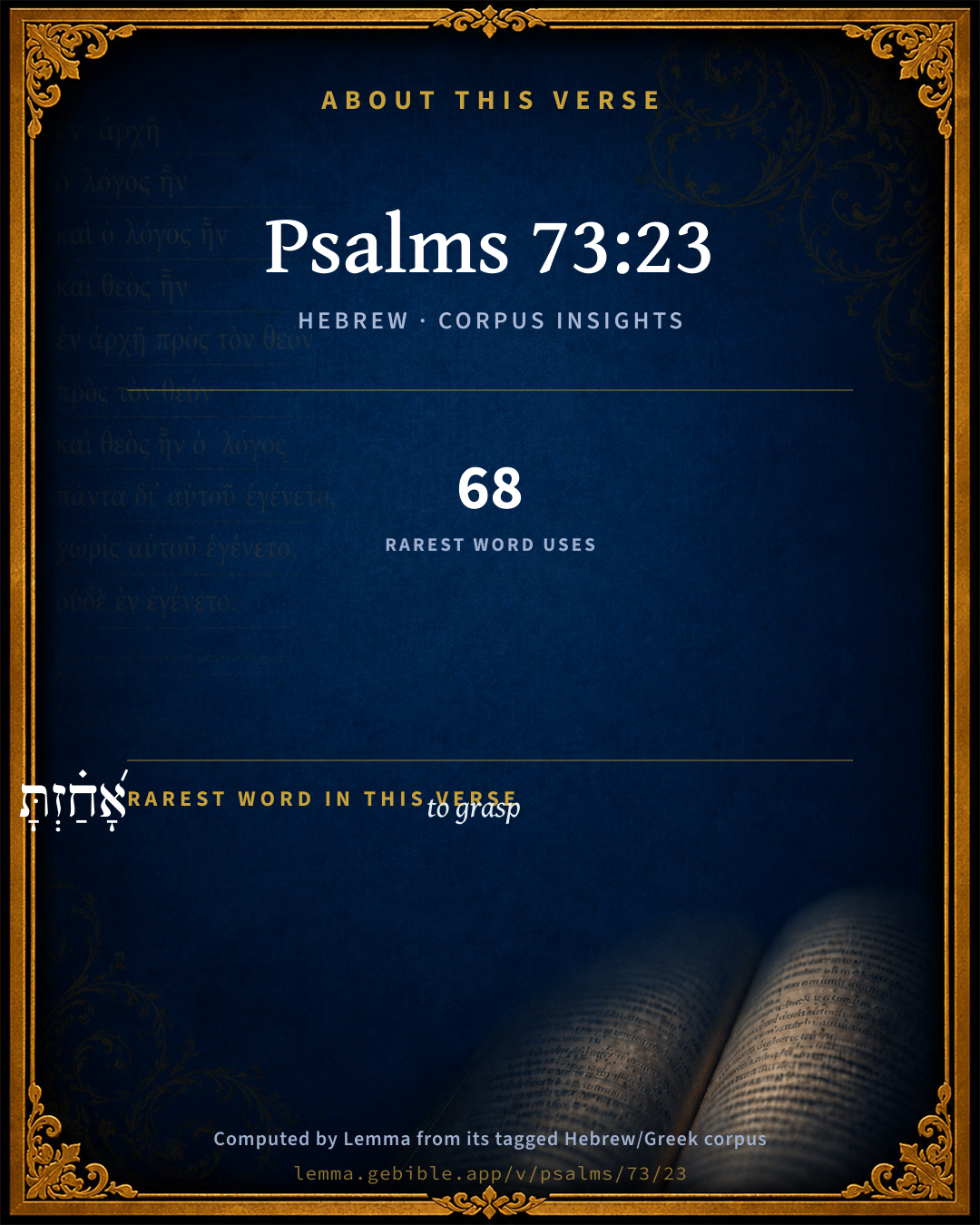
Psalms, in the Wisdom, opens this verse with 6 words (6 distinct Hebrew lemmas). Its most distinctive word is ʼâchaz (“to grasp”). A historical commentator’s framing appears above. Read the whole chapter for the surrounding context.

Discussion questions

  1. The word ʼâchaz carries the sense “to grasp.” How does it shape the verse?
  2. How does Isaiah 41:13, which shares this passage’s theme, read alongside this verse?
  3. The translations on this page render this verse differently — a whole-verse word diff, not a word-by-word alignment. What might account for the different wordings?
  4. «אָ֝חַ֗זְתָּ» is a Qal Perfect verb. How does that grammatical form shape the action described?
  5. Compare how Trapp's Complete Commentary and The Biblical Illustrator read this verse. Where do they agree or differ?

Things to notice

Reading settings

Reading text

Shown beneath each verse's original-language words.

Old Testament
Old Testament edition

Read the OT as the Masoretic Hebrew (MT) or the Greek Septuagint (LXX).

English shown for the Greek Septuagint (in the Hebrew ↔ Greek comparison).

Comparing translations? Open the Compare panel on any verse page to stack up to four side by side.