Psalms 40:11

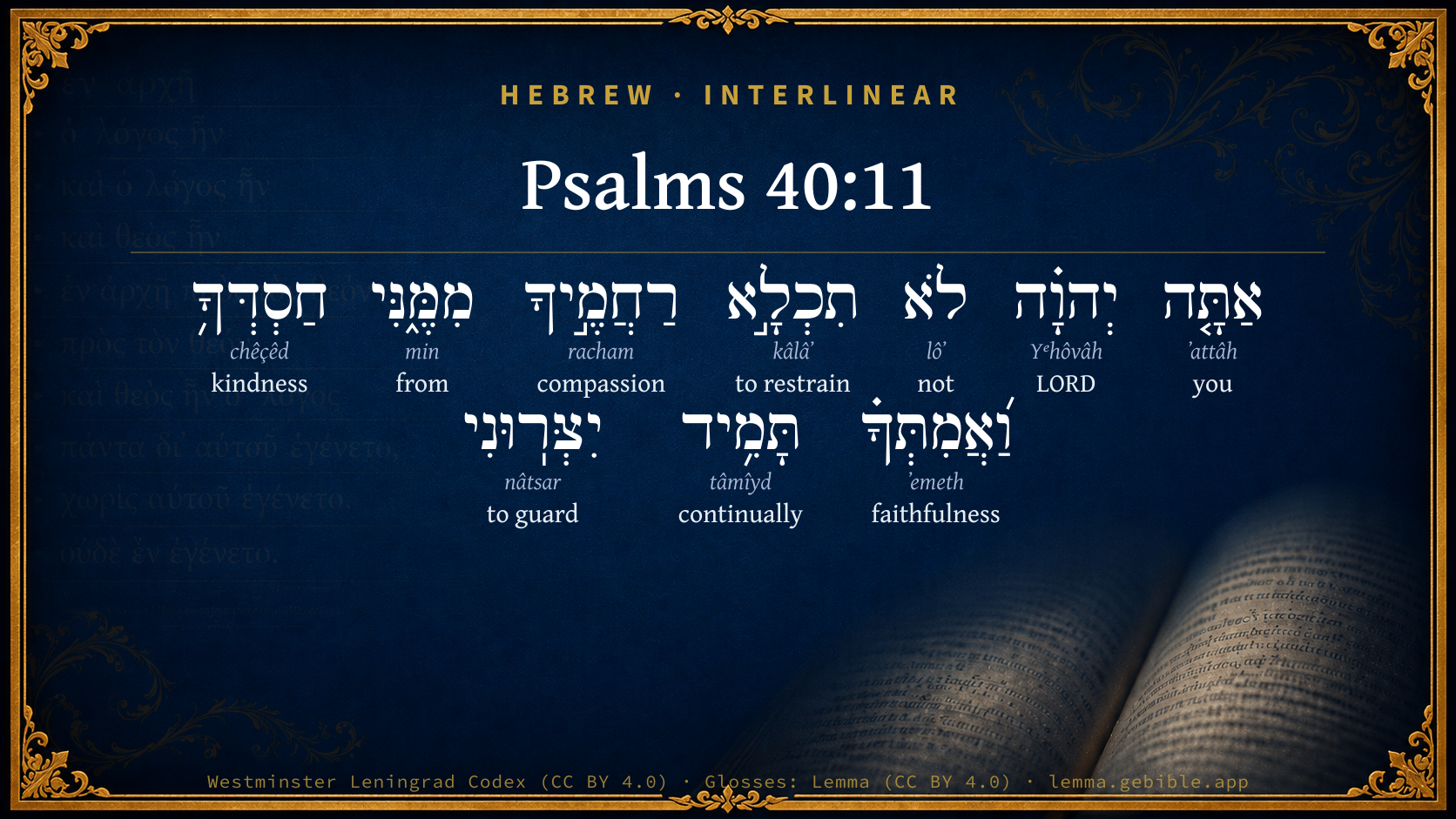
Hebrew (Westminster Leningrad Codex) Psalms 40:11 appears in the Hebrew Old Testament. The text above is from the Westminster Leningrad Codex. Each word links to its Strong’s number, a concise gloss, and parsing drawn from the Open Scriptures Hebrew Bible morphology. Click any word for its full Brown-Driver-Briggs (BDB) entry.
Download image
Cite this verse

Psalms 40:11 (World English Bible). Public Domain. Lemma interlinear Bible study tool, https://lemma.gebible.app/v/psalms/40/11.

Show BibTeX & RIS
BibTeX
RIS
English Translation
Don't withhold your tender mercies from me, Yahweh. Let your loving kindness and your truth continually preserve me.
World English Bible · Public Domain
Download a study sheet

One document with this verse’s original text, its word-by-word gloss line, the meaning frame, cross-references with their text, attributed commentary, and full source and license credits — printable, and it pastes into notes with its structure intact.

This verse Autodidact and up

Study sheet (.html) Plain text (.txt)

A passage Seminary Student

Up to 50 verses in one chapter. A passage sheet keeps up to 6 commentary sources and 12 cross-references per verse, in the order this page ranks them, and says so on the sheet whenever that leaves anything out. Ask for a single verse and you get the Autodidact verse sheet above.

Everything on this page stays free to read, with no account — the sheet is a download of what is already on screen, not access to it.

Want to remove ads? Support Godless Engineer
Compare translations 3

The same verse in 3 English versions, stacked beneath the original-language interlinear above. Click any original word for its lexicon entry.

Each is an independent rendering of the whole verse — the interlinear is not word-aligned to these translations.

Highlighted words mark where these versions differ — a whole-verse word diff, not a word-by-word alignment.

  • World English Bible Public Domain
    Don't withhold your tender mercies from me, Yahweh. Let your loving kindness and your truth continually preserve me.
  • King James Version Public Domain
    Withhold not thou thy tender mercies from me, O LORD: let thy lovingkindness and thy truth continually preserve me.
  • unfoldingWord Literal Text CC BY-SA 4.0
    You, Yahweh, will not withhold your compassion from me; your covenant faithfulness and your trustworthiness will continually preserve me.

unfoldingWord Literal Text — © unfoldingWord, licensed CC BY-SA 4.0. Word-aligned USFM3 via Door43 (git.door43.org/unfoldingWord/en_ult).

Versions to compare (up to 4)

3 of 4 selected

Show all 18 translations

Every available English version of this verse, each an independent rendering of the whole verse.

  • World English Bible Public Domain
    Don't withhold your tender mercies from me, Yahweh. Let your loving kindness and your truth continually preserve me.
  • Berean Standard Bible Public Domain
    O LORD, do not withhold Your mercy from me; Your loving devotion and faithfulness will always guard me.
  • Majority Standard Bible Public Domain
    O LORD, do not withhold Your mercy from me; Your loving devotion and faithfulness will always guard me.
  • King James Version Public Domain
    Withhold not thou thy tender mercies from me, O LORD: let thy lovingkindness and thy truth continually preserve me.
  • American Standard Version (1901) Public Domain
    Withhold not thou thy tender mercies from me, O Jehovah; Let thy lovingkindness and thy truth continually preserve me.
  • Revised Version (1885) Public Domain
    Withhold not thou thy tender mercies from me, O LORD: let thy lovingkindness and thy truth continually preserve me.
  • Geneva Bible (1599) Public Domain
    Withdrawe not thou thy tender mercie from mee, O Lord: let thy mercie and thy trueth alway preserue me.
  • Douay-Rheims (1899) Public Domain
    I have not hid thy justice within my heart: I have declared thy truth and thy salvation. I have not concealed thy mercy and thy truth from a great council.
  • Young's Literal Translation Public Domain
    Thou, O Jehovah, restrainest not Thy mercies from me, Thy kindness and Thy truth do continually keep me.
  • Literal Standard Version CC BY-SA 4.0
    You, O YHWH, do not restrain Your mercies from me, || Your kindness and Your truth continually keep me.
  • Unlocked Literal Bible CC BY-SA 4.0
    Do not keep back your acts of mercy from me, Yahweh; let your covenant faithfulness and your trustworthiness always preserve me.
  • unfoldingWord Literal Text CC BY-SA 4.0
    You, Yahweh, will not withhold your compassion from me; your covenant faithfulness and your trustworthiness will continually preserve me.
  • Darby Bible Public Domain
    Withhold not thou, Jehovah, thy tender mercies from me; let thy loving-kindness and thy truth continually preserve me.
  • World Messianic Bible Public Domain
    Don’t withhold your tender mercies from me, LORD. Let your loving kindness and your truth continually preserve me.
  • Webster's Bible Public Domain
    \\40:10\\I have not hid thy righteousness within my heart; I have declared thy faithfulness and thy salvation: I have not concealed thy loving-kindness and thy truth from the great congregation.
  • Free Bible Version CC BY-SA 4.0
    Lord, please don't keep back your mercy from me. May your trustworthy love and faithfulness always be my protection.
  • Bible in Basic English Public Domain
    Take not away your gentle mercies from me, O Lord; let your mercy and your faith keep me safe for ever.
  • JPS Tanakh (1917) Public Domain
    (40-12) Thou, O LORD, wilt not withhold Thy compassions from me; let Thy mercy and Thy truth continually preserve me.

Literal Standard Version (2020), Covenant Press — licensed CC BY-SA 4.0. Text via the HelloAO Bible API (eBible.org). Unlocked Literal Bible (unfoldingWord) — licensed CC BY-SA 4.0. Text via the HelloAO Bible API (eBible.org). unfoldingWord Literal Text — © unfoldingWord, licensed CC BY-SA 4.0. Word-aligned USFM3 via Door43 (git.door43.org/unfoldingWord/en_ult). Free Bible Version, Dr. Jonathan Gallagher — licensed CC BY-SA 4.0. Text via the HelloAO Bible API (eBible.org).

Word by word

More ways to search: Search by grammar → Find every occurrence → Compare this word →

Practice this passage: Drill this verse → Learn its vocabulary →

תִכְלָ֣א
kâlâʼ
H3607
“to restrain”
Verb, Qal, Imperfect, 2nd Person, Masculine, Singular
Part of Speech
Verb
Stem
Qal
Form
Imperfect
Person
2nd Person
Gender
Masculine
Number
Singular
Full BDB Definition

Origin: a primitive root

TWOT: 980

to restrict, restrain, withhold, shut up, keep back, refrain, forbid - (Qal) - to shut up - to restrain - to withhold - (Niphal) to be restrained - (Piel) to finish
  1. אַתָּ֤ה ʼattâh H859 “you” Pronoun, Personal, 2nd Person, Masculine, Singular
  2. יְהוָ֗ה Yᵉhôvâh H3068 “LORD” Noun, Proper
  3. לֹא lôʼ H3808 “not” Particle, Negative
  4. רַחֲמֶ֣יךָ racham H7356 “compassion · your” Noun, Common, Masculine, Plural, Construct + Suffix, Personal, 2nd Person, Masculine, Singular
  5. מִמֶּ֑נִּי min H4480 “from · me” Preposition + Suffix, Personal, 1st Person, Common, Singular
  6. חַסְדְּךָ֥ chêçêd H2617 “kindness · your” Noun, Common, Masculine, Singular, Construct + Suffix, Personal, 2nd Person, Masculine, Singular
  7. וַ֝אֲמִתְּךָ֗ ʼemeth H571 “and · faithfulness · your” Conjunction + Noun, Common, Feminine, Singular, Construct + Suffix, Personal, 2nd Person, Masculine, Singular
  8. תָּמִ֥יד tâmîyd H8548 “continually” Noun, Common, Masculine, Singular, Absolute
  9. יִצְּרֽוּנִי nâtsar H5341 “to guard · me” Verb, Qal, Imperfect, 3rd Person, Masculine, Plural + Suffix, Personal, 1st Person, Common, Singular

About this verse

These counts appear in no published source. They are computed here, from the morphology-tagged text and Lemma’s own curated glosses. What Lemma adds →

10
words
10
distinct lemmas
Wisdom
section

Notable vocabulary

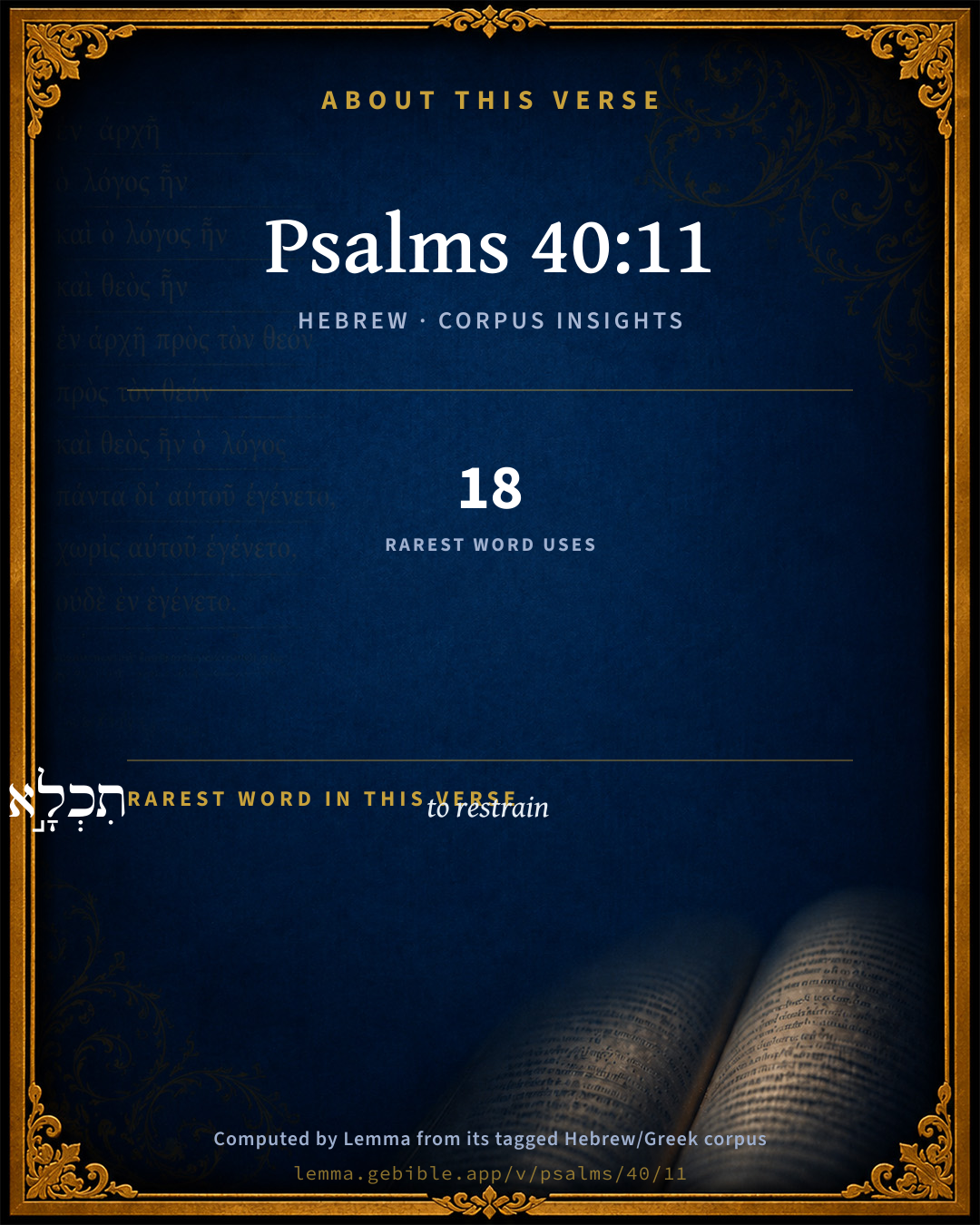
The rarest word here is תִכְלָ֣א to restrain H3607 — appearing just 18 times in the whole Hebrew Bible.

Shared distinctive vocabulary

תִכְלָ֣א to restrain H3607 occurs in 17 verses of the Hebrew Bible. Also found in:

Grammatical profile

  • 2 verbs
  • 5 nouns
  • 1 pronoun
  • 1 preposition
  • 1 particle

Verb forms

  • תִכְלָ֣א Qal · Imperfect
  • יִצְּרֽוּנִי Qal · Imperfect

Hebrew & Septuagint length

In English translation the verse runs 18 words from the Hebrew and 19 from the Septuagint (LXX English) — closely comparable.

A rough comparison of the two English renderings, which tokenize alike — not a word-level alignment.

Word counts can differ between the Hebrew and the Greek without any difference in meaning — e.g. the Hebrew direct-object marker אֵת has no separate Greek word, and Greek often adds the article ὁ.

Cross-references

9

Topical passages linked to Psalms 40:11 in the Treasury of Scripture Knowledge — connected by theme and wording, ordered by reader-vote popularity; previews shown in the World English Bible.

  • Psalms 23:6 Surely goodness and loving kindness shall follow me all the days of my life, And I shall dwell in Yahweh's house forever.
  • Psalms 43:3 Oh, send out your light and your truth. Let them lead me. Let them bring me to your holy hill, To your tents.
  • Psalms 57:3 He will send from heaven, and save me, He rebukes the one who is pursuing me. Selah. God will send out his loving kindness and his truth.
  • Proverbs 20:28 Love and faithfulness keep the king safe. His throne is sustained by love.
  • Psalms 61:7 He shall be enthroned in God's presence forever. Appoint your loving kindness and truth, that they may preserve him.
  • Psalms 69:16 Answer me, Yahweh, for your loving kindness is good. According to the multitude of your tender mercies, turn to me.
  • Psalms 69:13 But as for me, my prayer is to you, Yahweh, in an acceptable time. God, in the abundance of your loving kindness, answer me in the truth of your salvation.
  • Psalms 85:10 Mercy and truth meet together. Righteousness and peace have kissed each other.
  • Hebrews 5:7 He, in the days of his flesh, having offered up prayers and petitions with strong crying and tears to him who was able to save him from death, and having been heard for his godly fear,

Cross-references courtesy of OpenBible.info (CC BY 4.0).

Hebrew and Greek witnesses Masoretic Hebrew ↔ Greek Septuagint

The same verse in the two great witnesses to the Old Testament, shown verse-for-verse.

You’re reading Greek Psalm 39 (Hebrew Psalm 40). The Septuagint counts the superscription, so verse numbers can differ from the Hebrew — chapter-level alignment, not verse-by-verse. Numbering follows Rahlfs.

These are two independent witnesses, not word-aligned to each other, and the Septuagint is shown in lemma (dictionary) form.

Hebrew Psalms 40:11 Masoretic · Westminster Leningrad Codex

אַתָּ֤ה יְהוָ֗ה לֹא תִכְלָ֣א רַחֲמֶ֣יךָ מִמֶּ֑נִּי חַסְדְּךָ֥ וַ֝אֲמִתְּךָ֗ תָּמִ֥יד יִצְּרֽוּנִי

Don't withhold your tender mercies from me, Yahweh. Let your loving kindness and your truth continually preserve me.

World English Bible · Public Domain

Greek LXX Greek Psalm 39:11 Septuagint · lemma form

ὁ δικαιοσύνη σύ οὐ κρύπτω ἐν ὁ καρδία ἐγώ ὁ ἀλήθεια σύ καί ὁ σωτήριον σύ εἶπον οὐ κρύπτω ὁ ἔλεος σύ καί ὁ ἀλήθεια σύ ἀπό σύναγωγή πολύς

But you, Lord, remove not your compassion far from me; your mercy and your truth have helped me continually.

LXX2012 (modern English Septuagint) · Public Domain

Hebrew: Westminster Leningrad Codex (CC BY 4.0). Greek: Septuagint (public domain); English from LXX2012 (modern English Septuagint) (Public Domain). How the Septuagint differs from the Hebrew →

Commentary

Notes on Psalms 40:11 from classic Christian and Jewish commentators (each source and its license shown beneath its notes). The classic Christian expositions comment on the surrounding passage and are grouped to its opening verse, so a note may address several verses; the Jewish commentaries on the Tanakh (Rashi and others) are per-verse, so they appear only where the commentator wrote on this verse.

Lemma curates 59 commentaries, every one of them public domain or Creative Commons licensed, each selected and text-cleaned for this edition rather than reprinted as found. About our sources →

Matthew Henry's Commentary

The psalmist, having meditated upon the work of redemption, and spoken of it in the person of the Messiah, now comes to make improvement of the doctrine of his mediation between us and God, and therefore speaks in his own person. Christ having done his Father's will, and finished his work, and given orders for the preaching of the gospel to every creature, we are encouraged to come boldly to the throne of grace, for mercy and grace.

I. This may encourage us to pray for the mercy of God, and to put ourselves under the protection of that mercy, Psa 40:11. "Lord, thou hast not spared thy Son, nor withheld him; withhold not thou thy tender mercies then, which thou hast laid up for us in him; for wilt thou not with him also freely give us all things? Rom 8:32. Let thy lovingkindness and thy truth continually preserve me." The best saints are in continual danger, and see themselves undone if they be not continually preserved by the grace of God; and the everlasting lovingkindness and truth of God are what we have to depend upon for our preservation to the heavenly kingdom, Psa 61:7.

II. This may encourage us in reference to the guilt of sin, that Jesus Christ has done that towards our discharge from it which sacrifice and offering could not do. See here, 1. The frightful sight he had of sin, Psa 40:12. This was it that made the discovery he was now favoured with of a Redeemer very welcome to him. He saw his iniquities to be evils, the worst of evils; he saw that they compassed him about; in all the reviews of his life, and his reflections upon each step of it, still he discovered something amiss. The threatening consequences of his sin surrounded him. Look which way he would, he saw some mischief or other waiting for him, which he was conscious to himself his sins had deserved. He saw them taking hold of him, arresting him, as the bailiff does the poor debtor; he saw them to be innumerable and more than the hairs of his head. Convinced awakened consciences are apprehensive of danger from the numberless number of the sins of infirmity which seem small as hairs, but, being numerous, are very dangerous. Who can understand his errors? God numbers our hairs (Mat 10:30), which yet we cannot number; so he keeps an account of our sins, which we keep no account of. The sight of sin so oppressed him that he could not hold up his head - I am not able to look up; much less could he keep up his heart - therefore my heart fails me. Note, The sight of our sins in their own colours would drive us to distraction, if we had not at the same time some sight of a Saviour. 2. The careful recourse he had to God under the sense of sin (Psa 40:13); seeing himself brought by his sins to the very brink of ruin, eternal ruin, with what a holy passion does he cry out, "Be pleased, O Lord! to deliver me (Psa 40:13); O save me from the wrath to come, and the present terrors I am in through the apprehensions of that wrath! I am undone, I die, I perish, without speedy relief. In a case of this nature, where the bliss of an immortal soul is concerned, delays are dangerous; therefore, O Lord! make haste to help me."

III. This may encourage us to hope for victory over our spiritual enemies that seek after our souls to destroy them (Psa 40:14), the roaring lion that goes about continually seeking to devour. If Christ has triumphed over them, we through him, shall be more than conquerors. In the belief of this we may pray, with humble boldness, Let them be ashamed and confounded together, and driven backward, Psa 40:14. Let them be desolate, Psa 40:15. Both the conversion of a sinner and the glorification of a saint are great disappointments to Satan, who does his utmost, with all his power and subtlety, to hinder both. Now, our Lord Jesus having undertaken to bring about the salvation of all his chosen, we may in faith pray that, in both these ways, that great adversary may be confounded. When a child of God is brought into that horrible pit, and the miry clay, Satan cries Aha! aha! thinking he has gained his point; but he shall rage when he sees the brand plucked out of the fire, and shall be desolate, for a reward of his shame. The Lord rebuke thee, O Satan! The accuser of the brethren is cast out.

IV. This may encourage all that seek God, and love his salvation, to rejoice in him and to praise him, Psa 40:16. See here, 1. The character of good people. Conformably to the laws of natural religion, they seek God, desire his favour, and in all their exigencies apply to him, as a people should seek unto their God; and conformably to the laws of revealed religion they love his salvation, that great salvation of which the prophets enquired and searched diligently, which the Redeemer undertook to work out when he said, Lo, I come. All that shall be saved love the salvation not only as a salvation from hell, but a salvation from sin. 2. The happiness secured to good people by this prophetic prayer. Those that seek God shall rejoice and be glad in him, and with good reason, for he will not only be found of them but will be their bountiful rewarder. Those that love his salvation shall be filled with the joy of his salvation, and shall say continually, The Lord be magnified; and thus they shall have a heaven upon earth. Blessed are those that are thus still praising God.

V. This may encourage the saints, in distress and affliction, to trust in God and comfort themselves in him, Psa 40:17. David himself was one of these: I am poor and needy (a king, perhaps now on the throne, and yet, being troubled in spirit, he calls himself poor and needy, in want and distress, lost and undone without a Saviour), yet the Lord thinketh upon me in and through the Mediator, by whom we are made accepted. Men forget the poor and needy, and seldom think of them; but God's thoughts, towards them (which he had spoken of Psa 40:5) are their support and comfort. They may assure themselves that God is their help under their troubles, and will be, in due time, their deliverer out of their troubles, and will make no long tarrying; for the vision is for an appointed time, and therefore, though it tarry, we may wait for it, for it shall come; it will come, it will not tarry.

Matthew Henry's Commentary on the Whole Bible (1708–1710) — public domain (CC PDM 1.0). Text via the HelloAO Bible API.

Trapp's Complete Commentary

John Trapp

Psa 40:11 Withhold not thou thy tender mercies from me, O LORD: let thy lovingkindness and thy truth continually preserve me.

Ver. 11. Withhold not thou thy tender mercies, &c.] Whereas, while the saints are on earth there will be a perpetual interchange of comforts and crosses; prayers must be joined with praises, and care taken that, confirmed by former experiences, they still depend upon God. Nunc in luto adhuc haerens et cum residuo calamitatum colluctans precatur Deum.

Let thy lovingkindness and thy truth continually preserve me] Tuos illos custodes mihi ad latus adhibe, let those two attributes of thine be mine angel guardians at all times. {See Trapp on "Psa 25:10"}

John Trapp, A Commentary or Exposition upon All the Books of the Old and New Testament (1647–1656) — public domain. Text from a community e-Sword module.

Joseph Benson's Commentary

Psa 40:11-12. Withhold not thy tender mercies, &c. — This prayer is uttered by David, either, 1st, In the person of Christ, to whom it may agree; or, rather, 2d, In his own person. For having been transported by the Spirit of God to the commemoration of the great mystery of the Messiah, of whom he was an illustrious type, he now seems to be led back by the same Spirit to the consideration of his own case. Mine iniquities — Either, 1st, The punishment of mine iniquities, as Gen 4:13, and elsewhere; or, 2d, The iniquities themselves. This cannot be understood of Christ. For although our sins were said to be laid upon him, Isa 53:6, and upon that account he is said to be made sin for us, 2Co 5:21; yet the Scripture everywhere represents him as one that never knew or did any sin; and, therefore, it is not probable that the Holy Ghost would use such an expression concerning him, as is never used in Scripture, but either of a man’s own sins, or of the punishment deserved by them. Have taken hold upon me — Men’s sins are figuratively said to follow them, 1Ti 5:24, and to find them out, Num 32:23; and here to take hold on them as an officer takes hold on a man, whom he arrests. So that I am not able to look up — Unto God or men with any comfort or confidence; I am ashamed and confounded. They are more than the hairs of my head — Namely, mine iniquities here mentioned, properly so called; for God’s people are more apt to aggravate their sins than the punishments of them.

Joseph Benson's Commentary on the Old and New Testaments (1811–1818) — public domain. Text from a community e-Sword module.

Whedon's Commentary on the Bible

Daniel D. Whedon

11. The tone and theme of the psalm suddenly change from thanksgiving and gladness to complaint, confession of sin, and prayer. That these two dissimilar parts make one whole, and belong to one occasion, is explained in the introduction to the psalm. But the complaint and confession are not to be restricted to David. They are a fore-shadowing of the sufferings of Christ, whose earthly advent was heralded with joy, but whose triumphant life closed in agony. If Psa_40:6-8 are the profession of Christ upon his coming into the world, and Psa_40:9-10 a declaration of his faithful life and labour, answering to “I have glorified thee on the earth,” Joh_17:4; then Psa_40:11-13 are an allusive sketch of the agony of Gethsemane, and of the mystery of imputation, by which he was made not a personal sinner, but legally answerable for our offences, and treated as if he were a sinner, when “his own self bare our sins in his own body.”

Continually preserve me—That is, day by day, without intermission. In moments of peril and intervals of quiet, we alike need the ever present help of God. The spiritual keeping is the predominant idea, as in Psa_25:21; Pro_13:6; Isa_26:3

Daniel D. Whedon (gen. ed.), Commentary on the Old and New Testaments (1874–1909) — public domain. Text from a community e-Sword module.

J. A. Alexander on Psalms

Joseph Addison Alexander

12. (Psa 40:11). Thou, Jehovah, wilt not withhold thy compassions from me; thy mercy and thy truth will always preserve me. This is not a prayer, as it seems to be in the common version, but an expression of strong confidence, like that in Psa 23:6. As if he had said, "I am sure that thou wilt not withhold," etc. Here, again, there is an obvious allusion to a previous expression. As he had said in Psa 40:10 (9), my lips I will not restrain, so now he says, and thou, O Lord (on thy part), wilt not restrain thy mercies from me. The phrase supplied, on thy part, is really included in the pronoun thou, which, being unnecessary to the sense, must be emphatic. See above, on Psa 2:6. Thy compassion, tender mercies, warm affections. See above, on Psa 25:6, and compare Psa 18:2 (1). Truth means the veracity of God's engagements, as in the preceding verse, where it is joined with faithfulness, fidelity. Preserve me from distresses, dangers, enemies. See above, Psa 12:8 (7), Psa 31:24 (23), Psa 32:7

Joseph Addison Alexander, The Psalms Translated and Explained (1850) — public domain. Text from a community e-Sword module.

Tyndale Open Study Notes

Tyndale Open Resources

40:11 The psalmist prays that the Lord will be true to his character when answering this plea for mercy.

Tyndale Open Study Notes — © Tyndale Open Resources, licensed CC BY-SA 4.0. Text via the HelloAO Bible API.

Jamieson, Fausset & Brown

Robert Jamieson, A. R. Fausset & David Brown

may be rendered as an assertion, that God will not withhold (Psa 16:1).

Jamieson, Fausset & Brown — Commentary Critical and Explanatory on the Whole Bible (1871) — public domain (CC PDM 1.0). Text via the HelloAO Bible API.

Adam Clarke's Commentary

Verse 11. Thy tender mercies] רחמיך rachameycha, such propensities and feelings as a mother bears to her child; or animals in general to their young.

Let thy loving-kindness] חסדך chasdecha, thy overflowing and superabundant mercy.

And thy truth] What is revealed in thy word: continually preserve me. Mercy to help me, truth to direct me; and, by the operation of both, I shall be continually preserved from sin and evil.

Adam Clarke's Commentary on the Bible (1810–1826) — public domain. Text from a community e-Sword/MySword module.

John Calvin's Commentaries

11 O thou Jehovah! withhold not thy tender mercies from me We now see more clearly, what I have just adverted to, that David speaks of his own thankfulness, that he might secure a continuance of God’s favor towards him; and that he opened his mouth in the praises of God, that he might continue to acquire new favors, against which our perverse and ungrateful silence very often closes the gate. We ought, therefore, carefully to observe the relation which the clause, in which David affirms that he closed not his lips, bears to what follows, namely, that God on his part would not contract or stop up the course of his tender mercies; for by this we are taught that God would always be ready to relieve us by his goodness, or rather that it would flow down upon us as from a never-failing fountain, if our own ingratitude did not prevent or cut off its course. The tender mercies of God, which he expresses by the word רחמיד, rachamecha, and of which he here speaks, differ little from his goodness. It was not, however, without cause that David chose to make this distinction. It could only be, first, because he was unable otherwise to satisfy himself in extolling the grace of God; and, secondly, because it was requisite to show that the source from which the mercy and goodness of God proceed, when he is moved in compassion for our miseries to aid and succor us. Then he places his confidence of salvation in the goodness and faithfulness of God, for we must of necessity begin (as I have said a little before) at the free favor of God, that his bounty may extend even to us. But as we are unable to discern that God is gracious to us until he grant us some assurance of his love, his constancy is, with much propriety, placed in connection with his truth in keeping his promises.

John Calvin's Commentaries (1540-1563) — public domain. Text from the Calvin Translation Society English edition (1840s-50s) via the Christian Classics Ethereal Library (ccel.org). Calvin's coverage is partial (roughly two-thirds of the Bible); uncommented books and verses are honest gaps, never fabricated. The 19th-century editor's footnotes and remarks are omitted so the notes are faithfully Calvin's own voice.

The Cambridge Bible for Schools and Colleges

gen. ed. J. J. S. Perowne

11. Thou, O Jehovah, wilt not restrain Thy tender mercies from me,

Thy lovingkindness and thy truth shall continually guard me.

The words are not a prayer but an expression of confidence in the certainty of God’s response (Mat_10:32). Thou is emphatic. God on His part will not fail. The double correspondence with Psa_40:9-10 should be noted. As he has not restrained his lips, so, he trusts, God will not restrain His tender mercies: as he has not ceased to acknowledge God’s lovingkindness and truth, so that lovingkindness and truth will not cease to protect him. Cp. Psa_25:21; Psa_61:7; Isa_63:15.

The Cambridge Bible for Schools and Colleges (gen. ed. J. J. S. Perowne; Cambridge University Press, 1878–1918) — public domain. Text from a community e-Sword module.

John Gill's Exposition

Withhold not thou thy tender mercies from me, O Lord,.... this is a petition of Christ to his Father, when in the midst of his sorrows and sufferings, before related; and particularly when he hid his face from him, and withheld the discoveries of his tender and affectionate love;

let thy lovingkindness and thy truth continually preserve me; as he had promised; of which promise some notice is given, Isa 49:8, in the fulfilment of which the lovingkindness, truth, and faithfulness of God, would appear. Some read these words as expressive of faith in these things, "thou wilt not withhold", &c. "thy lovingkindness and thy truth shall continually preserve me" (o).

(o) "non cohibebis", Gejerus, Michaelis; "custodient me", Vatablus, Gejerus, Michaelis.

John Gill's Exposition of the Whole Bible (1746–1763) — public domain (CC PDM 1.0). Text via the HelloAO Bible API.

Albert Barnes' Notes on the Bible

Withhold not thou thy tender mercies from me, O Lord - Do not restrain or hold back thy compassions. Let thy mercies - the expressions of thy love - flow out freely toward me in connection with what I have done. As applicable to the Redeemer, this is a prayer that God would bestow upon him in connection with his work, and as a reward of his work, appropriate proofs of his goodness. And especially is this to be understood here as a prayer for support and deliverance in the sorrows that came upon him in the accomplishment of his work. The prayer is intermediate between the expression of his purpose to do the will of God when all other means of salvation had failed Psa 40:6-8, and the sorrows or sufferings that would come upon him in the accomplishment of his work Psa 40:12-13. He saw himself at this point of his life, as represented in the psalm, as about to sink into the depth of woes. He had kept the law of God, and had by his obedience thus far done His will. He had made known the truth of God, and had declared His great message to the assembled multitude that had crowded his path, and thronged to hear him. He saw himself now about to enter the vale of sorrow; to plunge into that depth of the unutterable woes connected with the making of an atonement. He prayed, therefore, that, in these approaching sorrows, God would not withhold the expression of his tender mercy. The point of time, therefore, in the Redeemer’s life which the verse before us occupies, is that awful and sorrowful hour when, his public work of teaching and of miracles finished, he was about to endure the agonies of Gethsemane and of the cross.

Let thy loving-kindness - Thy mercy. “And thy truth.” Thy promises; thy plighted support and strength; thy fidelity. That is, he prayed that God would show himself true and faithful in bearing him through the great work of the atonement.

Continually - Through the whole of these sorrows. Do not for a moment leave or forsake me.

Preserve me - Keep me from sinking under these woes; from speaking any improper word; from shrinking back; from being overcome by the tempter; from failing in the great work now to be accomplished. As the Redeemer had a human as well as a divine nature; as he was man, with all human susceptibilities to suffering, it was not inappropriate that he should utter this prayer, and lift up his heart with the utmost earnestness to God, that he might not be forsaken in the consummation of the great work of his life, and that this work might not fail.

Albert Barnes' Notes on the Bible (1834–1885) — public domain. Text from a community e-Sword/MySword module.

Matthew Poole's English Annotations

This prayer is uttered by David, either,

1. In the person of Christ; to whom it may agree. Or,

2. In his own person. Having been transported and carried forth by the Spirit of God to the contemplation and commemoration of the great mystery of the Messias, of whom he was an illustrious type, now he seems to be led back by the same Spirit to the consideration of himself and his own particular case.

Matthew Poole's English Annotations on the Holy Bible (1683–1685) — public domain. Text from a community e-Sword/MySword module.

The Treasury of David

Charles H. Spurgeon

Ver. 11. Withhold not thou thy tender mercies from me, O Lord. Alas! these were to be for awhile withheld from our Lord while on the accursed tree, but meanwhile in his great agony he seeks for gentle dealing; and the coming of the angel to strengthen him was a clear answer to his prayer. He had been blessed aforetime in the desert, and now at the entrance of the valley of the shadow of death, like a true, trustful, and experienced man, he utters a holy, plaintive desire for the tenderness of heaven. He had not withheld his testimony to God's truth, now in return he begs his Father not to withhold his compassion. This verse might more correctly be read as a declaration of his confidence that help would not be refused; but whether we view this utterance as the cry of prayer, or the avowal of faith, in either case it is instructive to us who take our suffering Lord for an example, and it proves to us how thoroughly he was made like unto his brethren. Let thy lovingkindness and thy truth continually preserve me. He had preached both of these, and now he asks for an experience of them, that he might be kept in the evil day and rescued from his enemies and his afflictions. Nothing endears our Lord to us more than to hear him thus pleading with strong crying and tears to him who was able to save. O Lord Jesus, in our nights of wrestling we will remember thee.

Ver. 11. Withhold not thou thy tender mercies from me. Do not hinder them from coming showering down upon me. Let thy lovingkindness and thy truth continually preserve me; or, do thou employ them in preserving me. John Diodati.

Ver. 11. Enrichment and preservation sought. The true riches are from God, gifts of his sovereignty, fruits of his mercy, marked with his tenderness. The best preservations are divine love and faithfulness.

Ver. 11-13. As an instance of clerical ingenuity, it may be well to mention that Canon Wordsworth has a sermon from these verses upon "the duty of making responses in public prayer."

Psalms 40:12*

Ver. 11-13. As an instance of clerical ingenuity, it may be well to mention that Canon Wordsworth has a sermon from these verses upon "the duty of making responses in public prayer."

Ver. 11-13. As an instance of clerical ingenuity, it may be well to mention that Canon Wordsworth has a sermon from these verses upon "the duty of making responses int public prayer."

Charles H. Spurgeon's The Treasury of David (1869–1885) — public domain. Psalms only. Text from a community e-Sword/MySword module.

The Pulpit Commentary

Withhold not thou thy tender mercies from me, O Lord. The supplicatory portion of the psalm here commences. David beseeches God, whose loving-kindness is so great (ver. 10), not to withhold from him those "tender mercies" which he lavishes so freely. As he is bent on "not withholding," or "refraining," his lips (ver. 9), so it is fitting that God should not "withhold," or "refrain" (alk) his kindness. Let thy lovingkindness and thy truth continually preserve me (compare the last clause of ver. 10).

Vers. 11-17. "Poor and needy:" a prayer and a plea.

There are many psalms which begin in a sigh and end with a song, showing us that even in the act of waiting before God, and of waiting on God, the darkness often passes away. We find our burden rolling off in the very act and energy of prayer. In this psalm, however, matters are reversed; and immediately following on a song of triumph and a vow of surrender, there is a piteous wail. This dissimilarity, nay, almost discordance, has led to a very general opinion that what here seems to be the latter part of this psalm is actually another psalm, which has somehow or other come to be attached to this one. The probability of this is confirmed by the fact that Ps 70 is the same as the close of Psalm 40. But, of course, at this distance of time, data which would fully explain that cannot be expected to be available. Still, it is a great comfort to be permitted to think of this paragraph as being penned at a different time and under different circumstances from those which called forth the preceding ten verses. It would be discouraging, indeed, if we found that in one and the same breath the psalmist was triumphantly set upon a rock, and then in a minute or two bowed down with a weight of woe! We are not called on to entertain such a doleful supposition; and are glad, therefore, to deal with this piteous prayer and plea as standing by itself. It is not difficult to seize the progress of the thought.

I HERE IS A SOUL IN DEEP DISTRESS. (Ver. 12) Whether the "evils" are the iniquities themselves, or the form in which those iniquities are brought home to him, is not absolutely clear. Probably the latter is the case. Very often surrounding circumstances may bring to us bitterly painful reminders of past sin. And this may be one of God"s means of bringing a soul to repentance through the avenue of remorse and shame.

II HERE IS AN UTTER ABSENCE OF SYMPATHY FROM THE OUTSIDE WORLD. Yea, something more than a lack of sympathy; for there is ridicule (ver. 15), there is joy over his sorrow (ver. 14, latter part); there is even an effort to destroy his peace, and perchance to further a plot against his life. Note: In the moments of deepest distress, when we look for succour from man, we find that the greater part are so engrossed in their own affairs, that they have never a tear to shed over another"s sorrows, nor a hand to help in another"s needs. This is hard. But it is a part of the discipline of life; and it is made use of by God to drive us to himself.

III THE PSALMIST IS SHUT UP TO GOD. (Vers. 11, 13, 17) It is not for nought that we are sometimes shut off from the sympathies of man. However trying, it is an infinite mercy when we are left with God alone. There, however, we have a perpetual Refuge. There are no fewer than four comforting thoughts specified here.

(1) There is the name Jehovah;

(2) there is the assurance of having a share in the thoughts of God (ver. 17); there is in God

(3) loving-kindness; and

(4) faithfulness. "Thy truth," i.e. thy fidelity to thy promises. Note: Whoever has such a Refuge to which to flee, is well prepared for the worst of times.

IV TO GOD HE UTTERS A FERVENT, PLEADING PRAYER.

1. One part of his prayer, and a prominent part too, is against his enemies. (Ver. 15) We need not imitate David here" (see our homily on Psalm 35). Let us leave our enemies in the hands of God; or, rather, let us pray for them.

2. A second part of his prayer is on behalf of the godly. (Ver. 16) Note: This indicates that the psalmist was not moved by private feeling only, but by a pious public spirit.

3. A third part of his prayer is for himself. (Vers. 13 and 17) Note: It will be very selfish of us if we pray only for ourselves, and very unnatural if we do not include ourselves. C.

Discipline lifelong.

Though the sufferer has been delivered from one great distress, he is still encompassed by great sufferings and dangers, from which he prays to be rescued. Suggests

I THAT THE WORK OF OUR DISCIPLINE AND SALVATION IS A LIFELONG WORK. No one act of deliverance is sufficient; no one deliverance can cover the whole of our experience.

1. Fresh sin brings a renewed consciousness of suffering. (Ver. 12) The psalmist suffered so in this respect that his eyes became dim from exhaustion; he felt his sins to be more than the hairs of his head, so that his heart failed in strength. Sense and soul both gave way.

2. Men in high station are in constant danger from enemies. (Vers. 14, 15) However righteous in conduct and blameless in character. Bad men have selfish ends to attain, and they try to get good men out of their way by slander and persecution.

3. As life advances, the sense of our poverty and need deepens. (Ver. 17) If we are growing wiser and better, we get a deeper insight into what we ought to be and might become, and so nourish a Divine discontent with our poverty and weakness.

II LIFELONG NEED WILL BEGET LIFELONG PRAYER.

1. Gratitude for the past will inspire us to prayer. This was the case with the psalmist (vers. 1-10).

2. We are encouraged to pray by the thought of the goodness of God. (Ver. 11) He appeals to "the tender mercies," "the loving-kindness," and "the truth," or the faithfulness, of God to those who trust in him. He knows that "God thinketh upon him.

3. He appeals also to the retributive justice of God. (Vers. 14, 15) He is sure that God will deal righteously with his enemies.

4. He is emboldened to seek for speedy deliverance. (Ver. 17) In the first verse he says he waited patiently for the Lord; here he becomes impatient for the Divine interference. The patience means persevering prayer; the impatience means urgent prayer; and both are right and acceptable and necessary to the believer in earnest about salvation. S.

The Pulpit Commentary (1880–1919), ed. H.D.M. Spence-Jones & Joseph S. Exell — public domain. Text from a community e-Sword module.

John Wesley's Explanatory Notes

With-hold not - David, having been transported by the spirit of God to the commemoration of the great mystery of the Messiah, he now seems to be led back by the same spirit, to the consideration of his own case.

John Wesley, Explanatory Notes Upon the Whole Bible (1754–1765) — public domain. Text via the GEBible commentary corpus.

Lesson kit

Teaching starters — assembled from the data on this page, not authored interpretation. Every prompt links to the verse data it draws on. Edit before teaching.

Psalms, in the Wisdom, opens this verse with 10 words (10 distinct Hebrew lemmas). Its most distinctive word is kâlâʼ (“to restrain”). A historical commentator’s framing appears above. Read the whole chapter for the surrounding context.

Discussion questions

  1. The word kâlâʼ carries the sense “to restrain.” How does it shape the verse?
  2. Genesis 8:2 shares the word «to restrain» with this verse. How do the two illuminate each other?
  3. These translations render this verse differently; the difference is in the English rendering, not the original. What questions does that raise?
  4. The verb «תִכְלָ֣א» is Qal Imperfect. How does its form color the action?
  5. Reading how Matthew Henry's Commentary and Trapp's Complete Commentary read this verse, where do the two commentators agree and where do they part?

Things to notice

Reading settings

Reading text

Shown beneath each verse's original-language words.

Old Testament
Old Testament edition

Read the OT as the Masoretic Hebrew (MT) or the Greek Septuagint (LXX).

English shown for the Greek Septuagint (in the Hebrew ↔ Greek comparison).

Comparing translations? Open the Compare panel on any verse page to stack up to four side by side.