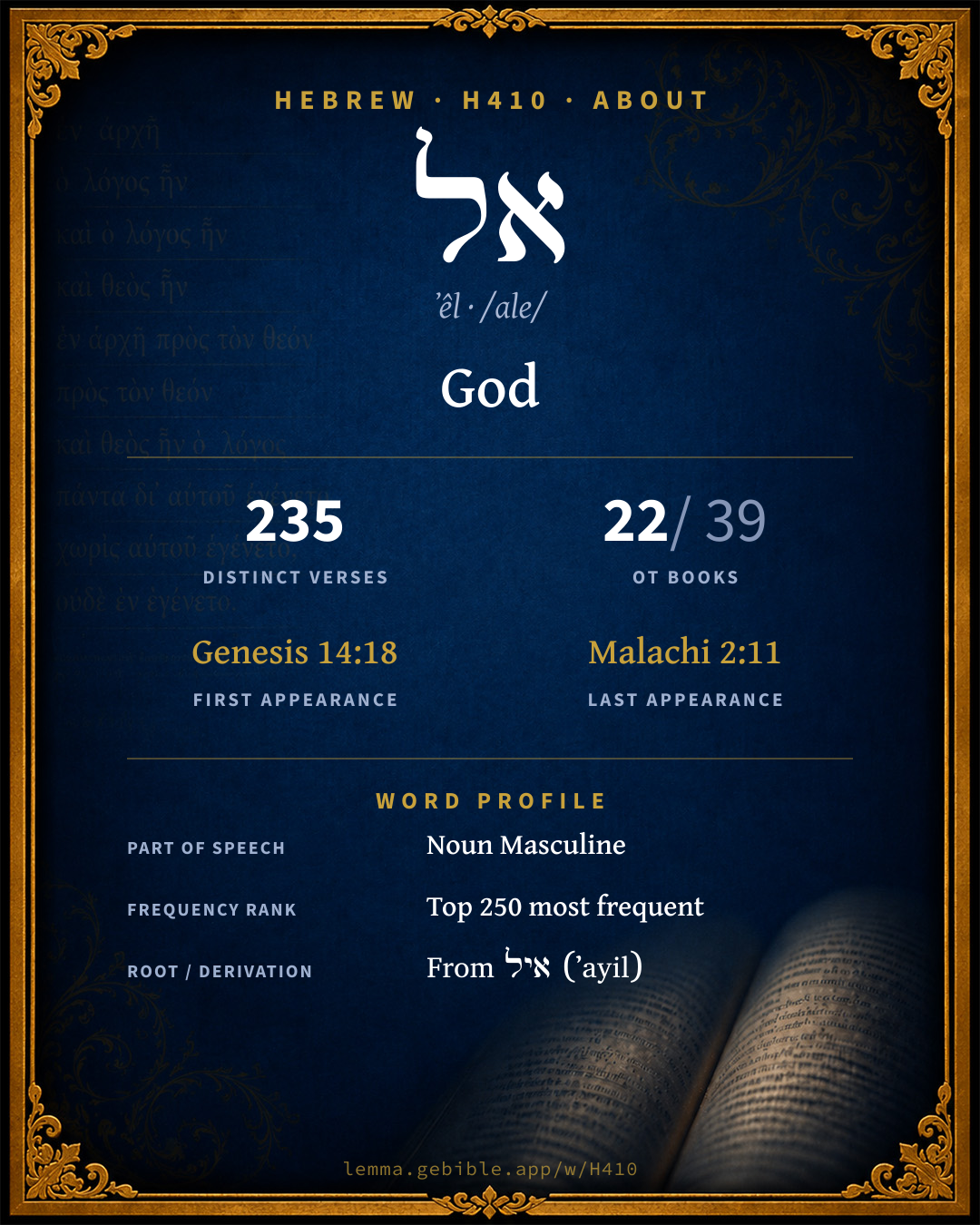
אֵל
God
also: god-like one, mighty one fuller range ↓
Full lexicon entry — Brown-Driver-Briggs (BDB)
From Brown-Driver-Briggs (BDB)
Where this word appears
See every Absolute-state word in the Hebrew Bible →
Grammar key — what these labels mean
Part of speech
- Noun
- A naming word — a person, place, thing, or idea.
Noun type
- Common
- A common noun — a general class of person, place, or thing (“king,” “city,” “water”), not a specific name.
- Proper
- A name of a specific person, place, or people (e.g. Abraham, Zion, Israel).
State
- Absolute
- The independent form of a noun, not bound to a following word.
- Construct
- A noun bound to a following noun in a possessive / “of” relationship (the construct chain).
Gender
- Masculine
- Grammatically masculine.
Number
- Singular
- One.
- Plural
- More than one (in Hebrew, generally three or more).
Grammatical forms
- Noun, Common, Masculine, Singular, Absolute 190 times (78%)
- Noun, Common, Masculine, Singular, Construct 43 times (18%)
- Noun, Common, Masculine, Plural, Absolute 6 times (2%)
- Noun, Proper 5 times (2%)
- Noun, Common, Masculine, Plural, Construct 1 time (0%)
Parsed forms decoded from the imported morphology (morphhb / Westminster Leningrad Codex — WLC text public domain, morphhb tagging CC BY 4.0), counted across 245 parsed occurrences — not distinct verses.
Page 2 of 2 — showing verses 201–235 of 235 distinct verses where H410 appears, across 22 books. Click any verse to open its interlinear word-by-word view. Verse text shown in the World English Bible for context — . Each verse’s Hebrew form is shown with its reference; the English is not keyword-highlighted, since the data carries no word-level English alignment. Use “Compare translations” on any verse to read it across multiple English versions. This concordance covers the Hebrew Bible; Septuagint (Greek Old Testament) occurrences are not indexed here.
Isaiah 22 verses
- Isaiah 31:3 אֵ֔ל n c ms Now the Egyptians are men, and not God; and their horses flesh, and not spirit: and when Yahweh shall stretch out his hand, both he who helps shall stumble, and he who is helped shall fall, and they all shall be consumed together.
- Isaiah 40:18 אֵ֑ל n c ms To whom then will you liken God? or what likeness will you compare to him?
- Isaiah 42:5 הָ/אֵ֣ל ptcl def.art + n c ms Thus says God Yahweh, he who created the heavens, and stretched them forth; he who spread abroad the earth and that which comes out of it; he who gives breath to the people on it, and spirit to those who walk therein:
- Isaiah 43:10 אֵ֔ל n c ms You are my witnesses, says Yahweh, and my servant whom I have chosen; that you may know and believe me, and understand that I am he: before me there was no God formed, neither shall there be after me.
- Isaiah 43:12 אֵֽל n c ms I have declared, and I have saved, and I have shown; and there was no strange [god] among you: therefore you are my witnesses, says Yahweh, and I am God.
- Isaiah 44:10 אֵ֖ל n c ms Who has fashioned a god, or molten an image that is profitable for nothing?
- Isaiah 44:15 אֵל֙ n c ms Then shall it be for a man to burn; and he takes of it, and warms himself; yes, he kindles it, and bakes bread: yes, he makes a god, and worships it; he makes it an engraved image, and falls down to it.
- Isaiah 44:17 לְ/אֵ֥ל אֵלִ֖/י prep + n c ms n c ms cs + sfx pers 1cs The residue of it he makes a god, even his engraved image; he falls down to it and worships, and prays to it, and says, Deliver me; for you are my god.
- Isaiah 45:14 אֵ֛ל n c ms Thus says Yahweh: "The labor of Egypt, and the merchandise of Ethiopia, and the Sabeans, men of stature, shall come over to you, and they shall be yours. They shall go after you. In chains they shall come over; and they shall fall down to you. They shall make supplication to you: 'Surely God is in you; and there is none else, there is no other god.
- Isaiah 45:15 אֵ֣ל n c ms Most assuredly you are a God who hid yourself, God of Israel, the Savior.'
- Isaiah 45:20 אֵ֖ל n c ms Assemble yourselves and come; draw near together, you who have escaped from the nations: they have no knowledge who carry the wood of their engraved image, and pray to a god that can't save.
- Isaiah 45:21 אֵֽל n c ms Declare you, and bring [it] forth; yes, let them take counsel together: who has shown this from ancient time? who has declared it of old? Haven't I, Yahweh? and there is no God else besides me, a just God and a Savior; there is no one besides me.
- Isaiah 45:22 אֵ֖ל n c ms Look to me, and be you saved, all the ends of the earth; for I am God, and there is none else.
- Isaiah 46:6 אֵ֔ל n c ms Some pour out gold from the bag, and weigh silver in the balance. They hire a goldsmith, and he makes it a god. They fall down--yes, they worship.
- Isaiah 46:9 אֵל֙ n c ms Remember the former things of old: for I am God, and there is none else; [I am] God, and there is none like me;
- Isaiah 57:5 בָּֽ/אֵלִ֔ים prep det + n c mp you who inflame yourselves among the oaks, under every green tree; who kill the children in the valleys, under the clefts of the rocks?
Jeremiah 2 verses
- Jeremiah 32:18 הָ/אֵ֤ל ptcl def.art + n c ms who show loving kindness to thousands, and recompense the iniquity of the fathers into the bosom of their children after them; the great, the mighty God, Yahweh of Hosts is his name;
- Jeremiah 51:56 אֵ֧ל n c ms cs for the destroyer is come on her, even on Babylon, and her mighty men are taken, their bows are broken in pieces; for Yahweh is a God of recompenses, he will surely requite.
Lamentations 1 verse
Ezekiel 4 verses
- Ezekiel 10:5 אֵל n c ms cs The sound of the wings of the cherubim was heard even to the outer court, as the voice of God Almighty when he speaks.
- Ezekiel 28:2 אֵ֣ל אֵ֔ל n c ms n c ms Son of man, tell the prince of Tyre, Thus says the Lord Yahweh: Because your heart is lifted up, and you have said, I am a god, I sit in the seat of God, in the midst of the seas; yet you are man, and not God, though you did set your heart as the heart of God;-
- Ezekiel 28:9 אֵ֖ל n c ms Will you yet say before him who kills you, I am God? but you are man, and not God, in the hand of him who wounds you.
- Ezekiel 32:21 אֵלֵ֧י n c mp cs The strong among the mighty shall speak to him out of the midst of Sheol with those who help him: they are gone down, they lie still, even the uncircumcised, slain by the sword.
Daniel 2 verses
- Daniel 9:4 הָ/אֵ֤ל ptcl def.art + n c ms I prayed to Yahweh my God, and made confession, and said, Oh, Lord, the great and dreadful God, who keeps covenant and loving kindness with those who love him and keep his commandments,
- Daniel 11:36 אֵ֔ל אֵ֣ל אֵלִ֔ים n c ms n c ms cs n c mp The king shall do according to his will; and he shall exalt himself, and magnify himself above every god, and shall speak marvelous things against the God of gods; and he shall prosper until the indignation be accomplished; for that which is determined shall be done.
Hosea 3 verses
- Hosea 1:10 אֵֽל n c ms Yet the number of the children of Israel will be as the sand of the sea, which can't be measured nor numbered; and it will come to pass that, in the place where it was said to them, 'You are not my people,' they will be called 'sons of the living God.'
- Hosea 11:9 אֵ֤ל n c ms I will not execute the fierceness of my anger. I will not return to destroy Ephraim: For I am God, and not man; the Holy One in the midst of you; And I will not come in wrath.
- Hosea 11:12 אֵ֔ל n c ms Ephraim surrounds me with falsehood, And the house of Israel with deceit; And Judah still us unruly with God, And is unfaithful to the Holy One.
Jonah 1 verse
Micah 2 verses
- Micah 2:1 לְ/אֵ֖ל prep + n c ms cs Woe to those who devise iniquity And work evil on their beds! When the morning is light, they practice it, Because it is in the power of their hand.
- Micah 7:18 אֵ֣ל n c ms Who is a God like you, who pardons iniquity, And passes over the disobedience of the remnant of his heritage? He doesn't retain his anger forever, Because he delights in loving kindness.
Nahum 1 verse
Malachi 3 verses
- Malachi 1:9 אֵ֖ל n c ms "Now, please entreat the favor of God, that he may be gracious to us. With this, will he accept any of you?" says Yahweh of Hosts.
- Malachi 2:10 אֵ֥ל n c ms Don't we all have one father? Hasn't one God created us? Why do we deal treacherously every man against his brother, profaning the covenant of our fathers?
- Malachi 2:11 אֵ֥ל n c ms cs Judah has dealt treacherously, and an abomination is committed in Israel and in Jerusalem; for Judah has profaned the holiness of Yahweh which he loves, and has married the daughter of a foreign god.
About this entry
At a glance — auto-summarized from this page’s data, not written by a person. Every figure links to its source below. This summary describes the numbers; it doesn’t interpret them.
אל (ʼêl) is a Hebrew name most often rendered “God.” It first appears in Genesis 14:18. It turns up in 235 verses across 22 books, a common footprint. It concentrates in Psalms, which alone accounts for 31% of its uses. The sections below give every occurrence and version rendering.
Gloss history
Strong's 1890 vs modern scholarship
About this word
Strong's H410 catalogs a Hebrew word from the Hebrew Old Testament.
These counts are not copied from any lexicon or concordance. They are computed here, from the morphology-tagged Hebrew Old Testament. What Lemma adds →
- 235
- distinct verses
- The word appears in 235 distinct verses.
- 22 / 39
- OT books
- The word appears in 22 of 39 Old Testament books.
- #195
- by frequency
- Top 250 most frequent Hebrew words (rank 195 of 8,640 Hebrew words by occurrence).
View all 235 occurrences in the concordance →
By section of the Old Testament
By traditional corpus
Conventional, traditional groupings — biblical authorship is debated, so this is a traditional corpus grouping, not an authorship claim. Each share is this word’s portion of its verses in that division of the Hebrew canon. Each figure is a share of the word’s 235 distinct verses.
- Writings (Ketuvim) 137 verses · 58%
- Torah (Pentateuch) 49 verses · 21%
- Prophets (Nevi'im) 49 verses · 21%
How translations render this word
Counts come from each version’s own published word-to-Strong’s tagging or interlinear alignment — an approximate guide to how each version renders this word, not a word-level alignment the data otherwise carries. Because each total is that version’s own tagged count, the per-version totals vary from one another and need not match the appearance or distinct-verse counts above. These counts may also differ from a printed concordance because Lemma counts each distinctly tagged rendering and does not collapse phrase taggings into a single head-word total. This is a fixed set of word-tagged versions (KJV, ASV, BSB, ULT) and does not change with the reading translation you choose elsewhere. Each version’s license is shown beside its name below (and on Sources).
BDB lists this Strong’s number as 3 distinct words (homographs). Each count above pools all of them and is not split by sense — see the Senses section below. A low-frequency rendering may belong to a different one of those words, not the primary meaning.
- King James Version†: God 166×, I am god 6×, Behold god 5×
- American Standard Version†: God 136×, Behold 6×, I am god 5×
- Berean Standard Bible†: God 175×, Am god 6×, Are my god 3×
- unfoldingWord Literal Text†: God 186×, God of 17×, The 9×
King James Version Public Domain
Renders H410 across 243† tagged occurrences — most commonly:
Plus 43 renderings that appear only once — usually multi-word phrases or single function words the recovered tagging swept in, not distinct renderings. Not rendered by a distinct English word in 2 further occurrences.
American Standard Version Public Domain
Renders H410 across 235† tagged occurrences — most commonly:
Plus other, less common renderings. Plus 58 renderings that appear only once — usually multi-word phrases or single function words the recovered tagging swept in, not distinct renderings.
Berean Standard Bible Public Domain
Renders H410 across 235† tagged occurrences — most commonly:
Plus 32 renderings that appear only once — usually multi-word phrases or single function words the recovered tagging swept in, not distinct renderings. Not rendered by a distinct English word in 5 further occurrences.
unfoldingWord Literal Text CC BY-SA 4.0
Renders H410 across 275† tagged occurrences — most commonly:
Plus 28 renderings that appear only once — usually multi-word phrases or single function words the recovered tagging swept in, not distinct renderings.
7 senses and sub-senses in the full BDB
What do BDB’s symbols mean?
BDB uses these scholarly abbreviations:
| Symbol | Meaning |
|---|---|
| 𝔊 | the Septuagint (the ancient Greek translation, LXX) |
| 𝔙 | the Vulgate (the Latin translation) |
| 𝔖 | the Syriac version (the Peshitta) |
| 𝔗 | the Targum (the Aramaic translation) |
| ψ | the Psalms |
| √ | root (the underlying root or stem) |
| ‖ | parallel passage (a synonymous or contrasted parallel) |
| † | the dagger: every passage where the word occurs is cited |
The 7 senses and sub-senses the full Brown-Driver-Briggs lexicon distinguishes for this word, in lexicon order (not ranked by frequency), with BDB’s own verbatim wording and sub-sense lettering. Shown in Hebrew script with BDB’s own scholarly abbreviations. The condensed entry is in the Lexicon Entry tab. See also the Forms in the corpus table below.
אל I pl.m. & f. = the more usual אֵלָּה, these 1 Ch 20
אל II god, אֶלְדָּד,, אֶלְדָּעָה etc. v. I. אלה.
אל III (also, in n.pr. אֶל, אֱלִי
- 1. applied to men of might and rank, אֵל גוים mighty one of the nations Ez 31:11 (of Neb.; 𝔊 ἂρχων ἒθνων, איל some mss. Co); אֵלִים mighty men Jb 41:17 (אילים, many mss. Di); אֵלֵי גִבּוֹרִים mighty heroes Ez 32:21 (אֵילֵי mss. Co); אֵילֵי הָאָרֶץ Ez 17:13 2 K 24:15 (Kt אולי); אֵילִים Ex 15:15 (prob. pl. of iii. אַיִל, q.v.) These readings are uncertain because of an effort to distinguish these forms from the divine name. אֵל גִּבּוֹר mighty hero (as above) or divine hero (as reflecting the divine majesty) Is 9:5. e.g. Ezekiel 31:11
- 2. angels, בְּנֵי אֵלִים ψ 29:1; 89:7 = בְּנֵי הָאֱלֹהִים. e.g. Psalms 29:1
- 3. gods of the nations, אֵל אֵלִים God of gods, supreme God Dn 11:36; מִי כָמֹכָה בָּאֵלִם who is like thee among the gods Ex 15:11; idols Is 43:10; 44:10, 15, 17; 46:6; מי אל בשמים what God in heaven Dt 3:24; אִל אחר another god Ex 34:14 (J); אֵל זר foreign god ψ 44:21; 81:10; אל נכר Dt 32:12 Mal 2:11 ψ 81:10. e.g. Daniel 11:36
- 4. Ēl n.pr. אל ברית Ēl Berith Ju 9:46 (= בעל ברית Ju 8:33; 9:4); בְּאֵר אֵלִים s. p. 91 b e.g. Judges 9:46
- 5. as characterizing mighty things in nature, הררי אל mighty mountains ψ 36:7 (lit. mountains of Ēl); also ψ 50:10 Ol Bi Che v. sub II. אלף; ארוי אל mighty cedars ψ 80:11; כוכבי אל lofty stars Is 14:13. e.g. Psalms 36:7
- 6. God217, the one only and true God of Israel: (a) הָאֵל the God, the true God Gn 31:13; 35:1, 3; 46:3 (E) 2 S 22:31, 33, 48 (= ψ 18:31, 33, 48) ψ 68:20, 21; 77:15; הָאֵל הַנֶּאֱמָן the faithful God Dt 7:9; האל הגדול the great God Dt 10:17 = Je 32:18 Dn 9:4 Ne 1:5; 9:32; האל הקדשׁ the holy God Is 5:16; האל יהוה the God Yahweh Is 42:5 ψ 85:9. †(b) אֵלִי my God Ex 15:2 (poet.) ψ 18:3; 22:2(×2), 11; 63:2; 68:25; 89:27; 102:25; 118:28; 140:7; Is 44:17. (c) cstr. אל בית אל the God of Bethel, who had his seat there Gn 35:7 (E); אל אביך God of thy father Gn 49:25 (poet.); אל ישראל ψ 68:36; אל יעקב ψ 146:5; אל השמים the God of heaven ψ 136:26; אל סלעי the God who is my rock ψ 42:10; אל שמחת גילי the God who is the joy of my exultation ψ 43:4; אֵל רֳאִי the God who lets himself be seen Gn 16:13 (J); אל הכבוד the God of glory ψ 29:3; אל דעות the all-knowing God 1 S 2:3 (poet.); אֵל עוֹלָם the everlasting God Gn 21:33 (J); אל ישועתי Is 12:2; אל חַיָּי֑ ψ 42:9; אל אמת ψ 31:6 = אל אֱמוּנָה Dt 32:4 (poet.); אל נקמות ψ 94:1(×2) אל גְּמֻלוֹת Je 51:56. (d) אל אֶחָד one God Mal 2:10; אל גדול a great God Dt 7:21 ψ 77:14; 95:3; אל מסתתר a God hiding himself Is 45:15; אל רחום a compassionate God Ex 34:6 (J) Dt 4:31 ψ 86:15; אל נשא a forgiving God ψ 99:8; אל חַנּוּן a gracious God Ne 9:31 Jon 4:2; אל קנא a jealous God Ex 20:5; 34:14 (J) Dt 4:24; 5:9; 6:15 Jos 24:19 (D) = אל קנוא Na 1:2; אֵל חי a living God Jos 3:10 (J) Ho 2:1 ψ 42:3; 84:3; אל צדיק Is 45:21; לא אֵל חפץ רשע ψ 5:5; לא אֵל Dt 32:21 (poet.) Is 31:3 Ez 28:2, 9; מי אל כמוךָ Mi 7:18 (cf. Ex 15:11). (e) God (the only true God, needing no article or predicate to define him) Nu 12:13 (E read אַל Di) always in poetry, Jb 5:8 + (55 times Jb), ψ 7:12; 10:11, 12; 16:1; 17:6; 19:2; 52:3, 7; 55:20; 57:3; 73:11, 17; 74:8; 77:10; 78:7, 8, 18, 19, 34, 41; 82:1; 83:2; 90:2; 104:21; 106:14, 21; 107:11; 118:27; 139:17, 23; 149:6; 150:1 Is 40:18; 43:12; 45:14, 20; 46:9 La 3:41 Ho 11:9; 12:1 Mal 1:9; עִמָּנוּאל God is with us, as name of child in prediction Is 7:14 cf. 8:8, 10.(f) Ēl, a divine name אל אלהי ישראל Gn 33:20 (E); אל אלהי הרוחת Nu 16:22 (P = יהוה אלהי חרוחת Nu 27:16); אל אלהים יהוה Jos 22:22 (P) ψ 50:1. This is probable also in the ancient poems, Nu 23:8, 19, 22, 23; 24:4, 8, 16, 23 (poet. Balaam ‖ שדּי & עליון) Dt 32:18; 33:26 (poet.) Moses ‖ צוּר & אֱלֹהֵי קֶדֶם) 2 S 22:32; 23:5 (poet. David ‖ צוּר) and in the combinations אל עליון (5 times; vid. עלאיון) & אל שדּי (10 times; vid. שַׁדַּי). e.g. Genesis 31:13
- 7. אֵל strength, power (on connection with I. אָלָה cf. Di Gn 1:1; 31:29) in יֶשׁ־לְאֵל יָדִי it is according to the power of my hand = it is in my power, etc. Gn 31:29 (E; sq. לְ + Inf.); בִּהְיוֹת לְאֵל יָדְ֯יךָ Pr 3:27 (sq. id.); יֶשׁ־לְאֵל יָדָם Mi 2:1 (abs.); neg. וְאֵין לְאֵל יָדֶ֑ךָ Dt 28:32 (abs.) = thou shalt be powerless, so Ne 5:5.* v. also BrockZAW xxvi (1906), 29 ff. (meaning ‘might’ very dub.: renders belongs to the god of (my) hand, supposing phrase a survival, with orig. meaning forgotten, of ancient idea, found also among other nations, of spirits conferring powers upon particular members of body). e.g. Genesis 1:1
Senses from the full Brown-Driver-Briggs lexicon (Brown, Driver, Briggs; Oxford 1906 — public domain), digitized via Sefaria, supplemented by the OpenScriptures HebrewLexicon (CC BY 4.0). Full attribution on Sources.
Word origin
II. pr.pl.m. & f. = the more usual אֵלָּה, these 1 Ch 20:8; with art. הָאֵל Gn 19:8, 25; 26:3, 4 Lv 18:27 Dt 4:42; 7:22; 19:11. (Merely an orthogr. variation of אֵלָּה, and doubtless pronounced similarly; the kindred dialects have in genl. a dissyllabic form: v. sub אֵלֶּה. Written similarly in Ph., e.g. CIS 3:22; 14:5; 93:3 (האל), but ZMG1875, 240 (Neo-Punic) אלא; in Plaut. Poen. v. 1. 9 transliterated ily; Schroed.Ph. Gr. p. 81, 160, 286 ff.)
III. god, אֶלְדָּד,, אֶלְדָּעָה etc. v. I. אלה.
IV. n.m. (also, in n.pr. אֶל, אֱלִי; Sam. אל, Ph. אל, אלן (i.e. prob. אֵלֹן), Sab. אל, DHM Or. Congr. Leiden, 1883, As. ilu, DlW; perhaps also Arabic, Aramaic. cf. Nöl.c.; on goddess אלת Ph. Palm. Nab. Sab. (also אלהת) DHMl.c., Arabic إِلَاهَة) (pl. إِلَاهَات) FlKl.Schr. i. 154, Assyrian Allatu Jr 66, Syriac ܐܰܠܳܗܳܬܳܐ,, cf. also BaeRel 58, 90, 97, 271, 297) god, but with various subordinate applications to express idea of might;—hardly ever in prose except with defining word (adj. or gen.); its only suff. is ִי;—
— Brown-Driver-Briggs (Oxford 1906, public domain), digitized via Sefaria, supplemented by the OpenScriptures HebrewLexicon (CC BY 4.0). See Sources.
Derived from איל (ʼayil) (H352) — ram.
Jastrow Dictionary
A second Hebrew/Aramaic lexicon for comparison, covering Aramaic and post-biblical (Talmudic, Targumic, Midrashic) usage that the biblical-Hebrew BDB does not. Matched by lemma rather than by Strong’s number, so a lemma may carry more than one Jastrow headword (shown separately below), and the entries cover usage well beyond the Bible.
אַל־
- a prefix, = עַל; e.g. אַלְתּוּסְבְּרָאוֹת (= על האוצרות) appointed over treasures, v. אַ־.
אַל
- (b. h.) not, no (according to Talmud a milder form of prohibition than לֹא; v. Y. Pes. VI, 33ᵇ). Aboth I, 3.—אל תקרי (abbr. א"ת), v. אֶלָּא. Taan. 11ᵃ א׳ יראה וכ׳ shall not live to see &c.; a. v. fr.
אֶל
- אול to turn) prep. to, toward. — Pl., with prefix מ a. suffix of pers. pron., of itself, of my (his &c.) own accord, on my (his &c.) authority. Yoma 5ᵇ לא מֵאֵלַי not on my own authority. Orlah I, 2 העולה מֵאֵלָיו growing spontaneously.—Y. Peah VII, 20ᵇ bot. its sacred character מֵאֵלָיו למדו they did derive from itself (i.e. from the wording of the law itself).—Hence מִמֵּילָא, v. מֵילָא.
אֵל
- v. אלל) God. Shebu. 35ᵃ divine names which dare not be erased are El &c. Taan. 6ᵇ bot.; a. fr.
A Dictionary of the Targumim, the Talmud Babli and Yerushalmi, and the Midrashic Literature (Marcus Jastrow; London, Luzac, 1903) — Public Domain. Digitized via Sefaria. Digitized via Sefaria. Full attribution on Sources.
Forms in the corpus
The 74 distinct written forms H410 takes in the Hebrew Bible, most frequent first — each parse links to that state’s occurrences in the concordance. Hebrew forms include their vowel points and cantillation, so a single lemma takes many written forms.
The 60 most common forms are shown; 14 rarer forms follow in the full concordance.
Same root — word family
Other BDB entries built from the same root as H410, grouped by Strong’s listed origin. These share a root / origin per the lexicon — not necessarily a shared meaning. Each links to that word’s own entry.
Derives from
Shares the same root
- איל ʼĕyâl H353 strength
- איל ʼayâl H354 stag
- אילם ʼêylâm H361 porch
- אילן ʼîylân H363 tree
- אלה ʼêlâh H424 terebinth
- אלון ʼêlôwn H436 oak
Derived from this word
Proper names from this root
People and places named from this root — a name, not an additional meaning of the word.
- אילון ʼÊylôwn H356 Elon
- אילות ʼÊylôwth H359 Elath
- אילם ʼÊylim H362 Elim
- איל פארן ʼÊyl Pâʼrân H364 El-paran
- אל אלהי ישראל ʼÊl ʼĕlôhêy Yisrâʼêl H415 Elelohe-israel
- אל ביתאל ʼÊl Bêyth-ʼÊl H416 El-beth-el
- אלדד ʼEldâd H419 Eldad
- אלדעה ʼEldâʻâh H420 Eldaah
- אלוה ʼĕlôwahh H433 God
- אלזבד ʼElzâbâd H443 Elzabad
- אלחנן ʼElchânân H445 Elhanan
- אליאב ʼĔlîyʼâb H446 Eliab
- אליאל ʼĔlîyʼêl H447 Eliel
- אליאתה ʼĔlîyʼâthâh H448 Eliathah
- אלידע ʼElyâdâʻ H450 Eliada
- אליה ʼÊlîyâh H452 Elijah
- אליהו ʼĔlîyhûw H453 Elihu
- אליחבא ʼElyachbâʼ H455 Eliahba
- אליחרף ʼĔlîychôreph H456 Elihoreph
- אלימלך ʼĔlîymelek H458 Elimelech
- אליסף ʼElyâçâph H460 Eliasaph
- אליעזר ʼĔlîyʻezer H461 Eliezer
- אליעם ʼĔlîyʻâm H463 Eliam
- אליפז ʼĔlîyphaz H464 Eliphaz
- אליפל ʼĔlîyphâl H465 Eliphal
- אליפלהו ʼĔlîyphᵉlêhûw H466 Elipheleh
- אליפלט ʼĔlîypheleṭ H467 Eliphelet
- אליצור ʼĔlîytsûwr H468 Elizur
+25 more proper names from this root (not shown).
Compare all same-root words → Showing 4 of 62 — not the complete family. 53 of the same-root words are proper names (people or places). They share a root, not necessarily a meaning.
Bible dictionary
Public-domain dictionary articles matched to this entry by name (God). A biblical name can be shared by more than one person or place, so an article may treat several.
Easton's Bible Dictionary · M. G. Easton, 1897
(A.S. and Dutch God; Dan. Gud; Ger. Gott), the name of the Divine Being. It is the rendering (1) of the Hebrew 'El, from a word meaning to be strong; (2) of 'Eloah_, plural _'Elohim. The singular form, Eloah, is used only in poetry. The plural form is more commonly used in all parts of the Bible, The Hebrew word Jehovah (q.v.), the only other word generally employed to denote the Supreme Being, is uniformly rendered in the Authorized Version by "LORD," printed in small capitals. The existence of God is taken for granted in the Bible. There is nowhere any argument to prove it. He who disbelieves this truth is spoken of as one devoid of understanding (Ps. 14:1).
The arguments generally adduced by theologians in proof of the being of God are:
(1.) The a priori argument, which is the testimony afforded by reason.
(2.) The a posteriori argument, by which we proceed logically from the facts of experience to causes. These arguments are,
(a) The cosmological, by which it is proved that there must be a First Cause of all things, for every effect must have a cause.
(b) The teleological, or the argument from design. We see everywhere the operations of an intelligent Cause in nature.
(c) The moral argument, called also the anthropological argument, based on the moral consciousness and the history of mankind, which exhibits a moral order and purpose which can only be explained on the supposition of the existence of God. Conscience and human history testify that "verily there is a God that judgeth in the earth."
The attributes of God are set forth in order by Moses in Ex. 34:6, 7. (see also Deut. 6:4; 10:17; Num. 16:22; Ex. 15:11; 33:19; Isa. 44:6; Hab. 3:6; Ps. 102:26; Job 34:12.) They are also systematically classified in Rev. 5:12 and 7:12.
God's attributes are spoken of by some as absolute, i.e., such as belong to his essence as Jehovah, Jah, etc.; and relative, i.e., such as are ascribed to him with relation to his creatures. Others distinguish them into communicable, i.e., those which can be imparted in degree to his creatures: goodness, holiness, wisdom, etc.; and incommunicable, which cannot be so imparted: independence, immutability, immensity, and eternity. They are by some also divided into natural attributes, eternity, immensity, etc.; and moral, holiness, goodness, etc.
Smith's Bible Dictionary · William Smith, 1863
(good). Throughout the Hebrew Scriptures two chief names are used for the one true divine Being--ELOHIM, commonly translated God in our version, and Jehovah, translated Lord . Elohim is the plural of Eloah (in Arabic Allah); it is often used in the short form EL (a word signifying strength, as in EL-SHADDAI, God Almighty, the name by which God was specially known to the patriarchs. (Genesis 17:1; 28:3; Exodus 6:3) The etymology is uncertain, but it is generally agreed that the primary idea is that of strength, power of effect, and that it properly describes God in that character in which he is exhibited to all men in his works, as the creator, sustainer and supreme governor of the world. The plural form of Elohim has given rise to much discussion. The fanciful idea that it referred to the trinity of persons in the Godhead hardly finds now a supporter among scholars. It is either what grammarians call the plural of majesty, or it denotes the fullness of divine strength, the sum of the powers displayed by God. Jehovah denotes specifically the one true God, whose people the Jews were, and who made them the guardians of his truth. The name is never applied to a false god, nor to any other being except one, the ANGEL-JEHOVAH who is thereby marked as one with God, and who appears again in the New Covenant as "God manifested in the flesh." Thus much is clear; but all else is beset with difficulties. At a time too early to be traced, the Jews abstained from pronouncing the name, for fear of its irreverent use. The custom is said to have been founded on a strained interpretation of (Leviticus 24:16) and the phrase there used, "THE NAME" (Shema), is substituted by the rabbis for the unutterable word. In reading the Scriptures they substituted for it the word ADONAI (Lord), from the translation of which by Kurios in the LXX., followed by the Vulgate, which uses Dominus, we have the Lord of our version. The substitution of the word Lord is most unhappy, for it in no way represents the meaning of the sacred name. The key to the meaning of the name is unquestionably given in God's revelation of himself to Moses by the phrase "I AM THAT I AM," (Exodus 3:14; 6:3) We must connect the name Jehovah with the Hebrew substantive verb to be, with the inference that it expresses the essential, eternal, unchangeable being of Jehovah. But more, it is not the expression only, or chiefly, of an absolute truth: it is a practical revelation of God, in his essential, unchangeable relation to this chosen people, the basis of his covenant.
Classic public-domain reference works; full attribution on Sources.
Septuagint verse parallels
This word appears in 204 verses that also exist in the Greek Old Testament (Septuagint), out of the 235 Hebrew verses it occurs in. You can read those verses in Greek by switching the Old Testament edition to the Septuagint.
Read these verses in the Septuagint
- Genesis 14:18
- Exodus 6:3
- Numbers 12:13
- Deuteronomy 3:24
- Joshua 3:10
- Judges 9:46
- 1 Samuel 2:3
- 2 Samuel 2:30
- Job 5:8
- Psalms 5:4
- Proverbs 3:27
- Isaiah 5:16
This is a verse-level parallel only — the same verses exist in both the Hebrew and Greek Old Testaments. No word-level Hebrew↔Greek correspondence is claimed: the data carries no such alignment, so no Greek word is shown as this Hebrew word’s translation. Coverage is not total — the Septuagint omits the deuterocanon and renumbers the Psalms, so some Hebrew verses have no direct Greek parallel.