
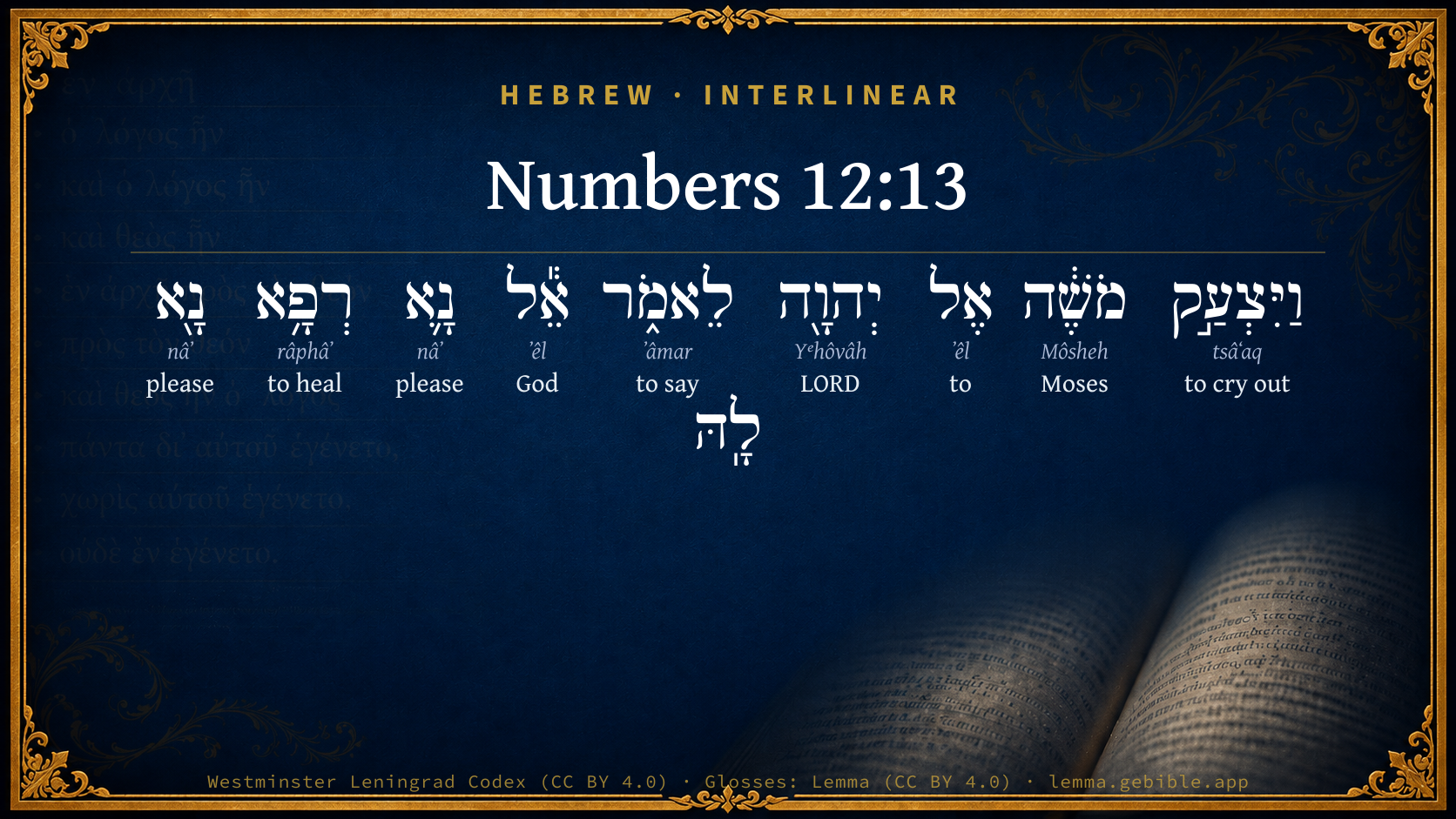
Numbers 12:13

Hebrew (Westminster Leningrad Codex) Numbers 12:13 appears in the Hebrew Old Testament. The text above is from the Westminster Leningrad Codex. Each word links to its Strong’s number, a concise gloss, and parsing drawn from the Open Scriptures Hebrew Bible morphology. Click any word for its full Brown-Driver-Briggs (BDB) entry.
Download image
Cite this verse

Numbers 12:13 (World English Bible). Public Domain. Lemma interlinear Bible study tool, https://lemma.gebible.app/v/numbers/12/13.

Show BibTeX & RIS
BibTeX
RIS
English Translation
Moses cried to Yahweh, saying, Heal her, God, I beg you.
World English Bible · Public Domain
Download a study sheet

One document with this verse’s original text, its word-by-word gloss line, the meaning frame, cross-references with their text, attributed commentary, and full source and license credits — printable, and it pastes into notes with its structure intact.

This verse Autodidact and up

Study sheet (.html) Plain text (.txt)

A passage Seminary Student

Up to 50 verses in one chapter. A passage sheet keeps up to 6 commentary sources and 12 cross-references per verse, in the order this page ranks them, and says so on the sheet whenever that leaves anything out. Ask for a single verse and you get the Autodidact verse sheet above.

Everything on this page stays free to read, with no account — the sheet is a download of what is already on screen, not access to it.

Want to remove ads? Support Godless Engineer
Compare translations 3

The same verse in 3 English versions, stacked beneath the original-language interlinear above. Click any original word for its lexicon entry.

Each is an independent rendering of the whole verse — the interlinear is not word-aligned to these translations.

Highlighted words mark where these versions differ — a whole-verse word diff, not a word-by-word alignment.

  • World English Bible Public Domain
    Moses cried to Yahweh, saying, Heal her, God, I beg you.
  • King James Version Public Domain
    And Moses cried unto the LORD, saying, Heal her now, O God, I beseech thee.
  • unfoldingWord Literal Text CC BY-SA 4.0
    And Moses cried out to Yahweh, saying, “God, please, please heal her!”

unfoldingWord Literal Text — © unfoldingWord, licensed CC BY-SA 4.0. Word-aligned USFM3 via Door43 (git.door43.org/unfoldingWord/en_ult).

Versions to compare (up to 4)

3 of 4 selected

Show all 18 translations

Every available English version of this verse, each an independent rendering of the whole verse.

  • World English Bible Public Domain
    Moses cried to Yahweh, saying, Heal her, God, I beg you.
  • Berean Standard Bible Public Domain
    So Moses cried out to the LORD, “O God, please heal her!”
  • Majority Standard Bible Public Domain
    So Moses cried out to the LORD, “O God, please heal her!”
  • King James Version Public Domain
    And Moses cried unto the LORD, saying, Heal her now, O God, I beseech thee.
  • American Standard Version (1901) Public Domain
    And Moses cried unto Jehovah, saying, Heal her, O God, I beseech thee.
  • Revised Version (1885) Public Domain
    And Moses cried unto the LORD, saying, Heal her, O God, I beseech thee.
  • Geneva Bible (1599) Public Domain
    Then Moses cryed vnto the Lord, saying, O God, I beseech thee, heale her nowe.
  • Douay-Rheims (1899) Public Domain
    And Moses cried to the Lord, saying: O God, I beseech thee heal her.
  • Young's Literal Translation Public Domain
    And Moses crieth unto Jehovah, saying, `O God, I pray Thee, give, I pray Thee, healing to her.'
  • Literal Standard Version CC BY-SA 4.0
    And Moses cries to YHWH, saying, “O God, please give healing to her! Please!”
  • Unlocked Literal Bible CC BY-SA 4.0
    So Moses called out to Yahweh. He said, “Please heal her, God, please.”
  • unfoldingWord Literal Text CC BY-SA 4.0
    And Moses cried out to Yahweh, saying, “God, please, please heal her!”
  • Darby Bible Public Domain
    And Moses cried to Jehovah, saying, O ùGod, heal her, I beseech thee!
  • World Messianic Bible Public Domain
    Moses cried to the LORD, saying, “Heal her, God, I beg you!”
  • Webster's Bible Public Domain
    And Moses cried to the LORD, saying, Heal her now, O God, I beseech thee.
  • Free Bible Version CC BY-SA 4.0
    Moses called out to the Lord, “God, please heal her!”
  • Bible in Basic English Public Domain
    And Moses, crying to the Lord, said, Let my prayer come before you, O God, and make her well.
  • JPS Tanakh (1917) Public Domain
    And Moses cried unto the LORD, saying: 'Heal her now, O God, I beseech Thee.'

Literal Standard Version (2020), Covenant Press — licensed CC BY-SA 4.0. Text via the HelloAO Bible API (eBible.org). Unlocked Literal Bible (unfoldingWord) — licensed CC BY-SA 4.0. Text via the HelloAO Bible API (eBible.org). unfoldingWord Literal Text — © unfoldingWord, licensed CC BY-SA 4.0. Word-aligned USFM3 via Door43 (git.door43.org/unfoldingWord/en_ult). Free Bible Version, Dr. Jonathan Gallagher — licensed CC BY-SA 4.0. Text via the HelloAO Bible API (eBible.org).

Word by word

More ways to search: Search by grammar → Find every occurrence → Compare this word →

Practice this passage: Drill this verse → Learn its vocabulary →

וַיִּצְעַ֣ק
tsâʻaq
H6817
“and · to cry out”
Conjunction + Verb, Qal, Sequential Imperfect, 3rd Person, Masculine, Singular
Part of Speech
Conjunction + Verb
Stem
Qal
Form
Sequential Imperfect
Person
3rd Person
Gender
Masculine
Number
Singular
Full BDB Definition

Origin: a primitive root

TWOT: 1947

to cry, cry out, call, cry for help - (Qal) - to cry, cry out (for help) - to cry, cry out (in distress or need) - to make outcry, clamour - (Niphal) to be summoned - (Piel) to cry aloud (in grief) - (Hiphil) to call together
  1. מֹשֶׁ֔ה Môsheh H4872 “Moses” Noun, Proper
  2. אֶל ʼêl H413 “to” Preposition
  3. יְהוָ֖ה Yᵉhôvâh H3068 “LORD” Noun, Proper
  4. לֵאמֹ֑ר ʼâmar H559 “to say” Preposition + Verb, Qal, Infinitive Construct
  5. אֵ֕ל ʼêl H410 “God” Noun, Common, Masculine, Singular, Absolute
  6. נָ֛א nâʼ H4994 “please” Particle, Exhortation
  7. רְפָ֥א râphâʼ H7495 “heal” Verb, Qal, Imperative, 2nd Person, Masculine, Singular
  8. נָ֖א nâʼ H4994 “please” Particle, Exhortation

About this verse

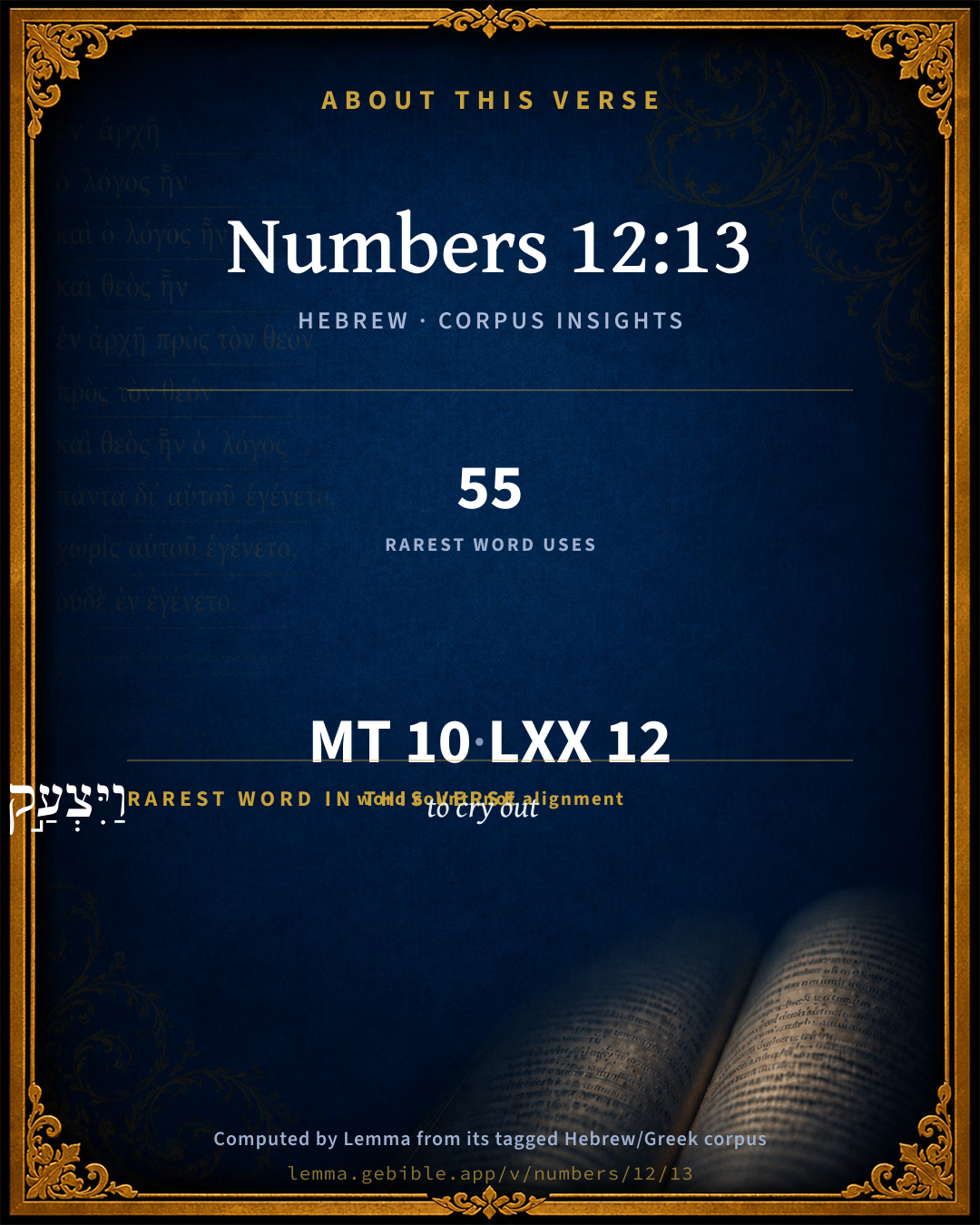
These counts appear in no published source. They are computed here, from the morphology-tagged text and Lemma’s own curated glosses. What Lemma adds →

10
words
8
distinct lemmas
Pentateuch
section

Shared distinctive vocabulary

וַיִּצְעַ֣ק to cry out H6817 occurs in 53 verses of the Hebrew Bible. Also found in:

Grammatical profile

  • 3 verbs
  • 3 nouns
  • 2 prepositions
  • 2 particles

Verb forms

  • וַיִּצְעַ֣ק Qal · Sequential Imperfect
  • לֵאמֹ֑ר Qal · Infinitive Construct
  • רְפָ֥א Qal · Imperative

Repetition

A word recurs within this verse — often emphatic in Hebrew:

  • נָ֛א please H4994 ×2

Hebrew & Septuagint length

In English translation the verse runs 11 words from the Hebrew and 14 from the Septuagint (LXX English) — closely comparable.

A rough comparison of the two English renderings, which tokenize alike — not a word-level alignment.

Word counts can differ between the Hebrew and the Greek without any difference in meaning — e.g. the Hebrew direct-object marker אֵת has no separate Greek word, and Greek often adds the article ὁ.

In the original languages it is 10 Hebrew tokens and 12 Greek tokens — but the two are counted differently (Hebrew bundles its prefixes and suffixes into one token; the Greek is in lemma form), so that isn’t a like-for-like length.

Cross-references

15

Topical passages linked to Numbers 12:13 in the Treasury of Scripture Knowledge — connected by theme and wording, ordered by reader-vote popularity; previews shown in the World English Bible.

  • Luke 6:28 bless those who curse you, and pray for those who mistreat you.
  • Romans 12:21 Don't be overcome by evil, but overcome evil with good.
  • James 5:15 and the prayer of faith will heal him who is sick, and the Lord will raise him up. If he has committed sins, he will be forgiven.
  • Exodus 32:10–14 Now therefore leave me alone, that my wrath may burn hot against them, and that I may consume them; and I will make of you a great nation."
  • Numbers 14:2 All the children of Israel murmured against Moses and against Aaron: and the whole congregation said to them, Would that we had died in the land of Egypt! or would that we had died in this wilderness!
  • Numbers 14:13–20 Moses said to Yahweh, Then the Egyptians will hear it; for you brought up this people in your might from among them;
  • Numbers 16:41 But on the next day all the congregation of the children of Israel murmured against Moses and against Aaron, saying, You have killed the people of Yahweh.
  • Numbers 16:46–50 Moses said to Aaron, Take your censer, and put fire therein from off the altar, and lay incense thereon, and carry it quickly to the congregation, and make atonement for them: for there is wrath gone out from Yahweh; the plague is begun.
  • 1 Samuel 12:23 Moreover as for me, far be it from me that I should sin against Yahweh in ceasing to pray for you: but I will instruct you in the good and the right way.
  • 1 Samuel 15:11 It repents me that I have set up Saul to be king; for he is turned back from following me, and has not performed my commandments. Samuel was angry; and he cried to Yahweh all night.
  • Isaiah 30:26 Moreover the light of the moon shall be as the light of the sun, and the light of the sun shall be sevenfold, as the light of seven days, in the day that Yahweh binds up the hurt of his people, and heals the stroke of their wound.
  • Jeremiah 17:14 Heal me, O Yahweh, and I shall be healed; save me, and I shall be saved: for you are my praise.
  • Matthew 5:44–45 But I tell you, love your enemies, bless those who curse you, do good to those who hate you, and pray for those who mistreat you and persecute you,
  • Luke 23:34 Jesus said, "Father, forgive them, for they don't know what they are doing." Dividing his garments among them, they cast lots.
  • Acts 7:60 He kneeled down, and cried with a loud voice, "Lord, don't hold this sin against them!" When he had said this, he fell asleep.

Cross-references courtesy of OpenBible.info (CC BY 4.0).

Hebrew and Greek witnesses Masoretic Hebrew ↔ Greek Septuagint

The same verse in the two great witnesses to the Old Testament, shown verse-for-verse.

These are two independent witnesses, not word-aligned to each other, and the Septuagint is shown in lemma (dictionary) form.

Hebrew Numbers 12:13 Masoretic · Westminster Leningrad Codex

וַיִּצְעַ֣ק מֹשֶׁ֔ה אֶל יְהוָ֖ה לֵאמֹ֑ר אֵ֕ל נָ֛א רְפָ֥א נָ֖א לָֽהּ

Moses cried to Yahweh, saying, Heal her, God, I beg you.

World English Bible · Public Domain

Greek LXX Numbers 12:13 Septuagint · lemma form

καί βοάω μωυσῆς πρός κύριος λέγω ὁ θεός δέομαι σύ ἰάομαι αὐτός

And Moses cried to the Lord, saying, O God, I beseech you, heal her.

LXX2012 (modern English Septuagint) · Public Domain

Hebrew: Westminster Leningrad Codex (CC BY 4.0). Greek: Septuagint (public domain); English from LXX2012 (modern English Septuagint) (Public Domain). How the Septuagint differs from the Hebrew →

Targum (Aramaic paraphrase)

2

The Targum is the ancient Jewish Aramaic paraphrase of the Hebrew Scriptures — an interpretive translation, not the Hebrew text itself. Onkelos (literal) and Pseudo-Jonathan (expansive) render the Torah, and Jonathan the Prophets. Coverage is partial: where no permissively-licensed English translation exists for a verse, only the Aramaic is shown. This is verse-level text, not a word-by-word alignment to the Hebrew.

  1. Targum Onkelos Torah (Genesis–Deuteronomy)
    וְצַלִי משֶׁה קֳדָם יְיָ לְמֵימָר אֱלָהָא בְּבָעוּ אַסֵי כְעַן יָתָהּ

    (no public-domain English translation for this verse)

    Targum Onkelos — Aramaic: “Onkelos Genesis” (public domain); “Onkelos Exodus” (public domain); “Onkelos Leviticus” (public domain); “Onkelos Numbers” (public domain); “Onkelos Deuteronomy” (public domain). English: “Sefaria Community Translation” (CC0 1.0 (public-domain dedication)); “J.W. Etheridge. The Targums of Onkelos and Jonathan Ben Uzziel on the Pentateuch. London: Longmans, Green, 1862” (public domain). Text via Sefaria.

  2. Targum Pseudo-Jonathan Torah (Genesis–Deuteronomy)
    וְצַלִי משֶׁה וּבְעָא רַחֲמִין קֳדָם יְיָ לְמֵימָר בְּבָעוּ בְּרַחֲמִין אֱלָהָא רַחֲמָנָא בְּבָעוּ אֱלָהָא דְשַׁלִיט בְּנִשְׁמַת כָּל בִּישְרָא אַסֵי בְּבָעוּ לָהּ

    And Mosheh did pray, and seek mercy before the Lord, saying: I pray through the compassions of the merciful God, O Eloha, who hast power over the life of all flesh, heal her, I beseech thee.

    Targum Pseudo-Jonathan — Aramaic: “Targum Jonathan on Genesis” (public domain); “Targum Jonathan on Exodus” (public domain); “Targum Jonathan on Leviticus” (public domain); “Targum Jonathan on Numbers” (public domain); “Targum Jonathan on Deuteronomy” (public domain). English: “The Targum of Jonathan ben Uzziel, trans. J. W. Etheridge, London, 1862” (public domain). Text via Sefaria.

Commentary

Notes on Numbers 12:13 from classic Christian and Jewish commentators (each source and its license shown beneath its notes). The classic Christian expositions comment on the surrounding passage and are grouped to its opening verse, so a note may address several verses; the Jewish commentaries on the Tanakh (Rashi and others) are per-verse, so they appear only where the commentator wrote on this verse.

Lemma curates 59 commentaries, every one of them public domain or Creative Commons licensed, each selected and text-cleaned for this edition rather than reprinted as found. About our sources →

Trapp's Complete Commentary

John Trapp

Num 12:13 And Moses cried unto the LORD, saying, Heal her now, O God, I beseech thee.

Ver. 13. And Moses cried.] Passing by all the unkindness, he prayed earnestly for her. This was a noble kind of revenge. David was much in it.

John Trapp, A Commentary or Exposition upon All the Books of the Old and New Testament (1647–1656) — public domain. Text from a community e-Sword module.

Ellicott's Commentary for English Readers

(13) Heal her now, O God, I beseech thee.—Better, O God, I beseech thee, heal her, I beseech thee.

A Bible Commentary for English Readers, edited by Charles John Ellicott (1878–1897) — public domain. Text from a community e-Sword module.

John Gill's Exposition

And Moses cried unto the Lord,.... With a loud voice, and with great earnestness and importunity, being heartily affected with the miserable condition Miriam was in:

saying, heal her now, O God, I beseech thee; in the original text it is, "O God now, heal her now"; for the same particle is used at the close as at the beginning of the petition; and the repetition of it shows his earnestness and importunity that she might be healed directly, immediately, without any delay; and Moses uses the word "El", which signifies the strong and mighty God, as expressive of his faith in the power of God, that he was able to heal her; and at the same time suggests that none but he could do it; and so Aben Ezra interprets it,"thou that hast power in thine hand, now heal her;''this prayer is a proof of his being of a meek, humble, and forgiving spirit.

John Gill's Exposition of the Whole Bible (1746–1763) — public domain (CC PDM 1.0). Text via the HelloAO Bible API.

Whedon's Commentary on the Bible

Daniel D. Whedon

13. Heal her now — Strong faith always insists on a present blessing. Says J. Wesley, in respect to the healing of the leprosy of inbred sin, “If it is by faith, why not NOW?” Weak faith drops out the now, grasps no definite time, and looks only for a gradual cure. The greatest achievement of faith requires for its condition the idea of immediateness and instantaneousness.

Daniel D. Whedon (gen. ed.), Commentary on the Old and New Testaments (1874–1909) — public domain. Text from a community e-Sword module.

The Pulpit Commentary

Moses cried unto the Lord. A much harder and prouder man than Moses was must needs have been melted into pity at the sight of his sister, and the terrible suggestion of Aaron. Heal her now, O God, I beseech thee. The "now" has no place here, unless it be merely to add force to the exclamation. Moses, although directly appealed to himself, can only appeal to God.

The Pulpit Commentary (1880–1919), ed. H.D.M. Spence-Jones & Joseph S. Exell — public domain. Text from a community e-Sword module.

Keil & Delitzsch

C. F. Keil & F. Delitzsch

Moses, with his mildness, took compassion upon his sister, upon whom this punishment had fallen, and cried to the Lord, "O God, I beseech Thee, heal her." The connection of the particle נא with אל is certainly unusual, but yet it is analogous to the construction with such exclamations as אוי (Jer 4:31; Jer 45:3) and הנּה (Gen 12:11; Gen 16:2, etc.); since אל in the vocative is to be regarded as equivalent to an exclamation; whereas the alteration into אל, as proposed by J. D. Michaelis and Knobel, does not even give a fitting sense, apart altogether from the fact, that the repetition of נא after the verb, with נא אל before it, would be altogether unexampled.

Keil & Delitzsch — Biblical Commentary on the Old Testament (1861–1891) — public domain (CC PDM 1.0). Text via the HelloAO Bible API. (Old Testament only.)

unfoldingWord translationNotes

Door43 World Missions Community

Please heal her, God, please

Here "please" is repeated for emphasis.

If her father had spit in her face

This describes something that could have happened but did not. Spitting in someone's face was a terrible insult. (See: Hypothetical Situationsand Symbolic Action)

Miriam was shut outside the camp

Being sent out of the camp and not being allowed to go back in is spoken of as if there were a door that was closed behind her. AT: "Miriam was sent outside the camp" or "Miriam was kept outside the camp" (See: Metaphor)

Miriam was shut outside the camp

This can be stated in active form. AT: "Moses shut Miriam outside the camp" or "Moses sent Miriam outside the camp" (See: Active or Passive)

translationWords

cure

God

disgrace

unfoldingWord translationNotes — © Distant Shores Media and the Door43 World Missions Community, licensed CC BY-SA 4.0. Source: git.door43.org/Door43/en_tn.

Rashi

Rabbi Shlomo Yitzchaki (Rashi)

אל נא רפא נא לה HEAL HER NOW, O GOD, I BESEECH THEE — Scripture intends to teach you by this form of prayer the correct attitude in social life — that if one is asking a favour of his fellow man he should first say two or three words of supplication and then solicit the favour (Sifrei Bamidbar 105).

לאמר SAYING (more lit., to say, i.e. that he should say) — What is the force of this word? It means “to say” i.e. that God should say, viz., he (Moses) said to Him, “Answer me whether you are going to heal her or not”, — until at length He replied: “If her father had but spit in her face etc.” Rabbi Eleazer, the son of Azariah, said: In four instances Moses asked the Holy One, blessed be He, to tell him whether He would fulfil his request or not. Similar to the case here is, (Exodus 6:12): “And Moses spoke before the Lord, saying, “[Behold, the children of Israel have not hearkened unto me; how then shall Pharaoh hearken to me]”. What is the force of the word לאמר? — “Answer me whether you will redeem them or not”. Until at length the Lord said unto him, (Exodus 6:1) “Now shalt thou see [What I will do to Pharaoh]”. Similar to this is: (Numbers 27:15—18) “and Moses spake unto the Lord, saying, ‘Let the Lord, the God of the spirits of all flesh set a man [over the congregation]’”. He answered him, “Take thee [Joshua the son of Nun, etc.]”. Similar to this is: (Deuteronomy 3:23—26) “And I besought the Lord at that time, saying, [O Lord, God, thou hast begun to show thy servant thy greatness]’, the Lord replied: “Let it suffice” (Sifrei Bamidbar 105).

רפא נא לה HEAL HER, I PRAY THEE — Why did Moses not pray at length? In order that Israel should not say: His sister is in trouble, and he stands and offers long prayers! (Sifrei Bamidbar 105). — [Another explanation is: He did not pray at length so that Israel should not say: On behalf of his sister he prays long, but on our behalf he would offer no long prayer].

Rashi on the Tanakh — English translations: “The Judaica Press complete Tanach with Rashi, translated by A. J. Rosenberg” (CC BY 4.0); “Pentateuch with Rashi's commentary by M. Rosenbaum and A.M. Silbermann, 1929-1934” (public domain); “The Metsudah Tanach series, Lakewood, N.J” (CC BY 4.0); and “The Book of Joshua, Metsudah Publications, 1997” (CC BY 4.0). Text via Sefaria.

Ibn Ezra

Rabbi Abraham ibn Ezra

Moshe cried out. This teaches that he was in pain about his sister.

Please, God. The usage of this Name of Hashem (אל) connotes: You, Who have the Might in Your Hand, please heal her now.

Ibn Ezra on the Tanakh — English translations: “Sefaria Community Translation” (CC0 1.0 (public-domain dedication)); “Yalkut, Sifsei Chachomim Chumash, Metsudah Publications, 2009” (CC BY 4.0); and “Commentary of Ibn Ezra on Isaiah - trans. by M. Friedlander, 1873” (public domain). Text via Sefaria.

Lesson kit

Teaching starters — assembled from the data on this page, not authored interpretation. Every prompt links to the verse data it draws on. Edit before teaching.

Numbers, in the Pentateuch, opens this verse with 10 words (8 distinct Hebrew lemmas). Its most distinctive word is tsâʻaq (“to cry out”). A historical commentator’s framing appears above. Read the whole chapter for the surrounding context.

Discussion questions

  1. The word tsâʻaq carries the sense “to cry out.” How does it shape the verse?
  2. How does Genesis 4:10, which shares the word «to cry out», read alongside this verse?
  3. What does the repetition of “please” (2× in this one verse) do in this verse?
  4. These translations render this verse differently; the difference is in the English rendering, not the original. What questions does that raise?
  5. «וַיִּצְעַ֣ק» is a Qal Sequential Imperfect verb. How does that grammatical form shape the action described?
  6. Compare how Trapp's Complete Commentary and Ellicott's Commentary for English Readers read this verse. Where do they agree or differ?

Things to notice

Reading settings

Reading text

Shown beneath each verse's original-language words.

Old Testament
Old Testament edition

Read the OT as the Masoretic Hebrew (MT) or the Greek Septuagint (LXX).

English shown for the Greek Septuagint (in the Hebrew ↔ Greek comparison).

Comparing translations? Open the Compare panel on any verse page to stack up to four side by side.