
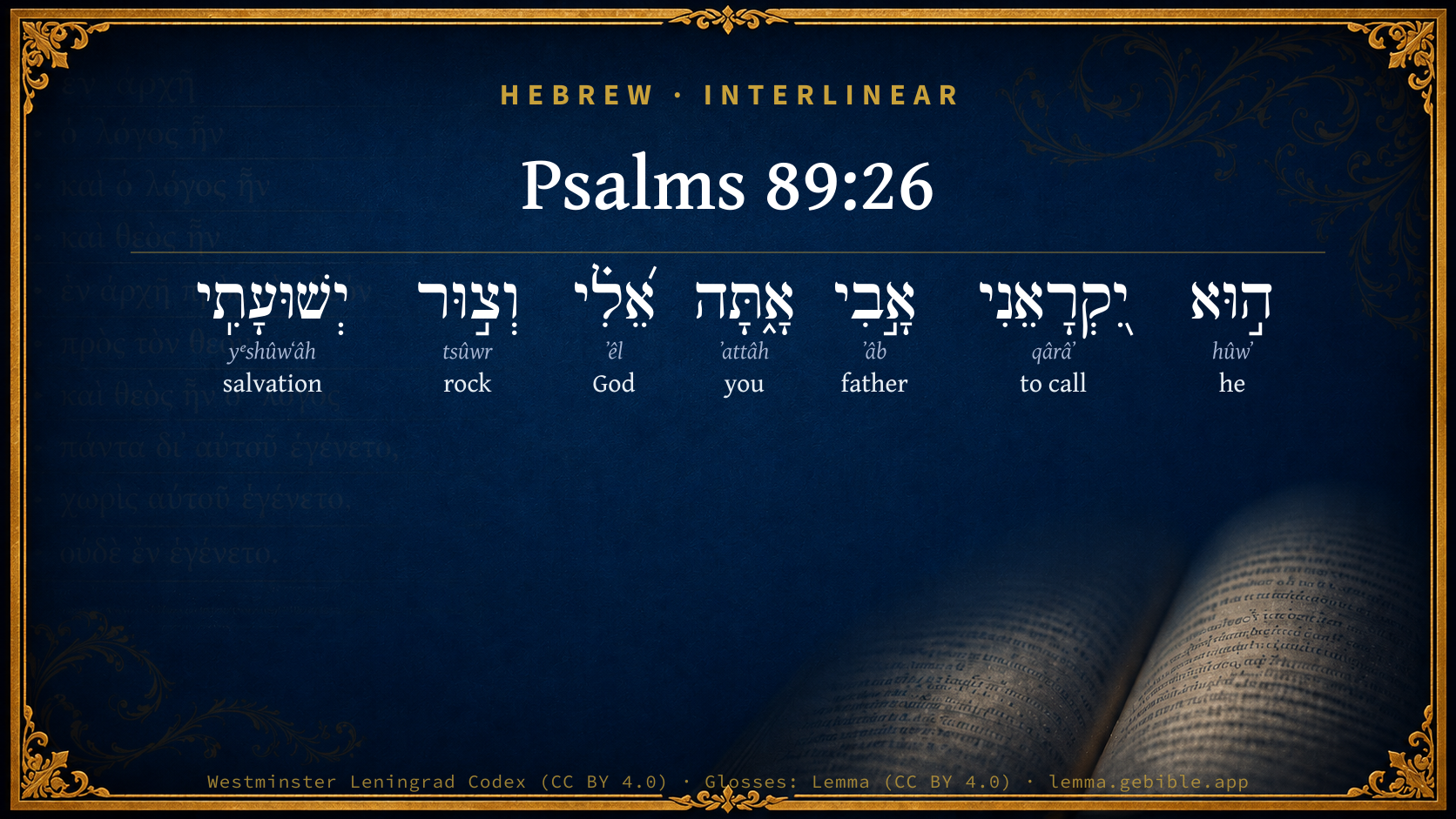
Psalms 89:26

Hebrew (Westminster Leningrad Codex) Psalms 89:26 appears in the Hebrew Old Testament. The text above is from the Westminster Leningrad Codex. Each word links to its Strong’s number, a concise gloss, and parsing drawn from the Open Scriptures Hebrew Bible morphology. Click any word for its full Brown-Driver-Briggs (BDB) entry.
Download image
Cite this verse

Psalms 89:26 (World English Bible). Public Domain. Lemma interlinear Bible study tool, https://lemma.gebible.app/v/psalms/89/26.

Show BibTeX & RIS
BibTeX
RIS
English Translation
He will call to me, 'You are my Father, My God, and the rock of my salvation!'
World English Bible · Public Domain
Download a study sheet

One document with this verse’s original text, its word-by-word gloss line, the meaning frame, cross-references with their text, attributed commentary, and full source and license credits — printable, and it pastes into notes with its structure intact.

This verse Autodidact and up

Study sheet (.html) Plain text (.txt)

A passage Seminary Student

Up to 50 verses in one chapter. A passage sheet keeps up to 6 commentary sources and 12 cross-references per verse, in the order this page ranks them, and says so on the sheet whenever that leaves anything out. Ask for a single verse and you get the Autodidact verse sheet above.

Everything on this page stays free to read, with no account — the sheet is a download of what is already on screen, not access to it.

Want to remove ads? Support Godless Engineer
Compare translations 3

The same verse in 3 English versions, stacked beneath the original-language interlinear above. Click any original word for its lexicon entry.

Each is an independent rendering of the whole verse — the interlinear is not word-aligned to these translations.

Highlighted words mark where these versions differ — a whole-verse word diff, not a word-by-word alignment.

  • World English Bible Public Domain
    He will call to me, 'You are my Father, My God, and the rock of my salvation!'
  • King James Version Public Domain
    He shall cry unto me, Thou art my father, my God, and the rock of my salvation.
  • unfoldingWord Literal Text CC BY-SA 4.0
    He, he will call to me, ‘You my Father, my God and the rock of my salvation.’

unfoldingWord Literal Text — © unfoldingWord, licensed CC BY-SA 4.0. Word-aligned USFM3 via Door43 (git.door43.org/unfoldingWord/en_ult).

Versions to compare (up to 4)

3 of 4 selected

Show all 18 translations

Every available English version of this verse, each an independent rendering of the whole verse.

  • World English Bible Public Domain
    He will call to me, 'You are my Father, My God, and the rock of my salvation!'
  • Berean Standard Bible Public Domain
    He will call to Me, ‘You are my Father, my God, the Rock of my salvation.’
  • Majority Standard Bible Public Domain
    He will call to Me, ‘You are my Father, my God, the Rock of my salvation.’
  • King James Version Public Domain
    He shall cry unto me, Thou art my father, my God, and the rock of my salvation.
  • American Standard Version (1901) Public Domain
    He shall cry unto me, Thou art my Father, My God, and the rock of my salvation.
  • Revised Version (1885) Public Domain
    He shall cry unto me, Thou art my father, my God, and the rock of my salvation.
  • Geneva Bible (1599) Public Domain
    He shall cry vnto mee, Thou art my Father, my God and the rocke of my saluation.
  • Douay-Rheims (1899) Public Domain
    And I will set his hand in the sea; and his right hand in the rivers.
  • Young's Literal Translation Public Domain
    He proclaimeth me: `Thou `art' my Father, My God, and the rock of my salvation.'
  • Literal Standard Version CC BY-SA 4.0
    He proclaims to Me: “You [are] my Father, || My God, and the rock of my salvation.”
  • Unlocked Literal Bible CC BY-SA 4.0
    He will call out to me, 'You are my Father, my God, and the rock of my salvation.'
  • unfoldingWord Literal Text CC BY-SA 4.0
    He, he will call to me, ‘You my Father, my God and the rock of my salvation.’
  • Darby Bible Public Domain
    *He* shall call unto me, Thou art my father, my ùGod, and the rock of my salvation;
  • World Messianic Bible Public Domain
    He will call to me, ‘You are my Father, my God, and the rock of my salvation!’
  • Webster's Bible Public Domain
    \\89:25\\I will set his hand also in the sea, and his right hand in the rivers.
  • Free Bible Version CC BY-SA 4.0
    He will call out to me, ‘You are my Father, my God, and the rock of my salvation.’
  • Bible in Basic English Public Domain
    He will say to me, You are my father, my God, and the Rock of my salvation.
  • JPS Tanakh (1917) Public Domain
    (89-27) He shall call unto Me: Thou art my Father, my God, and the rock of my salvation.

Literal Standard Version (2020), Covenant Press — licensed CC BY-SA 4.0. Text via the HelloAO Bible API (eBible.org). Unlocked Literal Bible (unfoldingWord) — licensed CC BY-SA 4.0. Text via the HelloAO Bible API (eBible.org). unfoldingWord Literal Text — © unfoldingWord, licensed CC BY-SA 4.0. Word-aligned USFM3 via Door43 (git.door43.org/unfoldingWord/en_ult). Free Bible Version, Dr. Jonathan Gallagher — licensed CC BY-SA 4.0. Text via the HelloAO Bible API (eBible.org).

Word by word

More ways to search: Search by grammar → Find every occurrence → Compare this word →

Practice this passage: Drill this verse → Learn its vocabulary →

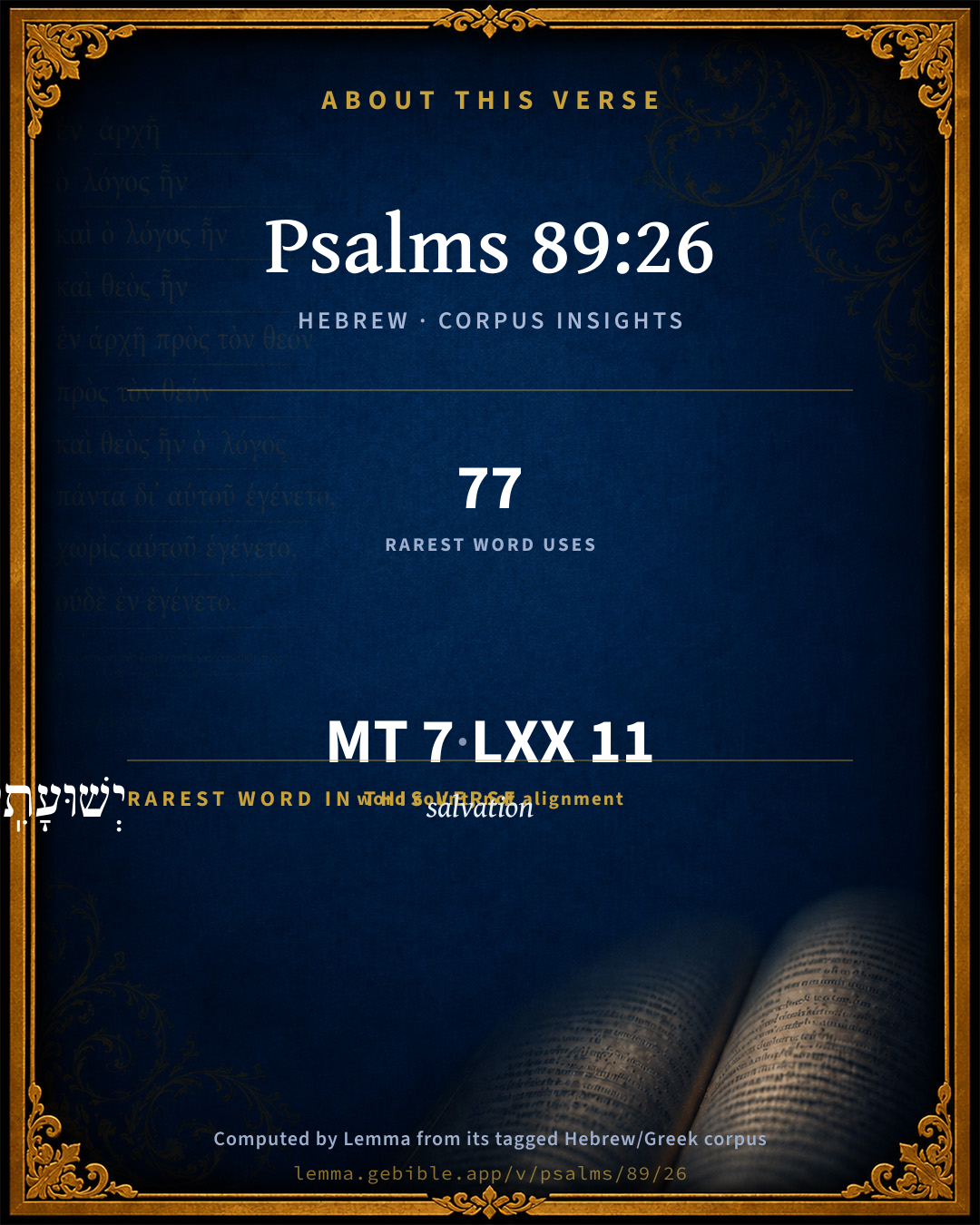
About this verse

These counts appear in no published source. They are computed here, from the morphology-tagged text and Lemma’s own curated glosses. What Lemma adds →

7
words
7
distinct lemmas
Wisdom
section

Grammatical profile

  • 1 verb
  • 4 nouns
  • 2 pronouns

Verb forms

  • יִ֭קְרָאֵנִי Qal · Imperfect

Hebrew & Septuagint length

In English translation the verse runs 17 words from the Hebrew and 18 from the Septuagint (LXX English) — closely comparable.

A rough comparison of the two English renderings, which tokenize alike — not a word-level alignment.

Word counts can differ between the Hebrew and the Greek without any difference in meaning — e.g. the Hebrew direct-object marker אֵת has no separate Greek word, and Greek often adds the article ὁ.

In the original languages it is 7 Hebrew tokens and 11 Greek tokens — but the two are counted differently (Hebrew bundles its prefixes and suffixes into one token; the Greek is in lemma form), so that isn’t a like-for-like length.

Cross-references

16

Topical passages linked to Psalms 89:26 in the Treasury of Scripture Knowledge — connected by theme and wording, ordered by reader-vote popularity; previews shown in the World English Bible.

  • 2 Samuel 7:14 I will be his father, and he shall be my son: if he commit iniquity, I will chasten him with the rod of men, and with the stripes of the children of men;
  • 2 Samuel 22:47 Yahweh lives; Blessed be my rock; Exalted be God, the rock of my salvation,
  • Psalms 95:1 Oh come, let's sing to Yahweh. Let's shout aloud to the rock of our salvation!
  • Psalms 62:6–7 He alone is my rock and my salvation, my fortress. I will not be shaken.
  • Psalms 62:2 He alone is my rock and my salvation, my fortress-- I will never be greatly shaken.
  • Matthew 26:42 Again, a second time he went away, and prayed, saying, "My Father, if this cup can't pass away from me unless I drink it, your desire be done."
  • Psalms 18:46 Yahweh lives; and blessed be my rock. Exalted be the God of my salvation,
  • Luke 23:46 Jesus, crying with a loud voice, said, "Father, into your hands I commit my spirit!" Having said this, he breathed his last.
  • John 11:41 So they took away the stone from the place where the dead man was lying. Jesus lifted up his eyes, and said, "Father, I thank you that you listened to me.
  • 1 Chronicles 22:10 he shall build a house for my name; and he shall be my son, and I will be his father; and I will establish the throne of his kingdom over Israel for ever.
  • Psalms 43:4 Then I will go to the altar of God, To God, my exceeding joy. I will praise you on the harp, God, my God.
  • Mark 15:34 At the ninth hour Jesus cried with a loud voice, saying, "Eloi, Eloi, lama sabachthani?" which is, being interpreted, "My God, my God, why have you forsaken me?"
  • John 20:17 Jesus said to her, "Don't touch me, for I haven't yet ascended to my Father; but go to my brothers, and tell them, 'I am ascending to my Father and your Father, to my God and your God.'"
  • Isaiah 50:7–9 For the Lord Yahweh will help me; therefore I have not been confounded: therefore have I set my face like a flint, and I know that I shall not be disappointed.
  • Matthew 26:39 He went forward a little, fell on his face, and prayed, saying, "My Father, if it is possible, let this cup pass away from me; nevertheless, not what I desire, but what you desire."
  • Hebrews 1:5 For to which of the angels did he say at any time, "You are my Son, Today have I become your father?" and again, "I will be to him a Father, And he will be to me a Son?"

Cross-references courtesy of OpenBible.info (CC BY 4.0).

Hebrew and Greek witnesses Masoretic Hebrew ↔ Greek Septuagint

The same verse in the two great witnesses to the Old Testament, shown verse-for-verse.

You’re reading Greek Psalm 88 (Hebrew Psalm 89). The Septuagint counts the superscription, so verse numbers can differ from the Hebrew — chapter-level alignment, not verse-by-verse. Numbering follows Rahlfs.

These are two independent witnesses, not word-aligned to each other, and the Septuagint is shown in lemma (dictionary) form.

Hebrew Psalms 89:26 Masoretic · Westminster Leningrad Codex

ה֣וּא יִ֭קְרָאֵנִי אָ֣בִי אָ֑תָּה אֵ֝לִ֗י וְצ֣וּר יְשׁוּעָתִֽי

He will call to me, 'You are my Father, My God, and the rock of my salvation!'

World English Bible · Public Domain

Greek LXX Greek Psalm 88:26 Septuagint · lemma form

καί τίθημι ἐν θάλασσα χείρ αὐτός καί ἐν ποταμός δεξιός αὐτός

He shall call upon me, saying, You are my Father, my God, and the helper of my salvation.

LXX2012 (modern English Septuagint) · Public Domain

Hebrew: Westminster Leningrad Codex (CC BY 4.0). Greek: Septuagint (public domain); English from LXX2012 (modern English Septuagint) (Public Domain). How the Septuagint differs from the Hebrew →

Commentary

Notes on Psalms 89:26 from classic Christian and Jewish commentators (each source and its license shown beneath its notes). The classic Christian expositions comment on the surrounding passage and are grouped to its opening verse, so a note may address several verses; the Jewish commentaries on the Tanakh (Rashi and others) are per-verse, so they appear only where the commentator wrote on this verse.

Lemma curates 59 commentaries, every one of them public domain or Creative Commons licensed, each selected and text-cleaned for this edition rather than reprinted as found. About our sources →

Trapp's Complete Commentary

John Trapp

Psa 89:26 He shall cry unto me, Thou [art] my father, my God, and the rock of my salvation.

Ver. 26. He shall cry unto me, Thou art my Father] This was a royalty above all the rest, Joh 1:12 1Jn 3:1, and applied to Christ, the only begotten Son of God; it sets him above all the angels, Heb 1:4-8

My God] This is the beehive of heavenly honey.

John Trapp, A Commentary or Exposition upon All the Books of the Old and New Testament (1647–1656) — public domain. Text from a community e-Sword module.

J. A. Alexander on Psalms

Joseph Addison Alexander

27. (Psa 89:26) He shall call me (or cry unto me), Thou art my Father, my God, and the rock of my salvation. The emphatic pronouns in the original bring out more clearly the mutual relation and reciprocal action of the parties. With the first clause compare 2Sa 7:14, 1Ch 22:10, Job 17:14. With the second compare Psa 18:2; Psa 31:2. The rock of my salvation, the rock that saves me, the hiding-place and stronghold where my safety lies.

Joseph Addison Alexander, The Psalms Translated and Explained (1850) — public domain. Text from a community e-Sword module.

Tyndale Open Study Notes

Tyndale Open Resources

89:26-29 The Lord adopted David as his son, appointed him as his commander over the nations, and promised to support him forever. Verse 26 recalls a verse from David’s song of praise (2 Sam 22:47).

Tyndale Open Study Notes — © Tyndale Open Resources, licensed CC BY-SA 4.0. Text via the HelloAO Bible API.

Geneva Bible (1599)

Geneva Bible translators

His excellent dignity shall appear herein, that he shall be named the son of God, and the firstborn wherein he is a figure of Christ.

Geneva Bible (1599) marginal notes — public domain. Text via Bolls.life.

John Calvin's Commentaries

26. He shall cry to me, Thou art my Father. In this verse it is declared, that the chief excellence of this king will consist in this, that he will be accounted the Son of God. This indeed is a title of honor, which is applied to all whom God ordains to be kings, as we have seen in a previous psalm,

“I have said, Ye are gods; and all of you are children of the Most High:” (Psalm 82:6)

but in the passage before us, something special is expressed of the holy king whom God had chosen, and it is intended to say, that he will be the son of God in a different sense. We shall immediately see in the subsequent verse, how he is placed in a higher rank than the kings of the earth, although they may sway the scepter over a larger extent of country. It was therefore a privilege peculiar to only one king in this world, to be called the Son of God. Had it been otherwise, the apostle reasoned not only inconclusively but absurdly, in quoting this text as a proof of the doctrine, that Christ is superior to the angels:

“I will be to him a Father, and he shall be to me a Son,” (Hebrews 1:5.)

Angels, and kings, and all who are regenerated by the Spirit of adoption, are called sons of God; but David, when God promises to take him for his son, is, by singular prerogative, elevated above all others to whom this designation is applied. This is still more apparent from the following verse, in which he is called God’s first-born, because he is higher than all the kings of the earth; and this is an honor which transcends all the dignity both of men and angels. If it is objected, that David being a mortal man could not be equal to the angels, the obvious answer is, that if he is considered in himself, he cannot justly be elevated to the same rank with them, but with the highest propriety he may, in so far as for a time he represented the person of Christ.

John Calvin's Commentaries (1540-1563) — public domain. Text from the Calvin Translation Society English edition (1840s-50s) via the Christian Classics Ethereal Library (ccel.org). Calvin's coverage is partial (roughly two-thirds of the Bible); uncommented books and verses are honest gaps, never fabricated. The 19th-century editor's footnotes and remarks are omitted so the notes are faithfully Calvin's own voice.

Ellicott's Commentary for English Readers

(26) He shall cry.—This verse is interesting in view of the theological development in the psalter. We might think that the poet was referring to an actual psalm of David, with whom the expression, “My God, the rock of my salvation,” was familiar (see Psa_18:1-2, &c.), were it not for the word “Father,” a title for the Divine Being which the national religion did not frame till the exile period (Jer_3:4; Jer_3:19; Isa_63:16).

A Bible Commentary for English Readers, edited by Charles John Ellicott (1878–1897) — public domain. Text from a community e-Sword module.

The Cambridge Bible for Schools and Colleges

gen. ed. J. J. S. Perowne

26. The promise made to David on behalf of Solomon is here extended to David himself. For my God, and the rock of my salvation cp. Psa_18:2; Deu_32:15.

The Cambridge Bible for Schools and Colleges (gen. ed. J. J. S. Perowne; Cambridge University Press, 1878–1918) — public domain. Text from a community e-Sword module.

John Gill's Exposition

Also I will make him my firstborn,.... Or, "make him the firstborn"; make him great, as Jarchi interprets it; give him the blessing, the double portion of inheritance: so Christ is made most blessed for ever, and has all spiritual blessings in his hands; and is heir of all things, and his people joint-heirs with him. Christ is God's "firstborn", or "first begotten", Heb 1:6, being begotten by him, and of him; and his firstbegotten, though none begotten after him; as the first that opened the womb, under the law, was called the firstborn, though none were ever born after; and in such sense his first begotten, as that he is his only begotten: and he is the firstborn, with respect to creatures; "he is the firstborn of every creature"; Col 1:15, being begotten and brought forth before any creature was in being, Pro 8:22, and, with respect to the saints, "he is the firstborn among many brethren", Rom 8:29, they are of the same nature, and in the same family, and in which Christ is a son, and the firstborn; and in all things he has the preeminence; and he is also "the firstborn from the dead", or "the first begotten of the dead", Col 1:18 being raised first from thence by his own power, and to an immortal life; and is the first fruits of them that sleep, and the efficient and meritorious cause of the resurrection of life, and the pattern and exemplar of it: even him the Father promises to make "higher than the kings of the earth"; having a kingdom of a superior nature to theirs, and a more extensive and durable one; and even they themselves shall be subject to him; hence he is called "King of kings", Rev 19:16. This will be when their kingdoms become his; when they shall fall down before him, and worship him, and bring their riches and glory into his kingdom, or the New Jerusalem church state, Psa 72:10. This passage is interpreted of the Messiah by the Jews (f).

(f) In Shemot Rabba, s. 19. fol. 104. 4.

John Gill's Exposition of the Whole Bible (1746–1763) — public domain (CC PDM 1.0). Text via the HelloAO Bible API.

Albert Barnes' Notes on the Bible

He shall cry unto me, Thou art my Father - He shall appeal to me, or come to me as a Father, and as his only hope and defense.

My God - He shall come to me as God, and shall recognize me as his God, his only trust and hope.

And the rock of my salvation - See the notes at Psa 18:2. The meaning of all this is, that he would at all times recognize him as his only trust and hope, and that he would be faithful on his part to God.

Albert Barnes' Notes on the Bible (1834–1885) — public domain. Text from a community e-Sword/MySword module.

Matthew Poole's English Annotations

He shall find me to be a true and a kind Father to him, and shall familiarly and confidently make his addresses to me as such, for all necessary supplies and assistances, which parents willingly afford to their children, as need requires.

Matthew Poole's English Annotations on the Holy Bible (1683–1685) — public domain. Text from a community e-Sword/MySword module.

The Treasury of David

Charles H. Spurgeon

Ver. 26. He shall cry unto me, Thou art my father. David's seed would be a praying race, and so in the main they were, and when they were not they smarted for it. The Lord Jesus was preeminent in prayer, and his favourite mode of address was "Father". Never was there a son more filial in his cries than "the Firstborn among many brethren." God had one Son without sin, but he never had a Son who lived without prayer.

My God, so our Lord called his Father when upon the cross.

And the rock of my salvation. It was to his Father that he turned for help when in sore anguish in Gethsemane, and to him he committed his spirit in the article of death. In this filial, crying the true sons should imitate him. This is the common language of the elect family: adoption, reverence, trust, must all speak in their turns, and will do if we are heirs according to promise. To say to God "Thou art my father" is more than learning and talent can teach us; the new birth is essential to this. Reader, hast thou the nature of a child and the spirit of one who can cry, "Abba, Father"?

Ver. 26. He shall cry unto me, thou art my father. When did David call God his Father? It is striking that we do not find anywhere in the Old Testament that the patriarchs or prophets called God their Father. You do not find them addressing Him as Father: they did not know him as such. This verse is unintelligible in reference to David; but in regard to the True David it is exactly what he did say, "My Father, and your Father; my God, and your God." Never until Christ uttered these words, never until he appeared on earth in humanity as the Son of God, did any man or any child of humanity address God in this endearing character. It was after Christ said, "I ascend unto my Father, and your Father", that believers were enabled to look up to God and to say, "Abba, Father". Here you see distinctly that this applies to Christ. He was the first to say this: David did not say it. If there were no other proof in the whole Psalm, that one clause would be a demonstration to me that no other man than the Lord Jesus Christ can be here spoken of. Capel Molyneux, 1855.

Ver. 26. My Father. Christ commenced his labours by referring to his Father, for in Lu 2:49 he says, "Wist ye not that I must be about my Father's business?" and his last words were, "Father, into thy hands I commend my spirit"; and through his whole life he most constantly addressed God as his Father. He shall cry unto me: Thou art my Father, as far as my divinity is concerned. My God, as far as my humanity is concerned; the support of my salvation, as regards my mortality. Bellarmine.

Ver. 26-28. Christ had a command to be a sufferer, and a body prepared him for that purpose; so he had likewise a command to be an advocate, and a life given him, and a throne prepared for him at the right hand of God to that end. This commission is contained in the words before us; and this after his exaltation, Ps 89:24-25. Yet for the full completing of it, Ps 89:27 the matter of the plea is here mentioned, Thou art the rock of my salvation, the foundation, the first cause, of all thy salvation I have wrought in the world, being the first mover of it, and promising the acceptance of me in the performance of what was necessary for it. As he hath authority to cry to God, so he hath an assurance of the prevalence of his cry, in regard of the stability of the covenant of mediation, which shall stand fast with him, or be faithful to him: my mercy will I keep for him for evermore, Ps 89:28. The treasures of my mercy are reserved only to be opened and dispensed by him: and the enjoying of his spiritual seed for ever, and the establishing of his own throne thereby, is the promised fruit of this cry, Ps 89:28. Stephen Charnock.

Ver. 26. Our Lord's filial spirit, and how it was displayed.

Psalms 89:27*

Charles H. Spurgeon's The Treasury of David (1869–1885) — public domain. Psalms only. Text from a community e-Sword/MySword module.

The Pulpit Commentary

He shall cry unto me, Thou art my Father. (comp. 2Sa_7:14) My God, and the Rock of my salvation. (see 2Sa_22:2, 2Sa_22:3, 2Sa_22:47)

The Pulpit Commentary (1880–1919), ed. H.D.M. Spence-Jones & Joseph S. Exell — public domain. Text from a community e-Sword module.

Lesson kit

Teaching starters — assembled from the data on this page, not authored interpretation. Every prompt links to the verse data it draws on. Edit before teaching.

Psalms, in the Wisdom, opens this verse with 7 words (7 distinct Hebrew lemmas). Its most distinctive word is yᵉshûwʻâh (“salvation”). A historical commentator’s framing appears above. Read the whole chapter for the surrounding context.

Discussion questions

  1. The word yᵉshûwʻâh carries the sense “salvation.” How does it shape the verse?
  2. How does 2 Samuel 7:14, which shares this passage’s theme, read alongside this verse?
  3. The translations on this page render this verse differently — a whole-verse word diff, not a word-by-word alignment. What might account for the different wordings?
  4. «יִ֭קְרָאֵנִי» is a Qal Imperfect verb. How does that grammatical form shape the action described?
  5. Compare how Trapp's Complete Commentary and J. A. Alexander on Psalms read this verse. Where do they agree or differ?

Things to notice

Reading settings

Reading text

Shown beneath each verse's original-language words.

Old Testament
Old Testament edition

Read the OT as the Masoretic Hebrew (MT) or the Greek Septuagint (LXX).

English shown for the Greek Septuagint (in the Hebrew ↔ Greek comparison).

Comparing translations? Open the Compare panel on any verse page to stack up to four side by side.