Psalms 18:2

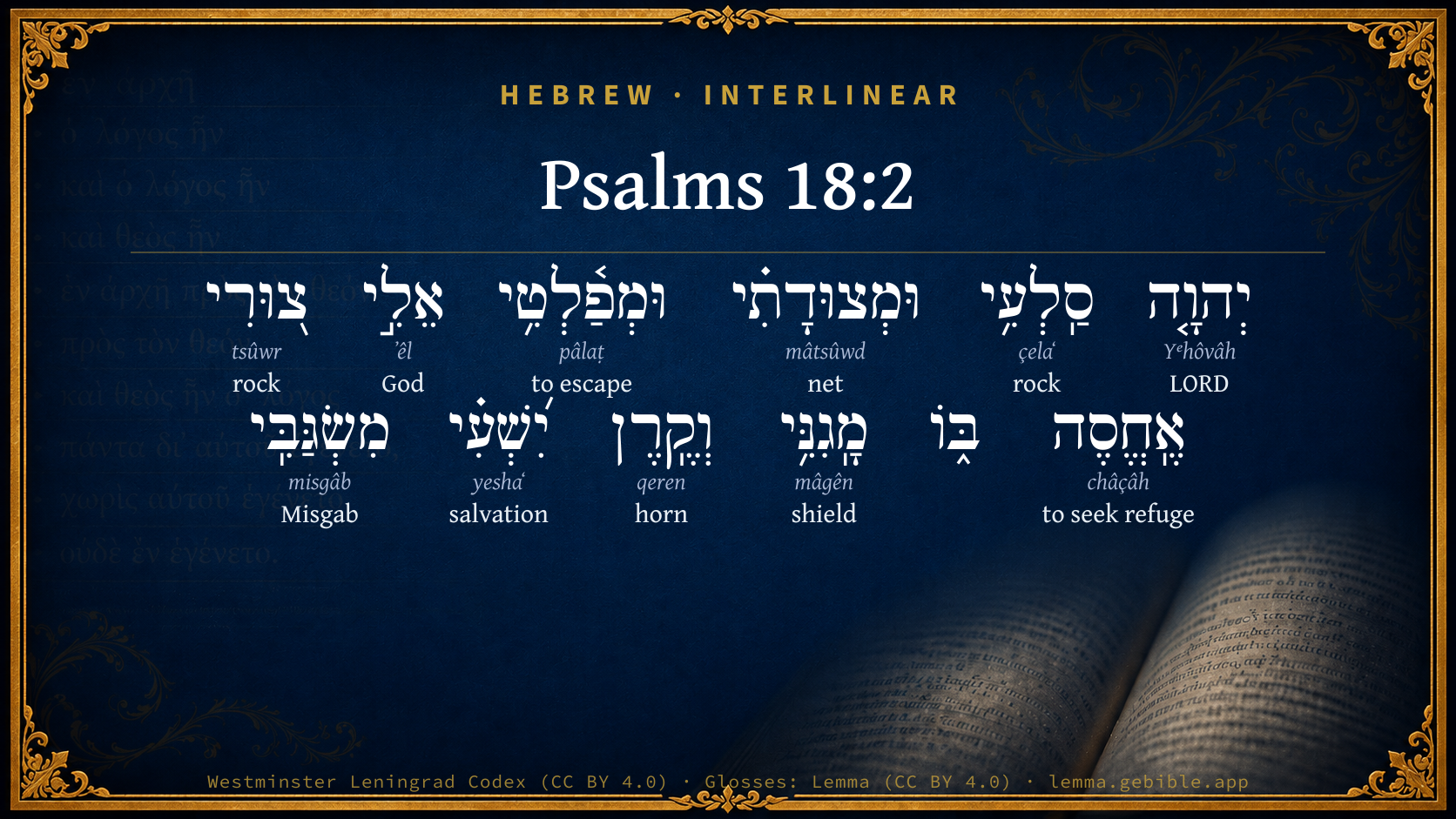
Hebrew (Westminster Leningrad Codex) Psalms 18:2 appears in the Hebrew Old Testament. The text above is from the Westminster Leningrad Codex. Each word links to its Strong’s number, a concise gloss, and parsing drawn from the Open Scriptures Hebrew Bible morphology. Click any word for its full Brown-Driver-Briggs (BDB) entry.
Download image
Cite this verse

Psalms 18:2 (World English Bible). Public Domain. Lemma interlinear Bible study tool, https://lemma.gebible.app/v/psalms/18/2.

Show BibTeX & RIS
BibTeX
RIS
English Translation
Yahweh is my rock, my fortress, and my deliverer; My God, my rock, in whom I take refuge; My shield, and the horn of my salvation, my high tower.
World English Bible · Public Domain
Download a study sheet

One document with this verse’s original text, its word-by-word gloss line, the meaning frame, cross-references with their text, attributed commentary, and full source and license credits — printable, and it pastes into notes with its structure intact.

This verse Autodidact and up

Study sheet (.html) Plain text (.txt)

A passage Seminary Student

Up to 50 verses in one chapter. A passage sheet keeps up to 6 commentary sources and 12 cross-references per verse, in the order this page ranks them, and says so on the sheet whenever that leaves anything out. Ask for a single verse and you get the Autodidact verse sheet above.

Everything on this page stays free to read, with no account — the sheet is a download of what is already on screen, not access to it.

Want to remove ads? Support Godless Engineer
Compare translations 3

The same verse in 3 English versions, stacked beneath the original-language interlinear above. Click any original word for its lexicon entry.

Each is an independent rendering of the whole verse — the interlinear is not word-aligned to these translations.

Highlighted words mark where these versions differ — a whole-verse word diff, not a word-by-word alignment.

  • World English Bible Public Domain
    Yahweh is my rock, my fortress, and my deliverer; My God, my rock, in whom I take refuge; My shield, and the horn of my salvation, my high tower.
  • King James Version Public Domain
    The LORD is my rock, and my fortress, and my deliverer; my God, my strength, in whom I will trust; my buckler, and the horn of my salvation, and my high tower.
  • unfoldingWord Literal Text CC BY-SA 4.0
    Yahweh is my rock and my stronghold and my deliverer; my God, my rock; I take refuge in him, my shield and the horn of my salvation, my high tower.

unfoldingWord Literal Text — © unfoldingWord, licensed CC BY-SA 4.0. Word-aligned USFM3 via Door43 (git.door43.org/unfoldingWord/en_ult).

Versions to compare (up to 4)

3 of 4 selected

Show all 18 translations

Every available English version of this verse, each an independent rendering of the whole verse.

  • World English Bible Public Domain
    Yahweh is my rock, my fortress, and my deliverer; My God, my rock, in whom I take refuge; My shield, and the horn of my salvation, my high tower.
  • Berean Standard Bible Public Domain
    The LORD is my rock, my fortress, and my deliverer. My God is my rock, in whom I take refuge, my shield, and the horn of my salvation, my stronghold.
  • Majority Standard Bible Public Domain
    The LORD is my rock, my fortress, and my deliverer. My God is my rock, in whom I take refuge, my shield, and the horn of my salvation, my stronghold.
  • King James Version Public Domain
    The LORD is my rock, and my fortress, and my deliverer; my God, my strength, in whom I will trust; my buckler, and the horn of my salvation, and my high tower.
  • American Standard Version (1901) Public Domain
    Jehovah is my rock, and my fortress, and my deliverer; My God, my rock, in whom I will take refuge; My shield, and the horn of my salvation, my high tower.
  • Revised Version (1885) Public Domain
    The LORD is my rock, and my fortress, and my deliverer; my God, my strong rock, in him will I trust; my shield, and the horn of my salvation, my high tower.
  • Geneva Bible (1599) Public Domain
    The Lord is my rocke, and my fortresse, and he that deliuereth me, my God and my strength: in him will I trust, my shield, the horne also of my saluation, and my refuge.
  • Douay-Rheims (1899) Public Domain
    I will love thee, O Lord, my strength:
  • Young's Literal Translation Public Domain
    Jehovah `is' my rock, and my bulwark, And my deliverer, My God `is' my rock, I trust in Him: My shield, and a horn of my salvation, My high tower.
  • Literal Standard Version CC BY-SA 4.0
    YHWH [is] my rock, and my bulwark, || And my deliverer, || My God [is] my rock, || I trust in Him: My shield, and the horn of my salvation, || My high tower.
  • Unlocked Literal Bible CC BY-SA 4.0
    Yahweh is my rock, my fortress, the one who brings me to safety; he is my God, my rock; I take refuge in him. He is my shield, the horn of my salvation, and my stronghold.
  • unfoldingWord Literal Text CC BY-SA 4.0
    Yahweh is my rock and my stronghold and my deliverer; my God, my rock; I take refuge in him, my shield and the horn of my salvation, my high tower.
  • Darby Bible Public Domain
    Jehovah is my rock, and my fortress, and my deliverer; my ùGod, my rock, in whom I will trust; my shield, and the horn of my salvation, my high tower.
  • World Messianic Bible Public Domain
    The LORD is my rock, my fortress, and my deliverer; my God, my rock, in whom I take refuge; my shield, and the horn of my salvation, my high tower.
  • Webster's Bible Public Domain
    \\18:1\\To the chief Musician, A Psalm of David, the servant of the LORD, who spoke to the LORD the words of this song in the day that the LORD delivered him from the hand of all his enemies, and from the hand of Saul: And he said, I will love thee, O LORD, my strength.
  • Free Bible Version CC BY-SA 4.0
    The Lord is my rock, my fortress, and my Savior. He is my God, my rock who protects me. He shields me from harm, his power protects me, he keeps me safe.
  • Bible in Basic English Public Domain
    The Lord is my Rock, my walled town, and my saviour; my God, my Rock, in him will I put my faith; my breastplate, and the horn of my salvation, and my high tower.
  • JPS Tanakh (1917) Public Domain
    (18-3) The LORD is my rock, and my fortress, and my deliverer; my God, my rock, in Him I take refuge; my shield, and my horn of salvation, my high tower.

Literal Standard Version (2020), Covenant Press — licensed CC BY-SA 4.0. Text via the HelloAO Bible API (eBible.org). Unlocked Literal Bible (unfoldingWord) — licensed CC BY-SA 4.0. Text via the HelloAO Bible API (eBible.org). unfoldingWord Literal Text — © unfoldingWord, licensed CC BY-SA 4.0. Word-aligned USFM3 via Door43 (git.door43.org/unfoldingWord/en_ult). Free Bible Version, Dr. Jonathan Gallagher — licensed CC BY-SA 4.0. Text via the HelloAO Bible API (eBible.org).

Word by word

More ways to search: Search by grammar → Find every occurrence → Compare this word →

Practice this passage: Drill this verse → Learn its vocabulary →

מִשְׂגַּבִּֽי
misgâb
H4869
“Misgab · my”
Noun, Common, Masculine, Singular, Construct + Suffix, Personal, 1st Person, Common, Singular
Part of Speech
Noun
Type
Common
Gender
Masculine
Number
Singular
State
Construct
Full BDB Definition

Origin: from H7682

TWOT: 2234a

Misgab = "height" - high place, refuge, secure height, retreat (noun masculine) - stronghold - refuge (of God) - a place in Moab (noun proper locative)
  1. יְהוָ֤ה Yᵉhôvâh H3068 “LORD” Noun, Proper
  2. סַֽלְעִ֥י çelaʻ H5553 “rock · my” Noun, Common, Masculine, Singular, Construct + Suffix, Personal, 1st Person, Common, Singular
  3. וּמְצוּדָתִ֗י mâtsûwd H4686 “and · net · my” Conjunction + Noun, Common, Both, Singular, Construct + Suffix, Personal, 1st Person, Common, Singular
  4. וּמְפַ֫לְטִ֥י pâlaṭ H6403 “and · escaping · me” Conjunction + Verb, Piel, Participle Active, Masculine, Singular, Construct + Suffix, Personal, 1st Person, Common, Singular
  5. אֵלִ֣י ʼêl H410 “God · my” Noun, Common, Masculine, Singular, Construct + Suffix, Personal, 1st Person, Common, Singular
  6. צ֭וּרִי tsûwr H6697 “rock · my” Noun, Common, Masculine, Singular, Construct + Suffix, Personal, 1st Person, Common, Singular
  7. אֶֽחֱסֶה châçâh H2620 “to seek refuge” Verb, Qal, Imperfect, 1st Person, Common, Singular
  8. מָֽגִנִּ֥י mâgên H4043 “shield · my” Noun, Common, Both, Singular, Construct + Suffix, Personal, 1st Person, Common, Singular
  9. וְקֶֽרֶן qeren H7161 “and · horn of” Conjunction + Noun, Common, Both, Singular, Construct
  10. יִ֝שְׁעִ֗י yeshaʻ H3468 “salvation · my” Noun, Common, Masculine, Singular, Construct + Suffix, Personal, 1st Person, Common, Singular

About this verse

These counts appear in no published source. They are computed here, from the morphology-tagged text and Lemma’s own curated glosses. What Lemma adds →

12
words
11
distinct lemmas
Wisdom
section

Notable vocabulary

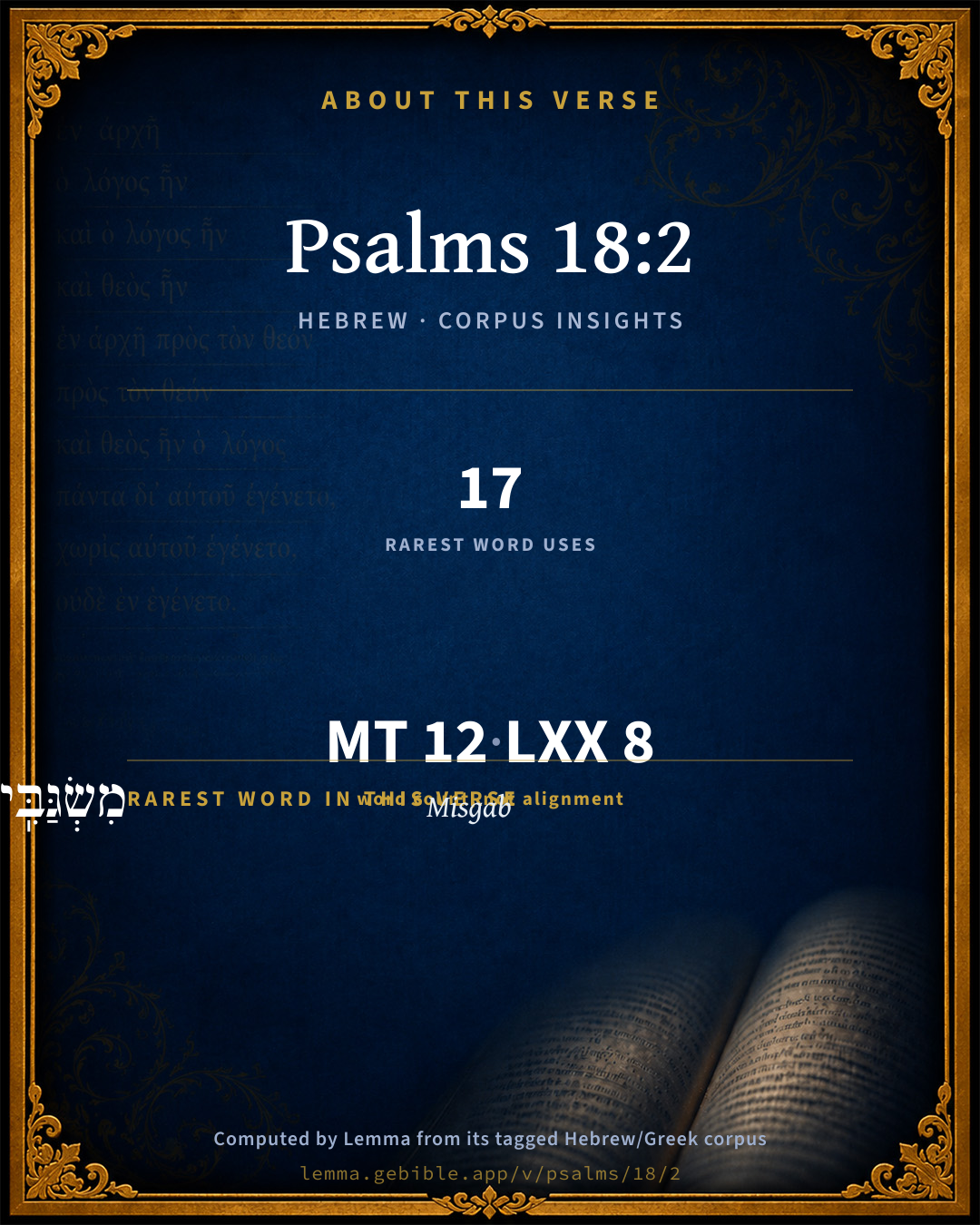
The rarest word here is מִשְׂגַּבִּֽי Misgab H4869 — appearing just 17 times in the whole Hebrew Bible.

Shared distinctive vocabulary

מִשְׂגַּבִּֽי Misgab H4869 occurs in 16 verses of the Hebrew Bible. Also found in:

Grammatical profile

  • 2 verbs
  • 9 nouns
  • 1 preposition

Verb forms

  • וּמְפַ֫לְטִ֥י Piel · Participle Active
  • אֶֽחֱסֶה Qal · Imperfect

Hebrew & Septuagint length

In English translation the verse runs 29 words from the Hebrew and 35 from the Septuagint (LXX English) — closely comparable.

A rough comparison of the two English renderings, which tokenize alike — not a word-level alignment.

Word counts can differ between the Hebrew and the Greek without any difference in meaning — e.g. the Hebrew direct-object marker אֵת has no separate Greek word, and Greek often adds the article ὁ.

In the original languages it is 12 Hebrew tokens and 8 Greek tokens — but the two are counted differently (Hebrew bundles its prefixes and suffixes into one token; the Greek is in lemma form), so that isn’t a like-for-like length.

Cross-references

16

Topical passages linked to Psalms 18:2 in the Treasury of Scripture Knowledge — connected by theme and wording, ordered by reader-vote popularity; previews shown in the World English Bible.

  • Psalms 144:2 My loving kindness, my fortress, My high tower, my deliverer, My shield, and he in whom I take refuge; Who subdues my people under me.
  • Psalms 62:7 With God is my salvation and my honor. The rock of my strength, and my refuge, is in God.
  • Psalms 19:14 Let the words of my mouth and the meditation of my heart Be acceptable in your sight, Yahweh, my rock, and my redeemer.
  • Proverbs 18:10 The name of Yahweh is a strong tower: The righteous run to him, and are safe.
  • Psalms 91:2 I will say of Yahweh, "He is my refuge and my fortress; My God, in whom I trust."
  • Psalms 62:2 He alone is my rock and my salvation, my fortress-- I will never be greatly shaken.
  • 2 Samuel 22:3 God, my rock, in him will I take refuge; My shield, and the horn of my salvation, my high tower, and my refuge; My savior, you save me from violence.
  • Jeremiah 16:19 Yahweh, my strength, and my stronghold, and my refuge in the day of affliction, to you shall the nations come from the ends of the earth, and shall say, Our fathers have inherited nothing but lies, [even] vanity and things in which there is no profit.
  • Isaiah 32:2 A man shall be as a hiding-place from the wind, and a covert from the tempest, as streams of water in a dry place, as the shade of a great rock in a weary land.
  • Psalms 91:4 He will cover you with his feathers. Under his wings you will take refuge. His faithfulness is your shield and rampart.
  • Proverbs 2:7 He lays up sound wisdom for the upright. He is a shield to those who walk in integrity;
  • Hebrews 2:13 Again, "I will put my trust in him." Again, "Behold, here am I and the children whom God has given me."
  • Psalms 28:1 To you, Yahweh, I call. My rock, don't be deaf to me; Lest, if you are silent to me, I would become like those who go down into the pit.
  • Psalms 59:11 Don't kill them, or my people may forget. Scatter them by your power, and bring them down, Lord our shield.
  • Psalms 75:10 I will cut off all the horns of the wicked, But the horns of the righteous shall be lifted up.
  • Psalms 132:17 There I will make the horn of David to bud. I have ordained a lamp for my anointed.

Cross-references courtesy of OpenBible.info (CC BY 4.0).

Hebrew and Greek witnesses Masoretic Hebrew ↔ Greek Septuagint

The same verse in the two great witnesses to the Old Testament, shown verse-for-verse.

You’re reading Greek Psalm 17 (Hebrew Psalm 18). The Septuagint counts the superscription, so verse numbers can differ from the Hebrew — chapter-level alignment, not verse-by-verse. Numbering follows Rahlfs.

These are two independent witnesses, not word-aligned to each other, and the Septuagint is shown in lemma (dictionary) form.

Hebrew Psalms 18:2 Masoretic · Westminster Leningrad Codex

יְהוָ֤ה סַֽלְעִ֥י וּמְצוּדָתִ֗י וּמְפַ֫לְטִ֥י אֵלִ֣י צ֭וּרִי אֶֽחֱסֶה בּ֑וֹ מָֽגִנִּ֥י וְקֶֽרֶן יִ֝שְׁעִ֗י מִשְׂגַּבִּֽי

Yahweh is my rock, my fortress, and my deliverer; My God, my rock, in whom I take refuge; My shield, and the horn of my salvation, my high tower.

World English Bible · Public Domain

Greek LXX Greek Psalm 17:2 Septuagint · lemma form

καί εἶπον ἀγαπάω σύ κύριος ὁ ἰσχύς ἐγώ

The Lord is my firm support, and my refuge, and my deliverer; my God is my helper, I will hope in him; he is my defender, and the horn of my salvation, and my helper.

LXX2012 (modern English Septuagint) · Public Domain

On this verse, Ellicott's Commentary for English Readers discusses the Septuagint’s reading. Read the note in Commentary ↓

Hebrew: Westminster Leningrad Codex (CC BY 4.0). Greek: Septuagint (public domain); English from LXX2012 (modern English Septuagint) (Public Domain). How the Septuagint differs from the Hebrew →

Commentary

Notes on Psalms 18:2 from classic Christian and Jewish commentators (each source and its license shown beneath its notes). The classic Christian expositions comment on the surrounding passage and are grouped to its opening verse, so a note may address several verses; the Jewish commentaries on the Tanakh (Rashi and others) are per-verse, so they appear only where the commentator wrote on this verse.

Lemma curates 59 commentaries, every one of them public domain or Creative Commons licensed, each selected and text-cleaned for this edition rather than reprinted as found. About our sources →

Trapp's Complete Commentary

John Trapp

Psa 18:2 The LORD [is] my rock, and my fortress, and my deliverer; my God, my strength, in whom I will trust; my buckler, and the horn of my salvation, [and] my high tower.

Ver. 2. The Lord is my rock, and my fortress, &c.] i.e. He is all in all for my preservation. Ten words, say the Hebrews, he here heapeth up, in reference to ten signal victories; or rather because his thankful heart was so enlarged, that he could never satisfy himself in saying what God had been to him and done for him; and hence this congeries, or heap of holy expressions; and all to show that God is a rock of refuge, a firm fortress, a receptacle of rest, a sanctuary of safety to all his saints in time of trouble. David had had his share, and had been put to his shifts; glad to hide himself, as he could, in rocks and strong holds that sheltered him from the storm. To these he alludeth when he calls God his rock, fortress, &c.

And my deliverer] Rocks and strong holds do not always deliver (witness the Shechemites, Jebusites, Arimasphes), but God always doth.

And the horn of my salvation] Qui veluti cornu petit et conficit hostes meos, saith Vatablus; who goreth and dispatcheth mine enemies. A metaphor either from horned beasts, or else (as some will have it) from the ancient custom of wearing horns of iron upon their helmet, for a crest or military ornament; whereupon the raised horn was a sign of victory, and the horn beaten down a sign of being overcome.

John Trapp, A Commentary or Exposition upon All the Books of the Old and New Testament (1647–1656) — public domain. Text from a community e-Sword module.

J. A. Alexander on Psalms

Joseph Addison Alexander

3. (Psa 18:2). Jehovah (is) my rock, and my fortress, and my deliverer; (is) my rock, I will trust in him; my shield and my horn of salvation, my height (or high place). By this accumulation of descriptive epithets, the Psalmist represents God as the object of his trust and his protector. The first two figures, my rock and my fortress, contain an allusion to the physical structure of the Holy Land, as well as to David's personal experience. The caves and fissures of the rocks, with which the land abounded, had often afforded him shelter and concealment when pursued by Saul. See Jdg 6:2, 1Sa 24:3, 2 Samuel 5; 2 Samuel 7. The literal expression, my deliverer, seems to be added as an explanation of the figures which precede. My God may also be explained as one of the descriptive terms; but it seems more natural to make it the subject of a new proposition, equivalent and parallel to that in the first clause. Here again we are obliged to use the same English word as a translation of two different words in Hebrew. As the rock (flas,) of the first clause suggests the idea of concealment and security, so the rock (rUc) of the second clause suggests that of strength and immobility. The figure is borrowed from Deu 32:4, and reappears in Ps. 92:16 (15). Compare Isaiah's phrase, a rock of ages (Isa 26:4), and Jacob's phrase, the stone of Israel (Gen 49:24), where stone, like rock in the clause before us, denotes not the place but the material, not a stone, but stone, as one of the hardest and least mutable substances with which we are acquainted, and therefore an appropriate figure for combined immutability and strength. For the figurative use of shield in such connections, see above on Psa 3:4 (3). The next phrase has allusion to the defensive habits of horned animals. The figure seems to be borrowed from Deu 33:17. (Compare 1 Samuel 10, Job 16:15.) My horn of salvation may be understood to mean, my horn, to wit, my salvation, so that the second noun is explanatory of the first. More probably, however, the expression means the horn that saves me, by repelling or destroying all my enemies. In Luk 1:69, the same phrase is applied to Christ by Zacharias. The last term in the description belongs to the same class with the first, and was probably suggested by the Psalmist's early wanderings among the rocks and caverns of Judea. The Hebrew word properly denotes a place so high as to be beyond the reach of danger. See above, on Psa 9:10 (9), where the same word is twice used in the same sense and figurative application.

Joseph Addison Alexander, The Psalms Translated and Explained (1850) — public domain. Text from a community e-Sword module.

Tyndale Open Study Notes

Tyndale Open Resources

18:2 A shield is an image of protection, salvation, and victory (7:10; 18:2, 30, 35; 84:11; 91:4; 115:9, 10, 11; 119:114; 144:2). It evokes a response of trust, waiting, and godly confidence.

Tyndale Open Study Notes — © Tyndale Open Resources, licensed CC BY-SA 4.0. Text via the HelloAO Bible API.

Geneva Bible (1599)

Geneva Bible translators

He useth this diversity of names, to show that as the wicked have many means to hurt, so God hath many ways to help.

Geneva Bible (1599) marginal notes — public domain. Text via Bolls.life.

Jamieson, Fausset & Brown

Robert Jamieson, A. R. Fausset & David Brown

The various terms used describe God as an object of the most implicit and reliable trust.

rock--literally, "a cleft rock," for concealment.

strength--a firm, immovable rock.

horn of my salvation--The horn, as the means of attack or defense of some of the strongest animals, is a frequent emblem of power or strength efficiently exercised (compare Deu 33:17; Luk 1:69).

tower--literally, "high place," beyond reach of danger.

Jamieson, Fausset & Brown — Commentary Critical and Explanatory on the Whole Bible (1871) — public domain (CC PDM 1.0). Text via the HelloAO Bible API.

Adam Clarke's Commentary

Verse 2. The Lord is my rock]

2. I stand on him as my foundation, and derive every good from him who is the source of good. The word סלע sela signifies those craggy precipices which afford shelter to men and wild animals; where the bees often made their nests, and whence honey was collected in great abundance. "He made him to suck honey out of the rock," De 32:13.

3. He was his fortress; a place of strength and safety, fortified by nature and art, where he could be safe from his enemies. He refers to those inaccessible heights in the rocky, mountainous country of Judea, where he had often found refuge from the pursuit of Saul. What these have been to my body, such has the Lord been to my soul.

Deliverer]

4. מפלתי mephalleti, he who causes me to escape. This refers to his preservation in straits and difficulties. He was often almost surrounded and taken, but still the Lord made a way for his escape - made a way out as his enemies got in; so that, while they got in at one side of his strong hold, he got out of the other, and so escaped with his life. These escapes were so narrow and so unlikely that he plainly saw the hand of the Lord was in them.

5. My God, אלי Eli, my strong God, not only the object of my adoration, but he who puts strength in my soul.

6. My strength, צורי tsuri. This is a different word from that in the first verse.

Rabbi Maimon has observed that צור tsur, when applied to God, signifies fountain, source, origin, c. God is not only the source whence my being was derived, but he is the fountain whence I derive all my good in whom, says David, I will trust. And why? Because he knew him to be an eternal and inexhaustible fountain of goodness. This fine idea is lost in our translation; for we render two Hebrew words of widely different meaning, by the same term in English, strength.

7. My buckler, מגני maginni, my shield, my defender, he who covers my head and my heart, so that I am neither slain nor wounded by the darts of my adversaries.

8. Horn of my salvation. Horn was the emblem of power, and power in exercise. This has been already explained; see on 1Sa 2:1. The horn of salvation means a powerful, an efficient salvation.

9. My high tower; not only a place of defence, but one from which I can discern the country round about, and always be able to discover danger before it approaches me.

Adam Clarke's Commentary on the Bible (1810–1826) — public domain. Text from a community e-Sword/MySword module.

John Calvin's Commentaries

2. Jehovah is my rock, etc. When David thus heaps together many titles by which to honor God, it is no useless or unnecessary accumulation of words. We know how difficult it is for men to keep their minds and hearts stayed in God. They either imagine that it is not enough to have God for them, and, consequently, are always seeking after support and succor elsewhere, or, at the first temptation which assails them, fall from the confidence which they placed in him. David, therefore, by attributing to God various methods of saving his people, protests that, provided he has God for his protector and defender, he is effectually fortified against all peril and assault; as if he had said, Those whom God intends to succor and defend are not only safe against one kind of dangers, but are as it were surrounded by impregnable ramparts on all sides, so that, should a thousand deaths be presented to their view, they ought not to be afraid even at this formidable array. “Comme environnez de bons rempars de tous costez, tellement que mille morts, quand autant il s’en presenteroit a eux, ne leur doyvent point faire peur.” — Fr.

“Et pourtant David equippe yci les fideles de pied en cap comme on dit.” — Fr. “David, therefore, here equips the faithful from head to foot, as we say.”

John Calvin's Commentaries (1540-1563) — public domain. Text from the Calvin Translation Society English edition (1840s-50s) via the Christian Classics Ethereal Library (ccel.org). Calvin's coverage is partial (roughly two-thirds of the Bible); uncommented books and verses are honest gaps, never fabricated. The 19th-century editor's footnotes and remarks are omitted so the notes are faithfully Calvin's own voice.

Ellicott's Commentary for English Readers

(2) Rock.—Better here, cliff, keeping “rock” for the next clause. In the first figure the ideas of height and shelter, in the second of broad-based and enduring strength, are predominant.

Fortress.—Properly, mountain castle. We have the joint figure of the lofty and precipitous cliff with the castle on its crest, a reminiscence—as, in fact, is every one in this “towering of epithets”—of scenes and events in David’s early life.

My God . . .—Better, my God, my rock, I trust in Him. God is here El, “the strong one.” In Samuel, “God of my rock.”

Horn of my salvation.—The allusion seems to be not to a means of attack, like the horn of an animal, but to a mountain peak (called “horn” in all languages—so κέρας, Xen. Anab. v. 6; “Cornua Parnassi,” Statius, Theb. v. 532; and so in Hebrew, Isa_5:1, see margin), such as often afforded David a safe retreat. Render “my peak of safety.”

High tower.—The LXX. and Vulgate have “helper.” (Comp. Psa_9:9.) The word comes in so abruptly, that doubtless the addition in Samuel, “and my refuge, my Saviour, thou savest me from violence,” was part of the original hymn, completing the rhythm.

A Bible Commentary for English Readers, edited by Charles John Ellicott (1878–1897) — public domain. Text from a community e-Sword module.

The Cambridge Bible for Schools and Colleges

gen. ed. J. J. S. Perowne

2. The imagery which David uses is derived from the features of a country abounding in cliffs and caves and natural strongholds, with which he had become familiar in his flight from Saul. The rock, or cliff (sela) where he had been so unexpectedly delivered from Saul (1Sa_23:25-28): the fortress or stronghold in the wilderness of Judah or the fastnesses of En-gedi (1Sa_22:4; 1Sa_23:14; 1Sa_23:19; 1Sa_23:29; 1Sa_24:22); “the rocks of the wild goats” (1Sa_24:2; 1Ch_11:15); were all emblems of Him who had been throughout his true Refuge and Deliverer.

my God] El, and so in Psa_18:30; Psa_18:32; Psa_18:47. See note on Psa_5:4.

my strength &c.] Lit., my rock in whom I take refuge. Here first in the Psalter occurs the title Rock (tsûr), so often used to describe the strength, faithfulness, and unchangeableness of Jehovah. See Psa_18:31; Psa_18:46; Deu_32:4; Deu_32:15; Deu_32:18; Deu_32:30-31; 1Sa_2:2; Psa_19:14; Psa_28:1; &c. Here, as the relative clause shews, the special idea is that of an asylum in danger. Cp. Psa_94:22; Deu_32:37.

my buckler &c.] As my shield He defends me: as the horn of my salvation He drives my enemies before Him and gives me the victory. The horn is a common symbol of irresistible strength, derived from horned animals, especially wild oxen. See Deu_33:17; and note the use of the phrase in Luk_1:69. Cp. Psa_28:7-8.

my high tower] See note on Psa_9:9. 2 Sam. adds, “and my retreat, my saviour, who savest me from violence.”

The Cambridge Bible for Schools and Colleges (gen. ed. J. J. S. Perowne; Cambridge University Press, 1878–1918) — public domain. Text from a community e-Sword module.

John Gill's Exposition

I will call upon the Lord,.... In prayer, for fresh mercies, and further appearances of himself, and discoveries of his grace and favour;

who is worthy to be praised; for the perfections of his nature, the works of his hands, his providential goodness, and more especially for his covenant grace and blessings in Christ. The Targum is,

"in praise, or with an hymn, I pray before the Lord;''

agreeably to the rule the apostle gives, Phi 4:6; and this prayer was a prayer of faith, as follows;

so shall I be saved from mine enemies: which was founded upon past experience of God's goodness to him in distress, when he called upon him, as the next words show.

John Gill's Exposition of the Whole Bible (1746–1763) — public domain (CC PDM 1.0). Text via the HelloAO Bible API.

Albert Barnes' Notes on the Bible

The Lord is my rock - The idea in this expression, and in the subsequent parts of the description, is that he owed his safety entirely to God. He had been unto him as a rock, a tower, a buckler, etc. - that is, he had derived from God the protection which a rock, a tower, a citadel, a buckler furnished to those who depended on them, or which they were designed to secure. The word “rock” here has reference to the fact that in times of danger a lofty rock would be sought as a place of safety, or that men would fly to it to escape from their enemies. Such rocks abound in Palestine; and by the fact that they are elevated and difficult of access, or by the fact that those who fled to them could find shelter behind their projecting crags, or by the fact that they could find security in their deep and dark caverns, they became places of refuge in times of danger; and protection was often found there when it could not be found in the plains below. Compare Jdg 6:2; Psa 27:5; Psa 61:2. Also, Josephus, Ant., b. xiv., ch. xv.

And my fortress - He has been to me as a fortress. The word fortress means a place of defense, a place so strengthened that an enemy could not approach it, or where one would be safe. Such fortresses were often constructed on the rocks or on hills, where those who fled there would be doubly safe. Compare Job 39:28. See also the notes at Isa 33:16.

And my deliverer - Delivering or rescuing me from my enemies.

My God - Who hast been to me a God; that is, in whom I have found all that is implied in the idea of “God” - a Protector, Helper, Friend, Father, Saviour. The notion or idea of a “God” is different from all other ideas, and David had found, as the Christian now does, all that is implied in that idea, in Yahweh, the living God.

My strength - Margin, “My rock” So the Hebrew, although the Hebrew word is different from that which is used in the former part of the verse. Both words denote that God was a refuge or protection, as a rock or crag is to one in danger (compare Deu 32:37), though the exact difference between the words may not be obvious.

In whom I will trust - That is, I have found him to be such a refuge that I could trust in him, and in view of the past I will confide in him always.

My buckler - The word used here is the same which occurs in Psa 3:3, where it is translated “shield.” See the notes at that verse.

And the horn of my salvation - The “horn” is to animals the means of their defense. Their strength lies in the horn. Hence, the word is used here, as elsewhere, to represent that to which we owe our protection and defense in danger; and the idea here is, that God was to the psalmist what the horn is to animals, the means of his defense. Compare Psa 22:21; Psa 75:4-5, Psa 75:10; Psa 92:10; Psa 132:17; Psa 148:14.

And my high tower - He is to me what a high tower is to one who is in danger. Compare Pro 18:10, “The name of the Lord is a strong tower: the righteous runneth into it, and is safe.” The word used here occurs in Psa 9:9, where it is rendered “refuge.” (Margin, “A high place.”) See the notes at that verse. Such towers were erected on mountains, on rocks, or on the walls of a city, and were regarded as safe places mainly because they were inaccessible. So the old castles in Europe - as that at Heidelberg, and generally those along the Rhine - were built on lofty places, and in such positions as not to be easily accessible.

Albert Barnes' Notes on the Bible (1834–1885) — public domain. Text from a community e-Sword/MySword module.

Matthew Poole's English Annotations

My rock; to which I flee for refuge, as the Israelites did to their rocks. See Jdg 6:2; 1Sa 13:6.

The horn; by which I have both defended myself, and subdued mine enemies. It is a metaphor from those beasts whose strength lies in their horns. The horn is oft put for power, as Psa 92:10; Amo 6:13, and elsewhere.

Matthew Poole's English Annotations on the Holy Bible (1683–1685) — public domain. Text from a community e-Sword/MySword module.

The Treasury of David

Charles H. Spurgeon

Ver. 2. The Lord is my rock and my fortress. Dwelling among the crags and mountain fastnesses of Judea David had escaped the malice of Saul, and here he compares his God to such a place of concealment and security. Believers are often hidden in their God from the strife of tongues and the fury of the storm of trouble. The clefts of the Rock of Ages are safe abodes.

My deliverer, interposing in my hour of peril. When almost captured the Lord's people are rescued from the hand of the mighty by him who is mightier still. This title of "deliverer" has many sermons in it, and is well worthy of the study of all experienced saints.

My God; this is all good things in one. There is a boundless wealth in this expression; it means, my perpetual, unchanging, infinite, eternal good. He who can say truly "my God, "may well add, "my heaven, my all."

My strength; this word is really my rock, in the sense of strength and immobility. My sure, unchanging, eternal confidence and support. Thus the word rock occurs twice, but it is no tautology, for the first time it is a rock for concealment, but here a rock for firmness and immutability.

In whom I will trust. Faith must be exercised, or the preciousness of God is not truly known; and God must be the object of faith, or faith is mere presumption.

My buckler, warding off the blows of my enemy, shielding me from arrow or sword. The Lord furnishes his warriors with weapons both offensive and defensive. Our armoury is completely stored so that none need go to battle unarmed.

The horn of my salvation, enabling me to push down my foes, and to triumph over them with holy exultation.

My high tower, a citadel high planted on a rocky eminence beyond the reach of my enemies, from the heights of which I look down upon their fury without alarm, and survey a wide landscape of mercy reaching even unto the goodly land beyond Jordan. Here are many words, but none too many; we might profitably examine each one of them had we leisure, but summing up the whole, we may conclude with Calvin, that David here equips the faithful from head to foot.

Ver. 2. The Lord is my rock. As the rocks that are hard to be clambered unto are good refuges to fly unto from the face of pursuers, so God is the safety of all such as in distress do fly to him for succour. Robert Cawdray.

Ver. 2. My deliverer. He who betook himself to one of these inaccessible retreats, was sometimes obliged by famine to surrender to his enemy, who lay in wait for him beneath; but Jehovah gives him not only security but liberty; not only preserves him, as it were, in an inaccessible retreat, but at the same time enables him to go forth in safety. Jarchi.

Ver. 2. The horn of my salvation. The allusion here is doubtful. Some have supposed the reference to be to the horns of animals, by which they defend themselves and attack their enemies. "God is to me, does for me, what their horns do for them." Others consider it as referring to the well established fact, that warriors were accustomed to place horns, or ornaments like horns, on their helmets. The horn stands for the helmet; and "the helmet of salvation" is an expression equivalent to "a saving, a protecting helmet." Others consider the reference as to the corners or handles of the altar in the court of the tabernacle or temple, which are called its horns. Others suppose the reference to be to the highest point of a lofty and precipitous mountain, which we are accustomed to call its peak. No doubt, in the Hebrew language, horn is used for mountain as in Isa 5:1. A very fertile mountain is called a horn of oil. The sense is substantially the same, whichever of these views we take; though, from the connection with "shield" or "buckler, "I am induced to consider the second of these views as the most probable. It seems the same idea as that expressed, Ps 140:7, "Thou hast covered, "and thou wilt cover "my head in the day of battle." John Brown.

Ver. 2. The horn of my salvation. Horns are the well known emblems of strength and power, both in the sacred and profane writers; by a metaphor taken from horned animals, which are frequently made subjects of comparison by poetical writers, and the strength of which, whether for offence or defence, consists principally in their horns. Bruce speaks of a remarkable head dress worn by the governors of provinces in Abyssinia, consisting of a large broad fillet, bound upon their foreheads and tied behind their heads, and having in the middle of it a horn, or a conical piece of silver, gilt, about four inches long, much in the shape of our common candle extinguishers. It is called kirn or horn, and is only worn on reviews or parades after victory. He supposes this, like other Abyssinian usages, to be taken from the Hebrews, and is of opinion that there are many allusions to the practice in Scripture, in the expression, "lifting up the horn, " "exalting the horn, "and the like. Richard Mant.

Ver. 2. The Lord is my high tower. If a man do run to a tower, yet if that be a weak and an insufficient tower, without men and munition, and a ruinous shaken tower; or if a man do make choice of a tower, a strong sufficient tower, yet if in his danger he betakes not himself to that tower, but he sit still; or if he sit not still, yet he but only go and walk on easily towards it, he may well be met withal, and a danger may arrest him, surprise him, and cut him off before he get the tower over his head. But the man that will be safe, as he must choose a strong tower, so he must go to, nay, run into that tower. Running will not secure a man unless the tower be strong... David was got unto his tower, and in that tower there was thundering ordnance, and David put fire to them by prayer, Ps 18:6, "In my distress I called upon the Lord, and cried unto my God: he heard my voice out of his temple, and my cry came before him, even unto his ears." Here David prays and gives fire to the cannon, and what followed? See Ps 18:7-8, 13-14. "Then the earth shook and trembled, "etc. "There went up a smoke out of his nostrils, "etc. "The Lord also thundered in the heavens, and the Highest gave his voice; hail stones and coals of fire. Yea, he sent out his arrows, and scattered them; and he shot out lightnings, and discomfited them." There were no guns nor ordnance invented and in use in David's time, and yet David's prayers being in this tower, did him as good service against his enemies as all the ordnance and cannons in the world have done. David had thundering ordnance, and with them discomfited his enemies long before powder and guns were invented. It is a memorable and well known story of that Christian legion that was in Marcus Aurelius's army: the enemy being in great straits, those Christian soldiers did by their prayers not only procure rain, by which his languishing army was refreshed, but also obtained hail mixed with thunderbolts against his enemies, upon which he honoured them with the name Legio fulminatrix, the Thundering Legion. They used David's cannon against the enemy, and discharged that thundering ordnance by their prayers, and that to the confusion of their enemies. Jeremiah Dyke's "Righteous Man's Tower, "1639.

Ver. 2. My high tower. Even as the fowls of the air, that they may escape the nets and snares of the fowlers, are wont to fly up on high; so we, to avoid the infinite snares of innumerable temptations, must fly to God; and lift up ourselves from the corruptions, lying vanities, and deceitful sleights of the world. Robert Cawdray.

Ver. 2. The many excellences of Jehovah to his people.

Ver. 2. God the all sufficient portion of his people. C. Simeon's Works, Vol. 5, Page 85.

Psalms 18:3*

Charles H. Spurgeon's The Treasury of David (1869–1885) — public domain. Psalms only. Text from a community e-Sword/MySword module.

Whedon's Commentary on the Bible

Daniel D. Whedon

2. My rock—In this verse, which is strikingly similar to Psa_144:2, six terms, signifying the strongest military defences of those times, are used and applied to God, namely: strength, rock, fortress, shield, horn, tower, or high place. Other titles are also given. David’s earnest heart was overflowing.

Daniel D. Whedon (gen. ed.), Commentary on the Old and New Testaments (1874–1909) — public domain. Text from a community e-Sword module.

The Pulpit Commentary

The Lord is my Rock; or, my Cliff my Sela an expression used commonly of Petra. And my Fortress. (comp. Psa_144:2) Not only a natural stronghold, but one made additionally strong by art. And my Deliverer. A living Protector, not a mere inanimate defence. My God, my Strength; rather, my Rock, as the same word (tsur) is translated in Exo_17:6 Exo_33:21, 22 Deu_32:4, Deu_32:15, Deu_32:18, 31 1Sa_2:2 2Sa_23:3 Isa_26:4. It is the word from which the strong city, Tyro, derived its. name. In whom I will trust. (comp. Deu_32:37) My Buckler. (comp. Gen_15:1, where God announced himself as Abraham"s "Shield;" and see also Deu_33:29 Psa_3:2 Psa_5:12 Psa_84:11 Psa_119:114 Psa_144:2) The Horn also of my salvation. (comp. Luk_1:69) The horn is the emblem at once of strength and of dignity. A "horn of salvation" is a source of excellency and might, whence "salvation" or deliverance comes to those who trust in it. And my high Tower. (comp. Psa_9:9, with the comment ad loc. ) It is remarked that God, in this passage, receives seven epithets, "the mystic number which in sacred things symbolizes perfection" (Delitzsch).

The Pulpit Commentary (1880–1919), ed. H.D.M. Spence-Jones & Joseph S. Exell — public domain. Text from a community e-Sword module.

John Wesley's Explanatory Notes

Rock - To which I flee for refuge, as the Israelites did to their rocks. Horn - It is a metaphor from those beasts whose strength lies in their horns.

John Wesley, Explanatory Notes Upon the Whole Bible (1754–1765) — public domain. Text via the GEBible commentary corpus.

unfoldingWord translationNotes

Door43 World Missions Community

Yahweh is my rock

David speaks of Yahweh as if he were a rock. The word "rock" is a picture of a safe place. (See: Metaphor)

my rock, my fortress

Here the words "rock" and "fortress" share similar meanings and emphasize that Yahweh provides safety from enemies. (See: Doublet and Metaphor)

take refuge in him

Going to Yahweh for protection is spoken of as taking refuge in him. AT: "go to him for protection" (See: Metaphor)

my shield, the horn of my salvation, and my stronghold

David speaks of Yahweh as if he were a "shield," "the horn" of his salvation, and his "stronghold." Yahweh is the one who protects him from harm. Here a similar idea is repeated three ways for emphasis. (See: Metaphor)

I will be saved from my enemies

"I will be rescued from my enemies"

translationWords

stronghold

God

refuge

shield

save

call

worthy

praise

save

adversary

unfoldingWord translationNotes — © Distant Shores Media and the Door43 World Missions Community, licensed CC BY-SA 4.0. Source: git.door43.org/Door43/en_tn.

Rashi

Rabbi Shlomo Yitzchaki (Rashi)

I love You Heb. ארחמך, I love You, as the Targum renders (Lev. 19:18): “and you shall love your neighbor,” ותרחם.

Rashi on the Tanakh — English translations: “The Judaica Press complete Tanach with Rashi, translated by A. J. Rosenberg” (CC BY 4.0); “Pentateuch with Rashi's commentary by M. Rosenbaum and A.M. Silbermann, 1929-1934” (public domain); “The Metsudah Tanach series, Lakewood, N.J” (CC BY 4.0); and “The Book of Joshua, Metsudah Publications, 1997” (CC BY 4.0). Text via Sefaria.

Lesson kit

Teaching starters — assembled from the data on this page, not authored interpretation. Every prompt links to the verse data it draws on. Edit before teaching.

Psalms, in the Wisdom, opens this verse with 12 words (11 distinct Hebrew lemmas). Its most distinctive word is misgâb (“Misgab”). A historical commentator’s framing appears above. Read the whole chapter for the surrounding context.

Discussion questions

  1. What does “Misgab” (misgâb) contribute to the verse as a whole?
  2. How does 2 Samuel 22:3, which shares the word «Misgab», read alongside this verse?
  3. These translations render this verse differently. What is at stake in choosing one wording over another?
  4. «וּמְפַ֫לְטִ֥י» is a Piel Participle Active verb. How does that grammatical form shape the action described?
  5. Compare how Trapp's Complete Commentary and J. A. Alexander on Psalms read this verse. Where do they agree or differ?

Things to notice

Reading settings

Reading text

Shown beneath each verse's original-language words.

Old Testament
Old Testament edition

Read the OT as the Masoretic Hebrew (MT) or the Greek Septuagint (LXX).

English shown for the Greek Septuagint (in the Hebrew ↔ Greek comparison).

Comparing translations? Open the Compare panel on any verse page to stack up to four side by side.