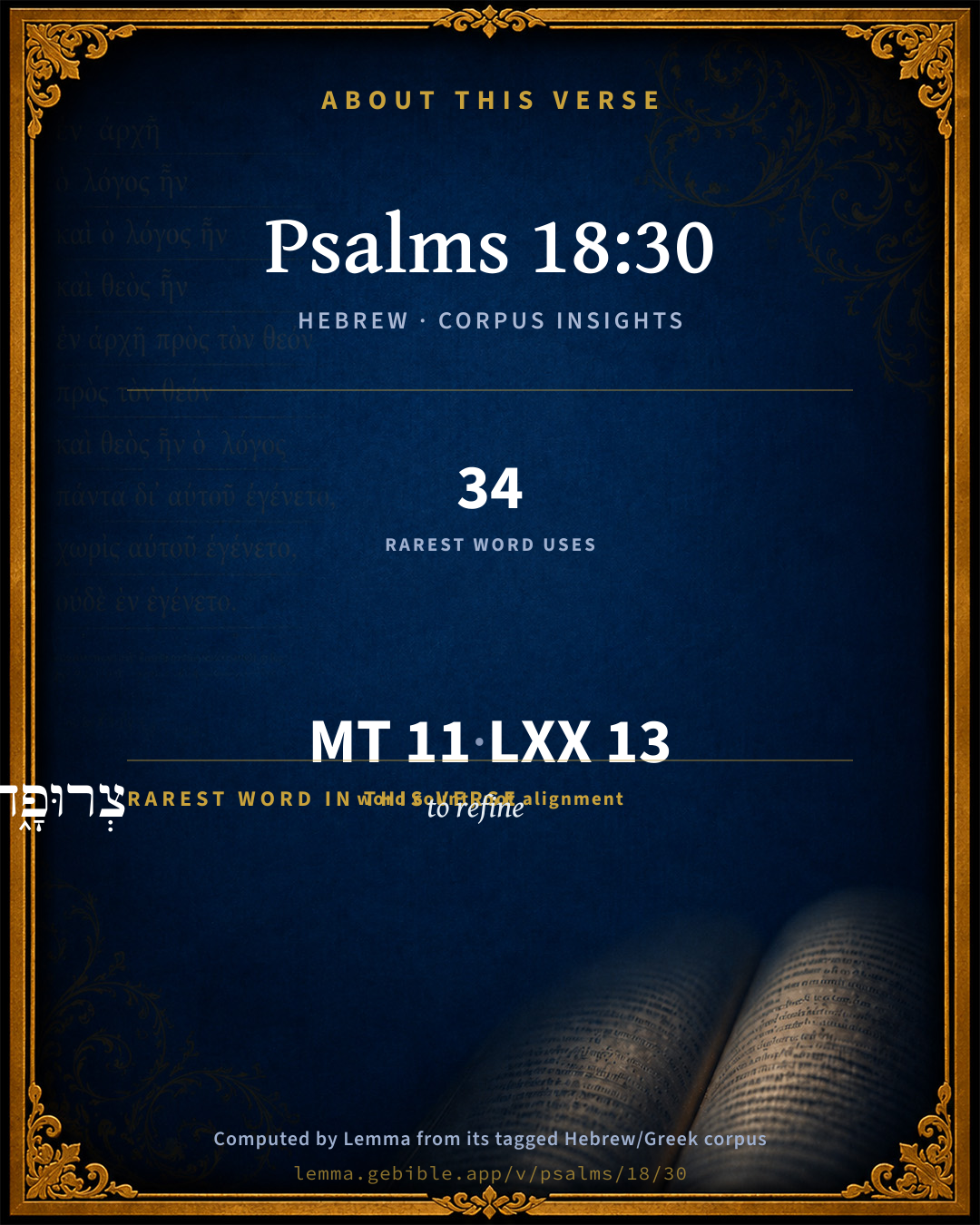
Psalms 18:30

Hebrew (Westminster Leningrad Codex) Psalms 18:30 appears in the Hebrew Old Testament. The text above is from the Westminster Leningrad Codex. Each word links to its Strong’s number, a concise gloss, and parsing drawn from the Open Scriptures Hebrew Bible morphology. Click any word for its full Brown-Driver-Briggs (BDB) entry.
Download image
Cite this verse

Psalms 18:30 (World English Bible). Public Domain. Lemma interlinear Bible study tool, https://lemma.gebible.app/v/psalms/18/30.

Show BibTeX & RIS
BibTeX
RIS
English Translation
As for God, his way is perfect. The word of Yahweh is tried. He is a shield to all those who take refuge in him.
World English Bible · Public Domain
Download a study sheet

One document with this verse’s original text, its word-by-word gloss line, the meaning frame, cross-references with their text, attributed commentary, and full source and license credits — printable, and it pastes into notes with its structure intact.

This verse Autodidact and up

Study sheet (.html) Plain text (.txt)

A passage Seminary Student

Up to 50 verses in one chapter. A passage sheet keeps up to 6 commentary sources and 12 cross-references per verse, in the order this page ranks them, and says so on the sheet whenever that leaves anything out. Ask for a single verse and you get the Autodidact verse sheet above.

Everything on this page stays free to read, with no account — the sheet is a download of what is already on screen, not access to it.

Want to remove ads? Support Godless Engineer
Compare translations 3

The same verse in 3 English versions, stacked beneath the original-language interlinear above. Click any original word for its lexicon entry.

Each is an independent rendering of the whole verse — the interlinear is not word-aligned to these translations.

Highlighted words mark where these versions differ — a whole-verse word diff, not a word-by-word alignment.

  • World English Bible Public Domain
    As for God, his way is perfect. The word of Yahweh is tried. He is a shield to all those who take refuge in him.
  • King James Version Public Domain
    As for God, his way is perfect: the word of the LORD is tried: he is a buckler to all those that trust in him.
  • unfoldingWord Literal Text CC BY-SA 4.0
    This God, his way perfect. The word of Yahweh is refined. He a shield to all of the ones taking refuge in him.

unfoldingWord Literal Text — © unfoldingWord, licensed CC BY-SA 4.0. Word-aligned USFM3 via Door43 (git.door43.org/unfoldingWord/en_ult).

Versions to compare (up to 4)

3 of 4 selected

Show all 18 translations

Every available English version of this verse, each an independent rendering of the whole verse.

  • World English Bible Public Domain
    As for God, his way is perfect. The word of Yahweh is tried. He is a shield to all those who take refuge in him.
  • Berean Standard Bible Public Domain
    As for God, His way is perfect; the word of the LORD is flawless. He is a shield to all who take refuge in Him.
  • Majority Standard Bible Public Domain
    As for God, His way is perfect; the word of the LORD is flawless. He is a shield to all who take refuge in Him.
  • King James Version Public Domain
    As for God, his way is perfect: the word of the LORD is tried: he is a buckler to all those that trust in him.
  • American Standard Version (1901) Public Domain
    As for God, his way is perfect: The word of Jehovah is tried; He is a shield unto all them that take refuge in him.
  • Revised Version (1885) Public Domain
    As for God, his way is perfect: the word of the LORD is tried; he is a shield unto all them that trust in him.
  • Geneva Bible (1599) Public Domain
    The way of God is vncorrupt: the worde of the Lord is tried in the fire: he is a shield to all that trust in him.
  • Douay-Rheims (1899) Public Domain
    For by thee I shall be delivered from temptation; and through my God I shall go over a wall.
  • Young's Literal Translation Public Domain
    God! perfect `is' His way, The saying of Jehovah is tried, A shield `is' He to all those trusting in Him.
  • Literal Standard Version CC BY-SA 4.0
    God—perfect [is] His way, || The saying of YHWH is tried, || He [is] a shield to all those trusting in Him.
  • Unlocked Literal Bible CC BY-SA 4.0
    As for God—his way is perfect! The word of Yahweh is pure! He is a shield to everyone who takes refuge in him.
  • unfoldingWord Literal Text CC BY-SA 4.0
    This God, his way perfect. The word of Yahweh is refined. He a shield to all of the ones taking refuge in him.
  • Darby Bible Public Domain
    As for ùGod, his way is perfect; the word of Jehovah is tried: he is a shield to all that trust in him.
  • World Messianic Bible Public Domain
    As for God, his way is perfect. The LORD’s word is tried. He is a shield to all those who take refuge in him.
  • Webster's Bible Public Domain
    \\18:29\\For by thee I have run through a troop; and by my God have I leaped over a wall.
  • Free Bible Version CC BY-SA 4.0
    God's way is absolutely right. What the Lord says is trustworthy. He is a shield to all who come to him for protection.
  • Bible in Basic English Public Domain
    As for God, his way is completely good; the word of the Lord is tested; he is a breastplate for all those who put their faith in him.
  • JPS Tanakh (1917) Public Domain
    (18-31) As for God, His way is perfect; the word of the LORD is tried; He is a shield unto all them that take refuge in Him.

Literal Standard Version (2020), Covenant Press — licensed CC BY-SA 4.0. Text via the HelloAO Bible API (eBible.org). Unlocked Literal Bible (unfoldingWord) — licensed CC BY-SA 4.0. Text via the HelloAO Bible API (eBible.org). unfoldingWord Literal Text — © unfoldingWord, licensed CC BY-SA 4.0. Word-aligned USFM3 via Door43 (git.door43.org/unfoldingWord/en_ult). Free Bible Version, Dr. Jonathan Gallagher — licensed CC BY-SA 4.0. Text via the HelloAO Bible API (eBible.org).

Word by word

More ways to search: Search by grammar → Find every occurrence → Compare this word →

Practice this passage: Drill this verse → Learn its vocabulary →

צְרוּפָ֑ה
tsâraph
H6884
“refined”
Verb, Qal, Participle Passive, Feminine, Singular, Absolute
Part of Speech
Verb
Stem
Qal
Form
Participle Passive
Gender
Feminine
Number
Singular
State
Absolute
Full BDB Definition

Origin: a primitive root

TWOT: 1972

to smelt, refine, test - (Qal) - to smelt, refine - to test - to test (and prove true) - smelter, refiner, goldsmith (participle) - (Niphal) to be refined - (Piel) to be a refiner - refiner (participle)
  1. הָאֵל֮ ʼêl H410 “the · God” Particle, Definite Article + Noun, Common, Masculine, Singular, Absolute
  2. תָּמִ֪ים tâmîym H8549 “complete” Adjective, Adjective, Masculine, Singular, Absolute
  3. דַּ֫רְכּ֥וֹ derek H1870 “way · his” Noun, Common, Both, Singular, Construct + Suffix, Personal, 3rd Person, Masculine, Singular
  4. אִמְרַֽת ʼimrâh H565 “word of” Noun, Common, Feminine, Singular, Construct
  5. יְהוָ֥ה Yᵉhôvâh H3068 “LORD” Noun, Proper
  6. מָגֵ֥ן mâgên H4043 “shield” Noun, Common, Both, Singular, Absolute
  7. ה֝֗וּא hûwʼ H1931 “he” Pronoun, Personal, 3rd Person, Masculine, Singular
  8. לְכֹ֤ל kôl H3605 “to/for · all of” Preposition + Noun, Common, Masculine, Singular, Construct
  9. הַחֹסִ֬ים châçâh H2620 “the · seeking refuge” Particle, Definite Article + Verb, Qal, Participle Active, Masculine, Plural, Absolute

About this verse

These counts appear in no published source. They are computed here, from the morphology-tagged text and Lemma’s own curated glosses. What Lemma adds →

11
words
10
distinct lemmas
Wisdom
section

Shared distinctive vocabulary

צְרוּפָ֑ה to refine H6884 occurs in 29 verses of the Hebrew Bible. Also found in:

Grammatical profile

  • 2 verbs
  • 6 nouns
  • 1 adjective
  • 1 pronoun
  • 1 preposition

Verb forms

  • צְרוּפָ֑ה Qal · Participle Passive
  • הַחֹסִ֬ים Qal · Participle Active

Hebrew & Septuagint length

In English translation the verse runs 25 words from the Hebrew and 29 from the Septuagint (LXX English) — closely comparable.

A rough comparison of the two English renderings, which tokenize alike — not a word-level alignment.

Word counts can differ between the Hebrew and the Greek without any difference in meaning — e.g. the Hebrew direct-object marker אֵת has no separate Greek word, and Greek often adds the article ὁ.

In the original languages it is 11 Hebrew tokens and 13 Greek tokens — but the two are counted differently (Hebrew bundles its prefixes and suffixes into one token; the Greek is in lemma form), so that isn’t a like-for-like length.

Cross-references

13

Topical passages linked to Psalms 18:30 in the Treasury of Scripture Knowledge — connected by theme and wording, ordered by reader-vote popularity; previews shown in the World English Bible.

  • Deuteronomy 32:4 The Rock, his work is perfect; For all his ways are justice: A God of faithfulness and without iniquity, Just and right is he.
  • Proverbs 30:5 "Every word of God is flawless. He is a shield to those who take refuge in him.
  • 2 Samuel 22:31 As for God, his way is perfect: The word of Yahweh is tried; He is a shield to all those who take refuge in him.
  • Psalms 84:11–12 For Yahweh God is a sun and a shield. Yahweh will give grace and glory. He withholds no good thing from those who walk blamelessly.
  • Psalms 12:6 The words of Yahweh are flawless words, As silver refined in a clay furnace, purified seven times.
  • Revelation 15:3 They sang the song of Moses, the servant of God, and the song of the Lamb, saying, "Great and marvelous are your works, Lord God, the Almighty; Righteous and true are your ways, you King of the nations.
  • Psalms 19:7–10 Yahweh's law is perfect, restoring the soul. Yahweh's testimony is sure, making wise the simple.
  • Psalms 119:140 Your promises have been thoroughly tested, And your servant loves them.
  • Psalms 18:2 Yahweh is my rock, my fortress, and my deliverer; My God, my rock, in whom I take refuge; My shield, and the horn of my salvation, my high tower.
  • Psalms 25:10 All the paths of Yahweh are loving kindness and truth To such as keep his covenant and his testimonies.
  • Daniel 4:37 Now I, Nebuchadnezzar, praise and extol and honor the King of heaven; for all his works are truth, and his ways justice; and those who walk in pride he is able to abase.
  • Romans 12:2 Don't be conformed to this world, but be transformed by the renewing of your mind, so that you may prove what is the good, well-pleasing, and perfect will of God.
  • Psalms 17:7 Show your marvelous loving kindness, You who save those who take refuge by your right hand from their enemies.

Cross-references courtesy of OpenBible.info (CC BY 4.0).

Hebrew and Greek witnesses Masoretic Hebrew ↔ Greek Septuagint

The same verse in the two great witnesses to the Old Testament, shown verse-for-verse.

You’re reading Greek Psalm 17 (Hebrew Psalm 18). The Septuagint counts the superscription, so verse numbers can differ from the Hebrew — chapter-level alignment, not verse-by-verse. Numbering follows Rahlfs.

These are two independent witnesses, not word-aligned to each other, and the Septuagint is shown in lemma (dictionary) form.

Hebrew Psalms 18:30 Masoretic · Westminster Leningrad Codex

הָאֵל֮ תָּמִ֪ים דַּ֫רְכּ֥וֹ אִמְרַֽת יְהוָ֥ה צְרוּפָ֑ה מָגֵ֥ן ה֝֗וּא לְכֹ֤ל הַחֹסִ֬ים בּֽוֹ

As for God, his way is perfect. The word of Yahweh is tried. He is a shield to all those who take refuge in him.

World English Bible · Public Domain

Greek LXX Greek Psalm 17:30 Septuagint · lemma form

ὅτι ἐν σύ ῥύομαι ἀπό πειρατήριον καί ἐν ὁ θεός ἐγώ ὑπερβαίνω τεῖχος

As for my God, his way is perfect: the oracles of the Lord are tried in the fire; he is a protector of all them that hope in him.

LXX2012 (modern English Septuagint) · Public Domain

Hebrew: Westminster Leningrad Codex (CC BY 4.0). Greek: Septuagint (public domain); English from LXX2012 (modern English Septuagint) (Public Domain). How the Septuagint differs from the Hebrew →

Commentary

Notes on Psalms 18:30 from classic Christian and Jewish commentators (each source and its license shown beneath its notes). The classic Christian expositions comment on the surrounding passage and are grouped to its opening verse, so a note may address several verses; the Jewish commentaries on the Tanakh (Rashi and others) are per-verse, so they appear only where the commentator wrote on this verse.

Lemma curates 59 commentaries, every one of them public domain or Creative Commons licensed, each selected and text-cleaned for this edition rather than reprinted as found. About our sources →

Trapp's Complete Commentary

John Trapp

Psa 18:30 [As for] God, his way [is] perfect: the word of the LORD is tried: he [is] a buckler to all those that trust in him.

Ver. 30. As for God, his way is perfect] All his dispensations toward his children, his actions and directions, his providences and promises, are most trusty and true; having neither vice, vanity, insincerity, nor deceit in them, 2Sa 22:31.

The word of the Lord is tried] This is a famous sentence, and was much in the mouths of God’s people. See Pro 30:5, {See Trapp on "Pro 30:5"}

John Trapp, A Commentary or Exposition upon All the Books of the Old and New Testament (1647–1656) — public domain. Text from a community e-Sword module.

The Biblical Illustrator

Joseph S. Exell

Psa_18:30

As for God, His way is perfect.

Gods ministries

Many mythologies have told how the gods arm their champions, but the Psalmist reaches a loftier height than these. He ventures to think of God as doing the humble office of bracing on his girdle, but the girdle is itself strength. God, whose own way is perfect, makes His servants way in some measure like His own; and though, no doubt, the figure must be interpreted in a manner congruous with the context, as chiefly implying perfection in regard to the purpose in hand - namely, warfare - we need not miss the deeper truth, that Gods soldiers are fitted for conflict by their ways being conformed to Gods. This mans strength was as the strength of ten, because his heart was pure. Strength and swiftness are the two characteristics of antique heroes, and Gods gift bestowed both on the Psalmist. Light of foot as a deer, and able to climb to the robber forts perched on crags as a chamois would, his hands deft, and his muscular arms strong to bend the bow which others could not use, he is the ideal of the warrior of old; and all these natural powers he again ascribes to Gods gift. A goddess gave Achilles his wondrous shield, but what was it to that which God binds on this warriors arm? As his girdle was strength, and not merely a means of strength, his shield is salvation, and not merely a means of safety. The fact that God purposes to save, and does act for saving, is the defence against all dangers and enemies. It is the same deep truth as the prophet expresses by making salvation the walls and bulwarks of the strong city where the righteous nation dwells in peace. God does not thus arm His servant and then send him out alone to fight as he can, but Thy right hand holds me up. What assailant can beat him down if that Hand is under his armpit to support him? The beautiful rendering of the Authorised Version, Thy gentleness, scarcely conveys the meaning, and weakens the antithesis of the Psalmists greatness, which is brought out by translating Thy lowliness, or even more boldly, Thy humility. There is that in God which answers to the peculiarly human virtue of lowliness; and unless there were, man would remain small, and unclothed with God-given strength. The devout soul thrills with wonder at Gods stooping love, which it discerns to be the foundation of all His gifts, and therefore of its blessedness. The Singer saw deep into the heart of God, and anticipated the great word of the one Revealer, I am meek and lowly in heart. (A. Maclaren, D. D.)

The perfection of providential dispensations

David had by this time followed the Lord through many a dark step, and he had endured various troubles. Now he is looking back and giving his verdict as to them all. There is--

1. A magnificent preface--As for God. He is standing up for God.

2. What of God he commends--His way, whether it be that in which men walk with God, personal holiness, or the way wherein God walks with men--the way of His providence, His dispensations.

3. The commendation is perfect. Now, in illustration of text--

I. To our corrupt eyes Gods way is not always perfect. Because--

1. We cannot always see the reason of it (Psa_77:19). The Lord leads man he knows not where. We have to wait to know (Act_10:17; Joh_13:6-7).

2. It sometimes seems to forget the promises. We are ready to cry, as in Jer_15:18, Wilt Thou be altogether unto me as a liar? Abraham went in to Hagar for this reason.

3. It sometimes goes cross to the promises, as when Abraham was commanded to offer up Isaac. See also Hezekiah (Isa_38:1). The way in the wilderness is often crooked.

4. It runs at times seemingly quite contrary to the design of Providence. The Lord designs good, but disappointment after disappointment cross it more and more. Thus it was with Joseph when cast into the dungeon. Oftentimes Providence reads best backwards (Deu_32:36). Sometimes--

5. It lays aside the most likely means (1Co_1:23-24; 2Ki_5:11; Joh_16:6-7). Sometimes--

6. It falls on means quite contrary to its design. As when clay was used to cure the blind. When the Lord heals by wounding (Rom_8:28). Then--

7. Providence smiles though wicked men get the sunny side of the brae and walk contrary to God. This made Asaph stammer (Psa_73:12-14, and Jer_12:1-2). But there is no fault in this (Psa_92:7). See the end of all these things.

8. The good troubled (Ecc_8:14). Job. But 2Co_12:9-10. And--

9. Great afflictions meeting the Lords people in the way of duty. This often Jacobs case.

II. But Gods way is perfect. It is according to the pattern shown in the Word. Is suited to our need (Deu_32:4). Is ever suited to the time. Is stable. (T. Boston. D. D.)

The Word of the Lord is tried.--

The Bible tested and triumphant

Look at some of the severe tests to which the Bible has been subjected, and by successfully meeting which it has vindicated its claims to a Divine origin, and to universal human acceptance.

I. The bible has stood the test of time. Since the Sacred Canon closed, how many and how vast are the changes which have gone on among men. Hardly one of the ancient powers is today extant. How great have been the strides of human progress! Yet the science of salvation, as taught in the Bible, has needed no remodeling. The race does not outgrow the religion of the Bible. Compare the case of the Bible with the poems of Homer. The two works are, in a certain sense, contemporaneous; critics have denied to the Bible any higher inspiration than that of human genius; and Greek poetry held among that ancient people very much the same place as did the sacred Scriptures among the Jews. Three thousand years ago the two works stood before the world on a comparative equality. How stands the case today? Homer is read as a model of epic verse and specimen of old Ionic Greek. The Bible is read everywhere as a transcript of the Eternal.

II. The test of criticism. Criticism, the most searching and severe to which any work has ever been subjected. A criticism often hostile. But the old Book has come out of it only purified.

III. The test of practical trial. In the patent office are models of many beautiful machines that could not be worked. The Book will stand every practical test. It gives the solution of the great enigmas of the human soul, and provides the consolation for lifes dark hours, those hours of disappointment, adversity, sorrow, and bereavement which come so surely to us all. (B. B. Loomis, Ph. D.)

The Word of the Lord commended to our faith by its being a tried Word

A thing that has been tried is deemed all the more valuable on that account. A medicine which has been found on trial to be a sure remedy for certain kinds of disease is held in high estimation. It is thus that the Word of the Lord is commended to our high esteem. It is a tried Word.

I. Science has tried it. For though at first it denied, now it does homage to the Word of God. For example--

1. Geology. In its early development many facts were brought forward that seemed to bear hard on Scripture statements. Several years since the discovery was made, or was thought to be made, by perforating the successive lavas formed by the volcanic overflowings of Mount AEtna, that the earth must have existed, in its present form, at least fourteen thousand years. The discovery was published by Brydone, an English traveller in Sicily, and flew like light through Europe, and was seized upon by multitudes as furnishing complete evidence that the chronology of the Bible is false and the Bible itself untrue. But subsequent investigation has proved that the supposed discovery was based on an entirely false view of facts. At a later period the astronomical tables of India were supposed to furnish incontestable proof of a much higher antiquity belonging to our globe than is assigned it according to the writings of Moses. But these same astronomical tables were afterwards examined by the great French philosopher Laplace, and were demonstrated to be of comparatively modern date, and furnish not the slightest evidence against the Mosaic chronology. In like manner the variety of languages, and the diversity of colour and form which distinguish the different races of men, have often been urged with great confidence as disproving the account given in Genesis of the common origin of mankind. But the study of ethnography, or the classification of nations by a comparison of their languages, together with a better acquaintance with the natural history of man, has removed this objection, and shown to the satisfaction of the most competent judges that the human race sprang from a common pair. It is with science as it is with the human mind in youth, it is apt to be self-conceited and sceptical; but in its maturity it becomes humble, modest, and reverent of Gods Word. Hence, as Professor Hitchcock of Amherst College says in his Religion of Geology, Every part of science which has been supposed, by the fears of friends or the malice of foes, to conflict with religion, has been found at length, when fully understood, to be in perfect harmony with its principles, and even to illustrate them.

II. Time has tried it. It is with the Bible as it is with its Divine Author: One day is as a thousand years, and a thousand years as one day.

III. Friends have tried it. For they have been all made such by the transforming and subduing power of the Word itself. Consider their numbers, and what it has done for them, and the circumstances under which they have made trial of it and never found it fail.

IV. Enemies have tried it: by persecution; by laws directed against it; by ridicule; by philosophy, and by every means left at their command. Still the object of all these attacks remains uninjured, while one army of its enemies after another has passed away in defeat and dishonour. Though it has been ridiculed more bitterly, misrepresented more grossly, opposed more rancorously, and burnt more frequently than any other book, or perhaps than all other books united, it is so far from sinking under the efforts of its enemies that it is plainly gathering fresh strength from age to age, and the probability of its surviving until the consummation of all things is now far greater than ever.

V. It has been tried in its influence on individual character, upon society, and all the best interests of man. See what institutions it has founded for human good, and maintains them still. Hence learn--

1. There is no fear for the future. As natures answers are ever uniform and constant and true, so are those of the Word of the Lord.

2. It is a serious matter for anyone to set himself against it. Voltaire said, It has been the boast of ages that twelve men established Christianity in the world. I will show the world that one man can destroy it. But where is Voltaire, or what did he accomplish of his impious boast? He lived long, and he worked hard and went down to the grave, cursing the horrid work in which he had spent his days.

3. Let us all prepare to meet the scenes which it tells us are yet before us: death, judgment, eternity. Prepare to meet your God, prepare, through His mercy in Christi to meet Him in peace. For the time is at hand when all that He has said in His Word of the righteous and the wicked, and of heaven and hell, will be matter of experience, of personal unchanging experience to us all. (Joel Hawes, D. D.)

.

The Biblical Illustrator, edited by Joseph S. Exell (c. 1880s–1900s) — public domain. Text from a community e-Sword module.

Whedon's Commentary on the Bible

Daniel D. Whedon

30. As Psa_18:20-29 are an appeal to his righteousness as the reason why God took his part, so Psa_18:30-43 are a zealous rendering to God of all the praise of all his victories and prosperity. They are an enlargement of the first strophe, (Psa_18:1-3,) and of the titles there given to God.

As for God, his way is perfect—Hebrew, The God, perfect his way. The article is emphatic—the great, the only God.

Tried—Refined, as metals in a furnace; therefore his “word” is not as drossy ore, but as pure gold. Psa_12:6. See the fundamental passage Deu_32:4

Daniel D. Whedon (gen. ed.), Commentary on the Old and New Testaments (1874–1909) — public domain. Text from a community e-Sword module.

J. A. Alexander on Psalms

Joseph Addison Alexander

31. (Psa 18:30). The Almighty — perfect is his way—the word of Jehovah is tried —a shield (is) he to all those trusting in him. The first clause seems to be an amplification of my God in the preceding verse. In my God, the Mighty (God), whose way is perfect, i. e. his mode of dealing, as before described, is free from all taint of injustice. This explanation suggests a further description of Jehovah as a sure protector. His word here means especially his promise, perhaps with specific allusion to the seventh chapter of 2 Samuel. Tried, as metals are tried by fire, and thus proved to be genuine; see above, on Psa 12:7 (6). A shield; see above, on Psalms 4 (3). Trusting in him; see above, on Psa 2:12.

Joseph Addison Alexander, The Psalms Translated and Explained (1850) — public domain. Text from a community e-Sword module.

Tyndale Open Study Notes

Tyndale Open Resources

18:30-36 The psalmist experiences God’s rescue and provision of victory.

18:30 perfect: God’s character has integrity (see 18:26). • God promises to protect his people, and he does so. • Seeking God’s protection entails trust and faith. Regardless of his feelings or external circumstances, the psalmist makes a deep commitment to the Lord. He experiences joy (5:11; 64:10) as he awaits the Lord’s rescue (57:1).

Tyndale Open Study Notes — © Tyndale Open Resources, licensed CC BY-SA 4.0. Text via the HelloAO Bible API.

Geneva Bible (1599)

Geneva Bible translators

Be the dangers never so many or great, yet God’s promise must take effect.

Geneva Bible (1599) marginal notes — public domain. Text via Bolls.life.

Jamieson, Fausset & Brown

Robert Jamieson, A. R. Fausset & David Brown

God's perfection is the source of his own, which has resulted from his trust on the one hand, and God's promised help on the other.

tried--"as metals are tried by fire and proved genuine" (Psa 12:6). Shield (Psa 3:3). Girding was essential to free motion on account of the looseness of Oriental dresses; hence it is an expressive figure for describing the gift of strength.

Jamieson, Fausset & Brown — Commentary Critical and Explanatory on the Whole Bible (1871) — public domain (CC PDM 1.0). Text via the HelloAO Bible API.

Adam Clarke's Commentary

Verse 30. God, his way is perfect] His conduct is like his nature, absolutely pure.

The word of the Lord is tried] Literally tried in the fire. It has stood all tests; and has never failed those who pleaded it before its author.

He is a buckler] A sure protection to every simple believing soul. We cannot believe his word too implicitly; nor trust too confidently in him.

Adam Clarke's Commentary on the Bible (1810–1826) — public domain. Text from a community e-Sword/MySword module.

John Calvin's Commentaries

30. The way of God is perfect. The phrase, The way of God, is not here taken for his revealed will, but for his method of dealing towards his people. The meaning, therefore, is, that God never disappoints or deceives his servants, nor forsakes them in the time of need, (as may be the case with men who do not aid their dependants, except in so far as it contributes to their own particular advantage,) but faithfully defends and maintains those whom he has once taken under his protection. But we will never have any nearness to God, unless he first come near to us by his word; and, for this reason, David, after having asserted that God aids his people in good earnest, adds, at the same time, that his word is purified. Let us, therefore, rest assured that God will actually show himself upright towards us, seeing he has promised to be the guardian and protector of our welfare, and his promise is certain and infallible truth. That by the word we are not here to understand the commandments, but the promises of God, is easily gathered from the following clause, where it is said, He is a shield to all those who trust in him It seems, indeed, a common commendation to say, that the word of God is pure, and without any mixture of fraud and deceit, like silver which is well refined and purified from all its dross. But our unbelief is the cause why God, so to speak, is constrained to use such a similitude, for the purpose of commending and leading us to form exalted conceptions of the steadfastness and certainty of his promises; for whenever the issue does not answer our expectation, there is nothing to which we are naturally more prone than forthwith to begin to entertain unhallowed and distrustful thoughts of the word of God. For a farther explanation of these words, we would refer our readers to our remarks on Psalm 12:6.

John Calvin's Commentaries (1540-1563) — public domain. Text from the Calvin Translation Society English edition (1840s-50s) via the Christian Classics Ethereal Library (ccel.org). Calvin's coverage is partial (roughly two-thirds of the Bible); uncommented books and verses are honest gaps, never fabricated. The 19th-century editor's footnotes and remarks are omitted so the notes are faithfully Calvin's own voice.

Ellicott's Commentary for English Readers

(30) Tried.—“Sterling gold,” not dross. (Comp. Psa_12:6; and for “shield,” Psa_5:12.) Pro_30:5 seems to be taken from this verse.

A Bible Commentary for English Readers, edited by Charles John Ellicott (1878–1897) — public domain. Text from a community e-Sword module.

The Cambridge Bible for Schools and Colleges

gen. ed. J. J. S. Perowne

30. As for God (El), his way is perfect, flawless and without blemish, like His work (Deu_32:4), and His law (Psa_19:7): the word, or promise, of the Lord is tried, refined like pure gold, without dross of uncertainty or insincerity (Psa_12:6; Psa_119:140): he is a shield to all them that take refuge in him (Psa_18:2). The last two lines are quoted in Pro_30:5.

The Cambridge Bible for Schools and Colleges (gen. ed. J. J. S. Perowne; Cambridge University Press, 1878–1918) — public domain. Text from a community e-Sword module.

John Gill's Exposition

For who is God save the Lord?.... Or Jehovah: there is but one God, and Jehovah is he; there is none besides him, nor any like him: there are many that are called gods, nominal deities, who are not by nature gods; fictitious ones, the idols of the Gentiles, made of gold, silver, brass, wood, and stone; but there is but one true God: there are gods, in an improper sense, as civil magistrates; but there is none really and truly so but the Lord; which is to be understood, not of Jehovah the Father, to the exclusion of the Son and Spirit; for the Son is Jehovah, and the Spirit is Jehovah; both are so called, as well as the Father, and all three one God;

or who is a rock save our God? to have recourse to for shelter and protection; or to trust to, and build upon, for eternal life and salvation. False gods are rocks; but not like ours, our enemies themselves being judges, Deu 32:31; so Apollo at Delphos is called the Delphian rock (n): the words seem to be taken from, or at least there is in them a reference to, Sa1 2:2.

(n) , Sophoclis Oedipus, v. 472.

John Gill's Exposition of the Whole Bible (1746–1763) — public domain (CC PDM 1.0). Text via the HelloAO Bible API.

Albert Barnes' Notes on the Bible

As for God - The declaration in this verse is suggested by the facts narrated in the previous verses. The contemplation of those facts leads the thoughts of the author of the psalm up to the Great Source of all these blessings, and to these general reflections on his character. “As for God,” that is, in respect to that Great Being, who has delivered me, his ways are all perfect; his word is tried; he is a shield to all those who trust in him.

His way is perfect - That is, his doings are perfect; his methods of administration are perfect; his government is perfect. There is nothing wanting, nothing defective, nothing redundant, in what he does. On the word perfect, see the note at Job 1:1.

The word of the Lord is tried - Margin, refined. The idea is, that his word had been tested as silver or any other metal is in the fire. The psalmist had confided in him, and had found him faithful to all his promises. Compare the note at Psa 12:6. In a larger sense, using the phrase the “word of the Lord” as denoting the revelation which God has made to mankind in the volume of revealed truth, it has been abundantly tested or tried, and it still stands. It has been tested by the friends of God, and has been found to be all that it promised to be for support and consolation in trial; it has been tested by the changes which have occurred in the progress of human affairs, and has been found fitted to meet all those changes; it has been tested by the advances which have been made in science, in literature, in civilization, and in the arts, and it has shown itself to be fitted to every stage of advance in society; it has been tested by the efforts which men have made to destroy it, and has survived all those efforts.

It is settled that it will survive all the revolutions of kingdoms and all the changes of dynasties; that it will be able to meet all the attacks which shall be made upon it by its enemies; and that it will be an unfailing source of light and comfort to all future ages. If persecution could crush it, it would have been crushed long ago; if ridicule could drive it from the world, it would have been driven away long ago; if argument, as urged by powerful intellect, and by learning, combined with intense hatred, could destroy it, it would have been destroyed long ago; and if it is not fitted to impart consolation to the afflicted, to wipe away the tears of mourners, and to uphold the soul in death, that would have been demonstrated long ago. In all these methods it has been “tried,” and as the result of all, it has been proved as the only certain fact, in regard to a book as connected with the future - that the Bible will go down accredited as a revelation from God to the end of the world.

He is a buckler - Or, a shield, for so the original word means. See the note at Psa 3:3.

Albert Barnes' Notes on the Bible (1834–1885) — public domain. Text from a community e-Sword/MySword module.

Matthew Poole's English Annotations

His way is perfect; his counsel and providence, though it may sometimes be dark and hard to be understood, yet is always wise and just, and every way perfect or unbeareable.

The word of the Lord is tried; the truth of God’s promises is certain, and approved by innuerable experiences, and mine among the rest.

Matthew Poole's English Annotations on the Holy Bible (1683–1685) — public domain. Text from a community e-Sword/MySword module.

The Treasury of David

Charles H. Spurgeon

Ver. 30. As for God, his way is perfect. Far past all fault and error are God's dealings with his people; all his actions are resplendent with justice, truth, tenderness, mercy, and holiness. Every way of God is complete in itself, and all his ways put together are matchless in harmony and goodness. Is it not very consolatory to believe that he who has begun to bless us will perfect his work, for all his ways are "perfect." Nor must the divine "word" be without its song of praise.

The word of the Lord is tried, like silver refined in the furnace. The doctrines are glorious, the precepts are pure, the promises are faithful, and the whole revelation is superlatively full of grace and truth. David had tried it, thousands have tried it, we have tried it, and it has never failed. It was meet that when way and word had been extolled, the Lord himself should be magnified; hence it is added,

He is a buckler to all those that trust in him. No armour of proof or shield of brass so well secures the warrior as the covenant God of Israel protects his warring people. He himself is the buckler of trustful ones; what a thought is this! What peace may every trusting soul enjoy!

None.

Ver. 30. God's way, word, and warfare.

Psalms 18:31*

Charles H. Spurgeon's The Treasury of David (1869–1885) — public domain. Psalms only. Text from a community e-Sword/MySword module.

The Pulpit Commentary

As for God, his way is perfect. (comp. Deu_32:4, "His work is perfect, for all his ways are judgment What God does, he does effectually; he does not have recourse to half-measures. The word of the Lord is tried; i.e. the promises of God are sure, they have been tested, and tried as by fire, and will never fail. He is a Buckler to all those that trust in him (comp. ver. 2).

The Pulpit Commentary (1880–1919), ed. H.D.M. Spence-Jones & Joseph S. Exell — public domain. Text from a community e-Sword module.

John Wesley's Explanatory Notes

Perfect - His providence, though it may sometimes be dark, yet is always wise and just, and unblameable. Tried - The truth of God's promises is approved by innumerable experiences.

John Wesley, Explanatory Notes Upon the Whole Bible (1754–1765) — public domain. Text via the GEBible commentary corpus.

Kretzmann's Popular Commentary

Paul E. Kretzmann

Giving all Glory to God Alone

v. 30. As for God, His way is perfect, always faultless and unblamable; the Word of the Lord is tried, refined and found, not drossy ore, but pure gold. He is a Buckler, a reliable Protection, to all those that trust in Him.

v. 31. For who is God save the Lord? Or who is a rock, a certain refuge and concealment, save our God? Jehovah alone is the true God, who can and will help.

v. 32. It is God that girdeth me with strength, enabling him to meet all dangers and all enemies successfully, and maketh my way perfect, giving him success in his rightful undertakings.

v. 33. He maketh my feet like hinds’ feet, gifted with fleetness to pursue the enemy, and setteth me upon my high places, as the master of the whole country.

v. 34. He teacheth my hands to war, his skill in battle being a gift of the Lord, so that a bow of steel is broken by mine arms, rather, his arms bending the bow of brass or tempered bronze, a feat which took considerable strength.

v. 35. Thou hast also given me the shield of Thy salvation, the protection of Jehovah proving his deliverance; and Thy right hand hath holden me up, and Thy gentleness, as the great God of heaven condescended to come to his assistance, hath made me great.

v. 36. Thou hast enlarged my steps under me, giving him plenty of room for his feet, that my feet did not slip, being able to walk with a firm step, without limping.

v. 37. I have pursued mine enemies and overtaken them, by virtue of the strength of the Lord which he had received; neither did I turn again till they were consumed, utterly overthrown.

v. 38. I have wounded them that they were not able to rise, in all internal strife and in all foreign wars; they are fallen under my feet.

v. 39. For Thou hast girded me with strength unto the battle; Thou hast subdued under me those that rose up against me.

v. 40. Thou hast also given me the necks of mine enemies, so that they turned their backs to David in precipitate flight, that I might destroy them that hate me.

v. 41. They cried, calling upon their idols to help them, but there was none to save them; even unto the Lord, turning to the true God in the last emergency, but He answered them not; it was too late, and their motive in seeking His assistance was not the proper one.

v. 42. Then did I beat them small as the dust before the wind, driven in hopeless confusion; I did cast them out as the dirt in the streets, the dust that is trodden under foot.

v. 43. Thou hast delivered me from the strivings of the people, preserving him in the midst of all internal conflicts; and Thou hast made me the head of the heathen, the ruler over all the nations round about; a people whom I have not known shall serve me, strangers bowing to his sovereignty.

v. 44. As soon as they hear of me, they shall obey me; the strangers shall submit themselves unto me.

v. 45. The strangers shall fade away, like flowers or grasses withering away before a fiery wind, and be afraid out of their close places, coming out with trembling from their strongholds. The song of David, therefore, ends in a mighty burst of triumphant praise.

v. 46. The Lord liveth, in contrast to the dead idols of the heathen; and blessed be my Rock, in whom David trusted; and let the God of my salvation, who has granted him deliverance, be exalted.

v. 47. It is God that avengeth me, He had taken David’s cause in hand as His own, and subdueth the people under me, reducing them to the position of slaves:

v. 48. He delivereth me from mine enemies; yea, Thou liftest me up above those that rise up against me, to a position of authority and influence; Thou hast delivered me from the violent man, this being said collectively of all David’s enemies.

v. 49. Therefore will I give thanks unto Thee, O Lord, among the heathen, for the praise of Jehovah would finally be general also among the Gentiles, as the fame of His great deeds would be made known, Romans 15, 9, and sing praises unto Thy name.

v. 50. Great deliverance giveth He to His king, making him a partaker of the fulness of His salvation; and showeth mercy to His anointed, to David, and to his Seed forever. The last words connect this psalm with the Messianic promise, 2Sa 7:12-16; for in Christ, the Son of David, the fulness of God’s grace and mercy, not only upon individuals, not only upon the children of Israel, but upon the Gentiles as well, was revealed. He who clings to this assurance in faith may safely trust in God as His Rock and the God of his salvation.

Paul E. Kretzmann, Popular Commentary of the Bible (1921–1924) — public domain. Text from a community e-Sword module.

unfoldingWord translationNotes

Door43 World Missions Community

He is a shield to everyone who takes refuge in him

A shield protects a soldier. David speaks as if God were a shield protecting him. See how you translated this in Psalms 3:3. AT: "You, Yahweh, protect like a shield everyone who takes refuge in you" (See: Metaphor)

For who is God except Yahweh? Who is a rock except our God?

The implied answer is no one. AT: "Only Yahweh is God! Only our God is a rock!" (See: Rhetorical Question)

a rock

David speaks of Yahweh as if he were a rock that he could climb to get away from his enemies. See how you translated this in Psalms 18:2. (See: Metaphor)

puts strength on me like a belt

God gives strength to David as if it were a piece of clothing. (See: Simile)

places the blameless person on his path

Here David speaks of living a life that is pleasing to God as if he were being placed on the right path. AT: "causes the blameless person to live a righteous life" (See: Metaphor)

translationWords

God

perfect

word

Yahweh

pure

shield

refuge

strength

blameless

unfoldingWord translationNotes — © Distant Shores Media and the Door43 World Missions Community, licensed CC BY-SA 4.0. Source: git.door43.org/Door43/en_tn.

Rashi

Rabbi Shlomo Yitzchaki (Rashi)

For by You By Your assurance.

and by my God I scale a wall When he came to wage war against Jebus, and he said (in I Chron. 11:6): “Whoever smites the Jebusites, etc. shall be a leader and a prince.” Joab brought a green juniper tree, bent it over, suspended himself on it, and scaled the wall. Said David (in Ps. 141:5): “May a righteous man smite me with loving-kindness,” and the Holy one, blessed be He, lowered the wall, and he scaled it (Mid. Ps. 18:24).

Rashi on the Tanakh — English translations: “The Judaica Press complete Tanach with Rashi, translated by A. J. Rosenberg” (CC BY 4.0); “Pentateuch with Rashi's commentary by M. Rosenbaum and A.M. Silbermann, 1929-1934” (public domain); “The Metsudah Tanach series, Lakewood, N.J” (CC BY 4.0); and “The Book of Joshua, Metsudah Publications, 1997” (CC BY 4.0). Text via Sefaria.

Lesson kit

Teaching starters — assembled from the data on this page, not authored interpretation. Every prompt links to the verse data it draws on. Edit before teaching.

Psalms, in the Wisdom, opens this verse with 11 words (10 distinct Hebrew lemmas). Its most distinctive word is tsâraph (“to refine”). A historical commentator’s framing appears above. Read the whole chapter for the surrounding context.

Discussion questions

  1. What does “to refine” (tsâraph) contribute to the verse as a whole?
  2. Judges 7:4 shares the word «to refine» with this verse. How do the two illuminate each other?
  3. The translations on this page render this verse differently — a whole-verse word diff, not a word-by-word alignment. What might account for the different wordings?
  4. The verb «צְרוּפָ֑ה» is Qal Participle Passive. How does its form color the action?
  5. Reading how Trapp's Complete Commentary and The Biblical Illustrator read this verse, where do the two commentators agree and where do they part?

Things to notice

Reading settings

Reading text

Shown beneath each verse's original-language words.

Old Testament
Old Testament edition

Read the OT as the Masoretic Hebrew (MT) or the Greek Septuagint (LXX).

English shown for the Greek Septuagint (in the Hebrew ↔ Greek comparison).

Comparing translations? Open the Compare panel on any verse page to stack up to four side by side.